
Judge, 1927-10-29 · page 20 of 36
Judge — October 29, 1927 — page 20: what you’re looking at
What you’re looking at
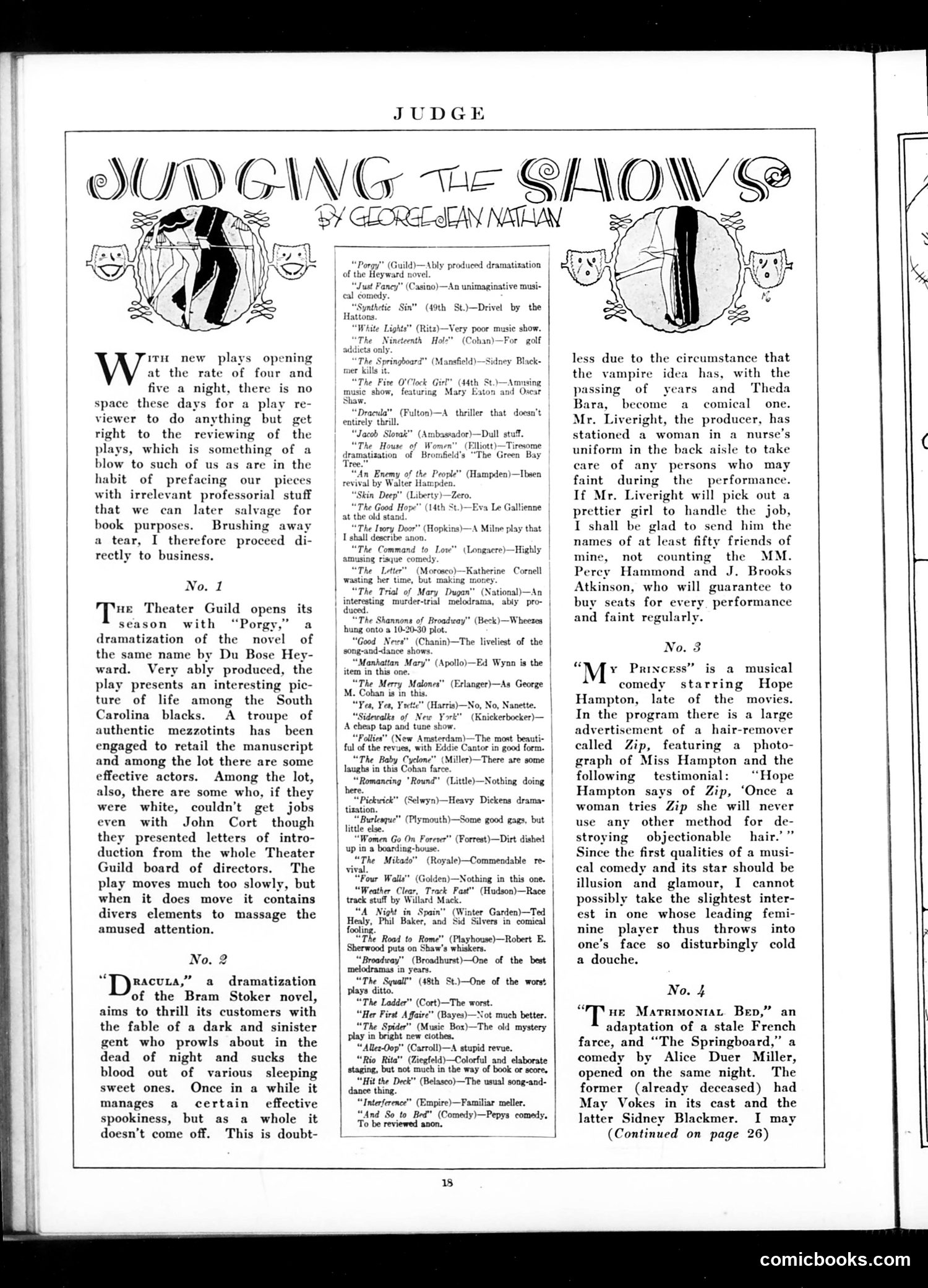
This page is a theater critic's rapid-fire reviews of Broadway plays opening during a busy season. The critic (Nathan, a prominent drama reviewer) apologizes for skipping his usual lengthy preamble due to the sheer volume of productions. Key reviews include "Porgy" (praised as well-produced despite slow pacing), "Dracula" (dismissed as ineffective despite occasional spookiness), and various other comedies, musicals, and dramas receiving brief verdicts—mostly negative. Nathan's tone is caustic: he calls one show "drivel," another "dull stuff," and "The Ladder" simply "the worst." The cartoons flanking the text appear decorative rather than satirical—ornamental theatrical masks and figures. This is straightforward theater criticism presented with Nathan's characteristic wit and brevity, not political satire. The "judge" of the title refers to Nathan's critical judgment of Broadway productions.
📄 Transcribed text from this page (OCR, searchable)
Machine-transcribed from the original scan — historical spelling and the odd misread are preserved.
‘ X Yiru new plays opening at the rate of four and five a night, there is no space these days for a play re- viewer to do anything but get right to the reviewing of the plays, which is something of a blow to such of us as are in the habit of prefacing our pieces with irrelevant professorial stuff that we can later salvage for book purposes. Brushing away a tear, I therefore proceed di- rectly to business. No. 1 T= Theater Guild opens its son with “Porgy,” a dramatization of the novel of the same name by Du Bose Hey- ward. Very ably produced, the play presents an interesting pic- ture of life among the South Carolina blacks. A troupe of authentic mezzotints has been engaged to retail the manuscript and among the lot there are some effective actors. Among the lot, also, there are some who, if they were white, couldn’t get jobs even with John Cort though they presented letters of intro- duction from the whole Theater Guild board of directors. The play moves much too slowly, but when it does move it contains divers elements to massage the amused attention. No. 2 RACULA,” a dramatization of the Bram Stoker novel, aims to thrill its customers with the fable of a dark and sinister gent who prowls about in the dead of night and sucks the blood out of various sleeping sweet ones. Once in a while it manages a certain effective spookiness, but as a whole it doesn’t come off. This is doubt- ey Vr NATHAN “Porgy” (Guild)—Ably produced dramatization of the Heyward novel (49th St.)—Drivel by the Hattons, “White Lights” (Ritz)—Very poor music show. (Cohan)—For golf Black- (44th St.)—Amnsing , featuring Mary Eaton and Oscar Dracula" entirely thrill. “Jacob Slorak” (Ambastador)—Dull stuf. “The House of Women” (Flliott)—Tiresome ization of Bromfield’s “The Green Bay (Fulton)—A thriller that doesn’t “An Enemy of the People” revival by Walter Ha (Hampden)—Tbsen )—Zero. 4th St.)—Eva Le Gallienne at the old stan ad. “The Ivory Door” (Hopkins)—A Milne play that I shall describe anon “The Command to Love amusing risque comedy “The Letter” (Moroseo) wasting her time, but maki “The Trial of Mary Dugan” (National)—An teresting murder-trial melodrama, ably pro- duced “The Shannons of Broadway" hung onto a 10-20-30 plot. | “Good Ne (Chanin)}—The liveliest of the song-and-dance shows. Manhattan Mary" item in this one. “The Merry Malones” M. Coban is in this. Yea, Yes, Yrette” (Harris) “Sidewalks of New York A cheap tap and tune show. “Follies” (New Amsterdam)—The most beauti- ful of the revues, with Eddie Cantor in good form. “The Baby Cyclone” (Miller)—There are some laughs in this Cohan farce. “Romancing "Round (Little)—Nothing doing re. (Longacre)— —Highly atherine Cornell (Apollo)—Ed Wynn is the No, No, Nanette. (Knickerbocker)— “Pickiwick™ tization. “Burlesque” | little else. “Women Go On Forever”™ up in a boarding-bouse. “The Mikado” (R vival. “Four Walls” (Golden)—Nothing in this one. “Weather Clear, Track Fast" (Hudson)—Race track stuff by Willard Mack. “A Night in Spain" (Winter Garden)—Ted raly, Phil Baker, and Sid Silvers in comical ing. “The Road to Rome” (Playhouse)—Robert E. Sherwood puts on Shaw's whiskers. “Broadway’" (Broadhurst)—One of the best melodramas in years. “The Squall" (48th St.)—One of the worst plays ditto, “The Ladder (Cort)—The worst. “Her First Affaire” (Bayes) —Not much better. “The Spider” (Music Box)—The old mystery play in bright new clothes. ““Allez-Oop” (Carroll) —A stupid revue, “Rio Rita” (Ziegfeld)—Colorful_ and elaborate staging, but not much in the way of book or score. “Hit the Deck” (Belasco)—The usual song-and- dance thing. “Interference” (Empire)—Familiar meller. “And So to Bed" (Comedy)—Pepys comedy. To be reviewed anon. (Selwyn)—Heavy Dickens drama- (Plymouth)—Some good gags, but (Forrest)—Dirt dished yale)\—Commendable re- (Beck)—Wheezes | (Erlanger)—As George less due to the circumstance that the vampire idea has, with the passing of years and Theda ara, comical one. Mr. Liveright, the producer, has stationed a woman in a nurse’s uniform in the back aisle to take care of any persons who may faint during the performance. If Mr. Liveright will pick out a prettier girl to handle the job, I shall be glad to send him the names of at least fifty friends of mine, not counting the MM. Perey Hammond and J. Brooks Atkinson, who will guarantee to buy seats for every, performance and faint regularly. become a No. 3 Princ is comedy starring Hope Hampton, late of the movies. In the program there is a large advertisement of a hair-remover called Zip, featuring a photo- graph of Miss Hampton and the following testimonial: “Hope Hampton says of Zip, ‘Once a woman tries Zip she will never use any other method for de- stroying objectionable _ hair.’ ” Since the first qualities of a musi- cal comedy and its star should be illusion and glamour, I cannot possibly take the slightest inter- est in one whose leading femi- nine player thus throws into one’s face so disturbingly cold a douche. a musical No. 4 “TH Marrimoniat Bep,” an adaptation of a stale French farce, and “The Springboard. comedy by Alice Duer Miller, opened on the same night. The former (already deceased) had May Vokes in its cast and the latter Sidney Blackmer. I may (Continued on page 26) comicbooks.com