
Judge, 1927-10-29 · page 24 of 36
Judge — October 29, 1927 — page 24: what you’re looking at
What you’re looking at
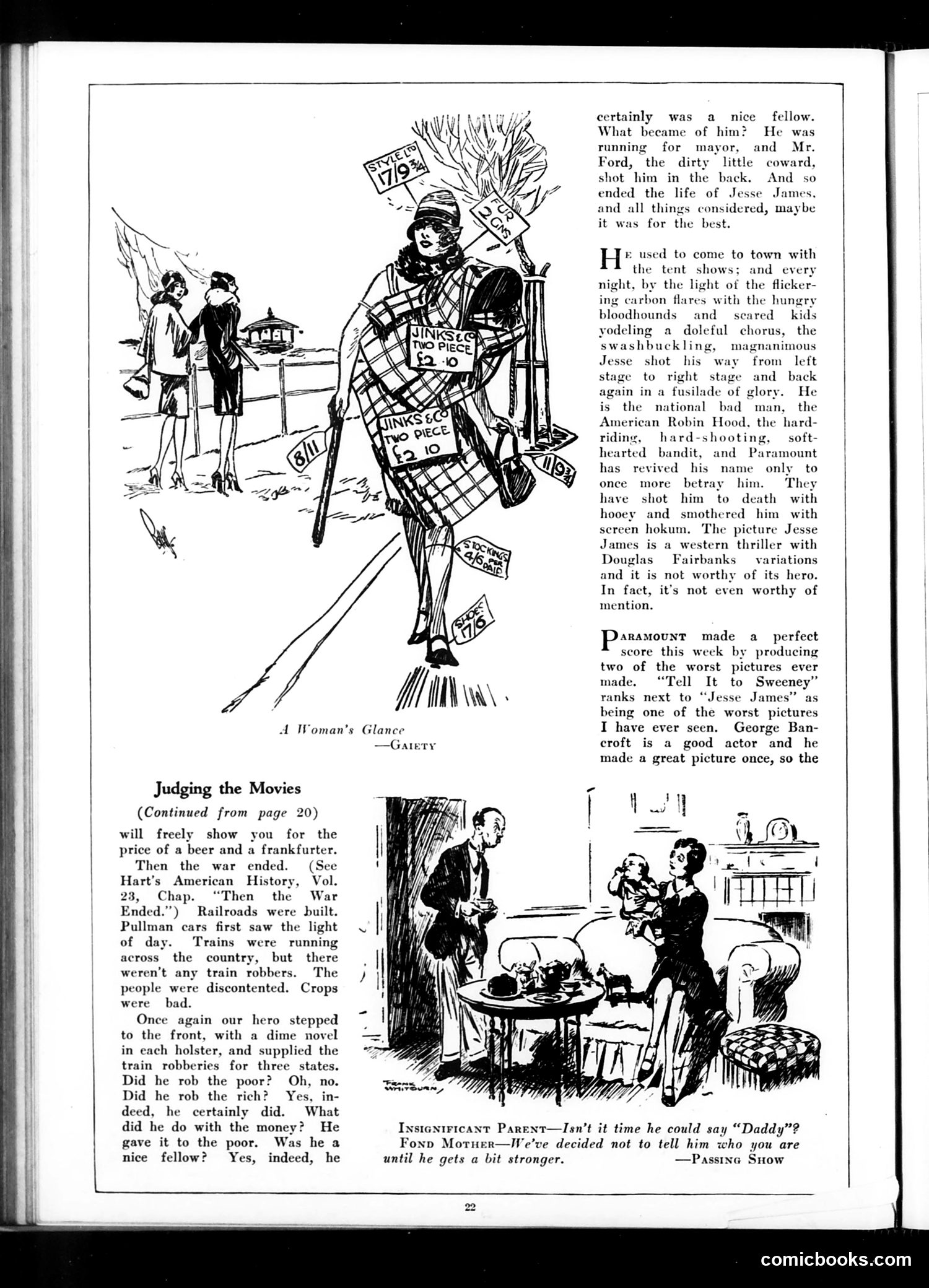
This page critiques early cinema Westerns, particularly Paramount's film adaptations. The main text attacks a "Jesse James" movie (likely the 1927 Fairbanks production), arguing it distorts the outlaw legend into "screen hokum." The author treats Jesse James as folklore—a Robin Hood figure who robbed the rich to aid the poor—then laments Hollywood has betrayed this romanticized image. The cartoon "A Woman's Glance" satirizes materialism: a fashionably dressed woman observes a ragged street performer weighted down with various show bills and price tags, suggesting entertainment has become purely commercial spectacle. The lower cartoon jokes about illegitimacy—a father hesitates to claim paternity until the child grows stronger, implying economic burden. It mocks class anxieties of the era. Together, the page reflects 1920s concerns about commercialization, authenticity in storytelling, and social respectability.
📄 Transcribed text from this page (OCR, searchable)
Machine-transcribed from the original scan — historical spelling and the odd misread are preserved.
7 certainly was a nice fellow. What became of him? He was running for mayor, and Mr. Ford, the dirty little coward, shot him in the back. And so ended the life of Jesse James, and all things considered, maybe it was for the best. H°* used to come to town with the tent shows; and every night, by the light of the flicker- ing carbon flares with the hungry bloodhounds and scared kids yodeling a doleful chorus, the swashbuckling, magnanimous se shot his from left to right stage and back 1in in a fusilade of glory. He the national bad man, the American Robin Hood, the hard- riding, hard-shooting, — soft- hearted bandit, and Paramount has revived his name only to once more betray him. They have shot him to death with hooey and smothered him with screen hokum. The picture Jesse James is a western thriller with Fairbanks — variations and it is not worthy of its hero. In fact, it’s not even worthy of mention. Paramount made a_ perfect score this week by producing two of the worst pictures ever ff \ made. “Tell It to Sweeney” ith \\W\ - ranks next to “Jesse James” “as being one of the worst pictures A Woman's Glance I have ever seen. George Ban- —Gatery croft is a good actor and he made a great picture once, so the Judging the Movies (Continued from page 20) will freely show you for the price of a beer and a frankfurter. Then the war ended. (See Hart’s American History, Vol. 23, Chap. “Then the War Ended.”) Railroads were built. Pullman cars first saw the light of day. Trains were running across the country, but there weren't any train robbers. The people were discontented. Crops were bad. Once again our hero stepped to the front, with a dime novel in each holster, and supplied the train robberies for three states. Did he rob the poor? Oh, no. Did he rob the rich? Yes, in- deed, he certainly did. What did he do with the money? He NSIGNIFICANT ParENtT—Isn’t it time he could say “Daddy”? gave it to the poor. Was he a Fonp Motuer—IWe've decided not to tell him who you are nice fellow? Yes, indeed, he until he gets a bit stronger. ON Be —Passinc SHow comicbooks.com