
Judge, 1927-10-29 · page 15 of 36
Judge — October 29, 1927 — page 15: what you’re looking at
What you’re looking at
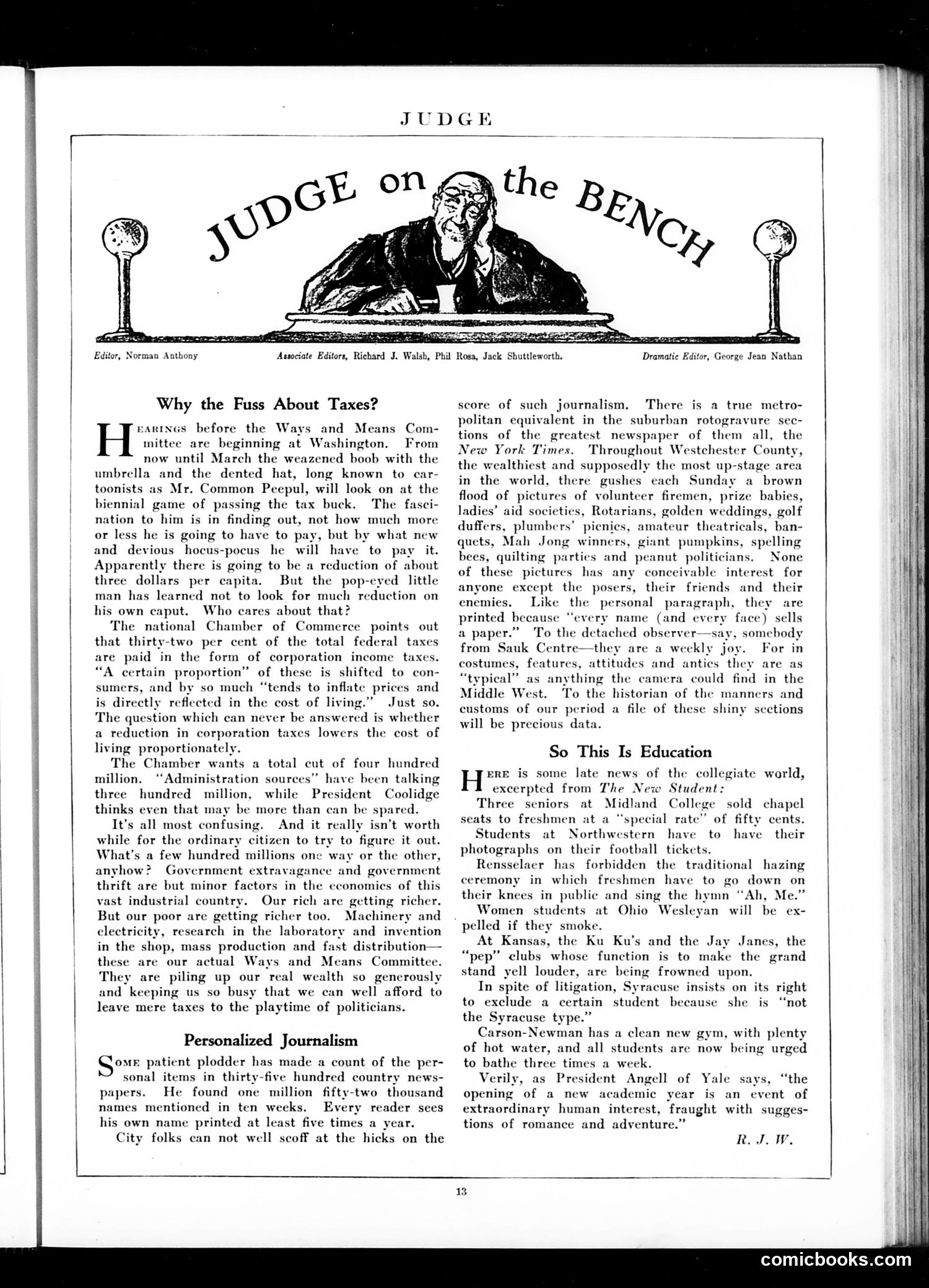
This satirical page from Judge magazine (circa mid-1920s) features three separate columns critiquing American institutions. **"Why the Fuss About Taxes?"** ridicules ordinary citizens ("Mr. Common Peepul"—depicted as a wide-eyed everyman figure) for failing to grasp tax policy debates. The editorial mocks both the Chamber of Commerce demands and political confusion, arguing that actual prosperity derives from technological progress and industrial efficiency rather than tax tinkering. **"Personalized Journalism"** satirizes small-town newspapers' obsession with printing residents' names to boost circulation. The piece ironically legitimizes this by noting even the prestigious New York Times publishes similar vanity content in Westchester County's society pages—wealthy suburbs aren't above the same practice. **"So This Is Education"** begins reporting collegiate absurdities: chapel seat auctions, football photo requirements, and overzealous "pep clubs." All three sections employ Judge's characteristic approach: urban-elite mockery of American mass culture and democratic institutions, blending cynicism with condescension toward both common people and commercial media practices.
📄 Transcribed text from this page (OCR, searchable)
Machine-transcribed from the original scan — historical spelling and the odd misread are preserved.
JUDGE tor, Norman Anthony Why the Fuss About Taxes? Eantincs before the Ways and Means Com- mittee are beginning at Washington. From now until March the weazened boob with the umbrella and the dented hat, long known to car- toonists as Mr. Common Peepul, will look on at the biennial game of passing the tax buck. The fasci- nation to him is in finding out, not how much more or less he is going to have to pay, but by what new and devious hocus-pocus he will have to pay it. Apparently there is going to be a reduction of about three dollars per capita. But the pop-eyed little man has learned not to look for much reduction on his own caput. Who cares about that? The national Chamber of Commerce points out that thirty-two per cent of the total federal taxes are paid in the form of corporation income taxes. “A certain proportion” of these is shifted to con- sumers, and by so much “tends to inflate prices and is directly reflected in the cost of living.” Just so. The question which can never be answered is whether a reduction in corporation taxes lowers the cost of living proportionately. The Chamber wants a total cut of four hundred million. “Administration soure: have been talking three hundred million, while President Coolidge thinks even that may be more than can be spared. It’s all most confusin And it really isn’t worth while for the ordinary en to try to figure it out. What's a few hundred millions one way or the other, anyhow? Government extravagance and government thrift are but minor factors in the economies of this vast industrial country. Our rich are getting richer. But our poor are getting richer too. Machinery and clectricity, research in the laboratory and invention in the shop, mass production and fast distribution— thes re our actual Ways and Means Committee. They are piling up our real wealth so generously and keeping us so busy that we can well afford to Jeave mere taxes to the playtime of politicians. Personalized Journalism ome patient plodder has made a count of the per- sonal items in thirty hundred country news- papers. He found one million fifty-two thousand ames mentioned in ten weeks. Every reader sees his own name printed at least five time: ar. City folks can not well scoff at the hicks on the Associate Editors, Richard J. Walsh, Phil Rosa, Jack Shuttleworth. Dramatic Editor, George Jean Nathan score of such journalism. There is a true metro- politan equivalent in the suburban rotogravure sec- tions of the greatest newspaper of them all, the New York Times. Throughout Westchester County, the wealthiest and supposedly the most up-stage are in the world, there gushes each Sunday a brown flood of pictures of volunteer firemen, prize babies, ladies’ aid societies, Rotarians, golden weddings, golf plumbers’ picnics, amateur theatricals, ban- » Mah Jong winners, giant pumpkins, spelling bees, quilting parties and peanut politicians. None of these pictures has any conceivable interest for anyone except the posers, their friends and_ their enemies. Like the personal paragraph, they are printed because “every name (and every face) sells a paper.” To the detached observer—say, somebody from Sauk Centre—they are a weekly joy. For in costumes, features, attitudes and antics they “typical” as anything the camera could find in the Middle West. To the historian of the manners and customs of our period a file of these shiny sections will be precious data. So This Is Education are as H ERE is some late news of the collegiate world, excerpted from The New Student: Three seniors at Midland College sold chapel s to freshmen at a “special rate” of fifty cents. Students at Northwestern have to have their photographs on their football tickets. Rensselaer has forbidden the traditional hazing ceremony in which freshmen have to go down on their knees in public and sing the hymn “Ah, Me.” Women students at Ohio Wesleyan will be ex- pelled if they smoke. At Kansas, the Ku Ku’s and the Jay Janes, the “pep” clubs whose function is to make the grand stand yell louder, are being frowned upon. In spite of litigation, Syracuse insists on its right xclude a certain student because she is “not racuse type.” Carson-Newman has a clean new gym, with plenty of hot water, and all students are now being urged to bathe three times a week. Verily, as President Angell of Yale says, “the opening of a new academic year is an event of extraordinary human interest, fraught with sugges- tions of romance and adventure.” Rid Ws comicbooks.com