
Judge, 1927-10-29 · page 17 of 36
Judge — October 29, 1927 — page 17: what you’re looking at
What you’re looking at
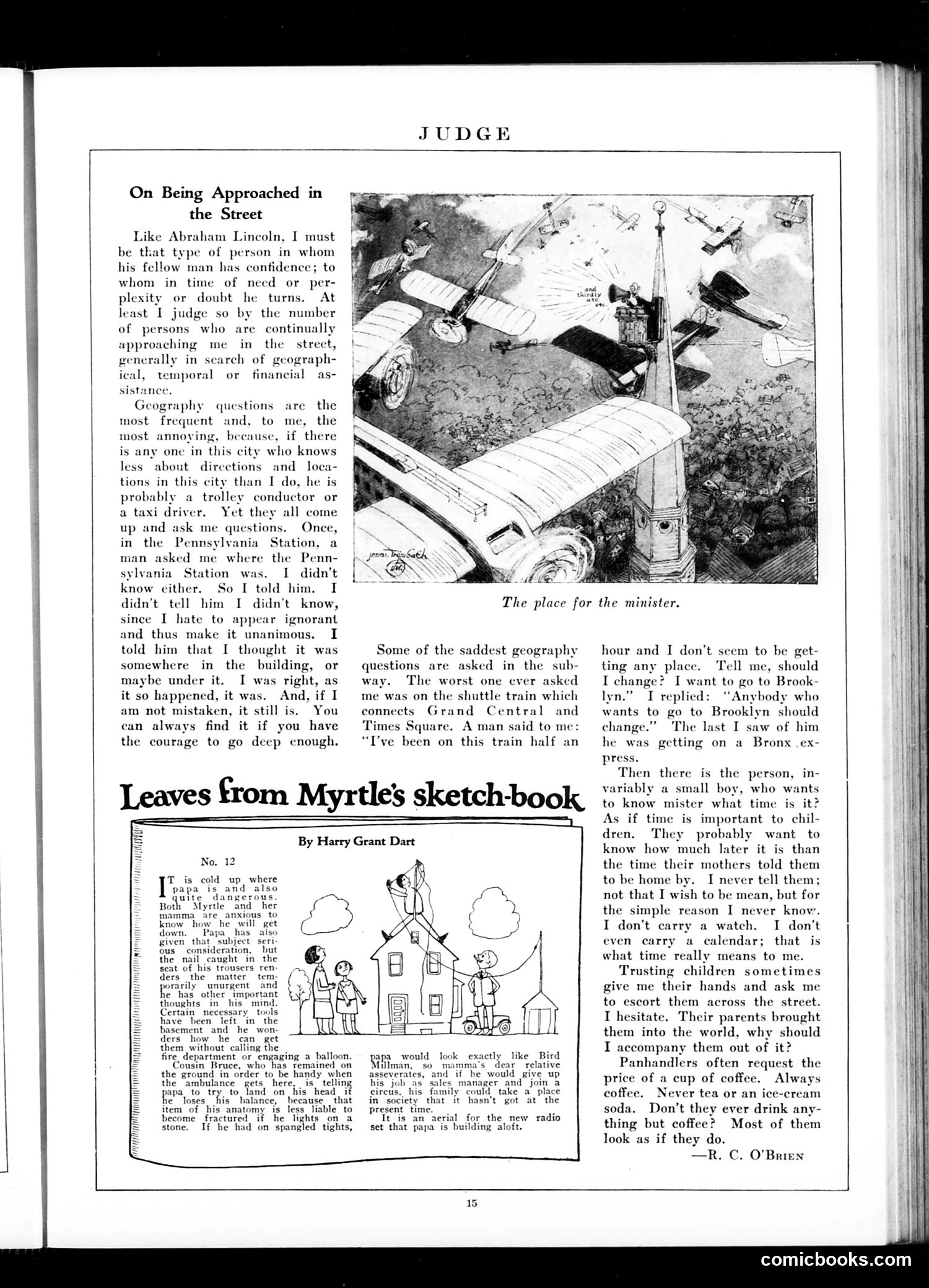
This page contains two distinct pieces of humor content: **"On Being Approached in the Street"** is a comedic essay by an unnamed author (signed R.C. O'Brien) about strangers constantly asking him for directions, the time, or money on city streets. The humor lies in his admission that he's remarkably unhelpful—he doesn't know directions, doesn't carry a watch, and pretends knowledge he lacks to avoid appearing ignorant. The Pennsylvania Station anecdote exemplifies this: asked where the Station is *while in it*, he makes a lucky guess. The piece satirizes both urban anonymity and the social anxiety of appearing foolish in public. **"Leaves from Myrtle's Sketch-book"** (No. 12) by Harry Grant Dart is a cartoon showing a child and mother stuck on a roof with papa attempting an aerial installation. The humor derives from the dangerous, chaotic situation—papa might land on his head; they're considering using a balloon or fire department. It's domestic slapstick comedy about DIY home projects gone absurdly wrong, typical of early 20th-century magazine humor.
📄 Transcribed text from this page (OCR, searchable)
Machine-transcribed from the original scan — historical spelling and the odd misread are preserved.
JUDGE On Being Approached in the Street Like Abraham Lincoln, I must be that type of person in whom his fellow man has confidence; to whom in time of need or per- plexity or doubt he turns. At least I judge so by the number of persons who are continually approaching me in the street, generally in search of geograph- cal, temporal or financial as- sistance. Geography questions are the most frequent and, to me, the most annoying, because, if there is any one in this city who knows less about directions and lo tions in this city than I do, he probably a trolley conductor or a taxi driver. Yet they all come up and ask me questions. Once, in the Pennsylvania Station, a man asked me where the Penn- sylvania Station was. I didn't know either. So I told him, I didn’t tell him I didn’t know, since I hate to appear ignorant and thus make it unanimous. I told him that I thought it was somewhere in the building, or maybe under it. I was right, as it so happened, it was. And, if I am not mistaken, it still is. You can alwz find it if you have the courage to go deep enough. Leaves from Myrtles sketch-book The place for the minister. Some of the saddest geography questions are asked in the sub- way. The worst one ever asked me son the shuttle train which ts Grand Central and Times Square. A man said to me: “Tve been on this train half conne: an By Harry Grant Dart No. 12 T is cold up where P is and also quite dangerous Both Myrtle and. her mamma are anxious to know e will get down. a has also given that subject seri consideration, but the ea Ss ren de: matter tem: porarily unurgent and he has other important thoughts Certain have ders them without ca - fire, department or engaging a balloon. Cousin Bruce, who has remained on the ground in order to be handy when the ambulance gets here, is_ telling papa. to try to land on his head it he loses his ba be: that a y le to ac he lights on a he had on spangled tights, stone. If papa would look exactly like Bird Millman, so mamma's dear relative and if he would give up es manager and join a ‘ amily could, take a place in society that it hasn't got at the Present time. . It is an aerial for the new radio set that papa is building aloft. hour and I don’t seem to be get- ting any place. Tell me, should I change? I want to go to Brook- lyn.” I replied: “Anybody who wants to go to Brooklyn should change.” The last I saw of him he was getting on a Bronx ex- press. Then there is the person, in- variably a small boy, who wants to know mister what time is it? As if time is important to chil- dren. They probably want to know how much later it is than the time their mothers told them to be home by. I never tell them; not that I wish to be mean, but for the simple reason I never know. I don’t carry a watch. I don’t even carry a calendar; that is what time really means to me. Trusting children sometimes give me their hands and ask me to escort them across the street. I hesitate. Their parents brought them into the world, why should I accompany them out of it? Panhandlers often request the price of a cup of coffee. Always coffee. Never tea or an ice-cream soda. Don’t they ever drink any- thing but coffee? Most of them look as if they do. —R. C. O'Br comicbooks.com