
A complete issue · 36 pages · 1927
Judge — July 23, 1927
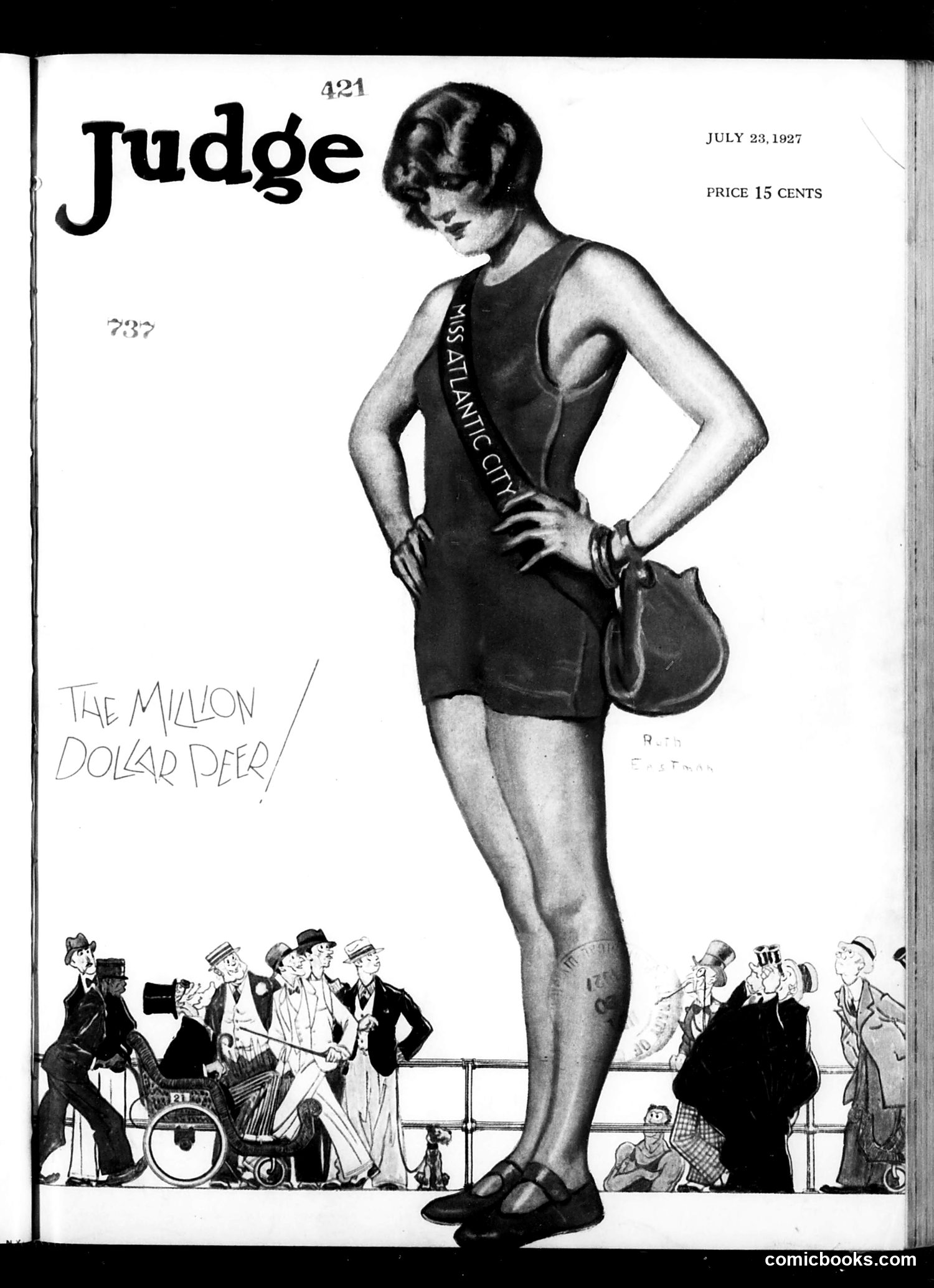
This cover satirizes the "Million Dollar Peer" — likely referencing a wealthy British aristocrat visiting America during the Jazz Age. The illustration shows a glamorous woman in a bathing suit displayed like a showpiece before admiring onlookers, suggesting wealthy European nobility's celebrity status and the American public's fascination with titled foreigners. The scene parodies both the ostentatious wealth of the era and Americans' social fascination with European aristocracy. The crowd of varied characters (musicians, businessmen, working-class figures) represents different American social classes gawking at this imported "spectacle," mocking the pretension surrounding wealthy foreign visitors during the prosperous 1920s. The "$0.15 price tag reflects typical Judge magazine costs of that period.
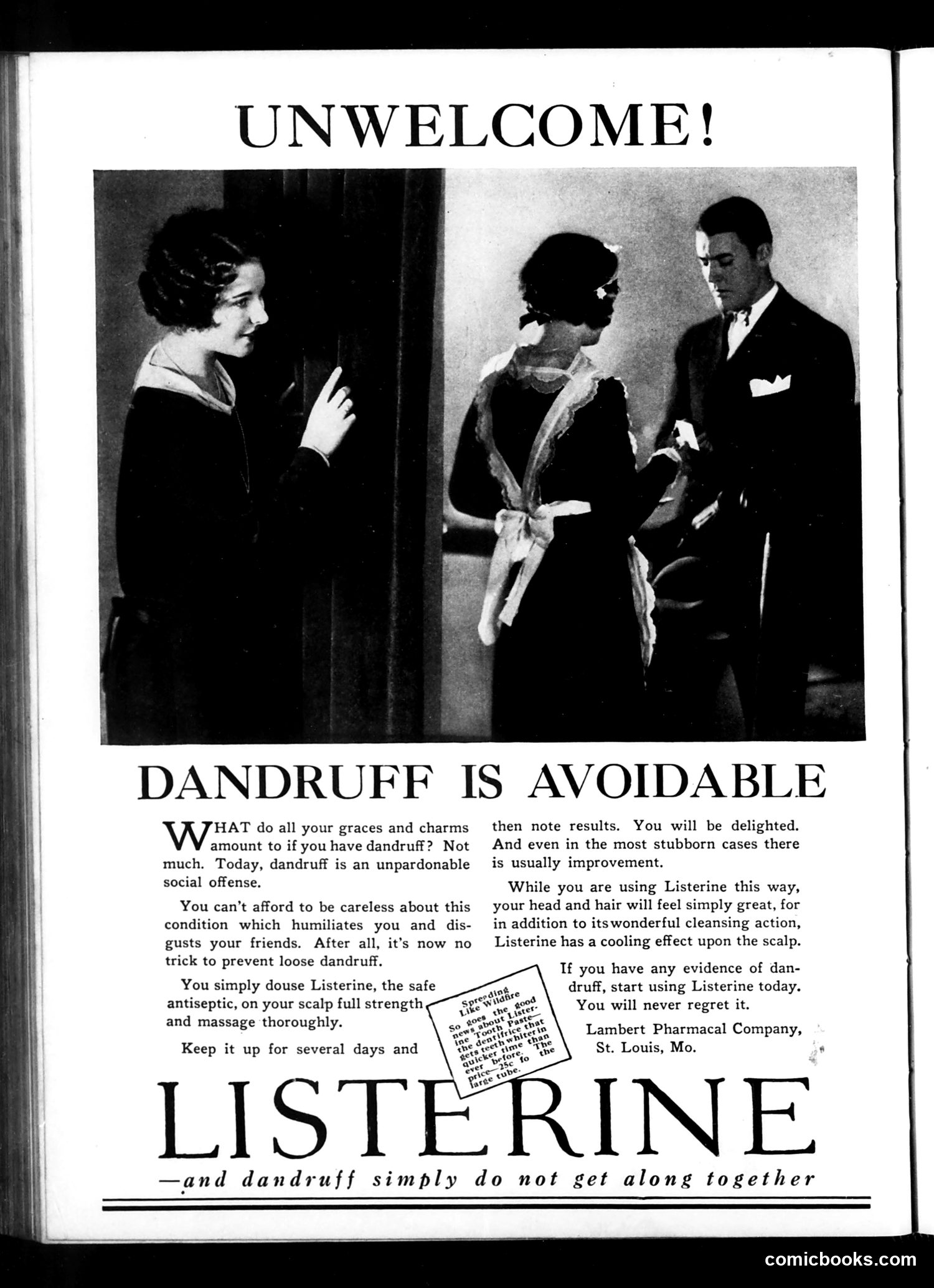
This is a **Listerine advertisement**, not political satire. The page uses social shame as a marketing tactic, depicting an "unwelcome" scenario where a well-dressed man and woman appear to reject a third person at a doorway. The headline "UNWELCOME! DANDRUFF IS AVOIDABLE" directly equates visible dandruff with social humiliation and exclusion. The ad's message is that dandruff causes rejection in social situations—a common advertising strategy of the era that weaponized anxiety about appearance and hygiene. By using Listerine (marketed as a scalp antiseptic), readers are promised they'll avoid becoming a social pariah. This reflects vintage advertising's reliance on shame and fear to drive product sales, particularly for personal hygiene items.
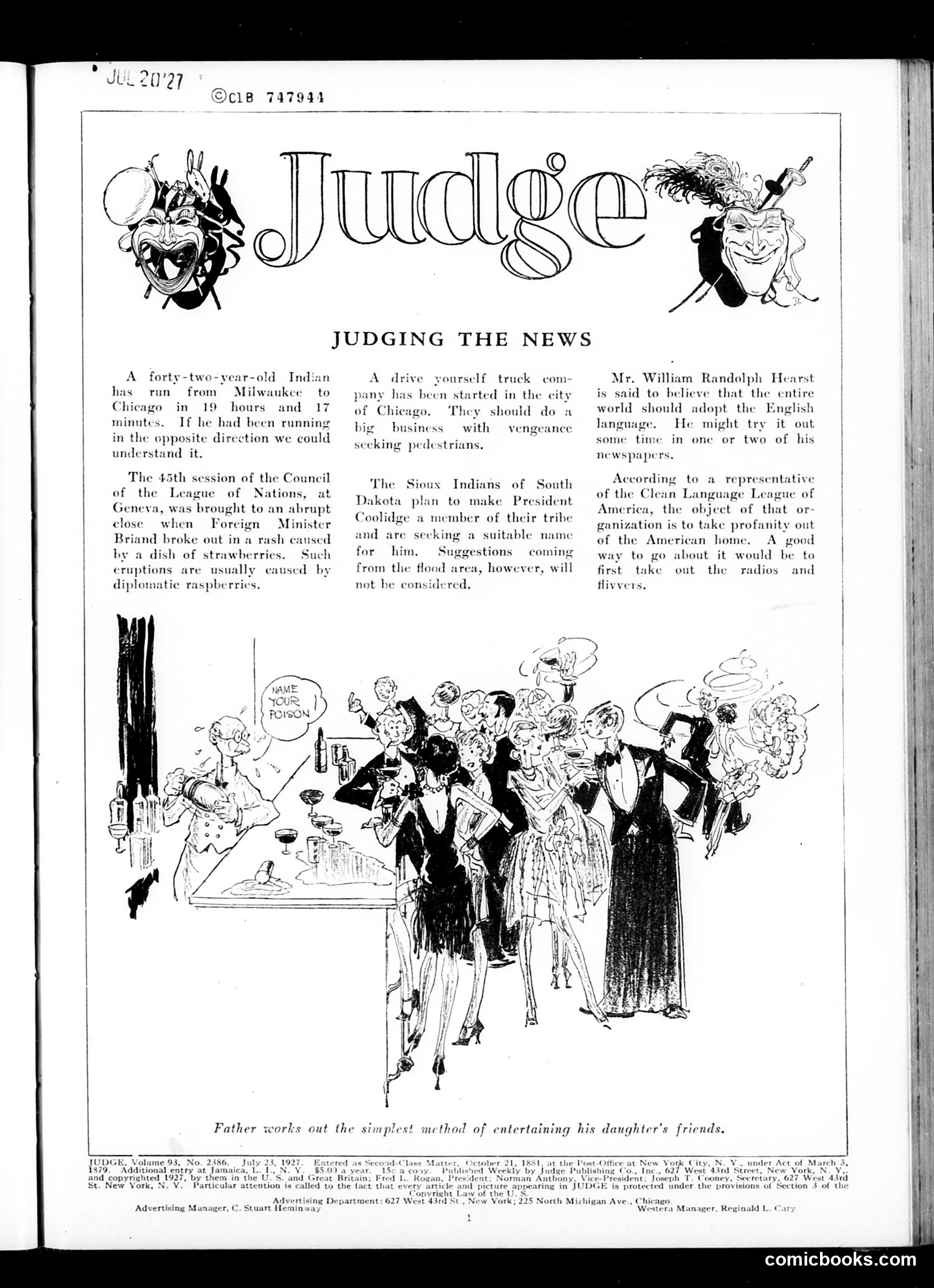
This page satirizes contemporary news stories through brief commentary and a cartoon. The "Judging the News" section mocks: 1. **An Indian runner's odd cross-country journey** - absurdist humor about a 42-year-old from Milwaukee reaching Chicago 2. **A truck company's aggressive driving** - suggesting they hunt pedestrians for business 3. **Native American naming disputes** - the Sioux seeking a suitable presidential name, humorously dismissed 4. **William Randolph Hearst's language ambitions** - mocking his belief that English could be simplified The main cartoon depicts a lavish party scene with elegantly dressed figures at what appears to be a nightclub or formal gathering. The caption jokes about "the simplest method of entertaining his daughter's friends"—satirizing excessive wealth and extravagant entertainment during the Jazz Age.
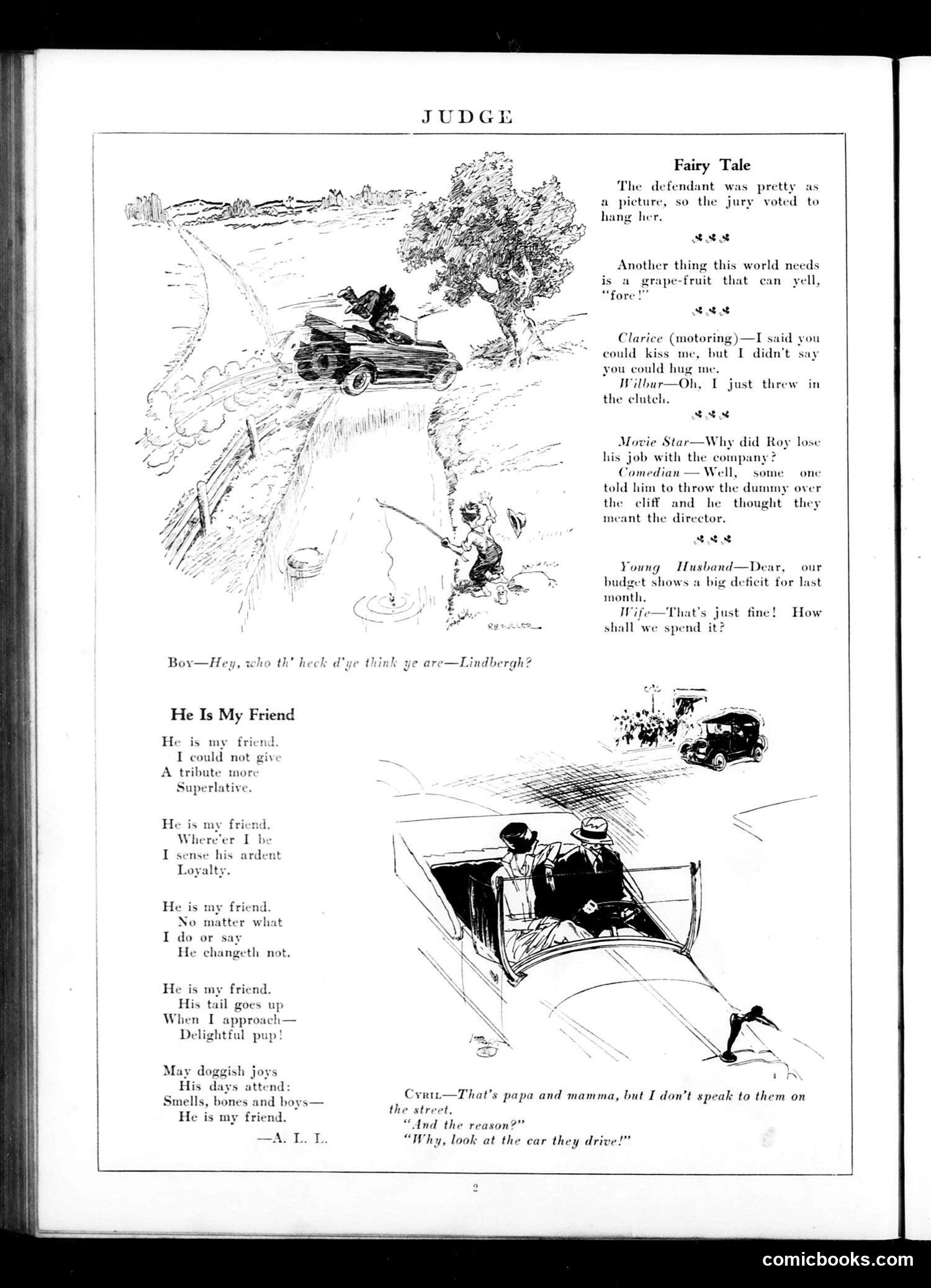
This page contains three separate items of humor typical of early 20th-century Judge magazine: 1. **"Fairy Tale"** (top): A series of brief jokes about modern life, including references to automobiles, courtship customs, and Hollywood filmmaking. The humor derives from juxtaposing romantic ideals with practical reality—a woman rejecting a kiss but accepting a hug, for instance. 2. **The main cartoon** depicts a reckless driver on a cliff road, with the caption asking "who th' heck d'ge think ye are—Lindbergh?" This references Charles Lindbergh's famous 1927 transatlantic flight, using his name as shorthand for dangerous risk-taking. 3. **"He Is My Friend"** (bottom): A sentimental poem celebrating canine loyalty, paired with a cartoon showing a dog's social snub of its owners when among other dogs—ironic commentary on friendship's conditions.
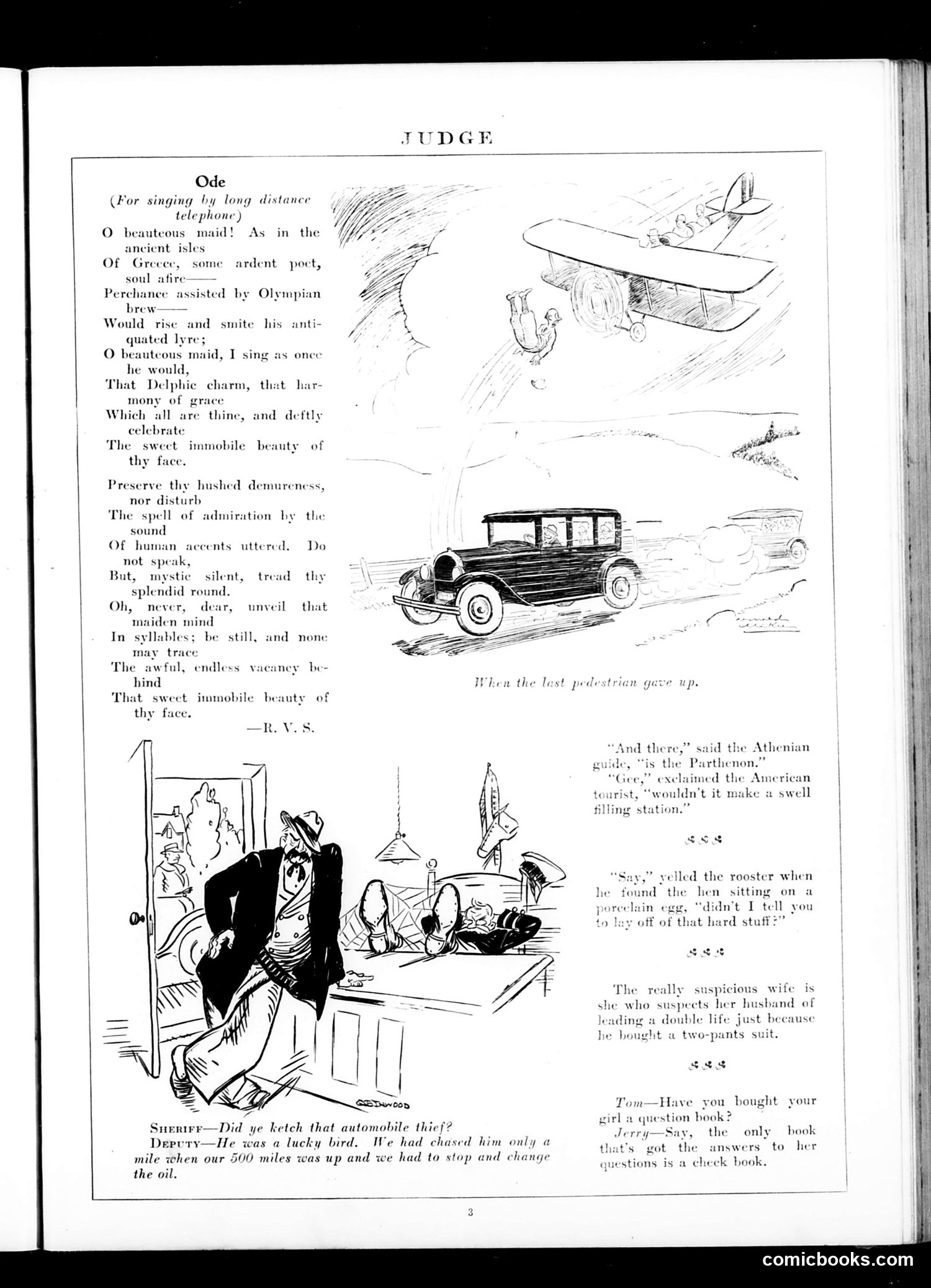
This page contains an "Ode" poem satirizing the telephone and modern transportation, alongside several cartoon jokes reflecting early 20th-century social anxieties. The main cartoon depicts a sheriff and deputy discussing an automobile theft—the criminal escaped after only one mile because they had to stop and change oil. This jokes about automobiles' unreliability and mechanical demands, a common early-car complaint. Other brief jokes reference: - Tour guides at what appears to be the Parthenon as a filling station - A rooster's reaction to infertile eggs - Marital suspicion over a husband's two-pants suit purchase - A "question book" as a dating guide These sketches reflect 1910s-1920s anxieties: automobile adoption, tourism, consumer goods, and evolving gender relations. The humor assumes readers recognize these as current social developments worth mocking.
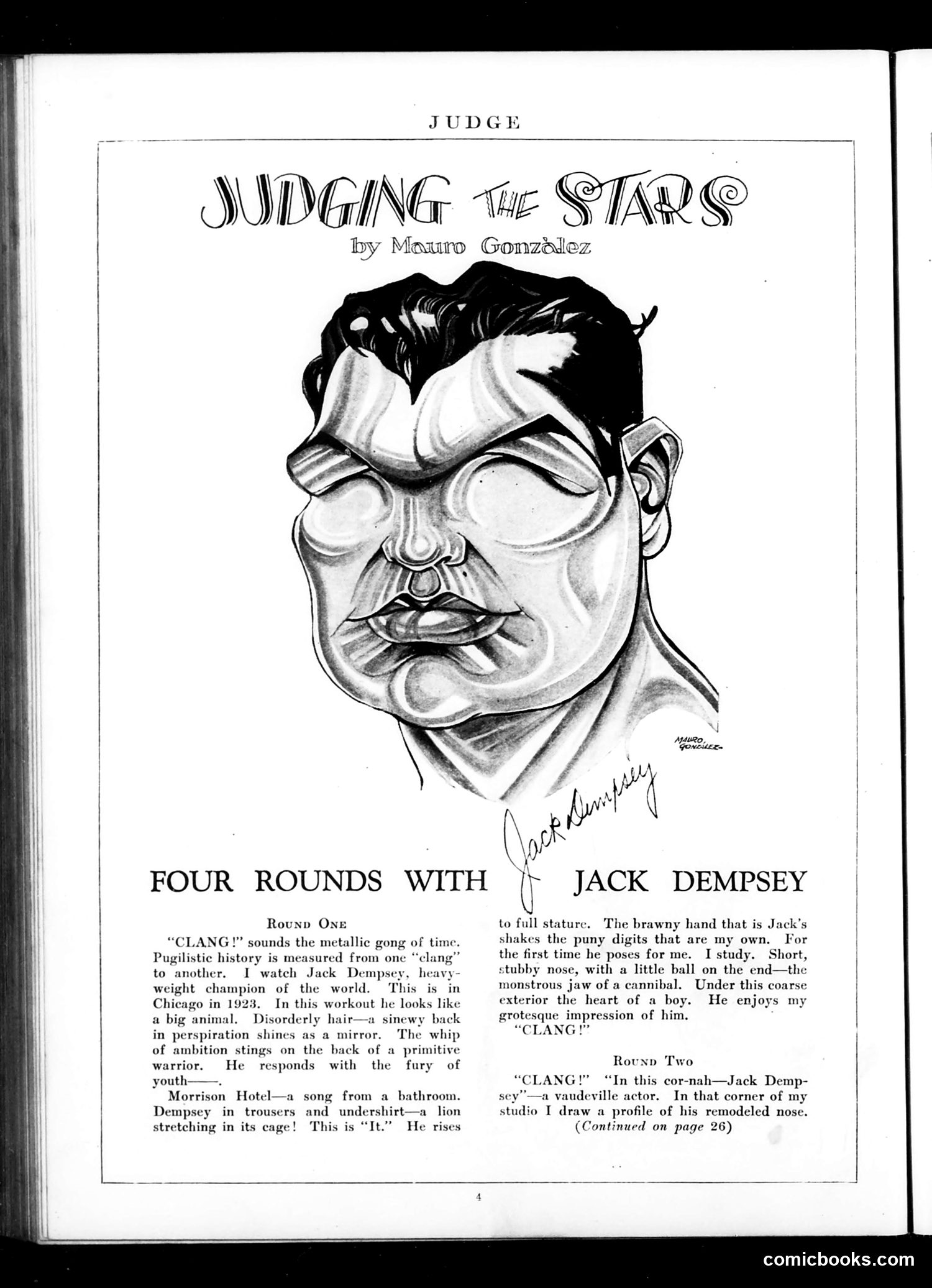
This page features artist Mauro Gonzalez's caricature of heavyweight boxer **Jack Dempsey**, famous champion of the 1920s. The article, "Four Rounds with Jack Dempsey," appears to be a humorous profile mixing boxing commentary with personal observation. The exaggerated caricature emphasizes Dempsey's physical features—his prominent jaw, broad face, and intense expression—typical of Judge's satirical style. The text references his "pugilistic history," his raw physicality ("big animal"), and his appearance, noting his "disorderly hair" and "sinewed back." This is celebrity satire: Judge mocks Dempsey's rough, brutish public persona while he was at peak fame. The humor derives from the contrast between his status as a celebrated athlete and the unflattering, almost grotesque portrayal of his appearance.
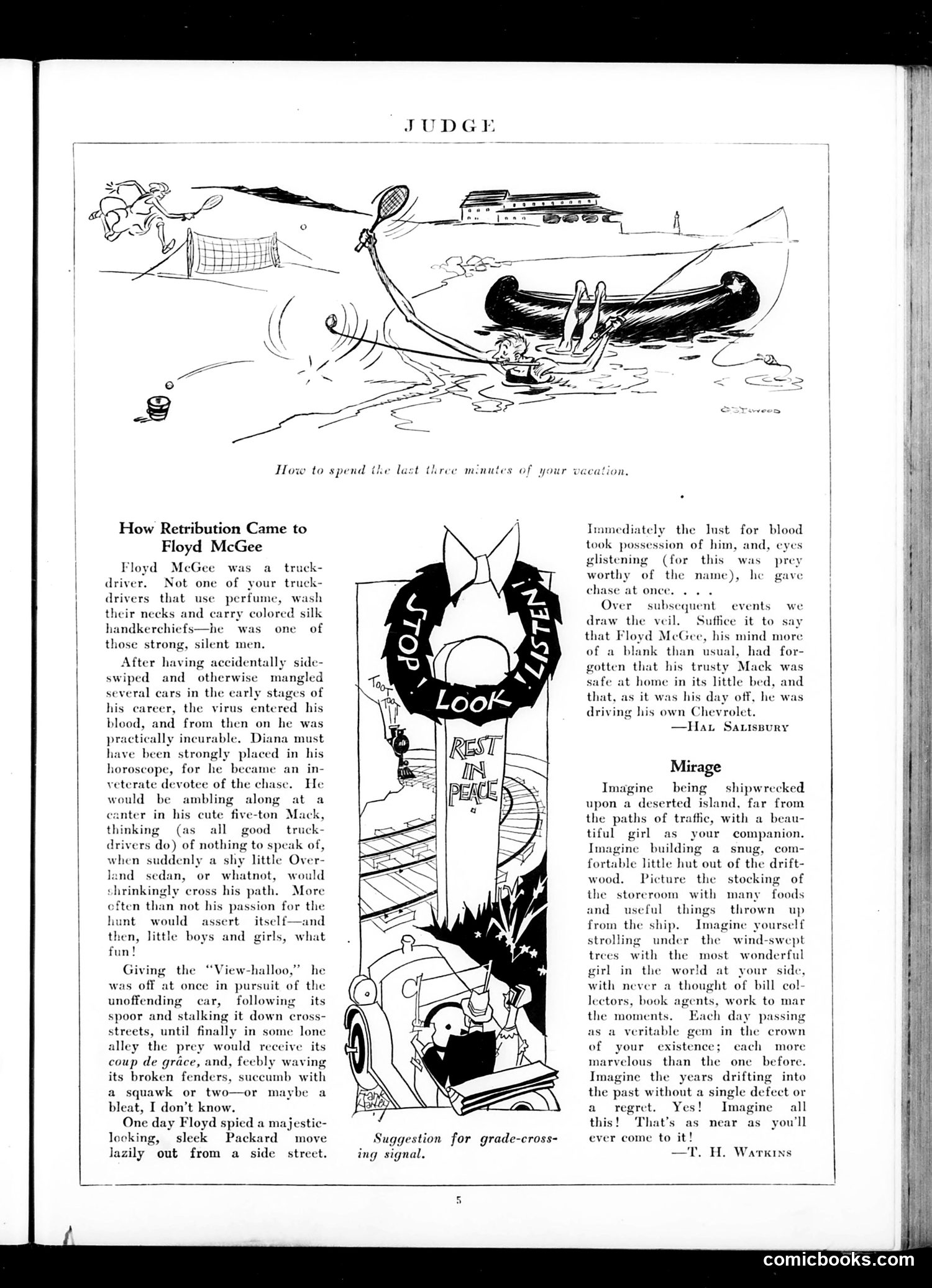
This page contains three distinct pieces: 1. **"How Retribution Came to Floyd McGee"** (left column): A cautionary tale about a truck driver named Floyd McGee who mistreats his vehicle "Mack." The story suggests divine punishment: McGee becomes obsessed with hunting, loses his mind, and crashes his car—retribution for his earlier cruelty. It's a morality tale promoting kindness to objects/animals. 2. **Top cartoon**: Humorously depicts vacation's final moments—showing chaotic leisure activities interrupted by obligations, with a train visible, suggesting the need to return home. 3. **"Mirage"** (right column): A romantic fantasy piece encouraging readers to imagine a perfect island escape with an ideal companion, escaping work and worldly concerns. The page blends humor, morality lessons, and escapist fantasy—typical Judge magazine content mixing satire with sentimental storytelling.
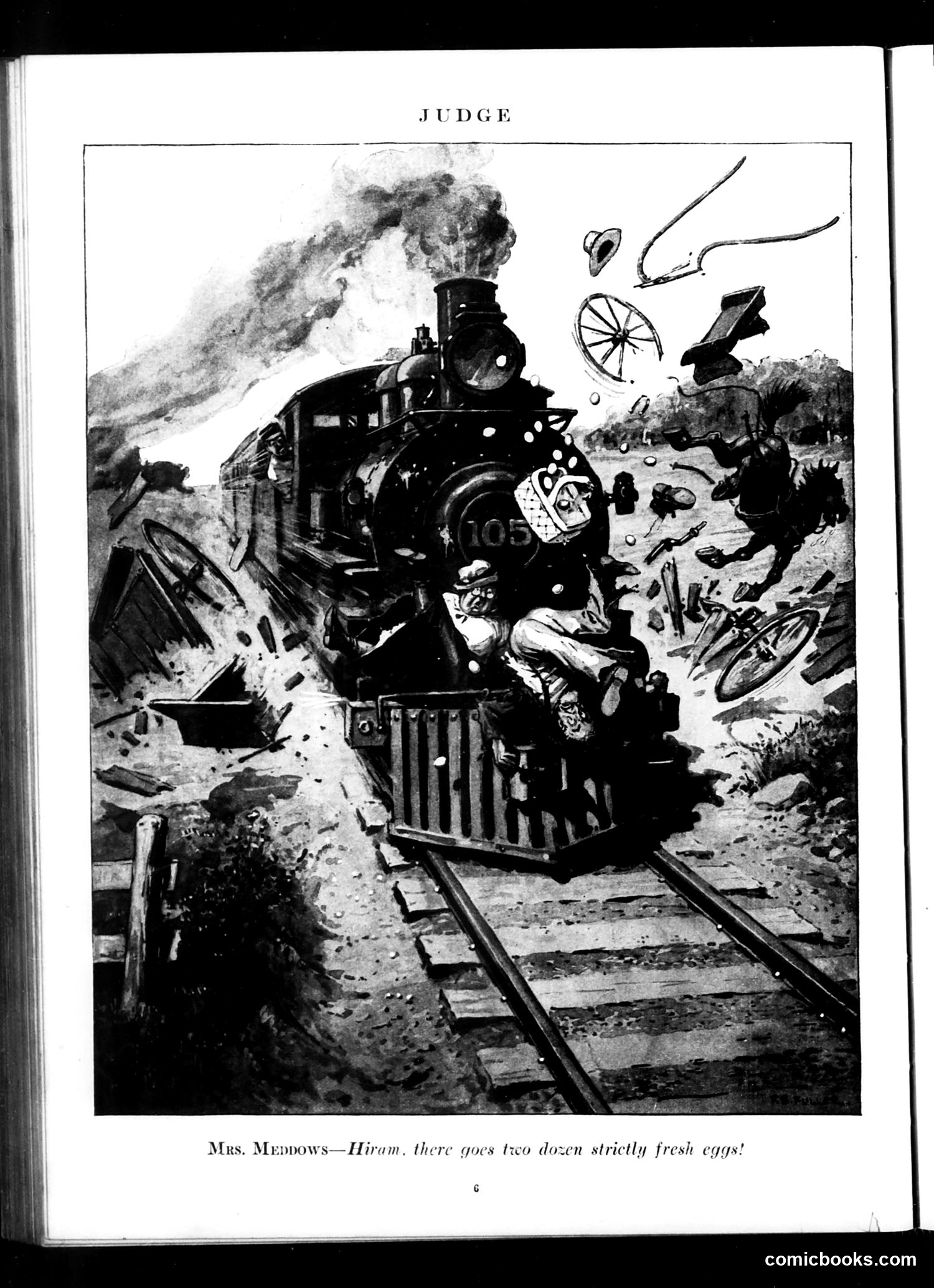
This page from *Judge* magazine presents a satirical illustration titled "Mrs. Meadows—Hiram, there goes two dozen strictly fresh eggs!" The cartoon depicts a train accident or derailment scene with a locomotive, scattered debris, and destroyed cargo. The caption suggests Mrs. Meadows is commenting on eggs being destroyed in the wreck, using dark humor to mock the situation. The satire likely criticizes railroad safety or efficiency during the early 20th century—a period when train accidents were common and controversial. By having a character casually remark about lost eggs amid obvious destruction, the cartoon employs ironic understatement to highlight either the frequency of such accidents or society's callous acceptance of them. The specific date and railroad referenced remain unclear from the visible text alone.
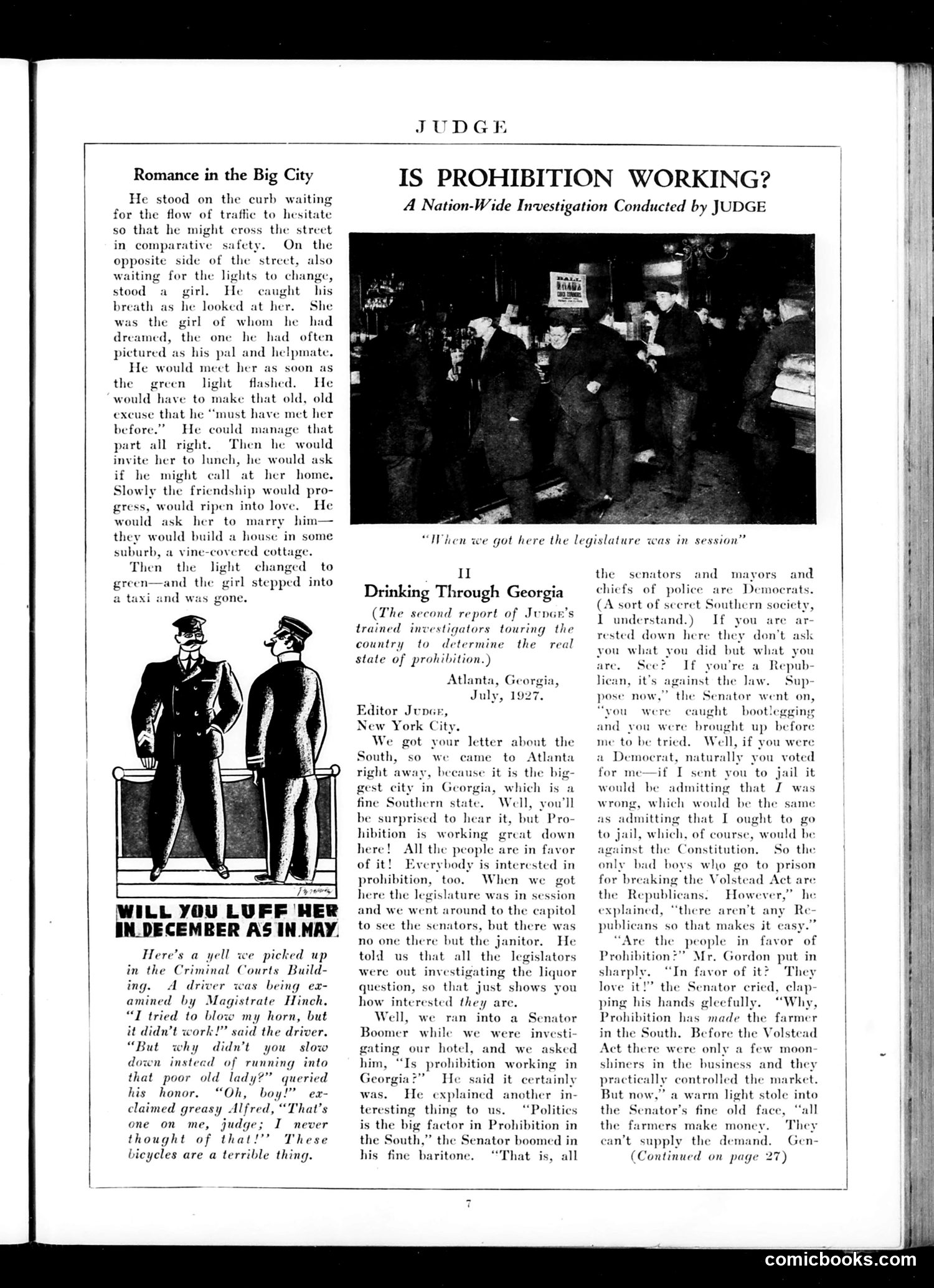
This page satirizes **Prohibition's failure** through two pieces: **"Romance in the Big City"** is a humorous short story about urban dating, unrelated to the main content—likely filler or mood-setting. **"Drinking Through Georgia"** is the central satire. Judge sent investigators to assess whether Prohibition actually worked. The reporter interviews a Georgia Senator about enforcement, exposing the hypocrisy: Democratic politicians arrest only Republican bootleggers while ignoring their own party members who break the law. The Senator openly admits **"Politics is the big factor in Prohibition"**—enforcement depends on party affiliation, not law. The photograph shows a speakeasy (illegal bar) operating openly, with the caption sardonically noting the legislature was "in session" (implying lawmakers were busy investigating liquor rather than legislating). The satire's point: Prohibition was unenforceable because Southern Democratic political machines protected their own while selectively prosecuting opponents. Corruption, not law, governed Prohibition's implementation.
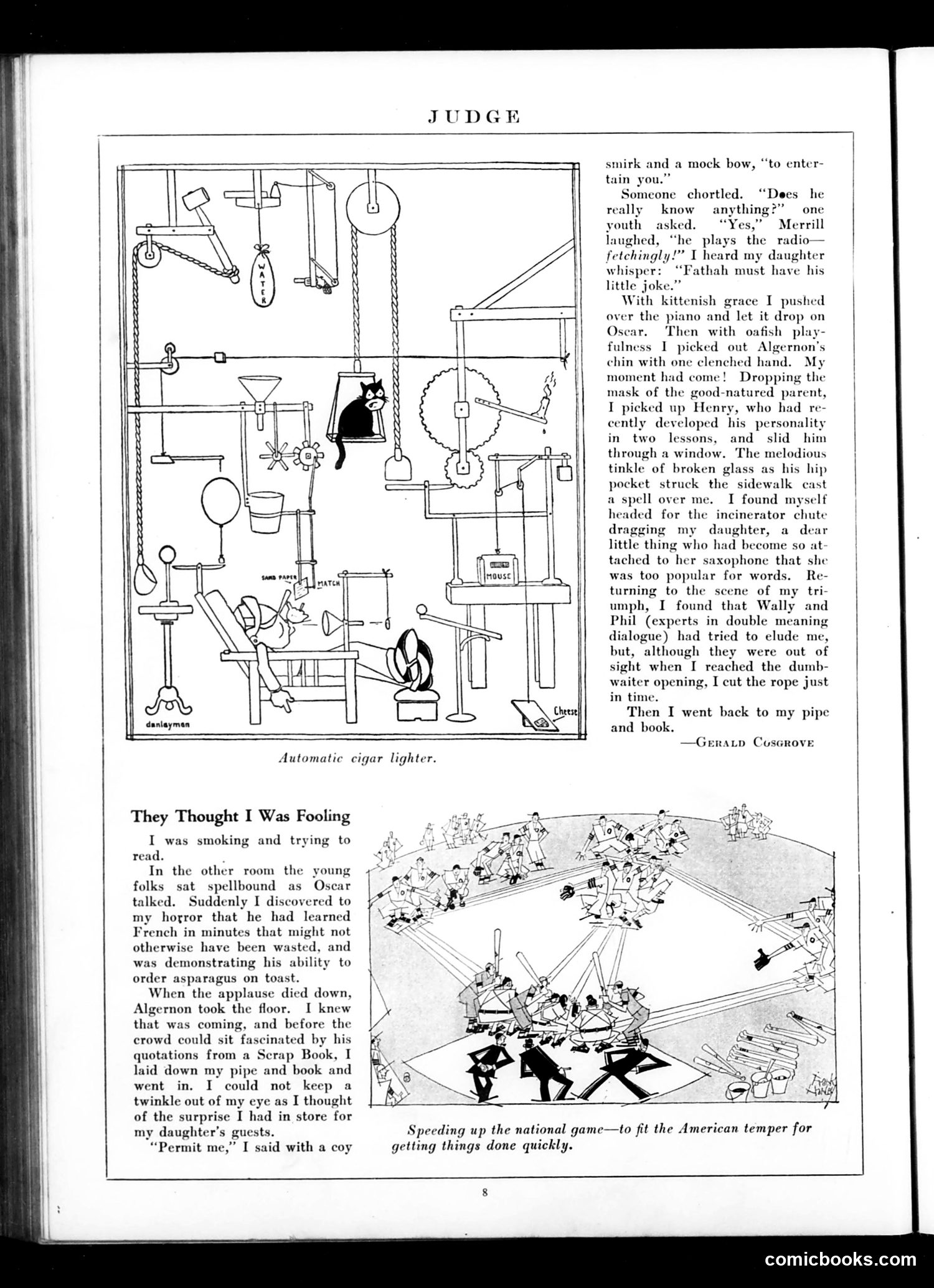
This is a humorous short story with accompanying cartoons from *Judge* magazine. The top illustration shows an absurdly complex "Automatic cigar lighter"—a Rube Goldberg-style contraption of pulleys, weights, and mechanisms that satirizes overengineered gadgetry. The story, attributed to Gerald Cosgrove, presents a father's darkly comedic fantasy about disposing of his daughter's insufferable young guests through increasingly violent means—throwing children out windows, cutting ropes on dumbwaiters. The joke relies on the contrast between the narrator's polite facade ("with a coy smirk") and his murderous internal thoughts. The second cartoon illustrates "the national game" (baseball) being "sped up" with frantic activity, mocking Americans' obsession with efficiency and speed. The humor targets both overcomplication in modern life and the exasperation parents feel entertaining their children's pretentious, talented friends—a social satire that remains recognizable today, though the violent fantasy premise reflects era-specific sensibilities about acceptable comedic exaggeration.
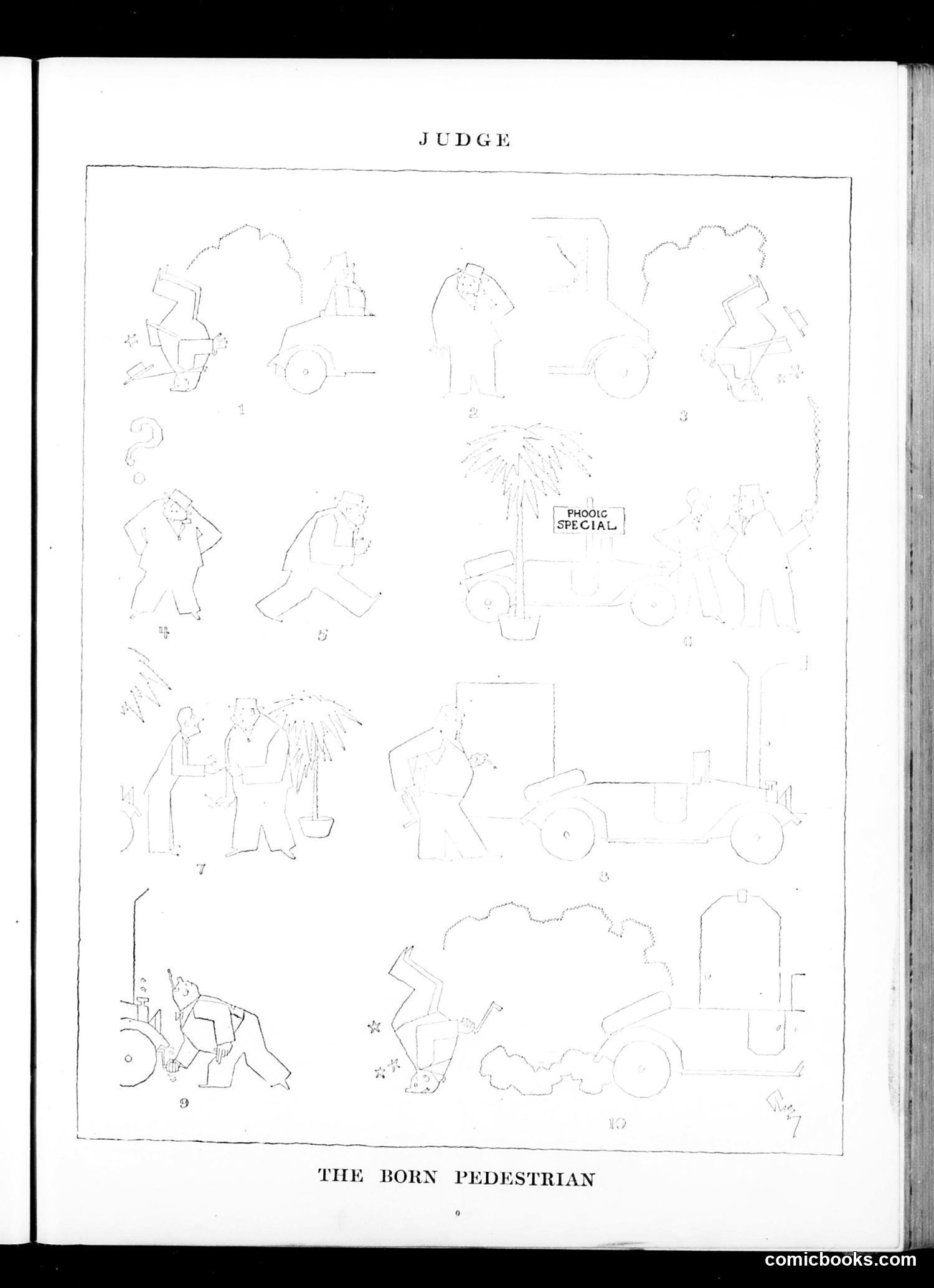
This page presents a series of satirical sketches depicting various pedestrians in urban situations, labeled "The Born Pedestrian." The numbered vignettes appear to show comic character types or stereotypes encountered on city streets—figures in different poses and predicaments, some with vehicles, some interacting with obstacles or each other. The central label "PHOOIC SPECIAL" suggests this may be a themed collection. The sketches use exaggerated proportions and poses typical of early 20th-century satirical cartooning to ridicule specific urban pedestrian behaviors or character types. Without clearer details, the exact subjects being mocked remain somewhat unclear, though the overall intent appears to be social commentary on city life and pedestrian habits through caricature.
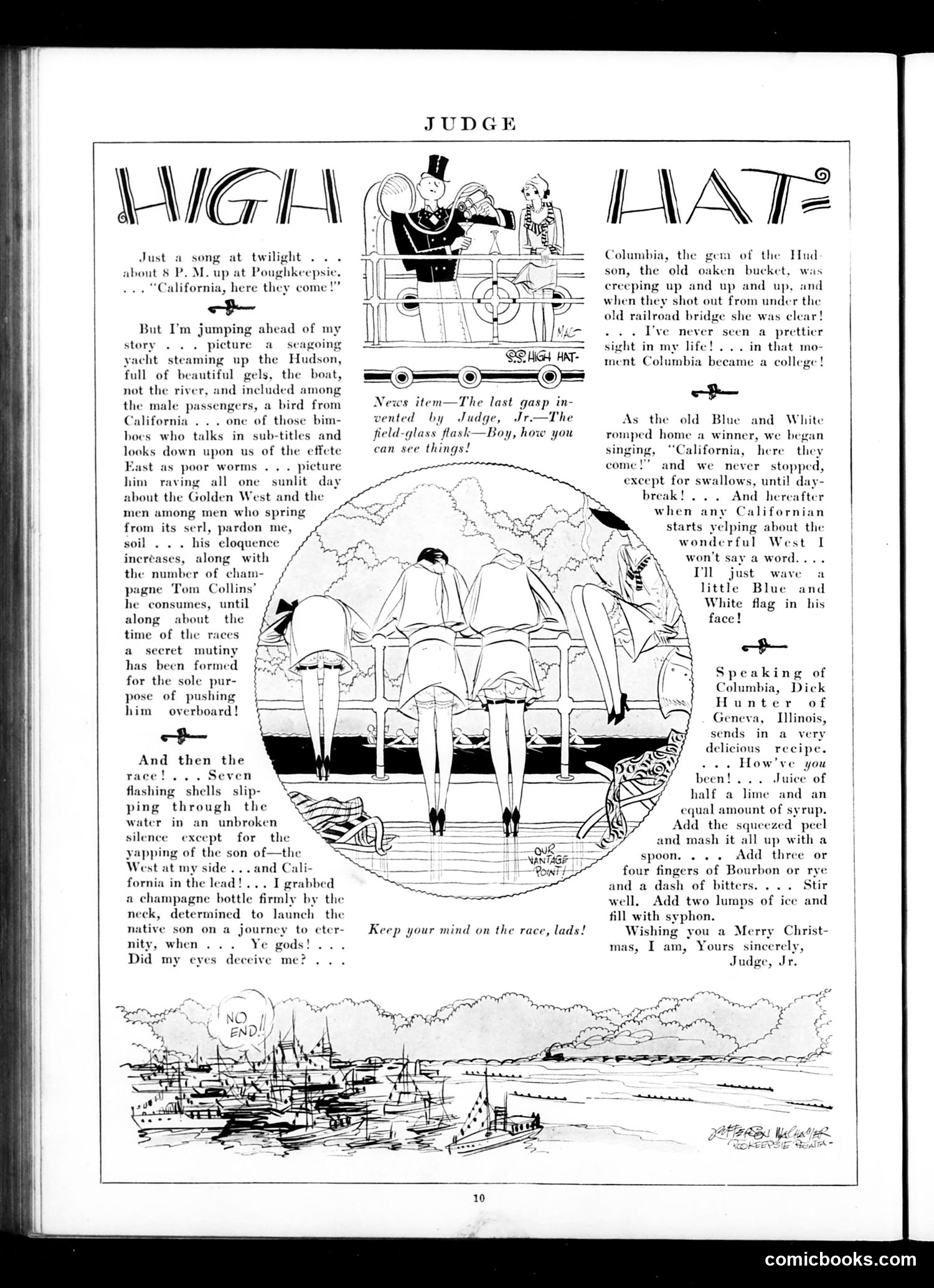
This page satirizes a boastful Californian tourist aboard a yacht on the Hudson River near Poughkeepsie. The character embodies the era's stereotype of Western nouveau riche—arrogant, condescending toward "effete" Easterners, and increasingly drunk on champagne cocktails while bragging about the Golden West. The joke's payoff: when Columbia University's rowing team wins a race, the narrator abandons his contempt and enthusiastically joins in celebrating, waving Columbia's blue-and-white colors. The satire mocks both the Californian's insufferable superiority and the narrator's sudden patriotic conversion based on a college sports victory. The "field-glass flask" product parody and cocktail recipe are typical Judge advertisements disguised as editorial content. The page dates to the college rowing season (likely early 1900s), when such competitions held significant social prestige among upper-class readers.
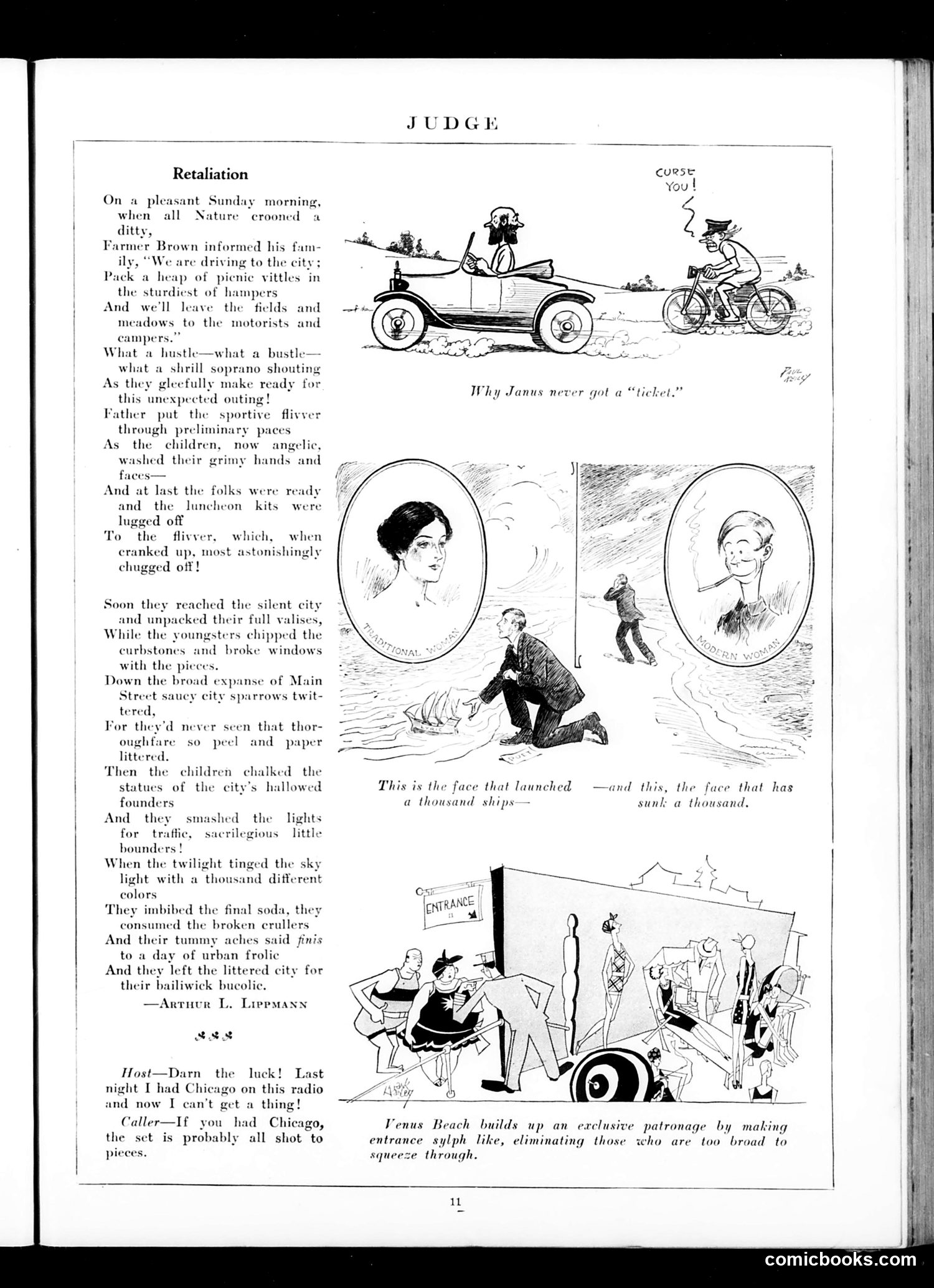
This two-part page satirizes early 20th-century urban tourism and social exclusivity. **"Retaliation" (main poem with illustrations):** A farm family drives their Model T Ford into the city for a Sunday outing. The satire depicts their children as destructive vandals—chalking statues, breaking windows and streetlights, littering—essentially "retaliating" against the city for motorists and campers invading rural areas. The joke inverts typical rural-versus-urban class tensions: country folks are portrayed as uncouth destructionists, not innocent picnickers. **Top illustration:** Shows a cyclist being passed by the family car, labeled "Why Jonns never got a 'ticket'"—likely satirizing traffic enforcement or reckless driving. **Middle illustrations:** Reference classical beauty ("the face that launched a thousand ships"—Helen of Troy) versus a sunken ship, unclear without additional context but appears to mock changing beauty standards. **Bottom section:** A radio joke and a jab at "Venus Beach" establishments using narrow doorways to exclude overweight patrons—social satire about exclusionary leisure venues.
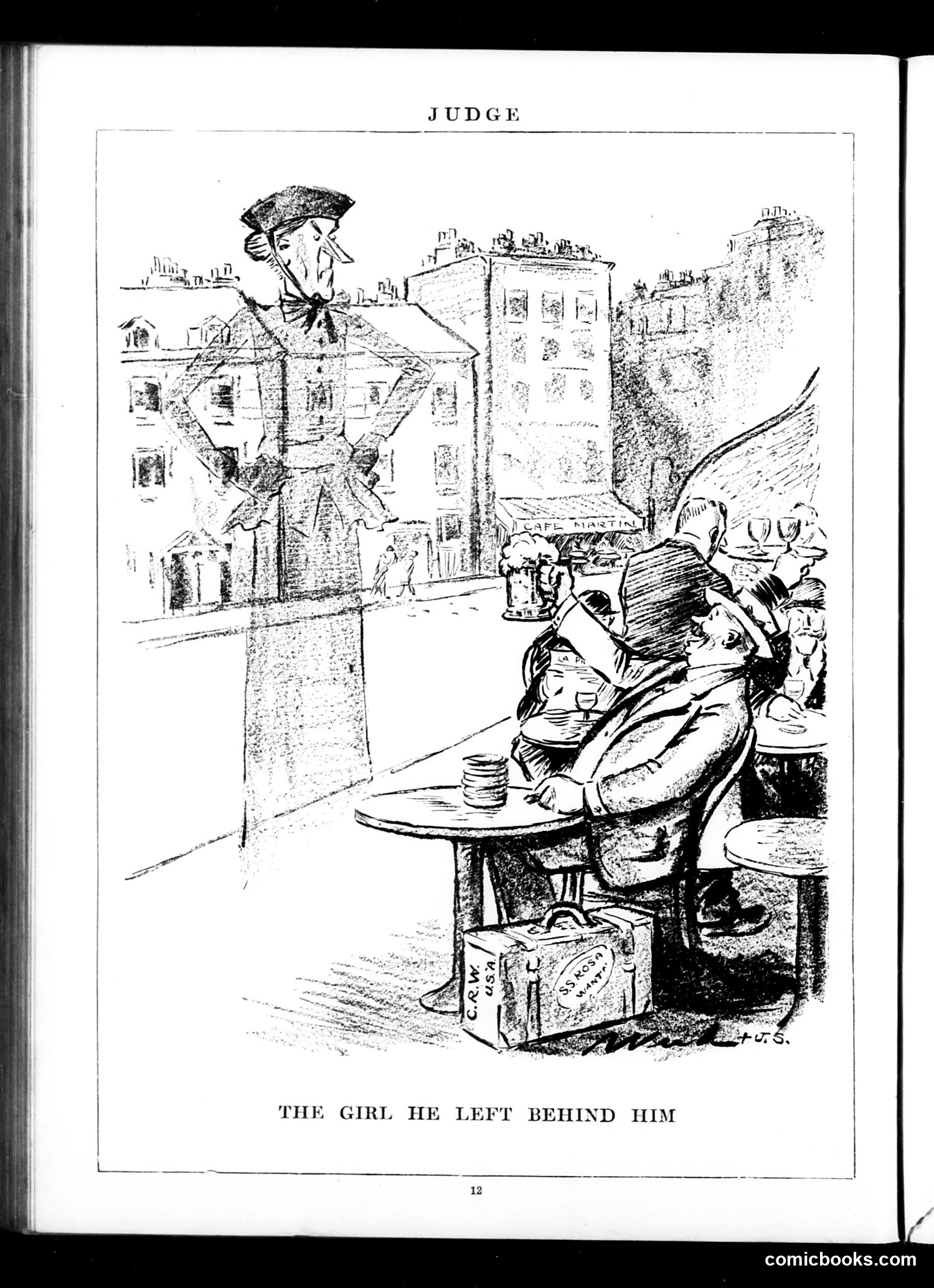
This cartoon from *Judge* magazine depicts a sentimental domestic scene. A caricatured man with exaggerated features sits at a café or restaurant table, apparently abroad (suggested by the European-style architecture and buildings visible in the background). He appears relaxed and content, holding a drink. The caption "The Girl He Left Behind Him" creates ironic commentary: rather than pining for a sweetheart back home, this man seems to be thoroughly enjoying himself in a foreign setting, unburdened by romantic obligations. The satire likely targets male travelers or expatriates who abandon domestic responsibilities, or criticizes the contrast between romanticized notions of faithful love and actual behavior. The specific historical context remains unclear without additional publication information.
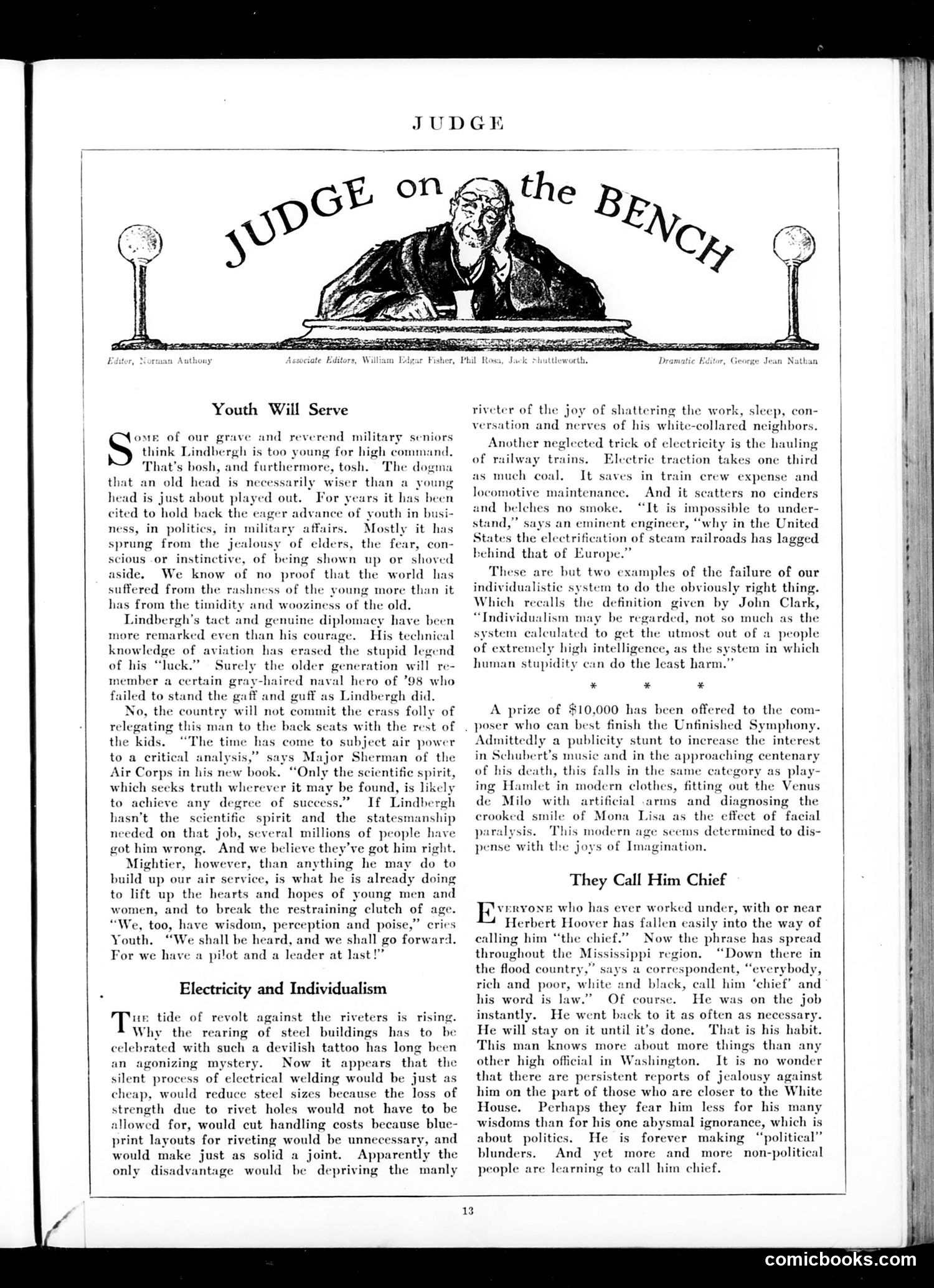
This page from Judge magazine (likely 1920s-30s based on references) contains three opinion pieces defending progressive modernization against conservative resistance. **"Youth Will Serve"** defends Charles Lindbergh's fitness for high military command despite his youth, arguing age doesn't guarantee wisdom. The piece attacks older generations' self-interested resistance to youth advancement and praises Lindbergh's diplomatic skill and aviation expertise. **"Electricity and Individualism"** critiques America's slow adoption of electrical technology in riveting and railroad electrification compared to Europe. It argues individualism—defined as a system where "human stupidity can do the least harm"—prevents obviously beneficial innovations simply because they threaten workers' jobs (riveting noise, train crew employment). **"They Call Him Chief"** (partially visible) discusses Herbert Hoover's popularity and influence, suggesting his non-political wisdom commands respect across regions. The satire targets conservative resistance to technological progress and youth leadership, framing such resistance as selfish nostalgia rather than rational policy.
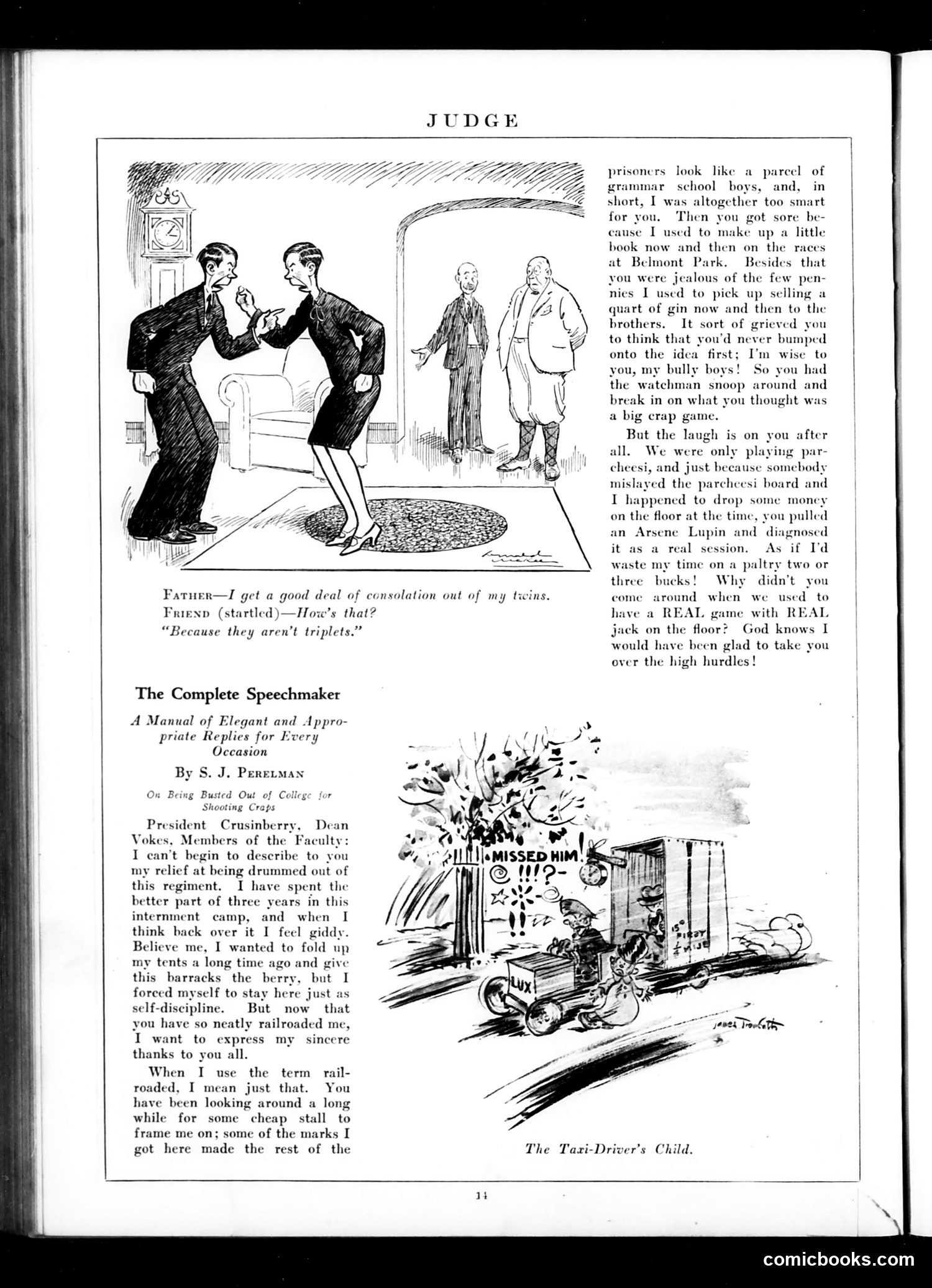
This page contains two satirical pieces: **Top cartoon ("Father")**: A simple domestic joke where a father mentions getting "consolation out of my twins," and a startled friend asks "How's that?" The punchline—"Because they aren't triplets"—is a dark humor joke about managing expectations with fewer children than feared. **Bottom section**: An excerpt from "The Complete Speechmaker" by S.J. Perelman, presented as a manual for elegant replies. The text is a sarcastic military speech where a soldier being "railroaded" (falsely accused/court-martialed) from his regiment sarcastically thanks his superiors. The satire mocks military bureaucracy and injustice—the soldier ironically thanks those who framed him on dubious charges (claiming they were playing parcheesi, not gambling, when caught). **"The Taxi-Driver's Child"** illustration shows a chaotic accident scene, likely accompanying a humorous anecdote about reckless driving—typical Judge satirical content about modern urban life and social absurdities. The page exemplifies Judge's blend of domestic humor and institutional satire.
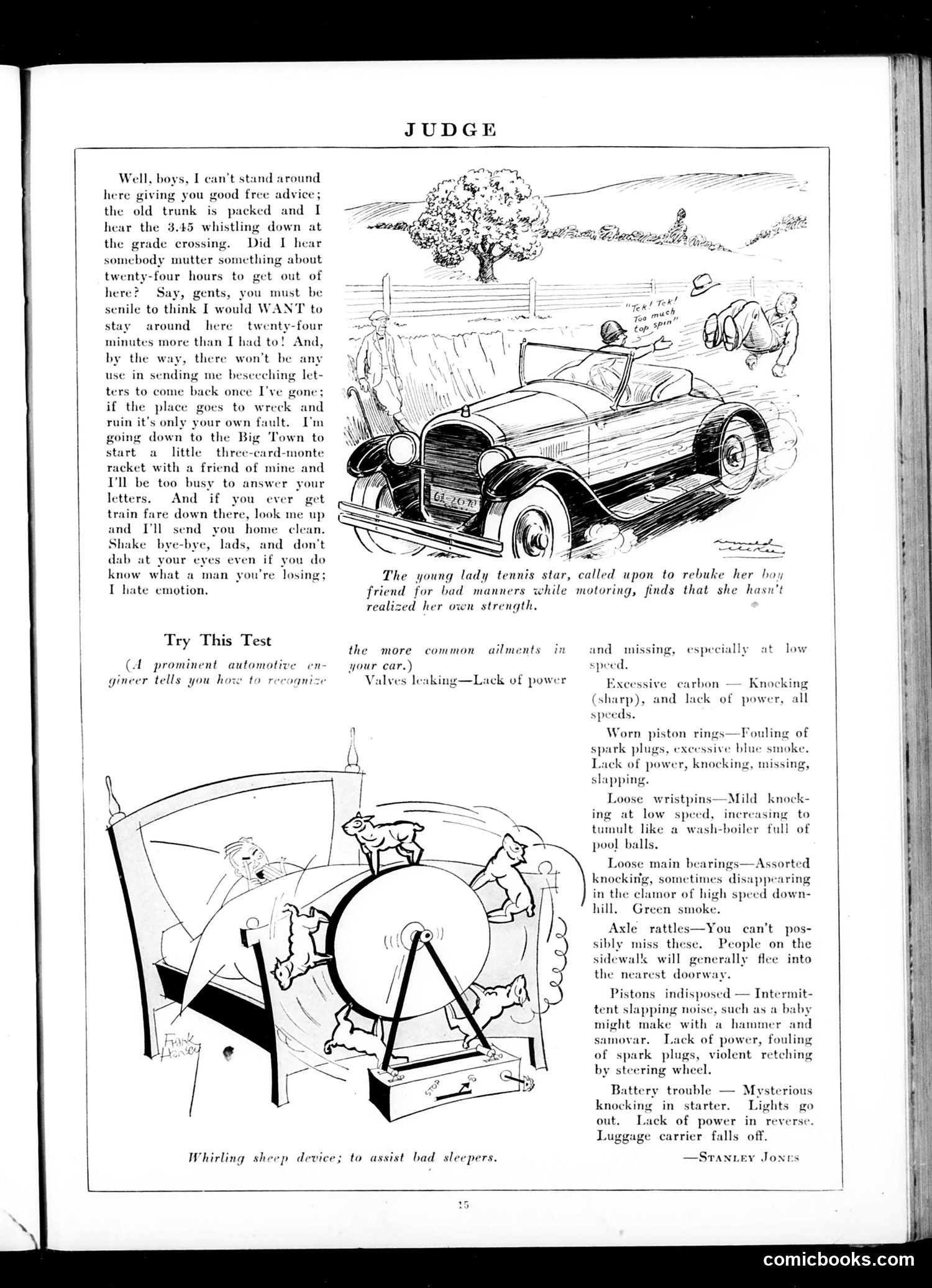
This page contains two satirical pieces about automobiles, reflecting 1920s car culture anxieties. The main cartoon shows a departing con artist dismissing small-town marks before fleeing to the city—a commentary on rural gullibility and urban sophistication that was a common Judge theme. The secondary cartoon depicts a young female tennis player striking her boyfriend while driving, satirizing both newfound women's independence (she plays tennis, drives) and automotive dangers. The joke: she's so strong she damages the car, undermining the premise that she's "rebuking" him for bad manners. The accompanying "Try This Test" provides humorous automotive diagnostic tips by Stanley Jones, using absurdist descriptions (pistons making noise "like a baby with a hammer and samovar"; axle rattles causing sidewalk pedestrians to flee). This reflects early automotive ownership's novelty—cars were still mysterious machines requiring explanation to readers unfamiliar with their mechanics.
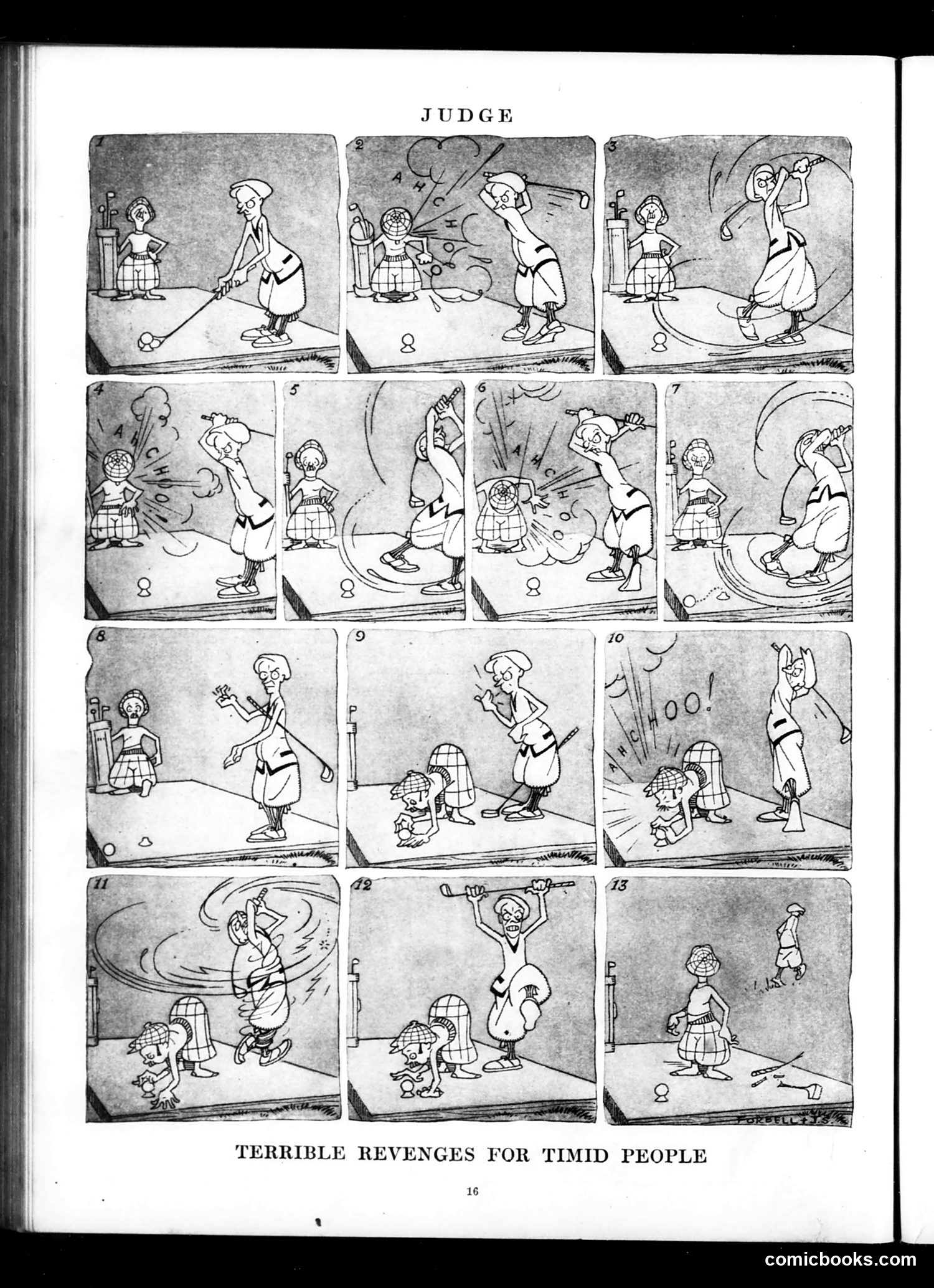
This is a humorous comic strip showing a meek man's fantasy scenarios of revenge against someone who has wronged him. The sequence depicts increasingly absurd and violent fantasies—the man imagines himself hitting the other person with a golf club, swinging at them, tying them up, and subjecting them to various physical punishments. The satire targets the contrast between how timid, socially anxious people *wish* they could respond to insults or slights versus their actual passive behavior. It's a relatable joke about the gap between inner rage and outer meekness. Each panel escalates the fantasy into more cartoon-like, impossible scenarios, emphasizing how these vengeful daydreams are mere wishful thinking for someone too nervous to actually confront anyone.
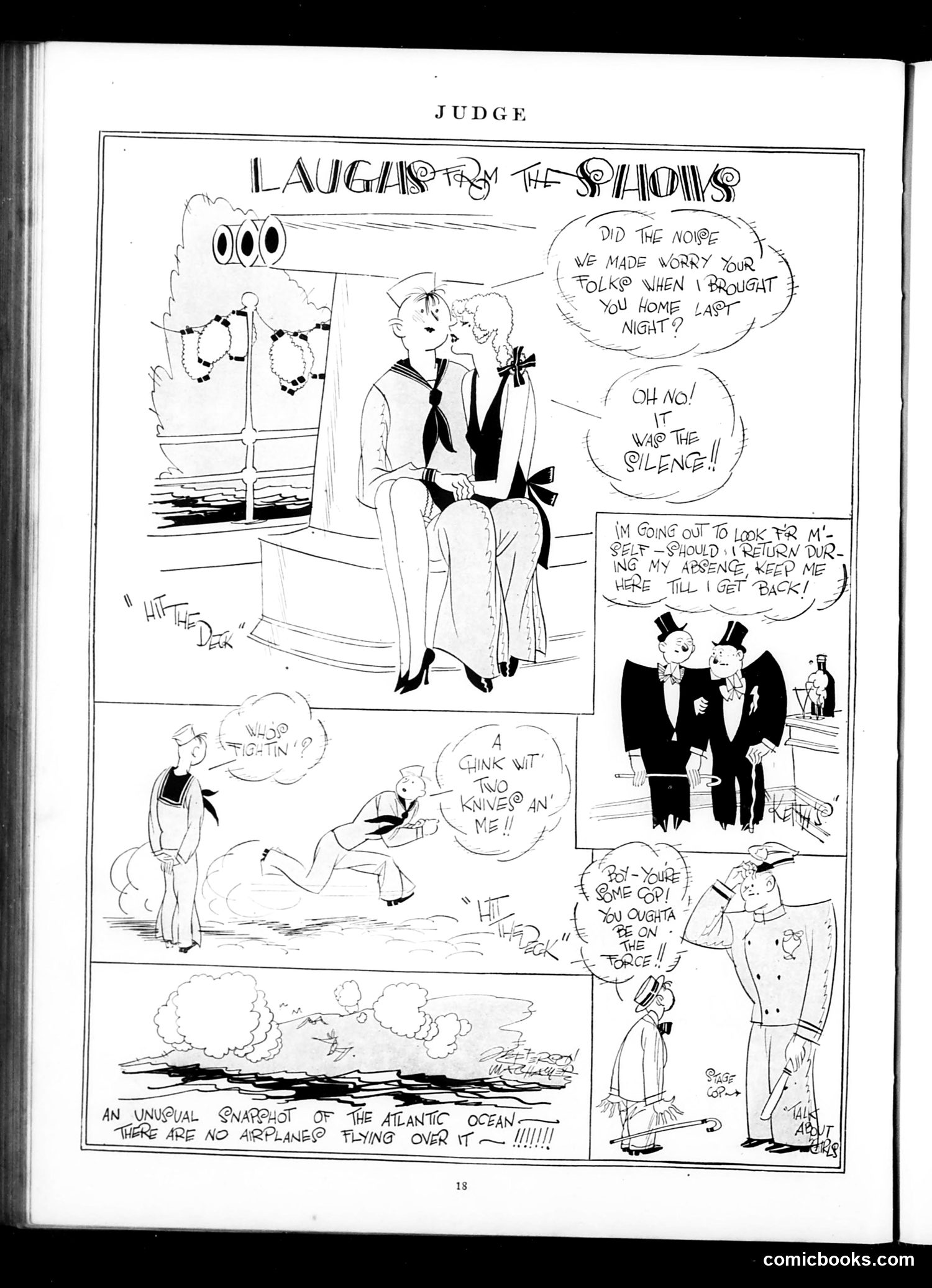
This is a multi-panel comic satirizing theatrical life and romantic complications. The main narrative follows a couple: when the man announces he's leaving to search for his "split" (girlfriend) to keep her from worrying during his absence, his current companion becomes alarmed about his fidelity. The humor escalates through slapstick scenes—the woman chases him with a knife, men in formal wear discuss the scandal, and a policeman pursues them. The final panel jokes about an "unusual snapshot of the Atlantic Ocean" with "no airplanes flying over it," likely a reference to contemporary aviation or naval activities. The satire targets theatrical performers' romantic drama and infidelity, common subjects in early 20th-century Judge magazine humor. The handwritten attribution "Hitt & Dirk" appears to be the cartoonist's signature. The overall tone is lighthearted domestic comedy rather than serious social criticism.
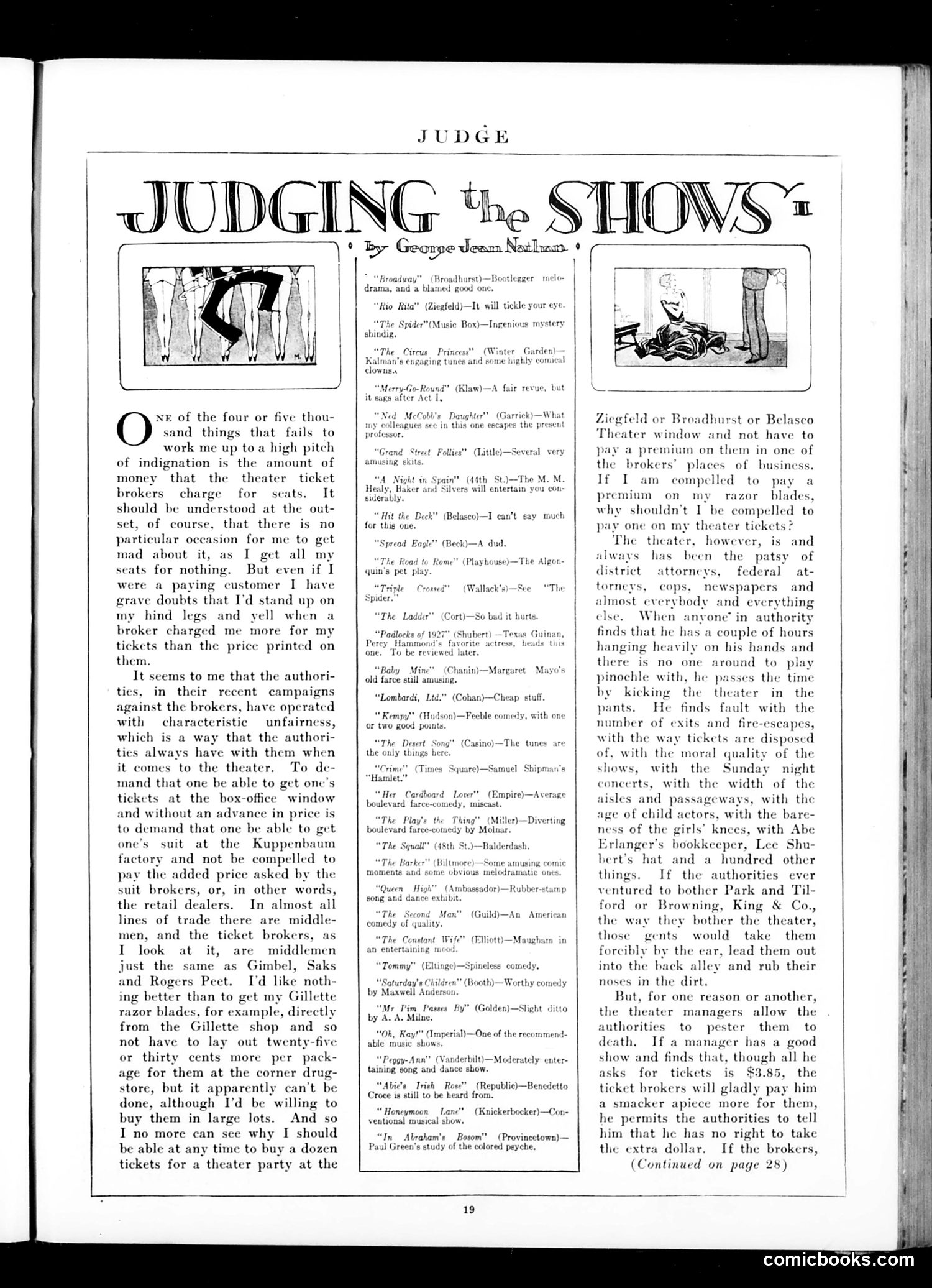
This page combines theater reviews with a satirical essay by George Jean Nathan (bylined at top) arguing against ticket broker price-gouging regulations. **The Satire's Point:** Nathan defends ticket brokers against recent "campaigns" by authorities (likely police or district attorneys). He argues brokers are legitimate middlemen, no different from department stores or drug retailers who mark up goods. Why should theaters be treated specially? He sardonically notes that authorities—cops, newspapers, DAs—always use the theater as a convenient target when they need something to do ("couple of hours hanging heavily on his hands"). **The Social Context:** This reflects 1920s debates over ticket scalping. Authorities were cracking down on brokers' markups, which Nathan sees as hypocritical: if consumers accept markups on razors and suits, why not theater tickets? His defense of "middlemen" reflects broader debates about retail commerce and regulation. **The Reviews Section:** Lists current Broadway shows with brief critical assessments, helping readers decide what to see.
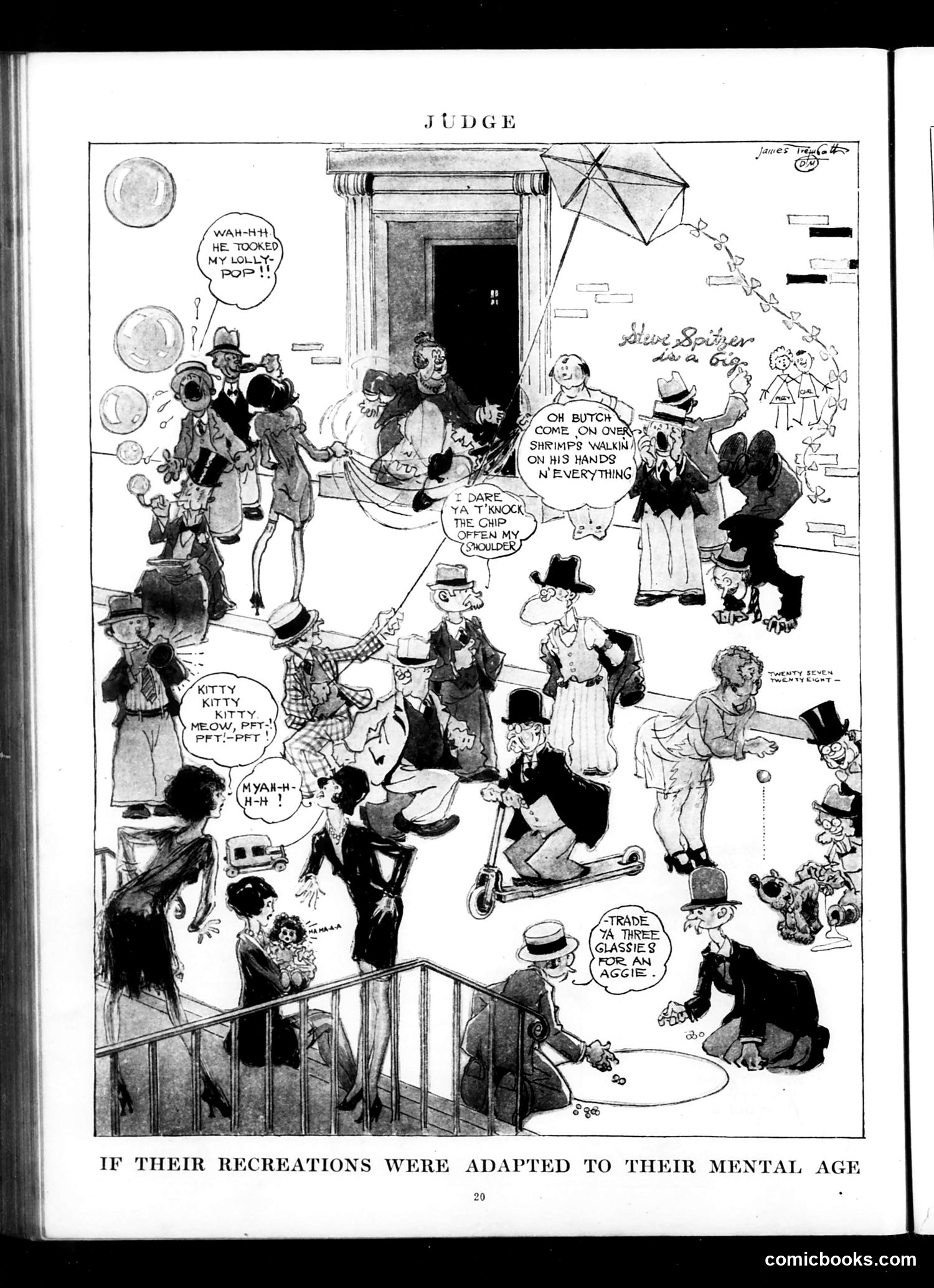
This satirical cartoon from *Judge* magazine shows adults engaged in children's activities, satirizing their supposed intellectual immaturity. The title "If Their Recreations Were Adapted to Their Mental Age" is the key: it suggests certain adults deserve only childish pursuits. The scene depicts various figures (likely politicians or public figures of the era, though specific identities aren't clearly labeled) playing with toys, bubbles, scooters, and engaging in simple games. One speech bubble references "Pop," another mentions trading marbles. The satire criticizes the mental capacity or judgment of these individuals—suggesting they behave so foolishly that they belong in a playground rather than positions of influence. This was typical *Judge* magazine fare: partisan political mockery presenting opponents as infantile or incompetent through visual humor.
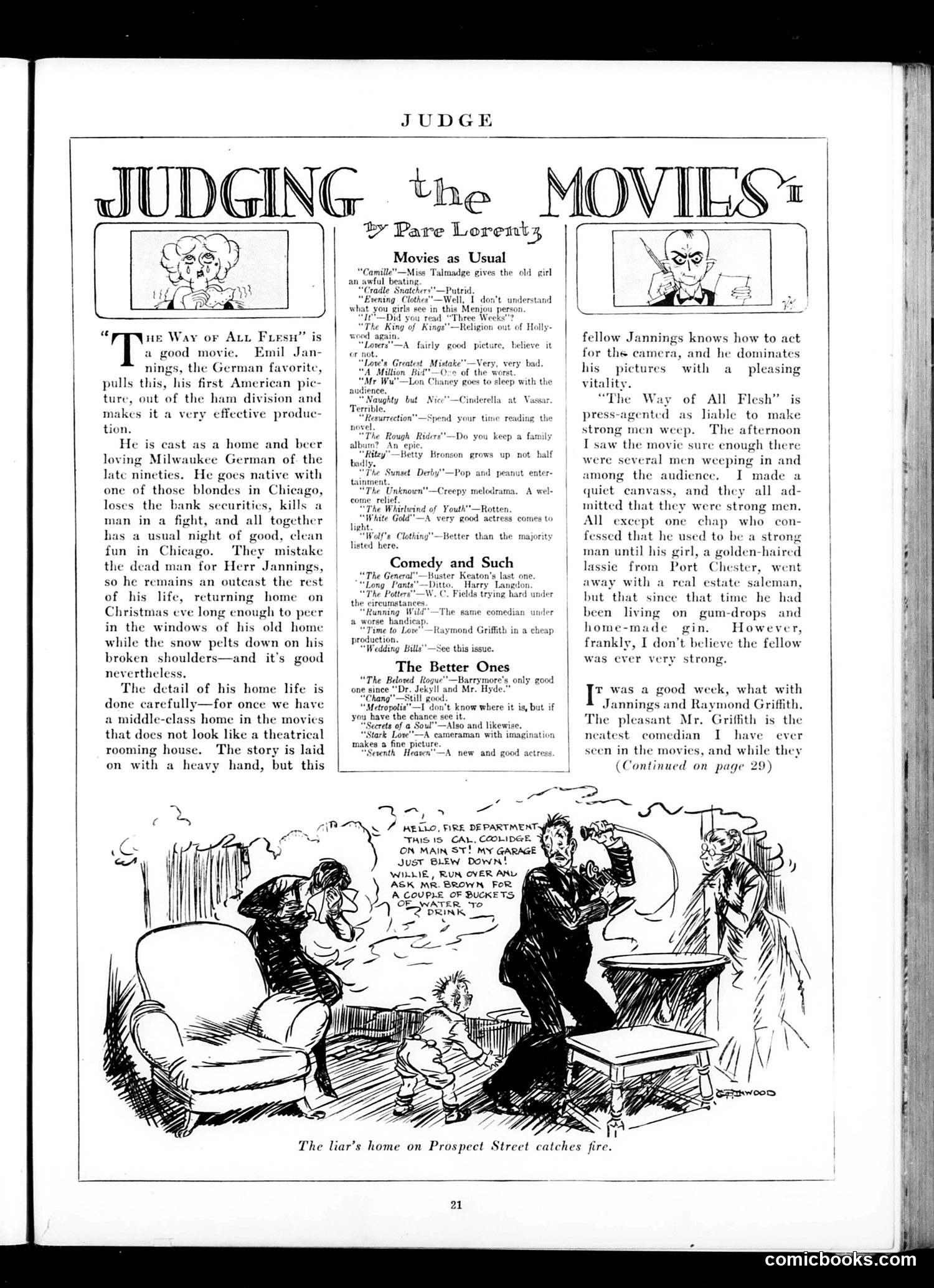
This page contains a film criticism column by Pare Lorenz reviewing 1920s movies, accompanied by a cartoon about a fire on Prospect Street. The reviews cover contemporary films starring Emil Jannings, Buster Keaton, and Raymond Griffith, praising "The Way of All Flesh" and criticizing others as "putrid" or "terrible." The column uses casual, sarcastic language typical of Judge's satirical tone. The cartoon at bottom depicts a man reporting a garage fire to the fire department while others scramble with buckets—a slapstick domestic comedy scenario. The caption "The liar's home on Prospect Street catches fire" suggests ironic punishment through physical comedy, a common Judge trope. The page reflects 1920s entertainment culture and Judge's irreverent approach to both cinema and everyday mishaps.
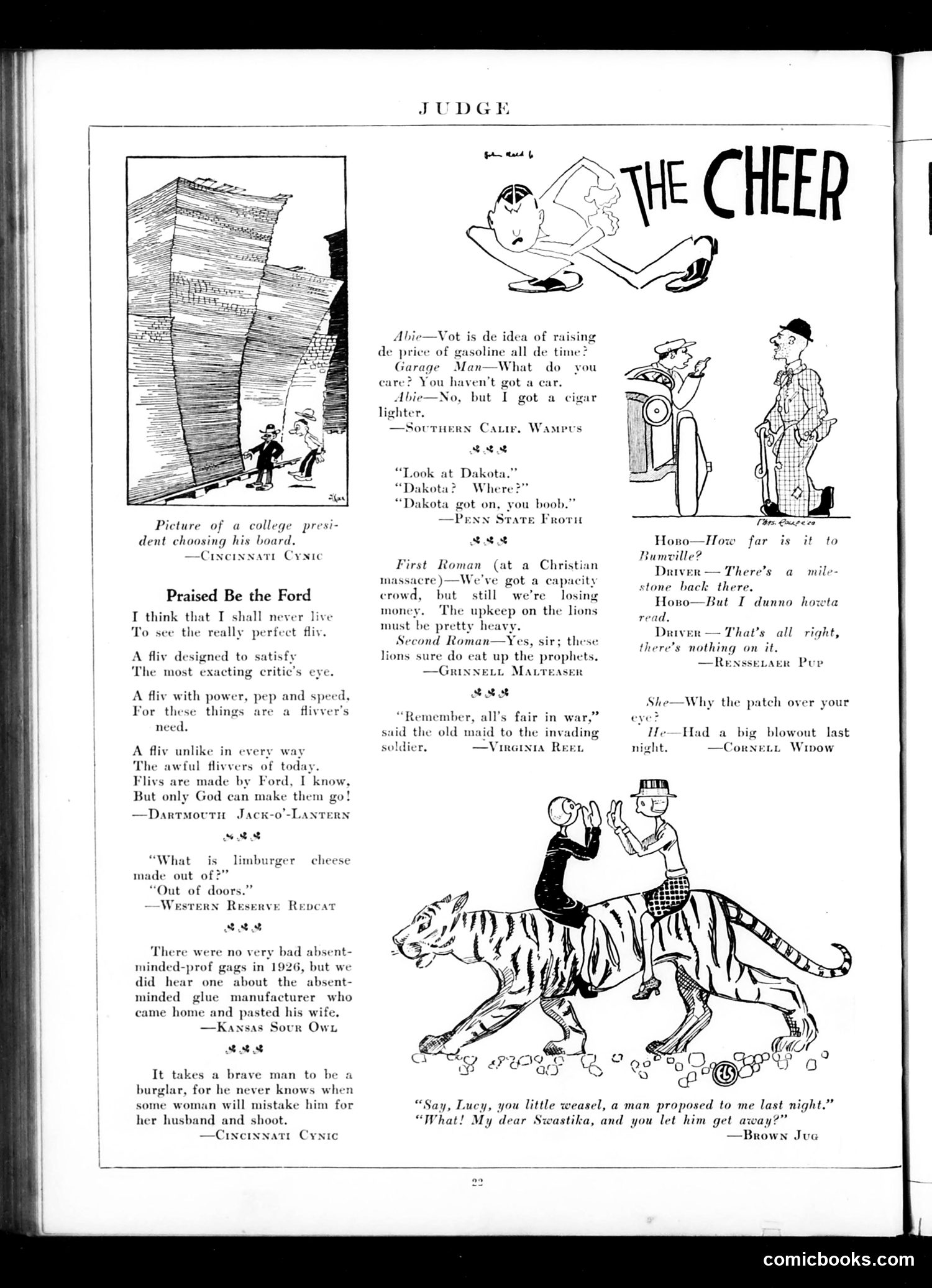
This page from the satirical magazine *Judge* collects brief jokes and cartoons reflecting 1920s American life: **"Praised Be the Ford"** parodies Henry Ford's mass-produced automobiles ("flivvers"), sarcastically suggesting Ford's cars are unreliable—only God can make them actually run. **"The Cheer"** cartoon depicts a motorist and driver discussing a flat tire, with wordplay about "milestone" (the driver jokes there's "nothing on it"). **Ethnic humor** appears in "Abie" jokes, featuring stereotypical Jewish immigrant dialogue about raising gas prices. **Other jokes** mock absent-minded professors, burglars, and dating customs. One references a woman named "Swastika"—then an innocent Sanskrit symbol, not yet associated with Nazism. The humor is largely observational about modern inconveniences (cars breaking down, rising costs) and relies on period stereotypes now considered offensive. The page's overall tone reflects 1920s working-class anxieties about technology and social change.
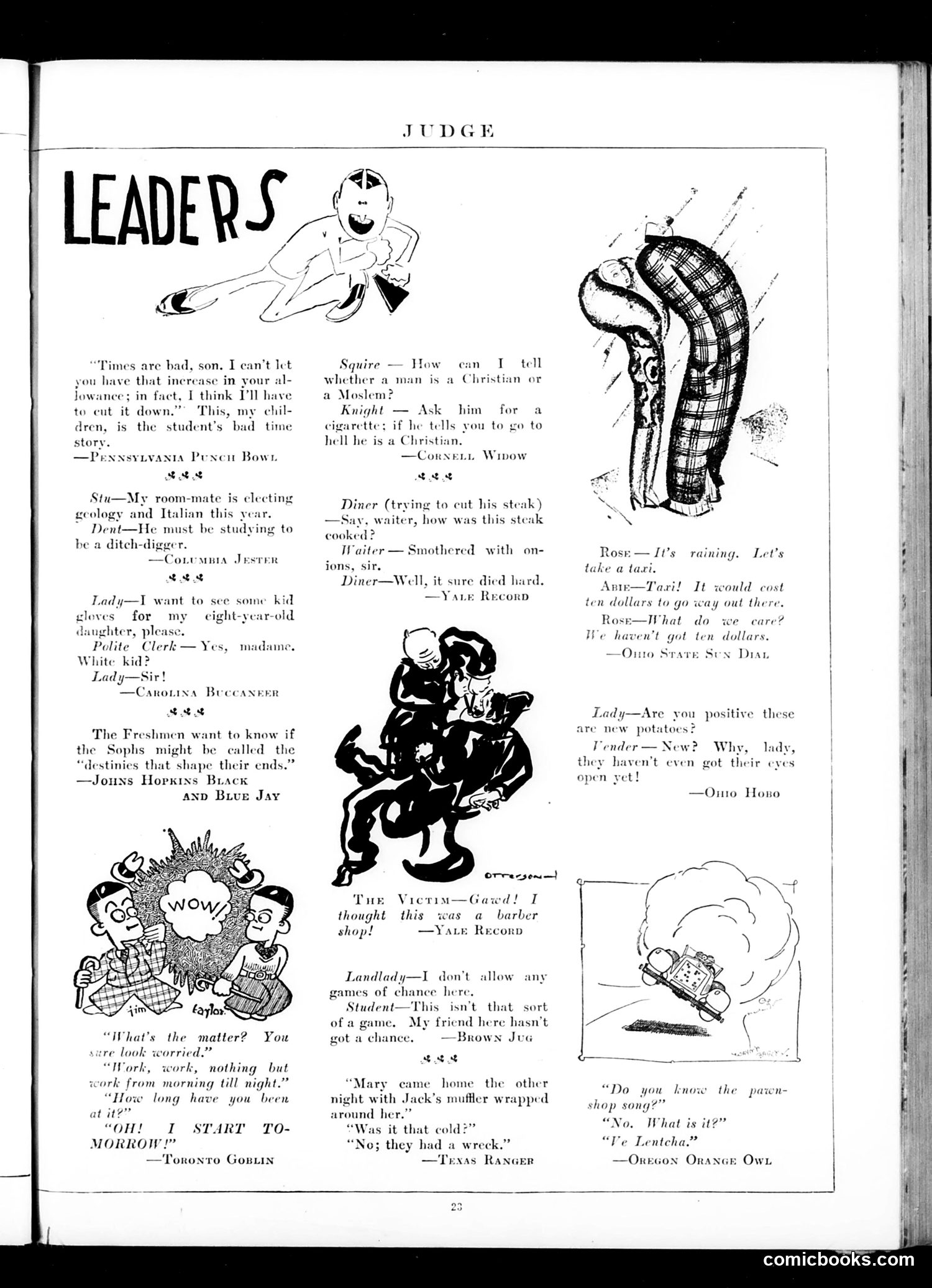
This page collects brief humorous quips and cartoons typical of Judge's satirical humor, circa early 20th century. The jokes target several recurring themes: **Economic hardship**: Multiple jokes reference financial struggles—fathers cutting allowances, complaints about work, and poverty preventing a taxi ride. **Class and education snobbery**: A geology/Italian student is mocked as a "ditch-digger," while freshman-sophomore hierarchies are referenced through Shakespeare. **Gender and propriety**: A lady's indignant reaction to being asked about "white kid" gloves suggests offensive implications; another joke mocks naive vegetable vendors. **Religion**: One joke cynically suggests distinguishing Christians from Muslims by their profanity when asked for cigarettes. **Food and service complaints**: Diners struggle with tough steaks; barber shop confusion. The illustrations—a football player, wrapped figure, arguing couple, and small domestic scene—reinforce these social observations with visual humor. The overall tone reflects Depression-era or post-WWI American anxieties about class, work, and changing social norms.
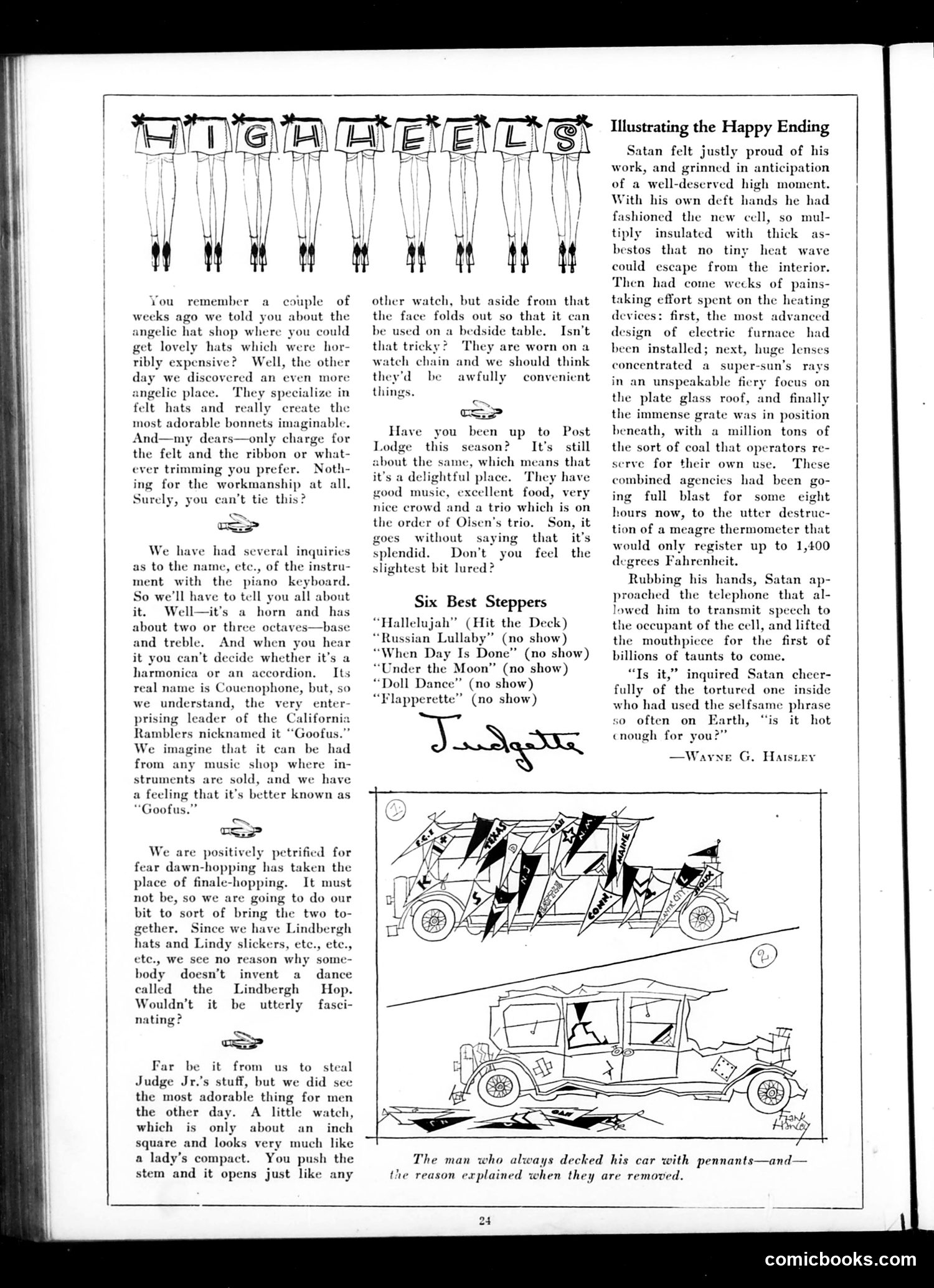
This Judge magazine page contains miscellaneous humor and social commentary typical of the 1920s: **Main Content:** - **Fashion commentary** on expensive hat shops and a novelty "Couenophone" (piano-keyboard horn instrument) - **Dance crazes**: References to "dawn-hopping" and "finale-hopping" (popular 1920s dance fads), with a joke proposing a new "Lindbergh Hop" dance, capitalizing on Charles Lindbergh's recent celebrity from his 1927 transatlantic flight - **Product review**: A compact men's watch designed to fold out for bedside use - **Cartoons**: Two panels showing a car decorated with pennants—the joke being that removing the pennants reveals the car's actual poor condition underneath, satirizing shallow decoration masking defects - **Short story**: "Illustrating the Happy Ending" about Satan creating an extremely hot torture cell, then mockingly asking the victim "is it hot enough for you?"—a darkly humorous tale The page reflects 1920s consumer culture, dance fads, and celebrity obsession rather than explicit political content.
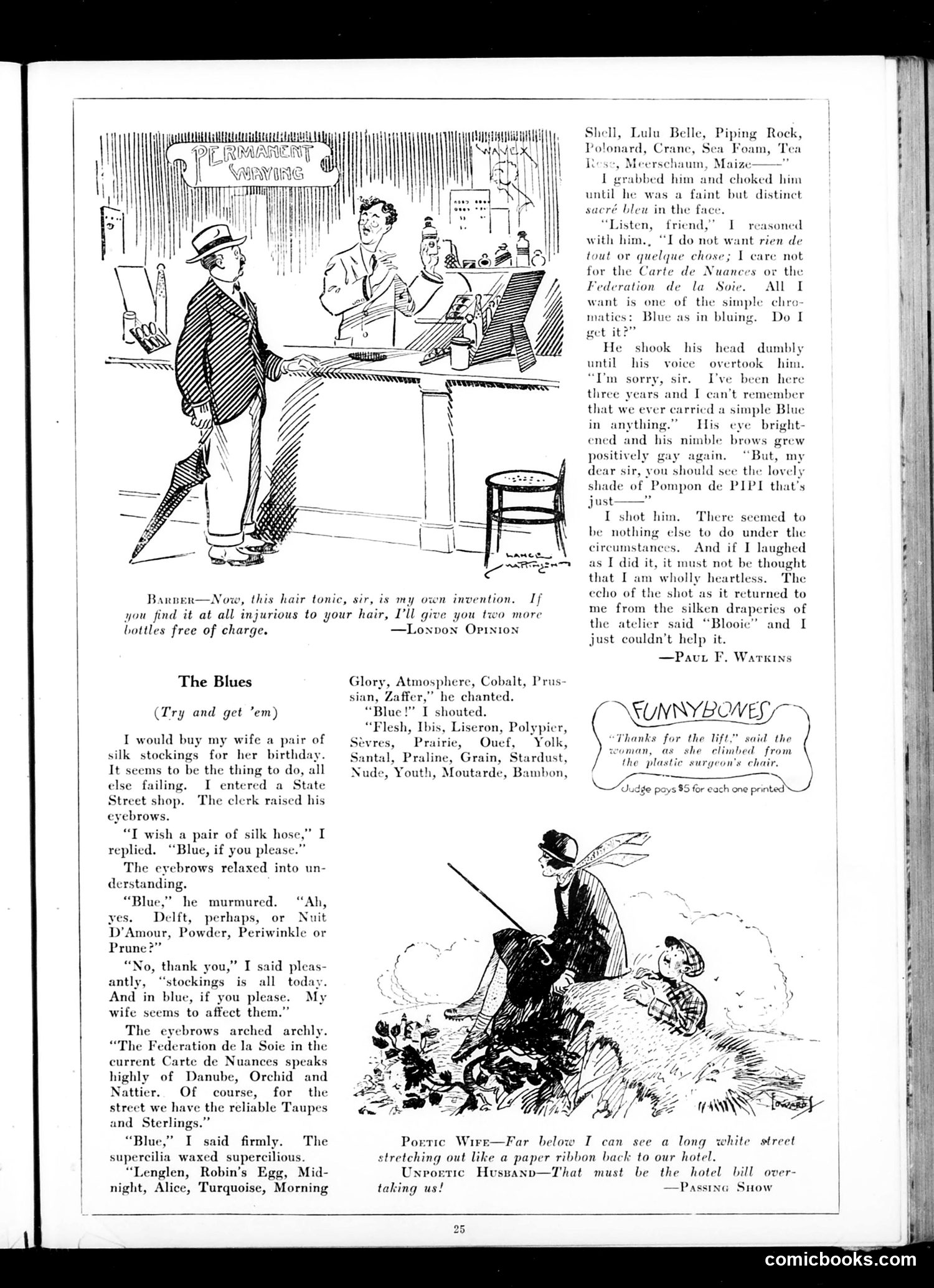
This page satirizes the absurd pretentiousness of fashion retail, specifically the naming of women's silk stockings. The unnamed protagonist simply wants to buy blue stockings for his wife's birthday. However, a clerk at a State Street shop responds to "blue" with increasingly ridiculous, pseudo-French color names: "Delft," "Nuit D'Amour," "Periwinkle," "Danube," "Orchid," "Lenglen," "Turquoise," and absurdities like "Pompon de PIPI." The joke mocks how merchants artificially inflate trivial products through fancy nomenclature—turning basic blue stockings into exotic "chromatics." The protagonist's frustration escalates until he literally shoots the clerk. The satire targets commercial pretension: how the fashion industry transforms simple merchandise into status symbols through elaborate marketing language that obscures rather than clarifies. The barber cartoon above offers parallel commentary on dubious commercial claims about "inventions."
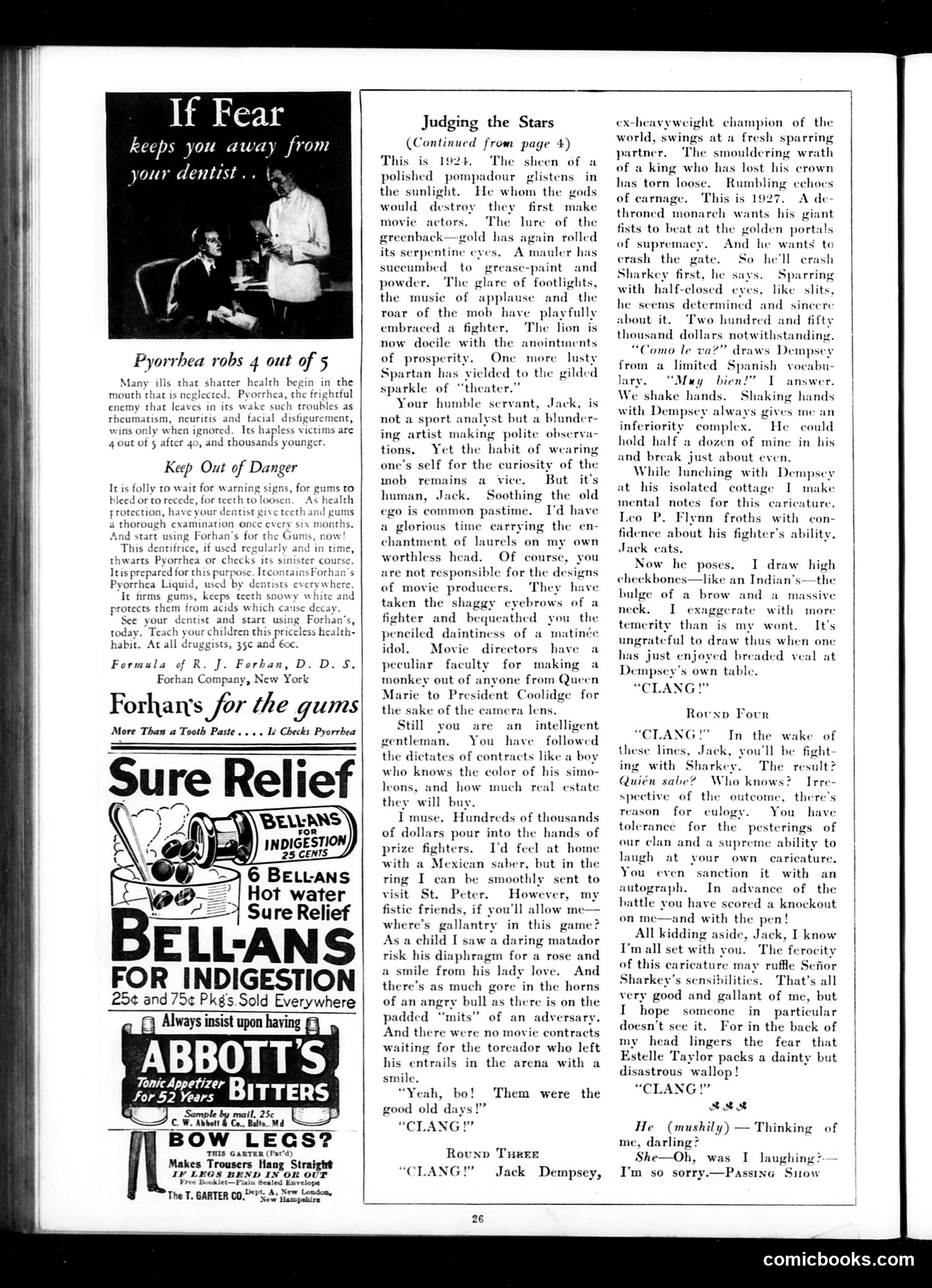
This page satirizes the fall of boxer Jack Dempsey from athlete to movie actor. The main article criticizes how Hollywood corrupts fighting champions by luring them away from sport with money and fame ("the lure of the greenback"). The author—a self-described humble artist—observes that Dempsey has become "docile" under "prosperity," trading his lion-like fighting spirit for the artificial glamour of cinema. The piece mocks movie directors' ability to transform rough fighters into polished matinée idols, "penciling" away their authentic masculinity. The satire contrasts Dempsey's glamorous new persona unfavorably with a matador's genuine courage, suggesting that Hollywood success represents ego-soothing vanity rather than true heroism. The surrounding advertisements (Forhan's toothpaste, Bellans antacid, Abbott's bitters) are typical of 1920s Judge content, targeting middle-class anxieties about health and propriety.
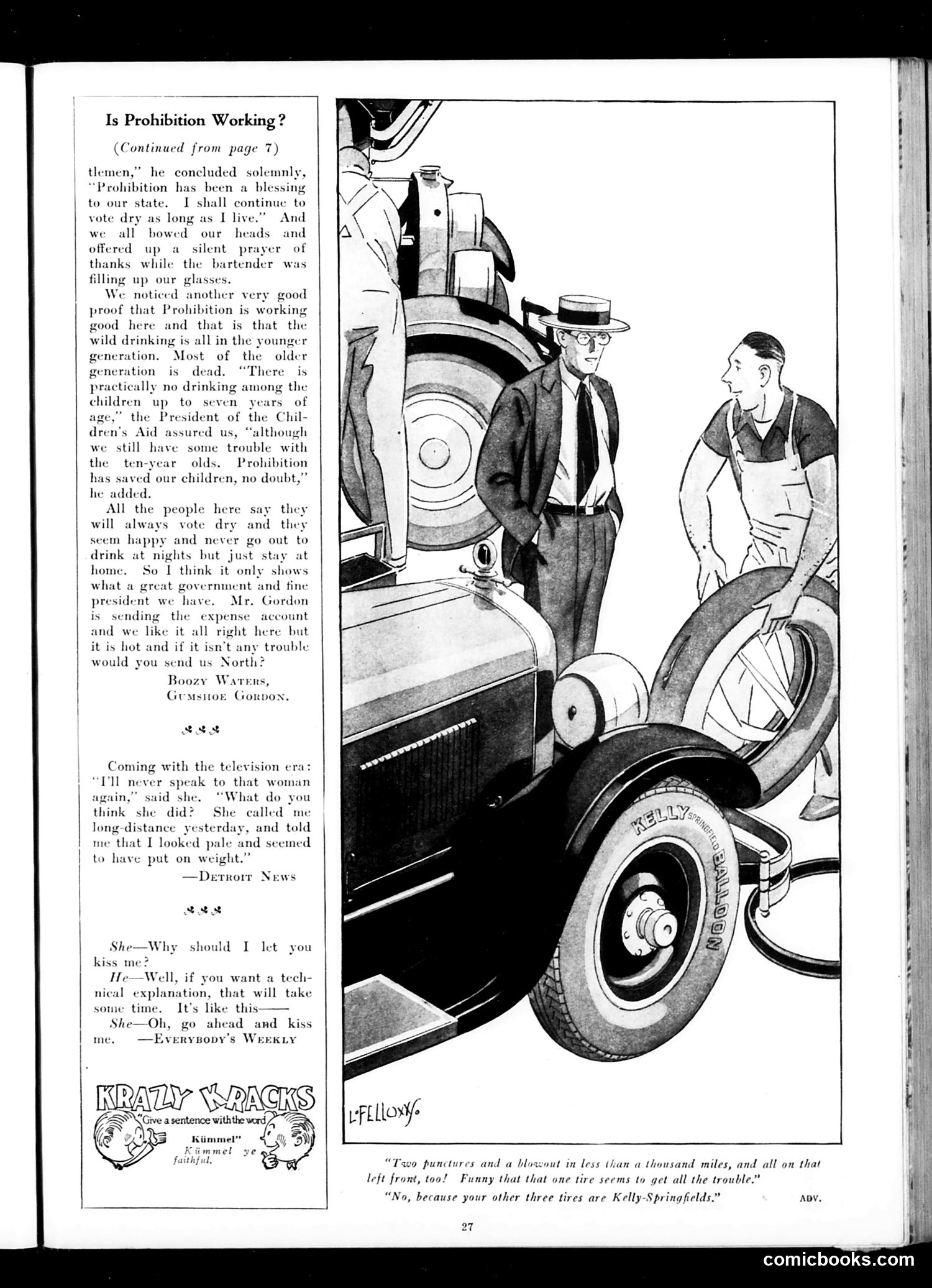
This page satirizes **Prohibition's claimed success** through ironic testimony. A character named "Boozy Waters" supposedly reports from a dry state where Prohibition supposedly works—yet the satire is obvious: he's writing *from a bartender's establishment while drinking*. The joke is that Prohibition advocates make absurd claims (children under seven don't drink; older generations died from it; people happily stay home) that contradict reality. The large cartoon depicts a **car mechanic discussing tire failures**—a commercial advertisement for Kelly-Springfield tires that's unrelated to the political content above. Below are humorous anecdotes about modern dating/telephone etiquette, also unrelated. **The satire's point**: Prohibition isn't working; its supporters are either delusional or hypocritical (drinking while claiming victory). The exaggerated claims and the narrator's obvious location in an active bar underscore the law's failure during the 1920s-30s.
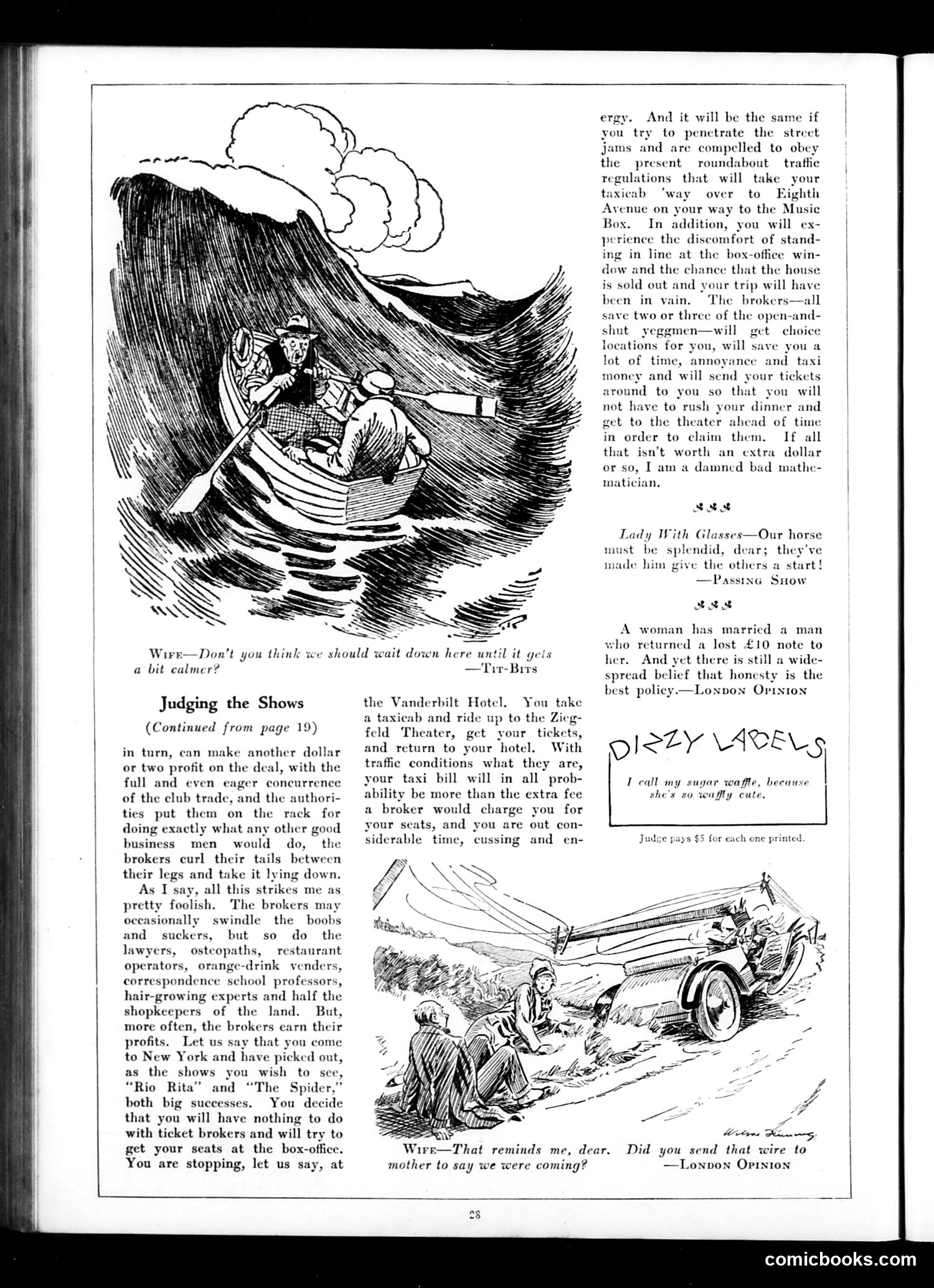
This page contains satirical commentary on theater ticket brokers in 1920s New York. The main article "Judging the Shows" argues that ticket brokers, despite their reputation as swindlers, actually provide a valuable service. The author contends that buying directly from box offices requires expensive taxi rides through congested streets, waiting in lines, and risking sold-out shows—costs that often exceed broker fees. The two cartoon couples at top and bottom illustrate marital miscommunication: a wife concerned about traffic delays, and a husband forgetting to wire his mother about arrival plans. These humorously support the article's point about New York's transportation chaos. The "Dizzy Labels" section and brief humor items are unrelated filler content typical of Judge's format. The overall piece defends brokers as pragmatists serving customers' actual needs, inverting their typical villainous characterization in popular discourse.
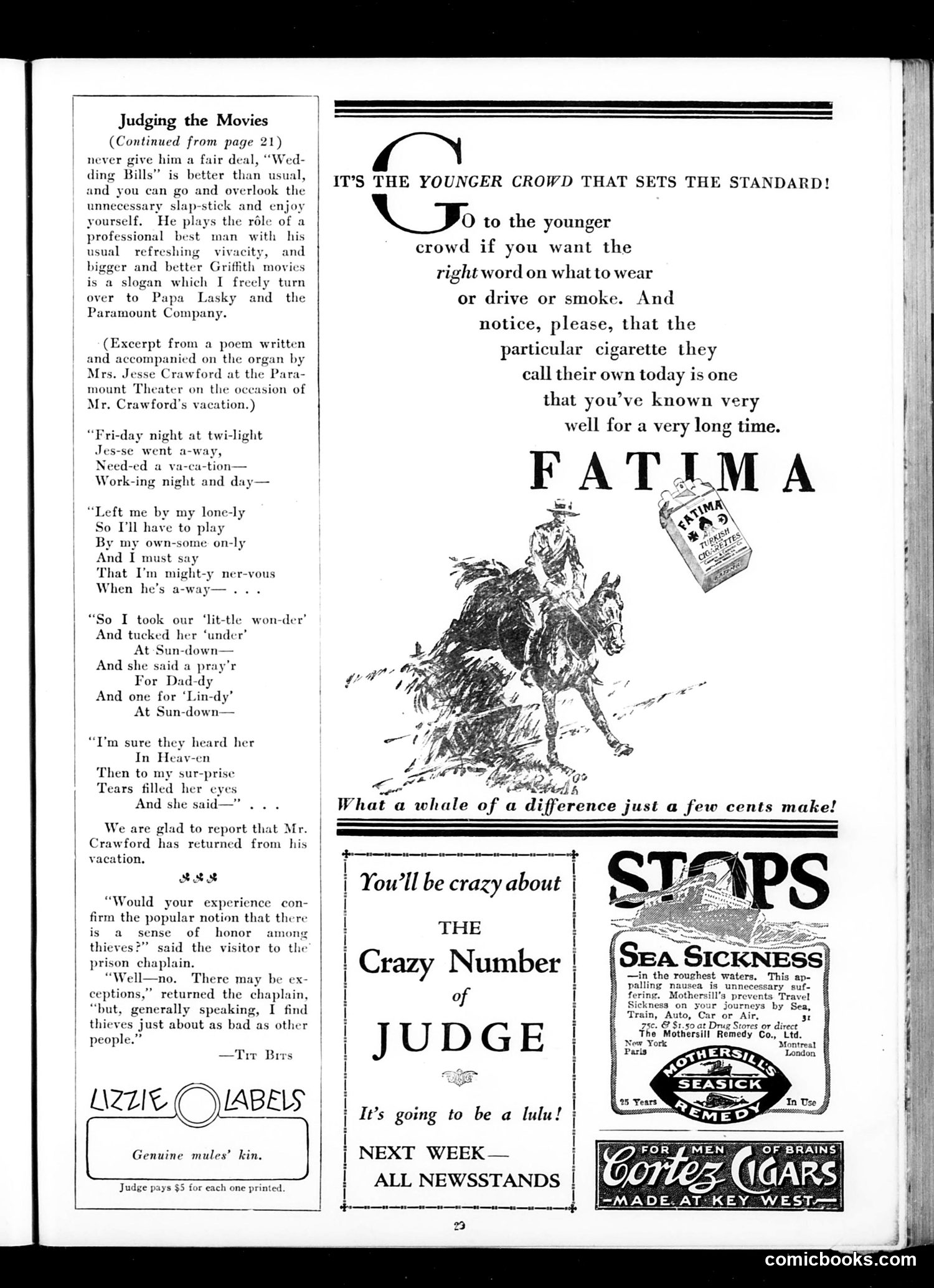
This page mixes entertainment criticism with period advertisements. The "Judging the Movies" column reviews a film called "Wedding Bills," praising actor Jesse Crawford's refreshing comedic style in a "best man" role. A touching poem about Crawford's vacation—written and organ-accompanied by his wife—humorously captures a child's loneliness while he's away. The main advertisement targets younger consumers, asserting that youth set fashion and product standards. It promotes **Fatima cigarettes**, claiming the younger generation favors this brand—one "you've known very long time," suggesting it's an established, respectable choice. Side ads promote **Mothersill's Sea Sickness remedy** and **Cortez cigars**. The cigarette and cigar ads reflect early-20th-century marketing normalcy; tobacco was openly advertised without health warnings. The "Crazy Number of Judge" teases next week's issue. Overall, this represents typical interwar American magazine content: movie criticism, consumer advertising, and light humor—all reflecting an era when cigarette promotion was entirely mainstream.
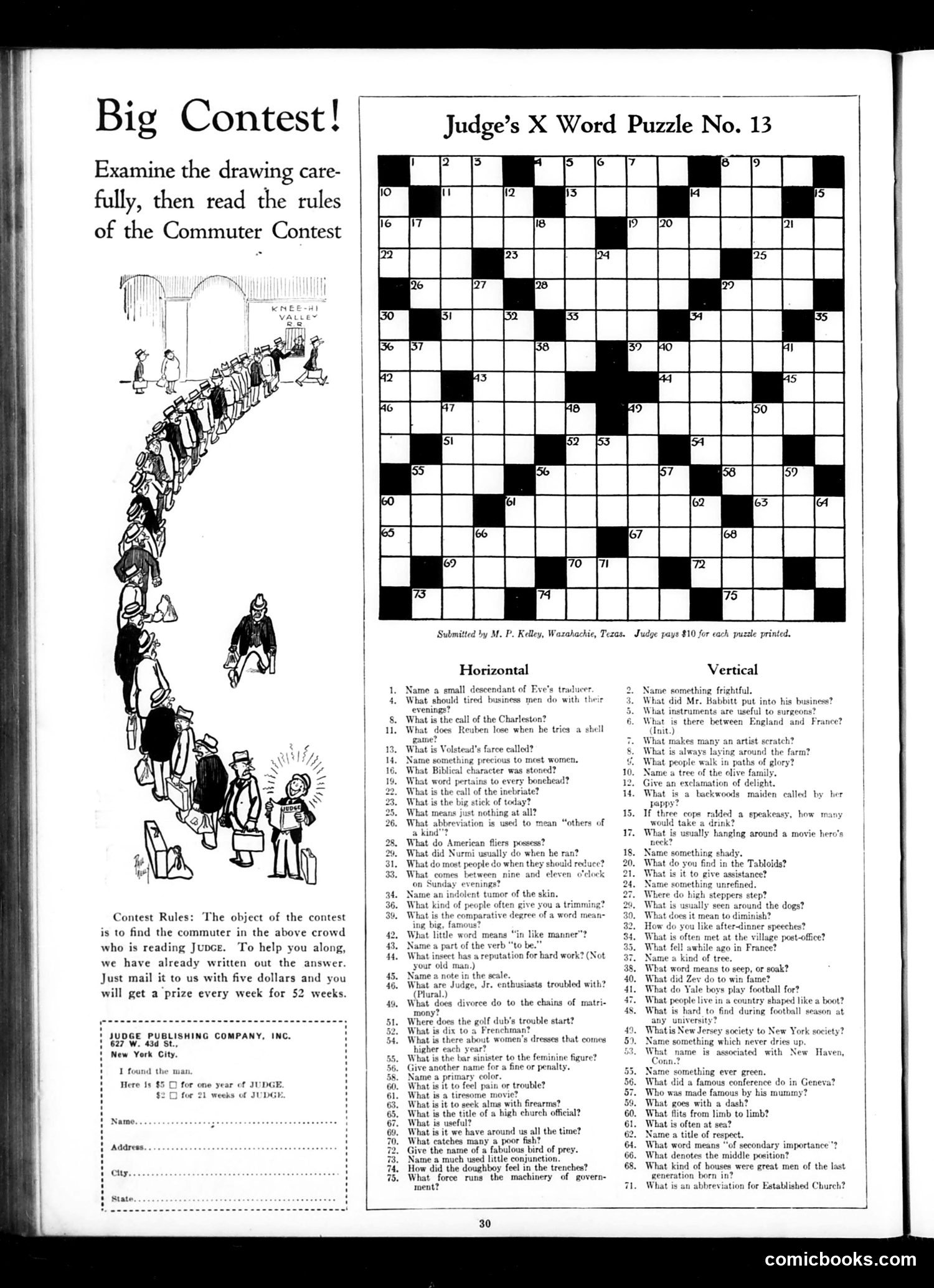
This page features a **self-promotional contest** rather than political satire. The central cartoon depicts a crowded commuter train or platform packed with businessmen in hats and coats—depicting the daily rush of urban workers in what appears to be the 1920s-30s era. The contest's conceit is humorous absurdity: readers must find "the commuter reading Judge" in the crowd, but the magazine has "already written out the answer"—meaning the puzzle is unsolvable without the solution they provide. It's a joke on themselves: readers pay $5 to mail in entries for weekly prizes, but the contest is rigged from the start. The accompanying crossword puzzle contains clues referencing 1920s-30s culture: Prohibition ("Volstead's farce"), the Charleston dance, Biblical references, and contemporary slang. It's designed to amuse Judge's target audience of educated, urban professionals while promoting the magazine's readership among commuters.
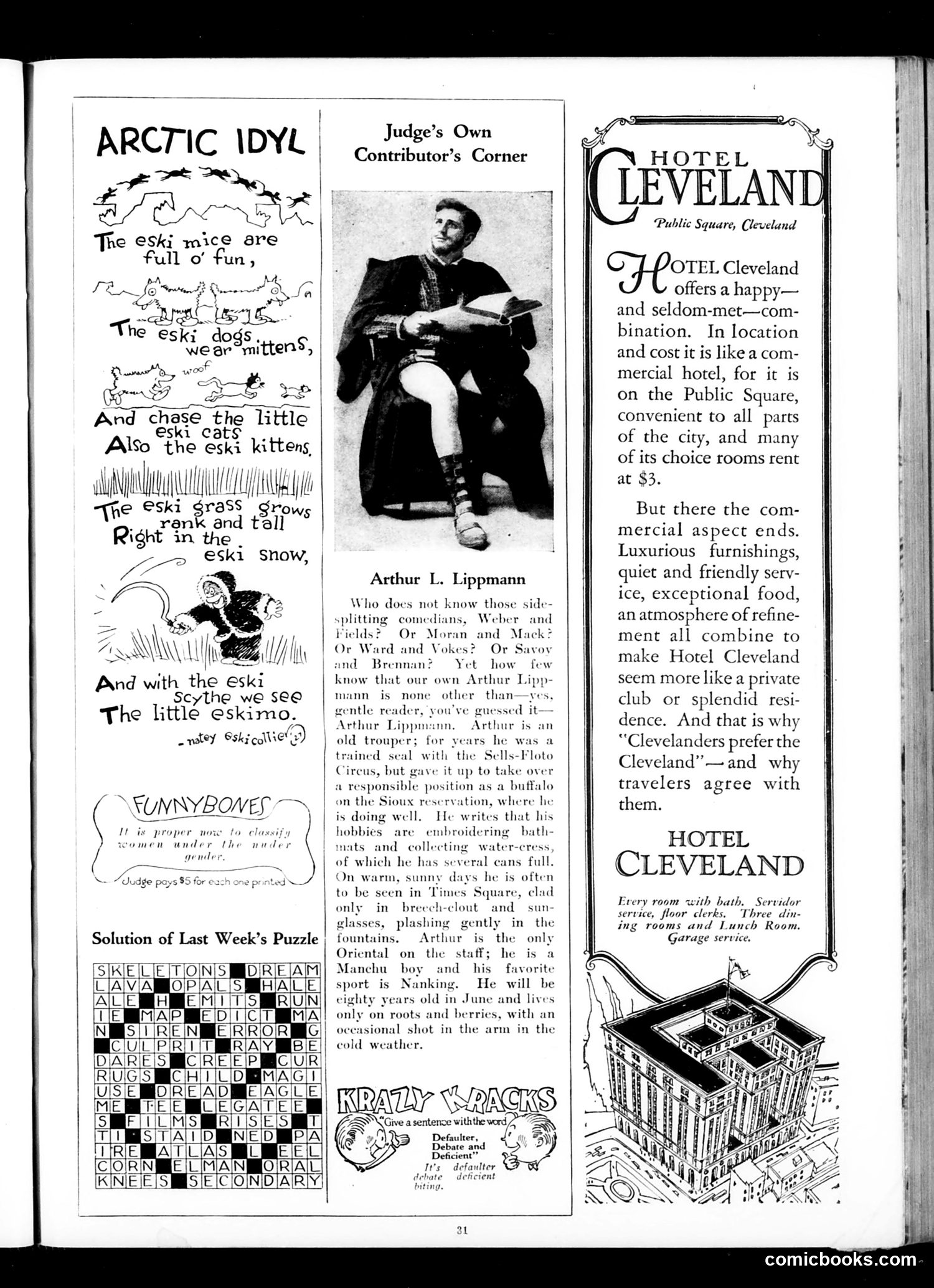
This page contains three distinct elements: **"Arctic Idyl"** (left) is a whimsical poem about Eskimo life, illustrated with simple drawings of arctic animals and an Inuit figure. It's lighthearted verse celebrating the Arctic environment—not political satire. **"Judge's Own Contributor's Corner"** (center) profiles Arthur L. Lippmann with obvious comedic fabrication. The text absurdly claims he's an "Oriental" Manchu boy who's eighty years old, works as a buffalo handler, and frequently sits half-naked in Times Square fountains. This appears to be satirical roasting of a magazine contributor through exaggerated, surreal biographical claims—typical of Judge's in-house humor. **Hotel Cleveland Advertisement** (right) is straightforward commercial copy promoting the Cleveland hotel's combination of affordability ($3 rooms) and luxury amenities. The page is primarily **advertising and light entertainment** rather than political commentary. The Lippmann piece uses absurdist humor typical of early 20th-century satirical magazines.
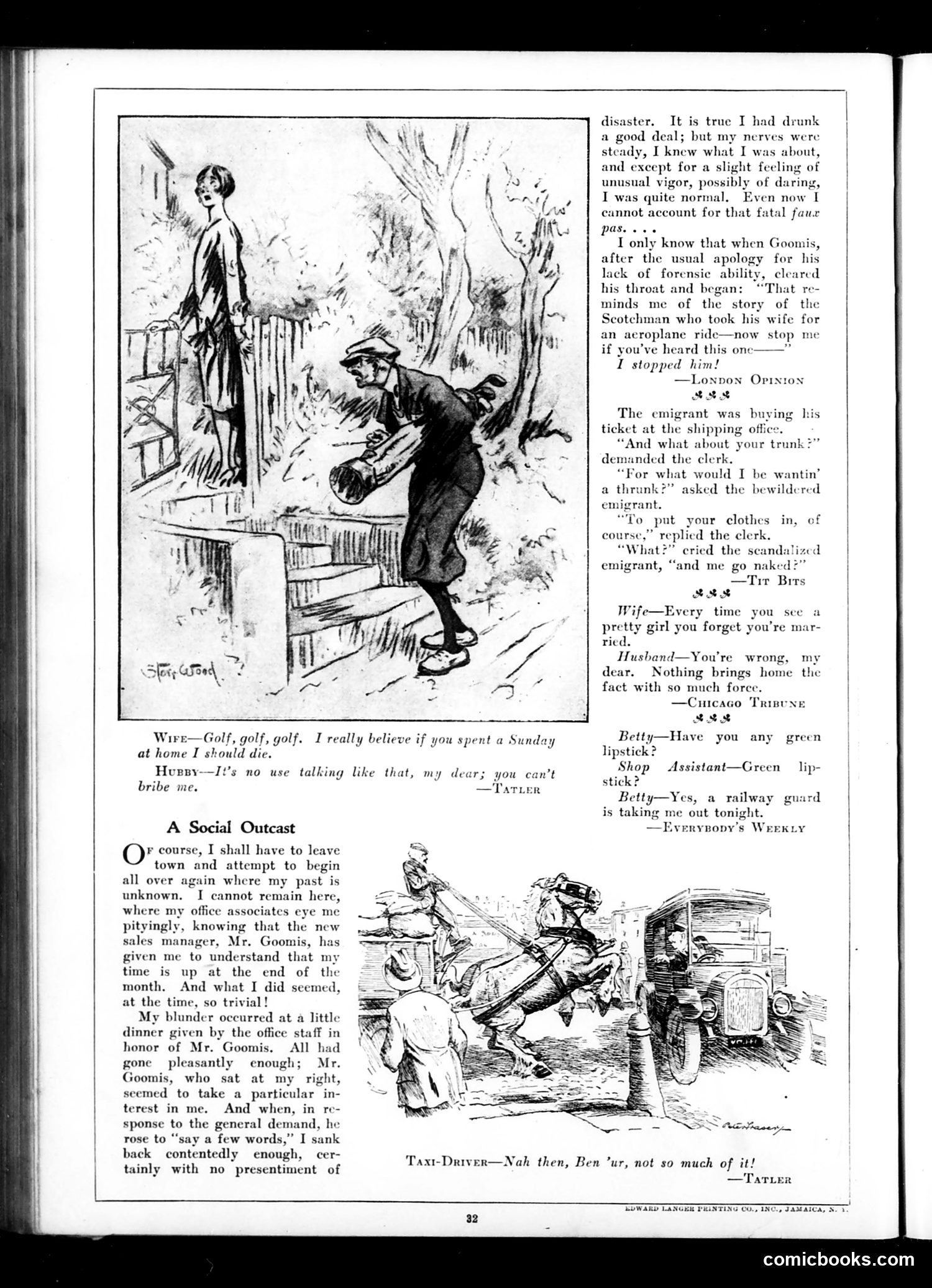
This page presents a humorous cautionary tale about workplace social dynamics. The main story describes a man who commits a fatal career mistake at a dinner honoring his new sales manager, Mr. Goomis. When Goomis begins telling a well-known story (about a Scotsman taking his wife on an airplane ride), the protagonist rudely interrupts him mid-sentence with "I stopped him!"—a breach of social etiquette that costs him his job. The satire mocks both rigid office hierarchies and the unwritten rules of social performance in corporate settings. The man must now leave town to escape the shame and stigma of having publicly disrespected his superior, making him a "social outcast" despite the triviality of his offense. The page includes additional brief comedic vignettes about marriage, emigration, and taxi drivers, typical of Judge's miscellaneous humor format.
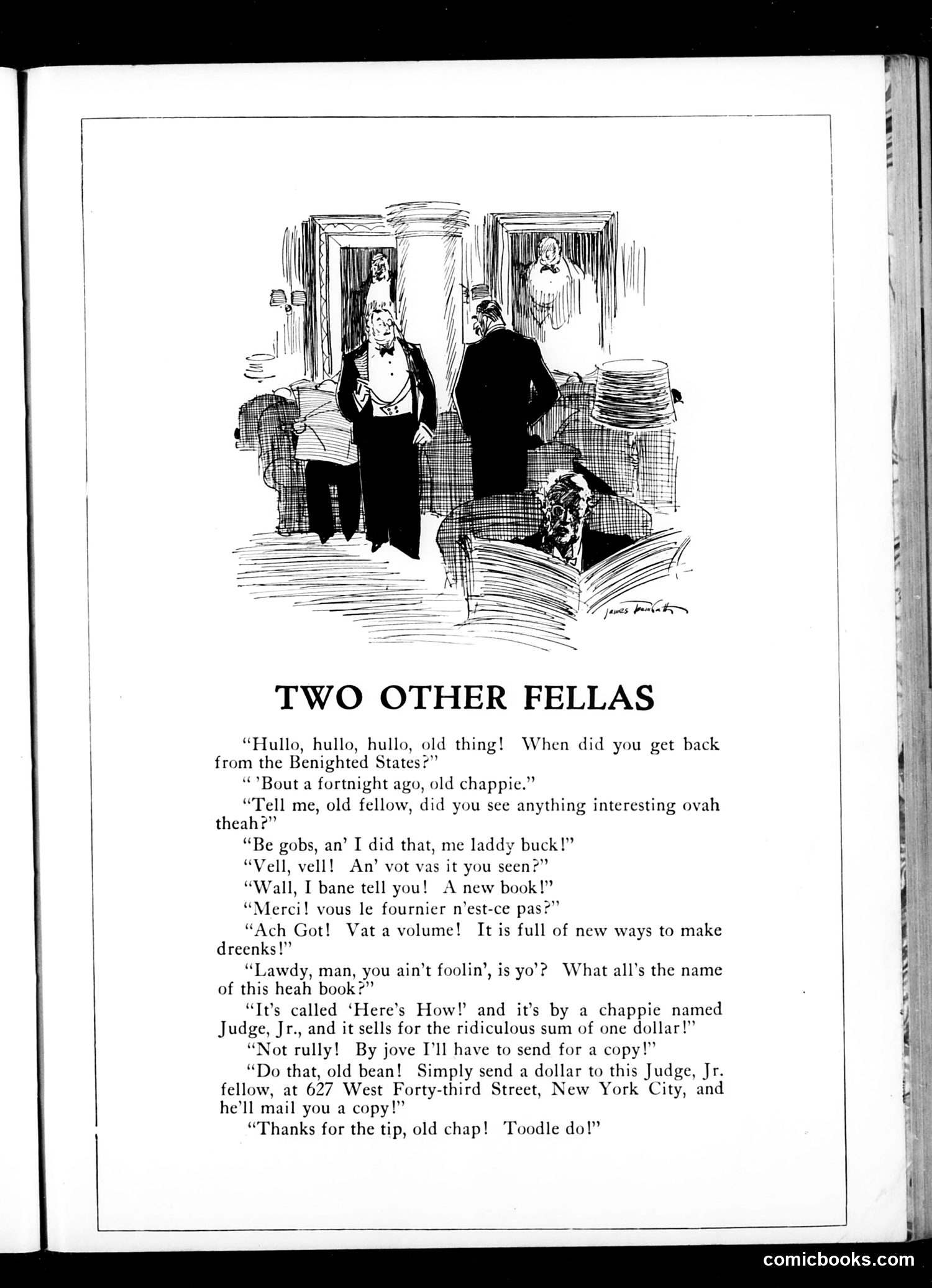
This is an advertisement disguised as comic dialogue, promoting a book called *"Here's How!"* by Judge, Jr. The sketch depicts two men with exaggerated foreign accents (British, Irish, French, German, and African American vernacular) meeting and enthusiastically discussing the book's merits, particularly its collection of cocktail recipes ("new ways to make dreinks"). The satire likely targets both prohibition-era drinking culture and the magazine's own promotional tactics. By having characters speak in broad, comedic ethnic/regional dialects, the piece mocks different social groups while simultaneously hawking the book at $1.00, with ordering instructions to an actual New York City address. The humor relies on period stereotypes and the transparent sales pitch masquerading as genuine conversation between friends discovering a "marvelous" new volume.
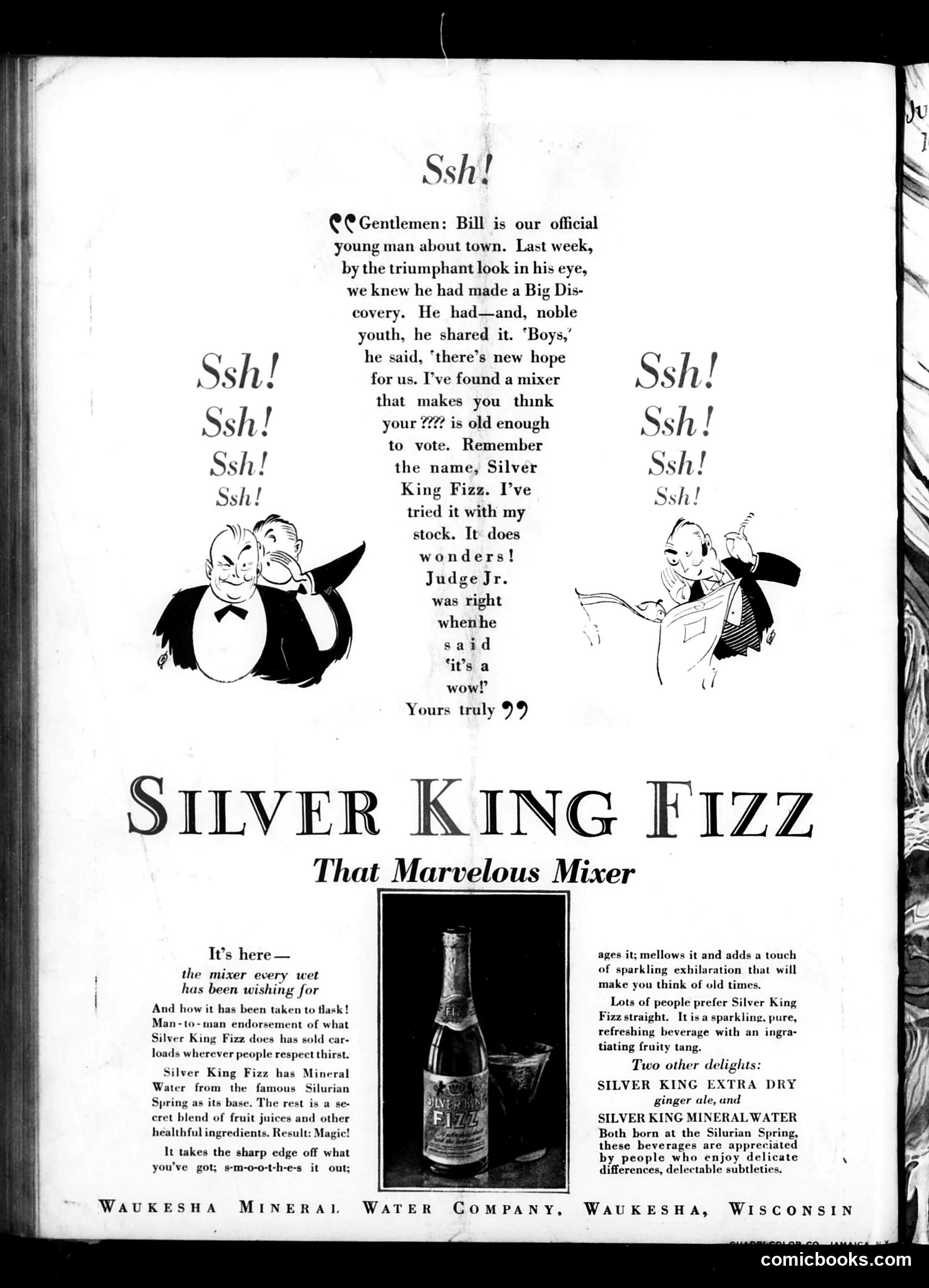
This is primarily a **product advertisement** disguised as editorial content, employing Prohibition-era humor. The cartoon depicts "Bill," Judge magazine's society columnist character, who has "discovered" Silver King Fizz—a mixer. The repeated "Ssh!" sounds signal secrecy, mocking Prohibition (1920-1933), when alcohol was illegal. The joke is that Bill presents this innocent-sounding "mixer" to fellow drinkers as a way to make their homemade or illicit alcohol ("your ???") palatable and seem "old enough to vote"—meaning drinkable. The advertisement presents Silver King Fizz as a legitimate mineral water and mixer from Wisconsin, but the satirical framing winks at readers that its *real* purpose is improving bootleg liquor. This was common advertising strategy during Prohibition: manufacturers sold "mixers" and "tonics" while publicly denying they were for alcoholic beverages. The "wow!" reference and enthusiastic testimonials reinforce the insider joke among readers who understood Prohibition's widespread violation.