
Judge, 1927-07-23 · page 15 of 36
Judge — July 23, 1927 — page 15: what you’re looking at
What you’re looking at
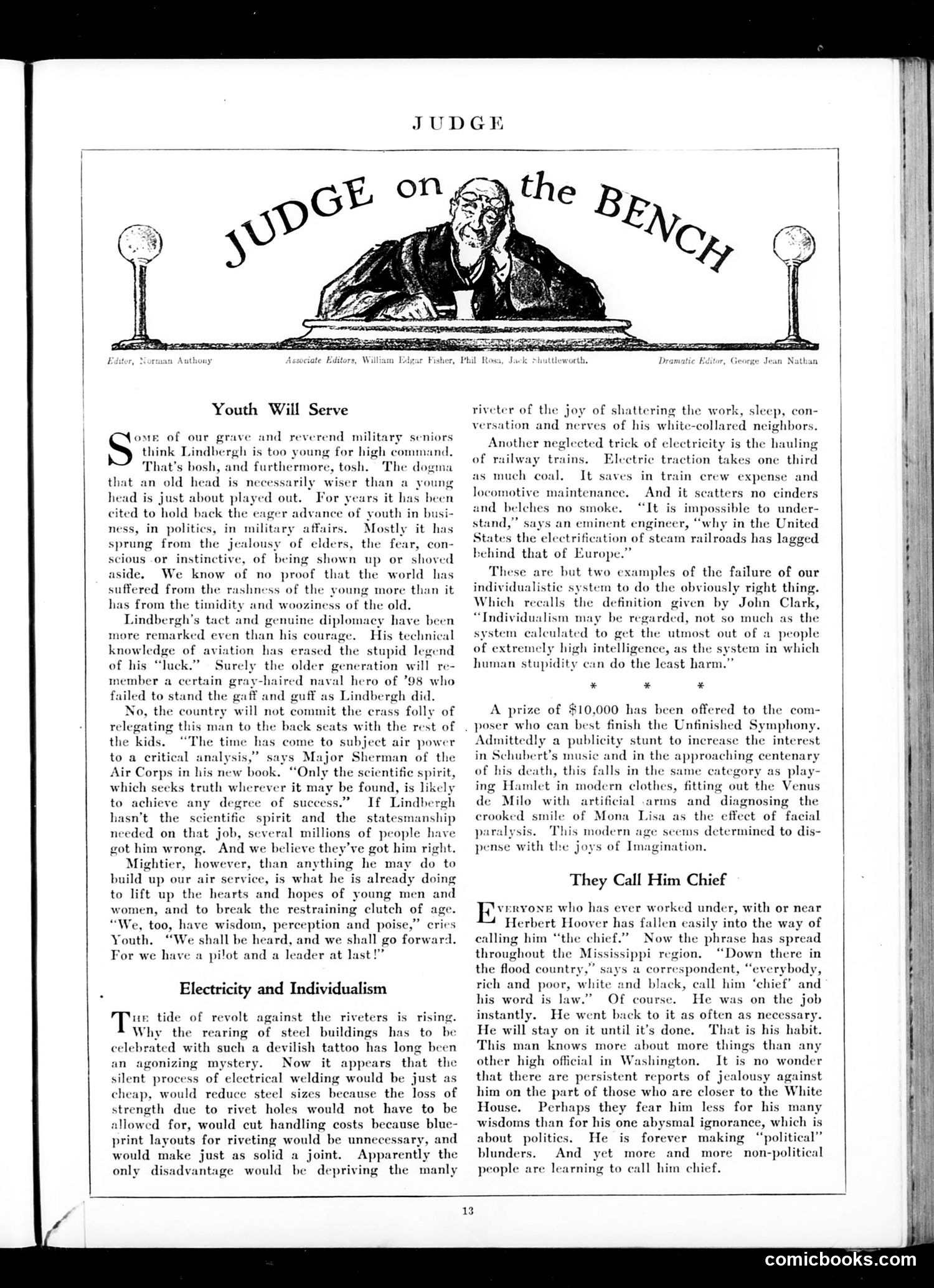
This page from Judge magazine (likely 1920s-30s based on references) contains three opinion pieces defending progressive modernization against conservative resistance. **"Youth Will Serve"** defends Charles Lindbergh's fitness for high military command despite his youth, arguing age doesn't guarantee wisdom. The piece attacks older generations' self-interested resistance to youth advancement and praises Lindbergh's diplomatic skill and aviation expertise. **"Electricity and Individualism"** critiques America's slow adoption of electrical technology in riveting and railroad electrification compared to Europe. It argues individualism—defined as a system where "human stupidity can do the least harm"—prevents obviously beneficial innovations simply because they threaten workers' jobs (riveting noise, train crew employment). **"They Call Him Chief"** (partially visible) discusses Herbert Hoover's popularity and influence, suggesting his non-political wisdom commands respect across regions. The satire targets conservative resistance to technological progress and youth leadership, framing such resistance as selfish nostalgia rather than rational policy.
📄 Transcribed text from this page (OCR, searchable)
Machine-transcribed from the original scan — historical spelling and the odd misread are preserved.
JUDGE Youth Will Serve ome of our grave and reverend military seniors S think Lindbergh is too young for high command. That's bosh, and furthermore, tosh. The dogma that an old head is necessarily wiser than a young head is just about played out. For years it has been cited to hold back the eager advance of youth in busi- ness, in politics, in military affairs. Mostly it has sprung from the j of elders, the fear, con- scious or instinctive, of being shown up or shoved aside. We know of no proof that the suffered from the rashness of the young more than it has from the timidity and wooziness of the old. Lindbergh’s tact and genuine diplomacy have been more remarked even than his courage. His technical knowledge of aviation has erased the stupid legend of his “luck.” Surely the older generation will re- member a certain gray-haired naval hero of ’98 who failed to stand the gaff and guff as Lindbergh did. No, the country will not commit the crass folly of relegating this man to the back seats with the rest of the kids. “The time has come to subject air power to a critical analysis,” says Major Sherman of the Air Corps in his new book. “Only the scientific spirit, which seeks truth wherever it may be found, is likely to achieve any degree of success.” If Lindhergh hasn't the scientific spirit and the statesmanship needed on that job, several millions of people have got him wrong. And we believe they’ve got him right. Mightier, however, than anything he may do to build up our air service, is what he is already doing to lift up the hearts and hopes of young men and women, and to break the restraining clutch of age. “We, too, have wisdom, perception and poise,” cries Youth, ‘We shall be heard, and we shall go forward. For we have a pilot and a leader at last!” lousy world has Electricity and Individualism of revolt against the riveters is rising. Pe tide Why the rearing of steel buildings has to be celebrated with such a devilish tattoo has long been an agonizing mystery. Now it appears that the silent process of electrical welding would be just as cheap, would reduce steel sizes because the loss of strength due to rivet holes would not have to be allowed for, would cut handling costs because blue- print layouts for riveting would be unnecessary, and would make just as solid a joint. Apparently the only disadvantage would be depriving the manly riveter of the joy of shattering the work, sleep, con- versation and nerves of his white-collared neighbors. Another neglected trick of electricity is the hauling of railway trains. Electric traction takes one third It saves in train crew and And it scatters no cinders “It is impossible to under- san eminent engineer, “why in the United States the electrification of steam railroads has lagged behind that of Europe.” as much coal, expense locomotive maintenance. and belches no smoke. stand,” s These are but two examples of the failure of our individualistic system to do the obviously right thing. Which recalls the definition given by John Clark, “Individualism may be regarded, not so inuch as the system calculated to get the utmost out of a people of extremely high intelligence, as the system in which human stupidity can do the least harm.” * * * A prize of $10,000 has been offered to the com- poser who can best finish the Unfinished Symphony. Admittedly a publicity stunt to increase the interest in Schubert's music and in the approaching centenary of his death, this falls in the same category as pla ing Hamlet in modern clothes, fitting out the Venus de Milo with artificial .arms and diagnosing the crooked smile of Mona Lisa as the effect of facial This modern age seems determined to dis- pense with the joys of Imagination. paralysis. They Call Him Chief EK ERYONE who has ever worked under, with or near Herbert Hoover has fallen easily into the way of calling him “the chief.” Now the phrase has spread throughout the Mississippi region. “Down there in the flood country,” says a correspondent, rich and poor, white and black, call him ‘chief’ and word is law.” Of course. He was on the job instantly. He went back to it as often as necessary. He will stay on it until it’s done. That is his habit. This man knows more about more things than any other high official in Washington. It is no wonder that the e persistent reports of jealousy against him on the part of those who are closer to the White House. Perhaps they fear him less for his many wisdoms than for his one abysmal ignorance, which is about politics. He is forever making ‘political’ blunders. And yet more and more non-political people are learning to call him chief. “everybody, comicbooks.com