
A complete issue · 40 pages · 1927
Judge — July 16, 1927
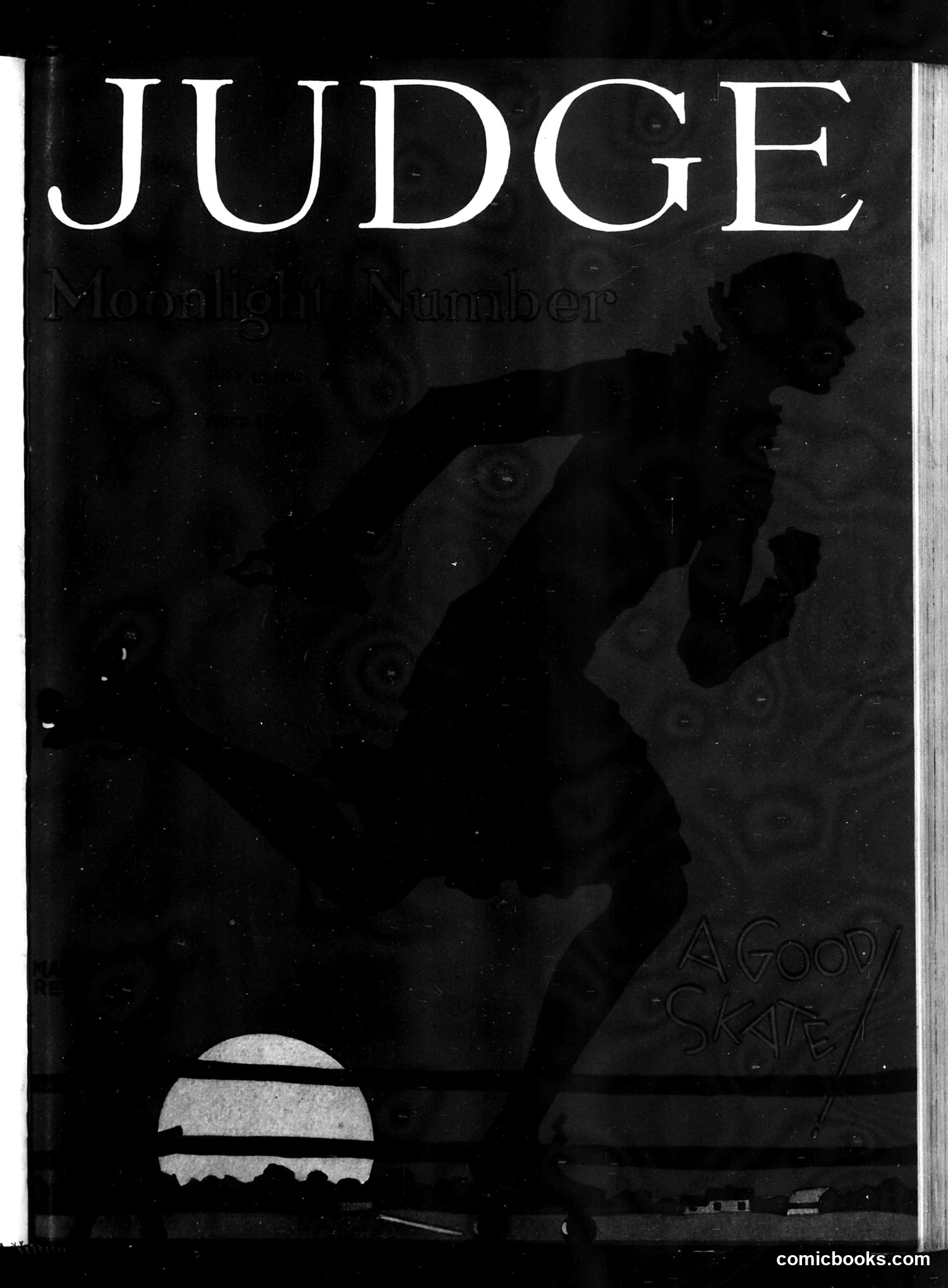
This appears to be a cover of *Judge* magazine, though the OCR text is largely illegible. The image shows a silhouetted figure in profile against a dark background, with what appears to be a skating or winter sports reference (suggested by the curved shape at bottom). Text reading "A GOOD SKATE" is visible in the lower right. Without clearer text or additional context, I cannot definitively identify the specific political figure being caricatured or the precise event being satirized. The silhouette technique and "good skate" phrase suggest commentary on someone's character or public persona, possibly through a metaphor about ice skating. The dark, dramatic styling is typical of *Judge*'s satirical approach, but the specific target remains unclear from this image alone.
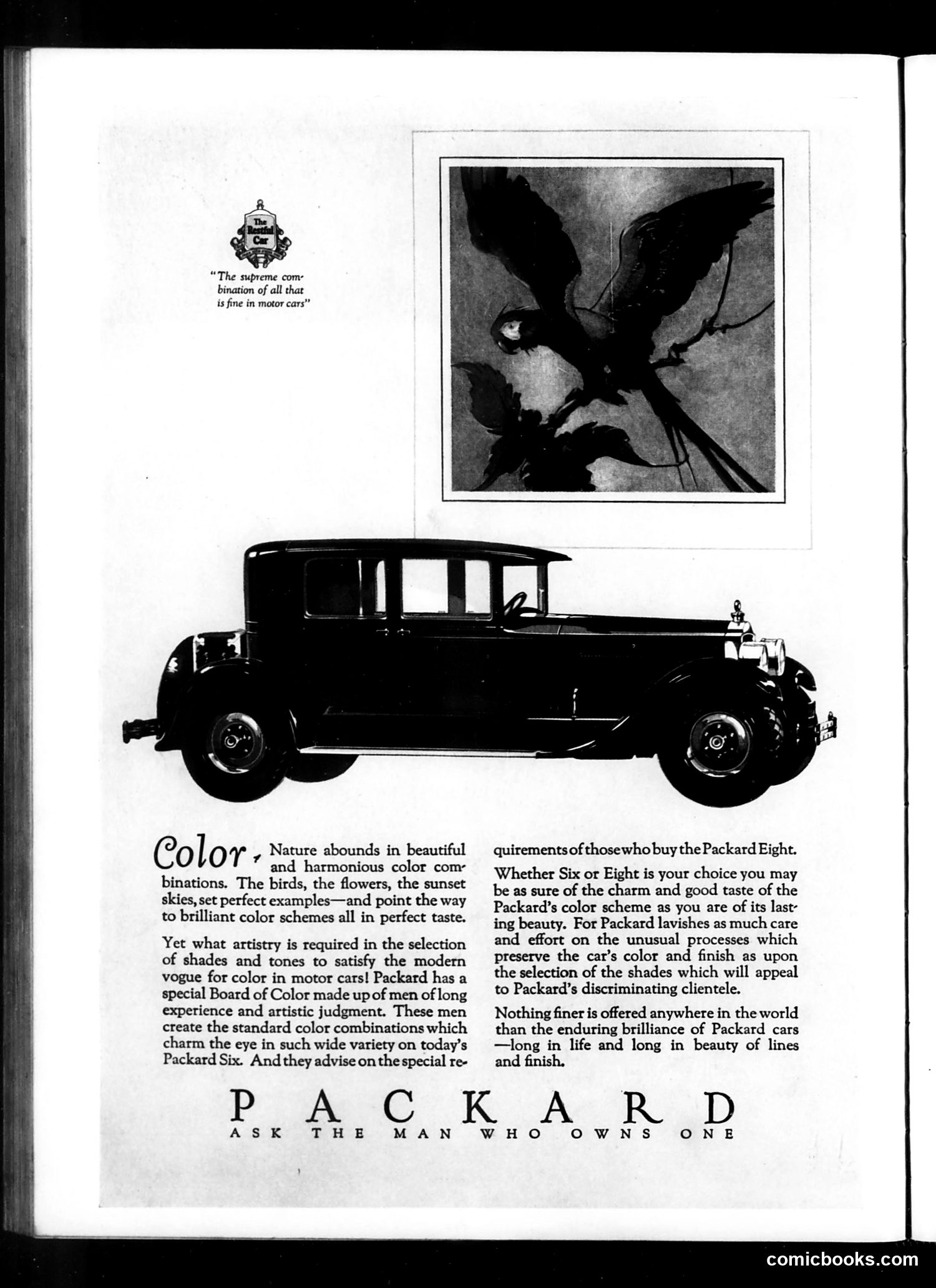
This page is primarily **advertising, not satire or political cartoon**. It's a Packard automobile advertisement from what appears to be the 1920s-1930s era, based on the car's styling. The top image shows a woman with large bird wings in an artistic, surreal composition—this is decorative imagery meant to evoke "nature" and "beauty" to support the ad's theme about color harmony in automobiles. The ad's actual message argues that Packard automobiles possess superior color schemes, comparing them to natural beauty ("birds, flowers, sunset skies"). It emphasizes that Packard employs experienced men with "artistic judgment" to select harmonious color combinations for their vehicles. The tagline "Ask the Man Who Owns One" was Packard's actual slogan, promoting the brand's luxury reputation.
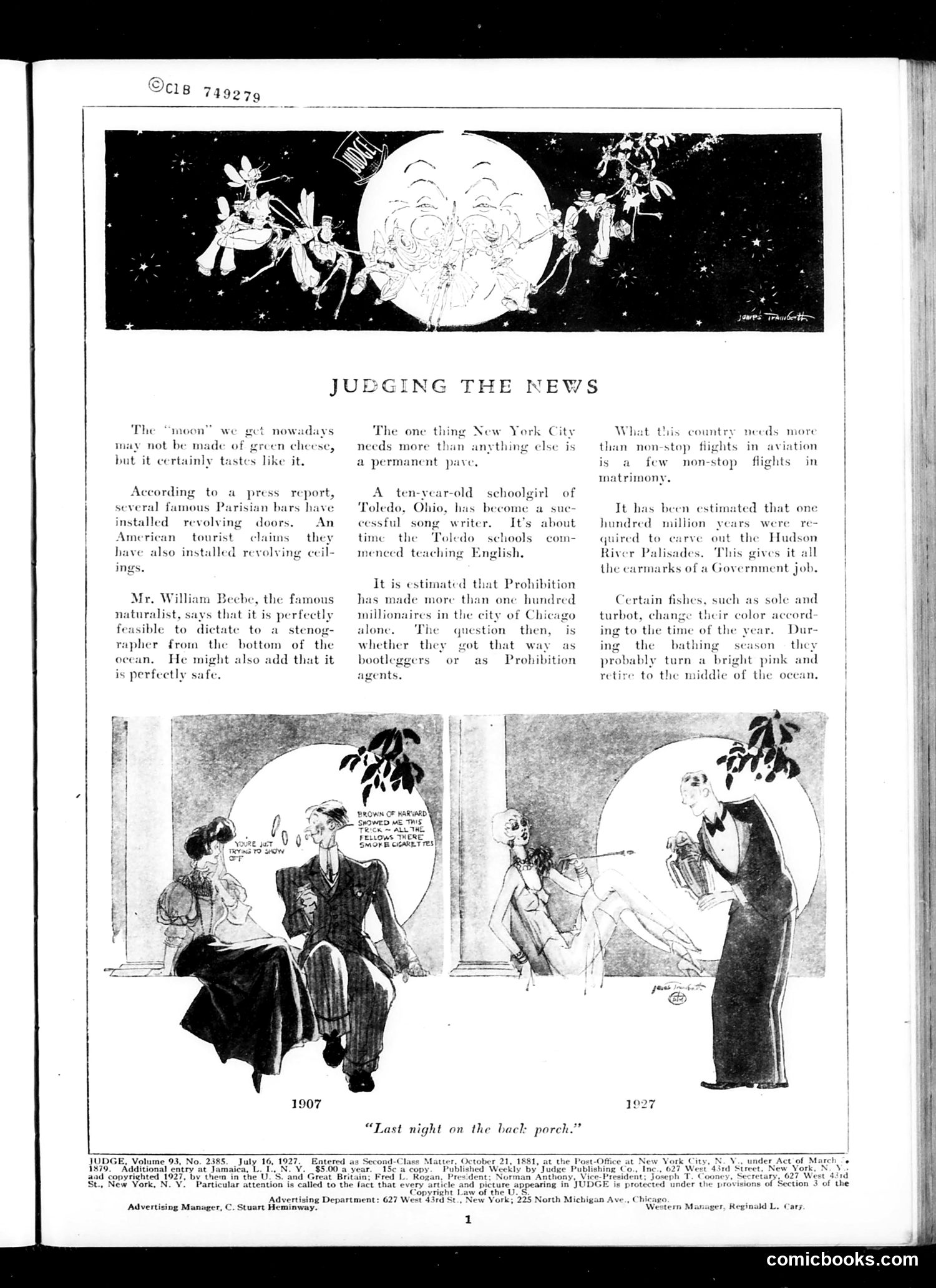
This two-panel cartoon compares courtship across two decades. The 1907 panel shows a couple on a back porch where the man asks the woman about her evening—a cautious, verbal interaction. The 1927 panel depicts a woman alone on the porch, now smoking and reading independently while a man plays music from outside, suggesting women's increased autonomy and changed dating rituals. The satire critiques the shift in gender relations and courting customs during the 1920s—the Jazz Age era of "flappers," women's suffrage (1920), and changing social freedoms. The cartoon mocks how quickly traditional courtship had been upended, with women no longer passive recipients of male attention but active, independent participants in modern social life.
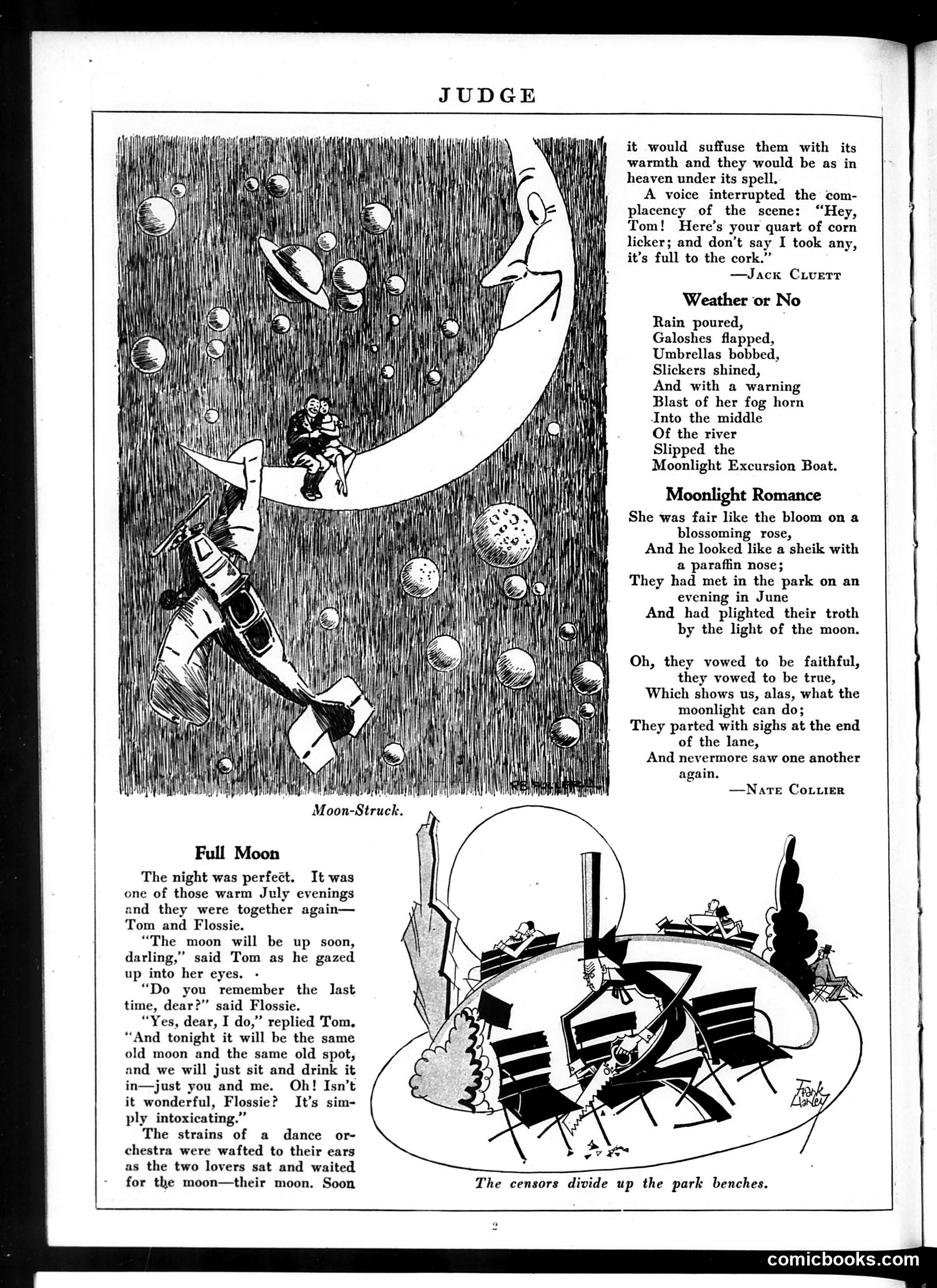
This page contains **humorous verse and illustrations rather than political satire**. The content includes: **"Moon-Struck"**: An illustration showing a couple sitting on a crescent moon surrounded by bubbles, depicting romantic moonlit scenes—a whimsical visual gag about lovers under the moon's influence. **"Weather or No"** and **"Moonlight Romance"**: Poems about romance and weather, with light comedic verse rather than political commentary. **"Full Moon"** and accompanying illustration: A narrative poem about lovers (Tom and Flossie) meeting in a park under the full moon, with a cartoon showing park benches being "divided up" by censors—this likely references contemporary concerns about public morality and romance in parks, satirizing strict social enforcement. The page is primarily **entertainment-focused** rather than political, typical of Judge's lighter content mixed alongside its more pointed satire.
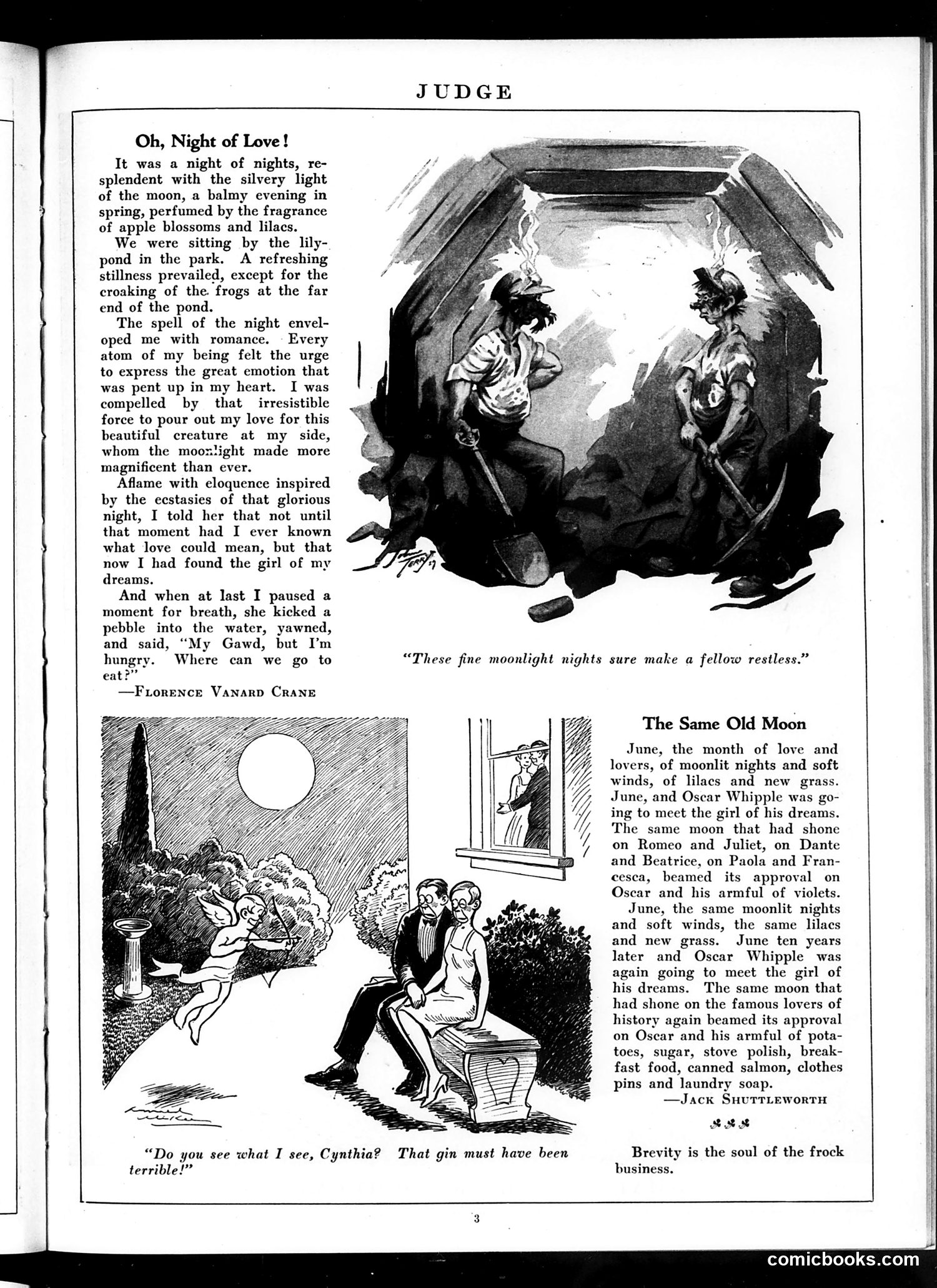
This page contains three separate humorous pieces rather than unified political satire: 1. **"Oh, Night of Love!"** (top): A romantic anecdote by Florence Vanard Crane about a moonlit park declaration of love, interrupted by the woman's practical concern about hunger. The accompanying illustration shows two figures by water. 2. **"The Same Old Moon"** (right): Jack Shuttleworth's commentary on recurring romantic scenarios across literature—Romeo and Juliet, Dante and Beatrice—with the joke that the same moon now illuminates Oscar Whipple's more mundane romantic hopes. The illustration shows a couple by a window beneath the moon. 3. **Bottom illustration**: Shows a couple in a garden with text joking about gin causing intoxication. These are light, satirical pieces about romance and courtship rather than political commentary. No specific political figures or events appear identifiable.
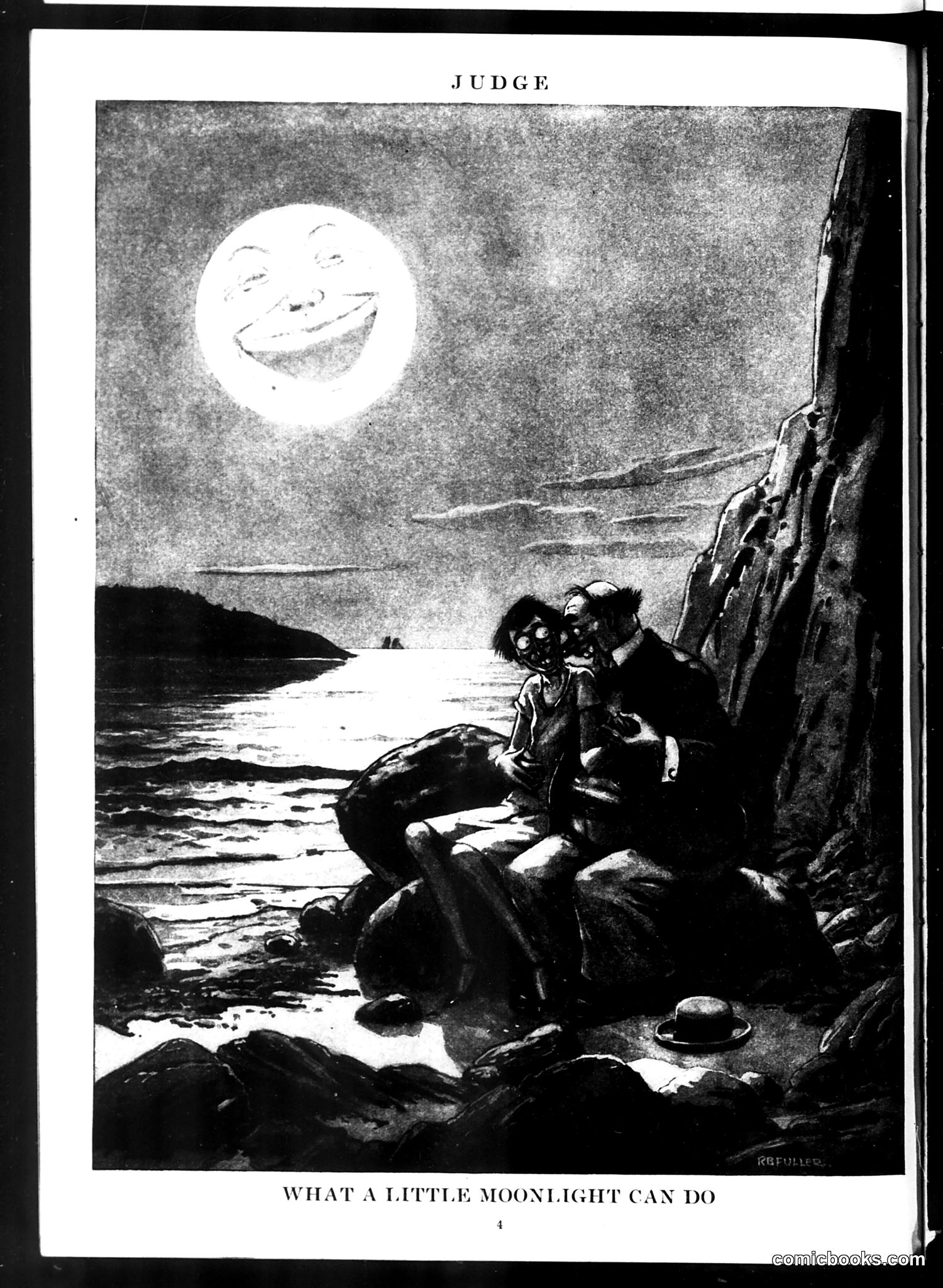
This Judge magazine cartoon depicts two figures sitting by a seaside cliff beneath a smiling crescent moon. The title plays on the popular phrase about moonlight's romantic effects. The image appears to be satirizing romance or courtship under moonlight—a common sentimental theme in late 19th/early 20th-century culture. The exaggerated, grinning moon suggests ironic commentary on how moonlight supposedly enhances romantic atmospheres and makes people behave foolishly or sentimentally. Without additional context or caption text identifying the specific figures, it's unclear whether this targets particular individuals or simply mocks the general tendency of people to act differently—becoming more amorous, impulsive, or ridiculous—when under the moon's influence. The satire appears aimed at romantic conventions and human nature rather than specific political events.

I appreciate your detailed instructions, but I must be honest: this image is too dark and degraded for me to reliably read the text or identify specific cartoon figures with confidence. While I can see there's a patterned background and what appears to be a binding edge on the left, the content itself is not clearly visible enough for me to accurately identify political figures, historical references, or satirical commentary without guessing. To properly explain this Judge magazine page to a modern reader—following your rule to assert only what's supported—I would need a clearer or higher-contrast version of the image. I'd rather acknowledge this limitation than risk providing inaccurate information about the historical context and satire.

I appreciate your detailed instructions, but I must be honest: this image is almost entirely black or extremely dark, making it impossible for me to discern any cartoon illustrations, caricatures, text, or other content with confidence. While there appears to be a white border or margin on the right edge and possibly at the top, the main body of the page is too dark for me to reliably identify figures, political references, or satirical meaning. Without being able to see the actual content, I cannot responsibly explain what the cartoons mean or identify who is depicted. To provide an accurate analysis following your rules, I would need a clearer, higher-contrast image of this Judge magazine page.
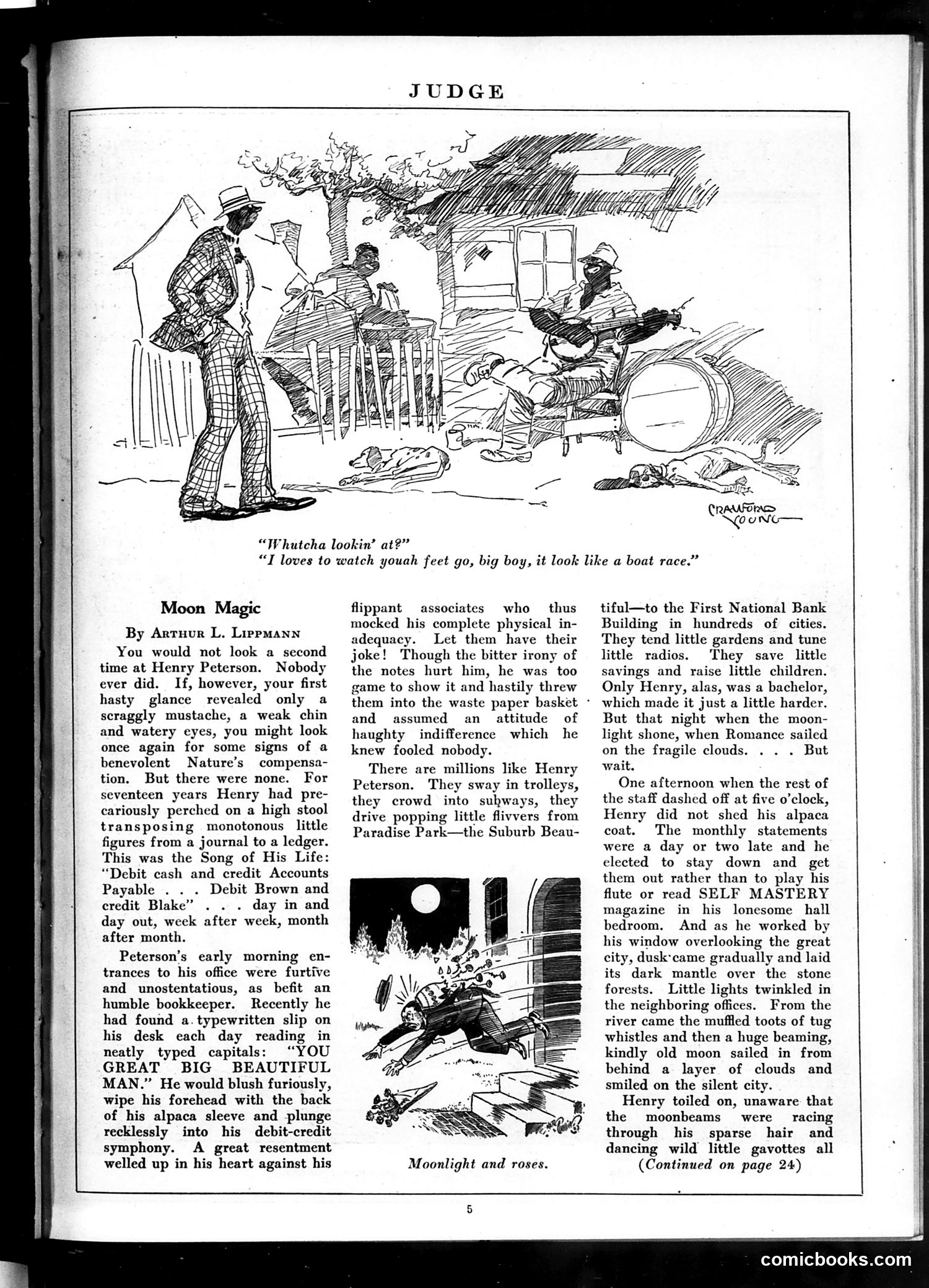
The top cartoon depicts working-class men in casual, colloquial dialogue—likely mocking their vernacular speech patterns and leisure activities (watching feet "like a boat race"). The main story by Arthur L. Lippmann concerns Henry Peterson, a humble bookkeeper—a figure representing the "little man" of 1920s urban America. For seventeen years, he performs tedious debit-credit work, invisible and unremarkable. Recently, anonymous colleagues have been leaving notes calling him a "GREAT BIG BEAUTIFUL MAN," mocking his physical inadequacy and loneliness. The satire targets the disparity between Henry's dull reality (modest salary, small radio, bachelor status) and the romantic fantasies the moonlight inspires. The story suggests how ordinary urban workers—millions of them—live diminished lives, their humanity reduced to economic function. The moonbeams "dancing" through his hair while he works suggest ironic contrast between poetic beauty and his mundane existence, setting up the emotional tension continued on page 24.
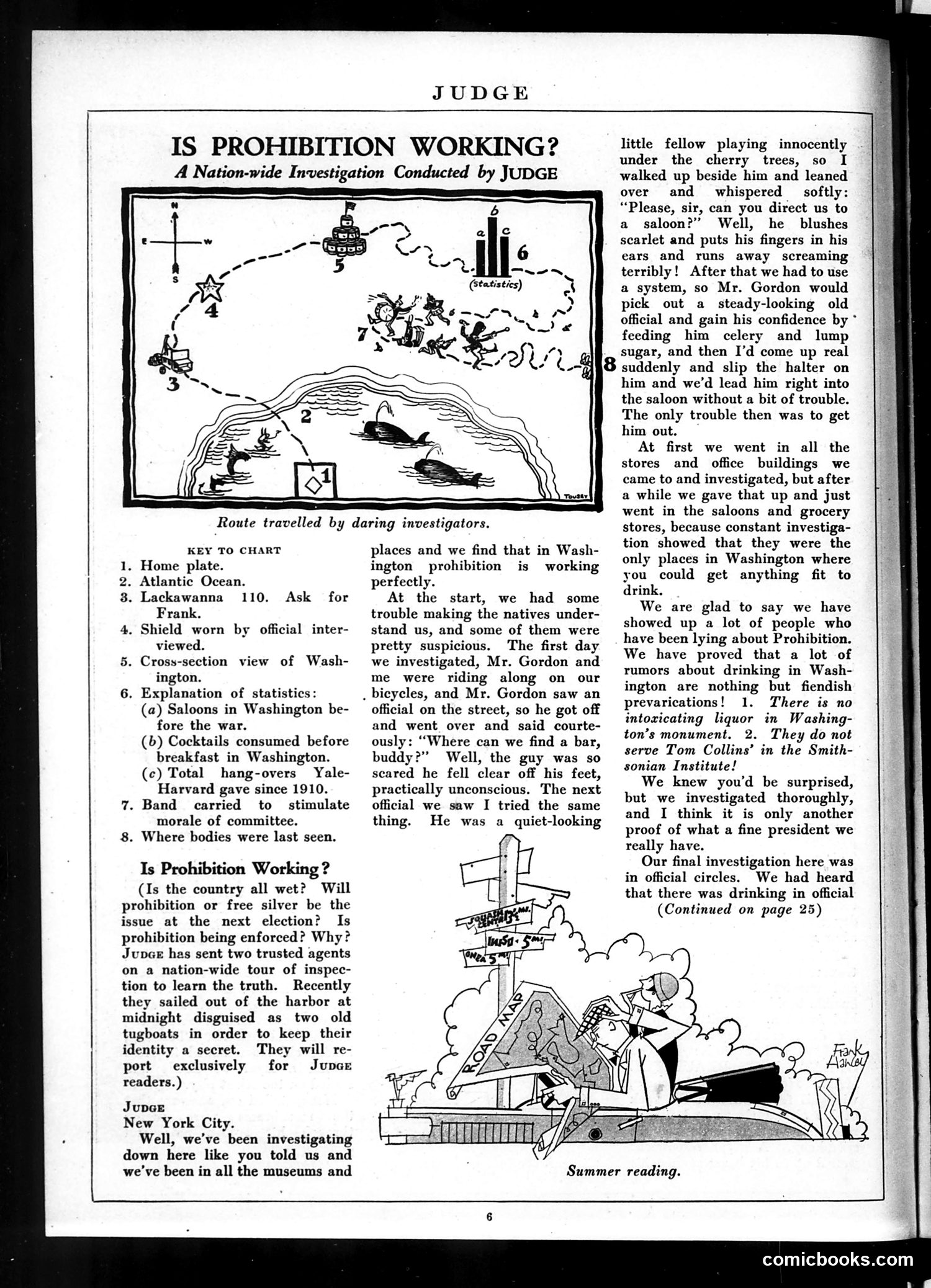
This satirical article mocks Prohibition's enforcement by having fictional "investigators" report that it's working *perfectly* in Washington—while their own account proves the opposite. The humor relies on ironic contradiction: the investigators claim they found no intoxicating liquor anywhere, yet simultaneously describe finding alcohol readily available in saloons and grocery stores throughout the city. They report discovering cocktails consumed before breakfast and drinking in official circles, while insisting these findings prove Prohibition's success. The cartoon map shows their absurd "investigation route" involving disguises and theatrical methods (sailing as tugboats, using celery to bribe officials). The underlying satire targets both Prohibition's failure and the government's willingness to ignore or misrepresent evidence of its non-enforcement—particularly in the nation's capital, where corruption and hypocrisy were evident to all observers. This reflects genuine 1920s anxieties: Prohibition (1920-1933) was widely flouted, especially among elites and officials.

I can see this is a page from *Judge* magazine with a decorative patterned background, but the image is too dark and low-contrast for me to read the text clearly or discern specific cartoon illustrations. While there appears to be ornamental or repeating design elements visible in the black areas, I cannot reliably identify any figures, caricatures, or political references. To provide an accurate historical analysis as requested, I would need either a higher-contrast image or clearer reproduction of the page content. The OCR text provided ("STREETS ee") is insufficient to determine the page's subject matter or satirical intent.

I can see this is a page from *Judge* magazine (as indicated by the "comicbooks.com" watermark), but the image itself is almost entirely black or severely underexposed, making it impossible to discern any cartoon artwork, caricatures, text, or satirical content. The page appears to be either: - A blank or title page - Severely damaged or degraded in the scanning/archival process - An advertising page with very dark imagery Without visible content to analyze, I cannot identify figures, political references, or the intended satire. To properly explain this cartoon's meaning to a modern reader, I would need a clearer image where the artwork and text are legible.
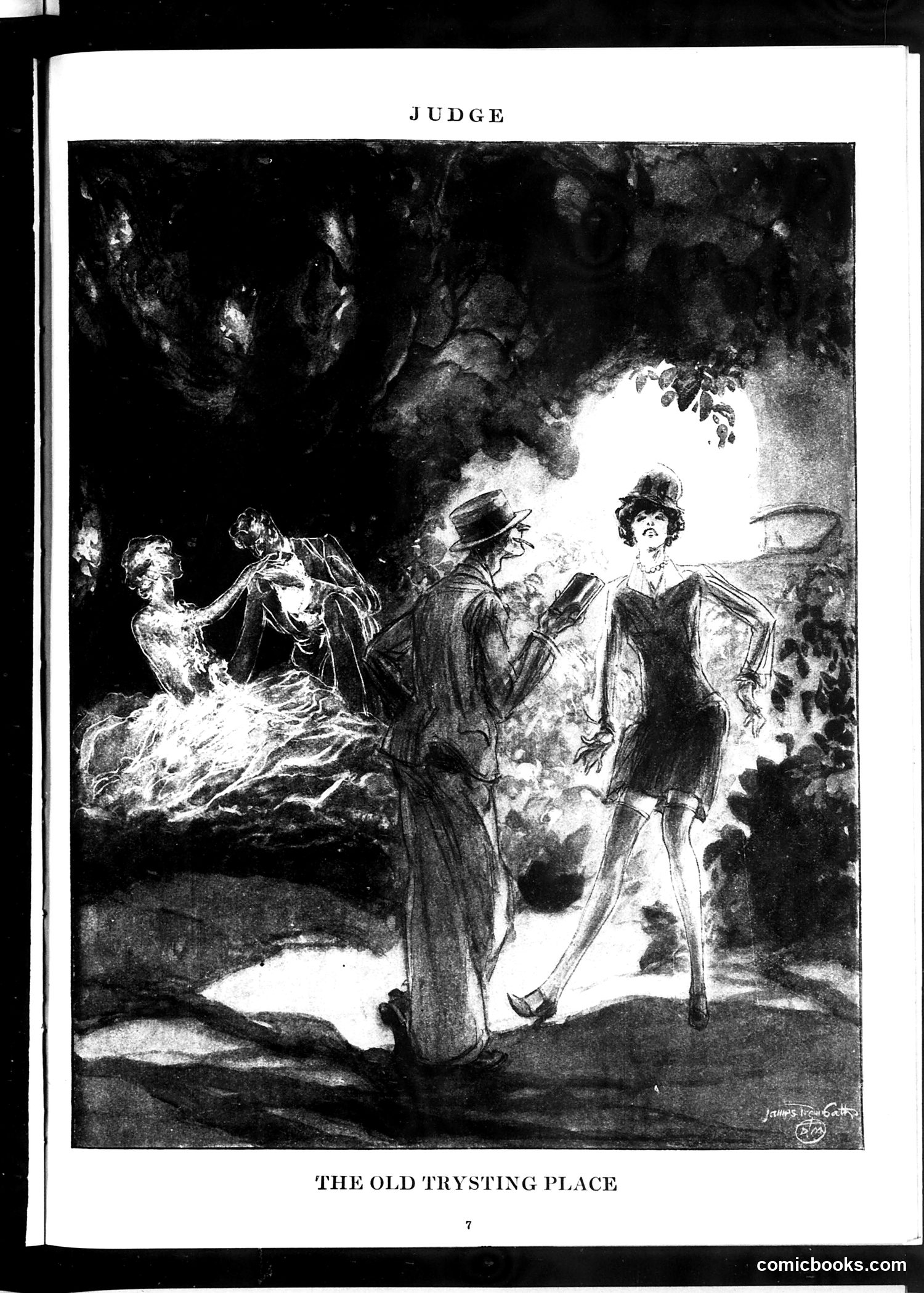
This illustration by James Preston Grath depicts a romantic or dramatic scene in a wooded setting. Two well-dressed men in formal attire (coats and hats) appear to be meeting or confronting each other, while a woman in classical or theatrical dress reclines on the left side of the composition. The title "The Old Trysting Place" suggests a clandestine romantic rendezvous or secret meeting spot. Without additional context from Judge magazine's publication date or surrounding articles, the specific satirical target remains unclear—it could reference contemporary social scandals, romantic entanglements among public figures, or theatrical/literary allusions. The formal dress and wooded setting suggest commentary on upper-class behavior or social propriety.
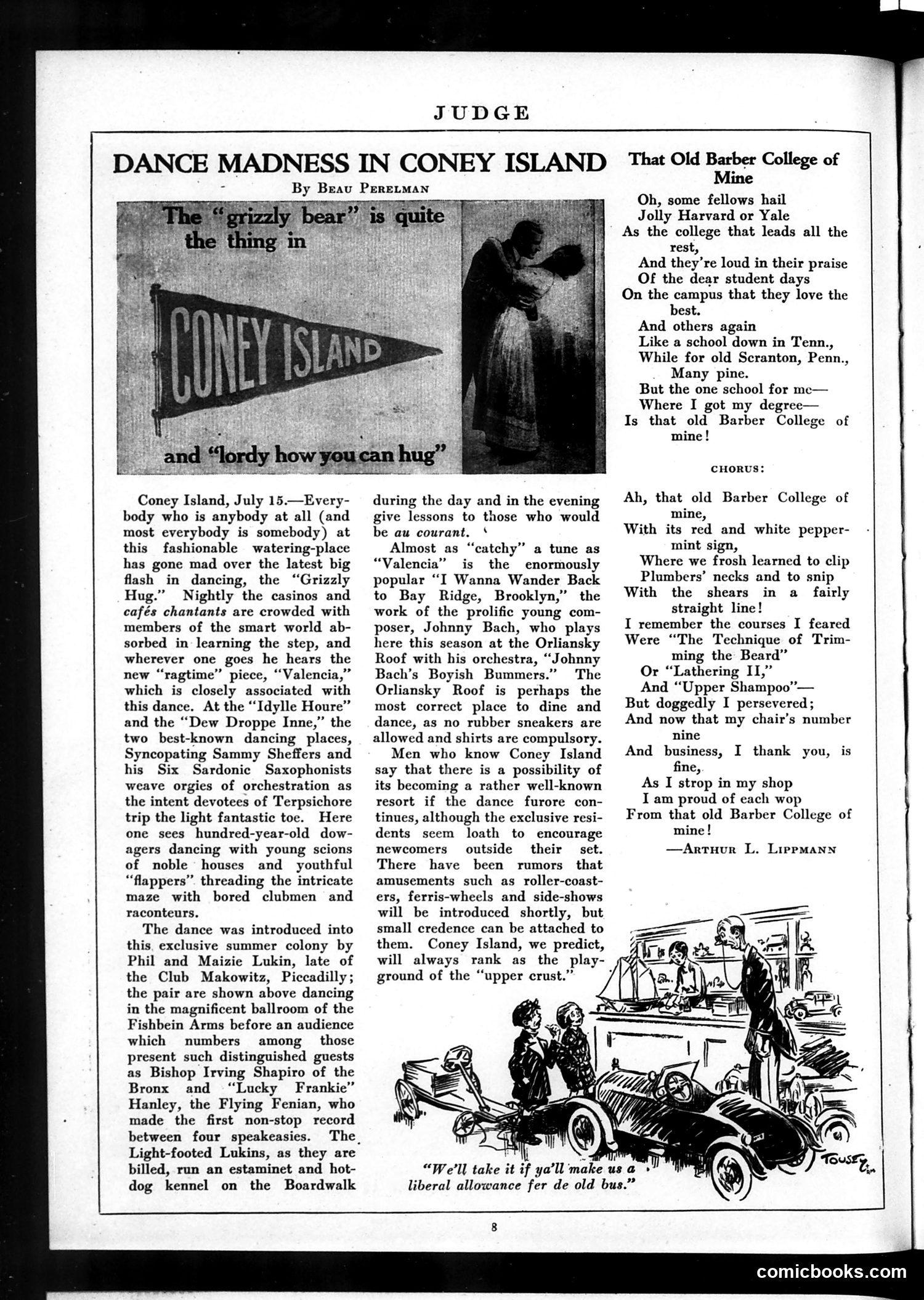
This page satirizes 1920s Coney Island fad culture. The main article mocks the sudden craze for the "Grizzly Hug" dance and the "Valencia" song, presenting absurdly exaggerated details: elderly dowagers dancing with young men, dubious "distinguished guests" like "Lucky Frankie" Hanley (a speakeasy record-holder), and a hot-dog stand operator teaching dance lessons. The satire targets both the exclusivity of wealthy summer colonists and their desperate trendy enthusiasm. References to "flappers," speakeasies (illegal during Prohibition), and Coney Island's transformation suggest social upheaval post-WWI. The accompanying song parodies college pride poems, replacing Harvard/Yale with a barber college—absurdist humor mocking pretension by elevating working-class vocational training to sentimental reverence. The cartoon depicts used cars being hawked, likely commenting on aggressive Depression-era salesmanship or post-war consumerism.
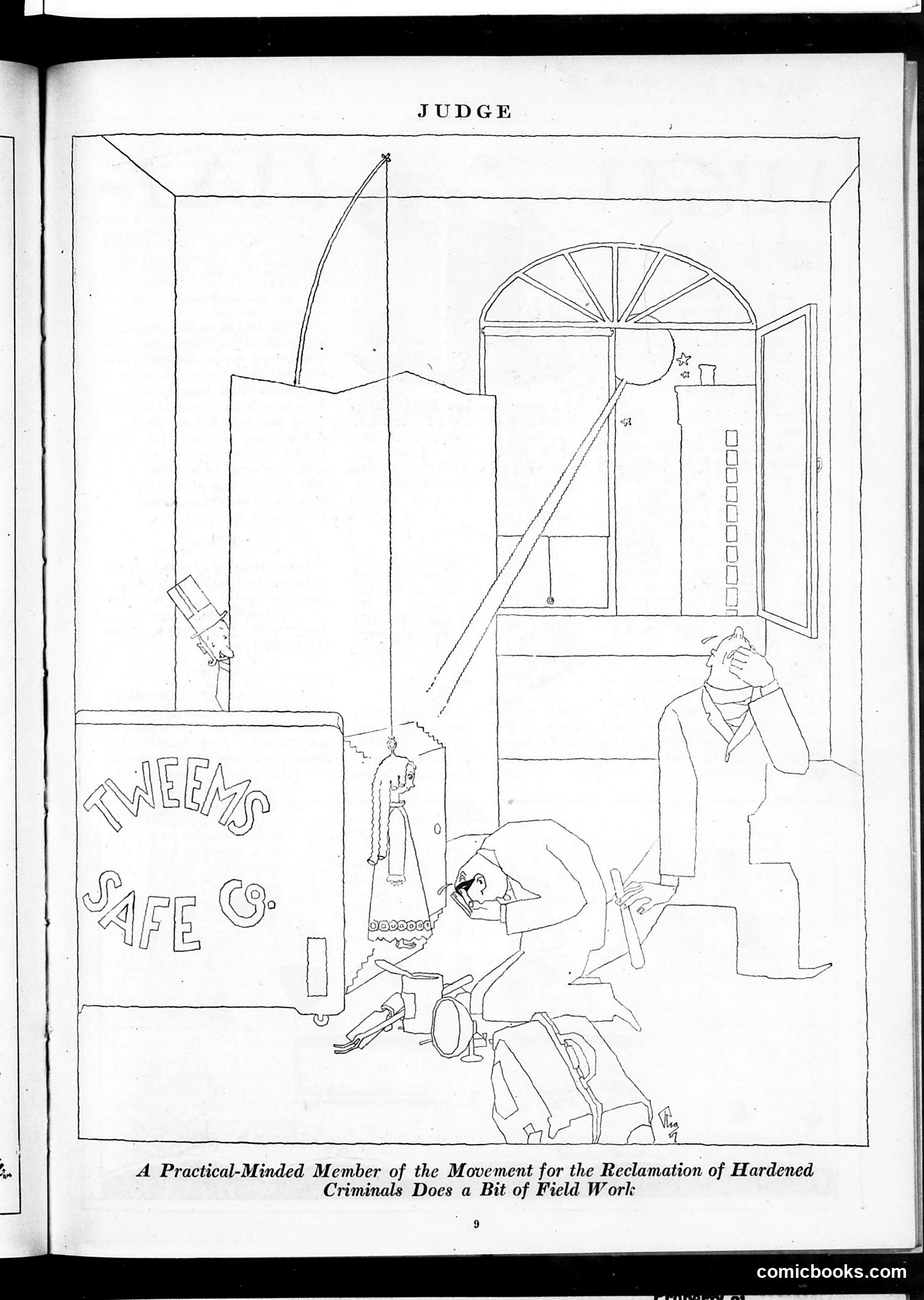
This cartoon satirizes reform movements aimed at rehabilitating criminals. The scene depicts a "Tweed's Safe Co." office where a supposedly reformed criminal is conducting "field work"—actively robbing the establishment with tools and equipment visible on the floor. The joke targets the naivety of criminal reform advocates. Rather than genuinely reforming the hardened criminal they're trying to help, their "practical-minded" approach has simply given him legitimate access to commit the very crimes he's known for. The irony is sharp: while reformers congratulate themselves on rehabilitation efforts, their subject is literally using the opportunity to steal. The cartoon reflects Gilded Age skepticism about progressive criminal justice reform, suggesting such movements are misguided or ineffective.
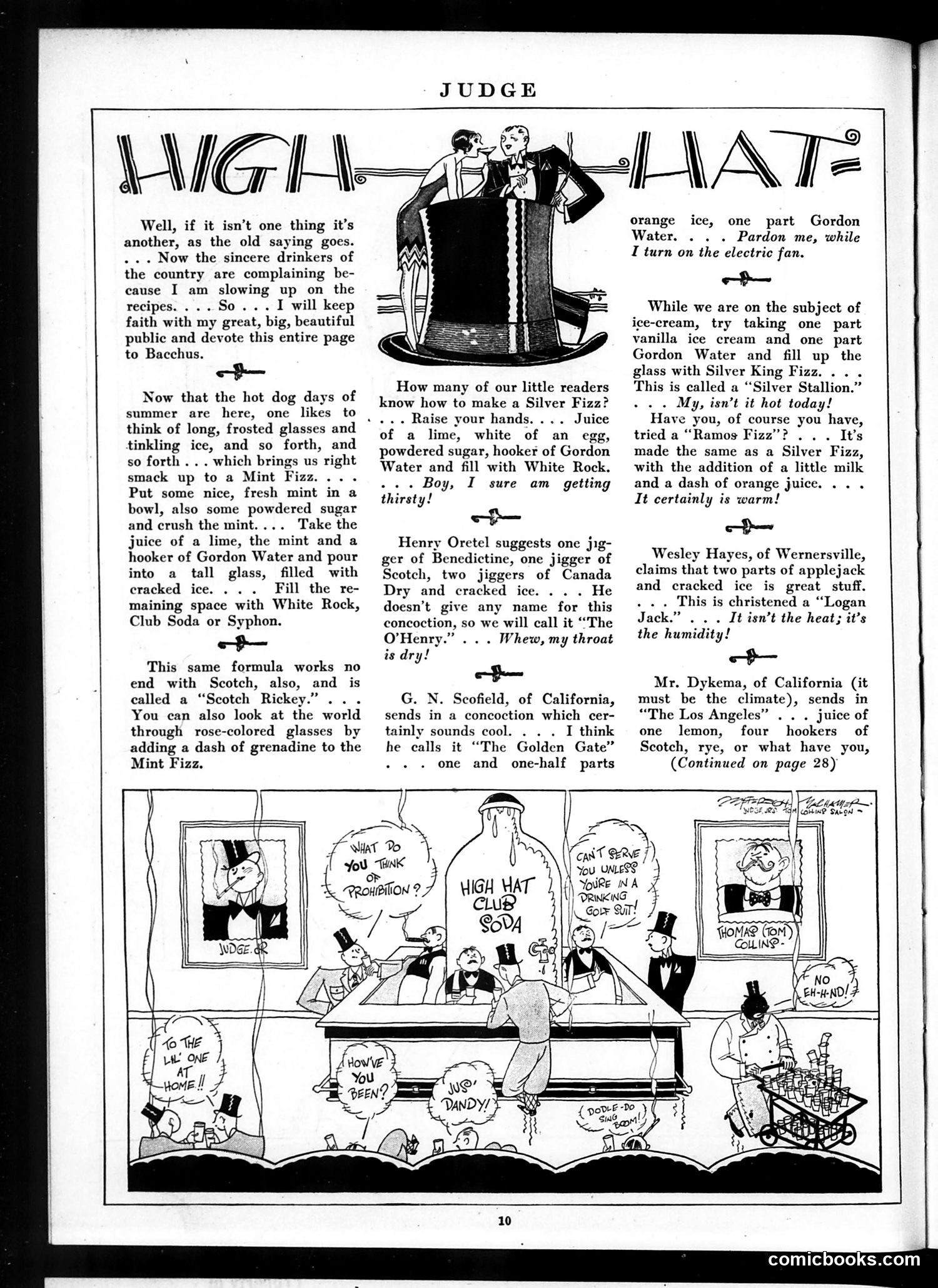
This page is a **drinks column** rather than political satire. The author (likely the magazine's regular "Bacchus" columnist) devotes the page to summer cocktail recipes in response to reader complaints about fewer drink recipes lately. The content lists various fizzes and mixed drinks with humorous names—"Silver Fizz," "Silver Stallion," "The O'Henry," "The Golden Gate," "Logan Jack," and "The Los Angeles"—each attributed to different readers who submitted suggestions. The recipes call for ingredients like Gordon Water, White Rock, powdered sugar, and spirits (Scotch, applejack, Benedictine). The **bottom cartoon** satirizes a soda fountain or bar scene, showing characters in formal dress discussing drinks while a server works. The humor appears to center on the absurdity of the social setting and pretentious drink-naming culture. The repeated refrain about heat and humidity reflects summer complaints typical of the era. This is lighthearted lifestyle content rather than political commentary.
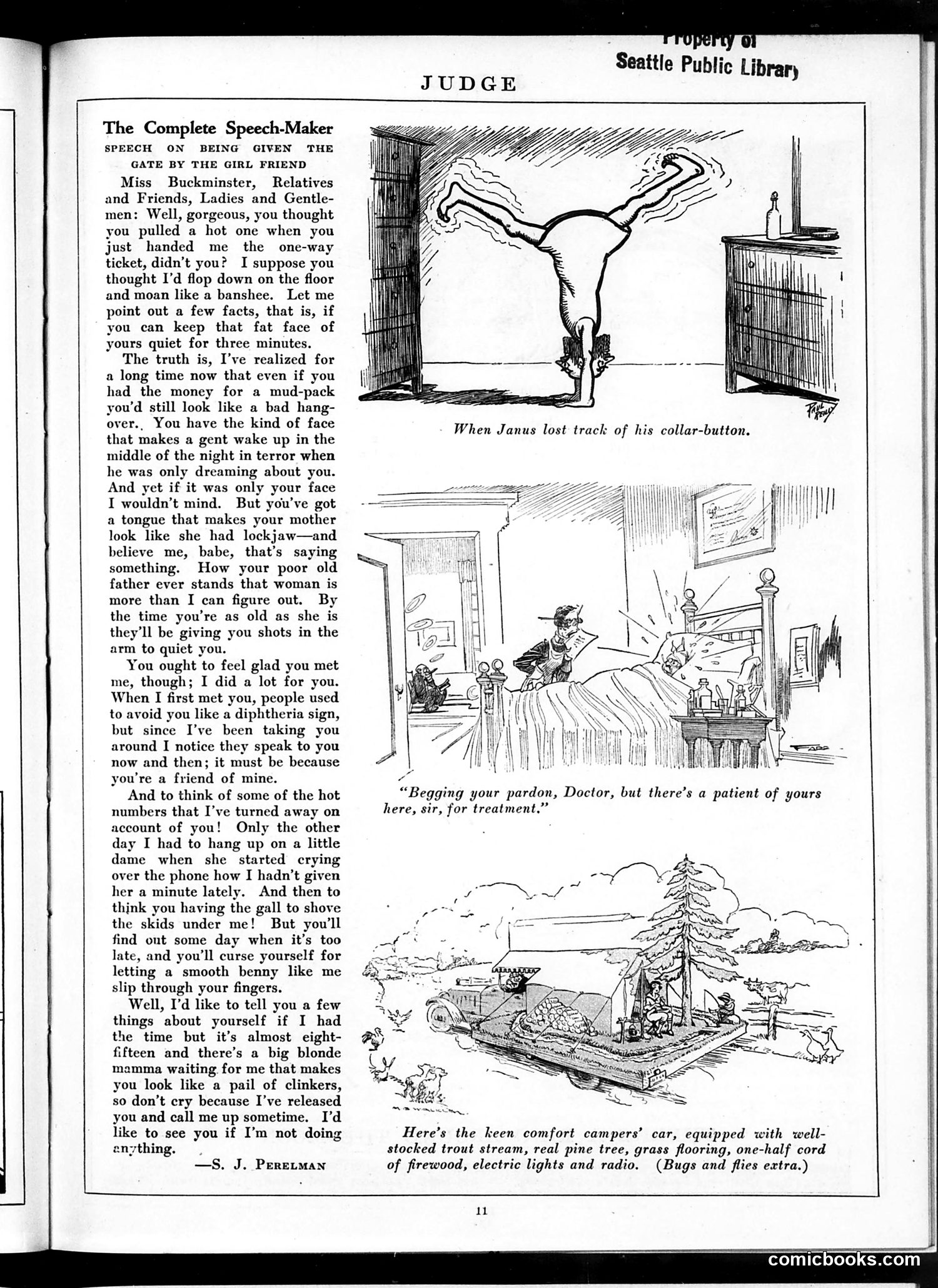
This Judge magazine page contains humorous content for early 20th-century readers: **Main Feature:** "The Complete Speech-Maker" is a satirical monologue by S.J. Perelman (credited at bottom). A spurned boyfriend delivers a brutally insulting breakup speech to "Miss Buckminster," claiming *he's* actually doing *her* a favor by leaving. The humor lies in his transparent desperation masked as superiority—he insults her appearance and personality while simultaneously bragging about other women waiting for him and claiming credit for her social acceptance. **Three Cartoon Illustrations:** 1. A comedic sketch of a man doing a headstand 2. A domestic scene of a doctor being interrupted by a patient 3. A camping vehicle labeled as having absurd amenities ("well-stocked trout stream," "real pine tree") with a sardonic note that bugs and flies cost extra The satire targets masculine bravado and relationship dynamics of the era, poking fun at men's transparent attempts to save face during rejection.
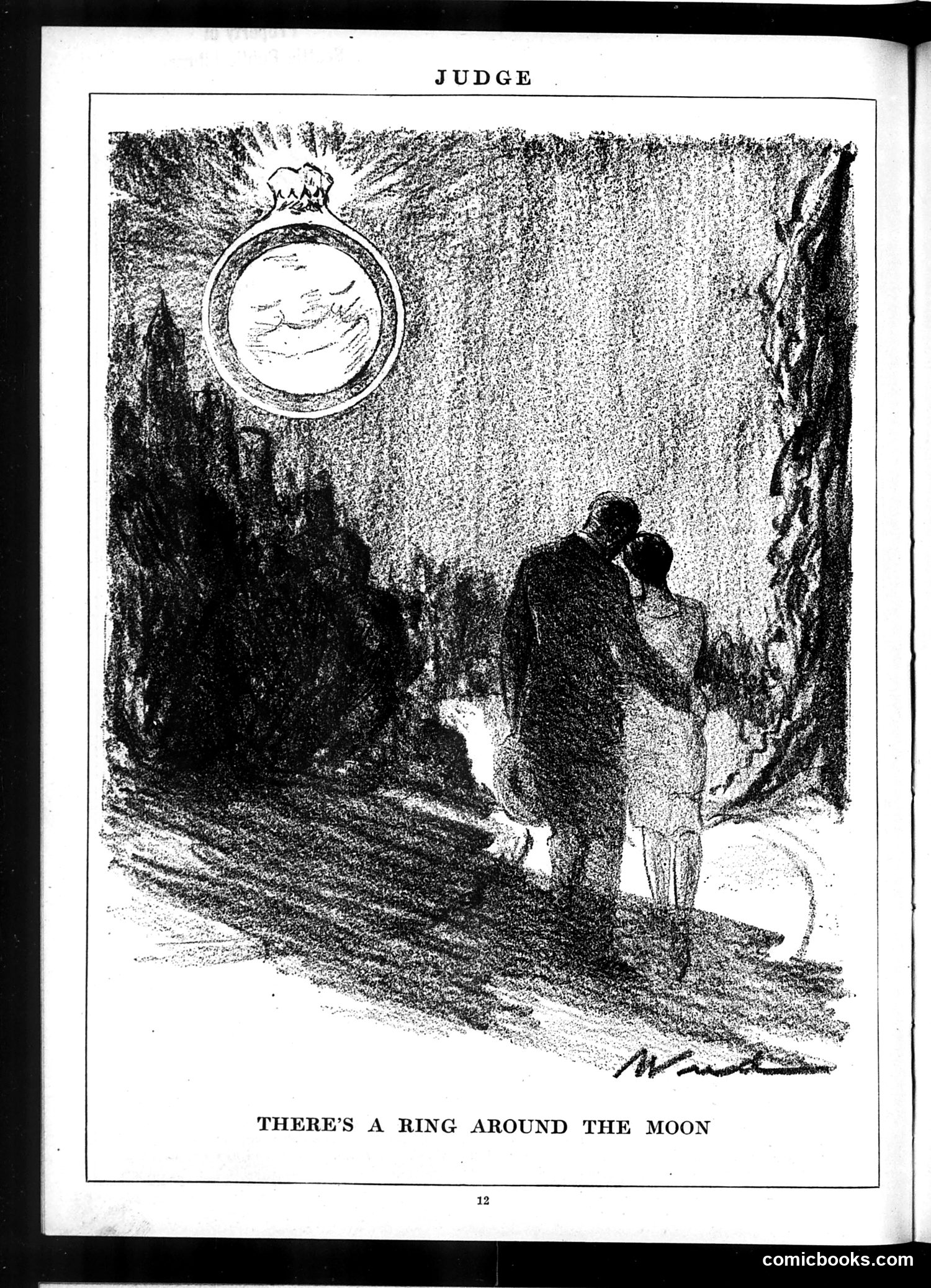
This Judge cartoon depicts two figures standing in a nighttime landscape, gazing upward at the moon, which displays a visible ring or halo around it. The illustration's title references the folk superstition that a ring around the moon indicates approaching bad weather or misfortune. The cartoon likely uses this meteorological phenomenon as visual metaphor for some contemporary concern or ominous social/political development. Without additional context identifying the specific figures or the publication date, the precise satirical target remains unclear. The dark, moody artistic style emphasizes foreboding, suggesting the cartoon comments on some looming crisis or negative expectation facing the nation or a particular group during the period Judge was published.
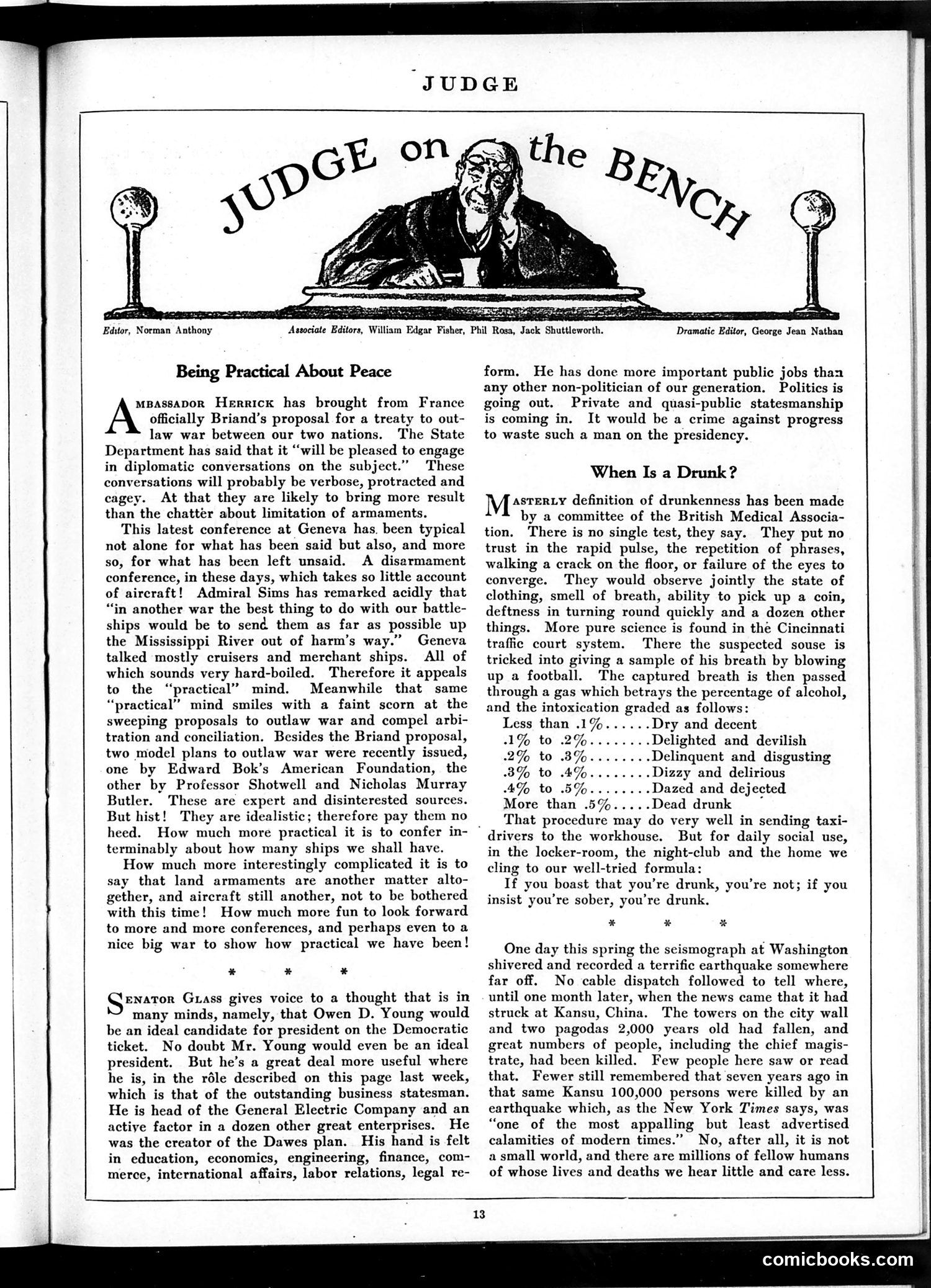
This is a 1920s opinion page from **Judge** magazine featuring three distinct editorial pieces: **"Being Practical About Peace"** satirizes disarmament negotiations. Ambassador Herrick brought French Foreign Minister Briand's war-outlawing proposal, but the piece mocks how diplomats spend endless time debating specific armaments (ships, aircraft, land weapons) while ignoring the idealistic broader goal of outlawing war itself—calling this false "practicality" a setup for future conflict. **The middle section** on Owen D. Young praises him as a business statesman and warns against wasting him on the presidency, arguing private sector leadership serves the nation better than electoral politics. **"When Is a Drunk?"** discusses how British Medical Association refuses single-test drunk definitions, contrasting this with Cincinnati's traffic courts, which use a breath-analysis football method to measure alcohol content—a semi-serious but humorous critique of scientific versus legal approaches to intoxication. The Judge mascot presides above as the authoritative voice on public affairs.
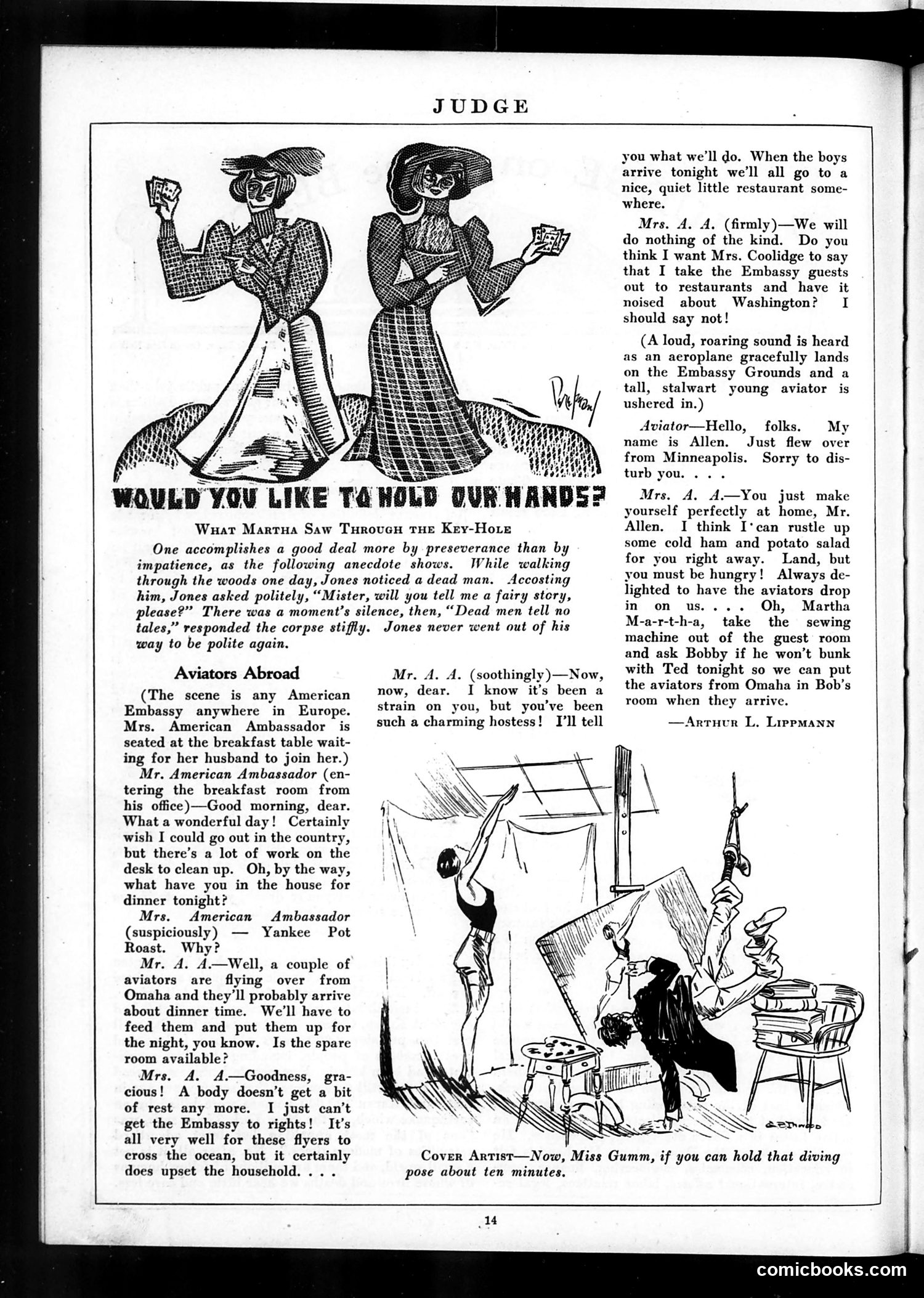
This page contains two satirical pieces from Judge magazine: **"What Martha Saw Through the Keyhole"** is a brief joke mocking politeness: a man asks a corpse for a fairy tale; the corpse refuses, and the man abandons courtesy forever. **"Aviators Abroad"** satirizes diplomatic social anxiety during the early aviation era. An American Ambassador's wife must suddenly host unexpected aviator guests at the Embassy. She's torn between hospitality and social propriety—worried that taking guests to restaurants will embarrass her before "Mrs. Coolidge" (the First Lady). The humor lies in her frantic scrambling to improvise accommodations (moving sewing machines, displacing children) while maintaining appearances. The cartoon mocks both the status-consciousness of diplomatic families and how aviation's rapid expansion created unexpected social disruptions for the era's elite.
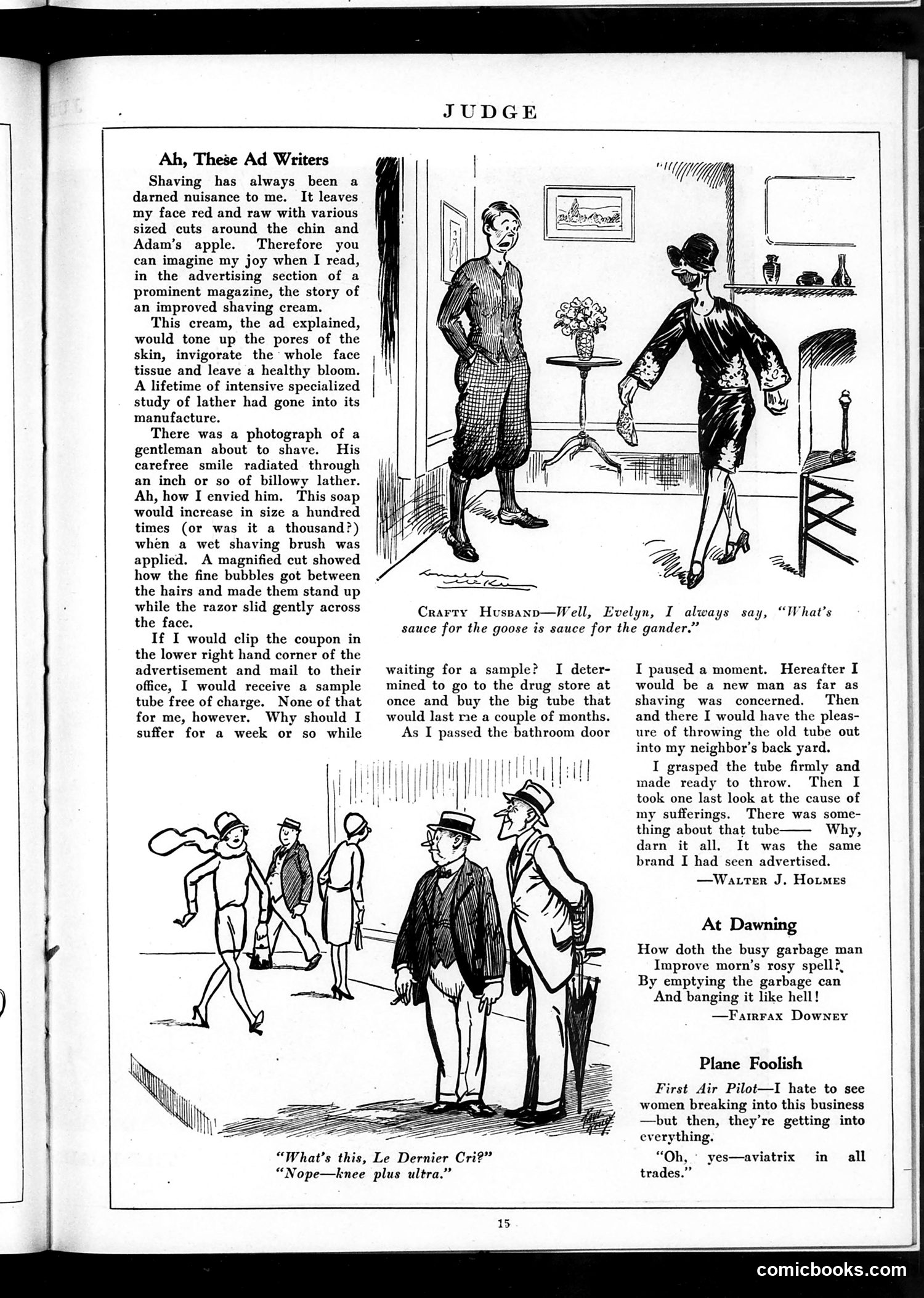
This satirical piece mocks exaggerated advertising claims of the era. The author describes reading an ad for miraculous shaving cream promising to "tone up the pores," invigorate tissue, and leave "healthy bloom." The ad includes a photograph of a blissfully smiling man and claims the lather expands hundredfold when applied. Eager to transform himself, the narrator buys the expensive large tube—only to discover it's the exact same inferior brand he'd already been using. The joke exposes the gap between advertisers' flowery promises and disappointing reality. By framing it as personal humiliation, Holmes satirizes how advertising exploits male insecurities about grooming while delivering nothing exceptional. The accompanying cartoons offer lighter social commentary: one on gender equality in housekeeping, another mocking male resistance to women entering aviation, calling female pilots "aviatrixes in all trades."
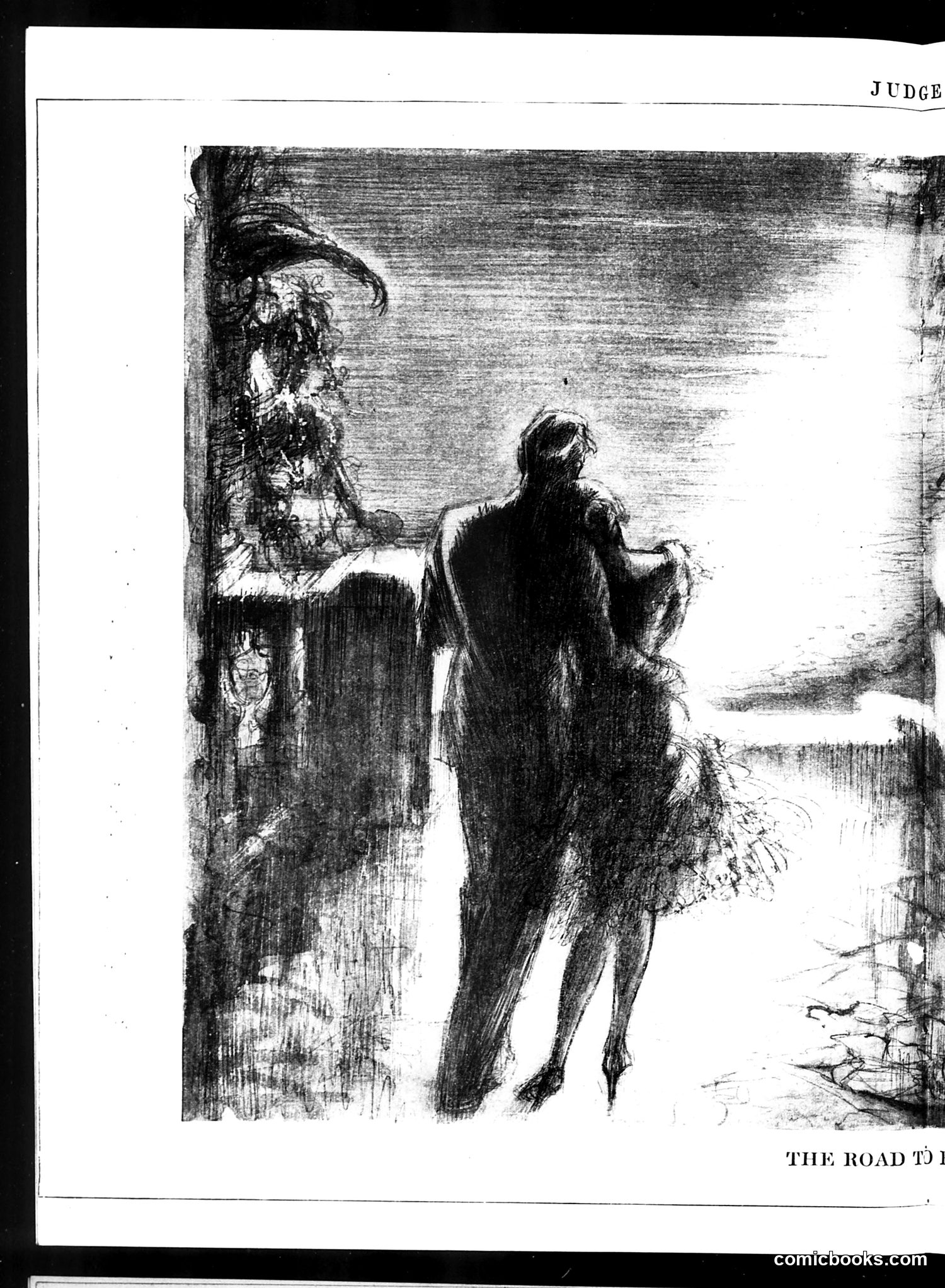
This is an etching or sketch illustration titled "The Road to..." (title cut off). It depicts a figure in period clothing standing at what appears to be a doorway or threshold, looking back over their shoulder in an ambiguous pose—possibly hesitant, tempted, or conflicted about proceeding. Without the complete title and caption visible, the specific political or social reference is unclear. However, Judge was known for satirizing moral and social issues of its era. The figure's body language and the doorway setting suggest commentary on a choice or crossroads—possibly related to vice, corruption, or moral compromise, common Judge themes. The illustration's dramatic chiaroscuro technique emphasizes the psychological tension of the moment depicted. More context would be needed to identify the specific satirical target.
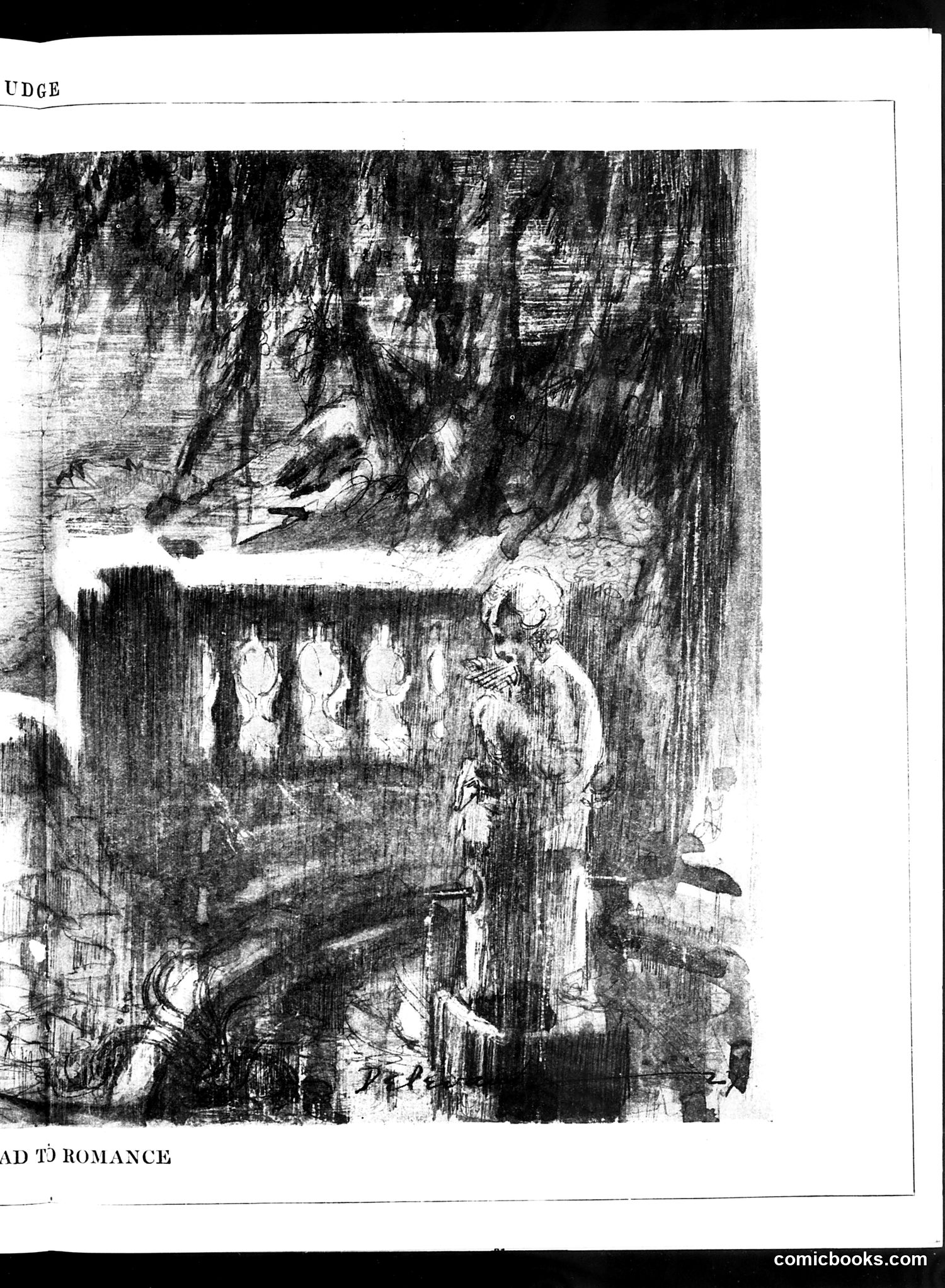
This page from *Judge* magazine shows a satirical illustration titled "AD TO ROMANCE" (visible at bottom). The sketch depicts what appears to be a theatrical or operatic scene with multiple figures in period costume arranged around an ornate structure or stage set. The heavy cross-hatching and dramatic shadowing suggest a darkly comedic tone. The specific targets of satire are unclear from this reproduction's quality and incomplete text. The "ad to romance" reference suggests mockery of theatrical productions, romantic melodrama, or possibly advertising culture's relationship to courtship—common subjects for *Judge's* satirical commentary in the early-to-mid 20th century. Without clearer OCR text or publication date, precise political or social references cannot be identified with confidence.
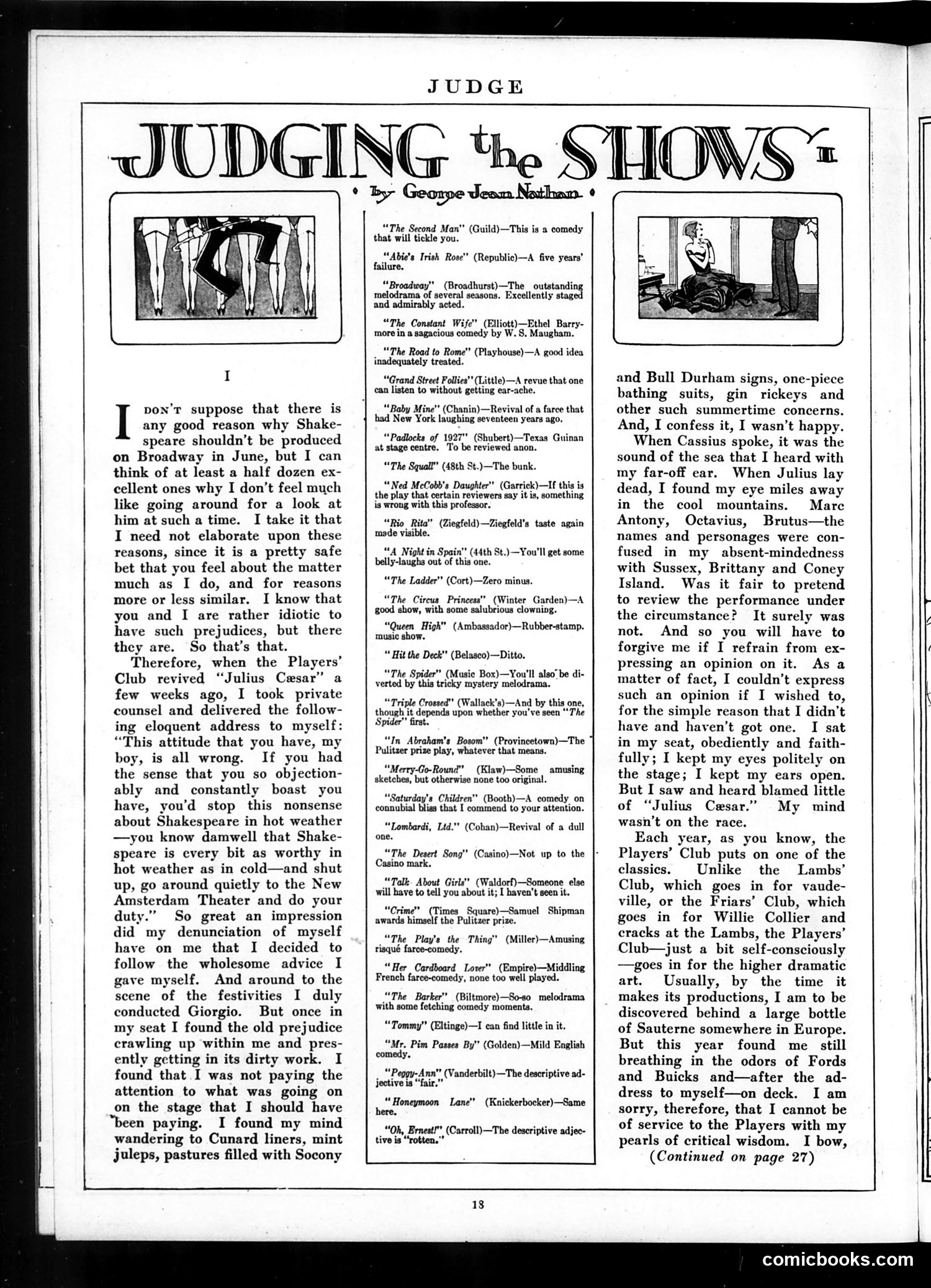
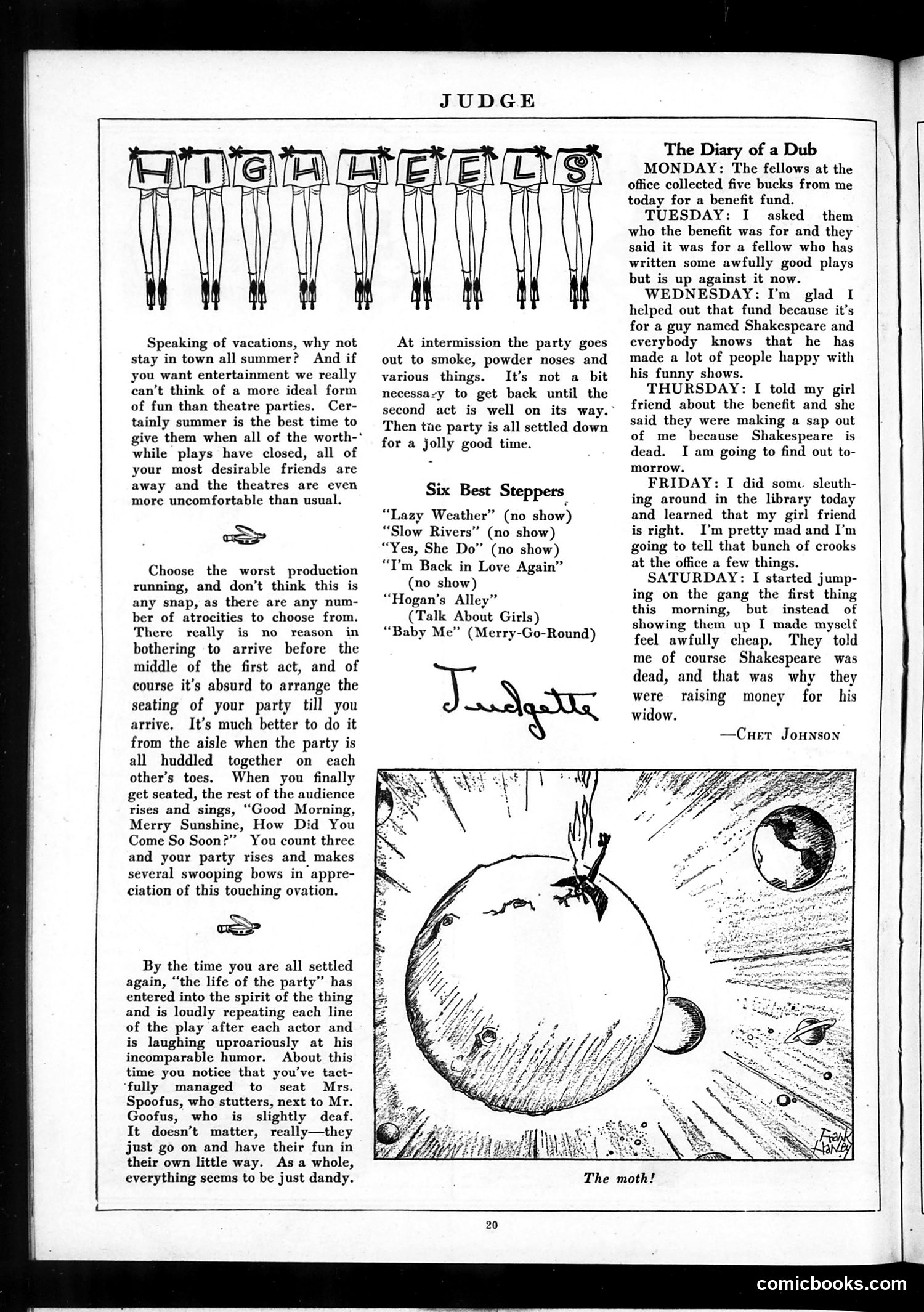
This page features George Jean Nathan's column reviewing Broadway productions during summer 1927. The essay explains Nathan's internal conflict: he knows Shakespeare deserves respect year-round, yet he cannot muster enthusiasm for a Players' Club revival of "Julius Caesar" in hot weather. Rather than pretend otherwise, he admits his mind wandered to cooler pleasures—Cunard liners, mint juleps, and pastoral scenes. The accompanying list reviews current Broadway shows with sharp, dismissive one-liners: "The Squall" is "bunk," "The Ladder" rates "zero minus," and "Padlocks of 1927" features Texas Guinan at center stage (a reference to the notorious nightclub hostess). The satire targets both Nathan's own snobbish pretensions and Broadway's commercial mediocrity—he confesses his own hypocrisy while skewering the productions themselves.
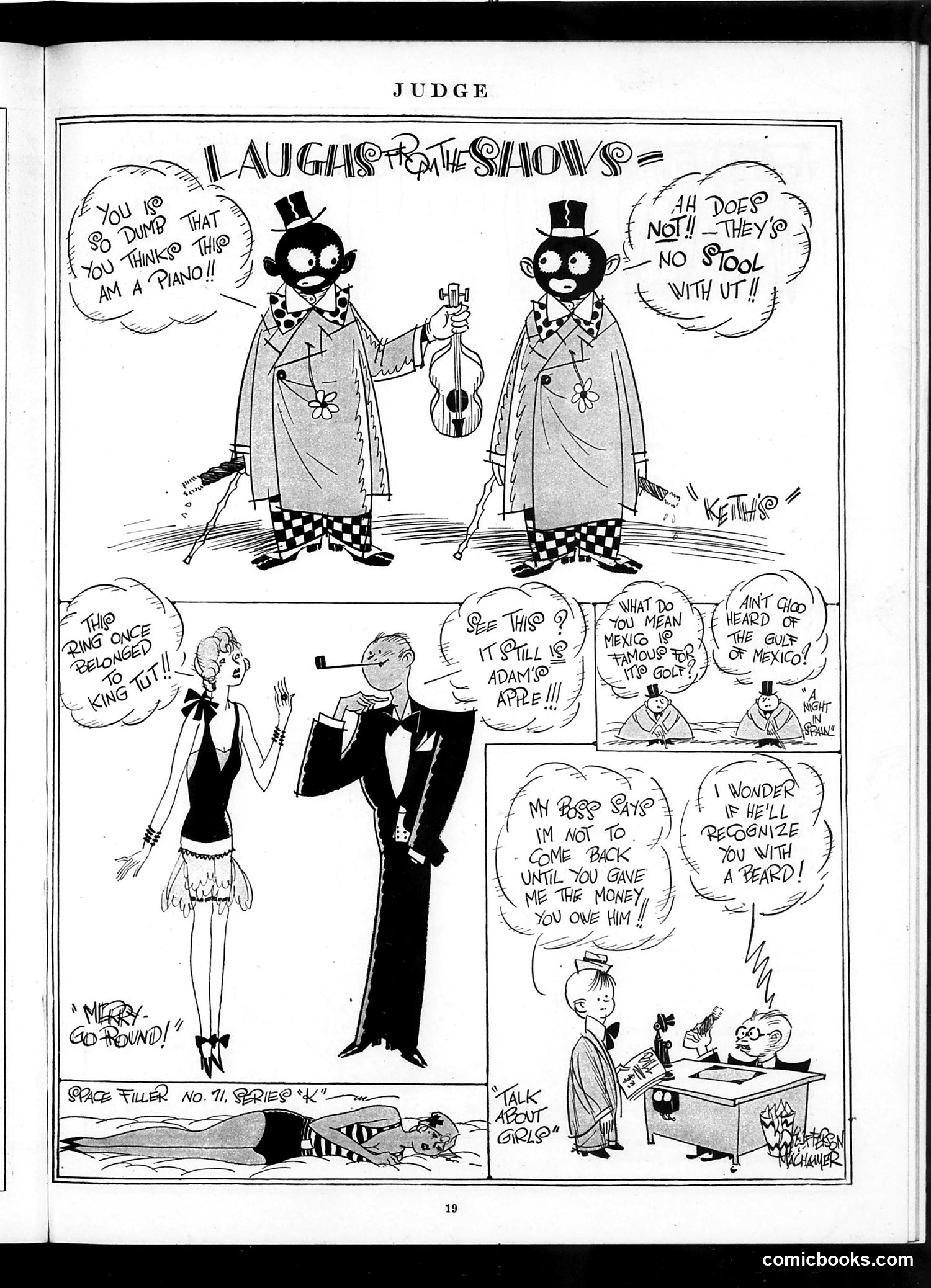
This page from *Judge* contains multiple comic vignettes satirizing early 20th-century social themes: **Top panel**: Two figures in top hats and checkered pants debate musical instruments, mocking pretentious cultural snobbery about pianos versus violins. **Middle sections**: A man in formal wear discusses financial troubles with a woman, then negotiates with his boss about repaying borrowed money—satirizing working-class financial struggles and workplace power dynamics. **Bottom panels**: Include a "Space Filler" joke and a domestic scene where a wife confronts her husband about his debt, with his absurd suggestion that she'll recognize him by his beard when he returns—mocking male irresponsibility in marriage. The humor targets class pretension, financial incompetence among men, and marital discord—common *Judge* subjects reflecting concerns of its era. The crude caricatures and exaggerated dialogue are typical of period satirical humor.
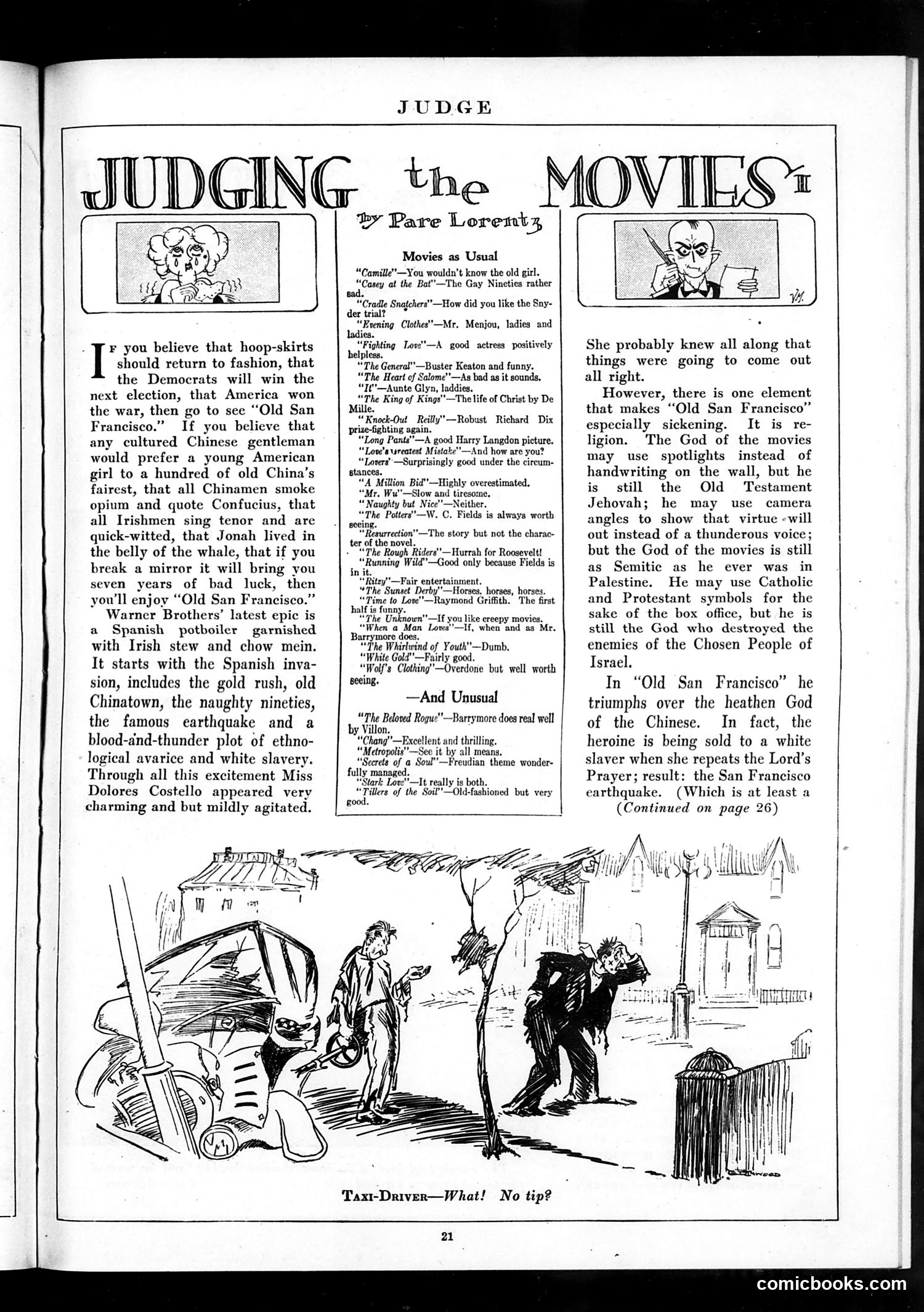
This is a film review column by Pare Lorenz critiquing Warner Brothers' "Old San Francisco," starring Dolores Costello. The satire works on two levels: **The Setup**: Lorenz sarcastically lists absurd premises audiences apparently accept—that hoop-skirts will return, that Democrats will win elections, that stereotypical portrayals of Chinese people, Irish people, and other groups are accurate. He suggests if you believe these falsehoods, you'll enjoy this film. **The Real Critique**: The film itself perpetuates these ethnic stereotypes while mixing Spanish conquest, the Gold Rush, Chinatown, and white slavery into a melodramatic mess. More pointedly, Lorenz attacks the film's religious messaging: that Hollywood's Christian God (presented as Old Testament Jehovah) triumphs over Chinese deities, and that prayer prevents the heroine from being trafficked—a simplistic, offensive equation of morality with Western religion and ethnicity. The cartoon below shows a taxi driver receiving no tip, possibly referencing the film's frivolous excess amid everyday struggles.
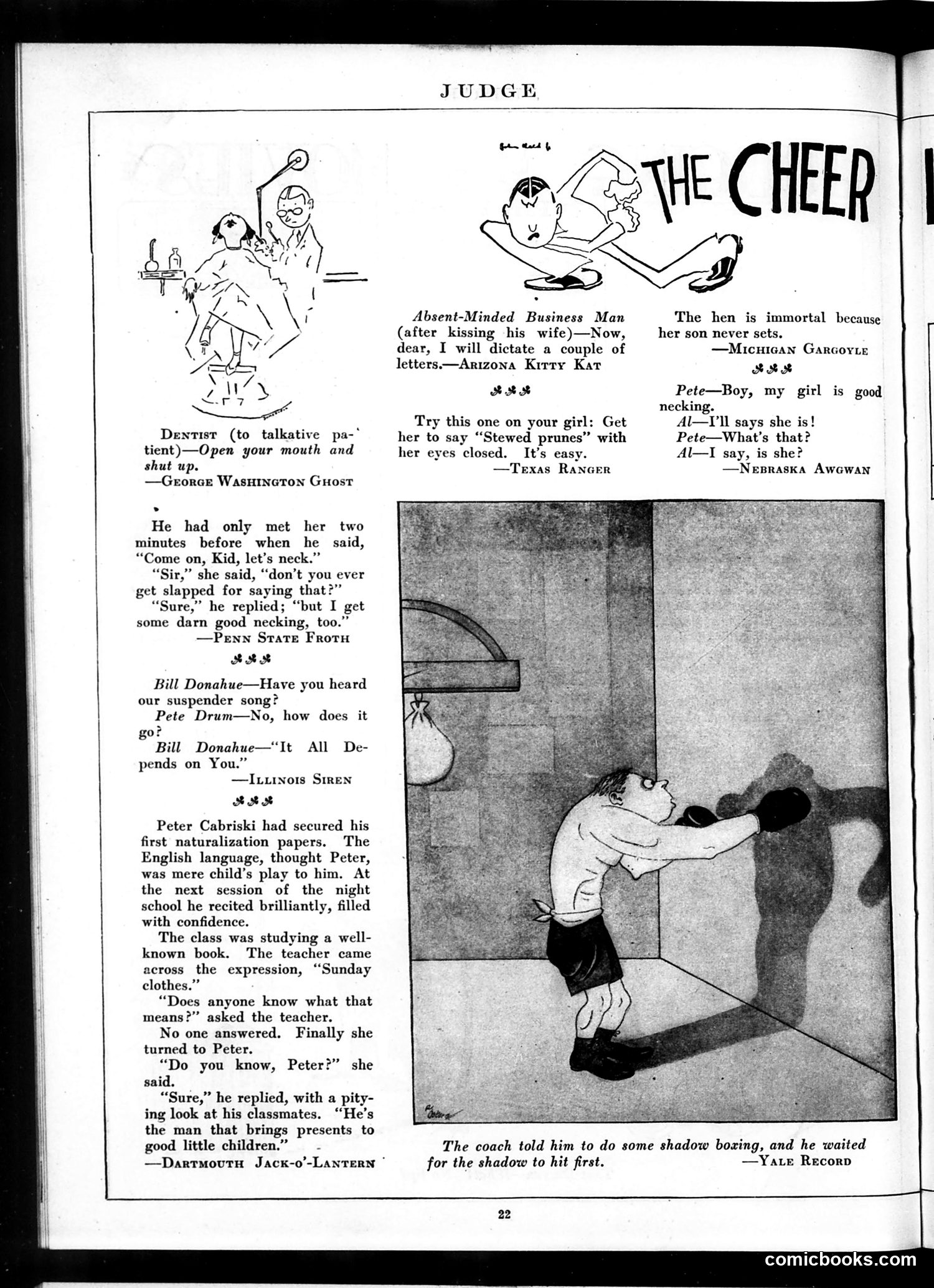
This page collects brief humorous anecdotes and jokes typical of Judge's satirical style. The humor relies on wordplay, misunderstandings, and social commentary: **Key jokes:** - A dentist tells a talkative patient to "shut up"—mocking verbose dental patients - A young man's casual flirtation ("let's neck") reflects 1920s dating culture - A suspender song pun ("It All Depends on You") - An immigrant (Peter Cabriski) newly naturalized misinterprets "Sunday clothes" as referring to Santa Claus—satirizing immigrants' incomplete grasp of English idioms - A boxing joke where someone literally waits for his shadow to hit him first **The large cartoon** shows shadow boxing instruction, illustrating the final joke literally. The page satirizes American social life: dating customs, immigrant assimilation, and everyday absurdities. The humor is gentle rather than cutting, aimed at middle-class readers. The multiple credited contributors ("Arizona Kitty Kat," "Texas Ranger," etc.) represent Judge's network of college and regional humor writers.
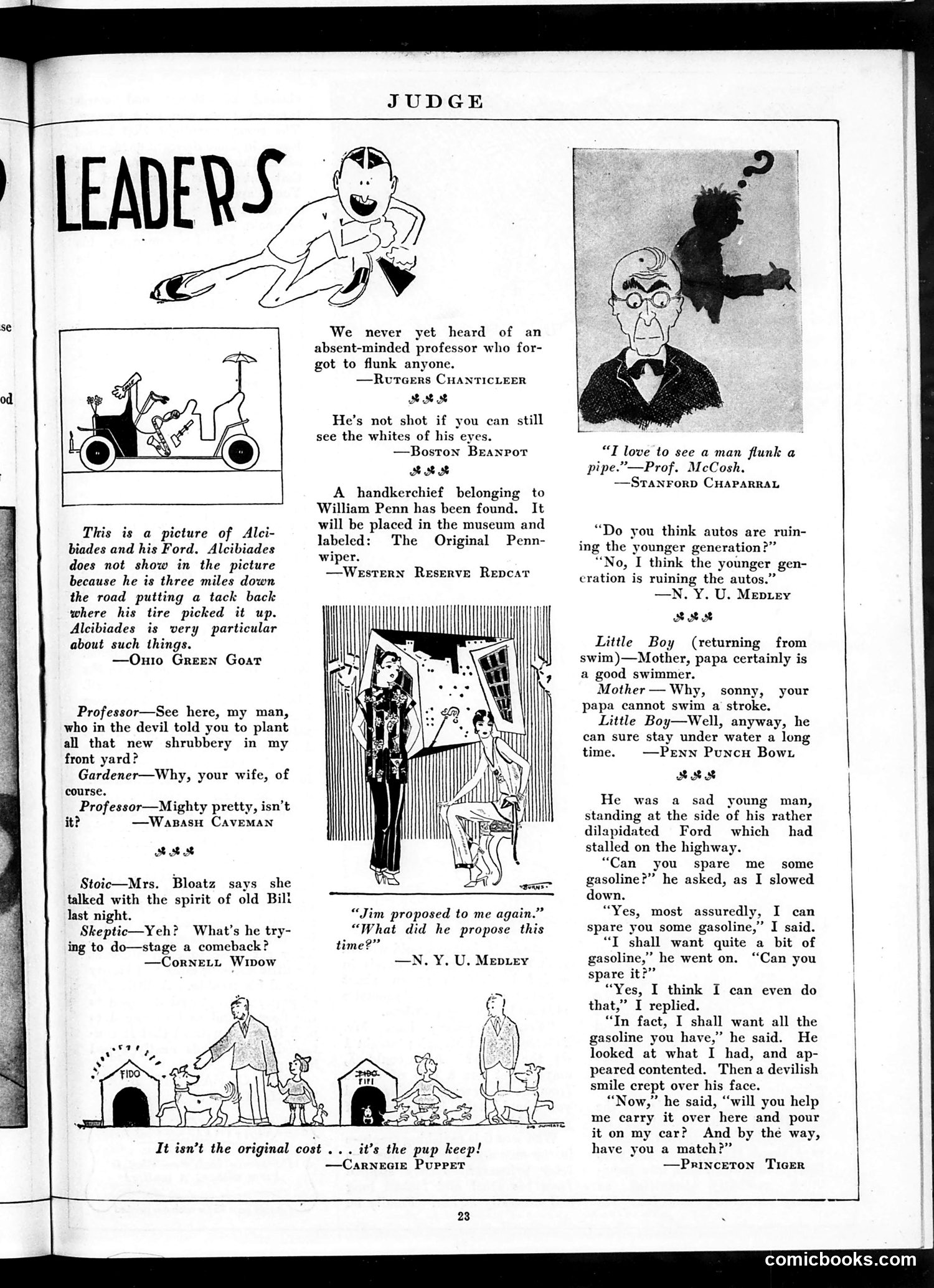
This page of *Judge* magazine (a major American humor publication) contains brief satirical jokes and cartoons mocking early 20th-century social types and concerns. The central theme is **automobiles and their cultural impact**. Multiple jokes reference cars: one depicts Alcibiades with a Ford constantly breaking down; another jokes that "the younger generation is ruining the autos" (not vice versa). A longer story describes a stranded motorist manipulating a stranger into giving him gasoline, then asking for a match—implying he plans to set the car on fire, satirizing the frustration people felt with unreliable early automobiles. Other jokes target **absent-minded professors** (who still flunk students), **spiritualism** (mocking séances), and **marriage dynamics** (a professor's wife plants shrubbery without permission). The cartoons use simple line drawings and exaggerated features typical of 1920s humor magazines. The overall tone mocks modern inconveniences and foolish human behavior—standard fare for *Judge's* college-educated, middle-class readership.
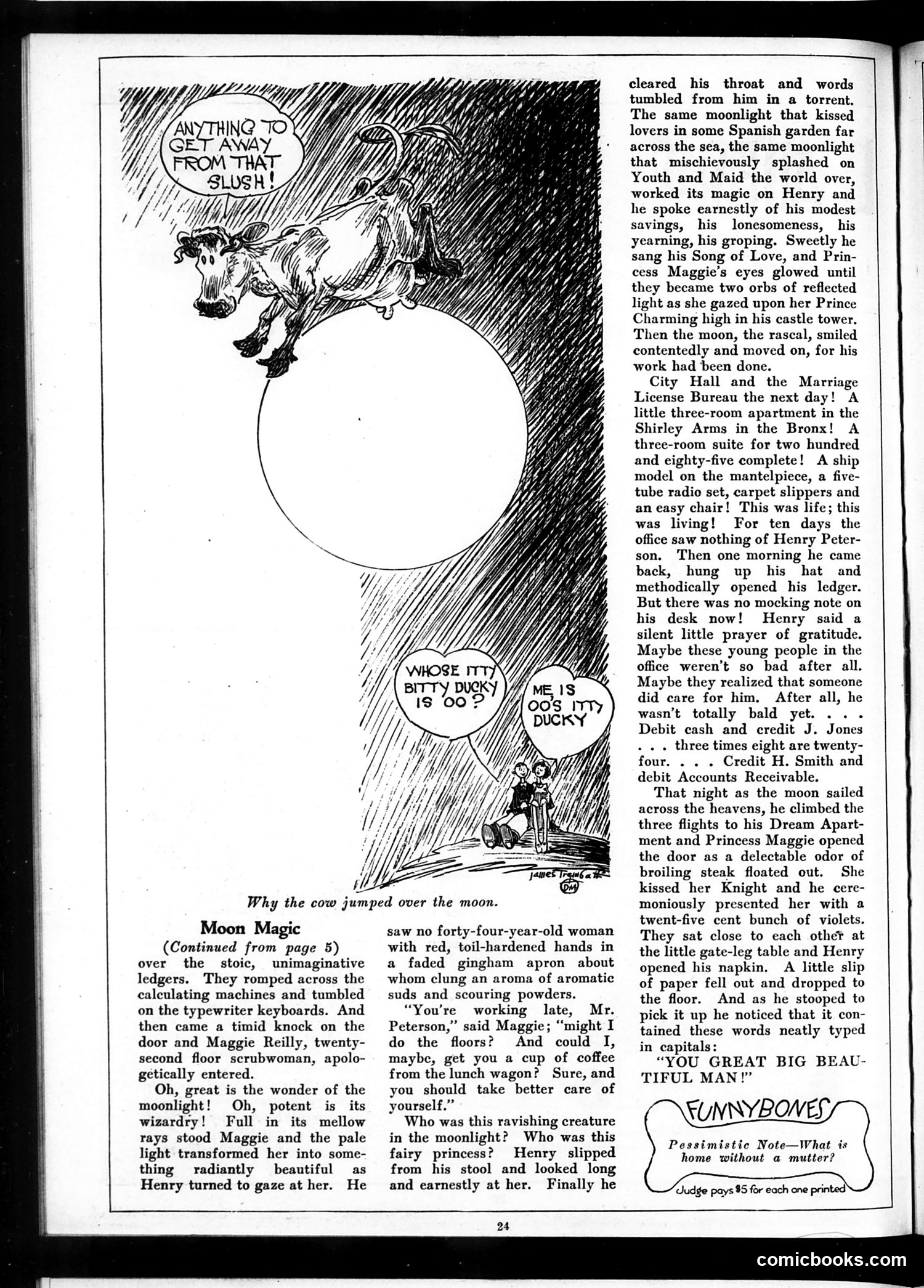
This is a romantic story with satirical undertones about transformative illusion versus reality. The narrative follows Henry Peterson, an unremarkable office clerk who, under moonlight's "magic," sees Maggie Reilly—the forty-four-year-old scrubwoman with "red, toil-hardened hands"—as a beautiful princess. The satire targets romantic idealism and social class delusion: moonlight literally transforms how Henry perceives this working-class woman, inspiring him to confess his loneliness and propose. They marry quickly, and initially Henry experiences happiness. However, the "Funnybones" joke at page's bottom hints at disillusionment: "What is home without a mutter?"—suggesting marital discord follows the romantic fog lifts. The cartoon "Why the cow jumped over the moon" (top) references the nursery rhyme, showing animals declaring "Whose itty putty ducky is oo?" This absurdist imagery reinforces the story's theme: moonlight creates fantastical, temporary illusions that reality inevitably dispels.
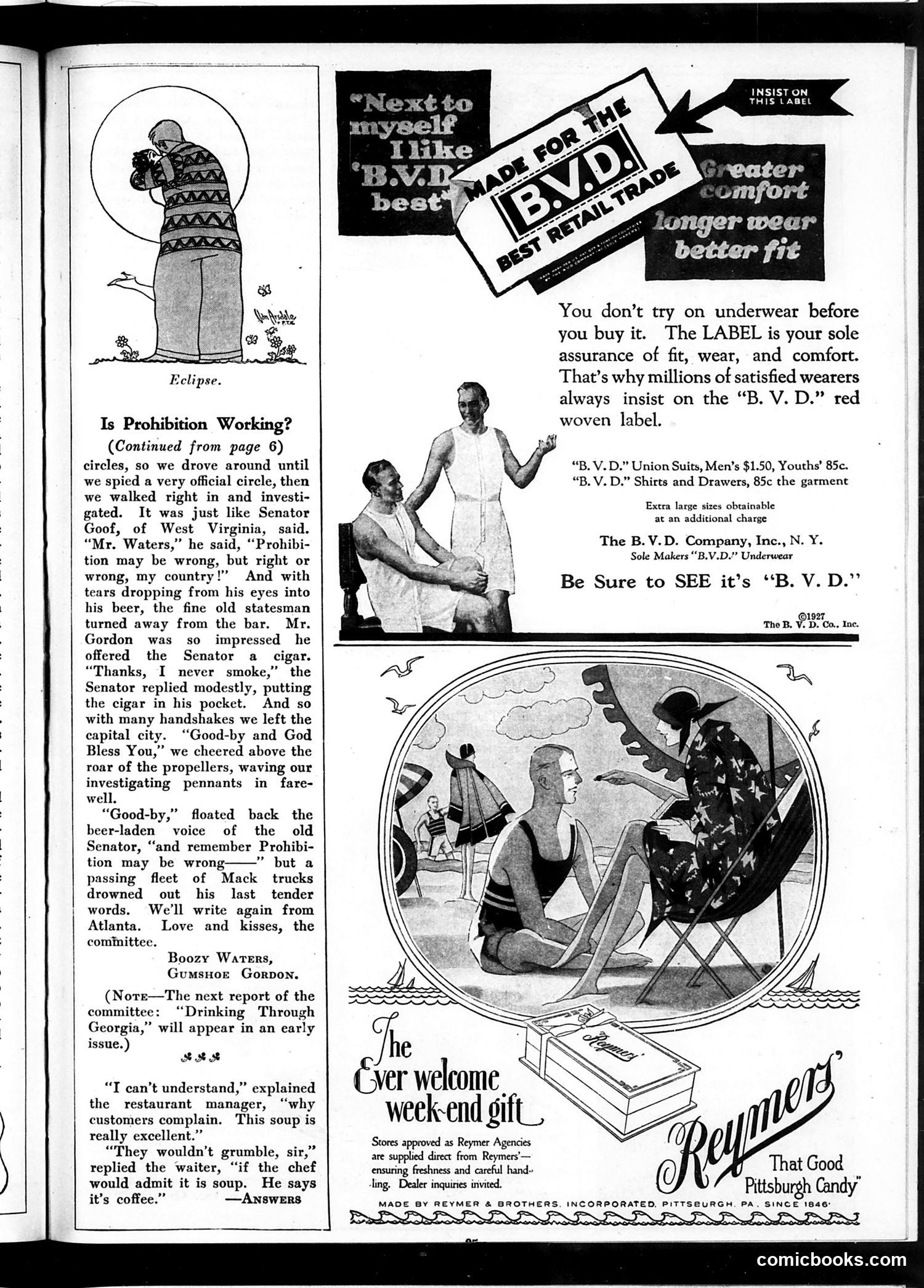
This article mocks Prohibition enforcement through a supposed "investigation" led by characters "Boozy Waters" and "Gumshoe Gordon." They visit Washington, D.C. and find a senator drinking beer openly at a bar—supposedly under official investigation. The senator hypocritically claims "Prohibition may be wrong, but right or wrong, my country!" while simultaneously violating the law and accepting a cigar he pockets rather than refuses. The satire's point: Prohibition is not working because even government officials openly flout it. The cartoon title "Eclipse" (showing a figure obscured) likely represents how Prohibition obscures or hides reality. The accompanying restaurant joke reinforces the theme—people deny obvious truths (soup being coffee, alcohol consumption during Prohibition). This reflects Judge magazine's skepticism toward Prohibition's actual effectiveness, a common satirical stance during the 1920s when speakeasies and corruption were widespread despite the constitutional ban.
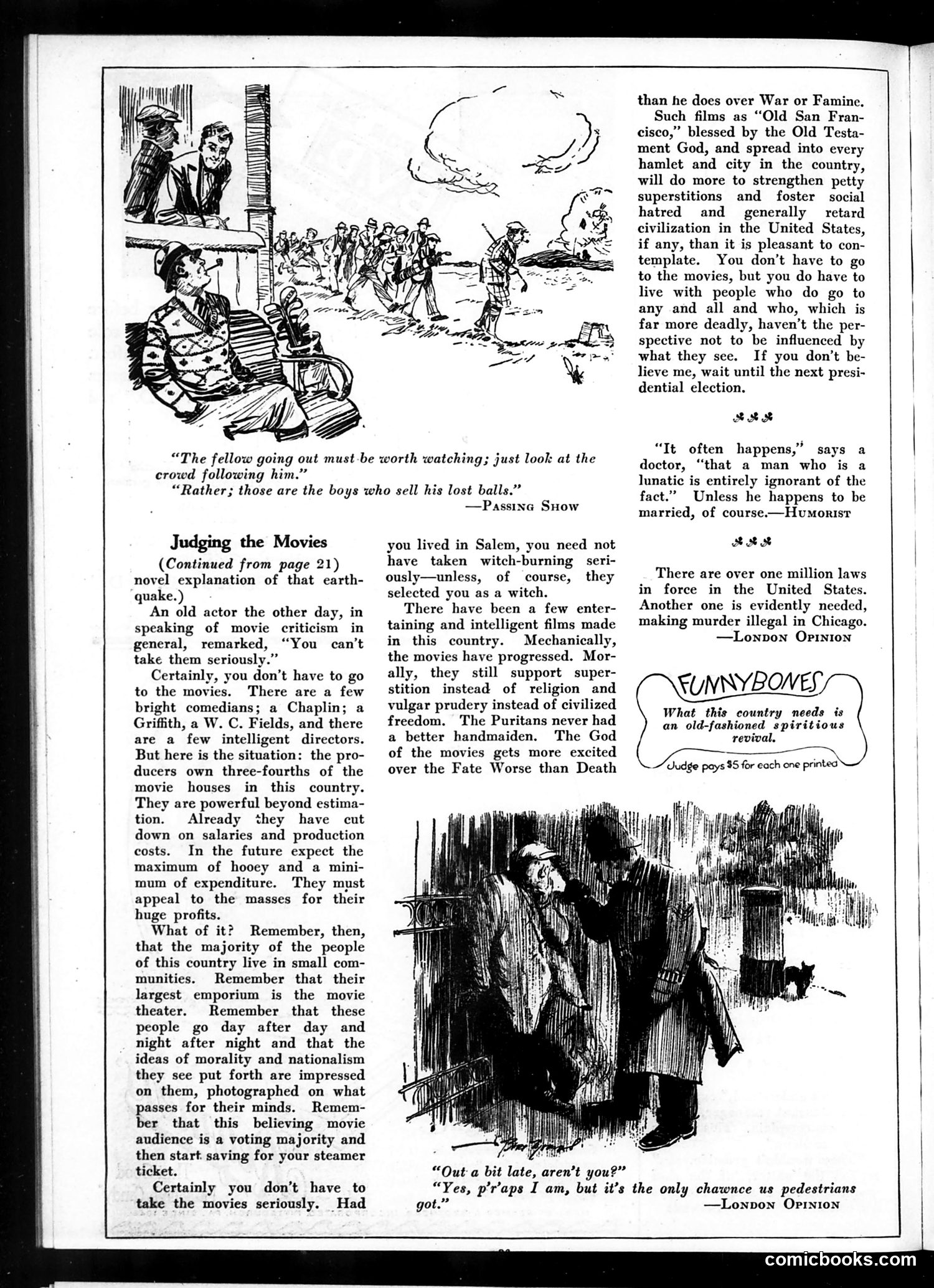
This page critiques Hollywood's growing moral and political influence on American society. The main article "Judging the Movies" argues that film producers—who own three-quarters of movie theaters—wield dangerous power over a "voting majority," particularly in small towns where the cinema is the primary entertainment and cultural reference point. The author attacks films like "Old San Francisco" for promoting superstition and Puritanical morality rather than genuine civilization. The Salem witch-trial comparison warns that movie audiences uncritically absorb these messages with real electoral consequences. The cartoons provide comic relief: one depicts a golfer whose spectators are actually ball-retrievers profiting from his poor play; another shows a nighttime pedestrian explaining their late hour as the only time they can safely cross streets—satirizing traffic dangers. The "Funny Bones" section jokes about needing a "spiritious revival," likely mocking Prohibition-era moralism that the magazine associates with the very Puritanism it criticizes in film.
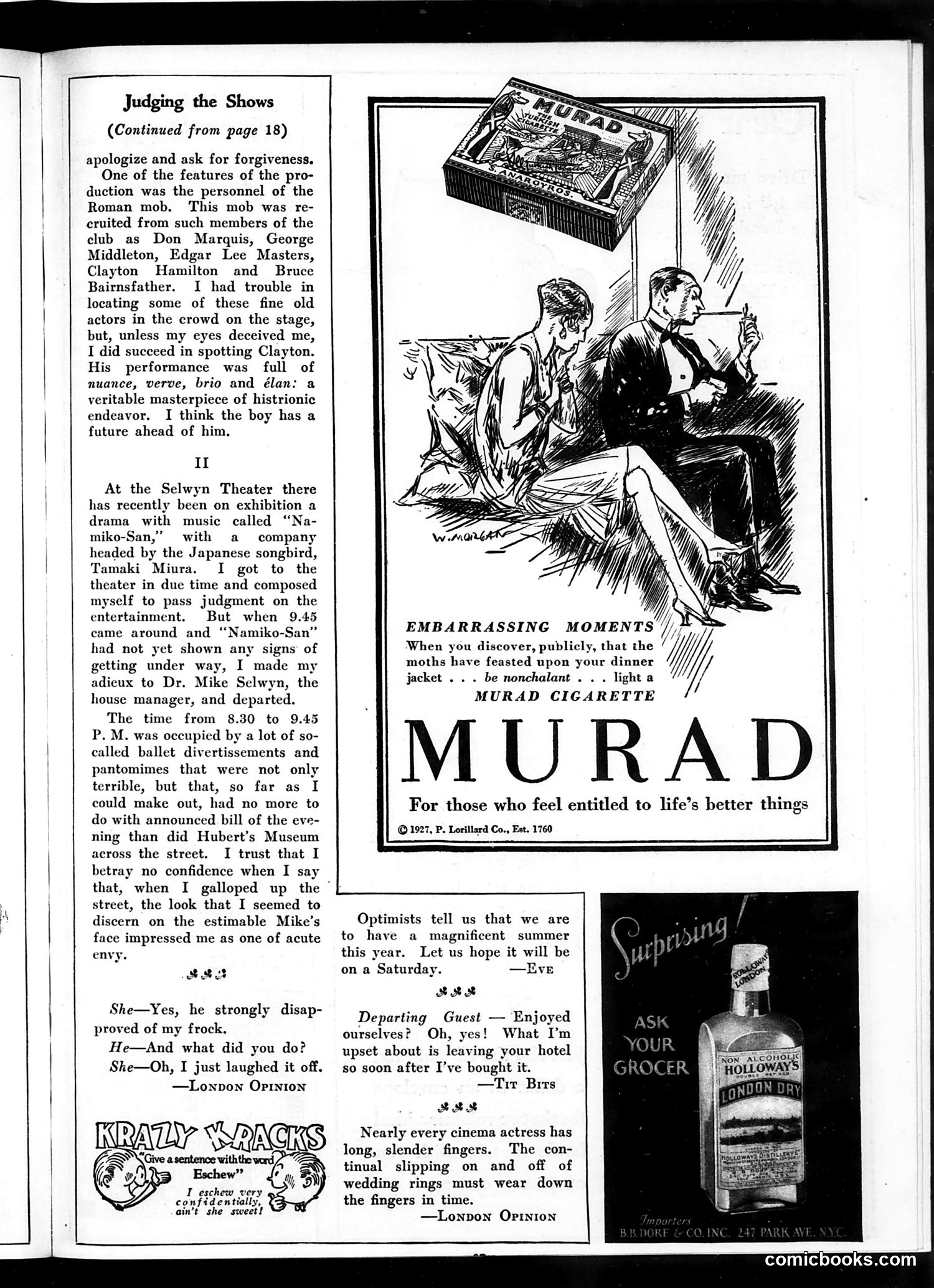
This page from *Judge* magazine contains theater criticism and advertisements typical of 1927 print journalism. **The Main Content:** The "Judging the Shows" column reviews theatrical productions. The critic humorously discusses spotting famous literary figures (Don Marquis, Edgar Lee Masters) performing in a Roman mob scene, praising Clayton Hamilton's performance with mock-serious language ("nuance, verve, brio and élan"). He also reviews "Namiko-San," a Japanese musical drama at the Selwyn Theater, leaving early due to tedious ballet preliminaries—and notes the theater manager's apparent envy at having to sit through them. **The Humor:** Much relies on period-specific theater culture and recognizing these now-obscure literary figures. The jokes about delayed shows and mandatory ballet "filler" reflect early 20th-century theatrical conventions. **The Advertisements:** The Murad cigarette ad uses "embarrassing moments" humor (moth damage to formal wear), and the Holloways London Dry gin ad targets grocery stores. These represent 1920s advertising approaches and the legal cigarette/alcohol marketing of the era.
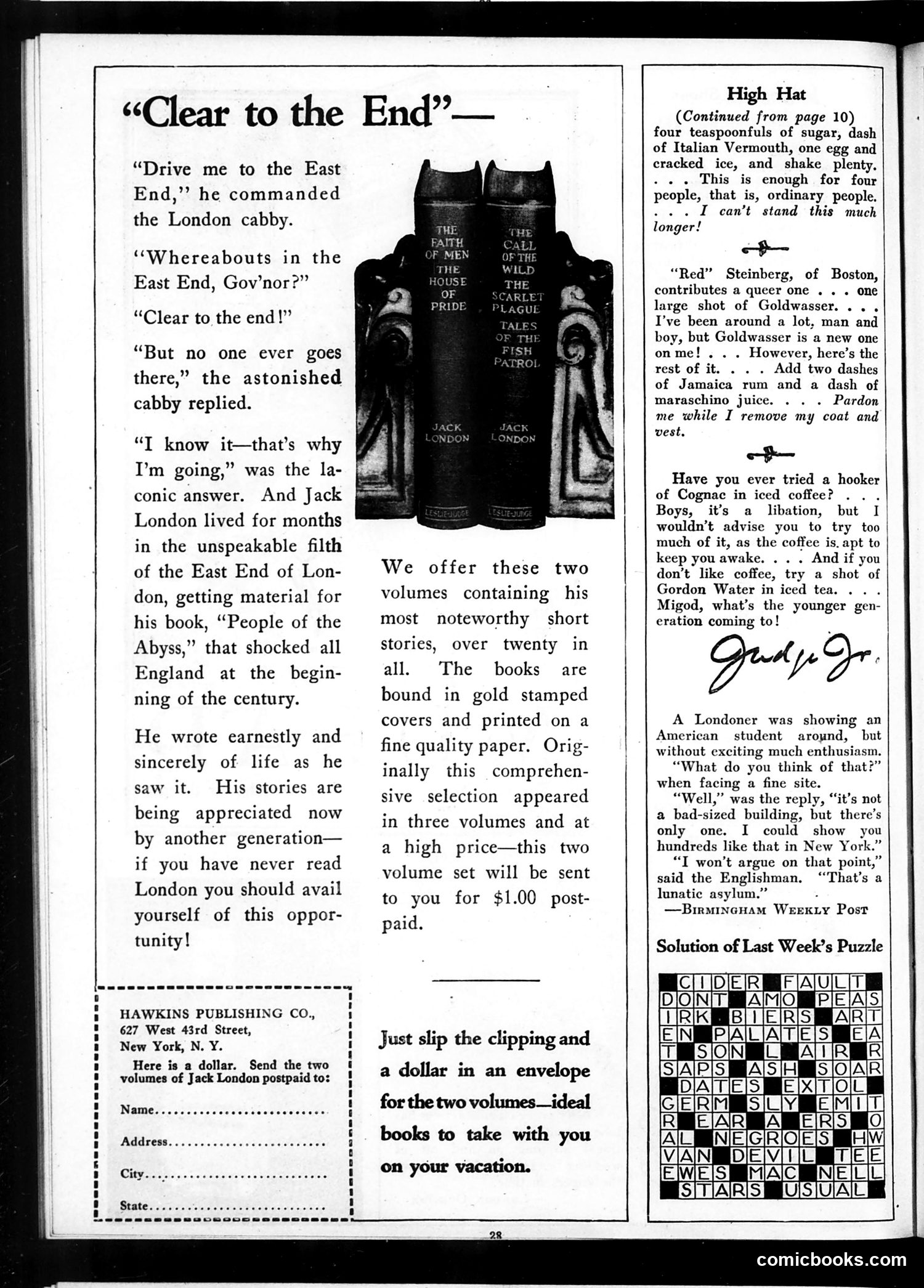
This page is primarily **advertising**, not political satire. The main content promotes Jack London's works through Hawkins Publishing Co. **The pitch:** The left column tells a brief anecdote about Jack London deliberately traveling to London's impoverished East End to research his 1903 book *"People of the Abyss,"* which exposed brutal living conditions. The ad positions London as a serious social observer whose writing "shocked all England." **The sales angle:** For $1.00, readers can buy a two-volume collection of his "most noteworthy short stories" (20+ total)—marketed as ideal vacation reading. **Secondary content:** The right side includes a "High Hat" cocktail recipe column and a joke about an American tourist's obtuse reaction to historic English architecture, ending with the punchline that he's actually looking at a lunatic asylum. The page reflects early-20th-century middlebrow culture: celebrating literary authenticity while packaging it as affordable consumer goods.
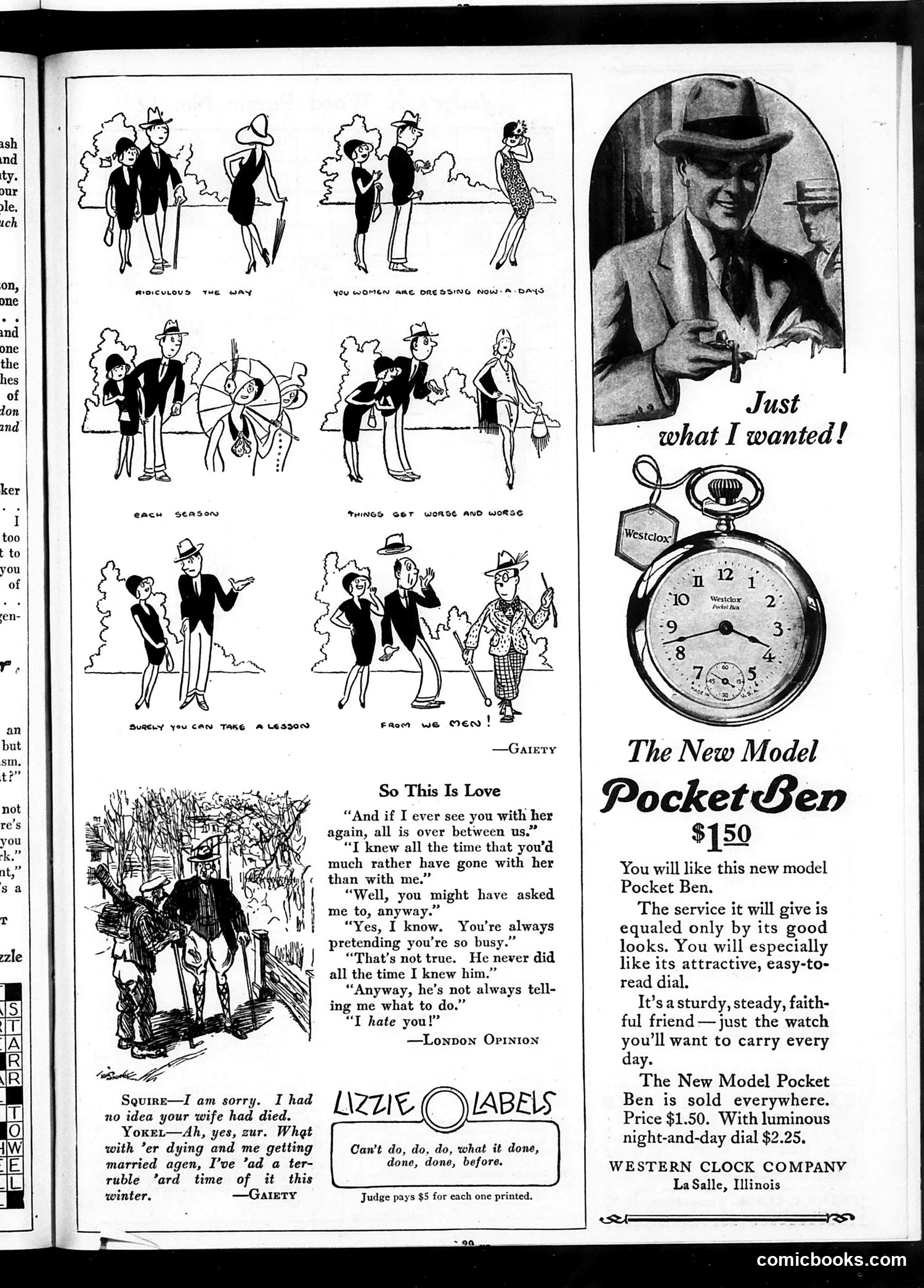
This page contains three distinct satirical pieces typical of early 20th-century humor magazines: **Top cartoon ("Ridiculous the Way")**: Depicts flapper-era women in various fashionable poses, satirizing women's changing dress standards and behavior. The caption suggests men's bewilderment at modern female fashion and social freedom—a common theme as women gained independence post-WWI. **"So This Is Love"**: A dialogue-based comic showing a romantic couple arguing in circles—each misunderstanding the other's intentions. It satirizes the complications of modern romance and gender relations, mocking both masculine and feminine stereotypes through their mutual accusations and defensive posturing. **Bottom sketch**: A rural "Squire" and "Yokel" discussing a farmer's remarriage immediately after his wife's death, played for dark humor about rural life's hardships and practical attitudes toward matrimony. The page is primarily **advertising** (Pocket Ben watch dominates the right side), with satirical content filling space around commercial copy—typical Judge magazine layout mixing humor with product promotion.
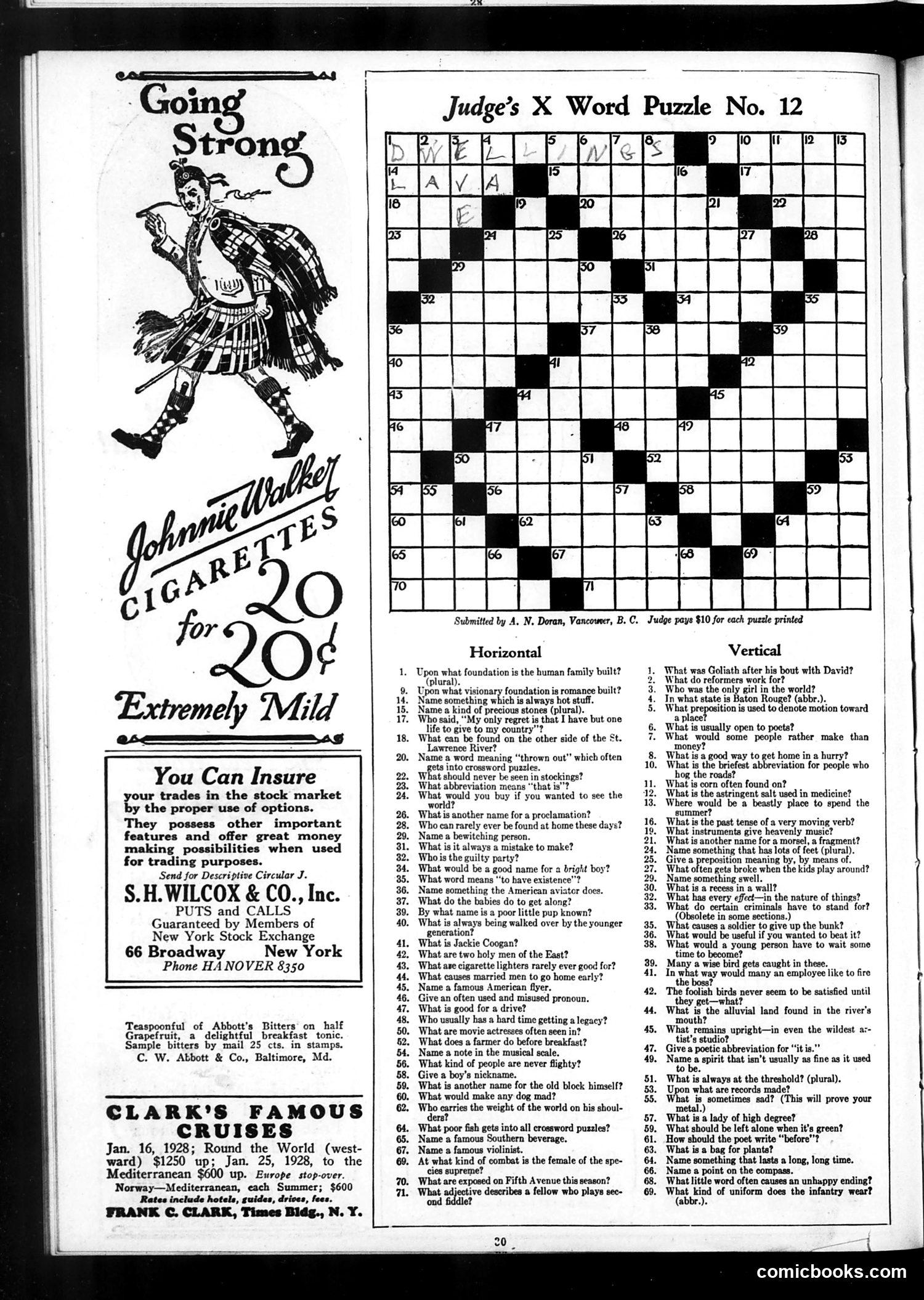
This page is primarily a **crossword puzzle** ("Judge's X Word Puzzle No. 12") submitted by A.N. Doran from Vancouver, B.C., with Judge offering $10 payment for each puzzle printed. The left side contains period advertisements and a cartoon illustration titled "Going Strong" depicting a Scottish Highlander in full traditional dress—likely promoting Johnnie Walker Cigarettes ("for 20¢"). The cigarette ad emphasizes the product is "Extremely Mild." The remaining advertisements promote financial services (stock options trading), patent medicines (Abbott's Bitters), luxury cruises, and other consumer goods typical of 1920s publications. **For modern readers:** This represents Judge magazine's dual function as satirical commentary and **mainstream consumer publication**—the crossword puzzle was a popular 1920s fad, while the Scottish imagery reflects common period ethnic stereotyping in advertising. The magazine subsidized itself through paid advertisements alongside its editorial content.
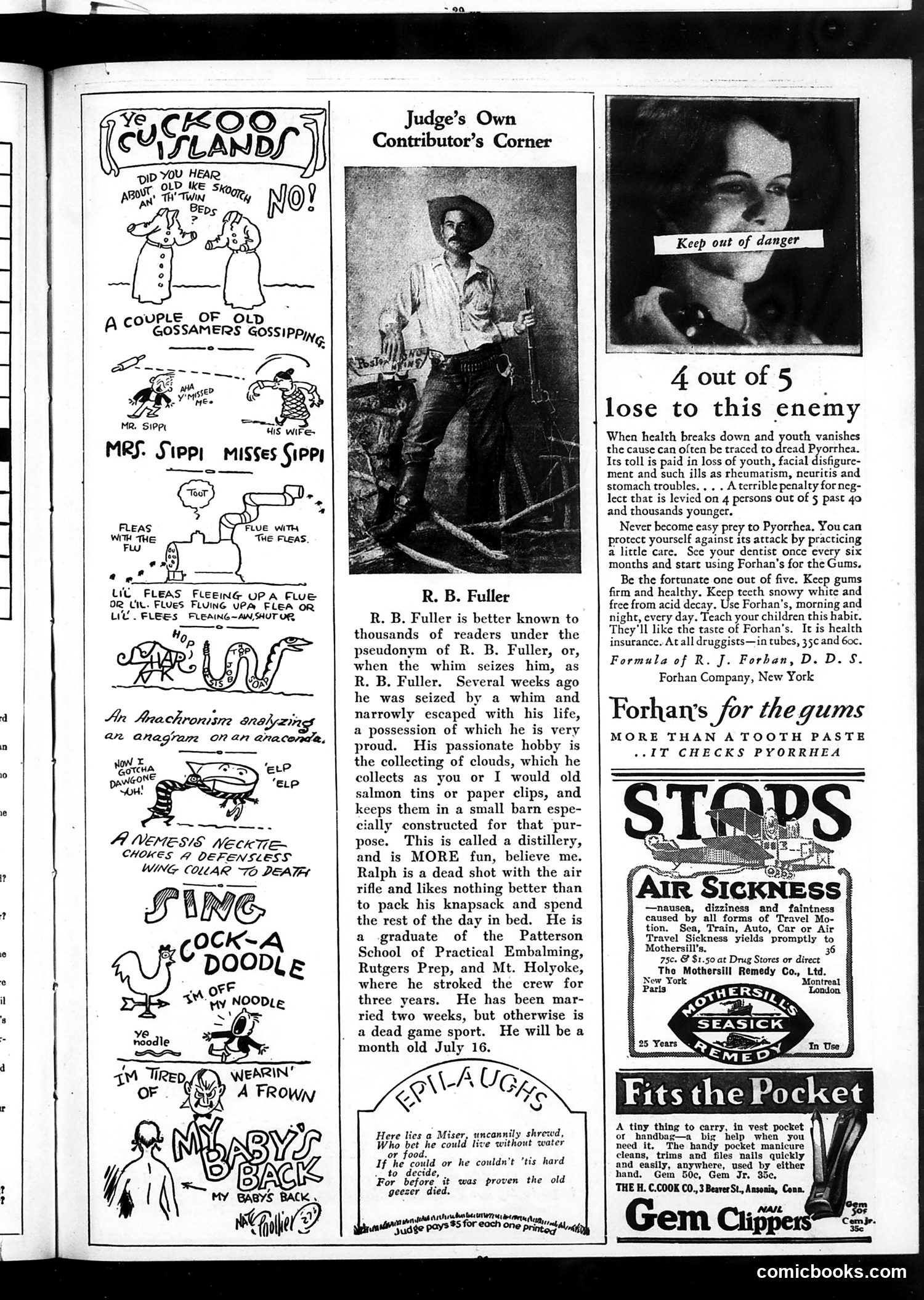
This page from Judge magazine (a major American satirical publication) contains multiple elements: **Left side:** Comic strips by contributor R.B. Fuller, featuring wordplay and visual gags typical of early 20th-century humor—puns about fleas, anachronisms, and domestic situations with minimal social commentary. **Center:** A biographical profile of R.B. Fuller himself, presented humorously. The text reveals he's an eccentric hobbyist who collects clouds in a barn he calls a "distillery," is a competitive marksman, and was recently married. The final line—"He will be a month old July 16"—is deliberately absurd, suggesting he's an infant, which contrasts comedically with his described accomplishments. **Right side:** Advertisements for health products (Forhan's toothpaste for pyorrhea/gum disease, Mothersill's for motion sickness, and Gem Clippers), reflecting contemporary medical concerns and consumer culture of the era. The page is primarily entertainment and commercial rather than political satire.
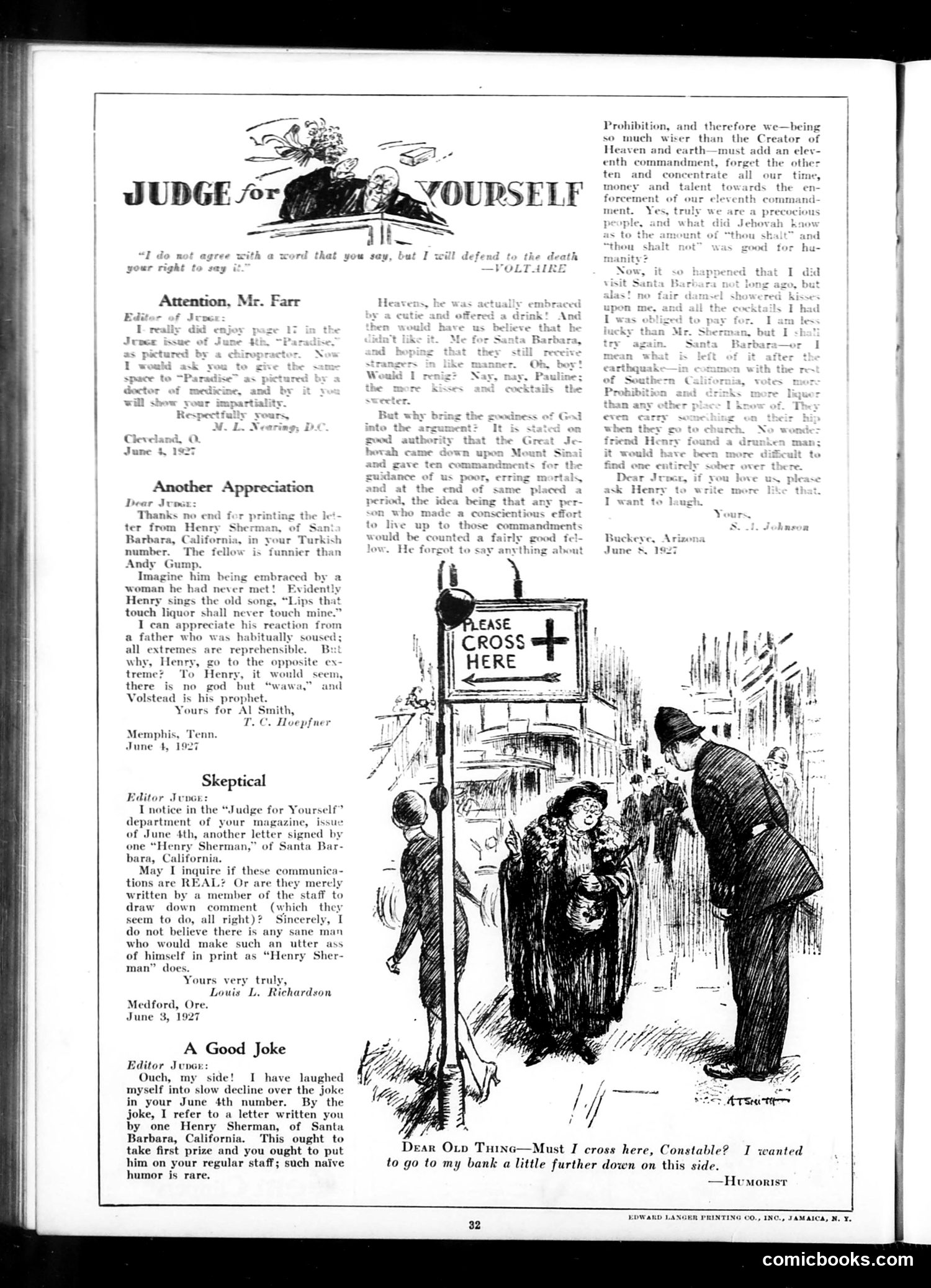
This page contains reader letters and one cartoon addressing **Prohibition-era social tensions**. The main cartoon depicts a pedestrian asking a police officer whether he must cross at a marked crosswalk to reach a bank "a little further down." The joke's dark humor references **Prohibition enforcement**: the pedestrian is likely implying he wants to avoid crossing near the marked location because it may indicate where illegal alcohol sales occur or police conduct raids. The "Please Cross Here" sign becomes ironic—the safer, legal route is exactly where trouble happens. The letters above discuss "Henry Sherman," an apparent recurring letter-writer promoting teetotalism. Readers debate whether Sherman is real or a fabricated character created by Judge's editors to generate humorous outrage. One correspondent mockingly suggests Sherman should join the magazine's staff, praising his "naive humor." The content satirizes **Prohibition's societal absurdity**: how the law created criminal activity, police corruption, and the surreal situations ordinary citizens navigated during the 1920s-era "noble experiment."
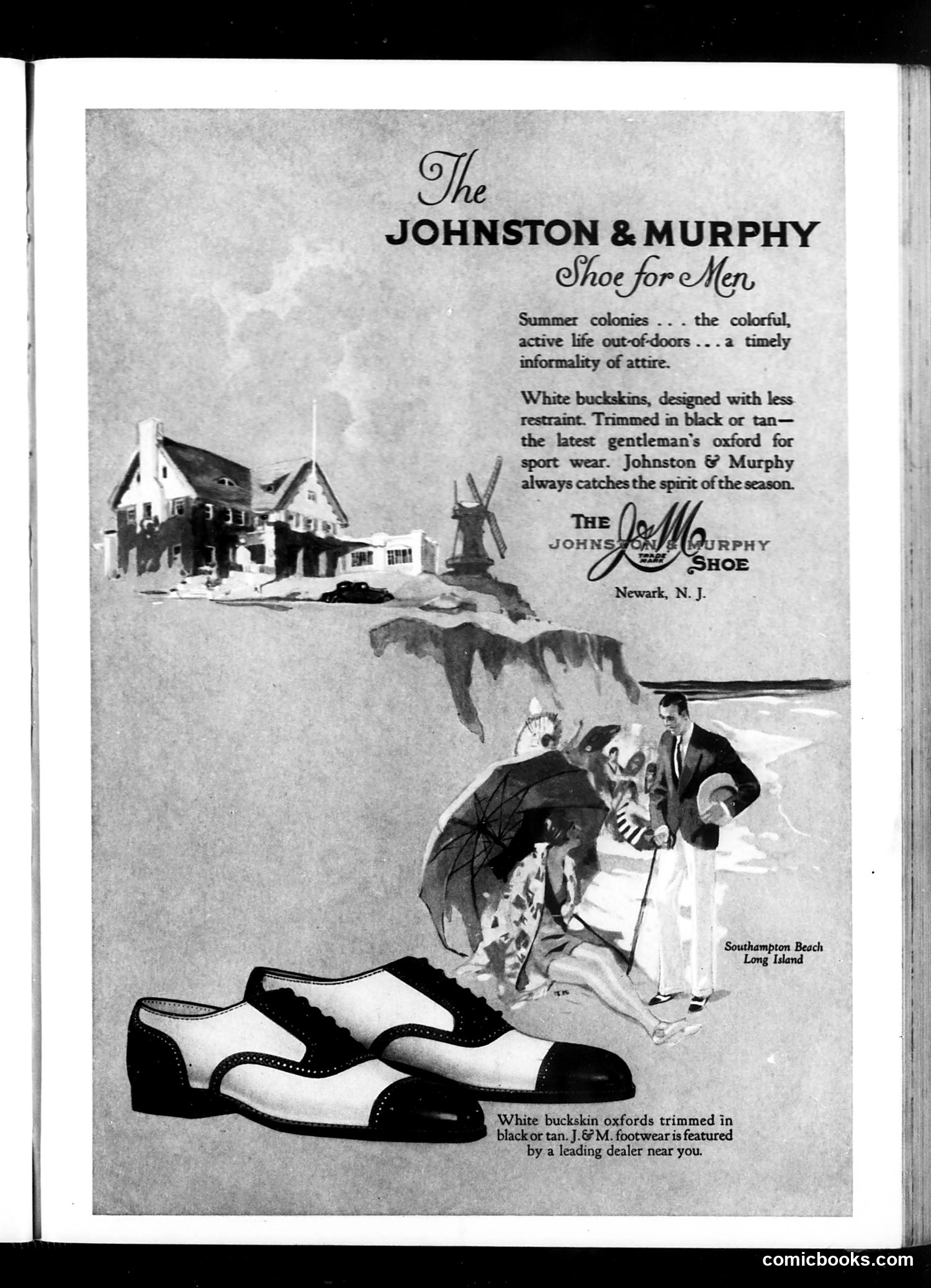
This is primarily a **product advertisement**, not political satire. It promotes Johnston & Murphy shoes for men, specifically white buckskin oxfords trimmed in black or tan. The page uses a summer leisure theme to market the shoes. The imagery shows a seaside resort scene (Southampton Beach, Long Island) with well-dressed men in casual sporting attire, establishing the shoes as appropriate for outdoor recreation and vacation wear. The accompanying cottage and windmill imagery evoke an idealized summer colony lifestyle. The ad emphasizes that Johnston & Murphy shoes capture "the spirit of the season"—positioning them as fashionable, gentlemanly footwear for modern informal occasions. The shoe design itself (white buckskin with contrasting trim) represents contemporary 1920s-era men's fashion trends. There is no political cartoon or satire on this page—it is purely commercial advertising designed to appeal to affluent male consumers.
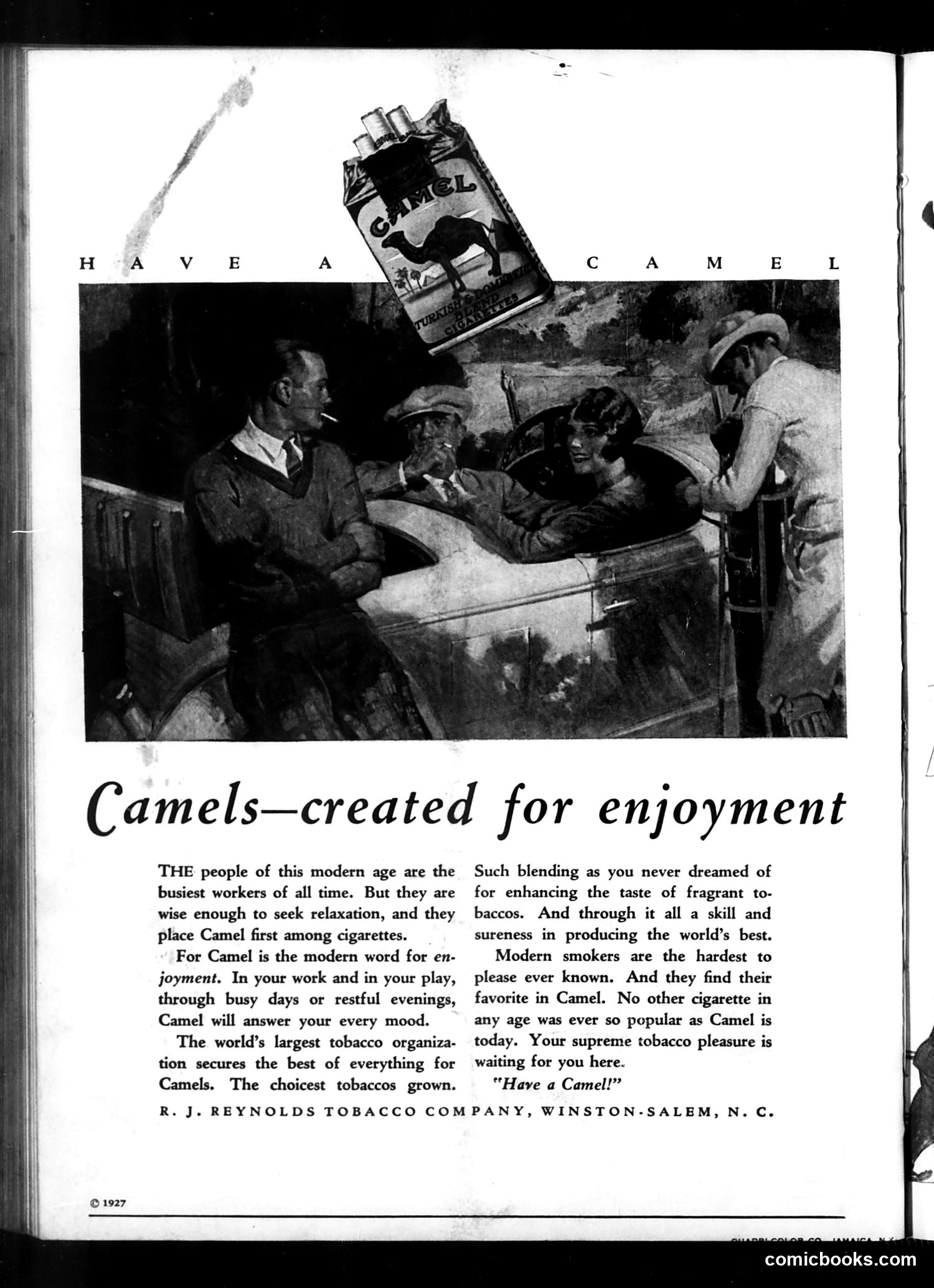
This page is primarily a **Camel cigarette advertisement** from 1927, not a political cartoon. The image shows working-class men (laborers in hats and work clothes) examining or receiving a large Camel cigarette package, apparently meant to illustrate the product's appeal to busy, hardworking people. The ad's messaging targets modern industrial workers, positioning smoking as "enjoyment" and relaxation for those who work hard. The slogan "Camels—created for enjoyment" and tagline "Have a Camel!" emphasize leisure and stress relief. By modern standards, this is notable primarily as a historical artifact showing **pre-regulation tobacco advertising**—directly marketing cigarettes to workers without health warnings, using lifestyle appeals rather than health claims. The casualness with which smoking is presented as universal pleasure and stress management reflects early 20th-century attitudes before cigarette dangers were widely acknowledged.