
Judge, 1927-07-16 · page 9 of 40
Judge — July 16, 1927 — page 9: what you’re looking at
What you’re looking at
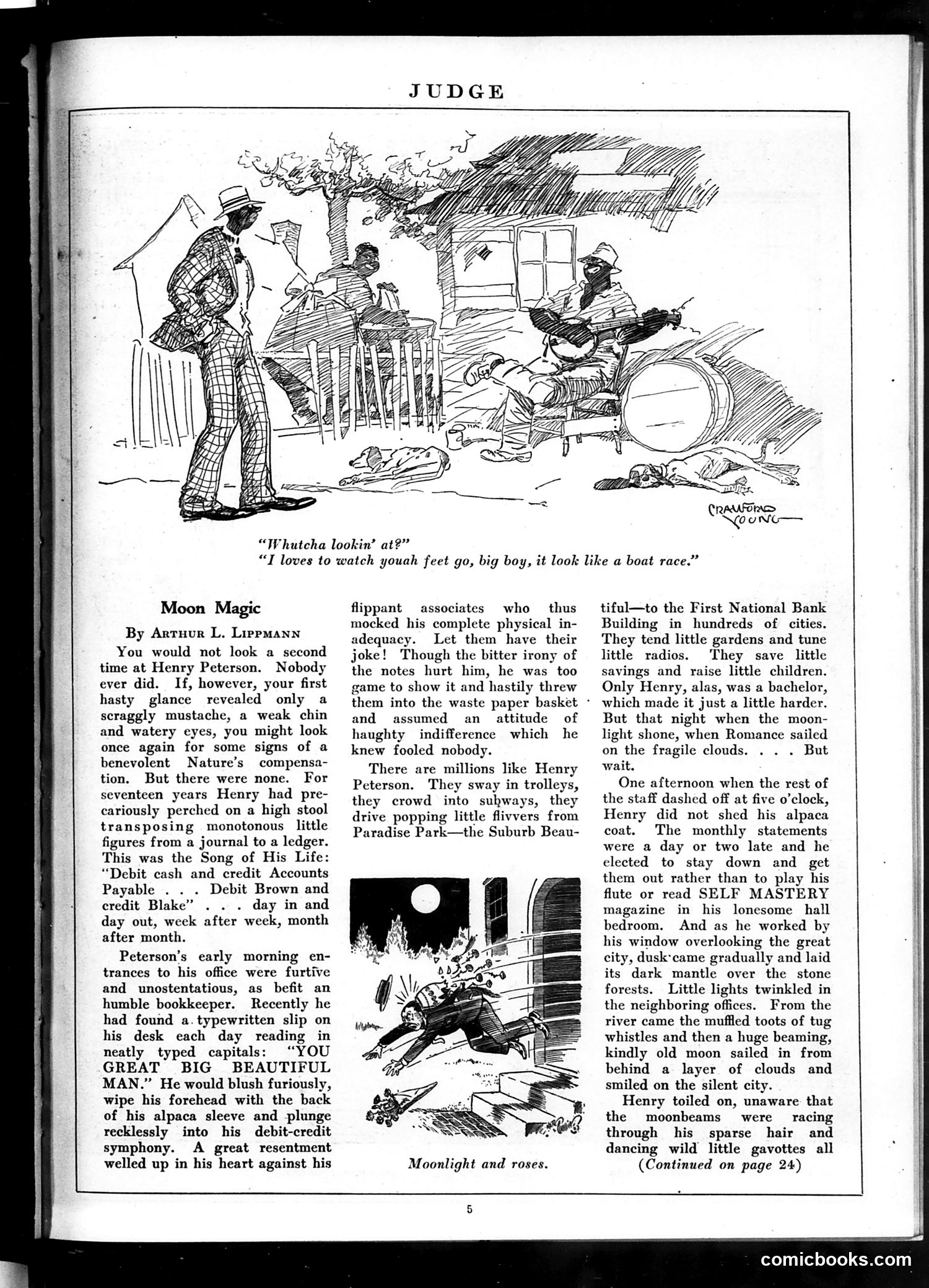
The top cartoon depicts working-class men in casual, colloquial dialogue—likely mocking their vernacular speech patterns and leisure activities (watching feet "like a boat race"). The main story by Arthur L. Lippmann concerns Henry Peterson, a humble bookkeeper—a figure representing the "little man" of 1920s urban America. For seventeen years, he performs tedious debit-credit work, invisible and unremarkable. Recently, anonymous colleagues have been leaving notes calling him a "GREAT BIG BEAUTIFUL MAN," mocking his physical inadequacy and loneliness. The satire targets the disparity between Henry's dull reality (modest salary, small radio, bachelor status) and the romantic fantasies the moonlight inspires. The story suggests how ordinary urban workers—millions of them—live diminished lives, their humanity reduced to economic function. The moonbeams "dancing" through his hair while he works suggest ironic contrast between poetic beauty and his mundane existence, setting up the emotional tension continued on page 24.
📄 Transcribed text from this page (OCR, searchable)
Machine-transcribed from the original scan — historical spelling and the odd misread are preserved.
— ~Sa RR eR T e enpa eo en “Whutcha lookin’ at?” “T loves to watch youah feet go, big boy, it look like a boat race.” Moon Magic By Artuur L. Lippmann You would not look a second time at Henry Peterson. Nobody ever did. If, however, your first hasty glance revealed only a scraggly mustache, a weak chin and watery eyes, you might look once again for some signs of a benevolent Nature’s compensa- tion. But there were none. For seventeen years Henry had pre- cariously perched on a high stool transposing monotonous little figures from a journal to a ledger. This was the Song of His Life: “Debit cash and credit Accounts Payable . . . Debit Brown and credit Blake” . day in and day out, week after week, month after month. Peterson’s early morning en- trances to his office were furtive and unostentatious, as befit an humble bookkeeper. Recently he had found a. typewritten slip on his desk each day reading in neatly typed capitals: “YOU GREAT BIG BEAUTIFUL MAN.” He would blush furiously, wipe his forehead with the back of his alpaca sleeve and plunge recklessly into his debit-credit symphony. A great resentment welled up in his heart against his flippant associates who thus mocked his complete physical in- adequacy. Let them have their joke! Though the bitter irony of the notes hurt him, he was too game to show it and hastily threw them into the waste paper basket - and assumed an attitude of haughty indifference which he knew fooled nobody. There are millions like Henry Peterson. They sway in trolleys, they crowd into suhways, they drive popping little flivvers from Paradise Park—the Suburb Beau- Moonlight and roses. tiful—to the First National Bank Building in hundreds of cities. They tend little gardens and tune little radios. They save little savings and raise little children. Only Henry, alas, was a bachelor, which made it just a little harder. But that night when the moon- light shone, when Romance sailed on the fragile clouds. . . . But wait. One afternoon when the rest of the staff dashed off at five o’clock, Henry did not shed his alpaca coat. The monthly statements were a day or two late and he elected to stay down and get them out rather than to play his flute or read SELF MASTERY magazine in his lonesome hall bedroom. And as he worked by his window overlooking the great city, dusk-came gradually and laid its dark mantle over the stone forests. Little lights twinkled in the neighboring offices. From the river came the muffled toots of tug whistles and then a huge beaming, kindly old moon sailed in from behind a layer of clouds and smiled on the silent city. Henry toiled on, unaware that the moonbeams were racing through his sparse hair and dancing wild little gavottes all (Continued on page 24) comicbooks.com —