
Judge, 1927-07-16 · page 19 of 40
Judge — July 16, 1927 — page 19: what you’re looking at
What you’re looking at
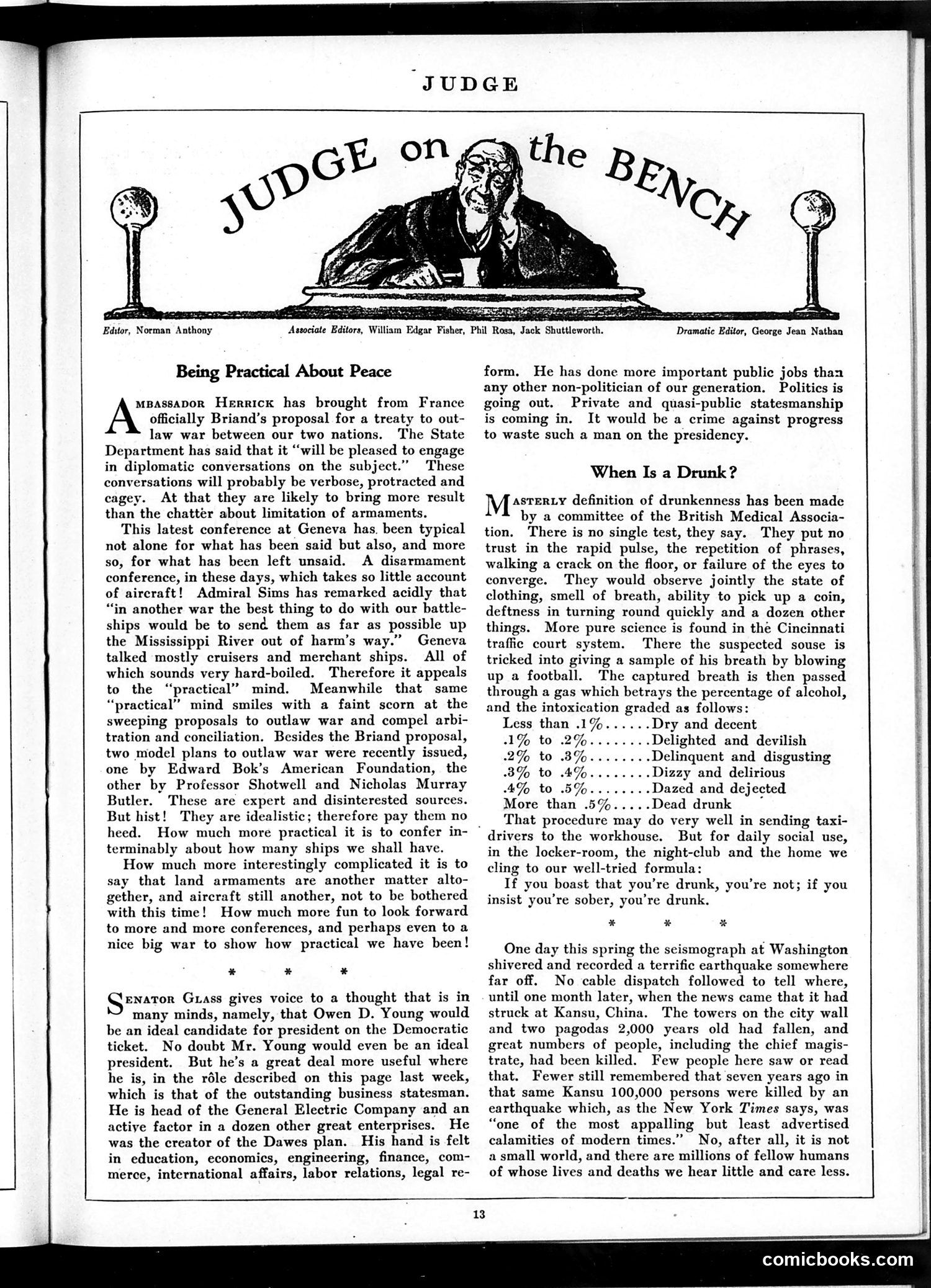
This is a 1920s opinion page from **Judge** magazine featuring three distinct editorial pieces: **"Being Practical About Peace"** satirizes disarmament negotiations. Ambassador Herrick brought French Foreign Minister Briand's war-outlawing proposal, but the piece mocks how diplomats spend endless time debating specific armaments (ships, aircraft, land weapons) while ignoring the idealistic broader goal of outlawing war itself—calling this false "practicality" a setup for future conflict. **The middle section** on Owen D. Young praises him as a business statesman and warns against wasting him on the presidency, arguing private sector leadership serves the nation better than electoral politics. **"When Is a Drunk?"** discusses how British Medical Association refuses single-test drunk definitions, contrasting this with Cincinnati's traffic courts, which use a breath-analysis football method to measure alcohol content—a semi-serious but humorous critique of scientific versus legal approaches to intoxication. The Judge mascot presides above as the authoritative voice on public affairs.
📄 Transcribed text from this page (OCR, searchable)
Machine-transcribed from the original scan — historical spelling and the odd misread are preserved.
Editor, Norman Anthony Being Practical About Peace mBassaporR Herrick has brought from France A officially Briand’s proposal for a treaty to out- law war between our two nations. The State Department has said that it “will be pleased to engage in diplomatic conversations on the subject.” These conversations will probably be verbose, protracted and cagey. At that they are likely to bring more result than the chatter about limitation of armaments. This latest conference at Geneva has. been typical not alone for what has been said but also, and more so, for what has been left unsaid. A disarmament conference, in these days, which takes so little account of aircraft! Admiral Sims has remarked acidly that “in another war the best thing to do with our battle- ships would be to send them as far as possible up the Mississippi River out of harm’s way.” Geneva talked mostly cruisers and merchant ships. All of which sounds very hard-boiled. Therefore it appeals to the “practical” mind. Meanwhile that same “practical” mind smiles with a faint scorn at the sweeping proposals to outlaw war and compel arbi- tration and conciliation. Besides the Briand proposal, two model plans to outlaw war were recently issued, one by Edward Bok’s American Foundation, the other by Professor Shotwell and Nicholas Murray Butler. These are expert and disinterested sources. But hist! They are idealistic; therefore pay them no heed. How much more practical it is to confer in- © terminably about how many ships we shall have. How much more interestingly complicated it is to say that land armaments are another matter alto- gether, and aircraft still another, not to be bothered with this time! How much more fun to look forward to more and more conferences, and perhaps even to a nice big war to show how practical we have been! * * * Grxaton Guass gives voice to a thought that is in many minds, namely, that Owen D. Young would be an ideal candidate for president on the Democratic ticket. No doubt Mr. Young would even be an ideal president. But he’s a great deal more useful where he is, in the réle described on this page last week, which is that of the outstanding business statesman. He is head of the General Electric Company and an actiye factor in a dozen other great enterprises. He was the creator of the Dawes plan. His hand is felt in education, economics, engineering, finance, com- merce, international affairs, labor relations, legal re- Associate Editors, William Edgar Fisher, Phil Rosa, Jack Shuttleworth. Dramatic Editor, George Jean Nathan form. He has done more important public jobs than any other non-politician of our generation. Politics is going out. Private and quasi-public statesmanship is coming in. It would be a crime against progress to waste such a man on the presidency. When Is a Drunk ? Miastz84¥ definition of drunkenness has been made by a committee of the British Medical Associa- tion. There is no single test, they say. They put no trust in the rapid pulse, the repetition of phrases, walking a crack on the floor, or failure of the eyes to converge. They would observe jointly the state of clothing, smell of breath, ability to pick up a coin, deftness in turning round quickly and a dozen other things. More pure science is found in the Cincinnati traffic court system. There the suspected souse is tricked into giving a sample of his breath by blowing up a football. The captured breath is then passed through a gas which betrays the percentage of alcohol, and the intoxication graded as follows: Less Dry and decent 1% Delighted and devilish 2% -Delinquent and disgusting 3% . Dizzy and delirious 4% -Dazed and dejected More than .5% Dead drunk ; That procedure may do very well in sending taxi- drivers to the workhouse. But for daily social use, in the locker-room, the night-club and the home we cling to our well-tried formula: If you boast that you’re drunk, you’re not; if you insist you’re sober, you’re drunk. * * * One day this spring the seismograph at Washington shivered and recorded a terrific earthquake somewhere far off. No cable dispatch followed to tell where, until one month later, when the news came that it had struck at Kansu, China. The towers on the city wall and two pagodas 2,000 years old had fallen, and great numbers of people, including the chief magis- trate, had been killed. Few people here saw or read that. Fewer still remembered that seven years ago in that same Kansu 100,000 persons were killed by an earthquake which, as the New York Times says, was “one of the most appalling but least advertised calamities of modern times.” No, after all, it is not a small world, and there are millions of fellow humans of whose lives and deaths we hear little and care less. comicbooks.com