
Judge, 1927-07-16 · page 24 of 40
Judge — July 16, 1927 — page 24: what you’re looking at
What you’re looking at
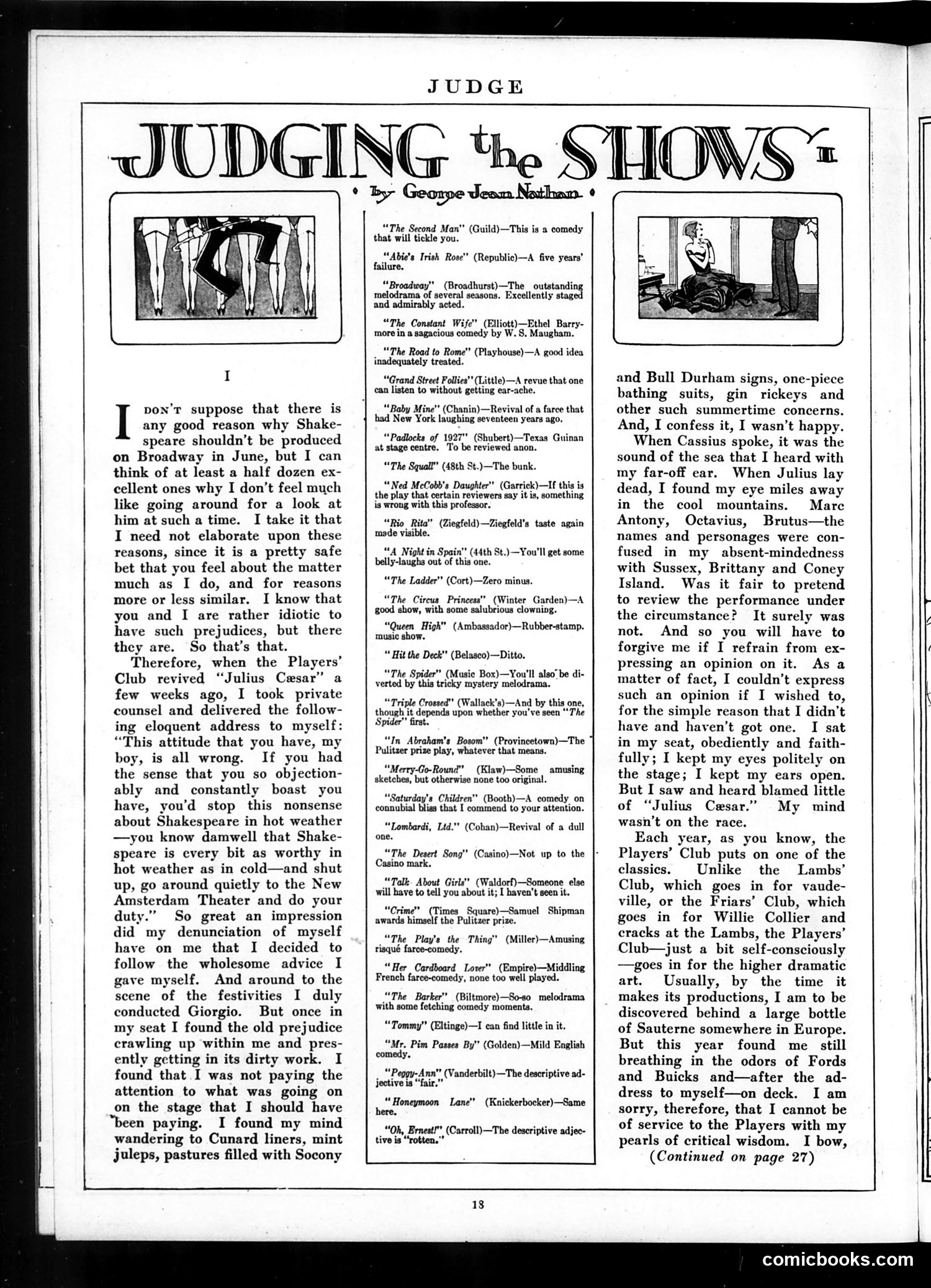
This page features George Jean Nathan's column reviewing Broadway productions during summer 1927. The essay explains Nathan's internal conflict: he knows Shakespeare deserves respect year-round, yet he cannot muster enthusiasm for a Players' Club revival of "Julius Caesar" in hot weather. Rather than pretend otherwise, he admits his mind wandered to cooler pleasures—Cunard liners, mint juleps, and pastoral scenes. The accompanying list reviews current Broadway shows with sharp, dismissive one-liners: "The Squall" is "bunk," "The Ladder" rates "zero minus," and "Padlocks of 1927" features Texas Guinan at center stage (a reference to the notorious nightclub hostess). The satire targets both Nathan's own snobbish pretensions and Broadway's commercial mediocrity—he confesses his own hypocrisy while skewering the productions themselves.
📄 Transcribed text from this page (OCR, searchable)
Machine-transcribed from the original scan — historical spelling and the odd misread are preserved.
ee JUDGE WUDGING ‘he SHOWS pon’t suppose that there is I any good reason why Shake- speare shouldn’t be produced on Broadway in June, but I can think of at least a half dozen ex- cellent ones why I don’t feel much like going around for a look at him at such a time. I take it that I need not elaborate upon these reasons, since it is a pretty safe bet that you feel about the matter much as I do, and for reasons more or less similar. I know that you and I are rather idiotic to have such prejudices, but there they are. So that’s that. Therefore, when the Players’ Club revived “Julius Cesar” a few weeks ago, I took private counsel and delivered the follow- ing eloquent address to myself: “This attitude that you have, my boy, is all wrong. If you had the sense that you so objection- ably and constantly boast you have, you’d stop this nonsense about Shakespeare in hot weather —you know damwell that Shake- speare is every bit as worthy in hot weather as in cold—and shut up, go around quietly to the New Amsterdam Theater and do your duty.” So great an impression did my denunciation of myself have on me that I decided to follow the wholesome advice I gave myself. And around to the scene of the festivities I duly conducted Giorgio. But once in my seat I found the old prejudice crawling up within me and pres- ently getting in its dirty work. I found that I was not paying the attention to what was going on on the stage that I should have een paying. I found my mind wandering to Cunard liners, mint juleps, pastures filled with Socony “The Second Man" (Guild)—This is a comedy that will tickle you. ‘Abie’s Irish Rose’ (Republic)—A five years’ jure. “Broadway” (Broadhurst)—The _outstandiny melodrama of sereeal seasons. Excellently mel and admirably act “The Constant Wife” (Elliott)—Ethel Barry- more in a sagacious comedy by W. S. Maugham. “The Road to Rome" (Playhouse)—A good idea inadequately treated. “Grand Street Follies" (Little)—A revue that one can listen to without getting ear-ache. “Baby Mine" (Chanin)—Revival of a farce that had New York laughing seventeen years ago. “Padlocks of 1927" (Shubert)—Texas Guinan at stage centre. To be reviewed anon. “The Squall” (48th St.)—The bunk. “Ned McCobb's Daughter” (Garrick)—If this is the play that certain reviewers say itis, something is wrong with this professor. “Rio Rita” (Ziegfeld)—Ziegfeld’s taste again made visible. “A. Night in Spain" (44th St.)—You'll get some belly-laughs out of this one. “The Ladder" (Cort)—Zero minus. “The Circus Princess” (Winter Garden)—A good show, with some salubrious clowning. “Queen High” (Ambassador)—Rubber-stamp. music show. “ Hit the Deck’ (Belasco)—Ditto. “The Spider” (Music Box)—You'll also"be di- verted by this tricky mystery melodrama. “Triple Crossed” (Wallack's)—And by this one, though it depends upon whether you've seen “The Spider’ first. “In Abraham's Bosom” (Provincetown)—The Pulitzer prize play, whatever that means. “Merry-Go-Round” (Klaw)—Some amusing sketches, but otherwise none too original. “Saturday's Children” (Booth)—A comedy on connubial bliss that I commend to your attention. “Lombardi, Ltd."" (Cohan)—Revival of a dull one. “The Desert Song” (Casino)—Not up to the Casino mark. “Talk. About Girls" (Waldorf)—Someone else will have to tell you about it; I haven't seen it. “Crime” (Times Square)—Samuel Shipman awards himself the Pulitzer prize. “The Play's the Thing” (Miller)—Amusing risqué farce-comedy. “Her Cardboard Lover” (Empire)—Middling French farce-comedy, none too well played. .‘The Barker” (Biltmore)—So-so_ melodrama with some fetching comedy moments. “Tommy” (Eltinge)—I can find little in it. “Mr. Pim Passes By” (Golden)—Mild English comedy, yy Peony An al , (Vanderbilt) —The descriptive ad- jective is “ a Lane" (Knickerbocker)—Same ere. “Oh, Ernest!” (Carroll) —The descriptive adjec- tive is “rotten.” * by Geonpe deom Nathan. ¢ as and Bull Durham signs, one-piece bathing suits, gin rickeys and other such summertime concerns. And, I confess it, I wasn’t happy. When Cassius spoke, it was the sound of the sea that I heard with my far-off ear. When Julius lay dead, I found my eye miles away in the cool mountains. Mare Antony, Octavius, Brutus—the names and personages were con- fused in my absent-mindedness with Sussex, Brittany and Coney Island. Was it fair to pretend to review the performance under the circumstance? It surely was not. And so you will have to forgive me if I refrain from ex- pressing an opinion on it. As a matter of fact, I couldn’t express such an opinion if I wished to, for the simple reason that I didn’t have and haven't got one. I sat in my seat, obediently and faith- fully; I kept my eyes politely on the stage; I kept my ears open. But I saw and heard blamed little of “Julius Cesar.” My mind wasn’t on the race. Each year, as you know, the Players’ Club puts on one of the classics. | Unlike the Lambs’ Club, which goes in for vaude- ville, or the Friars’ Club, which goes in for Willie Collier and cracks at the Lambs, the Players’ Club—just a bit self-consciously —goes in for the higher dramatic art. Usually, by the time it makes its productions, I am to be discovered behind a large bottle of Sauterne somewhere in Europe. But this year found me still breathing in the odors of Fords and Buicks and—after the ad- dress to myself—on deck. I am sorry, therefore, that I cannot be of service to the Players with my pearls of critical wisdom. I bow, (Continued on page 27) comicbooks.com —y-