
A complete issue · 36 pages · 1927
Judge — July 9, 1927
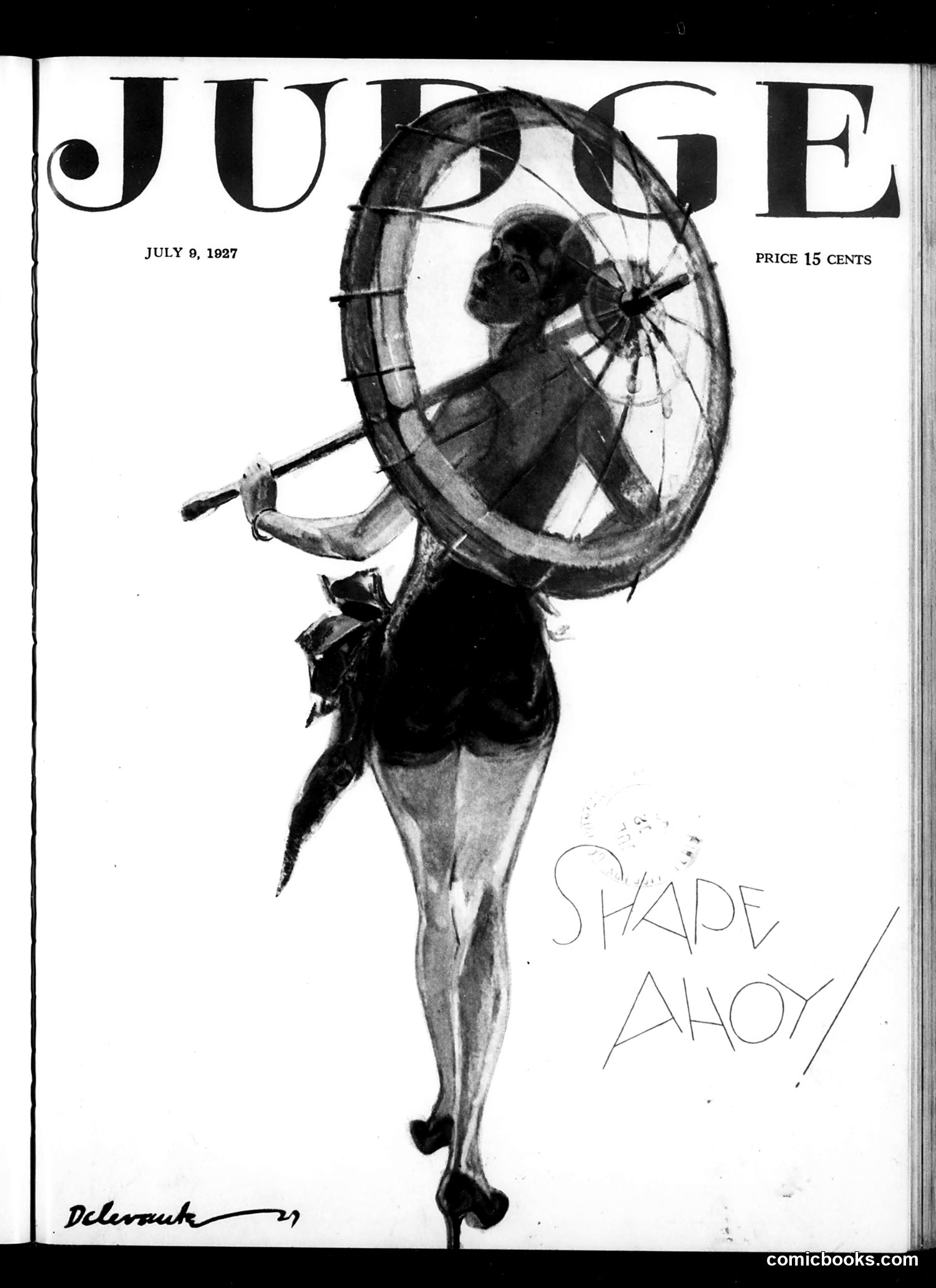
This cover features a stylized illustration of a woman holding a large circular parasol or fan labeled "SHAPE AHOY!" The design is credited to Delermuth. The image appears to be fashion-focused satire typical of Judge magazine's era. The woman's pose and the exaggerated parasol suggest commentary on summer fashion trends or beachwear. The nautical reference ("AHOY") combined with the circular object being held prominently implies mockery of either: 1. An unusual or impractical summer fashion accessory 2. Women's beach fashion of the 1920s 3. The absurdity of following specific shape or silhouette trends The 15-cent price and July dating confirm this is summer-season commentary on contemporary women's fashion, likely poking fun at whatever distinctive or bizarre style was popular that particular summer.
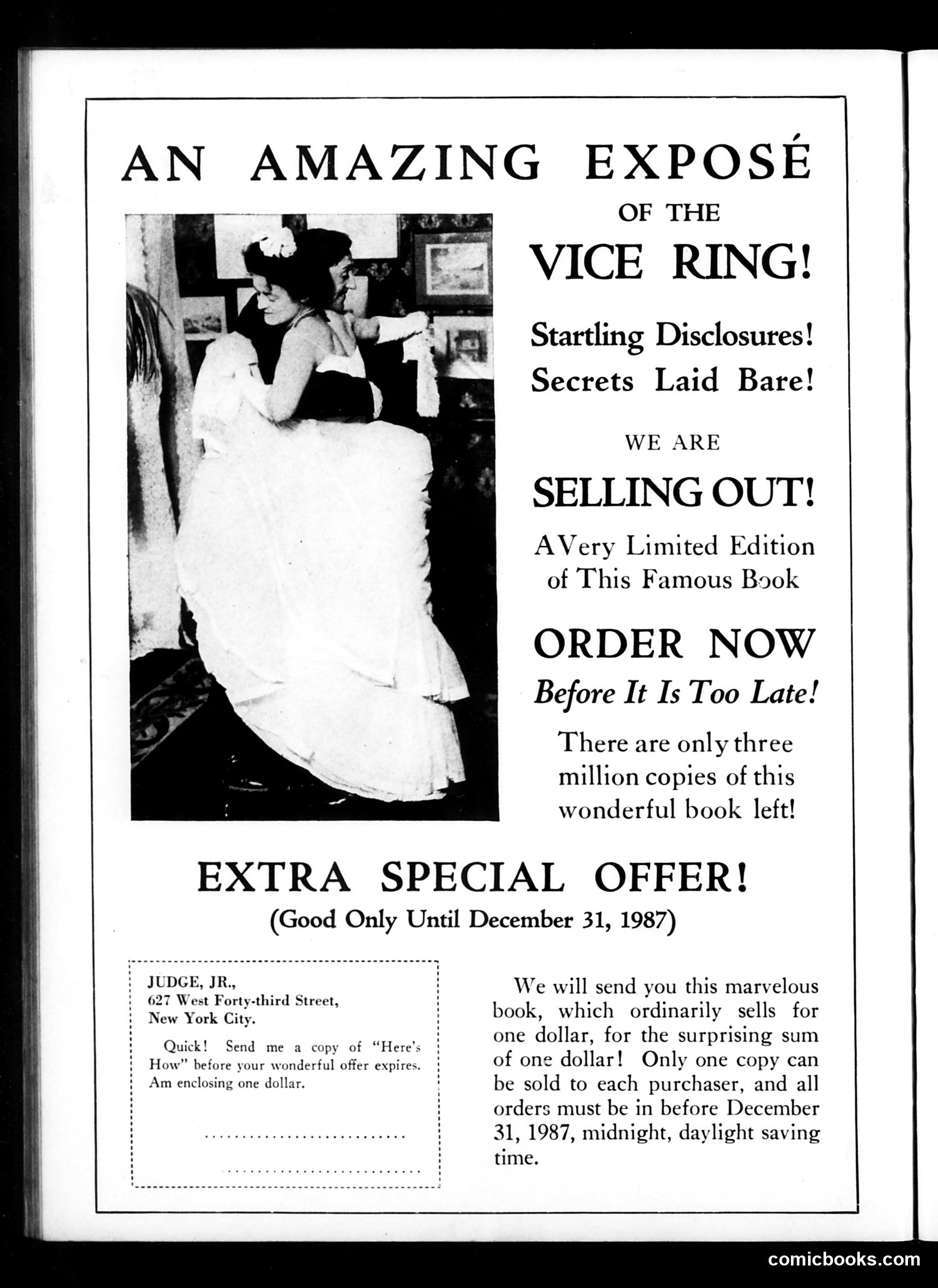
This page is primarily **advertising, not satire or political commentary**. It's a fake book advertisement appearing in Judge magazine, circa 1987 (based on the December 31, 1987 deadline). The ad promotes a sensationalized book titled "An Amazing Exposé of the Vice Ring" with urgent marketing language ("Selling Out!", "Before It Is Too Late!"). The accompanying photograph shows a woman in period clothing, though her identity is unclear. This appears to be a **parody advertisement**—Judge was satirizing melodramatic marketing tactics and pulp literature conventions common to sensationalist publishing. The exaggerated urgency, limited-edition claims, and dollar-for-a-book pricing were typical of actual dubious mail-order schemes. The satire targets consumer gullibility and exploitative advertising practices rather than specific political figures or events.
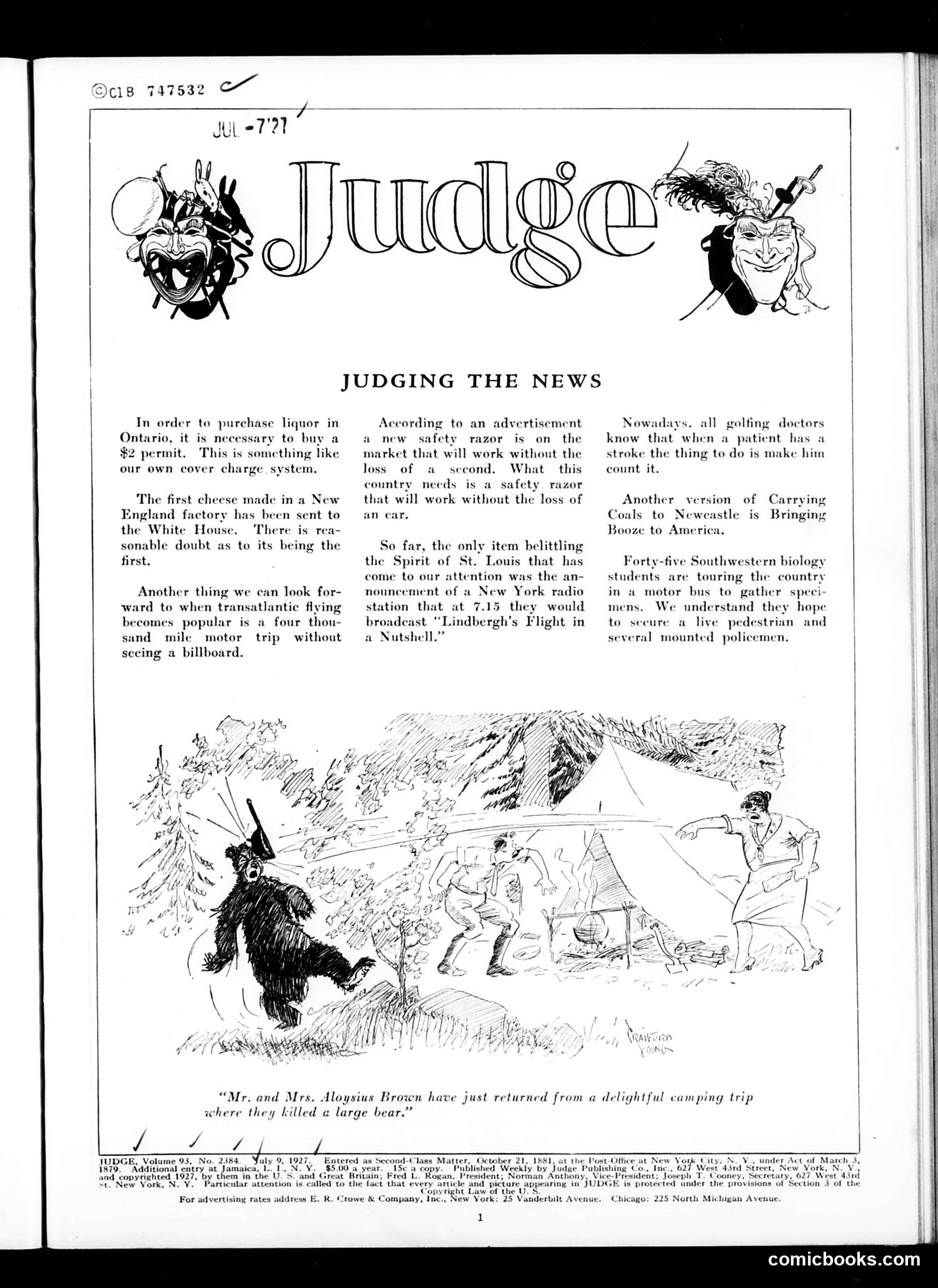
This page contains satirical commentary on current events rather than political cartoons. The "Judge" column critiques contemporary absurdities: 1. **Liquor permits in Ontario** - mocking bureaucratic licensing requirements 2. **Safety razors** - satirizing marketing claims for a product that supposedly works without losing efficiency 3. **Transatlantic aviation** - referencing Lindbergh's famous 1927 flight, joking that radio stations were already sensationalizing it 4. **Biology field trips** - poking fun at expeditions to collect specimens The bottom cartoon shows a couple returning from camping having killed a bear—a humorous domestic scene unrelated to the news items above. The satire targets consumer culture marketing, bureaucratic absurdity, and media sensationalism of the Jazz Age period.
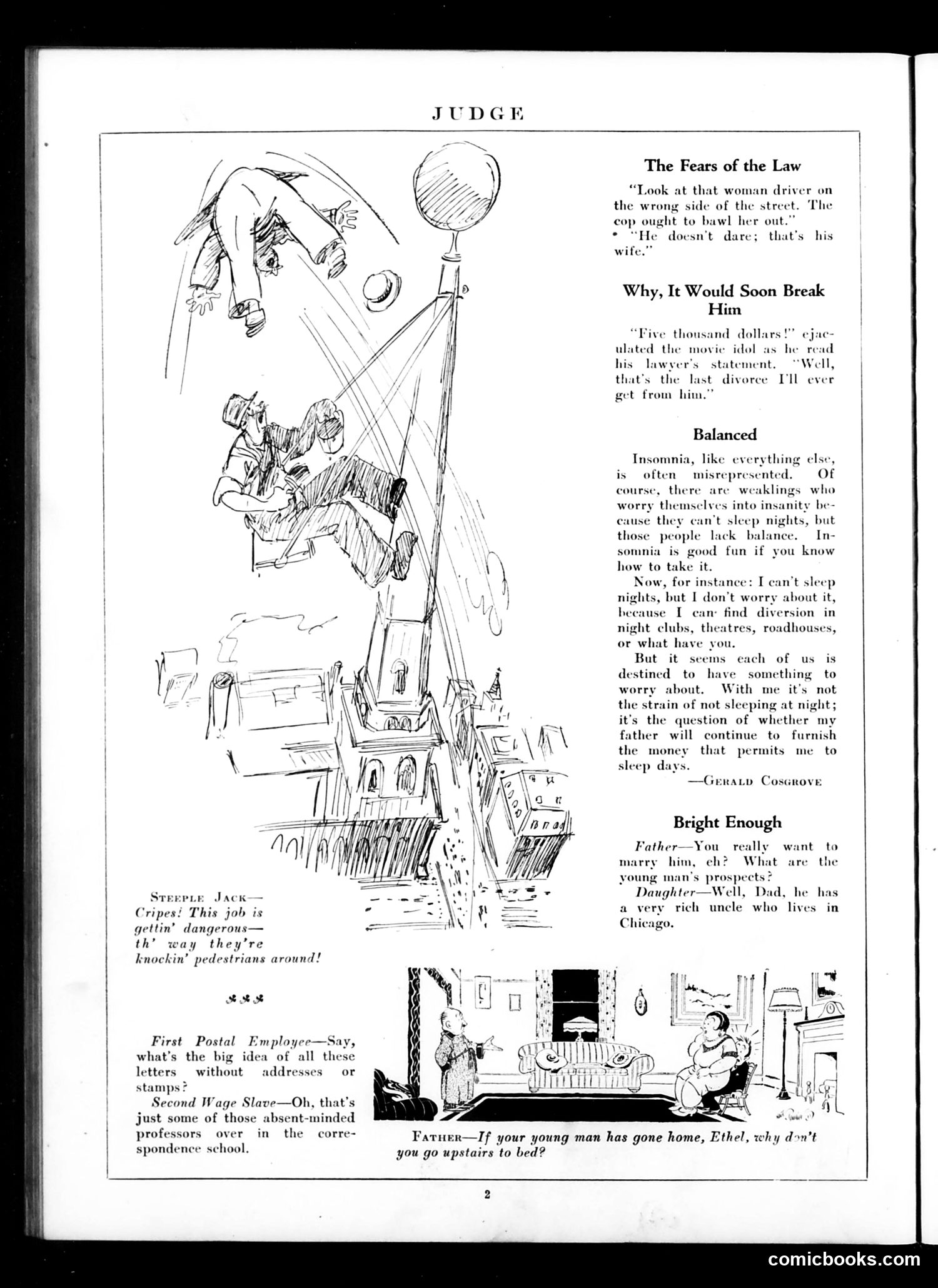
This page contains three separate humor pieces: 1. **"The Fears of the Law"** and **"Why It Would Soon Break Him"**: These brief jokes mock divorce proceedings and legal consequences, with references to spousal conflict and financial settlements. 2. **"Balanced"**: An essay by Gerald Cosgrove about insomnia, arguing that worry is universally distributed among humans—the wealthy worry about money, the sleepless worry about sleep. This satirizes the notion that problems are relative to one's station. 3. **"Bright Enough"**: A domestic humor sketch where a father questions his daughter's suitor's prospects, learning the young man's main qualification is a wealthy uncle in Chicago—mocking superficial standards for marriage eligibility. The large left illustration depicts **"Steeple Jack"**, a dangerous occupation involving workers on tall structures, criticizing hazardous working conditions.
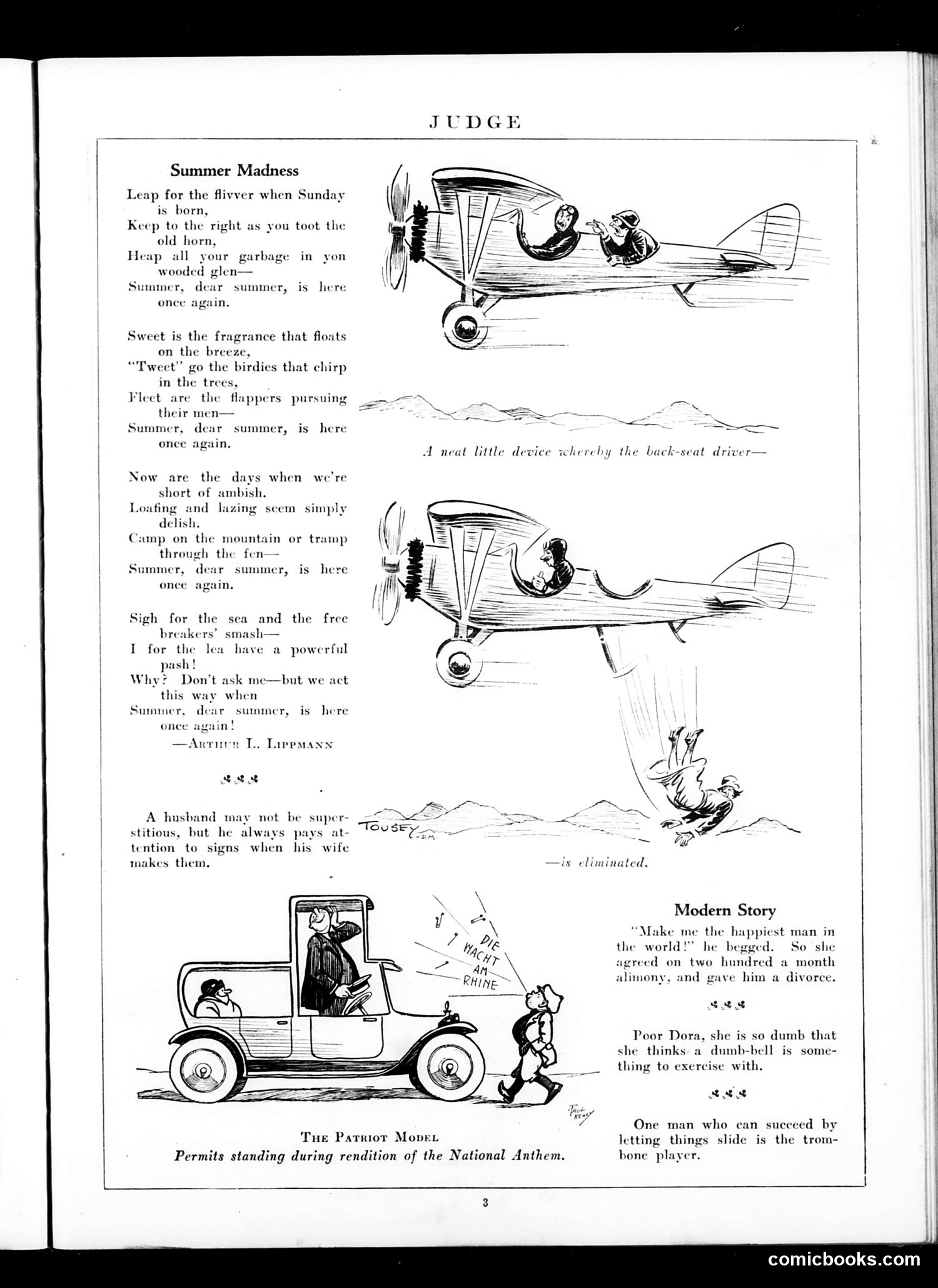
This page contains summer-themed humor and satire typical of Judge magazine's style. **"Summer Madness"** is a poem celebrating summer activities—swimming, camping, flying—with repeated refrain "Summer, dear summer, is here once again." The accompanying airplane sketches illustrate recreational aviation. **"The Patriot Model"** cartoon depicts a car with a man standing during the national anthem's rendition, while another figure appears to be driving recklessly or aggressively. The caption indicates this is satirizing someone who makes a patriotic gesture (standing for the anthem) while behaving badly otherwise—mocking performative patriotism disconnected from actual conduct. **"Modern Story"** section offers brief cynical observations about marriage and divorce, typical of Judge's humor attacking social pretension and relationship dynamics. The overall page emphasizes leisure, modern technology (automobiles, aviation), and social hypocrisy.
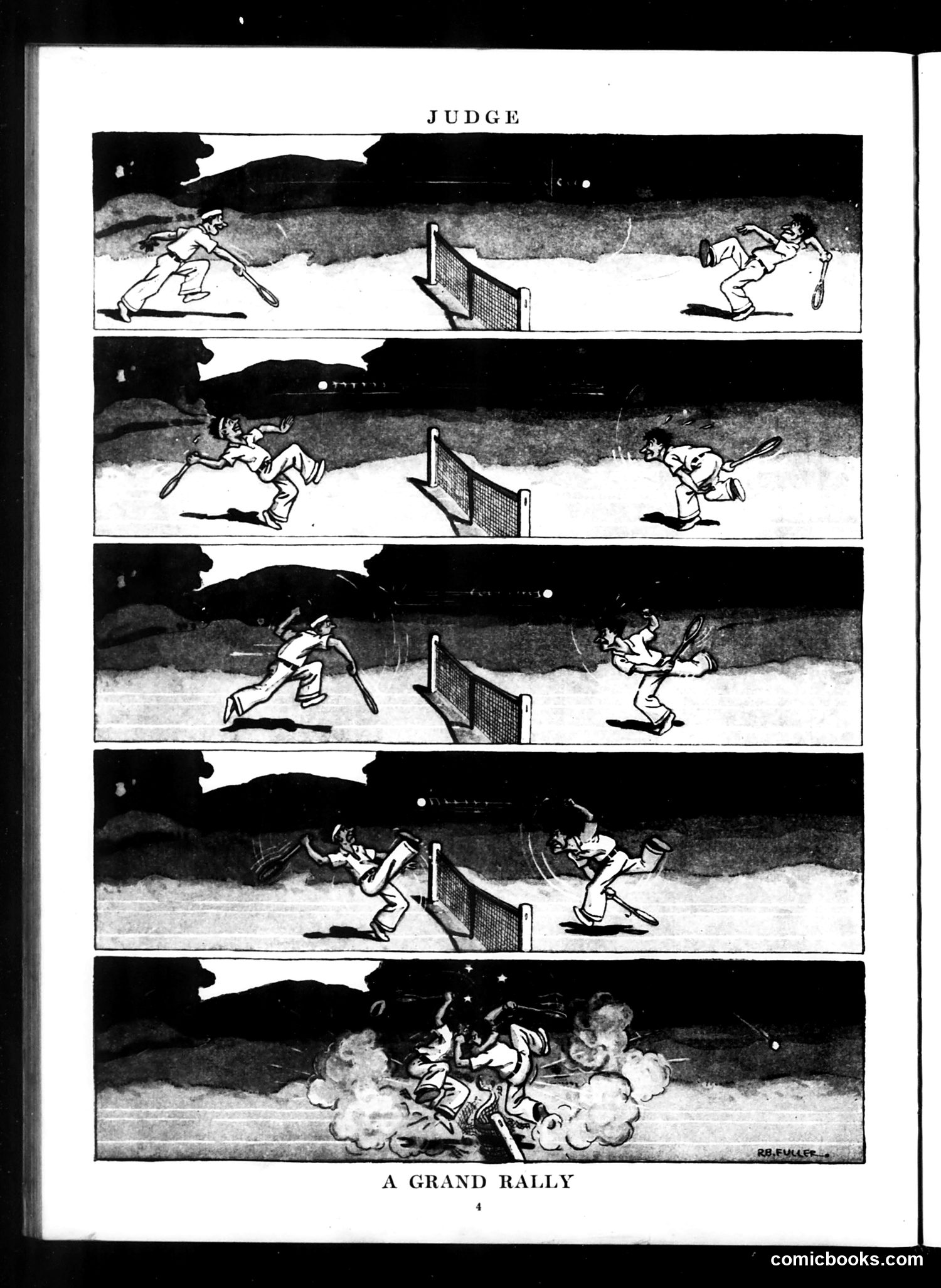
This tennis comic strip titled "A Grand Rally" depicts two players engaged in an increasingly chaotic volley. The humor escalates across five panels: the first four show standard back-and-forth tennis play with the net between players, while the final panel shows both players colliding in an explosion of dust and debris at the net. The satire appears to mock the idea of a "grand rally"—playing on the tennis term while suggesting that endless back-and-forth competition inevitably ends in collision and chaos. Without additional context from Judge's publication date, the specific political figures or social commentary these players might represent remains unclear, though the cartoon likely critiques political or social debate of its era through the tennis metaphor.
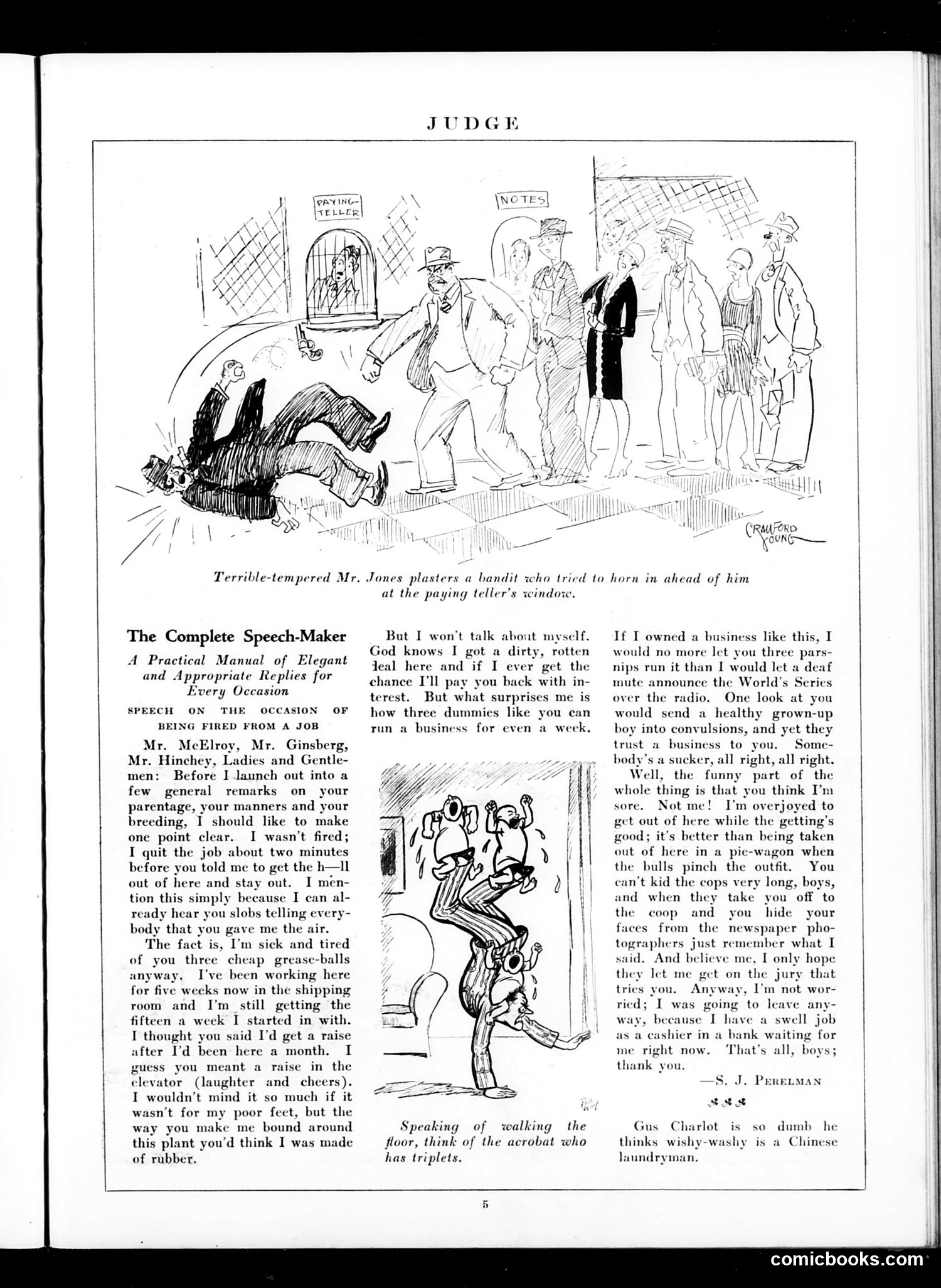
The top cartoon depicts a man (Mr. Jones) being thrown violently to the ground after apparently attempting to horn in ahead of someone at a bank teller's window. The satire addresses workplace frustration and social hierarchy—the exaggerated violence humorously illustrates the consequences of violating unspoken queue etiquette and attempting to gain unfair advantage. The text below, "The Complete Speech-Maker," presents a mock employee being fired. The satirized "speech" is a rambling, self-pitying monologue where the dismissed worker complains about working conditions, blames management, and makes excuses rather than accepting responsibility. The satire targets workers who respond to termination with defensiveness and entitlement rather than accountability—a commentary on workplace attitudes and labor relations of the era. The smaller cartoon shows an acrobat, captioned as having triplets, likely a joke about contortion or flexibility.
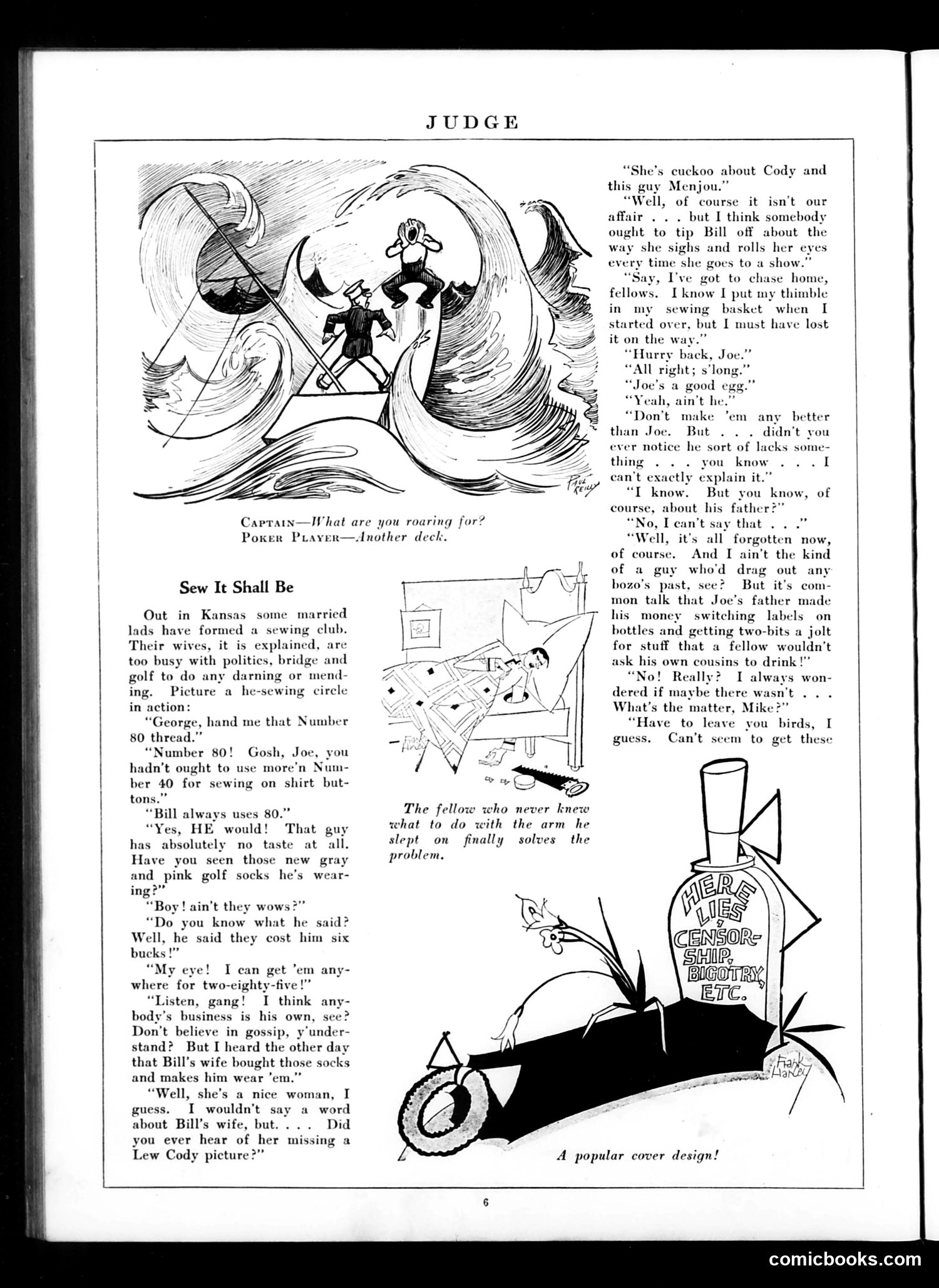
This page contains two separate pieces of satirical content: **"Captain—What are you roaring for? Poker Player—Another deck."** A cartoon about card players, likely mocking poker obsession or addiction among men. **"Sew It Shall Be"** is a longer piece satirizing a Kansas sewing club for married men. The humor targets masculinity anxieties: men doing traditionally "feminine" sewing work, with jokes about wearing golf socks and a wife buying items for her husband. The satire mocks both the men's embarrassment about the hobby and suggests class/taste concerns (gray socks, "no taste"). The right side shows what appears to be advertising or a humorous product design with bottles and a cover concept. The overall tone reflects early 20th-century anxieties about gender roles and domestic life, presented through crude humor typical of Judge magazine's style.
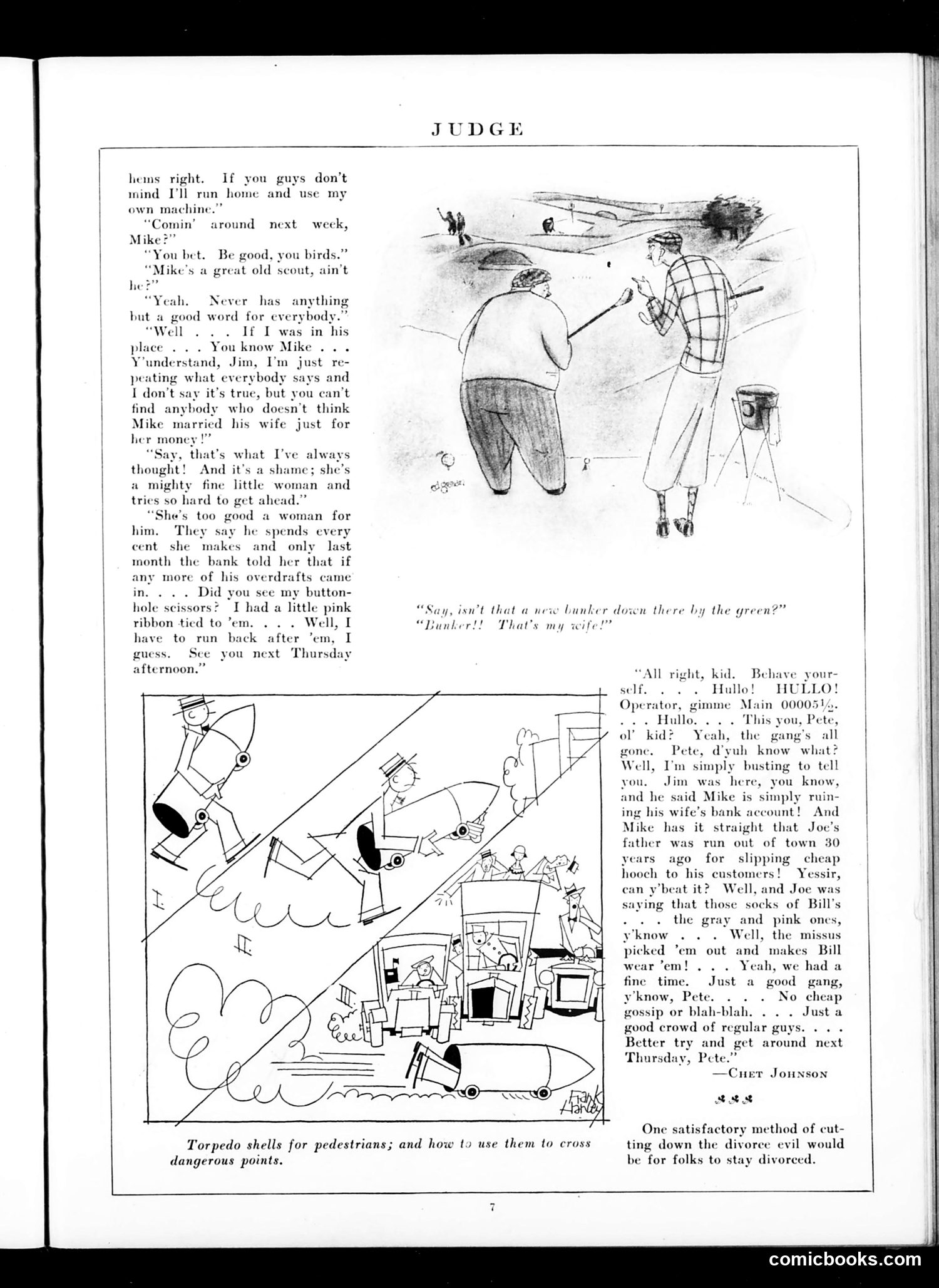
This page satirizes **gossip and hypocrisy** in small-town social circles. The top cartoon shows golfers discussing a man named Mike, initially praising him as "a great old scout," then immediately contradicting themselves by spreading unsubstantiated rumors that he married for money and is financially ruining his wife. The lower cartoon depicts a telephone chain where this gossip spreads—the speaker calls Pete to share not just Mike's alleged misconduct, but also scandalous claims about Joe's father and Bill's socks. The irony is sharp: the speaker insists "No cheap gossip or blah-blah... Just a good crowd of regular guys," while doing exactly that—engaging in baseless character assassination. The satire targets how people simultaneously condemn gossip while enthusiastically participating in it, and how rumors become "facts" through repetition despite explicit admissions of uncertainty ("I don't say it's true"). The final caption about divorce is a cynical aside on marital discord.
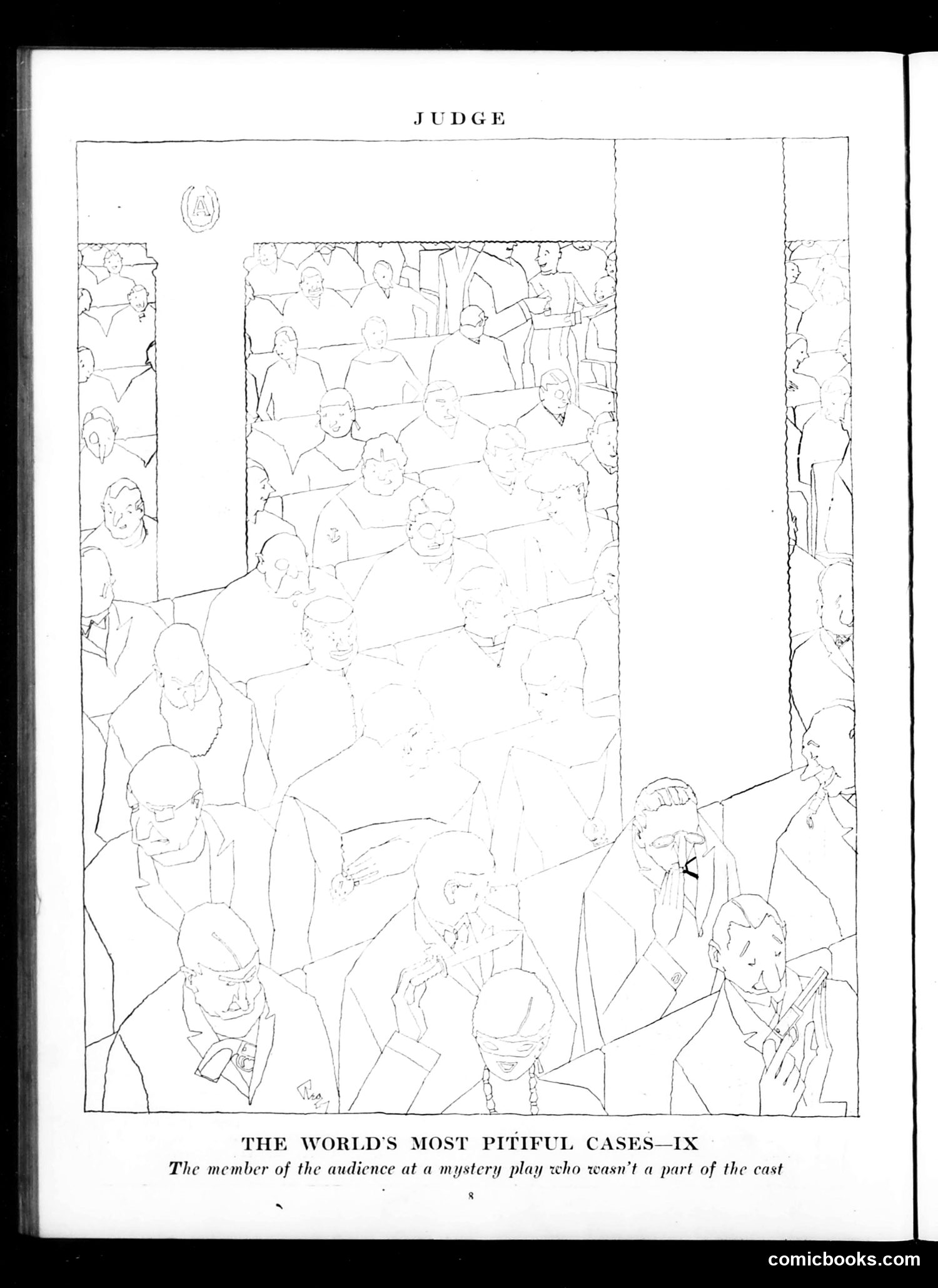
This cartoon satirizes theater audiences attending mystery plays—specifically, it jokes about someone in the audience who *wasn't* actually part of the cast. The drawing shows a crowded theater with many figures, and the humor relies on a common theatrical tradition of the era: mystery plays often featured surprise cast members planted in the audience to create dramatic reveals or interactive moments. The "pitiful case" is the unlucky audience member who paid for a ticket genuinely believing they were a spectator, only to discover nearly everyone around them was a performer. It's gentle satire about deceptive theatrical gimmicks and the audience member's embarrassment at being the only "real" spectator among staged participants. The joke depends on understanding this now-dated theater trend.
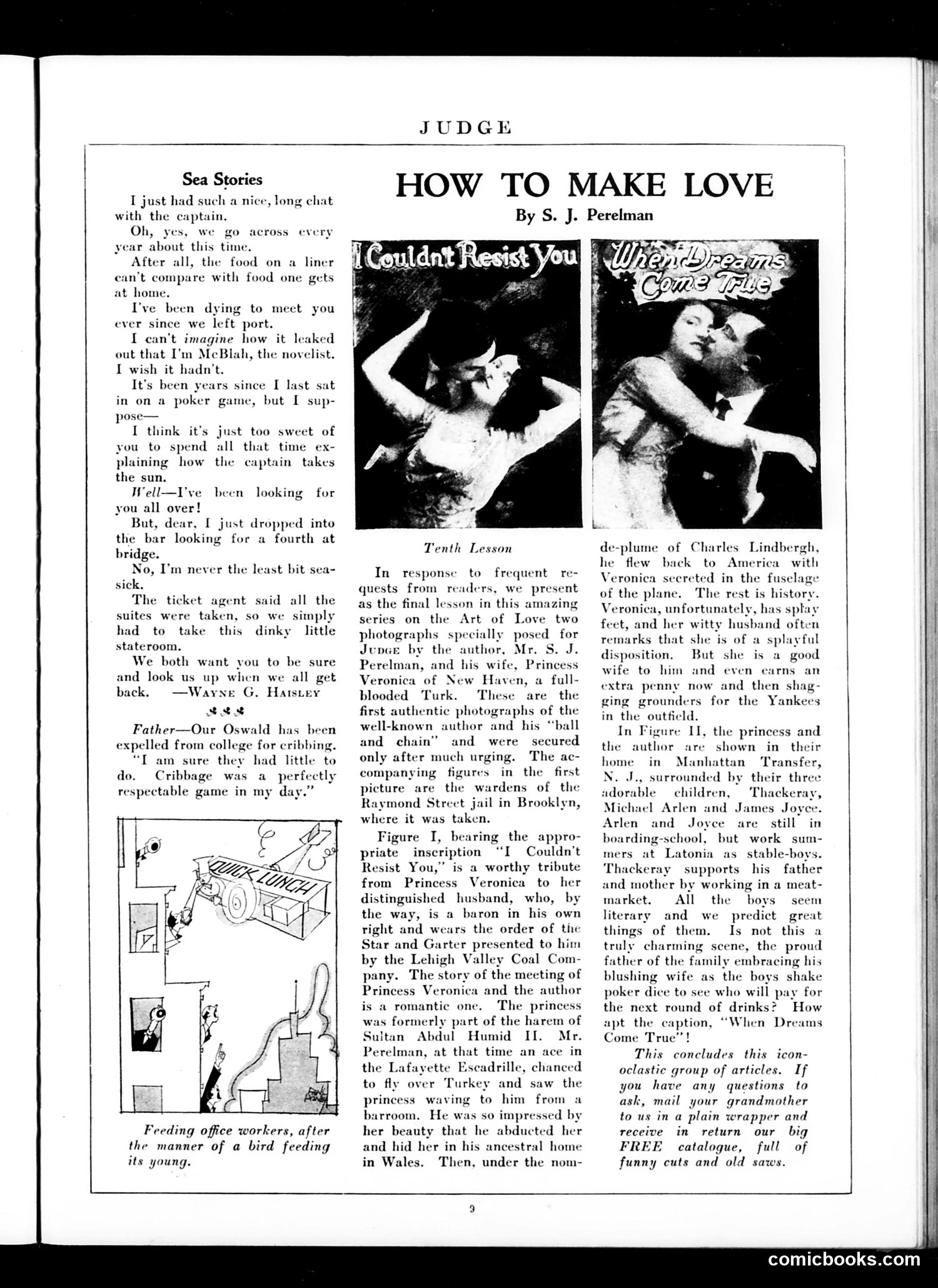
This is a humorous advice column parody featuring S.J. Perelman (a well-known satirist) and his wife "Princess Veronica of New Haven, a full-blooded Turk." The joke is an elaborate mock-serious treatment of a ridiculous backstory: Perelman allegedly met the princess in a Turkish harem while flying as a WWI ace in the Lafayette Escadrille, abducted her, and smuggled her back to America disguised as Charles Lindbergh. The satire mocks overwrought romantic narratives and advice columns. The captions for the photographs ("I Couldn't Resist You," "When Dreams Come True") parody sentimental relationship advice, while the text describes their chaotic family life with children named after literary figures working odd jobs—a deflation of romantic ideals. The piece concludes Judge's series on "the Art of Love" with deliberately absurd, non-advice, poking fun at similar instructional columns of the era.
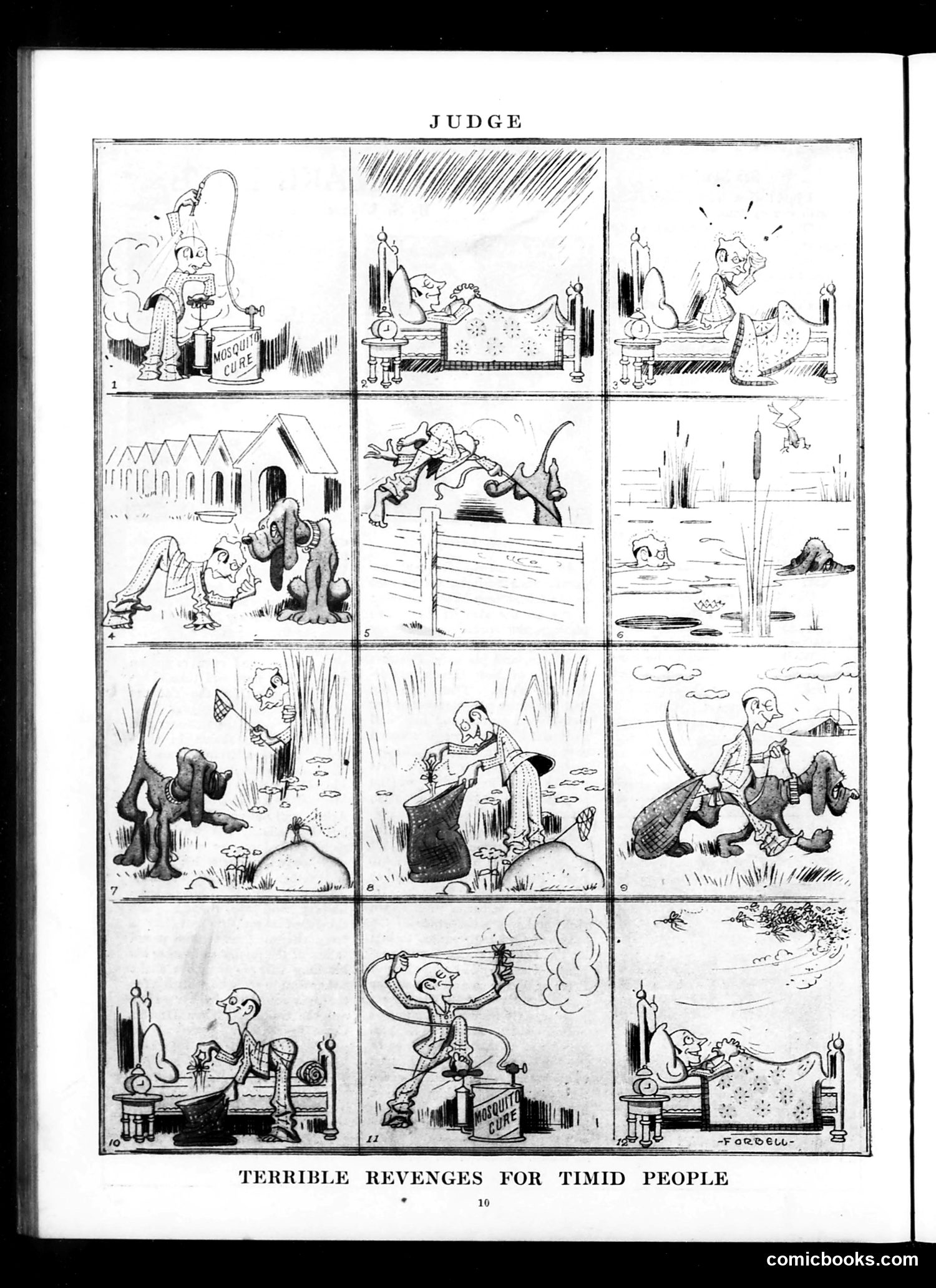
This comic strip from *Judge* depicts humorous revenge fantasies for socially anxious individuals. The title suggests these are fantasies—improbable scenarios unlikely to occur in real life. The panels show escalating scenarios: a timid person imagining themselves striking back against authority figures (appears to be a judge or official in the bedroom scenes), fishing scenes involving confrontation, and dramatic retaliations with "Mosquito Cure" products featured prominently. The satire targets the gap between meek social behavior and suppressed desires for vindication. Rather than mocking timid people, it sympathetically validates their frustrations while the absurd, exaggerated revenge scenarios underscore how unlikely such bold actions would be for inhibited individuals. The recurring "Mosquito Cure" suggests this may be advertising disguised as humor.
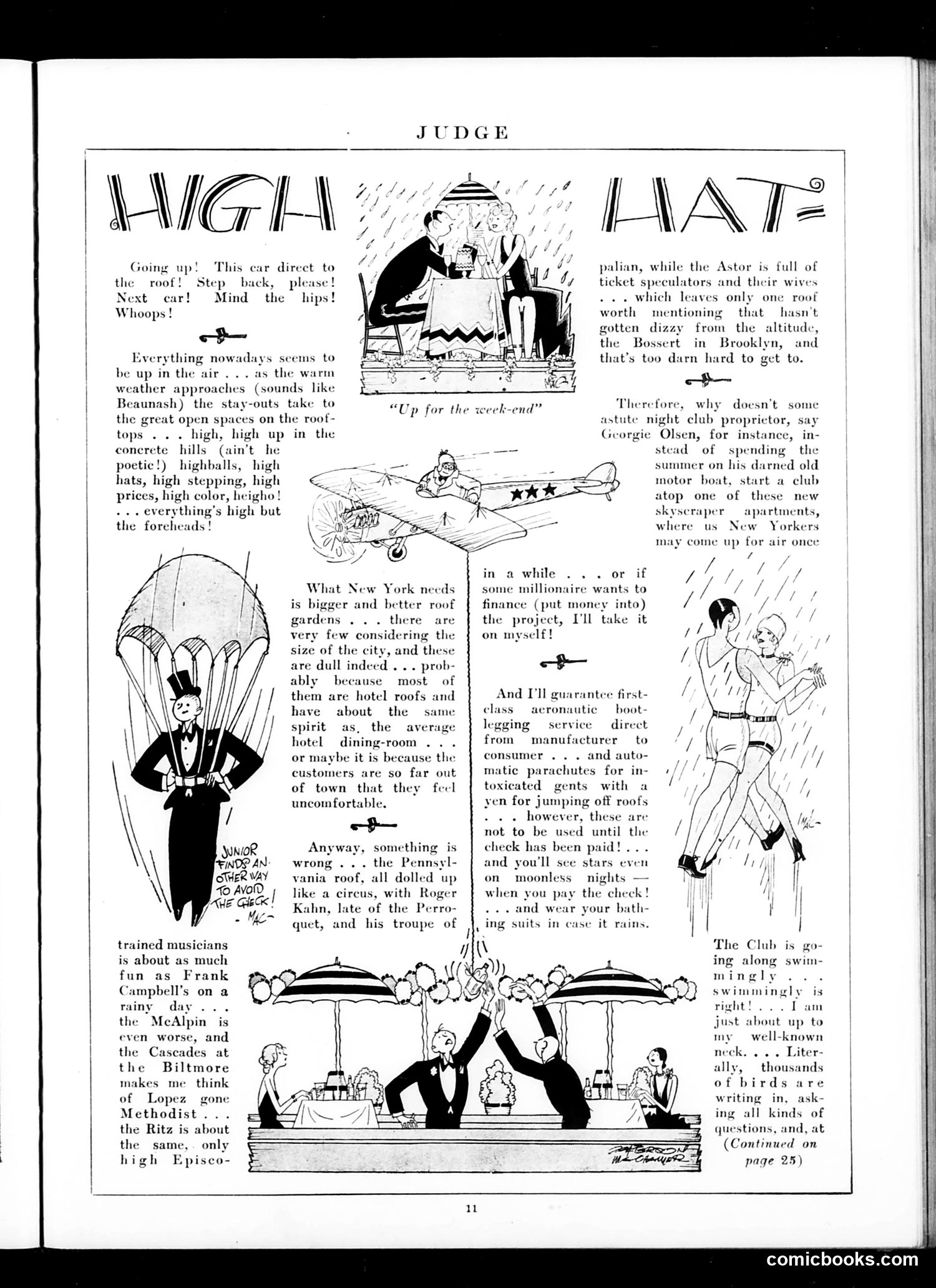
This Judge magazine page satirizes the 1920s craze for rooftop entertainment in New York City. The cartoons mock the wealthy's migration to expensive rooftop gardens, clubs, and restaurants during summer months—depicted as crowded, uncomfortable venues lacking genuine atmosphere despite their high prices. The satire targets specific Manhattan establishments (the Astor, Bossert in Brooklyn, McAlpin, Cascades at the Biltmore, the Ritz) and mentions bandleader Georgie Olsen and performer Roger Kahn, suggesting these were then-famous entertainers associated with roof venues. The author proposes an absurdist solution: a rooftop nightclub in a skyscraper apartment with "aeronautic boot-legging service" and parachutes for intoxicated guests—mocking both Prohibition-era speakeasy culture and the era's fascination with aviation. The underlying critique: wealthy New Yorkers seeking escape pursue expensive, mediocre venues simply because they're fashionable and high-altitude, while complaining about crowds and poor service.
This page features a single illustration titled "SH!" depicting a dramatic mountainous landscape with jagged peaks. A small boat with what appears to be a single occupant sits on calm water in the foreground, while evergreen trees grow from rocky outcrops on the right side. The "SH!" caption suggests a call for silence or discretion. Without additional context from the magazine's date or surrounding articles, the specific political or social satire remains unclear. The image could reference a contemporary news event, political figure, or social commentary typical of Judge magazine's satirical approach, but the exact meaning cannot be determined from the visual alone.
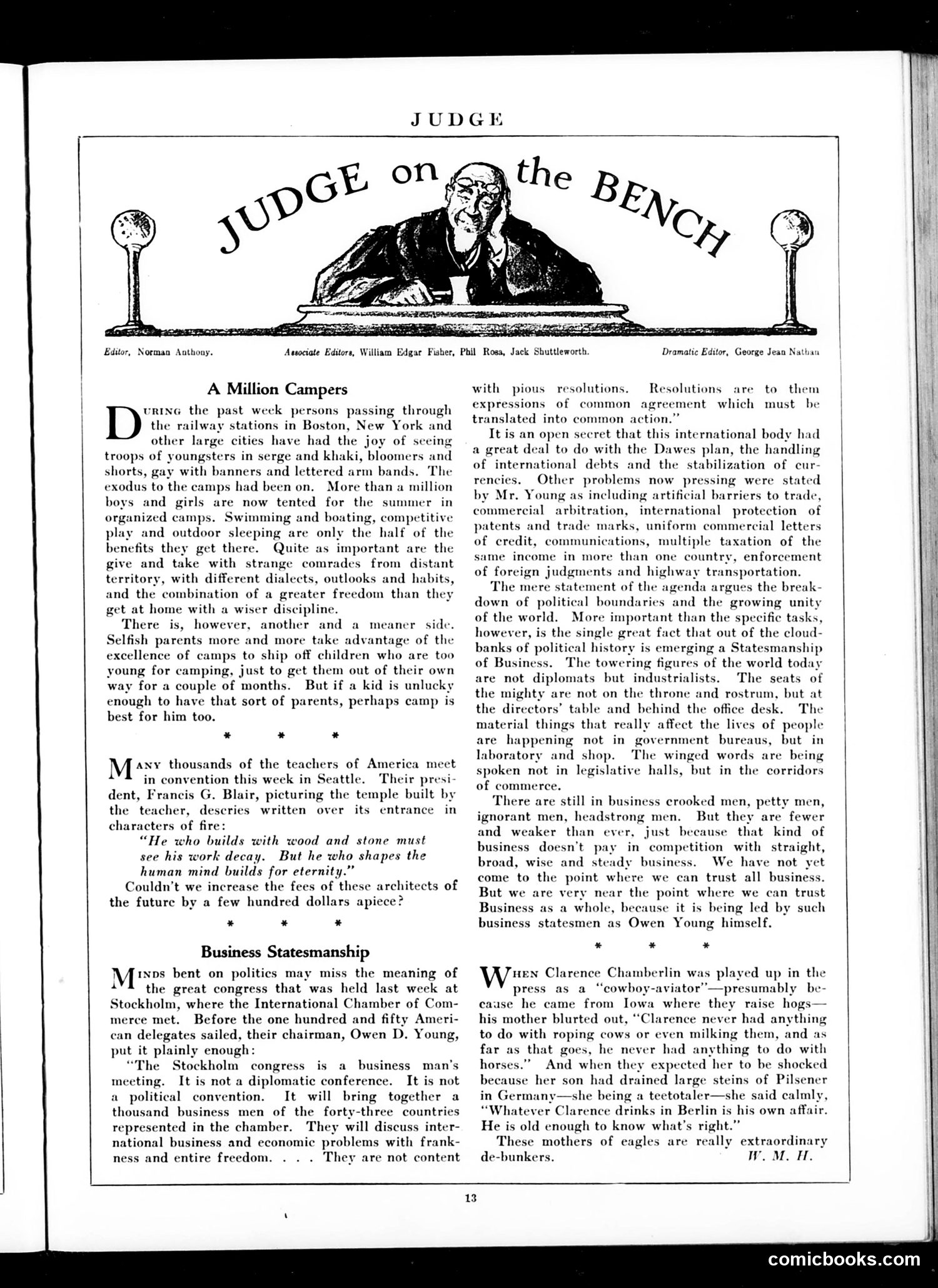
This page from the satirical magazine *Judge* contains three opinion pieces rather than traditional political cartoons. **"A Million Campers"** discusses the summer camp boom for American youth, praising the character-building benefits while cynically noting that some selfish parents use camps merely as childcare to remove inconvenient children. **"Business Statesmanship"** celebrates teachers and education, quoting Francis G. Blair's idealistic vision of educators as builders of minds. **The main satire** is the longest piece on the International Chamber of Commerce meeting in Stockholm, where Owen D. Young (the chairman) is quoted. The article argues that practical businessmen—not diplomats or politicians—now shape world affairs. It suggests industrialists and their commercial concerns (trade barriers, currency stabilization, the Dawes Plan for war reparations) are more important to global stability than traditional diplomacy. The satire's point: in post-WWI 1920s America, business pragmatism trumps political idealism in solving international problems.
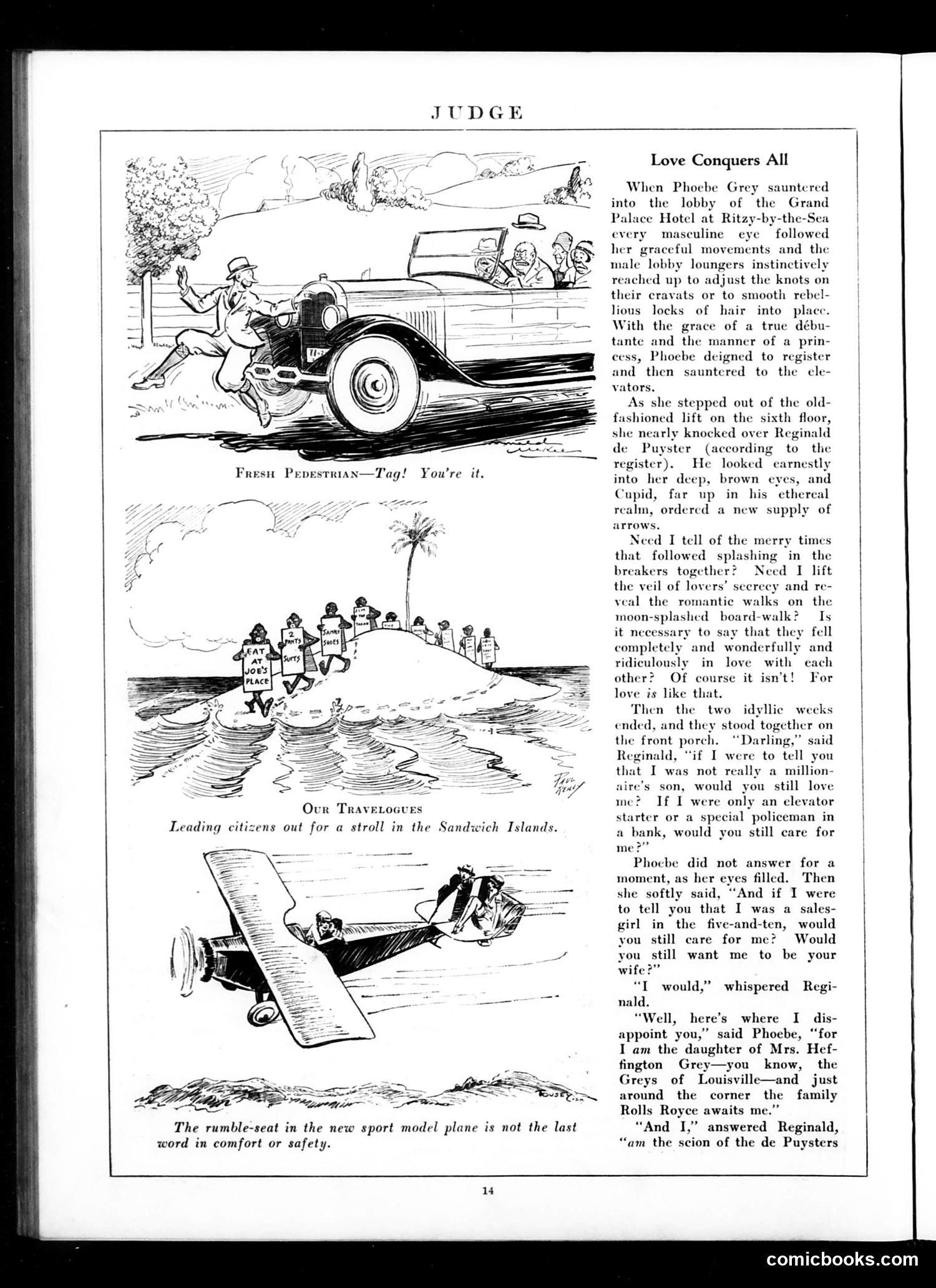
This page presents a romantic short story satirizing early 20th-century upper-class courtship conventions. The narrative mocks the artificial anxieties of wealthy young people by having two protagonists—Phoebe Grey and Reginald de Puyster—each harbor secret fears about their social standing, only to reveal they're both wealthy anyway. The satire targets the era's obsession with lineage and money as markers of marriageability. The ironic twist—where both lovers confess potentially "shameful" truths (not being millionaires, being salesgirls) only to admit their actual wealth—ridicules how hollow these class concerns are. The accompanying cartoons (about automobiles, beach tourism, and aircraft) humorously illustrate modern leisure activities available to the wealthy. The piece gently mocks society's preoccupation with status while suggesting that true love should transcend such concerns—though the resolution ironically confirms wealth matters most.
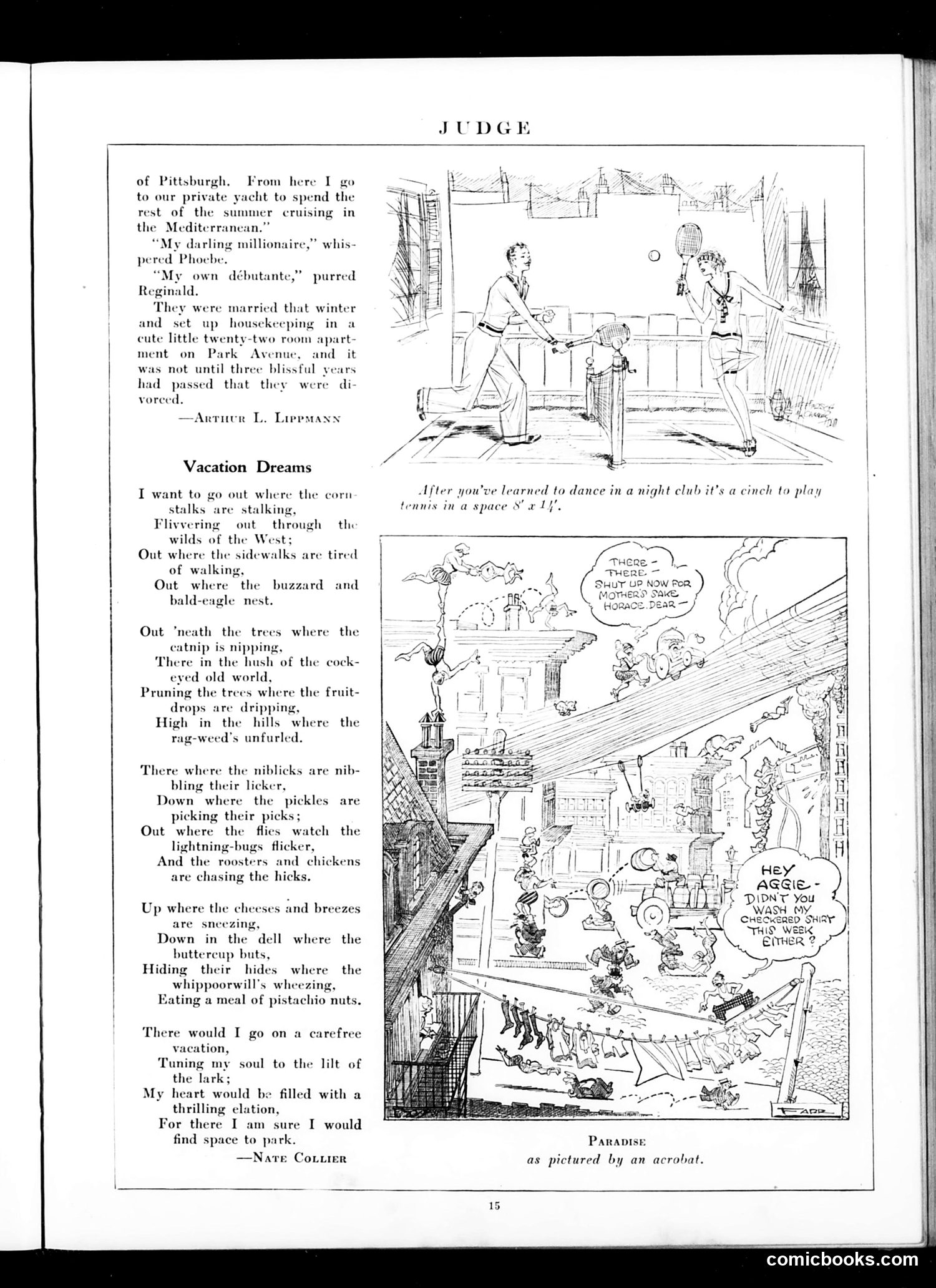
This page contains two satirical pieces mocking 1920s urban wealth and leisure culture. **Top section (Arthur L. Lippmann):** A brief narrative ridiculing nouveau riche courtship. The joke satirizes shallow millionaire romance—a couple marries after superficial declarations about yachts and Mediterranean cruises, then divorces after three years in a cramped "twenty-two room apartment on Park Avenue." The humor targets the artificiality of wealthy socialite culture and suggests that even extreme luxury cannot sustain empty relationships. **Bottom sections:** - A humorous poem by Nate Collier about vacation fantasies, full of absurdist wordplay ("flivvering," "niblicks are nibbling") that parodies romantic nature-escape literature. - A cartoon captioned about learning nightclub dancing in tiny spaces (8' x 14'), suggesting urban apartment constraints make people contortionists. This mocks both the cramped living conditions of city dwellers and the frenetic leisure activities of the jazz age. The overall theme: satirizing 1920s American materialism, superficiality, and the gap between aspirations and reality.
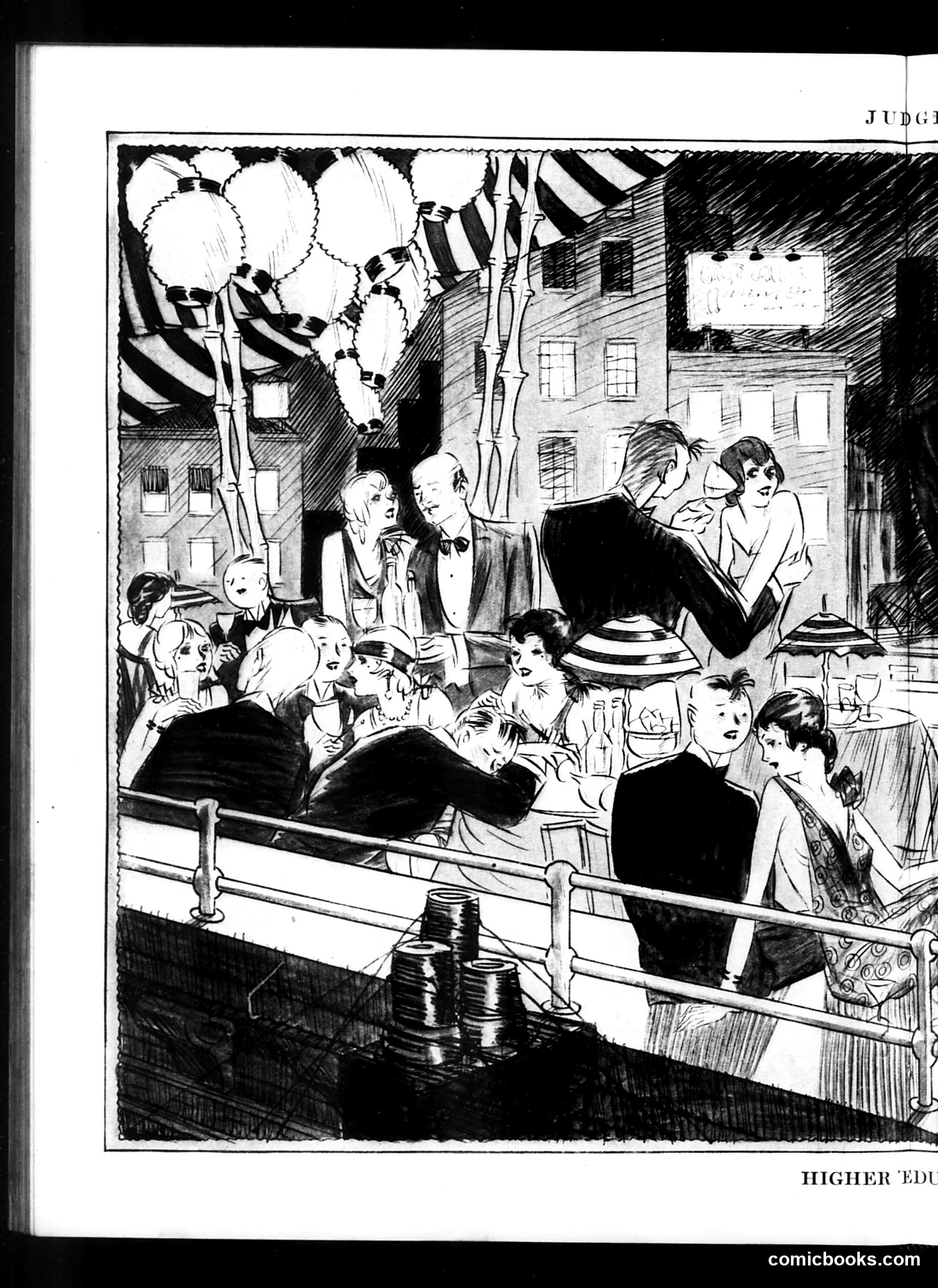
This appears to be a satirical illustration of an elegant outdoor evening social gathering or party, likely from the early 20th century. The scene shows well-dressed guests on what appears to be a rooftop or terrace with decorative lanterns overhead and city buildings in the background. The caption "HIGHER 'EDU[CATION]" suggests the cartoon satirizes the social pretensions of the upper classes. The formal dress, the architectural setting, and the orchestrated nature of the gathering appear to be the target of satire—possibly mocking how wealthy people used elaborate social events to display status and refinement, or critiquing superficial "education" through social climbing rather than genuine intellectual development. Without additional context or clearer text, the specific political or social critique remains unclear, though the tone appears mockingly observational about elite society.
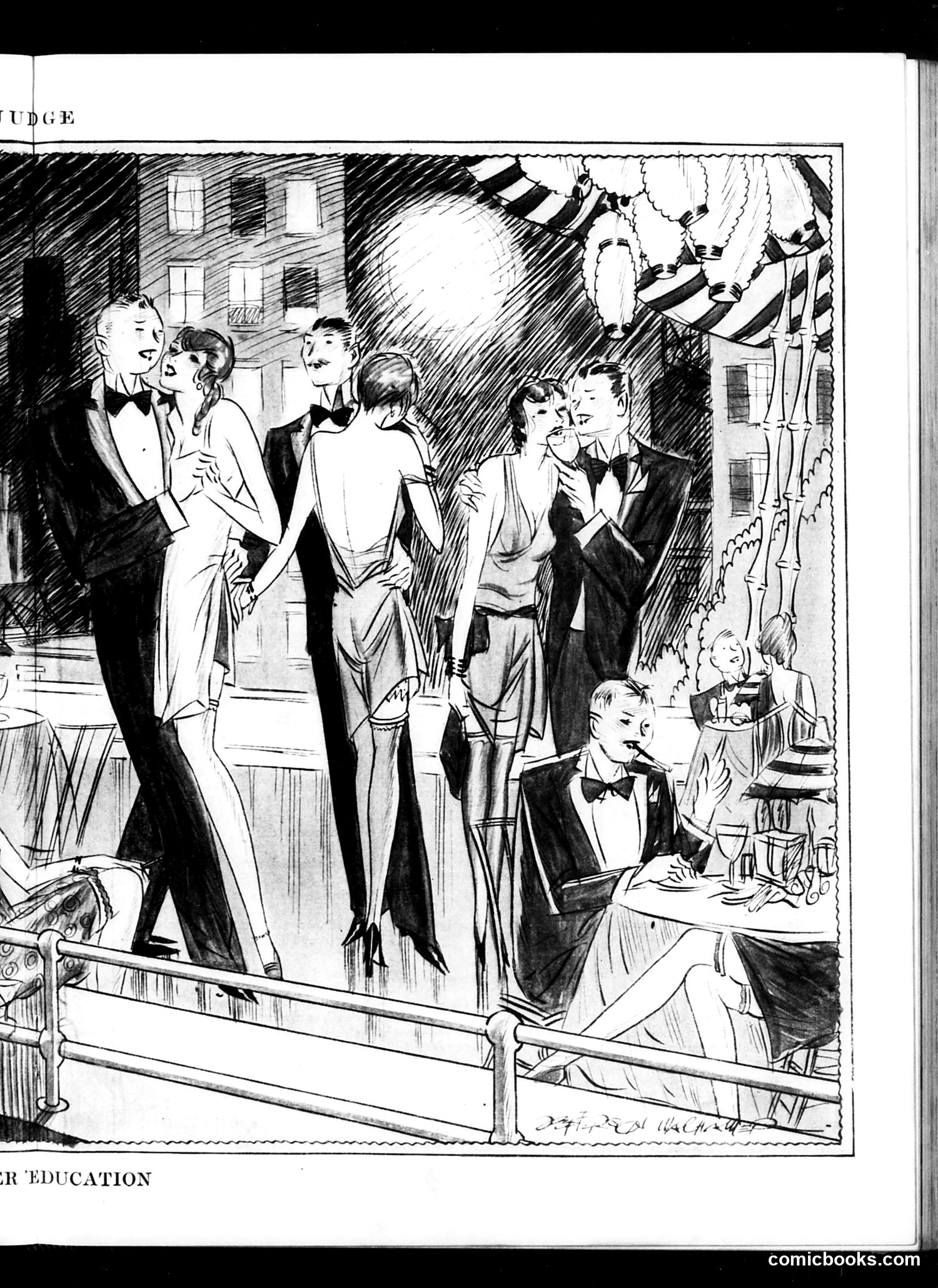
This appears to be a satirical illustration from *Judge* magazine depicting a formal evening social gathering—likely a high-society party or dance. The cartoon shows elegantly dressed men in tuxedos and women in evening gowns mingling in what appears to be an upscale venue with decorative elements visible in the background. The caption "FUDGE" and reference to "EDUCATION" suggest this is satirizing the superficial nature of upper-class social functions as a form of "education." The satire likely critiques how wealthy society uses such gatherings—ostensibly for cultural refinement—when they're actually just venues for socializing and display. Without additional context or visible artist signature, the specific targets or referenced individuals remain unclear, though the general mockery of elite social pretension is evident.
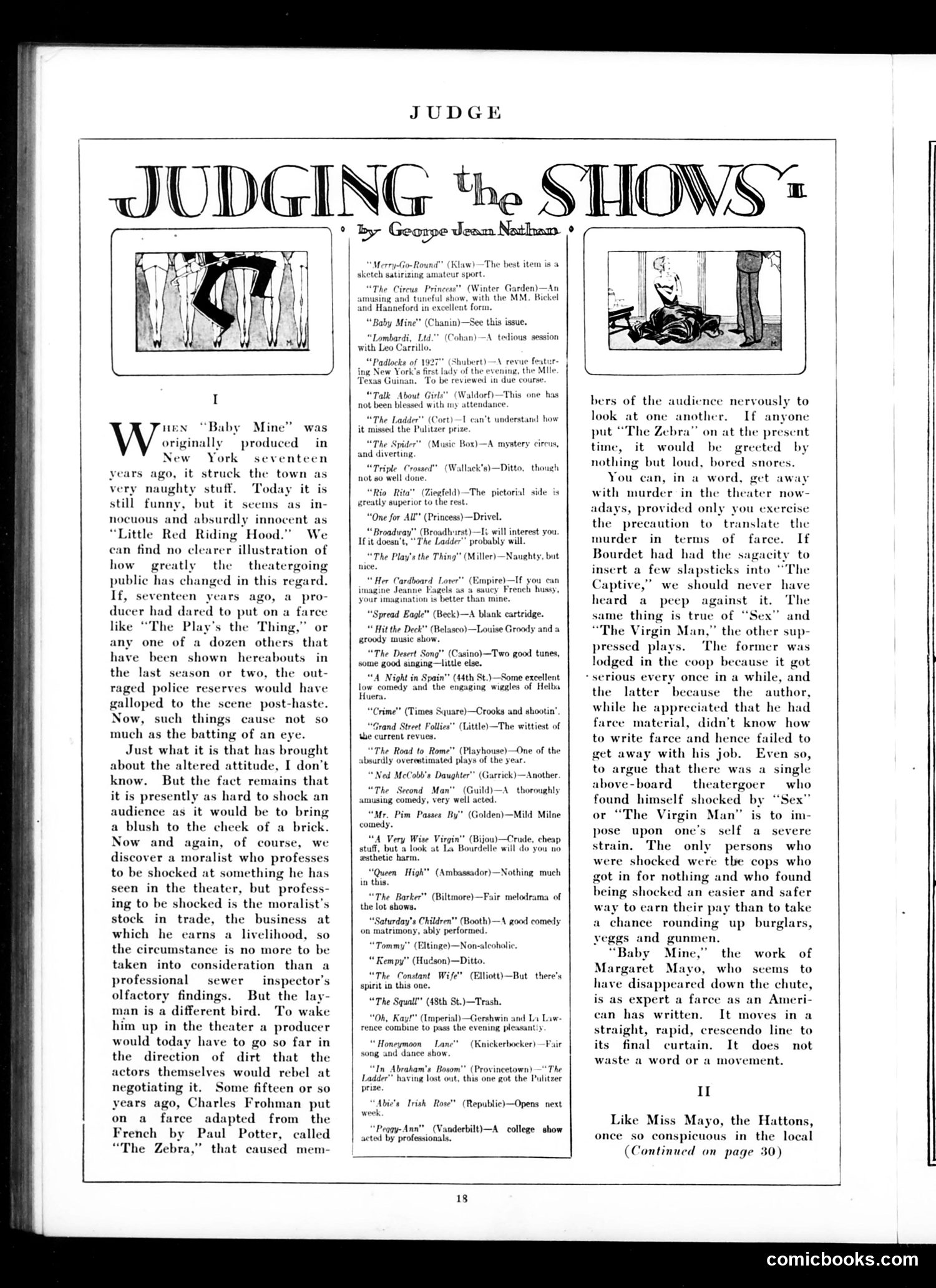
This is a theater review column by George Jean Nathan, a prominent drama critic of the 1920s. Rather than political satire, it's cultural commentary about Broadway productions and changing public morality. Nathan argues that theatrical audiences have become impossible to shock. He traces this shift by recalling "Baby Mine," a play deemed scandalous seventeen years earlier but now viewed as innocent. He contrasts this with "The Zebra," a farce so obscene it caused public outrage when Charles Frohman produced it around 1910. Nathan's satirical point: modern audiences are so desensitized to indecency that producers would need to transgress far beyond what actors would accept to provoke any reaction. The accompanying theater listings with brief reviews exemplify the current Broadway season he's evaluating. This reflects 1920s debates about declining moral standards and theatrical decorum during the Jazz Age.
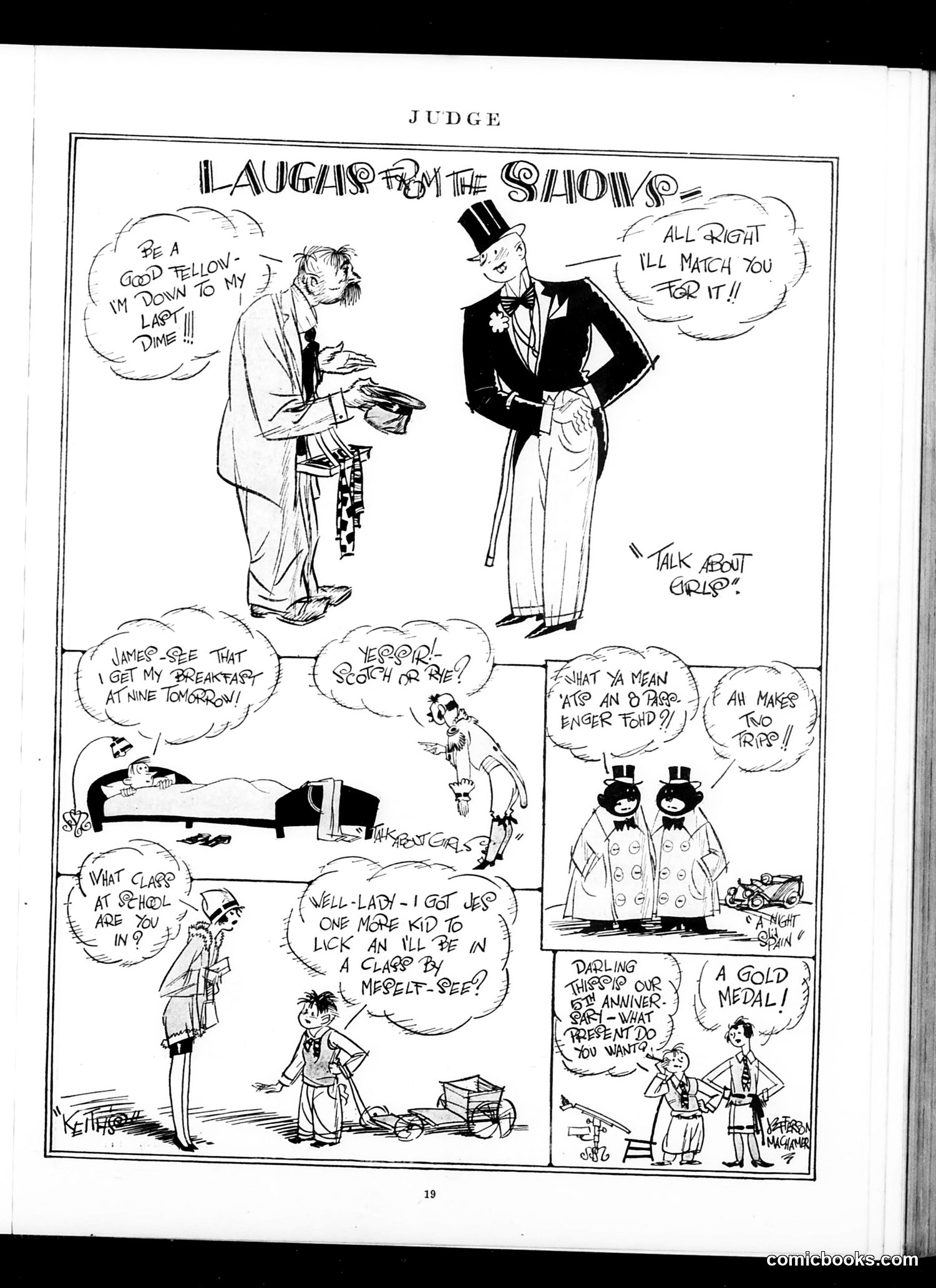
This multi-panel comic satirizes wealthy socialites and their servants. The top panel shows a well-dressed gentleman in a top hat matching a poor man's offer—suggesting financial desperation masked by genteel pretense. The remaining panels depict servants negotiating with employers over work conditions and compensation. The humor targets both the absurd demands of the wealthy (wanting breakfast at nine, complaining about "an o'tario finger," expecting servants to lick fingers clean) and servants' attempts to exploit or negotiate better terms. The final panel references winning "a gold medal," likely mocking how the wealthy reward loyalty with meaningless honors rather than actual payment—a dig at class hierarchies and the exploitative servant-employer relationship of the era. The overall satire critiques upper-class entitlement and their penny-pinching treatment of household staff despite obvious wealth.
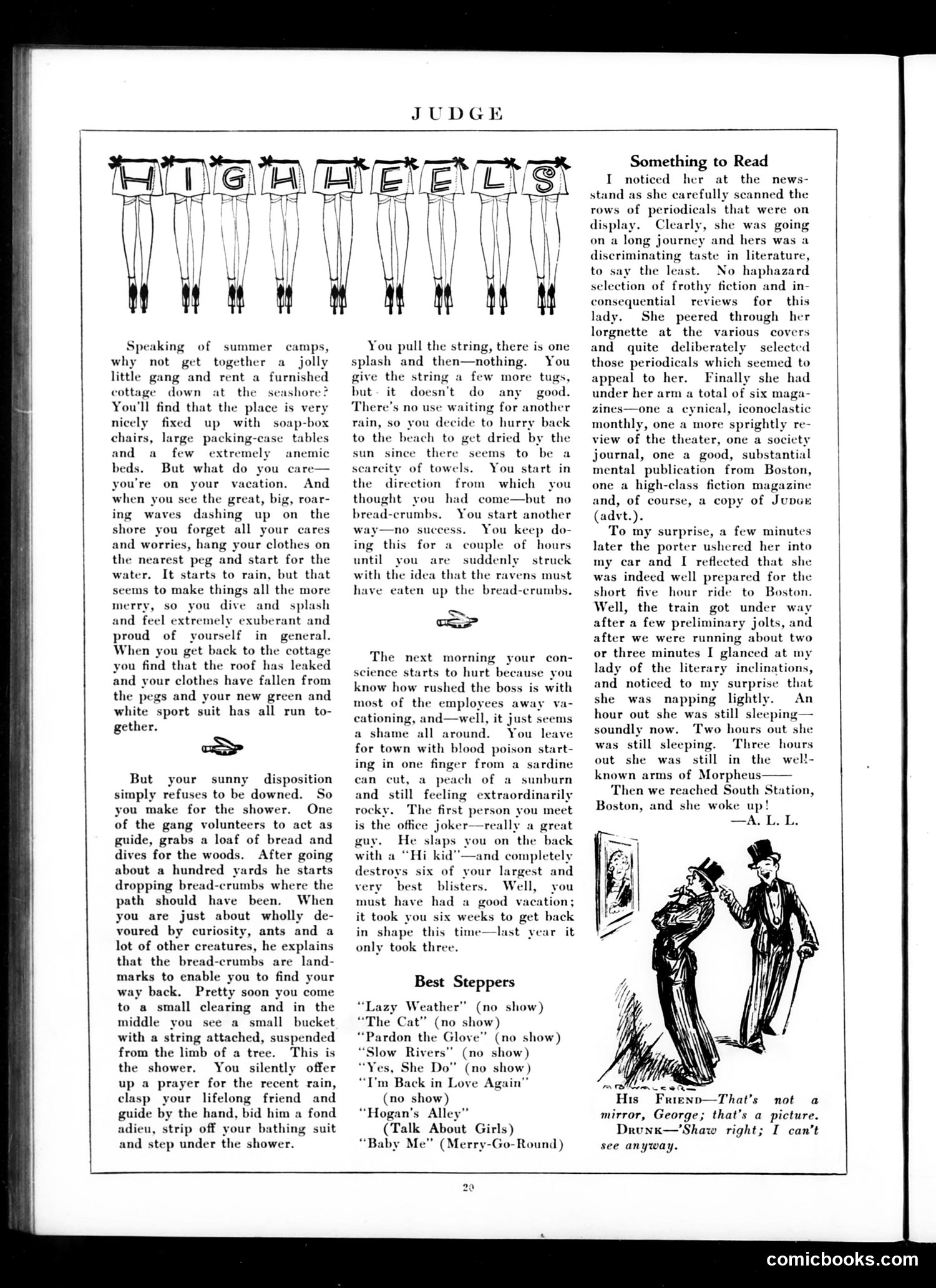
This page contains two distinct pieces of satirical content: **Main Article: "Summer Camp Humor"** A lengthy humorous essay mocking the idealized vacation experience. It satirizes the gap between expectation and reality—people rent shabby seaside cottages, experience comedic mishaps (clothes ruined by rain, a broken outdoor shower), get lost in the woods following bread-crumb trails, and return sunburned and injured. The joke targets middle-class Americans' romantic notions of leisure and their willingness to endure genuine discomfort while maintaining forced cheerfulness. **"Best Steppers" Section** A list of popular theatrical productions (likely Broadway shows) with notation "(no show)" indicating they're either closed or unavailable. This appears to be entertainment/theater commentary rather than political satire. **Secondary Humor Piece: "Something to Read"** A brief anecdote about an observant woman at a newsstand selecting intellectual magazines for travel reading, suggesting Judge readers appreciated witty observations about contemporary urban life and gender. The overall tone is lighthearted social commentary typical of Judge's satirical approach to American middle-class culture.
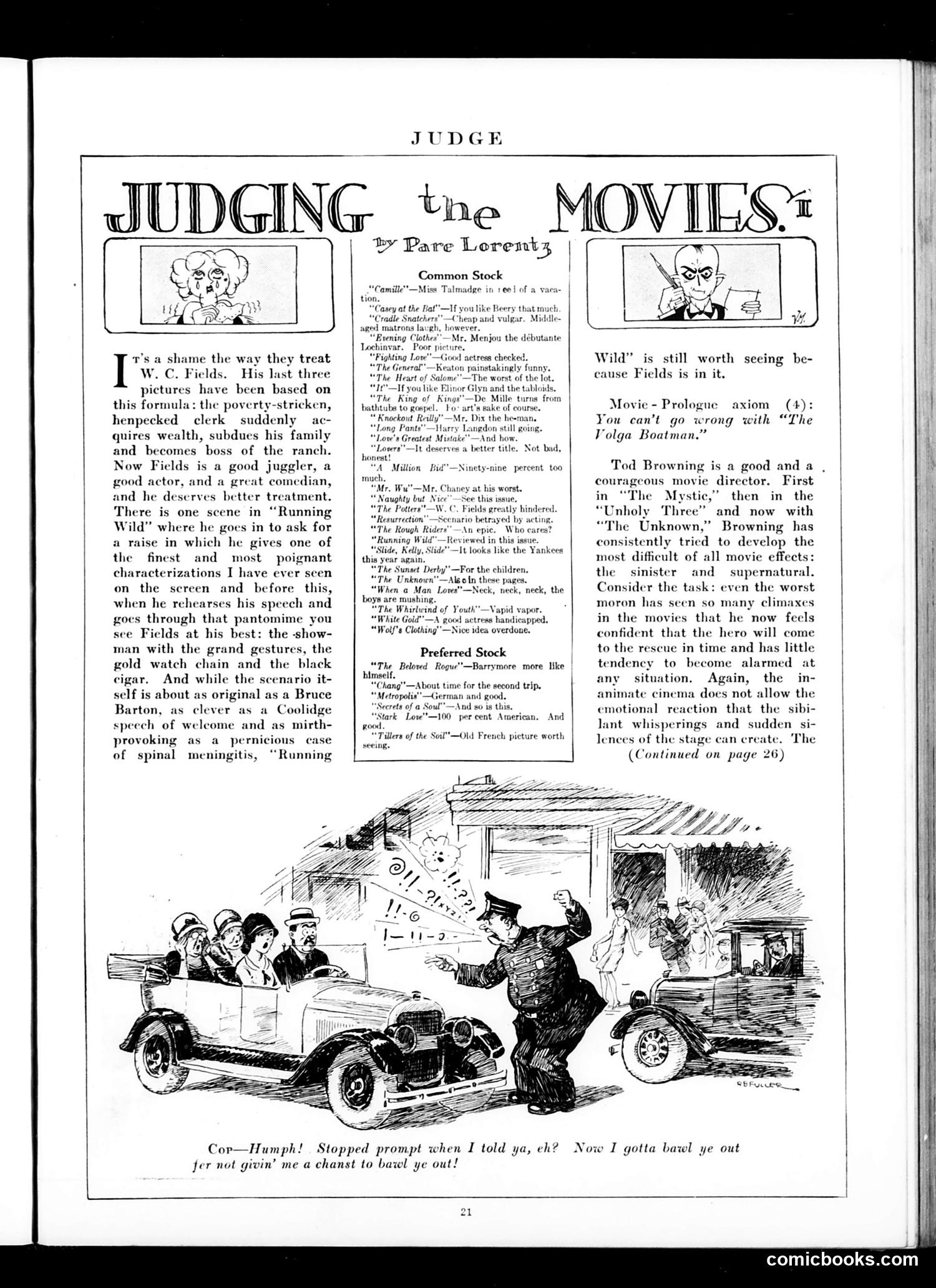
This is a film review column by Pare Lorentz critiquing 1920s movies. The main text praises W.C. Fields as a talented comedian and actor being wasted on formulaic plots—poor clerk becomes rich, dominates his family. Lorentz argues Fields deserves better material, highlighting a particularly fine pantomime scene in "Running Wild." The page includes lists of current films under "Common Stock" and "Preferred Stock" categories, rating them tersely (some good, some derivative). The bottom cartoon depicts a traffic stop—a police officer telling a driver he "stopped prompt," preventing the driver from getting a chance to "bawl ye out" (complain/argue). The joke relies on the officer beating the expected confrontation, getting his complaint in first. The review reflects how early cinema relied heavily on star power to overcome weak screenwriting.
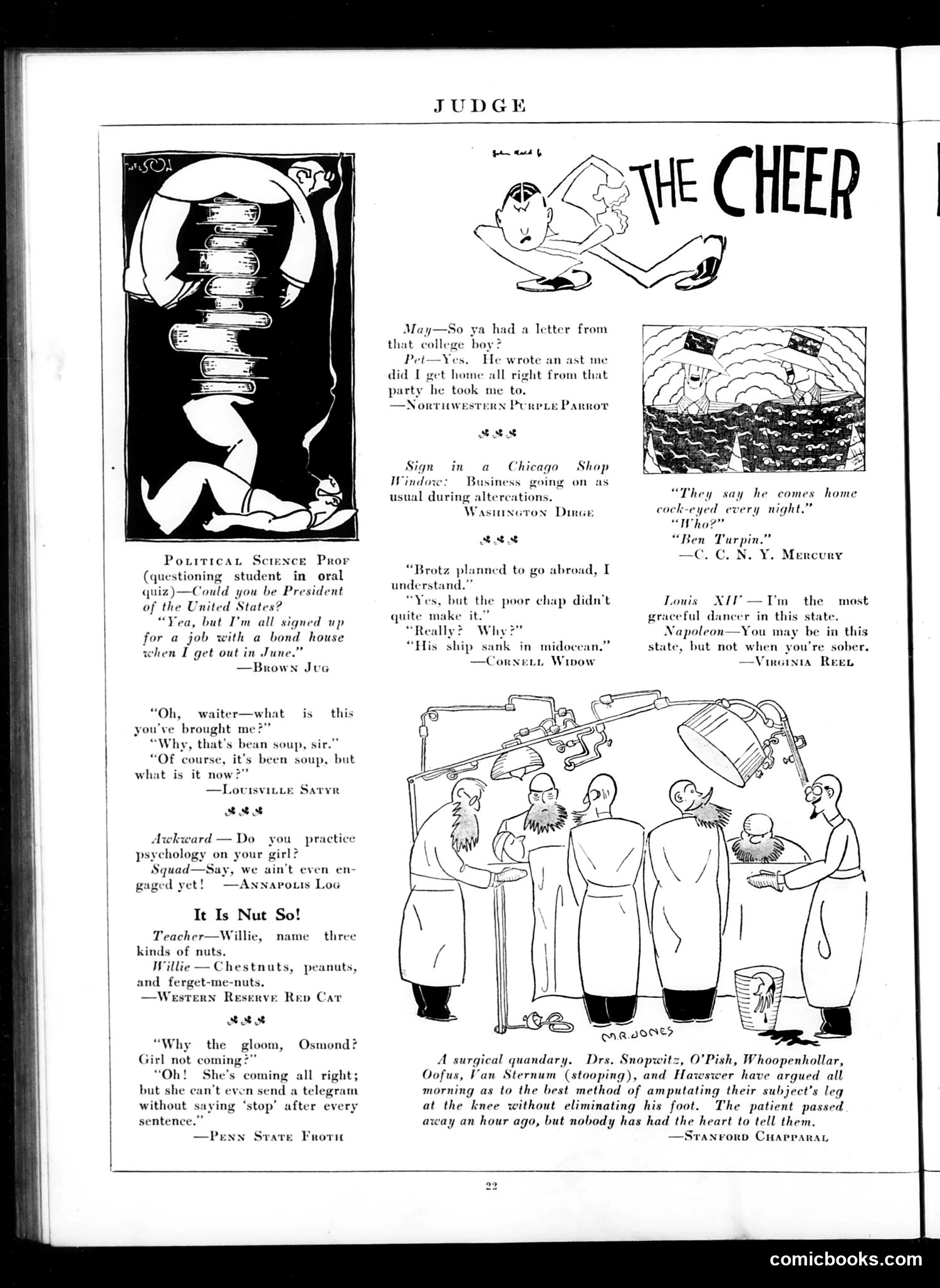
This is a humor page featuring various jokes and a satirical cartoon. The main cartoon depicts doctors in absurd disagreement over surgical technique—a commentary on professional pomposity and impracticality. The doctors argue endlessly about amputation methodology while their patient dies, highlighting how expert disagreement can be disconnected from practical reality. The surrounding jokes are typical early-20th-century humor: a professor noting students prioritize job security over presidential ambitions; romantic misunderstandings; wordplay (a student defining "forget-me-nuts" instead of "forget-me-nots"); and references to contemporary figures like Ben Turpin, a silent-film comedian known for cross-eyed comedy. The "Northwestern Purple Parrot" and other college publication attributions indicate these jokes were reprinted from university humor magazines—a common practice for Judge. The overall tone is light, focusing on generational and social absurdities rather than serious political satire.
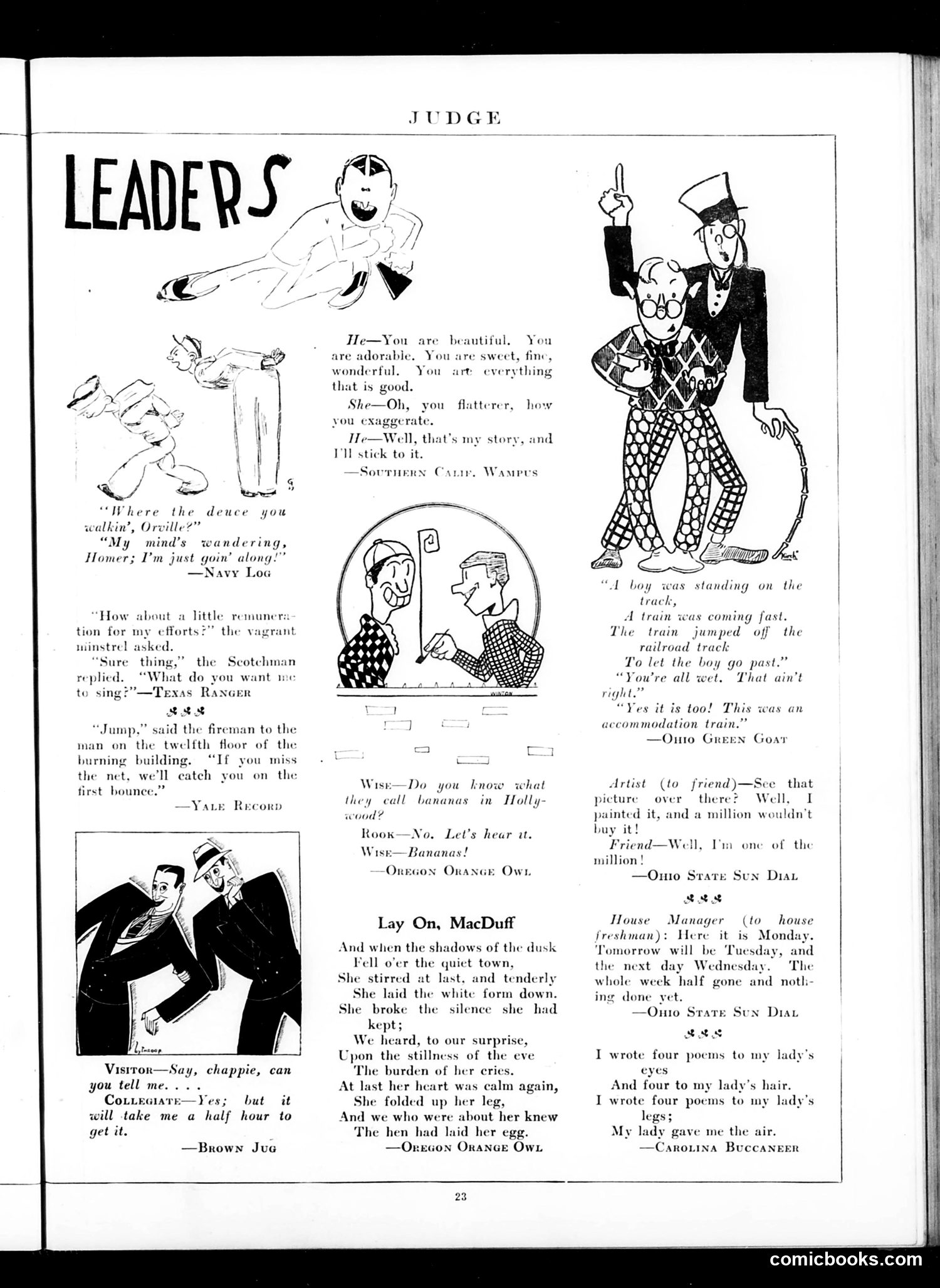
This page collects humorous anecdotes and jokes organized under the heading "Leaders"—likely meaning social or cultural figures worth mocking. The cartoons and jokes target various human types: flattering men, absent-minded walkers, vagrant musicians, firemen, Scotsmen, and Hollywood residents. One extended poem, "Lay On, MacDuff," humorously recounts a hen laying an egg with mock-dramatic language. The satirical targets are mild and social rather than overtly political: pretentiousness (the artist claiming his painting is priceless), Scottish stinginess (a period stereotype), accommodation trains, and romantic excess (a poet rejected after writing verses to his lady's legs). The overall tone is lighthearted ribbing of everyday character types and social foibles rather than serious political commentary. The page reflects Judge's approach as a general satirical magazine aimed at entertaining middle-class American readers with gentle mockery of familiar social situations.
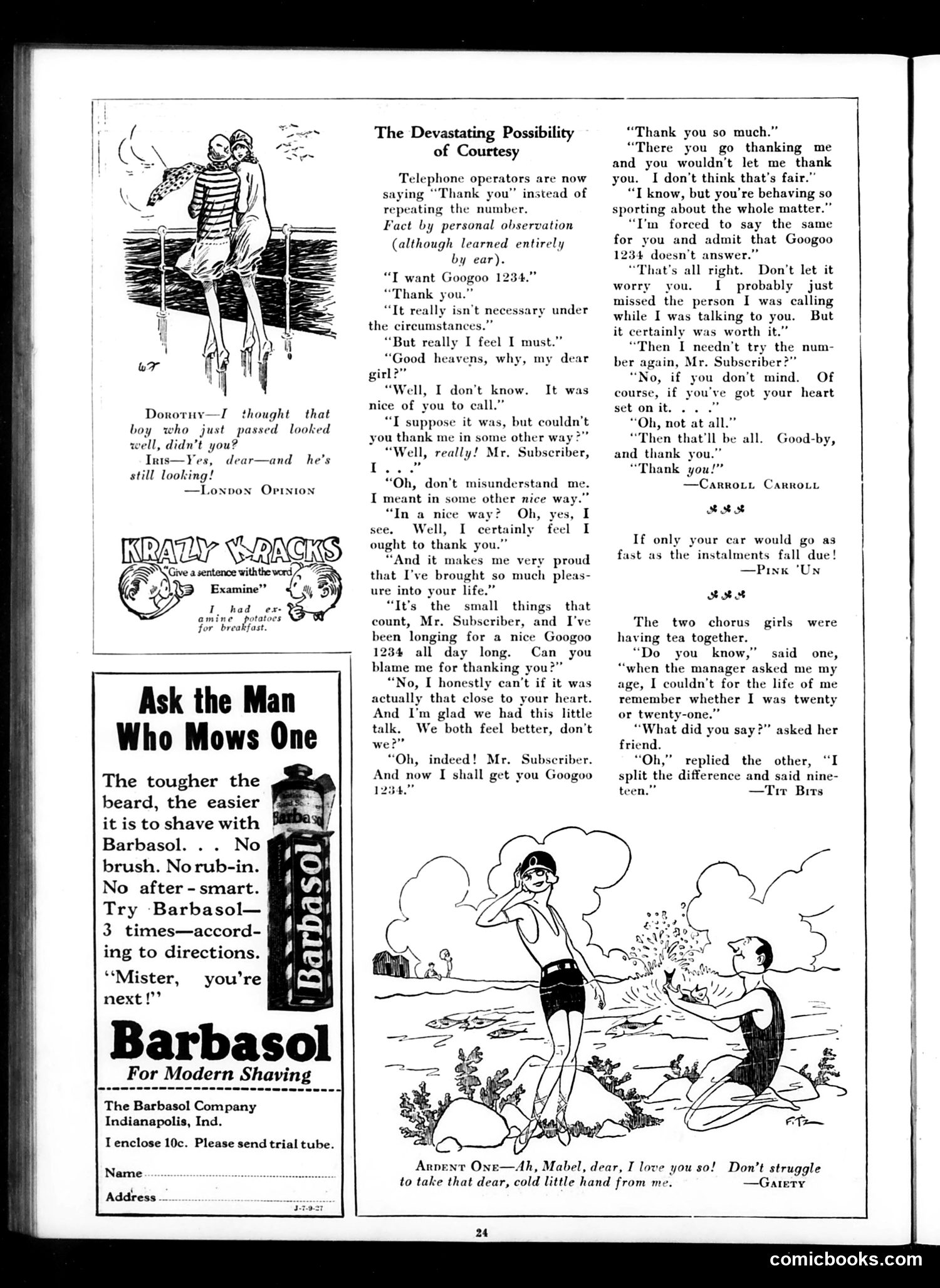
This page contains multiple satirical pieces typical of early 20th-century Judge magazine: **Main Article: "The Devastating Possibility of Courtesy"** The central satire mocks the emerging telephone operator practice of saying "Thank you" instead of repeating phone numbers. The comic dialogue escalates absurdly as a caller and operator become locked in an endless cycle of mutual thanking and compliments, ultimately failing to complete the call. The joke satirizes excessive politeness becoming counterproductive—a commentary on shifting social conventions around service interactions and the potential absurdity of over-politeness in practical matters. **Supporting Content:** - A Barbasol shaving cream advertisement - Brief humor snippets about romance and materialism (car payments, age-fibbing chorus girls) - A seaside cartoon about romantic struggle The page reflects period anxieties about changing manners and technology's social implications, particularly how new communication systems (telephones) required novel etiquette protocols that could themselves become problematic.
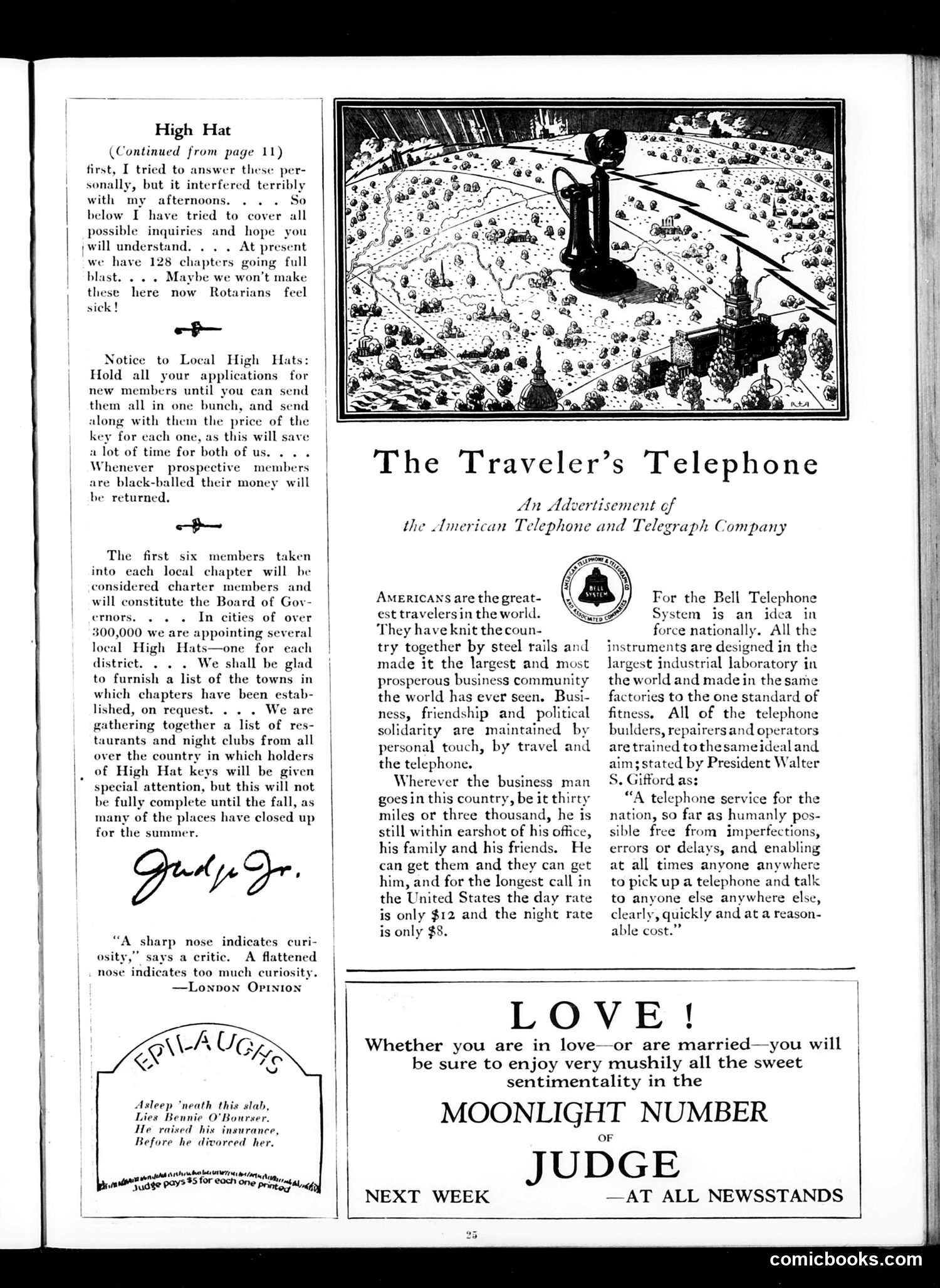
This page from *Judge* contains primarily **advertisements and notices** rather than satirical cartoons. The left column features "High Hat (Continued)," which appears to be editorial commentary on the High Hat organization—likely a fraternal or social club. The tone is gently mocking: the author jokes that expanding to 128 chapters might make "Rotarians feel sick," and the notice about "black-balled" (rejected) members returning money satirizes exclusive club pretensions. The right side contains **two advertisements**: 1. **Bell Telephone System**: A straightforward corporate ad emphasizing that Americans are "the greatest travelers" and that the telephone keeps businessmen connected to offices and families nationwide, with rates of $12 day/$8 night for long-distance calls. 2. **Judge Magazine promotion**: An ad for the upcoming "Moonlight Number," appealing to readers "in love—or married" with sentimental content. The page also includes an "Epilaughs" joke about insurance and divorce—typical *Judge* humor mocking marriage and financial matters. Overall, this is a commercially-driven page with light social satire rather than political commentary.
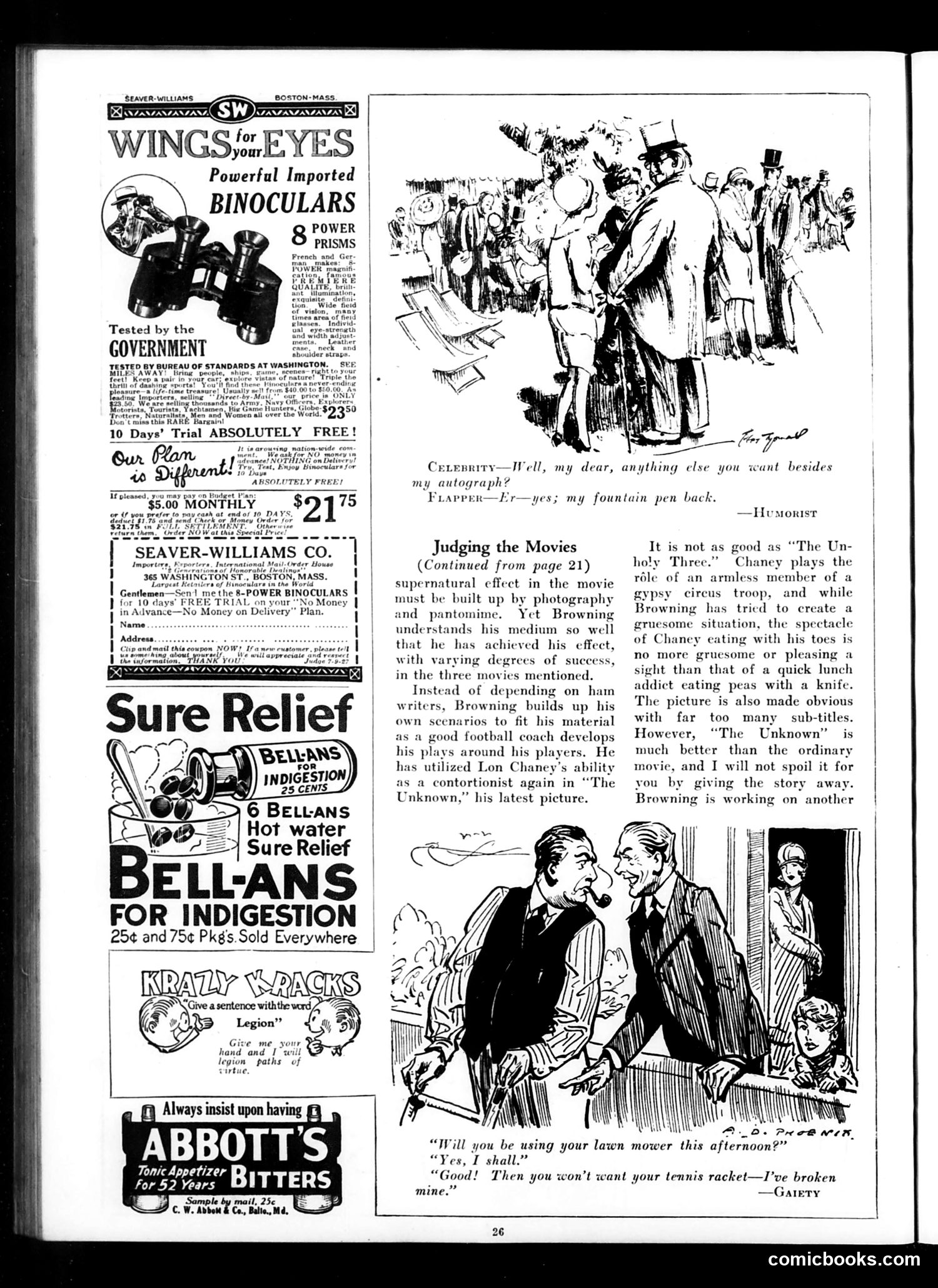
This page is primarily **advertisements** interspersed with entertainment content. The main editorial content is a film review titled "Judging the Movies," discussing director Tod Browning's work with actor Lon Chaney. **The Cartoon/Humor:** The illustrated cartoon features two men discussing borrowed items (lawn mower, tennis racket). It's a genteel domestic humor piece typical of Judge magazine—satirizing the social awkwardness of asking to borrow neighbors' belongings. The joke relies on polite circumlocution: one man asks about using the mower, then cleverly requests the tennis racket by claiming he's already broken his own. **Film Review Context:** The text discusses Browning's use of "supernatural effects" in films, specifically praising his directorial technique while critiquing his reliance on title cards and visual spectacle. Chaney's performance in "The Unknown" (eating with his toes) is noted as grotesque rather than genuinely unsettling—early cinema criticism about distinguishing genuine horror from mere shock value. **Advertising:** The page contains typical 1920s patent medicines (Bellans for indigestion, Abbott's Bitters) and optical equipment, reflecting Judge's commercial model.
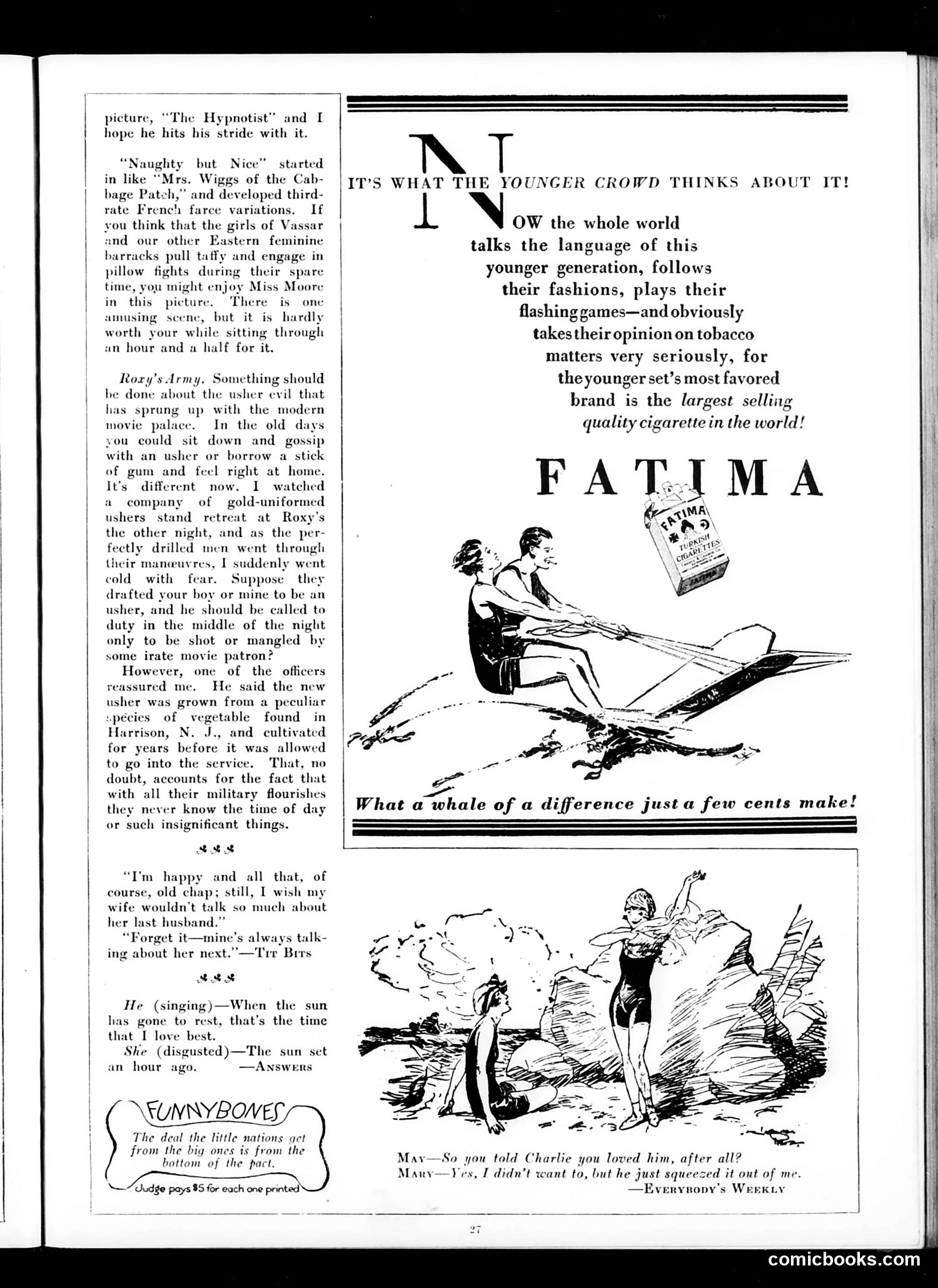
This page mixes **entertainment reviews** with **advertising and humor**. The left column contains film critiques of movies like "Naughty but Nice" and "Roxy's Army"—the latter satirizing the elaborate, military-style uniformed ushers at the Roxy movie palace. The reviewer jokes that these ushers are so perfectly drilled they seem inhuman, apparently "grown from a peculiar species of vegetable" from New Jersey. The right side is a **Fatima cigarette advertisement** claiming the brand is "the largest selling quality cigarette in the world" and "the younger set's most favored brand." This was a common advertising strategy: suggesting youth culture endorsed the product. Below are comic strips with jokes about marriage, misheard song lyrics, and international politics ("the deal the little nations get from the big ones"). **Modern context**: This reflects 1920s concerns about youth culture, consumer marketing targeting young people, and standardized corporate imagery. The Fatima ad particularly illustrates how tobacco companies marketed directly to youth before regulations prevented this.
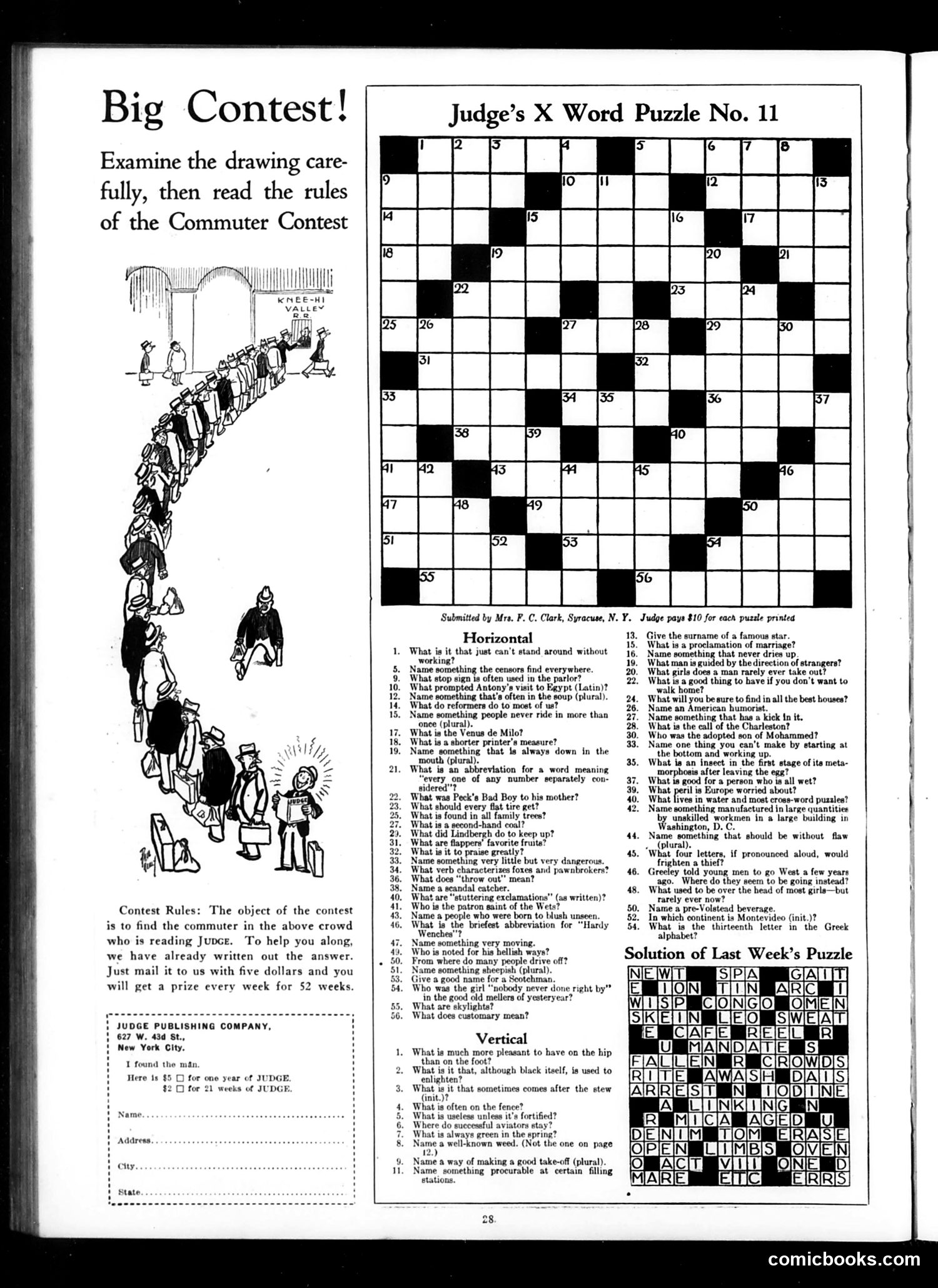
This page presents **Judge magazine's weekly reader contest** — a promotion offering prize money to subscribers who can locate a hidden figure in a crowd drawing. The cartoon shows a **long line of commuters** (likely waiting at a train station, given the "Knee-Hi Valley" sign visible), satirizing urban rush-hour congestion. The contest's humor lies in the impossibility of the task: finding one specific person in an indistinguishable mass of similarly-dressed, identical-looking commuters — a joke about modern urban anonymity and conformity. The accompanying **crossword puzzle** and contest rules suggest this was a common **engagement strategy** for magazines in this era, combining intellectual challenge with financial incentive ($5 entry fee for weekly prizes over 52 weeks). The satire points to anxiety about **urban mass society** — the loss of individual identity in modern commuting culture — disguised as lighthearted entertainment.
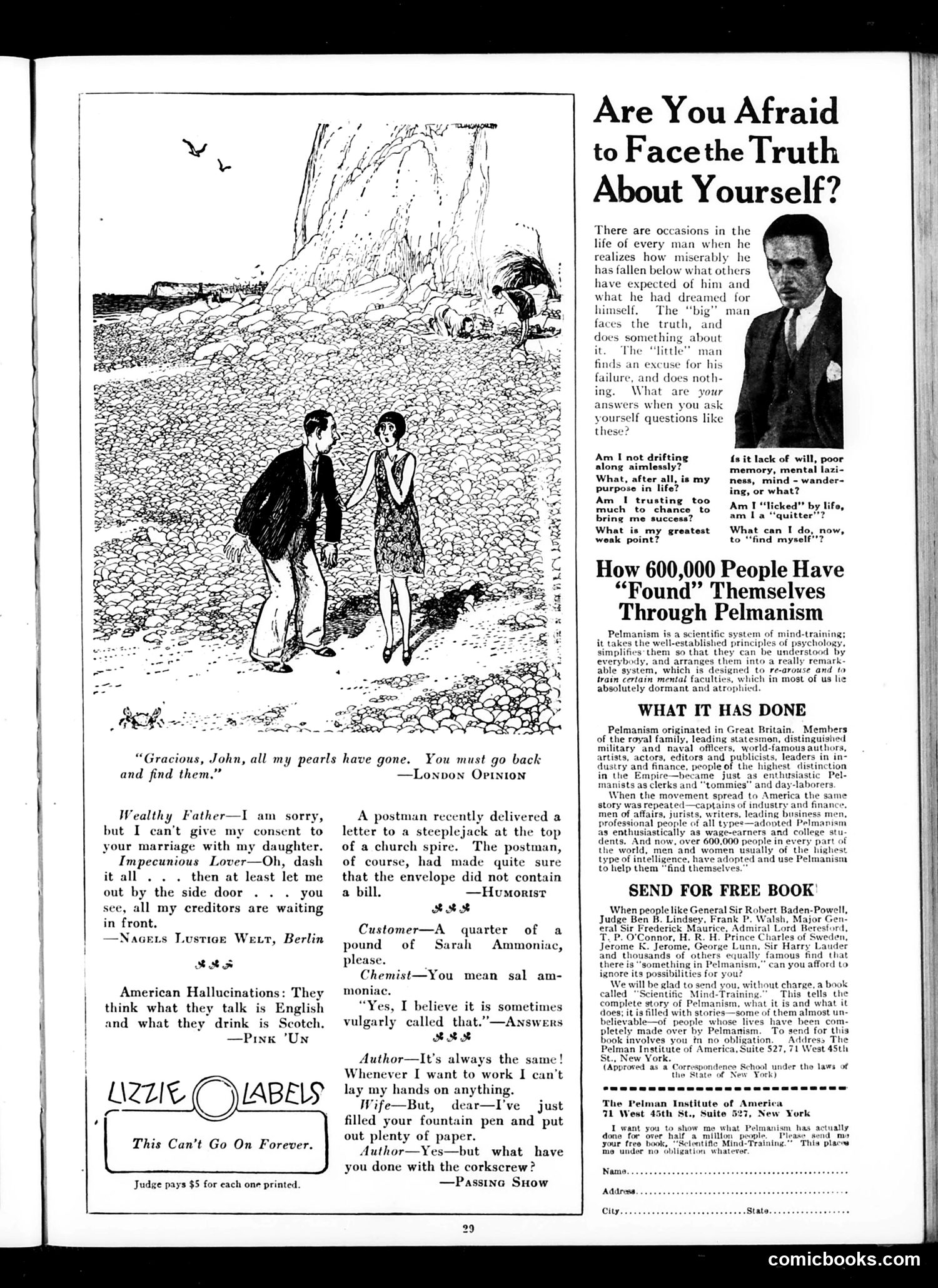
This page mixes humor with advertising. The main cartoon shows a poor suitor being ejected from a wealthy father's house—but sneaking out the side door because his creditors are waiting at the front. The satire targets both social class anxiety and financial precarity: the impoverished lover is literally trapped between familial rejection and creditor harassment, a common anxiety in early 20th-century society. The page is dominated by a "Pelmanism" advertisement—a memory-training system that claims 600,000 adherents worldwide, including royalty and celebrities. This self-improvement scheme represents period fascination with pseudo-scientific mental training. The framing question "Are You Afraid to Face the Truth About Yourself?" uses shame psychology to sell self-improvement. The scattered jokes ("Wealthy Father," "Chemist," "Author") are typical Judge fare—brief quips mocking incompetence, social misunderstandings, and domestic situations. The "Lizzie Labels" section invites readers to submit their own captions for payment—an early crowdsourced humor model.
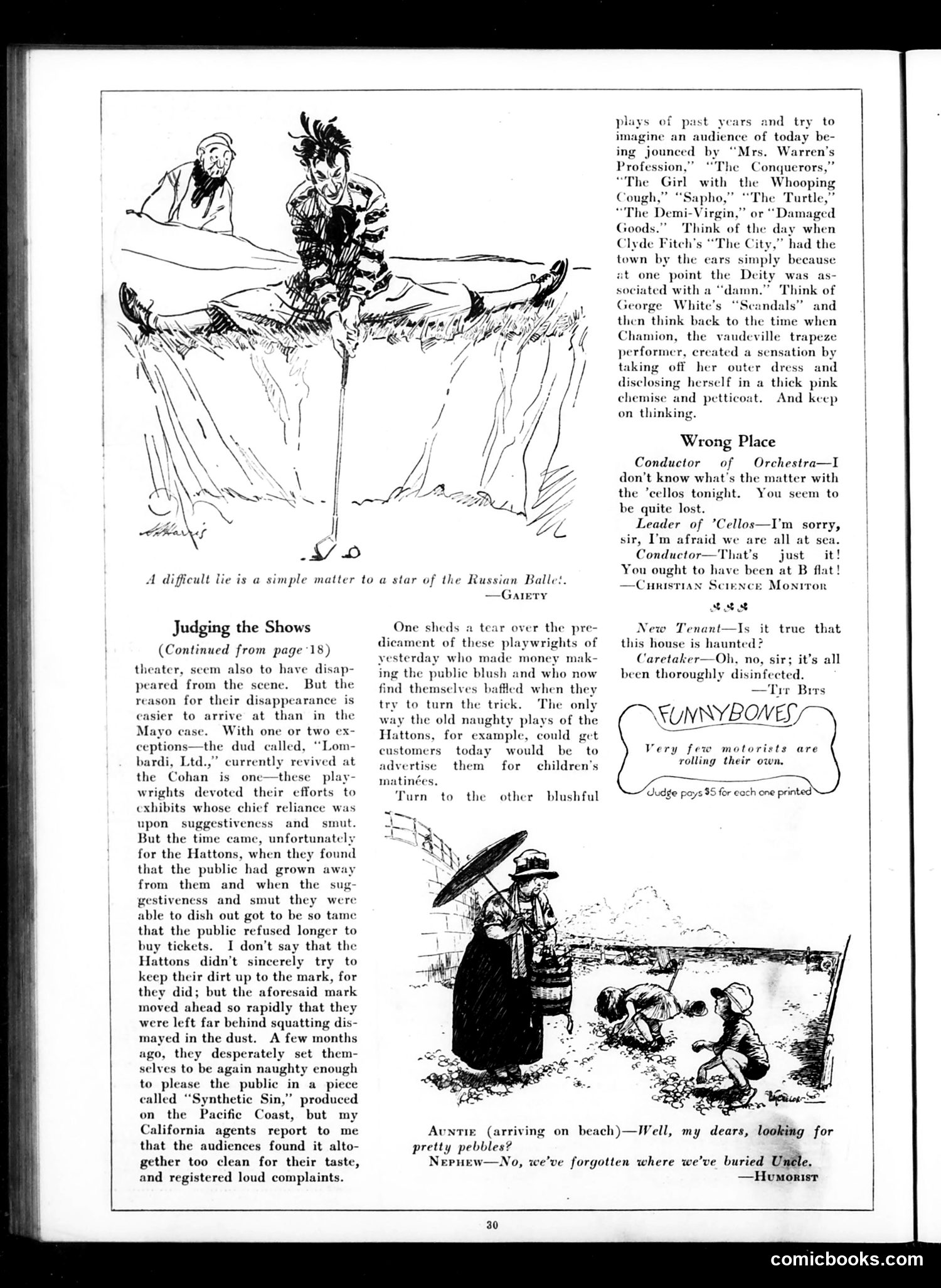
The top cartoon mocks the Russian Ballet's physical contortions: a conductor struggles to span an impossible distance while a ballet dancer executes an exaggerated split, captioned that "a difficult lie is a simple matter to a star of the Russian Ballet." This satirizes the Russian Ballet's then-famous extreme flexibility and the public's amazement at such feats. The main article criticizes playwrights (the Hattons) who built careers on suggestive, risqué theater. As public taste evolved and audiences grew desensitized, these writers found their once-scandalous material now considered tame—even their attempt at a racier play called "Synthetic Sin" backfired by being too clean. The satire suggests these playwrights had exhausted their formula and couldn't adapt. The bottom cartoons are brief gags: a conductor's musical pun, a haunted house joke, and children joking about burying their uncle—typical period humor offering light relief between articles.
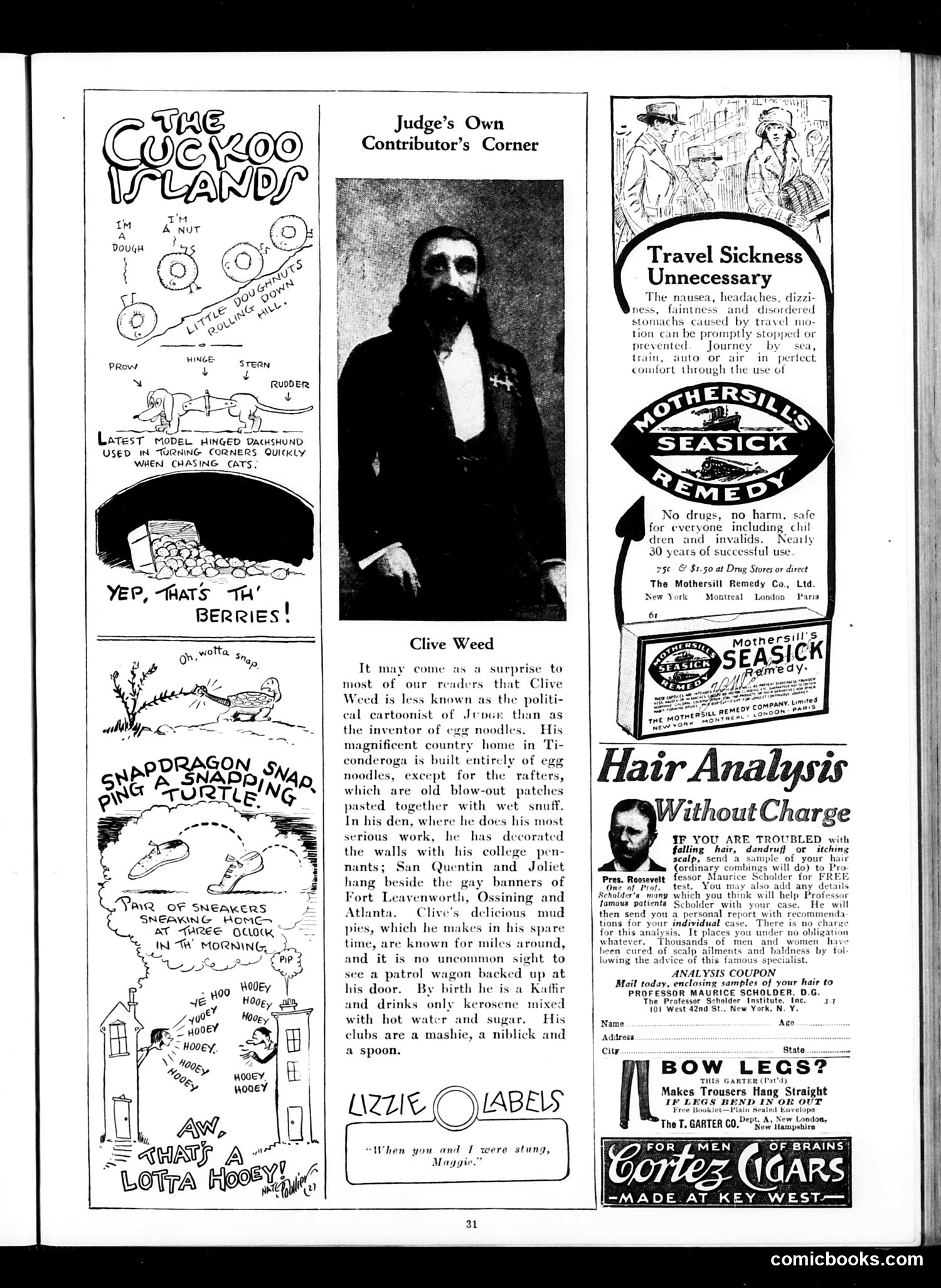
This page contains primarily **advertisements and filler content** rather than political satire. The left side features whimsical cartoons about "The Cuckoo Islands" and a turtle, which appear to be humorous illustrations without political reference. The center section profiles **Clive Weed**, described as a political cartoonist for Judge magazine, though the biography is largely absurdist humor—claiming he invented egg noodles and built his house from them. This appears to be satirical self-mockery of the magazine's own contributors. The right side consists entirely of **period advertisements**: Mothersill's Seasick Remedy (a patent medicine), hair analysis services, bow-leg correction devices, and cigars. These ads reflect early-20th-century commercial culture and medical quackery that Judge's readers would have encountered regularly. The page reflects Judge's format: mixing light humor with contemporary advertising rather than engaged political commentary.
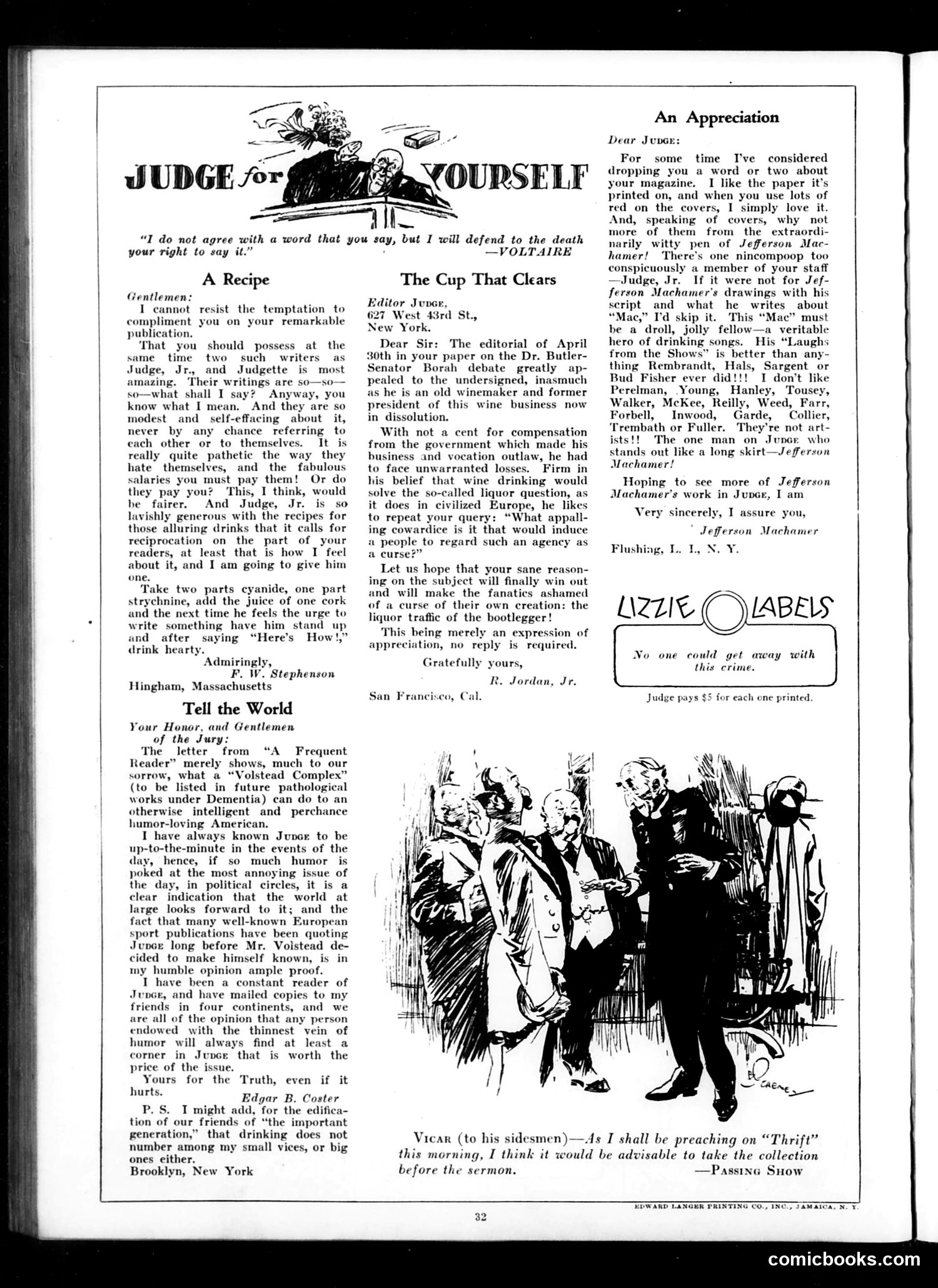
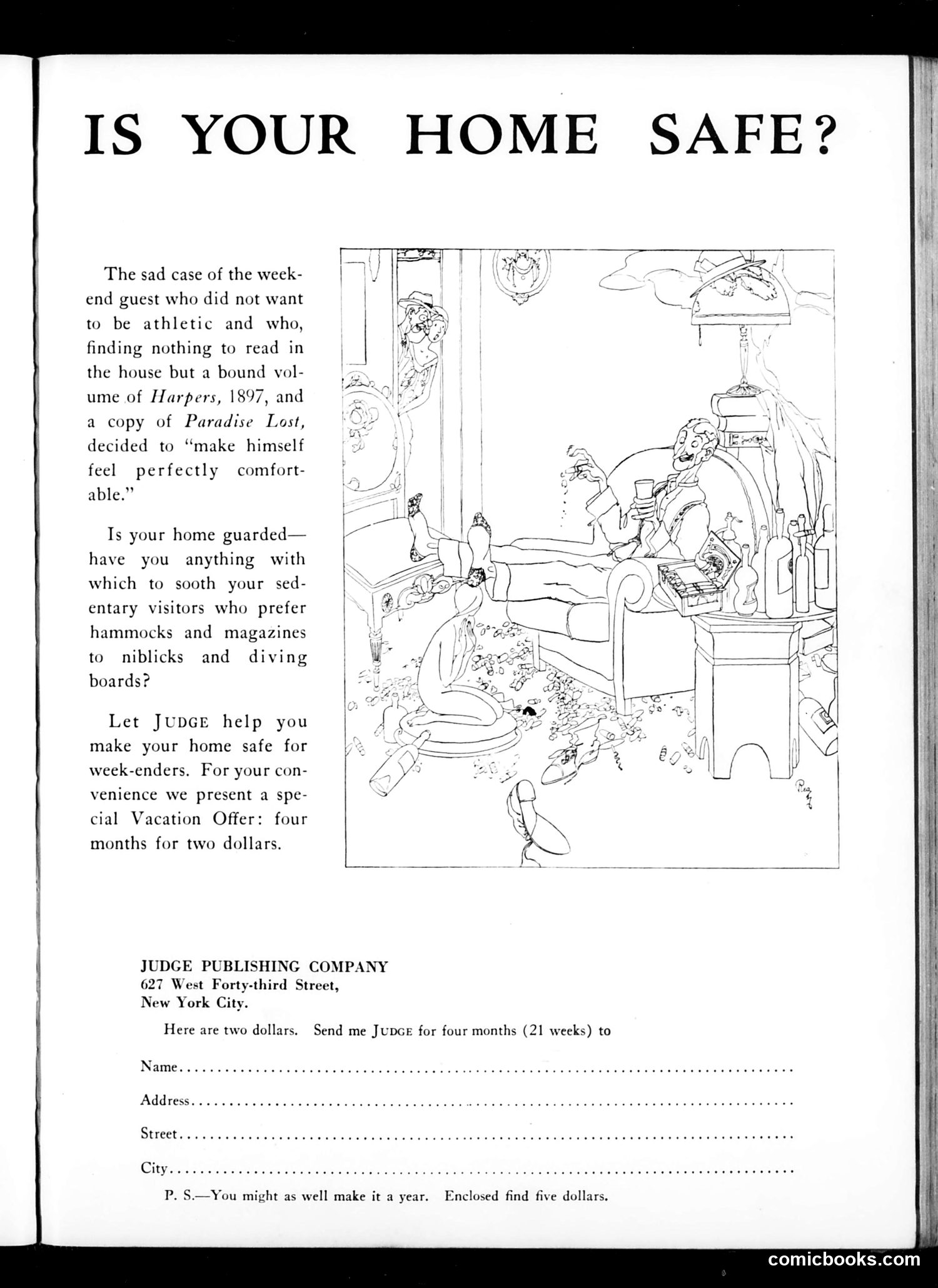
This is a **Judge magazine advertisement** (not a political cartoon). The humor targets sedentary houseguests who lack entertainment options. The cartoon depicts a bored weekend visitor sprawled uncomfortably across furniture in a messy living room, surrounded by scattered items. The joke: if your home only offers outdated reading material (an 1897 *Harper's* magazine and *Paradise Lost*—dense religious poetry), guests will literally make themselves uncomfortable trying to relax. The satire critiques both: 1. **Hosts** who don't provide adequate entertainment for non-athletic visitors 2. **The absurdity** of expecting people to be entertained by old magazines and classical literature **Judge's solution**: subscribe to their magazine (four months for $2, or a year for $5), which provides current, lighter reading material suitable for guests preferring "hammocks and magazines to niblicks and diving boards" (golf clubs and diving boards—activities for athletic guests). The appeal is practical domesticity humor—a self-promotional ad masquerading as social commentary about proper home hospitality.
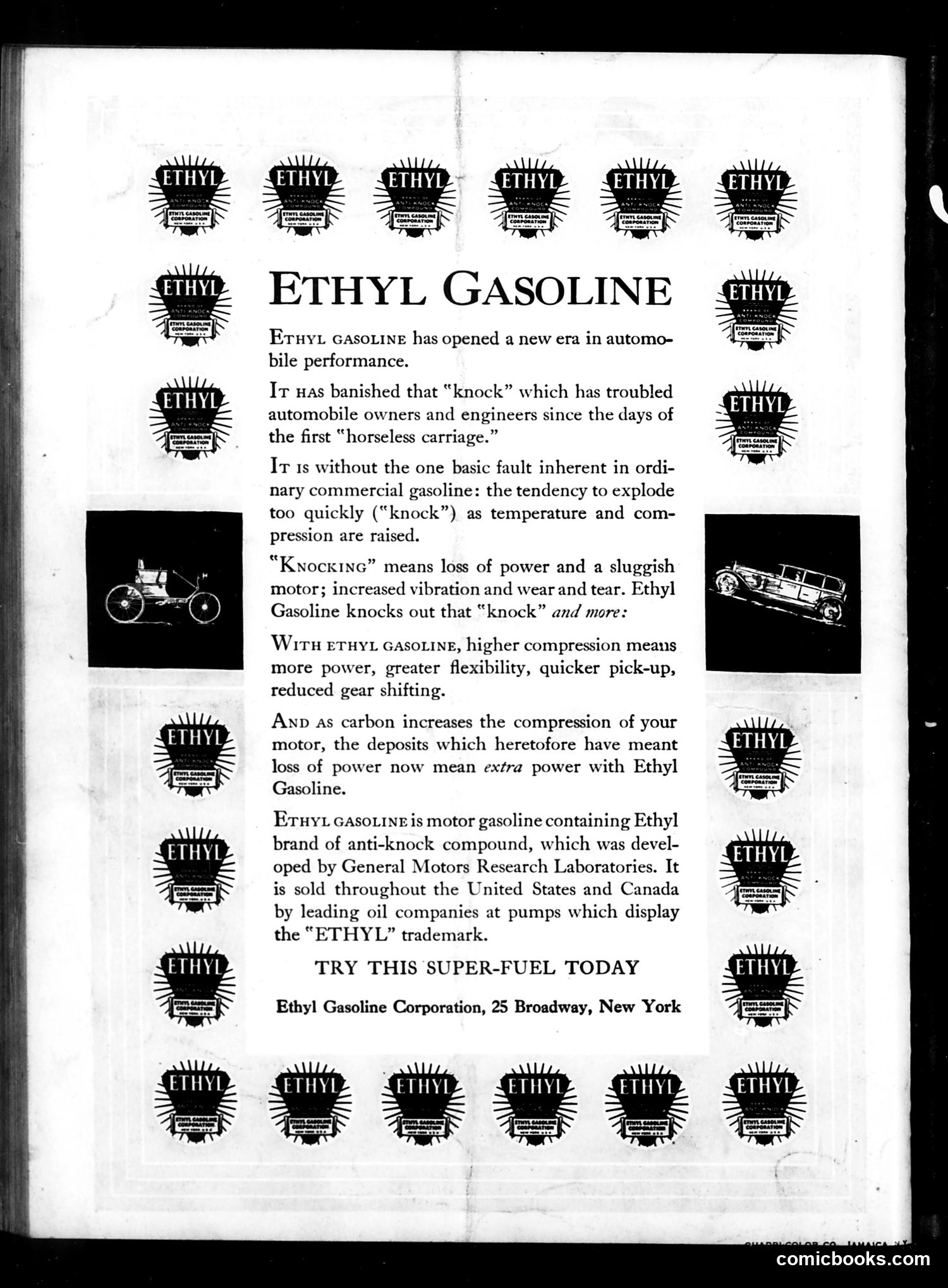
This is a straightforward **product advertisement**, not satire or political commentary. It promotes Ethyl Gasoline, a fuel additive developed by General Motors Research Laboratories that reduces engine "knock"—the premature combustion that caused power loss and mechanical wear in early automobiles. The page uses the "ETHYL" logo repeatedly as decorative border elements and includes two vintage automobile illustrations to convey modernity and performance. The text emphasizes how the anti-knock compound allows higher engine compression, delivering more power and smoother operation—a significant automotive innovation of the era. The phrase "super-fuel" and the overall design reflect early 20th-century marketing enthusiasm for technological advancement. This appears in *Judge* magazine simply as paid advertising, not as editorial content or satire.