
Judge, 1927-07-09 · page 16 of 36
Judge — July 9, 1927 — page 16: what you’re looking at
What you’re looking at
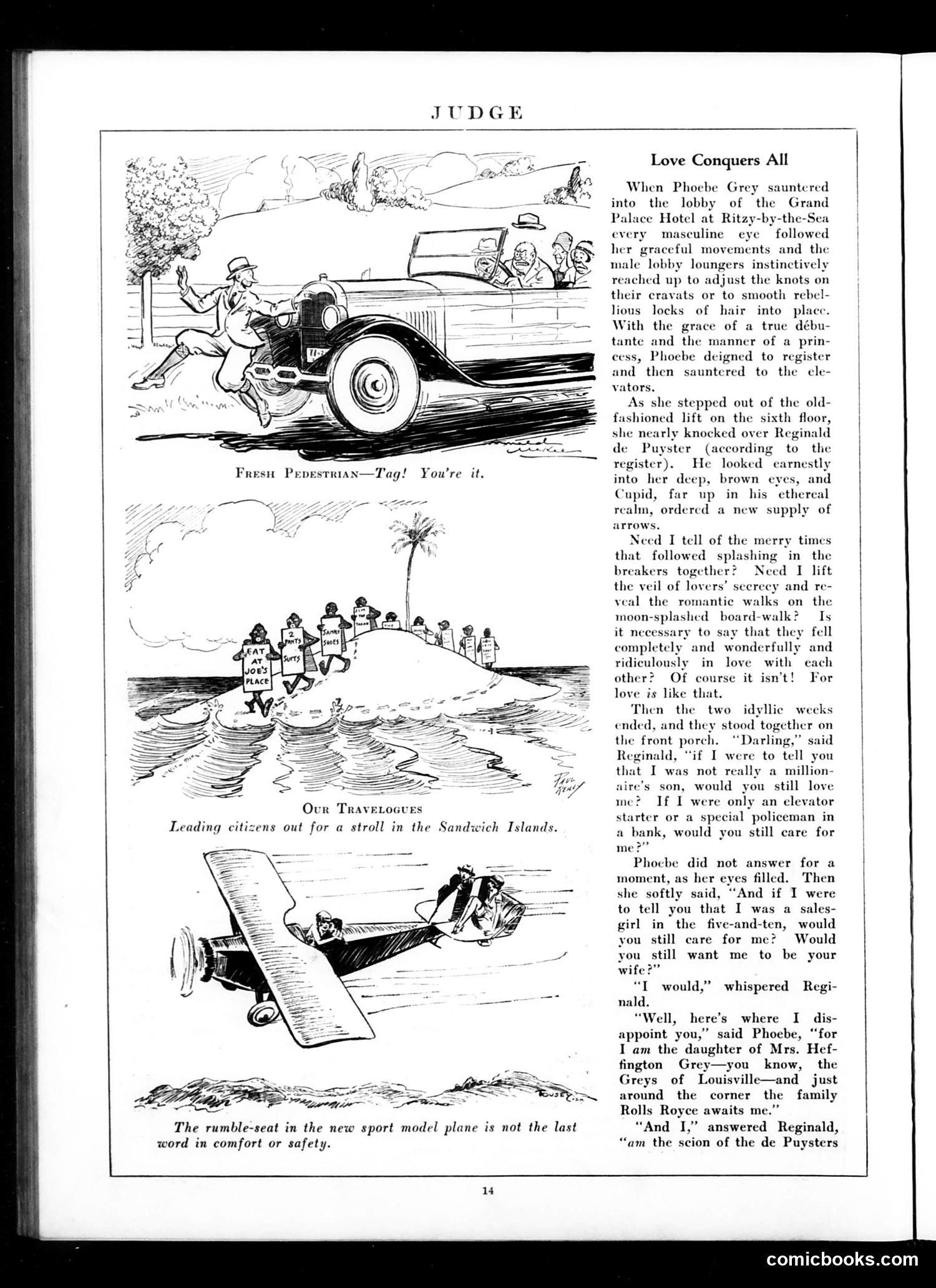
This page presents a romantic short story satirizing early 20th-century upper-class courtship conventions. The narrative mocks the artificial anxieties of wealthy young people by having two protagonists—Phoebe Grey and Reginald de Puyster—each harbor secret fears about their social standing, only to reveal they're both wealthy anyway. The satire targets the era's obsession with lineage and money as markers of marriageability. The ironic twist—where both lovers confess potentially "shameful" truths (not being millionaires, being salesgirls) only to admit their actual wealth—ridicules how hollow these class concerns are. The accompanying cartoons (about automobiles, beach tourism, and aircraft) humorously illustrate modern leisure activities available to the wealthy. The piece gently mocks society's preoccupation with status while suggesting that true love should transcend such concerns—though the resolution ironically confirms wealth matters most.
📄 Transcribed text from this page (OCR, searchable)
Machine-transcribed from the original scan — historical spelling and the odd misread are preserved.
JUDGE Love Conquers All When Phoebe Grey sauntered into the lobby of the Grand Palace Hotel at Ritzy-by-the every masculine eye followed her graceful movements and the male lobby loungers instinctively reached up to adjust the knots on their cravats or to smooth rebel- lious locks of hair into place. With the grace of a true débu- tante and the manner of a prin- cess, Phoebe deigned to register and then sauntered to the ele- vators. she stepped out of the old- fashioned lift on the sixth floor, she nearly knocked over Reginald de Puyster (according to the register). He looked earnestly into her deep, brown eyes, and Cupid, far up in his ‘ethereal realm, ordered a new supply of arrows. Need I tell of the merry times that followed splashing in the breakers together? Need I lift the veil of lovers’ secrecy and re- veal the romantic walks on the moon-splashed board-walk? — Is ary to say that they fell completely and wonderfully and ridiculously in love with’ each othe Of course it isn’t! For love is like that. Then the two idyllic weeks ended, and they stood together on the front porch. “Darling,” said ginald, “if I were to tell you I was not really a million- J aire’s son, would you still love Our Taavaoaves If I were only an elevator Leadi wes Il in the S F ter or a special policeman in Leading citizens out for a stroll in the Sandwich Islands. nk, would you still care for Pepestrian—Tag! You're Phoebe did not answer for a moment, as her eyes filled. Then she softly said, “And if I were to tell you that I was a sales- girl in the five-and-ten, would you still care for me? Would you still want me to be your wife?” “I would,” whispered Regi- nald. “Well, here’s where I dis- appoint you,” said Phoebe, “for I am the daughter of Mrs. Hef- fington Grey—you know, the ee — we Greys of Louisville—and just Py hae te Dengan c= sp around the corner the family a Rolls Royce awaits me.” The rumble-seat in the new sport model plane is not the last “And I,” answered Reginald, word in comfort or safety. “am the scion of the de Puysters comicbooks.com