
Judge, 1927-07-09 · page 15 of 36
Judge — July 9, 1927 — page 15: what you’re looking at
What you’re looking at
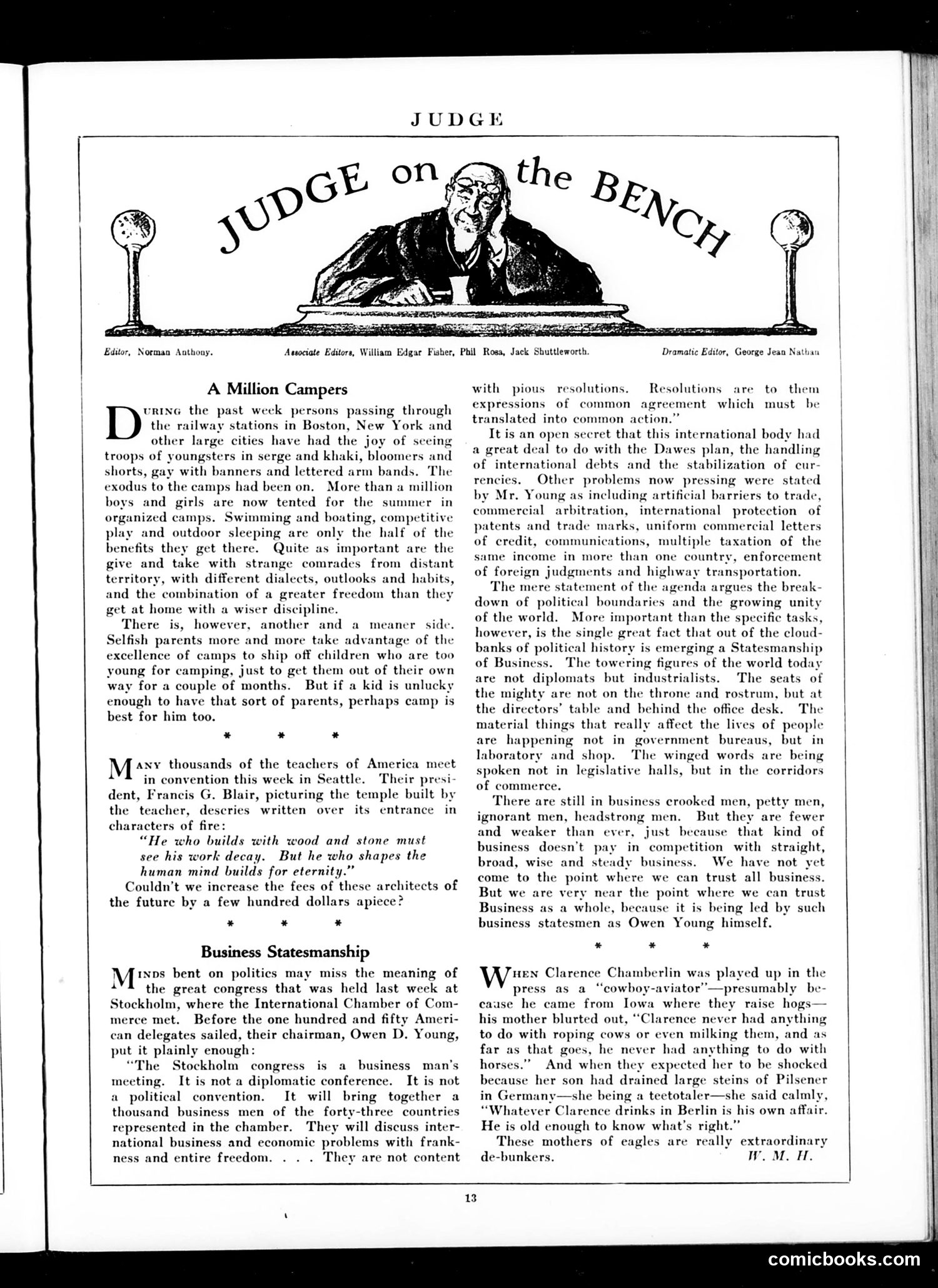
This page from the satirical magazine *Judge* contains three opinion pieces rather than traditional political cartoons. **"A Million Campers"** discusses the summer camp boom for American youth, praising the character-building benefits while cynically noting that some selfish parents use camps merely as childcare to remove inconvenient children. **"Business Statesmanship"** celebrates teachers and education, quoting Francis G. Blair's idealistic vision of educators as builders of minds. **The main satire** is the longest piece on the International Chamber of Commerce meeting in Stockholm, where Owen D. Young (the chairman) is quoted. The article argues that practical businessmen—not diplomats or politicians—now shape world affairs. It suggests industrialists and their commercial concerns (trade barriers, currency stabilization, the Dawes Plan for war reparations) are more important to global stability than traditional diplomacy. The satire's point: in post-WWI 1920s America, business pragmatism trumps political idealism in solving international problems.
📄 Transcribed text from this page (OCR, searchable)
Machine-transcribed from the original scan — historical spelling and the odd misread are preserved.
JUDGE Editor, Norman Anthony. A Million Campers URING the past week persons passing through D the railway stations in Boston, New York and other large cities have had the joy of seeing troops of youngsters in serge and khaki, bloomers and shorts, gay with banners and lettered arm bands. The exodus to the camps had been on. More than a million boys and girls are now tented for the summer in organized camps. Swimming and boating, competitive play and outdoor sleeping are only the half of the be nefits they get there. Quite as important are the give and take with strange comrades from distant territory, with different dialects, outlooks and habits, and the combination of a greater freedom than they get at home with a wiser discipline. There is, however, another and a meaner side. Selfish parents more and more take advantage of the excellence of camps to ship off children who are too young for camping, just to get them out of their own way for a couple of months. But if a kid is unlucky enough to have that sort of parents, perhaps camp is best for him too. * * * any thousands of the teachers of America meet in convention this week in Seattle. Their presi- dent, Francis G. Blair, picturing the temple built by the teacher, descries written over its entrance in characters of fire: “He who builds with wood and stone must see his work decay. But he who shapes the human mind builds for eternity.” Couldn't we increase the fees of these architects of the future by a few hundred dollars apiece? * * * Business Statesmanship Ms bent on politics may miss the meaning of the great congress that was held last week at Stockholm, where the International Chamber of Com- merce met. Before the one hundred and fifty Ameri- can delegates sailed, their chairman, Owen D. Young, put it plainly enough: “The Stockholm congress is a business man’s meeting. It is not a diplomatic conference. It is not a political convention. It will bring together a thousand business men of the forty-three countries represented in the chamber. They will discuss inter- national business and economic problems with frank- ness and entire freedom. They are not content Associate Editors, William Edgar Fisher, Phil Rosa, Jack Shuttleworth. Dramatic Editor, George Jean Nathan with pious resolutions. Resolutions are to them expressions of common agreement which must be translated into common action.” It is an open secret that this international body had a great deal to do with the Dawes plan, the handling of international debts and the stabilization of cur- rencies. Other problems now pressing were stated by Mr. Young as including artificial barriers to trade, commercial arbitration, international protection of patents and trade marks, uniform commercial letters of credit, communications, multiple taxation of the same ome in more than one country, enforcement of foreign judgments and highway transportation. The mere statement of the agenda argues the bre: down of political boundaries and the growing unity of the world. More important than the specific tasks, however, is the single great fact that out of the cloud- banks of political history is emerging a Statesmanship of Business. The towering figures of the world today are not diplomats but industrialists. The seats of the mighty are not on the throne and rostrum, but at the directors’ table and behind the office desk. The material things that really affect the lives of people are happening not in government bureaus, but in laboratory and shop. The winged words are being spoken not in legislative halls, but in the corridors of commerce. There are still in business crooked men, petty men, ignorant men, headstrong men. But they are fewer and weaker than ever, just because that kind of business doesn’t pay in competition with straight, broad, wise and steady business. We have not yet come to the point where we can trust all business. But we are very near the point where we can trust Business as a whole, because it is being led by such business statesmen as Owen Young himself. * * * Wes Clarence Chamberlin was played up in the press as a “cowboy-aviator’—presumably be- cause he came from Iowa where they raise hogs— his mother blurted out, “Clarence never had anything to do with roping cows or even milking them, and as far as that goes, he never had anything to do with horses.” And when they expected her to be shocked because her son had drained large steins of Pilsener in Germany—she being a teetotaler—she said calmly, “Whatever Clarence drinks in Berlin is his own affair. He is old enough to know what's right.” These mothers of eagles are really extraordinary de-bunkers. Ww. M. H. comicbooks.com