
Judge, 1927-07-09 · page 20 of 36
Judge — July 9, 1927 — page 20: what you’re looking at
What you’re looking at
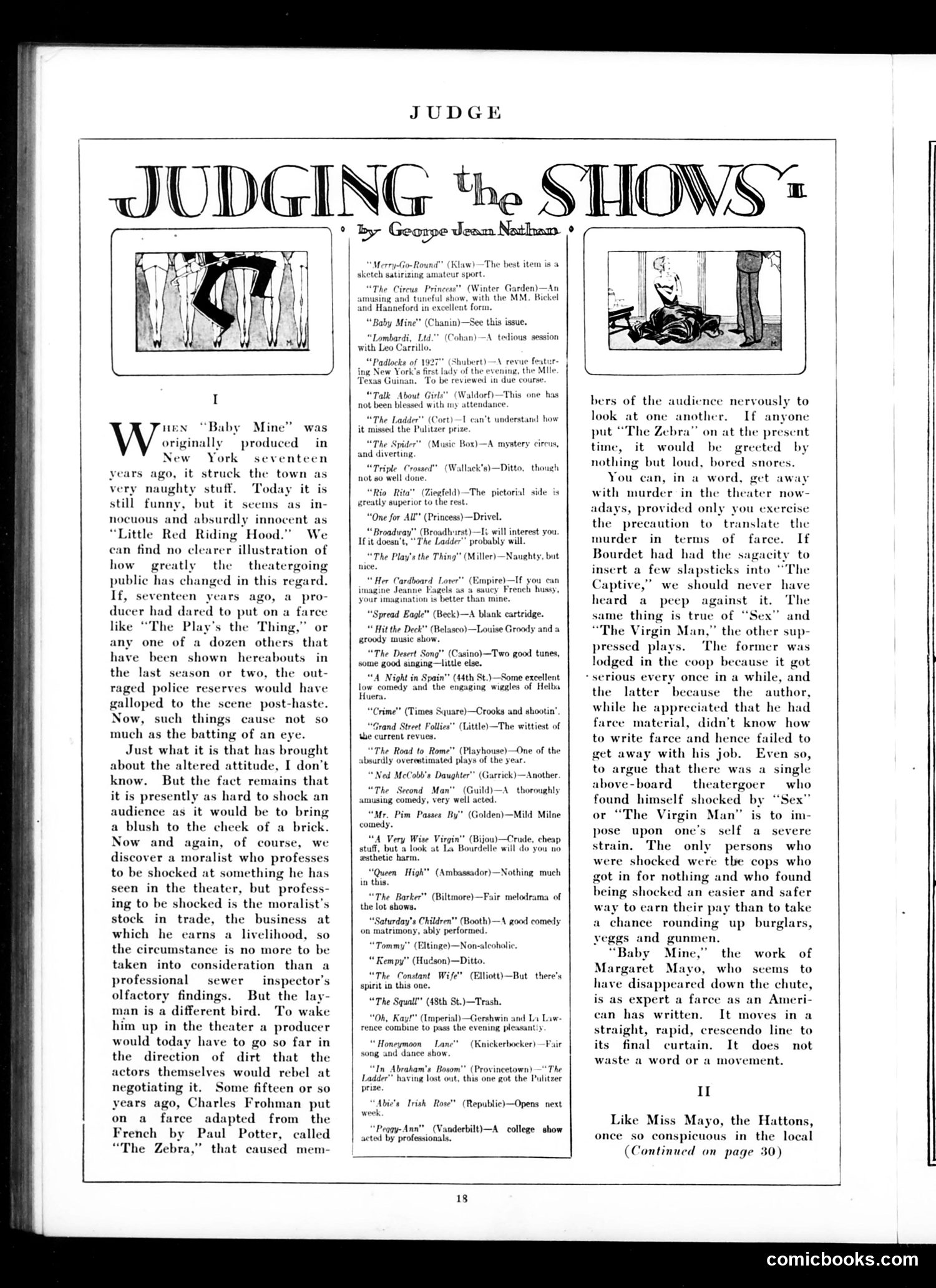
This is a theater review column by George Jean Nathan, a prominent drama critic of the 1920s. Rather than political satire, it's cultural commentary about Broadway productions and changing public morality. Nathan argues that theatrical audiences have become impossible to shock. He traces this shift by recalling "Baby Mine," a play deemed scandalous seventeen years earlier but now viewed as innocent. He contrasts this with "The Zebra," a farce so obscene it caused public outrage when Charles Frohman produced it around 1910. Nathan's satirical point: modern audiences are so desensitized to indecency that producers would need to transgress far beyond what actors would accept to provoke any reaction. The accompanying theater listings with brief reviews exemplify the current Broadway season he's evaluating. This reflects 1920s debates about declining moral standards and theatrical decorum during the Jazz Age.
📄 Transcribed text from this page (OCR, searchable)
Machine-transcribed from the original scan — historical spelling and the odd misread are preserved.
JUDGE nex “Baby Mine” was V V originally © produced — in ew York seventeen rs ago, it struck the town as very naughty stuff. Today it is still funny nocuous and absurdly innocent as “Little Red Riding Hood.” We can find no clearer illustration of how eatly the — theatergoing public has changed in this regard. If, seventeen years ago, a pro- ducer had dared to put on a farce like “The 3 Thing,” or any one of a dozen others that have been shown hereabouts in the last season or two, the out- raged police reserves would have galloped to the scene post-haste. Now, such things cause not so much as the batting of an eye. Just what it is that has brought about the altered attitude, I don’t know. But the fact remains that it is presently as hard to shock an audience as it would be to bring blush to the cheek of a brick. Now and again, of course, we discover a moralist who professes to be shocked at something he has seen in the theater, but prof ing to be shocked is the moralist's stock in trade, the business at which he earns a livelihood, so the circumstance is no more to be taken into consideration than a professional sewer inspector's olfactory findings. But the lay- man is a different bird. To wake him up in the theater a producer would today have to go so far in the direction of dirt that the actors themselves would rebel at negotiating it. Some fifteen or so years ago, Charles Frohman put on a farce adapted from the French by Paul Potter, called The Zebra,” that ce: ¥ > but it seems as in- used mem- G ‘he SHOWS*® ° by Geompe Jem Nathan ¢ “Merry-Go-Round” (Klaw)—The best item is a sketch satirizing amateur sport “The Circus P (Winter Garden)—An nd tuneful show, with the MM. Bickel amusing and Hanneford in excellent form. “Baby Mine’ (Chanin)—See this issue. “Lombardi, Ltd.” (Cohan) —A tedious session with Leo Carrillo. “Padlocks of 1927" (Shubert) —\ revue 1g New York's first lady of the eveni Texas Guinan. To be reviewed in due cout “Talk About Girls” (Waldorf)—This one has not been blessed with my attendance. “The Ladder” (Cort) —I can't understand how it missed the Pulitzer prize. “The Spider” (Music Box)—A mystery circus, and diverting “Triple ( not so well done. “Rio Rita’ (Ziegfeld) —The pictorial side is greatly superior to the rest. “One for Al” (Princess)—Drivel. “Broadway” (Broadhvirst)—Ii will interest you If it doesn't, “The Ladder" probably will. The Play's the Thing’ (Miller)—Naughty, but nice. Her Cardboard Lorer"™ (Empire) imag! Fagels as a saucy Fre your imagination is better than mine. “Spread Eagle” (Beck)—A blank cartridge. “Hit the Deck"* (Belasco)—Louise Groody and a groody music show. od (Wallack's)—Ditto, though If you can bh hussy, “The Desert Song” (Casino)\—Two good tunes, some good singing—little else. “A Night in Spain’ (44th St.)—Some excellent low comedy and the engaging wiggles of Helbs Huera. “Crime” (Times Square)—Crooks and shootin’ ind Street Follies’ (Little) —The wittiest of the current revues. “The Road to Rome" (Playhouse)—One of the absurdly overestimated plays of the year: Ned McCobb's Daughter" rick) —Another “The Second Man" (Guild)—A thoroughly amusing comedy, very well acted. “Mr. Pim Passes By" (Golden)—Mild Milne comedy. “A Very Wise Virgin’ (Bijou) stuff, but a look at La Bourdelle w aesthetic hart . cheap you no “Queen High" (Ambasaador)—Nothing much in this “The Barker” (Biltmore)—Fair melodrama of the lot shows. 's Children" (Booth)—4 good comedy ably performed. “Tommy” (Eltinge)—Non-alcoholic. “ Kempy’" (Hudson)—Ditto. “The Constant Wife” (Elliott)—But there's spirit in this one. “The Squall” (48th St.)—Trash. “Oh, Kay!" (Imperial) Gershwin and La Law- rence combine to pass the evening pleasant!y “Honeymoon Lane’ (Knickerbocker) Fair 1g and dance show “In Abraham's Bosom" (Provincetown) —"The litzer Ladder" having lost out, this one got the prize. Trish Rose” (Republic)—Opens next “Peagy-Ann” (Vanderbilt)—A college show acted by professionals. bers of the audience nervously to look at one another. If anyone put “The Zebra” on at the present time, it would be greeted by nothing but loud, bored snores. You can, in a word, get aw with murder in the theater now- adays, provided only you exercise the precaution to translate the murder in terms of farce. If Bourdet had had the sagacity to insert a few slapsticks into “The Captive,” we should never have heard a peep against it. The same thing is true of “Sex” and “The Virgin Man,” the other sup- pressed plays. ‘The former was lodged in the coop because it got srious every once in a while, and the latter because the author, while he appreciated that he had farce material, didn’t know how to write farce and hence failed to get away with his job. Even so, to argue that there was a single above-board — theatergoer — who found himself shocked by “Sex” or “The Virgin Man” is to i pose upon one’s self a severe strain. The only persons who were shocked were the cops who got in for nothing and who found being shocked an ier and safer way to carn their pay than to take a chance rounding up burglars, yeggs and gunmen. “Baby Mine,” the work of Margaret Mayo, who to have disappeared down the chute, is as expert a farce as an Ameri- can has written. It moves in « straight, rapid, crescendo line to its final curtain. It does not waste a word or a movement. II Like Miss Mayo, the Hattons, once so conspicuous in the local (Continued on page 30) comicbooks.com