
A complete issue · 36 pages · 1927
Judge — June 18, 1927
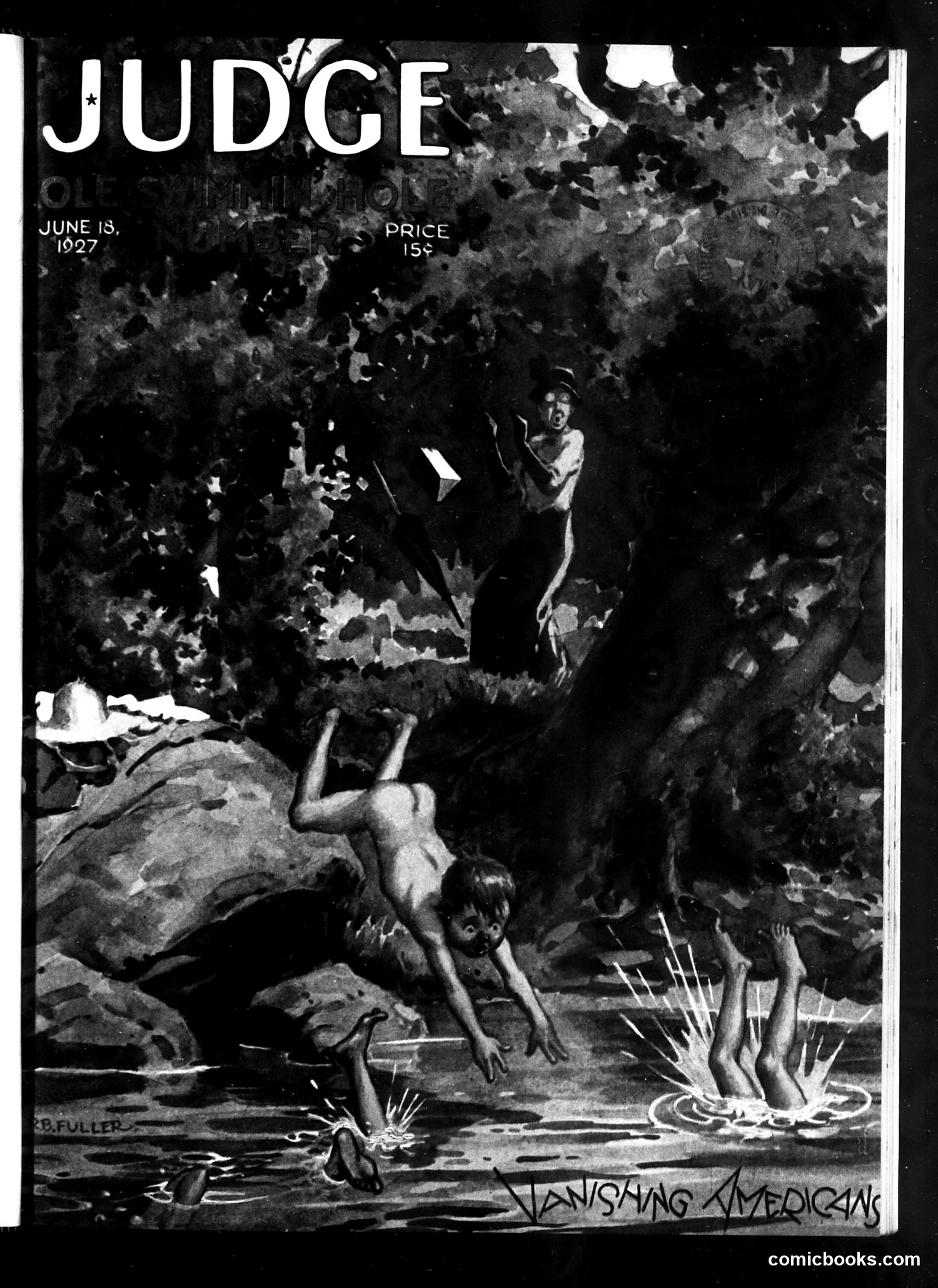
This cartoon illustrates the contemporary concern about Native Americans' disappearance from American life. The illustration depicts Indigenous children wading in water while fading into mist or vapor, symbolizing their literal and cultural erasure. The title "Vanishing American" references the widespread early-20th-century belief that Native populations were inevitably disappearing due to assimilation, disease, and displacement. This reflected both genuine historical tragedy and a problematic fatalistic attitude that discouraged intervention. The artist (signed "B. Fuller") appears to use this satirical image to critique American society's passive acceptance of Indigenous decline, though the cartoon's exact satirical angle—whether criticizing indifference or commenting on assimilation policies—remains somewhat ambiguous from the image alone.
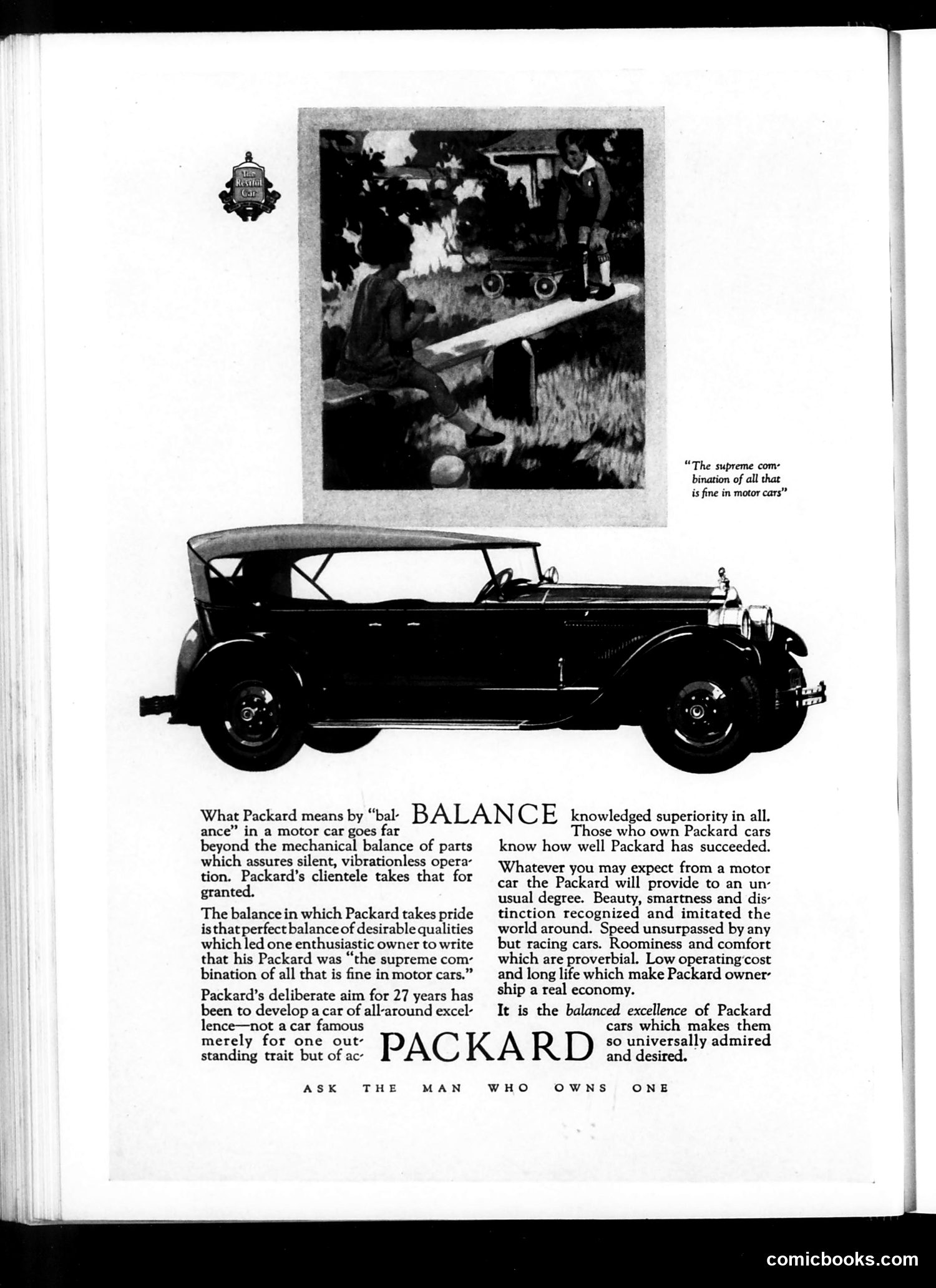
This page is primarily **advertising, not satire or political commentary**. It's a Packard automobile advertisement from what appears to be the 1920s era. The ad emphasizes "balance" as Packard's key selling point—mechanical balance of parts ensuring smooth, vibrationless operation. The top photograph shows what appears to be an early automotive manufacturing or assembly scene. The silhouette shows a side profile of a Packard touring car, typical of that period's open-air vehicles. The text repeatedly stresses that Packard's "balanced excellence" (used in italic for emphasis) creates superiority in speed, roominess, comfort, and economy. The tagline "Ask the man who owns one" was Packard's famous advertising slogan. This is straightforward product marketing rather than satirical or political content.
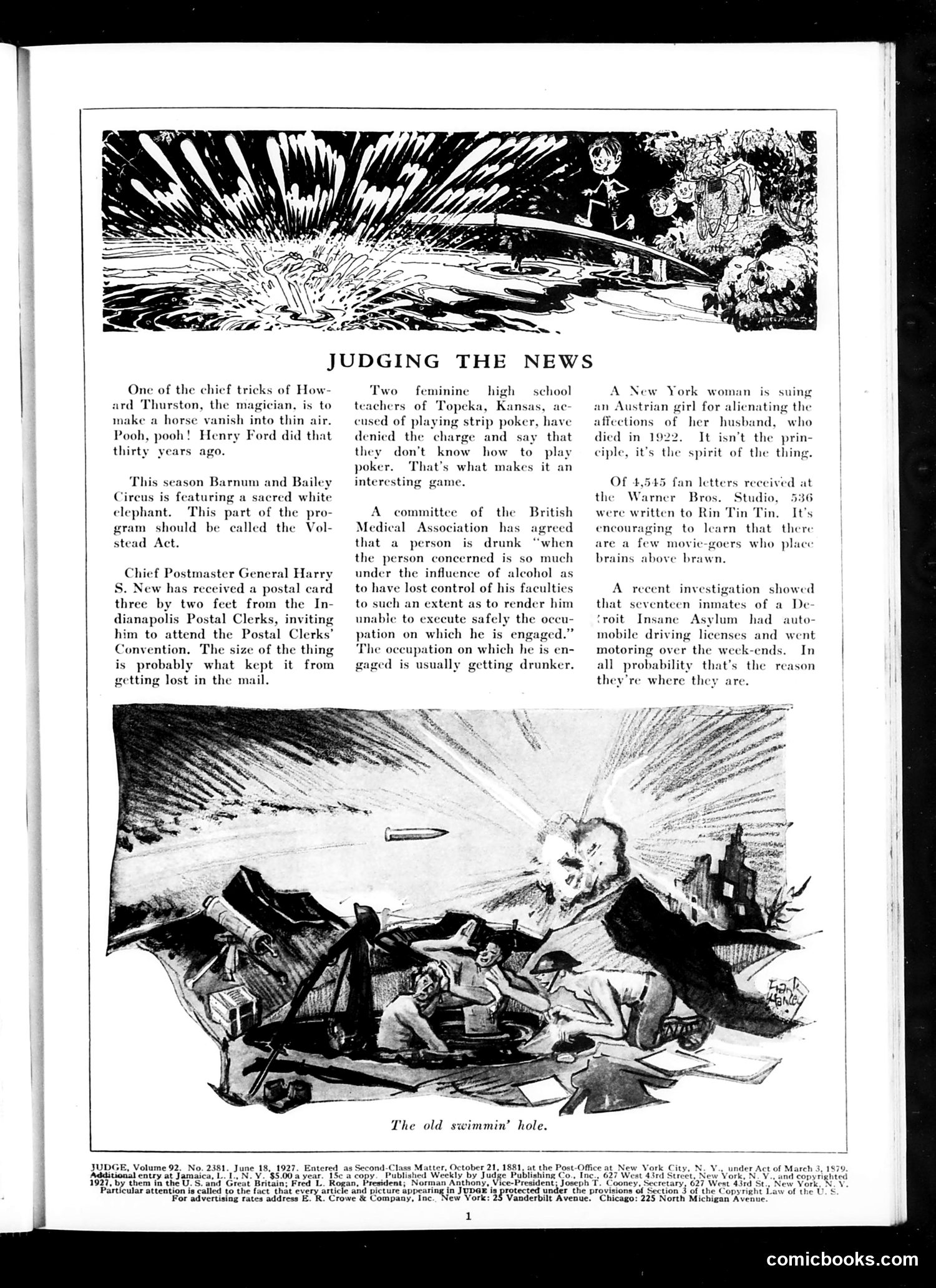
This page contains satirical commentary on contemporary news items rather than a political cartoon. The topics include: - **Barnum and Bailey's circus** performing a "sacred white elephant" act - **Strip poker scandal** involving two female high school teachers in Topeka, Kansas, accused of playing the game - **Chief Postmaster General Harry S. New** receiving a postal card from Indianapolis postal clerks inviting him to a "Postal Clerks' Convention"—satirizing the irony of mail getting lost while postal officials socialize - **British Medical Association's definition** of drunkenness as loss of control over faculties - **Warner Bros. fan mail** about Rin Tin Tin (the famous dog actor) - **Detroit asylum inmates** with suspended driving licenses The lower illustration captioned "The old swimmin' hole" appears to depict a chaotic, impoverished scene, likely commentary on social conditions.
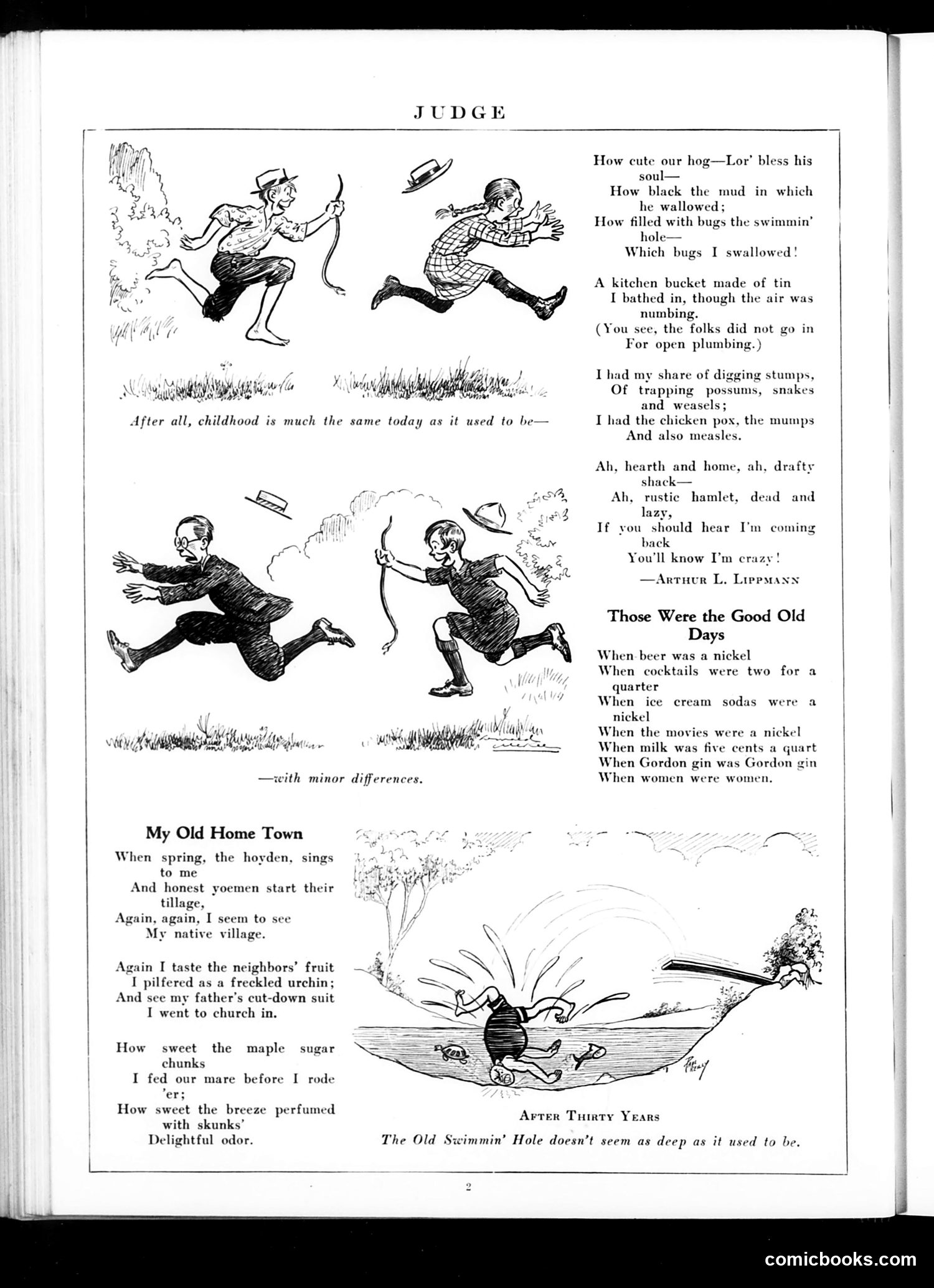
This page contains nostalgic poems and whimsical illustrations rather than political satire. "Judge," while primarily satirical, regularly featured lighter content alongside commentary. The section "After all, childhood is much the same today as it used to be" includes illustrations of children engaged in timeless play—fishing, catching frogs, and outdoor games. The accompanying verse by Arthur L. Lippmann celebrates rural childhood activities: digging stumps, trapping animals, enduring childhood illnesses like chicken pox and measles. "Those Were the Good Old Days" humorously lists bygone economic conditions (nickel beers, two-for-a-quarter cocktails), implying inflation and economic change—likely reflecting 1920s-30s nostalgia. "My Old Home Town" and "After Thirty Years" continue the nostalgic theme, contrasting remembered rural simplicity with present urban life. The sketch of a swimming hole represents idealized frontier childhood.
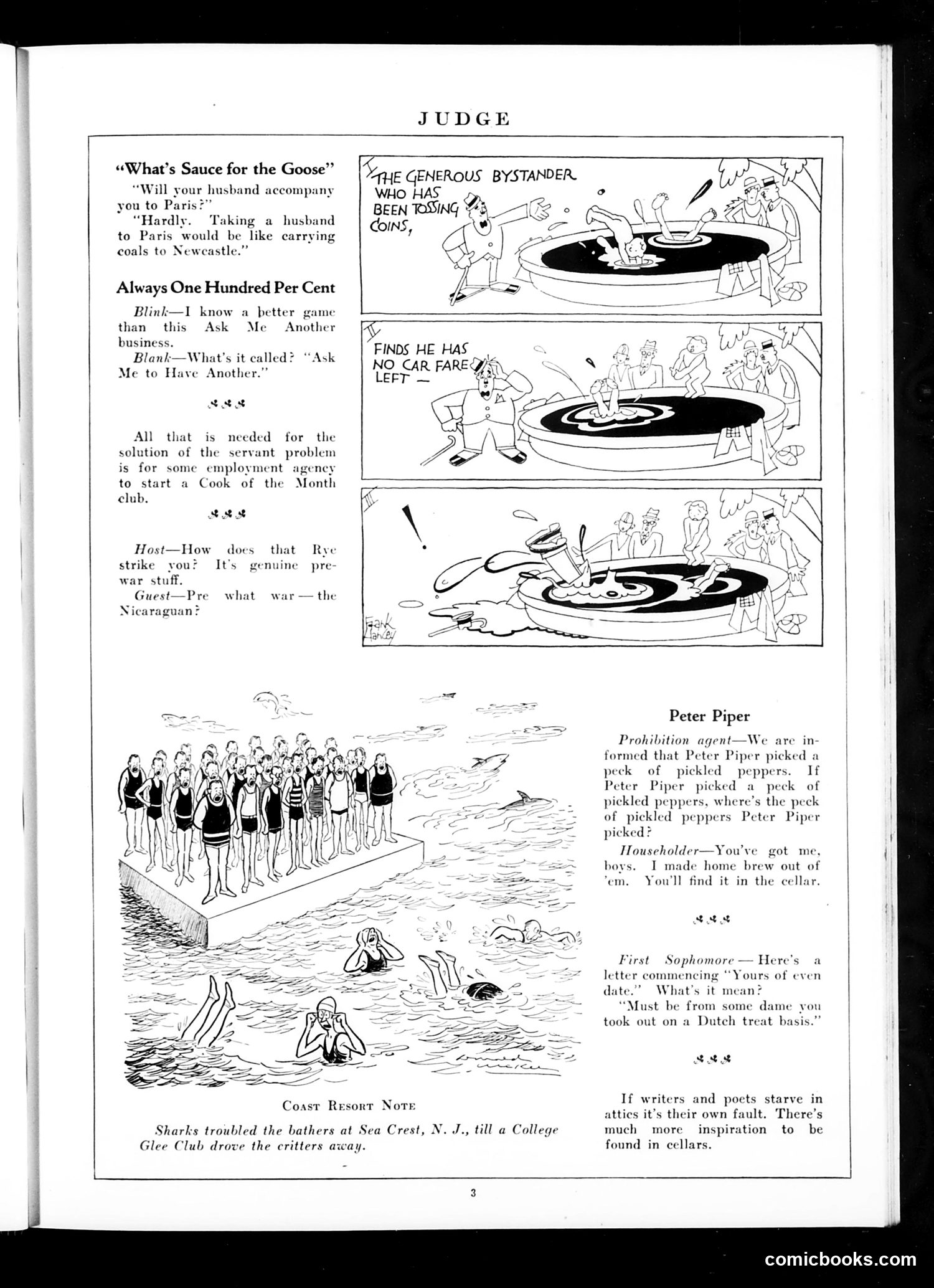
This page contains several unrelated humor items typical of Judge's format: **Top section ("What's Sauce for the Goose"):** Brief satirical exchanges about marital dynamics and servant employment—social humor of the era. **Middle comic strip:** A three-panel sequence about a "generous bystander" in a pool who keeps losing coins to the water. The satire mocks naive charitable impulses or public displays of generosity. **"Peter Piper" section:** A tongue-twister joke about prohibition—referenced as an "agent" catching someone with pickled peppers, likely a coded reference to alcohol smuggling during Prohibition era. **Bottom illustration:** Shows bathers at a beach with a "Coast Resort Note" about sharks and a college glee club. This appears to be lighthearted vacation humor. The page reflects 1920s social concerns: servant problems, prohibition enforcement, and leisure culture.
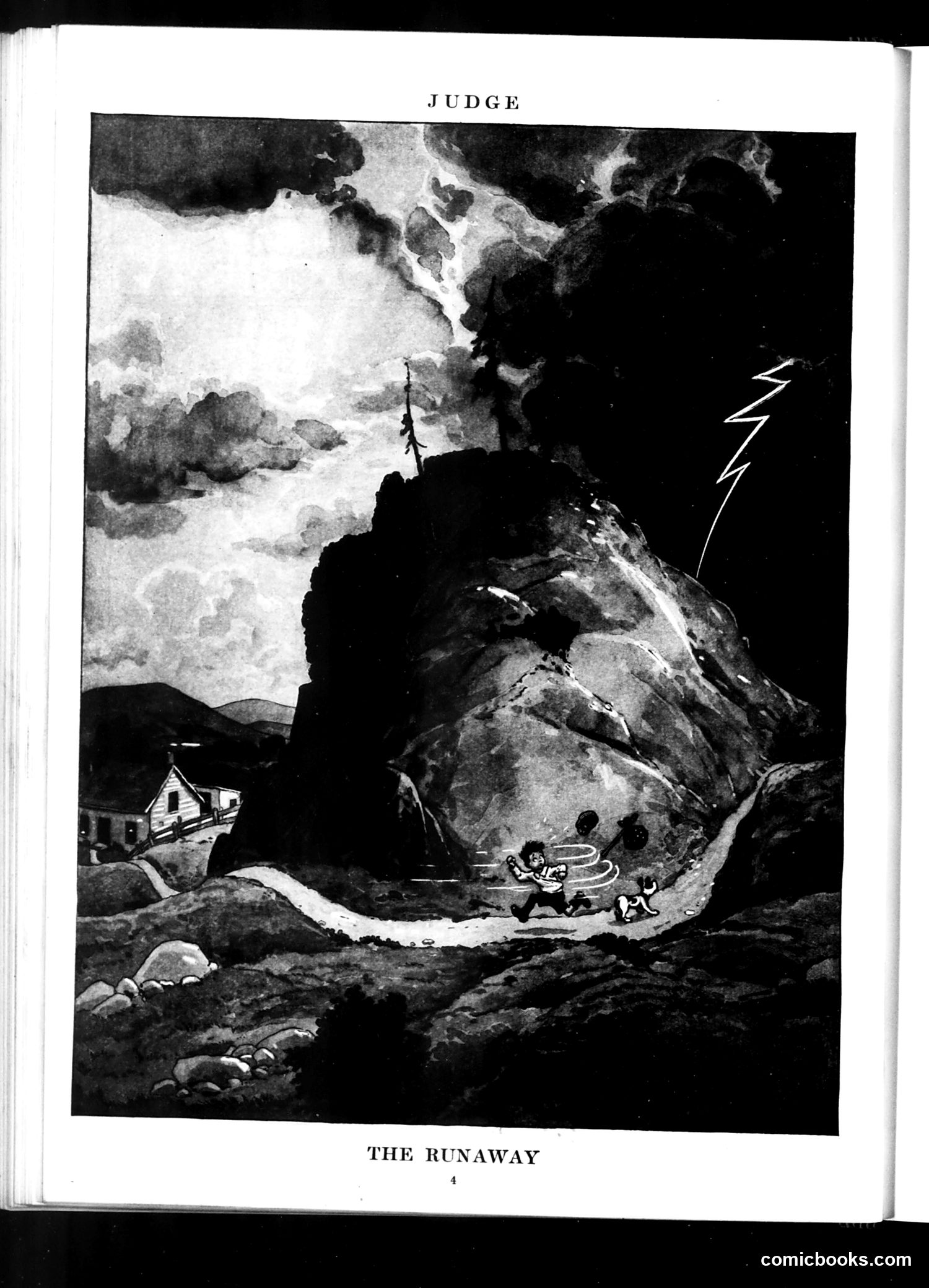
This Judge magazine illustration depicts a dramatic landscape scene rather than a political cartoon. The image shows a small figure (appearing to be a child or young person) fleeing across a barren landscape toward a distant cottage, while being pursued by what appears to be a large, ominous dark figure or force emerging from rocky terrain above. The title "The Runaway" suggests a narrative about escape or flight. Without additional context or OCR text explaining the symbolic meaning, the specific political or social reference remains unclear. It could allegorically represent flight from authority, poverty, or hardship—common themes in satirical magazines of this era—but the exact target of satire cannot be determined from the image alone.
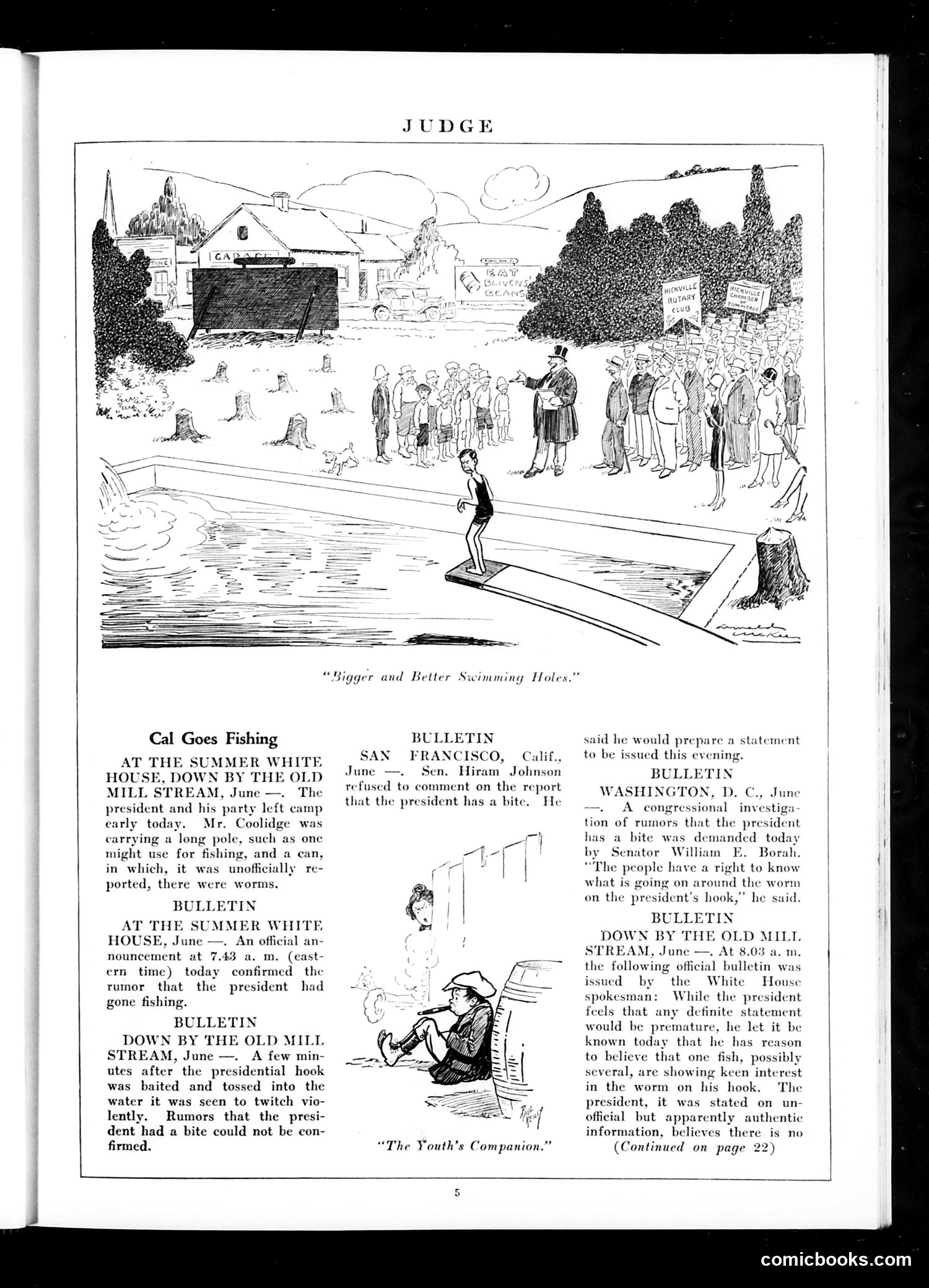
The main cartoon titled "Bigger and Better Swimming Holes" satirizes President Calvin Coolidge's fishing trip to the Summer White House at Old Mill Stream in June (early 1920s). The accompanying bulletins report humorously on the president's fishing activities and rumors that he was bitten by a fish. Senator William E. Borah apparently demanded the president publicly address this incident, claiming citizens have "a right to know what is going on around the worm on the president's look." The satire mocks both the media frenzy and public curiosity over trivial presidential activities. The swimming-hole cartoon jokes about expanding recreational facilities, likely referencing post-WWI American leisure culture. The overall tone suggests bemusement at excessive press coverage of the president's private recreational pursuits.
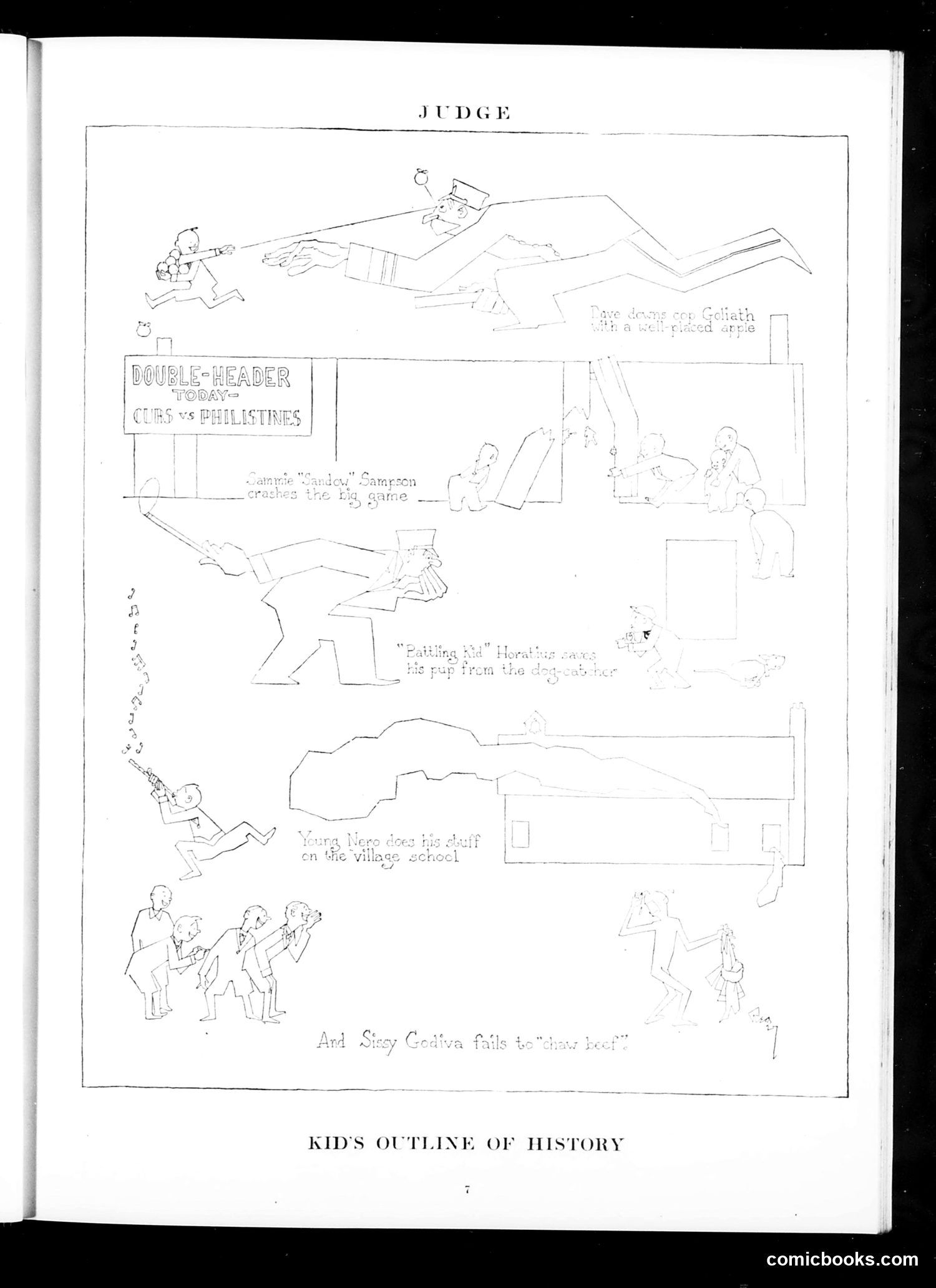
This page is titled "Judge" and presents "Kids Outline of History"—a satirical comic strip that parodies H.G. Wells's famous "Outline of History." The strip uses exaggerated, comedic scenarios to mock historical events and figures through children's perspectives. Visible segments include references to biblical and classical history (appearing to show David and Goliath, and what looks like ancient Roman or Greek scenes). Other panels reference more recent American history, including what appears to be sports or entertainment references ("Double-Header Today—Cubs vs. Phillies"). The humor relies on absurdist juxtapositions—treating serious historical events with childish, incongruous logic. Rather than educating readers, the comic deflates historical significance by reimagining famous moments through silly scenarios. This reflects Judge magazine's satirical style of using humor to comment on American culture and education.
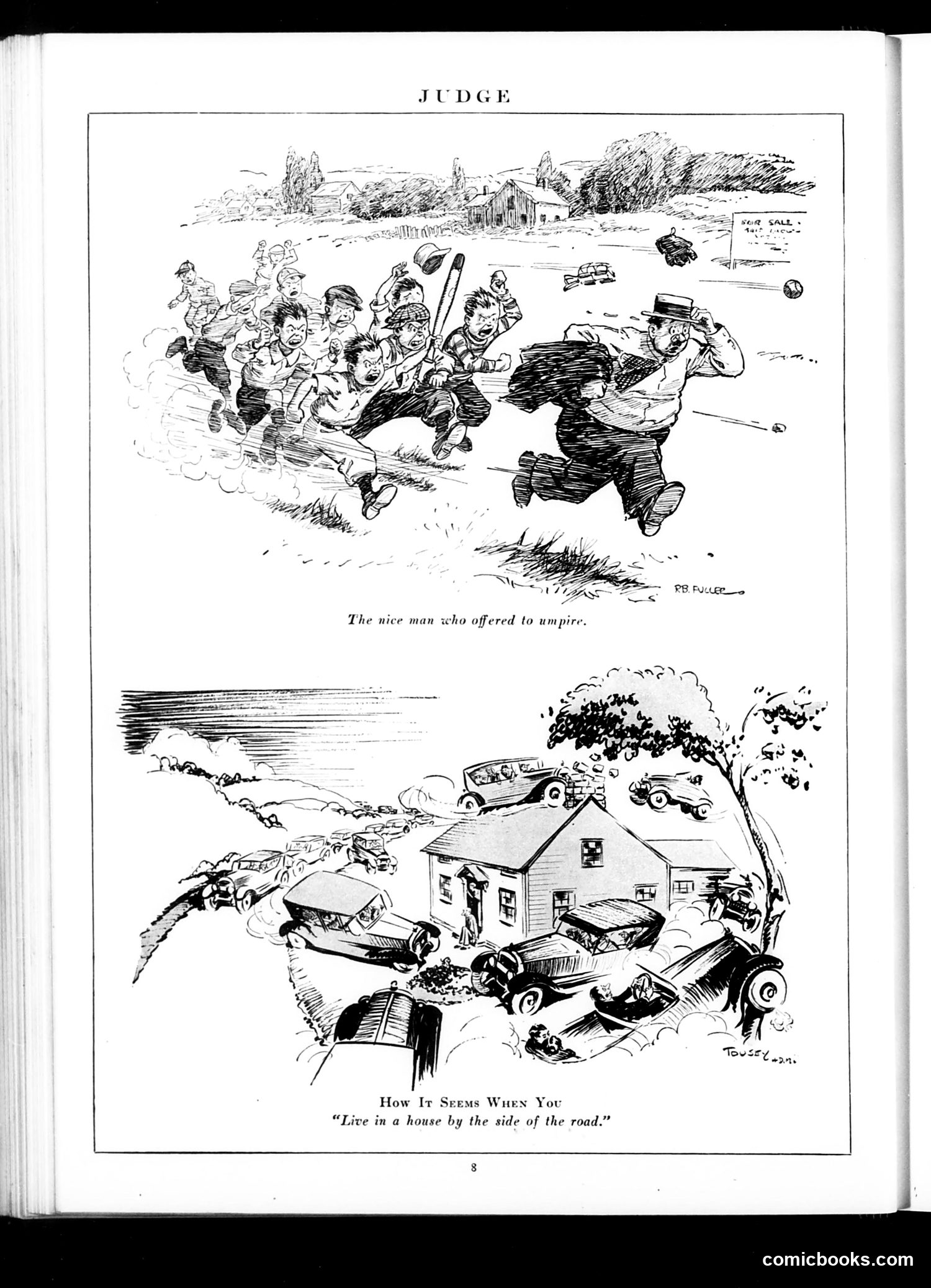
This Judge magazine page contains two separate cartoons satirizing early automobile culture and road safety. The **top cartoon** mocks someone who volunteered to umpire a baseball game but gets struck by speeding cars and flying debris instead—suggesting reckless driving has invaded even leisurely activities. The **bottom cartoon** illustrates the hazards of living near a roadside house, referencing the popular poem "The House by the Side of the Road" (which romanticizes such a location). Here, the house is surrounded by crashed and careening automobiles, with cars colliding everywhere. The satire critiques the unintended consequences of 1920s-era automotive expansion: what once seemed idyllic became genuinely dangerous as car traffic increased dramatically and traffic safety remained poorly regulated. Both cartoons reflect contemporary anxiety about automobiles transforming American life unpredictably and violently.
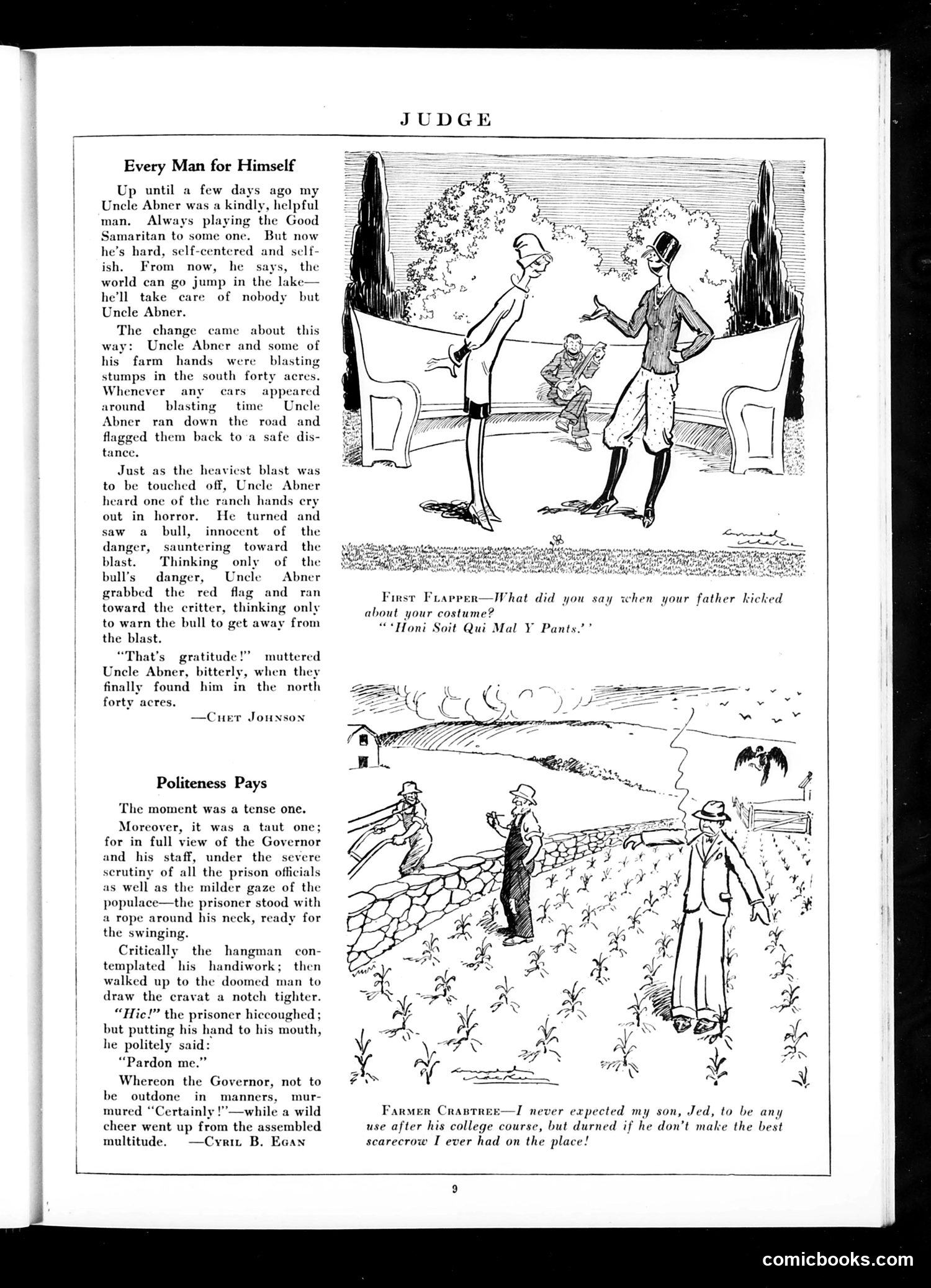
This page contains three separate humorous pieces satirizing American social attitudes: **"Every Man for Himself"** mocks Uncle Abner's sudden selfishness. After risking his life to save a bull from dynamite blasting, he's ignored and left injured—prompting him to declare he'll only look after himself. The satire critiques how people abandon kindness when their sacrifice goes unappreciated. **"Politeness Pays"** is absurdist humor about a prisoner about to be hanged who politely excuses himself when hiccoughing, and the Governor reciprocates by saying "Certainly!" The joke mocks excessive politeness as meaningless social ritual even in dire circumstances. **"First Flapper"** shows a young woman quoting French ("Honi soit qui mal y pense"—"shame on whoever thinks evil") when her father objects to her skimpy costume, suggesting she's using pretentious language to justify flapper fashion. The cartoons reflect 1920s concerns: rural versus urban values, social etiquette, and generational conflict over modern (flapper) dress and behavior.
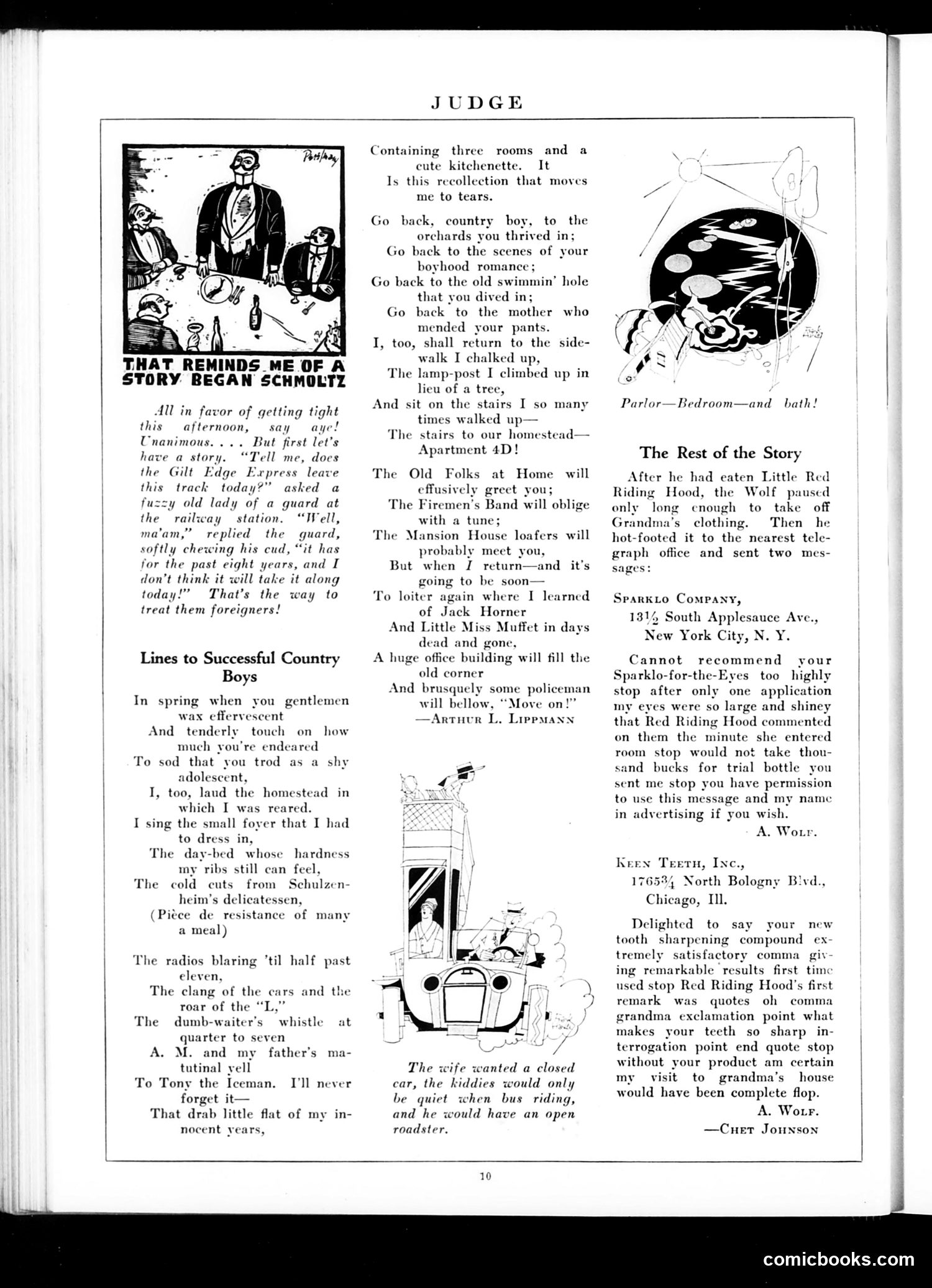
This page combines nostalgic poetry with satirical cartoons mocking American sentimentality. **"Lines to Successful Country Boys"** satirizes the clichéd rural nostalgia of the era. The poem mockingly contrasts idealized pastoral boyhood ("orchards," "swimmin' hole," caring mothers) with the speaker's actual urban immigrant childhood in a cramped apartment with a deli, noisy neighbors, and an ice delivery man—painting working-class tenement life as equally "homey." The joke: both the country gentleman and city boy romanticize their humble origins equally, suggesting this nostalgic sentiment is universal and perhaps artificially manufactured. **The cartoons** offer lighter humor: the top-left shows a dinner conversation where a guard dismissively treats a foreign woman asking about train schedules ("That's the way to treat them foreigners!"), mocking xenophobia. The bottom section parodies advertising testimonials with the Wolf from "Little Red Riding Hood" comically endorsing eye drops and tooth sharpening products via telegram—absurdist humor about commercial testimonials.
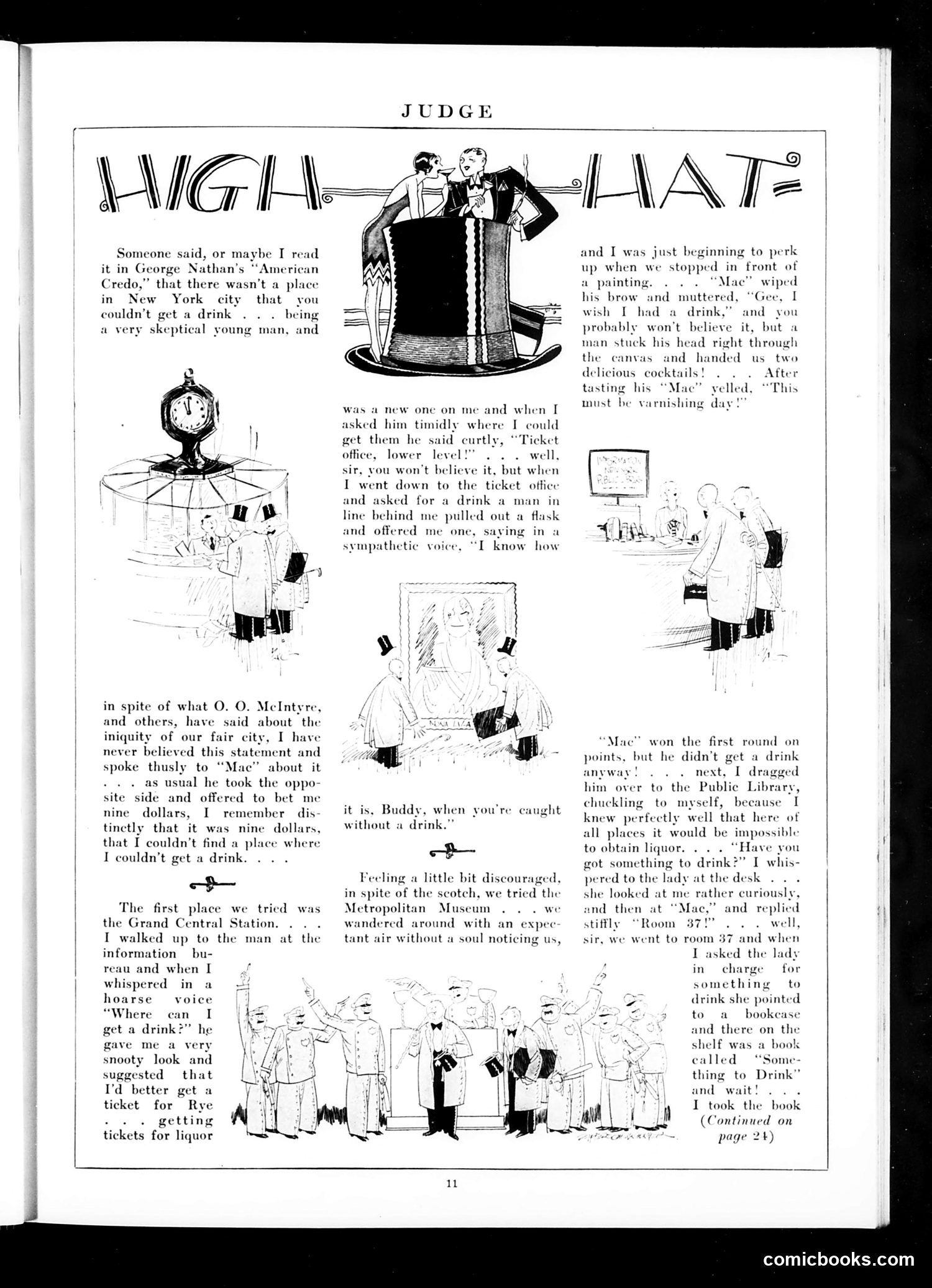
This humorous article mocks the claim that New York City offers drinks everywhere despite Prohibition (implied by the context of seeking alcohol in public places). The narrator bets "Mac" (likely columnist O.O. McIntyre, a real NYC cultural commentator referenced in the text) nine dollars that he *can't* find a drink anywhere in the city. The joke inverts expectations: at Grand Central Station, the Metropolitan Museum, and the Public Library—places where alcohol should be impossible to obtain—the narrator miraculously finds drinks. A sympathetic stranger offers a flask at the train station; a man pops through a museum painting with cocktails (pun: "varnishing day"); the library's reference desk points to a book literally titled "Something to Drink." The satire targets both Prohibition's ineffectiveness and the hypocrisy of New York's supposedly "respectable" institutions. It suggests liquor is so ubiquitous that even official establishments secretly accommodate drinkers. The cartoon's multiple illustrations show bewildered characters navigating these absurd scenarios.
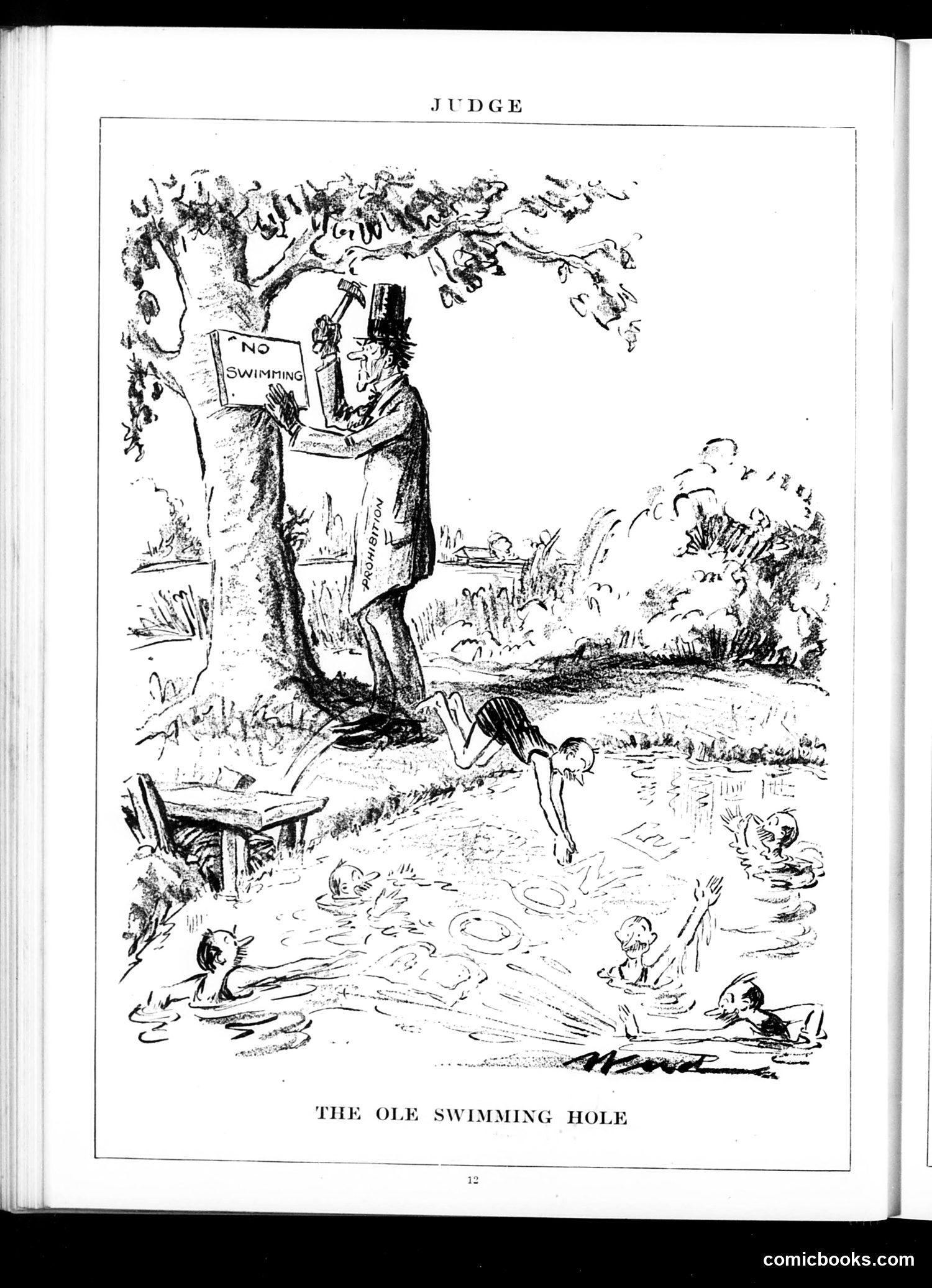
This cartoon satirizes enforcement of swimming regulations. A stern-faced judge in formal dress and top hat posts a "No Swimming" sign at a natural swimming hole, enforcing what appears to be a legal prohibition. Below, children continue swimming in the water, seemingly ignoring the restriction. The satire likely critiques overly rigid legal authority imposing unnecessary rules on innocent recreation—a judge's formal power applied absurdly to a simple, traditional pastime. The contrast between the austere authority figure and the carefree children suggests the cartoon mocks either excessive legalism or the impracticality of enforcing such rules against natural human behavior, particularly children's activities. The title's nostalgic tone ("Ole") reinforces this tension between tradition and bureaucratic control.
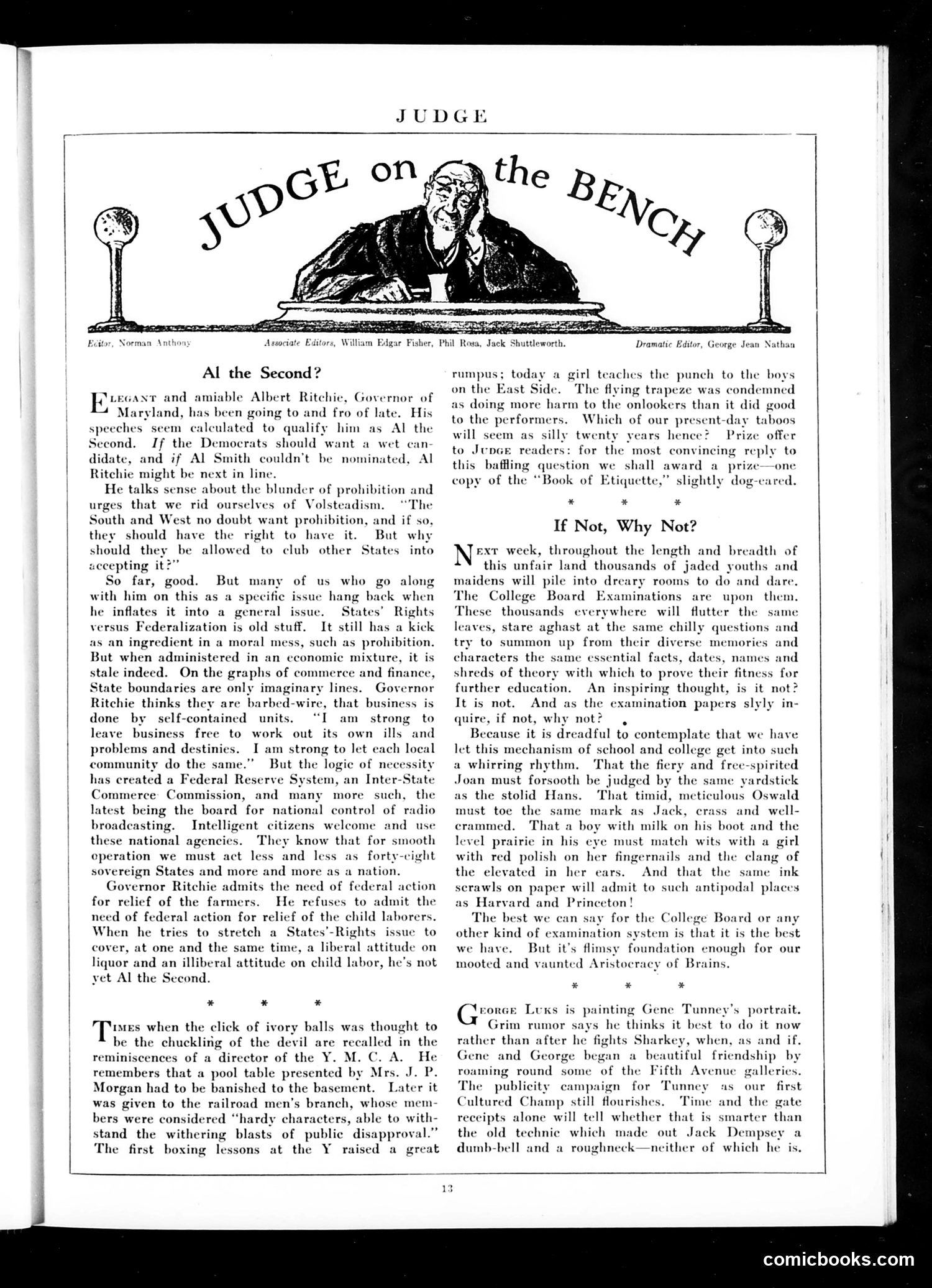
This page contains three distinct satirical pieces from *Judge* magazine (a major American humor publication): **"Al the Second?"** critiques Maryland Governor Albert Ritchie, who positioned himself as a potential Democratic presidential candidate emphasizing states' rights and opposing prohibition (Volsteadism). The satire acknowledges his sound position on liquor but exposes the contradiction: he champions "states' rights" to justify local control over alcohol while refusing to apply the same principle to federal child labor protections. The piece argues his states' rights philosophy is outdated in an interconnected modern economy requiring federal agencies like the Federal Reserve and Interstate Commerce Commission. **Unnamed second piece** humorously catalogs how the YMCA's moral standards have evolved—from condemning pool tables and trapeze work as corrupting to now teaching boxing to boys, illustrating changing social attitudes. **"If Not, Why Not?"** satirizes college entrance exams, mocking their uniformity and the pressure on diverse students to regurgitate identical facts and memorized theory to prove educational fitness—suggesting the system is fundamentally flawed.
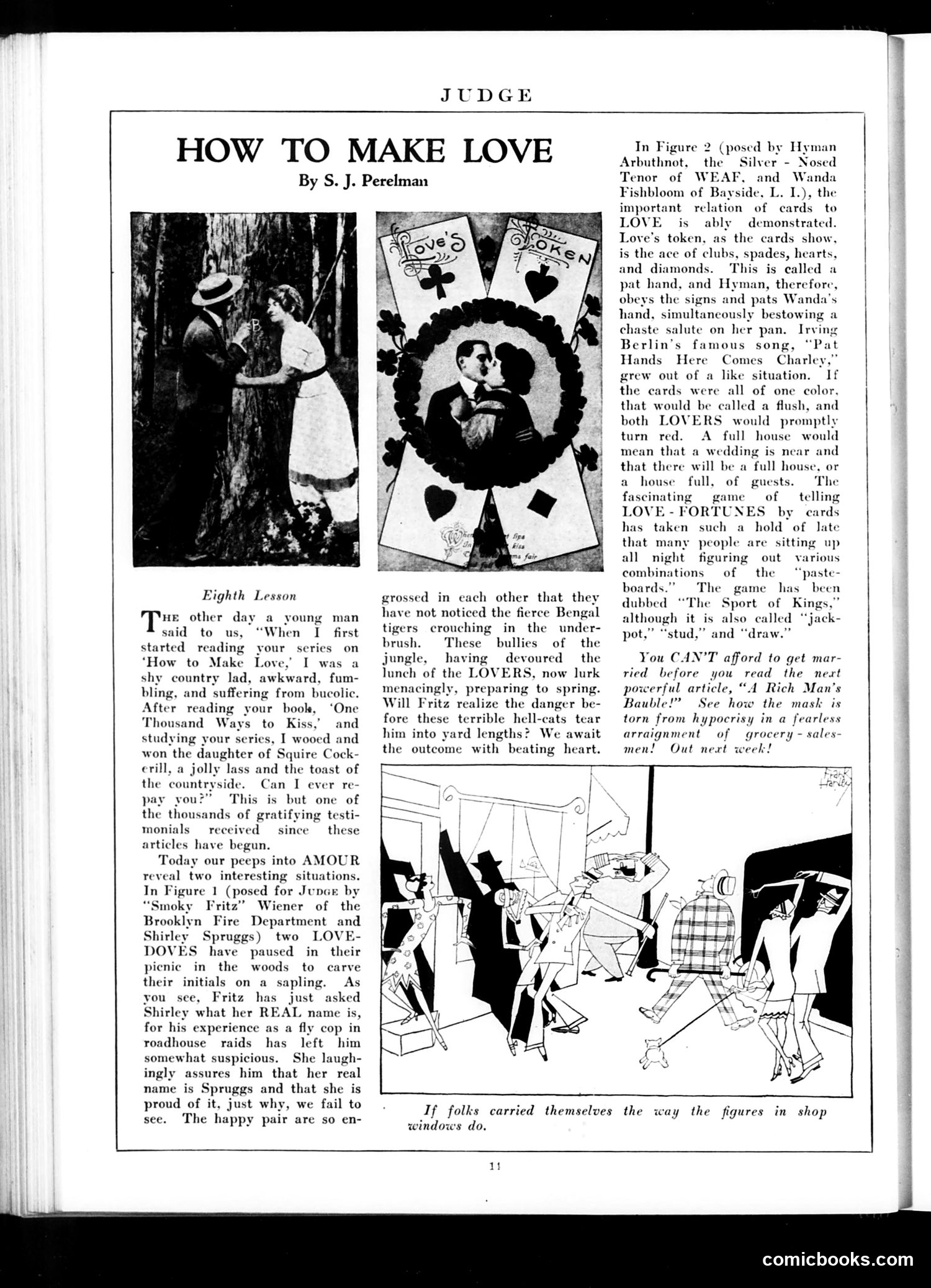
This is the eighth installment of a humorous advice column spoofing romantic self-help literature. Perelman presents two absurd scenarios: **Figure 1** shows a couple (posed by a fireman and woman named Shirley Spruggs) carving initials on a tree while unaware that Bengal tigers—having eaten their lunch—are about to attack them. The joke plays on oblivious romance and the contrast between sentimental love-making and mortal danger. **Figure 2** demonstrates "love fortunes" using playing cards. A couple interprets card combinations as romantic signs (a "pat hand" = patting her hand, a "flush" = blushing lovers, a "full house" = wedding imminent). This satirizes both fortune-telling and the magical thinking people apply to romance. The satire targets 1920s-30s popular culture's obsession with pseudo-scientific advice manuals and romantic superstitions. The exaggerated situations and deadpan explanations mock readers who take such guidance seriously.
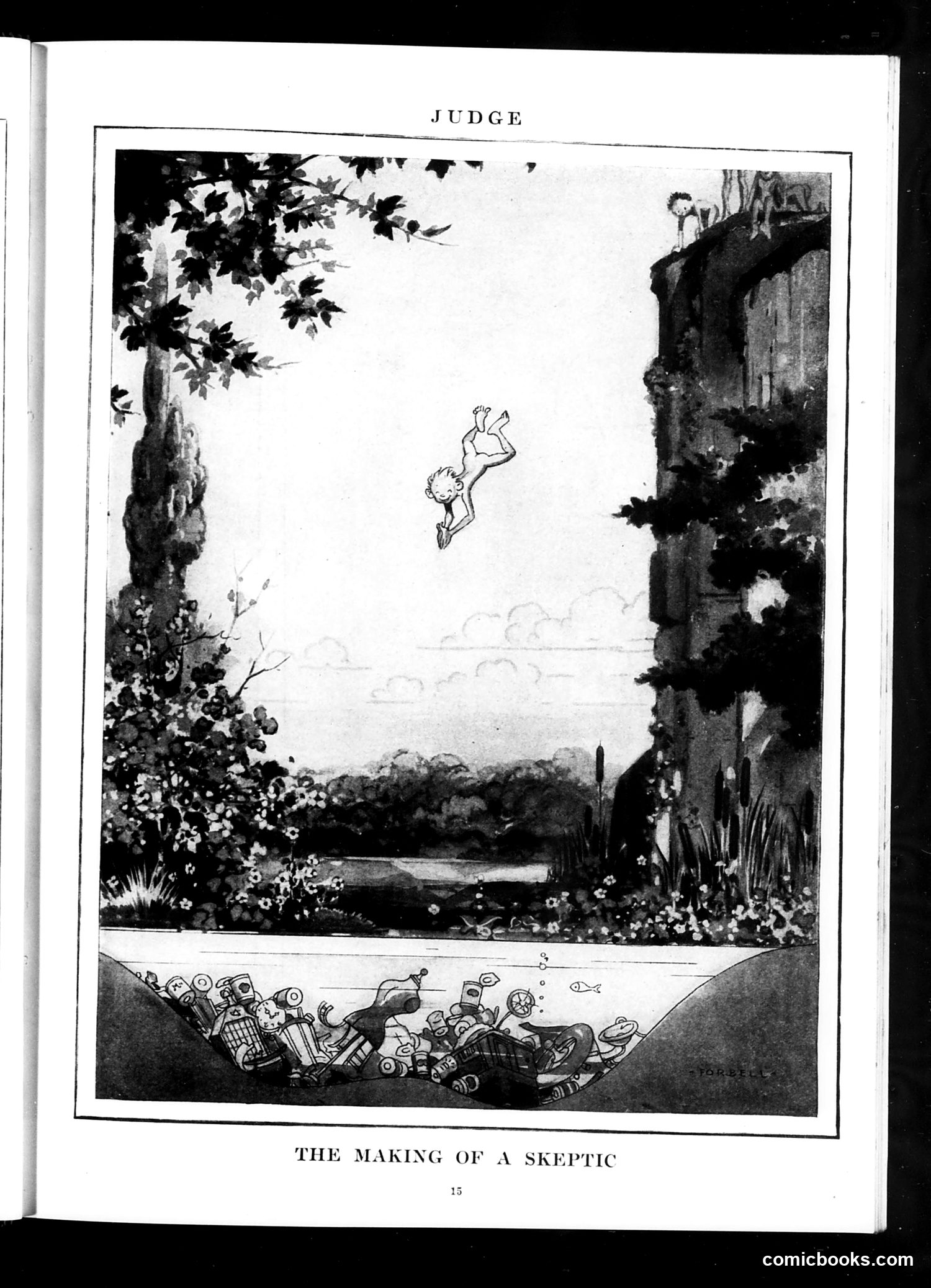
This Judge cartoon depicts a figure falling from the sky toward earth, while below, a crowd of mechanical or robot-like figures appear to be catching or reaching upward. The title suggests the cartoon satirizes how someone becomes skeptical—likely through harsh experience or disappointment. The juxtaposition suggests that idealistic belief (represented by the falling figure) encounters reality (the mechanical masses below), transforming faith into doubt. The mechanical nature of the lower figures may critique industrial society, bureaucracy, or mass conformity as the force that destroys human idealism and faith. Without additional context about Judge's publication date or specific contemporary events, the exact target remains unclear, though the cartoon appears to comment on how exposure to society's mechanical, dehumanizing forces corrodes optimism.
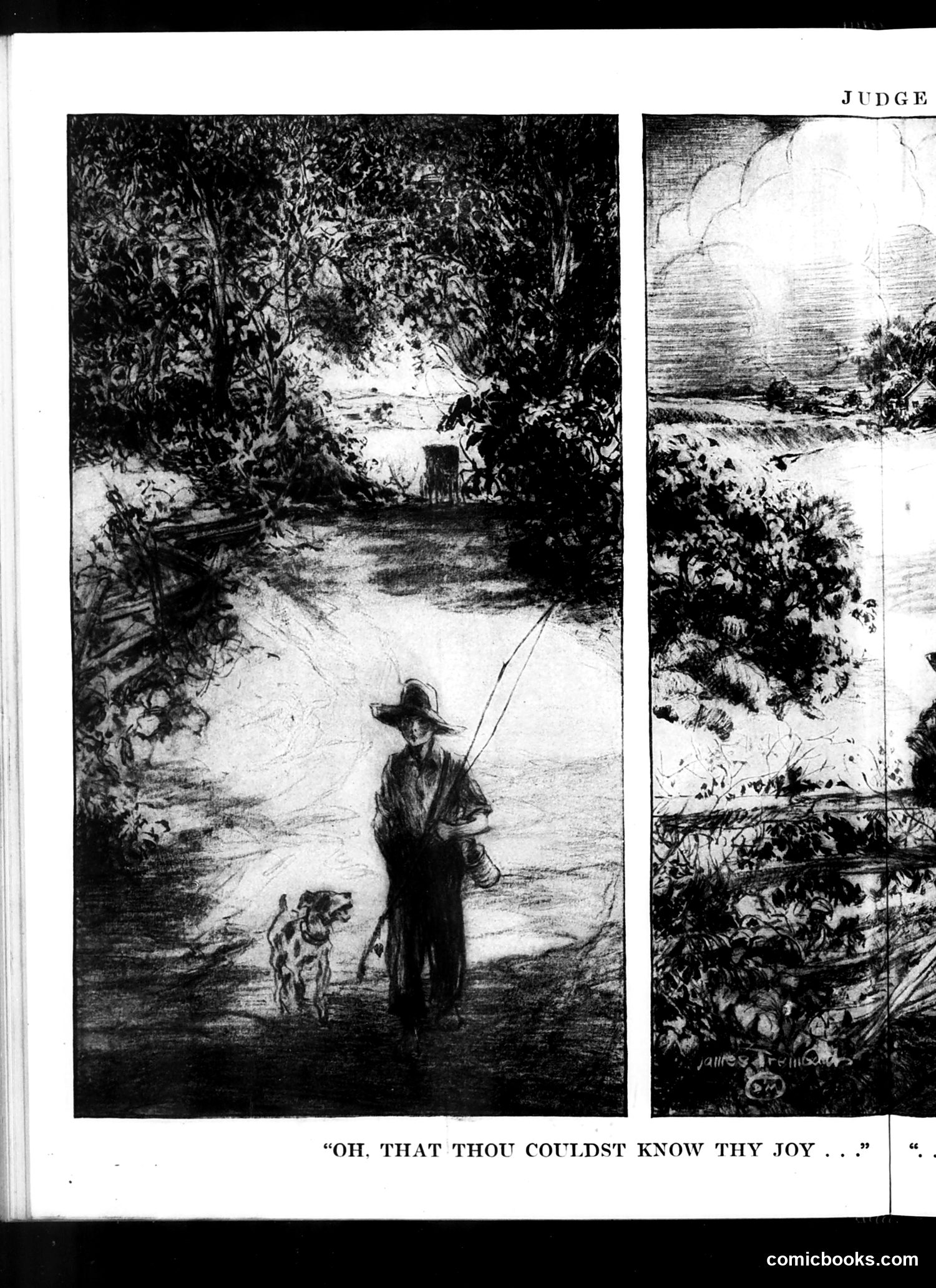
This appears to be a fishing scene cartoon from Judge magazine, likely from the early 20th century based on the artistic style. The left panel shows a man fishing contentedly by a stream with his dog, while the right panel depicts a broader landscape view. The caption "Oh, that thou couldst know thy joy..." suggests the cartoon's theme: celebrating simple pleasures and contentment with life's modest pursuits. The satire likely targets urban readers or the wealthy, contrasting the fisherman's genuine happiness through humble activity against the artificial pleasures or anxieties of modern society. The nostalgic, pastoral imagery emphasizes a romanticized rural simplicity, perhaps mocking city dwellers' disconnection from nature and authentic satisfaction. The dog's companionship reinforces themes of loyalty and uncomplicated contentment. The specific historical context or political reference remains unclear without additional publication information.
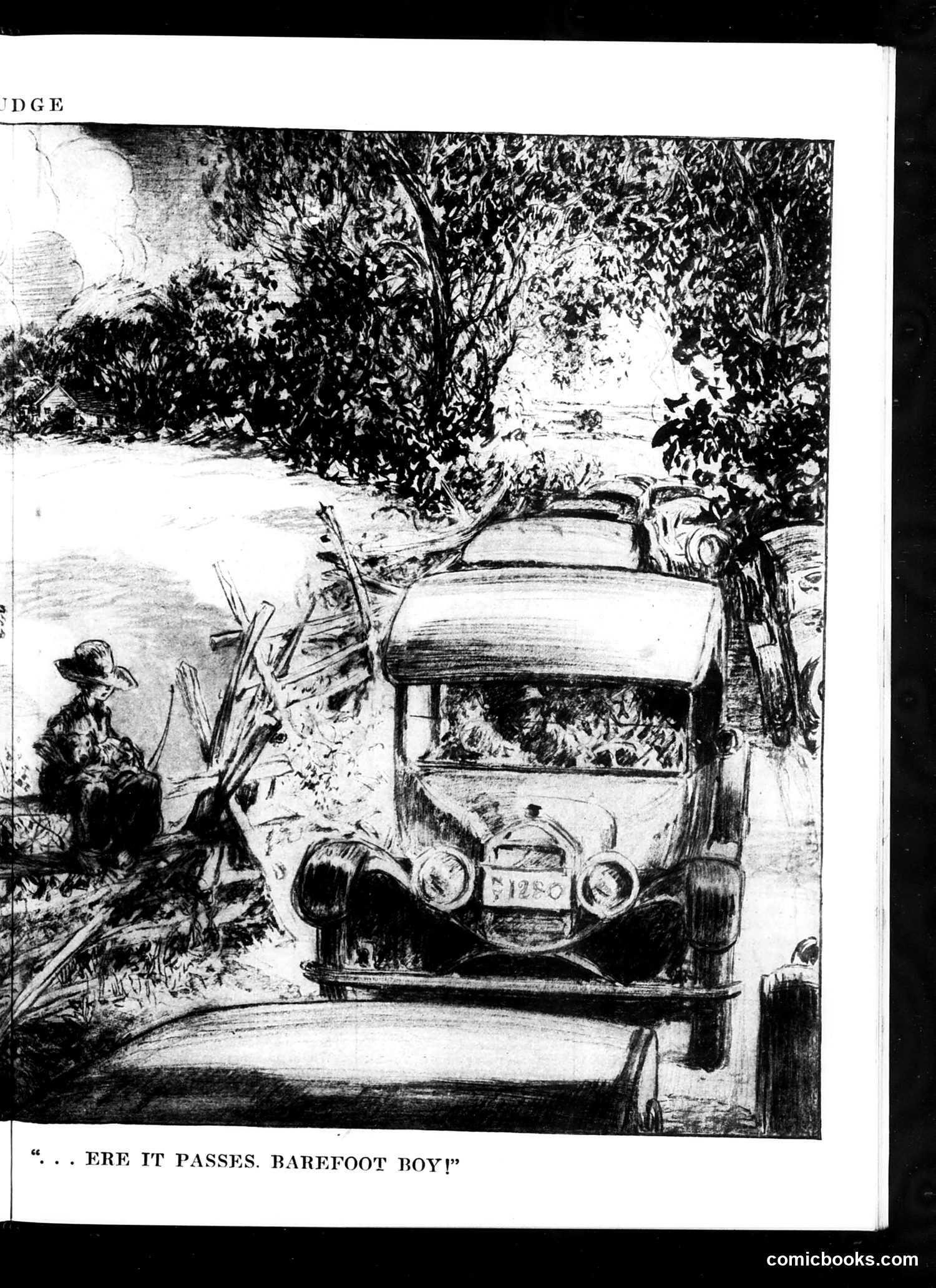
This appears to be a satirical illustration from *Judge* magazine depicting a scene with a vintage automobile and a barefoot boy on a rural road. The caption "...ERE IT PASSES. BAREFOOT BOY!" suggests social commentary about modernization and childhood. The image likely satirizes the tension between industrial progress (represented by the automobile) and traditional rural/pastoral American life (the barefoot child). The caption's phrasing—using archaic "ere" language—implies a nostalgic or ironic tone, possibly lamenting how the automobile era threatens simpler, pre-industrial childhood experiences. Without additional context about the publication date or surrounding articles, the specific political target remains unclear, but the core message appears to critique how technological advancement disrupts traditional American rural life and innocence.
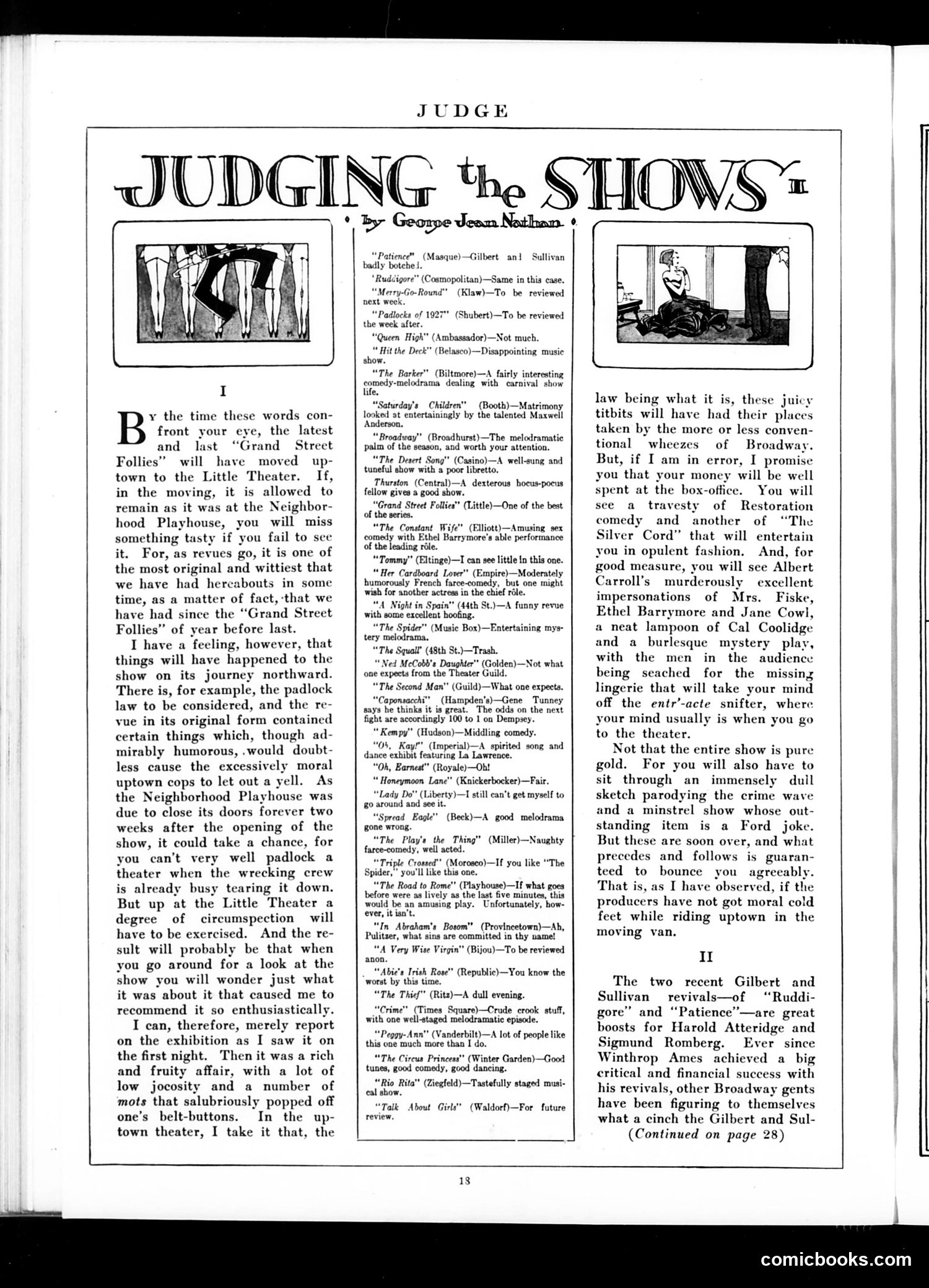
This page is a theater critic's column reviewing Broadway shows, not political satire. Judge magazine published entertainment criticism alongside comedy and satire. Nathan (a prominent theater critic of the 1920s) reviews approximately 30 current productions, listing venue names and brief judgments. The tone is witty and dismissive—he calls several shows "trash" or "disappointing," praises the "Grand Street Follies" revival, and includes a jab at boxer Gene Tunney, joking that Tunney's enthusiasm for "Caponsacchi" makes betting odds favor Dempsey in their next fight. The column's main point: Nathan warns that when the Follies moves uptown, censorship ("padlock law") will remove its edgier humor, disappointing readers. The two small photographs appear to be theatrical production stills, though details are unclear in this reproduction. This represents Judge's role as entertainment guide for sophisticated urban audiences.
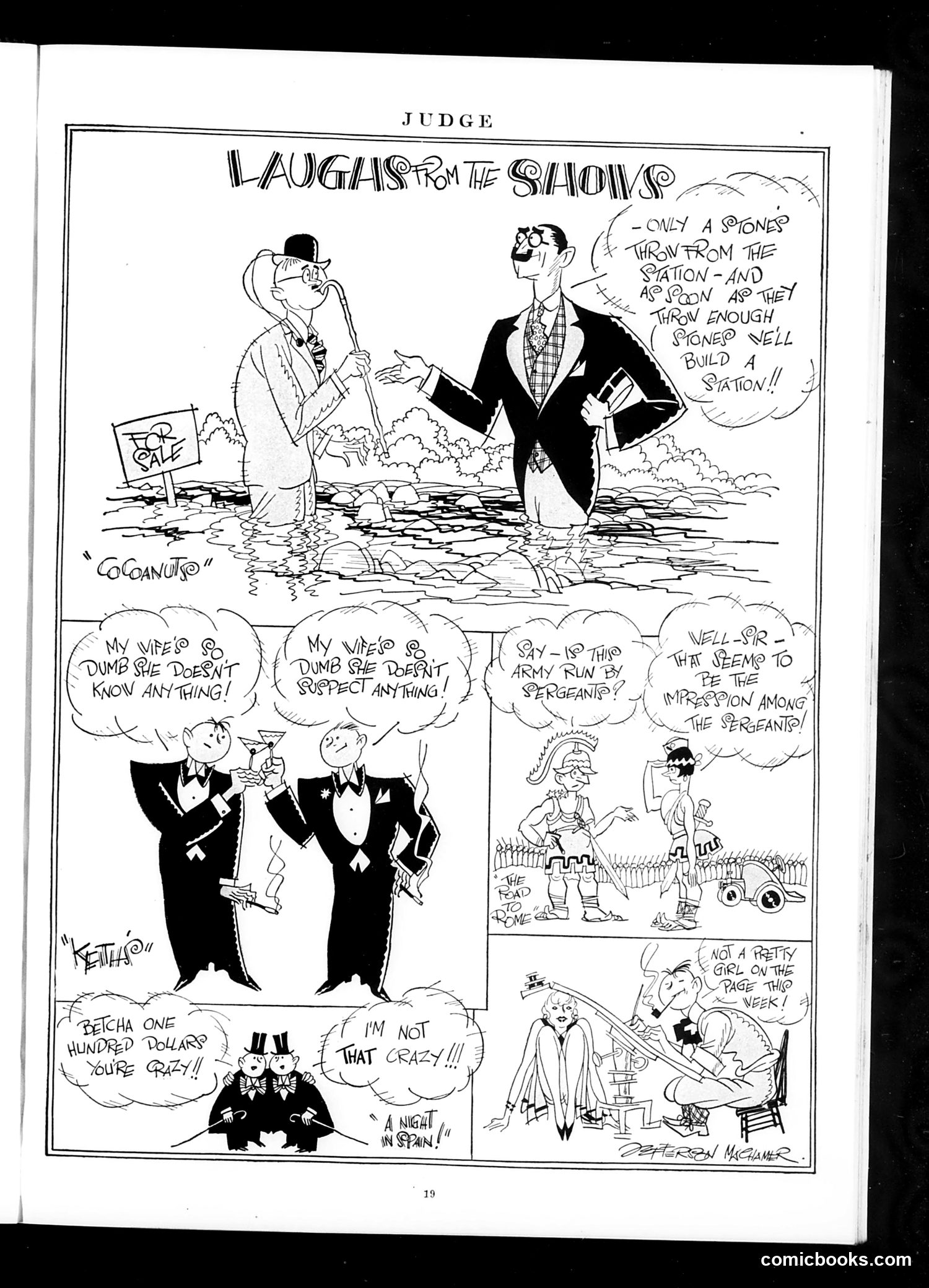
This multi-panel satire mocks wealthy businessmen and their wives during what appears to be the early 20th century. The top panel shows a real estate developer pitching colonization schemes to investors, claiming profits from stone-throwing settlers. The lower panels ridicule rich men's attitudes toward their wives—depicted as intellectually vapid ("dumb," lacking respect for "anything"). The joke hinges on marital contempt: these men discuss spending extravagantly on their spouses while openly disdaining them. The final panels show contrasting domestic scenes: wealthy men boasting about financial expenditure, and a working-class family scene depicting genuine activity and purpose (with an "army" reference, possibly satirizing militarism or preparedness). The satire critiques both upper-class materialism and the disconnect between financial display and actual relationship quality—suggesting that money cannot compensate for contempt.
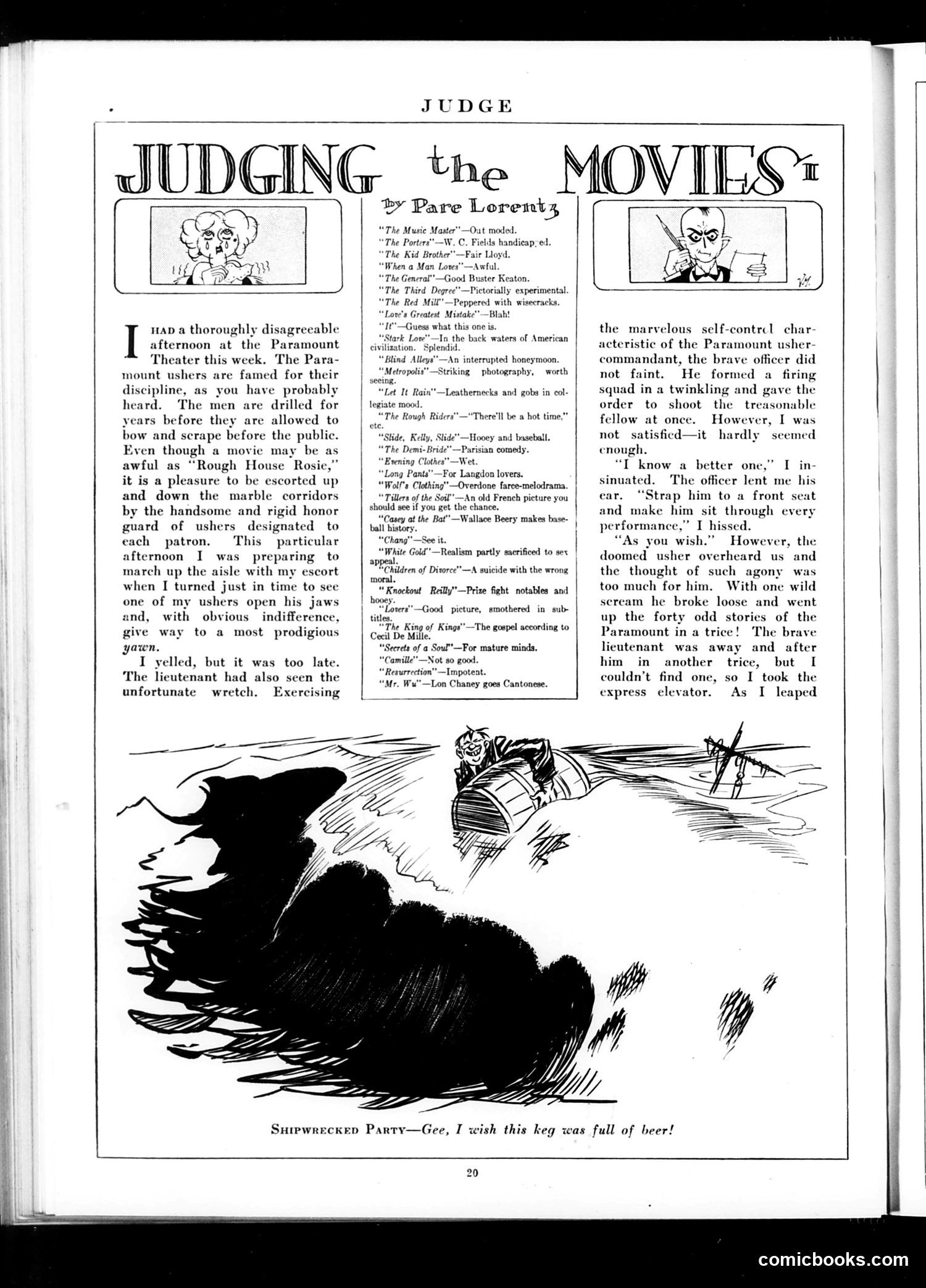
This is a film review column with accompanying cartoon satire. The main illustration depicts a shipwrecked sailor clinging to debris, captioned "Gee, I wish this keg was full of beer!"—a dark joke about surviving disaster. The column humorously reviews 1920s silent films, with author Lorentz's quirky, dismissive takes (calling films "maudlin," "blah," "not so good"). The accompanying narrative mocks the rigid discipline of Paramount Theater ushers. When an usher yawns during a screening, the usher-commandant forms a "firing squad" to discipline him. Lorentz jokingly suggests forcing the offender to watch every performance as punishment—so severe the usher jumps from the building in despair. The satire targets both mediocre Hollywood output and the absurd military-style hierarchy theaters maintained for their staff. It's period-specific humor about silent-era cinema and early 20th-century theater culture.
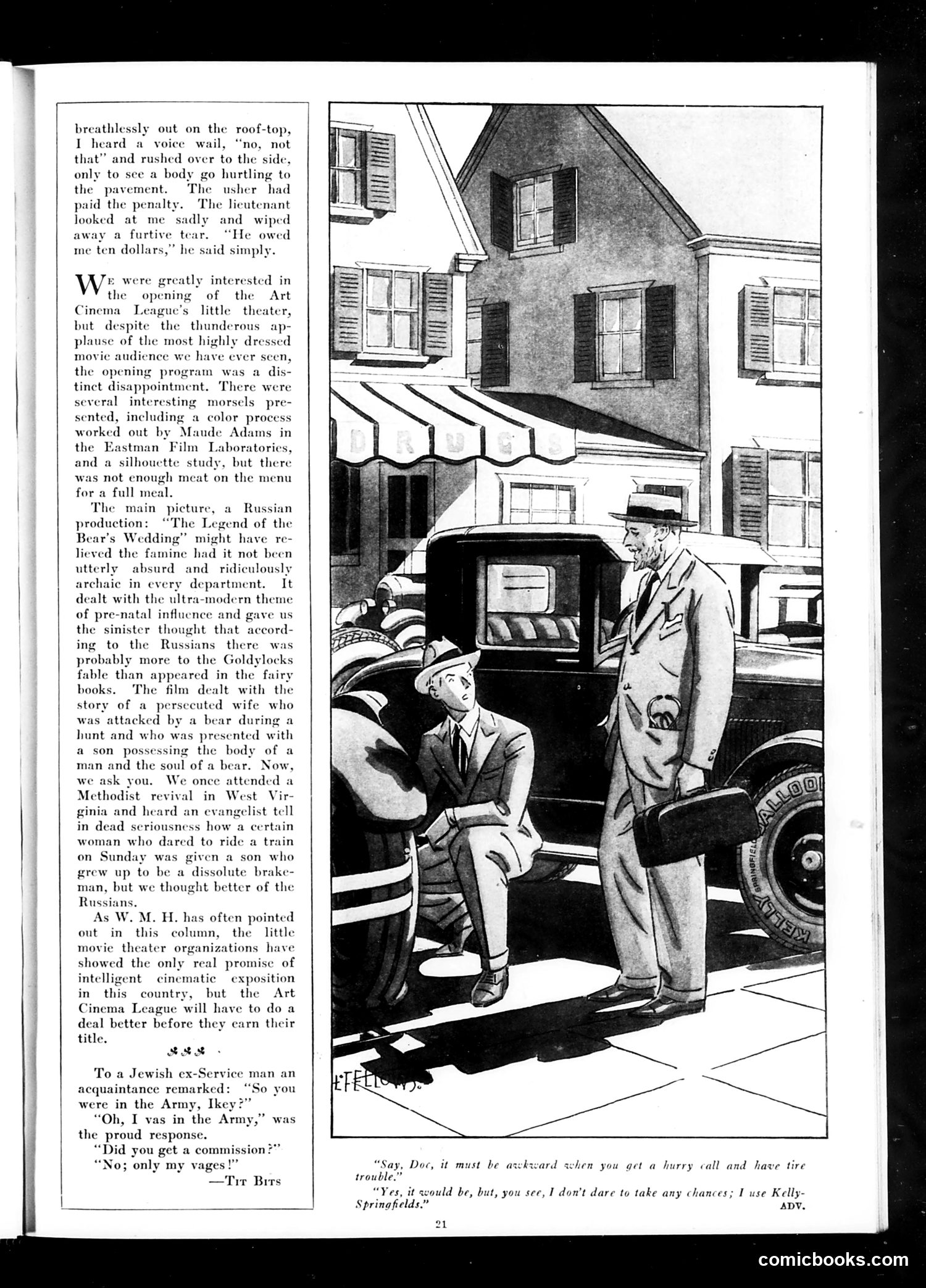
This page contains a film review and humor pieces typical of Judge's satirical approach. **Main Content:** The text critiques the Art Cinema League's opening theater program, particularly panning a Russian film called "The Legend of the Bear's Wedding." The reviewer dismisses it as absurd and archaic despite its "ultra-modern theme of pre-natal influence"—the plot involves a woman attacked by a bear who bears a son with a man's body but bear's soul. The satire mocks both the pretentiousness of experimental cinema and Russian storytelling conventions. **The accompanying illustration** shows two men examining a vehicle with a flat tire outside a storefront, likely advertising Kelly-Springfields tires (visible in the ad copy). **Ethnic humor:** The page includes a dated joke using "Ikey" and Yiddish dialect ("I vas") when discussing a Jewish ex-serviceman's military service and wages—typical of period humor that modern readers would recognize as stereotypical. The overall effect satirizes both highbrow film programming and contemporary advertising.
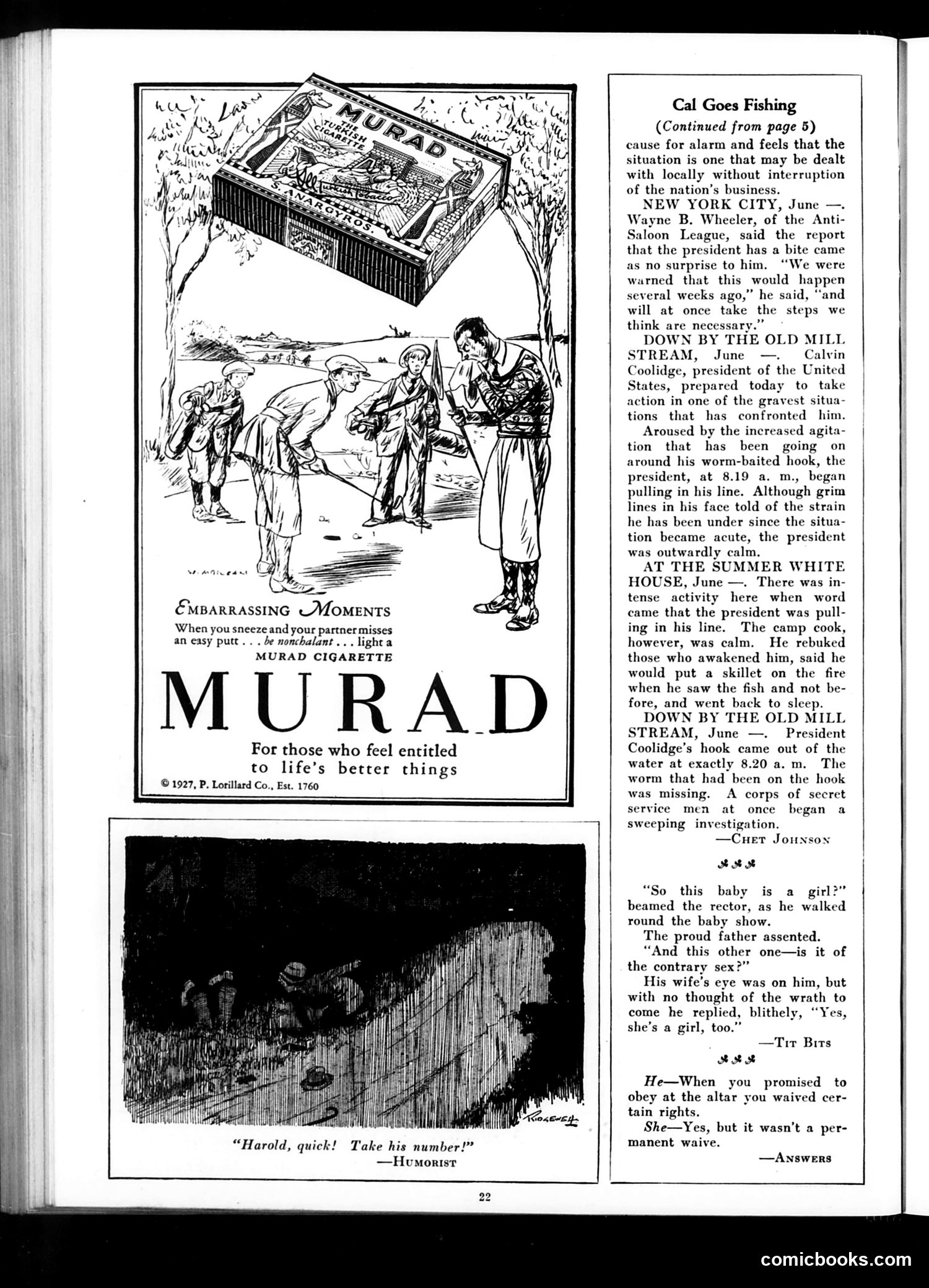
This Judge magazine page (1927) contains three distinct satirical pieces: **The Murad Cigarette Ad** mockingly depicts golfers—one has sneezed, causing his partner to miss an easy putt. The "solution" is lighting a cigarette to appear nonchalant. It's social satire about maintaining composure in embarrassing moments. **"Cal Goes Fishing"** is the main political satire. "Cal" refers to President Calvin Coolidge. The piece humorously treats his fishing trip as a national crisis, with the Anti-Saloon League treating a fish bite on his hook as a serious incident requiring presidential intervention. The exaggerated, mock-urgent tone satirizes both Coolidge's perceived passivity as president and the temperance movement's overwrought concerns (the "worm-baited hook" fishing story becomes a metaphor for Prohibition-era anxieties). **The remaining items** are brief humor pieces about embarrassing social situations—a rector's gaffe at a baby show and a married couple's sparring over marital obedience—typical filler content in satirical magazines of this era.
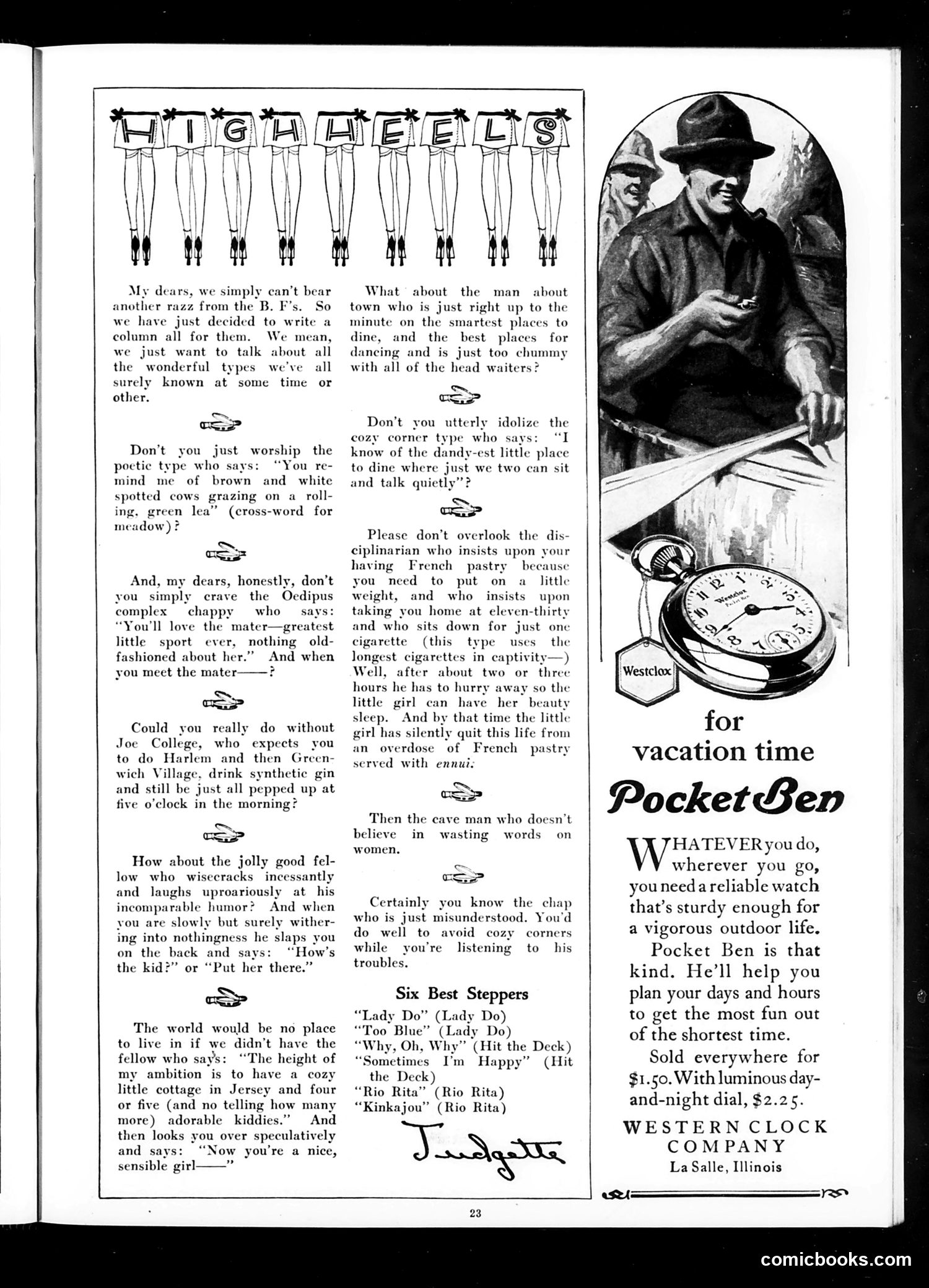
This page features a satirical advice column mocking archetypal male suitors of the Jazz Age. The author criticizes various "types" women encounter: the pretentious poetic man, the mama's-boy obsessed with his mother, the "Joe College" who takes dates to Harlem speakeasies, the bore with unfunny jokes, the domestic dreamer planning Jersey cottages, the status-conscious socialite, and the disciplinarian who manipulates weight and bedtime. The column's humor relies on exaggerated character sketches of common male personality flaws—emotional immaturity, superficiality, and manipulation. References to "synthetic gin" and speakeasies reflect Prohibition-era context. The accompanying advertisement for Pocket Ben watches (targeting vacation planners) and the illustration of two men are unrelated to the column's content.
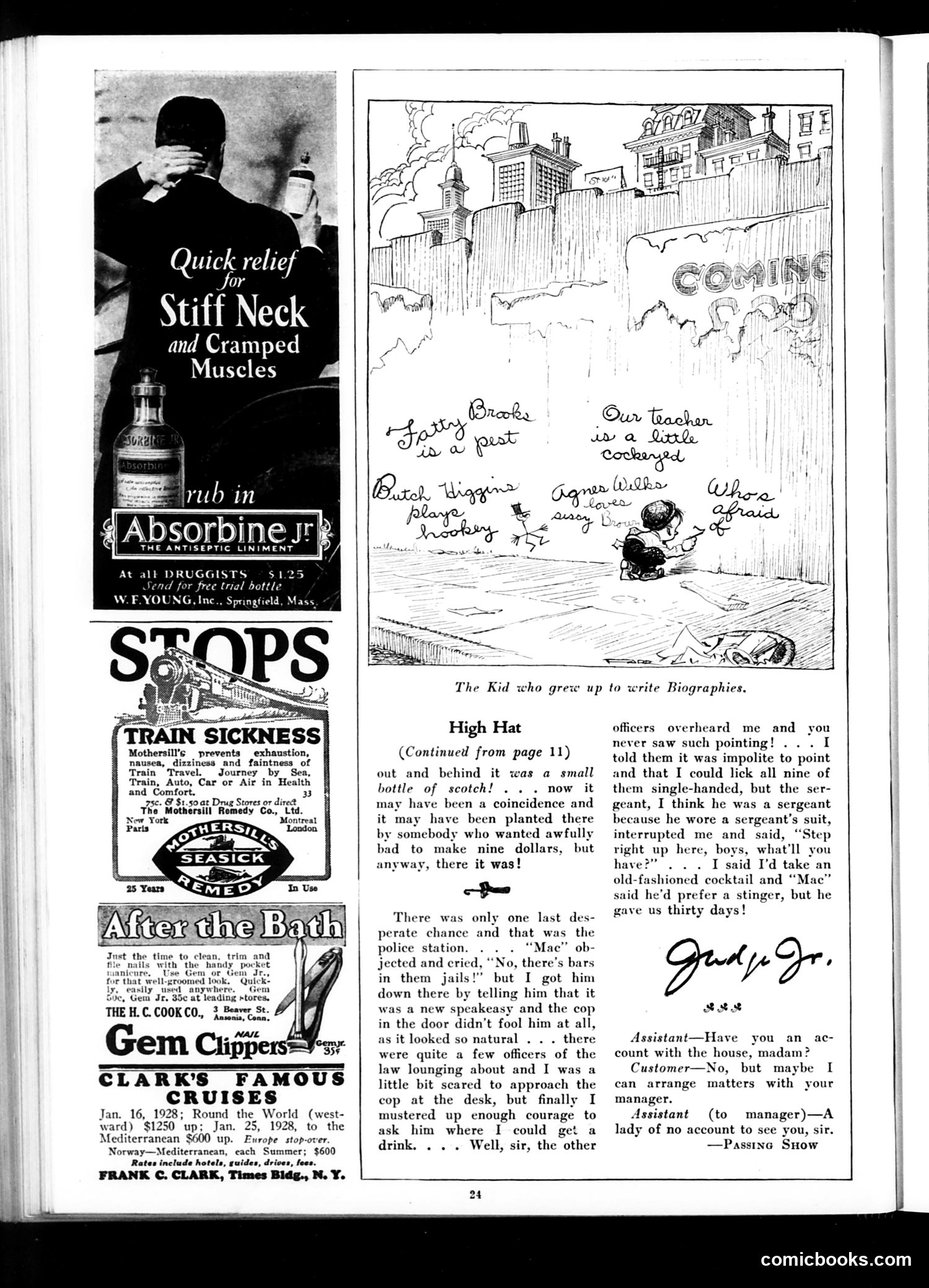
This page combines vintage advertisements with a short satirical story titled "High Hat" (continued from prior page). The main cartoon depicts a child cowering against a wall labeled "Coming" with handwritten captions identifying figures like "Fatty Brooks," "Butch Higgins," and "Our teacher is a sad cockeyed." The caption reads "The Kid who grew up to write Biographies." The accompanying text is a humorous anecdote about Prohibition-era speakeasy searching. The narrator describes attempting to locate an illegal bar, only to accidentally enter an actual police station disguised as one—complete with officers present. After requesting a drink, he and his companions receive thirty-day jail sentences. The satire mocks both the absurdity of Prohibition enforcement and the narrator's naïveté. The cartoon likely jokes about how childhood bullies or unremarkable figures sometimes become famous authors. The page primarily features period advertisements for remedies, cruise lines, and grooming products typical of 1928 publications.
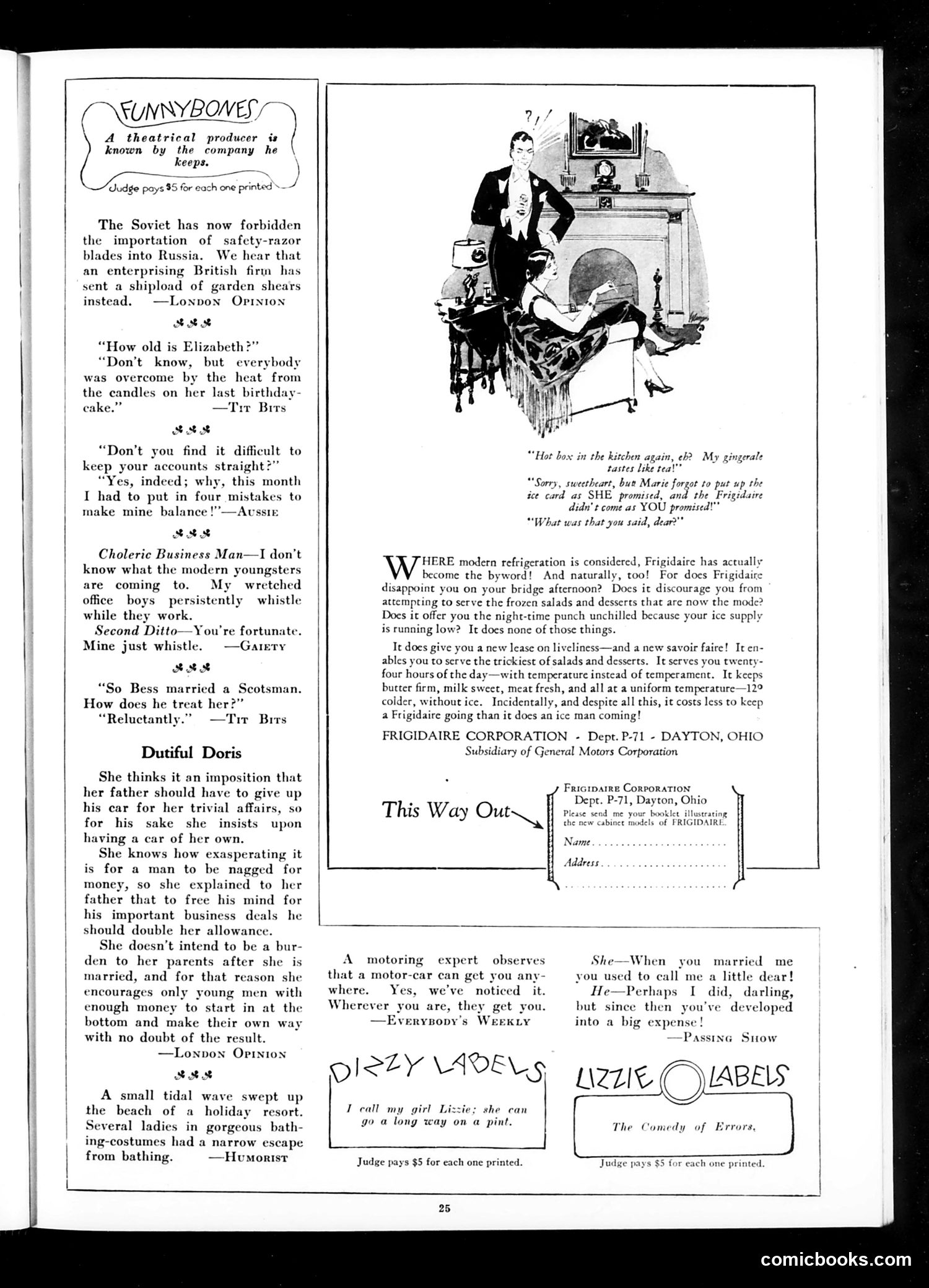
This page from *Judge* (a satirical American magazine) contains several brief humorous items typical of early-to-mid 20th century humor: **Main Content:** The dominant feature is a Frigidaire refrigerator advertisement disguised as editorial content, promoting the modern convenience of electric refrigeration. The accompanying cartoon shows a domestic dispute where a husband blames his wife for a warm drink, revealing the advertisement's pitch: Frigidaire solves household temperature problems reliably. **Supporting Humor Sections:** - **"Funnybones"**: Brief one-liners on topical subjects, including a jab at Soviet Russia banning safety razors (replaced with garden shears—mocking Soviet scarcity) - **"Dutiful Doris"**: A satirical sketch about a daughter manipulating her father into buying her a car by arguing it relieves him from nagging - **"Dizzy Labels" and "Lizzie Labels"**: Lightweight comedic one-liners about dating and marriage The overall tone reflects 1920s-30s gender dynamics humor and early advertising integration into editorial spaces.
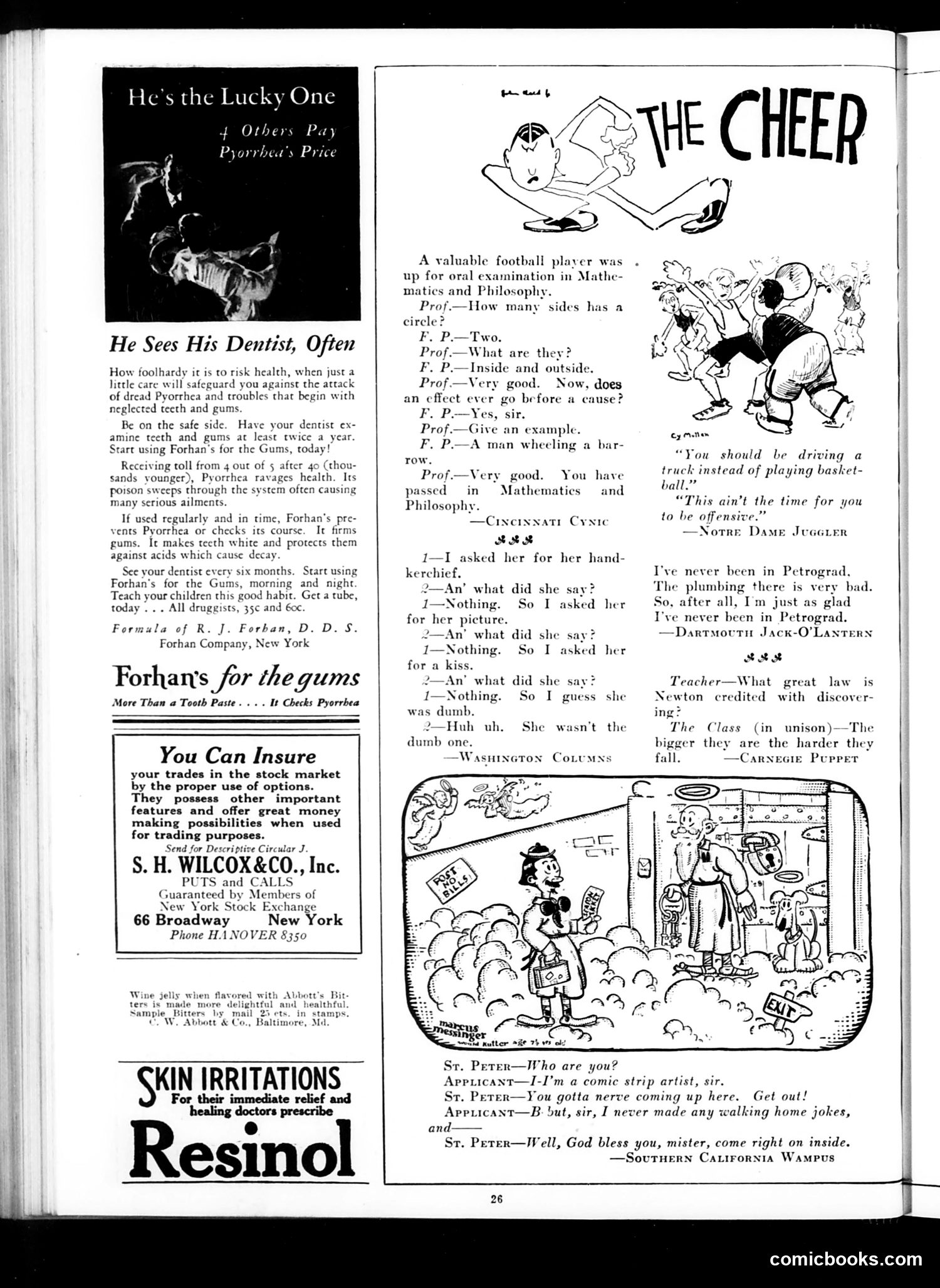
This page from *Judge* magazine contains several humor pieces typical of early 20th-century American satire: **Main cartoon ("The Cheer"):** Shows St. Peter at heaven's gates rejecting a "comic strip artist" applicant, then reversing course and welcoming him inside. The joke mocks comic strips as lowbrow entertainment unworthy of heaven, yet St. Peter ironically admits the artist anyway—suggesting even religious gatekeepers couldn't resist this popular medium's appeal. **Other jokes** include a football player answering absurdly in a philosophy exam (confusing cause/effect), and a story about a man repeatedly rejected by a woman. These are standard vaudeville-style humor. The page is dominated by **advertisements**—Forhan's toothpaste (warning of pyorrhea/gum disease), Resinol (skin treatment), and S.H. Wilcox & Co. (stock options brokerage)—reflecting how *Judge* subsidized its humor content through advertising revenue. The tone is lighthearted, non-political social comedy aimed at educated, middle-class readers.
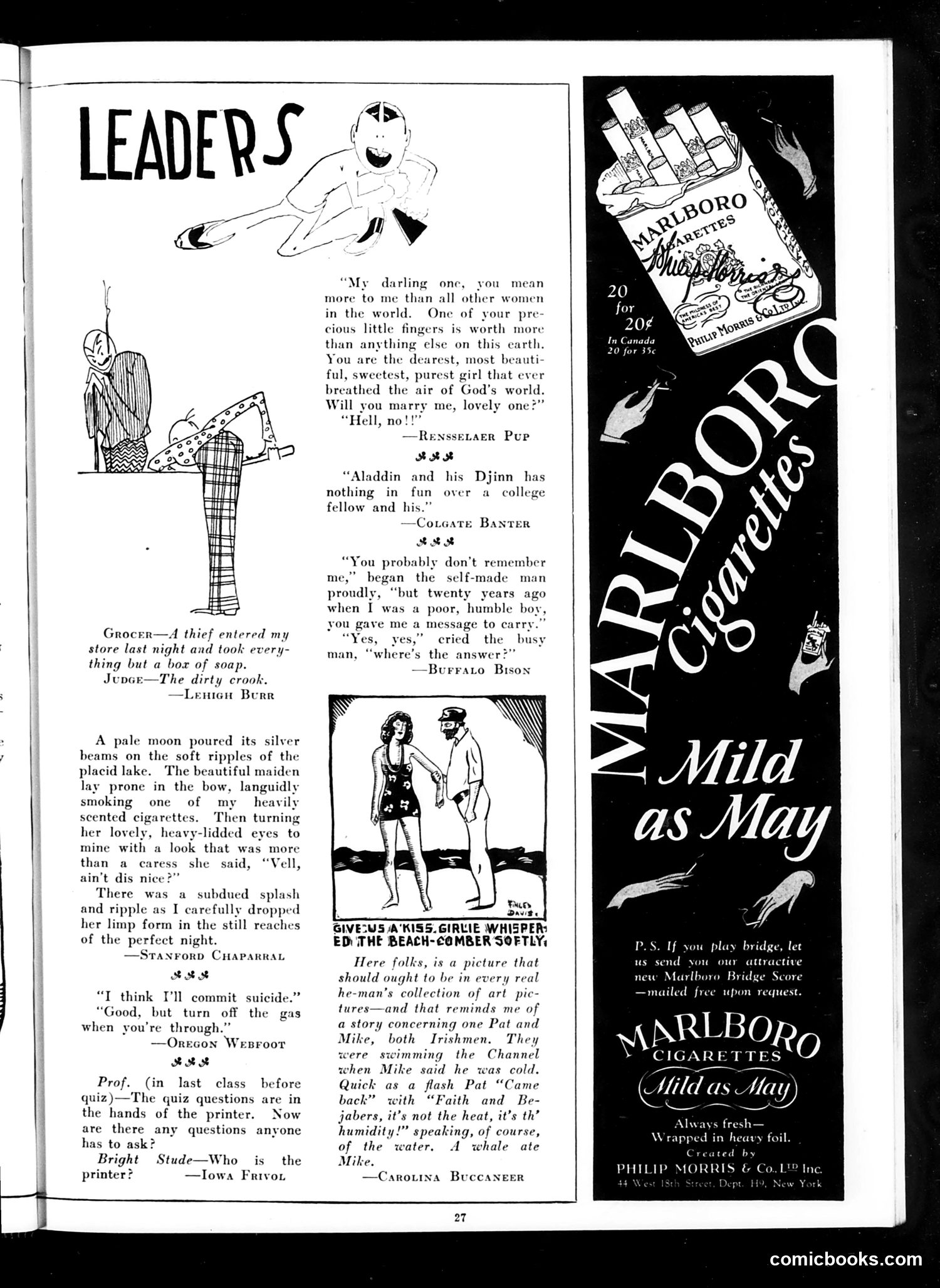
This page from *Judge* magazine contains mostly brief humorous anecdotes and jokes rather than political cartoons. The humor relies on early 20th-century sensibilities: **Key jokes:** - A grocer complains a thief stole everything *except* soap—implying thieves have no standards - A man proposes extravagantly to a woman who bluntly refuses - A self-made man's boasting is interrupted by someone asking for actual results - Dark comedy: a man casually suggests suicide; his friend tells him to turn off the gas (to avoid explosion/fire) - An Irishman joke about Pat and Mike swimming the Channel, ending absurdly when "a whale ate Mike" The right side is a cigarette advertisement for Marlboro ("Mild as May"), typical of era advertising in magazines. **Overall context:** These represent genteel, often cynical humor targeting romantic pretension, social climbing, and ethnic stereotypes common to 1920s-era satirical magazines. The jokes are quite dated and would likely fall flat today.
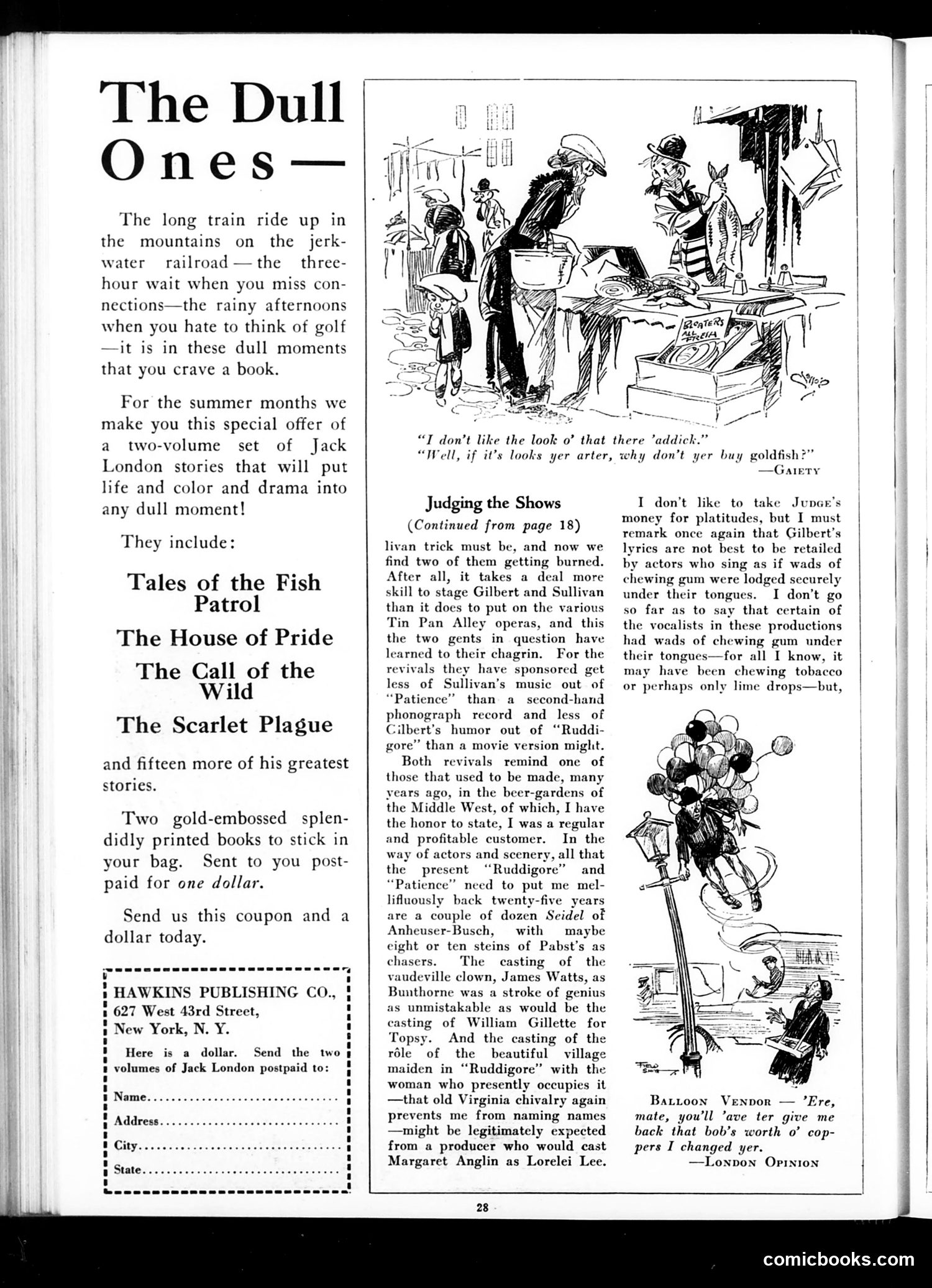
This page is primarily **advertising**, not satire. The left side promotes a Jack London two-volume book set for one dollar, marketed as entertainment for tedious travel situations (train delays, rainy days). The pitch emphasizes how stories provide "life and color and drama." The right side contains theatrical criticism titled "Judging the Shows," discussing recent Gilbert and Sullivan opera revivals ("Patience" and "Ruddigore"). The critic argues these productions poorly execute the composers' work—singers perform mechanically (as if with "chewing gum under their tongues"), and casting choices are questionable. He contrasts modern productions unfavorably with beer-garden versions from decades past. Two small captioned cartoons appear: one features dialogue about an "addict" (unclear context), and another depicts a London balloon vendor and customer haggling over change—typical working-class London humor of the period. The page reflects early 20th-century entertainment criticism and advertising conventions.
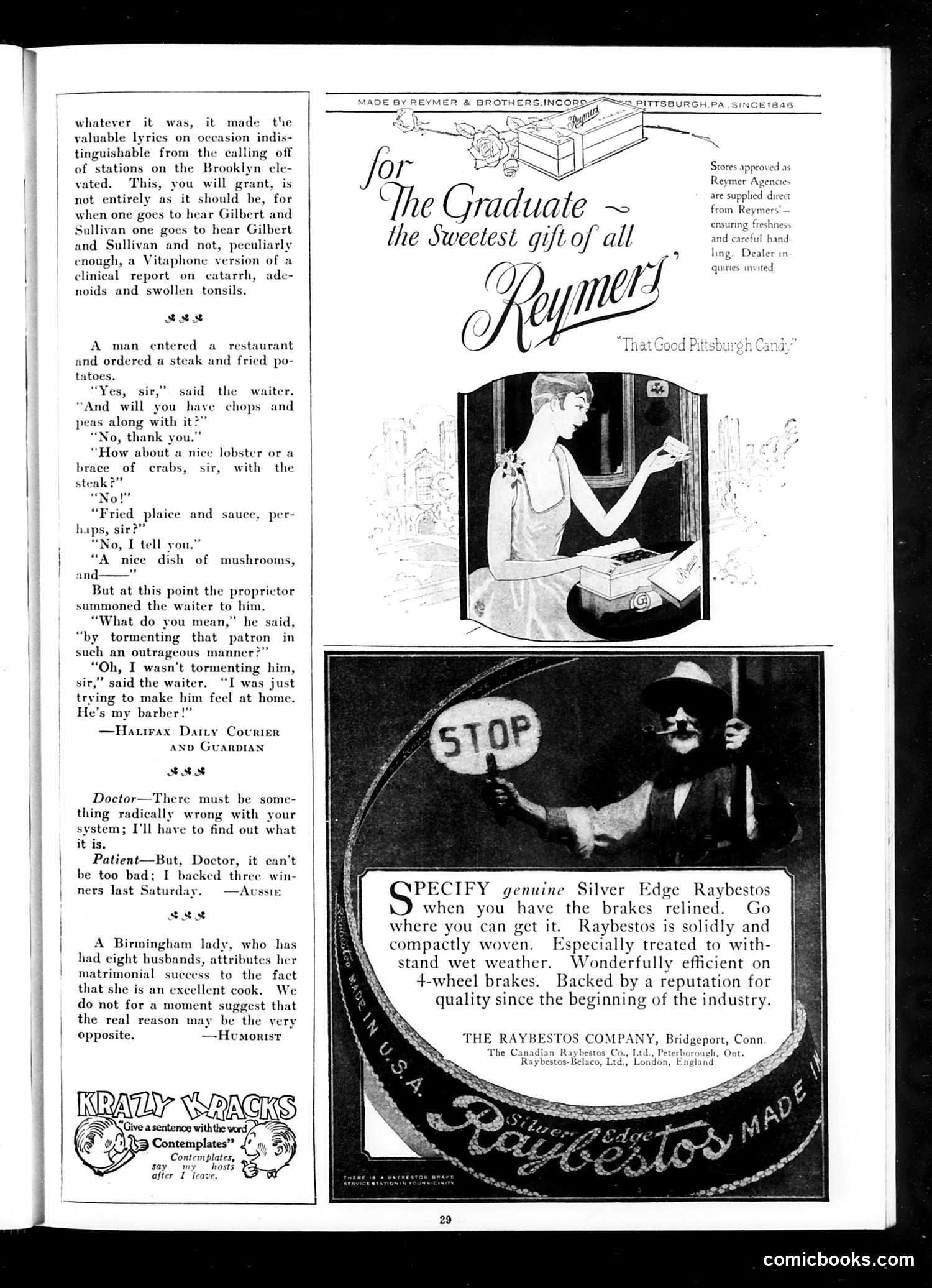
This Judge magazine page combines humor columns with period advertising. The main satirical content includes: **The Restaurant Joke**: A waiter torments a diner by repeatedly suggesting additions to his meal. The punchline reveals the waiter is the customer's barber—implying barbers were notoriously talkative and pushy, making this an expected character trait that explains his behavior. **The Doctor/Patient Exchange**: A patient is diagnosed with something seriously wrong, but responds that he's fine because he won gambling—satirizing people's illogical optimism and denial about health issues. **The Birmingham Lady Anecdote**: Dry humor suggesting a woman's eight marriages succeed not because she's an excellent cook (as she claims) but for the "very opposite"—implying her actual competence lies elsewhere, poking fun at traditional gender assumptions. **The Vitaphone Reference**: Opens with criticism of early sound film technology's poor audio quality, comparing garbled opera lyrics to incomprehensible station announcements. The advertisements are for Reymers candy and Raybestos brake linings—typical period products marketed to contemporary consumers.
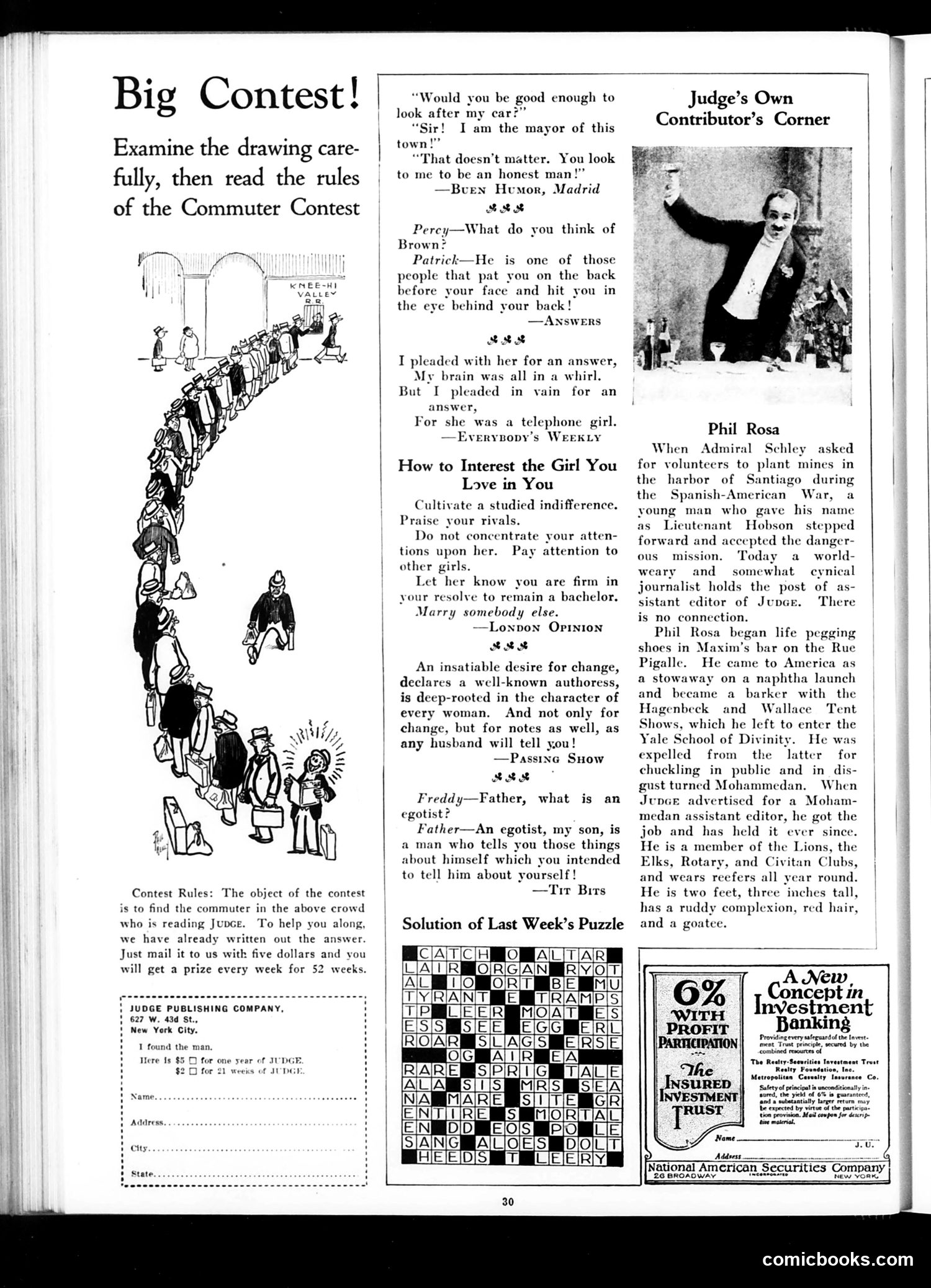
This page features Judge's self-promotional "Commuter Contest"—a humorous advertisement disguised as a puzzle. Readers must locate a figure reading *Judge* magazine within a crowded illustration of commuters, then mail in their answer with five dollars to win weekly prizes for a year. The contest satirizes both advertising gimmicks and magazine circulation tactics of the era. By framing the ad as a "game," Judge encourages reader participation and subscription while poking fun at the absurdity of the scheme itself (the "answer" is already provided, making the puzzle deliberately unsolvable as a genuine challenge). The page also includes humor columns, jokes about egotists and telephone operators, advice on romance, and a biographical sketch of contributor Phil Rosa with a deliberately absurd fictional biography mixing improbable careers. This reflects Judge's mix of satire, advertising, and light entertainment typical of early 20th-century American humor magazines.
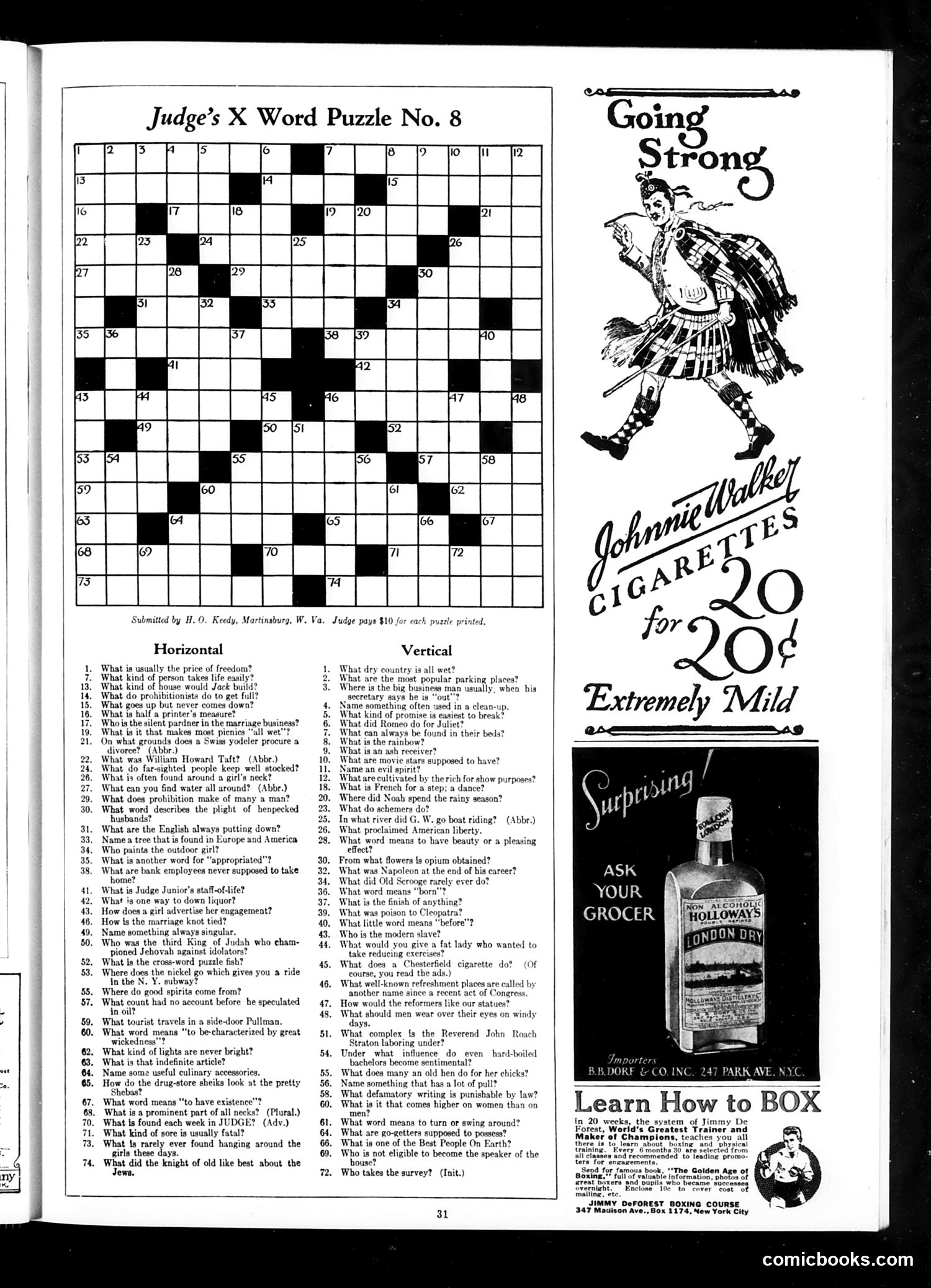
This page presents a standard crossword puzzle from Judge magazine, circa early 20th century. The puzzle itself contains no political satire—it's a straightforward word game with riddle-style clues typical of the era. The three advertisements on the right reveal the magazine's commercial context: 1. **Johnnie Walker Cigarettes** ("Going Strong")—promoting cigarettes with a Scottish figure, normalized advertising long before health warnings 2. **Holloway's Gin** (under grocer inquiry)—alcohol sales, notably during or near the Prohibition era 3. **Boxing instruction course**—teaching pugilism as a legitimate skill The puzzle's clues reflect period concerns: Prohibition ("What prohibitionists do to get full?"), marriage dynamics ("henpecked husbands"), and social class references. No specific political figures are caricatured here; this is primarily a leisure/advertising page rather than satirical commentary.
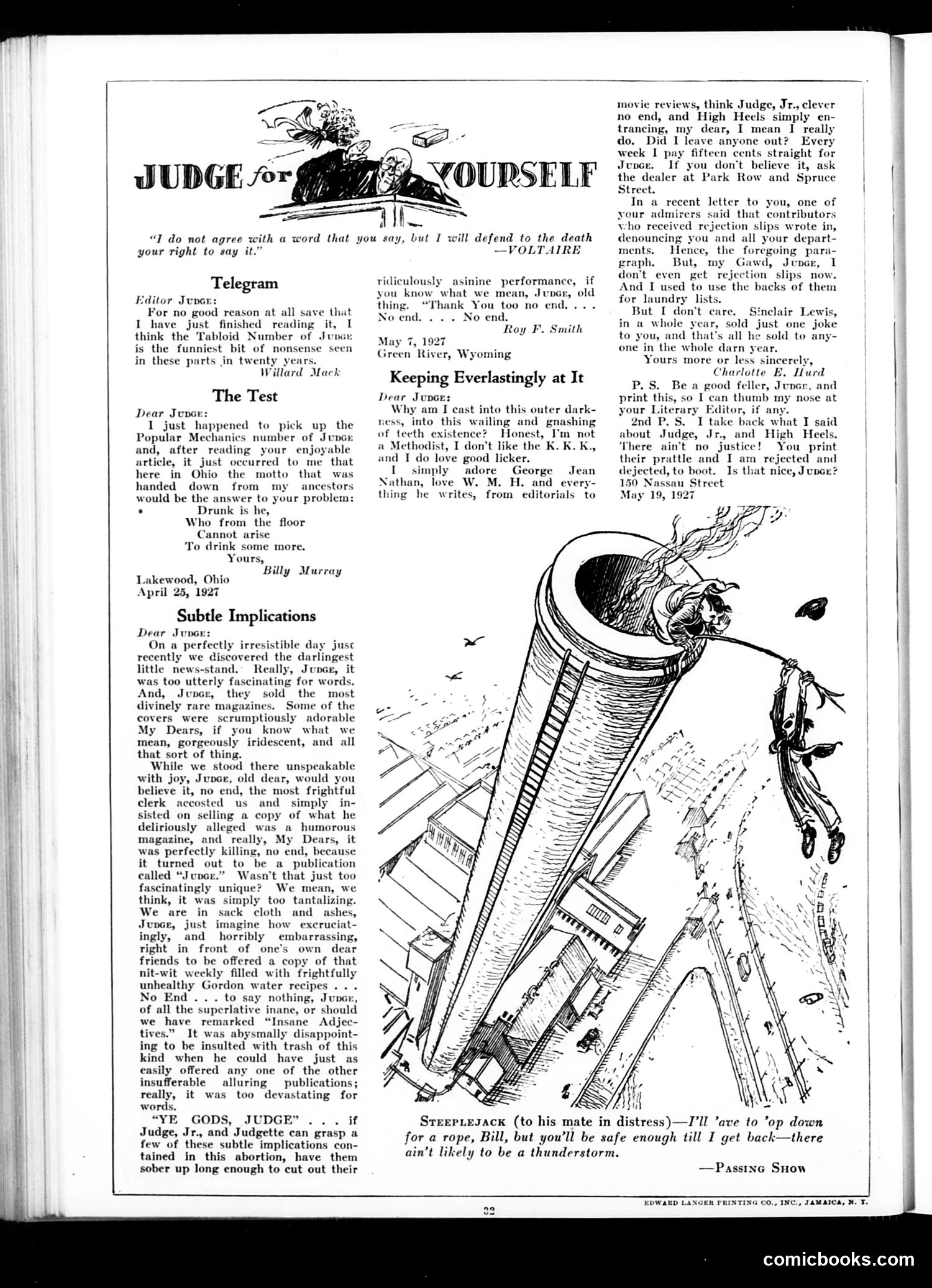
This page from Judge (May 1927) consists primarily of a **letters column** where readers respond to the magazine's content and editors. The main cartoon depicts a **steeplejack (window cleaner) perched precariously on a tall building**, about to descend with a rope. The caption quotes him reassuring his partner: he'll be safe despite the storm approaching. The letters satirize **affected literary pretension**. One correspondent mocks fashionable magazine readers who affect exaggerated sophistication ("scrumptiously adorable," "gorgeously iridescent") while condescendingly dismissing Judge magazine as trash compared to other publications. The writer exposes this snobbery by showing these affected readers will read anything, including Judge itself. Another letter jokes about rejection slips—implying Judge rarely accepts submissions—and boasts that even Sinclair Lewis could sell only one joke annually to Judge, suggesting the magazine's extremely high standards (or perhaps, ironically, its poor payment/acceptance rates). The overall tone mocks literary posturing and magazine culture of the era.
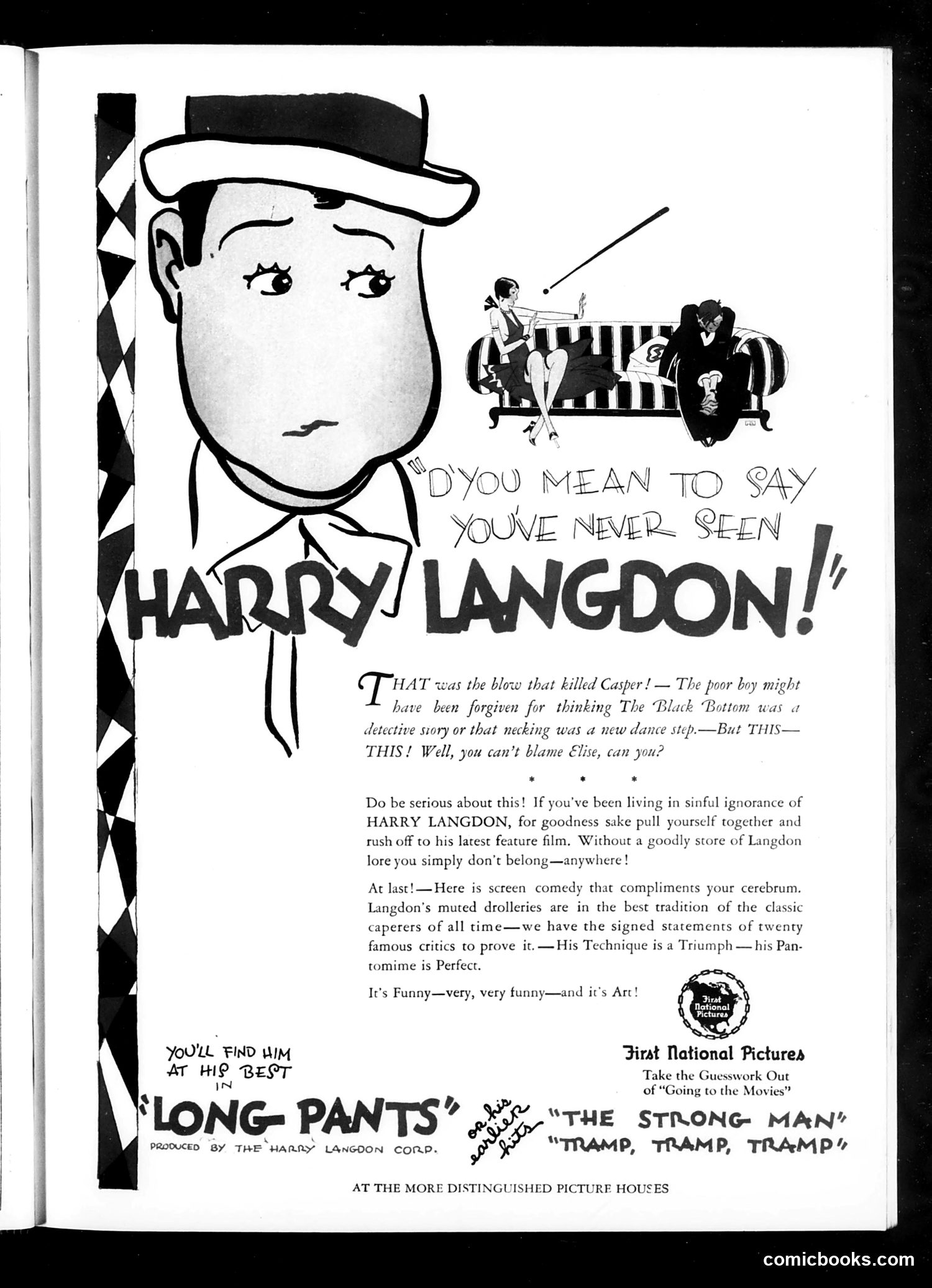
This is a **film advertisement** for silent comedian Harry Langdon, promoting his movies "Long Pants" and "The Strong Man" through First National Pictures. The cartoon at top depicts a shocked figure in a hat—likely representing an audience member or critic—learning he hasn't seen Langdon's films. The accompanying text humorously suggests this is a grave social failing: "you can't blame Elise, can you?" (referencing some scandal, unclear from context alone). The ad positions Langdon as serious cinema art, not mere entertainment. It sarcastically claims his "muted drolleries" follow "classic caperers of all time" and boasts endorsements from "twenty famous critics." The phrase "It's Funny—very, very funny—and it's Art!" captures 1920s debates about whether slapstick comedy could be legitimate art. This reflects the silent era when comedians like Chaplin and Keaton were gaining critical respectability. The ad targets educated audiences, positioning Langdon viewing as cultural sophistication rather than lowbrow entertainment.
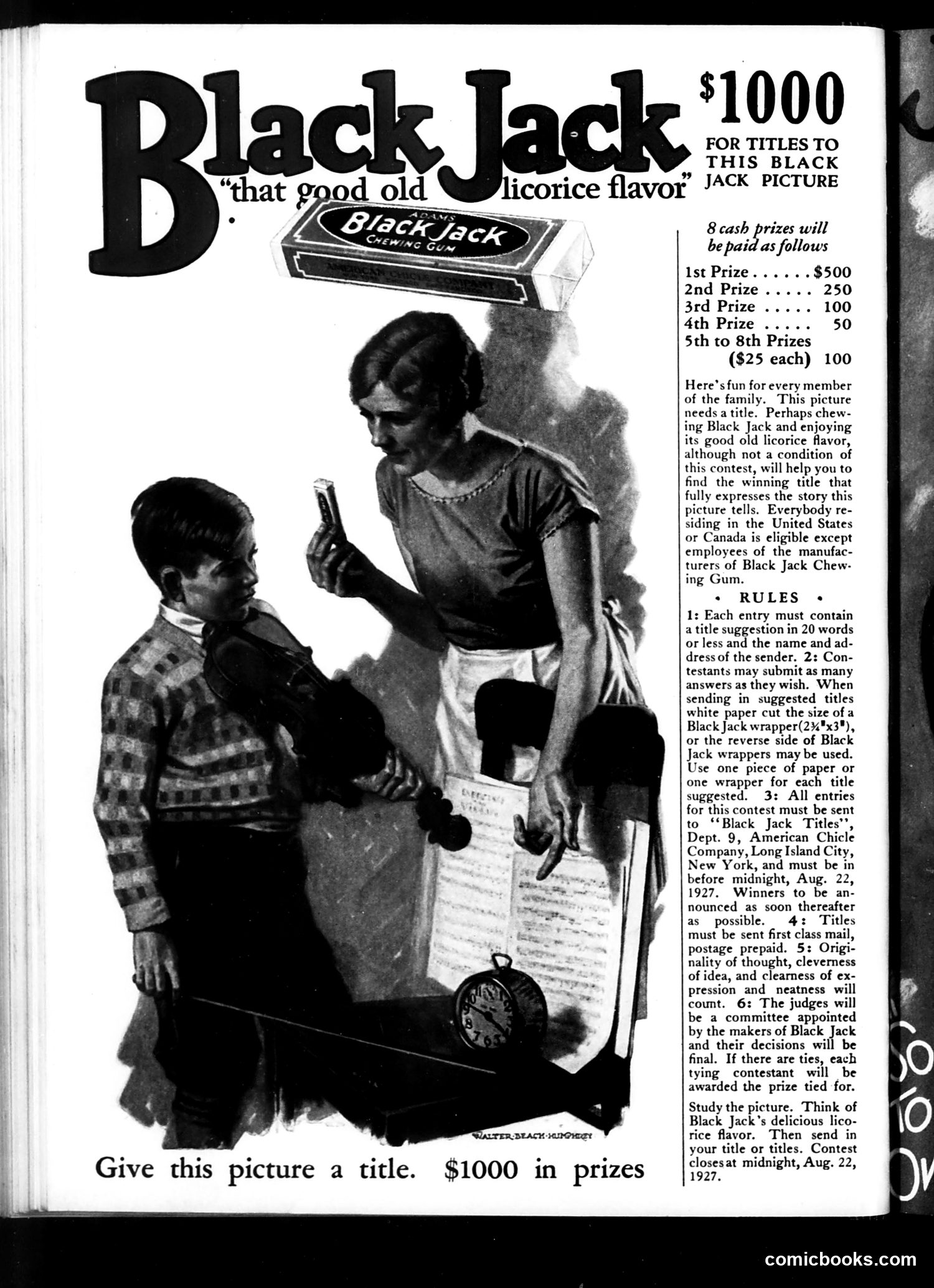
This is primarily a **contest advertisement**, not political satire. Black Jack Chewing Gum is running a $1,000 prize competition asking readers to title the accompanying image. The picture shows a domestic scene: a woman holding a Black Jack gum wrapper while a young boy looks up at her. The imagery appears designed to evoke family wholesome-ness and the product's appeal to all ages. The contest rules are extensive—entries must be 20 words or less, submitted on wrapper-sized paper, postmarked by August 22, 1927, with originality and clarity as judging criteria. First prize is $500. This represents typical **1920s advertising strategy**: engaging consumers directly through contests to build brand loyalty and product awareness. The "Judge" magazine placement suggests targeting middle-class readers with disposable income for both gum purchases and contest entry.