
Judge, 1927-06-18 · page 15 of 36
Judge — June 18, 1927 — page 15: what you’re looking at
What you’re looking at
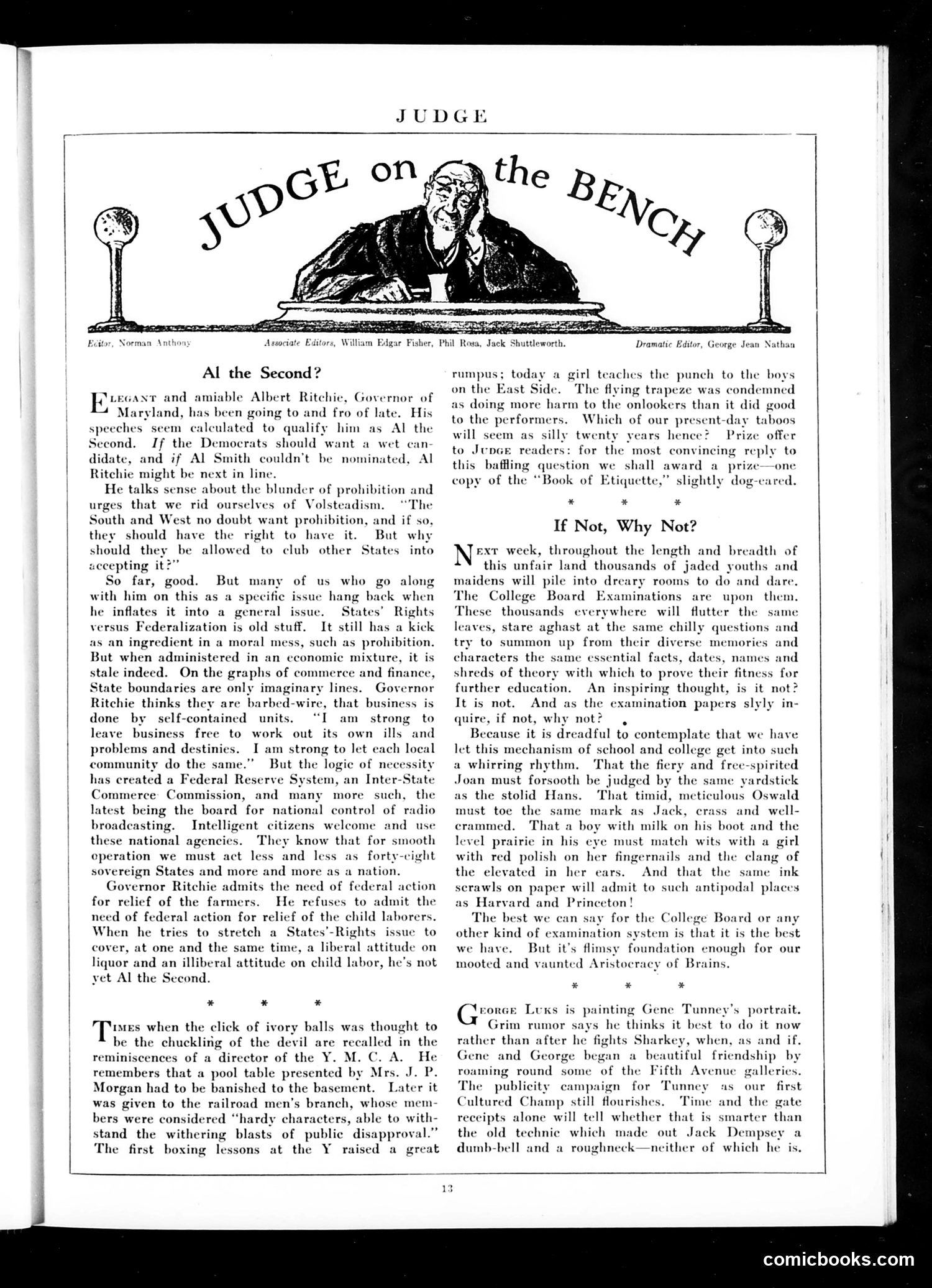
This page contains three distinct satirical pieces from *Judge* magazine (a major American humor publication): **"Al the Second?"** critiques Maryland Governor Albert Ritchie, who positioned himself as a potential Democratic presidential candidate emphasizing states' rights and opposing prohibition (Volsteadism). The satire acknowledges his sound position on liquor but exposes the contradiction: he champions "states' rights" to justify local control over alcohol while refusing to apply the same principle to federal child labor protections. The piece argues his states' rights philosophy is outdated in an interconnected modern economy requiring federal agencies like the Federal Reserve and Interstate Commerce Commission. **Unnamed second piece** humorously catalogs how the YMCA's moral standards have evolved—from condemning pool tables and trapeze work as corrupting to now teaching boxing to boys, illustrating changing social attitudes. **"If Not, Why Not?"** satirizes college entrance exams, mocking their uniformity and the pressure on diverse students to regurgitate identical facts and memorized theory to prove educational fitness—suggesting the system is fundamentally flawed.
📄 Transcribed text from this page (OCR, searchable)
Machine-transcribed from the original scan — historical spelling and the odd misread are preserved.
JUDGE ¢ Editors, Al the Second? yLecant and amiable Albert Ritchie, Governor of Maryland, has been going to and fro of late. His speeches seem calculated to qualify him Al the Second. If the Democrats should want a wet can didate, and if Al Smith couldn't be nominated, Al Ritchie might be next in line. He talks sense about the blunder of prohibition and urges that we rid ourselves of Volsteadism. The South and West no doubt want prohibi and if so, they should have the right to have it. But why should the allowed to club other States into accepting it? So far, good. But many of us who go along with him on this as a specific issue hang back when he inflates it into a general issue. States’ Rights versus Federalization is old stuff. It still has a kick as an ingredient in a moral mess, such as prohibition. But when administered in an economic mixture, it is stale indeed. On the graphs of commerce and finance, State boundaries are only imaginary lines. Governor Ritchie thinks they are barbed-wire, that business is as be done by self-contained units. “I am strong to leave business free to work out its own ills and problems and des: s. I am strong to let each local community do the same.”” But the logic of necessity has created a Federal Reserve System, an Inter-State Commerce: Commission, and more such, the latest being the board for national control of radio broadcasting. Intelligent citizens welcome and these national agencies. They know that for smooth operation we must act less and less as forty-cight sovereign States and more and more as a nation. Governor Ritchie admits the need of federal action for relief of the farmers. He refuses to admit the need of federal action for relief of the child laborers. When he tries to stretch a States’-Rights issue to cover, at one and the same time, a liberal attitude on liquor and an illiberal attitude on child labor, he’s not yet Al the Second. many use * * * To when the click of ivory balls was thought to be the chuckling of the devil are recalled in the reminiscences of a director of the Y. M. C. He remembers that a pool table presented by Mrs. J. P. Morgan had to be banished to the basement. Later it was given to the railroad men’s branch, whose mem- bers were considered “hardy characters, able to with- stand the withering blasts of public disapproval The first boxing lessons at the Y raised a great ‘gar Fisher, Phil Rosa, Jack Shuttleworth, Dramatic Editor, George Jean Nathan rumpus; today a girl teaches the punch to the boys on the East Side. The flying trapeze was condemned as doing more harm to the onlookers than it did good to the performers. Which of our present- y twenty years hence? : taboos Prize offer to June readers: for the most convincing reply to this baffling question we shall award a_ prize copy of the “Book of E will seem as sil one d. iquette,” slightly dog * * * If Not, Why Not? Ne week, throughout the length and breadth of this unfair land thousands of jaded youths and maidens will pile into dreary rooms to do and dare. The College Board Examinations are upon them, These thousands everywhere will flutter the same leaves, stare aghast at the same chilly questions and try to summon up from their diverse memories and characters the same essential facts, dates, names and shreds of theory with which to prove their fitness for further education. An inspiring thought, is it not? It is not. And as the examination papers slyly in- quire, if not, why not? Because it is dreadful to contemplate that we have let this mechanism of school and college get into such a whirring rhythm, That the fiery and free-spirited Joan must forsooth be judged by the same yardstick as the stolid Hans. That timid, meticulous Oswald must toe the same mark as Jack, crass and well- crammed. That a boy with milk on his boot and the level prairie in his must match wits with a girl with red polish on her fingernails and the clang of the elevated in her ears. And that the same ink scrawls on paper will admit to such antipodal places as Harvard and Princeton! The best we can say for the College Board or any other kind of examination system is that it is the best we have. But it’s flimsy foundation enough for our mooted and vaunted Aristocracy of Brains. * * * Groner Lexs is painting Gene Tunney’s portrait. Grim rumor says he thinks it best to do it now rather than after he fights Sharkey, when, as and if, Gene and George bey beautiful friendship by roaming round some of the Fifth Avenue galleries. The publicity campaign for Tunney as our first Cultured Champ still flourishes. ‘Time and the gate receipts alone will tell whether that is smarter than the old technic which made out Jack Demps dumb-bell and a roughneck—neither of which he an a comicbooks.com