
Judge, 1927-06-18 · page 20 of 36
Judge — June 18, 1927 — page 20: what you’re looking at
What you’re looking at
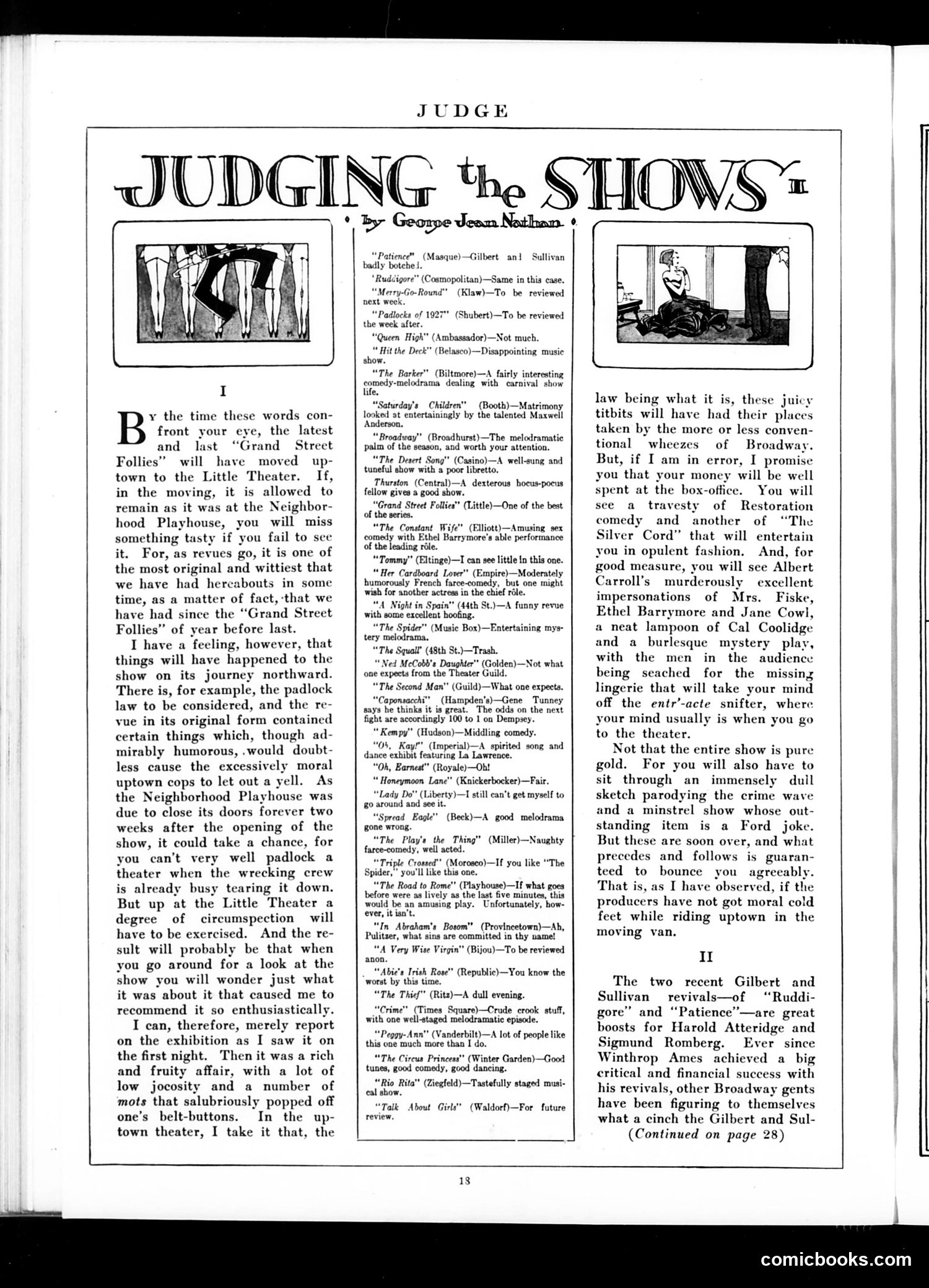
This page is a theater critic's column reviewing Broadway shows, not political satire. Judge magazine published entertainment criticism alongside comedy and satire. Nathan (a prominent theater critic of the 1920s) reviews approximately 30 current productions, listing venue names and brief judgments. The tone is witty and dismissive—he calls several shows "trash" or "disappointing," praises the "Grand Street Follies" revival, and includes a jab at boxer Gene Tunney, joking that Tunney's enthusiasm for "Caponsacchi" makes betting odds favor Dempsey in their next fight. The column's main point: Nathan warns that when the Follies moves uptown, censorship ("padlock law") will remove its edgier humor, disappointing readers. The two small photographs appear to be theatrical production stills, though details are unclear in this reproduction. This represents Judge's role as entertainment guide for sophisticated urban audiences.
📄 Transcribed text from this page (OCR, searchable)
Machine-transcribed from the original scan — historical spelling and the odd misread are preserved.
JUDGE y the time these words con- B front your eye, the latest and last “Grand Street Follies” will have moved up- town to the Little Theater. If, in the moving, it is allowed to remain as it was at the Neighbor- hood Playhouse, you will miss something tasty if you fail to s it. For, as revues go, it is one of the most original and wittiest that we have had hereabouts in some time, as a matter of fact, ‘that we have had since the “Grand Street Follies” of year before last. I have a feeling, however, that things will have happened to the show on its journey northward. There is, for example, the padlock law to be considered, and the re- vue in its original form contained certain things which, though ad- mirably humorous, .would doubt- less cause the excessively moral uptown cops to let out a yell. As the Neighborhood Playhouse was due to close its doors forever two weeks after the opening of the show, it could take a chance, for you can’t very well padlock a theater when the wrecking crew is already busy tearing it down. But up at the Little Theater a degree of circumspection will have to be exercised. And the re- sult will probably be that when you go around for a look at the show you will wonder just what it was about it that caused me to recommend it so enthusiastically. I can, therefore, merely report on the exhibition as I saw it on the first night. Then it was a rich and fruity affair, with a lot of low jocosity and a number of mots that salubriously popped off one’s belt-buttons. In the up- town theater, I take it that, the NG. ‘he SHOWS (Masque)—Gilbert ani Sullivan *Ruddigor “Merry-Go-Round” week. “Padlocks of 1927"" (Shubert)—To be reviewed the week after. “Queen High” (Ambassador)—Not much. “ Hit the Deck" (Belasco)—Disappointing music show. “The Barker" (Biltmore)—A fairly interesting omedy-melodrame dealing with carnival show life. “Saturday's Children" (Booth)—Matrimony looked at entertainingly by the talented Maxwell Anderson, “Broadway” (Broadhurst)—The melodramatic palm of the season, and worth your attention, “The Desert Song" (Casino)—A well-sung and tuneful show with a poor libretto, Thuraton (Central)—A dexterous hocus-pocus fellow gives a good show. “Grand Street Follies” (Little)—One of the best of the series. “The Constant Wife” (Elliott)—Amusing sex comedy with Ethel Barrymore's able performance of the leading rile. “Tommy” (Eltinge)—I can see little in this one. “Her Cardboard Lover" (Empire)—Moderately humorously French farce-comedy, but one might wish for another actreas in the chief rile. “4 Night in Spain” (44th St.)—A funny revue with some excellent hoofing. “The Spider" (Music Box)—Entertaining mys- tery melodrama, “The Squall’ (48th St.)—Trash. “Ned MeCobb's Daughter" (Golden)—Not what one expects from the Theater Guild. “The Second Man" (Guild)—What one expects. “Caponsacchi"” (Hampden's)—Gene Tunney says he thinks it is great. The odds on the next fight are accordingly 100 to 1 on Dempsey. “ Kempy" (Hudson)—Middling comedy. “O's, Kayf" (Imperial\—A spirited song and dance exhibit featuring La Lawrence. “Oh, Earnest” (Royale)—Oh! “ Honeymoon Lane" (Knickerbocker)—Fair. “Lady Do" (Liberty)—I still can't get myself to go around and see it. “Spread Eagle” gone wrong. “The Play's the Th farce-comedy, well acted. “Triple Crossed (Moroseo)—If you like “The Spider,” you'll like this one. “The Road to Rome’’ (Playhouse)—If what goes before were as lively as the last five minutes, this would be an amusing play. Unfortunately, how- ever, it isn't. “In Abraham's Bosom" (Provincetown)—Ab, Pulitzer, what sins are committed in thy uamel “A Very Wise Virgin" (Bijou)—To be reviewed anon. “ Abie's Trish Rose’ (Republic)—You know the worst by this time. “The Thief” (Ritz)—A dull evening. “Crime” (Times Square)—Crude crook stuf, with one well-staged melodramatic episode. “*Peggy-Ann" (Vanderbilt)—A lot of people like this one much more than I do. “The Circus Princess” (Winter Garden)—Good tunes, good comedy, good dancing. “Rio Rita” (Ziegfeld)—Tastefully staged musi- cal show. “Talk review. * (Cosmopolitan) —Same in this ease. (Klaw)—To be reviewed (Beck)—A good melodrama ” (Miller)—Naughty About Girls (Waldorf)—For future law being what it is, these juic titbits will have had their places taken by the more or less conven- tional wheezes of Broadw But, if I am in error, I promise you that your money will be well spent at the box-office. You will see a travesty of Restoration comedy and another of “The Silver Cord” that will entertain you in opulent fashion. And, for good measure, you will see Albert Carroll's murderously excellent impersonations of Mrs. Fiske, Ethel Barrymore and Jane Cowl, a neat lampoon of Cal Coolidge and a burlesque mystery play, with the men in the audience being seached for the missing lingerie that will take your mind off the entr’-acte snifter, where your mind usually is when you go to the theater. Not that the entire show is pure gold. For you also have to sit through an immensely dull sketch parodying the crime wave and a minstrel show whose out- standing item is a Ford joke. But these are soon over, and what precedes and follows is guaran- teed to bounce you agreeably. That is, as I have observed, if the producers have not got moral co} feet while riding uptown in the moving van. II The two recent Gilbert and Sullivan revivals—of ‘“Ruddi- gore” and “Patience’”—are great boosts for Harold Atteridge and Sigmund Romberg. Ever since Winthrop Ames achieved a big itical and financial success with als, other Broadway gents have been figuring to themselves what a cinch the Gilbert and Sul- (Continued on page 28) comicbooks.com