
A complete issue · 36 pages · 1927
Judge — June 11, 1927
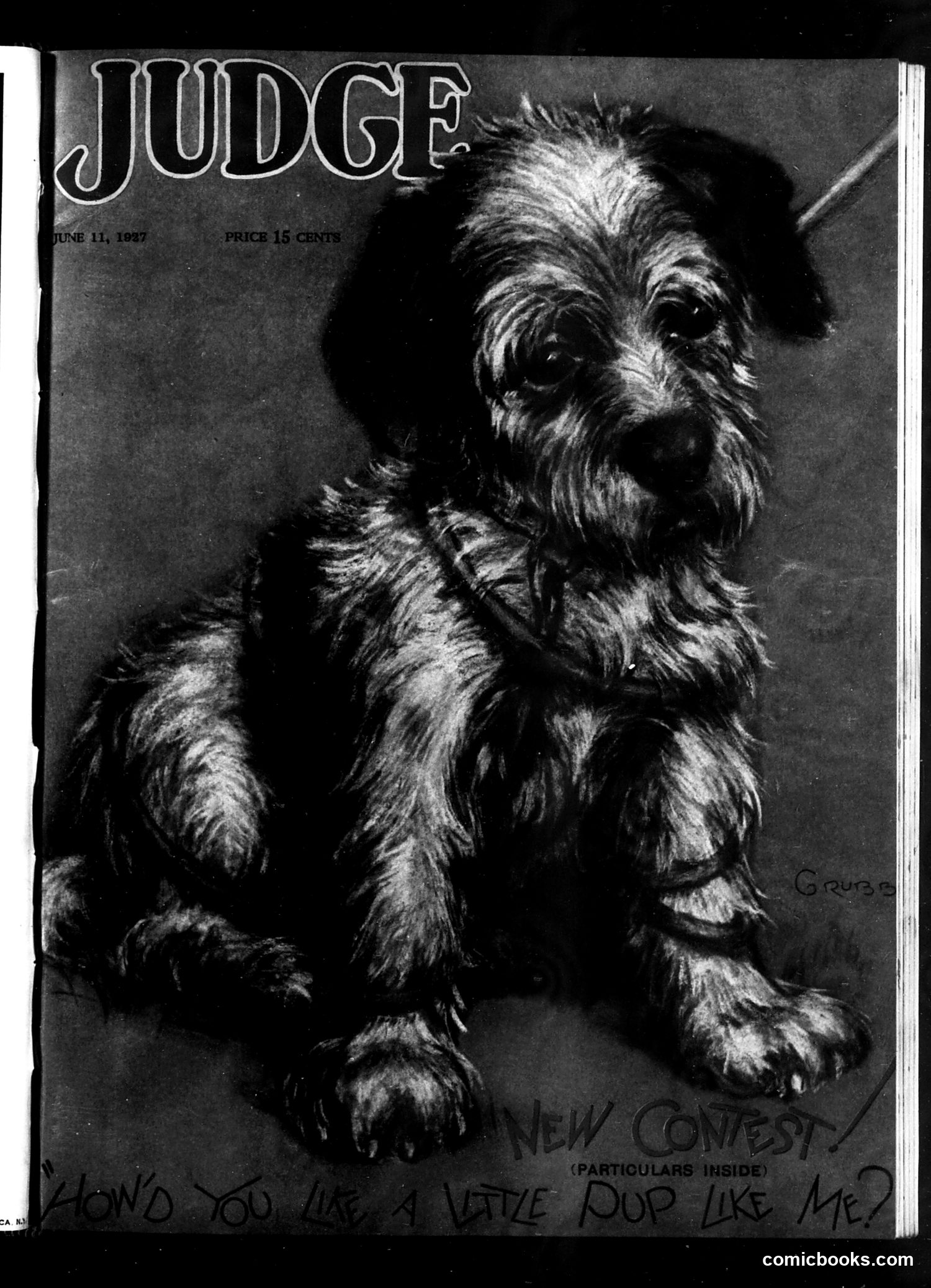
This June 11, 1927 *Judge* cover features a shaggy-haired dog with the caption "Would you like a little pup like me?" and "New Contest (Particulars Inside)." This appears to be a promotional cover advertising a reader contest, likely asking *Judge* subscribers to name or identify the dog breed. The terrier-type dog's distinctive wiry coat and beard-like facial hair make it visually distinctive enough to anchor a guessing game. No obvious political satire is evident on this cover—it's primarily a circulation-building promotional device typical of magazines of this era, which used contests to increase readership and engagement. The artist's signature "Gruger" is visible in the lower right.
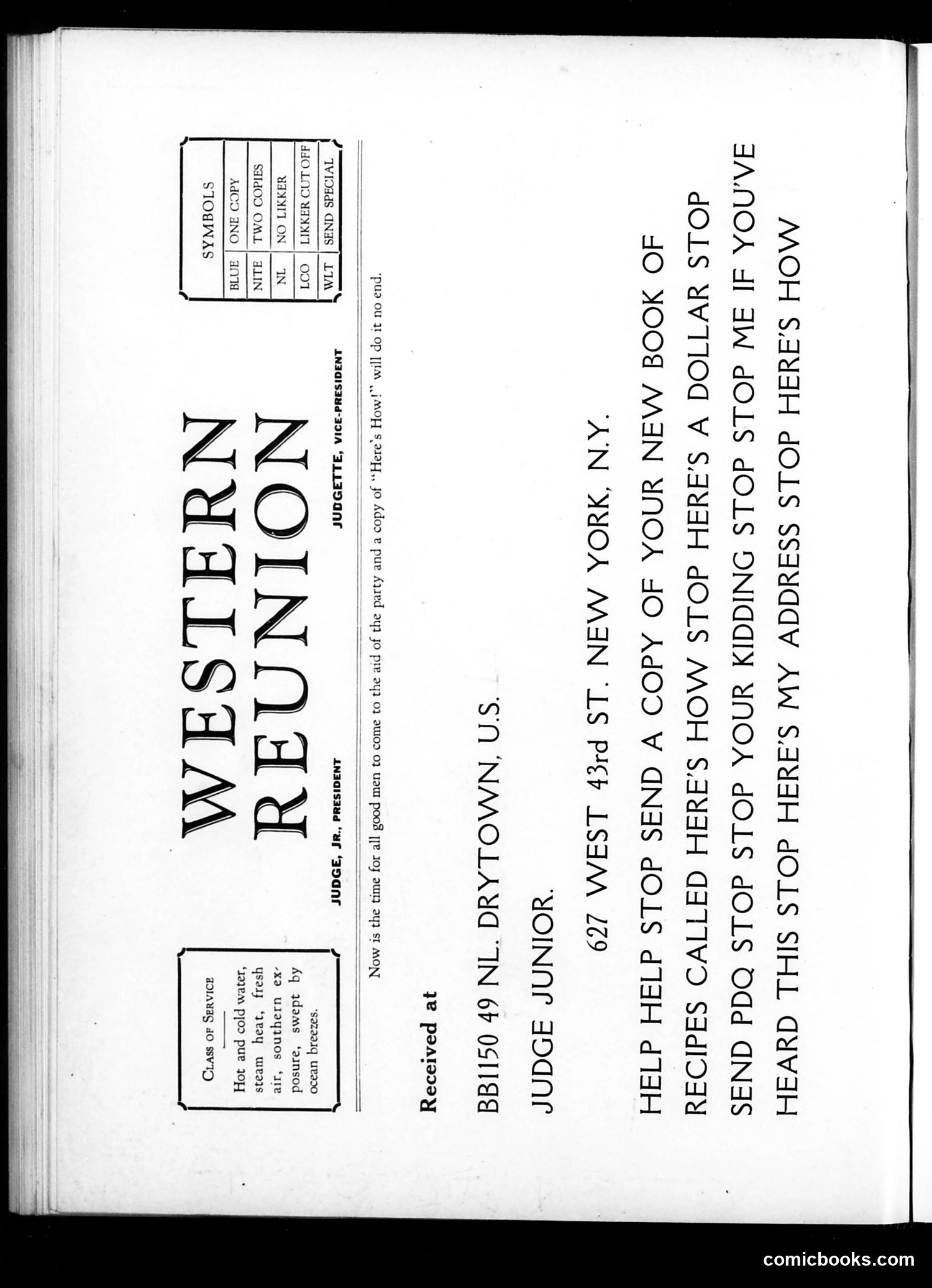
This page from *Judge* magazine contains primarily **advertising content** rather than political satire. The main elements are: 1. **"Western Reunion" advertisement** - A classified-style ad announcing a gathering for people with western connections, likely seeking attendees or spreading word of an event. 2. **Two boxed advertisements** on the left side: - "Care or Shaves" - appears to be a grooming/personal care product ad - Another product advertisement (text unclear in image) 3. **A symbols/legend box** in the upper right explaining notation used in the publication The page appears to be filler content typical of magazine layouts from this era, mixing commercial advertisements with editorial material rather than featuring the satirical cartoons *Judge* was known for.
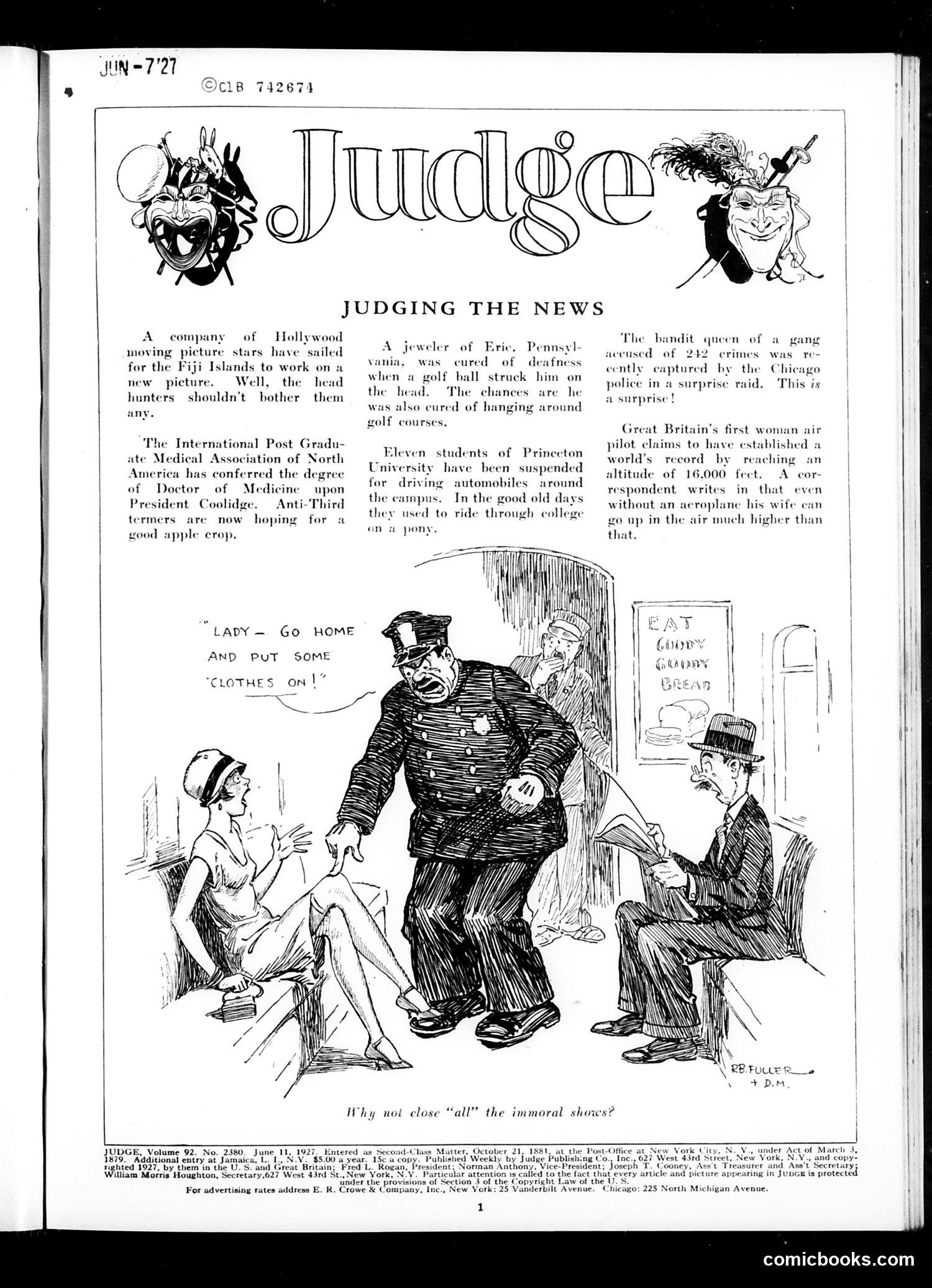
The main cartoon depicts a soldier or military officer telling a scantily-clad woman to "go home and put some clothes on," while a man in a suit observes. The caption asks "Why not close 'all' the immoral shoes?" This appears to satirize enforcement of morality laws during the Prohibition era (1920-1933). The soldier likely represents law enforcement or government authority attempting to regulate public behavior and dress. The joke suggests the hypocrisy of selective moral enforcement—if authorities want to eliminate "immoral" behavior, why not ban shoes themselves? The cartoon mocks the era's conflicts between moral reformers and public resistance to government intervention in personal freedoms. The absurdist punchline highlights how arbitrary such regulations seemed to ordinary citizens.
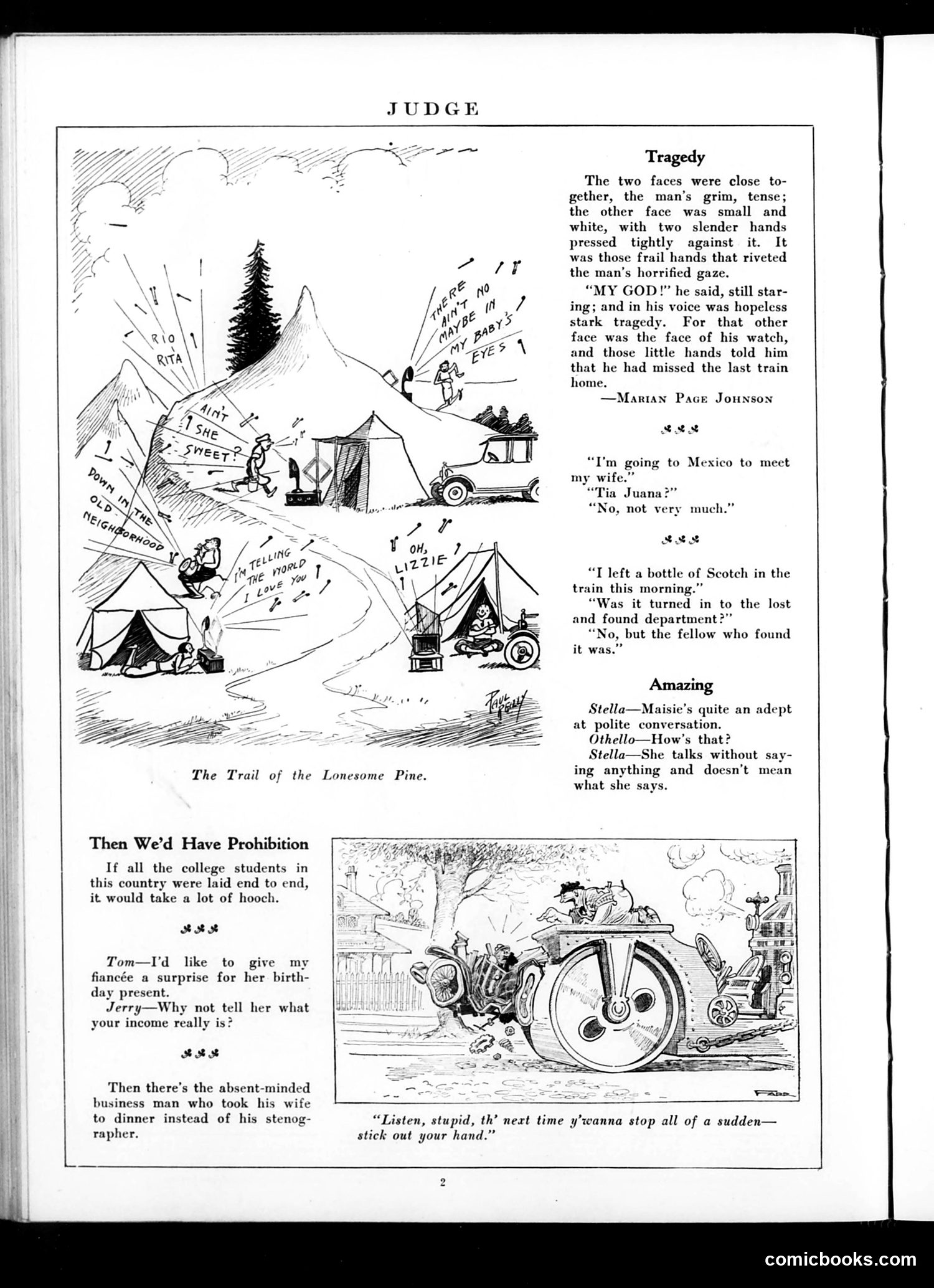
This page contains humorous vignettes rather than political cartoons. The content includes: **"The Trail of the Lonesome Pine"** (top illustration): A sketch depicting a hobo encampment with various figures and tents, likely satirizing either the popular song of that name or Depression-era vagrant life. **"Then We'd Have Prohibition"** (bottom section): Several short jokes about prohibition-era alcohol, including quips about college drinking and hiding alcohol. The references assume readers' familiarity with Prohibition enforcement and bootlegging culture. **Additional jokes** about courtship, business practices, and absent-mindedness fill the remaining space. The page's tone is lighthearted domestic and social satire typical of 1920s-30s Judge magazine—poking fun at everyday middle-class American life rather than engaging with specific political figures or events.
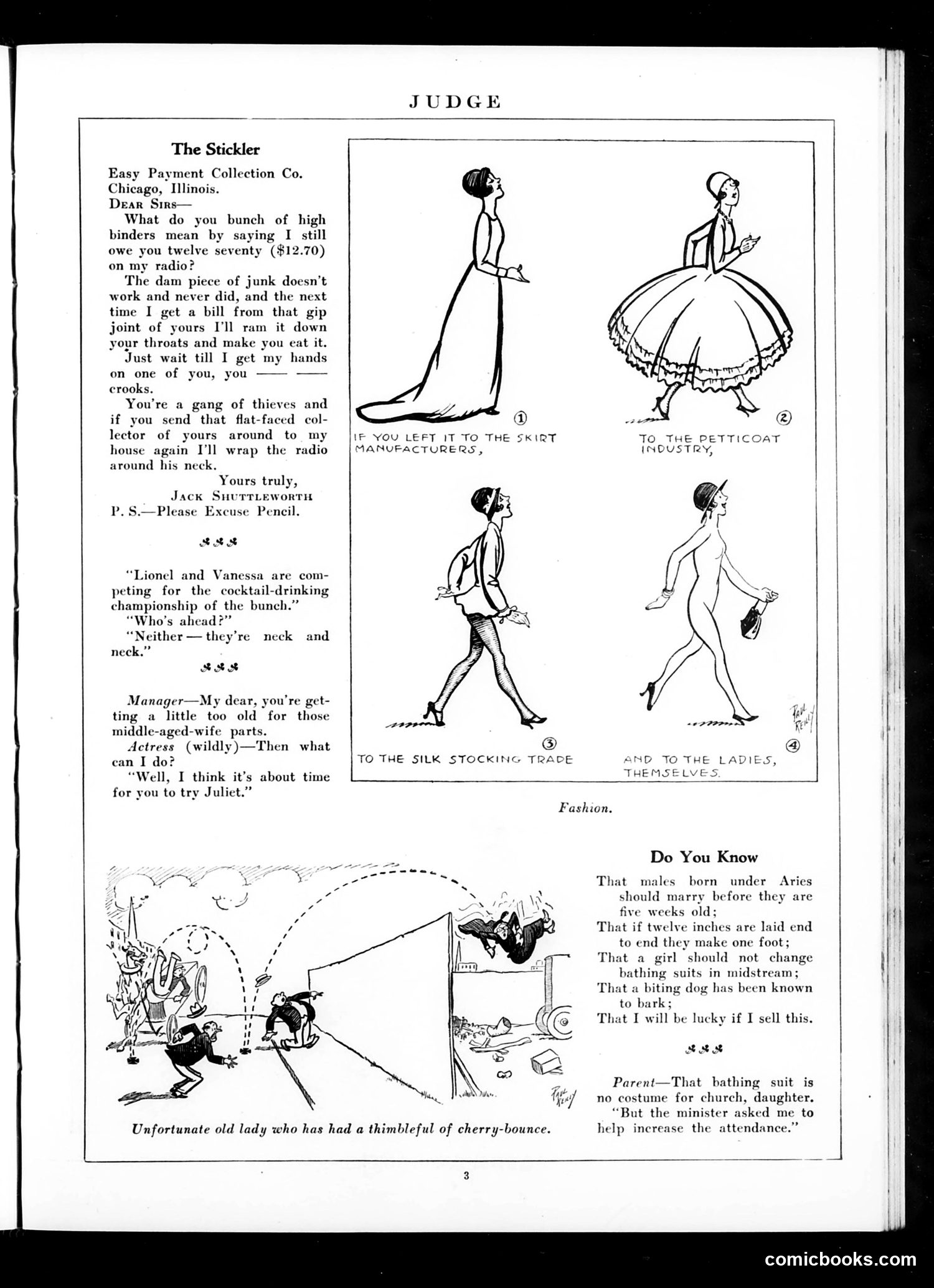
This page contains several satirical pieces: **"The Stickler"** is a complaint letter from Jack Smithworth about a faulty radio from Easy Payment Collection Co. He threatens retaliation if they send their collector again, establishing the joke that debt collectors were aggressive, persistent nuisances. **The Fashion section** shows four illustrated panels satirizing women's evolving hemlines—progressively shorter from skirts to petticoats to stockings to bare legs. This mocks the rapid, shocking rise of women's hemlines during the 1920s, which scandalized conservative society. **"Do You Know"** offers humorous superstitions and social observations, including criticism of women's bathing suits. The bottom cartoon shows an elderly woman's mishap with fireworks, captioned "Unfortunate old lady who has had a thimbleful of cherry-bounce" (cheap liquor). The page reflects 1920s anxieties about debt collection, changing female fashion, and moral propriety.
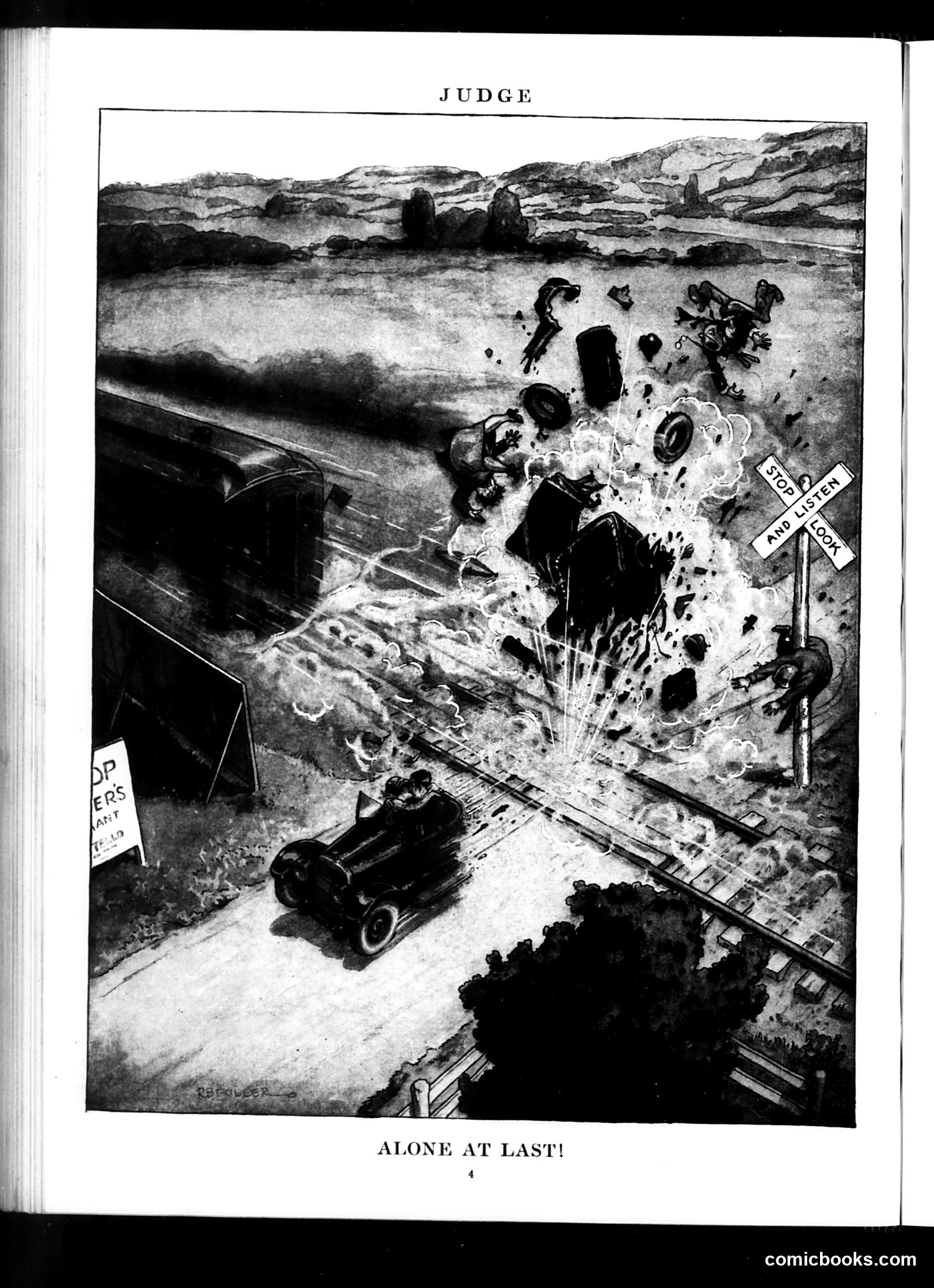
This cartoon depicts a car crash at a railroad crossing, with explosive violence and debris scattered across the scene. The title "Alone at Last!" suggests dark humor about a couple finally achieving privacy through catastrophic accident. The image shows a vehicle struck by a train at a grade crossing marked with a "STOP AND LISTEN" sign. The satirical point appears to critique either: 1. Dangerous driving practices at railroad crossings, or 2. The ironic "privacy" achieved through fatal accidents The cartoon likely comments on early automotive safety hazards and the tragic frequency of train-car collisions in the early 20th century. The sardonic title transforms a fatal accident into grim humor about an unwanted couple finally being left undisturbed—permanently.
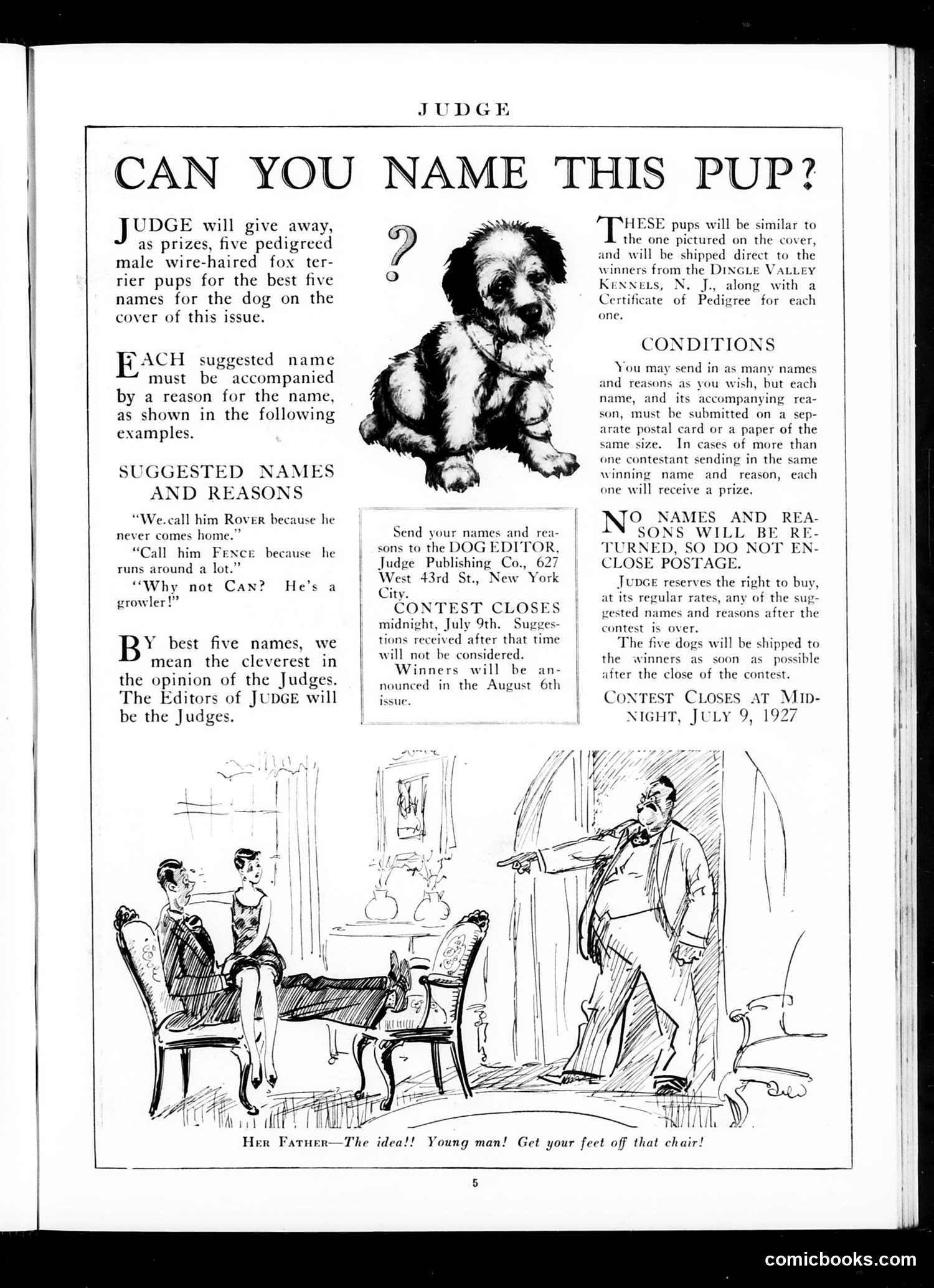
This page is primarily a **contest announcement**, not political satire. Judge magazine is holding a naming contest for wire-haired fox terrier puppies, with prizes of five puppies as rewards for the best-suggested names. The "SUGGESTED NAMES AND REASONS" section shows how to enter: contestants submit dog names with explanations. Examples given include "Rover" (because he never comes home) and "Iin Fences" (because he runs around a lot)—these are gentle household humor rather than satire. The cartoon at bottom is unrelated social humor: a father discovers his young son sitting in his chair, humorously ordering him out. This represents typical 1920s magazine content mixing contests, light domestic comedy, and advertisements to engage readers and build participation.
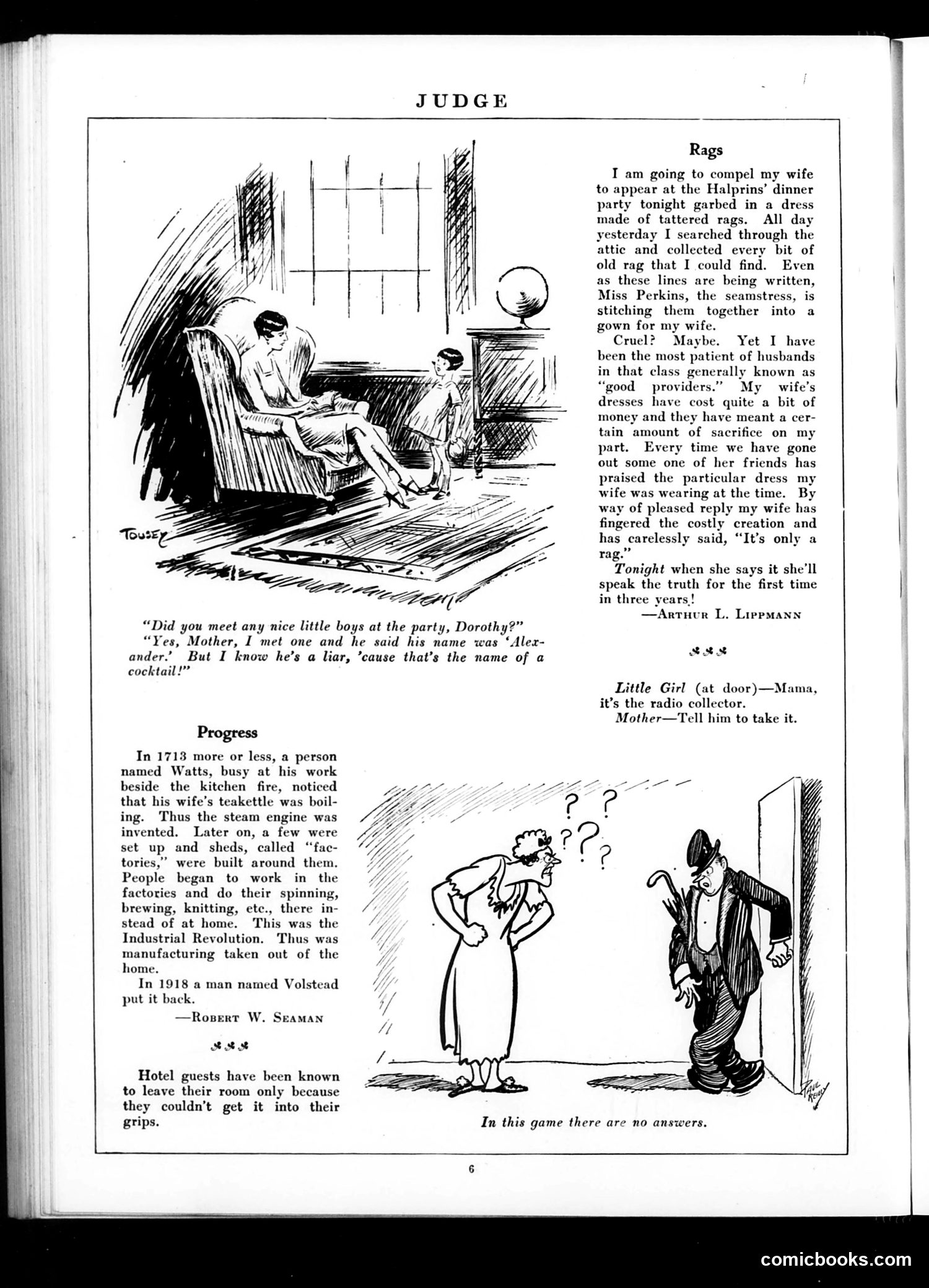
This page contains three separate satirical pieces: **"Rags"** (top): A husband's humorous revenge. His wife repeatedly dismisses her expensive dresses as "only a rag," so he's forcing her to wear an actual dress made of tattered rags to a dinner party. The satire targets wives' casual dismissal of costly purchases and their desire to appear modest about material wealth. **"Progress"** (middle-left): A brief history joke about industrialization. It notes that James Watts' steam engine (1713) launched the Industrial Revolution, moving manufacturing from homes to factories—but then Volstead "put it back" in 1918. This references Prohibition (the Volstead Act of 1919), sarcastically suggesting it returned manufacturing to homes by creating illegal home distilleries. **Bottom cartoons**: Two brief gags—one about a child innocently confusing "Alexander" (a person's name) with "Alexander" (a cocktail), and another about a woman claiming the radio "collector" can take the radio, implying she wants rid of it. These reflect 1920s concerns: consumer spending, Prohibition enforcement, and new technologies like radio.
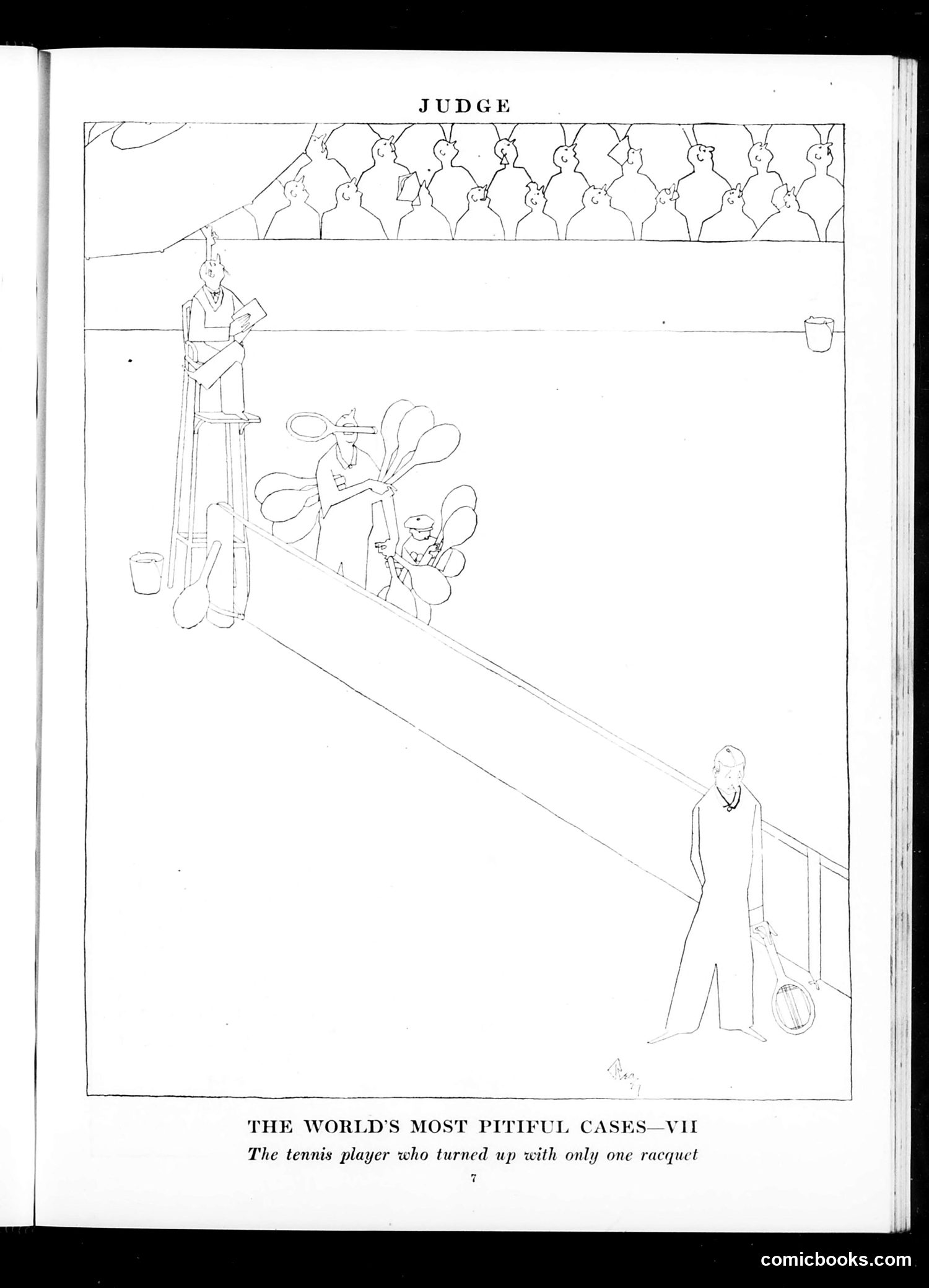
This is a humorous cartoon from Judge magazine depicting "The World's Most Pitiful Cases." The image shows a tennis court scene where a player arrives with only a single racquet—an apparently inadequate preparation for competitive play, where players typically carry multiple racquets as backups in case one breaks or needs restringing. The joke relies on social satire about upper-class incompetence and poor preparation. The judge (visible on an elevated platform) and spectators in the gallery observe this absurd situation. The cartoon mocks either the player's lack of proper equipment, carelessness, or perhaps satirizes a broader theme of wealthy people's inability to manage basic practical affairs—a common subject in early 20th-century satirical magazines.
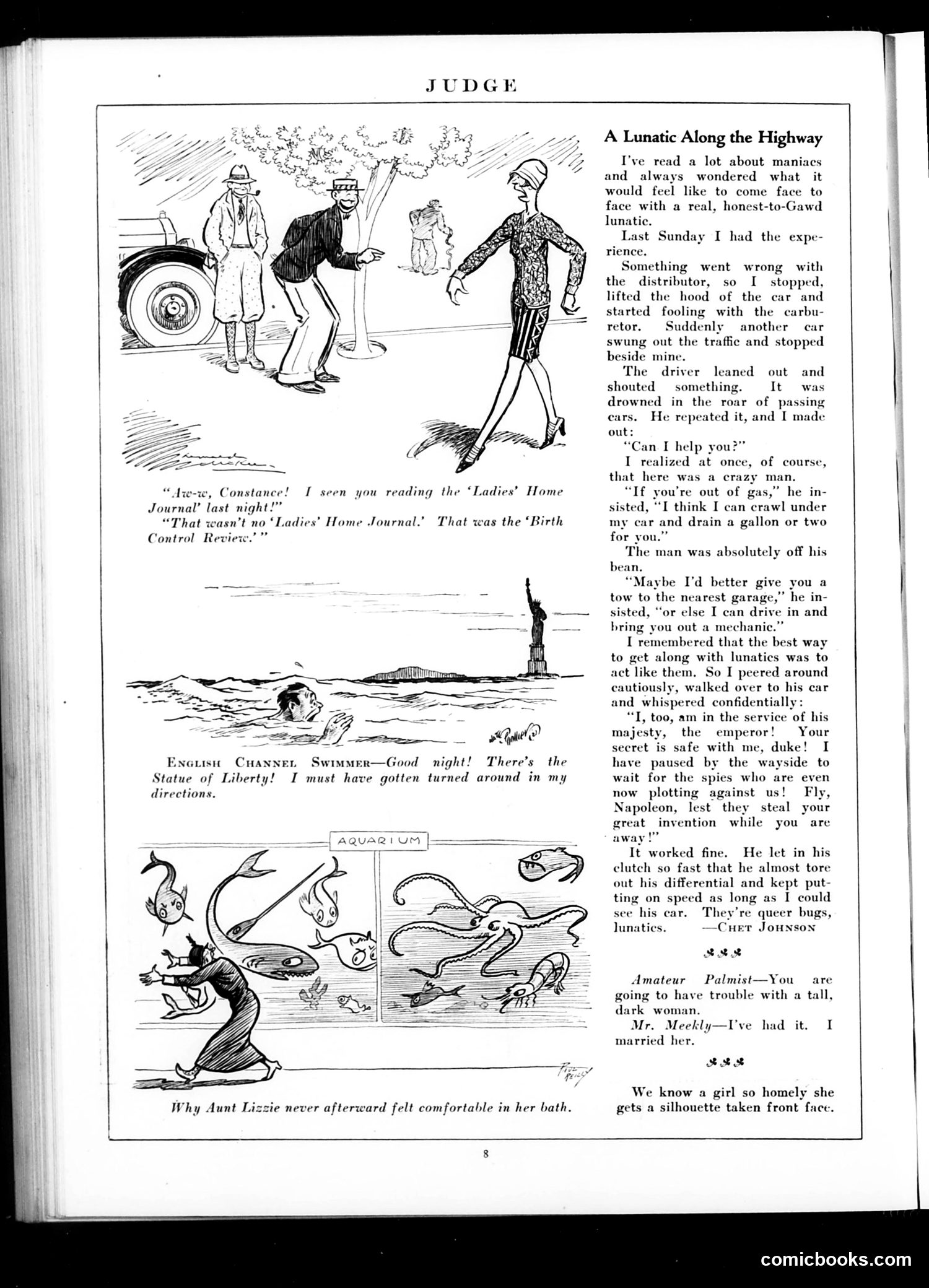
This page contains three humor pieces typical of early 20th-century American satire: 1. **"A Lunatic Along the Highway"** (main story): A motorist with car trouble encounters a helpful stranger offering assistance. The narrator, assuming the man is insane, humors him by pretending to be Napoleon plotting against spies. The "lunatic" panics and drives away at high speed—the joke being that the motorist's pretense of madness actually frightened the normal person away. 2. **The cartoons** depict absurdist scenarios: a woman reading "Birth Control Reviews" (disguised as *Ladies' Home Journal*), an English swimmer mistaking the Statue of Liberty for guidance, and "Aunt Lizzie" encountering fantastical creatures in her bathtub—all playing on social anxieties and embarrassment around contemporary topics. 3. **Brief jokes** at bottom mock palmistry and female appearance. The humor relies on period-specific concerns: birth control taboos, immigration, mental illness stigma, and beauty standards—subjects *Judge* treated with irreverent mockery.
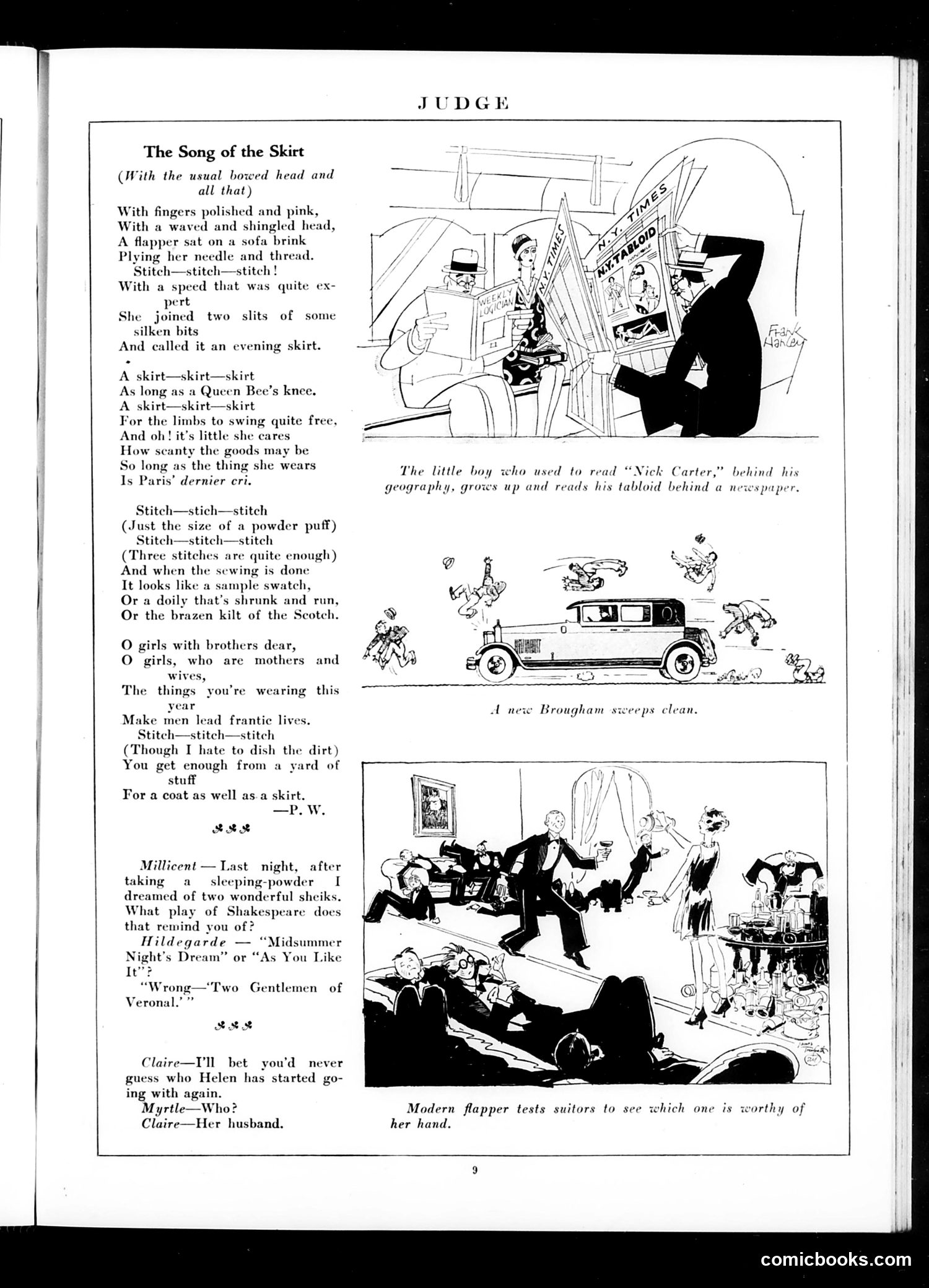
This page satirizes 1920s women's fashion and social behavior, particularly the "flapper" phenomenon. **"The Song of the Skirt"** mocks the newly shortened women's skirts of the era—scandalously brief by contemporary standards (knee-length or above). The poem ridicules both the minimal fabric required ("a yard of stuff") and women's obsession with Paris fashion ("dernier cri"). It warns that these revealing garments drive men to distraction, addressing mothers and wives directly as if they should be concerned about moral implications. The cartoon illustrations include: - A woman reading tabloids in a car (suggesting modern, frivolous women) - A "Brougham" car sweeping clean (pun on "flapper" behavior) - Young women testing male suitors (showing women as calculating and superficial) The bottom jokes mock flapper dating culture and women's perceived shallowness. Overall, the page expresses anxiety about 1920s women's independence, fashion choices, and dating practices—concerns typical of conservative voices regarding the era's social upheaval.
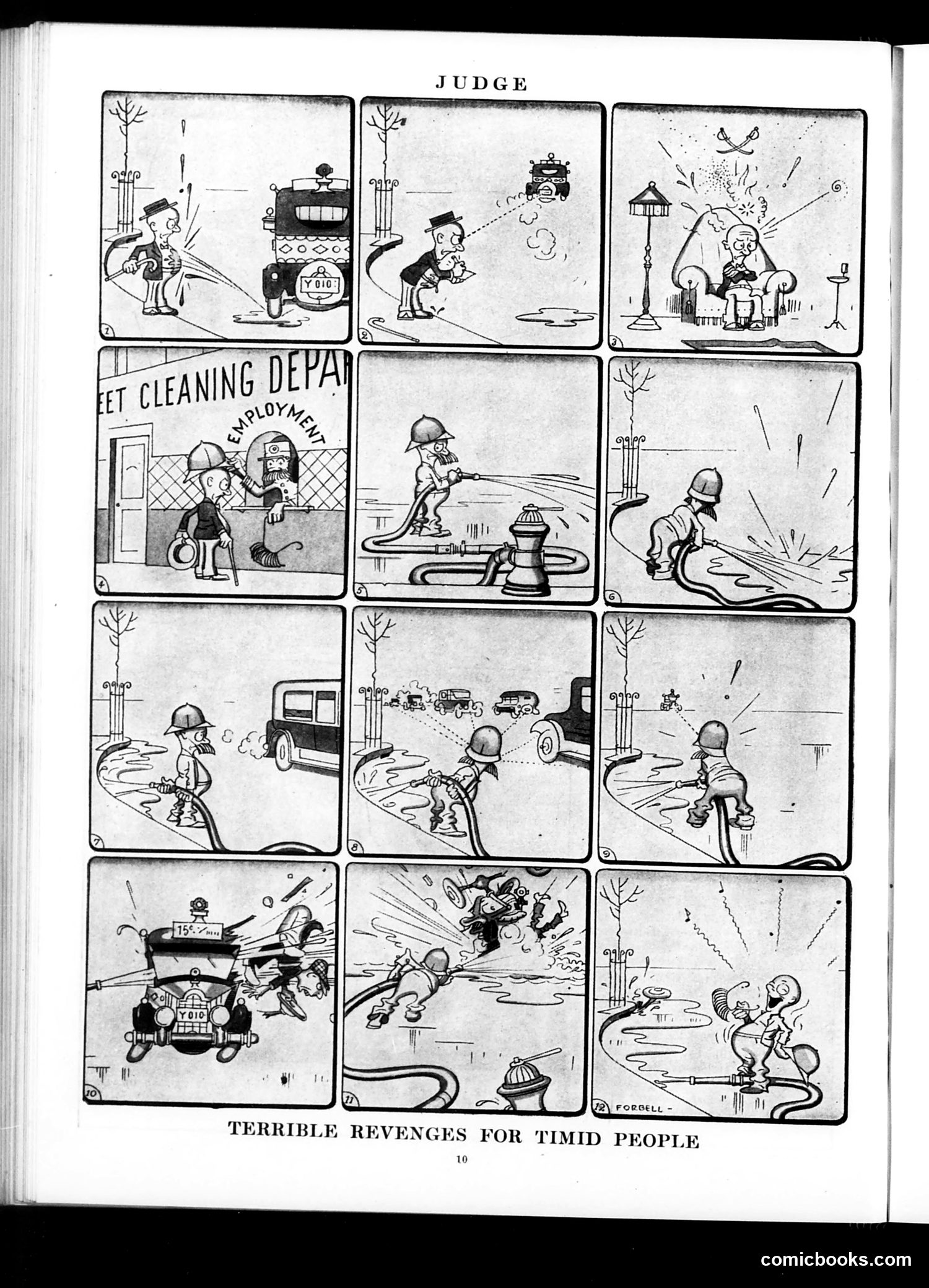
This comic strip satirizes the fantasies of timid, meek individuals by showing exaggerated scenarios of violent revenge. The protagonist (appearing as a small, nervous man in a suit and helmet) imagines increasingly absurd and destructive ways to retaliate against those who've wronged him—including confrontations with authority figures (a judge, a street-cleaning department official), aggressive drivers, and others. The humor derives from the contrast between the character's actual timidity and his wildly disproportionate imagined responses: using fire hoses as weapons, destroying vehicles, and causing general mayhem. The comic gently mocks both the meek personality type and the fantasy of sudden, violent empowerment—a common theme in early-20th-century satirical humor that played on masculine anxieties about inadequacy and social powerlessness.
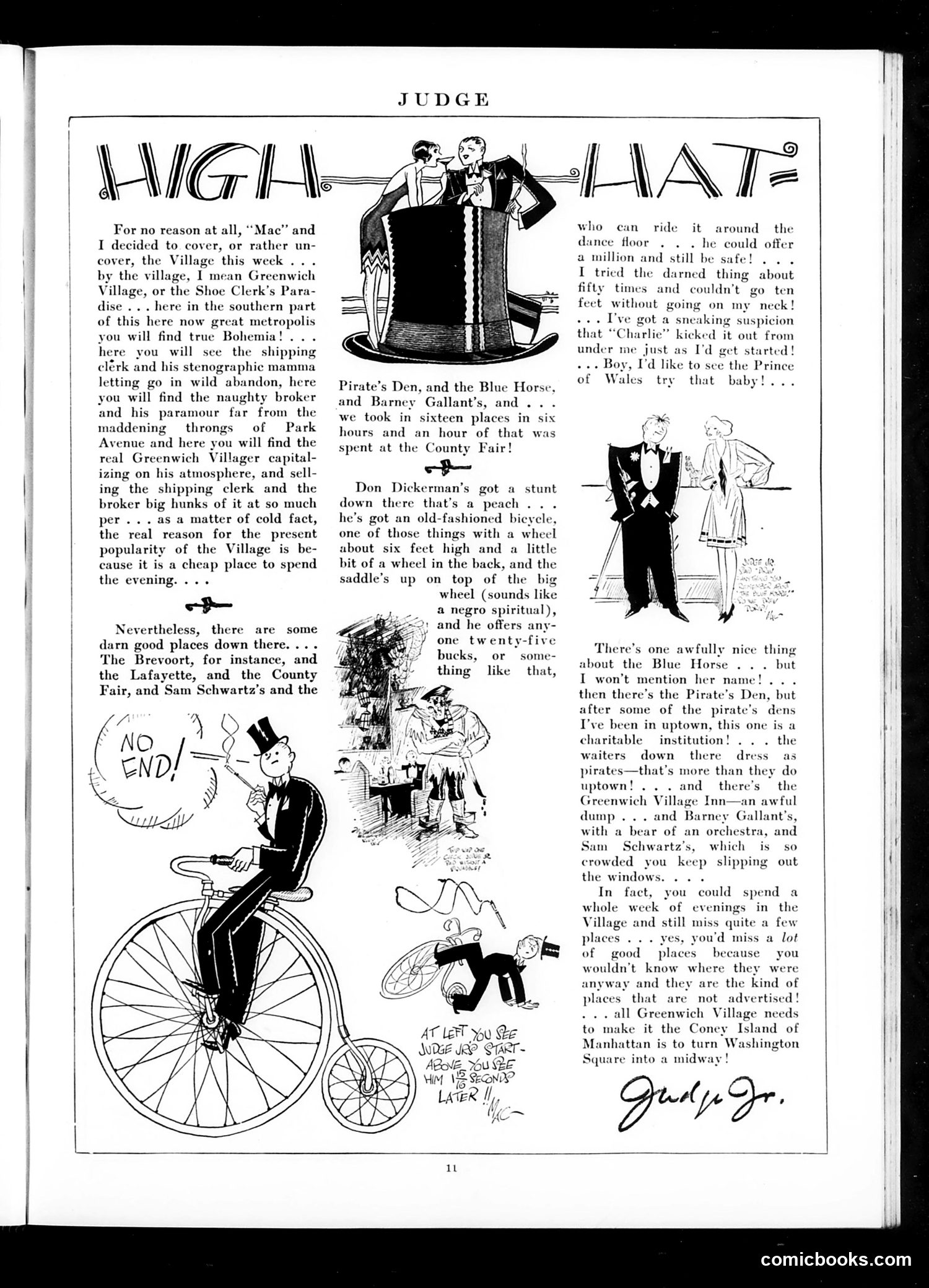
This Judge magazine column mocks Greenwich Village's pretensions to bohemian authenticity while simultaneously promoting its nightlife venues. The author ("Mac") claims to expose the "real" Village—presenting it as a cheap entertainment district where working-class people (shipping clerks, stenographers, brokers) escape Park Avenue's constraints. The satire targets **poseurs capitalizing on bohemian atmosphere** while listing actual establishments: the Brevoort, Pirate's Den, Blue Horse, and Barney Gallant's. A humorous sidebar features Don Dickerman's stunt: a penny-farthing bicycle (large front wheel, tiny back wheel) he rents for challenges on dance floors—satirizing the Village's gimmicky attractions. The concluding critique suggests Greenwich Village needs legitimate development ("turn Washington Square into a midway") rather than unadvertised, shabby establishments. The piece ultimately mocks both the neighborhood's false bohemianism and middle-class tourists seeking cheap thrills nearby.
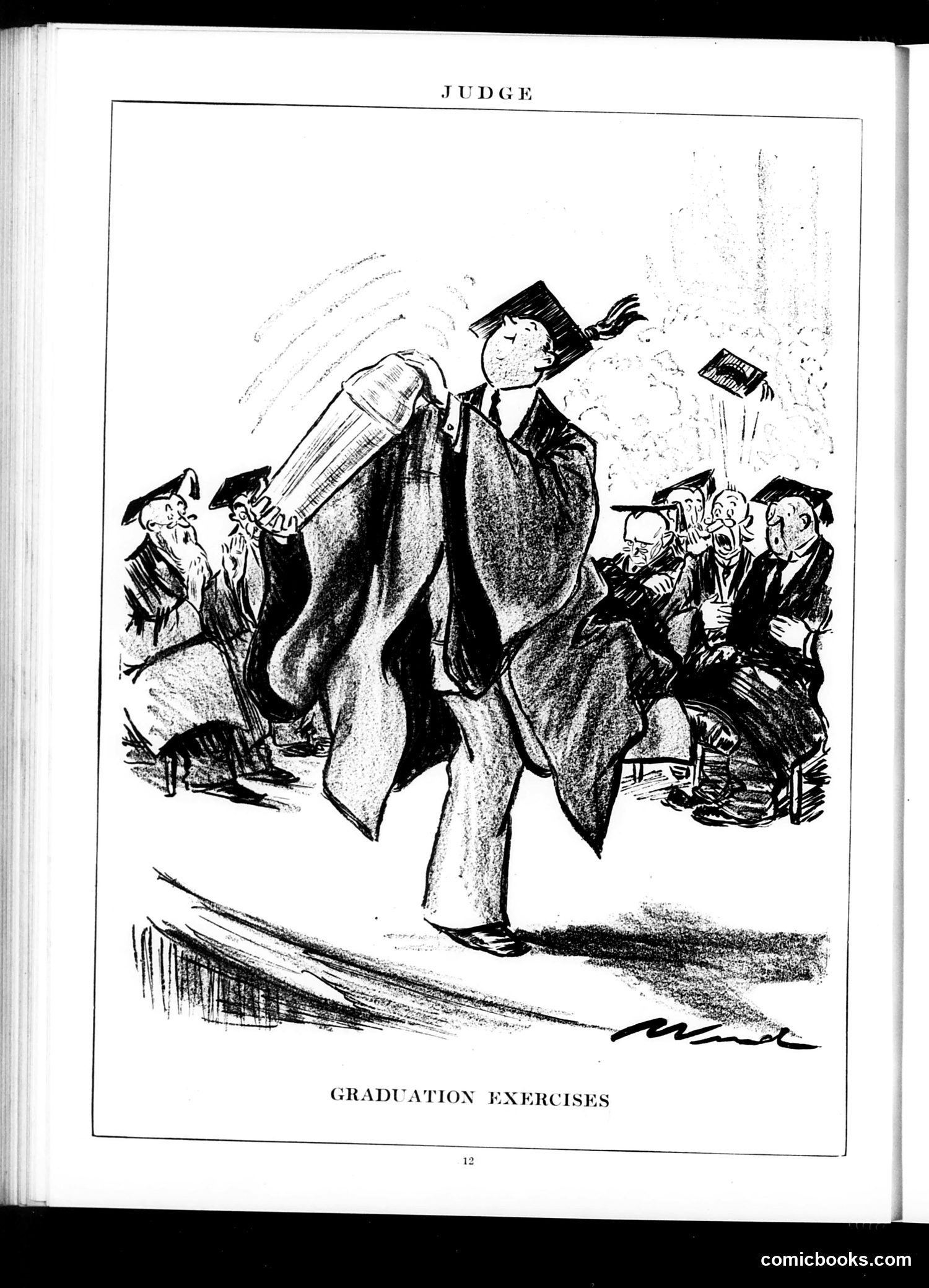
This satirical cartoon depicts a graduate being launched like a coffin or projectile by academic figures (likely professors or school administrators) seated around him. The central figure, dressed in graduation robes and mortarboard, is being forcefully ejected skyward while holding what appears to be a diploma or book. The satire critiques the graduation process itself—suggesting that schools simply "shoot out" unprepared students into the world rather than truly educating them. The onlooking figures' expressions suggest this is treated as routine, even celebratory. The coffin-like appearance adds dark humor, implying graduates are being sent to their professional "deaths" or doom. This reflects early 20th-century anxieties about educational quality and whether schools adequately prepared students for real-world challenges.
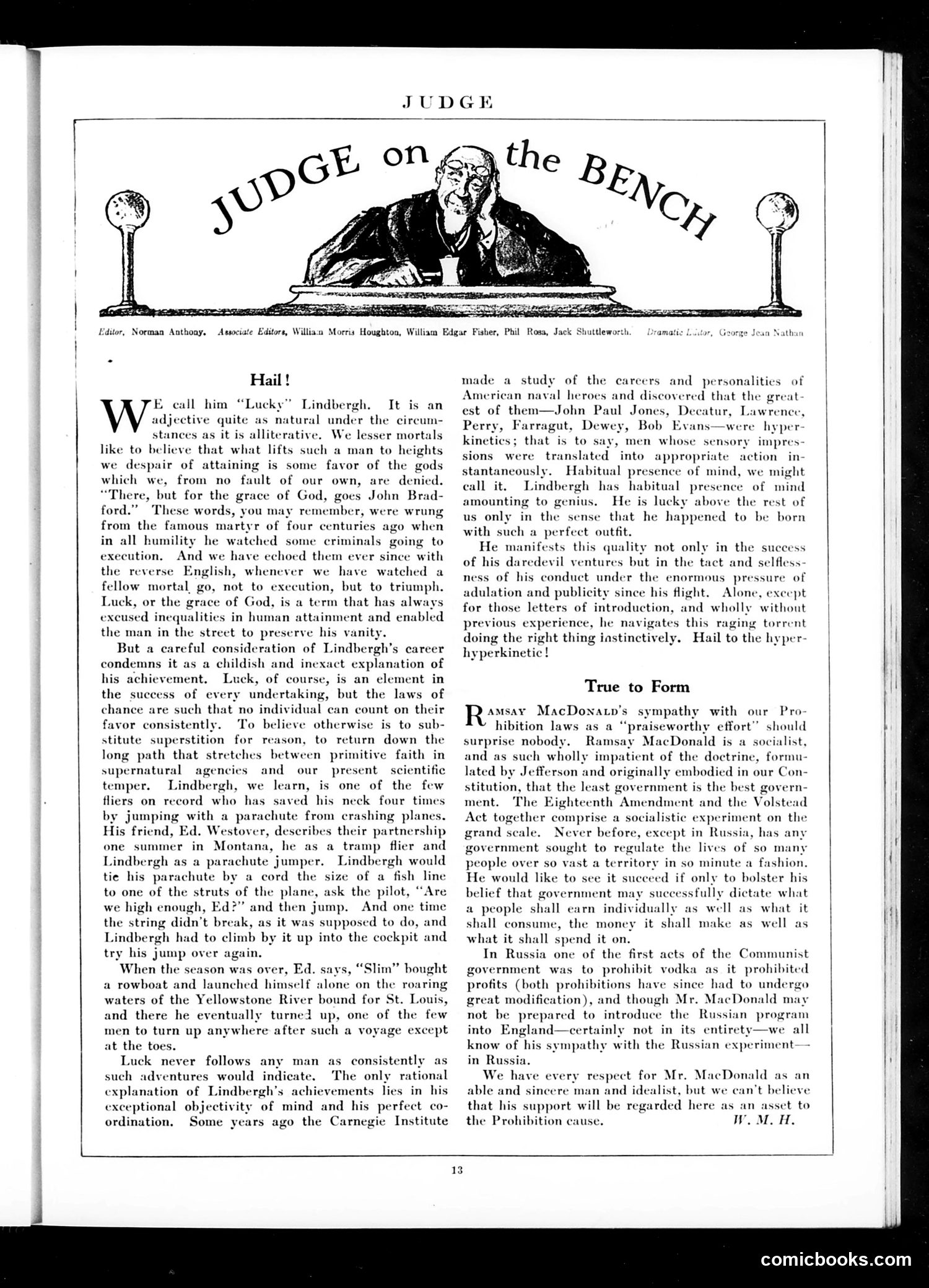
This page praises Charles Lindbergh's 1927 transatlantic flight, dismissing "luck" as explanation for his achievement. The editorial argues Lindbergh succeeded through exceptional mental coordination—a quality the Carnegie Institute called "hyperkinetic" (rapid sensory-to-action response). The article catalogs his survival of four parachute jumps and a dangerous solo rowboat journey, attributing these escapes to "habitual presence of mind amounting to genius" rather than chance. It also praises his dignified handling of post-flight fame and publicity. A secondary editorial mocks Ramsay MacDonald's support for American Prohibition laws, finding it characteristically inconsistent. The "Judge on the Bench" header image shows a stern judge overseeing the publication's satirical commentary on public figures and policy.
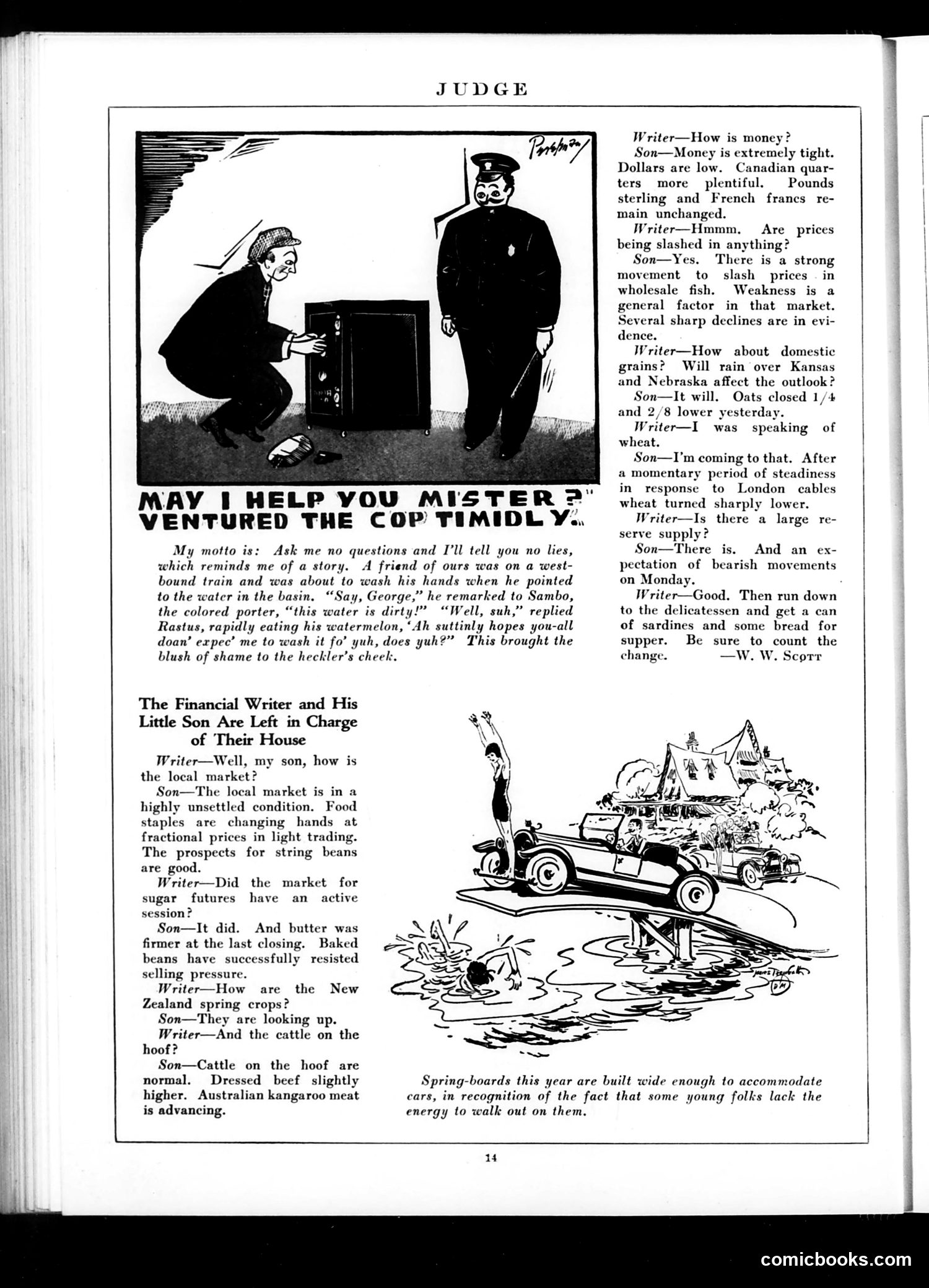
This page contains two satirical pieces targeting different subjects: **Top cartoon**: A cop timidly asks a burglar for help. The joke plays on role reversal—the authority figure is helpless before the criminal. The accompanying anecdote mocks racial stereotypes, featuring a racist caricature of a Black porter named "Rastus" who refuses to clean dirty water. **Main article**: "The Financial Writer and His Little Son" satirizes a father and son discussing markets using absurdly sophisticated financial jargon—futures, trading, bearish movements—for mundane groceries. The humor lies in the son speaking like a Wall Street analyst about beans and fish prices. The final instruction to "count the change" deflates the pretentious financial language with pedestrian reality. **Bottom cartoon**: Shows a car accident near a springboard at a house, captioning that springboards are now "wide enough to accommodate cars" because young people lack energy to "walk out on them"—a dark joke about suicide. The page reflects 1920s-30s anxieties about financial markets, class, and generational decline.
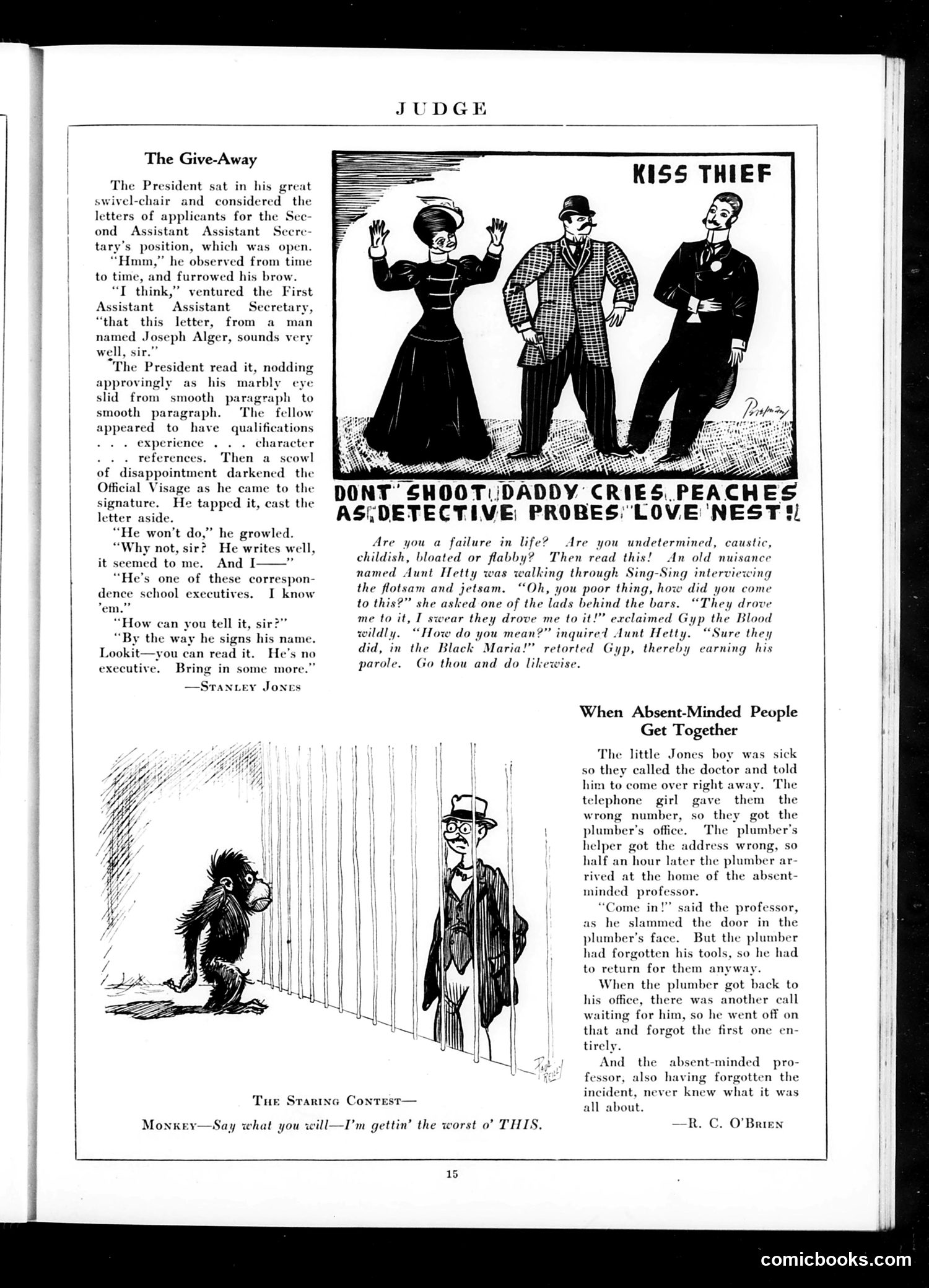
This page contains three separate humorous pieces satirizing American life and bureaucracy: **"The Give-Away"** mocks civil service hiring practices. A Presidential applicant is rejected solely because his name is "Joseph Alger"—apparently a reference to the notorious Horatio Alger rags-to-riches narrative formula, suggesting the candidate is a correspondence school graduate rather than properly qualified. The satire targets how bureaucratic positions were given away as political patronage rather than based on merit. **"Kiss Thief"** appears to be a serialized story advertisement about romantic entanglement, typical of Judge's mixed content. **"When Absent-Minded People Get Together"** humorously depicts a chain-reaction of mishaps when forgetful people interact—wrong phone numbers, wrong addresses, forgotten tools—ultimately leaving everyone confused about what happened. The monkey cartoon at bottom shows a staring contest, with the monkey "winning" by outlasting the man. Overall, the page exemplifies Judge's satirical approach to everyday American social incompetence and institutional absurdity.
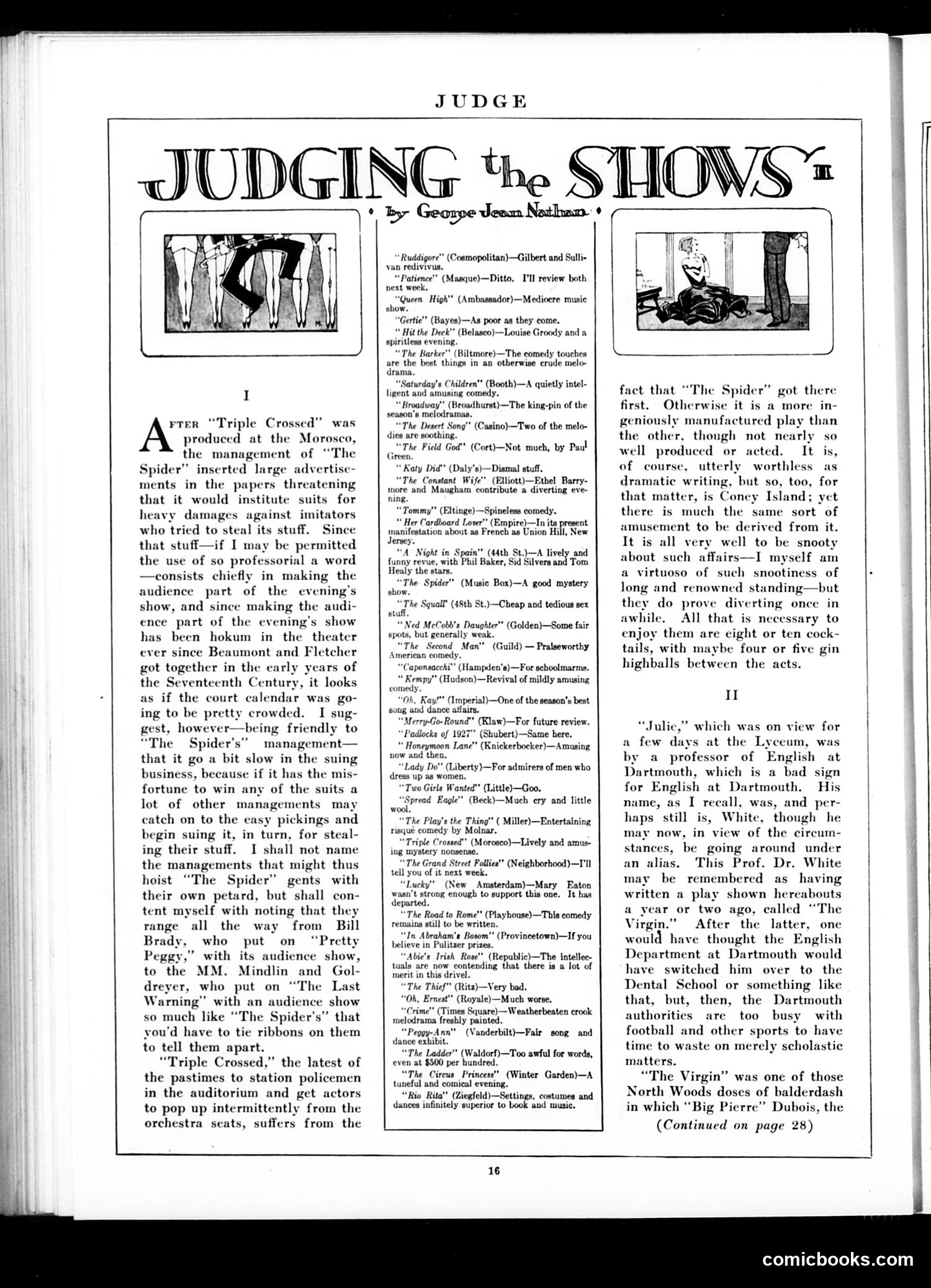
This is a theater critic's column by George Jean Nathan reviewing Broadway productions. The two small illustrations show typical theatrical scenes—likely depicting audience-participation gimmicks common in 1920s shows. The main satirical point concerns "The Spider," a play that threatened legal action against imitators for "stealing" its central theatrical device: audience participation. Nathan mocks this pretension, noting that interactive theater dates back to the 1600s (Beaumont and Fletcher). He warns the producers that winning such suits could backfire, as competing shows with similar audience-participation elements would then sue *them*—mentioning "Pretty Peggy" and "The Last Warning" as examples with nearly identical gimmicks. The column concludes with brief capsule reviews of various Broadway shows, mixing praise and dismissal. This reflects Judge's role as a satirical magazine covering contemporary entertainment and cultural trends for educated readers.
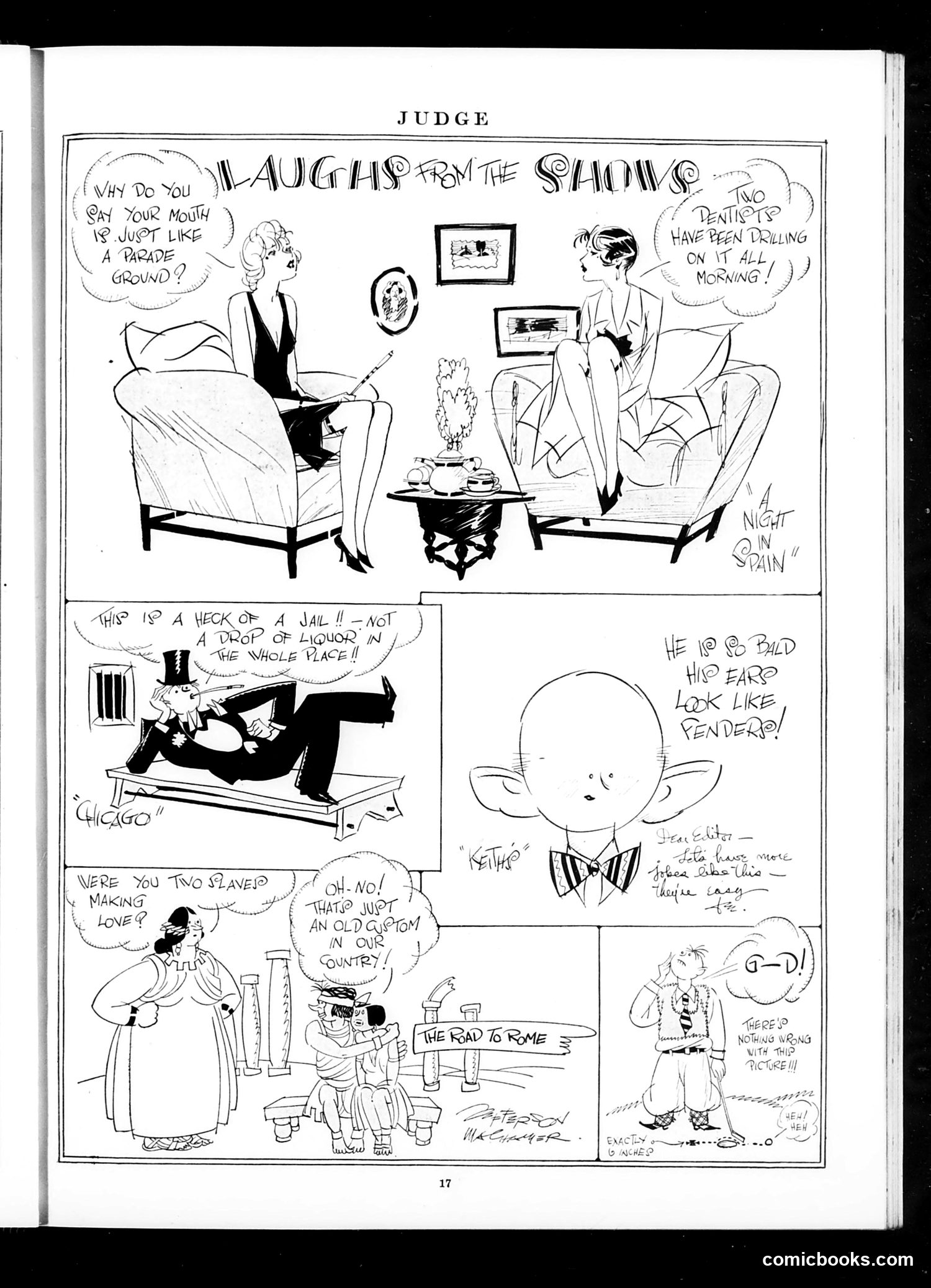
This page satirizes Prohibition-era hypocrisy and social pretense. The top panel shows two women in a living room discussing "laughs from the shows"—one claims to be a dentist who's been "drilling all morning," while the other boasts about her mouth being "just like a parade ground." The crude innuendo suggests they're masking illicit behavior with polite conversation. The lower panels mock Prohibition enforcement. A man lying on a jail cot complains there's "not a drop of liquor in the whole place"—absurd given widespread bootlegging. Another scene shows immigrants or working-class figures with a sign reading "The Road to Rome," referencing both classical civilization and the Vatican, while discussing "making love" as "an old custom in our country"—satirizing how Americans justify or rationalize behavior as cultural tradition. The cartoons mock both Prohibition's failure and the pretentious social codes people maintained while flouting the law.
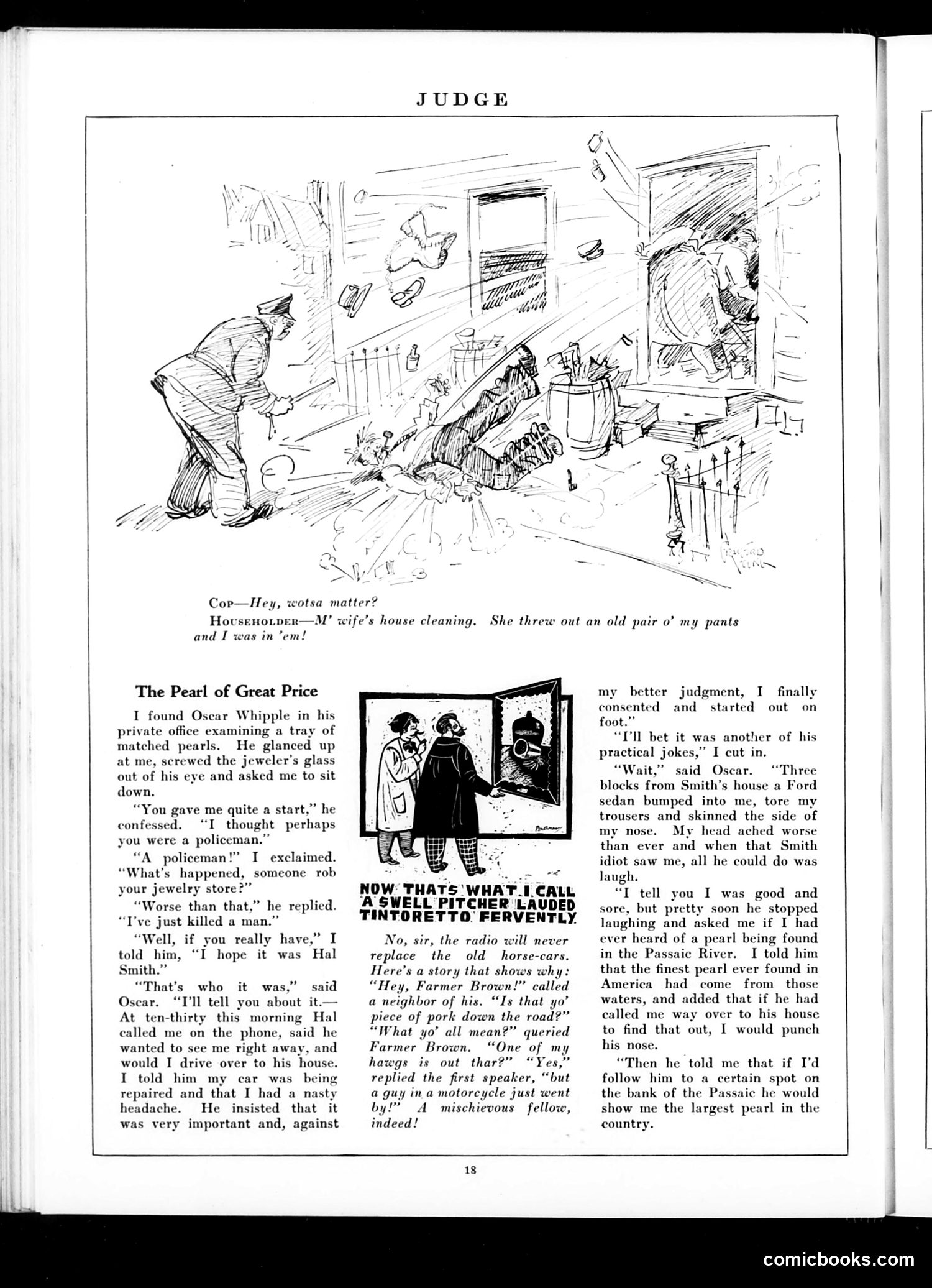
**Top Cartoon**: A domestic scene satirizing class and gender dynamics. A householder (likely middle-class) confronts a police officer about a disturbance caused by the householder's wife aggressively throwing out his old pants during house cleaning. The joke mocks both marital discord and wasteful domestic management—the wife discarding useful items without permission. **"The Pearl of Great Price" Story**: A narrative about jeweler Oscar Whipple who kills his acquaintance Hal Smith. Smith had repeatedly pranked Whipple (a car accident, public embarrassment), but lured him away with promises of finding a valuable pearl in the Passaic River. The story appears to be building toward revealing Smith's death was either accidental (during the pearl search) or justified revenge for the pranks. This is satirical fiction playing with crime narrative conventions. **Radio Advertisement Anecdote**: A brief joke contrasting radio entertainment with old street cars, using a farmer's story about a loose pig to suggest radio entertainment (like Tintoretto paintings) is overpraised. The page reflects early-to-mid 20th century American humor priorities: domestic conflict, practical jokes, crime melodrama, and technological change.
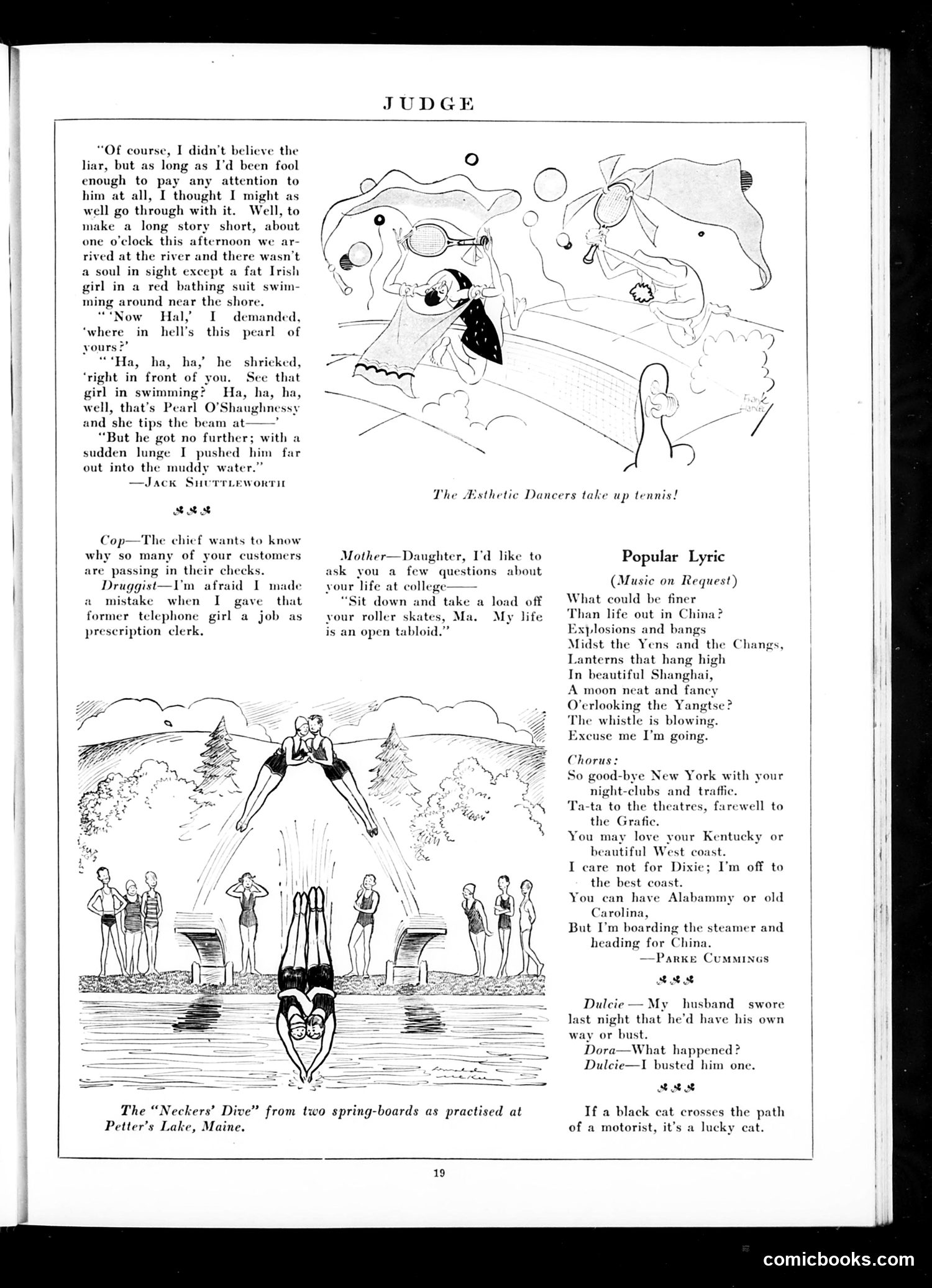
This page contains several satirical pieces reflecting 1920s American humor and social attitudes: **Top cartoon**: A man's angry reaction to being tricked—his friend "Hal" jokingly claims a fat Irish girl swimming in the river is his beautiful girlfriend "Pearl O'Shaughnessy." The joke relies on ethnic stereotyping (mocking Irish names and implying Irish women are overweight). The narrator's violent response—pushing his friend into the river—is presented as comedic justice for the deception. **Middle cartoon**: "The Neckers' Dive" depicts young people diving from springboards, satirizing modern youth behavior and the term "necking" (kissing/petting). **Sidebar jokes** mock workplace incompetence and marital discord in typical Judge style. **The "Popular Lyric"**: A song about abandoning New York for China plays on contemporary fascination with exotic travel and stereotypical references to Chinese imagery (Yangtse River, Shanghai, lanterns). The page reflects period attitudes toward immigration, class, gender, and international cultures through crude humor and caricature now recognized as offensive.
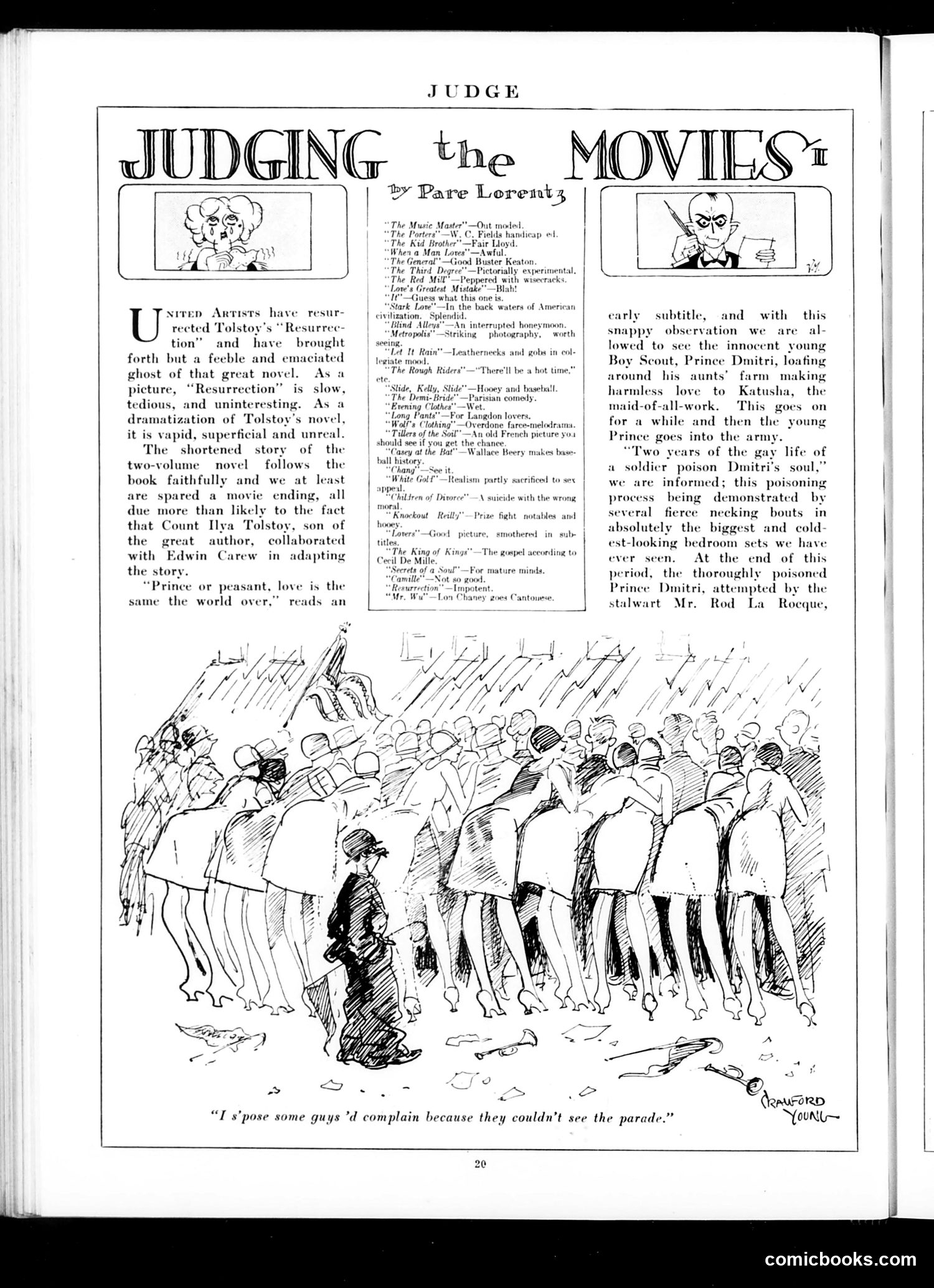
This page reviews a film adaptation of Tolstoy's novel "Resurrection." The critic argues the movie fails to capture the book's depth—it's slow, tedious, and superficial as drama. The plot synopsis follows Prince Dmitri, a young soldier who becomes morally corrupted by military life, depicted through "fierce necking bouts" in lavish bedroom sets. He pursues an innocent maid named Katusha before enlisting. The satire targets both the film's artistic failures and Hollywood's approach to adapting serious literature. By reducing Tolstoy's philosophical novel to melodrama about seduction and military excess, the adaptation trivializes the source material. The critic's observation that we're "spared a movie ending" (implying the studio compromised the story) suggests Hollywood prioritized commercial appeal over artistic integrity. The bottom cartoon (by Cesare Cunningham Young) jokes about parade viewing—possibly mocking the film's visual spectacle or crowd scenes.
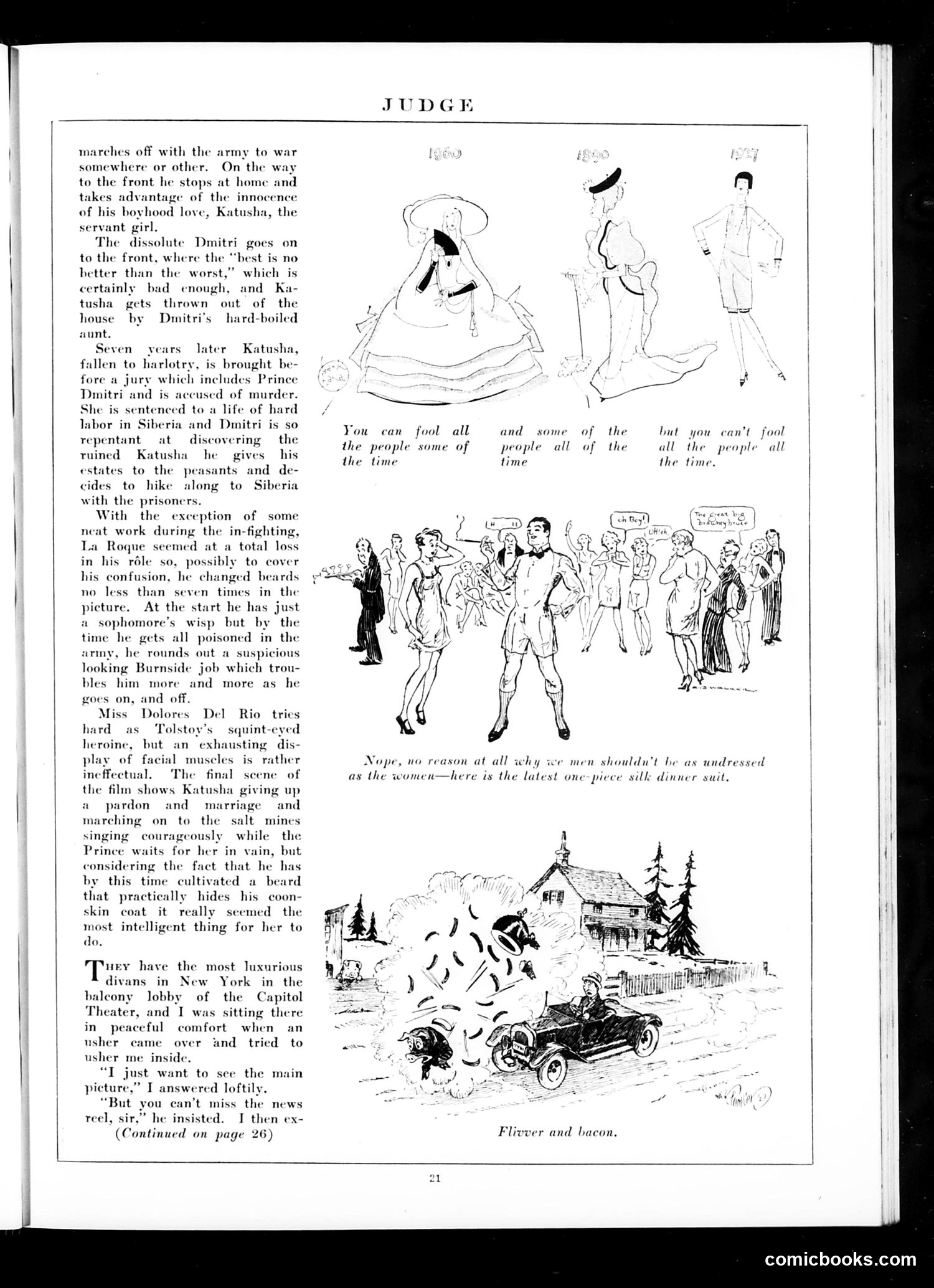
This page reviews a film adaptation of Tolstoy's *Resurrection*, criticizing actor La Roque's inconsistent beards (changing "no less than seven times") as a distraction from his weak performance. Actress Dolores Del Rio plays the fallen woman Katusha; the reviewer finds her "exhausting" facial expressions ineffectual despite the melodramatic plot. The satirical cartoons mock social hypocrisy: one contrasts the saying "you can fool all the people..." to suggest most people aren't fooled; another satirizes gender double standards in fashion, sarcastically suggesting men should adopt revealing "one-piece silk dinner suits" like women's clothing to match women's undressed appearance at dinner. The final cartoon shows a car ("Flivver"—slang for Model T Ford) and bacon, likely a non-sequitur gag about automotive or food topics unrelated to the main text. The page exemplifies *Judge*'s blend of theatrical criticism, social satire, and visual humor typical of 1920s American satirical magazines.
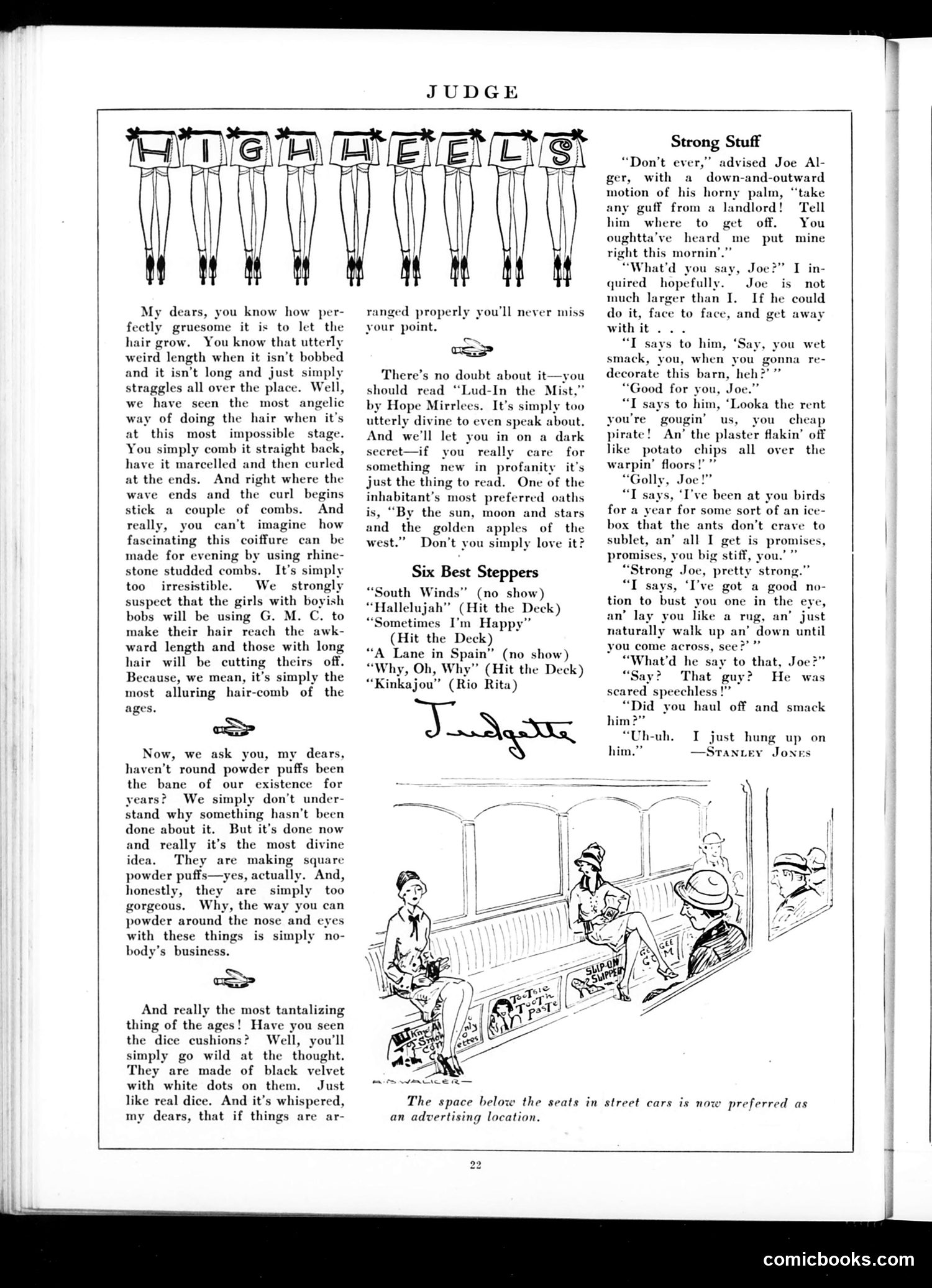
This page combines fashion/lifestyle commentary with humorous anecdotes. The top section, "High Heels," satirizes women's fashion obsessions, specifically the transitional "bob" hairstyle of the 1920s—mocking how women will artificially grow or cut their hair to achieve the "impossible" in-between length, then use decorative combs and accessories to make it fashionable. The text drily notes this vanity will benefit comb manufacturers. The middle sections humorously advertise novelty items: square powder puffs and dice-decorated cushions—frivolous luxury goods presented as essential. "Strong Stuff" is a comedic dialogue where Joe Alger brags about verbally confronting his landlord about apartment conditions (peeling plaster, broken floors) with increasingly colorful insults and threats—then admits he merely hung up the phone. The humor lies in the gap between his boastful recounting and his actual cowardice. The bottom illustration shows advertising space in streetcars, a common venue for commercial messaging.
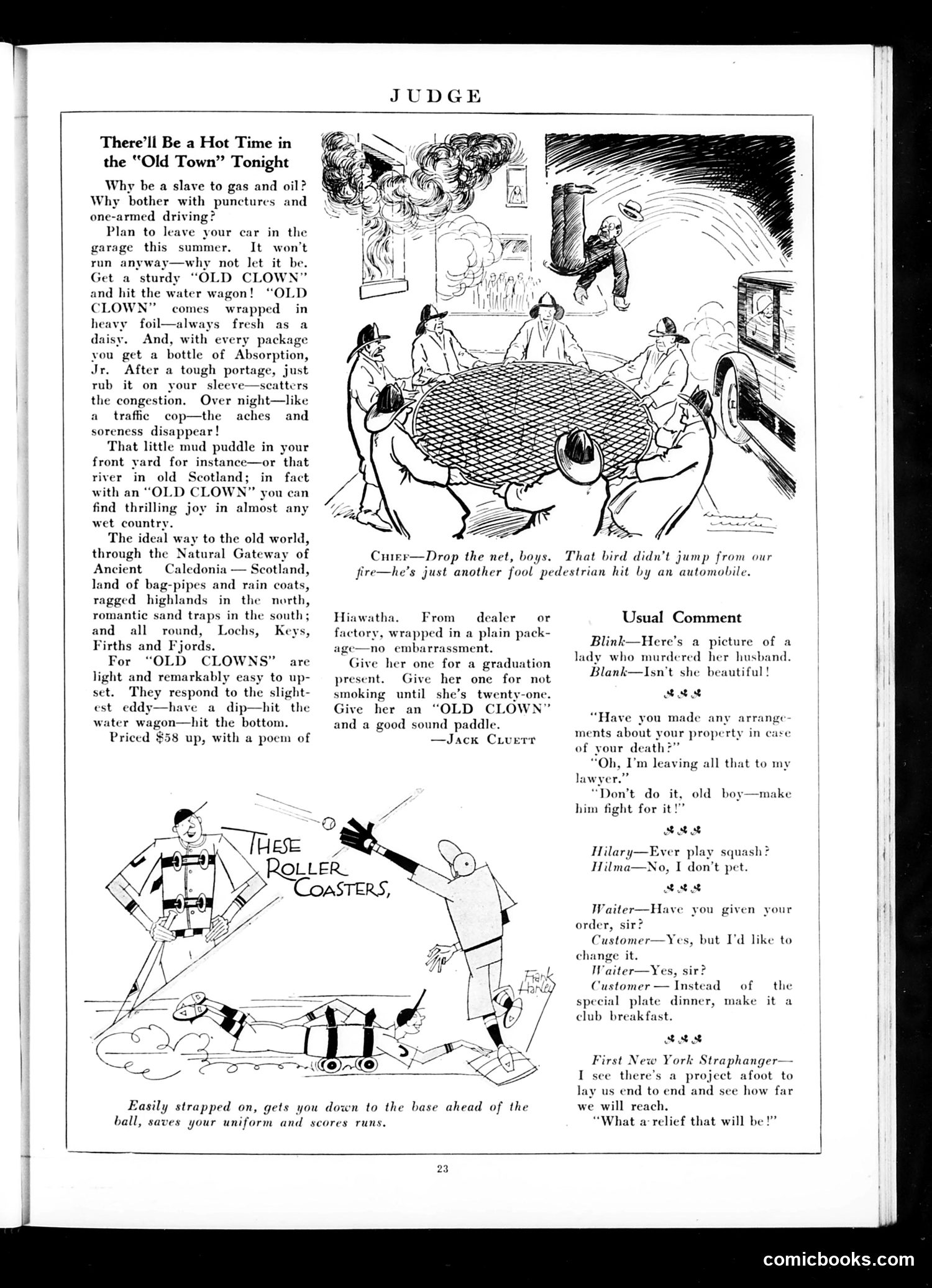
This page from *Judge* contains absurdist humor targeting early 1900s automobile culture and social anxieties. **Main Advertisement**: The "Old Clown" water wagon is a satirical product mocking car owners. The text ironically suggests abandoning automobiles—plagued by breakdowns, punctures, and unreliability—in favor of horse-drawn water wagons for summer travel. It's commentary on automobile manufacturing's failure to deliver reliable vehicles and the frustration of early motorists. **Roller Coasters Cartoon**: A humorous diagram showing roller coaster mechanics, satirizing the thrills and dangers of new amusement park technology. **"Usual Comment" Section**: Brief joke vignettes mocking contemporary attitudes—including a darkly comedic reference to a woman murdering her husband, workplace hierarchies, and class differences. **Overall Tone**: The satire reflects genuine public skepticism about automobiles' practicality and safety in the early automotive era, presented through exaggerated, absurdist advertising parody.
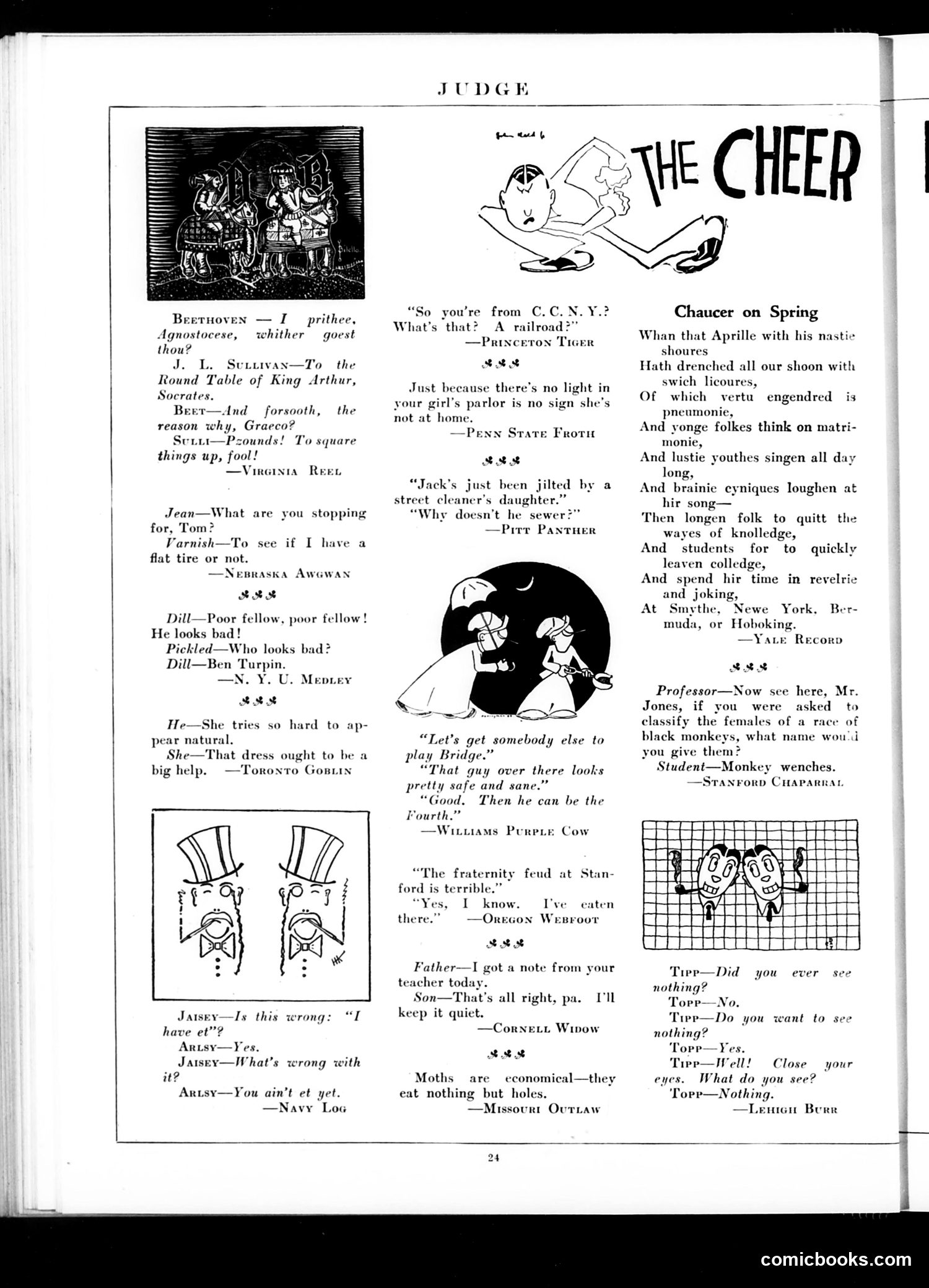
This page presents early-20th-century humor typical of *Judge* magazine—a mix of one-liners, visual gags, and literary parody aimed at educated readers. **Key content:** The prominent piece is a mock-Chaucerian poem ("Chaucer on Spring") that parodies Middle English verse to satirize college students abandoning academics for spring break revelry—referencing actual destinations like Bermuda and "Hoboking" (Hoboken, New Jersey). The jokes target contemporary college culture (C.C.N.Y., Stanford, Princeton references), urban life (flat tires, parlor courting), and social pretension. One gag mocks ben Turpin, likely the silent-film comedian. **Visual gags** include crude cartoon illustrations of bridge-playing couples and a simple optical illusion ("see nothing"). The humor relies on wordplay, social observation, and assumed familiarity with collegiate and urban middle-class life of the era. Most jokes are gentle rather than biting—light entertainment for educated magazine readers.
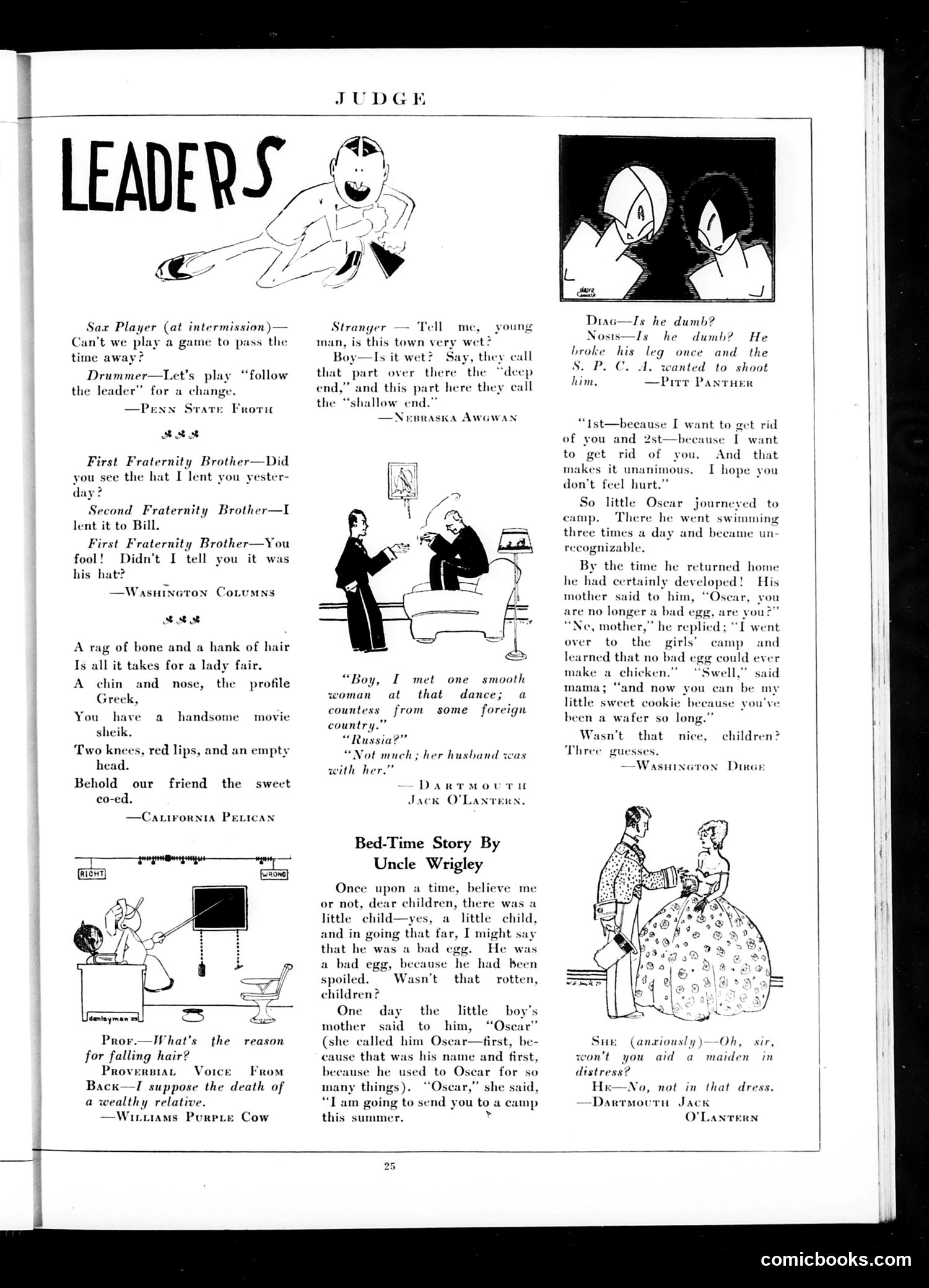
This page contains several unrelated humor pieces typical of Judge's satirical format: **"Leaders"** (top): A cartoon about musicians playing "follow the leader" to pass time during an intermission—a simple visual gag with no political content. **Fraternity joke**: Two brothers argue over a borrowed hat; the first lent it to the second, who lent it to Bill—only to discover it was Bill's hat all along. A circular logic joke about carelessness. **"Bed-Time Story by Uncle Wrigley"** (main feature): A children's story about spoiled boy "Oscar" sent to summer camp, where he swims constantly and transforms. When he returns, his mother asks if he's still a "bad egg," and he replies he learned at "the girls' camp" that "no bad egg could ever make a chicken"—a pun treating eggs/chickens as metaphors for behavior reform. **Minor jokes**: Include quips about physical attractiveness ("what makes a co-ed"), wet towns, and a professor's hair loss. The page is primarily **humorous entertainment with no clear political satire**—representative of Judge's general-audience comedy during this period.
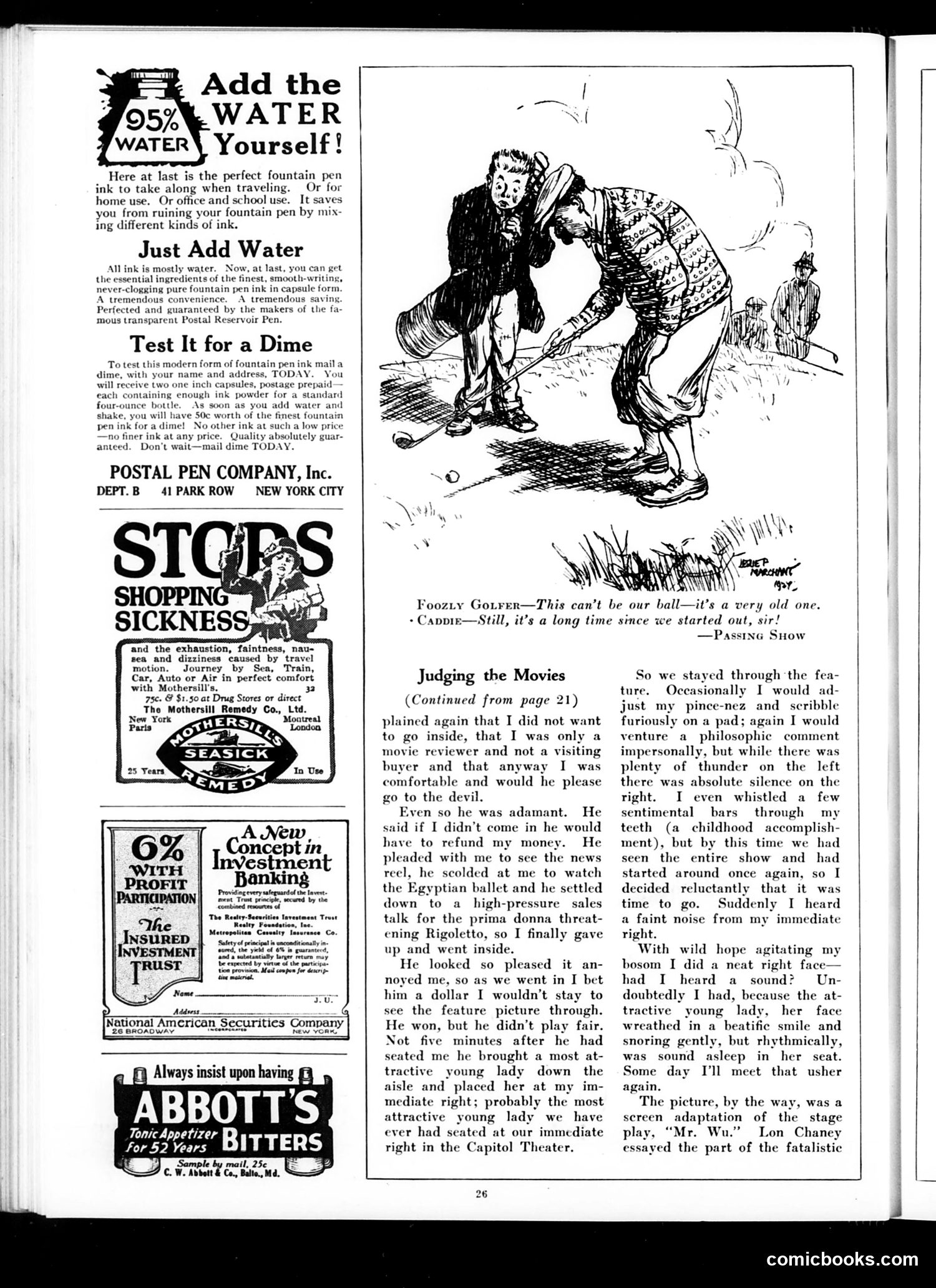
This page is primarily **advertisements and light humor**, not political satire. ## Main Content: The cartoon depicts two golfers discussing a worn golf ball—a simple visual gag about the ball's age. The caption jokes that they've been playing for so long the ball is ancient. This reflects early 20th-century leisure culture and golf's popularity among the middle/upper classes. ## The Advertisements: The page features multiple product ads typical of the era: - **Postal Pen Company**: "Add water yourself" fountain pen ink—convenient for travelers - **Mothersill's**: Motion sickness remedy for various travel modes - **Abbott's Bitters**: Tonic marketed as an "appetizer" (a patent medicine) - **Investment banking services** promoting 6% guaranteed returns ## Cultural Context: These ads reflect concerns of the 1920s-30s: travel convenience, modern commerce, and investment opportunities. The patent medicines were common before FDA regulations. The "Judging the Movies" article discusses a theater date, reflecting cinema's growing cultural prominence. **There is no significant political satire on this page**—it's a snapshot of period advertising and light leisure humor.
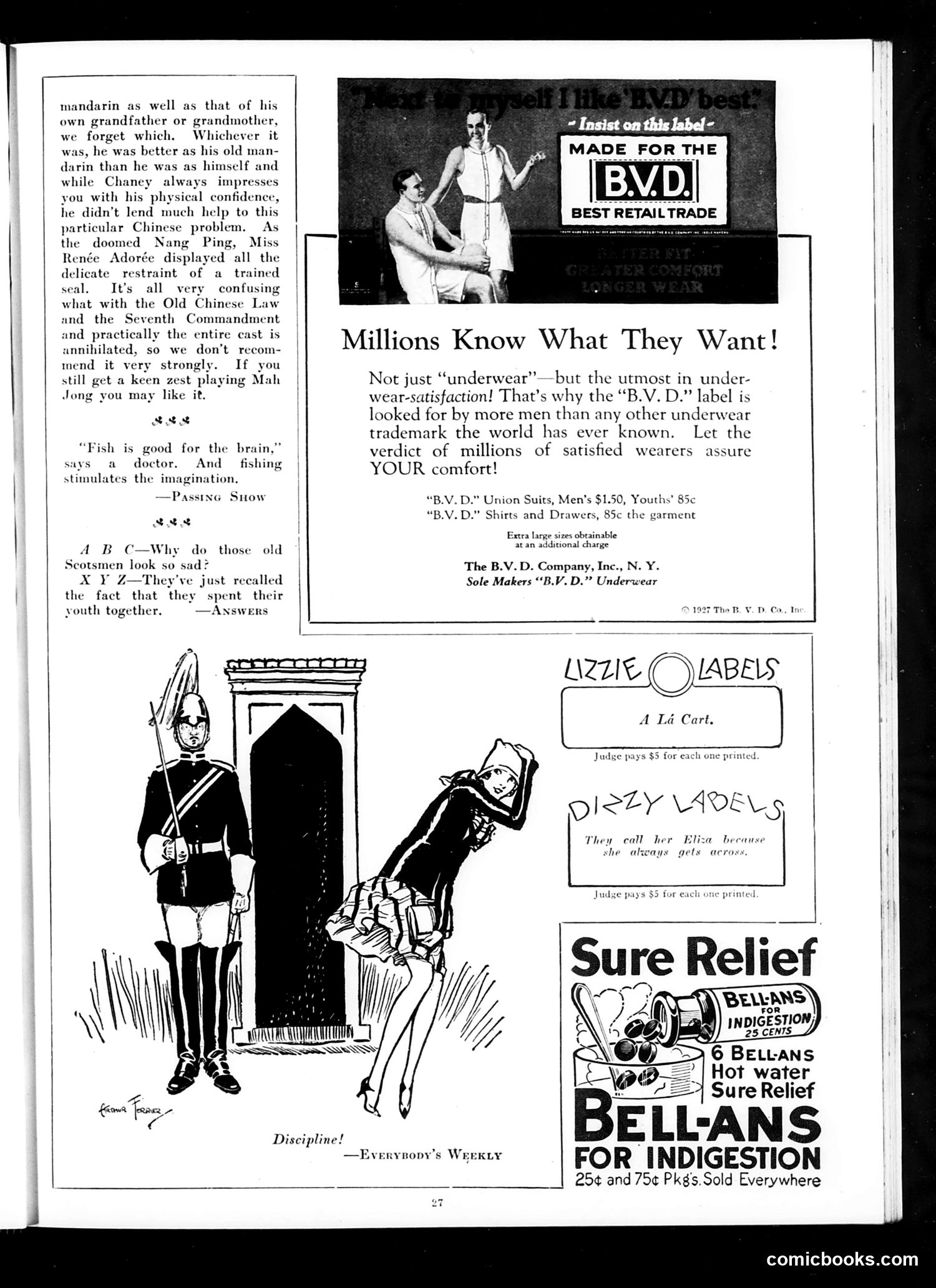
This is primarily an **advertising page** with a small amount of editorial content. The main feature is a **B.V.D. underwear advertisement** showing two men measuring garments, emphasizing the brand's quality and popularity. Below that is a cartoon titled "Discipline!" from *Everybody's Weekly*, depicting a British soldier standing guard while a woman in revealing clothing leans against a pillar—likely satirizing military discipline and the tension between propriety and temptation. The page also includes several minor joke sections (labeled "A B C" and "X Y Z") with puns, and **product advertisements** for Lizzie Labels and Bellans antacid. The top portion contains partial text reviewing what appears to be a Lon Chaney film involving Chinese characters and plot confusion, criticizing the casting and narrative. The overall content is typical of 1920s-era magazine advertising mixed with light satirical humor rather than serious political commentary.
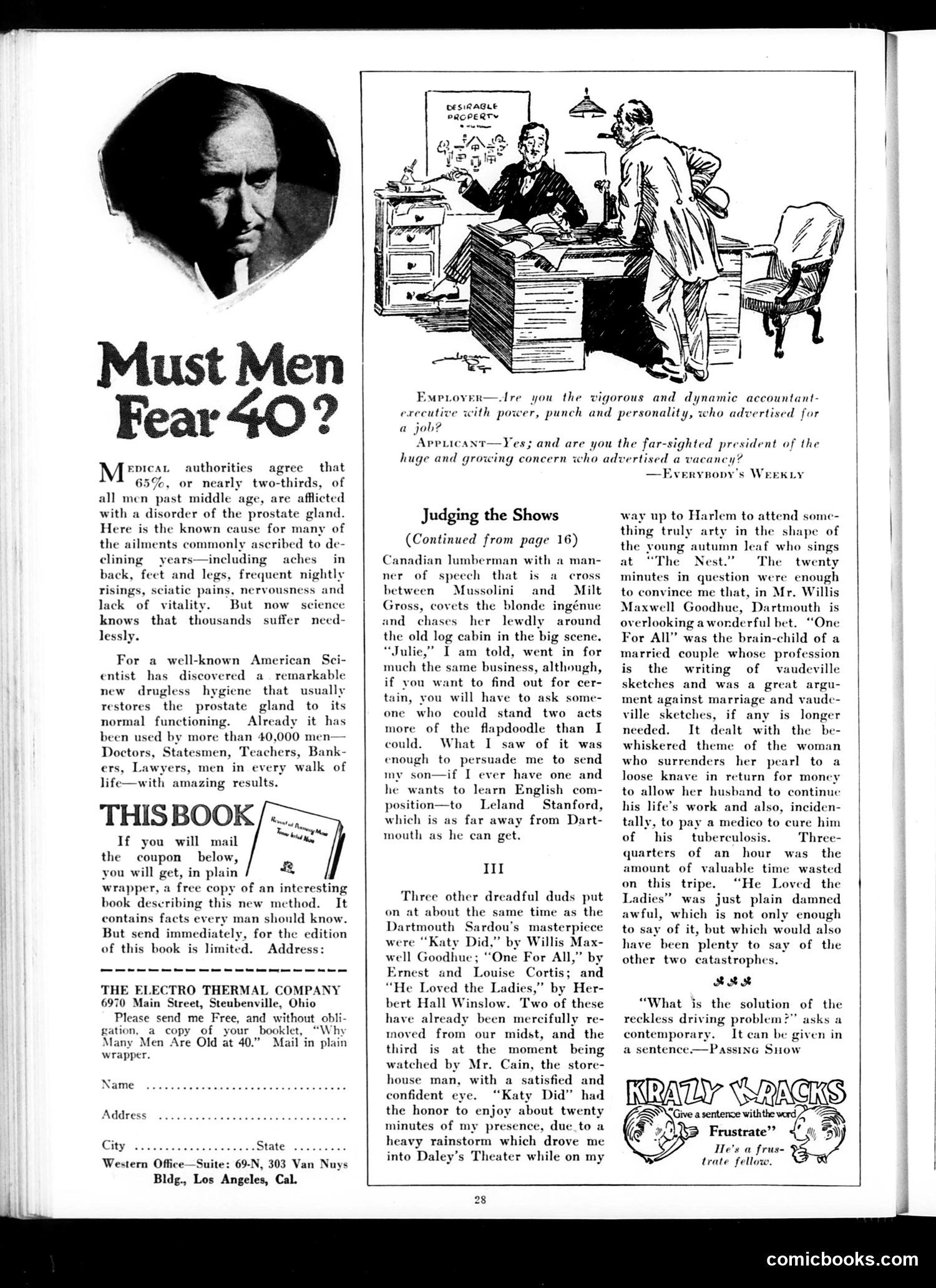
This page combines **medical advertising with theater criticism**, reflecting early 20th-century Judge magazine content. **Left side:** A dubious advertisement for a "prostate gland" treatment, claiming to cure ailments in aging men. The language—"drugless hygiene," free confidential booklets mailed in "plain wrapper"—suggests this was quasi-legitimate medical marketing of the era, likely making exaggerated health claims that modern readers would recognize as snake oil. **Right side:** A theater review mocking several Broadway plays as terrible ("dreadful duds"), including titles like "Katy Did" and "He Loved the Ladies." The critic dismissively describes overwrought plots and bad acting, sarcastically praising one playwright for proving marriage and vaudeville sketches are mistakes. **The cartoon at top right** depicts a job interview where an applicant is interrogated about being qualified for an advertised position—a typical Judge satirical commentary on workplace absurdities. The page reflects Judge's dual purpose: entertainment through both advertising and theatrical criticism aimed at educated readers.
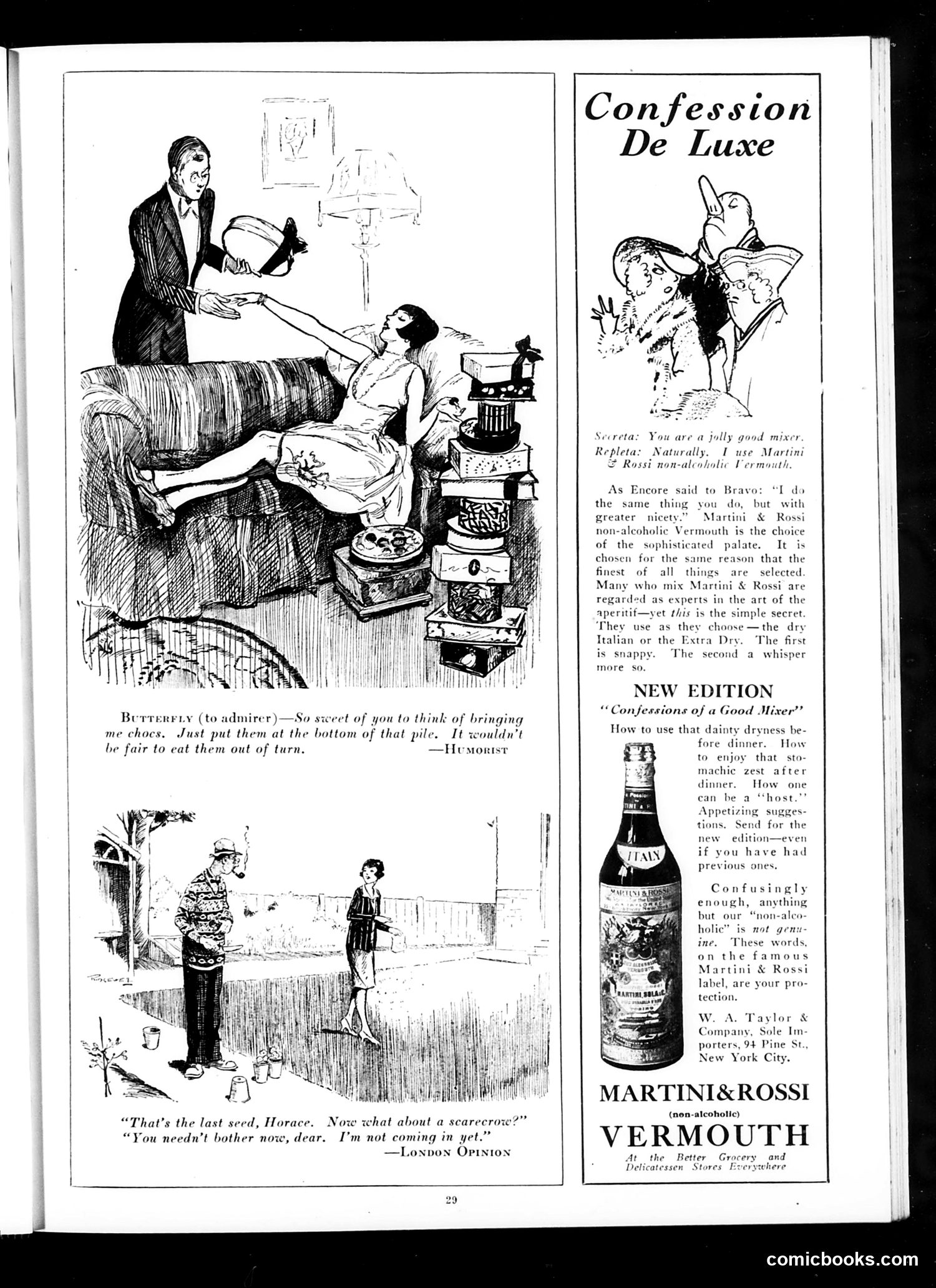
This page contains two unrelated cartoons and an advertisement for Martini & Rossi vermouth. **Top cartoon:** A woman receives chocolates from an admirer but insists on eating them in orderly fashion from a large pile, refusing to prioritize the gift. The humor satirizes excessive politeness or affected propriety. **Bottom cartoon:** A couple discusses gardening; the wife says she won't come in yet as her husband asks about a scarecrow. The joke plays on marital dynamics and domestic routine. **Right side:** A full-page advertisement for non-alcoholic Martini & Rossi vermouth, promoting it as the drink of sophisticated "mixers" (cocktail drinkers). The ad references a book called "Confessions of a Good Mixer" and emphasizes the product's authenticity by warning against counterfeits. This reflects Prohibition-era marketing (1920s-1930s), when alcohol was banned in America, so manufacturers promoted non-alcoholic alternatives.
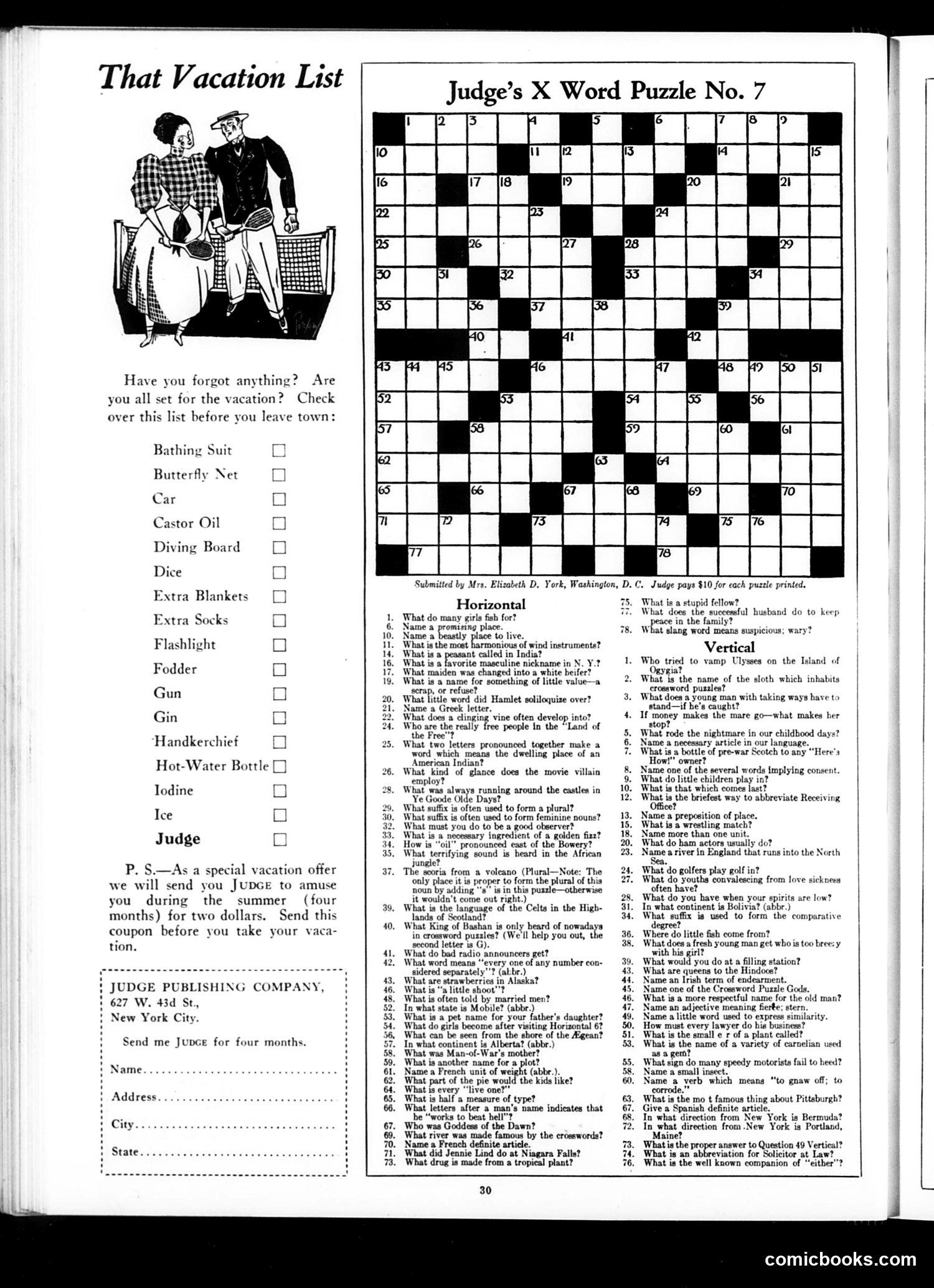
This page from *Judge* magazine presents two humorous features aimed at summer vacationers: **"That Vacation List"** is a lighthearted checklist offering practical (and absurd) items to pack before leaving town—ranging from sensible items like "Bathing Suit" and "Flashlight" to incongruous ones like "Dice," "Gin," and "Gun." The humor lies in treating frivolous or questionable vacation necessities as equally important as essentials. The accompanying illustration shows a couple relaxing, and the copy includes a promotional offer to subscribe to *Judge* magazine during summer travels. **"Judge's X Word Puzzle No. 7"** is a crossword puzzle with clues submitted by a reader. The clues are deliberately playful and riddling, often with double meanings or clever wordplay—typical of early crossword puzzle culture. Together, these pages reflect early-20th-century leisure culture and *Judge*'s function as light entertainment for middle-class summer vacationers, combining practical advice with whimsy.
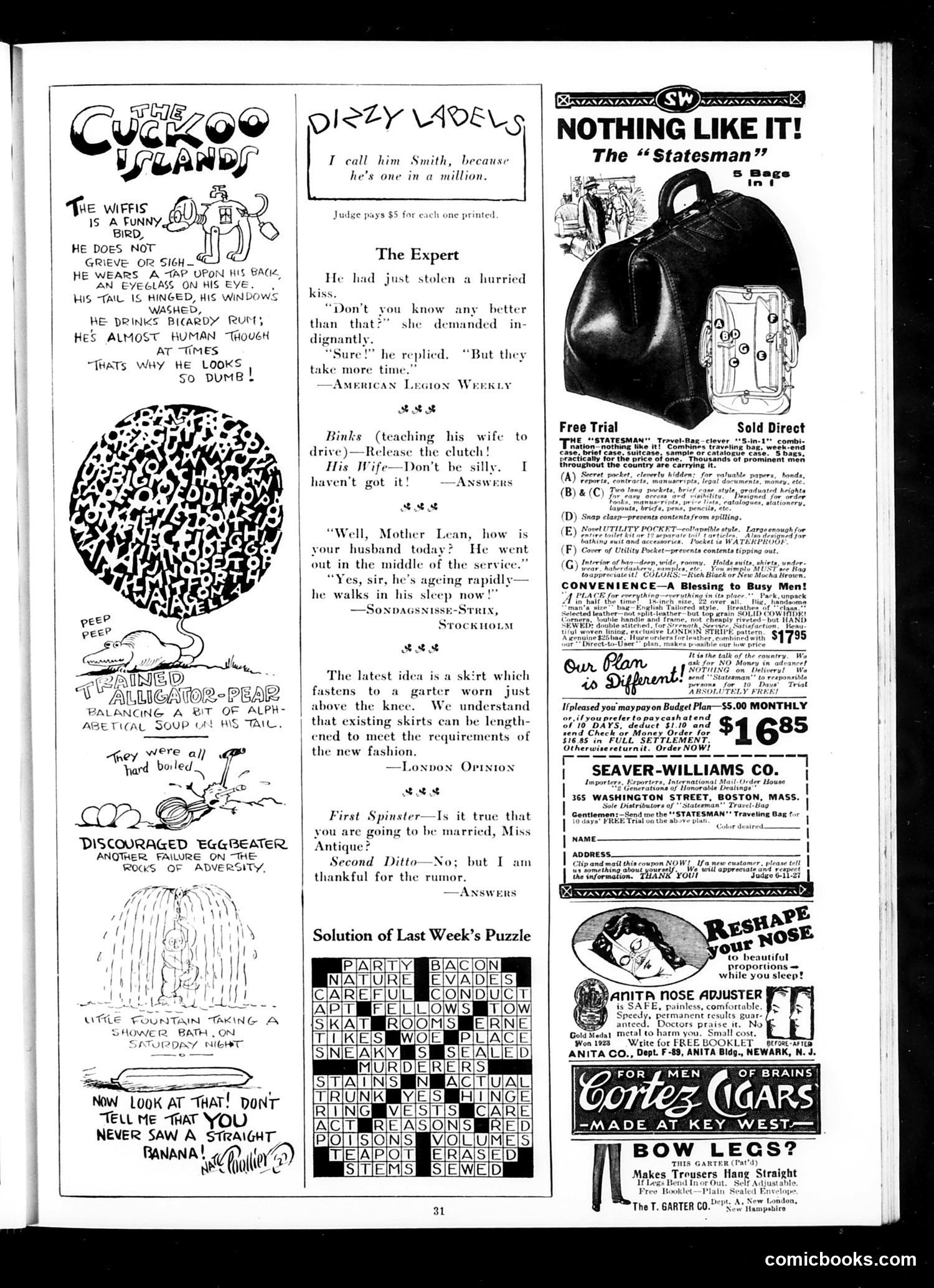
This page from the satirical magazine *Judge* contains humor pieces typical of early-20th-century American comedy, along with period advertisements. **Left side cartoons:** Humorous sketches mock everyday absurdities—a bumbling bird character, a confused driving lesson, and complaints about modern fashions (short skirts). The humor relies on physical comedy and domestic situations rather than political commentary. **"Dizzy Ladies" section:** Brief joke exchanges about courtship and marriage mishaps—a common *Judge* feature lampooning gender relations and social interactions of the era. **Advertisements:** The dominant right side promotes products now obsolete or concerning by modern standards: a traveling bag ("Statesman"), a nose-reshaping device ("Anita Nose Adjuster"), cigars, and treatments for "bow legs." **Overall context:** This represents *Judge*'s typical mix of light domestic humor and period advertising targeting middle-class readers. The comedy is genteel rather than pointed, reflecting conventional 1920s sensibilities about courtship, fashion, and consumer goods.
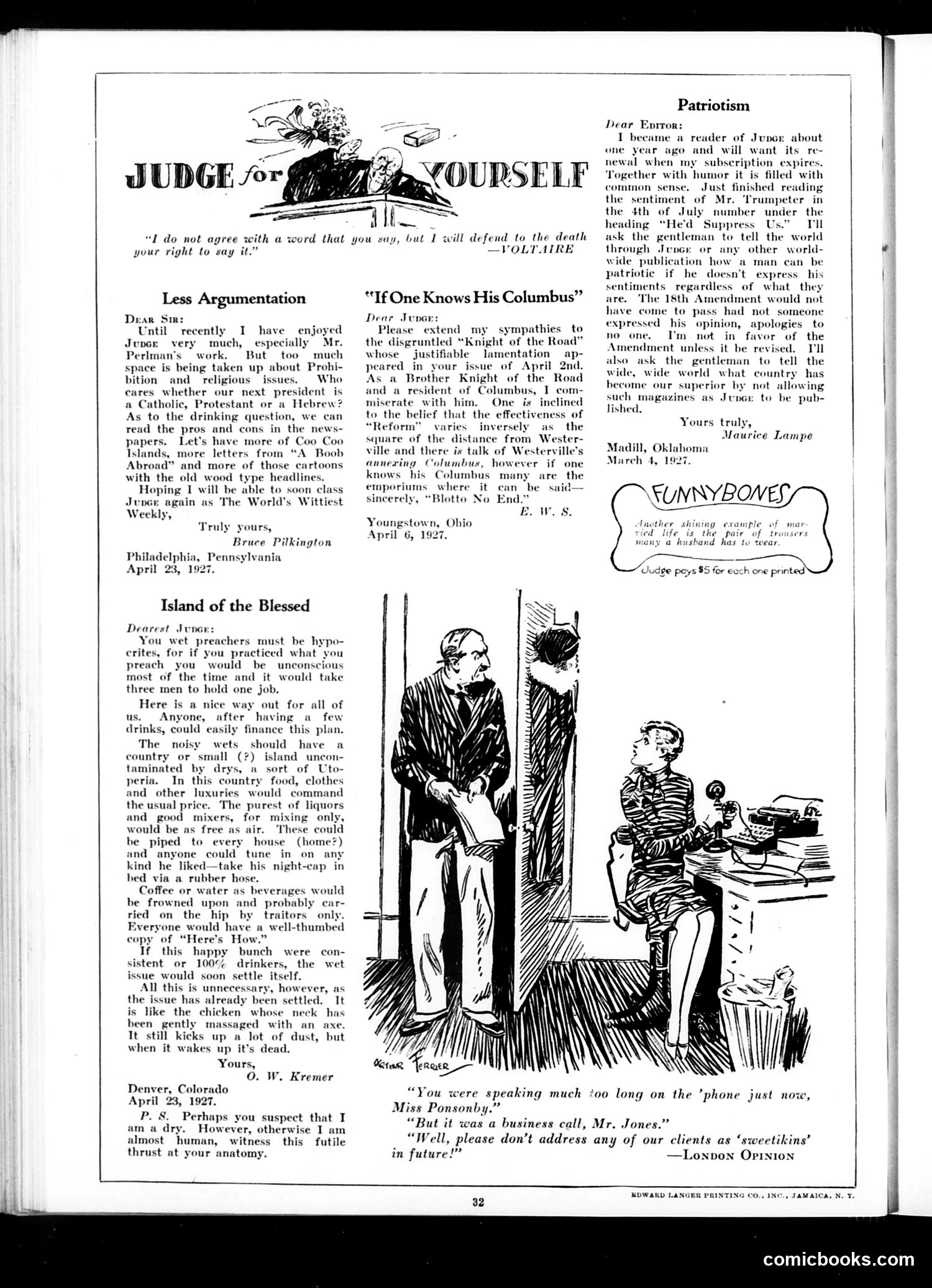
This page collects reader letters addressing **Prohibition and free speech** — major political controversies of the 1920s. **Key content:** The masthead quote from Voltaire establishes the page's theme: defending speech rights even when disagreeing. **Letters discuss:** - A reader requesting Judge publish less about Prohibition/religion - A satirical proposal for a "wet" island where alcohol flows freely, mocking both drinkers and prohibitionists - A complaint about police enforcement in Columbus, Ohio (comparing "reform" effectiveness to distance from Westerville, likely referencing dry vs. wet municipalities) - A defense of free speech regarding Prohibition criticism, arguing the 18th Amendment wouldn't exist without people expressing opinions **The cartoon** shows a man being interrupted during a phone call—a domestic/business humor piece unrelated to the political letters. The page reflects 1920s tension between **Prohibition advocates and opponents**, with Judge's editors platforming both viewpoints while emphasizing libertarian free-speech principles. The tone is satirical toward both "wets" and "drys."
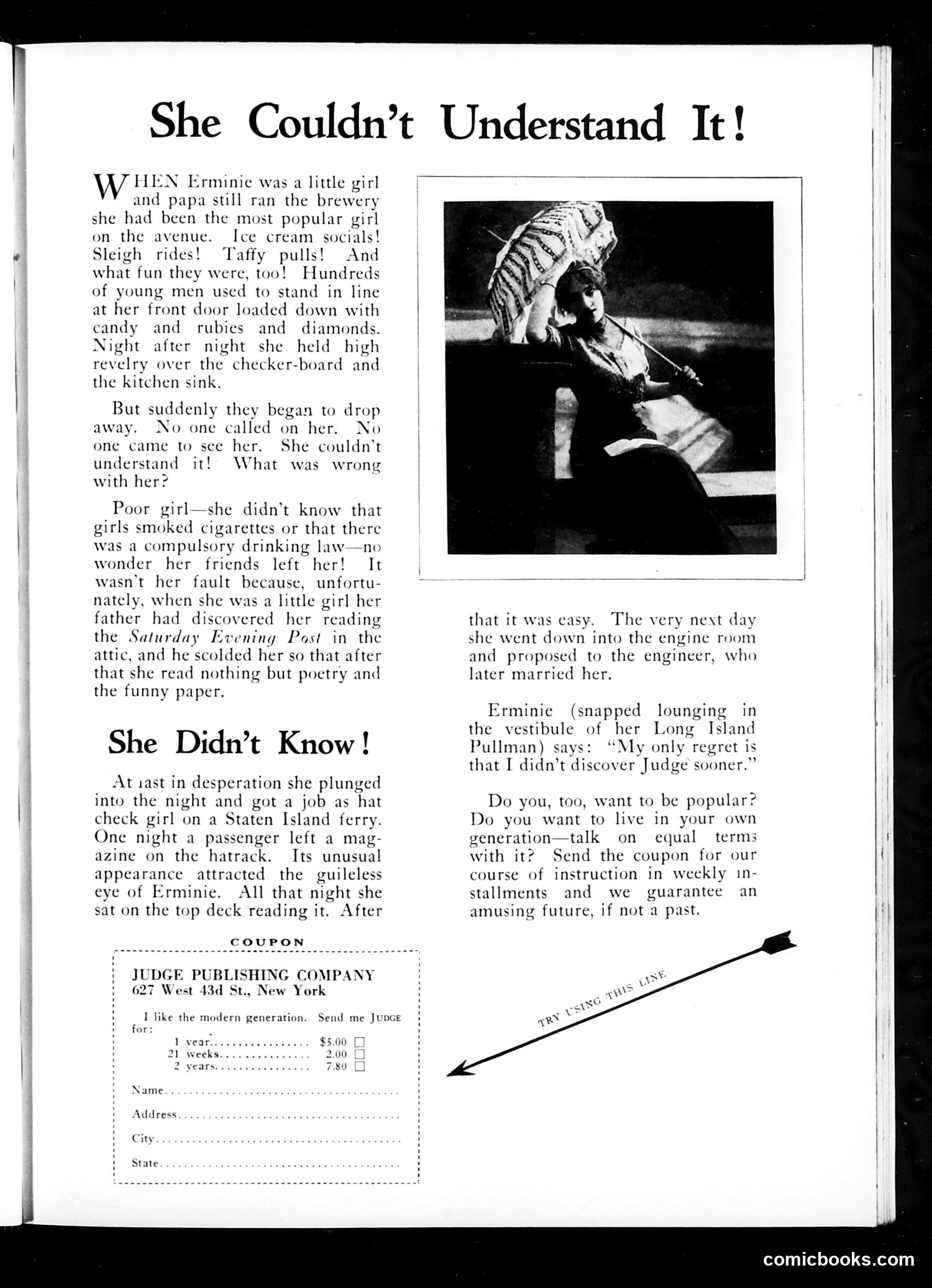
This is a Judge magazine advertisement disguised as satirical fiction, promoting a subscription service. The story mocks sheltered young women, particularly those raised without exposure to modern culture. Erminie loses her popularity because she's ignorant of contemporary social norms—smoking, drinking laws, and current events—due to her father's strict censorship (he forbade her reading the *Saturday Evening Post*). The satire targets two audiences: it ridicules outdated parental control while simultaneously promoting Judge magazine itself as the solution. The punchline reveals that reading Judge taught Erminie how to fit into "modern generation" society, making her confident enough to marry an engineer. The coupon below transforms the joke into a direct pitch: readers who want to be "popular" and "live in your own generation" should subscribe to Judge's weekly installments. It's self-promotional satire—using comedy about generational disconnect to sell subscriptions to readers anxious about staying current with modern life.
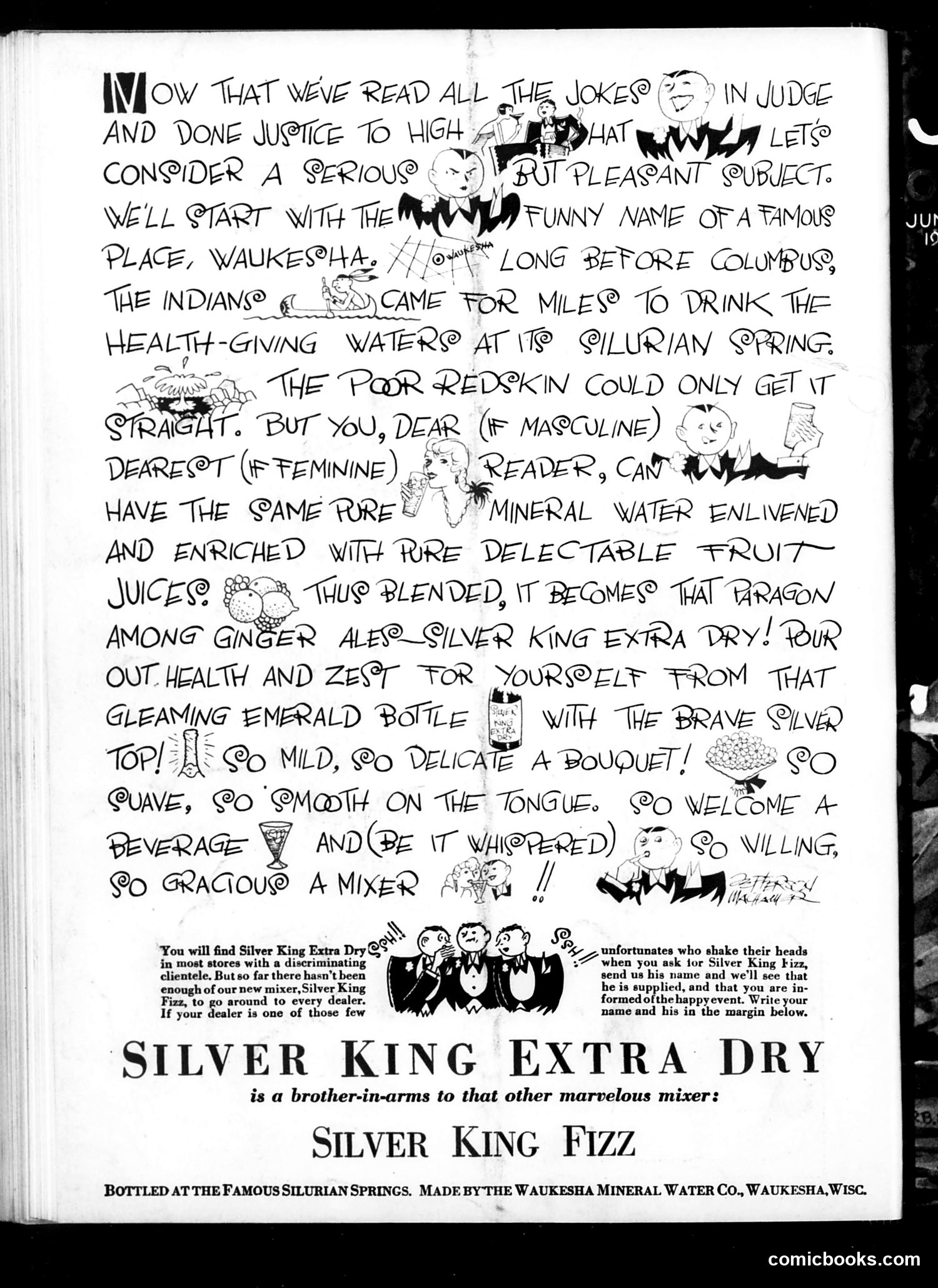
This is primarily an **advertisement for Silver King Extra Dry mineral water**, presented as satirical editorial content. The handwritten text humorously frames the product pitch as a "serious but pleasant subject." The satire references **Waukesha, Wisconsin's famous mineral springs**, which Native Americans reportedly visited for health benefits before European colonization. The ad playfully suggests that while "poor redskins" could only access the spring water directly, modern readers (addressed as "dear" masculine and feminine readers) can now enjoy it enriched with fruit juices—transformed into an elegant mixer beverage. The joke conflates Native American history with consumer marketing, using faux-respectful language ("that paragon among ginger ales") to sell the product as a sophisticated cocktail mixer. The tone is lighthearted rather than overtly malicious, but the content reflects period attitudes toward Indigenous peoples and casual appropriation of their history for commercial purposes. The page demonstrates how early 20th-century advertising exploited historical narratives for marketing appeal.