
Judge, 1927-06-11 · page 16 of 36
Judge — June 11, 1927 — page 16: what you’re looking at
What you’re looking at
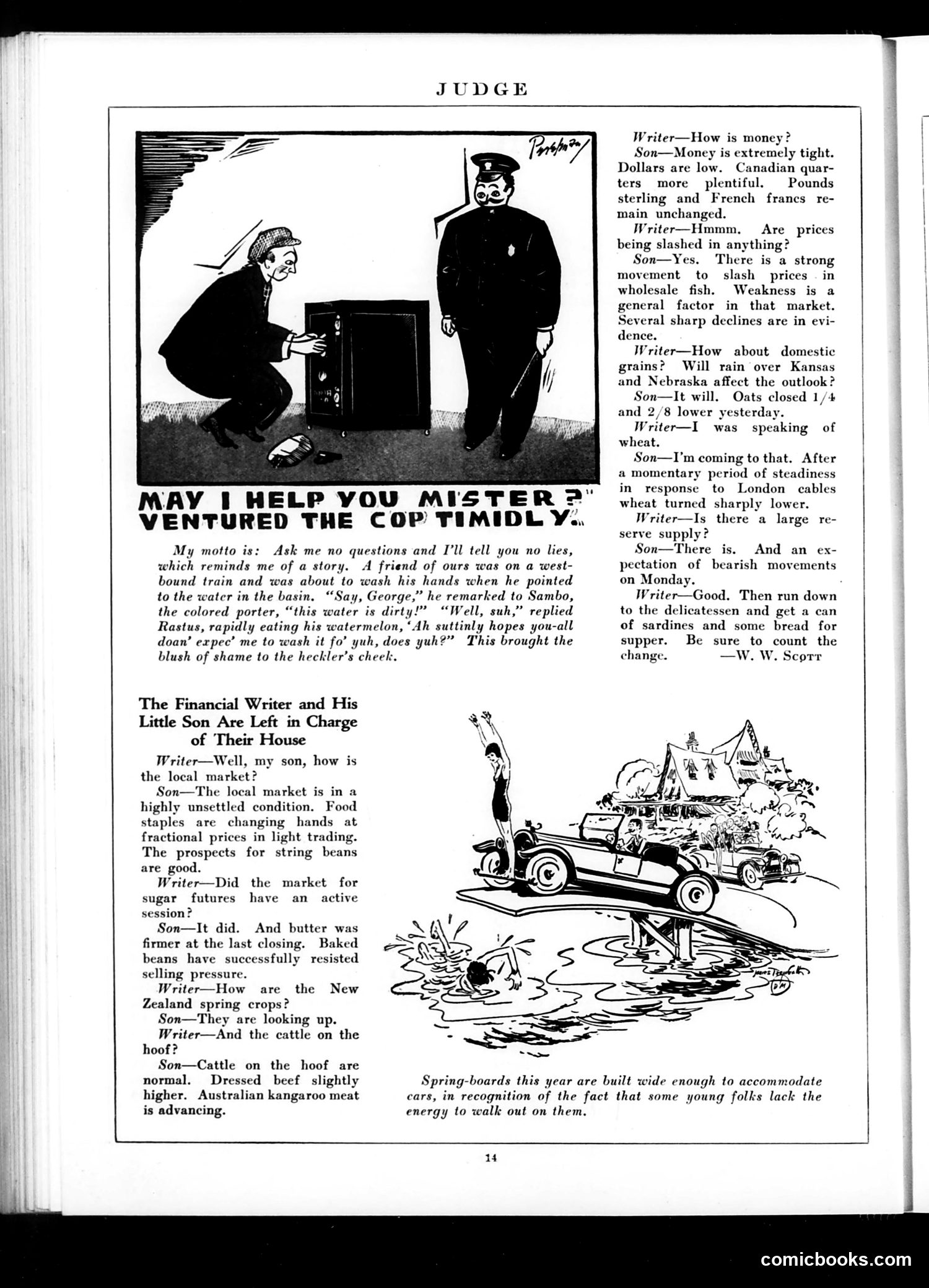
This page contains two satirical pieces targeting different subjects: **Top cartoon**: A cop timidly asks a burglar for help. The joke plays on role reversal—the authority figure is helpless before the criminal. The accompanying anecdote mocks racial stereotypes, featuring a racist caricature of a Black porter named "Rastus" who refuses to clean dirty water. **Main article**: "The Financial Writer and His Little Son" satirizes a father and son discussing markets using absurdly sophisticated financial jargon—futures, trading, bearish movements—for mundane groceries. The humor lies in the son speaking like a Wall Street analyst about beans and fish prices. The final instruction to "count the change" deflates the pretentious financial language with pedestrian reality. **Bottom cartoon**: Shows a car accident near a springboard at a house, captioning that springboards are now "wide enough to accommodate cars" because young people lack energy to "walk out on them"—a dark joke about suicide. The page reflects 1920s-30s anxieties about financial markets, class, and generational decline.
📄 Transcribed text from this page (OCR, searchable)
Machine-transcribed from the original scan — historical spelling and the odd misread are preserved.
JUDGE MAY 1 HELP YOU MISTER => VENTURED THE COP TIMIDL Y My motto is: Ask me no questions and I'll tell you no lies, which reminds me of a story. A friend of ours was on a west- bound train and was about to wash his hands when he pointed to the water in the basin. “Say, George,” he remarked to Sambo, the colored porter, “this water is dirty!” “Well, suh,” replied Rastus, rapidly eating his watermelon, ‘Ah suttinly hopes you-all doan’ expec’ me to wash it fo’ yuh, does yuh?” This brought the blush of shame to the heckler’s cheek. The Financial Writer and His Little Son Are Left in Charge of Their House Writer—Well, my son, how is the local market? Son—The local market is in a highly unsettled condition. Food staples are changing hands at fractional prices in light trading. The prospects for string beans are good. Writer—Did the market for sugar futures have an active session? Son—It did. And butter was firmer at the last closing. Baked beans have successfully resisted selling pressure. Writer—How are the New Zealand spring crops? Son—They are looking up. Writer—And the cattle on the hoof? Son—Cattle on the hoof are Writer—How is money? Son—Money is extremely tight. Dollars are low. Canadian quar- ters more plentiful. Pounds sterling and French francs re- main unchanged. Write—Hmmm, Are prices being slashed in anything? Son—Yes. There is a strong movement to slash prices — in wholesale fish. Weakness is a general factor in that market. Several sharp declines are in evi- dence. Writer—How about dome: grains? Will rain over K. and Nebraska affect the outlook? Son—lIt will. Oats closed 1/4 and 2/8 lower yesterday. Writer—I_ was speaking of wheat. Son—I'm coming to that. After a mome 'y period of steadiness in response to London cables wheat turned sharply lower. Writer—Is there a large re- serve supply? Son—There is. And an ex- pectation of bearish movements on Monday. Writer—Good. Then run down to the delicatessen and get a can of sardines and some bread for supper. Be sure to count the change. —W. W. Scorr normal. Dressed beef slightly Spring-boards this year are built wide enough to accommodate higher. Australian kangaroo meat cars, in recognition of the fact that some young folks lack the is advancing. energy to walk out on them. 14 comicbooks.com