
Judge, 1927-06-11 · page 15 of 36
Judge — June 11, 1927 — page 15: what you’re looking at
What you’re looking at
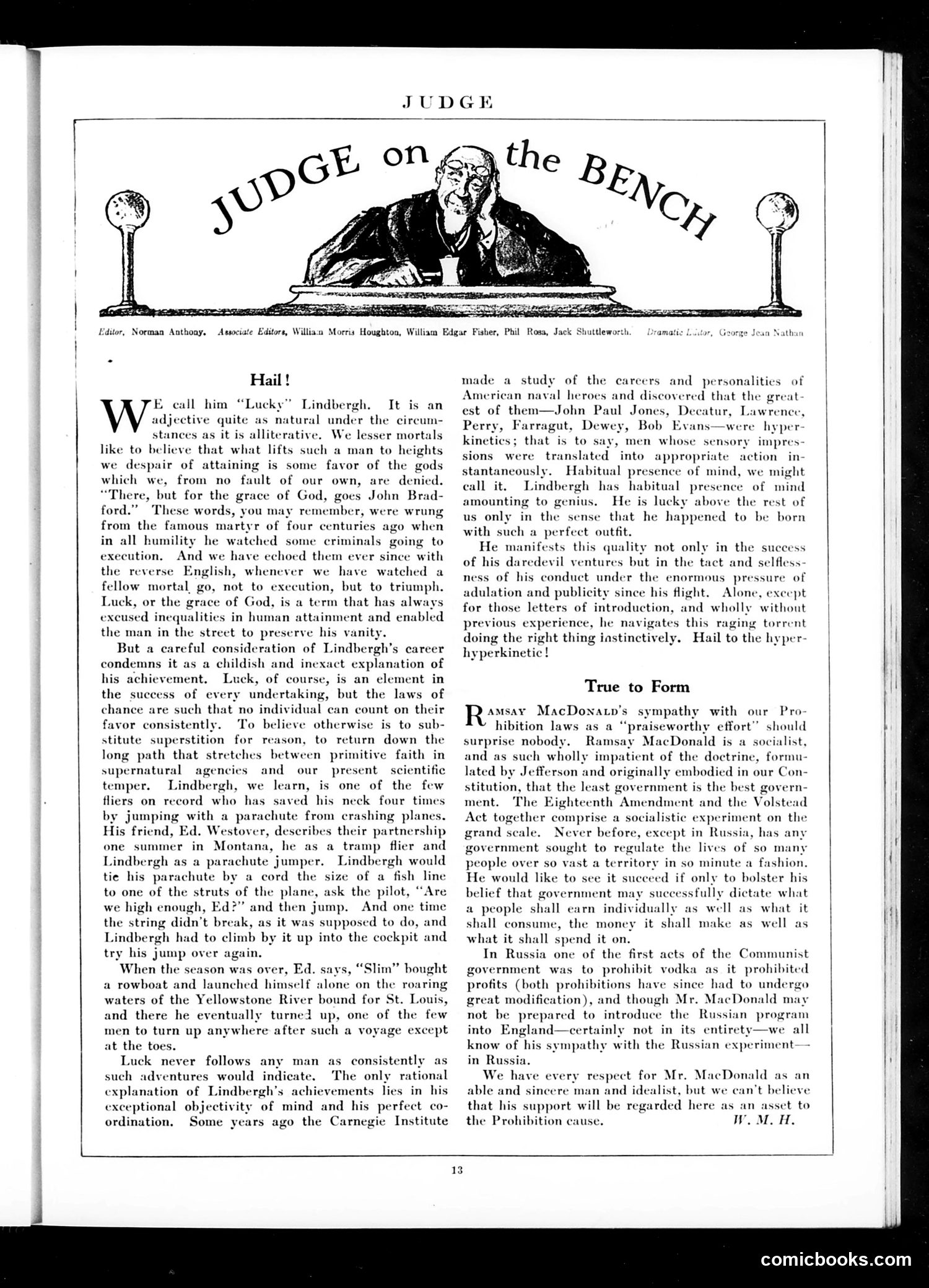
This page praises Charles Lindbergh's 1927 transatlantic flight, dismissing "luck" as explanation for his achievement. The editorial argues Lindbergh succeeded through exceptional mental coordination—a quality the Carnegie Institute called "hyperkinetic" (rapid sensory-to-action response). The article catalogs his survival of four parachute jumps and a dangerous solo rowboat journey, attributing these escapes to "habitual presence of mind amounting to genius" rather than chance. It also praises his dignified handling of post-flight fame and publicity. A secondary editorial mocks Ramsay MacDonald's support for American Prohibition laws, finding it characteristically inconsistent. The "Judge on the Bench" header image shows a stern judge overseeing the publication's satirical commentary on public figures and policy.
📄 Transcribed text from this page (OCR, searchable)
Machine-transcribed from the original scan — historical spelling and the odd misread are preserved.
JUDGE Editor, Norman Anthoay, Hail! E call him “Lucky” Lindbergh. It is an V V djective quite as natural under the ecircum- ances as it is alliterative. We lesser mortals like to believe that what lifts such a man to heights we despair of attaining is some favor of the gods which we, from no fault of our own, are denied. “There, but for the grace of God, goes John Brad- ford.” These words, you may remember, were wrung from the famous martyr of four centuries ago when in all humility he watched some criminals going to execution. And we ha ince with the reverse English, whenever we have watched a fellow mortal, go, not to execution, but to triumph. Luck, or the grace of God, is a term that has always excused inequalities in human attainment and enabled the man in the street to preserve his vanity. But a careful consideration of Lindbergh’s career condemns it as a childish and ine ation of his achievement. Luck, of course, is an element in the success of every undertaking, but the laws of chance fz To believe otherwise is to sub- stitute superstition for reason, to return down the long path that stretches between primitive faith in s » echoed them ever act expla such that no individual can count on their vor consistently. supernatural agencies and our present scientific temper. Lindbergh, we le is one of the few fliers on record who has saved his neck four times by jumping with a parachute from crashing planes. His friend, Ed. Westover, describes their partnership one in Montana, he as a tramp flier and Lindbergh as a parachute jumper. Lindbergh would tie his parachute by a cord the size of a fish line to one of the struts of the plane, ask the pilot, “A we high enough, E and then jump. And one tin the string didn’t break, as it was supposed to do, and Lindbergh had to climb by it up into the cockpit and try his jump over again. When the season was over, Ed. says, “Slim” bought a rowboat and launched himself alone on the roaring waters of the Yellowstone River bound for St. Louis, and there he eventually turned up, one of the few men to turn up anywhere after such a voyage except at the toes. Luck never follows any man as consistently as such adventures would indicate. The only rational explanation of Lindbergh’s achievements lies in his xceptional objectivity of mind and his perfect co- ordination, Some years ago the Carnegie Institute summer Associate Editors, Willian Morris Houghton, William Edgar Fisher, Phil Rosa, Jack Shuttleworth. made a study of the careers and personalities of American naval heroes and discovered that the gre est of them—John Paul Jones, Decatur, Lawrene Perry, Farragut, Dewey, Bob Evans—were hyper kinetics; that is to say, men whose sensory impres- sions were translated into appropriate action in- stantaneously. Habitual presence of mind, we might call it. Lindbergh has habitual presence of mind amounting to genius. He is lucky above the rest of us only in the sense that he happened to be born with such a perfect outfit. He manifests this quality not only in the success of his edevil ventures but in the tact and selfless- ness of his conduct under the enormous pressure of adulation and publicity since his flight. Alone, exeept for those letters of introduction, and wholly without previous experience, he navigates this raging torrent doing the right thing iastinctively. Hail to the hyper- hyperkinetic! True to Form R msay MacDonatp’s sympathy with our Pro hibition laws as a “praiseworthy effort” should surprise nobody. Ramsay MacDonald is a socialist, and as such wholly impatient of the doctrine, formu- lated by Jefferson and originally embodied in our Con- stitution, that the least government is the best govern- ment. The Eighteenth Ame Act together comprise listie experiment on the grand scale. xcept in Russia, has any government sought to regulate the lives of so many people over so vast a territory in so minute a fashion, He would like to see it succeed if only to bolster his belief that government may successfully dictate what a people shall earn individually as well as what it shall consume, the money it shall make as well as what it shall spend it on: In Russia one of the first acts of the Communist government was to prohibit vodka as it prohibited profits (both prohibitions have since had to undergo great modification), and though Mr. MacDonald may not be prepared to introduce the Russian prog into England—certainly not in its entirety—we know of his sympathy with the Russian experiment dment and the Volstead soc! Never before n all ry respect for Mr. MacDonald as an able and sincere man and idealist, but we can't believe that his support will be regarded here as an asset to the Prohibition cause. W. M. H. comicbooks.com