
Judge, 1927-06-11 · page 8 of 36
Judge — June 11, 1927 — page 8: what you’re looking at
What you’re looking at
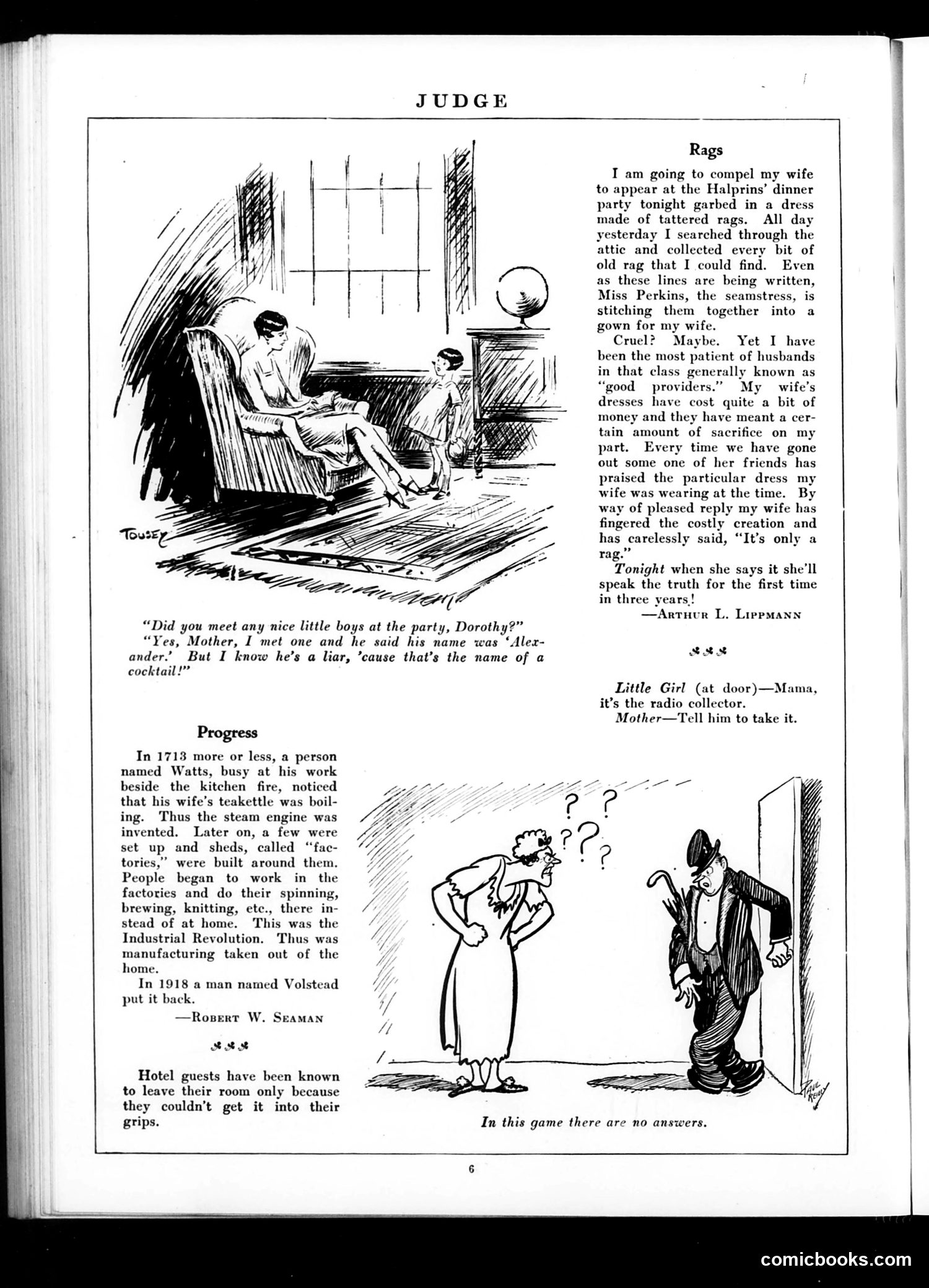
This page contains three separate satirical pieces: **"Rags"** (top): A husband's humorous revenge. His wife repeatedly dismisses her expensive dresses as "only a rag," so he's forcing her to wear an actual dress made of tattered rags to a dinner party. The satire targets wives' casual dismissal of costly purchases and their desire to appear modest about material wealth. **"Progress"** (middle-left): A brief history joke about industrialization. It notes that James Watts' steam engine (1713) launched the Industrial Revolution, moving manufacturing from homes to factories—but then Volstead "put it back" in 1918. This references Prohibition (the Volstead Act of 1919), sarcastically suggesting it returned manufacturing to homes by creating illegal home distilleries. **Bottom cartoons**: Two brief gags—one about a child innocently confusing "Alexander" (a person's name) with "Alexander" (a cocktail), and another about a woman claiming the radio "collector" can take the radio, implying she wants rid of it. These reflect 1920s concerns: consumer spending, Prohibition enforcement, and new technologies like radio.
📄 Transcribed text from this page (OCR, searchable)
Machine-transcribed from the original scan — historical spelling and the odd misread are preserved.
Qe “Did you meet any nice little boys at the party, Dorothy?” Lica A Rags I am going to compel my wife to appear at the Halprins’ dinner party tonight garbed in a dress made of tattered rags. All day yesterday I searched through the attic and collected every bit of old rag that I could find. Even as these lines are being written, Miss Perkins, the seamstress, is stitching them together into a gown for my wife. Cruel? Maybe. Yet I have been the most patient of husbands in that class generally known as “good providers.” My wife’s dresses have cost quite a bit of money and they have meant a cer- tain amount of sacrifice on my part. Every time we have gone out some one of her friends has praised the particular dress my wife was wearing at the time. By way of pleased reply my wife has fingered the costly creation and has carelessly said, “It’s only a rag.” Tonight when she says it she'll speak the truth for the first time in three years! —Arrtuer L. Lippmann “Yes, Mother, I met one and he said his name was ‘Alex- ae ander.” But I know he’s a liar, ’cause that’s the name of a w_ cocktail!” Progress In 1713 more or less, a person named Watts, busy at his work beside the kitchen fire, noticed that his wife’s teakettle was boil- ing. Thus the steam engine was invented. Later on, a few were set up and sheds, called ‘‘fac- tories,” were built around them. People began to work in the factories and do their spinning, brewing, knitting, etc., there in- stead of at home. This was the Industrial Revolution. Thus was manufacturing taken out of the home. In 1918 a man named Volstead put it back. —Rosert W. Seaman AAS Hotel guests have been known to leave their room only because they couldn’t get it into their grips. Little Girl (at door)—Mama, it’s the radio collector. Mother—Tell him to take it. In this game there are no answers. comicbooks.com