
Judge, 1927-06-11 · page 18 of 36
Judge — June 11, 1927 — page 18: what you’re looking at
What you’re looking at
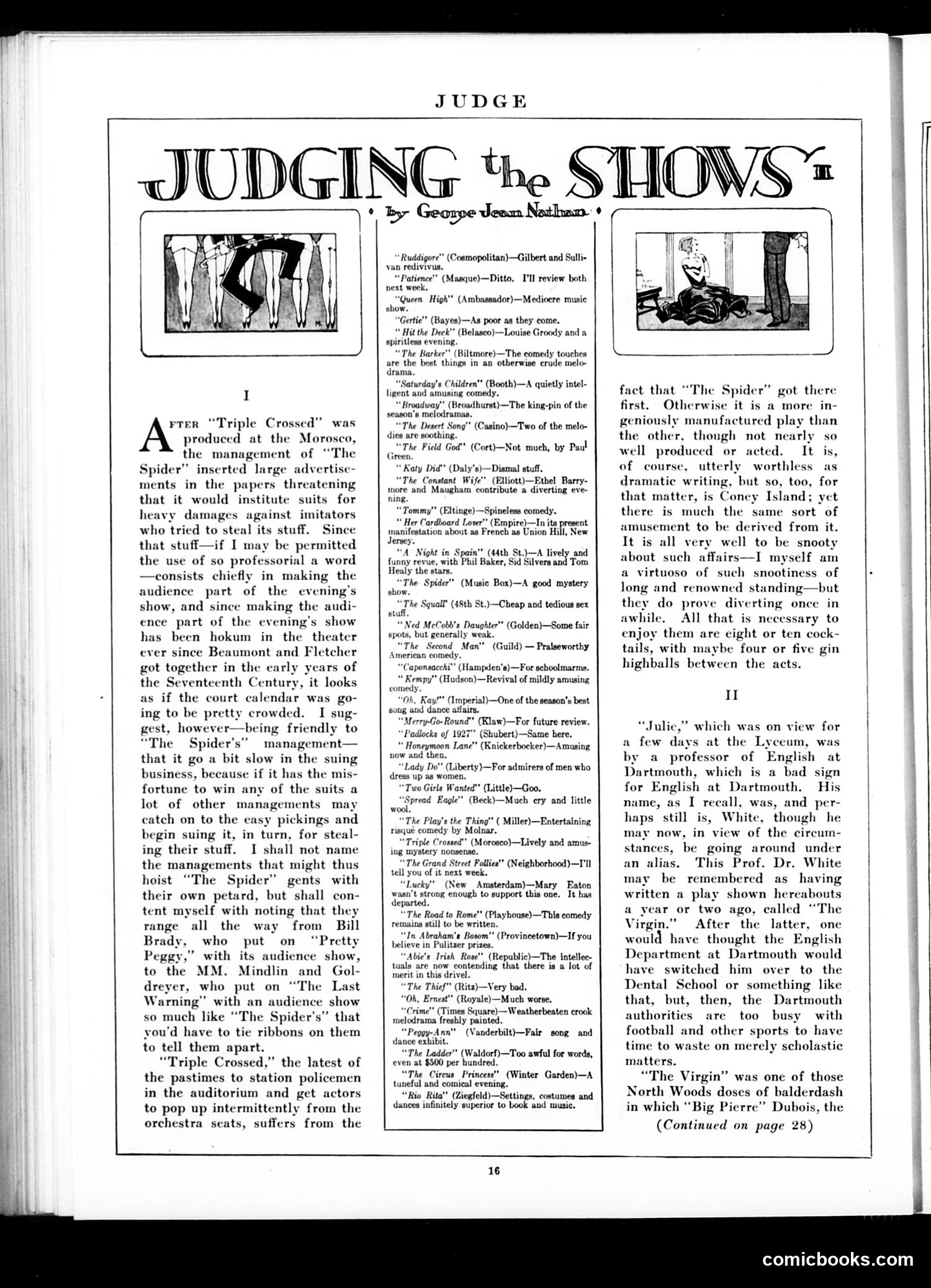
This is a theater critic's column by George Jean Nathan reviewing Broadway productions. The two small illustrations show typical theatrical scenes—likely depicting audience-participation gimmicks common in 1920s shows. The main satirical point concerns "The Spider," a play that threatened legal action against imitators for "stealing" its central theatrical device: audience participation. Nathan mocks this pretension, noting that interactive theater dates back to the 1600s (Beaumont and Fletcher). He warns the producers that winning such suits could backfire, as competing shows with similar audience-participation elements would then sue *them*—mentioning "Pretty Peggy" and "The Last Warning" as examples with nearly identical gimmicks. The column concludes with brief capsule reviews of various Broadway shows, mixing praise and dismissal. This reflects Judge's role as a satirical magazine covering contemporary entertainment and cultural trends for educated readers.
📄 Transcribed text from this page (OCR, searchable)
Machine-transcribed from the original scan — historical spelling and the odd misread are preserved.
JUDGE UDGING ‘he SHOWS I TER “Triple Crossed” y produced at the Morose the management of “The Spider” inserted large advertise- ments in the papers threatening that it would institute suits for heavy damages against imitators who tried to steal its stuff. Since that stuff—if I may be permitted the use of so professorial a word —consists chiefly in making the audience part of the evening's show, and since making the audi- ence part of the evening’s show has been hokum in the theater ever since Beaumont and Fletcher got together in the earl rs of the Seventeenth Century, it looks as if the court calendar was go- ing to be pretty crowded. I sug- gest, however—being friendly to “The Spider’ management— that it go a bit slow in the suing business, because if it has the mis- fortune to win any of the suits a lot of other managements may catch on to the easy pickings and begin suing it, in turn, for steal- ing their stuff. I shall not name the managements that might thus hoist “The Spider” gents with their own petard, but shall con- tent myself with noting that they range all the way from Bill Brad. who put on “Pretty Peggy,” with its audience show, to the MM. Mindlin and Gol- dreyer, who put on “The Last Warning” with an audience show so much like “The Spider's” that you'd have to tie ribbons on them to tell them apart. “Triple Crossed,” the latest of the pastimes to station policemen in the auditorium and get actors to pop up intermittently from the orchestra seats, suffers from the “ Ruddigore” (Coamopolitan)—Gilbert and Sulli- van redivivus. “Patience” (Masque)—Ditto. I'll review both next week. “Queen High" (Ambassador)—Mediocre music show. ‘Gertie’ (Bayes)—As poor as they come. * Hit the Deck’ (Belasco)—Louise Groody and a spiritless evening. “The Barker"* (Biltmore)—The comedy touches are the best things in an otherwise crude melo- drama. “Saturday's Children" (Booth)—A quietly intel- ligent and amusing comedy. * Broadway" (Broadhurst)—The king-pin of the season's melodramas. “The Desert Song’* (Casino)—Two of the melo- dies are soothing. “The Field God" (Cort)—Not much, by Paul Green. ‘ty Did” (Daly’s)—Dismal stuff. "The Constant Wife’ (Elliott)—Ethel Barry- more and Maugham contribute a diverting eve- ning. “Her Cardboard Lover" (Empire)—In its present manifestation about as French as Union Hill, New Jersey. “A Night in Spain" (44th St.)- funny revue, with Phil Baker, Si Healy the stars. “The Spider” (Music Box)—A good mystery shot A livel: vers and Tom ae Squall’ (48th St.)\—Cheap and tedious sex st Ef ‘ed McCobb's Daughter" (Golden)—Some fair spots, but generally’ wi “The Second Man ‘ean comedy. (Guild) — Praiseworthy “Caponsacchi"” (Hampden' Kenn (Hudson)—Revi dy. |—For schoolmarms. al of mildly amusing ‘Oh, Kay!" (Imperial)}—One of the season's best song and dance affairs. “Merry-Go-Round” (Klaw)—For future review. “Padlocks of 1927" (Shubert)—Same here. “ Honeymoon Lane" (Knickerbocker)—Amusing now and then. Lady Do’ (Liberty)—For admirers of men who dress up as women, ‘wo Girls Wanted" (Little)—Goo. ipread Eagle (Beck)—Much ery and little wool. “The Play's the Thing’ ( Miller)}—Entertaining risqué comedy by Molnar. “Triple Crossed’ (Moroseo)—Lively and amus- ing mystery nonsense. “The Grand Street Follies tell you of it next week. Lucky" (New Amsterdam)—Mary Eaton wasn't strong enough to support this one. It has depar “The Road to Rome" (Playhouse)—This comedy remains atill to be written. “In Abraham's Bosom" (Provincetown)—If you believe in Pulitzer prizes. Abie's Irish Rose’ (Republic)—The intellec- tuals are now contending that there is a lot of merit in this drivel. The Thief” (Ritz)—Very bad. Oh, Ernest” (Royale)—Much worse. rime" (Times Square) —Weatherbeaten crook melodrama freshly painted. “Peggy-Ann" (Vanderbilt)—Fair song and dance exhibit. “The Ladder” (Waldorf)—Too awful for words, even at $500 per hundred “The Circus Princess (Winter Garden)—A tuneful and comical evening Rio Rita” (Ziegfeld)—s tumes and (Neighborhood)—T'll dances infinitely superior to book and musi fact that “The Spider” got there first. Otherwise it is a more in- geniously manufactured play than the other, though not nearly so well produced or acted. It is, of course, utterly worthless as dramatic writing, but so, too, for that matter, is Coney Island; yet there is much the same sort of amusement to be derived from it. It is all very well to be snooty about such affairs—I myself am a virtuoso of such snootiness of long and renowned standing—but they do prove diverting once in awhile. All that is necessary to enjoy them are eight or ten cock- tails, with maybe four or five gin highballs between the acts. II “Julie,” which was on view for a few at the Lyceum, 5 by a professor of English at Dartmouth, which is a bad sign for English at Dartmouth. His name, as I recall, was, and per- h, still is, White, though he may now, in view of the cireum- stances, be going around under an alias. This Prof. Dr. White may be remembered as having written a play shown here: a year or two ago, called Virgin.” After the latter, one would have thought the English Department at Dartmouth would have switched him over to the Dental School or something like that, but, then, the Dartmouth authorities are too busy with football and other sports to have time to waste on merely scholastic matters. The Virgin” was one of those North Woods doses of balderdash in which “Big Pierre” Dubois, the (Continued on page 28) comicbooks.com