
A complete issue · 36 pages · 1927
Judge — June 4, 1927
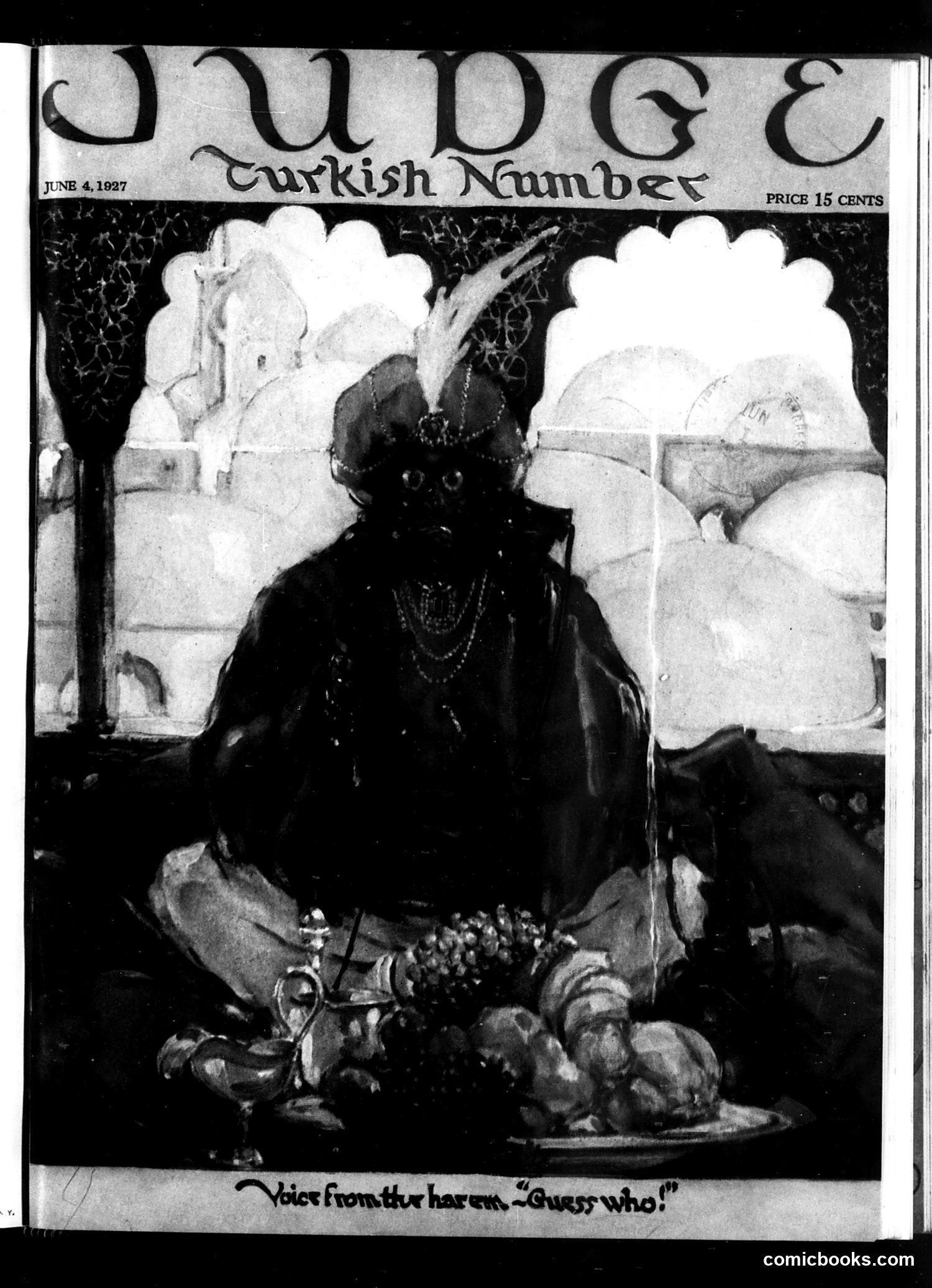
This cover features a caricatured figure in elaborate costume and headdress seated among fruits and vegetables. The caption reads "Voice from the harem—'Guess who!'" The satire appears to target someone adopting or performing in "exotic" or "Oriental" costume—likely referencing theatrical trends or a specific public figure of 1927 engaging in such performance. The "guess who" format suggests the disguise hides someone's actual identity, making the humor dependent on readers recognizing the person beneath the costume. This reflects 1920s attitudes toward theatrical exoticism and orientalism. The caricature's exaggerated features reflect period stereotyping. Without identifying the specific figure or event referenced, the satire mocks performance affectation and costume play common to entertainment of that era.
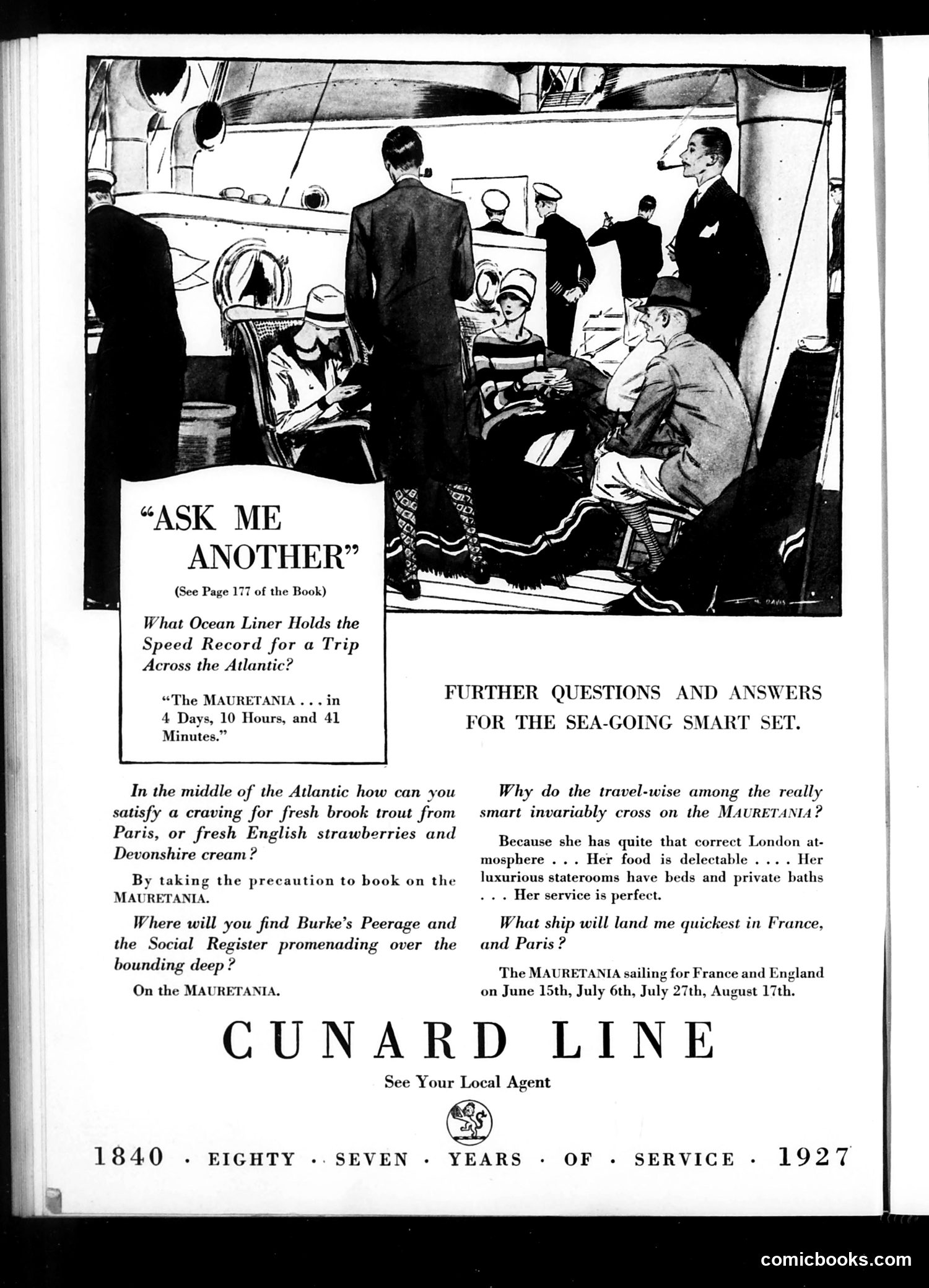
This page is primarily **advertising**, not satire or political commentary. It's a Cunard Line cruise ship advertisement from 1927 celebrating the company's 87 years of service. The illustration depicts wealthy passengers in a ship's cabin, establishing the luxury appeal. The ad promotes the **Mauretania**, which held the Atlantic speed record (4 days, 10 hours, 41 minutes). The "Ask Me Another" quiz format was a common advertising technique of the era, using trivia to engage readers while promoting the ship's amenities—fresh food, comfortable staterooms, perfect service, and fast passage to France and England. There is no political satire here; it's straightforward marketing targeting affluent travelers seeking prestigious transatlantic passage.
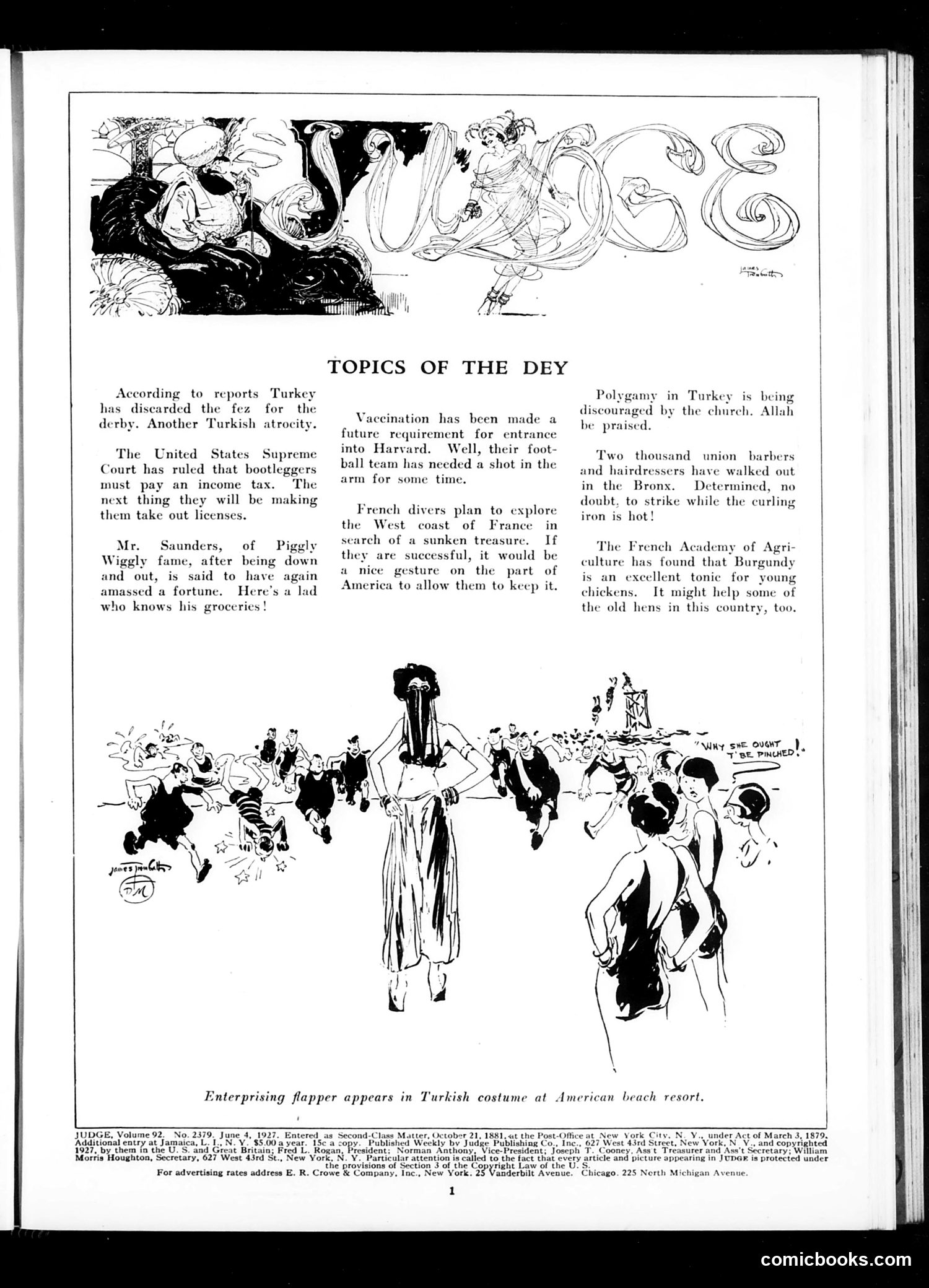
This page combines brief satirical news items with a cartoon depicting an "enterprising flapper" in Turkish costume at an American beach resort. The news items mock various topics: Turkey's ban on the fez, U.S. income tax requirements, a fortune-teller named Mr. Saunders, Harvard's vaccination requirements, French treasure-hunting plans, union barbers striking over curling irons, and France's discovery that Burgundy wine benefits young chickens. The main cartoon satirizes the 1920s "flapper" culture—young women adopting fashionable, sometimes exotic styles. The Turkish costume suggests Americans' fascination with foreign fashions and the flapper's willingness to adopt any trendy look, regardless of cultural context. The beach setting and surrounding figures emphasize this as fashionable leisure activity rather than authentic cultural expression.
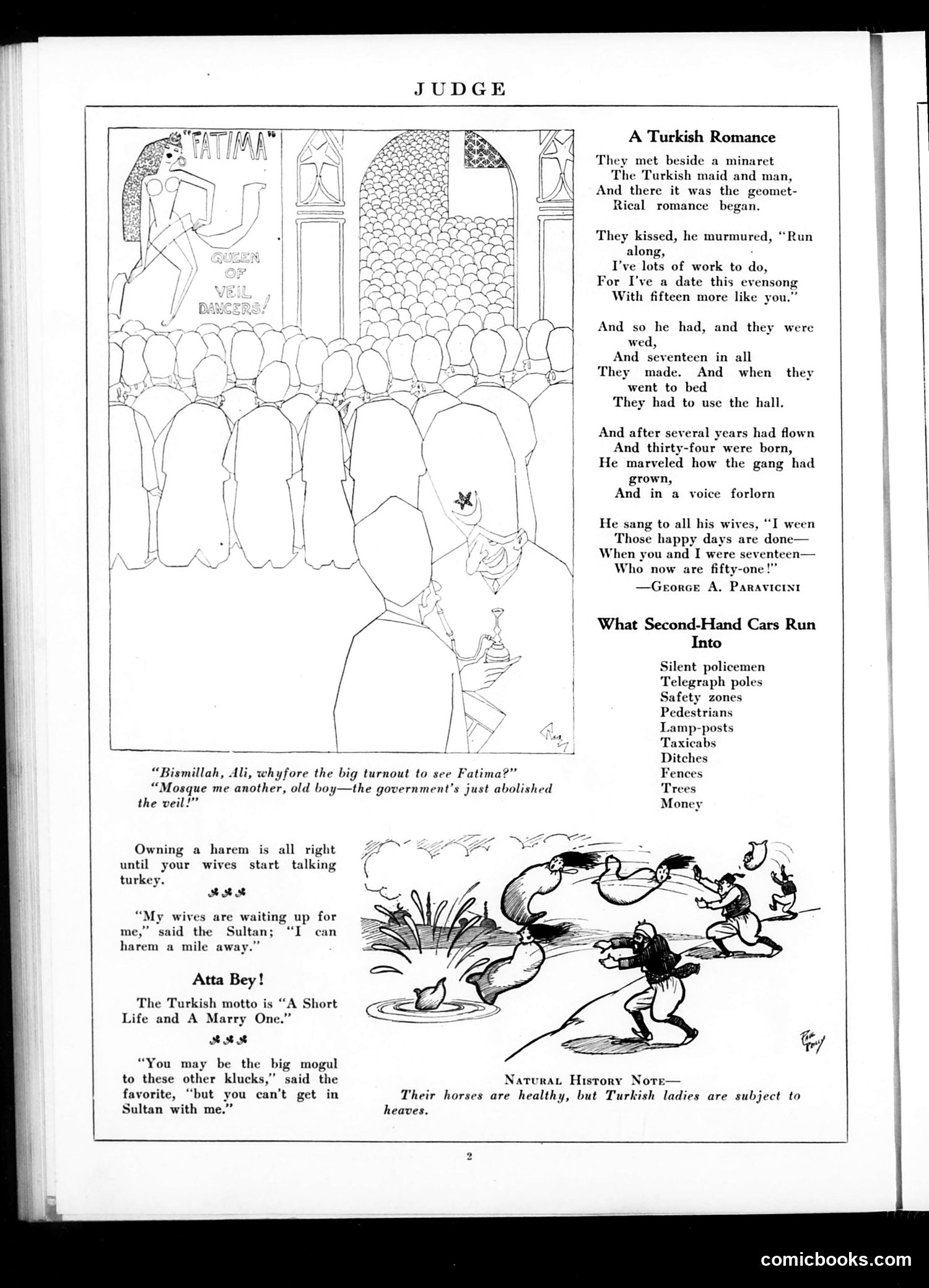
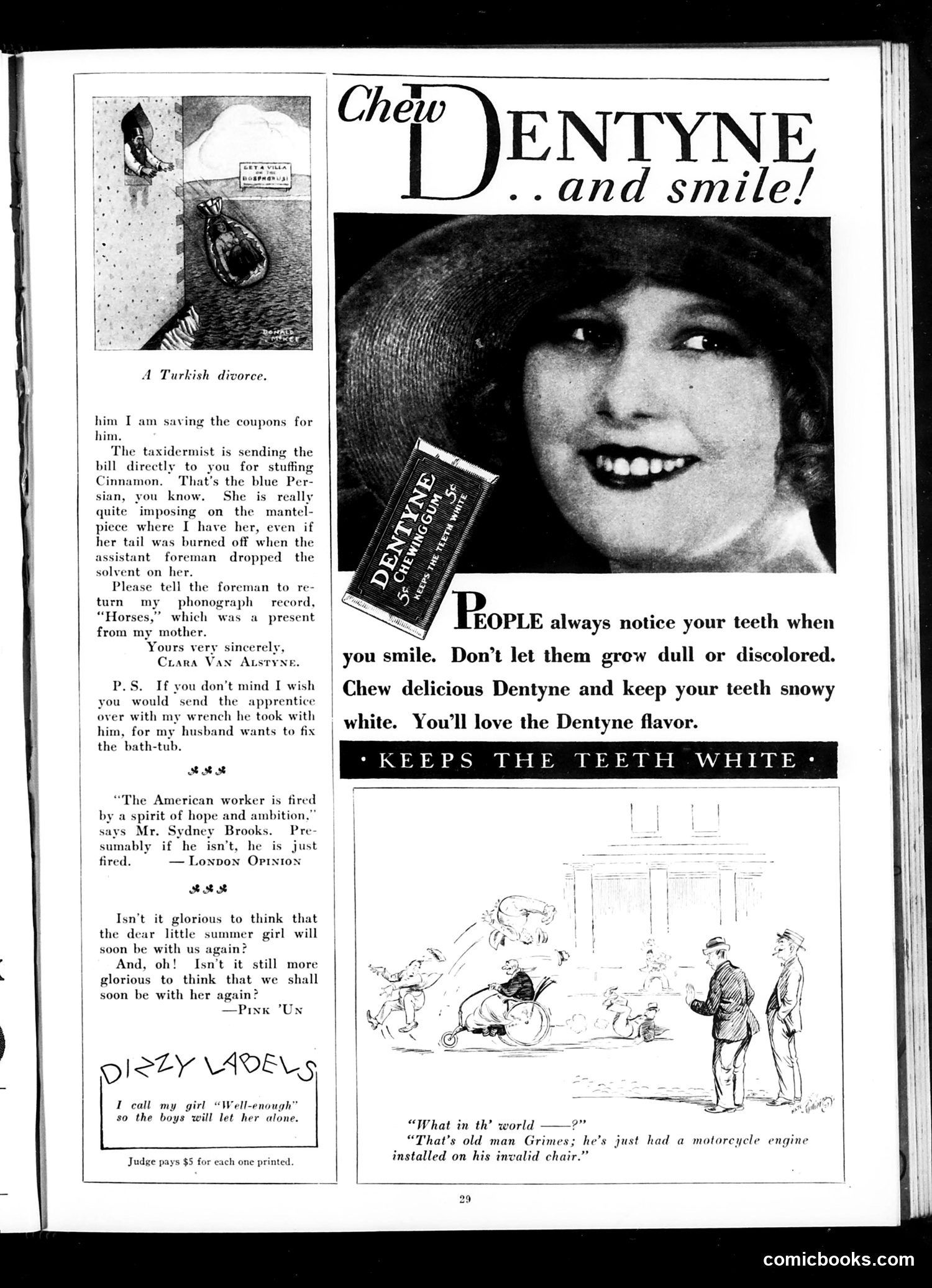
This page contains humorous commentary on Ottoman/Turkish culture. "A Turkish Romance" is a poem satirizing Turkish polygamy—a man marries a maid and eventually has 34 children, forcing them to sleep in a public hall. The humor targets Islamic marriage practices unfamiliar to American readers. The accompanying cartoons mock Turkish customs: one depicts a harem scene with numerous faceless wives; another shows the Sultan claiming he can "harem a mile away" while his wives wait. A final illustration of people in water mocks Turkish women, captioned with a "natural history note" suggesting they suffer from "heaves" (illness). The satire relies on orientalist stereotypes common in early 20th-century American magazines, presenting Turkish practices as exotic and ridiculous to Western audiences.
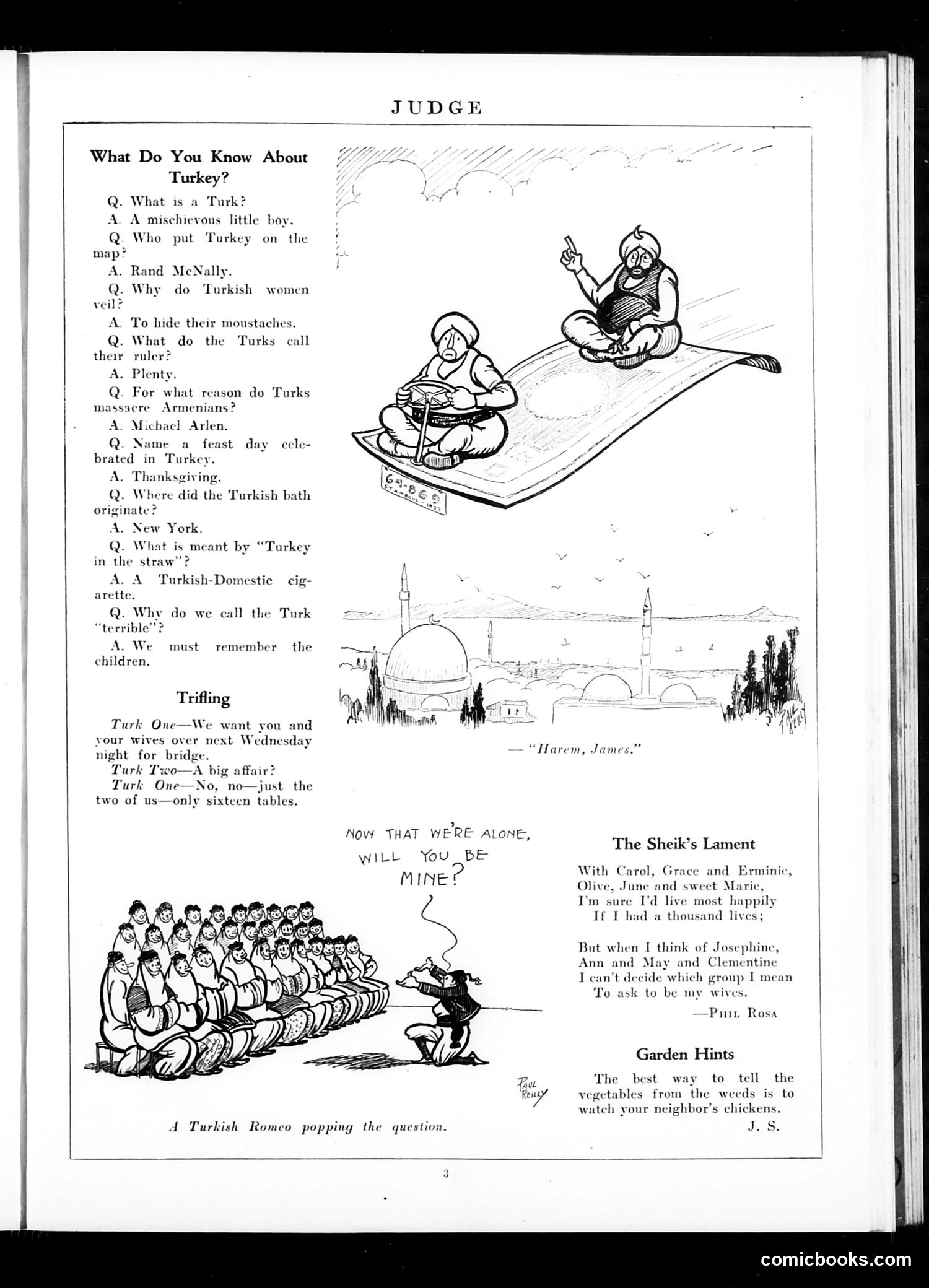
This page contains several humor pieces mocking Turkish culture during a period of Western stereotyping about the Ottoman Empire. **"What Do You Know About Turkey?"** uses offensive Q&A format jokes playing on stereotypes—Turkish women's mustaches, the ruler "Plenty" (likely referencing Ottoman leadership), and Michael Arlen (a contemporary Armenian-American writer, humorously blamed for massacres). **"A Turkish Romeo"** cartoon depicts a figure proposing to a large group of women, captioned "Now that we're alone, will you be mine?"—a crude joke about Ottoman polygamy/harem culture. The other pieces ("Trifling," "The Sheik's Lament," "Garden Hints") are unrelated satirical content typical of Judge's format. The overall tone reflects early 20th-century American attitudes: exoticizing and demeaning Turkish/Middle Eastern culture through crude caricature and stereotypes.
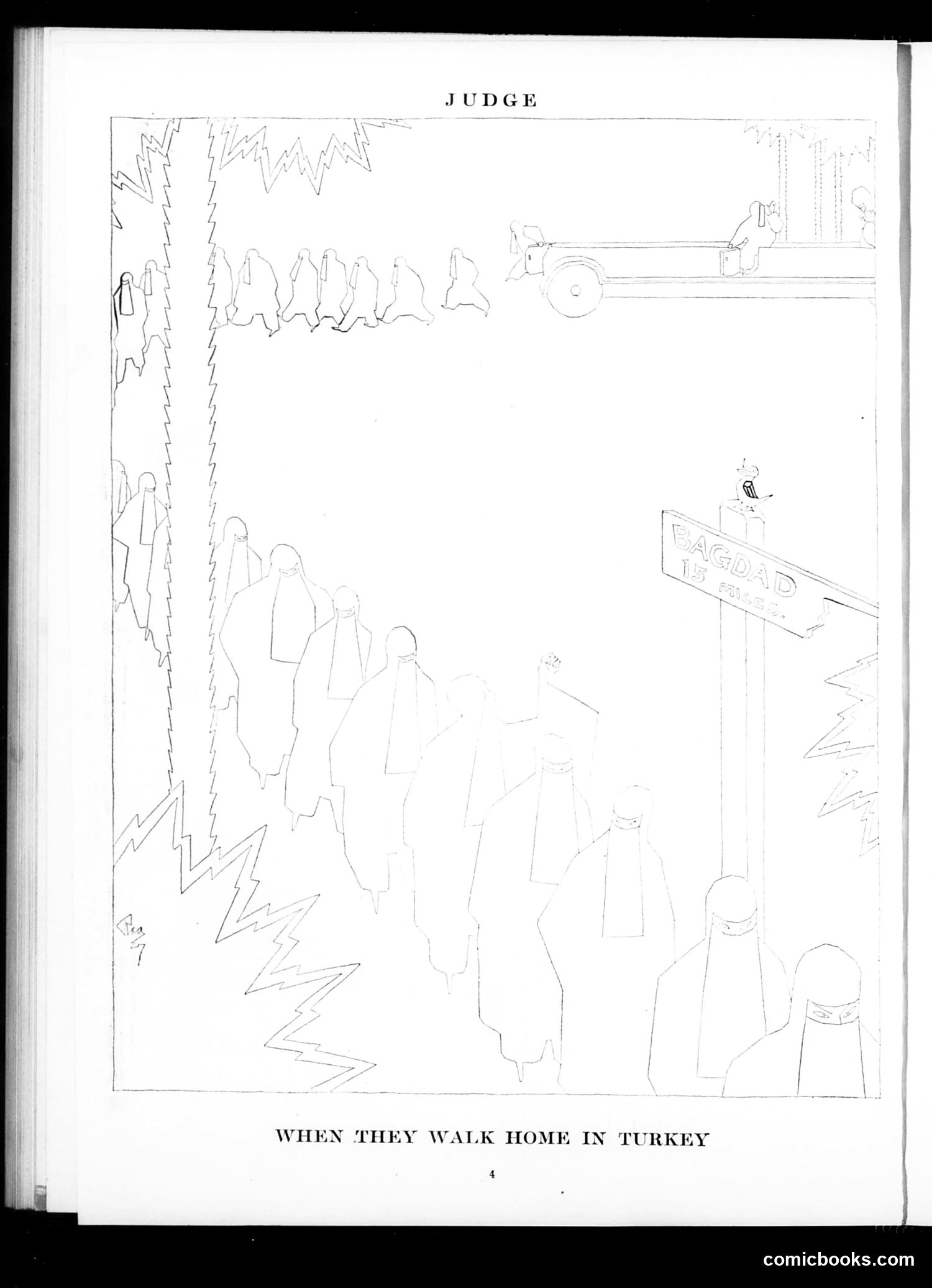
This cartoon from Judge satirizes the aftermath of World War I and the Turkish conflict. The sketch shows what appears to be Allied soldiers or officials walking home through Turkey, depicted with lightning bolts suggesting danger or turbulent conditions. On the right, a sign reading "BAGDAD" indicates the geographic setting in the Middle East. The satire likely comments on the chaotic withdrawal or return of foreign military forces from Turkish territory following WWI, or tensions during the Turkish War of Independence (1919-1923). The lightning imagery suggests the perilous journey home through unstable regions. The cartoon reflects American public interest in the complicated post-war situation in the Ottoman Empire's former territories.
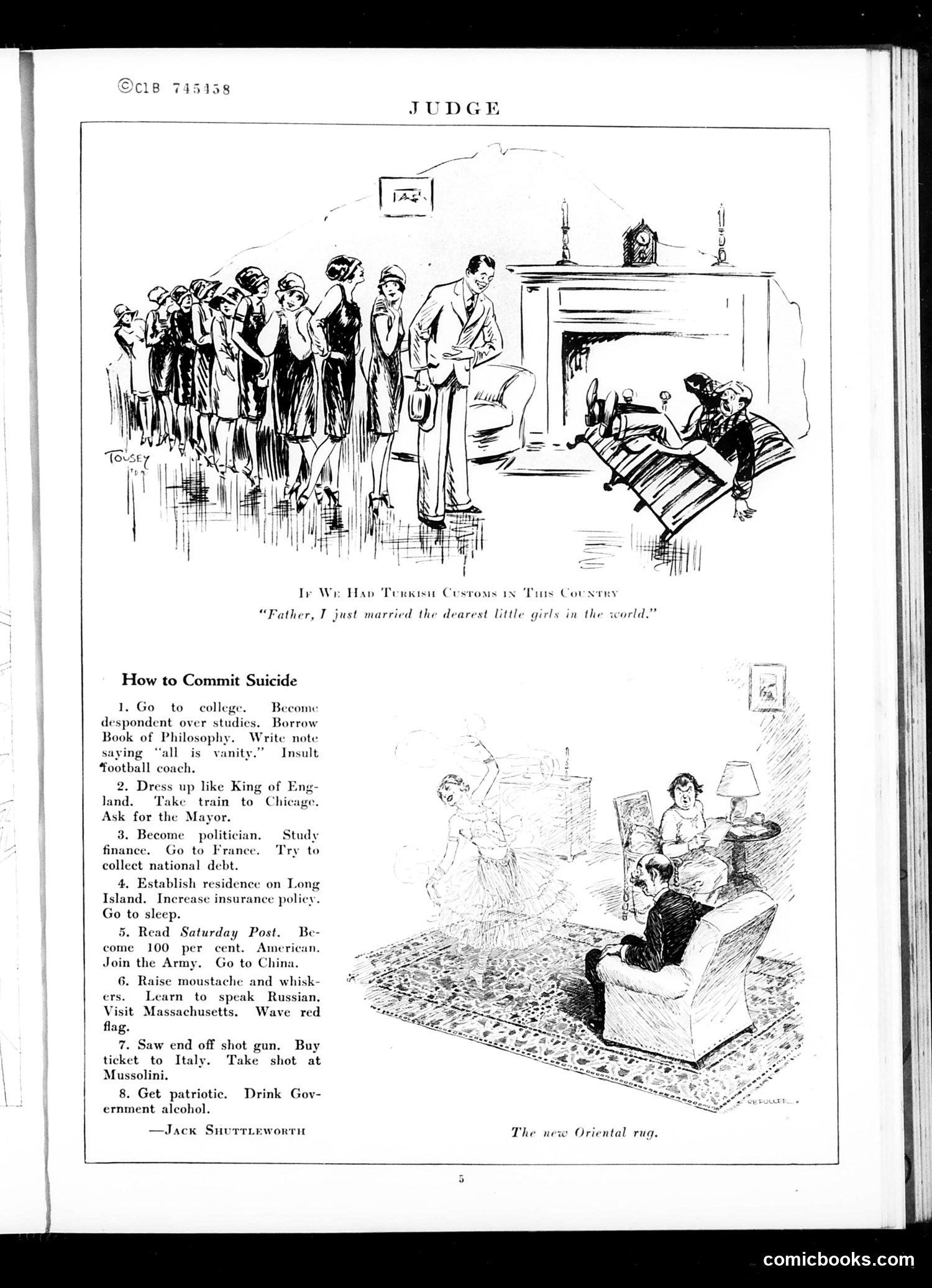
**Top Cartoon ("If We Had Turkish Customs in This Country"):** This satirizes concerns about immigration and foreign customs. A judge presides while a man defends marrying "the dearest little girls in the world"—referencing Turkish practices of child marriage. The cartoon expresses anxiety about preserving American legal standards against perceived threats from immigrant communities. **"How to Commit Suicide" Article:** This is darkly humorous satire listing absurd ways to destroy oneself financially and socially: attending college, dressing formally, becoming a politician, moving to Long Island, reading *Saturday Post*, joining the army, buying Italian property, and drinking government alcohol. It mocks various American institutions and contemporary follies. **"The new Oriental rug":** A domestic scene where a woman displays her new rug—likely expensive oriental merchandise reflecting period consumption trends.
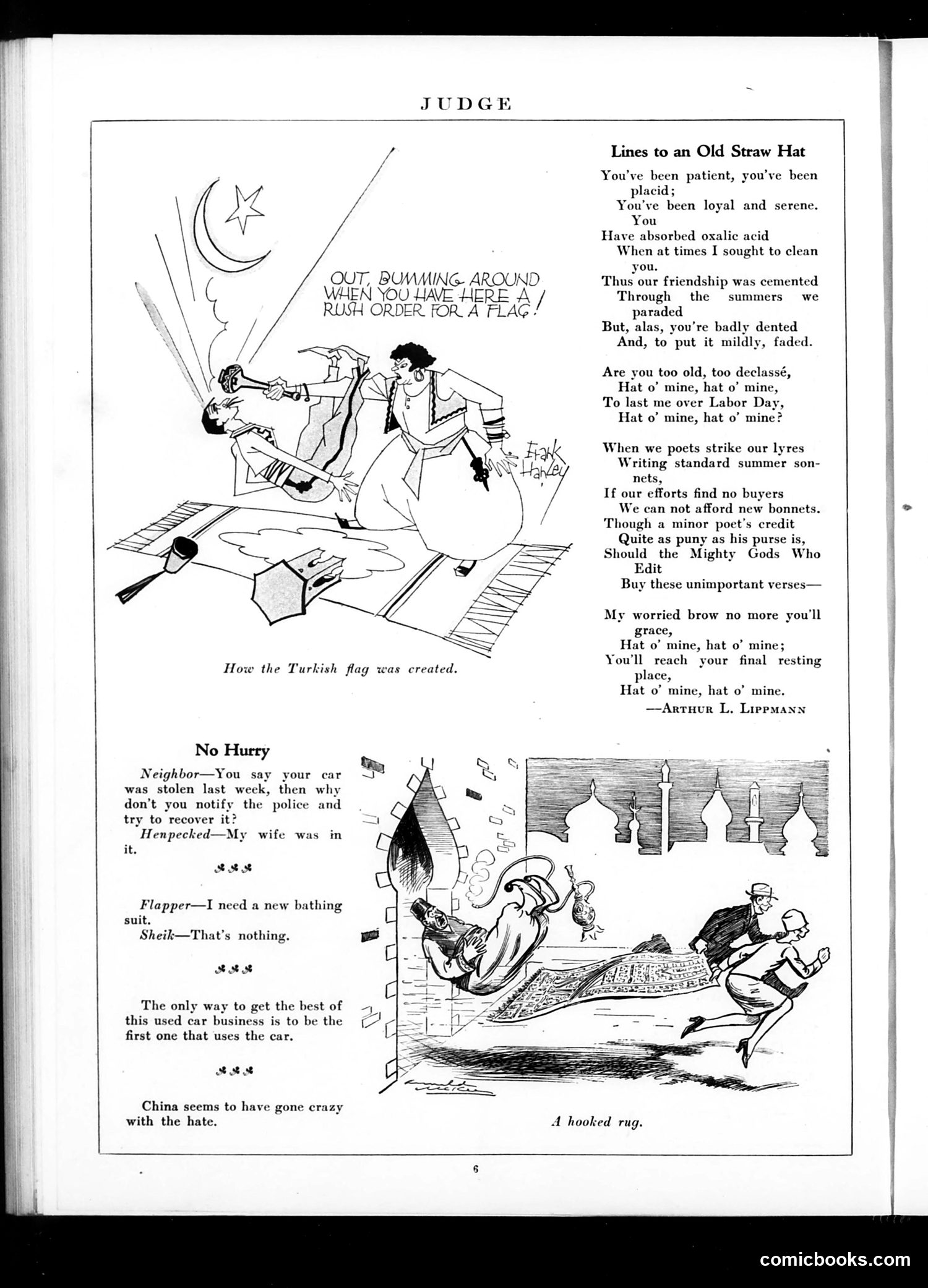
This page contains three separate pieces of humor: **"Lines to an Old Straw Hat"** is a sentimental poem by Arthur L. Lippmann addressing a worn-out hat as if it were a friend. It jokingly mourns the hat's deterioration while noting how poets struggle financially (they can't afford new hats because editors won't buy their work). **"How the Turkish flag was created"** (top cartoon) depicts chaotic bureaucratic fumbling—officials rushing to create a flag during some urgent order, with papers and confusion everywhere. This likely satirizes government incompetence or hasty decision-making, though the specific Turkish reference is unclear without more historical context. **"No Hurry"** presents brief jokes: a man doesn't report his stolen car because his wife was in it (implying he's glad she's gone), and observations about used cars and bathing suits reflecting 1920s consumer culture and flapper-era dating dynamics. **"A hooked rug"** (bottom cartoon) shows someone being literally "hooked" by a rug, illustrating the phrase's double meaning as wordplay.
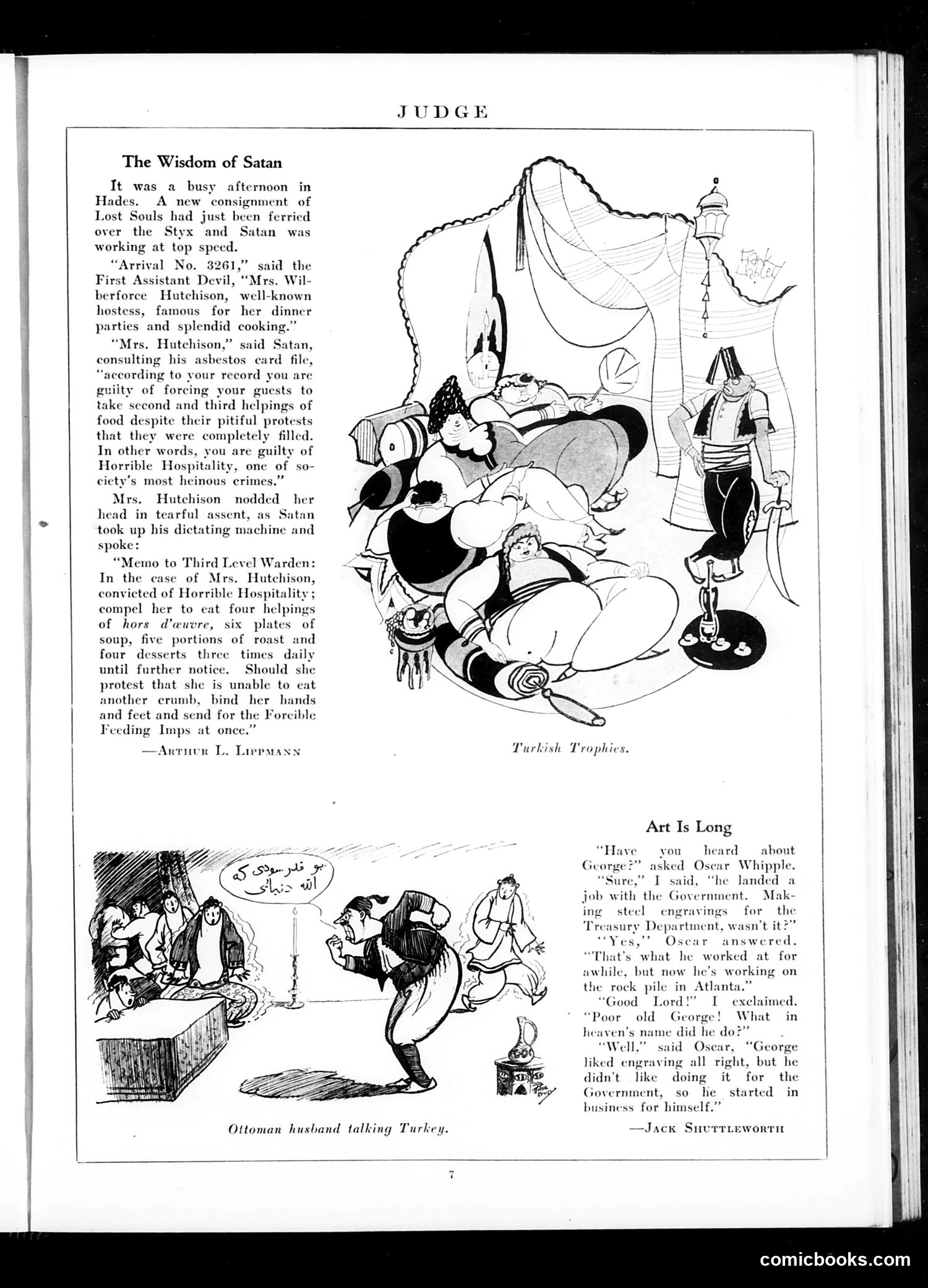
This page contains two satirical pieces: **"The Wisdom of Satan"** presents a humorous afterlife scenario where Mrs. Wilberforce Hutchison, a society hostess, arrives in Hell convicted of "Horrible Hospitality"—forcing dinner guests to overeat despite protests. Satan's punishment is poetic justice: she must consume massive quantities of food repeatedly until she can't protest, with magical "Forcible Feeding Imps" enforcing compliance if needed. The satire targets upper-class social conventions and the aggressive etiquette of wealthy hostesses who used elaborate meals as status displays. **"Art Is Long"** (a title referencing the famous phrase) is a brief anecdote by Jack Shuttleworth about George, who abandoned government engraving work for the Treasury Department to start his own business—and ended up imprisoned on a chain gang in Atlanta. The joke satirizes the irony of seeking independence from government work, only to face far worse consequences. Both pieces use dark humor typical of early-20th-century Judge satire, targeting social pretension and the consequences of personal choices.
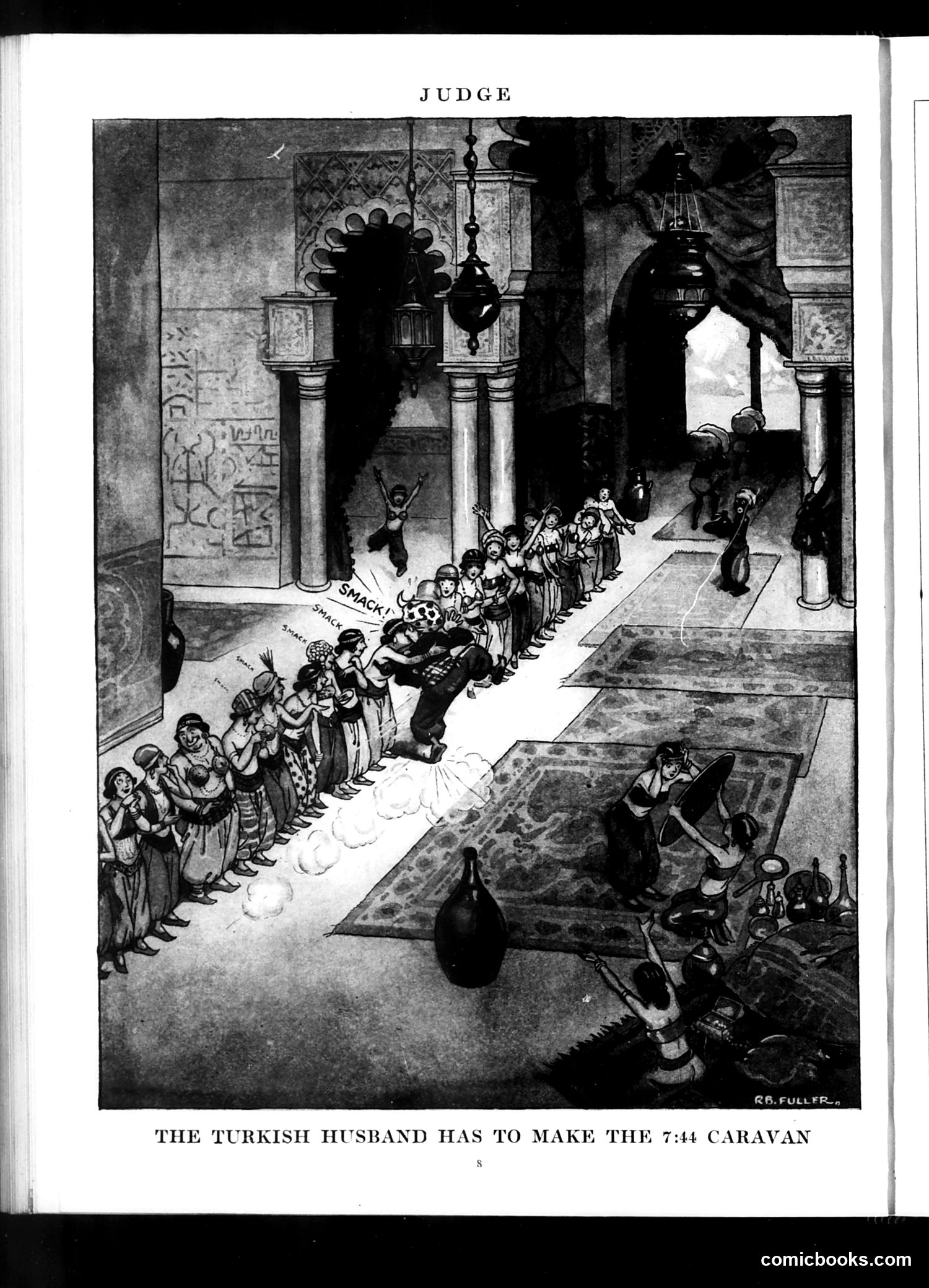
This satirical cartoon depicts a Turkish man frantically herding a large group of women (his wives) through an ornate Middle Eastern corridor, attempting to board what appears to be a departing caravan. The title plays on the Western stereotype of Turkish polygamy—the joke being that managing multiple wives creates domestic chaos comparable to catching a train. The cartoon relies on orientalist stereotypes common in early 20th-century American humor, mocking both Turkish marriage customs and the practical absurdity of coordinating such a large "family" for travel. The "7:44 caravan" is a comedic reference to strict railway schedules, applying modern transit humor to an exotic, foreign domestic arrangement. The crowded, frantic scene emphasizes the humorous burden of polygamous marriage as depicted through American eyes.
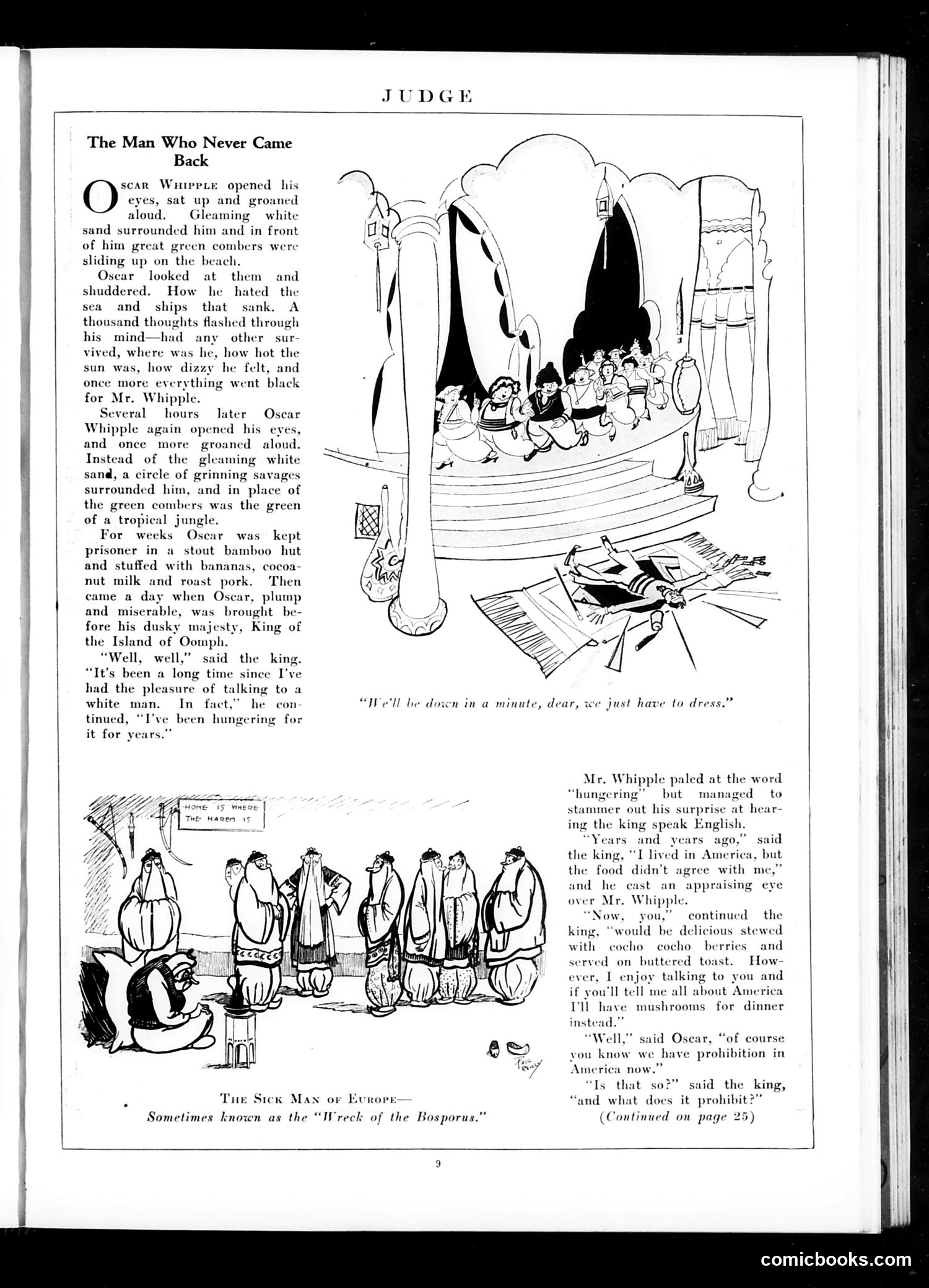
This is a humorous serialized story mocking American attitudes about foreign lands and prohibition. Oscar Whipple, a shipwreck survivor, washes ashore on a tropical island ruled by an English-speaking king who cannibalistic traditions. The satire centers on prohibition: when Oscar mentions America's new alcohol ban, the king questions what it actually prohibits—implying the law is absurd or ineffective. The "Sick Man of Europe" cartoon below appears unrelated, likely a separate political commentary on European instability (possibly referencing Turkey as the "sick man"). The overall joke reflects early 1920s American anxieties about prohibition's absurdity and the era's fascination with "exotic" foreign cultures depicted through crude stereotypes. The cannibals represent the "civilized" world's prejudices about non-Western societies.
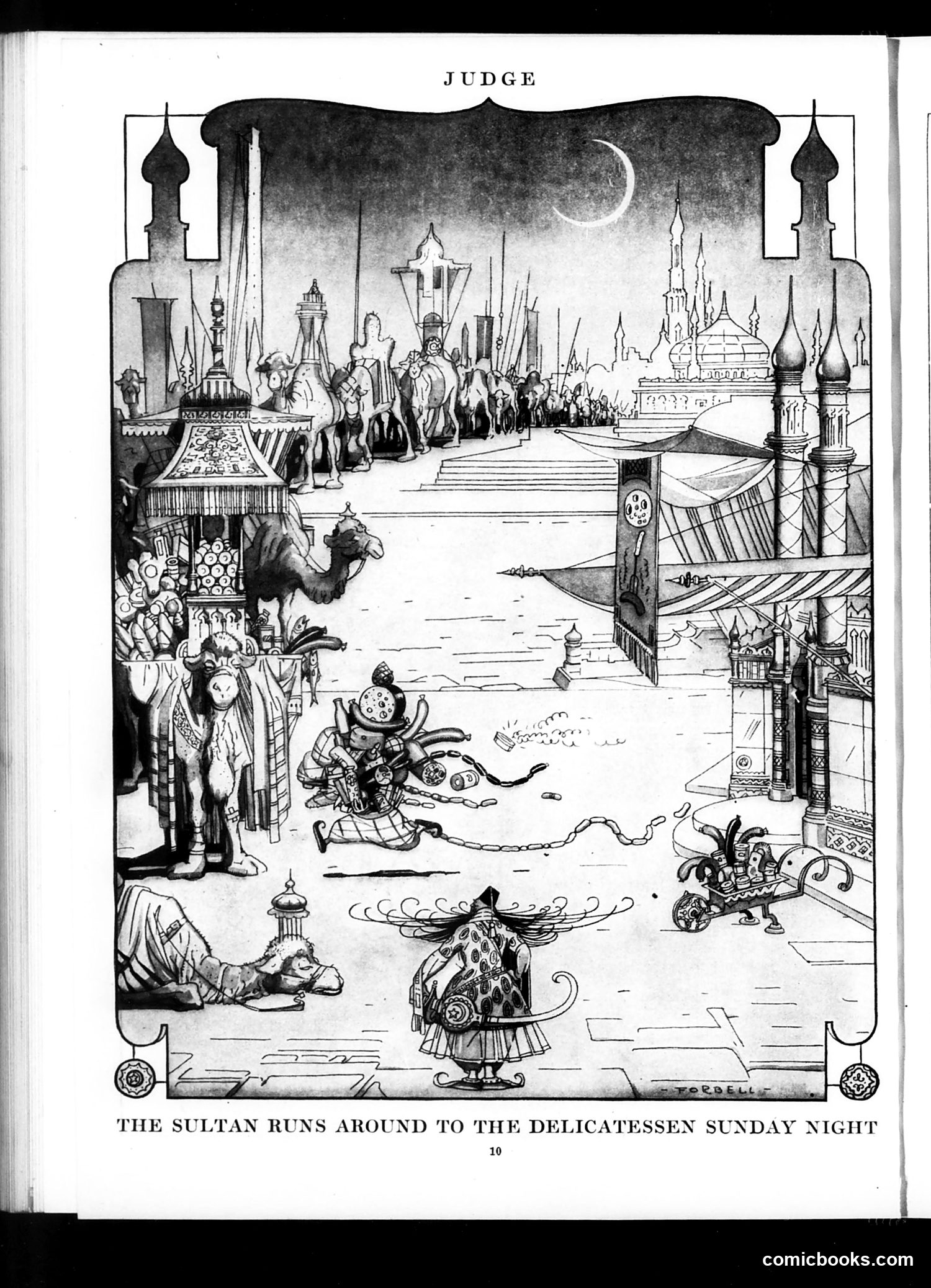
This political cartoon satirizes an Ottoman Sultan character running to a delicatessen on Sunday night. The elaborate architectural setting—featuring minarets, mosques, and Middle Eastern design elements—contrasts sharply with the mundane errand of fetching food from a neighborhood delicatessen, a typical Jewish-American business. The joke appears to target the Sultan's dignity through this humorous juxtaposition: a powerful foreign ruler reduced to casual, everyday American consumer behavior. The "Sunday night" timing may reference Jewish observance patterns or general American weekend shopping habits. The cartoon likely reflects early 20th-century American attitudes toward both Ottoman leadership and immigrant communities, using ethnic caricature for comedic effect. Without clearer dating or additional context, the specific political reference remains unclear, though it may relate to Ottoman-American diplomatic relations of the era.
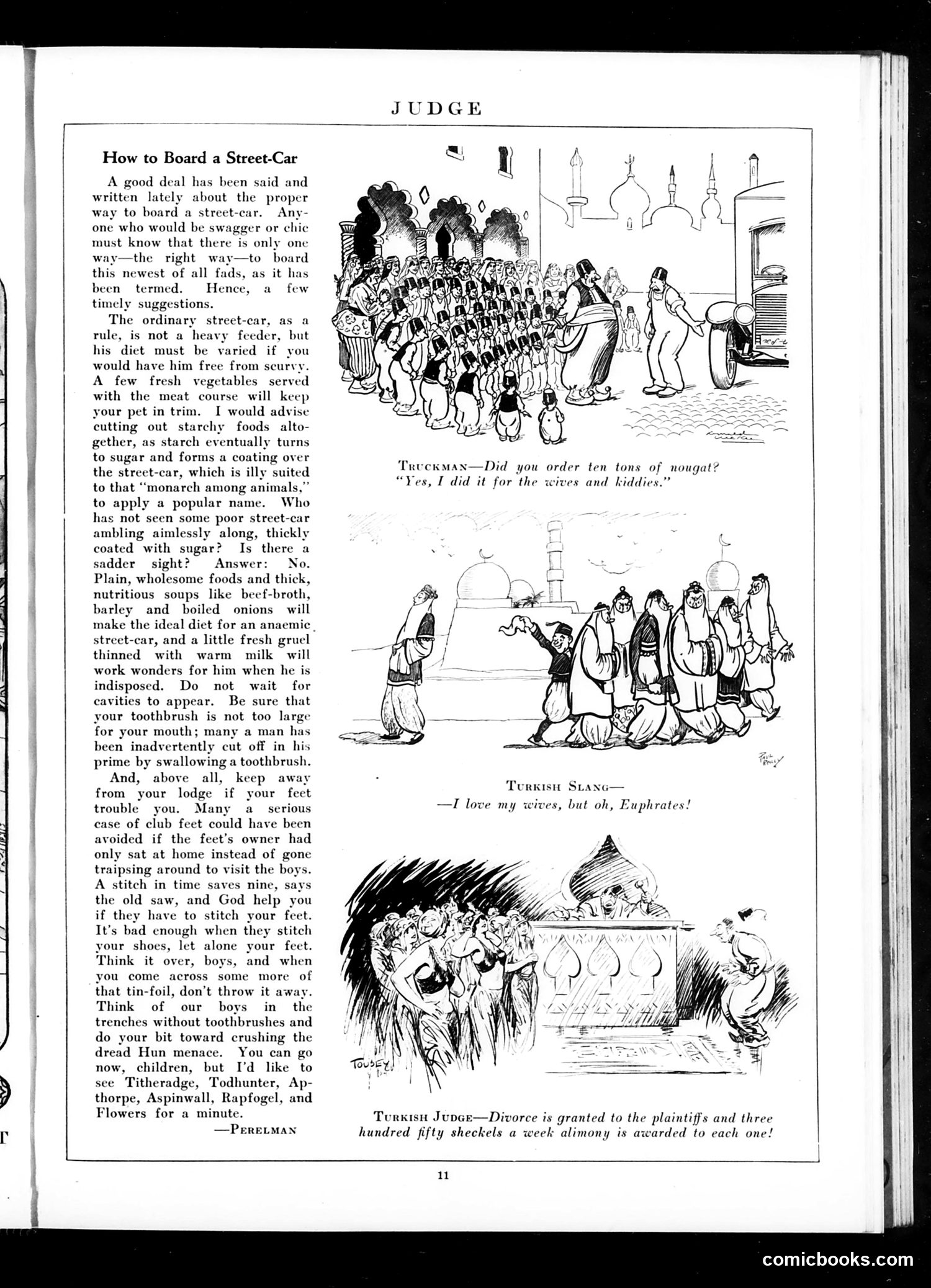
This page contains three satirical cartoons mocking different subjects: **"How to Board a Street-Car"** (top): A humorous advice column that absurdly treats streetcars as living creatures requiring proper diet and care. The satire satirizes both the contemporary obsession with "proper etiquette" for the new technology of electric streetcars and pseudo-scientific health fads of the era. **"Truckman" (middle)**: A joke about a truckman ordering ten tons of nougat "for the wives and kiddies"—satirizing either excess consumerism or immigrant families' perceived dietary habits (nougat being associated with Middle Eastern/Turkish sweets). **"Turkish Judge" (bottom)**: A joke about Ottoman divorce law, where a judge awards each of three wives alimony of "three hundred fifty sheckels a week." This satirizes both the perceived exoticism of non-Western legal systems and polygamy, presenting it as absurd and financially ruinous. The page reflects early 20th-century American attitudes toward technology, immigration, and non-Western cultures through humor.
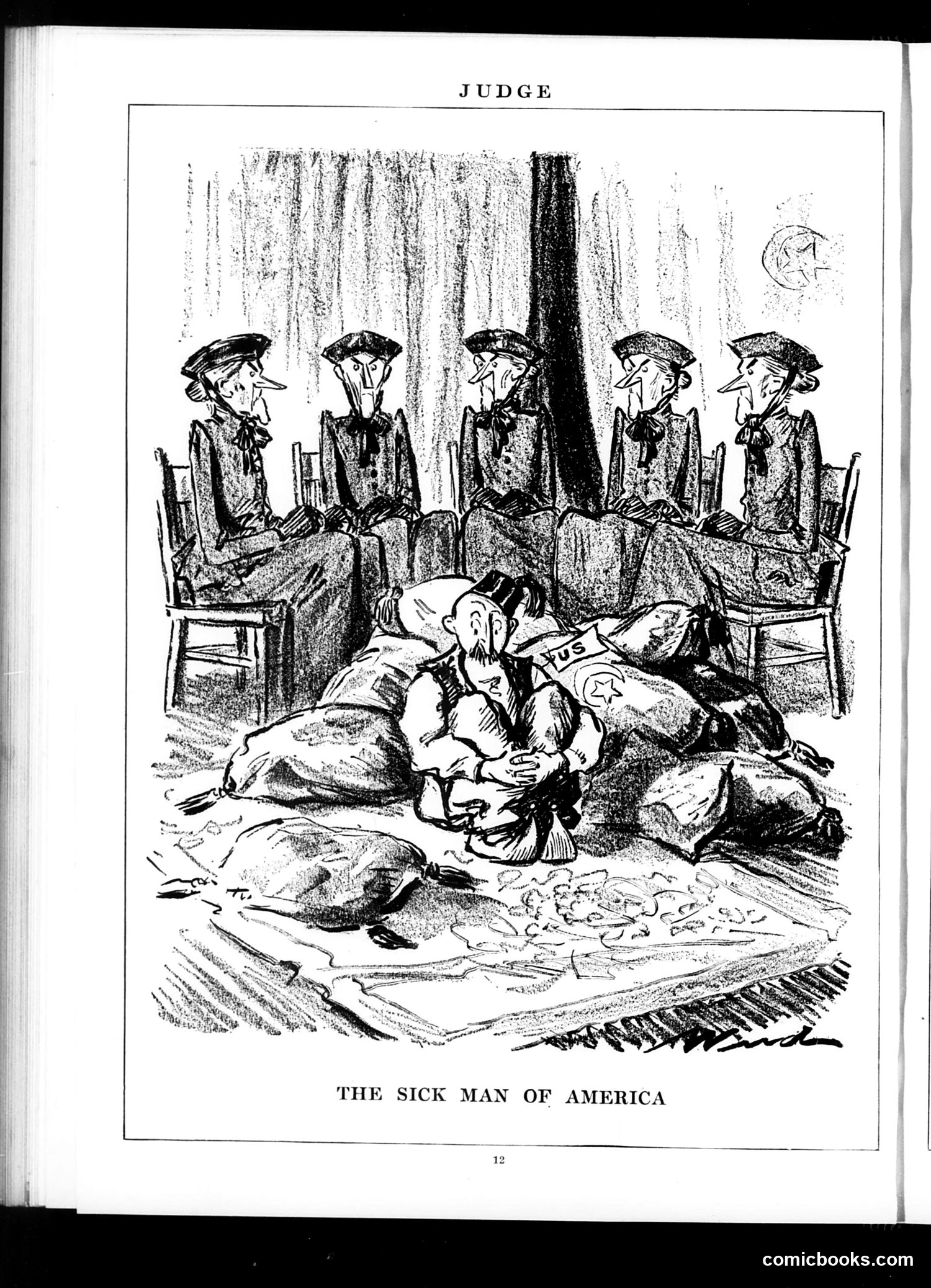
This political cartoon depicts America as an ailing patient surrounded by five stern-faced physicians (likely representing government officials or judges). The patient, labeled "America," lies prostrate on the ground, appearing gravely ill or dying, with what appears to be medical implements scattered nearby. The title alludes to "the Sick Man of Europe"—a historical phrase referring to the Ottoman Empire's decline. By applying this metaphor to America, the cartoonist suggests the nation itself is in serious decline or crisis. The physicians' grave expressions indicate deep concern about the nation's condition. Without a specific date visible, the exact crisis referenced remains unclear—it could relate to economic depression, political corruption, or social upheaval. The satire implies that America's leadership (the physicians) may be unable or unwilling to effectively treat the nation's fundamental problems.
This article debates what constitutes an "amateur" athlete, sparked by tennis player Mary K. Browne's disbarment from amateur golf because she was a professional in another sport. The piece argues Americans are inherently "professional" in attitude—viewing everything, including sports, as means to material success rather than leisure. It contrasts this with the British approach: English athletes play multiple sports casually for enjoyment ("happy-go-lucky attitude"), while Americans obsessively specialize and train intensely in single sports. The satirical point: America's competitive, success-driven culture infiltrates even amateur athletics, making true amateurism impossible here. The article cites Vincent Richards defending tennis players who profit indirectly through business connections (golf, bridge, hospitality). The British, by contrast, genuinely play "for amusement and exercise"—making them true amateurs despite lacking formal amateur status definitions. The satire mocks American capitalism's corruption of sport and leisure itself.
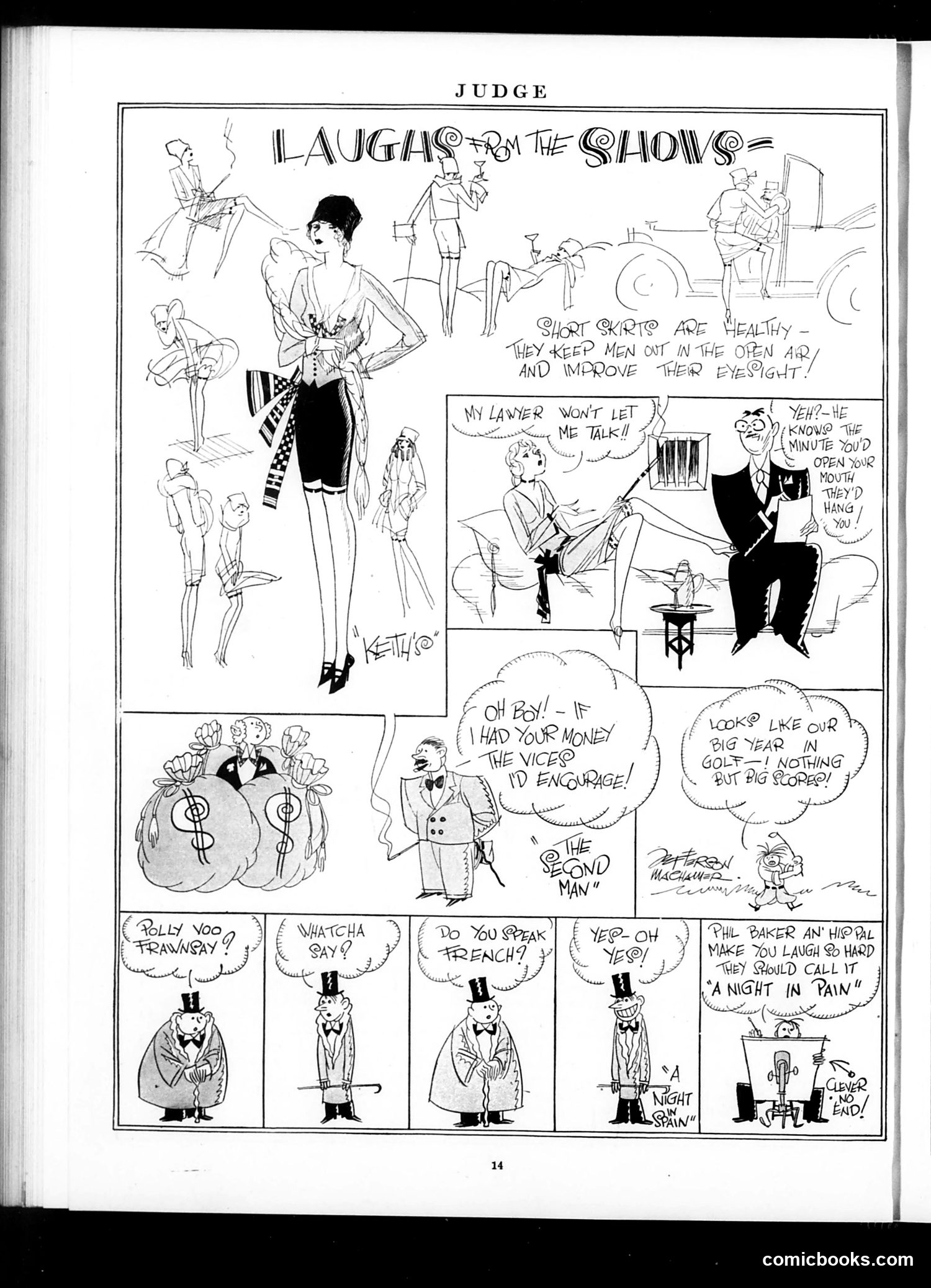
This page satirizes fashionable society and entertainment through multiple jokes. The top section mocks short skirts as healthy exercise, with a woman displaying the garment while men discuss its benefits. The middle panels ridicule wealthy men's priorities—one discusses encouraging vice through money, another boasts about golf as life's meaning. The bottom row features what appear to be vaudeville or theatrical performers in top hats, engaging in rapid-fire ethnic jokes and language gags ("Polly Voo Frawnsey?" "Do you speak French?"). These represent the era's common stage stereotypes. The final panel references Phil Baker, an entertainer, with a pun on "A Night in Spain"/"A Night in Pain." The overall satire targets both the leisure class's shallow values and period entertainment's reliance on crude stereotypical humor.
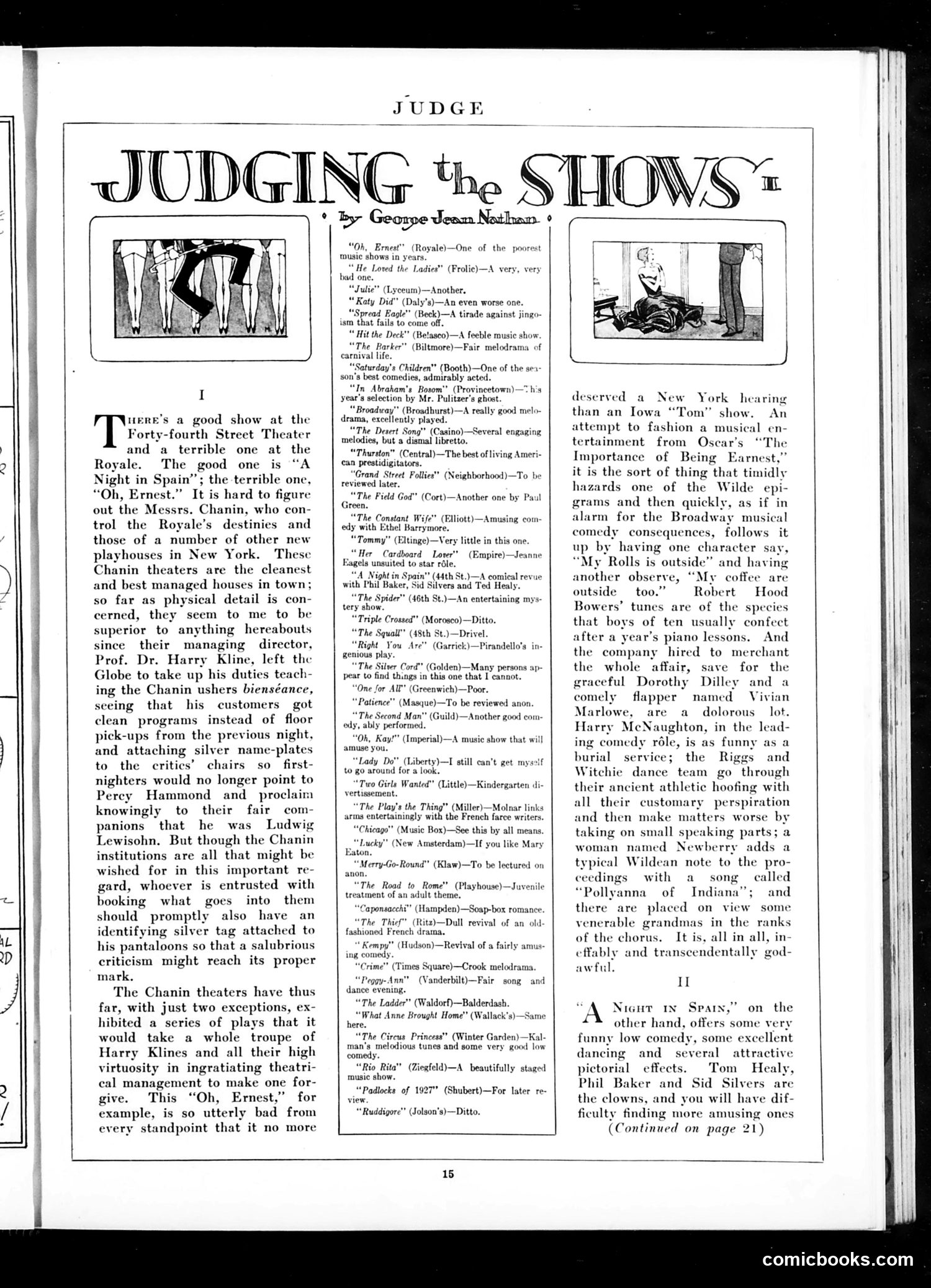
This is a theater review column titled "Judging the Shows" by George Jean Nathan, a prominent drama critic. The page contains Nathan's dismissive critique of current Broadway productions, particularly targeting the Chanin theaters—a chain of newly built, well-maintained playhouses in New York. Nathan praises the theaters' physical cleanliness and management but savagely mocks their booking decisions. He singles out "Oh, Ernest" at the Royale as exceptionally bad, using it as a jumping-off point to roast the entire season's lineup. The extensive list below catalogues shows with brutally brief verdicts: "poorest music shows in years," "even worse one," "dismal libretto," etc. The satire targets theater management's apparent incompetence despite superior facilities—hence Nathan's sarcastic suggestion that whoever books shows should wear an "identifying silver tag" so criticism reaches the right person. The column exemplifies early 20th-century highbrow theater criticism's withering contempt for commercial entertainment.
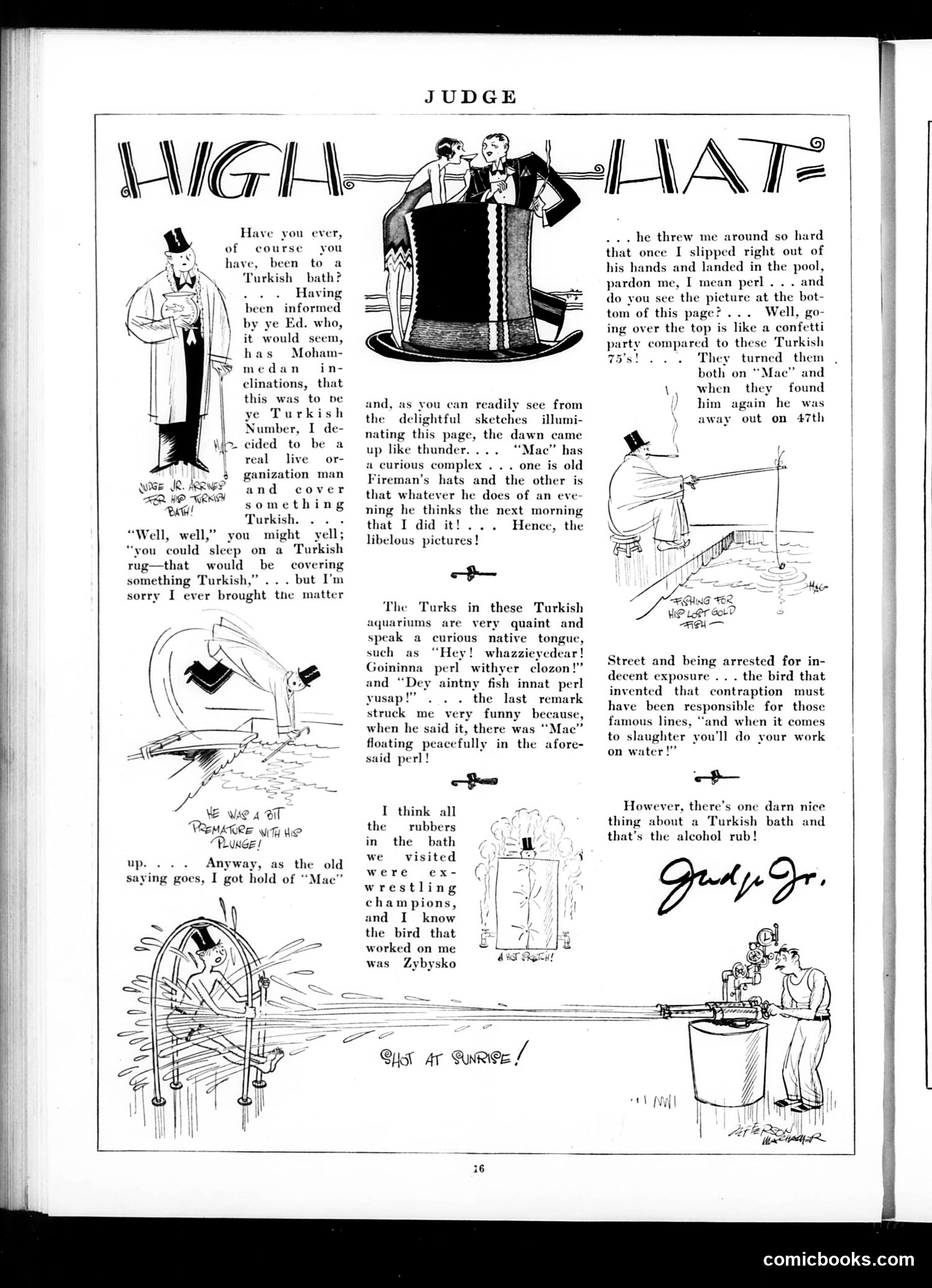
This is a humorous first-person account of visiting a Turkish bath, written as satire of Judge magazine's "Turkish Number" theme. The author describes comically exaggerated experiences: aggressive masseurs (named "Mac" and apparently a wrestler named Zybysko), getting thrown into pools, being blasted by water cannons at sunrise, and ending up arrested for indecent exposure on 47th Street. The humor relies on physical comedy and ethnic caricature typical of 1920s-era American magazines—the "curious native tongue" dialogue and stereotyped depictions of Turkish workers. The cartoons illustrate slapstick mishaps: a man in a giant Turkish bath vessel, someone tangled in what appears bathing equipment, and a figure being launched into the air. The satire targets both Turkish bathing culture and the magazine's editorial decision to dedicate an issue to "Turkish" themes. The final joke—that the only genuine benefit is "the alcohol rub"—mocks Prohibition-era America by suggesting visitors valued the rubdown's alcohol content.
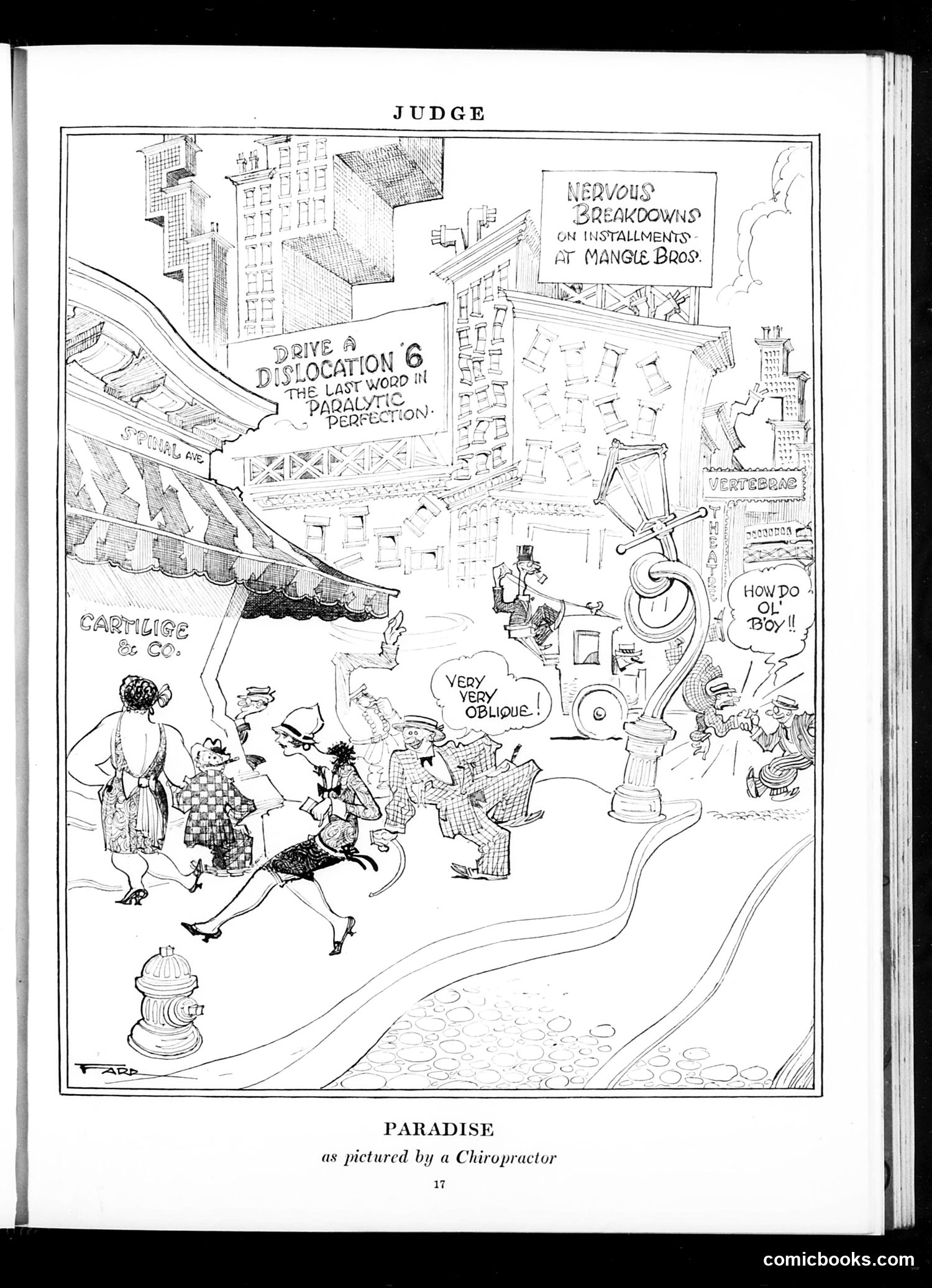
This satirical cartoon depicts a chiropractor's idealized version of paradise. The scene shows a fantastical urban landscape where people are experiencing various spinal adjustments and chiropractic treatments as leisure activities—what would constitute "paradise" to a chiropractor. The cartoon mocks the chiropractic profession's tendency to attribute most human ailments to spinal misalignment. Visible text references include "Drive a Dislocation & The Ideal Wood in Paralytic Perfection" and business signage like "Cartlidge & Co." and "Mangle Bros." The characters' exaggerated postures and the absurd architecture underscore the satire. This reflects early 20th-century skepticism toward chiropractic medicine, which was then considered pseudoscientific by the medical establishment. The joke is that a chiropractor would literally envision heaven as a place focused entirely on spinal manipulation.
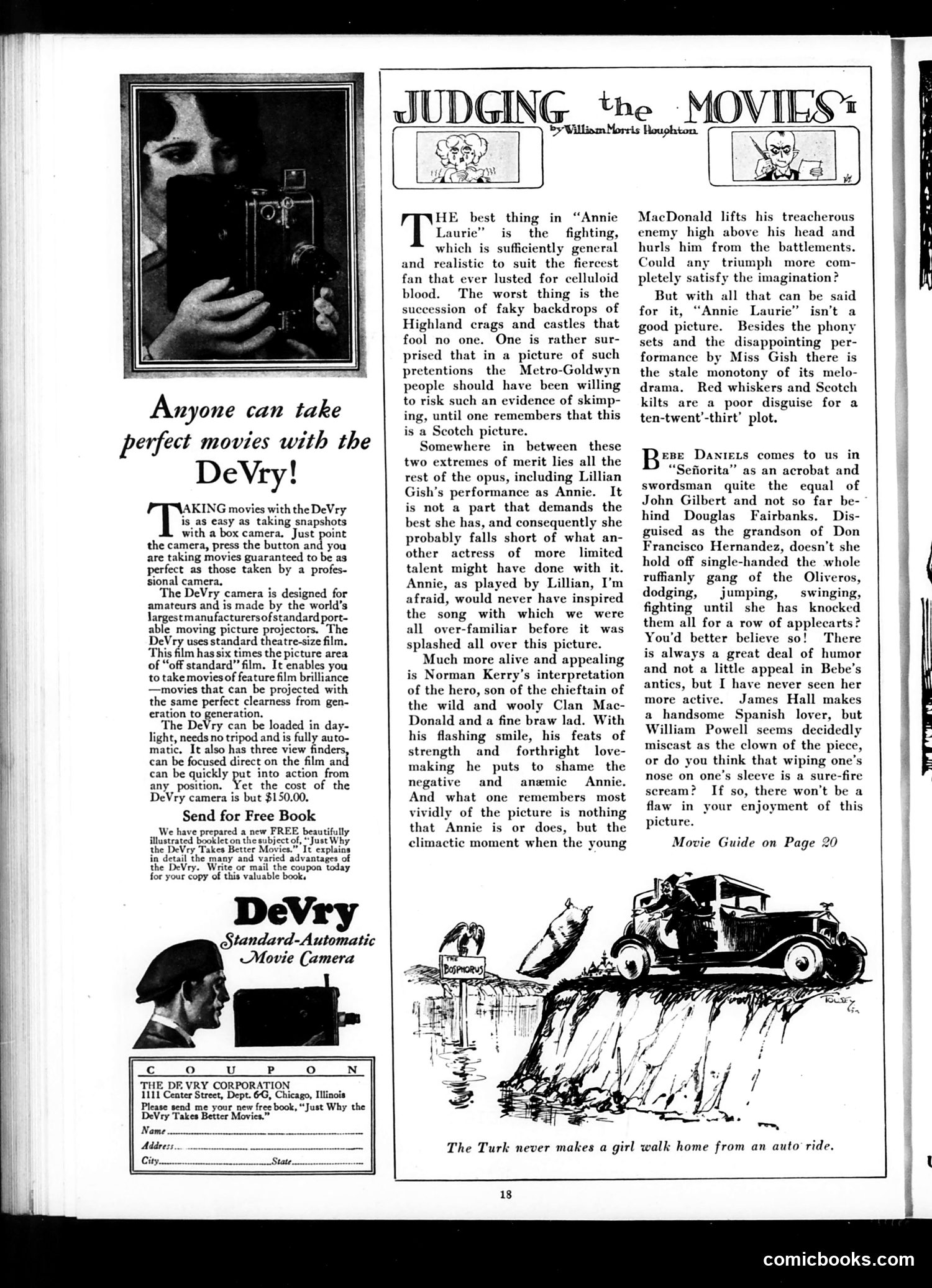
This page is primarily a **film review column** by William Morris Houghton, with an advertisement for DeVry movie cameras. The reviews critique two silent films: 1. **"Annie Laurie"** (Metro-Goldwyn): The critic praises its fighting scenes but condemns the cheap, fake Highland scenery. He finds Lillian Gish's performance uninspired and monotonous, while praising Norman Kerry's more dynamic hero role. The complaint about "ten-twent'-thirt'" plot references cheap melodrama theater—suggesting the film merely repackages old theatrical tropes with Scottish costumes. 2. **"Señorita"**: Features actress Bebe Daniels performing acrobatic stunts rivaling Douglas Fairbanks, disguised as a nobleman fighting off criminals. The bottom cartoon caption—"The Turk never makes a girl walk home from an auto ride"—appears to be a separate joke, possibly referencing ethnic stereotypes about foreign men's courtesies (or lack thereof) toward women.
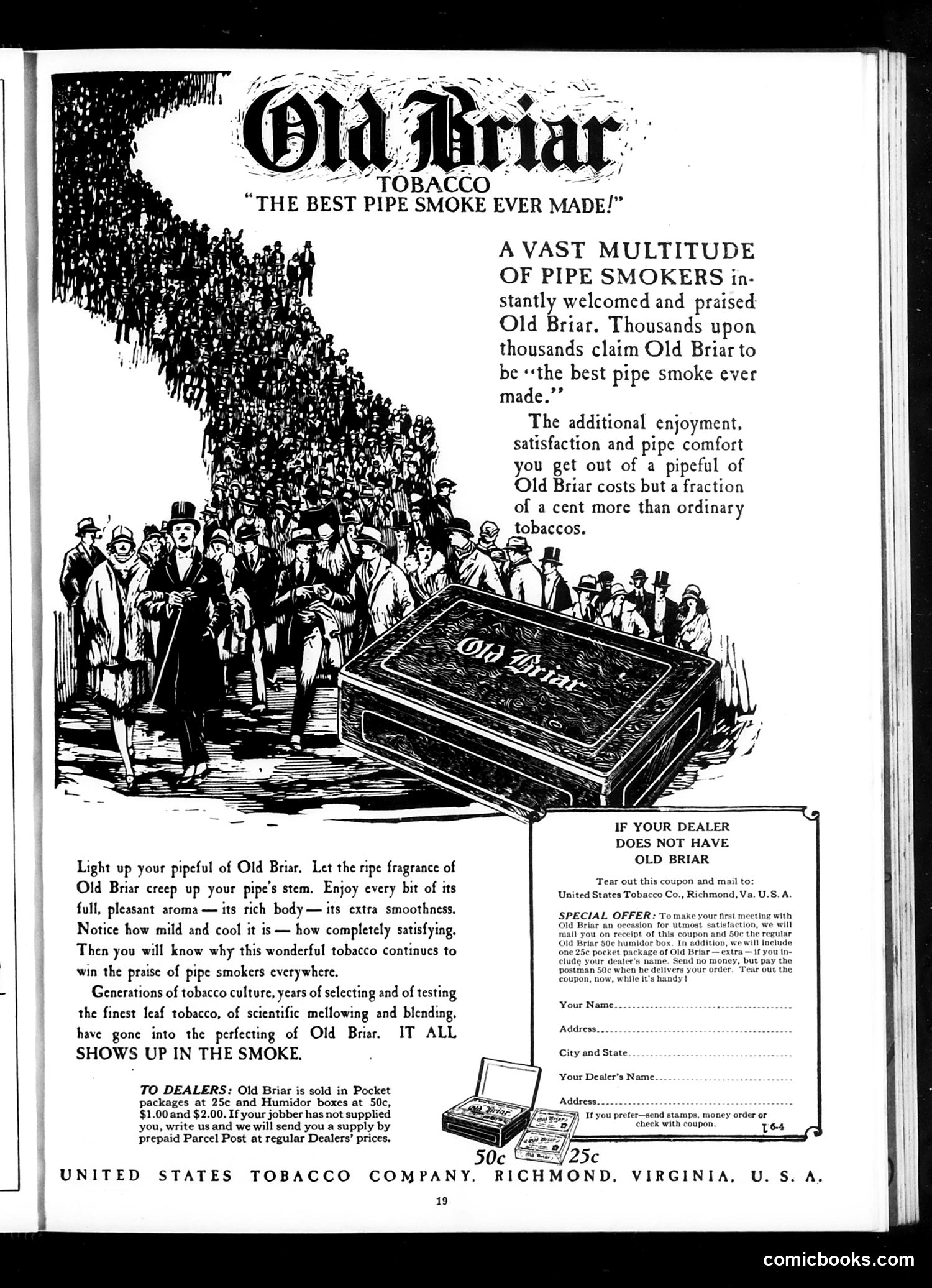
This page is **not a political cartoon or satire**—it's a straightforward **tobacco advertisement** from the United States Tobacco Company. The ad uses populist imagery: a massive crowd of ordinary men (depicted in period dress) gathering around an enormous Old Briar tobacco box, suggesting widespread consumer enthusiasm. The visual appeals to democratic consensus—"thousands upon thousands claim" this is the best pipe smoke. The marketing pitch emphasizes quality ("generations of tobacco culture," "scientific mellowing") while claiming affordability ("costs but a fraction of a cent more"). A coupon at bottom encourages direct mail orders, typical of early-20th-century direct marketing. For modern readers: this represents pre-cigarette era tobacco culture when pipe smoking was common and respectable, and when tobacco companies advertised openly in mainstream magazines without health warnings.
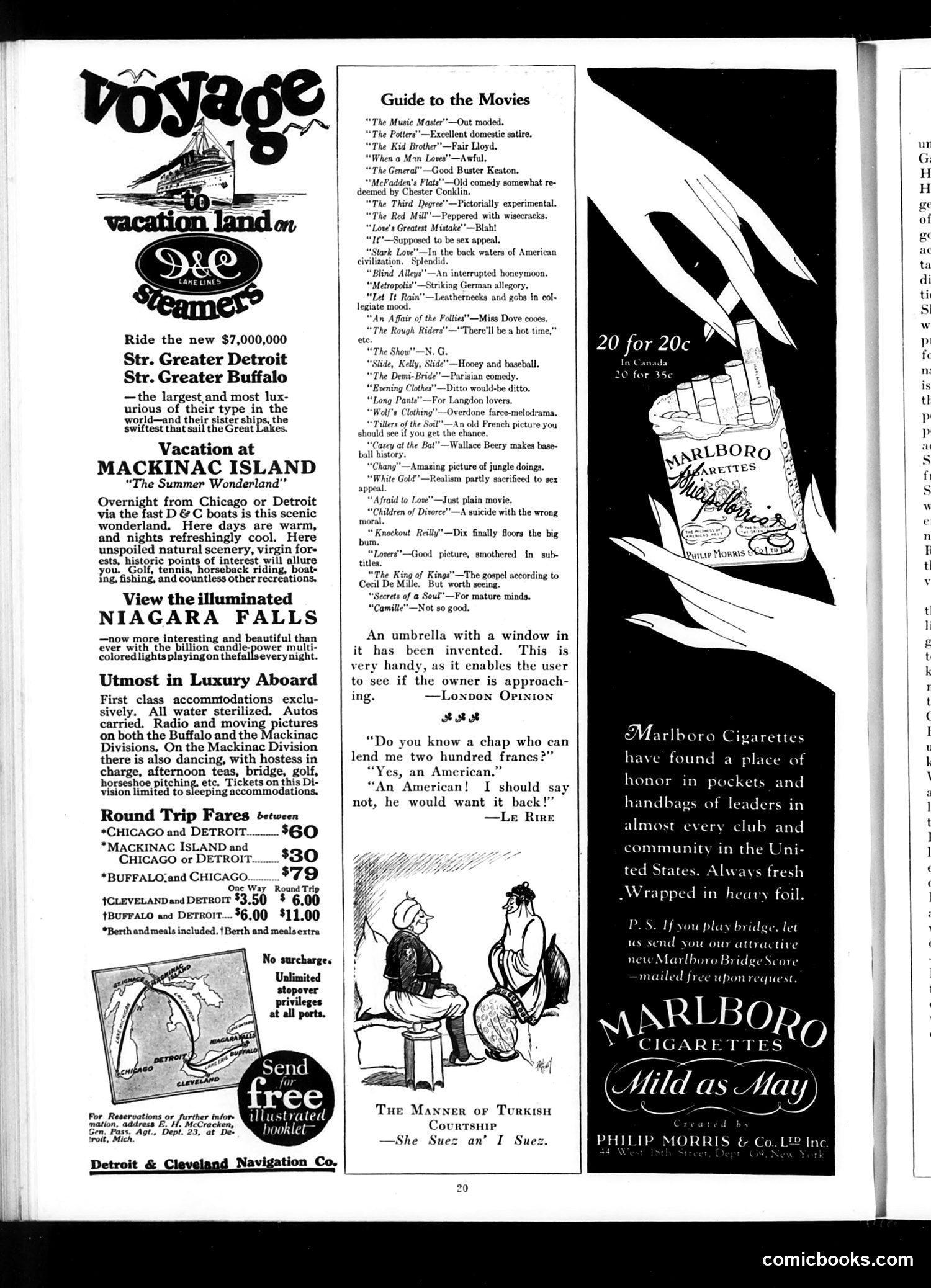
This page is primarily **advertising and entertainment listings** from what appears to be the 1920s. The main content includes: **Travel Advertisements:** Promoting luxury Great Lakes steamships (Greater Detroit, Greater Buffalo) and vacation destinations like Mackinac Island and Niagara Falls—leisure activities for affluent Americans. **Movie Reviews:** A "Guide to the Movies" listing contemporary films with brief critical judgments, reflecting 1920s cinema (Buster Keaton, Cecil B. DeMille productions). **Humor Sections:** Two small jokes—one about an umbrella with a window (practical joke), another playing on national stereotypes: an American is a poor choice for lending money because "he would want it back," mocking American financial attitudes. **Cigarette Advertisement:** Marlboro cigarettes advertising their prestige among "leaders" in clubs and communities. The page reflects 1920s consumer culture, leisure travel, cinema popularity, and emerging national stereotypes, with light satirical commentary embedded in the humor sections rather than explicit political cartoons.
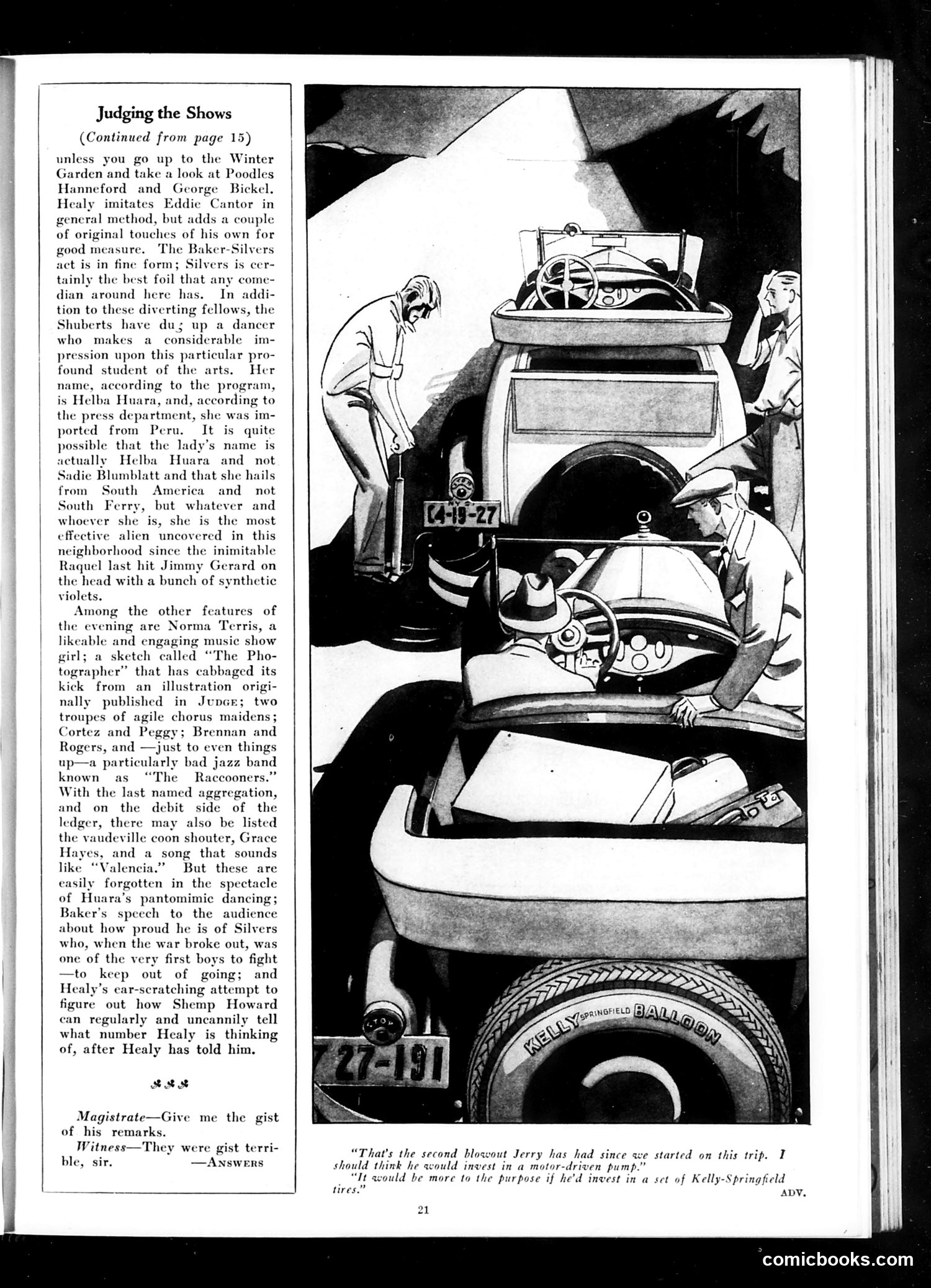
This page reviews theatrical shows at the Winter Garden, focusing on performers like Eddie Cantor imitator Healy, the Baker-Silvers comedy act, and dancer "Helba Huara" (likely a stage name—the critic skeptically notes she may actually be "Sadie Blumblatt" from South Ferry rather than Peru). The review praises various acts while critiquing others, including a "particularly bad jazz band" called "The Raccooners." The bottom features two separate humor items: a magistrate-witness exchange about unclear remarks, and a car-based joke. The car cartoon advertises Kelly-Springfield tires, depicting a man with repeated blowouts—the punchline suggesting he invest in proper tires rather than a motorized pump. The content reflects 1920s vaudeville culture and early automotive humor.
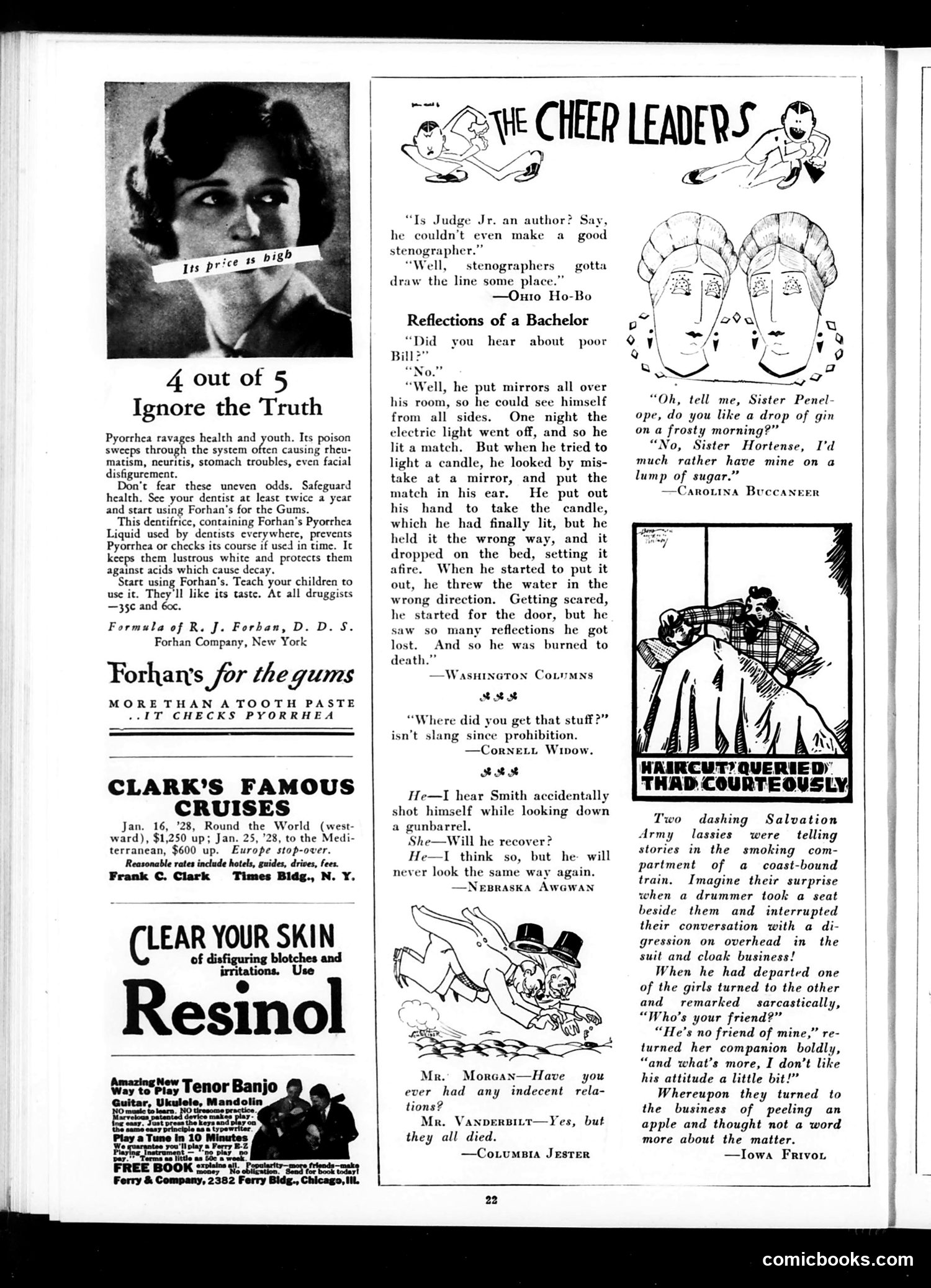
This page is primarily **advertising and humor content** rather than political satire. The dominant feature is a **Forhan's toothpaste advertisement** warning against pyorrhea (gum disease), using fear-based marketing typical of 1920s advertising. The page also contains **"The Cheer Leaders"** section—a collection of short jokes and anecdotes from various sources (Ohio Ho-Bo, Washington Columns, Nebraska Awgwan, etc.). These are lighthearted humor pieces, not political commentary. Examples include a joke about Judge Jr.'s incompetence as a writer, a darkly comedic story about a man killed by his own mirrors, and a pun about prohibition-era slang. The cartoons are generic comic illustrations accompanying these jokes rather than editorial commentary. Additional advertisements for cruises, skin cream (Resinol), and musical instruments fill the remaining space. **This is essentially a humor and advertising page**, not a vehicle for political satire or social commentary.
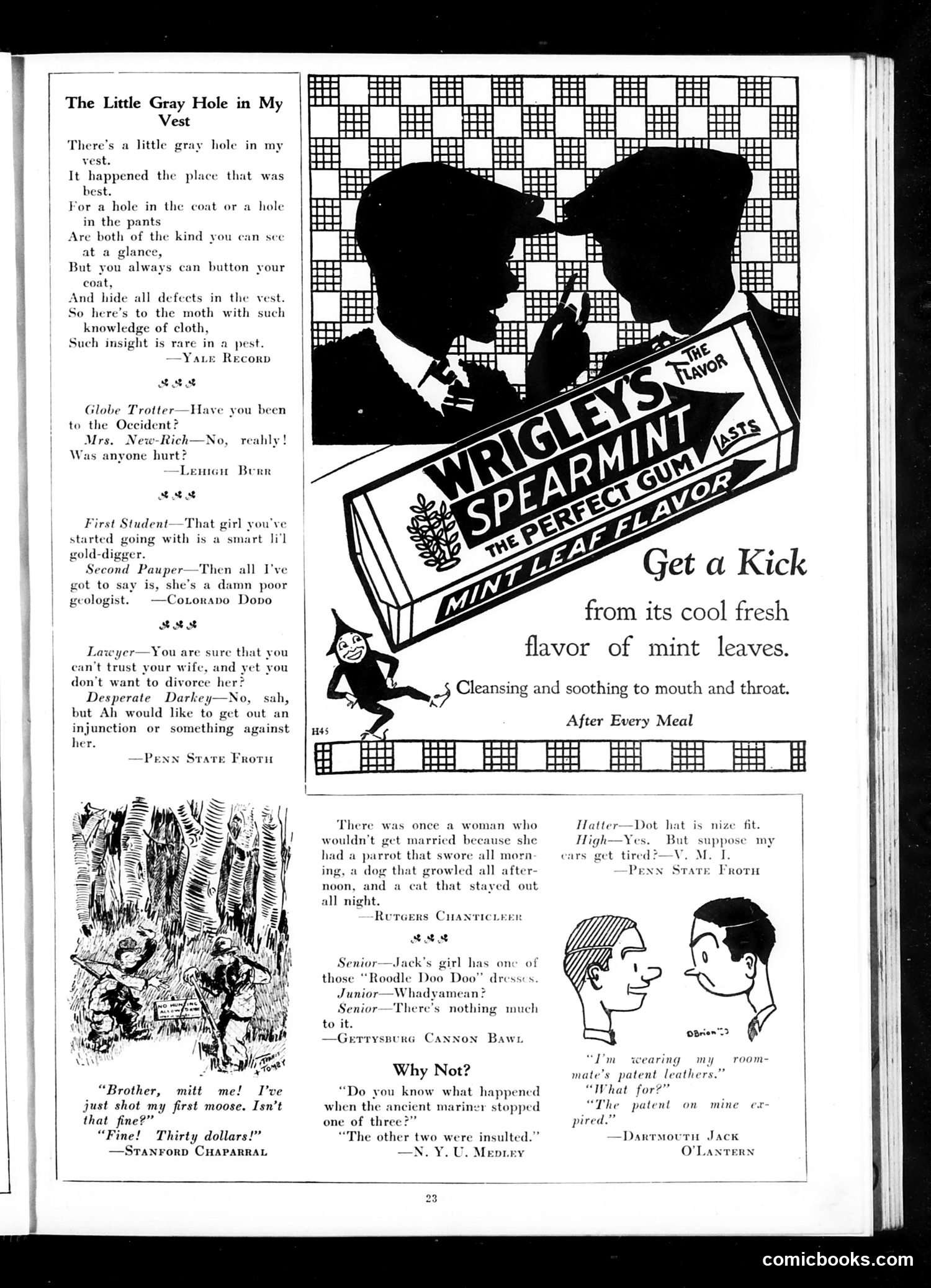
This page from satirical magazine *Judge* contains multiple short jokes and one advertisement, typical of early 20th-century humor magazines. **Key Content:** The main cartoon shows two silhouetted men examining a Wrigley's Spearmint Gum package—an advertisement disguised as editorial content. **The jokes** reflect period social attitudes: - "The Little Gray Hole in My Vest" mocks moths as having surprising "knowledge" of fabric - Multiple jokes target "gold-diggers" (women pursuing men for money) - A "Desperate Darkey" section uses offensive racial caricature and dialect to depict a Black man seeking legal separation rather than divorce - College humor focuses on dating, poverty, and male anxieties about women's motives **Social Context:** These jokes reflect 1920s anxieties about changing gender roles, wealth, and relationships. The racist content reflects the casual racism normalized in publications of this era. The advertisement seamlessly integrates product placement into the editorial—common practice before modern advertising distinctions.
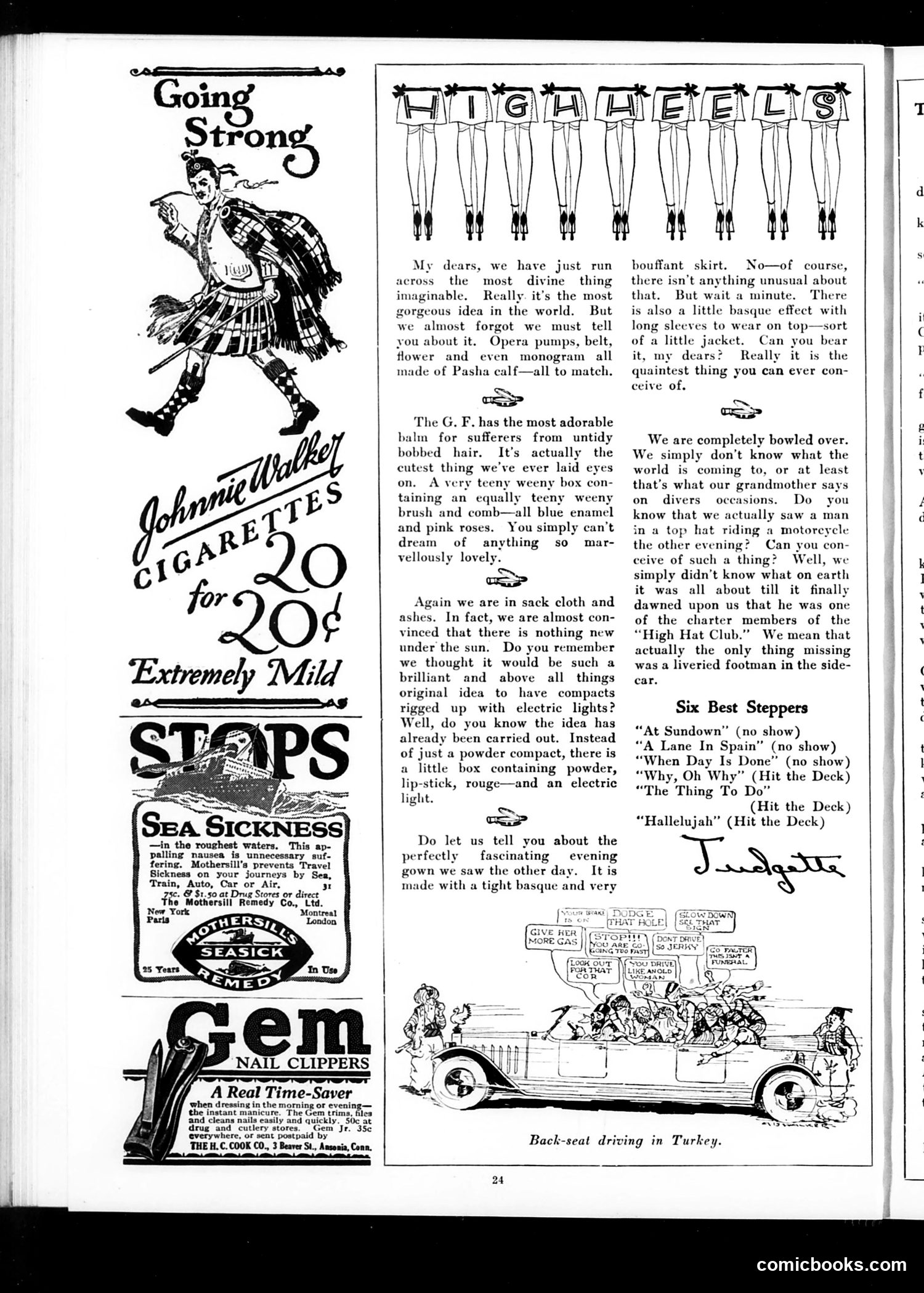
This page is primarily **fashion and society commentary** rather than political satire. The "Highaheels" column mocks wealthy society women's obsession with trivial fashion trends and conspicuous consumption. The satirical voice repeatedly expresses mock amazement at minor style innovations—matching accessories made from "Pasha calf," compacts with electric lights, an evening gown with layered basque effects. The humor lies in the breathless, affected tone: "My dears," "Really," "You simply can't dream"—parodying how fashionable women discuss mundane variations as revolutionary discoveries. The most pointed joke concerns a man in a top hat riding a motorcycle, interpreted as scandalous behavior befitting only "charter members of the 'High Hat Club'"—suggesting the upper class clings to outdated formality despite modern transportation. The accompanying cartoon shows a car full of people in Turkey labeled "Back-seat driving," a generic joke about unwanted passenger commentary. **Overall**, the page satirizes upper-class women's shallow materialism and fashion obsession circa the 1920s Jazz Age.
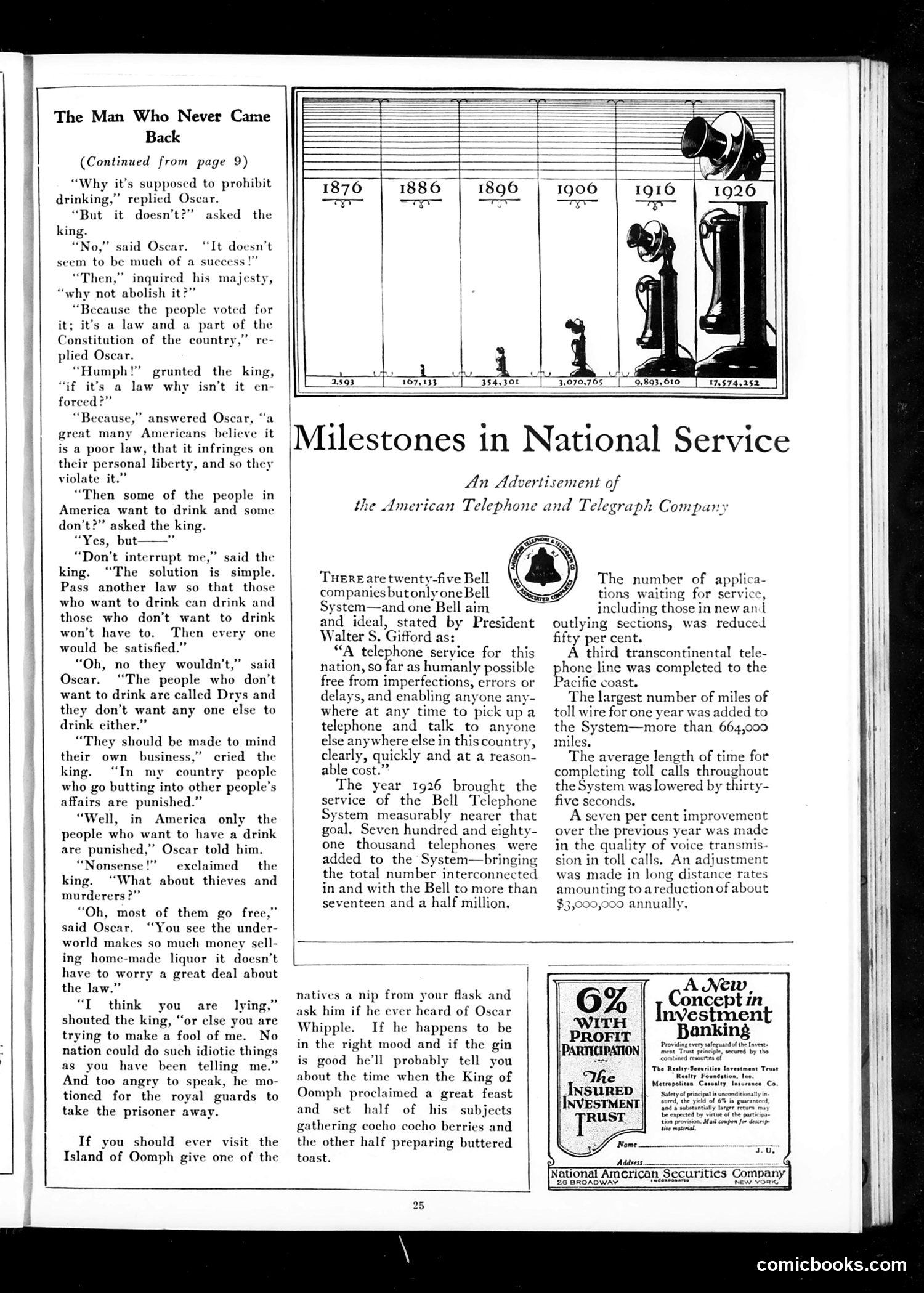
This page contains two distinct pieces: a satirical dialogue and an advertisement. **The Satire ("The Man Who Never Came Back"):** Oscar, apparently an American visitor, debates Prohibition with a foreign king. The king finds American law absurd: citizens voted to ban alcohol, yet many violate it and resent enforcement. Oscar explains that "Drys" (Prohibition supporters) want the law enforced on *everyone*, not just themselves—the king finds this tyrannical. Oscar adds that bootleggers profit so heavily that criminals go unpunished. The king deems the entire American system idiotic and has Oscar arrested. The satire mocks Prohibition's contradictions: democratic law that much of the population opposes, selective enforcement that punishes drinkers but enriches criminals, and moralistic busybodies imposing their values on others. **The Advertisement:** AT&T touts 1926 telephone expansion—adding 781,000 phones, reducing wait times, and lowering long-distance rates. It's straightforward corporate publicity celebrating infrastructure growth.
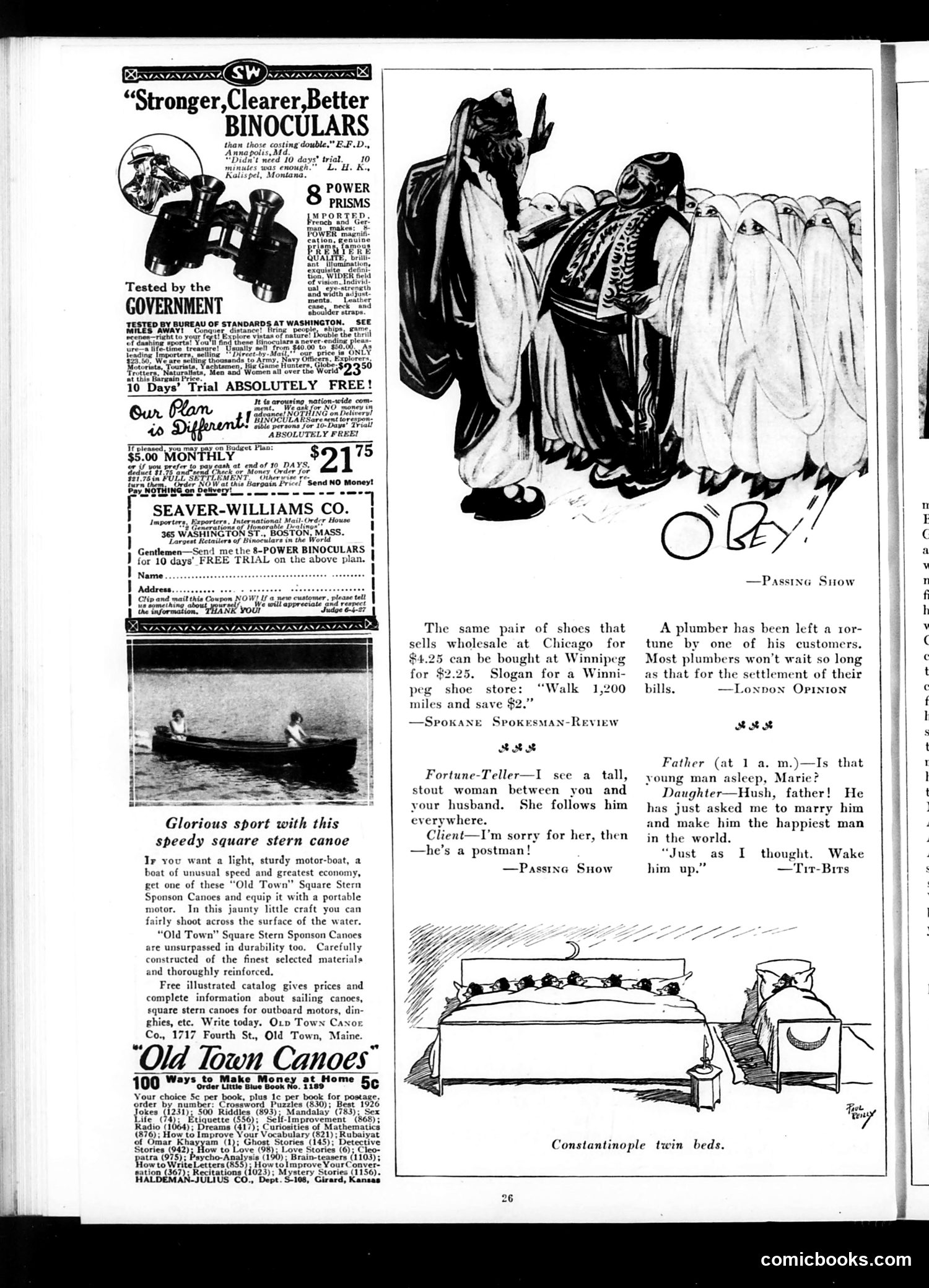
This page is primarily **advertising and humor content**, not political satire. **Main elements:** 1. **Binoculars advertisement** (top left): Seaver-Williams Co. promotes "8-Power Prisms" binoculars, claiming government testing and superiority over costlier competitors. Includes customer testimonials. 2. **"Obey" cartoon** (top right): Shows robed figures (appears to be clergy or authority figures) gesturing toward compliance. The caption "Obey" suggests commentary on authority or institutional control, though specific context is unclear. 3. **Multiple joke columns and advertisements**: Brief humorous anecdotes about shoe pricing differences between cities, a plumber's inheritance, a fortune-teller's quip about a postman, and a father discovering his daughter's engagement at 1 a.m. 4. **Product ads**: Canoes, home-study books, and mail-order merchandise. **Overall**: This is a typical Judge page mixing consumer advertising with short, light-hearted jokes rather than sharp political commentary. The "Obey" cartoon's meaning requires additional context to interpret meaningfully.
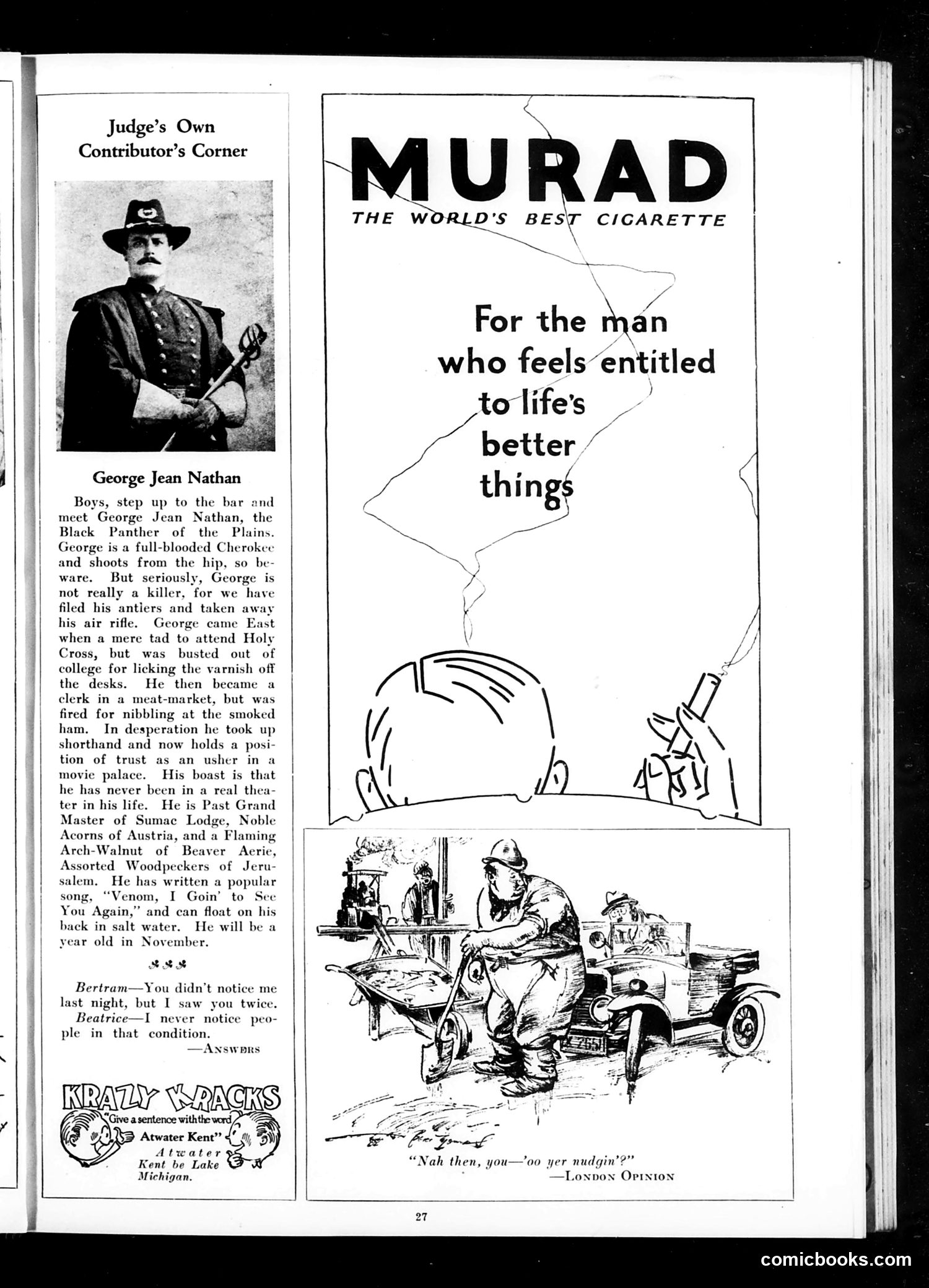
This page contains two distinct elements: **Left side:** A humorous bio of George Jean Nathan, likely a real Judge contributor. The satire mocks Nathan through absurdist exaggeration—describing him as a "Black Panther of the Plains" (full-blooded Cherokee) who "shoots from the hip," then undermining this tough persona by revealing he was fired from jobs for petty misconduct (licking desk varnish, nibbling ham) and now works as a movie-theater usher who's never seen an actual theater. The layered joke is that this supposed tough character is actually pathetic and incompetent. **Right side:** A Murad cigarette advertisement claiming "The World's Best Cigarette / For the man who feels entitled to life's better things." Below is a cartoon showing working-class laborers with a vehicle, one saying "Nah then, you—oo yer nudgin'?" (attributed to "London Opinion"). The irony appears intentional: the ad targets aspirational consumers, yet the illustration depicts rough, common workers—suggesting either that Murad's actual audience is working-class, or satirizing the gap between advertising's promises and reality.
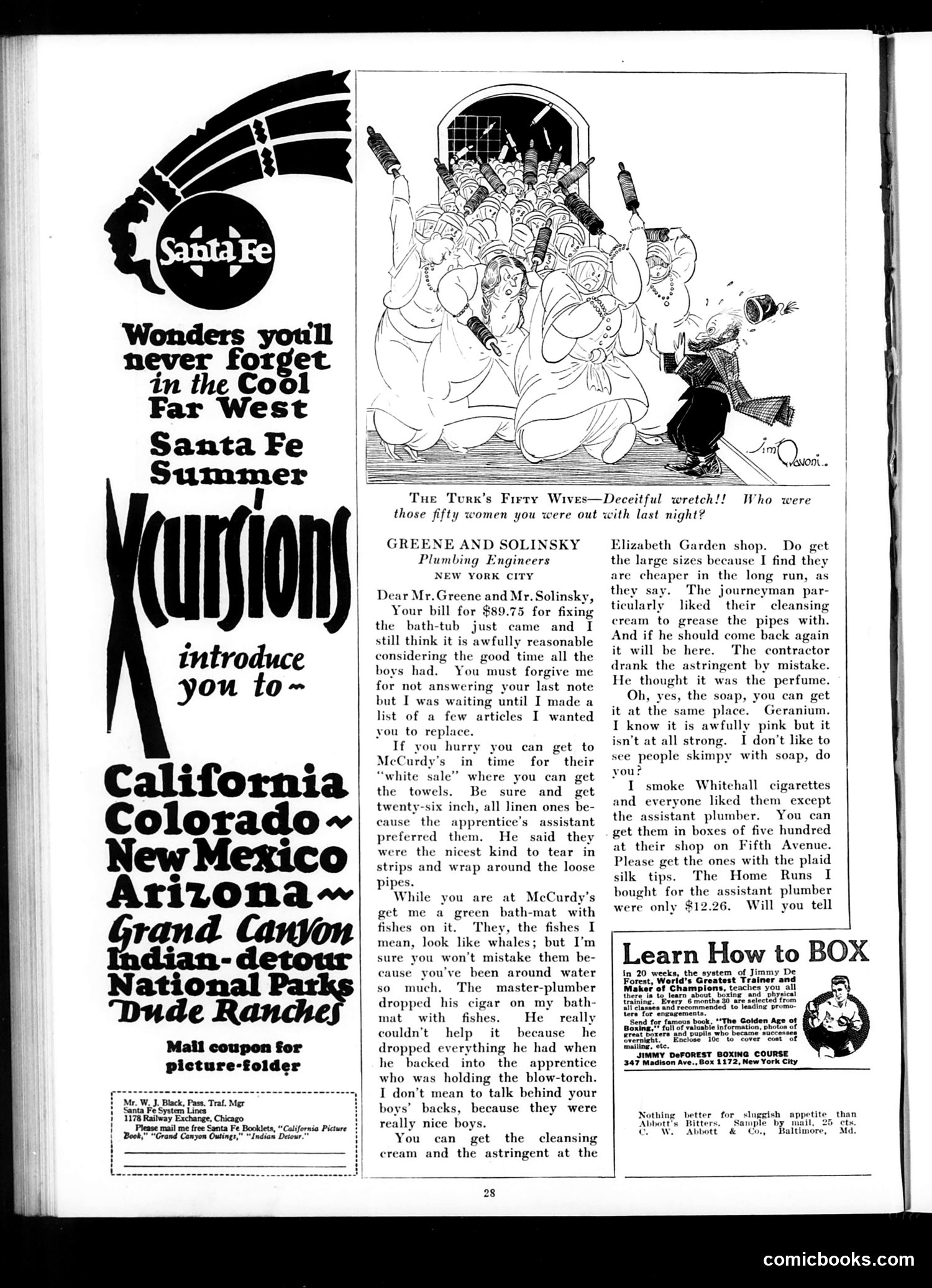
This page contains two distinct elements: a **travel advertisement** (left) and a **satirical letter** (right). The main cartoon is "The Turk's Fifty Wives"—a humorous domestic complaint letter from a wife to plumbers Greene and Solinsky. The joke satirizes excessive socializing: she sarcastically "forgives" them for their expensive bill because the plumbers' workers apparently had such a good time at her home that they caused damage (loose pipes, stains requiring cleaning cream). The satire works by inverting normal complaint logic—instead of condemning their misconduct, she *enables* it by sending them on shopping errands and buying them gifts (cigarettes, bath mats), while subtly documenting their negligence and indulgence. The "Turk's Fifty Wives" title suggests she's treating them like a harem, keeping them perpetually obligated. The left side is a Santa Fe railway advertisement promoting Western tourism destinations (Grand Canyon, dude ranches, etc.), unrelated to the cartoon's content.
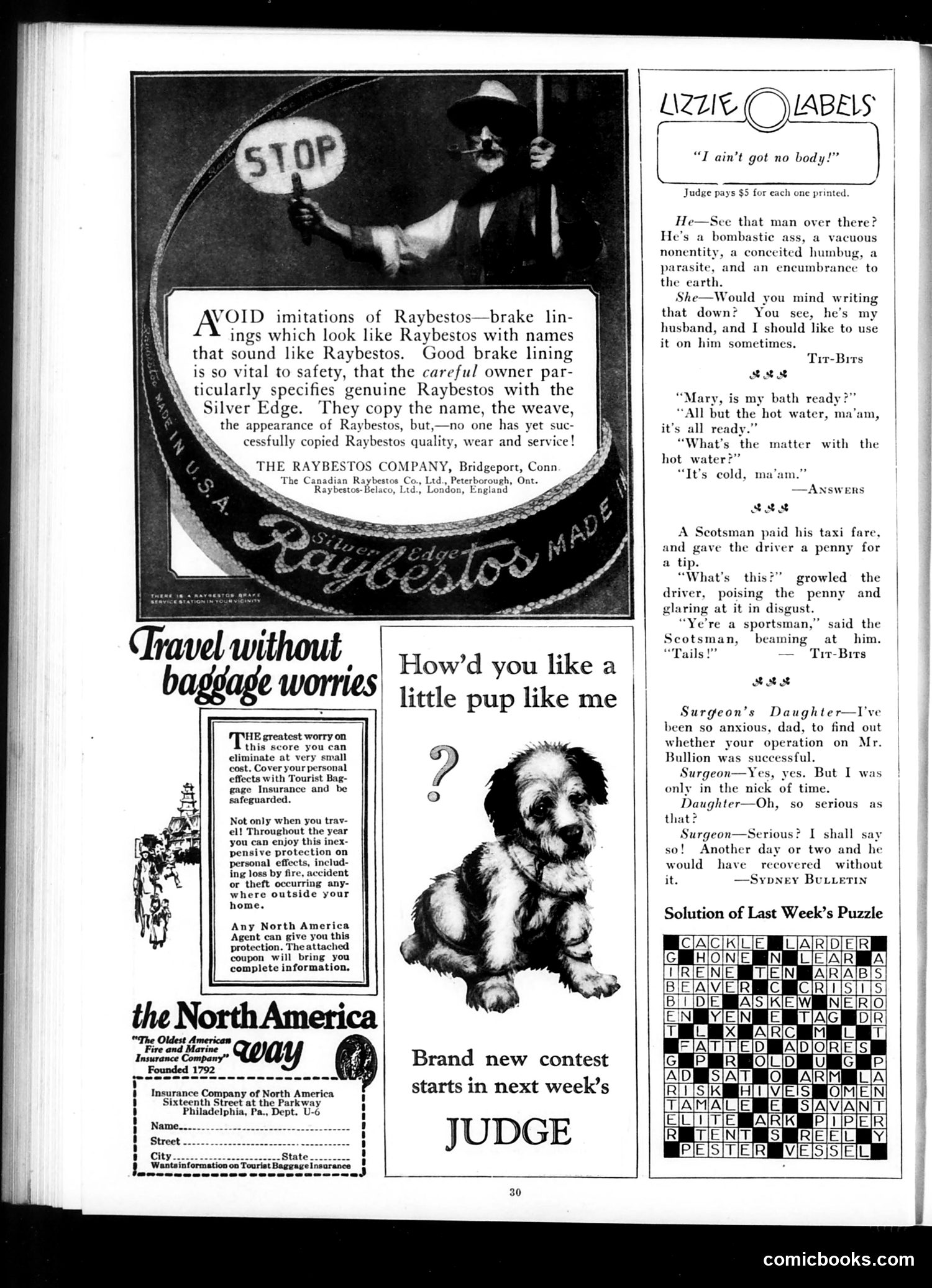
This page is primarily **advertising and humor content** rather than political cartooning. The main advertisements are: - **Raybestos brake linings**: warns consumers against counterfeit imitations, emphasizing that genuine products cannot be successfully copied - **North America Travel Insurance**: promotes baggage coverage for travelers The humor section "**Lizzie Labels**" contains short joke submissions (readers paid $5 per published joke). These are domestic/observational gags—a wife wanting to remember insults for her husband, a Scottish taxi driver's confusion over a penny tip, bathroom water temperature mishaps, and a surgeon's confession that his operation on "Mr. Bullion" was unnecessary. A new **Judge contest** featuring a puppy illustration is announced for the following week, alongside a crossword puzzle solution. The content reflects early 20th-century concerns: consumer fraud awareness, travel logistics, and middle-class domestic humor. There is no identifiable political satire on this particular page.
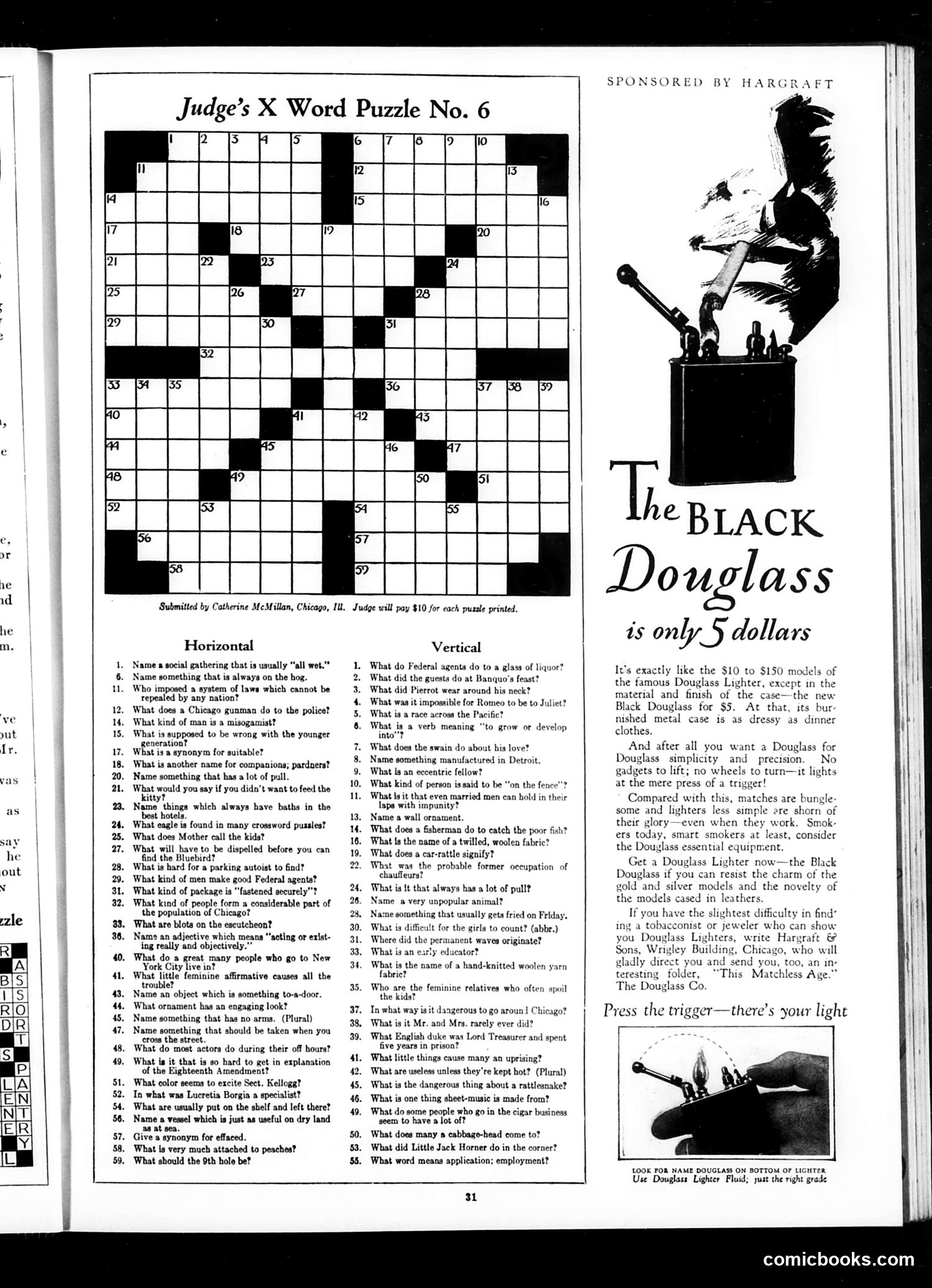
This page contains a crossword puzzle with clues that serve as social and political satire typical of Judge magazine's humor. The clues mock contemporary issues and figures of the era: **Political/Social References:** - Clues reference Prohibition ("Federal agents do to a glass of liquor") - The 18th Amendment ("hard to get in explanation of the Eighteenth Amendment") - Secretary Kellogg (appears to be Secretary of State Frank B. Kellogg, 1920s) - Lucretia Borgia (invoking poisoning/corruption) **Social Commentary:** The puzzle mocks "the younger generation" (a recurring Judge theme), Chicago gangsters, and various social hypocrisies—"all wet" gatherings, hotel formalities, and moral contradictions. **The Advertisement:** Notably, the page is dominated by a Douglas lighter advertisement featuring a silhouetted figure with a gun emerging from a cigarette lighter—deliberately evoking the gangster/violence imagery the puzzle clues satirize, creating ironic juxtaposition between the puzzle's social criticism and commercial messaging. The puzzle itself is primarily entertainment rather than direct political cartooning.
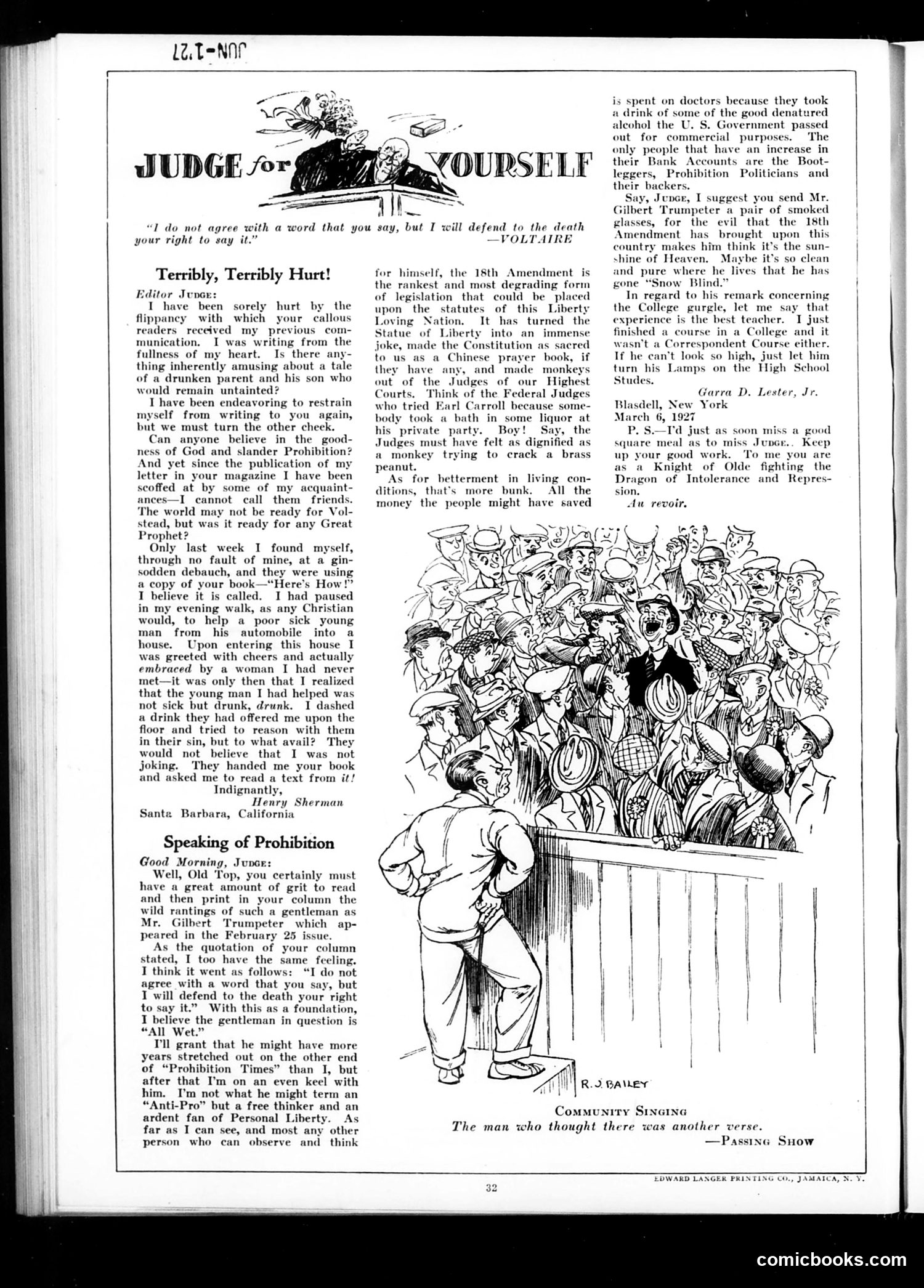
This page reflects the **Prohibition era debate** (1920-1933) through satirical letters to *Judge* magazine's editor. **The Main Cartoons/Content:** The page features two letters attacking Prohibition. Henry Sherman's letter mocks a naive Prohibition supporter caught at a drunken party, then hypocritically lecturing others—satirizing the disconnect between Prohibition's ideals and reality. The second letter directly attacks the 18th Amendment as degrading Liberty, citing Federal Judge Earl Carroll's trial over a bathtub incident at his private party as evidence of Prohibition's absurdity. The writer argues Prohibition hasn't improved living conditions but instead enriched bootleggers and corrupt politicians while citizens drink poisoned "denatured alcohol." **The Cartoon** (by R.J. Dailey, "Community Singing") shows a large crowd packed together, captioned: "The man who thought there was another verse"—likely mocking forced Prohibition solidarity or the assumption that public support for the law was universal. The satire targets Prohibition's failure to stop drinking and its corruption of American institutions.
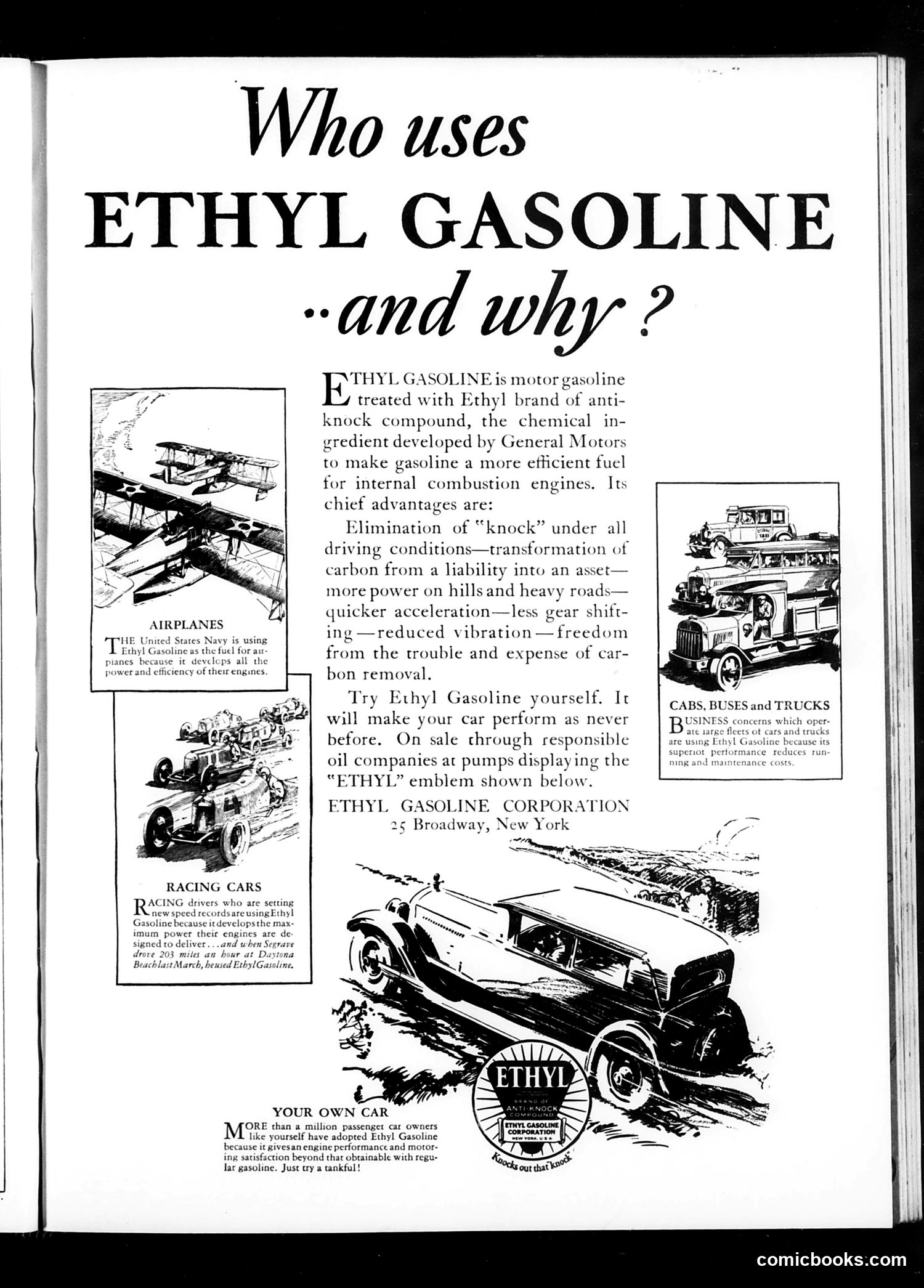
This is a **product advertisement, not political satire**—it's a corporate marketing page for Ethyl Gasoline Corporation promoting their anti-knock fuel additive. The page uses illustrated examples of different vehicle users to establish credibility and broad appeal: military airplanes, racing cars, commercial vehicles (cabs/buses/trucks), and ordinary passenger cars. Each section claims performance benefits—eliminating engine "knock," improving acceleration, and reducing maintenance costs. The central imagery shows a stylized racing car with the "Ethyl" brand emblem, positioning the product as performance-enhancing and modern. **What's notable for modern readers:** This represents 1920s-30s industrial marketing before leaded gasoline's severe health dangers were widely known. The ad emphasizes technical benefits without acknowledging the lead compound's toxicity—a concern that wouldn't prompt regulation until decades later. The page exemplifies how corporations marketed harmful products as beneficial innovations.
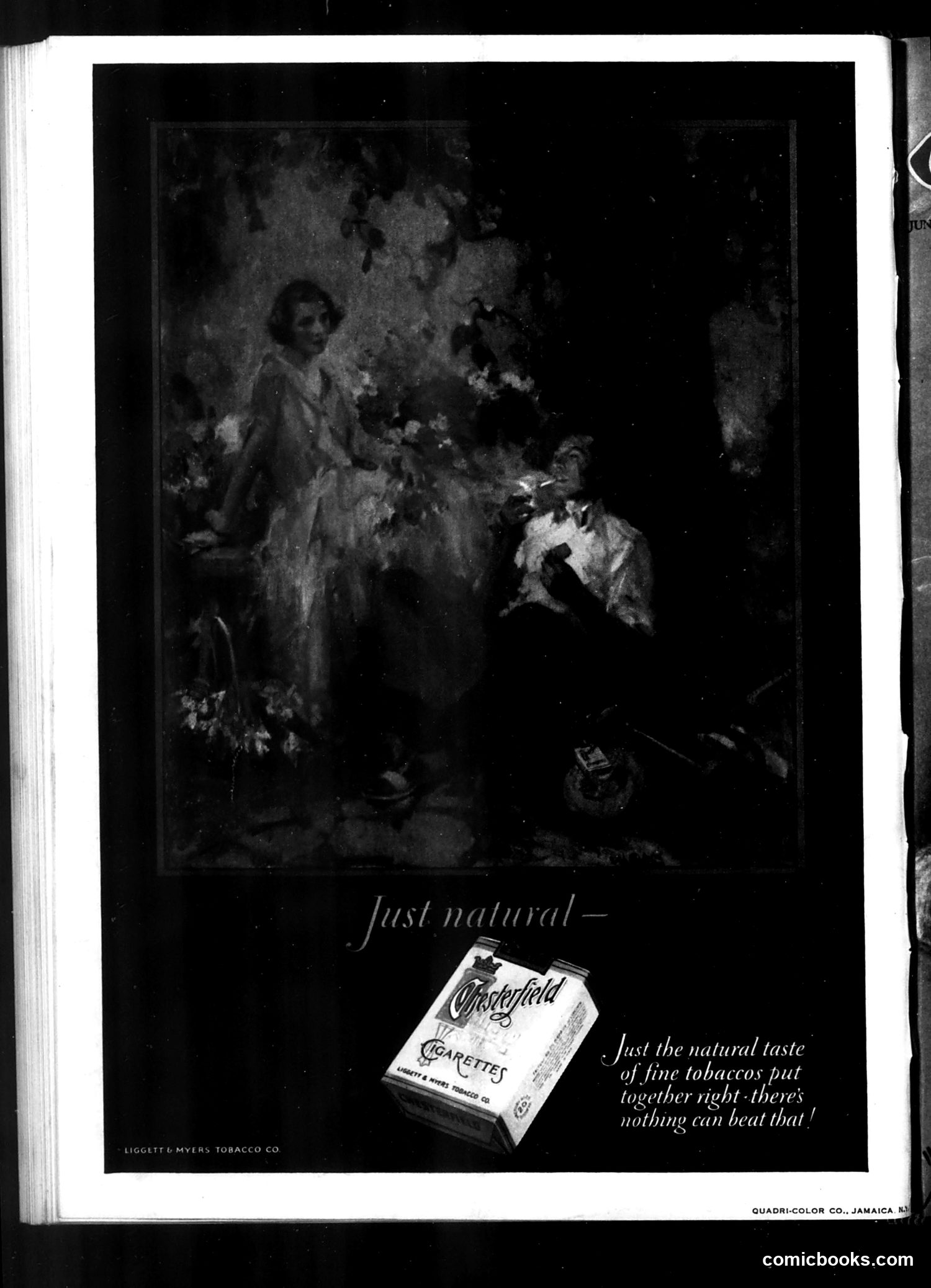
This is a **Chesterfield cigarette advertisement**, not political satire. The page features romantic imagery of two figures in period costume (appearing 18th or 19th century) in a darkly lit, atmospheric scene with flowering vines—likely meant to evoke elegance and romance. The ad's appeal is purely about taste and quality: it claims Chesterfield's superiority comes from simply combining "fine tobaccos put together right." This represents vintage tobacco marketing that emphasized naturalness and straightforward craftsmanship as selling points. There is no political cartoon or satire present. This is straight commercial advertising from the Liggett & Myers Tobacco Co., using atmospheric imagery and simple messaging typical of early-to-mid 20th century cigarette marketing.