
Judge, 1927-06-04 · page 17 of 36
Judge — June 4, 1927 — page 17: what you’re looking at
What you’re looking at
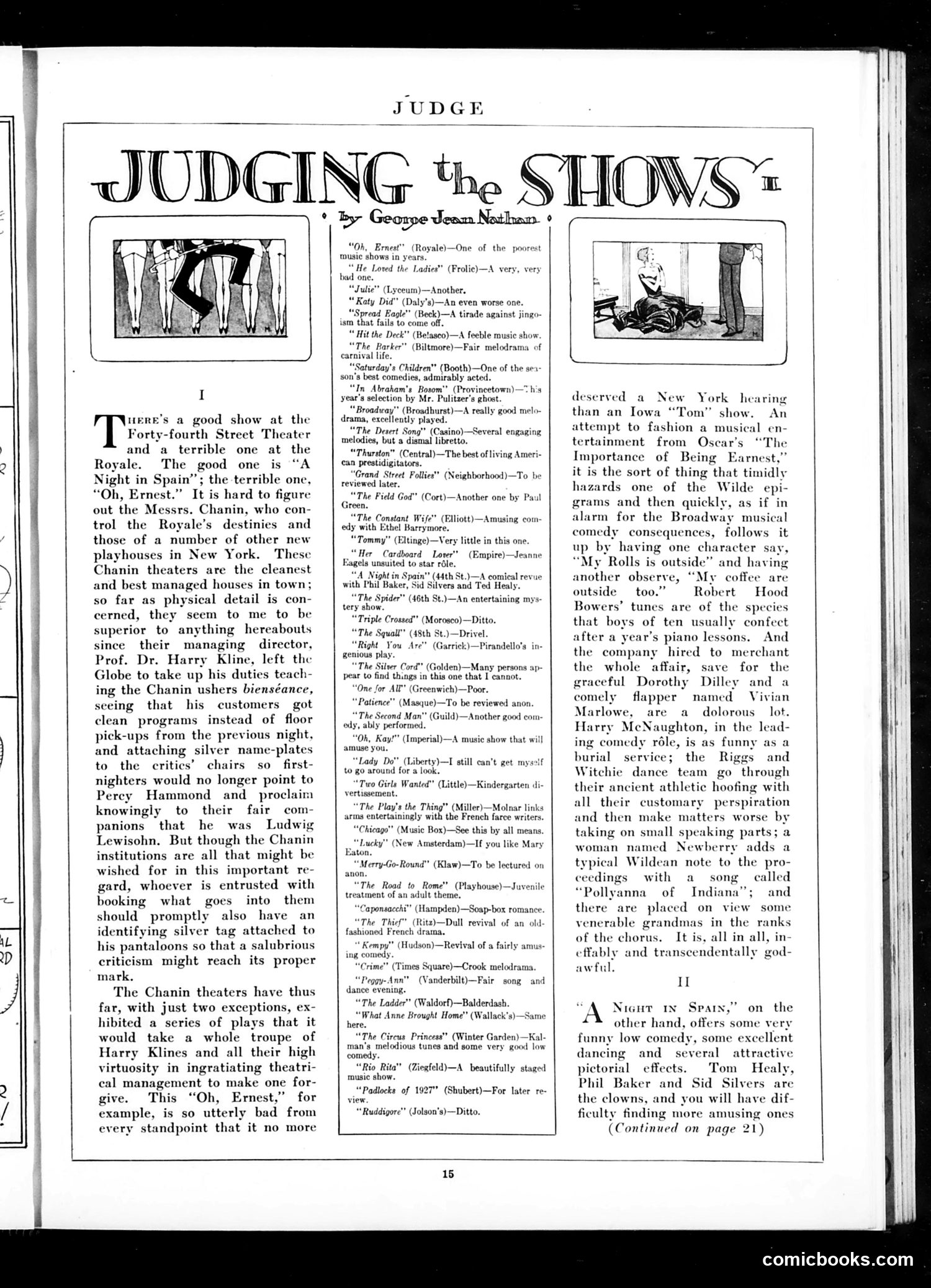
This is a theater review column titled "Judging the Shows" by George Jean Nathan, a prominent drama critic. The page contains Nathan's dismissive critique of current Broadway productions, particularly targeting the Chanin theaters—a chain of newly built, well-maintained playhouses in New York. Nathan praises the theaters' physical cleanliness and management but savagely mocks their booking decisions. He singles out "Oh, Ernest" at the Royale as exceptionally bad, using it as a jumping-off point to roast the entire season's lineup. The extensive list below catalogues shows with brutally brief verdicts: "poorest music shows in years," "even worse one," "dismal libretto," etc. The satire targets theater management's apparent incompetence despite superior facilities—hence Nathan's sarcastic suggestion that whoever books shows should wear an "identifying silver tag" so criticism reaches the right person. The column exemplifies early 20th-century highbrow theater criticism's withering contempt for commercial entertainment.
📄 Transcribed text from this page (OCR, searchable)
Machine-transcribed from the original scan — historical spelling and the odd misread are preserved.
Ninna isan Nii KZ i la uereE’s a good show at the I Forty-fourth Street Theater and a terrible one at the Royale. The good one is “A Night in Spain’’; the terrible one, “Oh, Ernest.” It is hard to figure out the Messrs. Chanin, who con- trol the Re and those of a number of other new playhouses in New York. These Chanin theaters are the cleanest nd best managed houses in town; so far as physical detail is con- cerned, they seem to me to be superior to anything hereabouts since their managing director, Prof. Dr. Harry left the Globe to take up his duties teach- ing the Chanin ushers bienséance, seeing that his customers got clean programs instead of floor pick-ups from the previous night, and attaching silver name-plates to the critics’ chairs so _first- nighters would no longer point to Percy Hammond and_ proclaim knowingly to their fair com- panions that he was Ludwig Lewisohn. But though the Chanin institutions are all that might be wished for in this important re- gard, whoever is entrusted with booking what goes into them should promptly also have an identifying silver tag attached to his pantaloons so that a salubrious criticism might reach its proper mark, The Chanin theaters have thus far, with just two exceptions, ex- hibited a series of plays that it would take a whole troupe of Harry Klines and all their high virtuosity in ingratiating theatri- cal management to make one for- give. This “Oh, Ernest,” for example, is so utterly bad from every standpoint that it no more “Oh, Ernest” (Royale)—One of the poorest tmusic shows in years. “He Lored the Ladies" (Frolic)—A very, very bad one. “Julie” (Lyceu “Katy Did’ (Daly's)—An even worse one. “Spread Eagle” (Beck)—A tirade ism that fails to come off. “Hit the Deck" (Belaseo)—A feeble music show “The Barker” (Biltmore)—Fair melodrama of carnival lif “Saturday's Children" (Booth)—One of the sex. son's best comedies, admirably acted. “In Abraham's Bosom’? (Provincetown) —7 h's year's selection by Mr. Pulitzer’s ghost. “Broadway” (Broadburst)—A really good melo- drama, excellently played. “The Desert Song’ (Casino)—< melodies, but a dismal libretto. “Thurston” (Central) —The best of living Ameri- can prestidigitators. “Grand Street Follies (Neighborhood)—To be reviewed later. The Field God” (Cort)—Another one by Paul ireen, The Constant Wife (Elliott)—Amusing com- edy with Ethel Barrymore. “Tommy” (Eltinge)—Very little in this one. Her Cardboard Loter” (Empire)—Jeanne els unsuited to star rdle. ‘A Night in Spain” (44th St.)—A comical revue with Phil Baker, Sid Silvers and Ted Healy. “The Spider” (46th St.)—An entertaining mys- tery show. “Triple Crossed" (Morosco)—Ditto. “The Squall” (48th St.)—Drivel. Right You Are” (Garrick)—Pirandello’s in- genious play. “The Silver Cord” (Golden)—Many persons ap- to find things in this one that I cannot. “One for All” (Greenwich)—Poor. “Patience (Masque)—To be reviewed anon. “The Second Man" (Guild)—Another good com- edy, ably performed. eral engaging “Oh, Kay!” (Imperial)—A music show that will amuse you. “Lady Do" (Liberty)—I still can't get m to go around for a look. “Two Girls Wanted’ (Little)—Kindergarten di- vertissement. “The Play's the Thing” (Miller)—Molnar links arms entertainingly with the French farce writers. “Chicago” (Music Box)—See this by all means. payucty” (New Amsterdam)—If you like Mary Eaton. “Merry-Go-Round” (Klaw)—To be lectured on anon. “The Road to Rome” (Playhouse)—Juvenile treatment of an adult them “Caponsacchi”’ (Hampden)—Soap-box romance The Thief” (Ritz)—Dull revival of an old fashioned French drama. * Kempy'* (Hudson) —Revival of a fairly amus- ing comedy “Crime” (Times Square)—Crook melodrama. “Peggy-Ann" (Vanderbilt)—Fair song and dance evening. “The Ladder” (Waldorf)—Balderdash. “What Anne Brought Home’ (Wallack’s)—Same here, The Circus Princess (Winter Garden)—Kal- man’s melodious tunes and some very good low comedy. “Rio Rita” (Ziegfeld)—A beautifully music show. “Padlocks of 1927" (Shubert)—For later re- view “Ruddigore" (Jolson's)—Ditto. aged deserved a New York hearing than an Iowa “Tom” show. An attempt to fashion a musical en- tertainment from Oscar's “The Importance of Being Earnest,” it is the sort of thing that timidly azards one of the Wilde epi- grams and then quickly, as if in alarm for the Broadway comedy consequences, follows it up by having one character say, “My Rolls is outside” and having another observe, “My coffee are outside — too.” Robert Hood Bowers’ tunes are of the species that boys of ten usually confect after a year’s piano lessons. And the company hired to merchant the whole affair, save for the graceful Dorothy Dilley and a comely flapper named Vivian Marlowe, are a dolorous lot. Harry McNaughton, in the lead- ing comedy réle, is as funny as a burial service; the Riggs and Witchie dance team go through their ancient athletic hoofing with all their customary perspiration and then make matters worse by taking on small speaking parts; a woman named Newberry adds a musical typical Wildean note to the pro- ceedings with a song called “Pollyanna of Indiana”; and there are placed on view some venerable grandmas in the ranks of the chorus. It is, all in all, in effably and transcendentally god- awful, II Nicgut i Spary,” on the 2% other hand, offers some very funny low comedy, some excellent dancing and several attractive pictorial effects. Tom Healy, Phil Baker and Sid Silvers are the clowns, and you will have dif- ficulty finding more amusing ones (Continued on page 21) 15 comicbooks.com