
Judge, 1927-06-04 · page 15 of 36
Judge — June 4, 1927 — page 15: what you’re looking at
What you’re looking at
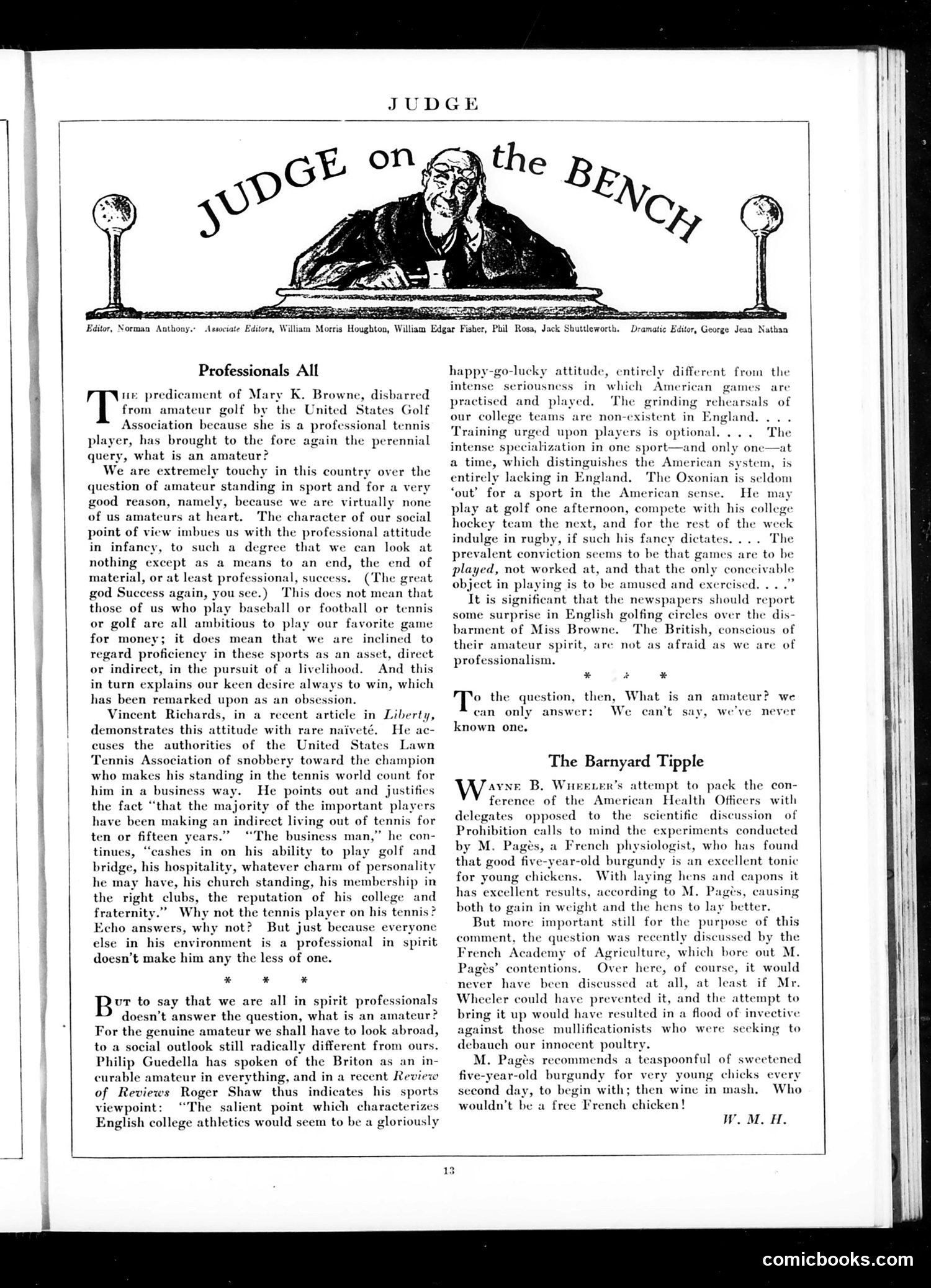
This article debates what constitutes an "amateur" athlete, sparked by tennis player Mary K. Browne's disbarment from amateur golf because she was a professional in another sport. The piece argues Americans are inherently "professional" in attitude—viewing everything, including sports, as means to material success rather than leisure. It contrasts this with the British approach: English athletes play multiple sports casually for enjoyment ("happy-go-lucky attitude"), while Americans obsessively specialize and train intensely in single sports. The satirical point: America's competitive, success-driven culture infiltrates even amateur athletics, making true amateurism impossible here. The article cites Vincent Richards defending tennis players who profit indirectly through business connections (golf, bridge, hospitality). The British, by contrast, genuinely play "for amusement and exercise"—making them true amateurs despite lacking formal amateur status definitions. The satire mocks American capitalism's corruption of sport and leisure itself.
📄 Transcribed text from this page (OCR, searchable)
Machine-transcribed from the original scan — historical spelling and the odd misread are preserved.
JUDGE Editor, Norman Anthony." Professionals All cament of Mary K. Browne, disbarred from amateur golf by the United States Golf Association because she is a professional tennis player, has brought to the fore again the perennial query, what is an amateur? We are extremely touchy in this country over the question of amateur standing in sport and for a very good reason, namely, because we are virtually none of us amateurs at heart. The character of our social point of view imbues us with the professional attitude in infancy, to such a degree that we can look at nothing except as a means to an end, the end of material, or at least professional, success. (‘The great god Success again, you see.) This does not mean that those of us who play baseball or football or tennis or golf are all ambitious to play our favorite game for money; it does mean that we are inclined to regard proficiency in these sports an asset, direct or indirect, in the pursuit of a livelihood. And this in turn ey to win, which ue predi plains our keen desire alw has been remarked upon as an obsess Vincent Richards, in a re demonstrates this attitude with rare naiveté. He ac- cuses the authorities of the United States Lawn Tennis Association of snobbery toward the champion who makes his standing in the tennis world count for him in a business way. He points out and justifies the fact “that the majority of the important players have been making an indirect living out of tennis for ten or fifteen years.” ‘The business man,” he con- tinues, “cashes in on his ability to play golf and bridge, his hospitality, whatever charm of personality he may have, his church standing, his membership in the right clubs, the reputation of his college and not the tennis player on his tennis? rs, why not? But just because everyone in his environment is a_profe doesn’t make him any the less of one. ion. nt article in Liberty, onal in spirit * * * ut to say that we are all in spirit professionals doesn’t answer the question, what is an amateur? For the genuine amateur we shall have to look abroad, to a social outlook still ra lly different from ours. Philip Guedella has spoken of the Briton as an in- curable amateur in everything, and in a recent Revie of Reviews Roger Shaw thus indicates his sports viewpoint: “The salient point which characterizes English college athletics would seem to be a gloriously Associate Editors, William Morris Houghton, William Edgar Fisher, Phil Rosa, Jack Shuttleworth. Dramatic Editor, George Jean Nathan happy-go-lucky attitude, entirely different from the intense seriousness in which American games are practised and played. The grinding rehearsals of our college teams are non-existent in England. . . . Training urged upon players is optional. ... ‘The intense specialization in one sport—and only one—at a time, which distinguishes the American system, is entirely lacking in England. The Oxonian is seldom ‘out’ for a sport in the American sense. He may ay at golf one afternoon, compete with his colle ey team the next, and for the rest of the we indulge in rugby, if such his fancy dictates. ... The prevalent conviction seems to be that games are to be played, not worked at, and that the only conceivable object in playing is to be amused and exercised. . . . It is significant that the newspapers should report some surprise in English golfing circles over the dis- barment of Miss Browne. The British, conscious of their amateur spirit, are not as afraid as we are of professionalism. T the question, then, What is an amateur? we can only answer: known one, * é * We can’t say, we've ne er The Barnyard Tipple W: ne B. Wire ttempt to pack the con- ference of the American Health Officers with delegates opposed to the scientific discussion of Prohibition calls to mind the experiments conducted by M. Pages, a French physiologist, who has found that good five-year-old burgundy is an excellent tonic for young chickens. With laying hens and capons it has excellent results, sording to M. P. causing both to gain in weight and the hens to lay better. But more important still for the purpose of this comment, the question was recently discussed by the French Academy of Agriculture, which bore out M. Pages’ contentions. Over here, of course, it would never have discussed at all, at least if Mr. Wheeler could have prevented it, and the attempt to bring it up would have resulted in a flood of invective against those mullificationists who were secking to debauch our innocent poultry. M. Pagés recommends a teaspoonful of sweetened five-year-old burgundy for very young chicks every second day, to begin with; then wine in mash. Who wouldn’t be a free French chicken! LER’ been W.M. H. comicbooks.com