
A complete issue · 36 pages · 1927
Judge — May 28, 1927
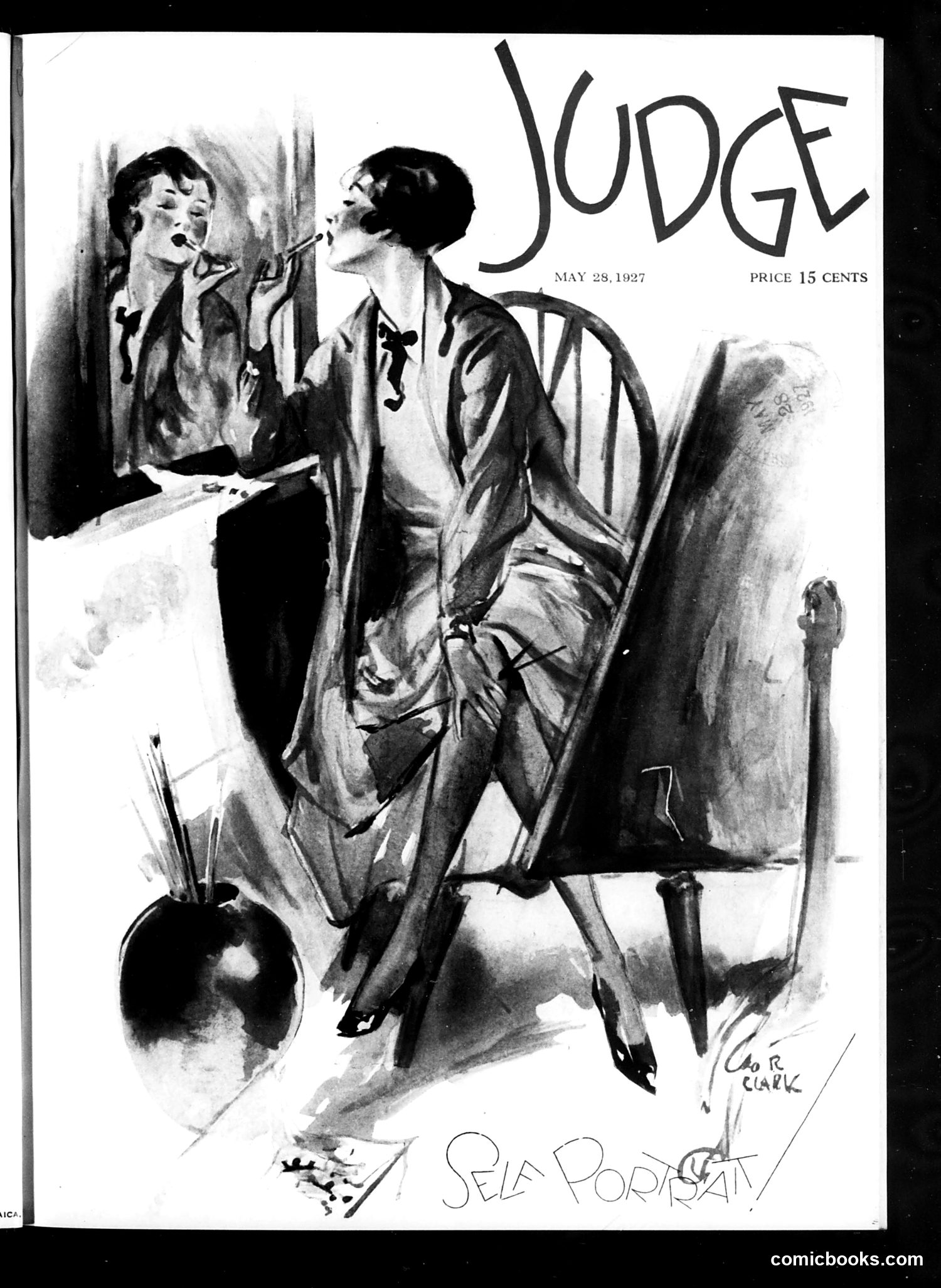
This cover illustration by Cla R. Clark depicts two fashionably dressed women in 1920s style, with one applying makeup while seated. The title "Sela Popolar" (likely "Sela Popular" or a similar phrase, unclear due to OCR) appears at the bottom. The satire appears to target women's beauty culture and vanity during the Jazz Age. The elaborate styling, makeup application, and theatrical poses mock the era's emphasis on cosmetics and appearance among modern women. The mirror reflection and artist's signature suggest this is commentary on contemporary beauty standards and consumer culture of the 1920s. Without clearer text identification, the specific individuals or events referenced remain uncertain, though the general critique of women's beauty obsession is evident from the visual composition alone.
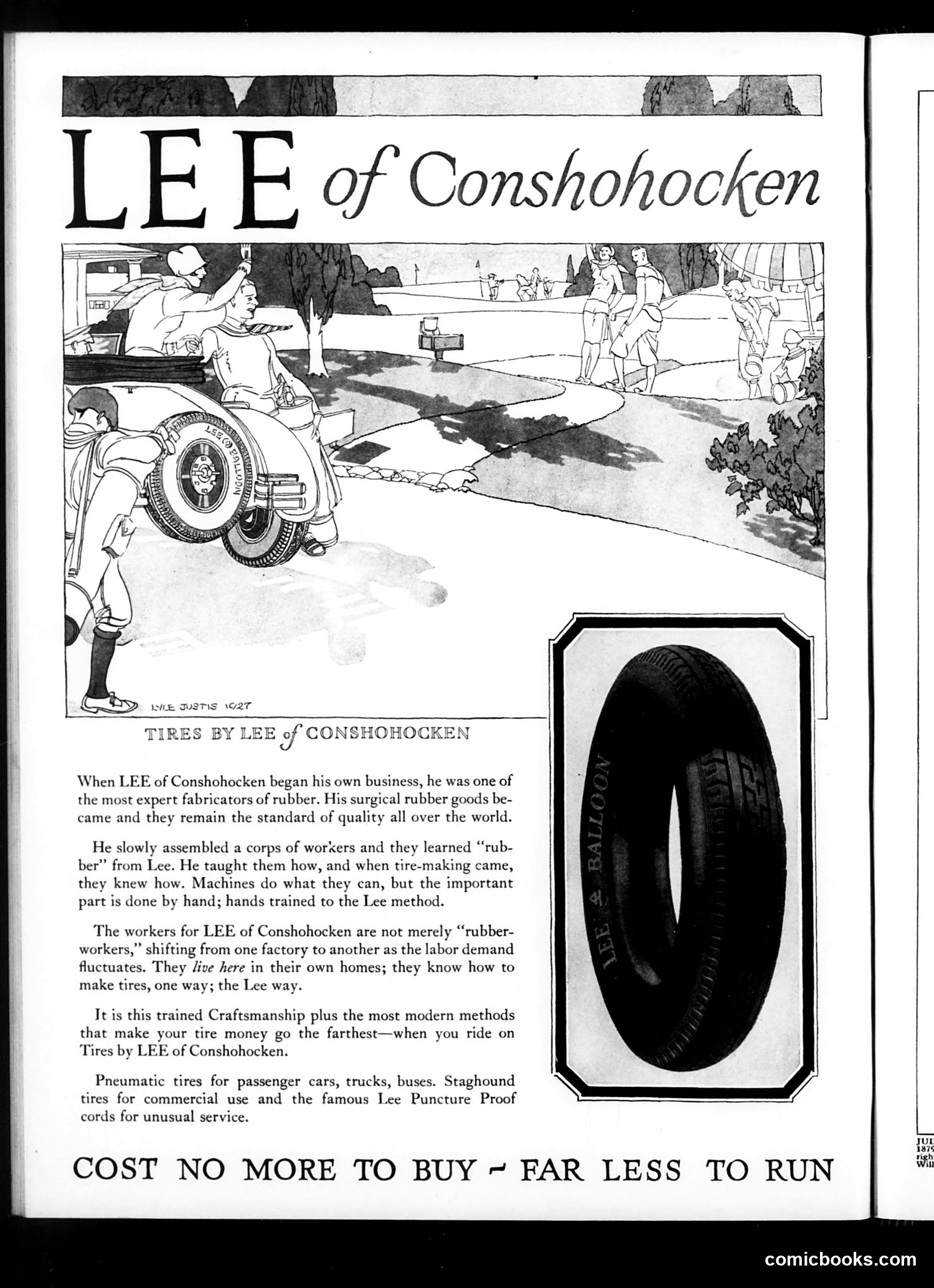
This is primarily a **commercial advertisement**, not satire or political commentary. It promotes LEE brand tires manufactured in Conshohocken, Pennsylvania. The illustration depicts an early 1920s suburban scene with children playing and an automobile displaying LEE tires. The ad emphasizes that LEE employed skilled, permanent workers trained in the company's tire-making methods—contrasting with the era's common practice of migrating laborers. The tagline "COST NO MORE TO BUY ~ FAR LESS TO RUN" positions LEE as an economical choice. The text highlights specializations: pneumatic tires for passenger vehicles, commercial tires for trucks/buses, and "Lee Puncture Proof cords." This appears in *Judge* likely because the magazine accepted paying advertisements to supplement editorial content.
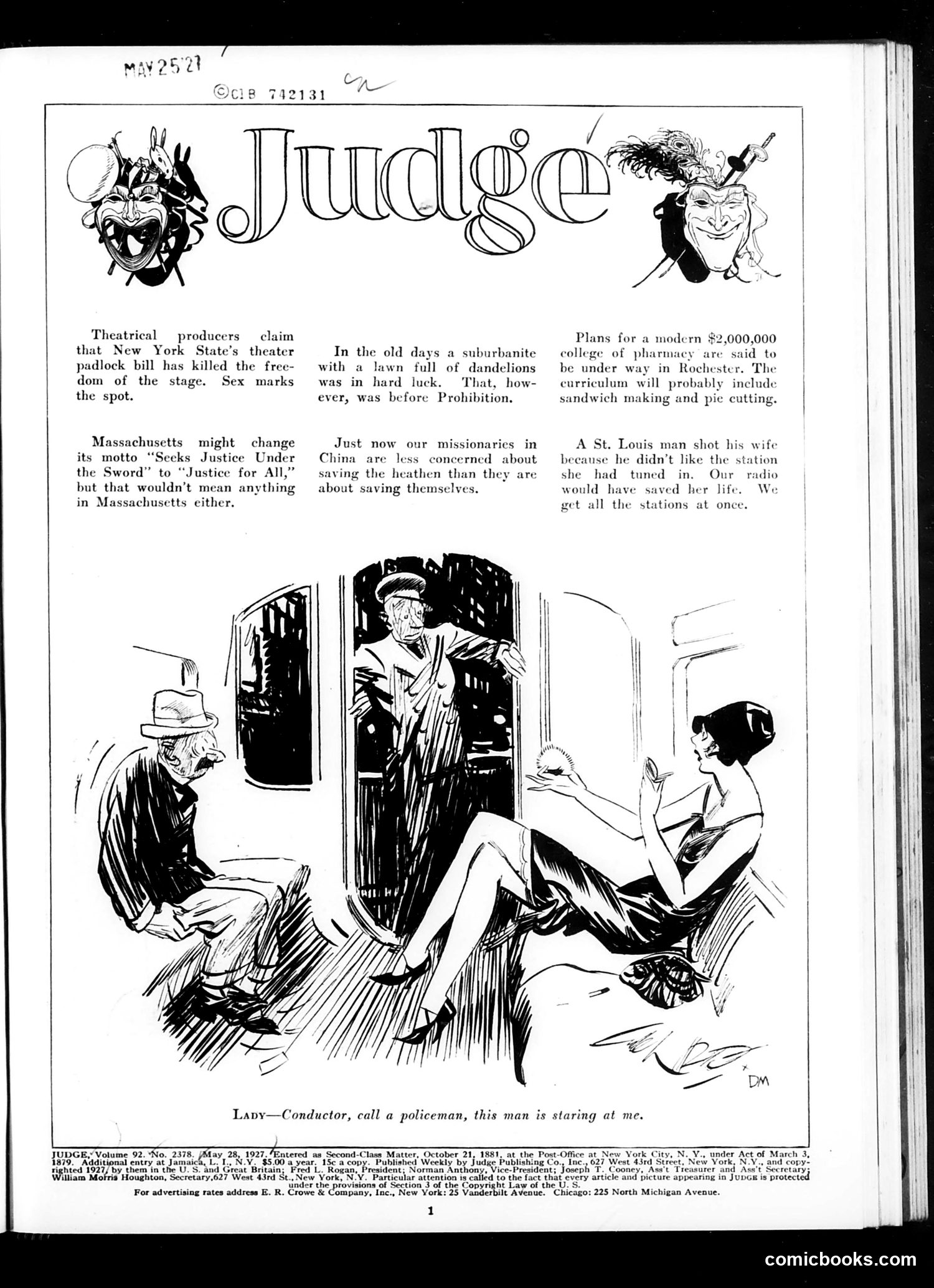
The main cartoon depicts a woman with legs prominently displayed, sitting in what appears to be a train compartment with a conductor and an older man. The woman says: "Lady—Conductor, call a policeman, this man is staring at me." This is satirizing the era's social anxieties about women's changing fashion and behavior in the 1920s. The "flapper" era featured women wearing shorter skirts, which scandalized conservative society. The joke mocks the absurdity of calling police over a man's stare—suggesting that if women display their legs, they shouldn't complain about male attention. It reflects the period's conflicted attitudes toward women's liberation and changing social norms during Prohibition era America.
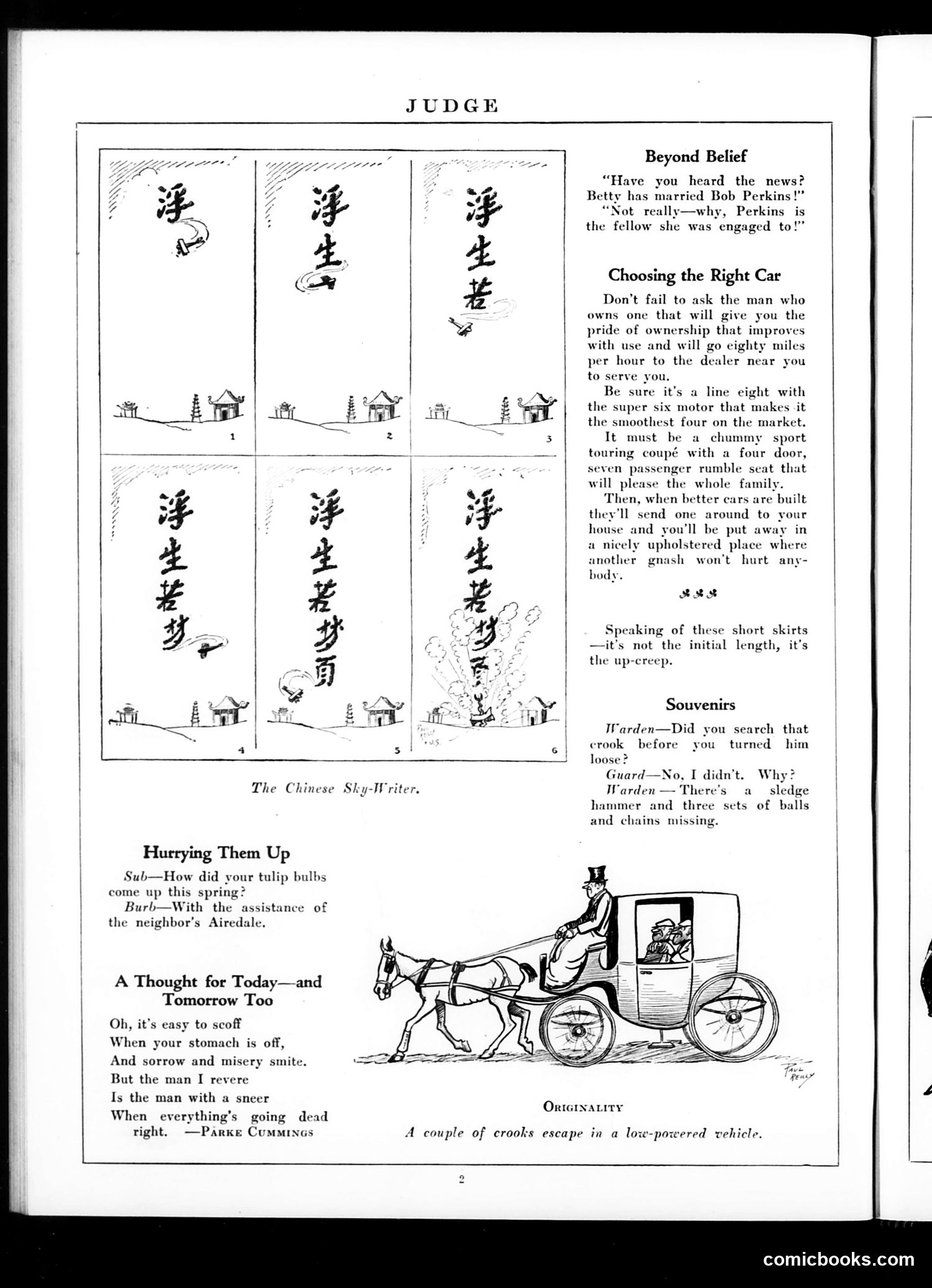
This page contains several unrelated satirical pieces typical of Judge magazine's format: **"The Chinese Sky-Writer"** shows six panels of Chinese characters with small landscape scenes, apparently satirizing the novelty of skywriting as an advertising medium. The joke's specifics are unclear without knowing the dated context. **"Hurrying Them Up"** is a brief joke about tulip bulbs and a neighbor's Airedale dog—likely poking fun at suburban gardening enthusiasts. **"Originality"** depicts a horse-drawn carriage with two figures, captioned as "crooks escape in a low-powered vehicle"—a straightforward visual gag about thieves using outdated transportation. The page also includes short quips on romance, cars, and fashion ("up-creep" of short skirts), representing typical Judge humor: quick, domestic-focused satire aimed at early 20th-century American middle-class readers.
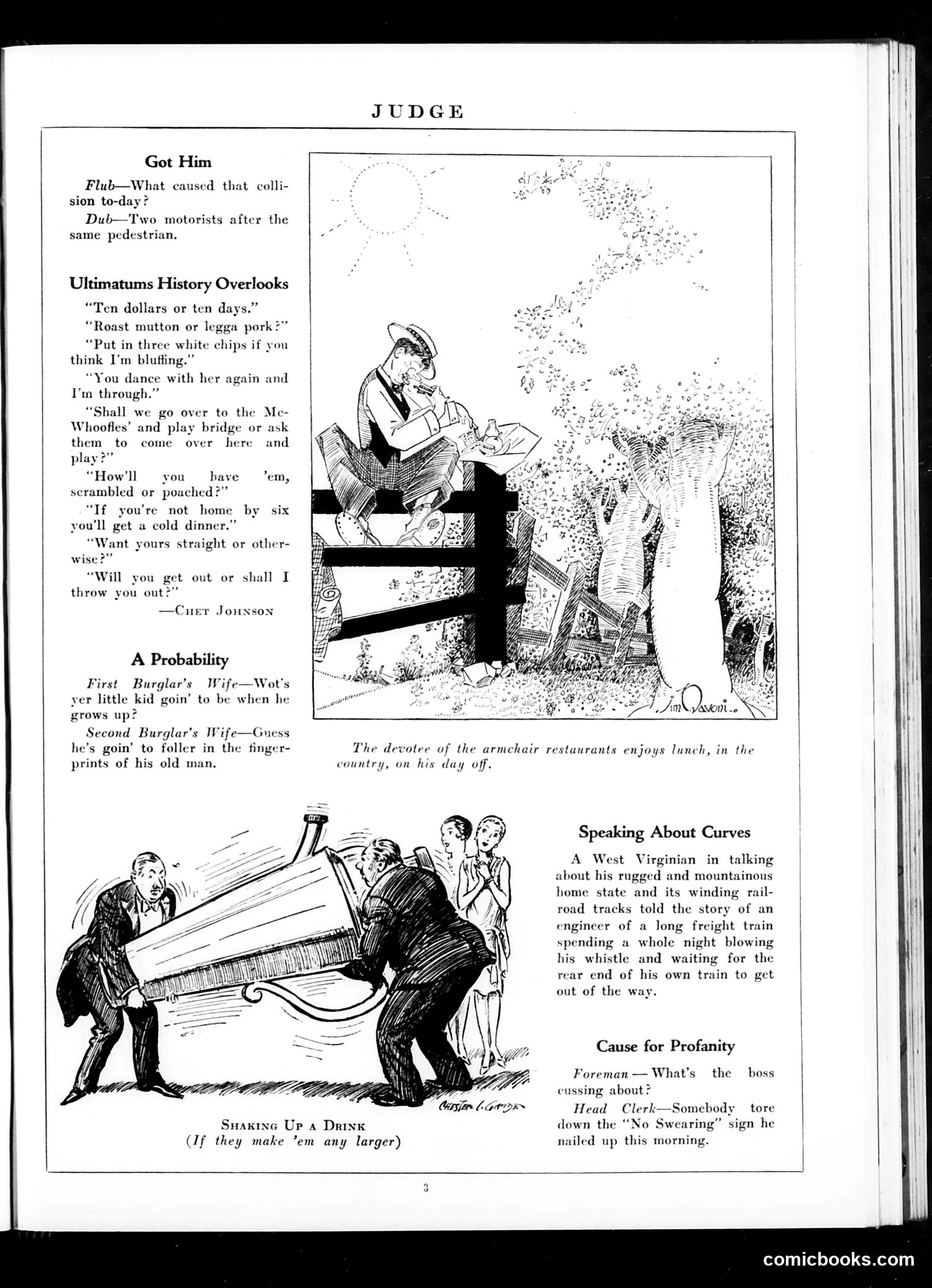
This page contains several unrelated humorous items rather than coherent political satire: **"Got Him"** and **"Ultimatums History Overlooks"**: Light jokes about motorists and domestic ultimatums—no specific political content. **"A Probability"**: A joke about a burglar's wife and fingerprints—generic humor, not topical satire. **"Speaking About Curves"**: An anecdote about a West Virginian railroad engineer—purely comedic, regional-interest story. **"Cause for Profanity"**: A workplace joke about a removed "No Swearing" sign. **The cartoons** (including "The devotee of the armchair restaurants" and "Shaking Up a Drink") are generic social humor about leisure activities and domestic life, lacking specific political or historical references. This appears to be a typical Judge humor page from the early 20th century—general-interest comedy rather than pointed satire.
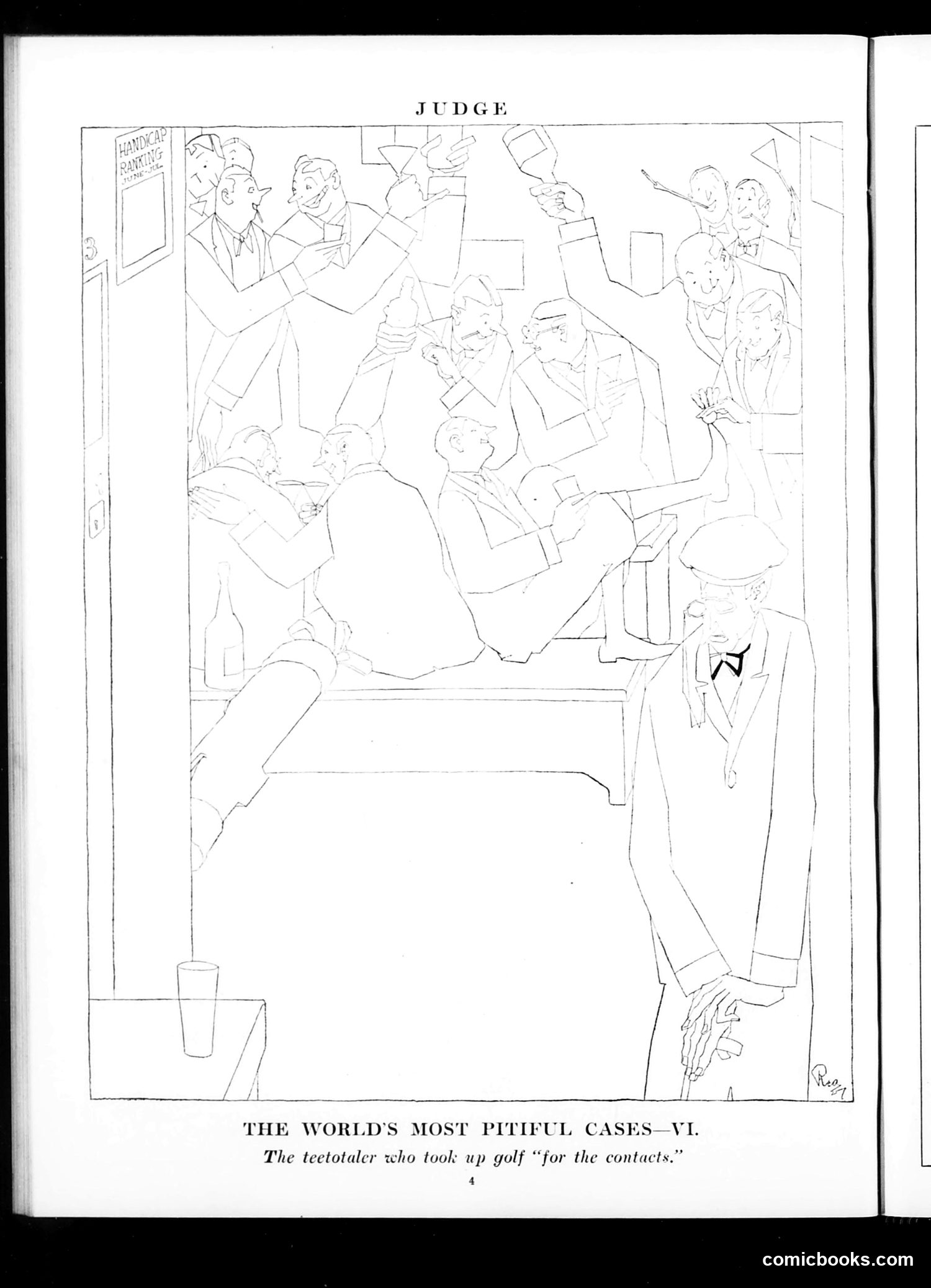
This cartoon satirizes a teetotaler (abstainer from alcohol) who took up golf "for the contracts"—meaning business dealings conducted through golf outings. The sketch shows a courtroom scene where a judge presides over what appears to be a legal proceeding, with numerous men in suits observing or participating. The satire targets the hypocrisy of prohibition-era teetotalers who claimed moral superiority while actually engaging in business networking at golf clubs—venues historically associated with drinking and social arrangements. The "pitiful case" is the teetotaler's contradiction: adopting alcohol abstinence on principle while still participating in the social/business culture that justified drinking in the first place. It's commentary on selective moralism during Prohibition.
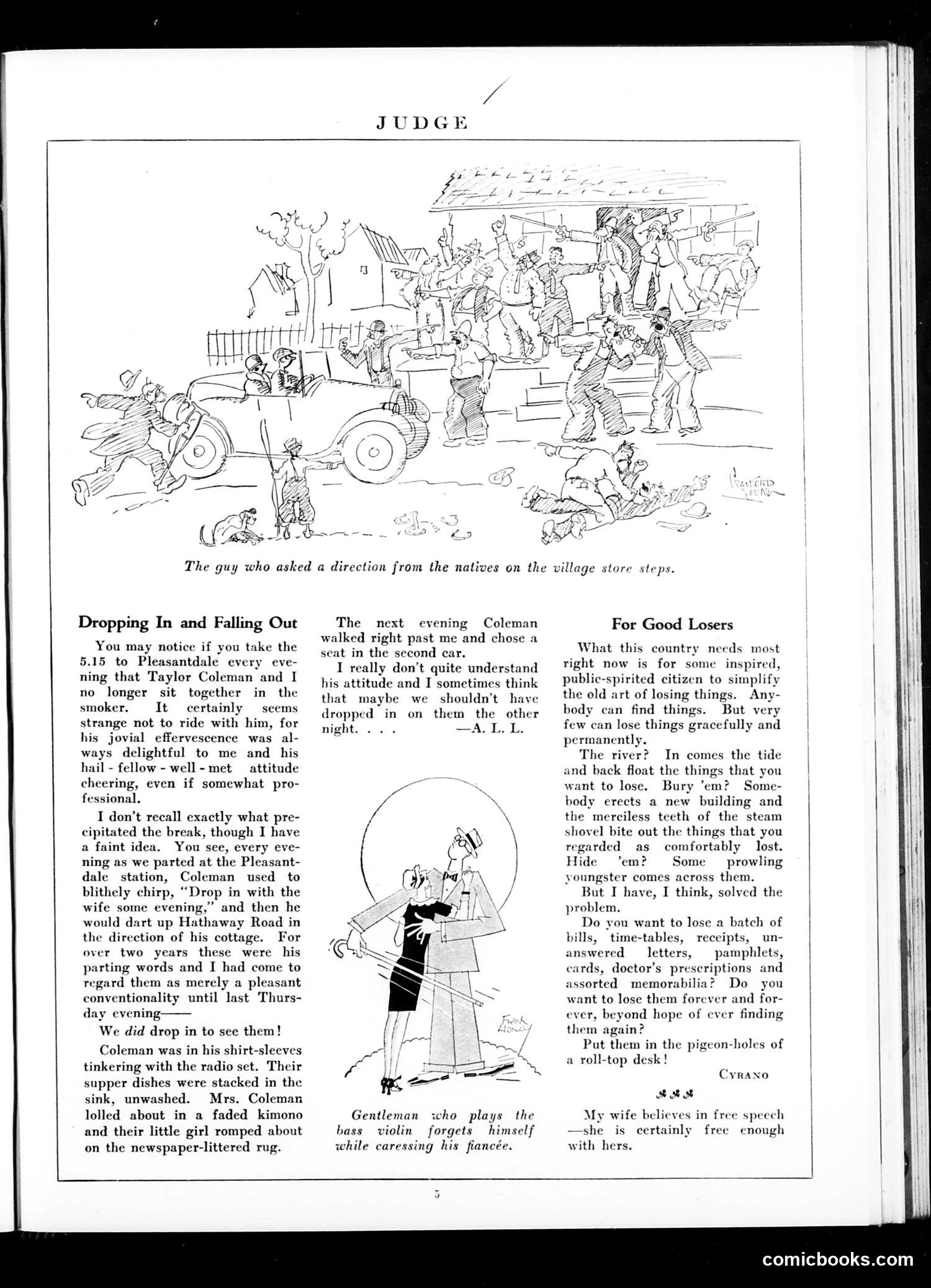
This page contains three distinct humorous pieces rather than a single political cartoon. **"Dropping In and Falling Out"** humorously recalls Taylor Coleman's courtship rituals—apparently he and the author would ride together in Coleman's car, with Coleman's jovial manner making the experience pleasant despite his somewhat "professional" cheeriness. **"For Good Losers"** is a satirical advice column by "Cyrano" about gracefully accepting loss. It recommends burying unwanted items (old documents, receipts, etc.) in a desk's "pigeon-holes" rather than discarding them properly—mocking people's tendency to hoard rather than genuinely dispose of things. **The bottom illustration** shows a man playing violin while embracing his fiancée, captioned as someone who forgets himself while caressing his beloved—gentle domestic humor about distracted courtship. These are lifestyle/relationship satires rather than political commentary.
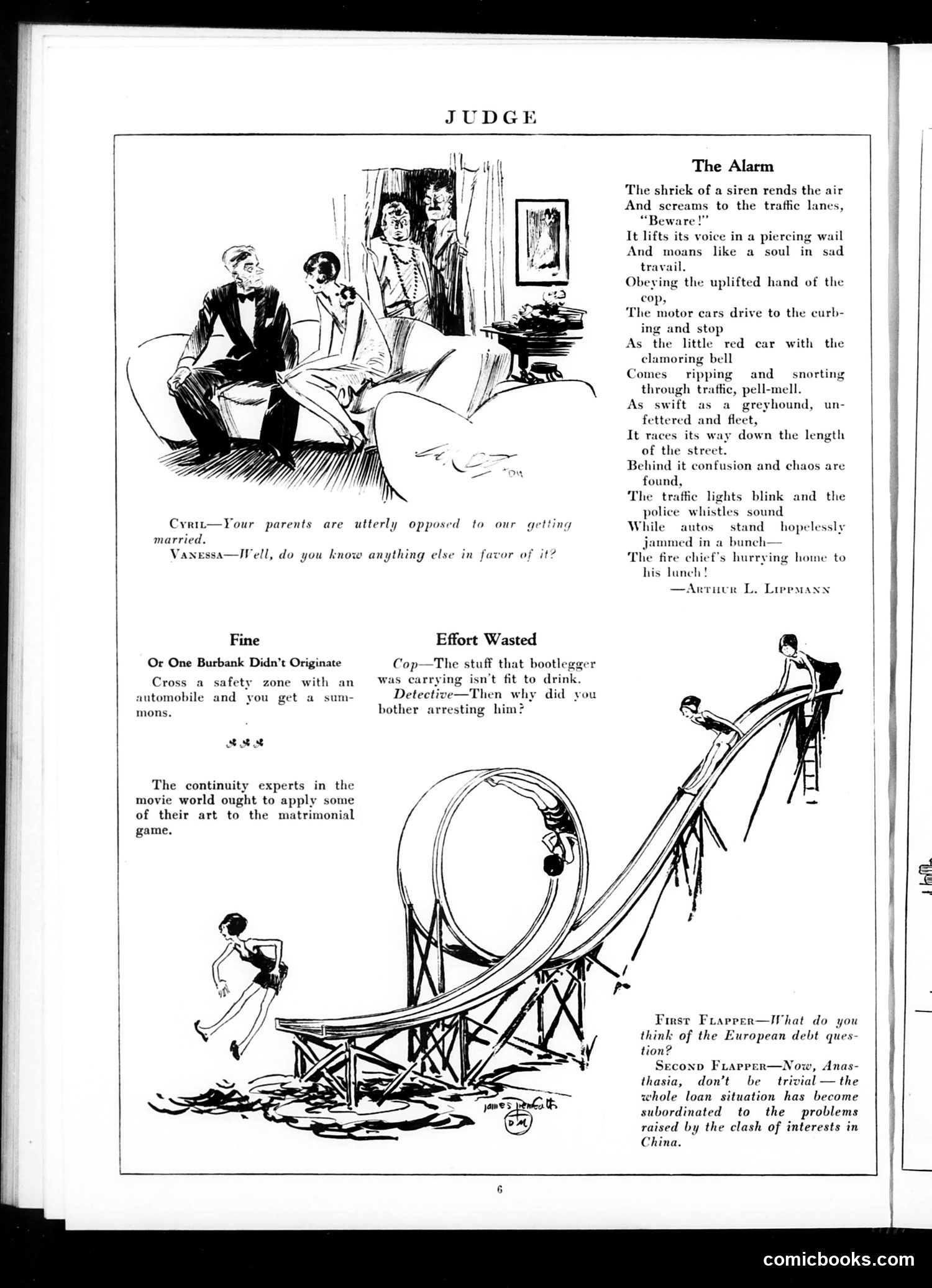
This page contains several satirical cartoons and jokes typical of 1920s-era American humor: **"The Alarm"** (poem + illustration): Mocks emergency vehicle traffic protocols—a fire truck's siren causes citywide chaos, yet the fire chief merely rushes home for lunch, undermining the urgency. **Top cartoon**: A couple discusses their parents' opposition to marriage. The joke's structure suggests the man can't articulate *any* legitimate reason for the union beyond parental disapproval. **"Fine"**: Satirizes traffic law inconsistency—crossing a safety zone in a car yields a summons, but the accompanying text about "Burbank" (likely Luther Burbank, the botanist) suggests arbitrary rule-making. **"Effort Wasted"**: A cop arrests a bootlegger for carrying undrinkable alcohol—the detective asks why arrest someone if the contraband is useless anyway. This mocks Prohibition-era enforcement absurdities. **Bottom cartoon**: Two "flappers" discuss European debt but pivot to China's geopolitical tensions, satirizing superficial intellectualism among the fashionable young. All content reflects post-WWI American preoccupations: traffic modernization, Prohibition, women's changing social roles, and international politics.
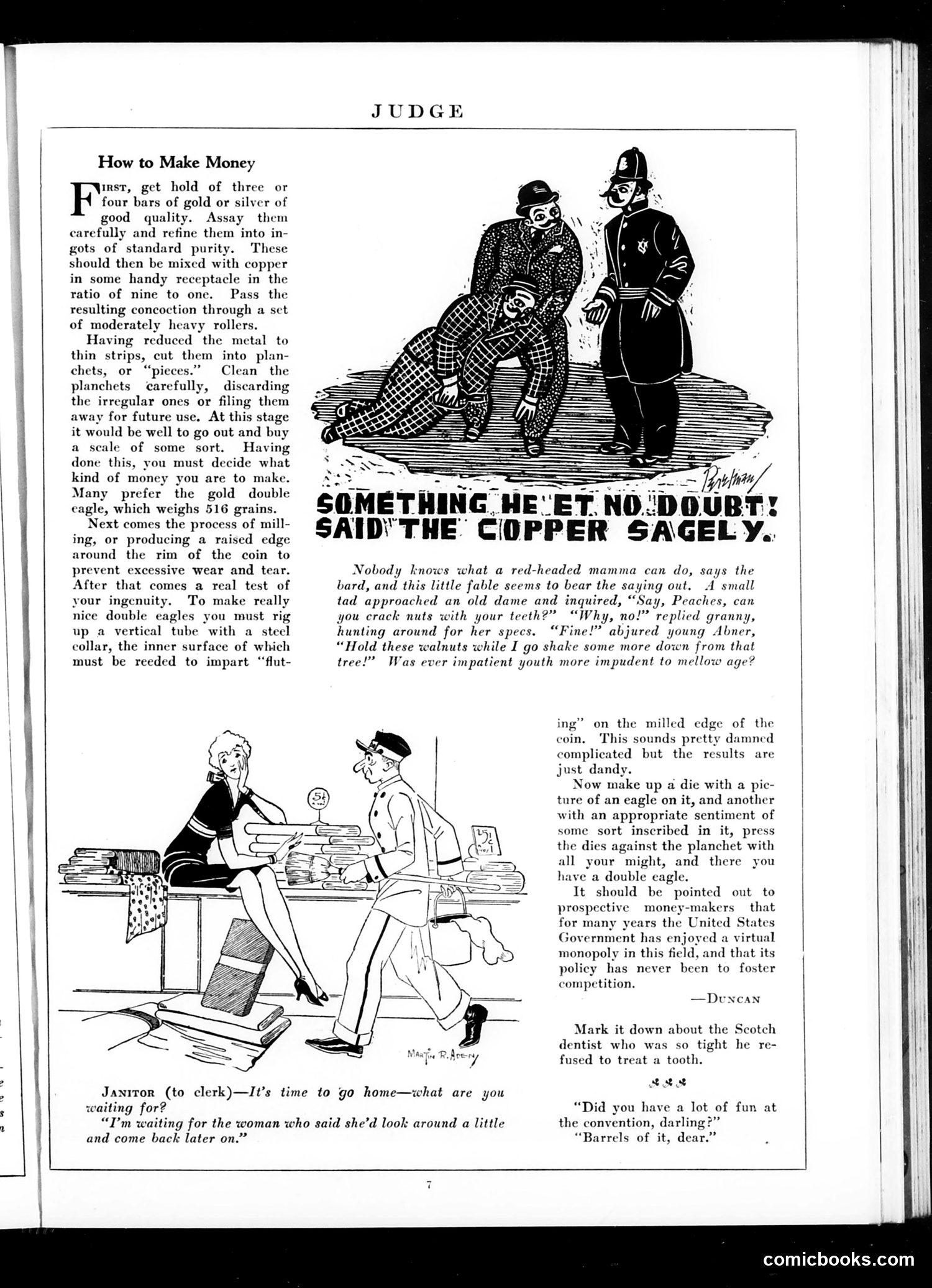
This page satirizes **counterfeiting currency**. The main article humorously presents detailed instructions for making counterfeit coins (specifically double eagles), written as if it were legitimate how-to advice. The joke culminates in a deadpan warning: the U.S. Government has a "virtual monopoly" in coin-making and "has never been to foster competition"—meaning counterfeiting is illegal and prosecuted. The accompanying illustrations show criminals conducting counterfeiting operations. The satirical point: by presenting counterfeiting in matter-of-fact instructional language, Judge mocks both the criminals who attempt it and perhaps critiques economic inequality that might drive such crime. The page also includes unrelated humorous anecdotes (a child's impertinent walnut-cracking request to an elderly woman, a stingy Scottish dentist), which were typical filler content in Judge magazine.
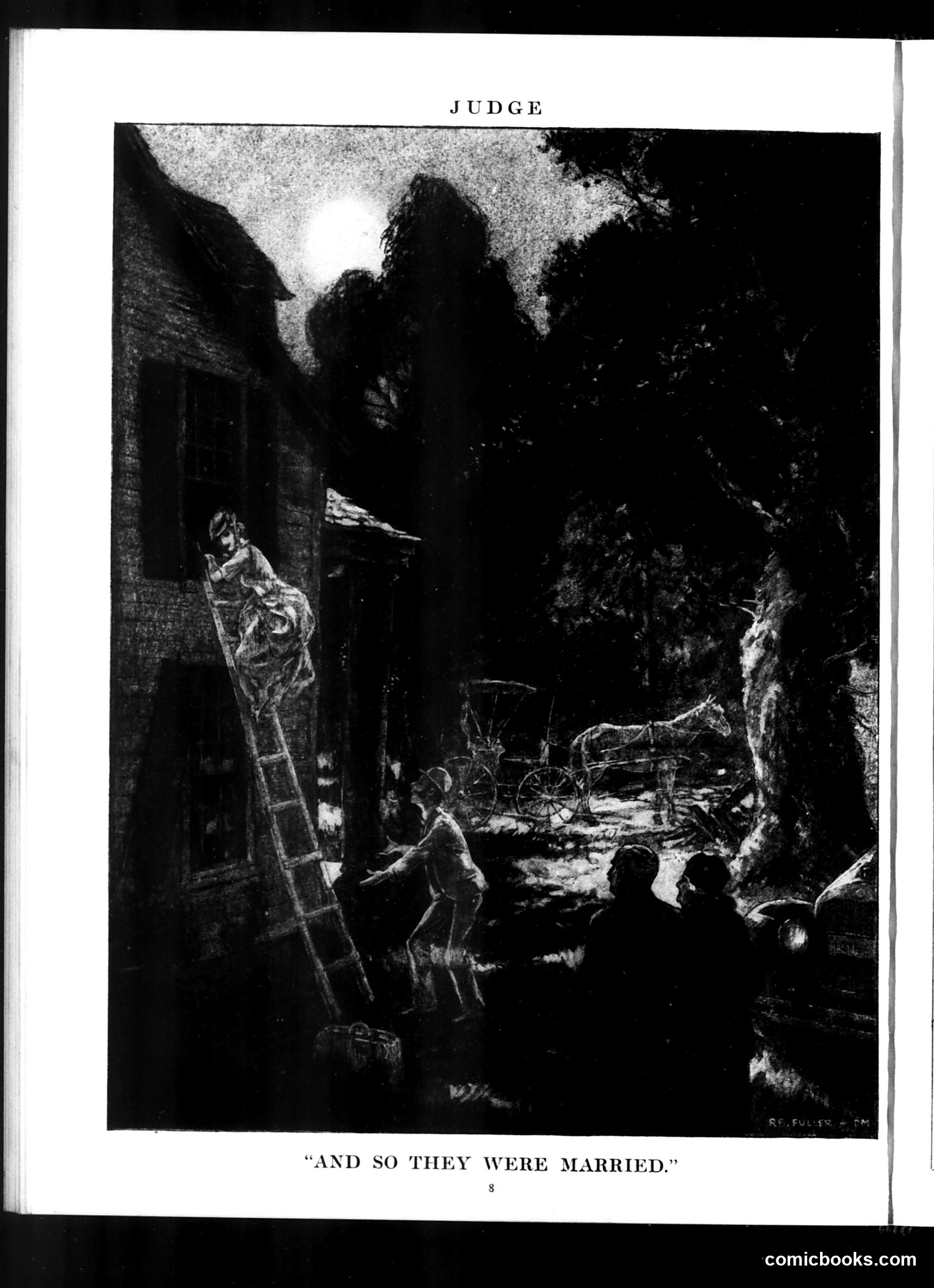
This appears to be an illustration from Judge magazine titled "And So They Were Married." The dark, expressionistic scene depicts what seems to be a nighttime street or alley setting with silhouetted figures and buildings. A ladder leans against a wall on the left, and there's a bicycle visible in the courtyard area. Without additional context or caption text beyond the title, the specific satirical point is unclear. The phrase "and so they were married" suggests commentary on courtship, marriage, or romance, but the gritty, shadowy urban setting and seemingly clandestine activity implied by the ladder and nighttime timing could indicate social satire about elopement, secret unions, or the gap between romantic ideals and harsh reality. The exact target of the satire cannot be definitively determined from the image alone.
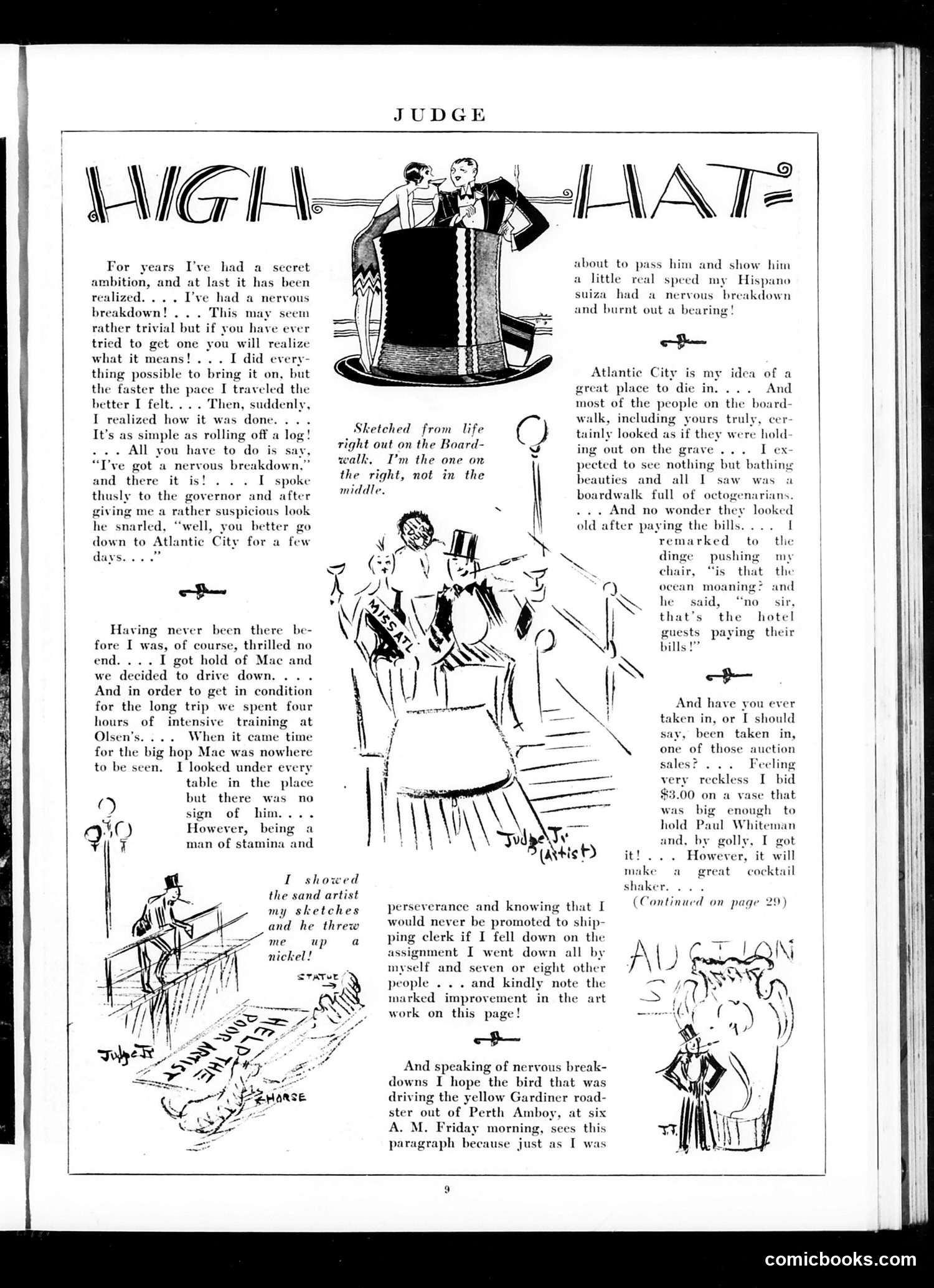
This page is a humorous first-person narrative about achieving a "nervous breakdown"—presented as a desirable status symbol in 1920s society. The narrator admits manufacturing one by simply *declaring* having one, then convincing the governor to authorize a vacation to Atlantic City. The satire targets several period anxieties: the fashionable status of mental exhaustion among the elite, the ease of gaming the system, and the absurdity of Atlantic City's aging tourist culture. Sketches show the narrator's driving mishaps and observations of elderly beachgoers. A secondary joke involves an auction where he impulsively bids $3 on a vase, joking it's large enough to hold bandleader Paul Whiteman (a contemporary celebrity), then repurposes it as a cocktail shaker. The humor relies on understated deadpan delivery and mocking Jazz Age pretensions—the idea that "nervousness" had become a status symbol worth faking among the leisure class.
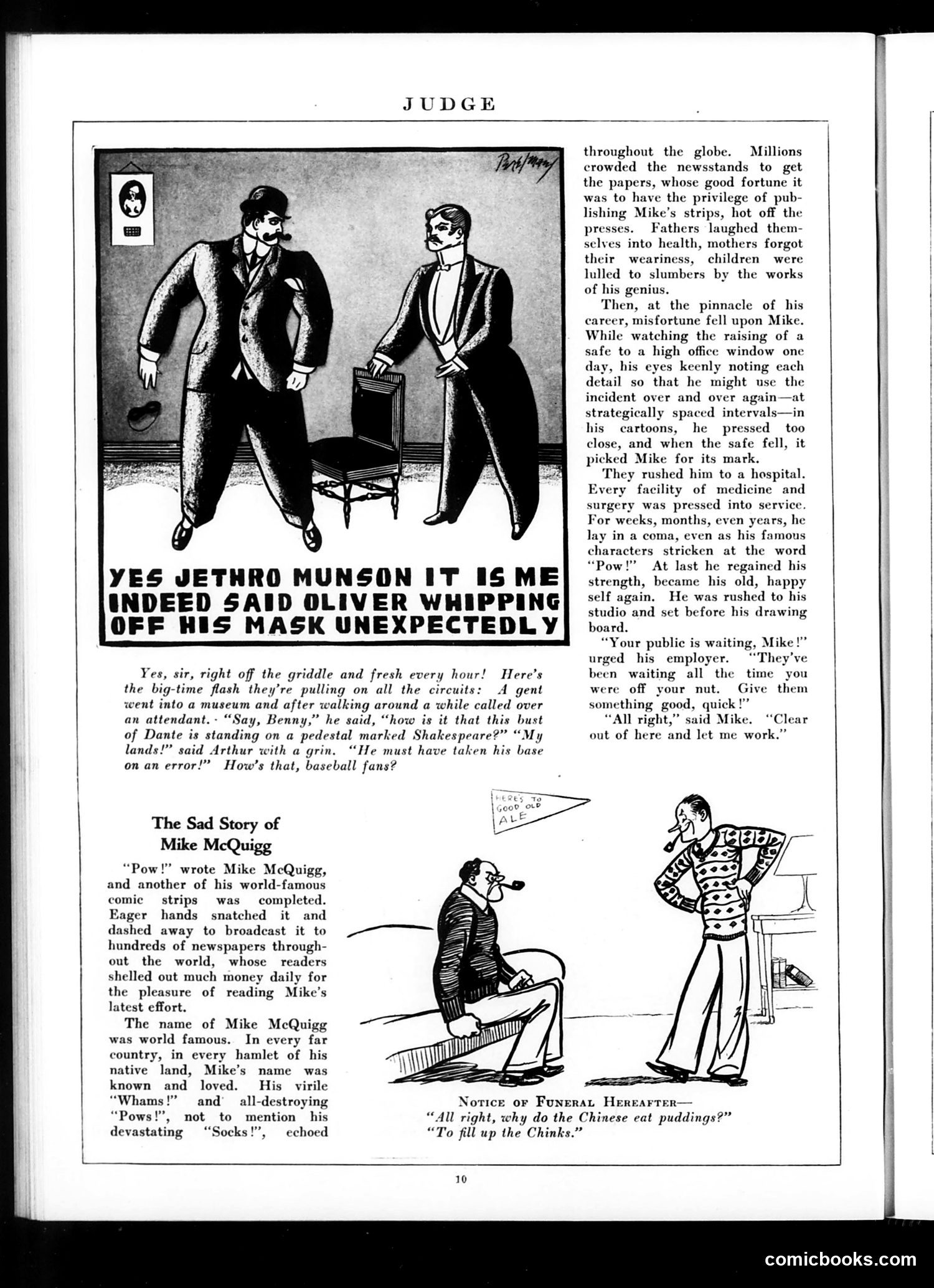
This page from *Judge* satirizes the celebrity and cultural dominance of cartoonist Mike McQuigg. The main narrative describes how McQuigg's comic strips became a global phenomenon—millions read his work daily, his catchphrases ("Pow!" "Whams!" "Socks!") were universally known. The satire pivots when misfortune strikes: while observing a safe being raised to study it for his cartoons, the safe falls on McQuigg, injuring him severely. He lies in a coma while his famous characters languish. When recovered, his employer pressures him to resume work immediately because "your public is waiting." The joke critiques both celebrity culture (the public's obsession with one artist) and exploitative labor practices (immediate demands for productivity despite serious injury). The cartoon in the upper panel appears to reference a specific incident, though the figure identities are unclear from the image alone. The bottom cartoon is an unrelated ethnic joke typical of the era.
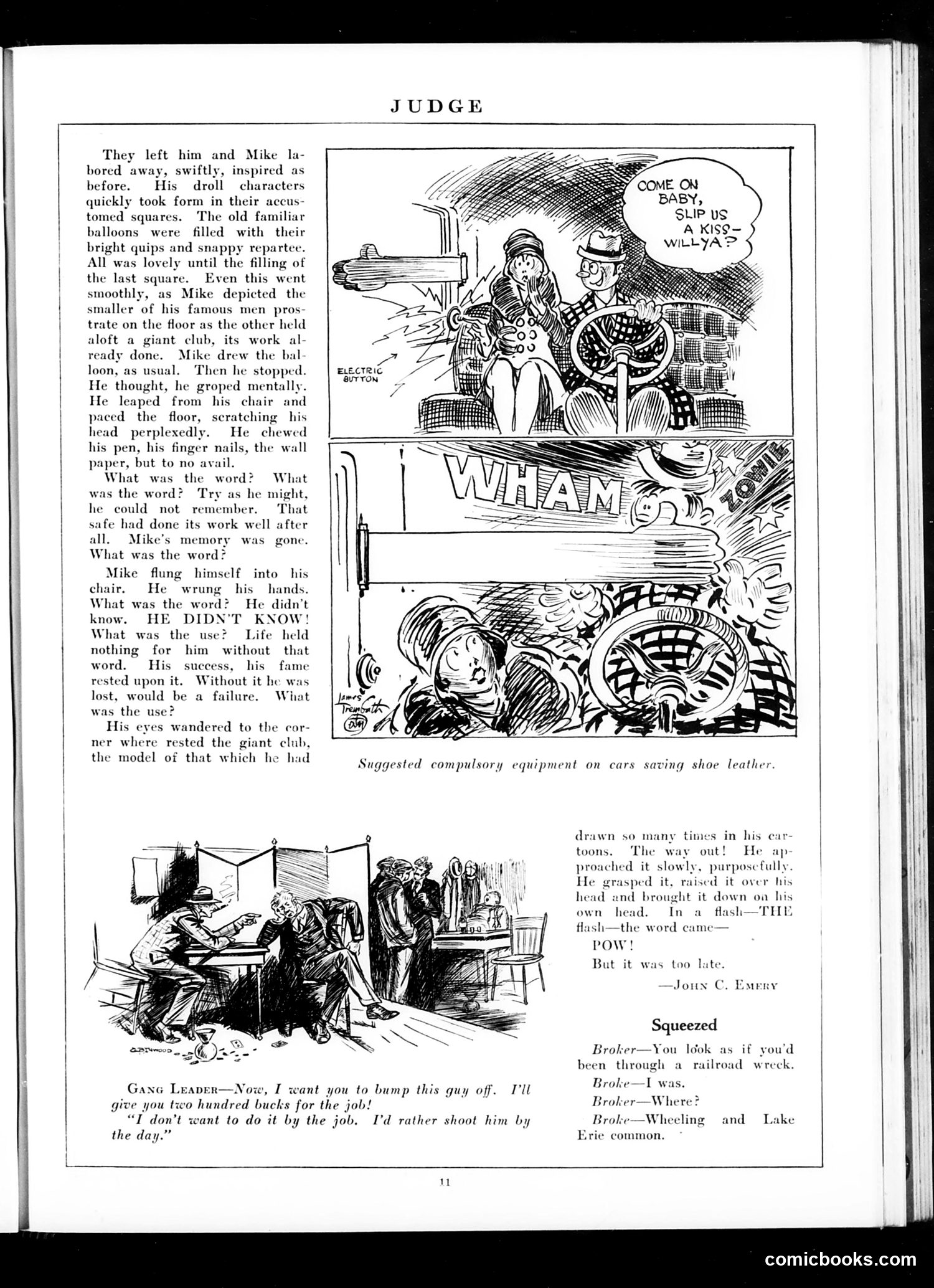
This Judge page contains a darkly comedic story about "Mike," a cartoonist who cannot remember a crucial word needed to complete his final comic panel. The narrative builds tension through his escalating desperation—the unnamed word is essential to his career and identity. The punchline is brutally absurdist: Mike solves his problem by striking himself with a club, which triggers the memory of the word "POW!"—the very onomatopoeia he needed. However, the trauma causes his death, making the remembered word useless. The page also includes a cartoon about hiring someone for murder ("bump this guy off"), with a joke about payment by day-rate versus job-rate, and a caption about "compulsory equipment on cars saving shoe leather"—likely satirizing some proposed automotive safety regulation. The humor relies on exaggeration, irony, and morbid consequences typical of early 20th-century satirical magazine humor.
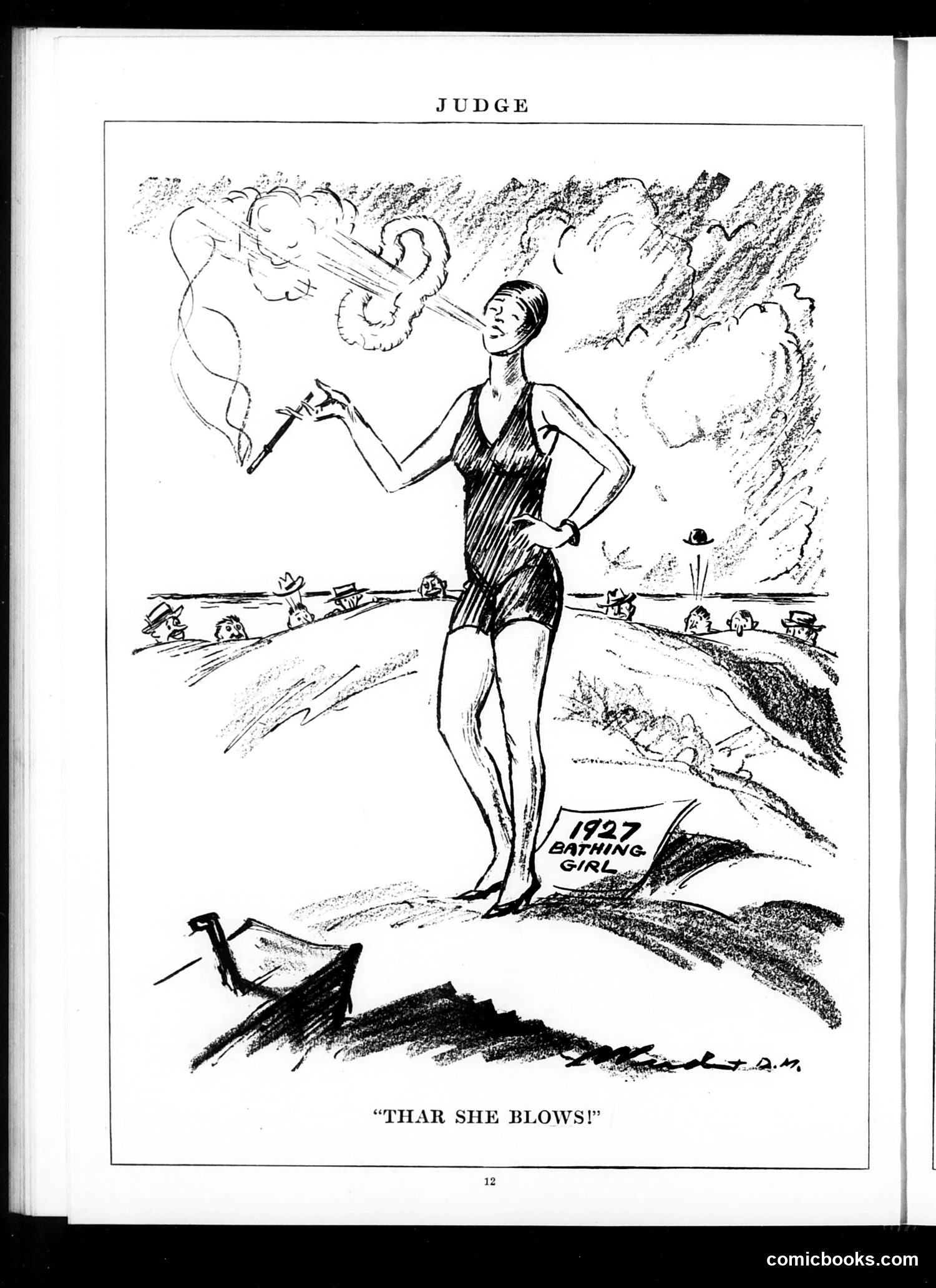
This 1927 Judge cartoon satirizes the "bathing girl" — a fashionable female figure of that era. The woman, labeled "1927 Bathing Girl," stands confidently in a revealing swimsuit while inflating what appears to be a large balloon or rubber object. The caption "Thar She Blows!" (evoking Moby Dick's whale-hunting cry) suggests the joke: the modern bathing girl is herself inflatable or artificially constructed — "all air," so to speak. This reflects 1920s anxieties about changing female fashion and body image. Shorter hemlines and revealing swimwear were controversial; the cartoon mocks both the exaggerated, artificial aesthetic and the male gaze fascinated by these changing styles. The spectators watching from the beach reinforce the satirical point about public consumption of the "bathing beauty" phenomenon.
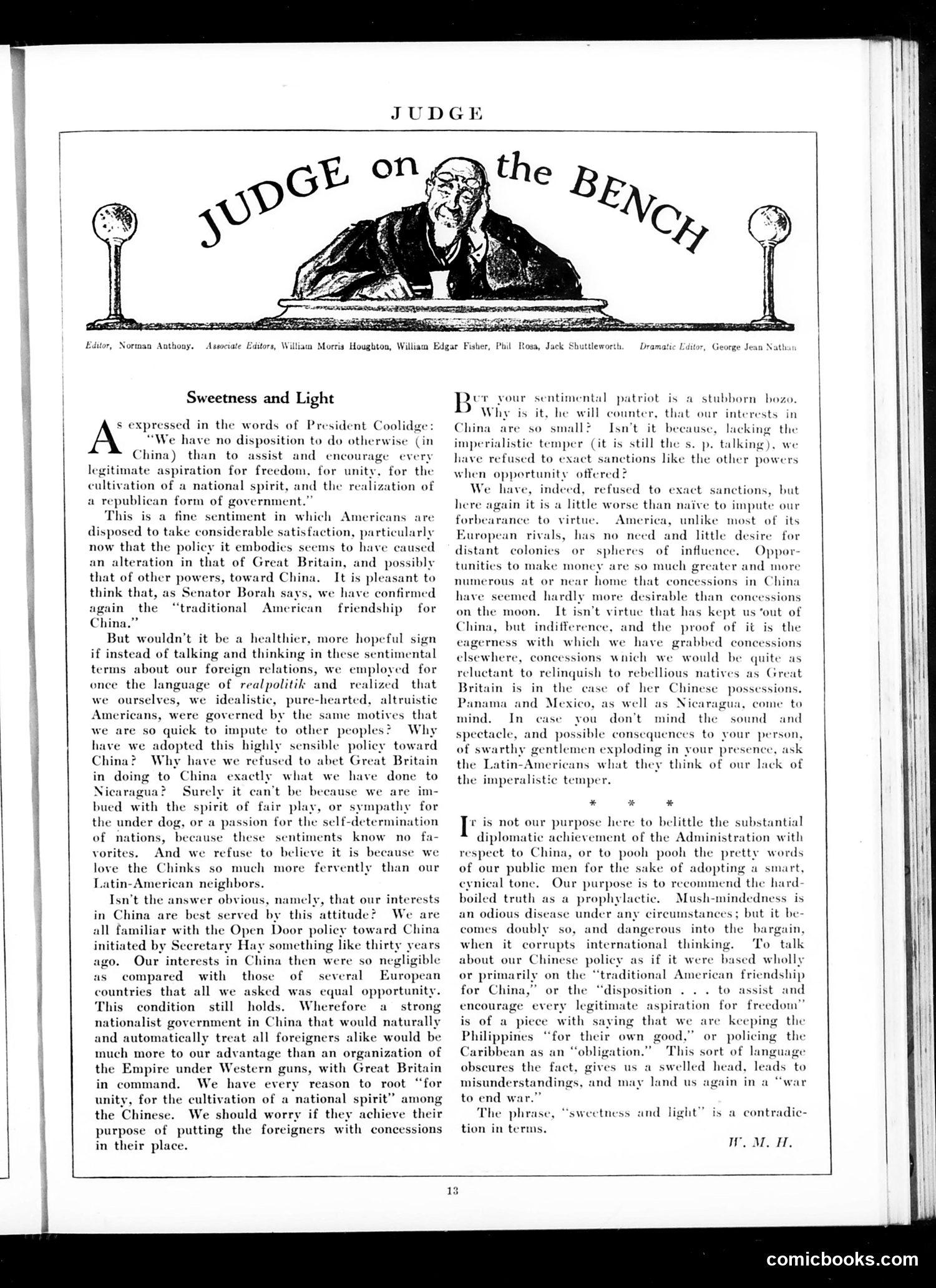
This editorial cartoon critiques American foreign policy toward China during the early 20th century. The "Judge" (representing American authority/opinion) sits on the bench, seemingly above reproach. The text by W.M.H. attacks what it calls hypocritical "sentimentality" in America's China relations. It argues Americans falsely claim moral superiority while pursuing imperial interests identical to European powers—demanding trade access, refusing Chinese sovereignty, and grabbing territorial concessions. The piece sarcastically notes America adopted an "Open Door policy" toward China while simultaneously refusing to grant China actual autonomy or equal treatment. It suggests American moralizing about democracy and freedom rings hollow when paired with practical imperialism. The satire targets American self-righteousness about its foreign relations compared to European rivals.
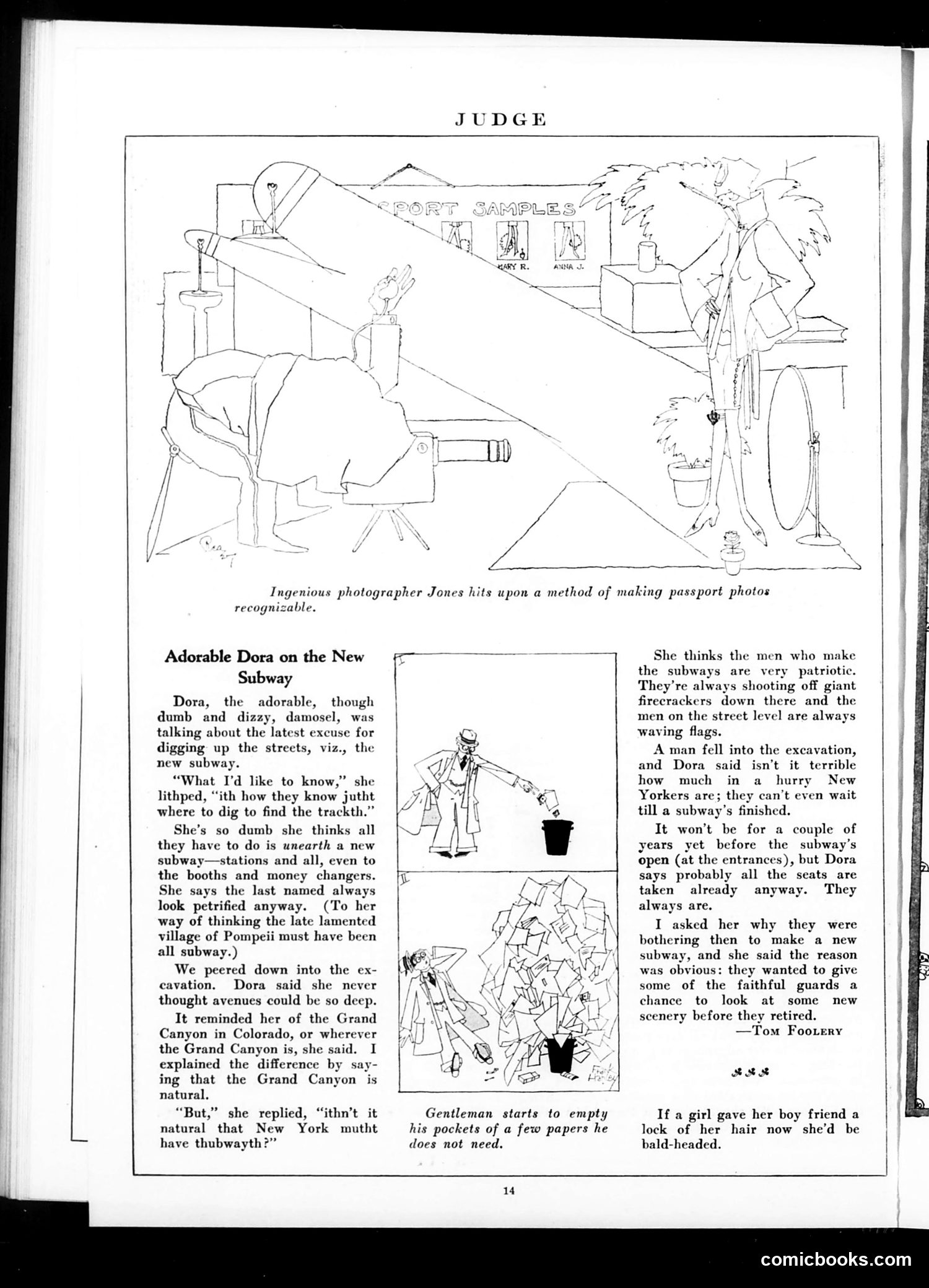
This page contains two satirical pieces about early 1900s New York City. **"Judge" (top cartoon):** A photographer uses a telescopic setup pointing at a fort to make passport photos "recognizable"—satirizing how difficult it was to capture recognizable likenesses in passport photography of that era. **"Adorable Dora on the New Subway":** The main article mocks a stereotypically dim-witted female character ("Dora") who makes absurd observations about New York City's subway construction. Her malapropisms (lisped speech), naive questions about how workers know where to dig, and ridiculous comparisons (the excavation resembles the Grand Canyon) drive the humor. The piece satirizes both the chaos of major urban construction and contemporary attitudes toward women's intelligence. References to patriotic workers setting off "firecrackers" and fallen workers underscore the danger and disruption of subway building. The bottom quips continue the comedic tone with period-appropriate observations about modern life.
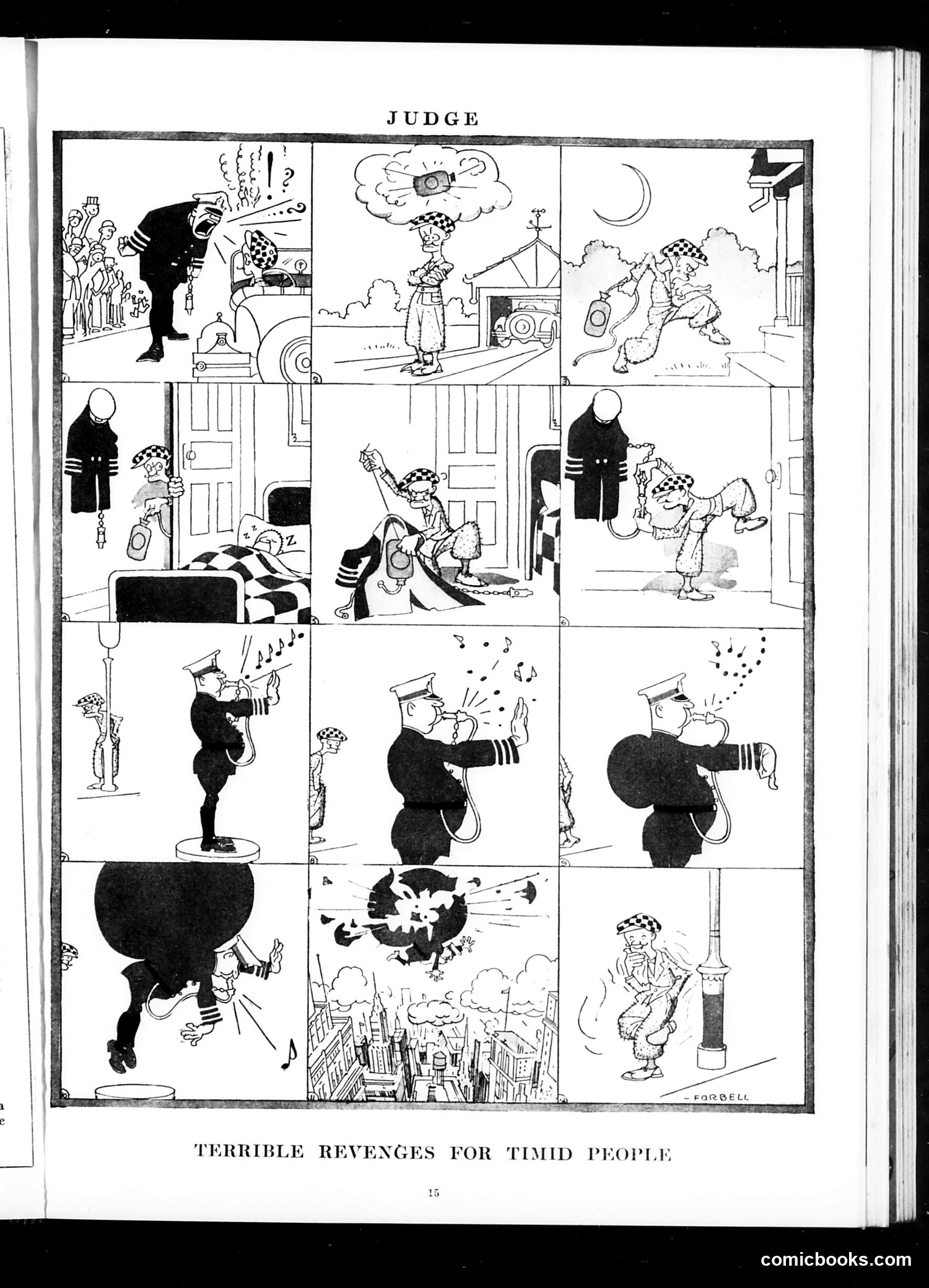
This Judge comic page satirizes meek or passive individuals who fantasize about bold retribution. The title character appears to be a timid authority figure (likely a judge, given the publication and his formal dress) who imagines increasingly dramatic revenge scenarios. The progression shows him: confronting crowds, standing on rooftops, blowing a large trumpet that grows progressively bigger, and finally causing citywide chaos from above. The humor relies on the contrast between his mild-mannered appearance and the absurdly escalating fantasies of vengeance. The satire targets people who suppress grievances, implying that bottled frustration leads to fantasies of disproportionate retaliation. It's a commentary on social inhibition and the gap between internal rage and external meekness—common Judge magazine themes mocking American social conventions.
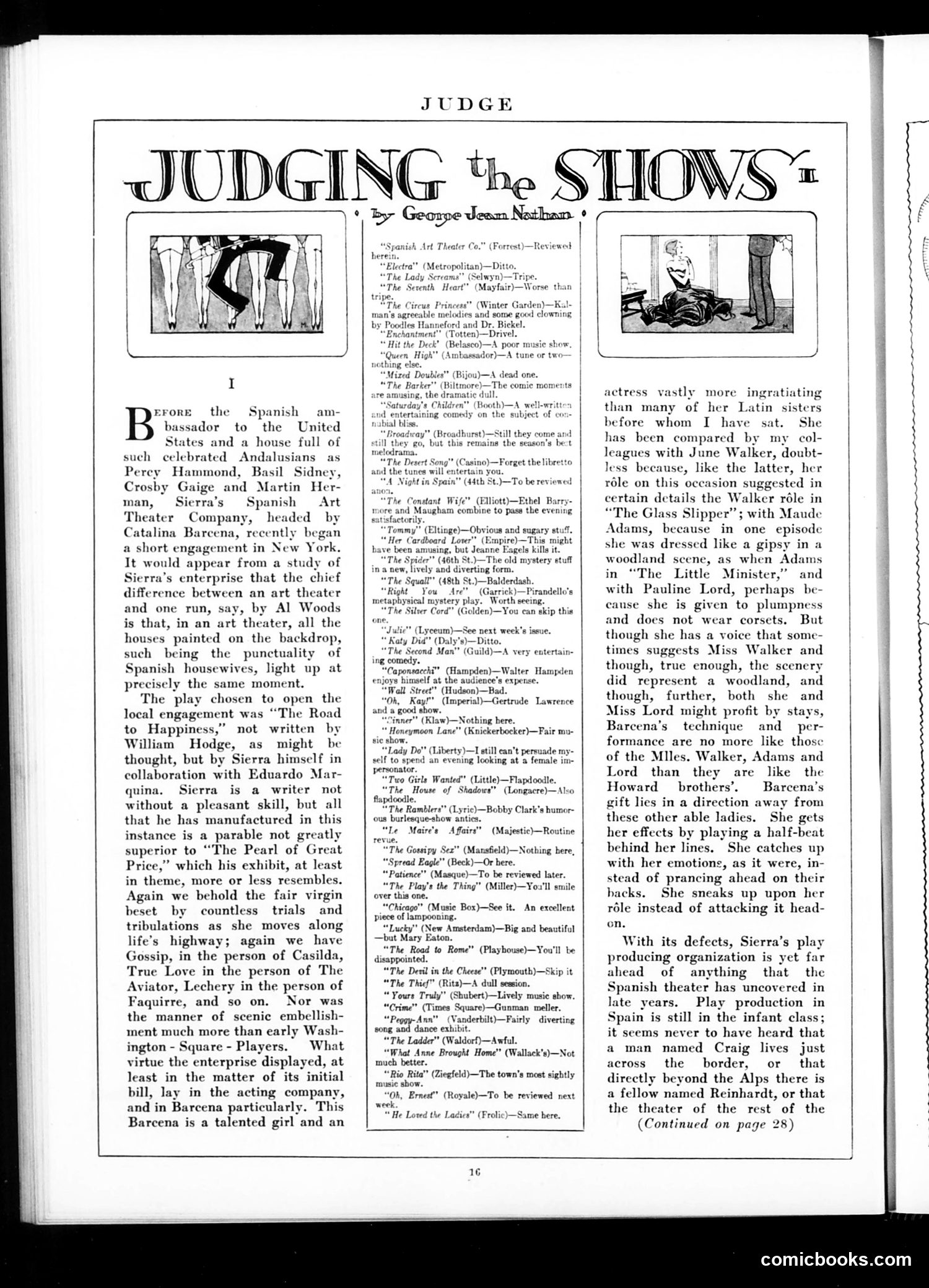
This is a theater review column by George Jean Nathan, Judge's drama critic. The main text discusses Sierra's Spanish Art Theater Company's New York engagement with the play "The Road to Happiness." **The Content:** Nathan critiques Sierra's theatrical enterprise, comparing "art theater" to commercial theater — his joke being that in Sierra's version, even the painted backdrop houses light up with Spanish punctuality (a stereotype about Spanish efficiency). The play itself is a morality parable featuring archetypal characters: a virtuous woman navigating life's trials, encountering personified concepts like Gossip, True Love, and Lechery. Nathan finds this derivative and unoriginal ("not greatly superior to 'The Pearl of Great Price'"). The column's real praise goes to **Catalina Barcena**, the lead actress, whom Nathan calls "talented" — noting her superior acting partially redeems the production's limited scenic design. The right column contains capsule reviews of current Broadway shows, rating them mostly dismissively. **The Satire:** Nathan uses condescension toward pretentious "art theater" while acknowledging good performances can salvage weak material.
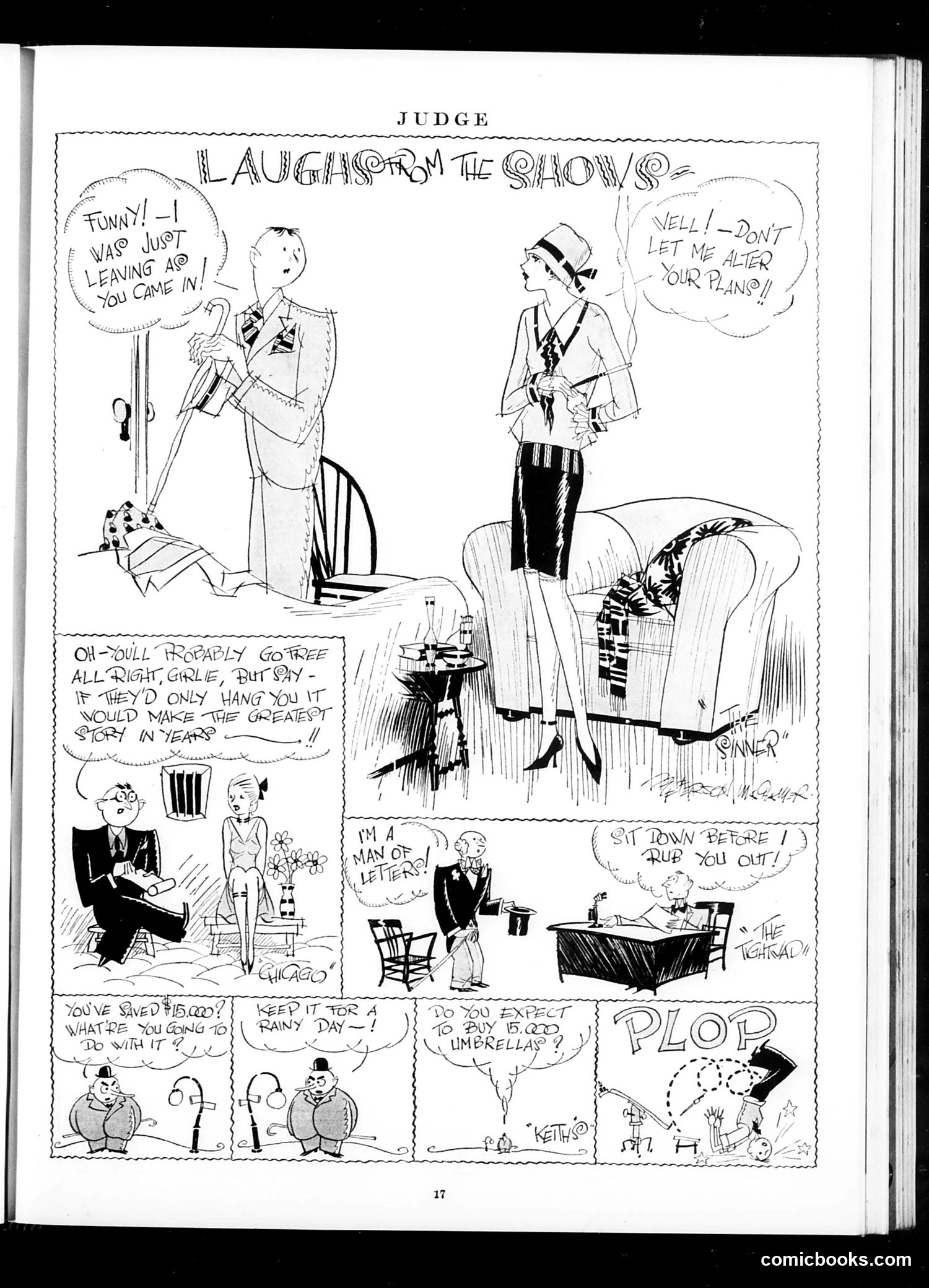
This multi-panel comic satirizes show business and romantic relationships, likely from the 1920s-30s era based on the art style and fashion. The narrative follows a couple's domestic dispute: a man leaving for "the shows" is stopped by his female companion, who fears he'll alter "their plans." A series of vignettes then depict various characters—including what appears to be a theatrical producer or manager ("Man of Letters") and a wealthy patron—discussing keeping a showgirl as a mistress ("Keep it for a rainy day"). The humor derives from the tension between respectable society and show business's reputation for loose morals. The final panel's "POP" sound effect suggests comedic revelation or exposure of infidelity. The satirical point criticizes the entertainment industry's association with kept women and the casual acceptance of such arrangements among wealthy men—treating a showgirl as a financial "investment" rather than acknowledging the relationship's true nature.
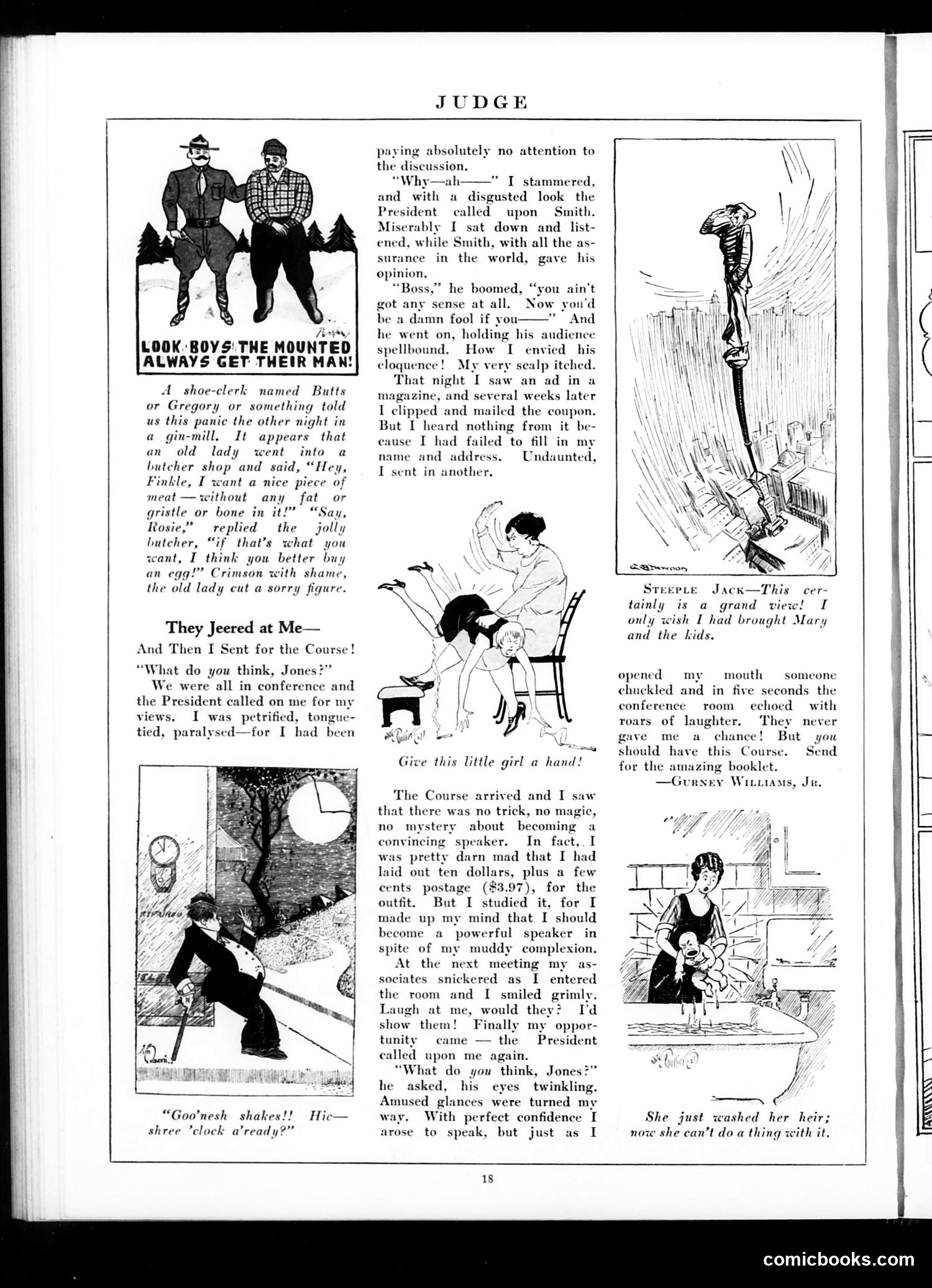
This page contains humorous anecdotes about public speaking and social embarrassment, typical of Judge magazine's satirical humor. **Main Story:** A timid office worker ("Jones") is repeatedly called upon during business meetings but freezes, unable to speak. Envying a confident colleague, he purchases a mail-order "Course" on public speaking for $3.97 (humorously misstated as costing more). After studying it diligently despite initial disappointment, he gains confidence. When finally asked for his opinion again, he attempts to speak but immediately becomes the subject of ridicule—the satire being that the expensive course teaches nothing, and his "muddy complexion" (likely racial/ethnic coded appearance) is the real barrier to acceptance, not lack of oratorical skill. **Supporting humor:** Includes a crude joke about an old woman ordering boneless meat from a butcher, and brief cartoon vignettes about domestic life and sight-seeing. The satire targets both mail-order self-improvement schemes and workplace social hierarchies.
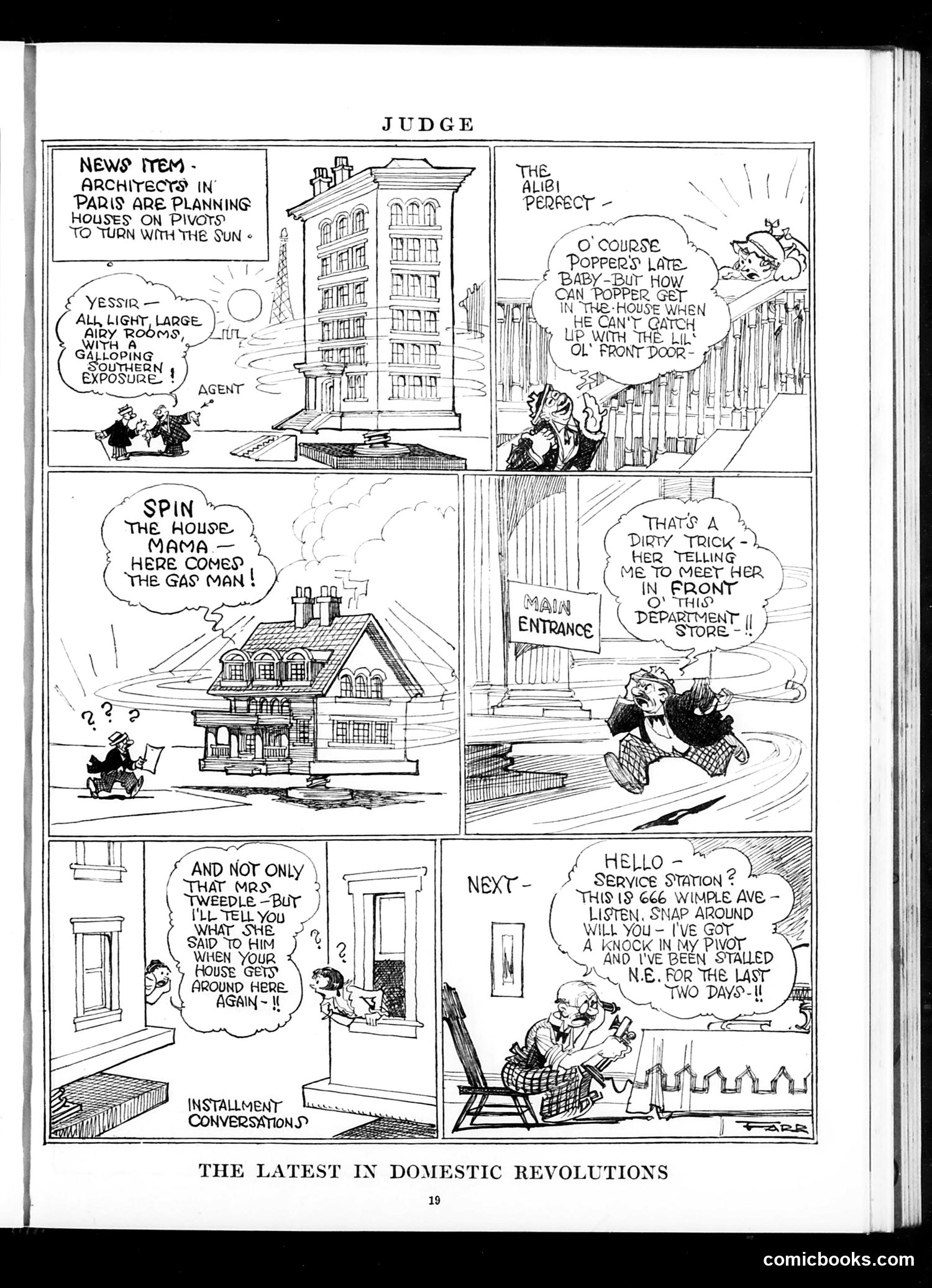
This multi-panel comic satirizes modern domestic inconveniences disguised as progress. The title "The Latest in Domestic Revolutions" signals the satire's target: innovations that supposedly improve home life but create new problems. The main joke: Parisian architects design houses on pivots to follow the sun for optimal light and exposure. However, the cartoon shows how this backfires—a husband can't get inside because the house has rotated away from the front door, trapping him outside for two days. Secondary humor involves "installment conversations"—a commentary on how modern improvements (like heating systems requiring maintenance calls) fragment domestic life into fragmented, transactional interactions rather than continuous living. The satire critiques how technological and architectural "progress" of the early 20th century often solved one problem while creating absurd new ones, and how modern life increasingly involves dealing with service people and technical complications rather than simple, straightforward home living.
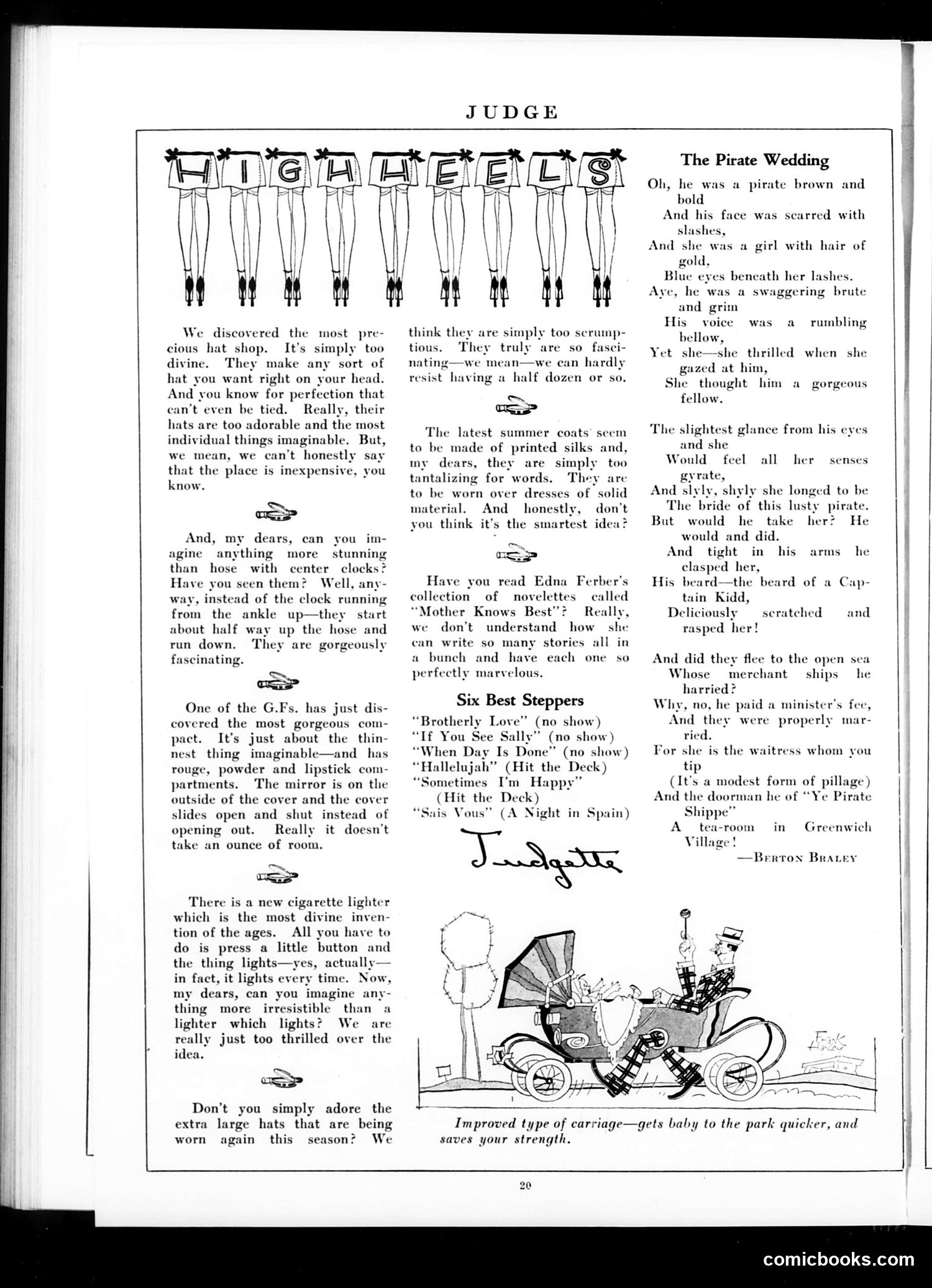
This page satirizes the vapid materialism and consumerism of wealthy society women in the 1920s. The left column mocks their breathless fascination with trivial luxury goods—custom-made hats, novelty hosiery with "center clocks," designer compacts, and cigarette lighters. The women ("G.F.s"—likely "Girl Friends") speak in affected, repetitive language ("simply too divine," "gorgeously fascinating"), emphasizing how conspicuous consumption replaces substance in their lives. The right side offers romantic relief: "The Pirate Wedding," a poem by Barron Bealey that ironically subverts pirate legend. A scarred, dangerous pirate and golden-haired maiden fall in love dramatically—but the "twist" is mundane: he pays a minister's fee and marries properly. She's revealed as a waitress he tips at "Ye Pirate Shippe" tearoom in Greenwich Village. The satire deflates both romantic fantasy and working-class pretense simultaneously. Together, the page contrasts frivolous wealth-obsession with ordinary life, suggesting that authenticity and romance matter more than fashionable consumption.
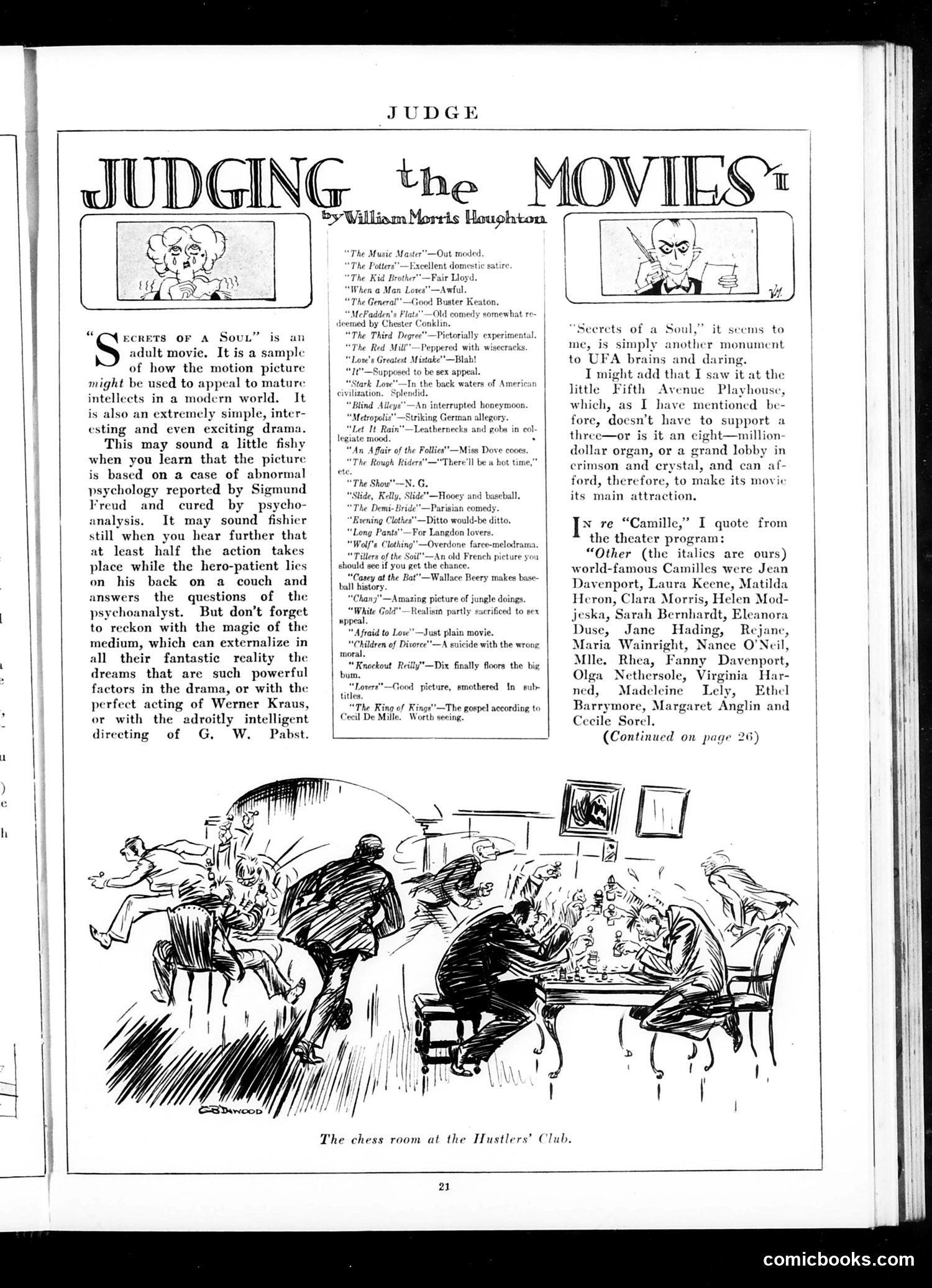
This page reviews silent films for Judge magazine's educated readership. The main cartoon depicts the "chess room at the Hustlers' Club"—a chaotic scene where well-dressed men have abandoned their game, suggesting distraction or frivolity among the leisure class. The film reviews mock contemporary cinema, praising artistic ambition ("Secrets of a Soul," based on Freudian psychology) while dismissing commercial fare as simplistic or morally questionable ("It"—supposed to be sex appeal," "When a Man Loves"—Awful"). The "Camille" commentary sarcastically lists famous actresses who've played this role, implying that casting is the movie's only distinction. Overall, Judge positions itself as arbiter of taste for sophisticated viewers, critiquing both pretentious experimental films and lowbrow entertainment aimed at mass audiences. The tone reflects 1920s cultural anxieties about cinema's influence and artistic legitimacy.
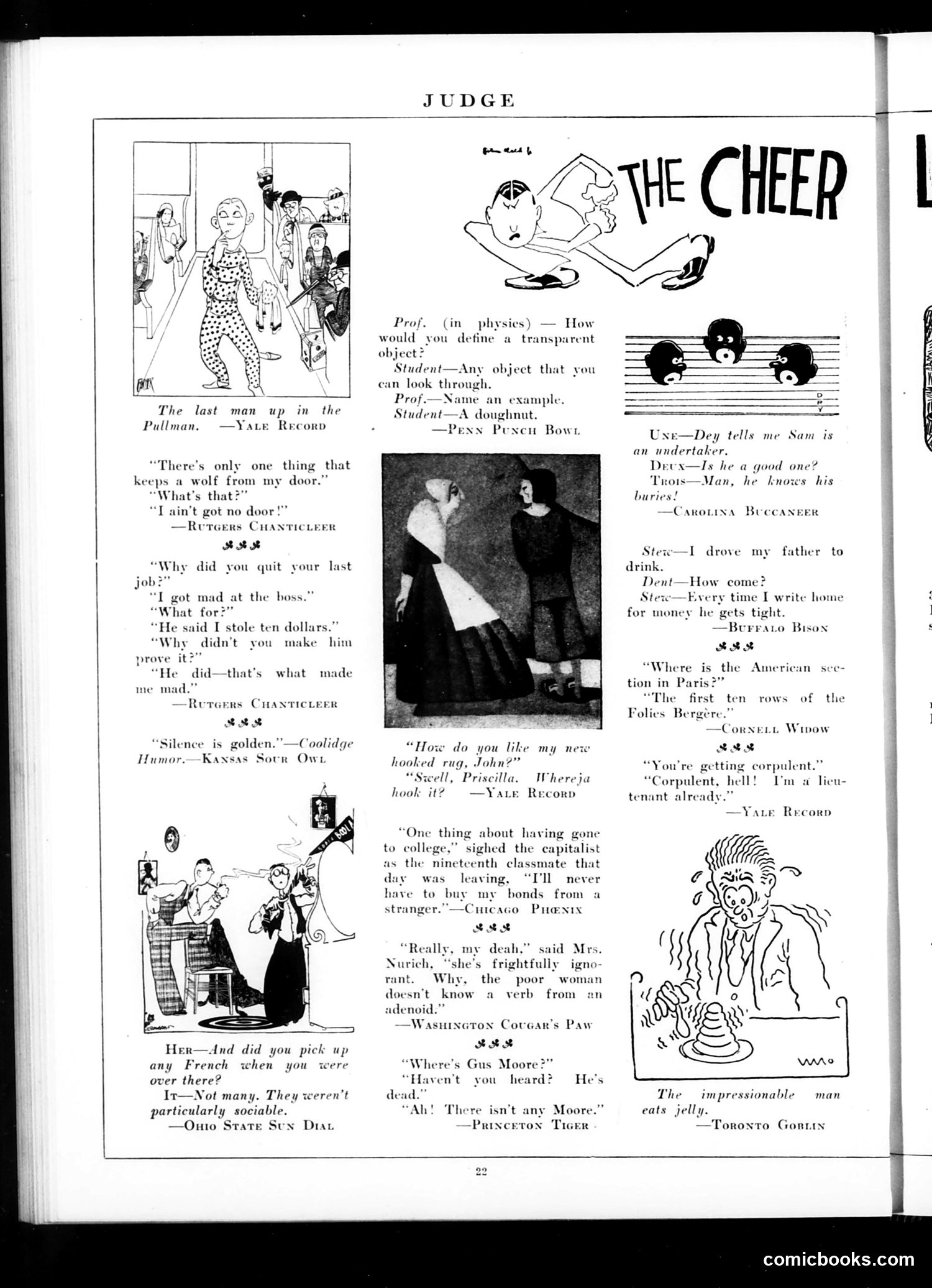
This page from *Judge* magazine features a collection of short jokes and humorous cartoons reflecting early 20th-century American social attitudes. The content includes workplace humor (quitting jobs, boss conflicts), satirical commentary on wealth and class (a capitalist avoiding bond purchases, wealthy ignorance), and period-specific references like the Folies Bergère in Paris and Coolidge-era silence. Several jokes play on ethnic or regional dialects ("Dey tells me Sam"), reflecting common comedic practices of that era. The cartoons mock social pretension, particularly among the wealthy ("frightfully ignorant" Mrs. Nurich), and poke fun at college life and romantic situations. References to Pullman cars and French travel indicate an audience familiar with upper-middle-class leisure activities. The humor is largely observational and domestic—about driving fathers to drink through requests for money, misunderstandings about transparency and doughnuts—typical of *Judge's* satirical approach to everyday American life rather than explicit political commentary.
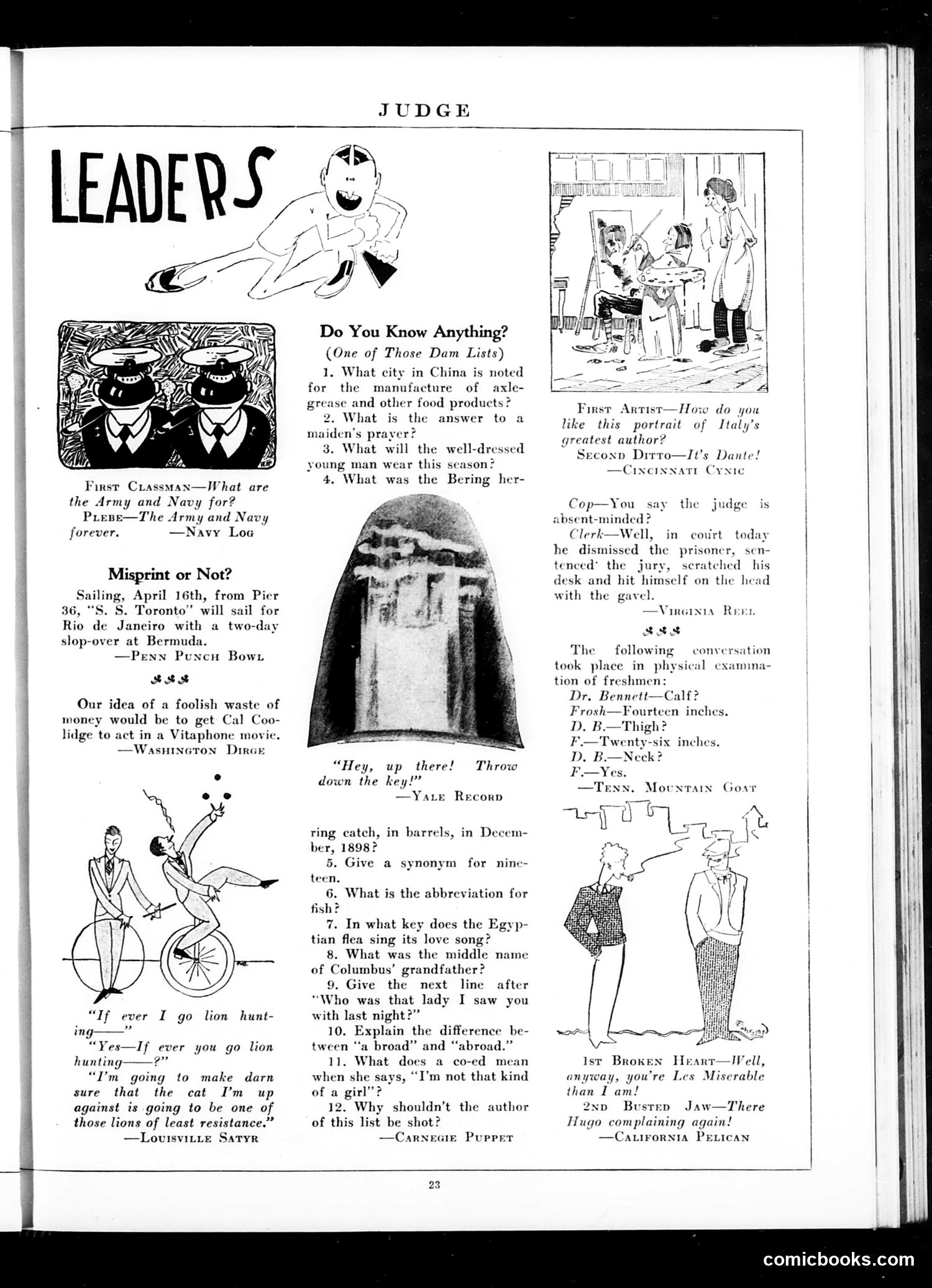
This page collects humorous short jokes and cartoons typical of 1920s satirical magazines. Key elements include: **"Leaders"** section features wordplay and absurdist humor about contemporary figures and situations—notable is the jab at Calvin Coolidge, suggesting he'd be a wasteful choice for a Vitaphone (early sound film) actor, playing on his reputation for being dull and taciturn. **"Do You Know Anything?"** is a deliberately ridiculous trivia list with nonsensical or trick questions (e.g., "What city in China makes axle-grease?"), mocking contemporary "knowledge quiz" entertainment fads. **Other cartoons** include workplace and relationship humor: a cop noting a judge's absent-mindedness in court, and collegiate jokes about physical measurements of freshmen. The overall tone is light, cynical mockery of popular culture, politics, and social pretensions—typical of Judge's middle-class satirical approach during the Coolidge era.
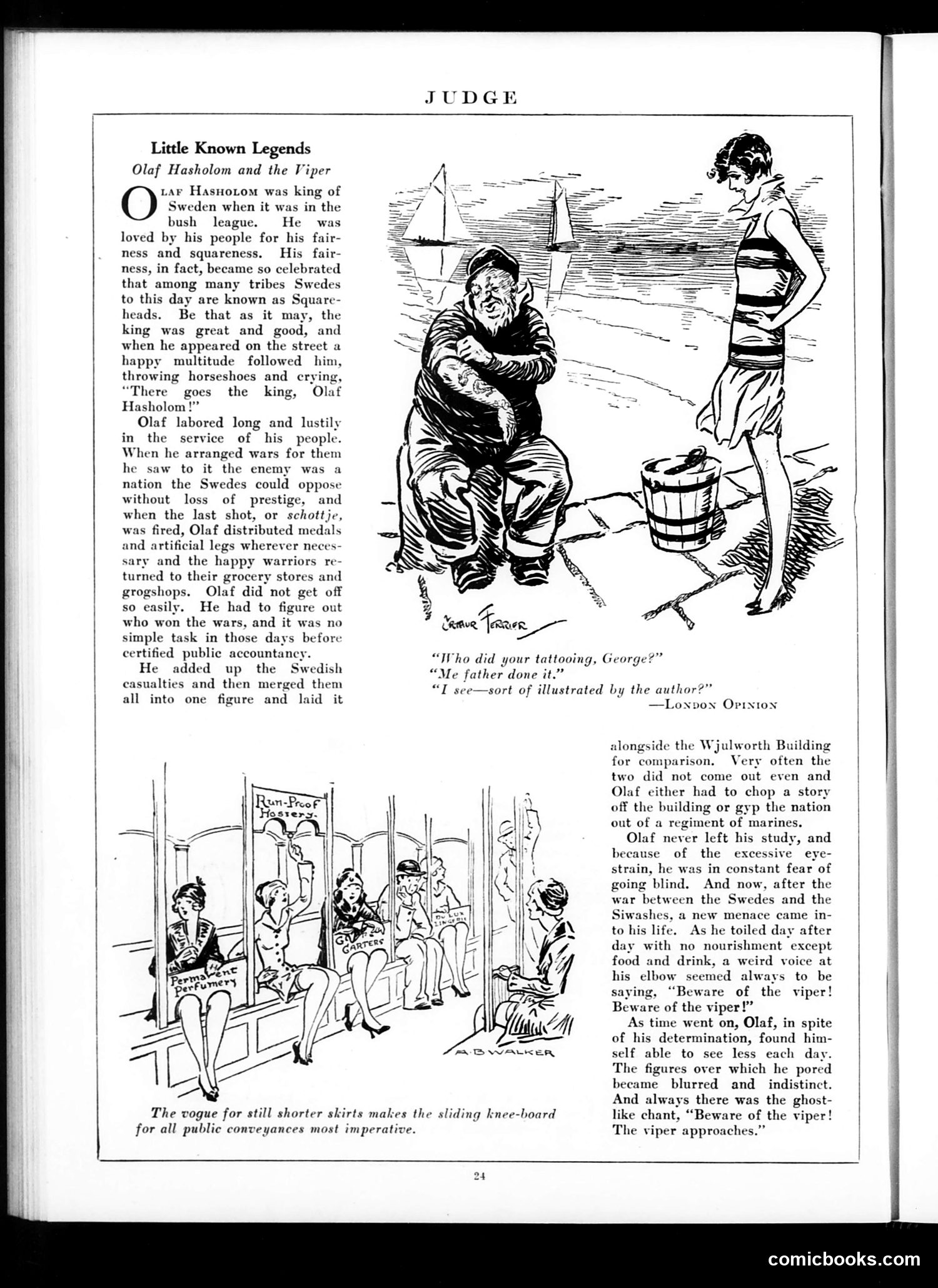
This is a humorous "Little Known Legends" feature satirizing bureaucratic incompetence and government waste. King Olaf represents an honest but hapless administrator—celebrated for fairness ("Squareheads"), he becomes bogged down in the mundane task of tallying war casualties and accounting for military expenses. The satire targets government inefficiency: Olaf must literally chop stories off buildings or "gyp the nation out of a regiment" when casualty figures don't reconcile with budget records. His progressive blindness symbolizes willful ignorance or oversight failure. The "viper" remains unclear—possibly representing the looming consequences of administrative failure, or perhaps a commentary on hidden threats within bureaucracy itself. The page also includes a separate cartoon mocking women's fashion (shorter skirts on public conveyances) and an unrelated joke about tattooing ("illustrated by the author"). The satirical thrust: honest administrators are defeated by accounting nightmares, suggesting Judge's critique of early-20th-century government incompetence.
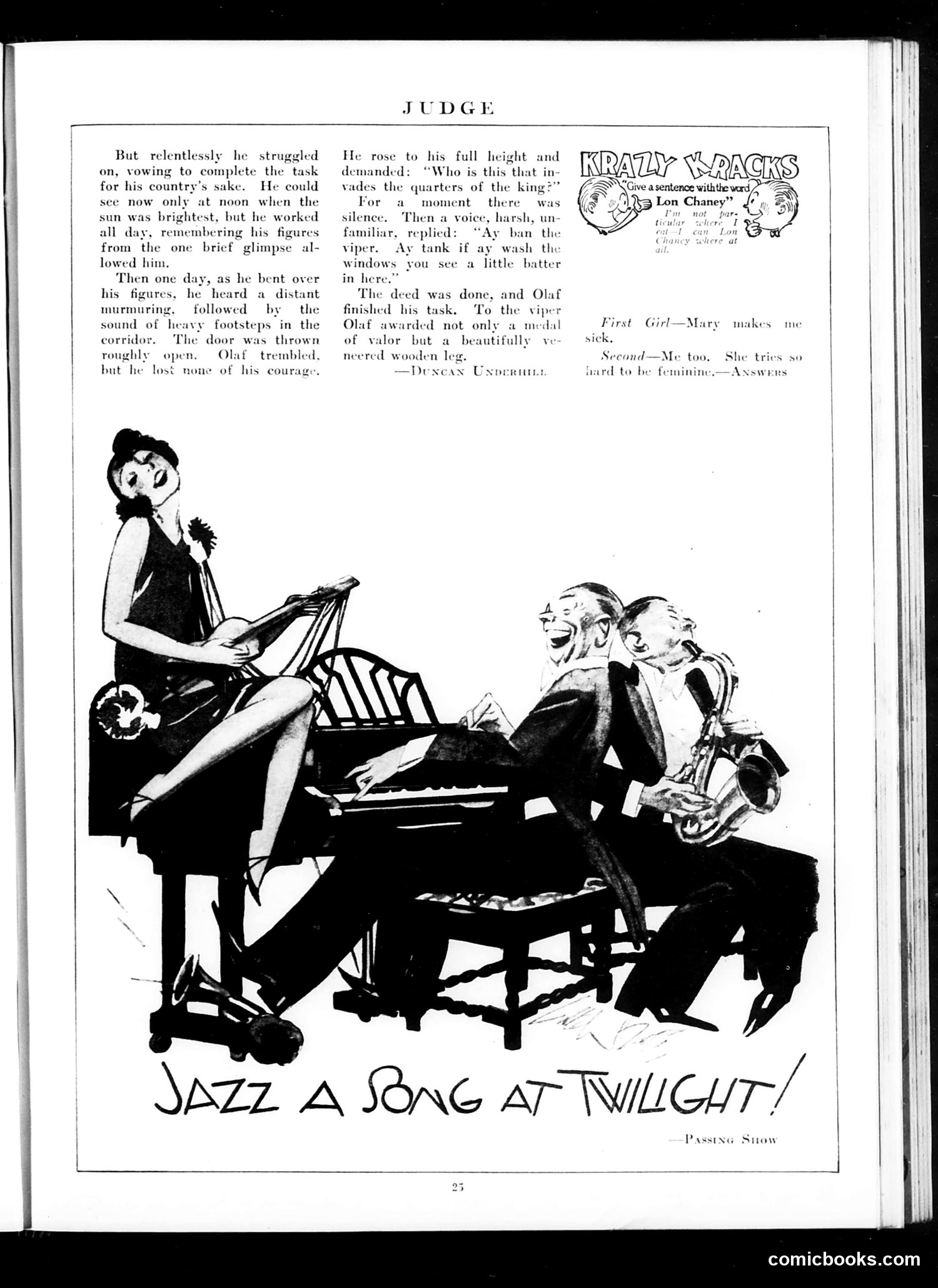
This page contains two distinct pieces: **Main Story/Cartoon**: A narrative illustrated tale about "Olaf," a man working on figures for his king despite going blind. A visitor arrives claiming to be "the viper" who wants to wash windows—apparently a Scandinavian-accented character (suggested by dialect spelling like "Ay ban" and "Ay tank"). The story's punchline awards this worker a wooden leg, suggesting either an accident or disability-related humor typical of the era. **Bottom Illustration**: "Jazz a Song at Twilight" shows a woman with two caricatured men playing musical instruments—likely depicting 1920s jazz culture and gender dynamics of the period. **Context**: The heavy Scandinavian-dialect humor and the wooden-leg punchline reflect common early-20th-century American stereotyping. The page mixes literary satire with visual gags typical of *Judge* magazine's format. The specific political or social commentary remains unclear without additional context about the publication date.
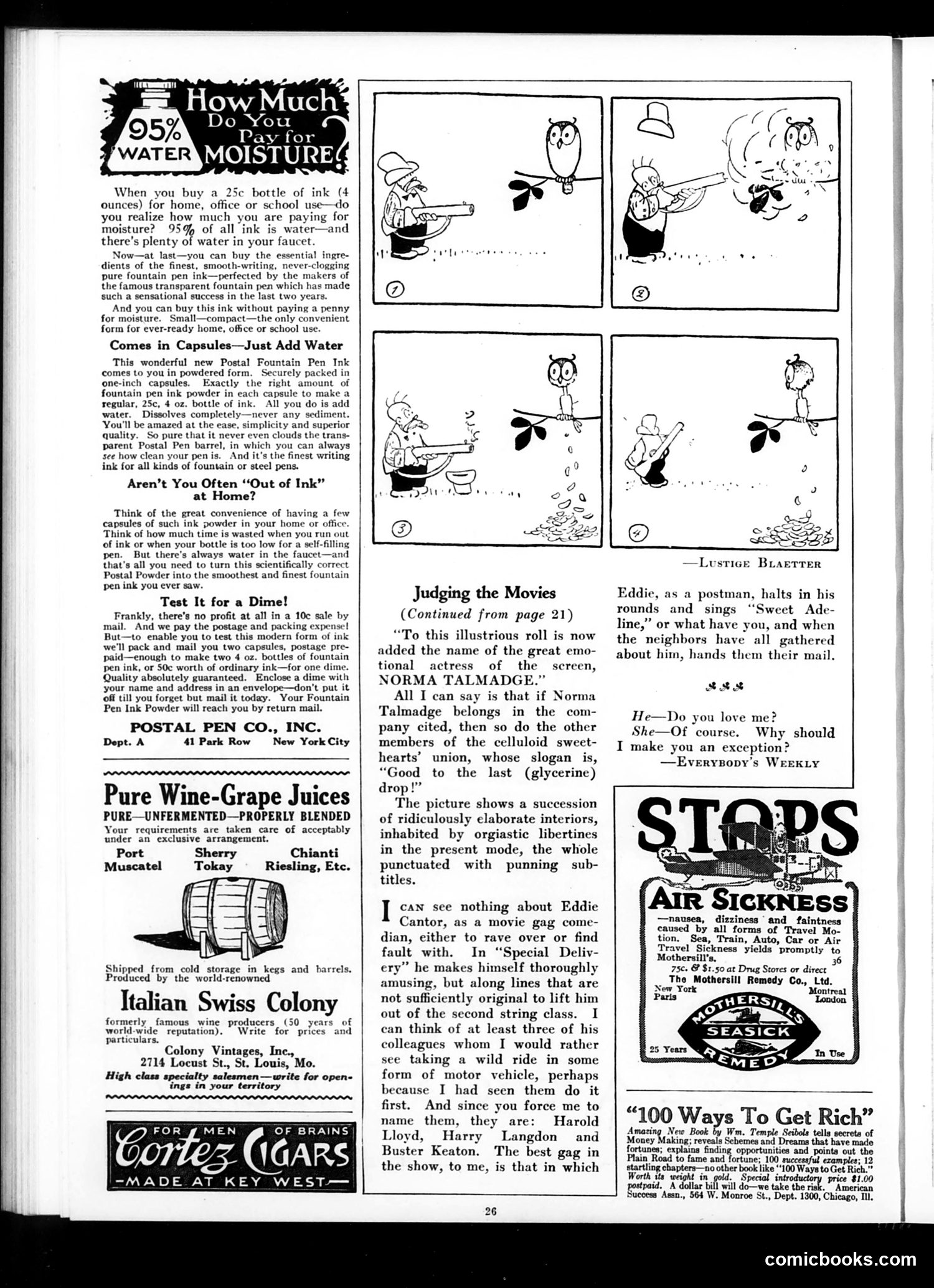
The four-panel comic strip titled "Lustige Blatter" (German for "funny pages") depicts a man repeatedly shooting at a bird perched on a branch. The bird survives each attempt, and the man's gun eventually backfires or explodes, injuring him instead. The joke is a classic slapstick reversal: the hunter becomes the hunted, his weapons turn against him, and his quarry remains unharmed and indifferent. This reflects early 20th-century cartoon humor's reliance on physical comedy and poetic justice—the foolish aggressor is punished by his own incompetence. The comic likely appealed to Judge magazine's readers as absurdist humor, requiring no cultural context beyond understanding that persistence in futility leads to self-inflicted disaster. It's vintage pre-1930s cartoon logic.
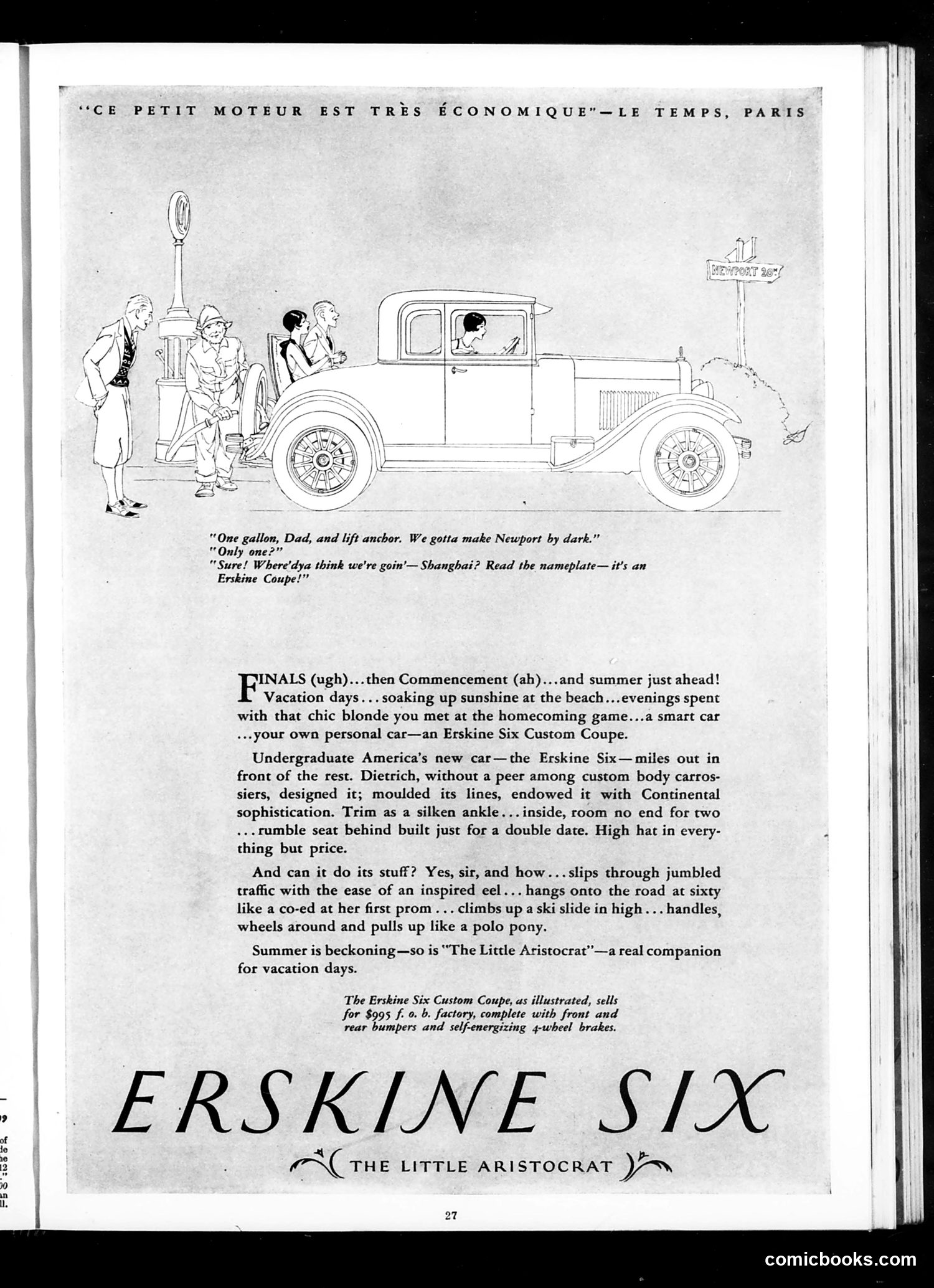
This is primarily a **car advertisement**, not political satire. It advertises the Erskine Six automobile, marketed as "The Little Aristocrat." The cartoon at top shows a family at a gas station; a father and children discuss the car's fuel efficiency—they can reach Newport (a wealthy coastal destination) on one gallon. The joke plays on the vehicle's economy. The bulk of the page is advertising copy targeting college students ("Undergraduate America's new car"), emphasizing luxury features—a "rumble seat" for dates, Continental styling, and performance—while claiming affordability at $995. The language is aspirational, associating the car with status ("silken ankle," "aristocrat") and dating/romance appeal ("chic blonde," "double date"). The French phrase at top translates to "This little engine is very economical," suggesting Erskine was marketed internationally. This reflects 1920s American consumer culture: automobiles as status symbols and essential for courting rituals, targeted to youth through lifestyle imagery rather than technical specifications.
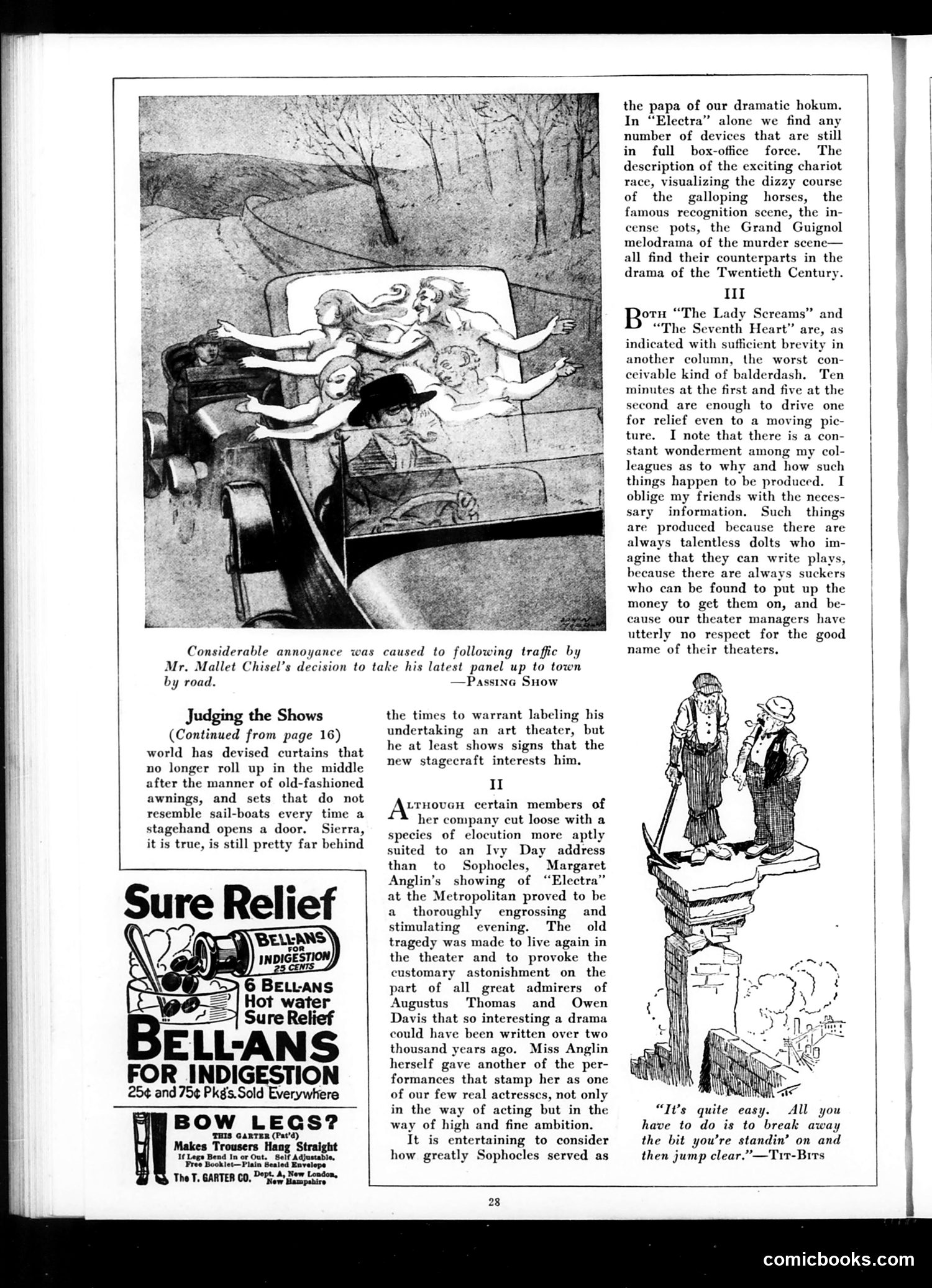
This page critiques theatrical productions of the 1920s era. The main article reviews recent Broadway shows, contrasting Margaret Anglin's classical production of Sophocles' "Electra" at the Metropolitan (praised as genuinely engaging) with two contemporary melodramas—"The Lady Screams" and "The Seventh Heart"—dismissed as worthless "balderdash." The satire targets the theater industry's willingness to produce talentless work. The author argues bad plays succeed because: (1) untalented writers constantly attempt playwriting, (2) investors foolishly fund them, and (3) theater managers lack professional standards. The accompanying illustration shows a woman reclining on a couch while a man adjusts a large decorative panel—likely depicting the "Mr. Mallet Chisel" mentioned in the caption, whose decision to transport his latest theatrical set caused traffic problems. The page includes period advertisements (Bellans indigestion remedy, bow-leg garters) typical of Judge's commercial content.
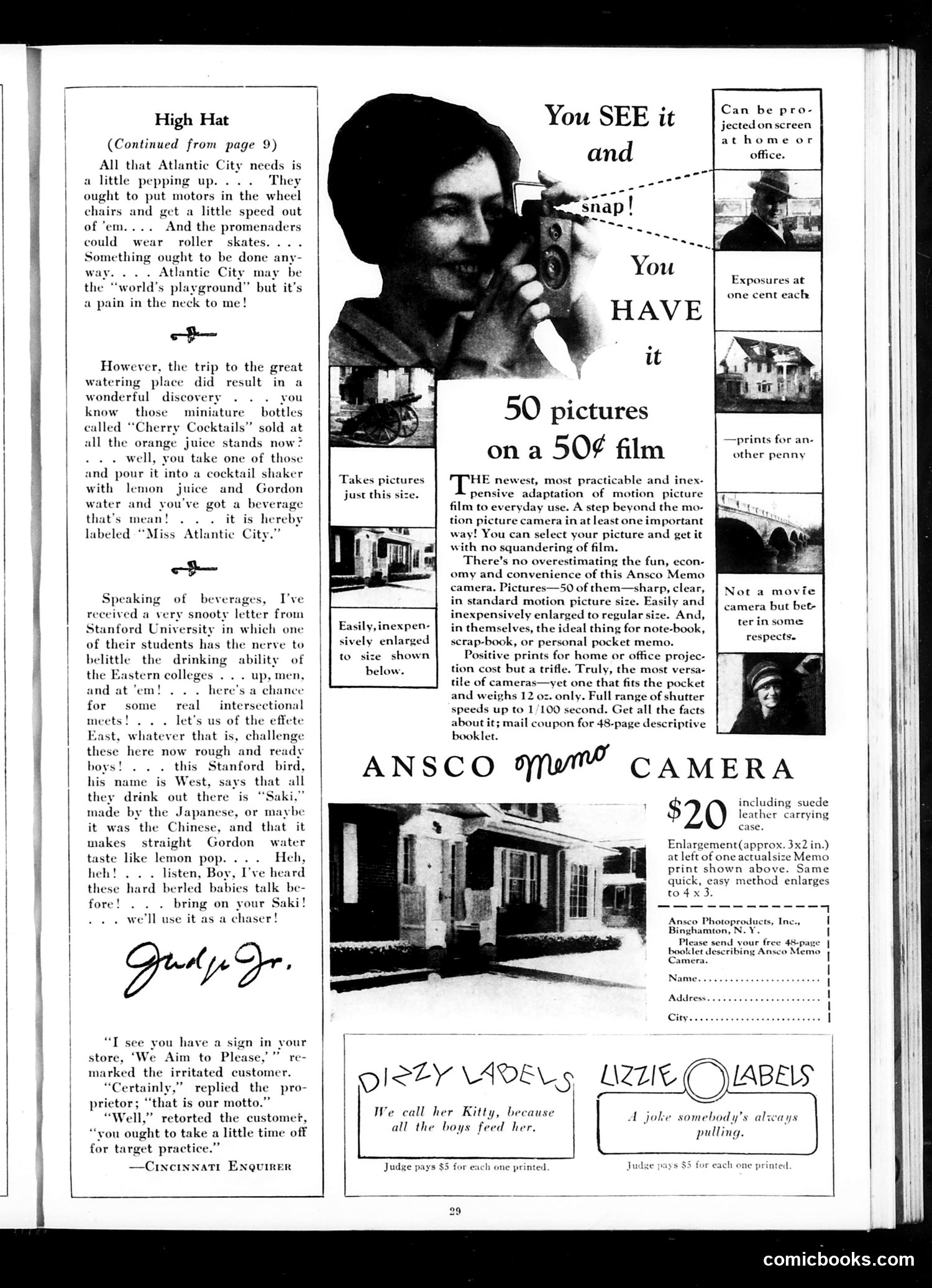
This Judge magazine page contains mostly **advertising and humor columns**, not political cartoons. The "High Hat" column (left) is casual social commentary: the author mocks Atlantic City as boring, describes inventing a cocktail called "Miss Atlantic City," and boasts about challenging Stanford University students on their drinking habits. It's lighthearted, era-appropriate banter about East Coast leisure culture and the stereotype that West Coast universities only drink sake. The main content is an **advertisement for the Ansco Memo camera**—a pocket-sized film camera selling for $20 that produces 50 pictures on cheap film. The ad emphasizes affordability and convenience for amateur photographers. Below are two small joke submissions: "Dizzy Labels" (about a girl nicknamed Kitty because "all the boys feed her") and "Lizzie Labels" (a weak punchline about practical joking). These appear to be reader submissions Judge paid $5 to print. **There is no significant political satire on this page**—it's primarily product advertising and light consumer humor typical of the period.
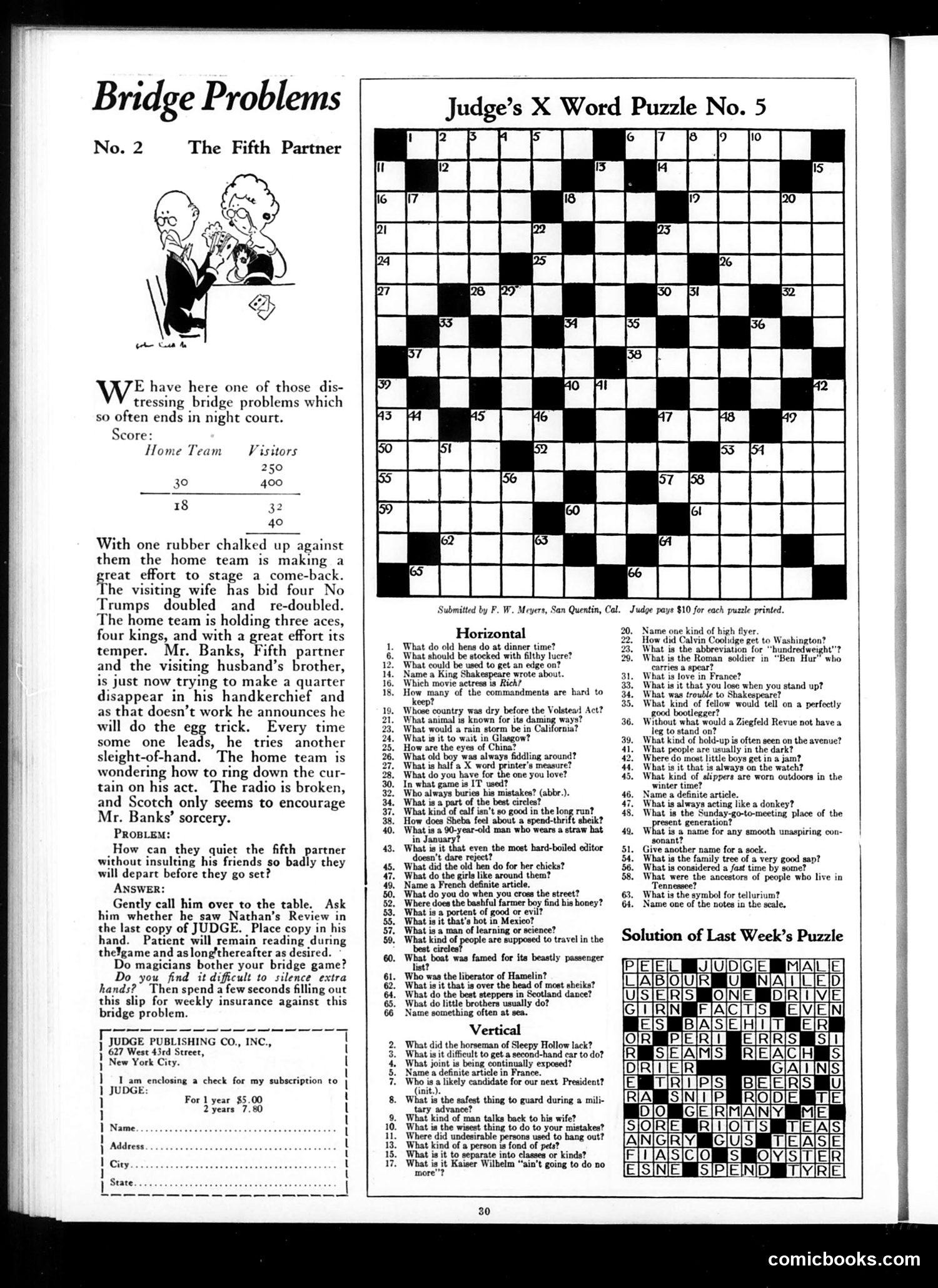
This cartoon satirizes a common social irritation of the 1920s-30s era: the amateur magician or "magic enthusiast" who performs unsolicited tricks at social gatherings, particularly during bridge games. Mr. Banks, the "Fifth Partner," repeatedly interrupts the card game with sleight-of-hand acts (making a quarter disappear, attempting an "egg trick"), disrupting play. The satire targets not just the performer's behavior but the social awkwardness of shutting him down without offending the hosts or other guests. The magazine's tongue-in-cheek "solution" is to hand him a copy of *Judge* magazine to read instead—a cleverly self-promotional joke advertising the publication's entertainment value as a distraction device. The page also includes a crossword puzzle and subscription advertisement, typical filler for the magazine. The humor relies on recognizing this as a universal frustration among bridge-playing middle-class Americans of that era.
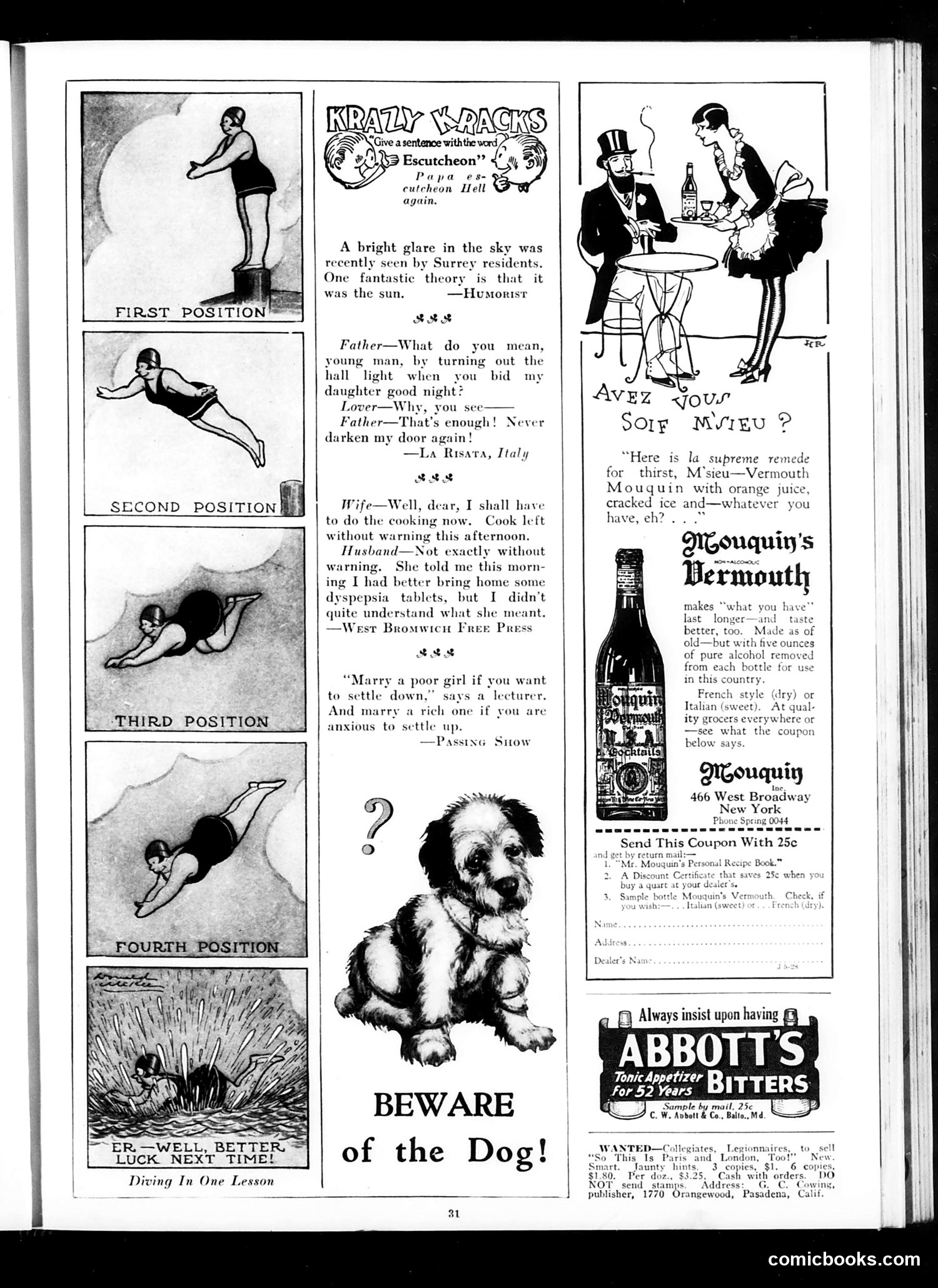
This page combines humor sections with period advertisements. The left column shows five swimming positions humorously labeled as a "diving lesson," satirizing instructional content popular in magazines of the era. The center contains brief jokes mocking domestic life: a father catches a young man turning off lights with his daughter; a wife warns her departing cook won't return without warning; a lecturer advises marrying poor girls to "settle down" (financially). These reflect early 20th-century anxieties about courtship, domestic service, and class. A "Beware of the Dog" caption accompanies a sketched terrier, likely a visual non-sequitur joke. The right side advertises **Moquin's Vermouth** and **Abbott's Bitters**—patent medicines/alcoholic tonics marketed as health remedies, typical of the period before FDA regulation. The Moquin ad emphasizes the product "lasts longer" and contains "pure alcohol," reflecting the pre-Prohibition era's open marketing of such products. Overall, the page reflects Edwardian-era social satire and unregulated medicinal alcohol advertising.
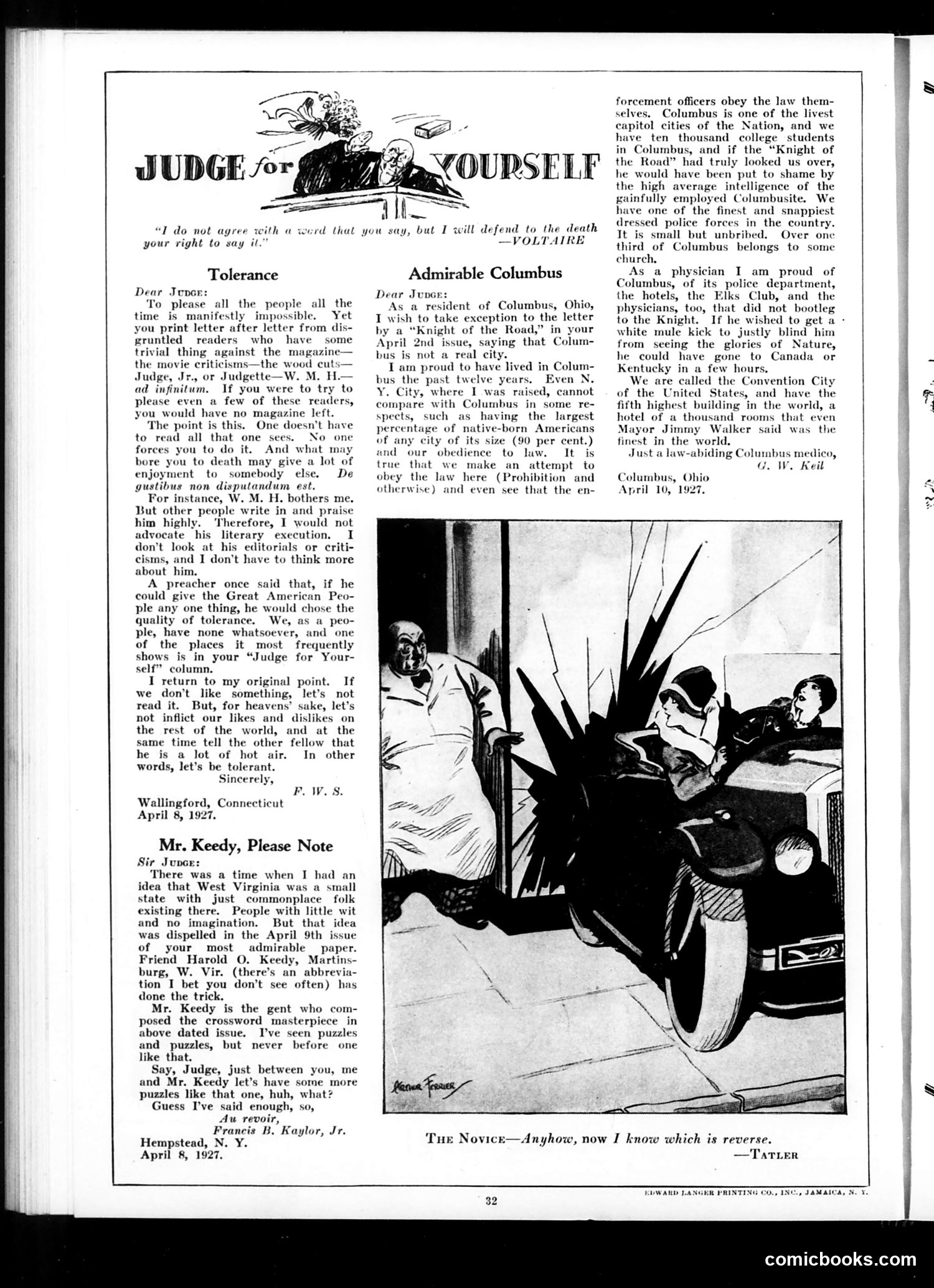
This page from Judge magazine (April 1927) presents a reader letters column showcasing contemporary social debates. **Main Content:** The "Judge for Yourself" section prints three letters debating magazine editorial standards and local pride: 1. **"Tolerance"** argues Judge should tolerate diverse reader complaints about content (movie criticism, artwork, editorials) rather than appease every critic—a meta-commentary on the magazine's own editorial balance. 2. **"Mr. Keedy, Please Note"** praises a West Virginia reader's crossword puzzle, celebrating ingenious puzzle-craft. 3. **"Admirable Columbus"** defends Columbus, Ohio against a previous letter calling it unremarkable, boasting of its native-born population, law enforcement, college students, and unpaid police—notably emphasizing Prohibition enforcement during the era's alcohol ban. **The Cartoon:** Shows a novice at reverse skiing, illustrating Tatler's caption about confusion. The page reflects 1920s preoccupations: editorial gatekeeping, civic boosterism, and Prohibition enforcement.
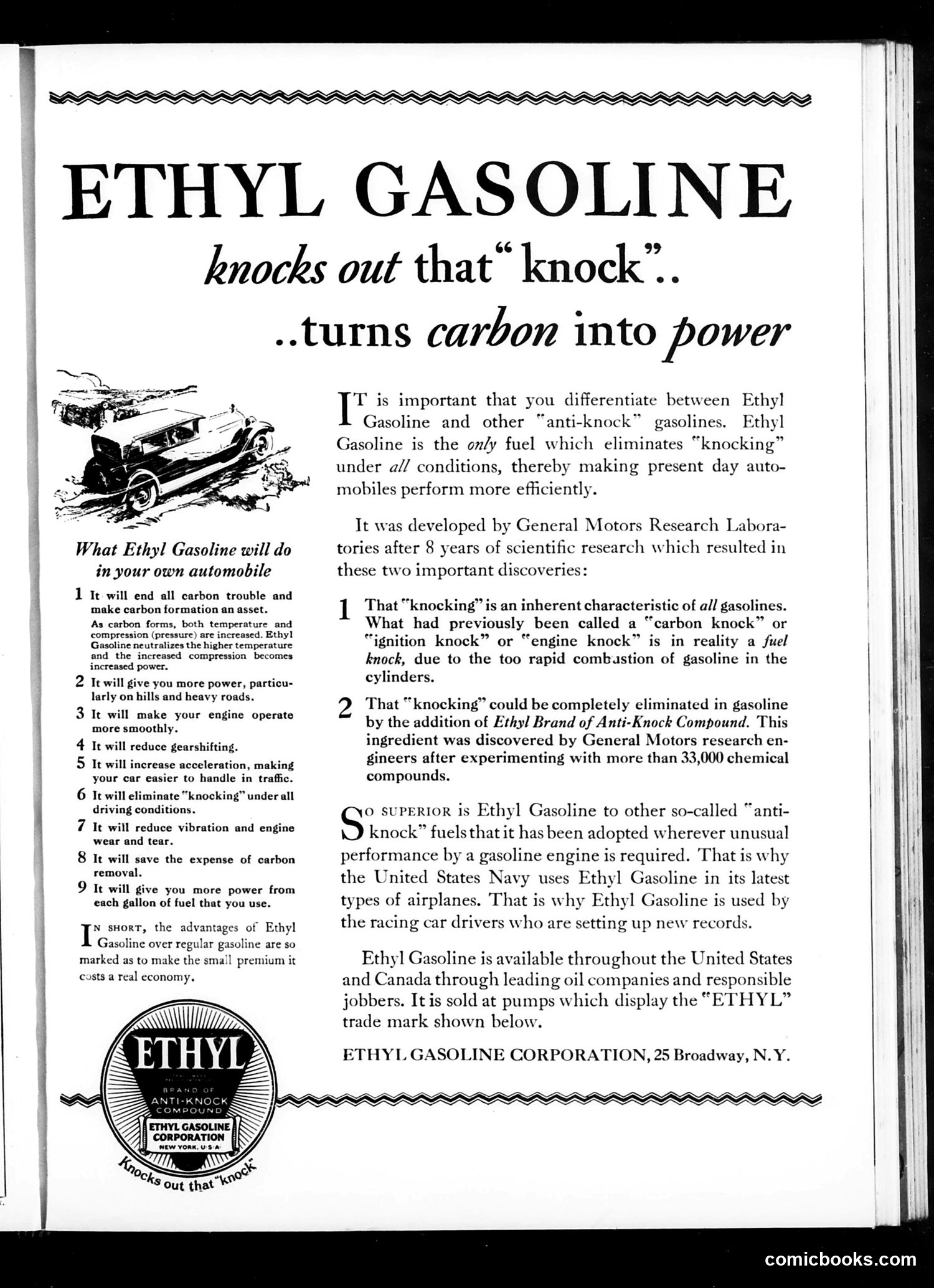
This is **not a cartoon or satire**—it's a straightforward advertisement for Ethyl Gasoline, a General Motors product. The page promotes ethyl leaded gasoline, which the company claims eliminates engine "knock" (the pinging sound caused by improper combustion). The ad lists nine supposed benefits and emphasizes that General Motors researchers developed this fuel after 8 years of research testing over 33,000 chemical compounds. The text claims ethyl gasoline's superiority by noting its adoption by the U.S. Navy and racing drivers. A small illustration shows a damaged car, presumably demonstrating the damage caused by knocking engines. **Historical context modern readers miss**: This advertisement predates awareness of leaded gasoline's severe health and environmental hazards. Ethyl (tetraethyl lead) was later revealed as a neurotoxin causing widespread lead poisoning before being phased out in the 1970s-1980s. At the time of publication, it was marketed as a scientific marvel.
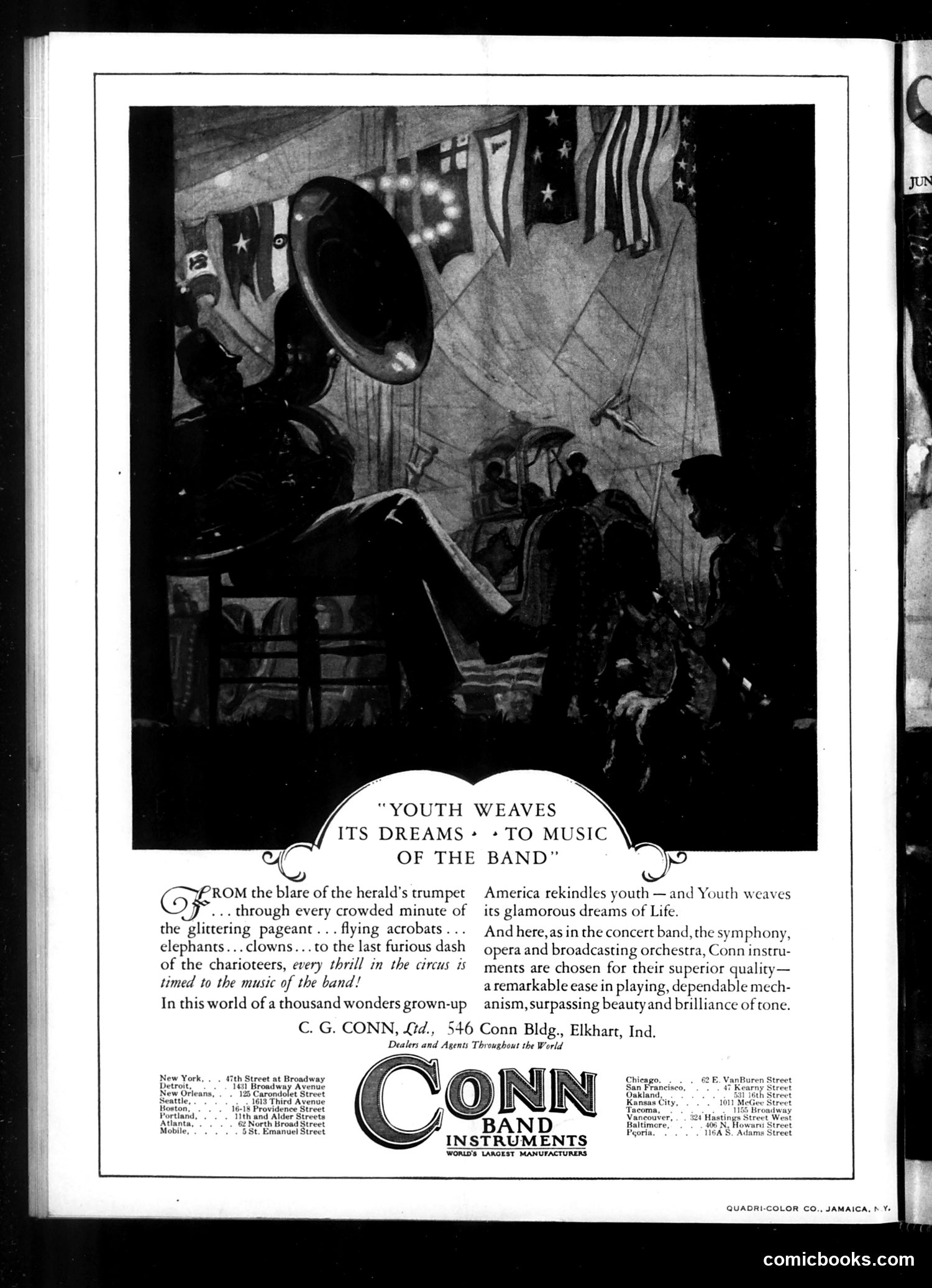
This is **a full-page advertisement**, not political satire. It's an ad for C. G. Conn Band Instruments, a major American manufacturer. The image shows a circus scene—acrobats, elephants, charioteers—all supposedly synchronized to band music. The ad's argument is that youth are drawn to spectacle and excitement ("glamorous dreams"), and that Conn instruments provide the superior quality needed for orchestras, concert bands, and broadcasting orchestras that deliver such thrilling experiences. The tagline "Youth Weaves Its Dreams...to Music of the Band" frames musical instruments as essential to capturing American youth's imagination and sense of wonder. This appears to be from the 1920s-1930s era, when band music and live orchestras were major entertainment. **The "satire" is minimal**—it's straightforward commercial messaging dressed in romantic language about American vitality and youthful aspiration.