
Judge, 1927-05-28 · page 23 of 36
Judge — May 28, 1927 — page 23: what you’re looking at
What you’re looking at
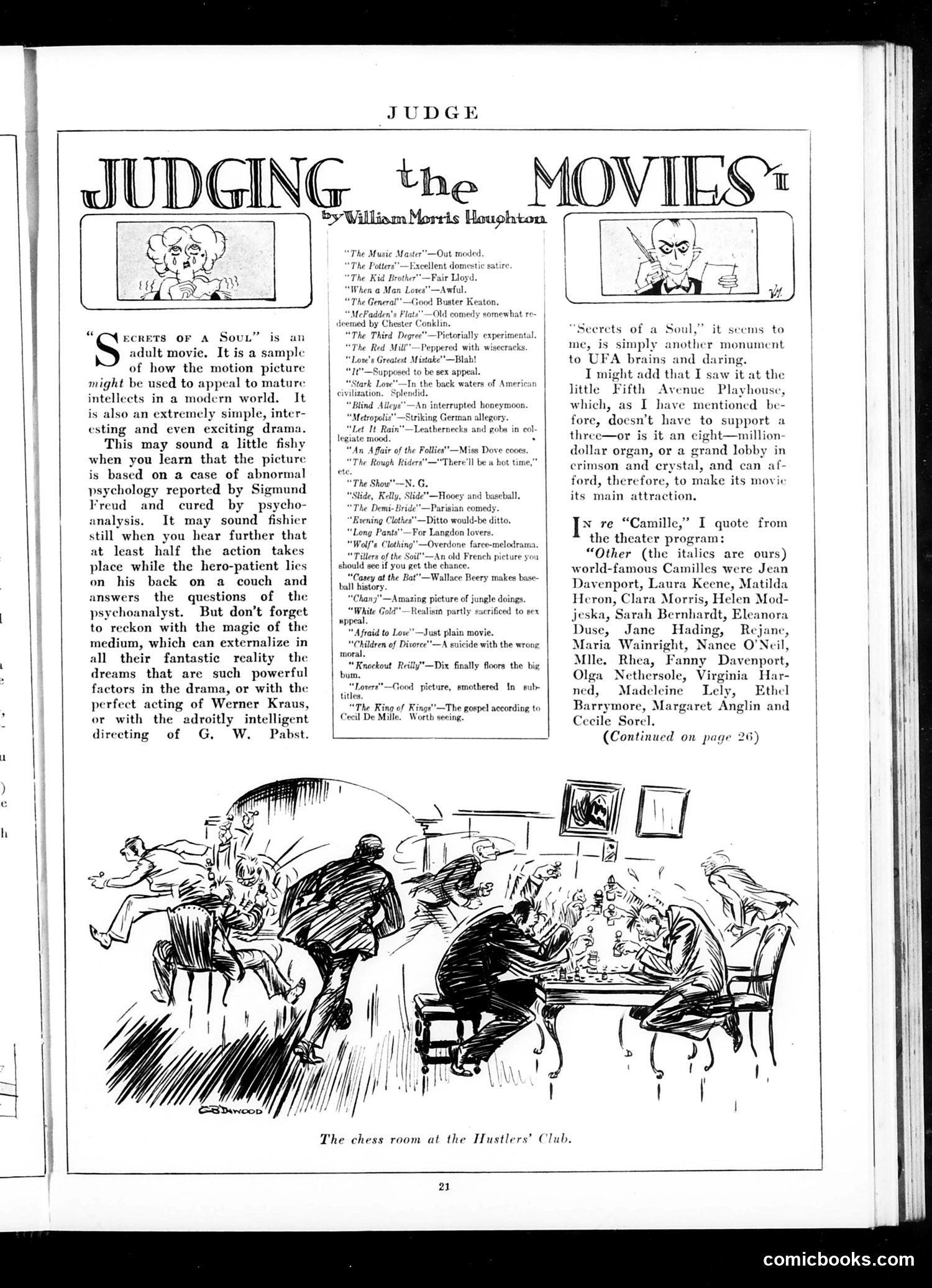
This page reviews silent films for Judge magazine's educated readership. The main cartoon depicts the "chess room at the Hustlers' Club"—a chaotic scene where well-dressed men have abandoned their game, suggesting distraction or frivolity among the leisure class. The film reviews mock contemporary cinema, praising artistic ambition ("Secrets of a Soul," based on Freudian psychology) while dismissing commercial fare as simplistic or morally questionable ("It"—supposed to be sex appeal," "When a Man Loves"—Awful"). The "Camille" commentary sarcastically lists famous actresses who've played this role, implying that casting is the movie's only distinction. Overall, Judge positions itself as arbiter of taste for sophisticated viewers, critiquing both pretentious experimental films and lowbrow entertainment aimed at mass audiences. The tone reflects 1920s cultural anxieties about cinema's influence and artistic legitimacy.
📄 Transcribed text from this page (OCR, searchable)
Machine-transcribed from the original scan — historical spelling and the odd misread are preserved.
ae | 7 a | | , | | h JUDGE JUDGING, be. HOV “ ECRETS OF A Sou” is an S adult movie. It is a sample of how the motion picture might be used to appeal to mature intellects in a modern world. It is also an extremely simple, inter- esting and even exciting drama. This may sound a little fishy when you learn that the picture sed on a case of abnormal ology reported by Sigmund Freud and cured by psycho- analysis. It may sound fishier still when you hear further that at least half the action takes place while the hero-patient lies on his back on a couch and answers the questions of the psychoanalyst. But don’t forget to reckon with the magic of the medium, which can externalize in all their fantastic reality the dreams that are such powerful factors in the drama, or with the perfect acting of Werner Kraus, or with the adroitly intelligent directing of G, W. Pabst. “The Music Master” —Out moded. The Potters —Excellent domes The Kid B —Pair Lloyd. “When a Man Loves""—Awful. “The Gener Buster Keaton. “McPadden' Old comedy somewhat re deemed by Chester Conklin. “The Third Degree" —Pictorially experiment: “The Red Mill”—Peppered with “Low's Greatest Mistake''—Blab! ““It"—Supposed to be sex appeal. “Stark Love’ civilization, “Blind “Metropolis wisecracl Splendid. An interrupted honeymoon. triking German allegory 1e mood. n Affair of the Follies" —Miss Dove coves. “The Show’ “Slide, Kelly, Ditto would-be ditto. For Langdon lovers. meloxtram: should see if you get the chance. “Casey at the Bat" — ball history. | “*Chan3!"—Amazing picture of jungle doings. “White Gold | uppeal. “Afraid to Love isin partly sacrificed to ee Just plain movie. moral. “Knockout Reilly" — od picture, smothered {n sub Cecil De Mille, Worth seeing. In the back waters of American “Let It Rain” —Leathernecks and gobs in col here'll be a hot time,” h picture you lace Beery makes base- “Children of Dirorce’'—A suicide with the wrong, ix finally floors the big “The King of Kings''—The gospel according to x The chess room at the Hustlers’ Club. Seerets of a Soul,” me, is simply another monument to UFA brains and daring. I might add that I saw it at the it seems to little Fifth Avenue Playhouse, which, as I have mentioned be- fore, doesn’t have to support a three—or is it an eight—million- dollar organ, or a grand lobby in crimson and erystal, and can af- ford, therefore, to make its movie its main attraction. wn re “Camille,” I quote from the theater program: “Other (the italics are ours) world-famous Camilles were Jean Davenport, Laura Keene, Matilda Heron, Clara Morris, Helen Mod- jeska, ‘Sarah Bernhardt, Eleanora Duse, Jane Hading, Re Maria Wainright, Nance O'Neil, Mile. Rhea, Fanny Davenport, Olga Nethersole, Virginia Har- ned, Madeleine Lely, Ethel Barrymore, Margaret Anglin and Cecile Sorel. (Continued on page 26) 21 comicbooks.com