
Judge, 1927-05-28 · page 18 of 36
Judge — May 28, 1927 — page 18: what you’re looking at
What you’re looking at
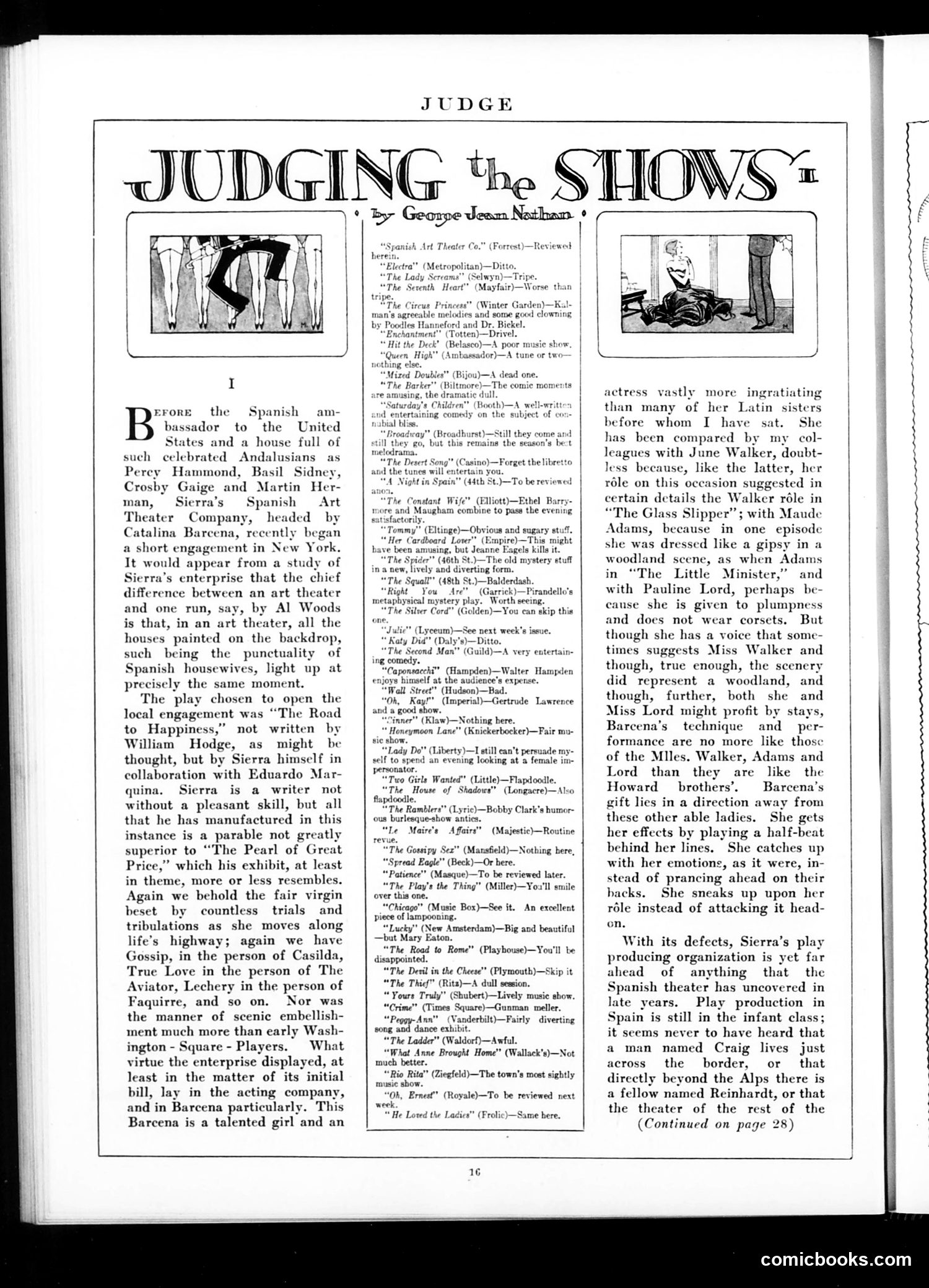
This is a theater review column by George Jean Nathan, Judge's drama critic. The main text discusses Sierra's Spanish Art Theater Company's New York engagement with the play "The Road to Happiness." **The Content:** Nathan critiques Sierra's theatrical enterprise, comparing "art theater" to commercial theater — his joke being that in Sierra's version, even the painted backdrop houses light up with Spanish punctuality (a stereotype about Spanish efficiency). The play itself is a morality parable featuring archetypal characters: a virtuous woman navigating life's trials, encountering personified concepts like Gossip, True Love, and Lechery. Nathan finds this derivative and unoriginal ("not greatly superior to 'The Pearl of Great Price'"). The column's real praise goes to **Catalina Barcena**, the lead actress, whom Nathan calls "talented" — noting her superior acting partially redeems the production's limited scenic design. The right column contains capsule reviews of current Broadway shows, rating them mostly dismissively. **The Satire:** Nathan uses condescension toward pretentious "art theater" while acknowledging good performances can salvage weak material.
📄 Transcribed text from this page (OCR, searchable)
Machine-transcribed from the original scan — historical spelling and the odd misread are preserved.
JUDGE I EFORE the Spanish an bassador to the United States and a house full of such celebrated Andalusians Percy Hammond, Basil Sidney, Crosby C nd Martin Her- man, Sierra’s Spanish Art Theater Company, headed by Catalina Barcena, recently b a short engagement in New York. It would appear from a study of Sierra’s enterprise that the chief difference between an art theater and one run, say, by Al Woods is that, in an art theater, all the houses painted on the backdrop, such being the punctuality of Spanish housewives, light up at precisely the same moment. The play chosen to open the local engagement was “The Road to Happiness,” not written by William Hodge, as might be thought, but by Sierra himself in collaboration with Eduardo Mar- quina, Sierra is a writer not without a pleasant skill, but all that he has manufactured in this instance is a parable not greatly superior to “The Pearl of Great Price,” which his exhibit, at least in theme, more or less resembles. Again we behold the fair virgin beset by countless trials and tribulations as she moves along life’s highway; again we have Gossip, in the person of Casilda, True Love in the person of The Aviator, Lechery in the person of Faquirre, and so on. Nor was the manner of scenic embellish- ment much more than early Wash- ington - Square - Players. What virtue the enterprise displayed, at least in the matter of its initial bill, lay in the acting company, and in Barcena particularly. This Barcena is a talented girl and an re NG: ‘he SHOWS” cian + | —Reviewed * (Met “The Lady S “The Seventh He (Selwyn) — Tei Winter Garden)—Kal- iodies and some good clowning ford and Dr. Bickel. Totten)—Drivel. co) —A poor 1 jor)—A tune or twe he Circus Prin show fized Doubles” (Bijou)—A dead on The Barker’’ (Biltmore)—The comic momer are amusing, the dr: dull. Saturday's Ch entertaining com y on the subje sadburst)—Still they come and this remains the season's be:t todrama. “The Desert Song" (Casino)—Forget the libretto id the tunes will entertain you. 4 Night in Spain" (44th St.)—To be reviewed “The Constant Wife” (Elliott)—Ethel Barry- d Maugham combine to pass the evening factorily. Tommy’ (Eltinge)—Obvious and sugary stu‘. “Her Cardboard Lover” (Empire)—This might been amusing, but Jeanne Esgels kills it. The Spider” (46th St.)—The old mystery stuff new, lively and diverting form. The Squall” (48th St.)—Balderdash. Right You Are” (Garrick)—Pirandello's taphysical m: play. Worth seeing. The Silser Cord" (Golden)—You can skip this ‘Julie (Lyceum)—See next week's issue. Katy Did" (Daly’s)—Ditto. “The Second Man" (Guild)—A very entertain- ing comedy. ““Caponsacchi” (Hampden)—Walter Hampden enjoys himself at the audience's expense. Wall Street” (Hudson)—Bad. ih, Kay!" (Imperial)—Gertrude Lawrence and a good show. "inner" (Klaw)—Nothing here. Honeymoon Lane’ (Knickerbocker)—Fair mu- sic show. “Lady Do" (Liber self to spend an ev personator. “Tuo Girls Wanted” (Little)—Flapdoodle. “The House of Shadows” (Longacre)—Also flapdoodle. “The Ramblers” (Lyric)—Bobby Clark's humor- ous burlesque-thow antics. “Le Maire's Affairs” }—I still can't persuade my- ning looking at a female im- (Majestic)\—Routine The Gossipy Sex” (Mansfield)—Nothing here, “Spread Eagle’ (Beck)—Or here. “Patience” (Masque)—To be reviewed later. “The Play's the Thing” (Miller)—You'll stuile over this one. “Chicago” (Music Box)—See it. An excellent piece of lampooning. “Lucky (New Amsterdam)—Big and beautiful —but Mary Eaton. “The Road to Rome” (Playbouse)—You'll be disappointed. “The Deril in the Cheese” (Plymouth)—Skip it “The Thief” (Ritz)—A dull session. “Yours Truly"” (Shubert)—Lively music show. “Crime” (Times Square)—Gunman meller. “Peggy-Ann" (Vanderbilt)—Fairly diverting song and dance exhibit. “The Ladder” (Waldorf)—Awful. “What Anne Brought Home” (Wallack's)}—Not much better. “Rio Rita” (Ziegfeld)—The town's most sightly music show. “Oh, Ernest” week “ He Loved the Ladies” (Frolic)—Same here. (Royale)—To be reviewed next actress vastly more ingratiating than many of her Latin sisters before whom I have sat. She has been compared by my col- leagues with June Walker, doubt- less because, like the latter, her role on this occasion suggested in certain details the Walker réle in “The Glass Slipper”; with Maude Adams, because in one episode she was dressed like a gipsy in a woodland scene, as when Adams in “The Little Minister,” and with Pauline Lord, perhaps be- ause she is given to plumpness and does not wear corsets. But though she has a voice that some- times suggests Miss Walker and though, true enough, the scenery did represent a woodland, and though, further, both she and Miss Lord might profit by stays, Barcen technique and per- formance are no more like those of the Miles. Walker, Adams and Lord than they are like the Howard _ brothe Barcena’s gift lies in a direction away from these other able lad he gets her effects by playing a half-beat behind her lines. She catches up with her emotions, as it were, in- stead of prancing ahead on their backs. She sneaks up upon her role instead of attacking it head- on, With its defects, Sierra’s play producing organization is yet far ahead of anything that the Spanish theater has uncovered in late years. Play production in Spain is still in the infant class; it seems never to have heard that a man named Craig lives just across the border, or that directly beyond the Alps there is a fellow named Reinhardt, or that the theater of the rest of the (Continued on page 28) 16 comicbooks.com