
Judge, 1927-05-28 · page 9 of 36
Judge — May 28, 1927 — page 9: what you’re looking at
What you’re looking at
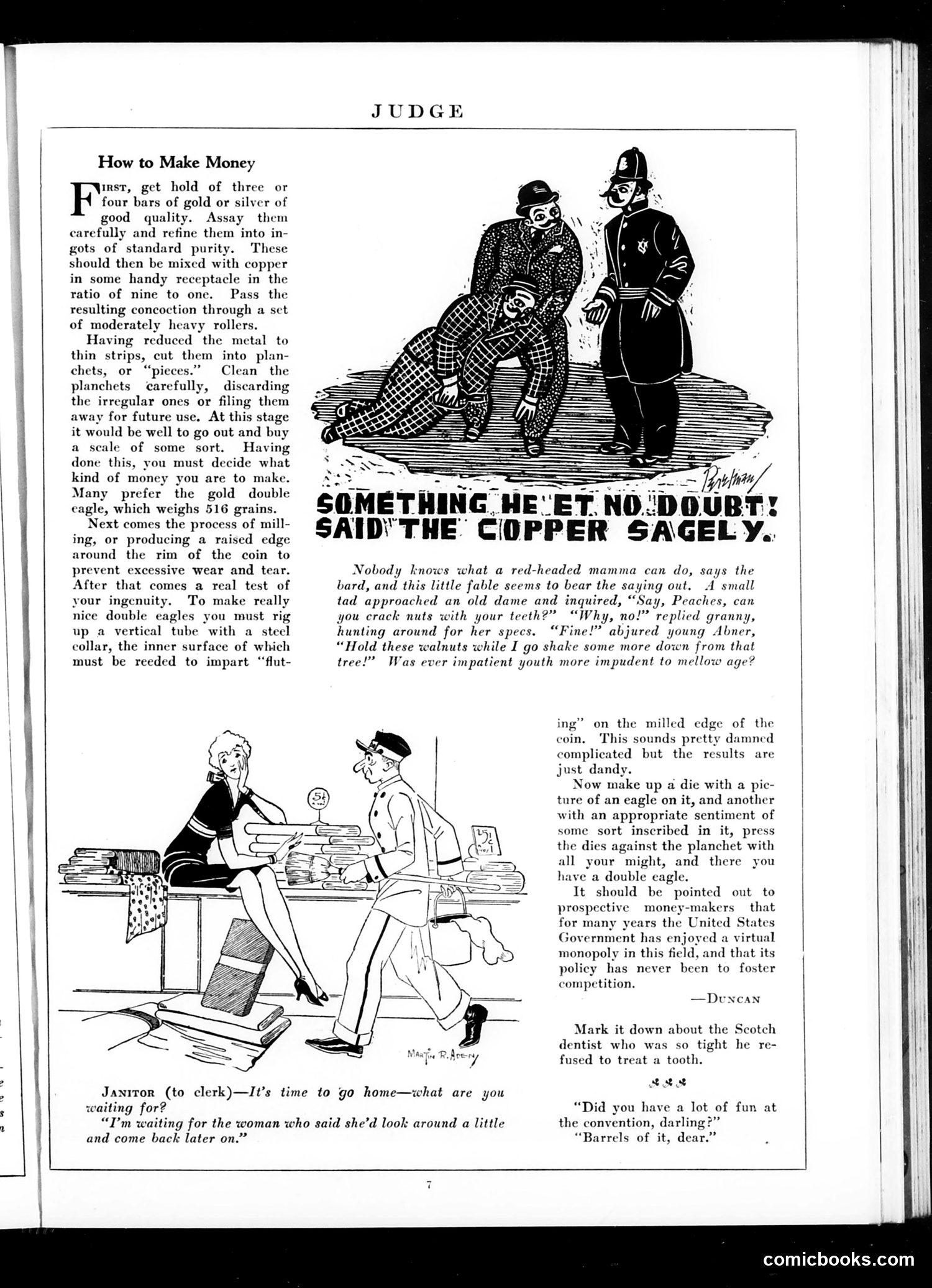
This page satirizes **counterfeiting currency**. The main article humorously presents detailed instructions for making counterfeit coins (specifically double eagles), written as if it were legitimate how-to advice. The joke culminates in a deadpan warning: the U.S. Government has a "virtual monopoly" in coin-making and "has never been to foster competition"—meaning counterfeiting is illegal and prosecuted. The accompanying illustrations show criminals conducting counterfeiting operations. The satirical point: by presenting counterfeiting in matter-of-fact instructional language, Judge mocks both the criminals who attempt it and perhaps critiques economic inequality that might drive such crime. The page also includes unrelated humorous anecdotes (a child's impertinent walnut-cracking request to an elderly woman, a stingy Scottish dentist), which were typical filler content in Judge magazine.
📄 Transcribed text from this page (OCR, searchable)
Machine-transcribed from the original scan — historical spelling and the odd misread are preserved.
—— en aA it san JUDGE How to Make Money inst, get hold of three or four bars of gold or silver of good quality. Assay them carefully and refine them into in- gots of standard purity. Th should then be mixed with copper in some handy receptacle in the ratio of nine to one. Pass the resulting concoction through a sect of moderately heavy rollers. Having reduced the metal to thin strips, cut them into plan- chets, or “pieces. planchets carefully, ca the irregular ones or filing them away for future use. At this stage it would be well to go out and buy a scale of some sort. Having done this, you must decide what kind of money you are to make. Many prefer the gold double eagle, which weighs 516 grains. Next comes the process of mill- ing, or producing a raised edge around the rim of the coin to prevent excessive wear and tear. After that comes a real test of your ingenuity. To make really nice double eagles you must rig up a vertical tube with a steel collar, the inner surface of which must be reeded to impart “flut- ————— ~ Dan ME’ 1G HE ET. NO: DOUBT: SAID" THE CIOOPPER SAGELY.. Nobody knows what a red-headed mamma can do, says the bard, and this little fable seems to bear the saying out. A small | tad approached an old dame and inquired, “Say, Peaches, can you crack nuts with your teeth?” “Why, no!” replied granny, hunting around for her specs. “Fine!” abjured young Abner, “Hold these walnuts while I go shake some more down from that tree!” Was ever impatient youth more impudent to mellow age? ing” on the milled edge of the coin, This sounds pretty damned complicated but the results are just dandy. Now make up a die with a pic- ture of an eagle on it, and another with an appropriate sentiment of — | some sort inscribed in it, press | the dies against the planchet with | all your might, and there you | have a double eagle. | It should be pointed out to prospective money-makers — that for many years the United States Government has enjoyed a virtual monopoly in this field, and that its policy has never been to foster competition. —Dvuncan Janitor (to clerk)—It’s time to go home—what are you waiting for? “I’m waiting for the woman who said she’d look around a little the convention, darling?” and come back later on.” Mark it down about the Scotch dentist who was so tight he re- fused to treat a tooth. 42s “Did you have a lot of fun at “Barrels of it, dear.” comicbooks.com