
A complete issue · 36 pages · 1927
Judge — April 30, 1927
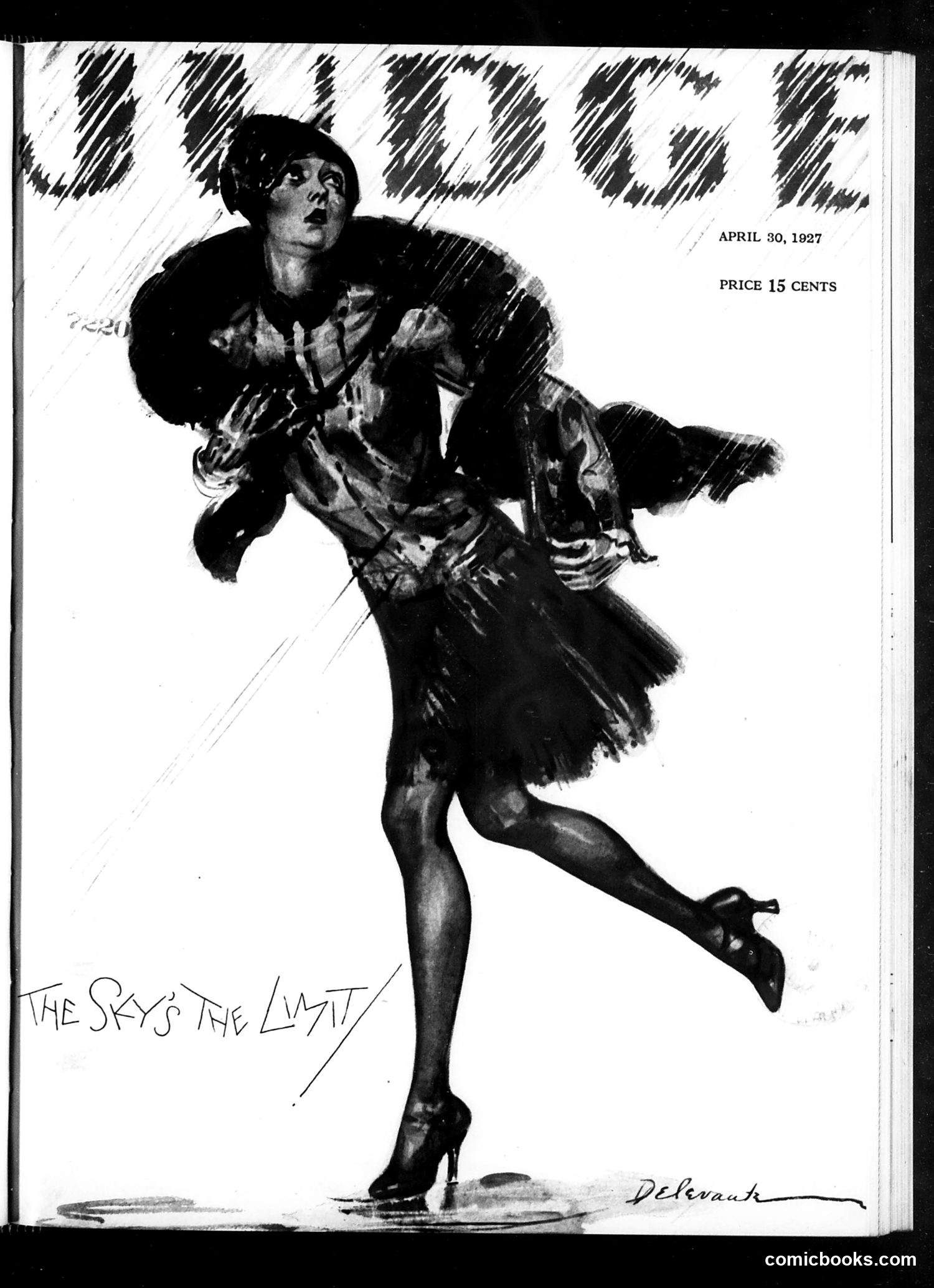
This is a Judge magazine cover from April 30, 1927, priced at 15 cents. The illustration shows a stylishly dressed woman in 1920s attire (cloche hat, fur stole, short skirt, heeled shoes) in a dynamic pose, titled "The Sky's the Limit." The image appears to celebrate the liberated "flapper" lifestyle and optimism of the Jazz Age—a period of economic prosperity and social freedom for women. The caption and dynamic composition suggest themes of boundless possibility and ambition. The signature reads "Delvaude." The satirical intent likely comments on either the era's exuberance and excess, or celebrates women's expanded social freedoms during the 1920s. Without additional text content, the precise satirical target remains unclear.
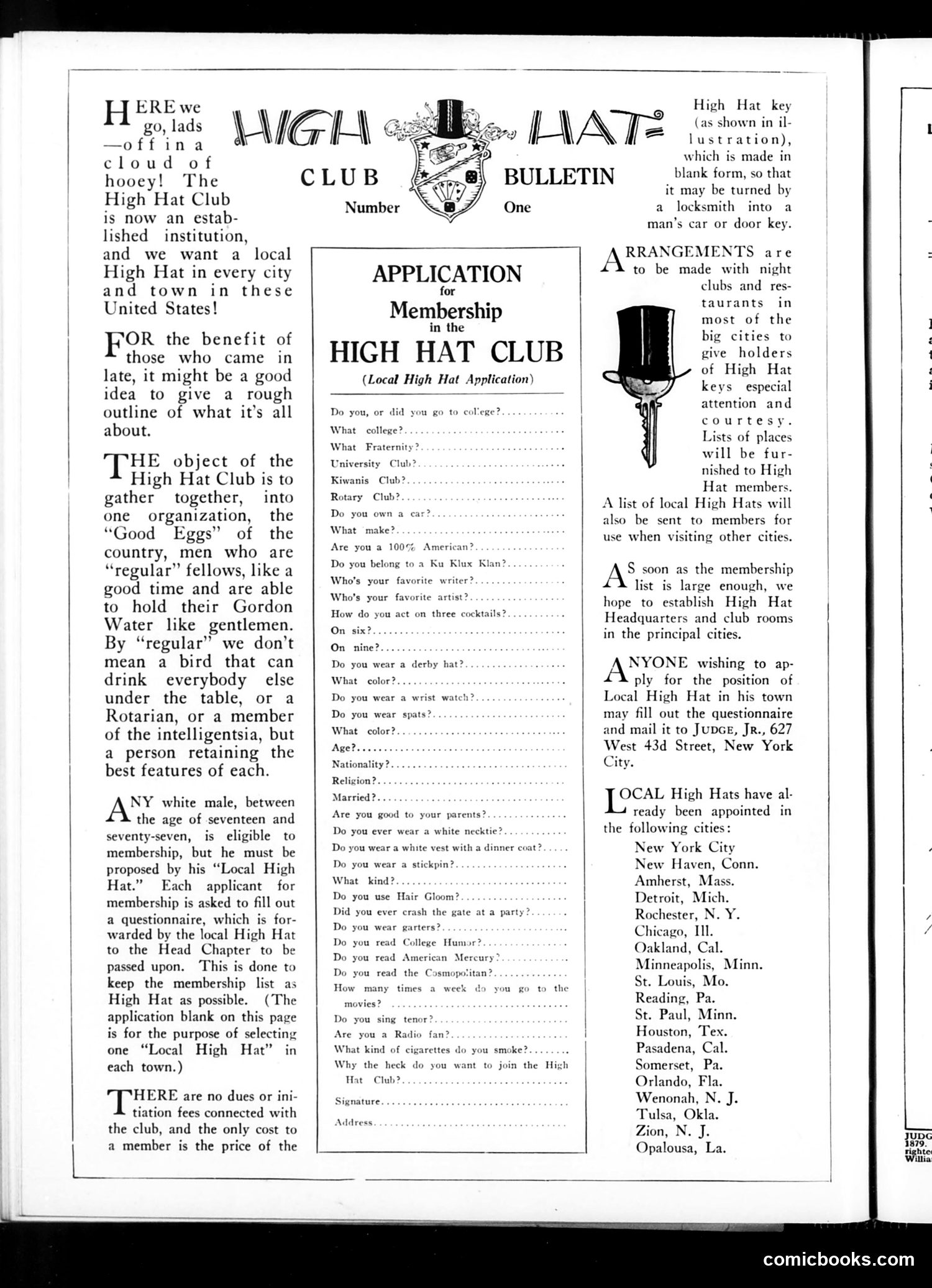
This page is primarily **advertising and membership information** for the "High Hat Club," a social organization for gentlemen. The text explains the club's purpose: gathering "regular" fellows who enjoy socializing and holding their liquor like gentlemen. The satirical elements are subtle: the club targets white males aged 17-70, emphasizing they must be proposed by existing members and pass a questionnaire. The humor lies in the pretentious framing of what appears to be a casual drinking club as an exclusive, refined institution. The membership application form lists absurd questions about personal habits, tastes, and background—poking gentle fun at fraternal organization gatekeeping and the aspirational gentility of the era's social clubs. The page lists "Local High Hats" already appointed in various American cities, suggesting this is a nationwide satirical venture rather than a serious establishment.
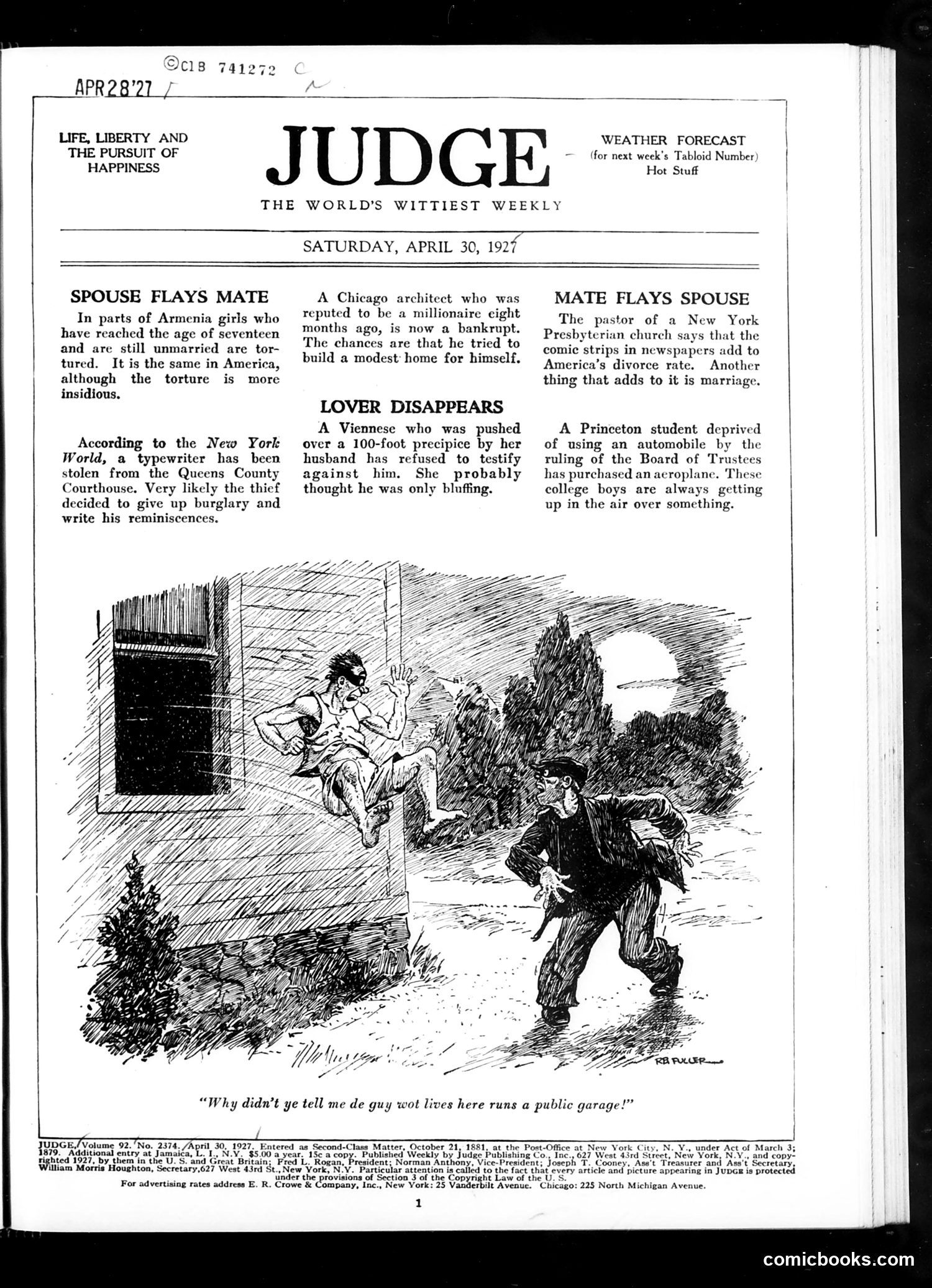
The main cartoon depicts a man discovering another man with a woman in/near a house, with the caption: "Why didn't ye tell me de guy wot lives here runs a public garage!" The joke satirizes infidelity and mistaken identity. The implied scenario is that a husband has discovered his wife with another man, but the intruder claims he thought the house was a public garage—a deliberately implausible excuse suggesting the man was caught red-handed and is making absurd excuses. The surrounding text items mock marital discord ("Spouse Flays Mate," "Mate Flays Spouse"), divorce trends, and relationship problems affecting America. The magazine positions itself as "The World's Wittiest Weekly," using humor to comment on contemporary social issues, particularly marriage instability and infidelity during the Jazz Age.
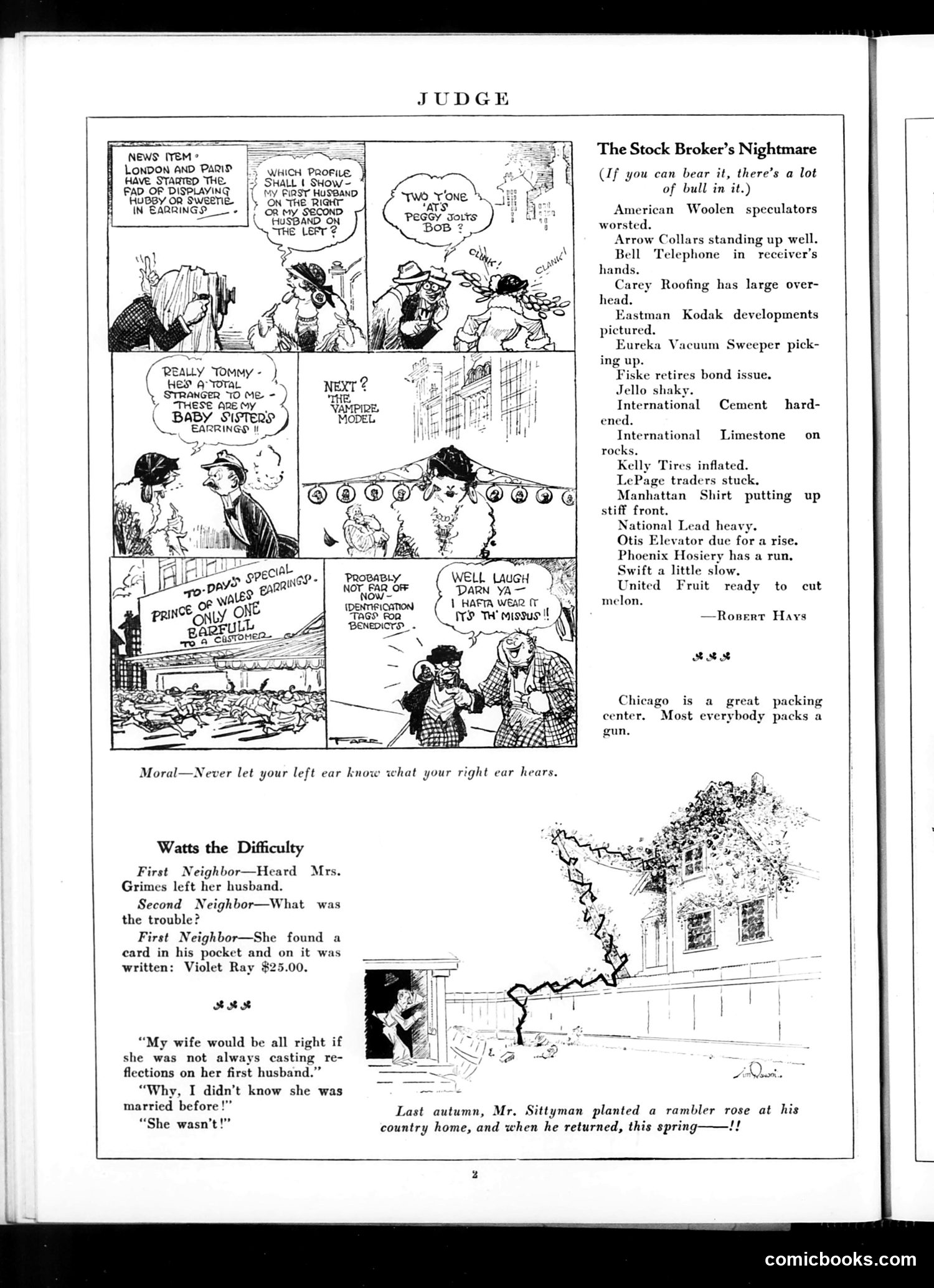
This page contains three distinct pieces of satirical content: 1. **"The Stock Broker's Nightmare"** (top): A comic strip mocking stock market speculators during what appears to be market volatility. The humor relies on rapid-fire financial jargon and the chaos of trading—"American Woolen speculators worsted," "Bell Telephone in receiver's hands," etc. The moral warns about compartmentalizing bad news. 2. **"Watts the Difficulty"** (bottom left): A brief joke about marital infidelity, where a wife discovers her husband's affair through a card marked "Violet Ray $25.00" in his pocket—apparently a euphemism or code. 3. **"Last autumn, Mr. Sillyman planted a rambler rose..."** (bottom right): An illustration showing a climbing rose vine that has grown wildly up a house wall, creating an absurd architectural problem—visual satire about uncontrolled growth or consequences. The content targets financial speculation, marital troubles, and domestic misadventure typical of Judge's humor.
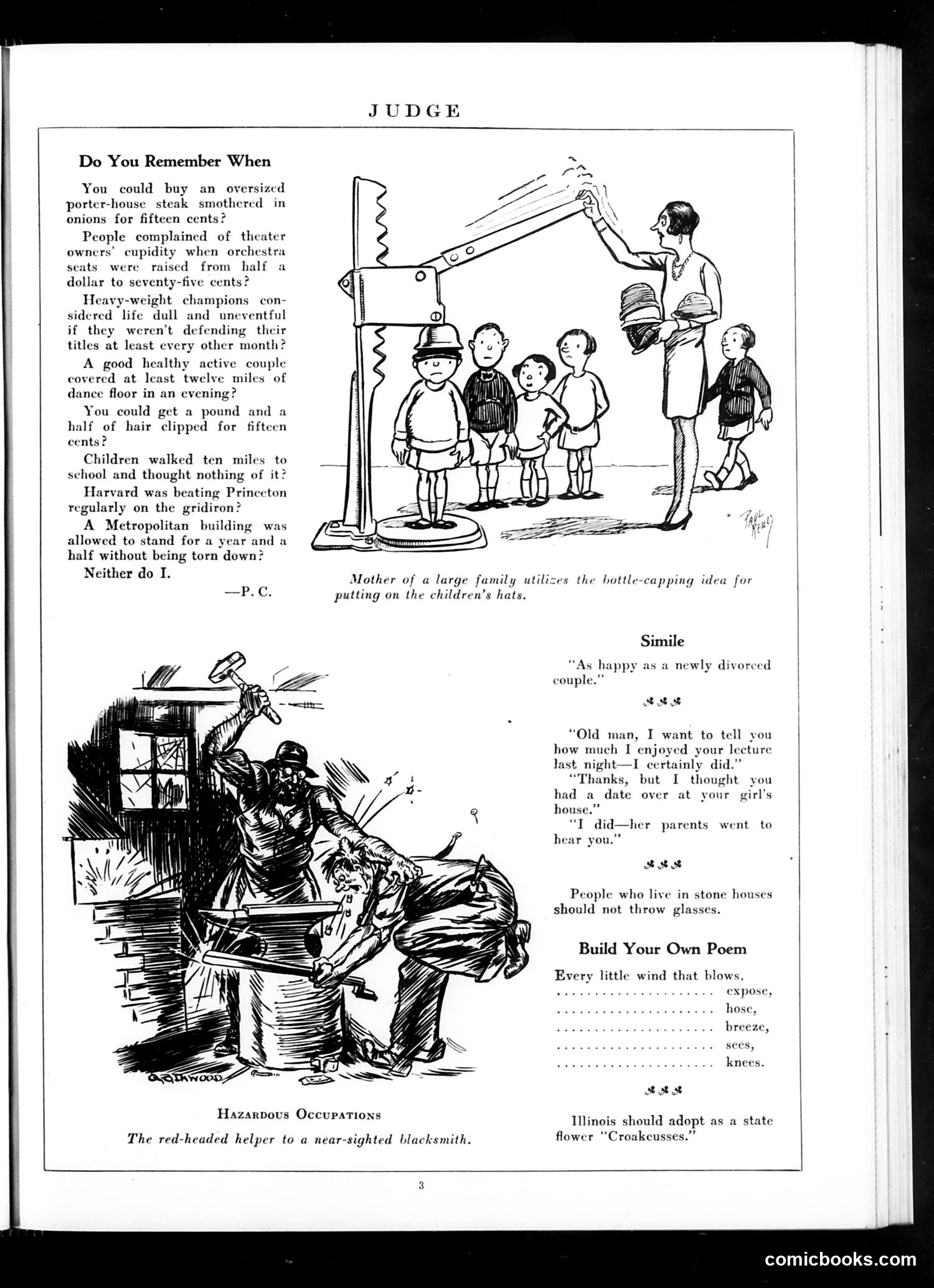
This page contains nostalgic humor and social commentary typical of Judge's satirical format. **"Do You Remember When"** contrasts past frugality with present extravagance—cheaper entertainment, affordable haircuts, and children's resilience (walking miles to school). The tone criticizes modern consumerism. **"Mother of a large family"** cartoon depicts a practical solution: using a pulley system to simultaneously place hats on multiple children—satirizing both large families and the labor-intensive nature of childcare. **"Hazardous Occupations"** shows a blacksmith and his red-headed assistant in a dangerous situation, likely playing on physical comedy and workplace safety concerns. The "Build Your Own Poem" and "Simile" sections offer light humor about divorce and aphorisms. Overall, the page reflects early 20th-century anxieties about changing social values and family life.
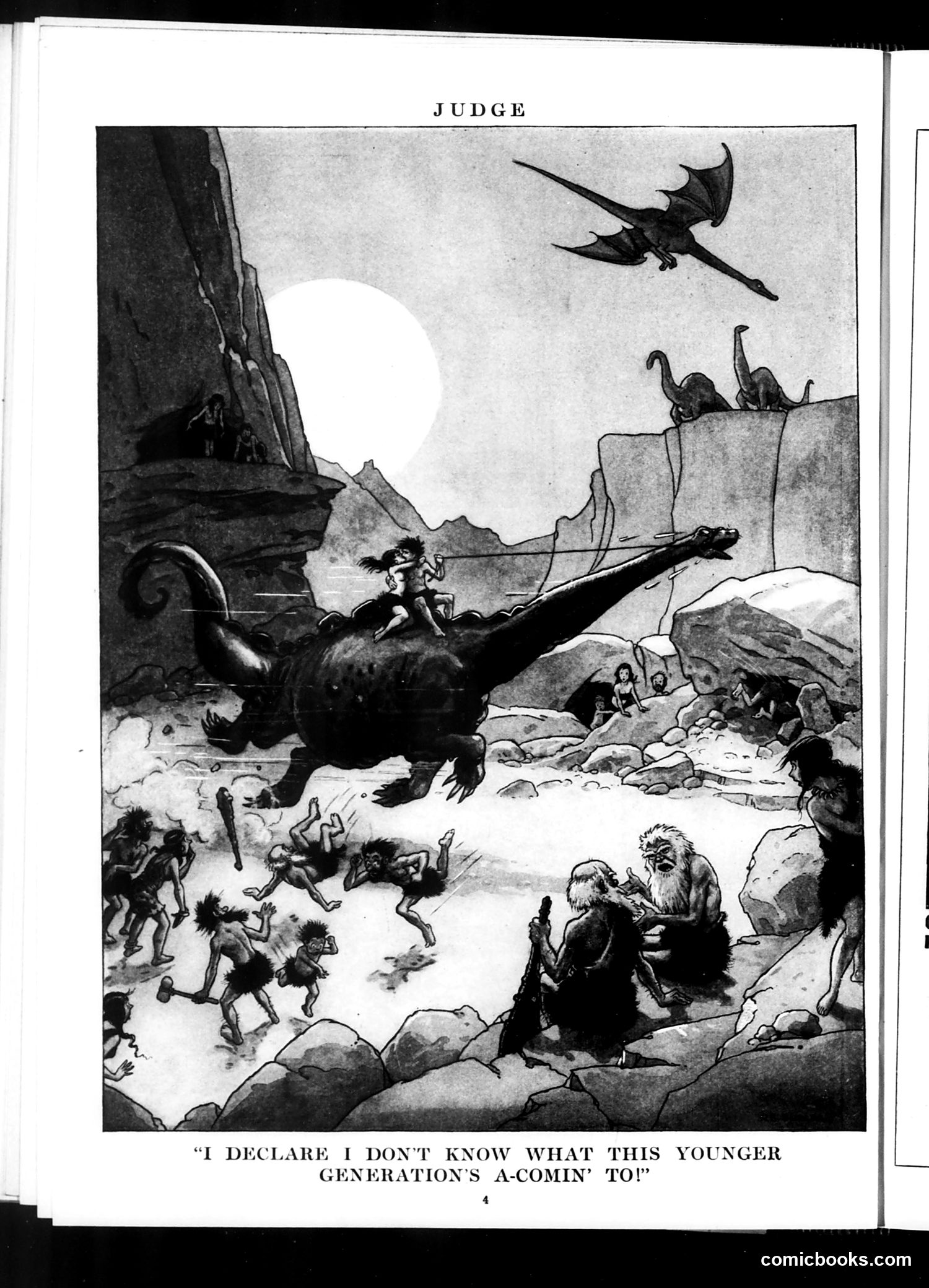
This satirical cartoon depicts a fantastical underworld scene with demons, dinosaurs, and mythological creatures. An elderly bearded figure (likely representing an older generation or traditionalist) sits astride a large dinosaur, pointing accusingly at younger figures below while declaring bewilderment at modern youth culture: "I declare I don't know what this younger generation's a-comin' to!" The satire critiques generational disconnect—specifically, an older authority figure's incomprehension and disapproval of younger people's behavior and values. The surreal, chaotic setting emphasizes the elder's sense that the modern world is alien and incomprehensible. This reflects a common Judge theme: mocking older generations' tendency to condemn youth as morally or culturally deficient, even as they fail to understand contemporary life. The cartoon's fantastical imagery suggests the generational gap feels like a descent into chaos or the underworld.
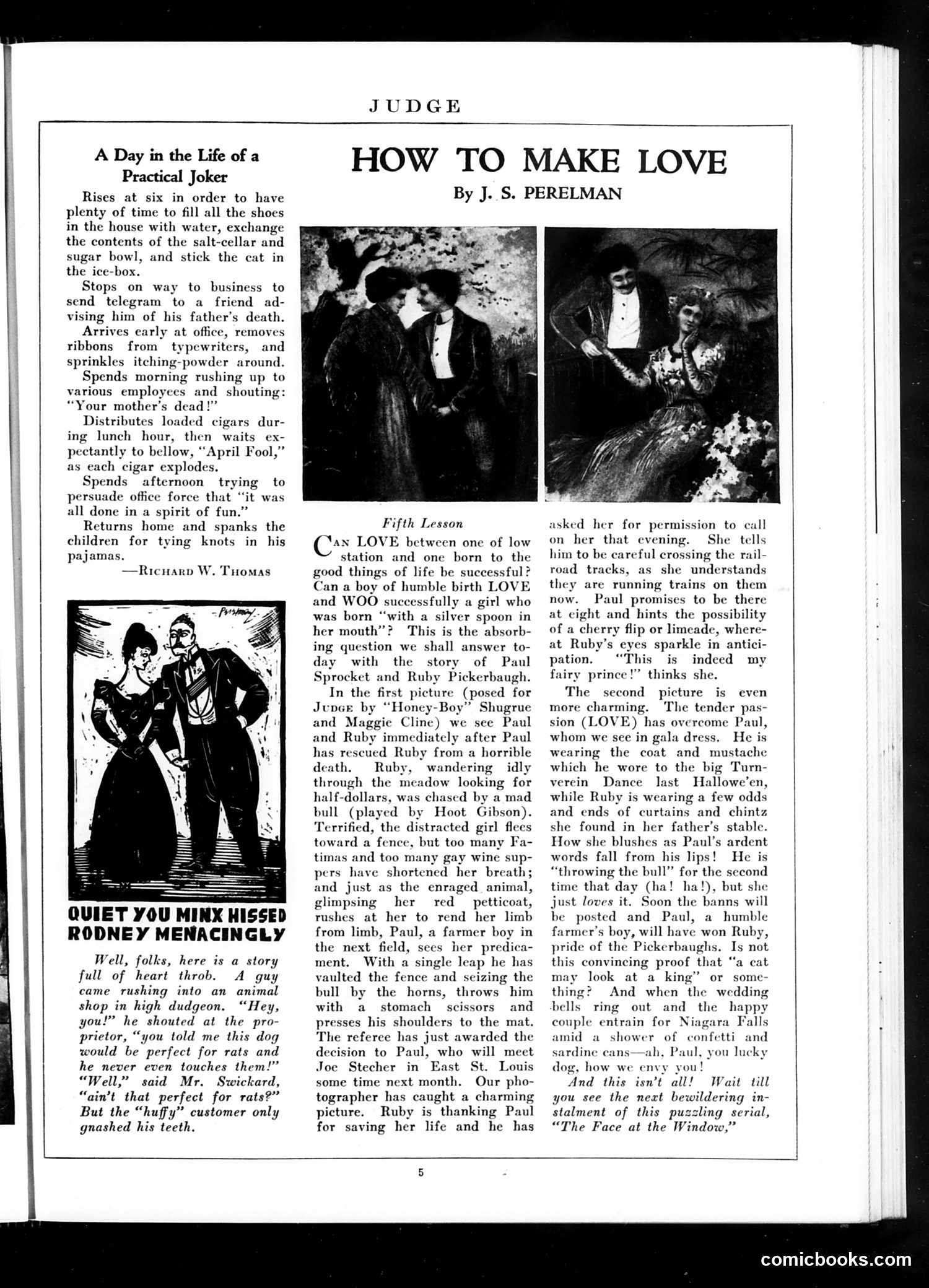
This page contains two distinct items: **Left side:** "A Day in the Life of a Practical Joker" by Richard W. Thomas, a humorous article describing an office prankster's activities (filling shoes with water, putting itching powder around, sending false death telegrams). The accompanying cartoon shows two men and emphasizes workplace pranks. **Main content:** "How to Make Love" by J.S. Perelman, the fifth lesson in a serialized romantic comedy. The narrative follows Paul Sprocket and Ruby Pickerbaugh, describing their budding romance through anecdotes—a bull chase, a Halloween dance, and other courtship moments. The story uses humor to satirize working-class romance conventions of the era. Both pieces reflect Judge magazine's typical light satirical approach to everyday American life and social interactions, with no apparent political commentary.
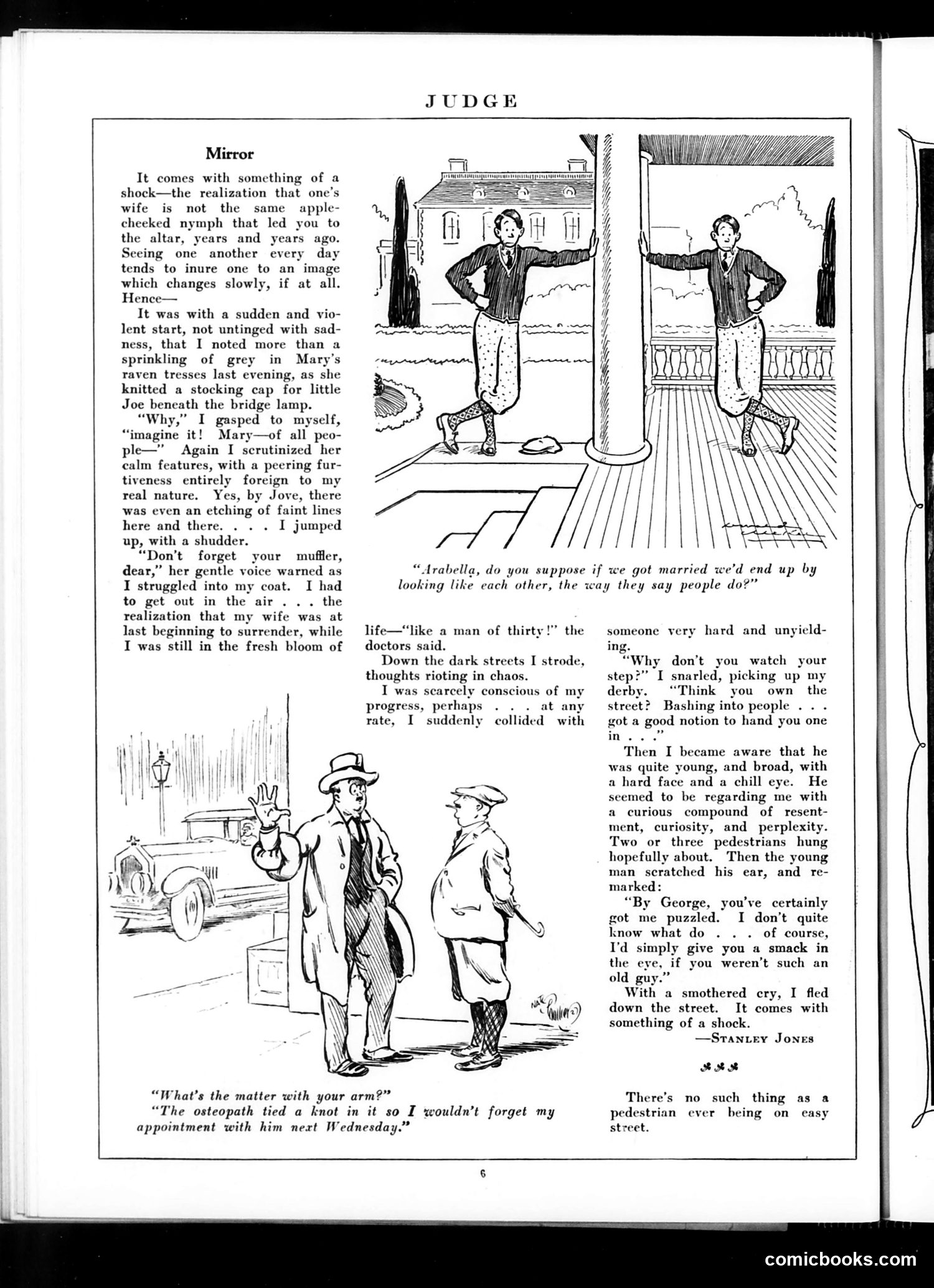
This satirical piece explores male vanity and the shock of aging. The narrator notices his wife Mary developing gray hair and wrinkles, triggering an existential crisis. While she's visibly aging, he still imagines himself in his prime—"like a man of thirty," as doctors supposedly said. His agitation leads him to physically collide with a young man on the street. Rather than fight back, the youth expresses puzzlement, calling him "an old guy"—the ultimate insult. The narrator flees in humiliation. The joke targets male self-delusion: he expected his wife alone to age while he remained youthful. The street collision serves as a harsh mirror reflecting reality. The accompanying cartoon about a couple worried they'll resemble each other after marriage reinforces the theme: time and marriage inevitably change us all, regardless of vanity. The satire mocks masculine denial about aging and mortality.
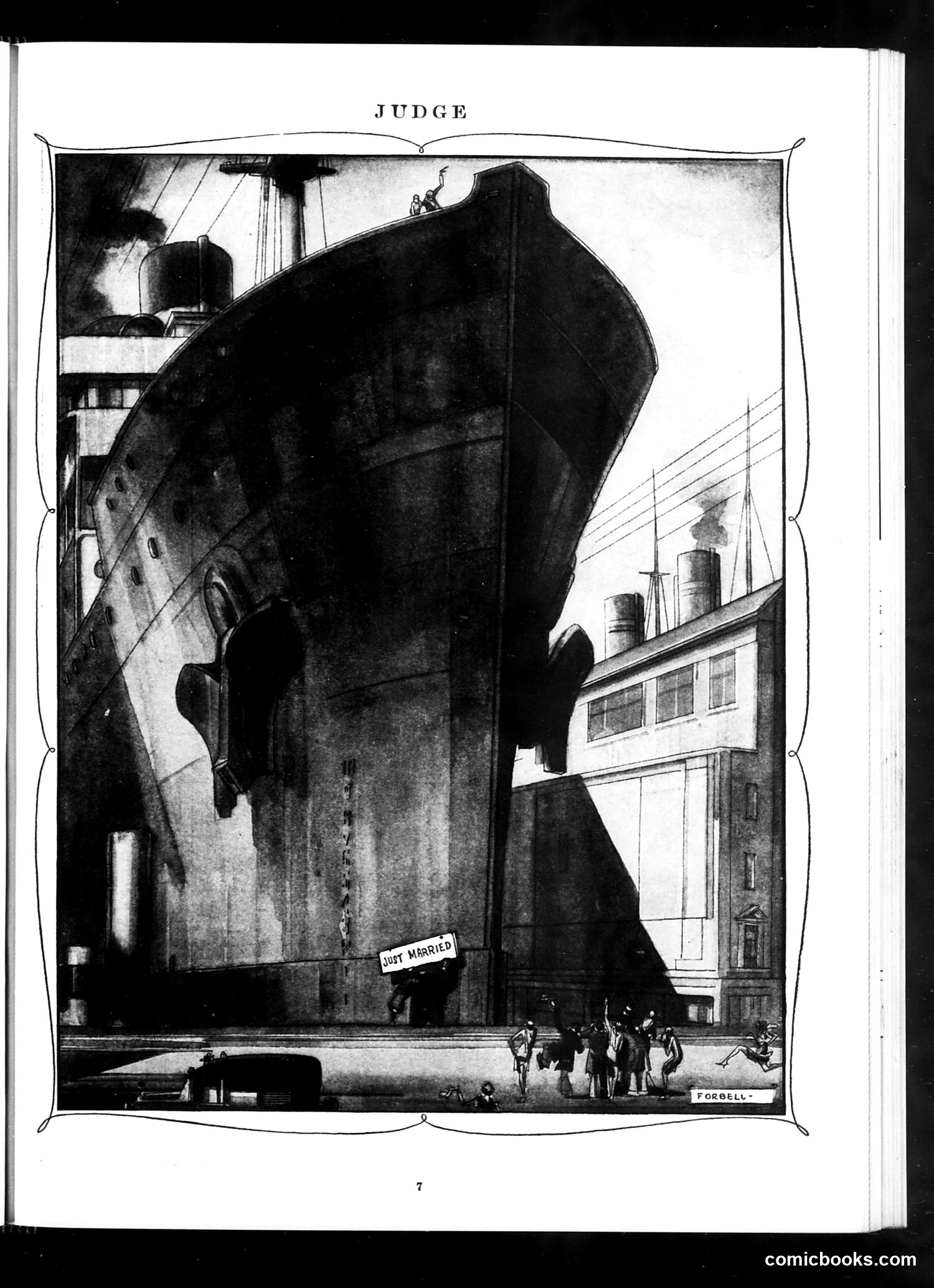
This page features a dramatic illustration titled "JUDGE" depicting a massive ship dwarfing surrounding buildings and dock workers. The ship bears a nameplate reading "JUST MARRIED," and the artist's signature reads "FORBELL." The cartoon appears to satirize a notable maritime marriage or ship launching, likely from the early 20th century. The exaggerated scale emphasizes the ship's enormity compared to human figures and structures below—a visual joke about industrial might or possibly critiquing something perceived as disproportionately large or ostentatious. Without additional context about the publication date, the specific ship, or contemporary news events, the precise satirical target remains unclear, though the "just married" label suggests commentary on either a notable ship's launching or possibly a metaphorical business merger.
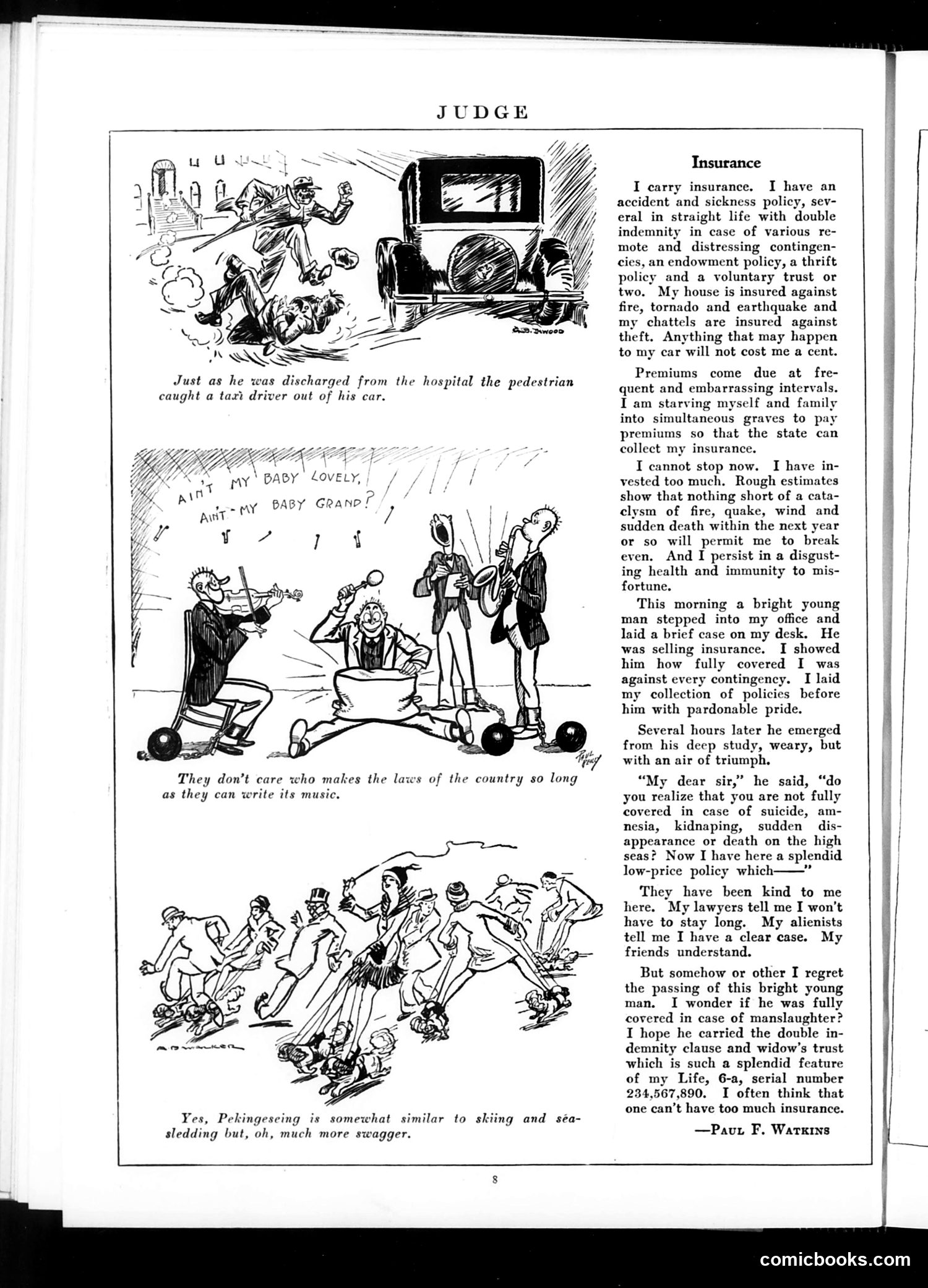
This page contains three satirical cartoons and an essay on insurance by Paul F. Watkins. **The cartoons mock:** 1. **Taxi violence**: A pedestrian, freshly discharged from a hospital, immediately encounters a reckless taxi driver—suggesting urban transportation hazards were frequent and inescapable. 2. **Musicians' political influence**: Figures playing instruments while lawmakers are ignored, satirizing the outsized cultural/entertainment industry power relative to actual governance. 3. **"Pekingese-ing"**: Wealthy people engaging in fashionable leisure activities (skiing, sledding), mocking upper-class pretension and invented status symbols. **The insurance essay** is dark satire: Watkins describes purchasing layer upon layer of insurance policies until he's impoverished his family to pay premiums—yet remains frustratingly healthy and accident-free, unable to "break even." When an insurance salesman discovers gaps in his coverage, Watkins implies (darkly) he may harm the salesman. The piece mocks both insurance industry exploitation and the obsessive risk-aversion of the wealthy. The overall tone critiques early 20th-century urban dangers, cultural elitism, and aggressive insurance marketing.
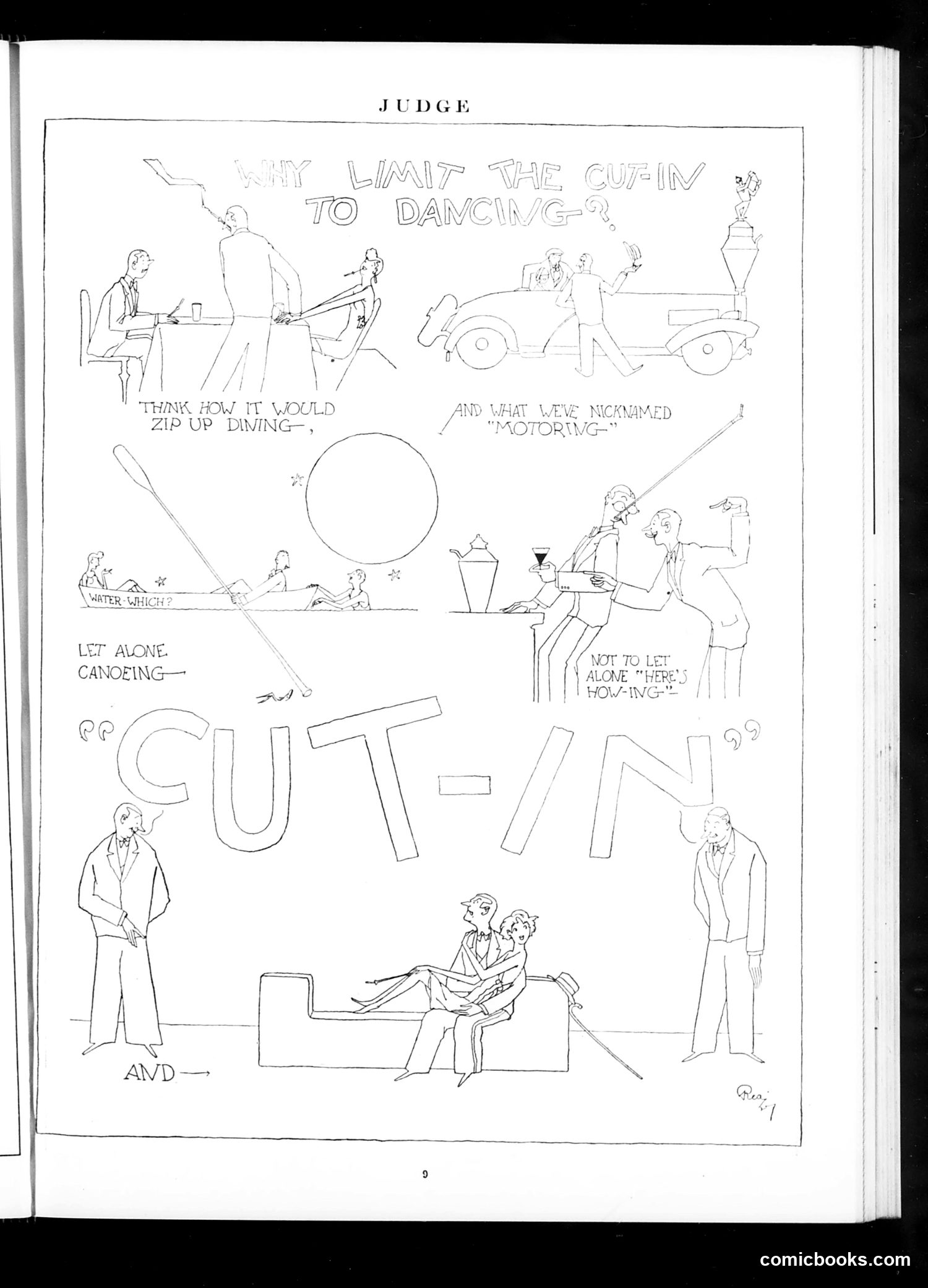
This cartoon satirizes the era's moral panic about modern leisure activities and their perceived dangers to proper social conduct. The title "Why Limit the Curfew to Dancing?" sarcastically proposes extending curfew restrictions beyond dancing to other recreational activities: motoring, diving, and canoeing. The cartoon shows disapproving authority figures (appearing to be judges or moralists) flanking scenes of young people enjoying these activities. The satire critiques overprotective regulation—suggesting that if society fears dancing corrupts youth, shouldn't they also ban cars, water sports, and other pastimes? The phrase "cut-in" refers to a dancing move considered scandalous at the time. The cartoon mocks the inconsistency of selective moral crusades against youth recreation, advocating either regulating everything or allowing more freedom.
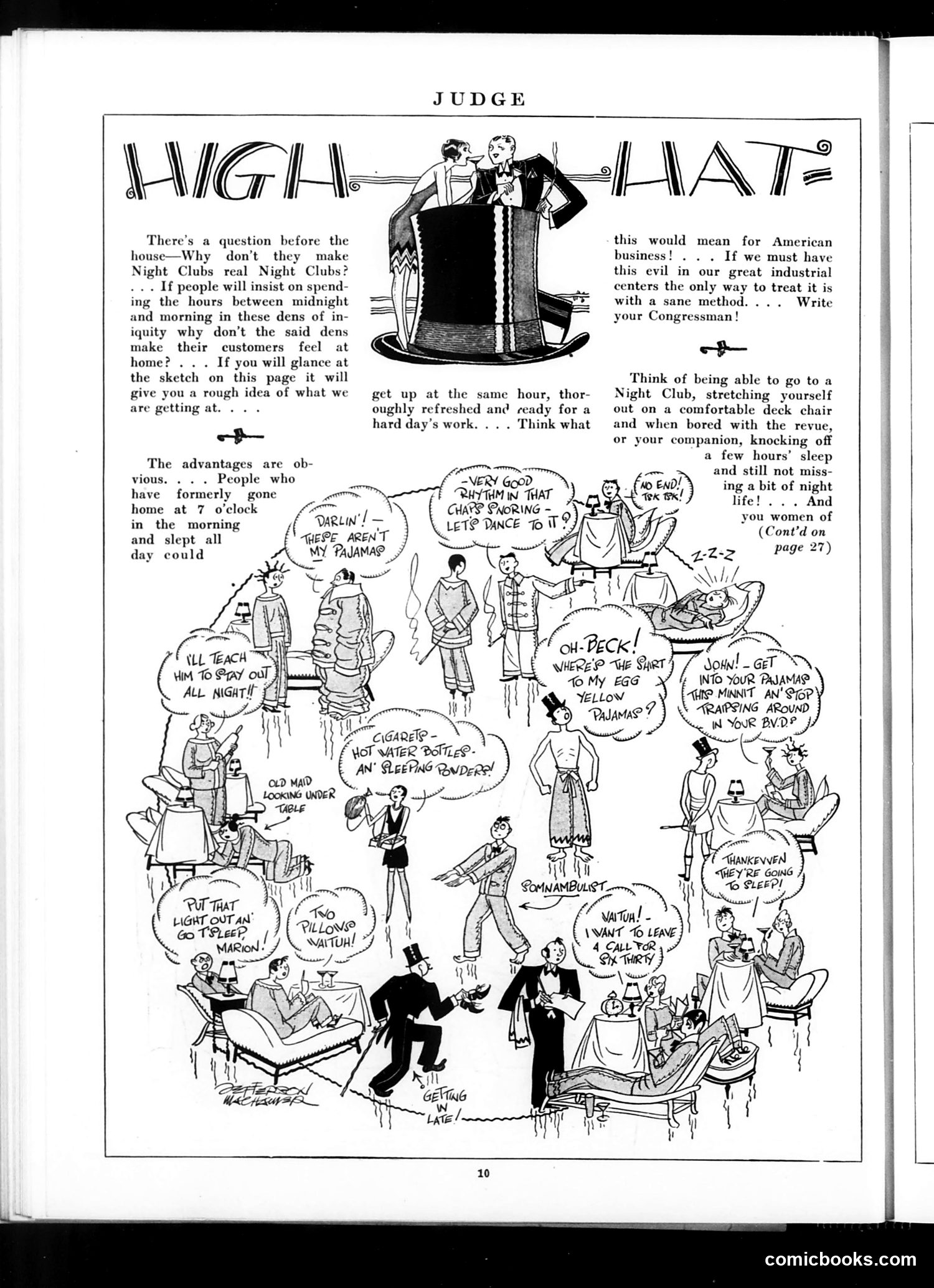
This page satirizes the emerging "Night Club" culture of the 1920s-30s. The central cartoon depicts the chaos and dysfunction of people trying to sleep during daytime after staying out all night at clubs—a lifestyle pitched as modern and desirable. The satire operates on multiple levels: the accompanying text mockingly suggests night clubs should be made "comfortable" for exhausted patrons (deck chairs, beds), implying the lifestyle is absurd. The dialogue bubbles show families in disarray—children kept awake, spouses confused about schedules, people sleeping in pajamas at odd hours. The headline "High-Hate" suggests the author's contempt for this trend. The political angle appears in the right column, which suggests writing congressmen to regulate these "dens of iniquity" as industrial evils. The joke: Judge is sarcastically promoting night-club comfort while actually mocking both the establishments and the people disrupting normal family life by adopting nocturnal schedules.
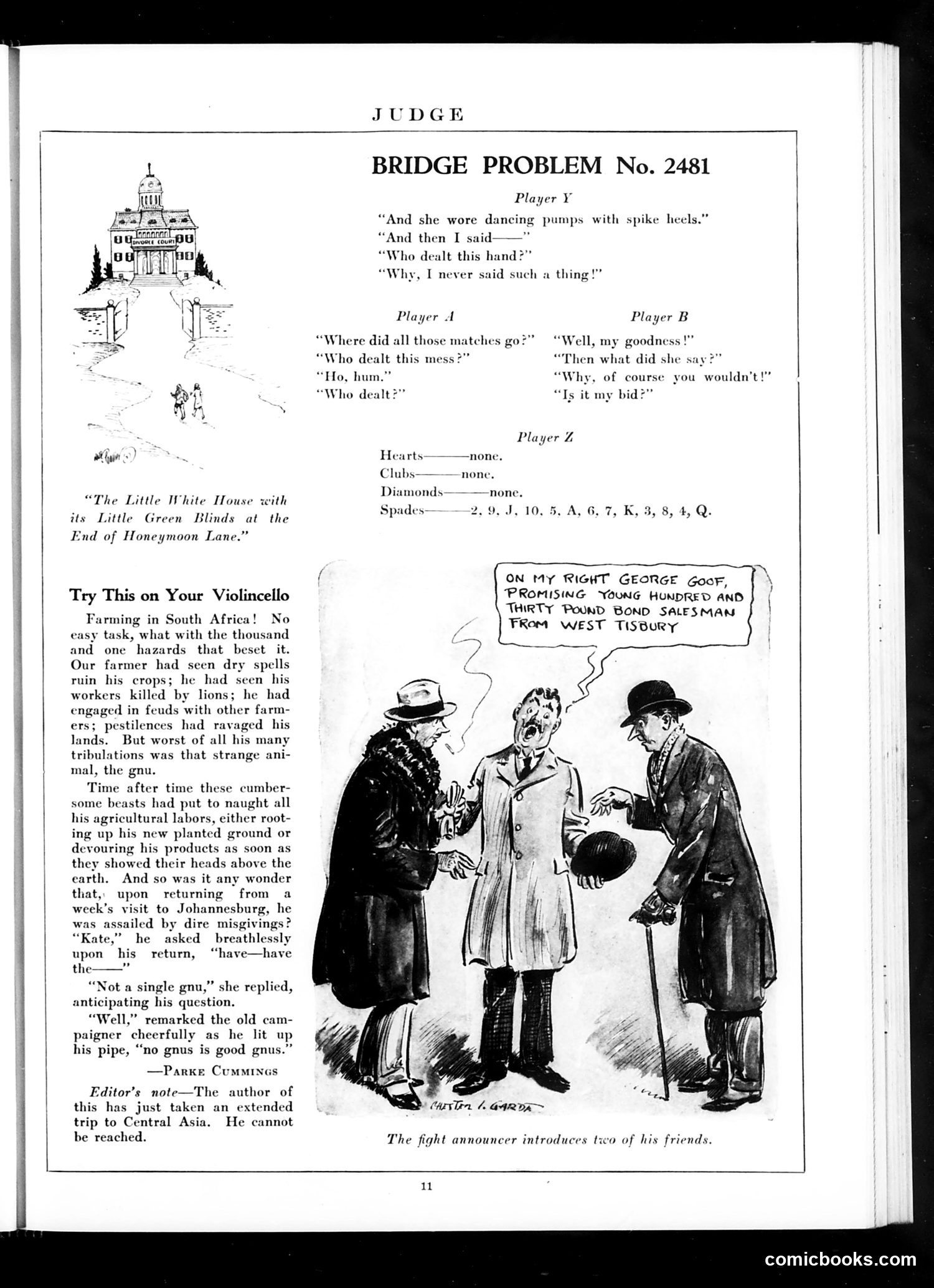
This page contains multiple unrelated features typical of Judge magazine's satirical format: **Bridge Problem No. 2481:** A humorous commentary on domestic bridge games, showing how players' gossiping and bickering interrupts actual gameplay. The joke satirizes how social distraction derails card games among the leisure class. **"Try This on Your Violincello":** A comedic short story by Parke Cummings about a South African farmer obsessed with protecting crops from gnus (wildebeest). The punchline—"no gnus is good gnus"—is a pun on the phrase "no news is good news." The editor's note that Cummings is unreachable in Central Asia suggests this is a fabricated author's persona, adding to the absurdist humor. **Cartoon (bottom):** A scene where a boxing fight announcer introduces two well-dressed gentlemen as "friends," mocking the pretense of boxing's social respectability. The salesman from "West Tisbury" suggests satirizing small-town pretension. Overall, the page emphasizes Judge's focus on domestic American life, class pretensions, and wordplay humor rather than explicit political satire.
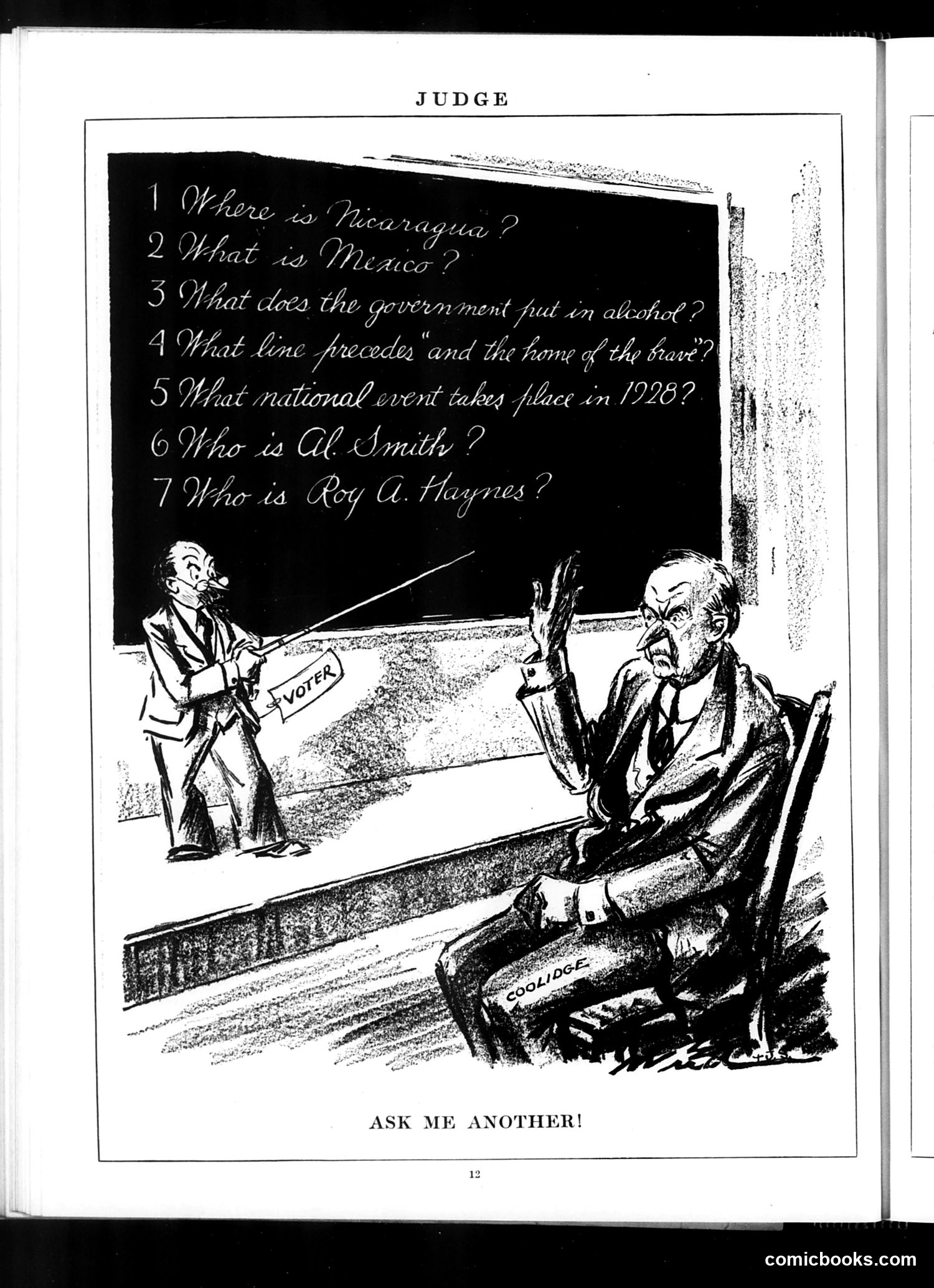
This cartoon satirizes a civics exam or voter qualification test. A stern examiner (labeled "Coolidge," likely President Calvin Coolidge) sits as judge while a nervous test-taker faces seven questions on a blackboard—geographic, governmental, and biographical trivia about Nicaragua, Mexico, alcohol prohibition, and contemporary political figures. The satire targets voter literacy tests, which were used to disenfranchise voters, particularly in the South. By depicting absurd, obscure questions (like identifying obscure politicians), the cartoon mocks how such tests functioned as gatekeeping mechanisms. The "ASK ME ANOTHER!" caption emphasizes the arbitrary, impossible nature of these requirements. The cartoon criticizes both the practice of literacy tests and, likely, Coolidge's administration's policies during Prohibition era politics.
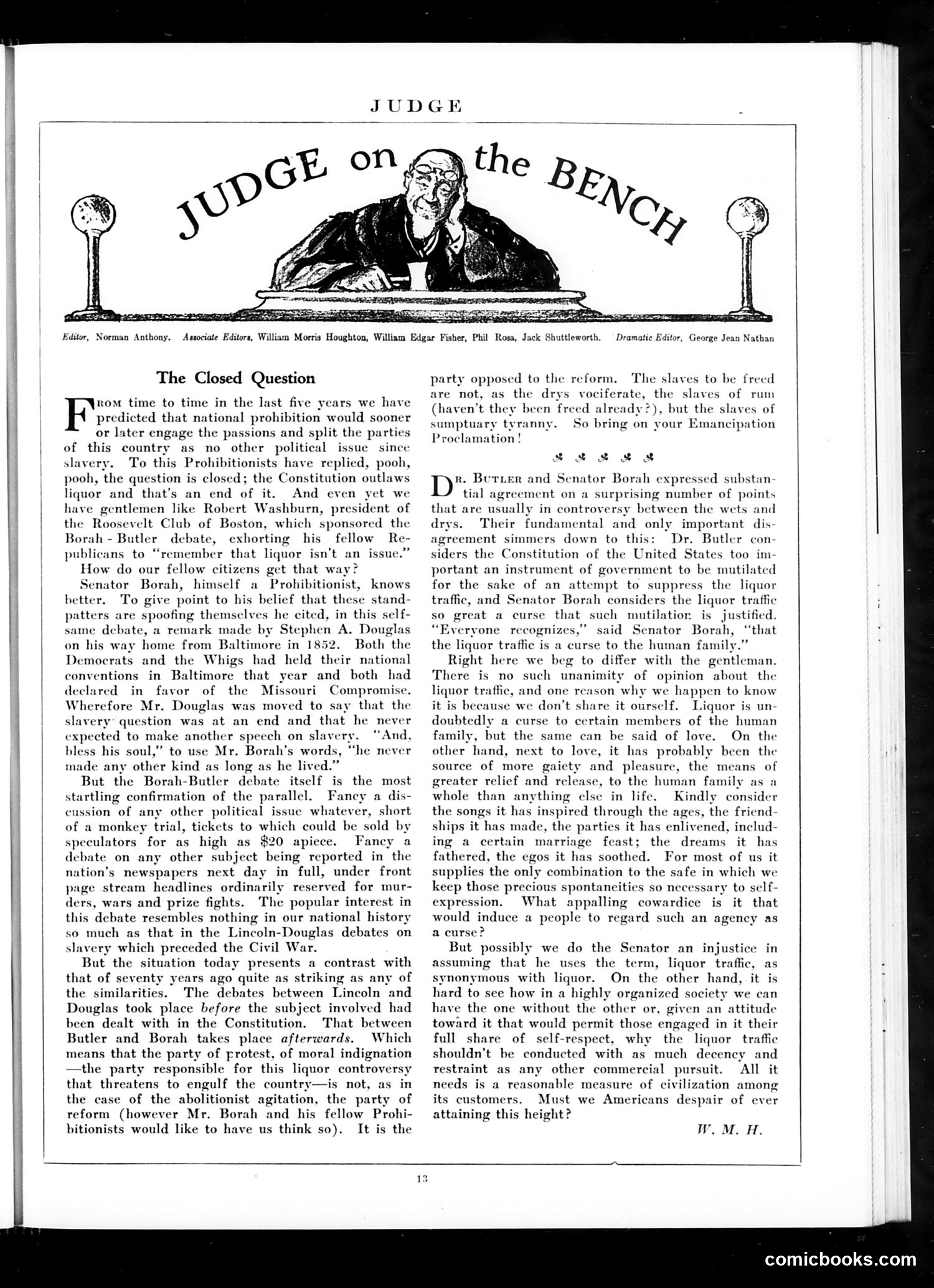
This editorial page argues that Prohibition is not a "closed question" despite claims otherwise. The article references a recent debate between Senator William Borah (a Prohibitionist) and Dr. Nicholas Murray Butler over liquor regulation. **The Satire's Point:** The piece compares the heated Prohibition debate to the pre-Civil War Lincoln-Douglas slavery debates, suggesting the issue is far from settled despite the 18th Amendment's passage. Judge mocks those claiming the matter is resolved. **Key Irony:** While Prohibitionists frame themselves as reformers "freeing slaves" from alcohol, the editorial suggests they're actually the party of restriction—enslaving people to "sumptuary tyranny" (enforced temperance). The wet (anti-Prohibition) position is framed as the true reform, opposing government overreach. The debate's massive public interest—tickets selling for $20, front-page coverage—proves Prohibition remains a divisive political issue despite constitutional prohibition, contradicting claims the question is "closed."
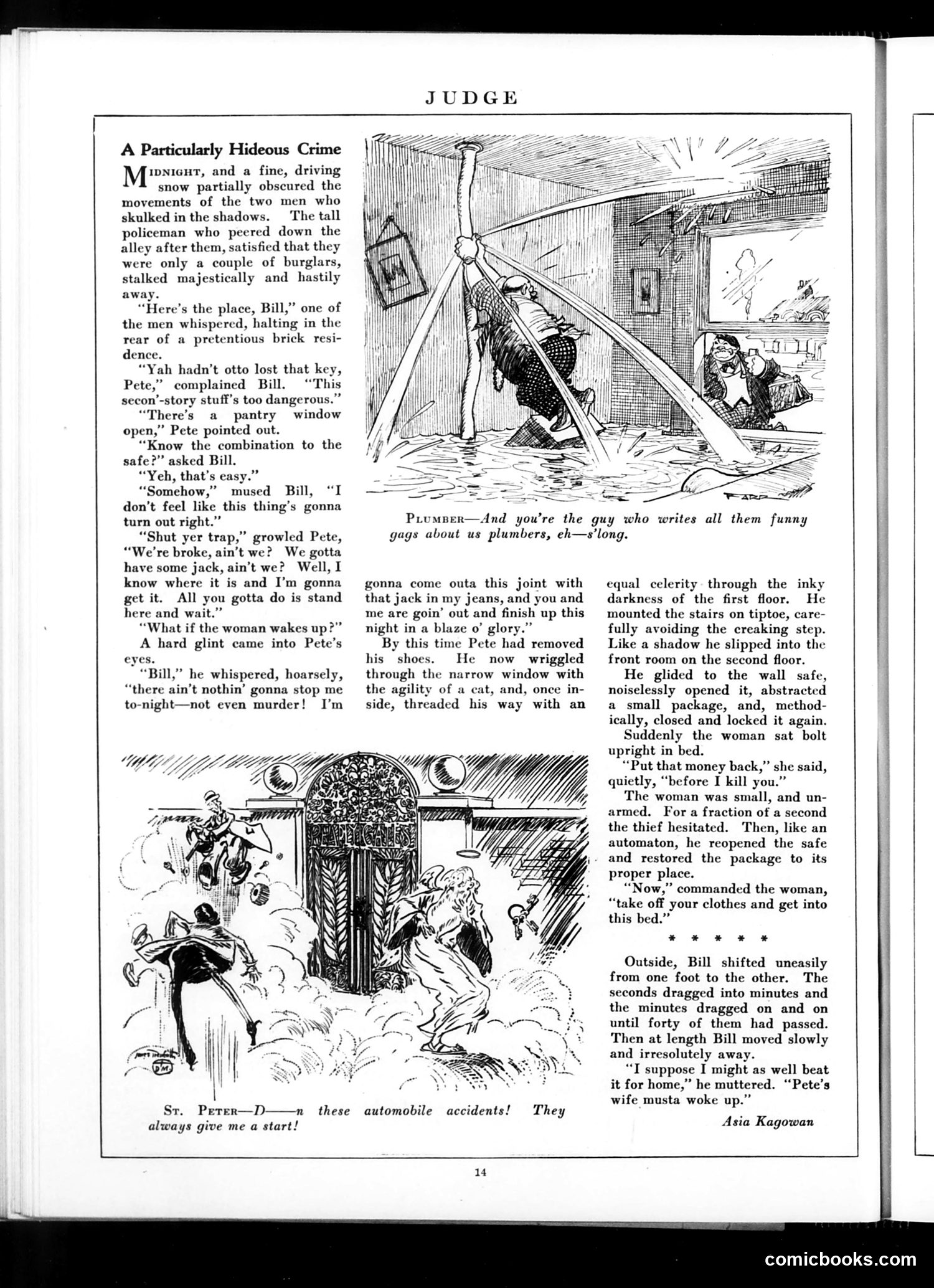
This story is a humorous inversion of burglar stereotypes. Two criminals, Pete and Bill, plan a straightforward robbery. Pete successfully enters a house and steals from a safe—but when the homeowner (a woman) wakes and threatens him, he meekly returns the money and obeys her command to get into bed with her. The joke's "hideous crime" is not the theft, but implied sexual misconduct. The satire mocks masculine bravado: Pete, who declared he'd commit murder for the heist, becomes helpless when confronted by an unarmed woman. Bill, waiting outside, eventually flees—not from police, but because he assumes "Pete's wife musta woke up," implying domestic consequences are more fearsome than any robbery charge. The cartoon caricatures working-class criminals with exaggerated dialect ("ain't," "gotta," "o' glory") while satirizing how social expectations—particularly regarding women and sexuality—could override criminal resolve.
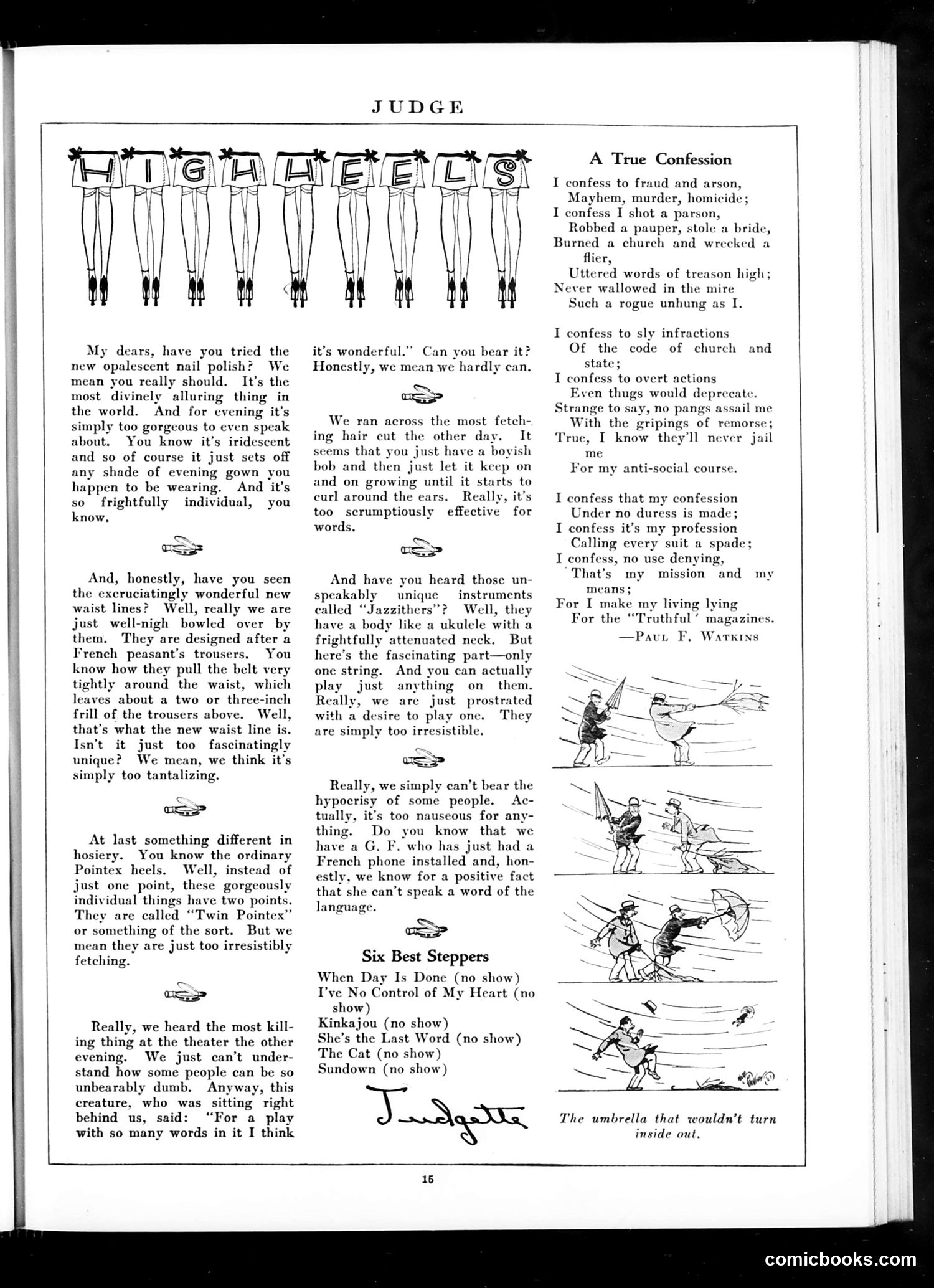
This page satirizes 1920s fashion-obsessed high society through affected socialites breathlessly discussing trivial consumer goods: opalescent nail polish, waistlines mimicking French peasant trousers, "Twin Pointes" heels, boyish bobs, and "Jazzithers" (single-string ukulele-like instruments). The humor targets vapid materialism and snobbish pretension—characters dismissing theatergoers as "unbearably dumb" for praising a wordy play, or mocking a woman who installed a French telephone but can't speak French. The repeated phrase "simply too [adjective]" parodies excessive enthusiasm about meaningless status symbols. The right column contains Paul F. Watkins's poem "A True Confession," which inverts expectations: a self-described criminal boasts of crimes without remorse, then reveals his real transgression—making a living by lying for "Truthful" magazines. This satirizes media dishonesty and advertising's deceptive practices promoting the very frivolous goods ridiculed above. Together, the page skewers consumerism, social pretension, and media manipulation of the Jazz Age.
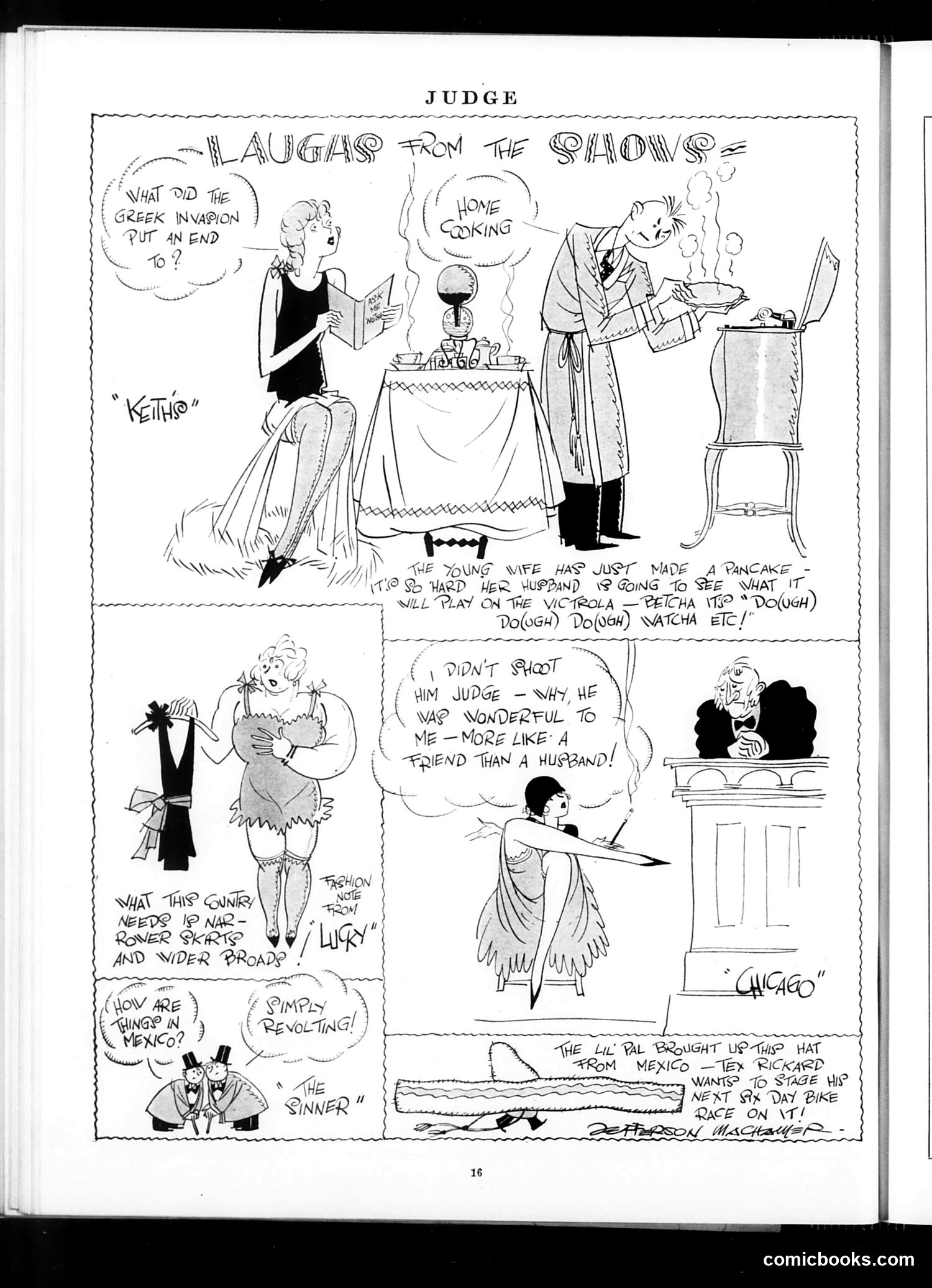
This is a multi-panel satirical comic by Keitho (signed) critiquing modern social trends through theatrical scenarios. The primary targets are: **1. Greek invasion/modern culture**: The opening panel mocks anxiety about Greek immigration or cultural influence in America, asking what the "Greek invasion" will bring. **2. Home cooking vs. modernity**: A young wife's pancake prompts her husband to play recorded music (Victrola) rather than appreciate her domestic labor—satirizing how technology is replacing traditional homemaking values. **3. Women's changing roles**: A woman discusses preferring a male judge as a "friend" rather than a husband, mocking evolving attitudes toward women's independence and companionship outside marriage. **4. Fashion and morality**: Commentary on women's clothing becoming "wider" and scandalous—a common anxiety of the era about flapper fashion. **5. Mexico/immigration**: Brief reference to Mexican imports and a bike race, continuing anti-immigrant sentiment. The overall satire critiques American anxieties about rapid social change, immigrant populations, women's liberation, and technology's impact on traditional domestic life.
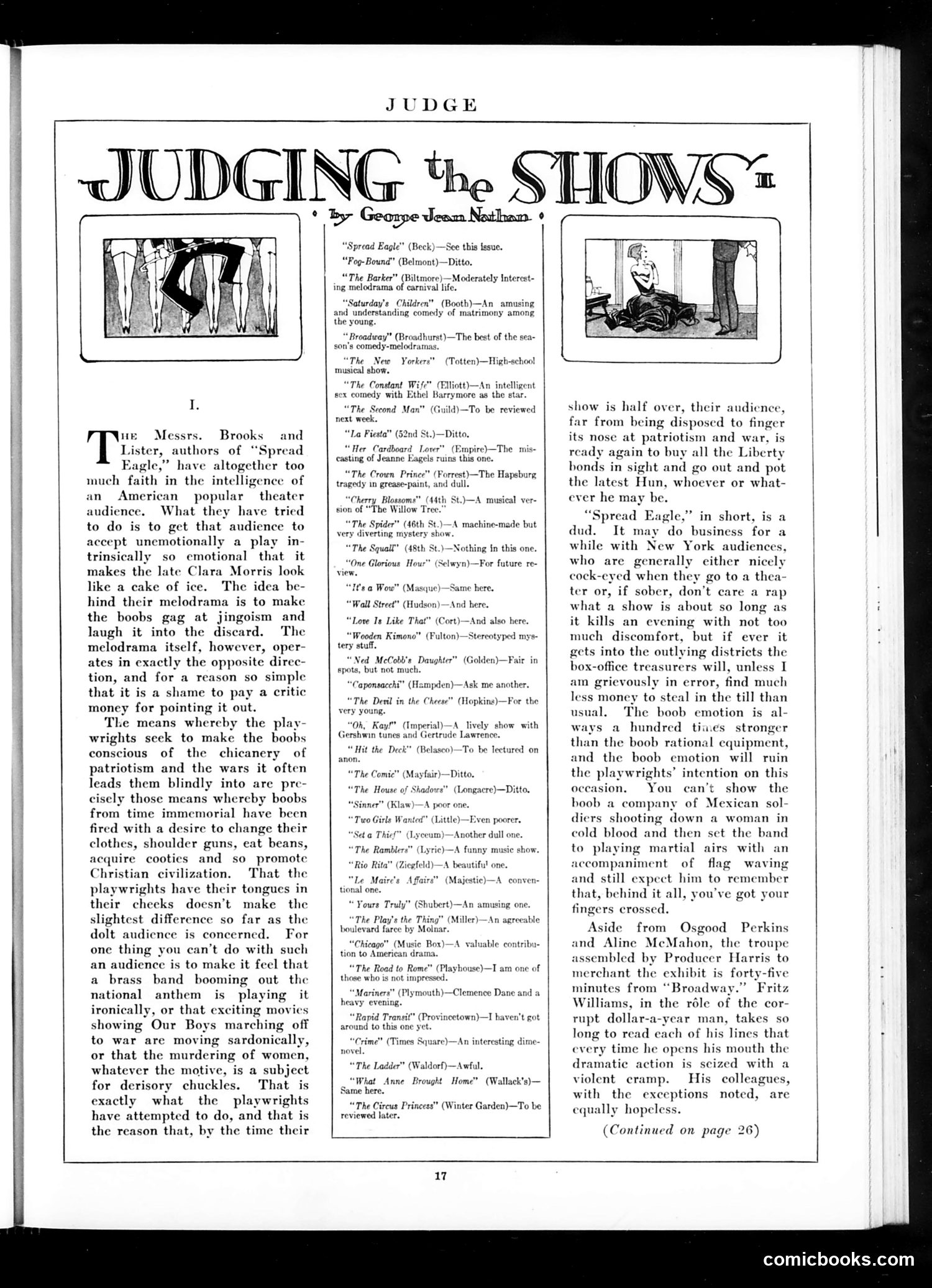
This page reviews current Broadway productions by critic George Jean Nathan. The main article critiques "Spread Eagle" (by Brooks and Lister), a play attempting satirical commentary on American patriotism and jingoism. Nathan argues the playwrights fatally miscalculate their audience: they use emotionally stirring theatrical devices—brass bands, martial imagery, flag-waving—intending ironic effect, but these elements work *against* satire. The average theatergoer cannot perceive irony in such material; patriotic spectacle automatically triggers genuine patriotic fervor rather than critical reflection. The piece exemplifies 1920s theatrical criticism's concern with audience intelligence and the limits of using propaganda techniques ironically. The surrounding listings review other current shows with terse verdicts ("Ditto," "Amusing," "Dull"), revealing Judge's role as entertainment arbiter for educated readers skeptical of both popular theater and mass sentiment.
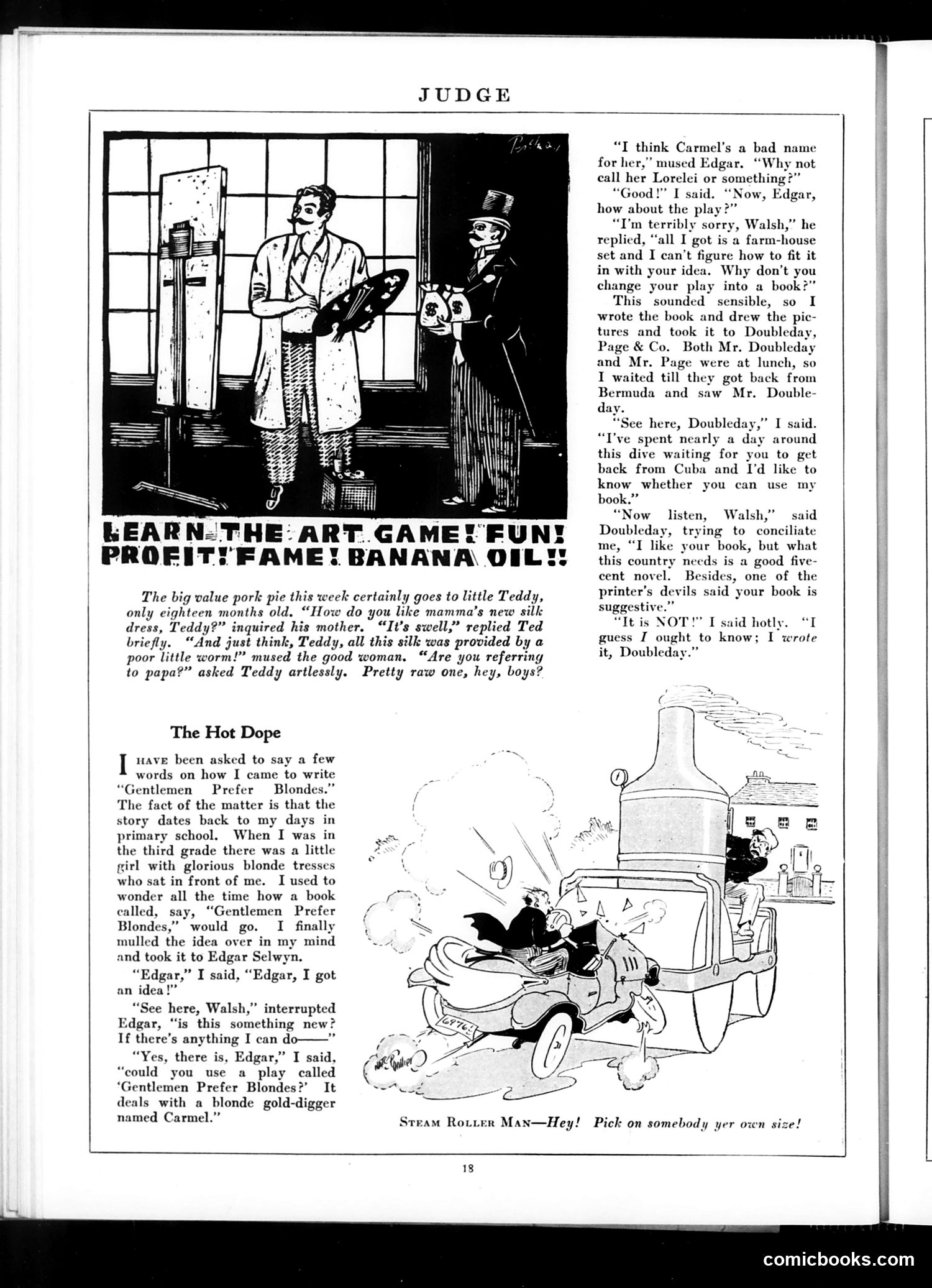
This page satirizes the publishing industry and artistic pretension circa the 1920s. "The Hot Dope" section parodies the origin story of *Gentlemen Prefer Blondes* (the famous novel/play), depicting how creators pitch work to publishers. The humor targets: **The satire:** Publishers' timidity about "suggestive" content, their arbitrary objections (the farm-house set complaint), and the gap between artist ambition and commercial reality. Walsh's indignant response—"I ought to know; I wrote it"—mocks defensive creators. **Top cartoon:** Jokes about a toddler asking if his mother's silk dress came from "papa" (implying the father is kept like a "worm"), with the punchline "Pretty raw one, hey, boys?" This is crude humor about marital infidelity. **The "Learn the Art Game" banner** advertises the satirical content itself—mocking how writers peddle work as path to "profit, fame, banana oil" (slang for empty promises/hype). The page targets artistic ego and publishing gatekeeping of the Jazz Age.
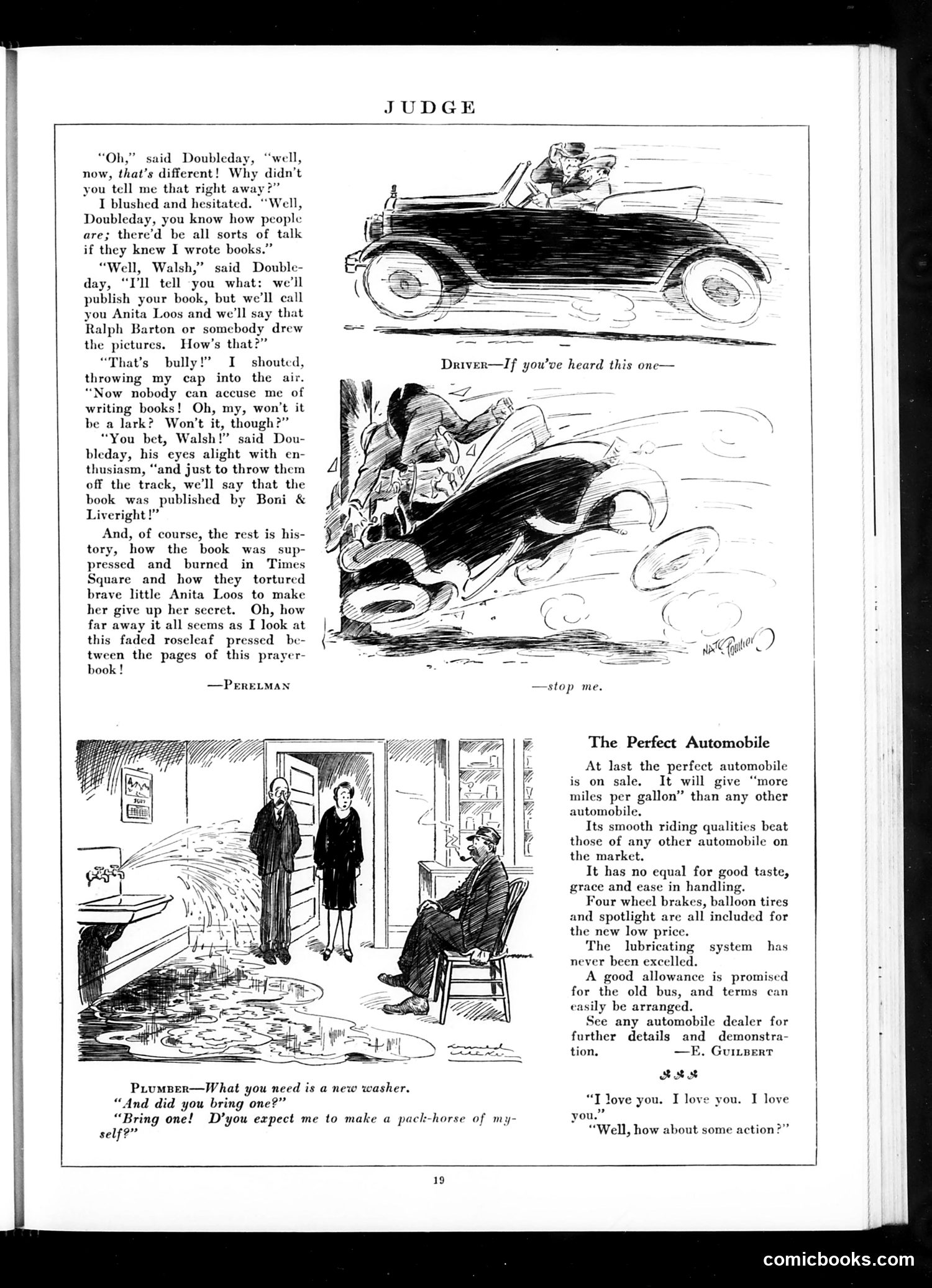
This page contains three distinct pieces of humor: **Top cartoon (by Perelman):** A satirical story about a male writer using a female pseudonym ("Anita Loos") and having an illustrator (Ralph Barton) take credit for drawings, published under a fake publisher name. The joke mocks the absurdity of literary deception and gender masquerade in publishing—the narrator is so desperate to hide that he writes books that he'll adopt a woman's identity to avoid social embarrassment. **Middle cartoon:** A domestic joke about a plumber's reluctance to carry equipment, playing on working-class attitudes about labor. **Bottom section:** An advertisement for "The Perfect Automobile" that humorously uses superlatives ("no equal," "never been excelled") while promising practical features like brakes and financing—typical early automotive advertising hyperbole. The final snippet appears to be a romantic joke about a woman demanding physical action rather than verbal declarations. The page reflects 1920s-era concerns about gender, publishing, class, and consumer culture.
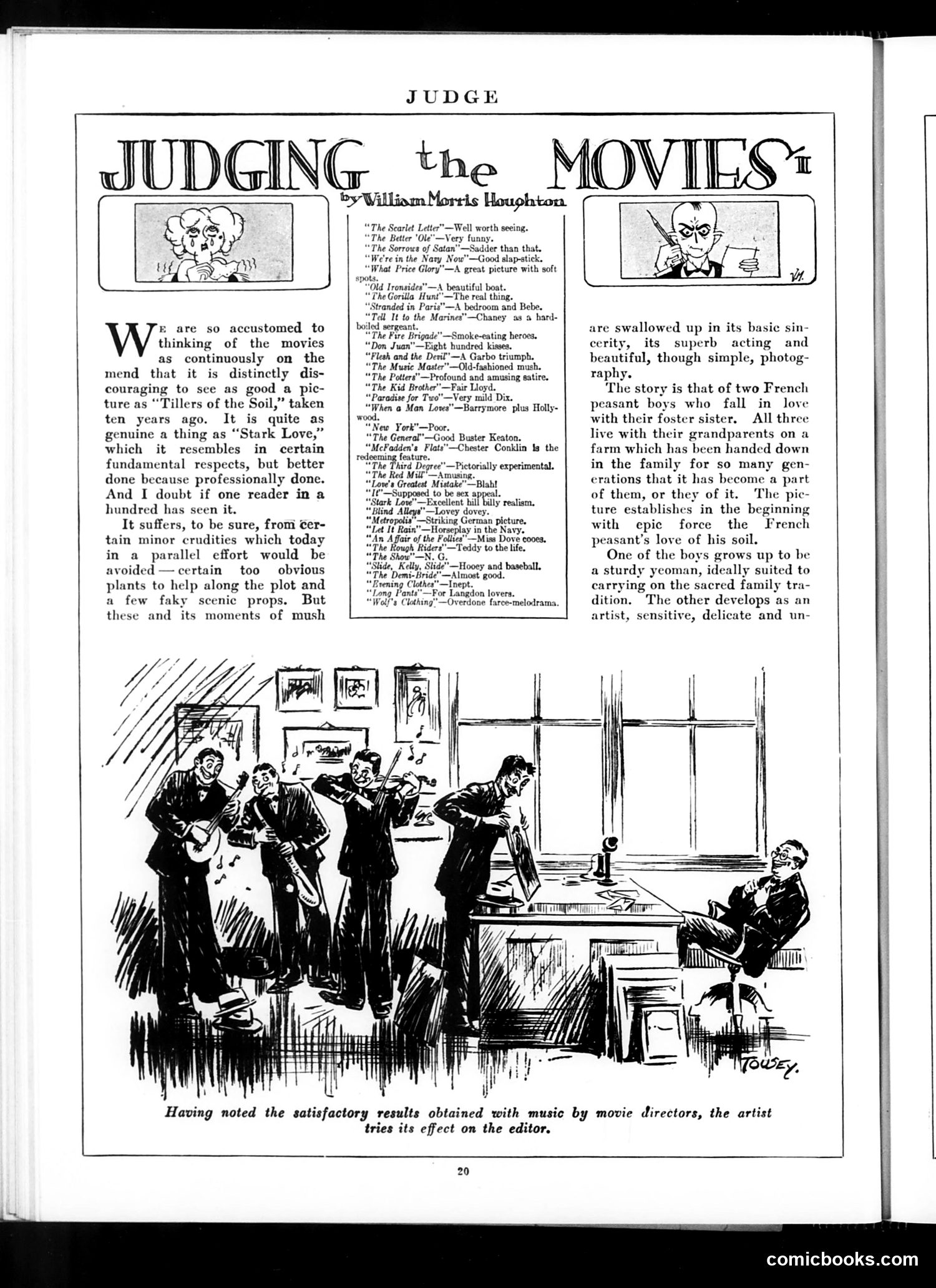
This page combines a film review column by William Morris Houghton with a cartoon satirizing movie music's effects. The cartoon depicts four musicians playing instruments while an editor sits at his desk, visibly distressed by the noise—the joke being that movie directors have discovered music enhances films, so now someone's trying the same technique on the magazine editor, with comically bad results. The review section lists brief critiques of contemporary films (many from the mid-1920s based on titles like "Metropolis" and "The General"), using sharp, humorous one-liners: praising some as genuinely good art while mocking others for being sentimental ("mush") or relying on scandal and sexuality rather than merit. The broader satire suggests Judge's skepticism about both the movie industry's hype and the notion that gimmicks (like added music) automatically improve quality—whether in cinema or journalism.
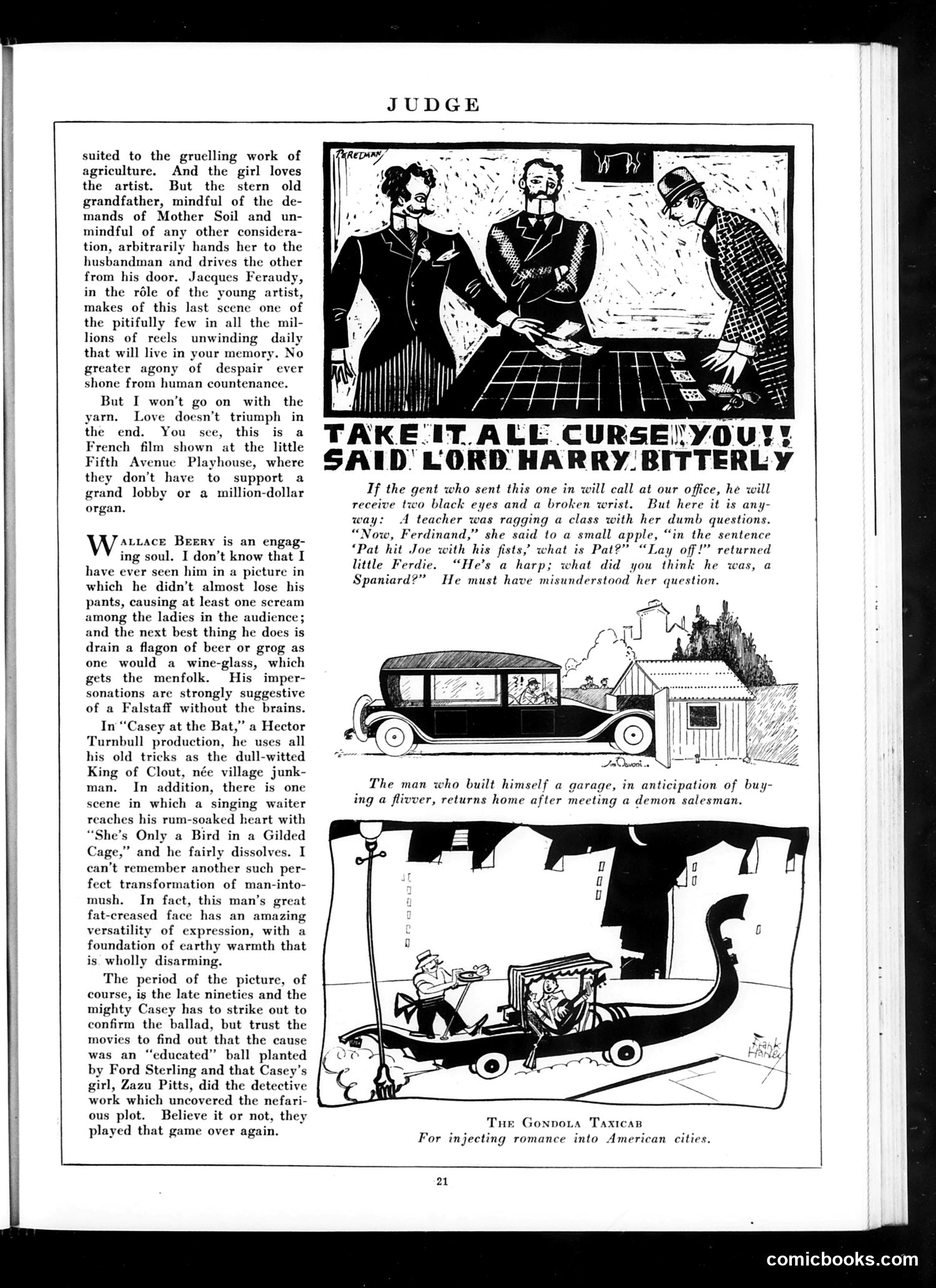
This page contains film reviews by a critic discussing recent movies, interspersed with satirical cartoons. **The Main Cartoons:** 1. **Top cartoon**: A classroom scene where a teacher asks Irish immigrant student "Ferdinand" to identify "Pat" in a sentence. Ferdinand interprets "Pat" as a slur for Irish people ("a harp"), turning the grammar lesson into ethnic humor. The satire targets anti-Irish prejudice common in early 20th-century America. 2. **Middle cartoon**: Shows a man who built a garage anticipating buying a car ("flivver"), but returns home defeated after meeting an aggressive automobile salesman—satirizing the aggressive sales tactics of car dealers during the automobile boom era. 3. **Bottom cartoon**: Depicts a "Gondola Taxicab," apparently a satirical invention meant to humorously "inject romance into American cities." **Film Reviews**: The text discusses actor Wallace Beery's comedic style and the film "Casey at the Bat," reflecting period entertainment tastes.
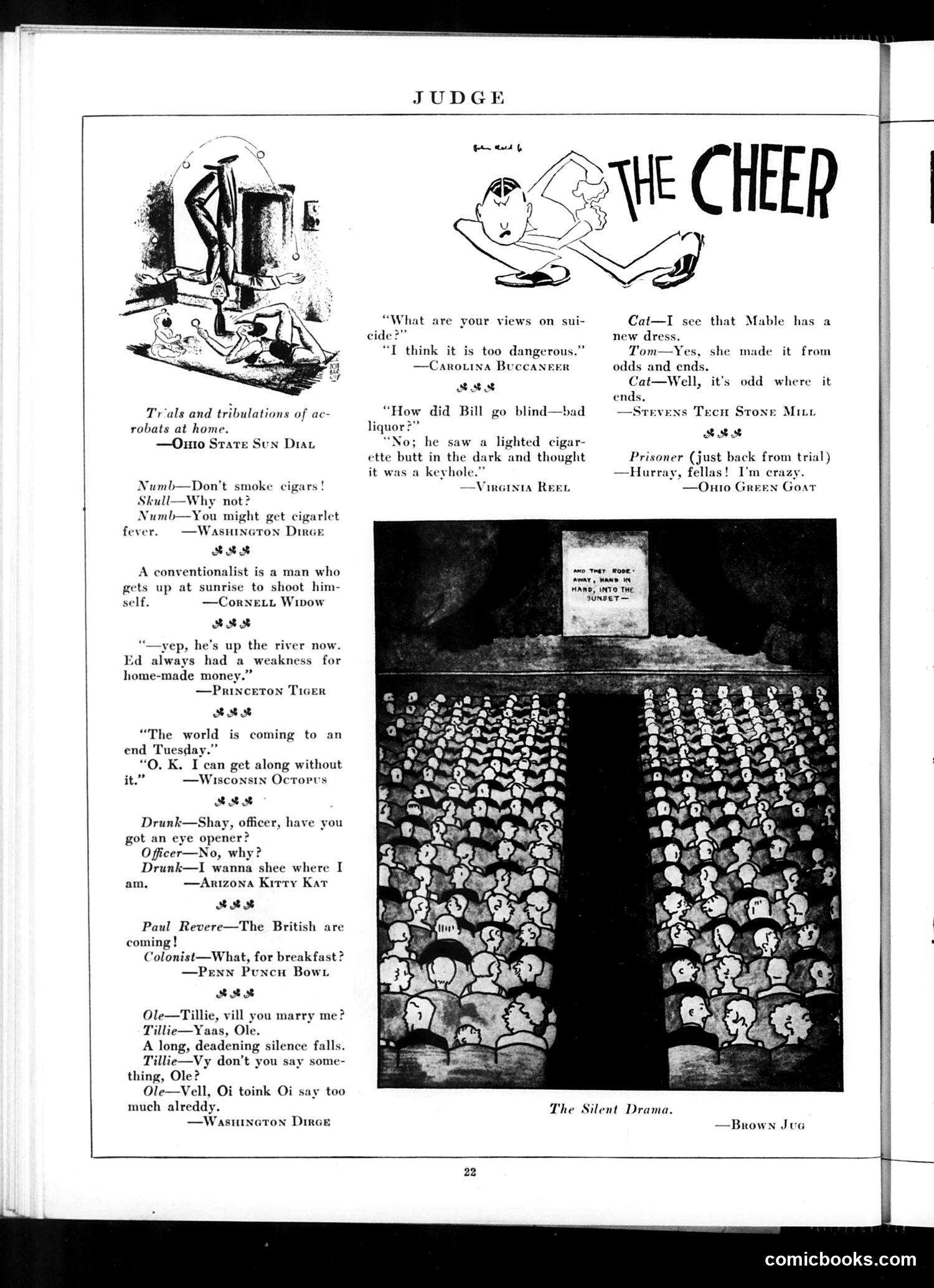
This page from *Judge* magazine presents a collection of brief jokes and gags typical of early 20th-century American humor. The content includes: **Text-based humor:** Short jokes on contemporary topics—smoking, suicide, drunkenness, courtship between immigrants (Ole and Tillie), counterfeit money, and the coming of World War I ("The British are coming!"). The humor relies on wordplay, ethnic dialect comedy (the Ole/Tillie exchange uses exaggerated Scandinavian-English), and situational irony. **The main illustration:** "The Silent Drama" (credited to Brown Jug) depicts a crowded movie theater audience watching a silent film. The joke appears to reference cinema's growing popularity and the communal experience of silent-film viewing—a relatively new entertainment form. **Attribution:** Jokes are credited to regional newspapers and colleges, suggesting a syndication network. The overall tone reflects period attitudes toward immigrants, drinking, and emerging modern anxieties, presented through slapstick sensibility rather than sophisticated satire.
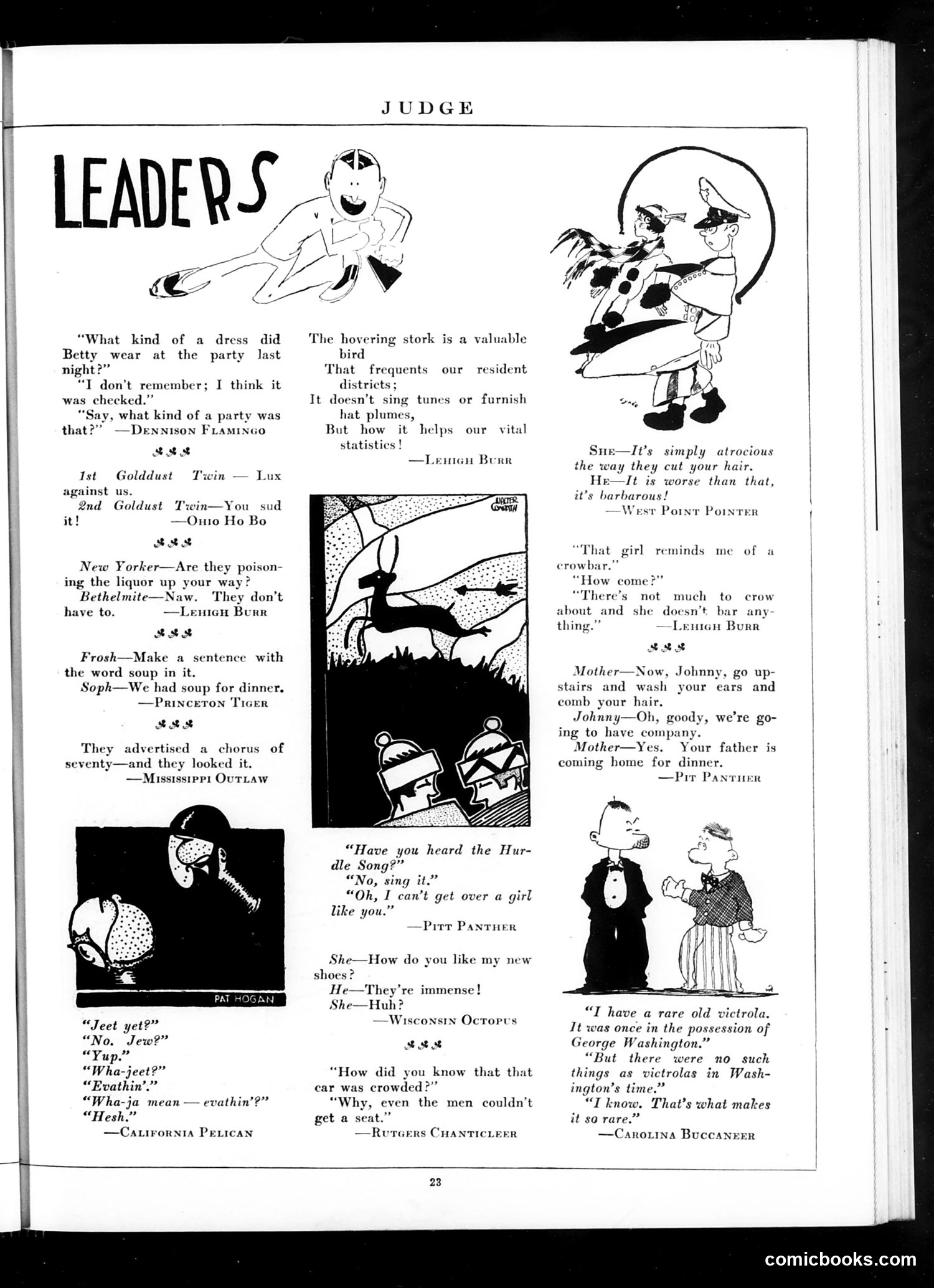
This page collects brief jokes and one-panel cartoons typical of early 20th-century American humor. The content reflects period preoccupations: **Social humor:** Jokes about college life (freshmen, sophomores), prohibition-era drinking, and gender dynamics appear throughout. References to "Golddust Twins" (a popular advertising mascot) and regional colleges (Princeton, Wisconsin, West Point) target educated, college-adjacent readers. **The stork cartoon** plays on the common euphemism for human reproduction—depicting storks as helping vital statistics (birth rates), likely with eugenic undertones common to this era. **Visual cartoons** include domestic scenes (mother/son), romantic misunderstandings, and slapstick. Pat Hogan's "Feet yet?" exchange is dialect humor, possibly mocking immigrant speech patterns. **The victrola joke** references the phonograph brand while making fun of anachronistic collecting. Overall, the page targets middle-class, educated audiences with mild satire on courtship, family life, and contemporary social behavior—nothing overtly political.
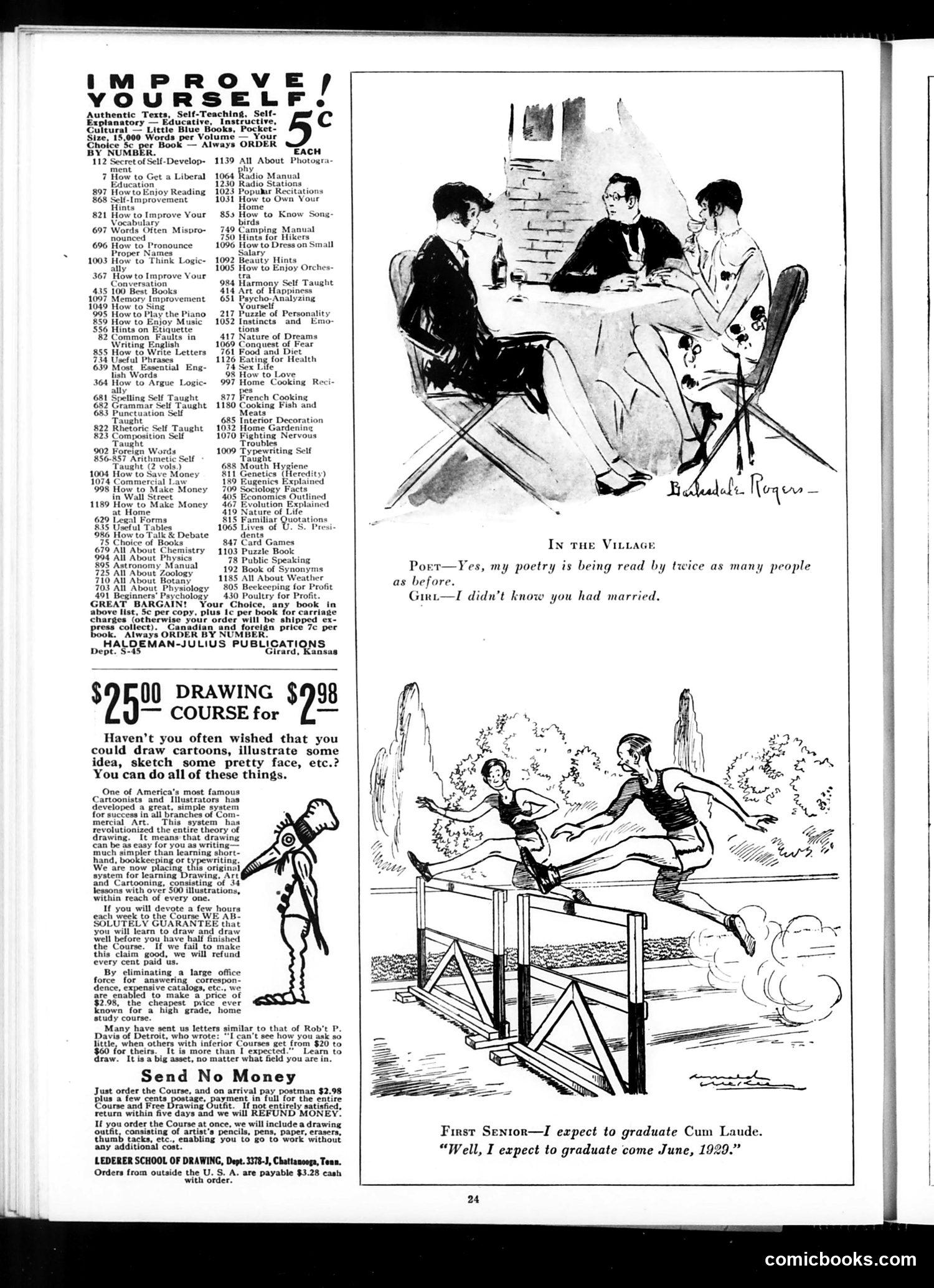
This page from *Judge* magazine is primarily **advertising and self-help catalog content**, not satirical editorial material. The top features two cartoon vignettes: 1. **"In the Village"** shows a poet bragging that his poetry now reaches twice as many readers, but a girl sarcastically notes she "didn't know you had married"—implying his expanded audience consists only of his wife reading it twice. 2. **"First Senior"** depicts a graduate claiming she'll graduate "Cum Laude," but clarifies the date as "June, 1929," suggesting she's not actually graduating with honors but merely in that month. The bulk of the page advertises **Haldeman-Julius Publications' mail-order self-improvement booklets** (5¢ each) covering topics from elocution to eugenics, plus a $2.98 drawing course. This reflects the early 20th-century American cultural moment when self-improvement literature and correspondence courses were wildly popular commercial products.
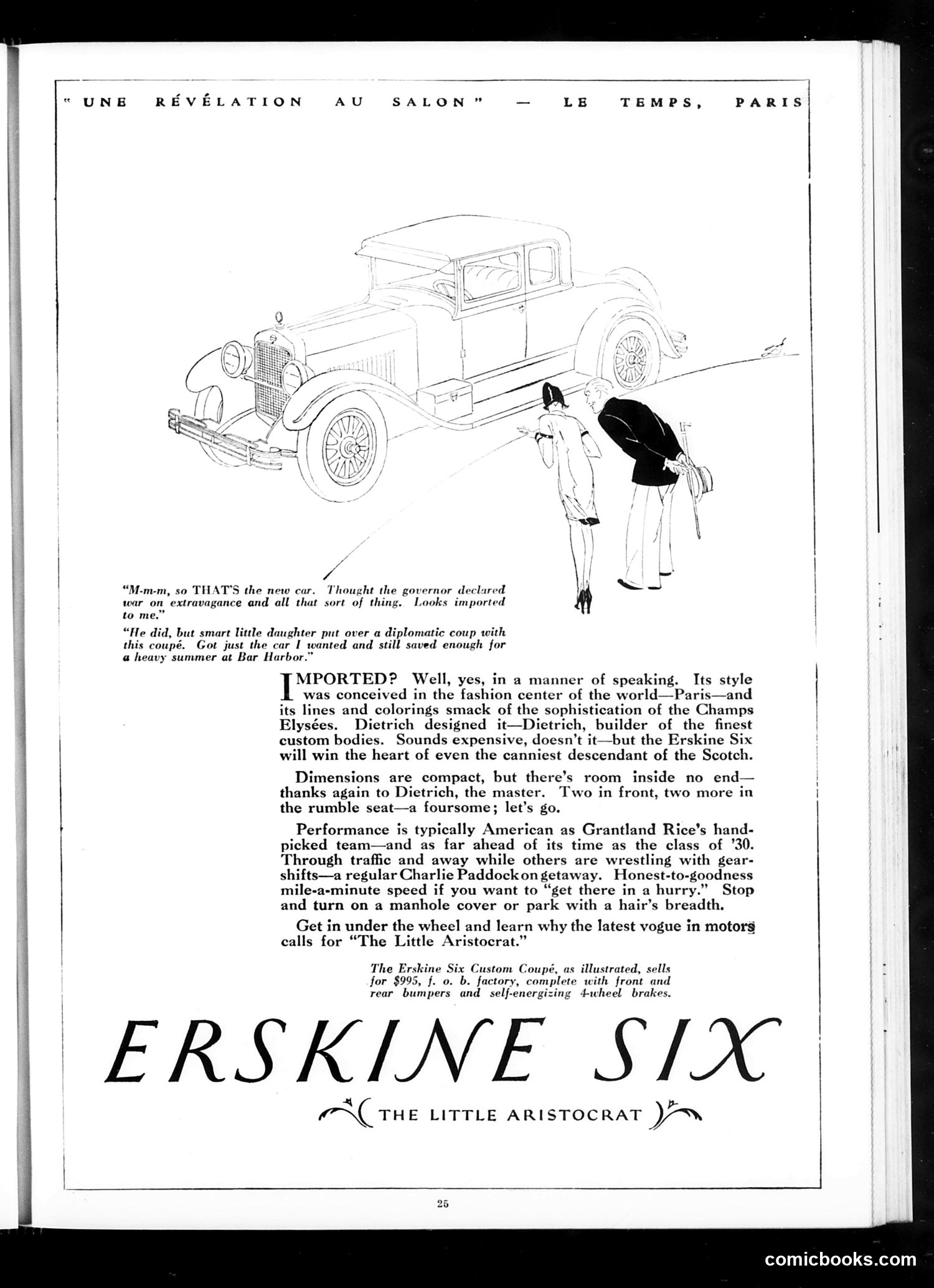
This is primarily a **car advertisement** for the Erskine Six, disguised as satirical commentary. The cartoon shows two women admiring an imported automobile, with dialogue that mocks wealthy hypocrisy. The joke: A governor has publicly declared "war on extravagance," yet his daughter circumvents this moral stance by using "diplomatic" charm to acquire an expensive imported car—then claims they still saved money for a luxurious summer at Bar Harbor (an elite resort). The satire targets the gap between public virtue-signaling and private consumption among the wealthy elite. The advertisement then pivots to praising the Erskine Six as an affordable "aristocrat"—a car that delivers luxury and French sophistication (designed by Dietrich, a prestigious coachbuilder) at $995, positioning it as the smart choice for status-conscious buyers who want elegance without excessive cost. References to "Charlie Paddock" (a famous sprinter) and "Grantland Rice" (sports columnist) emphasize American performance and modernity, competing implicitly with European luxury brands.
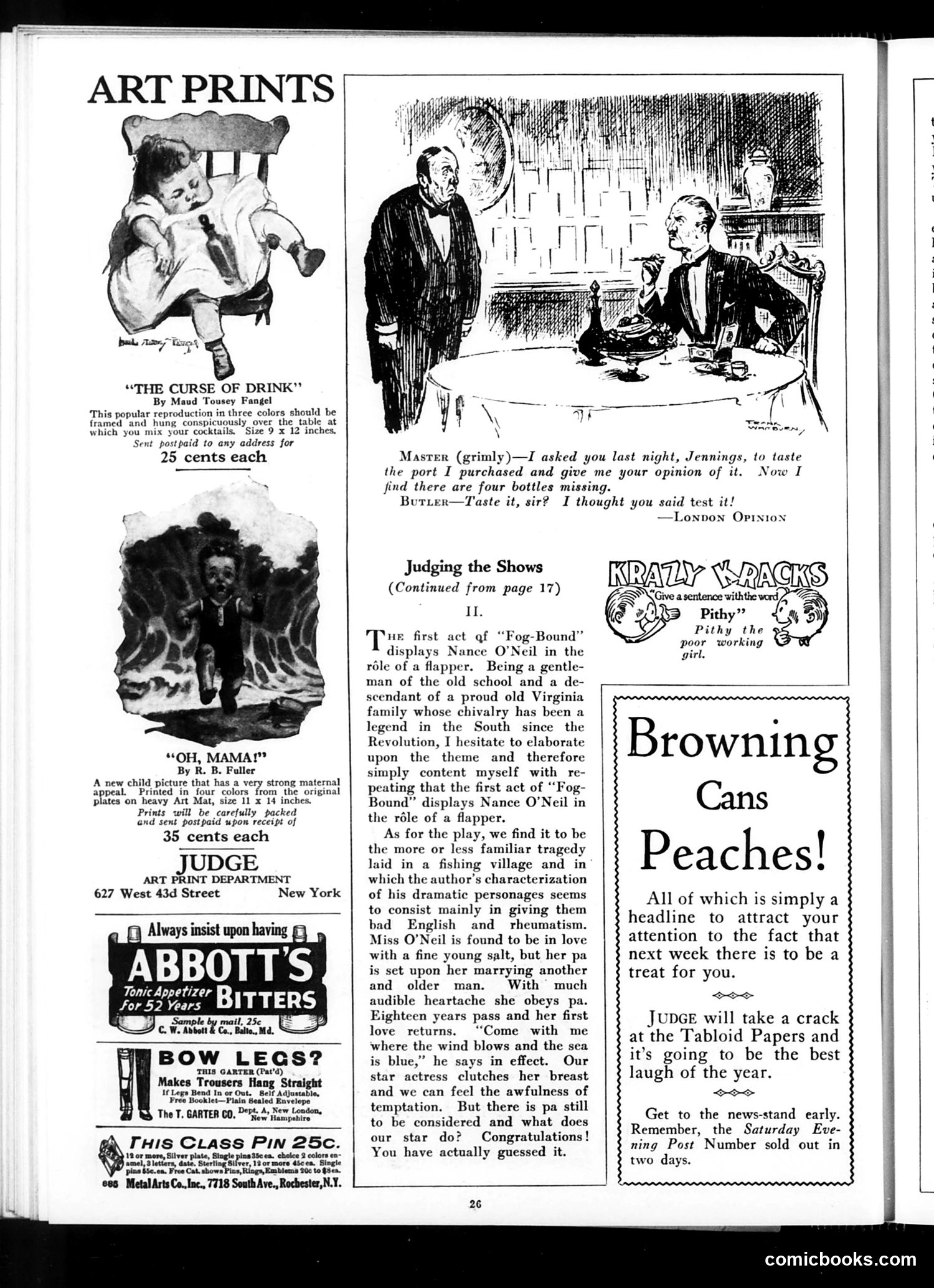
This page from *Judge* (a satirical weekly) contains multiple elements: **"The Curse of Drink" cartoon**: A master confronts his butler about missing port bottles. The butler claims he misunderstood—he thought "taste it" meant "test it" (implying he drank the port while "testing" it). The joke plays on the servant's feigned innocence and the period's anxiety about alcohol consumption and servant dishonesty. **Art prints advertised**: Including "Oh, Mama!" by R.B. Fuller, marketed as sentimental domestic imagery. **"Judging the Shows" theater review**: Critiques Nance O'Neil's performance in "Fog-Bound," a melodrama about a woman choosing duty (her father) over romantic love. The reviewer is somewhat condescending about the play's predictability. **"Krazy Kracks" word puzzle**: A minor humorous feature. **Advertisements**: For Abbott's Bitters (a patent medicine/tonic), a garter device for straightening bow legs, and pins. The page reflects early 20th-century concerns: drinking, class relations, theatrical sentimentality, and remedies for physical "defects."
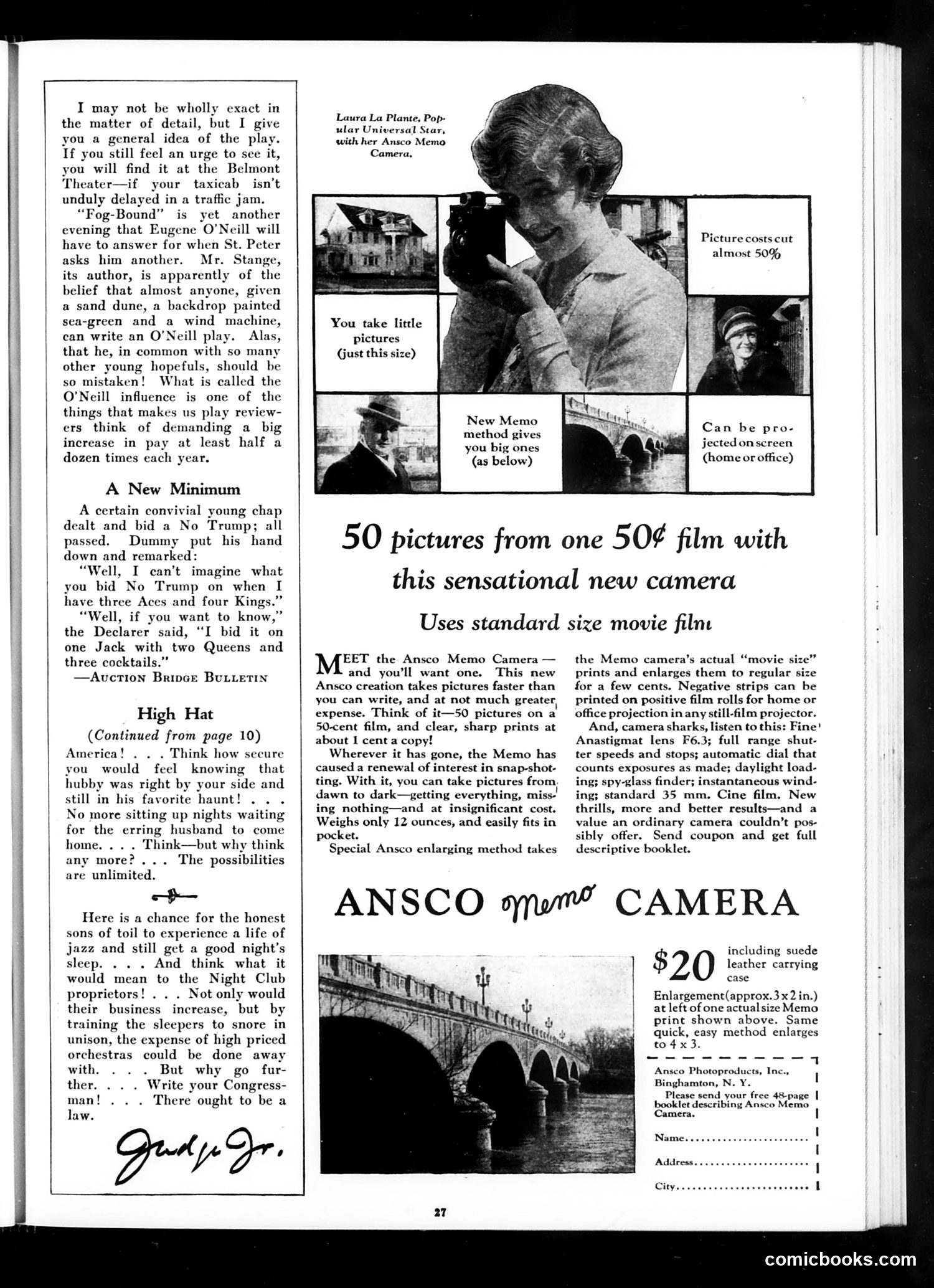
This page mixes theater criticism with advertising. The left side contains two satirical pieces: a scathing review of the play "Fog-Bound" (implying its author copied Eugene O'Neill's style poorly), and a bridge-game joke about a drunk declarer. A third section, "High Hat," ironically proposes that night clubs install beds so husbands can sleep while their wives enjoy entertainment—a commentary on Jazz Age nightlife and marital discord. The right half is entirely an advertisement for the Ansco Memo Camera, a compact camera that produced 50 photographs per 50-cent film roll, with enlargement capabilities. The ad features actress Laura La Plante to promote the product, emphasizing affordability and ease of use for amateur photographers. The page reflects 1920s concerns: theatrical taste, prohibition-era drinking culture, changing gender dynamics, and democratized consumer technology.
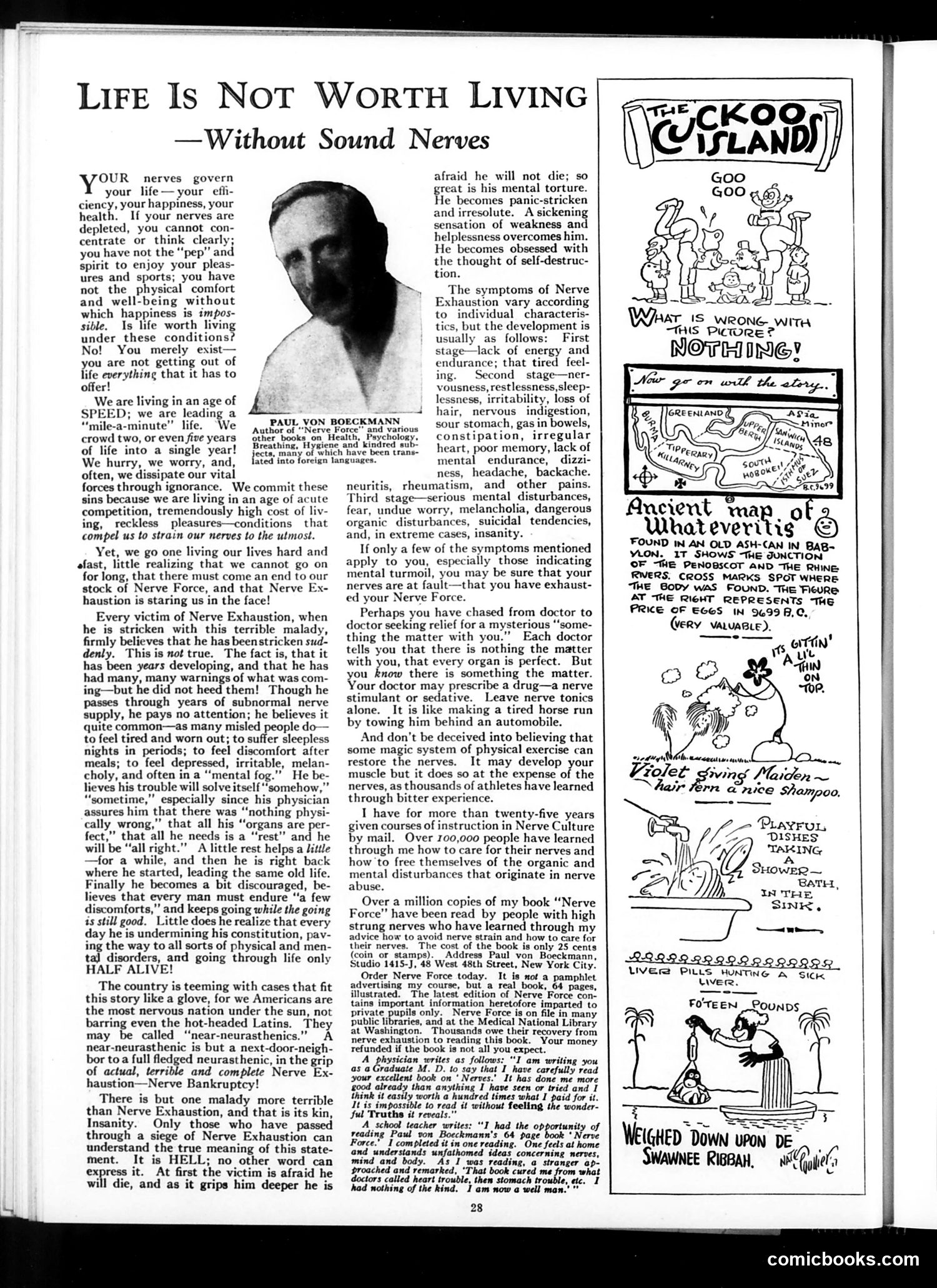
This page primarily features **advertising content disguised as health advice**, rather than political satire. The main article promotes Paul von Boeckmann's book "Nerve Force," warning about "Nerve Exhaustion"—a pseudo-medical condition popular in early 20th-century health fads. The accompanying cartoons are lighthearted filler: "The Cuckoo Islands" depicts silly characters; "Ancient Map of Wonderland" shows a whimsical fantasy map; and smaller sketches include hygiene and bathing humor ("Violet's Maiden hair form a nice shampoo"). **The satire here is mild**: the page gently mocks contemporary anxieties about modern life's fast pace ("mile-a-minute life," competition, high costs) causing nervous breakdown. This reflects real period concerns about industrialization's psychological toll, though the "cure" being sold—Boeckmann's book—is commercially motivated. The page is essentially **advertising dressed as editorial content**, targeting readers worried about health and modernity.
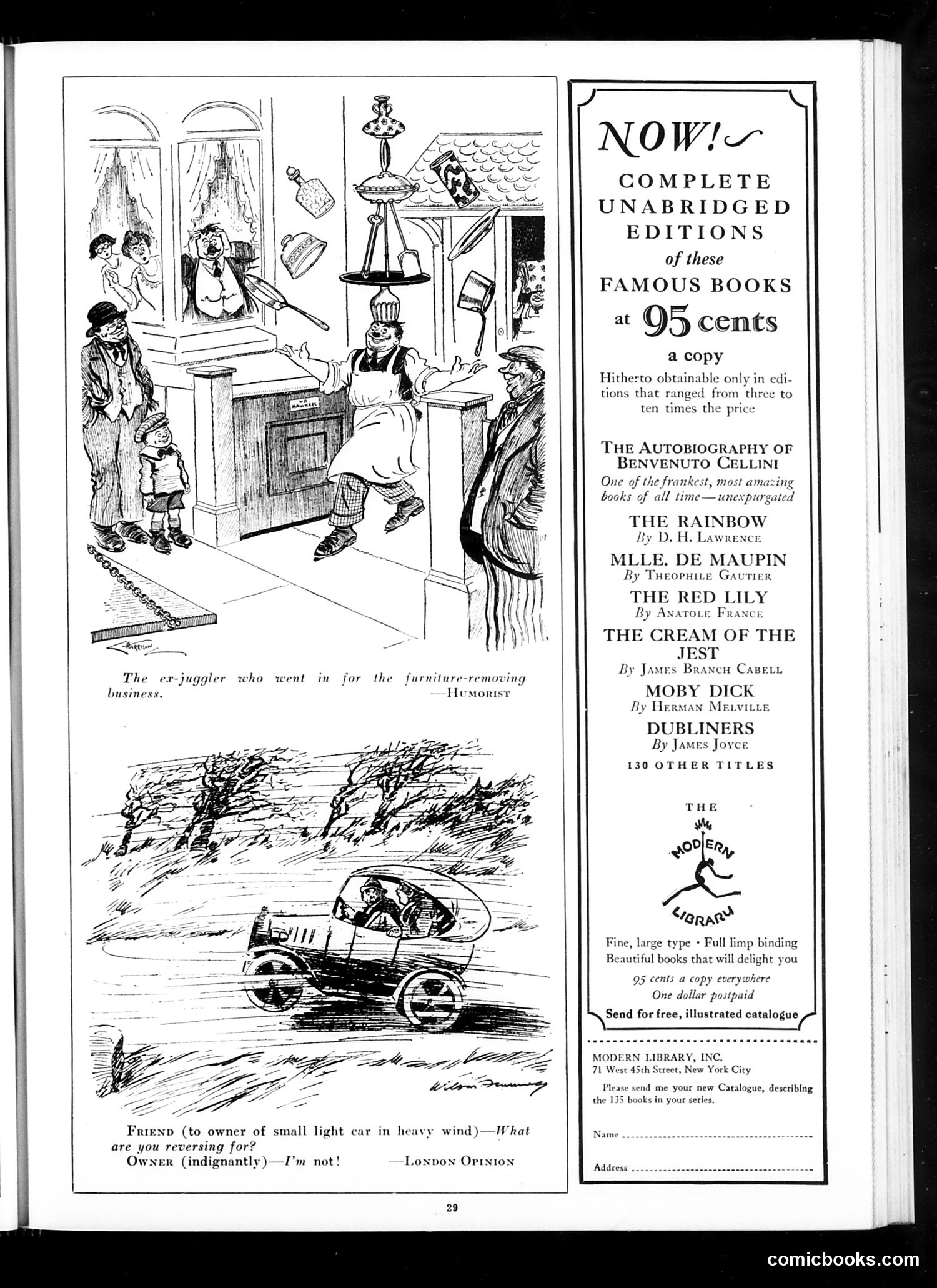
This page contains two unrelated items: **two humorous cartoons on the left and a book advertisement on the right.** ## The Cartoons: **Top cartoon**: "The ex-juggler who went in for furniture-removing business" depicts a chaotic moving scene where items are flying through the air. The joke is that an ex-juggler's professional skills, while impressive, translate poorly to the serious business of furniture moving—suggesting incompetence despite relevant hand-eye coordination. **Bottom cartoon**: A small car in heavy wind is being blown backward. The owner insists he's "not reversing"—implying the wind is so strong it's physically pushing the vehicle in reverse. It's a London Opinion reprint satirizing either poor automobile design or the absurdity of driving such a flimsy vehicle in bad weather. ## The Advertisement: The right side advertises Modern Library's complete unabridged editions at 95 cents—notably cheap for the era. It emphasizes these were previously expensive (3-10 times the price), making classic literature accessible to ordinary readers.
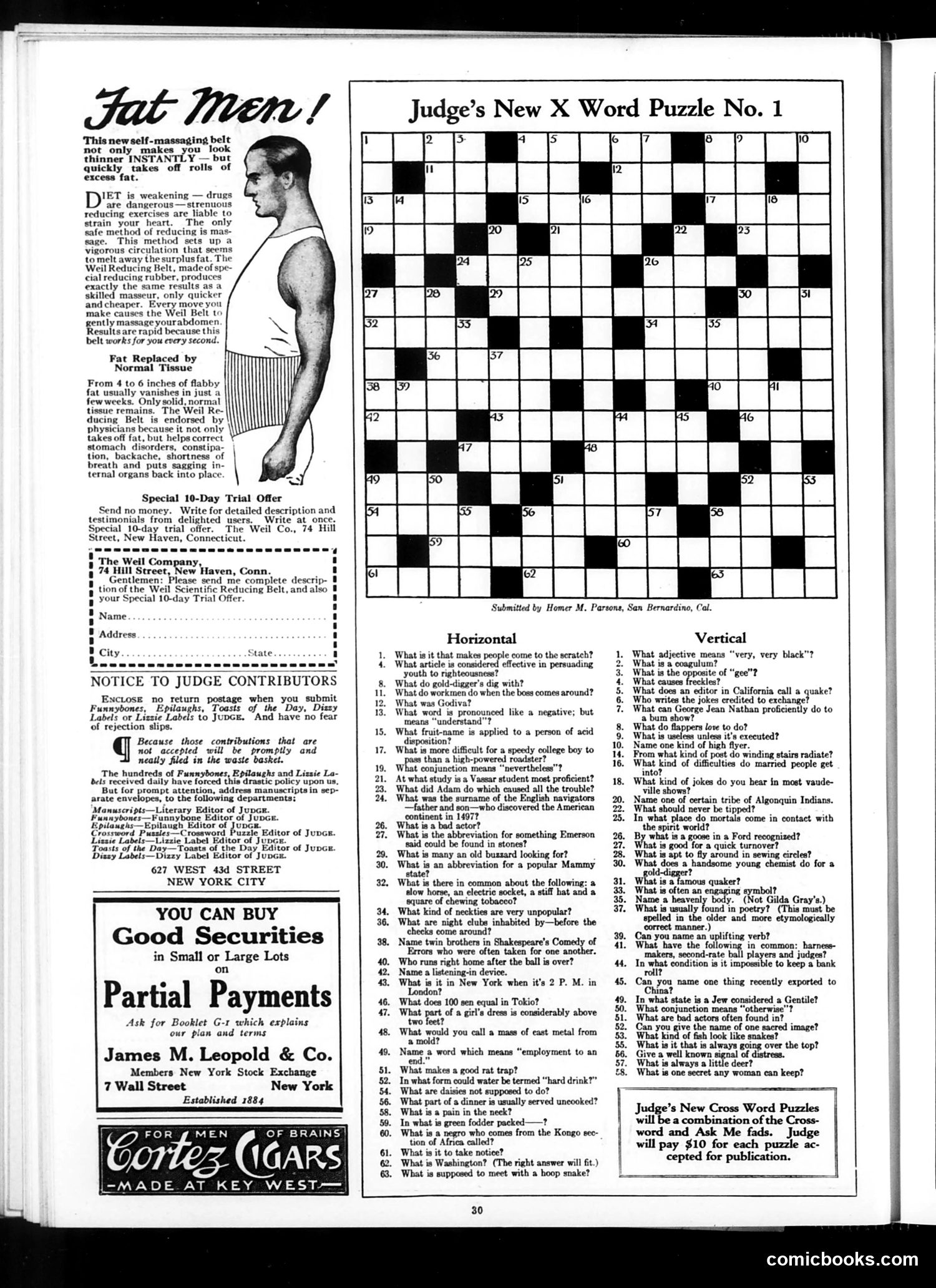
This page is primarily **advertising** for the Weil Reducing Belt, a weight-loss device marketed to men. The left side features a male figure in an undershirt, promoting a rubber belt that supposedly melts abdominal fat through "massage" — a common early 20th-century dubious health claim. The ad promises rapid results ("4 to 6 inches" lost) and physician endorsement, offering a 10-day trial. The page also includes: - Judge magazine's contributor guidelines (rejecting unsolicited manuscripts) - Stock brokerage and cigar advertisements - A crossword puzzle **The satire/humor**: The juxtaposition is subtle—Judge itself is satirizing contemporary consumer culture by running this questionable "scientific" reducing belt advertisement. To modern readers, the pseudoscientific claims (rubber belt = skilled massage = fat loss) are obviously fraudulent, but early 20th-century audiences apparently found such promises credible enough to warrant widespread advertising in major publications.
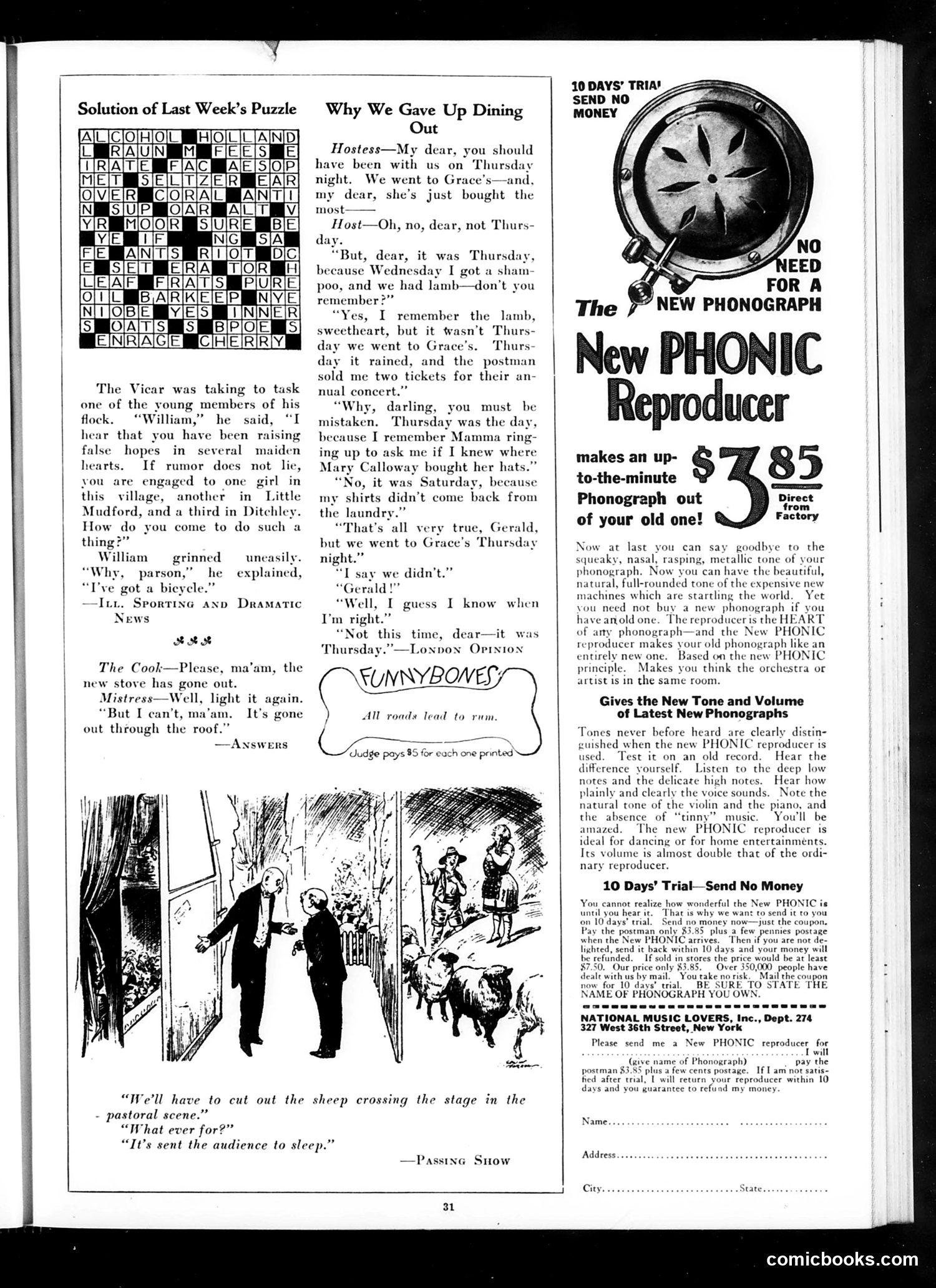
This page contains three distinct humor pieces and a phonograph advertisement: **"Why We Gave Up Dining Out"** (top): A married couple argues about which day they dined at a friend Grace's house. Each partner confidently misremembers—the husband claims Thursday, the wife insists it was Saturday or Wednesday. The joke satirizes how couples can have completely contradictory memories of the same event, yet both speak with absolute certainty. It's gentle domestic humor about marital miscommunication. **"The Vicar and William" (bottom left cartoon)**: A young man named William admits to being simultaneously engaged to three different women in three different villages. When the vicar expresses shock, William explains he can manage this deception because he has a bicycle—allowing him to visit each woman separately. The satire mocks both the unreliability of young men and the newfangled bicycle as an enabler of romantic duplicity. **"The Passing Show" (bottom): Theater-related joke about cutting a sheep-crossing scene from a pastoral play because it was putting the audience to sleep. The **PHONIC Reproducer advertisement** (right) promotes a phonograph attachment claiming to eliminate tinny sound quality and replicate expensive machines' tone.
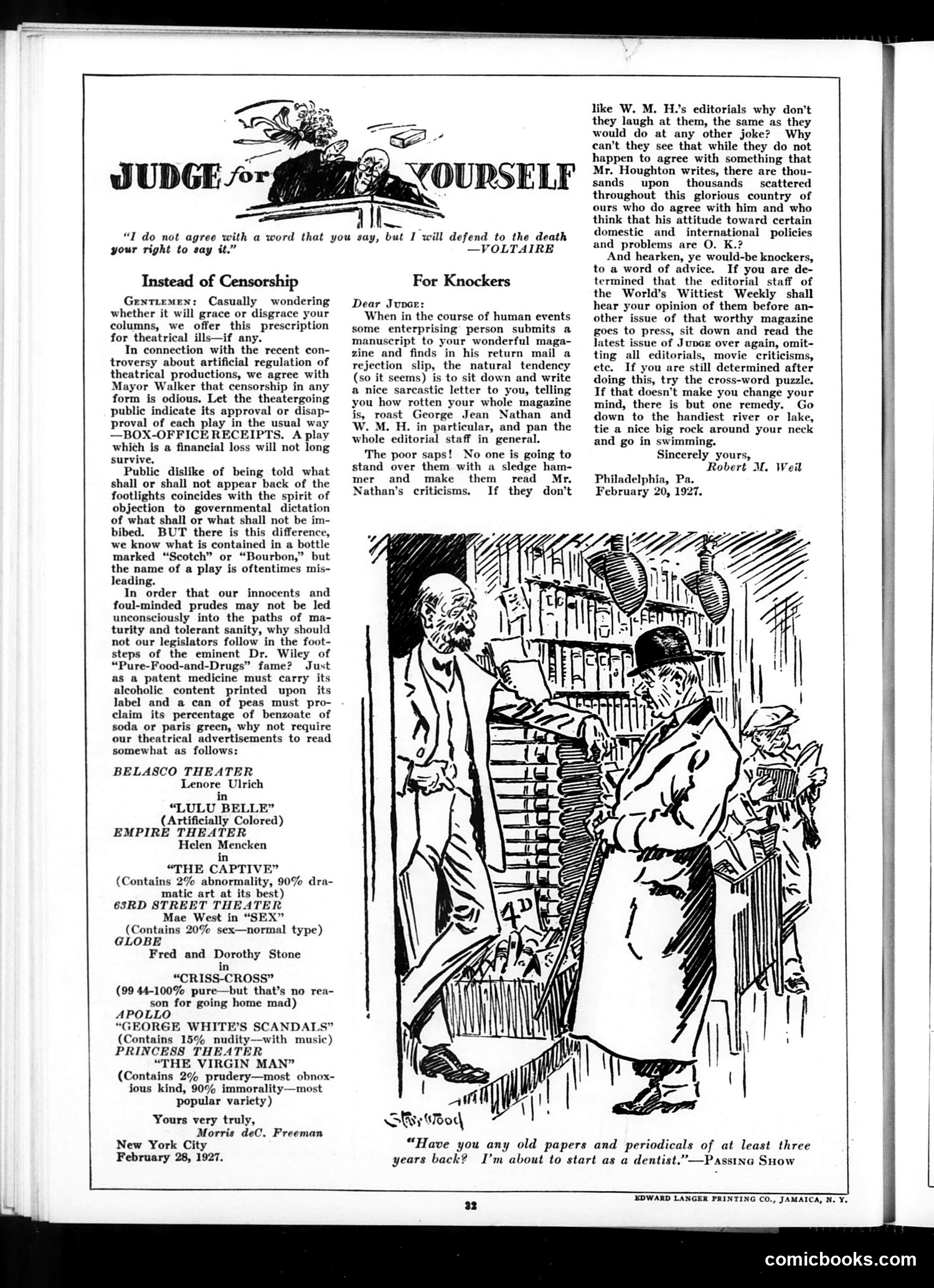
This 1927 *Judge* magazine page contains two satirical pieces on theatrical regulation and magazine criticism. **Main Cartoon & Text (Freeman's Letter):** The author proposes labeling Broadway plays like patent medicines, listing their "contents" humorously. He mocks recent censorship debates by suggesting plays by Mae West ("SEX"), Helen Mencken ("THE CAPTIVE"—likely referencing homosexual themes), and others be labeled with percentages of objectionable content. This satirizes Mayor Walker's opposition to theatrical censorship while acknowledging public concern about indecent material. **Secondary Letter ("For Knockers"):** The editor responds to rejected manuscript submissions who then criticize *Judge's* editorial staff (particularly critic George Jean Nathan and editor W.M.H.). The writer argues disgruntled readers should simply ignore content they dislike rather than complain—a libertarian stance reflecting 1920s attitudes about free speech and market forces. Both pieces defend editorial freedom while subtly acknowledging anxieties about morality in Jazz Age entertainment.
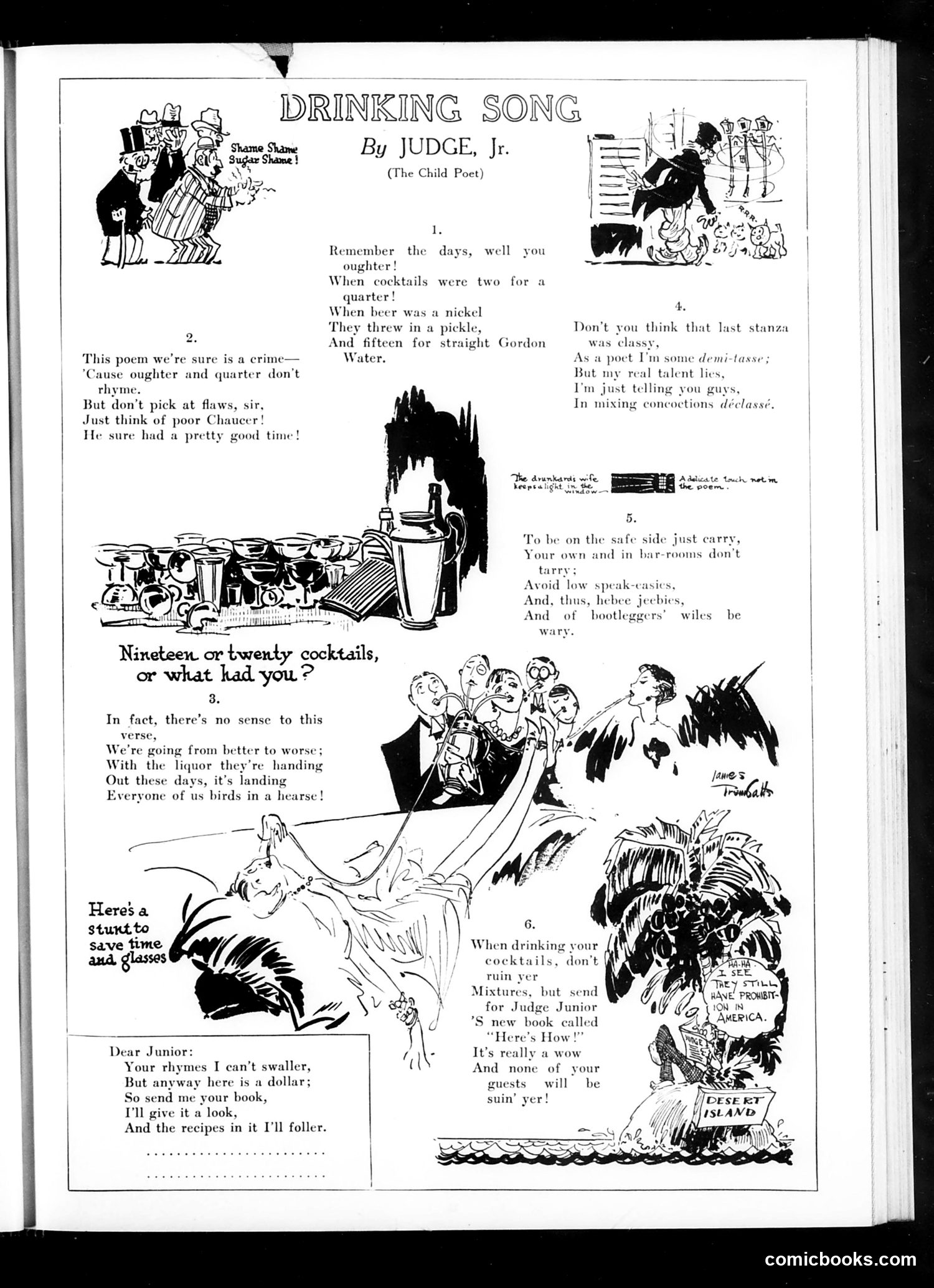
This is a satirical poem about Prohibition-era drinking culture. The song nostalgically recalls pre-Prohibition prices ("cocktails were two for a quarter") while mocking the current illegal drinking scene of the 1920s-30s. The humor targets: - **Prohibition's failure**: References to "bootleggers' wiles," illegal "speak-easies," and dangerous homemade "mixtures" that are poisoning drinkers ("landing everyone of us birds in a hearse") - **Self-aware bad poetry**: The author admits the rhymes don't work and the verse makes "no sense," creating intentional anti-humor - **Judge Junior's self-promotion**: The piece advertises a fake book called "Here's How!" with cocktail recipes, mocking both the author's mediocre talent and the public's continued appetite for drinking guides despite Prohibition The cartoons show drunken revelers and chaos, emphasizing how Prohibition created dangerous, unregulated alcohol consumption rather than eliminating drinking. The satire suggests Prohibition was counterproductive.
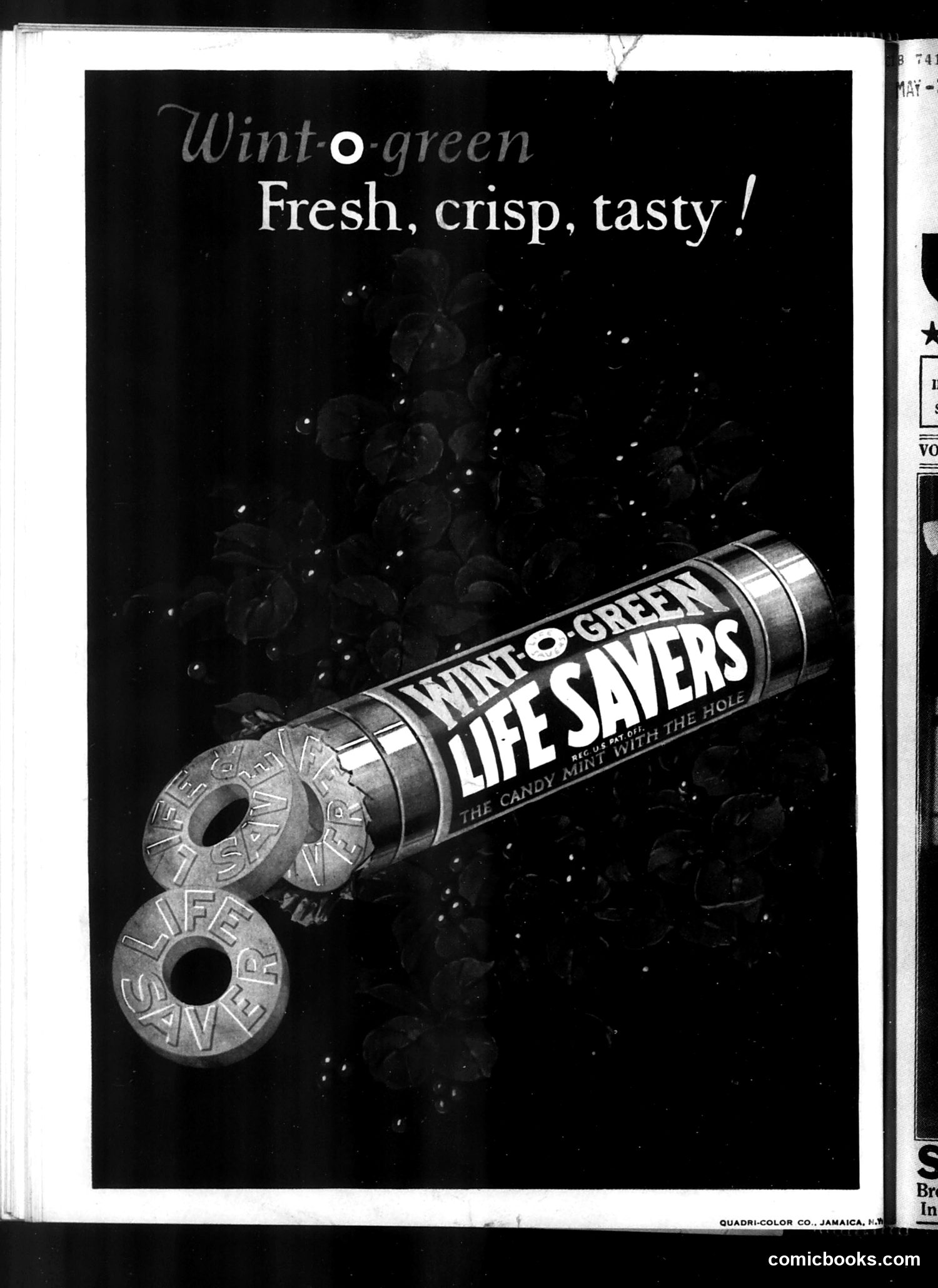
This is a vintage advertisement for Wint-O-Green Life Savers candy, not political satire. The ad promotes the mints as "Fresh, crisp, tasty!" and displays the product—a cylindrical roll of Life Savers with individual candies emerging below it. The tagline notes "THE CANDY MINT WITH THE HOLE," emphasizing the candy's distinctive ring shape with a center hole. The sparkling visual effects and dark background suggest freshness and appeal typical of mid-20th century advertising. This appears to be a straightforward commercial advertisement placed in Judge magazine rather than satirical content, representing the magazine's revenue model through paid advertising alongside editorial cartoons.