
Judge, 1927-04-30 · page 22 of 36
Judge — April 30, 1927 — page 22: what you’re looking at
What you’re looking at
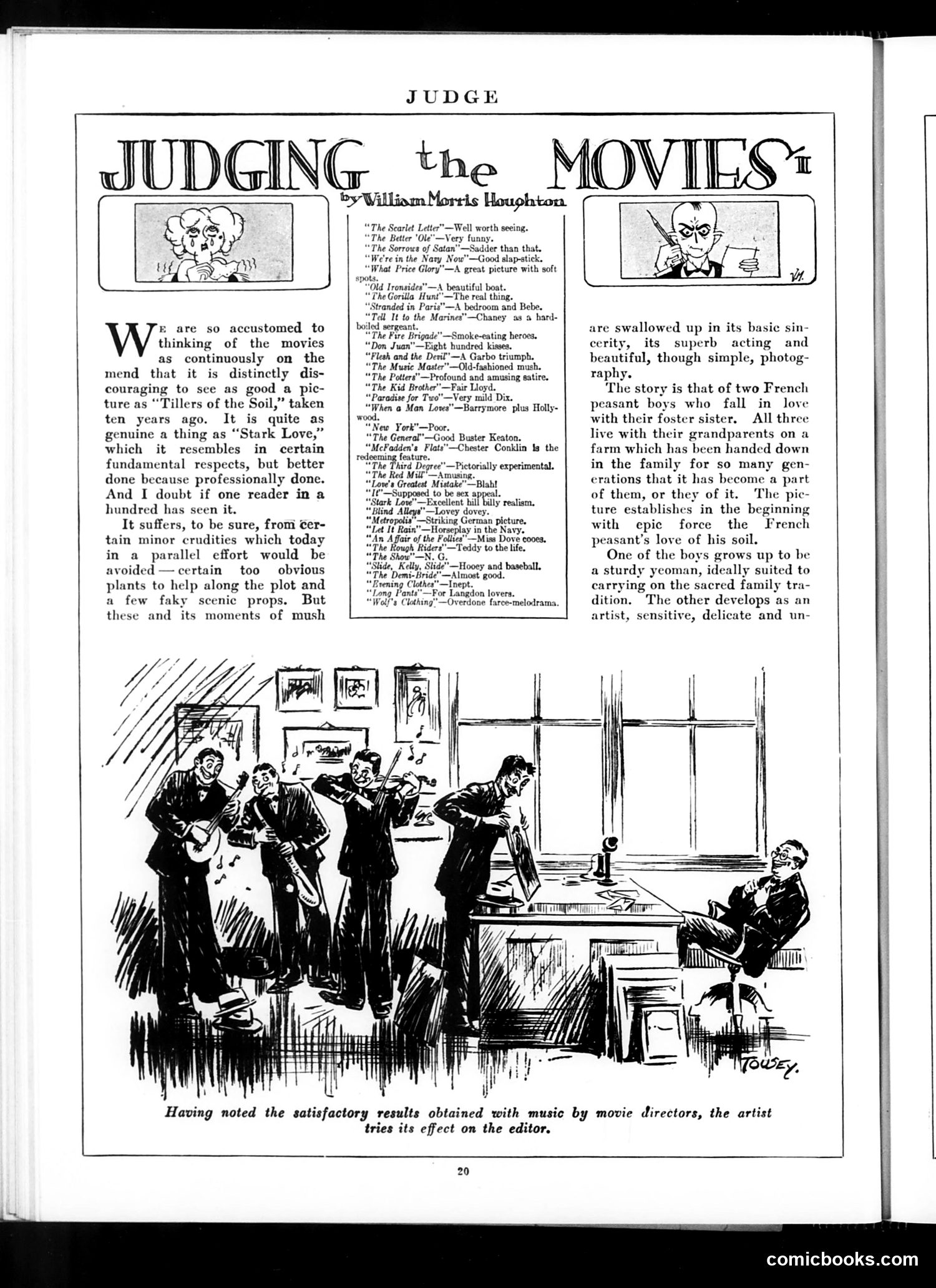
This page combines a film review column by William Morris Houghton with a cartoon satirizing movie music's effects. The cartoon depicts four musicians playing instruments while an editor sits at his desk, visibly distressed by the noise—the joke being that movie directors have discovered music enhances films, so now someone's trying the same technique on the magazine editor, with comically bad results. The review section lists brief critiques of contemporary films (many from the mid-1920s based on titles like "Metropolis" and "The General"), using sharp, humorous one-liners: praising some as genuinely good art while mocking others for being sentimental ("mush") or relying on scandal and sexuality rather than merit. The broader satire suggests Judge's skepticism about both the movie industry's hype and the notion that gimmicks (like added music) automatically improve quality—whether in cinema or journalism.
📄 Transcribed text from this page (OCR, searchable)
Machine-transcribed from the original scan — historical spelling and the odd misread are preserved.
JUDGING, ‘xe MOVIES* rE are so accustomed to W tinting of the movies as continuously on the mend that it is distinctly dis- couraging to see as good a pic- ture as “Tillers of the Soil,” taken ten years ago. It is quite as genuine a thing as “Stark Love,” which it resembles in certain fundamental respects, but better done because professionally done. And I doubt if one reader in a hundred has seen it. It suffers, to be sure, from cer- tain minor crudities which today in a parallel effort would be avoided — certain too obvious plants to help along the plot and a few faky scenic props. But these and its moments of mush JUDGE “The Scarlet Letter" —Well worth seeing. “The Better 'Ole"—Very funny. “The Sorrows of Satan"’—Sadder than that. “We're in the Naty Now" —Good slap-stick. What Price Glory"—A great picture with soft Old Ironsides"”—A beautiful boat. The Gorilla Hunt" —The real thing. “Stranded in Paris" —A bedroom and Bebe. “Tell It to the Marines"—Chaney as a hard- boiled sergeant. “The Fire Brigade”—Smoke-cating heroes. “Don Juan"—Eight hundred kisses, “Flesh and the Devil’—A Garbo triumph, “The Music Master”—Old-fashioned mush. “The Potters"—Profound and amusing satire. “The Kid Brother"—F: ¥ ld Dix. “When a Man Lovea"—Barrymore plus Holly- wood. “New York"—Poor. “The General"—Good Buster Keaton, “McFadden's Flats"—Chester Conklin ts the redeeming feature. —Pictoraly experimental e's Grealea! Mislake"=~Blabt "—Supposed to be sex ap} stark Lowe’ —Excellent hill billy realism. ‘Blind Alleys” —Lovey dovey. ‘Metropolis —Striking German picture, ‘Let It Rain” Pon, Langdon lovers. ‘Overdone farce-melodrama, are swallowed up in its basic sin- cerity, its superb acting and beautiful, though simple, photog- raphy. The story is that of two French peasant boys who fall in love with their foster sister. All three live with their grandparents on a farm which has been handed down in the family for so many gen- erations that it has become a part of them, or they of it. The pic- ture establishes in the beginning with epic force the French peasant’s love of his soil. One of the boys grows up to be a sturdy yeoman, ideally suited to carrying on the sacred family tra- dition. The other develops as an artist, sensitive, delicate and un- Having noted the satisfactory results obtained with music by movie directors, the artist 1 tries its effect on the editor. comicbooks.com