
Judge, 1927-04-30 · page 15 of 36
Judge — April 30, 1927 — page 15: what you’re looking at
What you’re looking at
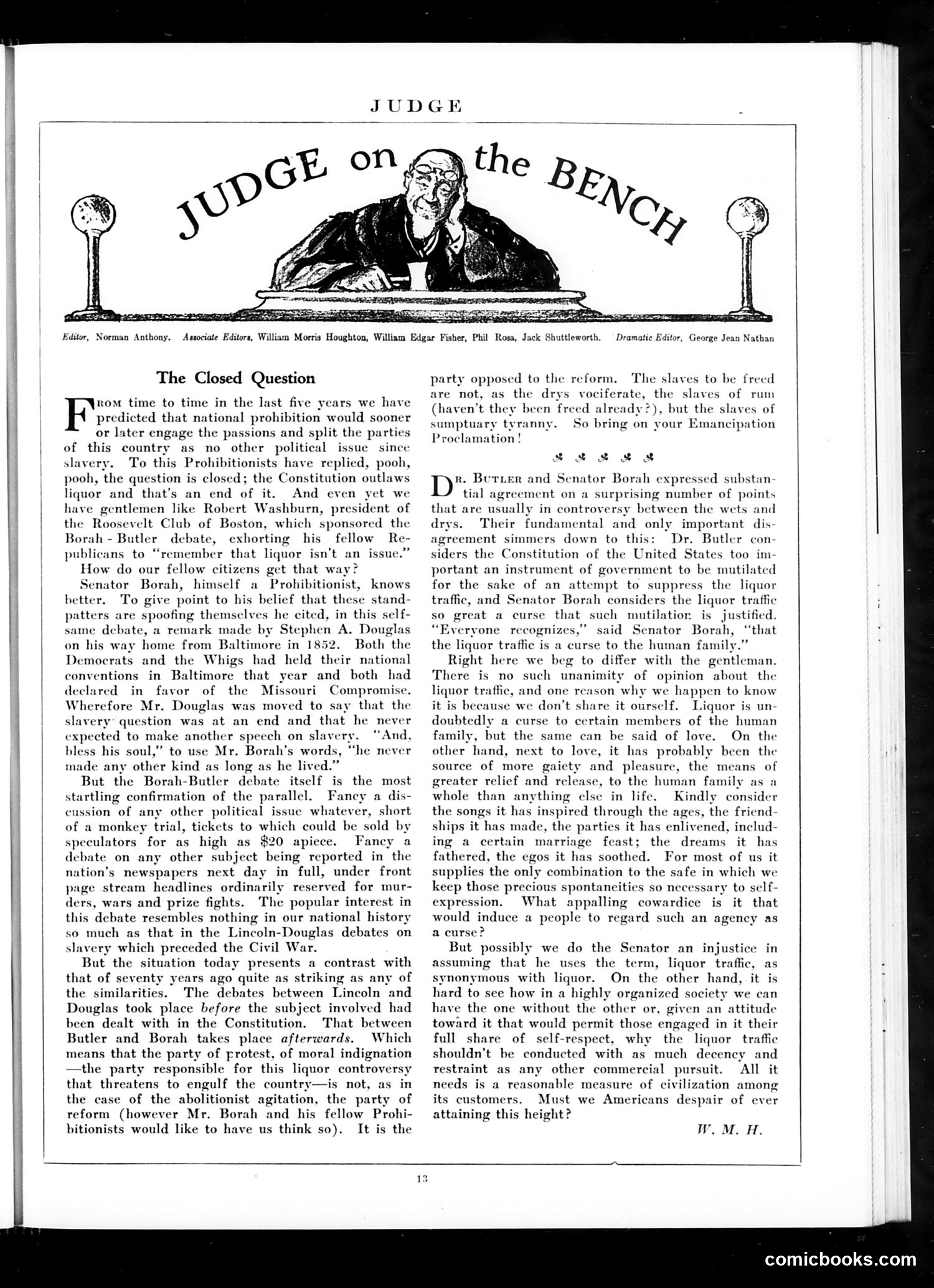
This editorial page argues that Prohibition is not a "closed question" despite claims otherwise. The article references a recent debate between Senator William Borah (a Prohibitionist) and Dr. Nicholas Murray Butler over liquor regulation. **The Satire's Point:** The piece compares the heated Prohibition debate to the pre-Civil War Lincoln-Douglas slavery debates, suggesting the issue is far from settled despite the 18th Amendment's passage. Judge mocks those claiming the matter is resolved. **Key Irony:** While Prohibitionists frame themselves as reformers "freeing slaves" from alcohol, the editorial suggests they're actually the party of restriction—enslaving people to "sumptuary tyranny" (enforced temperance). The wet (anti-Prohibition) position is framed as the true reform, opposing government overreach. The debate's massive public interest—tickets selling for $20, front-page coverage—proves Prohibition remains a divisive political issue despite constitutional prohibition, contradicting claims the question is "closed."
📄 Transcribed text from this page (OCR, searchable)
Machine-transcribed from the original scan — historical spelling and the odd misread are preserved.
Editor, Norman Anthony. Associate Editors, William Morris Houghton, William Edgar Fisher, Phil Rosa, Jack Shuttleworth. The Closed Question rom time to time in the last five rs we have FB oeesictea that national prohibition would sooner or later engage the passions and split the parties of this country as no other political issue since slavery. To this Prohibitionists have replied, pooh, pooh, the question is closed; the Constitution outlaws liquor and that’s an end of it. And even yet we have gentlemen like Robert Washburn, president of the Roosevelt Club of Boston, which sponsored the Borah - Butler debate, exhorting his fellow Re- publicans to “ ’ remember that liquor isn’t an issue.’ How do our fellow citizens get that way? Senator Borah, himself a Prohibitionist, knows better, To give point to his belief that these stand- patters are spoofing themselves he cited, in this self- same debate, a remark made by Stephen A. Douglas on his way home from Baltimore in 185 Both the Democrats and the Whigs had held their national conventions in Baltimore that year and both had declared in favor of the Missouri Compromise. Wherefore Mr. Douglas was moved to say that the slavery’ question was at an end and that he never expected to make another speech on slavery. “And, bless his soul,” to use Mr. Borah’s words, “he never made any other kind as long as he lived.” But the Borah-Butler deb: itself is the most startling confirmation of the allel. Fancy a dis- cussion of any other political issue whatever, short of a monkey trial, tickets to which could be sold by speculators for as high as $20 apiece. Fancy a debate on any other subject being reported in the nation’s newspapers next day in full, under front page stream headlines ordinarily reserved for mur- ders, wars and prize fights. The popular interest in this debate resembles nothing in our national history so much as that in the Lincoln-Douglas debates on slavery which preceded the Civil War. But the situation today presents a contrast with that of seventy years ago quite as striking as any of the similar! The debates between Lincoln and Douglas took place before the subject involved had been dealt with in the Constitution. That between Butler and Borah takes place afterwards. Which means that the party of protest, of moral indignation —the party responsible for this liquor controversy that threatens to engulf the country—is not, in the case of the abolitionist agitation, the party of reform (however Mr. Borah and his fellow Prohi- bitionists would like to have us think so). It is the Dramatic Editor, George Jean Nathan party opposed to the reform. The slaves to be freed are not, as the drys vociferate, the slaves of rum (haven't they been freed already ?), but the slaves of sumptuary tyranny. So bring on your Emancipation Proclamation! 42 fs rn. Butter and Senator Borah expressed substan tial agreement on a surprising number of points that are usually in controversy between the wets and drys. Their fundamental and only important dis- agreement simmers down to this: Dr. Butler con siders the Constitution of the United States too im- portant an instrument of government to be mutilated for the sake of an attempt to suppress the liquor traffic, and Senator Borah considers the liquor tr so great a curse that such mutilation. is j “Everyone recognizes,” said Senator Borah, the liquor traffic is a curse to the human family Right here we beg to differ with the gentleman, There is no such unanimity of opinion about the liquor traffic, and one red just on why we happen to know it is because we don’t share it ourself. Liquor is un doubtedly a curse to certain members of the human family, but the same n be said of love. On the other hand, next to love, it probably been the source of more gaiety and pleasure, the means of greater relief and release, to the human famil whole than anything else in life. Kindly consider the songs it has inspired through the ages, the friend ships it has made, the parties it has enlivened, includ- ing a certain marriage feast; the dreams it has fathered, the egos it has soothed. For most of us it supplies the only combination to the safe in which we keep those precious spontaneities so necessary to self- expression. What appalling cowardice is it that would induce a people to regard such an agency as a curse? But possibly we do the Senator an injustice in assuming that he uses the term, liquor traffic, as synonymous with liquor. On the other hand, it is hard to see how in a highly organized society we can have the one without the other or, given an attitude toward it that would permit those engaged in it their full share of self-respect, why the liquor traffic shouldn’t be conducted with as much decency and restraint as any other commercial pursuit. All it needs is a reasonable measure of civ its customers. Must we Americ: attaining this height? asa tion among ns despair of ever W.M. H. comicbooks.com