
Judge, 1927-04-30 · page 20 of 36
Judge — April 30, 1927 — page 20: what you’re looking at
What you’re looking at
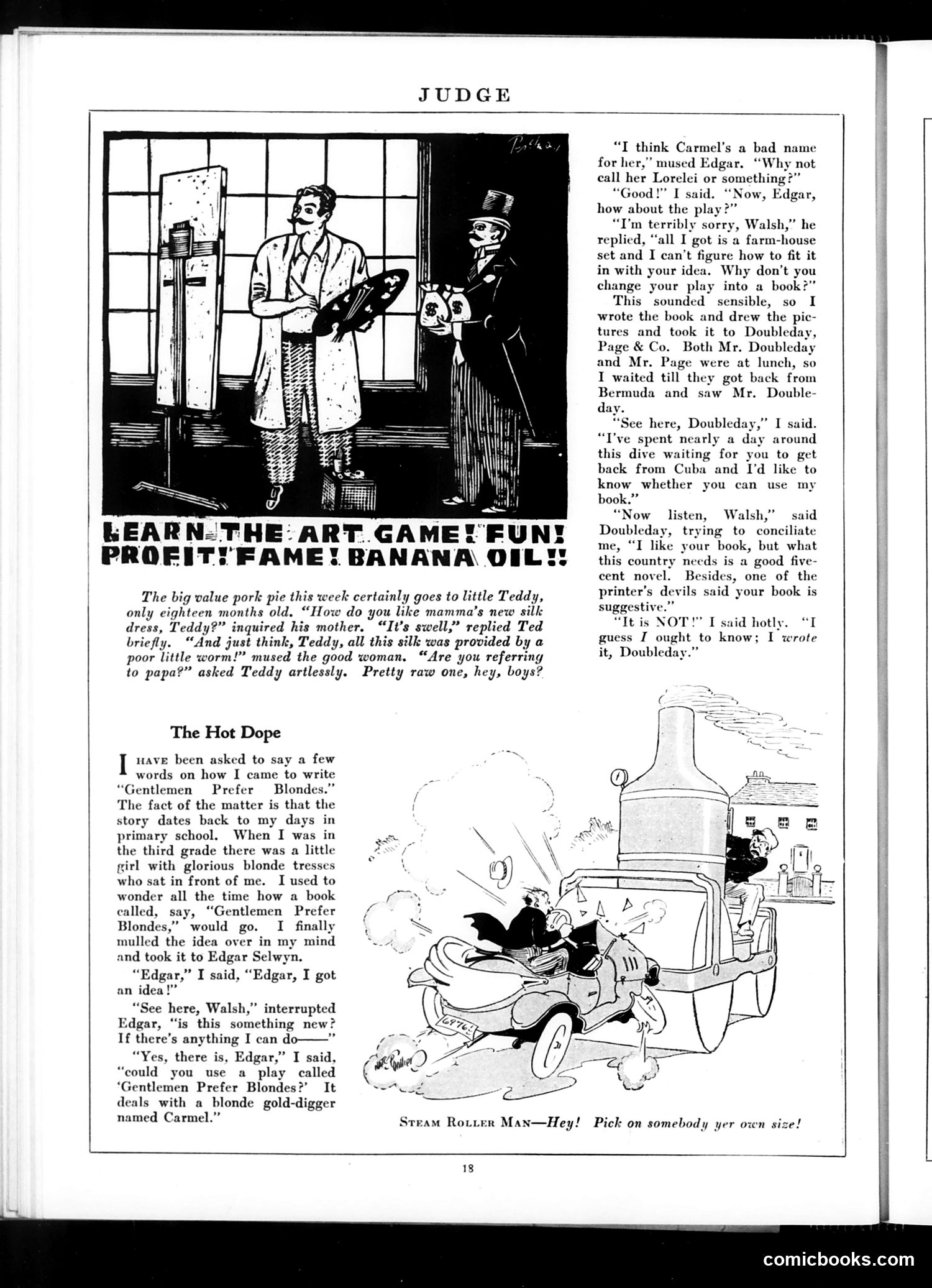
This page satirizes the publishing industry and artistic pretension circa the 1920s. "The Hot Dope" section parodies the origin story of *Gentlemen Prefer Blondes* (the famous novel/play), depicting how creators pitch work to publishers. The humor targets: **The satire:** Publishers' timidity about "suggestive" content, their arbitrary objections (the farm-house set complaint), and the gap between artist ambition and commercial reality. Walsh's indignant response—"I ought to know; I wrote it"—mocks defensive creators. **Top cartoon:** Jokes about a toddler asking if his mother's silk dress came from "papa" (implying the father is kept like a "worm"), with the punchline "Pretty raw one, hey, boys?" This is crude humor about marital infidelity. **The "Learn the Art Game" banner** advertises the satirical content itself—mocking how writers peddle work as path to "profit, fame, banana oil" (slang for empty promises/hype). The page targets artistic ego and publishing gatekeeping of the Jazz Age.
📄 Transcribed text from this page (OCR, searchable)
Machine-transcribed from the original scan — historical spelling and the odd misread are preserved.
BEARN. THE: ART. GAME! FUN! PROFIT! FAME! BANANA OIL! The big value pork pie this week certainly goes to little Teddy, only eighteen months old. “How do you like mamma’s new silk dress, Teddy?” inquired his mother. briefly. “And just think, Teddy, all this silk was provided by a poor little worm!” mused the good woman. “Are you referring Pretty raw one, hey, boys? to papa?” asked Teddy artlessly. The Hot Dope I Have been asked to say a few words on how I came to write “Gentlemen Prefer Blondes.” The fact of the matter is that the story dates back to my days in primary school. When I was in the third grade there was a little girl with glorious blonde tresses who sat in front of me. I used to wonder all the time how a book called, say, “Gentlemen Prefer Blondes,” would go. I finally mulled the idea over in my mind and took it to Edgar Selwyn. “Edgar,” I said, “Edgar, I got an idea!” “See here, Walsh,” interrupted Edgar, “is this something new? If there’s anything I can do——” “Yes, there is, Edgar,” I said, “could you use a play called ‘Gentlemen Prefer Blondes?’ It deals with a blonde gold-digger named Carmel.” “It’s swell,” replied Ted “T think Carmel’s a bad name for her,” mused Edgar. “Why not call her Lorelei or something?” “Good!” I said. “Now, Edgar, how about the play?” “T’m terribly sorry, Walsh,” he replied, ‘“‘all I got is a farm-house set and I can’t figure how to fit it in with your idea. Why don’t you change your play into a book?” This sounded sensible, so I wrote the book and drew the pic- tures and took it to Doubleday, Page & Co. Both Mr. Doubleday and Mr. Page were at lunch, so I waited till they got back from Bermuda and saw Mr. Double- day. ce here, Doubleday,” I said. spent nearly a day around this dive waiting for you to get back from Cuba and I'd like to know whether you can use my book.” “Now listen, Walsh,” said Doubleday, trying to concil me, “I like your book, but w! cent novel. Besides printer’s devils said your book is suggestive.” “It is NOT!" I said hotly. “T guess I ought to know; I wrote it, Doubleday.” comicbooks.com