
Judge, 1927-04-30 · page 10 of 36
Judge — April 30, 1927 — page 10: what you’re looking at
What you’re looking at
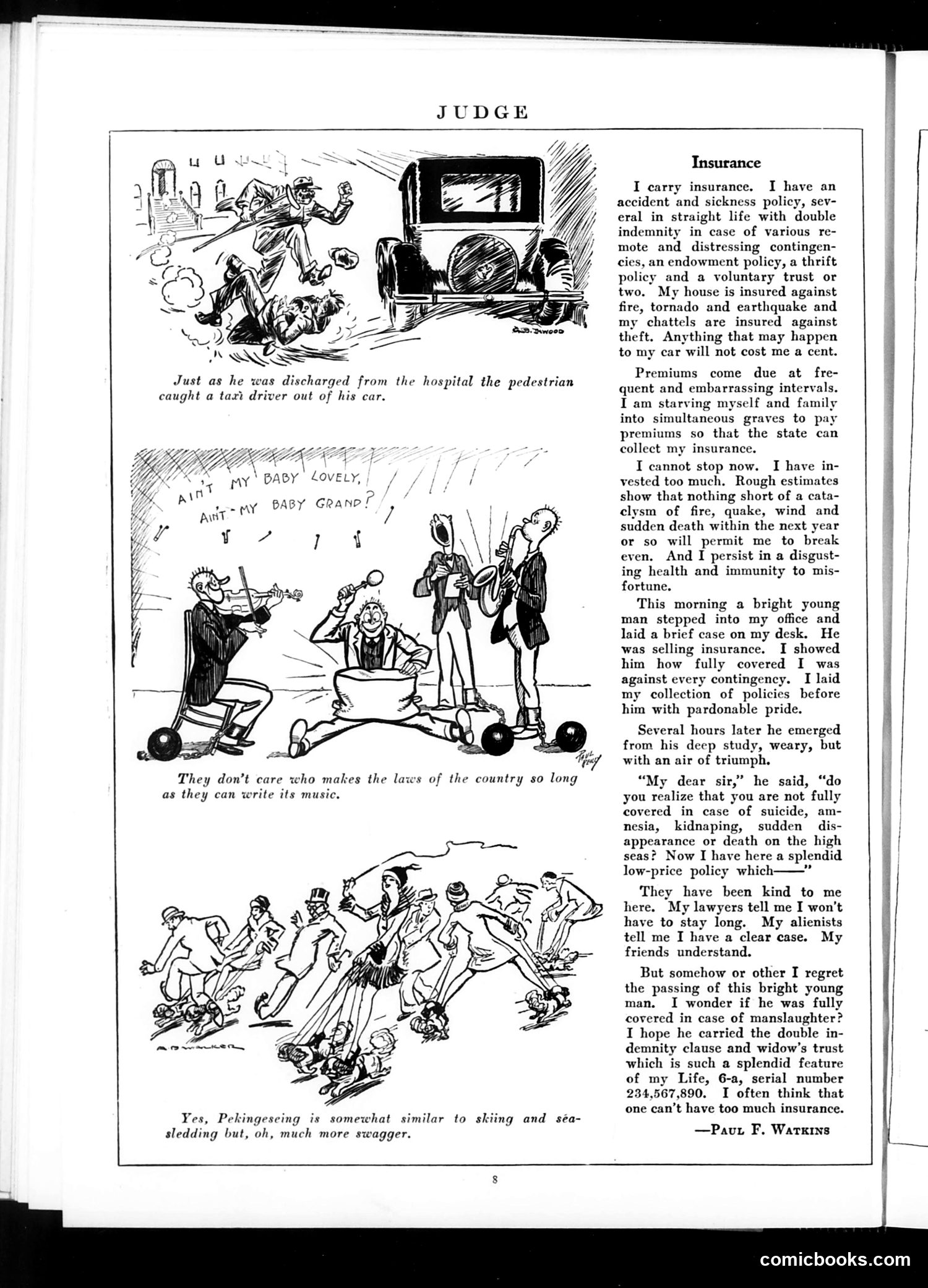
This page contains three satirical cartoons and an essay on insurance by Paul F. Watkins. **The cartoons mock:** 1. **Taxi violence**: A pedestrian, freshly discharged from a hospital, immediately encounters a reckless taxi driver—suggesting urban transportation hazards were frequent and inescapable. 2. **Musicians' political influence**: Figures playing instruments while lawmakers are ignored, satirizing the outsized cultural/entertainment industry power relative to actual governance. 3. **"Pekingese-ing"**: Wealthy people engaging in fashionable leisure activities (skiing, sledding), mocking upper-class pretension and invented status symbols. **The insurance essay** is dark satire: Watkins describes purchasing layer upon layer of insurance policies until he's impoverished his family to pay premiums—yet remains frustratingly healthy and accident-free, unable to "break even." When an insurance salesman discovers gaps in his coverage, Watkins implies (darkly) he may harm the salesman. The piece mocks both insurance industry exploitation and the obsessive risk-aversion of the wealthy. The overall tone critiques early 20th-century urban dangers, cultural elitism, and aggressive insurance marketing.
📄 Transcribed text from this page (OCR, searchable)
Machine-transcribed from the original scan — historical spelling and the odd misread are preserved.
JUDGE Just as he was discharged from the hospital the pedestrian caught a tazi driver out of his car. / + ny! Baby. LoveLy, n oy A rey BABY Granol w) A They don’t care who makes the laws of the country so long as they can write its music. Yes, Pekingeseing is somewhat similar to skiing and séa- sledding but, oh, much more swagger. Insurance I carry insurance. I have an accident and sickness policy, sev- eral in straight life with double indemnity in case of various re- mote and distressing contingen- cies, an endowment policy, a thrift policy and a voluntary trust or two. My house is insured against fire, tornado and earthquake and my chattels are insured against theft. Anything that may happen to my car will not cost me a cent. Premiums come due at fre- quent and embarrassing intervals. I am starving myself and family into simultaneous graves to pay premiums so that the state can collect my insurance. I cannot stop now. I have in- vested too much. Rough estimates show that nothing short of a cata- elysm of fire, quake, wind and sudden death within the next year or so will permit me to break even. And I persist in a disgust- ing health and immunity to mis- fortune. This morning a bright young man stepped into my office and laid a brief case on my desk. He was selling insurance. I showed him how fully covered I was against every contingency. I laid my collection of policies before him with pardonable pride. Several hours later he emerged. from his deep study, weary, but with an air of triumph, “My dear sir,” he said, “do you realize that you are not fully covered in case of suicide, am- nesia, kidnaping, sudden dis- appearance or death on the high seas? Now I have here a splendid low-price policy which: _ They have been kind to me here. My lawyers tell me I won't have to stay long. My alienists tell me I have a clear case. My friends understand. But somehow or other I regret the passing of this bright young man. I wonder if he was fully covered in case of manslaughter? I hope he carried the double in- demnity clause and widow’s trust which is such a splendid feature of my Life, 6-a, serial number 234,567,890. I often think that one can’t have too much insurance. —Paut F. Watkins mE comicbooks.com