
A complete issue · 36 pages · 1927
Judge — March 19, 1927
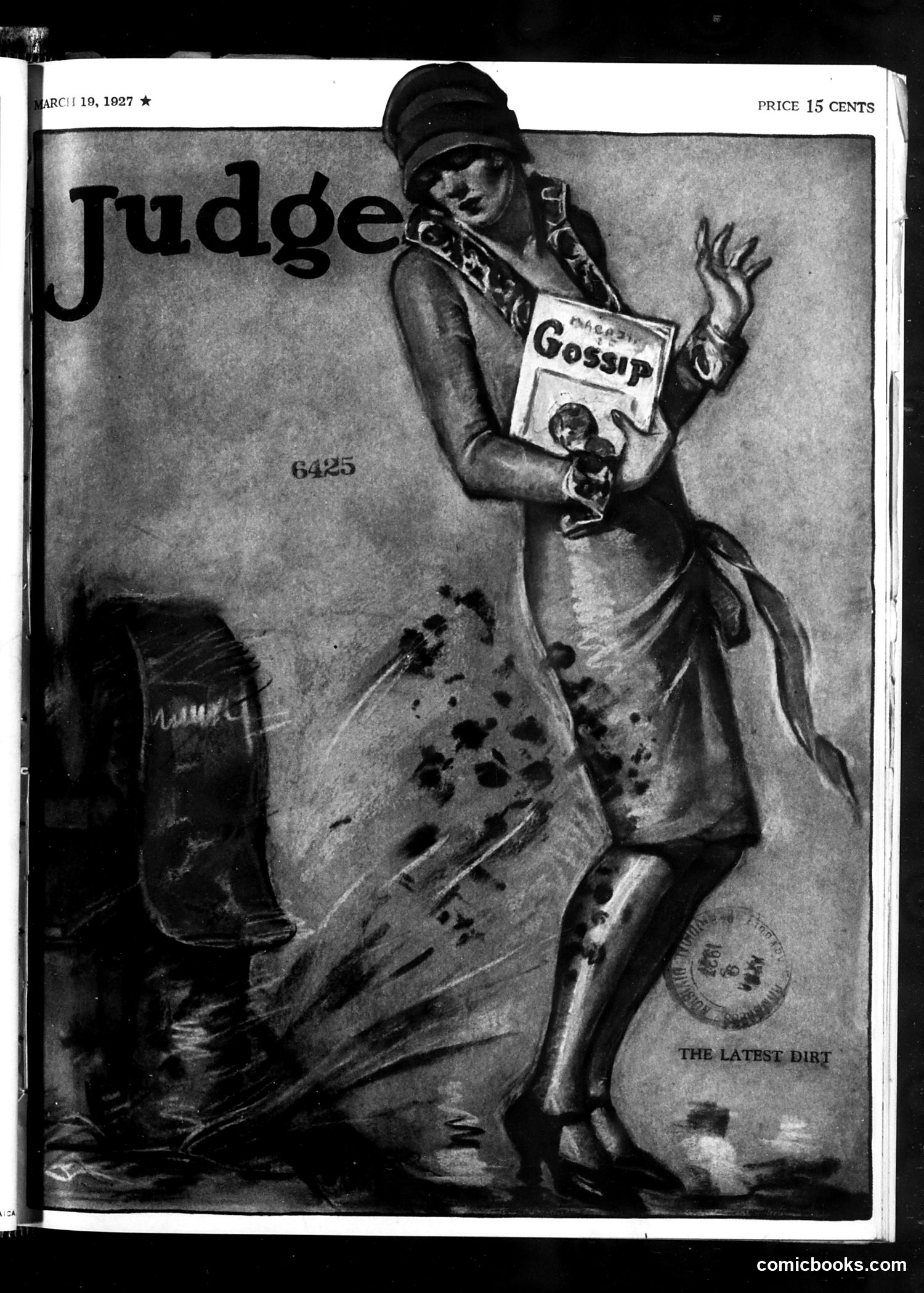
This satirical cover illustrates "The Latest Dirt"—a pun on gossip magazines. The central figure, a woman in 1920s attire, holds a "Gossip" publication while appearing to trudge through literal mud and dirt, with mud splattering her clothing and shoes. The satire targets gossip magazines themselves, suggesting they traffic in "dirt" both literally (through crude, base content) and figuratively (through salacious rumors). The woman's fashionable appearance contrasts ironically with her mud-covered condition, mocking how readers of gossip publications get metaphorically "soiled" by consuming such material. The cover critiques the popularity of celebrity gossip and scandal sheets during the Jazz Age, positioning them as degrading both to subjects and consumers.
This page contains a humorous visual test rather than a political cartoon. The text reads: "IF YOU CAN READ THIS" followed by a boxed message in very small print (intentionally illegible in reproduction) referencing "JUDGE, H.S. book of new drink recipes" and "Here's How." Below this, it states: "and don't sign on the dotted line. YOU'RE TOO DARN CLOSE!" **The joke:** This is a playful optical illusion/eye test. Readers positioned too close to the magazine literally cannot read the tiny print, making the warning ironic—by the time they can read it, they've already violated its instruction. It's self-referential humor about the magazine itself, poking fun at readers' eagerness while promoting one of Judge's own publications. There's no political content here; it's purely recreational satire.
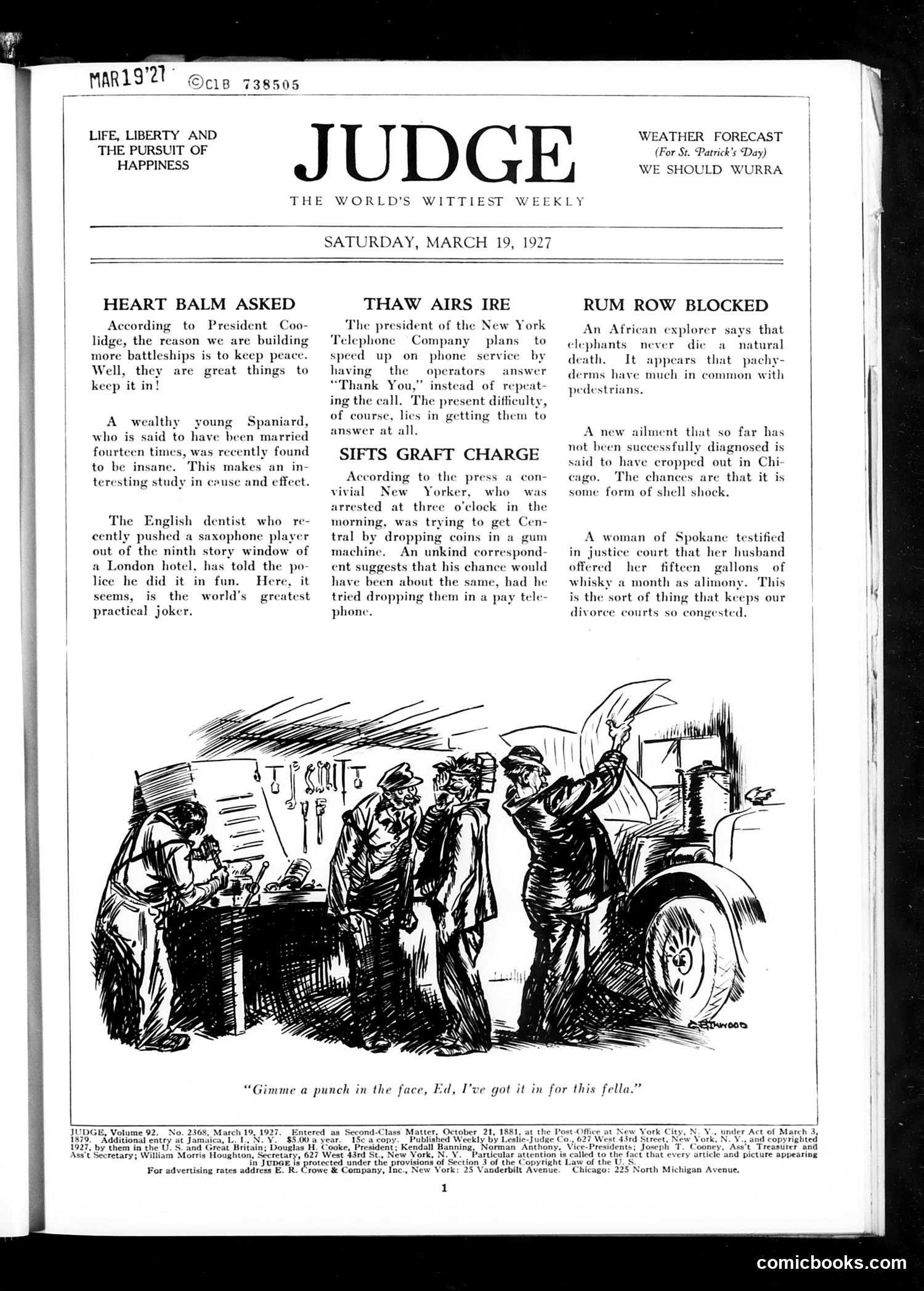
The main cartoon depicts street-level commerce, likely showing working-class men conducting informal transactions. The caption—"Gimme a punch in the face, Ed, I've got it in for this fella"—suggests a humorous scene about settling debts or disputes through barter rather than money. The accompanying articles address mundane social issues: a tooth-extraction prank, telephone service delays, and divorce court congestion. The "Rum Row Blocked" headline references Prohibition-era smuggling operations. The overall tone is light social satire critiquing everyday American frustrations in the 1920s—inefficient services, petty crime, and marital discord. The humor relies on absurdist scenarios rather than political commentary. This represents Judge's typical satirical approach to contemporary urban life during the Jazz Age.
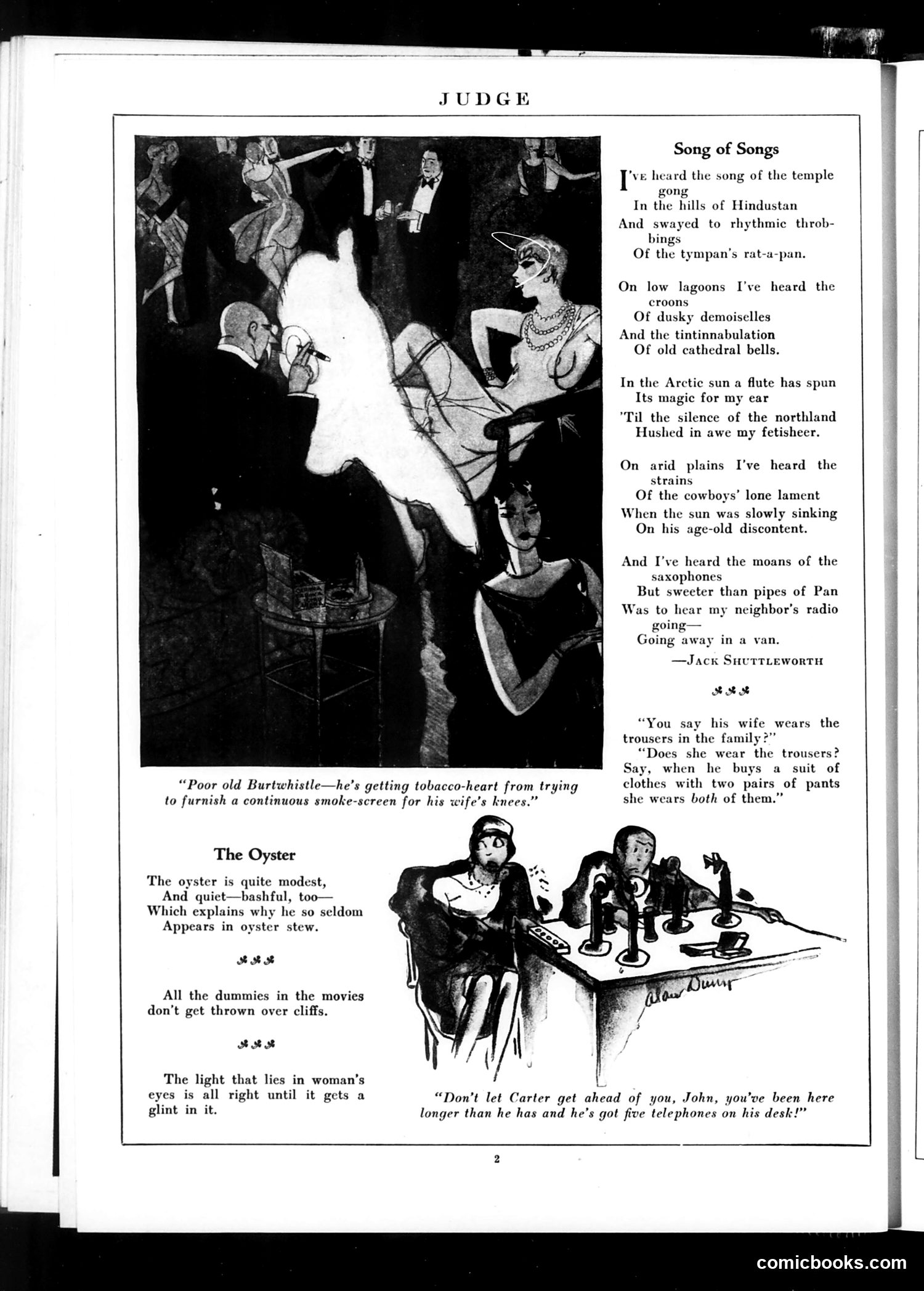
This page contains three separate pieces of humor: **"Song of Songs"** by Jack Shuttleworth is a nostalgic poem contrasting exotic sounds heard worldwide with the mundane pleasure of a neighbor's radio—satirizing American domesticity and the radio's cultural dominance in the era. **"The Oyster"** is a brief poem playing on the oyster's reputation for bashfulness, with accompanying quips about movie dummies and women's eyes. These are simple wordplay jokes without clear political reference. **The cartoon** (bottom) shows two businessmen at lunch, one warning the other not to let a colleague "get ahead" due to his multiple telephones. This satirizes workplace competition and status-seeking through technology ownership—a period concern as telephones represented professional power and access. The page reflects interwar American anxieties about modernity, technology, and office culture.
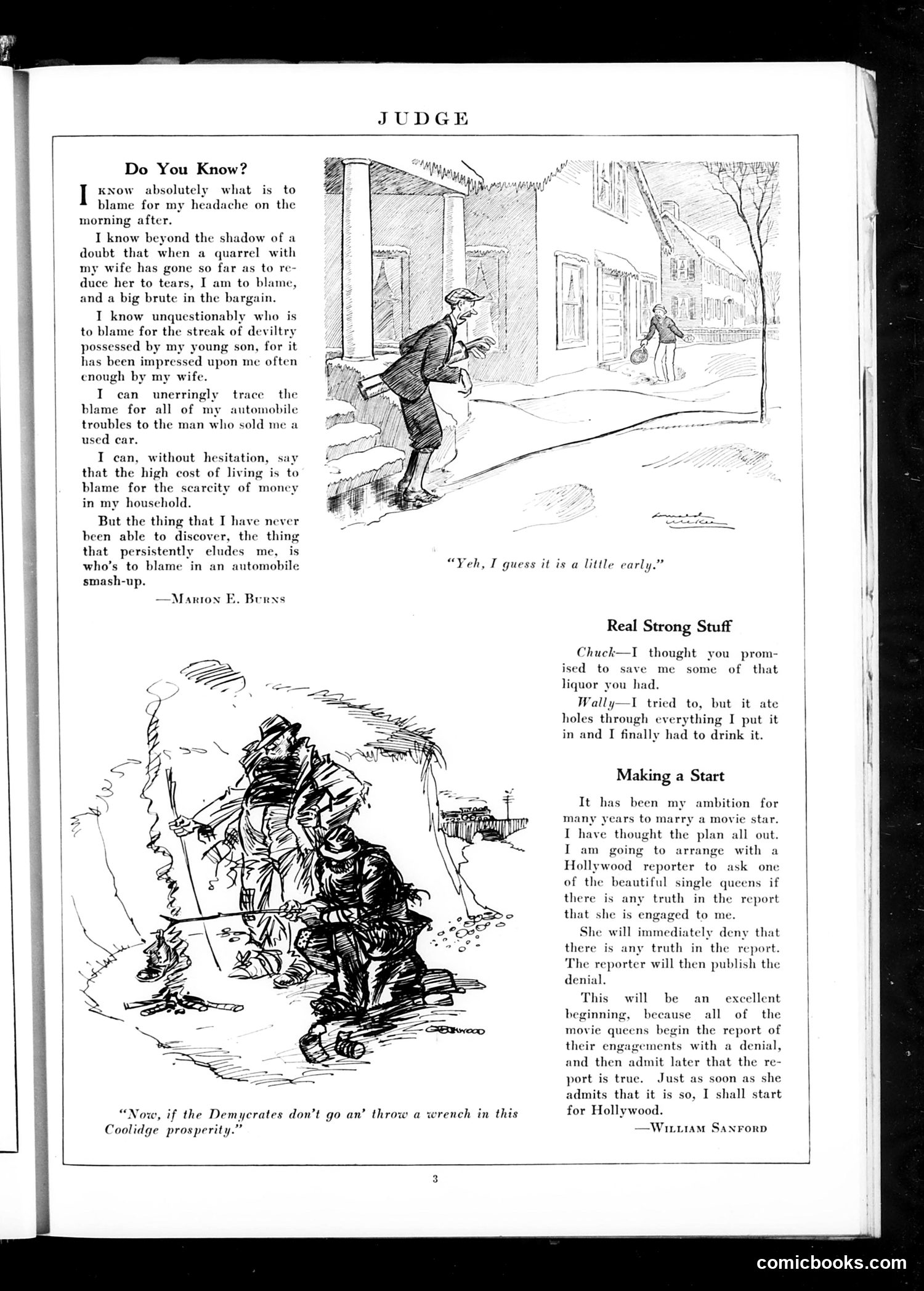
This page contains three separate humor pieces rather than connected political cartoons. **"Do You Know?"** - Marion F. Bruess humorously catalogs domestic blame-shifting, culminating in the joke that the one thing he can't determine is "who's to blame in an automobile smash-up." **"Real Strong Stuff"** - A brief joke about liquor that "ate holes through everything." **"Making a Start"** - William Sanford satirizes Hollywood gossip tactics: a man plans to ask a movie starlet if she's engaged, she'll deny it, he'll publish the denial, then she'll admit it's true—creating a cycle of engagement rumors. This mocks how entertainment reporters and actresses manipulate publicity through strategic denials. The page reflects early 20th-century preoccupations with automobiles, Prohibition-era liquor, and emerging Hollywood celebrity culture.
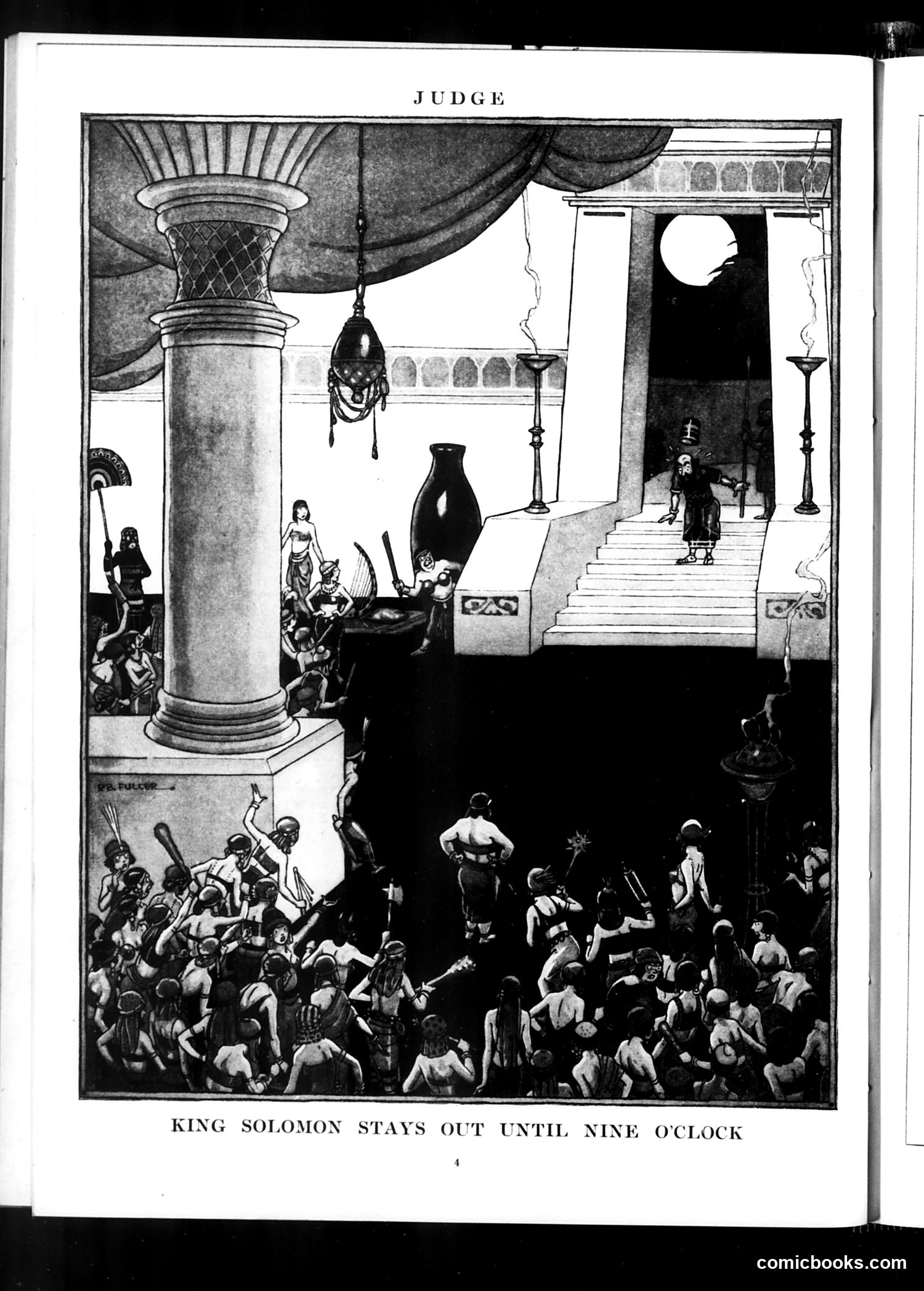
This cartoon satirizes a legal or judicial proceeding, as indicated by the "JUDGE" header. The image depicts a grand, classical courtroom or palace setting with a large crowd of common people below, appearing to petition or protest before an elevated judge's bench. The title's reference to King Solomon—the biblical judge famous for wise decisions—appears ironic. The satire likely critiques either a judge's delayed ruling, absence from duty, or reluctance to issue judgment on an important case affecting many people. The crowd's agitation and the judge remaining absent until 9 p.m. suggests commentary on judicial inefficiency, procrastination, or judicial indifference to public concerns during the early 20th century.
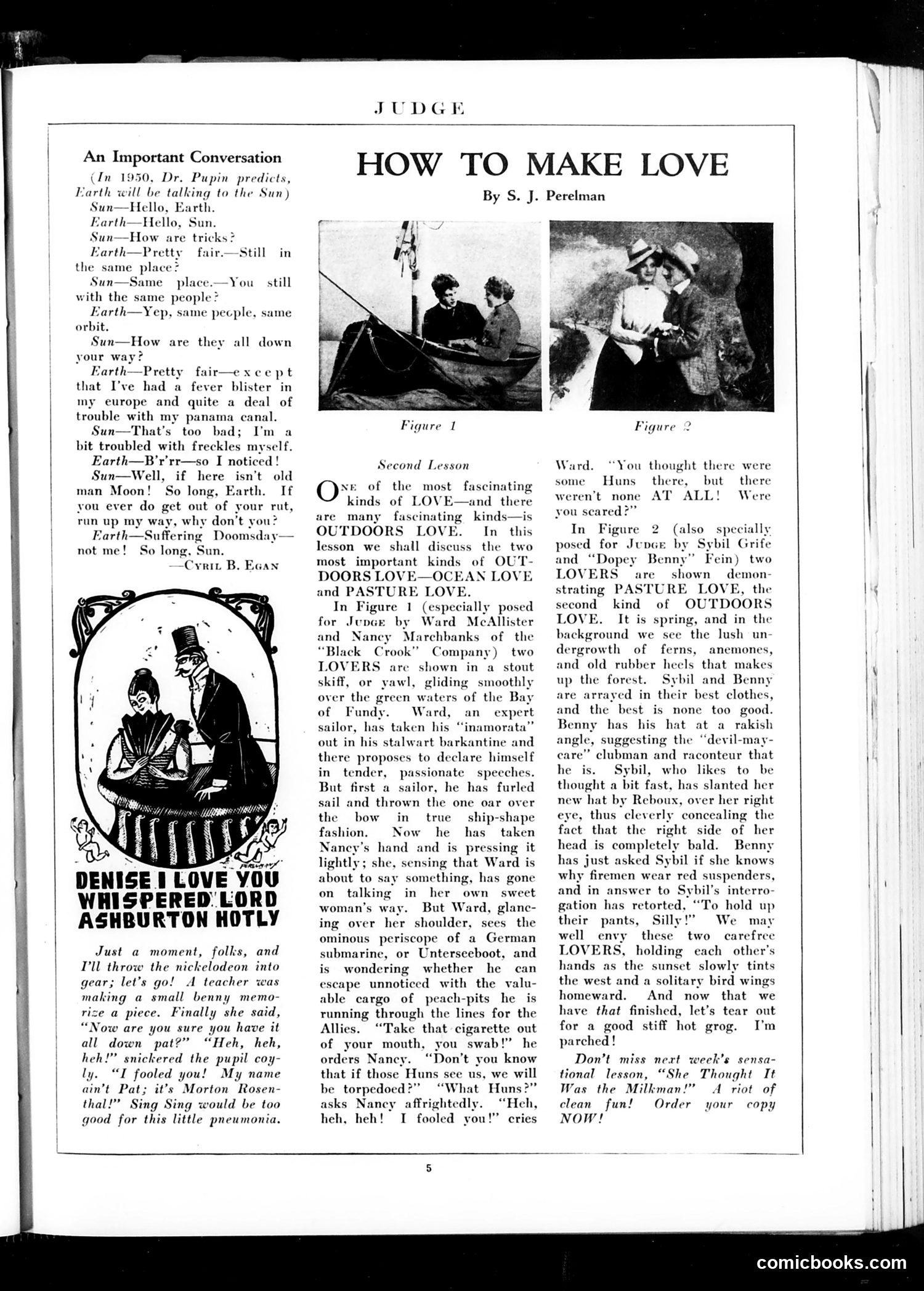
This page contains two distinct elements: **"An Important Conversation"** is a brief satirical dialogue (top left) imagining a 1950 conversation between Earth and the Sun, joking about humanity's lack of progress—same tricks, same people, same problems persisting over time. **"How to Make Love"** is the main feature, a humorous instructional piece by S.J. Perelman with two photographs (Figures 1 and 2) demonstrating courtship scenarios. Figure 1 shows a couple in a rowboat; Figure 2 depicts "Pasture Love"—outdoor romance among ferns and nature. The accompanying text humorously contrasts different "types" of love (ocean love, pasture love) while gently mocking romantic pretension and the awkwardness of courtship. The tone is lighthearted social satire about dating customs and romantic behavior, typical of Judge magazine's humor style.
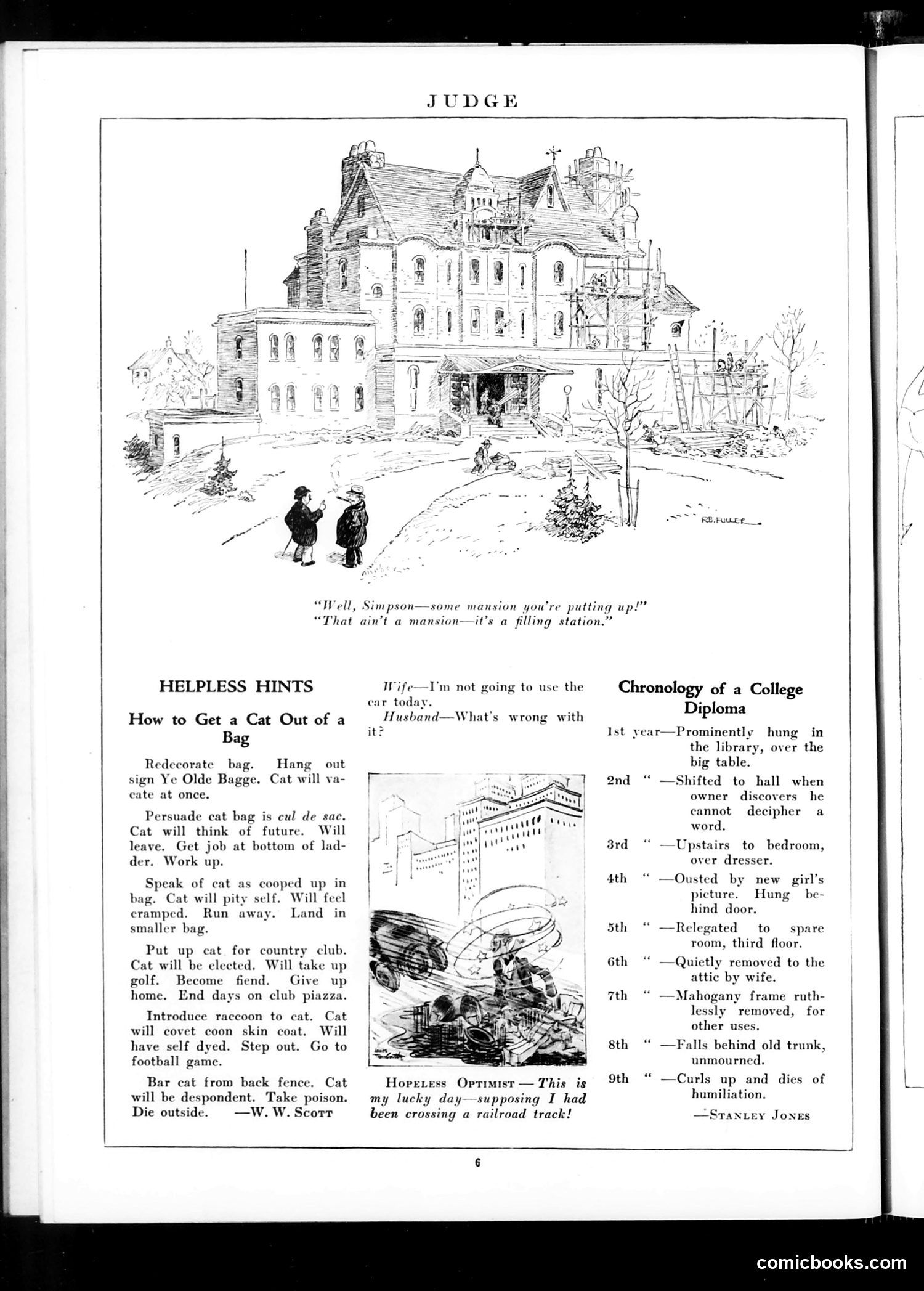
The main cartoon jokes about a building boom misunderstanding: Simpson shows off what he claims is a "mansion," but it's actually a filling station—a reference to the rapid, often haphazard commercial construction of the early 20th century, when gas stations proliferated and sometimes resembled elaborate structures. The page contains three humor sections: 1. **"Helpless Hints"** offers absurdist advice on getting a cat from a bag, the humor deriving from deliberately impractical and elaborate solutions to a simple problem. 2. A brief domestic joke about a wife declining to use the car, with the husband's befuddled response. 3. **"Chronology of a College Diploma"** satirizes the declining value and relevance of college degrees, tracking how a diploma moves from proudly displayed in the library to eventually "curls up and dies of humiliation" in the attic—commentary on education's diminishing worth or utility over time. The humor throughout targets everyday frustrations and pretensions of early 20th-century middle-class life.
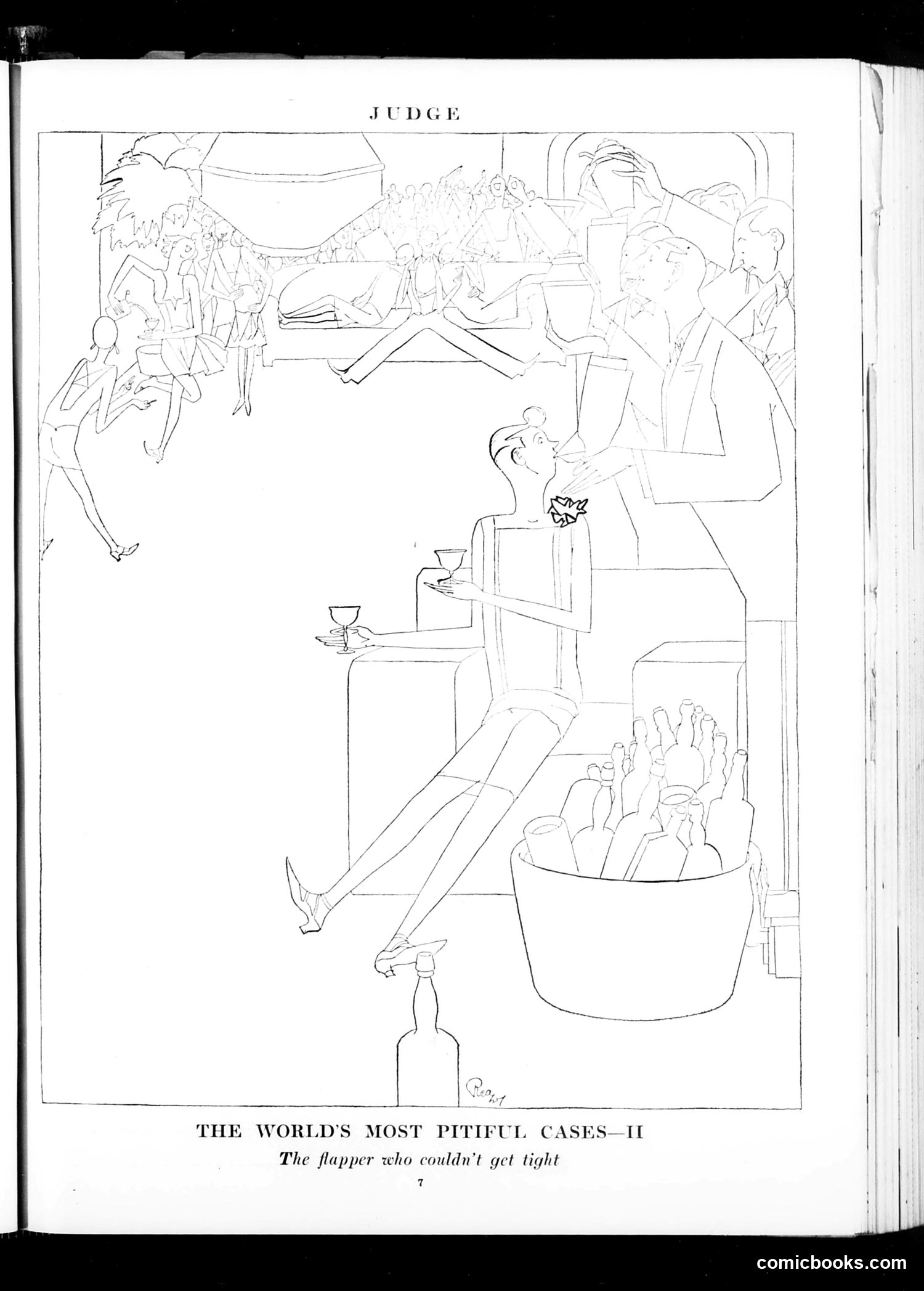
This cartoon satirizes a 1920s "flapper"—a young woman of the Jazz Age known for defying social conventions and enjoying nightlife. The humor centers on a woman unable to become intoxicated despite access to alcohol and drinks at what appears to be a speakeasy or party setting. During Prohibition (1920-1933), obtaining alcohol was illegal but common in underground venues. The joke plays on the era's association of flappers with drinking and partying as markers of modern independence. The "pitiful case" presents her inability to get drunk as a social predicament—implicitly mocking both the flapper lifestyle and Prohibition's ineffectiveness at controlling drinking culture. The elaborate party scene in the background emphasizes the irony: surrounded by revelry and alcohol, she remains sober.
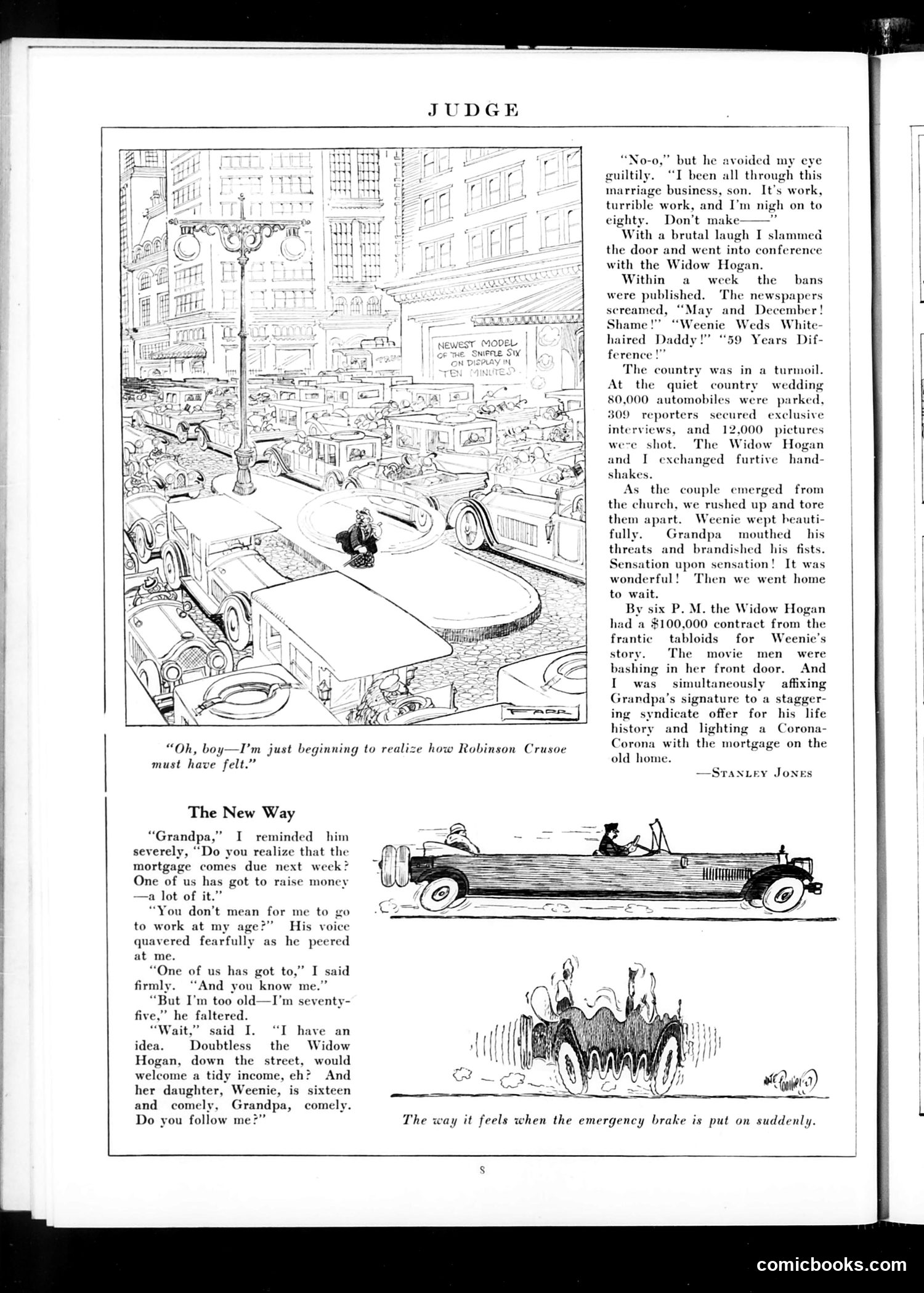
This is a satirical story titled "The New Way" by Stanley Jones, mocking 1920s media sensationalism and the commodification of human drama. The narrator manipulates his elderly grandfather into marrying the "Widow Hogan" to solve financial problems, then exploits the May-December romance for profit. The story satirizes how the media and entertainment industry (represented by "movie men" and syndicates) sensationalize ordinary lives—80,000 cars, 309 reporters, 12,000 photos at a simple wedding. The large illustration shows a crowded urban street packed with automobiles and people at what appears to be this wedding event, emphasizing the chaos and excess of media coverage. The cartoons below humorously depict the physical sensations of modern life (the "emergency brake" metaphor). The satire targets Depression-era desperation, yellow journalism, and how individuals became commodities for entertainment profit—their family drama reduced to syndicated "life stories" and movie contracts.
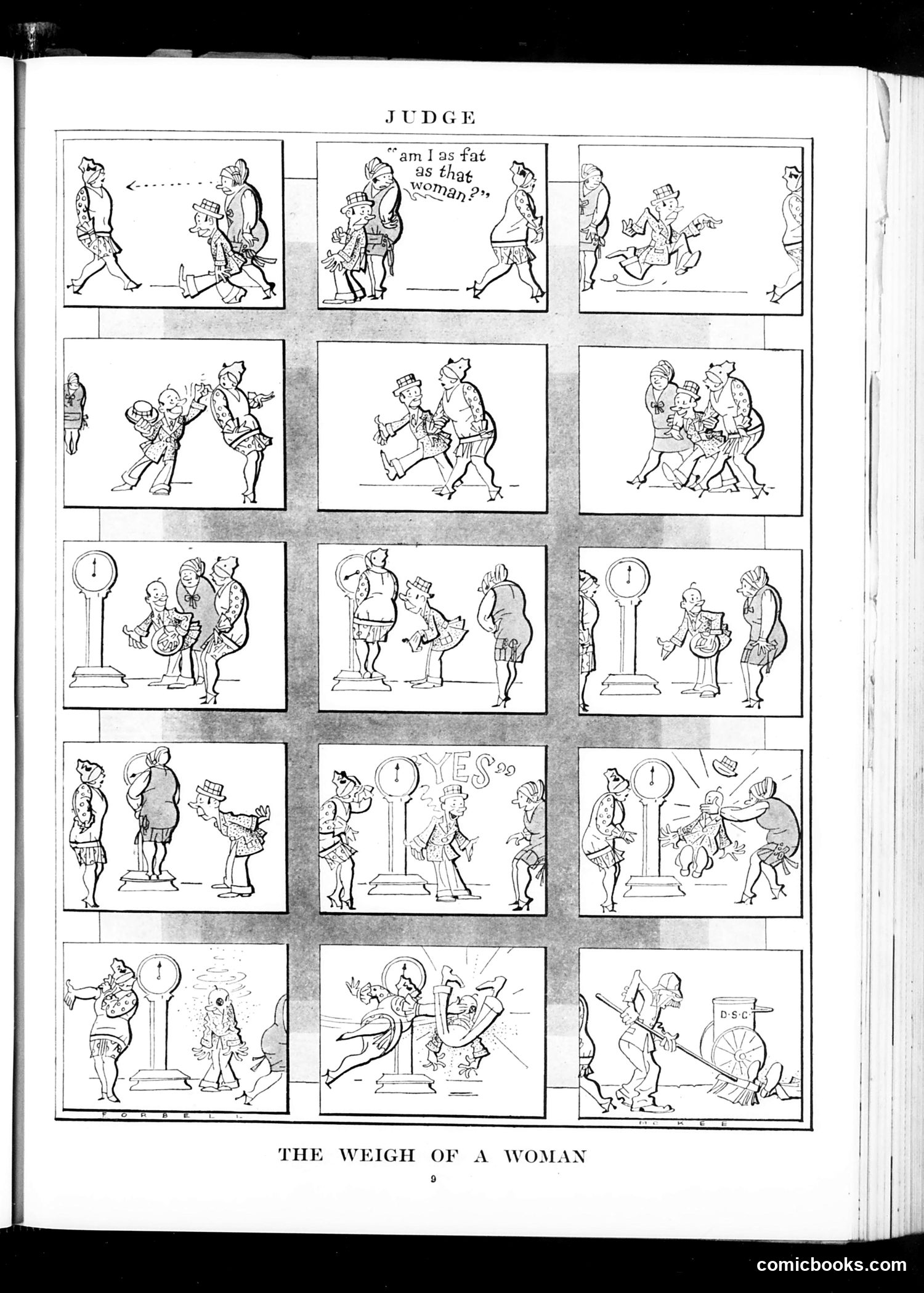
This comic strip satirizes the social anxiety men felt about women's body weight and appearance. The narrative follows a man's increasingly frantic attempts to discover his companion's weight using a public scale. The humor derives from the period's obsession with weighing as a measure of feminine desirability, combined with the woman's obvious reluctance and the man's escalating desperation—he physically struggles with her, enlists helpers, and eventually resorts to elaborate schemes involving the scale. The satire mocks both masculine insecurity about evaluating female bodies and the era's emerging culture of public health metrics. The woman's resistance and the comedic chaos her refusal creates suggest Judge's implied critique of this invasive social preoccupation, though the humor remains rooted in gender dynamics typical of early 20th-century American magazines.
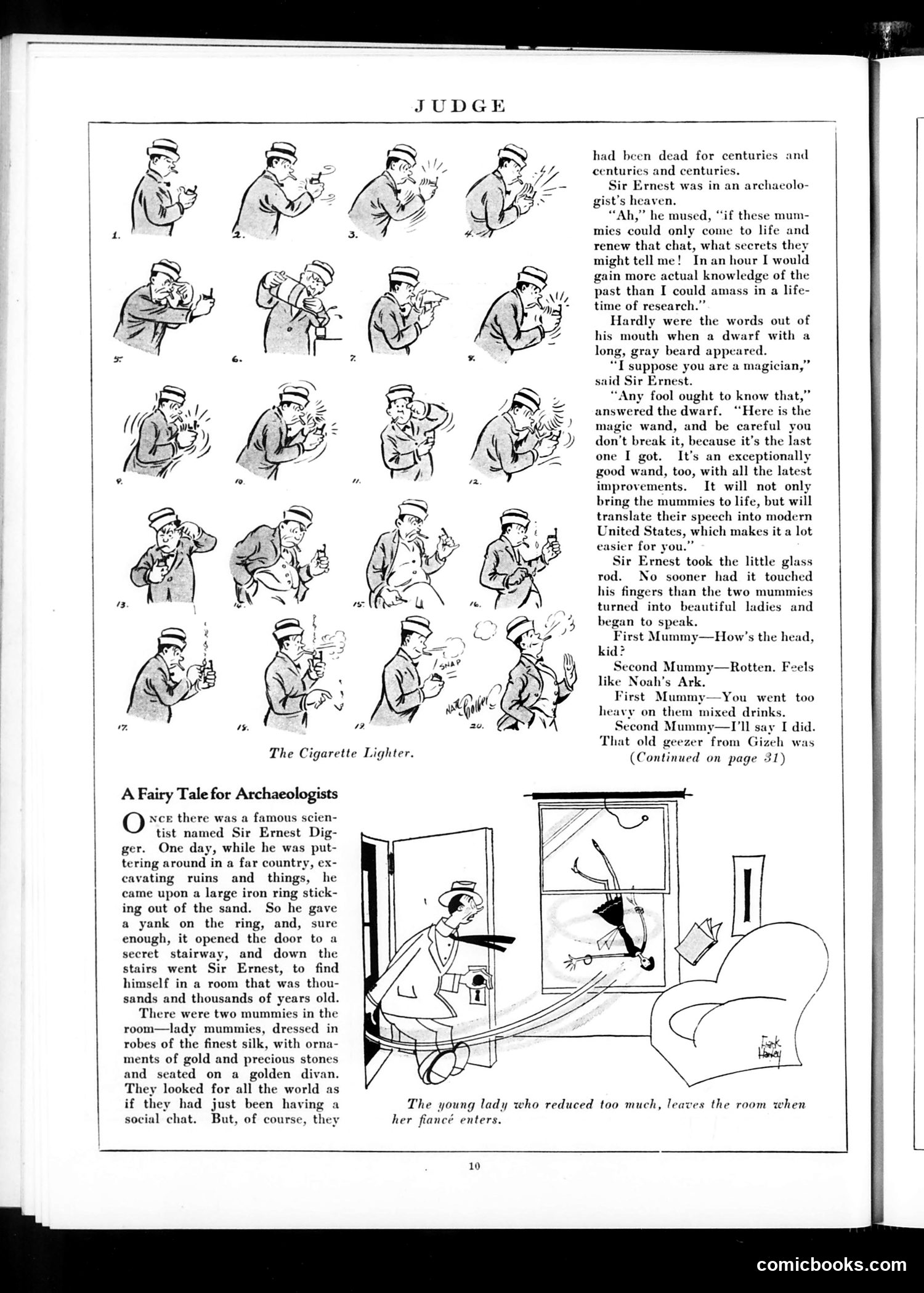
**Top Section ("The Cigarette Lighter"):** A series of 16 numbered illustrations showing a man in a cap demonstrating how to use a cigarette lighter. Each panel depicts progressive hand motions and positions. This appears to be instructional humor—either mocking the complexity of operating the device or satirizing overly-detailed instructional diagrams popular in the era. **Bottom Story ("A Fairy Tale for Archaeologists"):** A comic fantasy tale mocking archaeologists' romantic notions about the past. Sir Ernest Digger discovers ancient mummies and wishes they could speak. A dwarf magician grants this wish using a magic wand that conveniently translates their speech into "modern United States"—the joke being that these ancient Egyptian women, once revived, immediately complain about hangovers and mixed drinks in contemporary slang. The satire ridicules both archaeologists' fantasies about discovering profound historical secrets and the anachronistic absurdity of ancient people speaking modern vernacular. The side illustration shows a separate, unrelated domestic comedy about a woman reducing her weight.
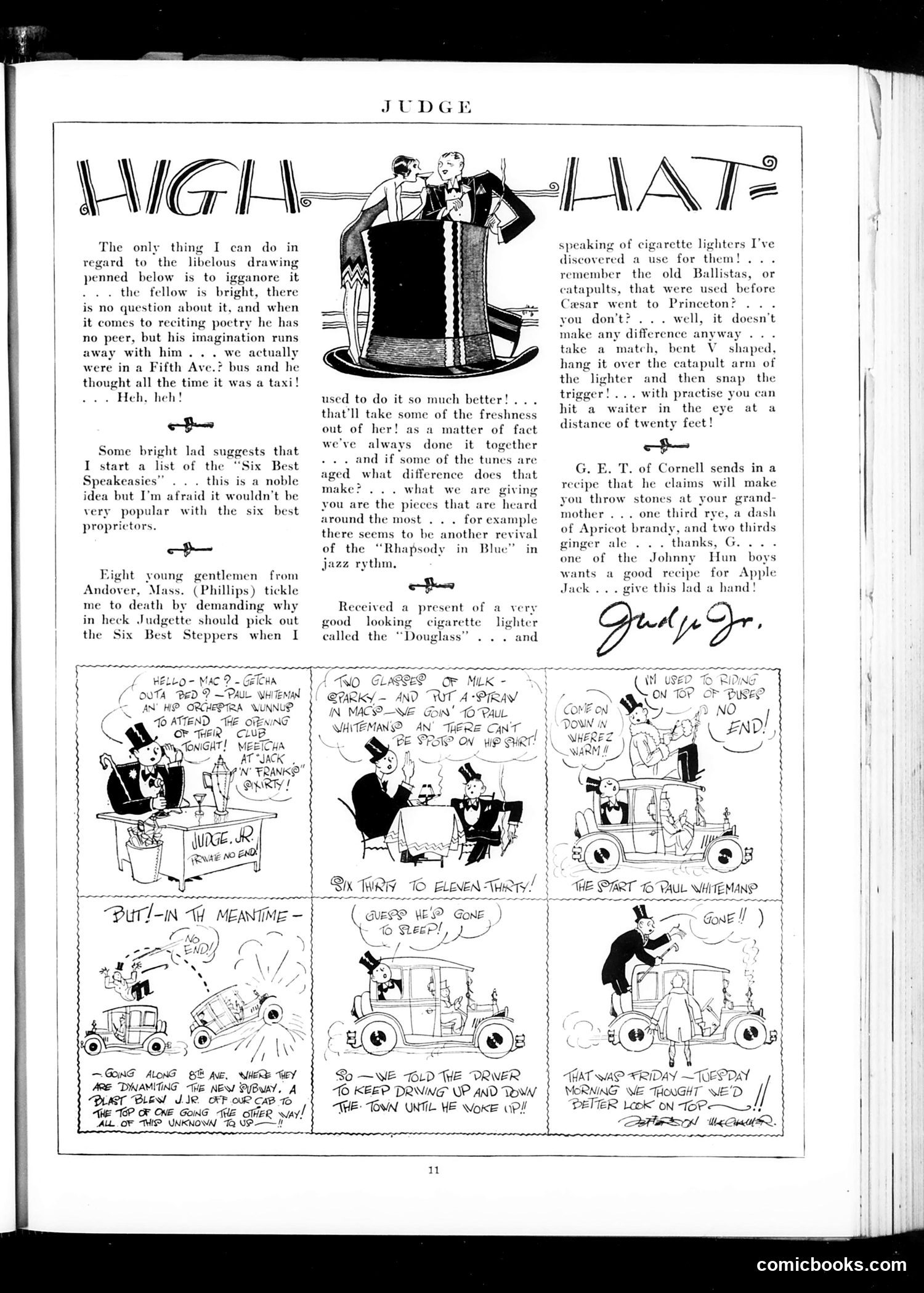
This page contains social commentary and humor typical of 1920s Judge magazine. The main cartoon strip depicts a humorous story about men from Andover, Massachusetts who kidnap a judge to attend the opening of a nightclub, then accidentally keep him driving around the city all night during Prohibition era. The satire targets: - **Speakeasy culture**: References to illegal bars ("Six Best Speakeasies") and Prohibition-era drinking - **Jazz Age excess**: Mentions of "Rhapsody in Blue" and nightclub openings - **Youthful misbehavior**: Eight young men recklessly kidnapping a authority figure - **Bootlegging**: The casual references to alcohol consumption and hidden bars The reader commentary above jokes about uses for cigarette lighters (comparing them to historical catapult devices) and includes a faux recipe allegedly from a Cornell student mixing rye, apricot brandy, and ginger—mocking homemade liquor production during Prohibition. The overall tone mocks 1920s excess, underage drinking, and the social chaos of Prohibition enforcement.
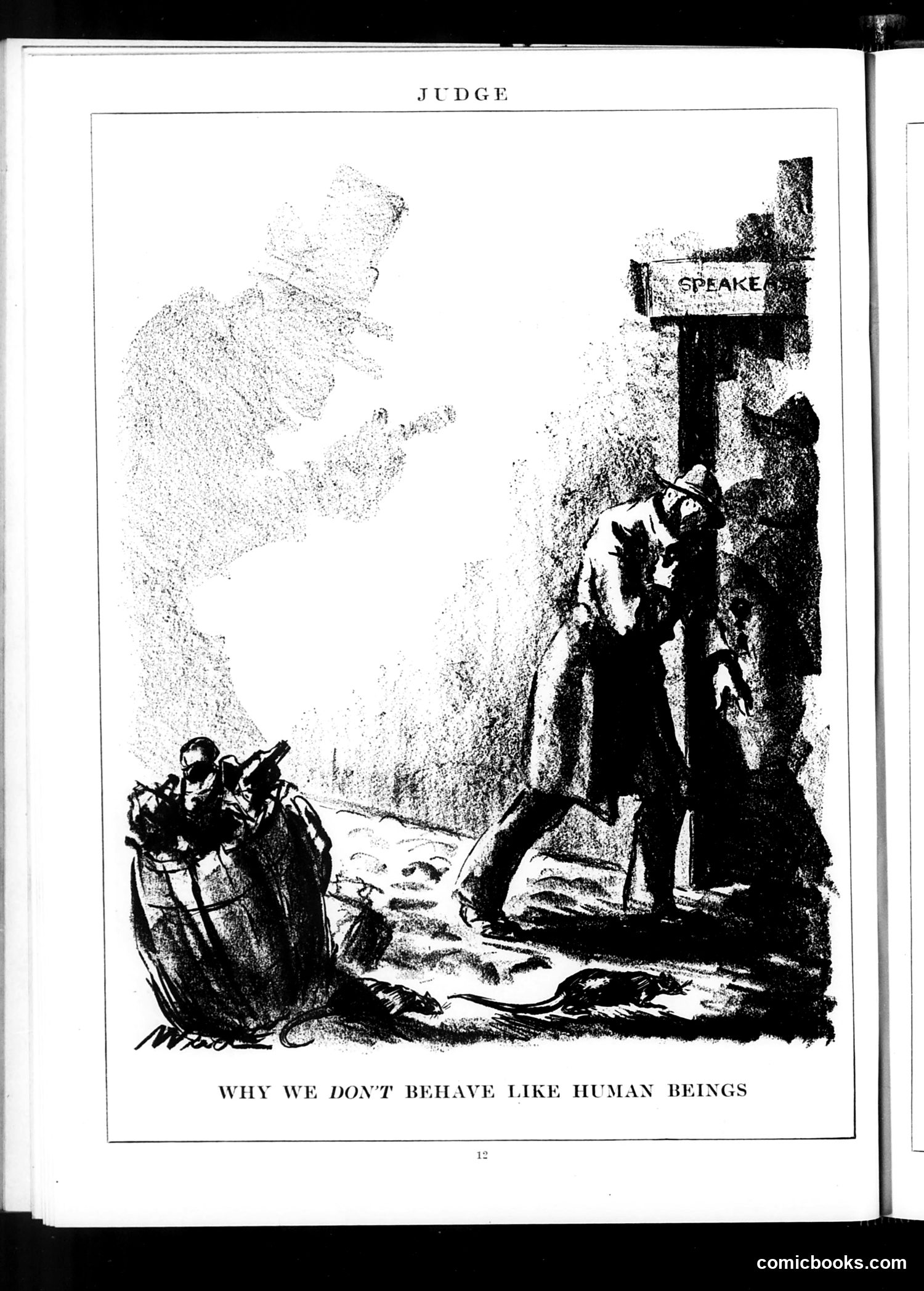
This Judge cartoon depicts a grotesque scene of execution or punishment. On the left, figures appear imprisoned or tortured in a basket or cage. On the right, a figure stands at a gallows marked "SPEAKE" (likely "SPEAK"), with what appears to be judicial or authority figures present. The caption's ironic title suggests the cartoon critiques human cruelty and injustice—specifically, the brutal treatment shown contradicts any claim to civilized behavior. The "SPEAK" sign may reference suppressed speech or silencing of dissent. Without a visible date, the specific historical context remains unclear, though the imagery suggests commentary on execution, imprisonment, or authoritarian punishment. The satire implies that such practices demonstrate humans behaving worse than animals, inverting the expected hierarchy of civilization.
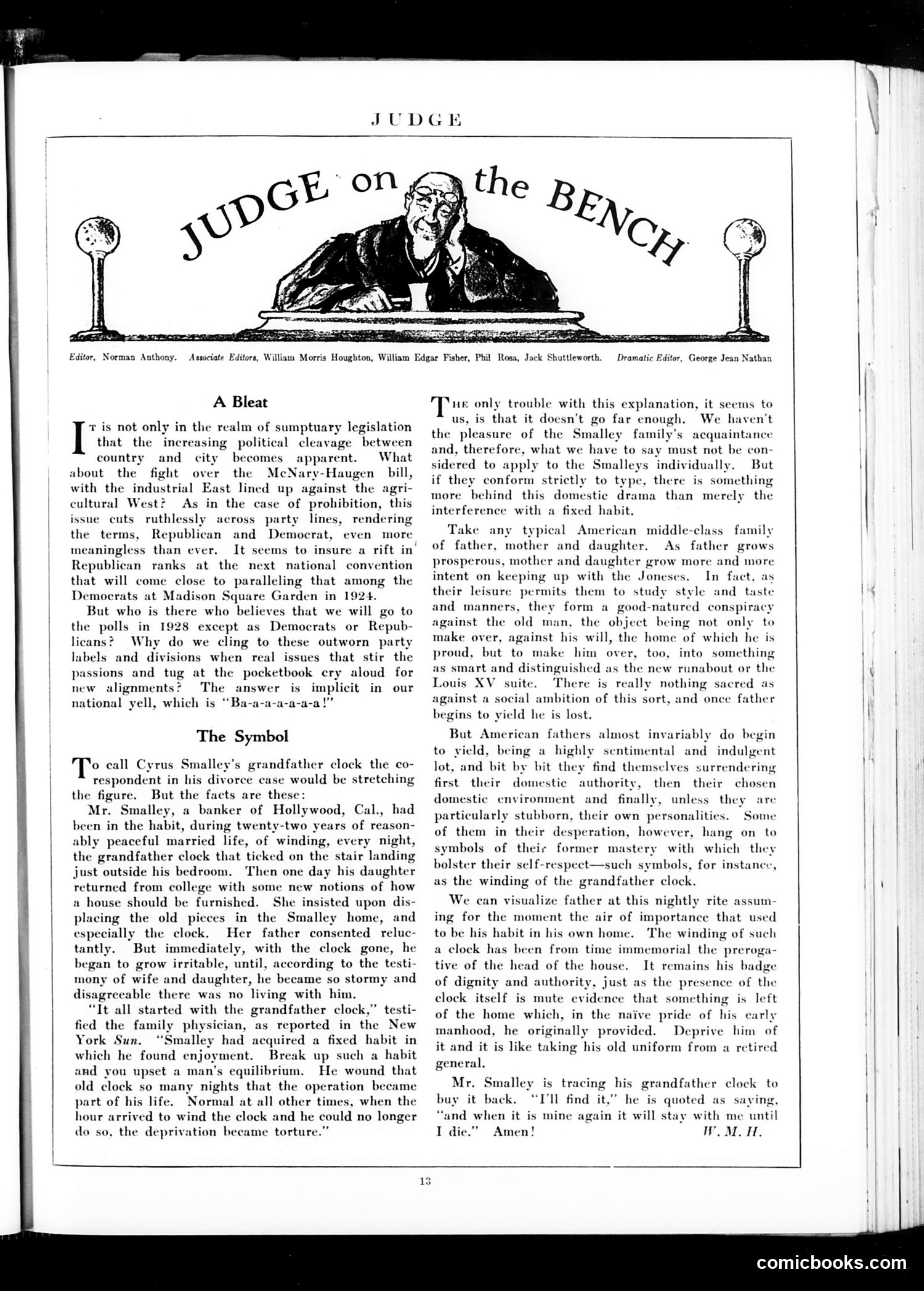
This page contains two satirical pieces from Judge magazine (1920s era). **"A Bleat"** critiques the persistence of outdated Democratic-Republican party divisions despite real economic conflicts—like the McNary-Haugen agricultural bill—that pit industrial East against agricultural West. The author questions why Americans cling to party labels when genuine issues affecting "pocketbook" divide the nation along different lines. **"The Symbol"** satirizes American middle-class domestic life through the story of banker Cyrus Smalley, whose wife and daughter pressure him to replace a beloved grandfather clock with modern furniture. When he becomes unbearably irritable without his nightly winding ritual, a physician attributes it to lost habit. The article's real point: this reflects a broader pattern where prosperous fathers, though sentimental and indulgent, gradually surrender their authority and identity as wives and daughters pursue social climbing and "keeping up with the Joneses." Both pieces critique American conformity—political and domestic.
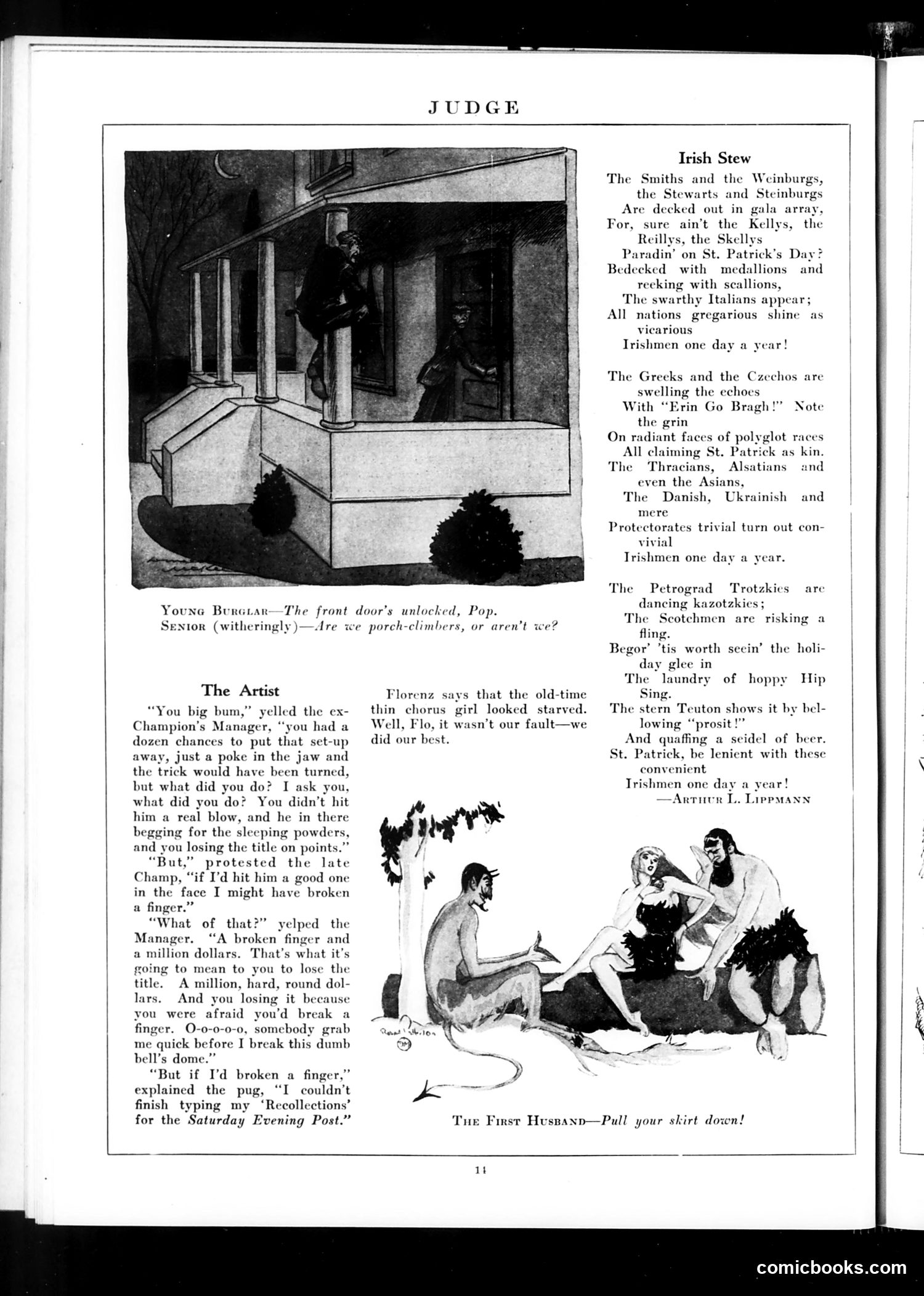
This page contains three separate humorous pieces satirizing American life circa early 20th century. **"The Artist"** mocks a boxer who lost his championship title. The joke: the fighter refused to seriously injure his opponent because he feared breaking his finger—which would prevent him from typing his autobiography for the *Saturday Evening Post*. It satirizes both prizefighting culture and the pretension of athletes-turned-writers. **"Irish Stew"** is a poem mocking St. Patrick's Day as an ethnic performance. It humorously observes that immigrants of all nationalities—Germans, Greeks, Italians, Russians, Scots, Danes, Ukrainians—temporarily adopt Irish identity for one day yearly, exaggerating their "Irishness" with stereotypical behavior (drinking, yelling). The satire targets both the commercialization of ethnic identity and assimilated immigrants' performative ethnicity. **"The First Husband"** (small cartoon, bottom) shows a domestic scene where a husband tells his wife to pull down her skirt—likely mocking changing fashion norms or marital tension over women's clothing. All three pieces employ Judge's characteristic satirical tone toward American social customs.
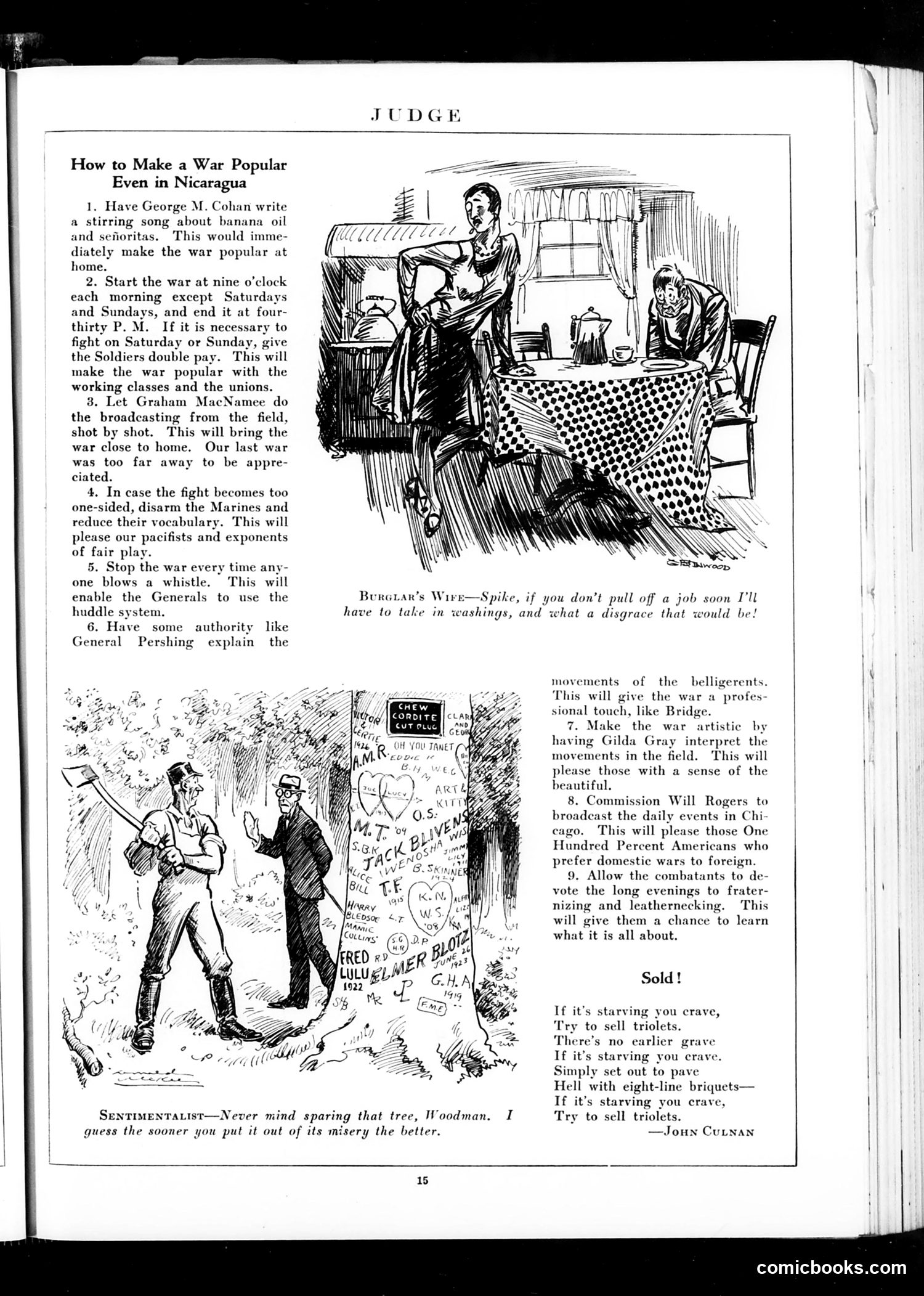
This Judge magazine page satirizes American military intervention in Nicaragua through absurdist humor. The main article, "How to Make a War Popular Even in Nicaragua," mockingly suggests treating warfare like entertainment—hiring songwriter George M. Cohan, broadcaster Graham MacNamee, and dancer Gilda Gray to popularize the conflict domestically. It ridicules how Americans consumed distant wars through media while suggesting absurd compromises (fighting only 9-4:30, double pay for weekend combat, football-style huddles). The cartoons below depict domestic anxieties: a struggling wife pressuring her husband about finances, and a sentimental figure urging tree destruction. The satire critiques American imperialism and media spectacle while exposing indifference to foreign suffering. The closing poem about starving poets selling literary forms ("triolets") shifts to economic desperation—suggesting broader Depression-era concerns about survival competing with nationalist fervor.
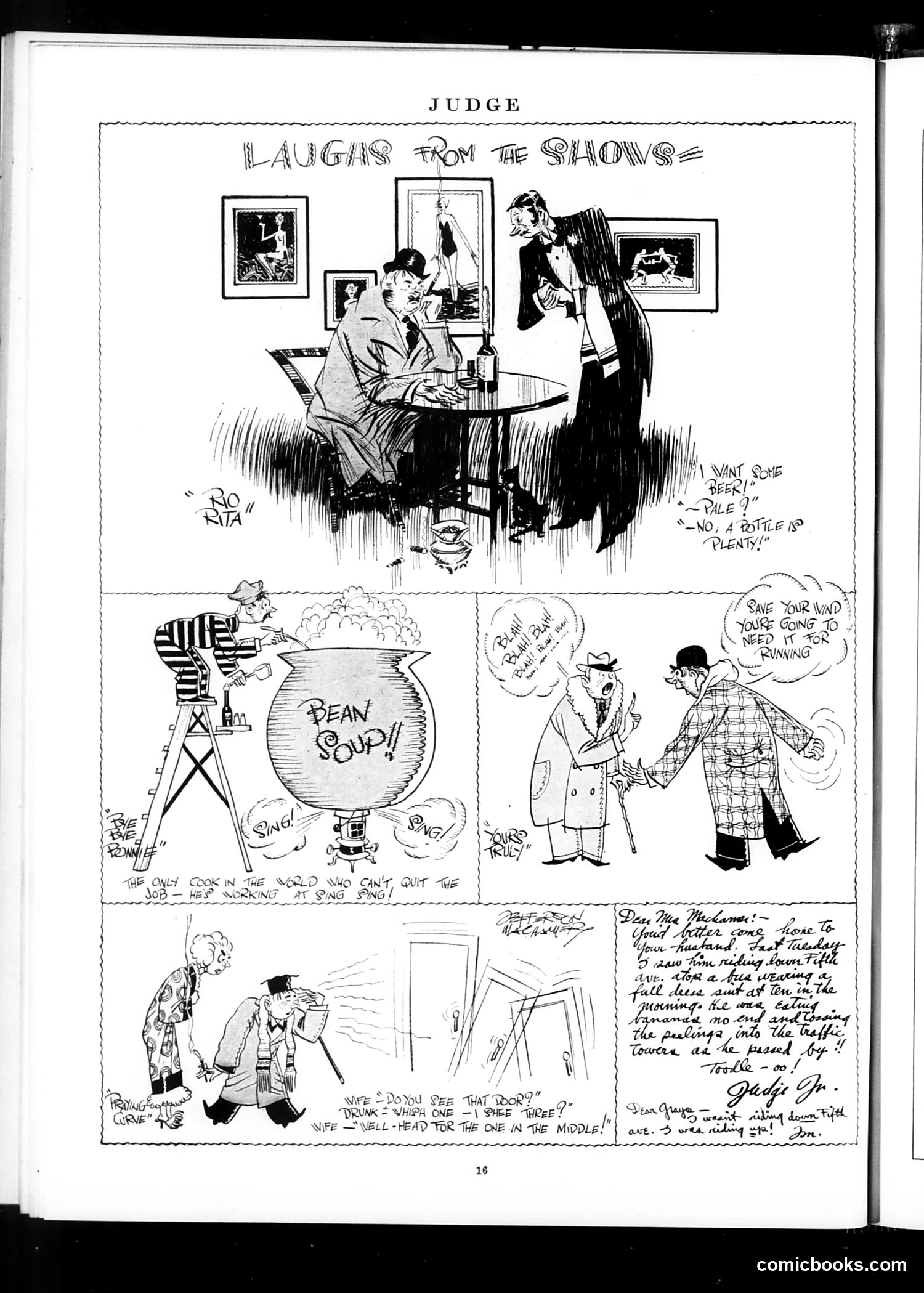
This page collects theatrical humor sketches. The top panel shows a waiter serving beer to a patron at a nightclub or restaurant, with dialogue about beer selections—likely satirizing pretentious dining culture or Prohibition-era speakeasy experience. The middle section depicts a "Bean Soup" scene, possibly referencing a famous Capitol Hill dish, with a character singing. The caption mentions "the only cook in the world who can't quit the job—he's cooking at sing sing"—a joke about prison (Sing Sing was a famous correctional facility). Lower panels show domestic comedy: a wife directing her husband about rooms and furnishings, and another scene with unclear context involving a riding outfit and warnings about "running." These are vaudeville-style gags adapted from theatrical performances, typical of Judge's practice of capturing stage comedy for print audiences during the early-to-mid 20th century.
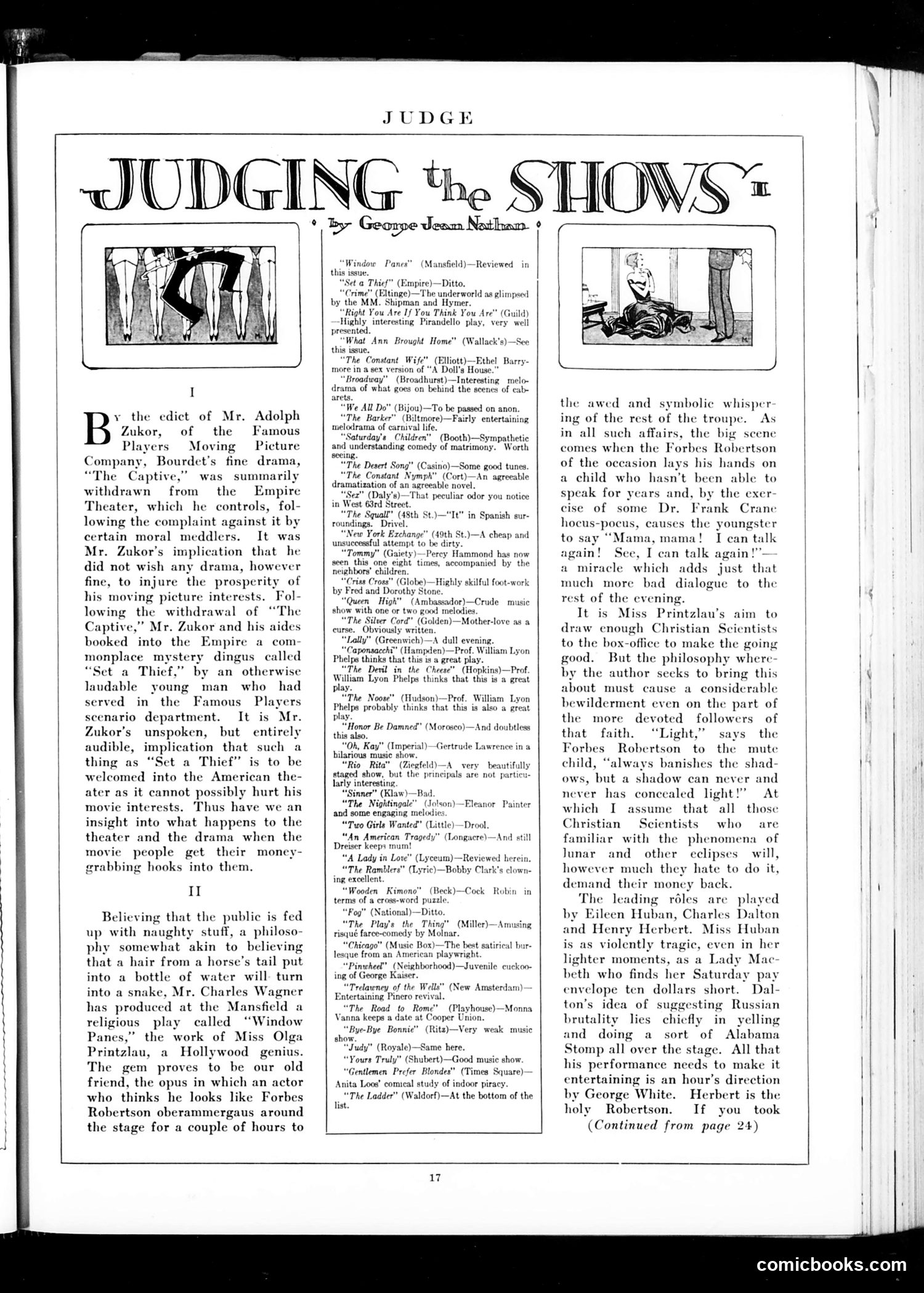
This page features theater critic George Jean Nathan's Broadway reviews. The main editorial commentary attacks movie mogul **Adolph Zukor** of Famous Players for withdrawing Bourdet's play "The Captive" from the Empire Theater due to moral complaints, then replacing it with a mediocre mystery play ("Set a Thief") that wouldn't threaten his film interests. Nathan argues this demonstrates how commercial movie interests corrupt serious theater. He further mocks producer **Charles Wagner** for staging "Window Panes," a pretentious religious play by Hollywood writer Olga Printzlau, suggesting movie people prioritize profit over artistic merit. The bulk of the page lists brief, often caustic reviews of current Broadway productions, with occasional jabs at theater personalities like Professor William Lyon Phelps (humorously credited with endorsing multiple plays as "great"). The satire targets the commercialization of American theater and the corrupting influence of the film industry on dramatic arts.
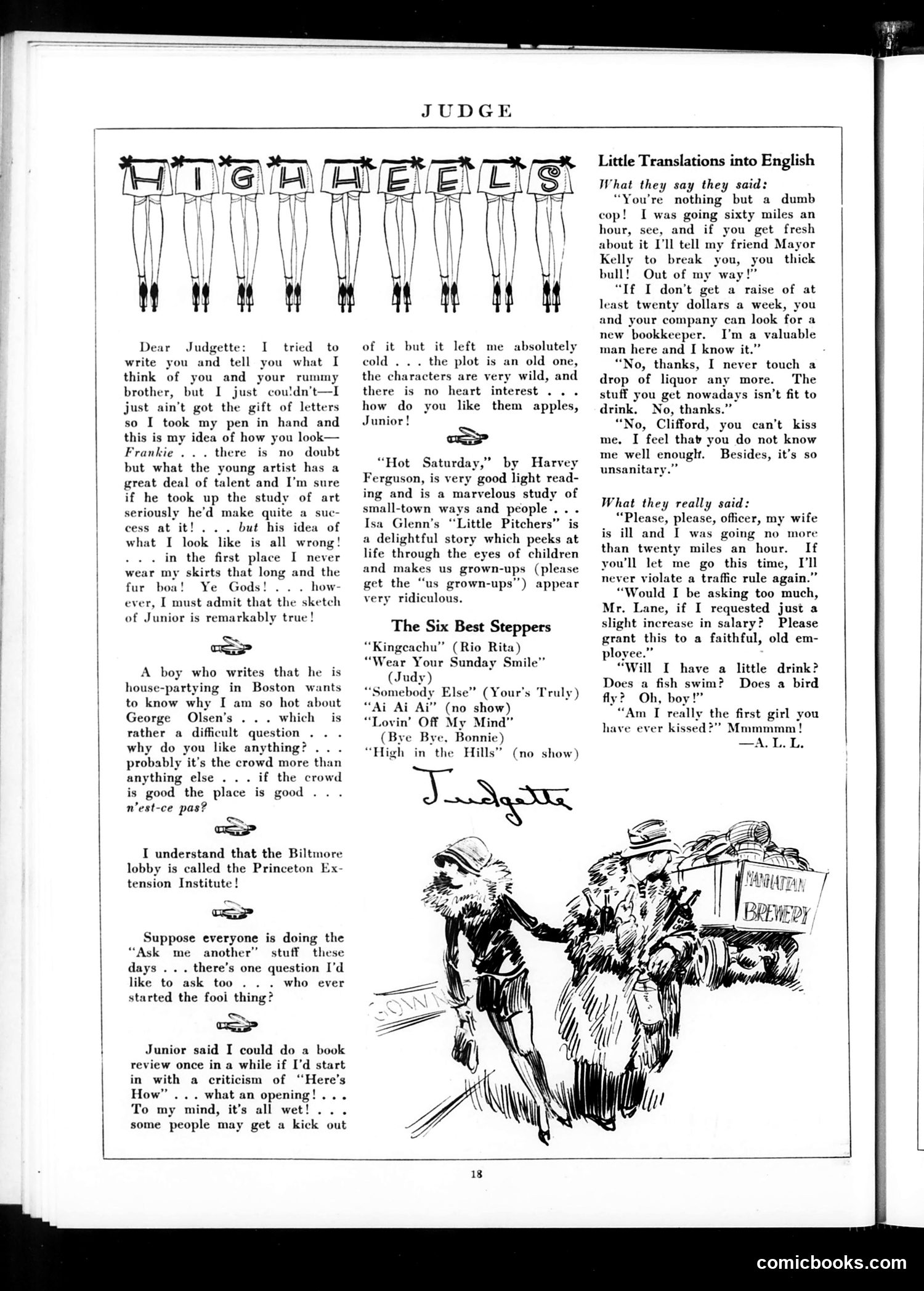
This page from *Judge* magazine presents satirical commentary on 1920s social behavior through two main sections: **"Little Translations into English"** is the primary satire. It juxtaposes what people *claim* to say versus what they *actually* mean—exposing hypocrisy in everyday interactions. Examples include: a reckless driver blaming a cop while threatening political connections; an employee making demands while flattering their boss; a reformed drinker who clearly hasn't reformed; and a woman rejecting romance while pretending propriety matters more than interest. The satire targets the gap between public propriety and private truth in Jazz Age society—people maintaining facades of respectability while their actions contradict their stated values. The secondary content includes book reviews and mentions of popular songs/shows ("Rio Rita," "Bye Bye, Bonnie"), reflecting contemporary entertainment. The fashion illustration at top shows typical 1920s flapper styling. The overall message critiques American social dishonesty and the performative nature of 1920s respectability culture.
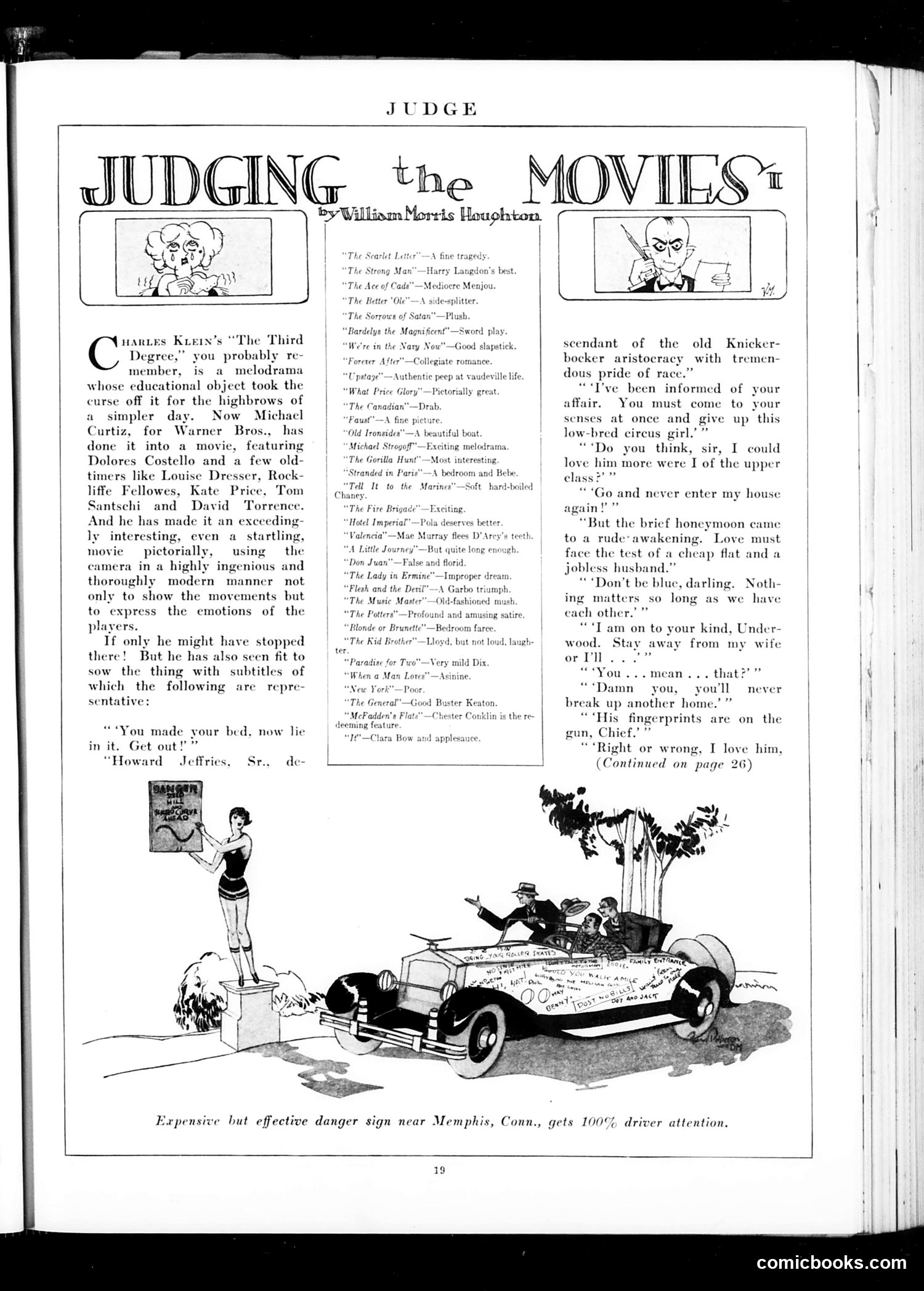
This page critiques Charles Klein's stage play "The Third Degree," adapted into a Warner Bros. film by Michael Curtiz starring Dolores Costello. The column praises the film's visual cinematography and modern camera work but mocks its melodramatic intertitles (printed dialogue cards) for clichéd sentimentality. The satirical point: while the movie succeeds visually as modern cinema, its heavy-handed subtitles undercut this achievement with overwrought, dated theatrical language. Examples like "You made your bed, now lie in it" exemplify the stilted moralizing that Judge found laughable. The bottom illustration shows a woman using an absurdly elaborate roadside danger sign—far more "expensive" and conspicuous than necessary—to warn drivers near Memphis, Connecticut. This visual joke parallels the film critique: the warning works despite its excessive theatricality, much like the movie succeeds despite its clumsy subtitles. Both represent outdated, overwrought approaches to modern communication.
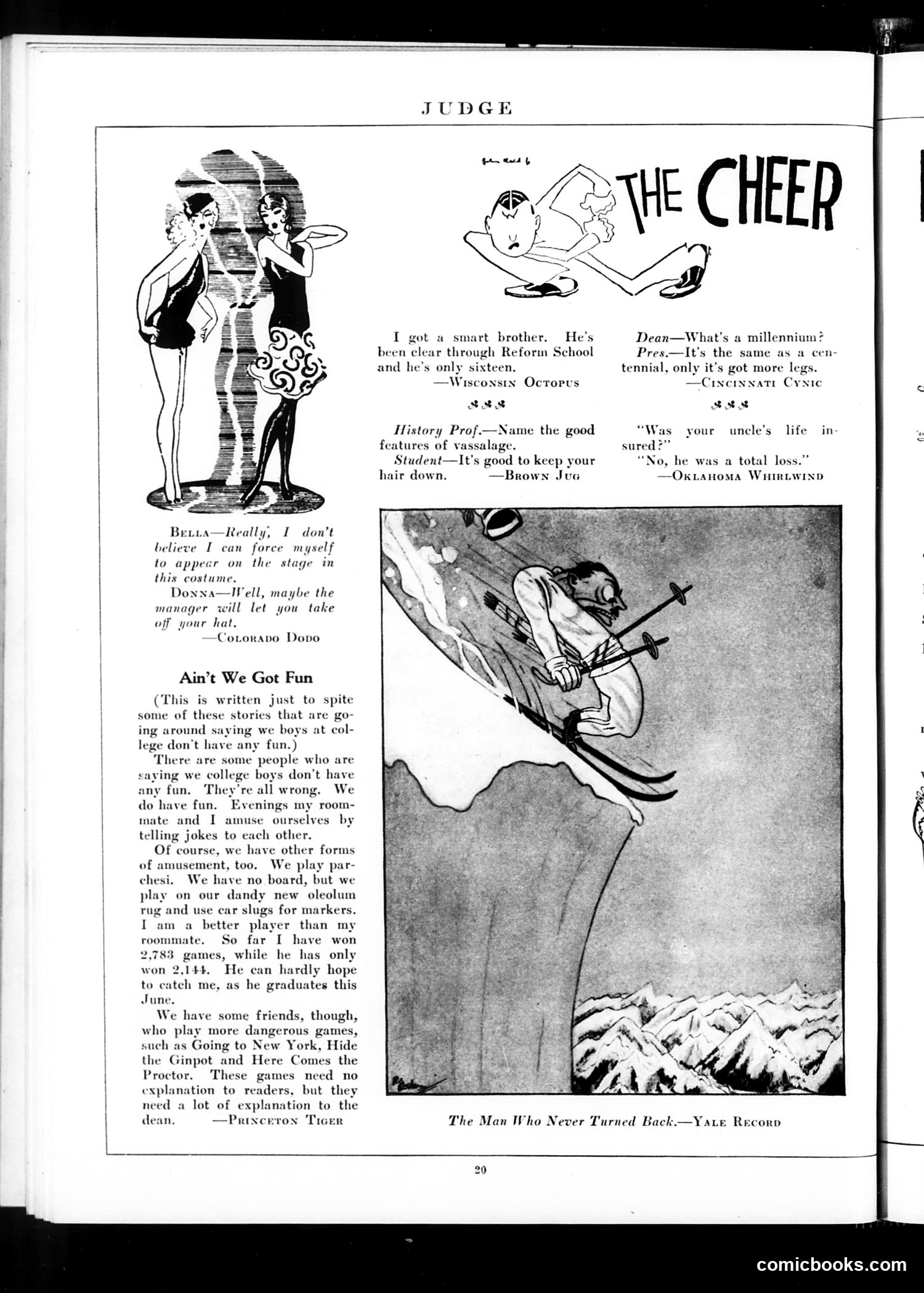
This page contains several humor items satirizing college life and social pretensions circa the 1920s. **"The Cheer"** section presents brief jokes mocking academic absurdity—a history professor asking students to name "good features of vassalage," a dean who can't define "millennium," and a president who conflates different time periods. These mock institutional pomposity. **"Ain't We Got Fun"** is a longer piece defending college boys against criticism that they're frivolous. The author ironically catalogs their "amusements": playing parlor games using car slugs as markers, telling jokes, and engaging in pranks like "Hide the Ginpot" and evading "the Proctor" (campus disciplinarian). The humor lies in the narrator's earnest defense of activities that actually prove the criticism valid—these are genuinely trivial pastimes presented as serious fun. The accompanying illustrations show period-appropriate flapper-era figures and a ski-jump scene (for "The Man Who Never Turned Back"), typical of Judge's visual style. The tone reflects post-WWI American youth culture's reputation for superficiality and rule-breaking.
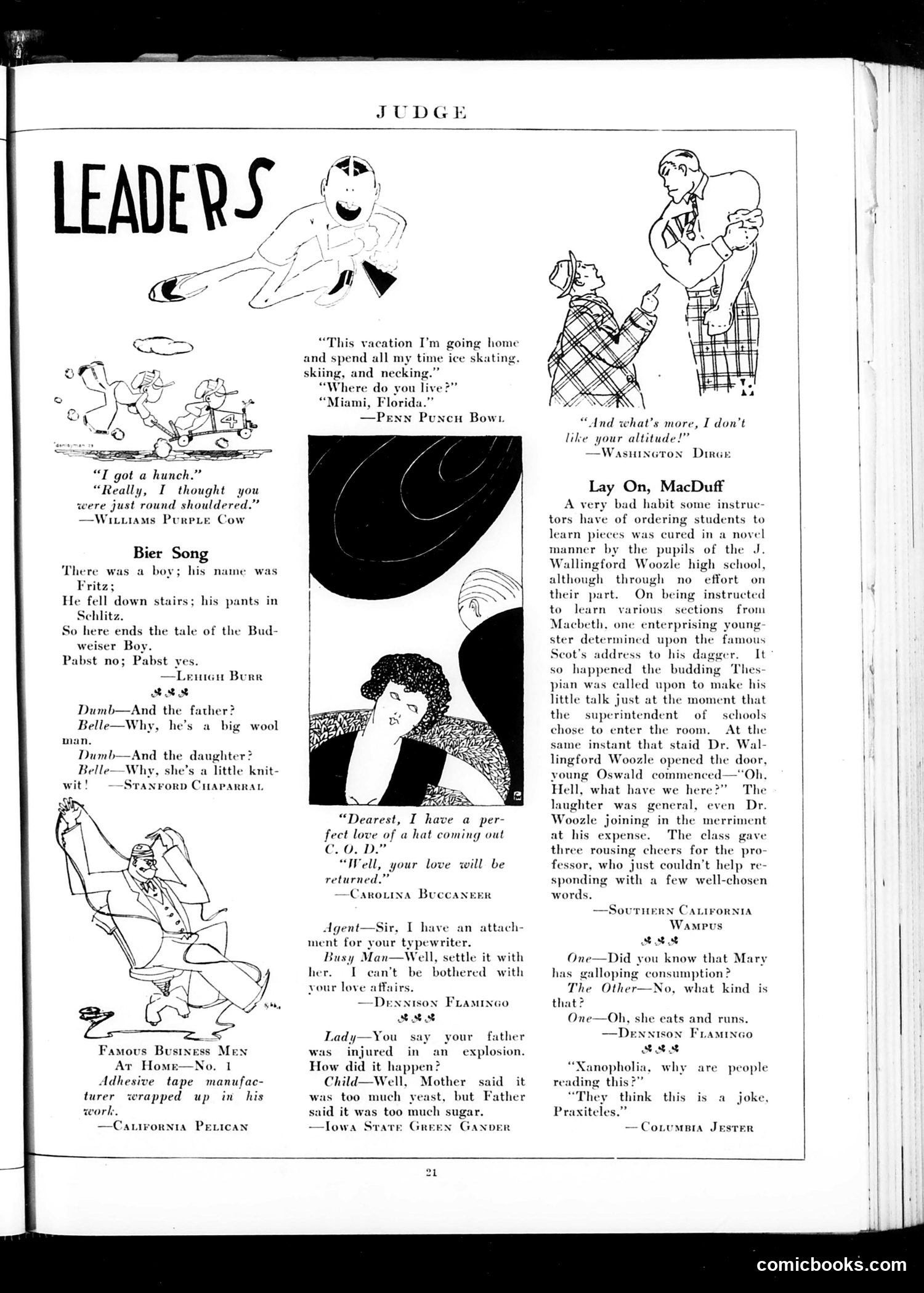
This page contains multiple brief jokes and cartoons typical of early 20th-century American humor magazines. The content includes: **Visual gags:** Cartoons depicting physical comedy—a man ice skating, someone wrapped in adhesive tape, domestic situations. **Ethnic/national humor:** The "Bier Song" jokes reference German beer brands (Schlitz, Budweiser, Pabst) through a story about "Fritz" falling downstairs—playing on stereotypes of German-Americans and beer culture. **Wordplay and puns:** Most jokes rely on double meanings ("round shouldered" for a "hunch," "C.O.D." hat delivery as romantic expression). **Social observation:** "Lay On, MacDuff" satirizes overeager students and absent-minded administrators in schools; other jokes mock busy businessmen avoiding romance, parental mishaps. The humor is gentle, domestic, and relies heavily on puns rather than political commentary. There's no identifiable reference to specific current events or political figures on this page.
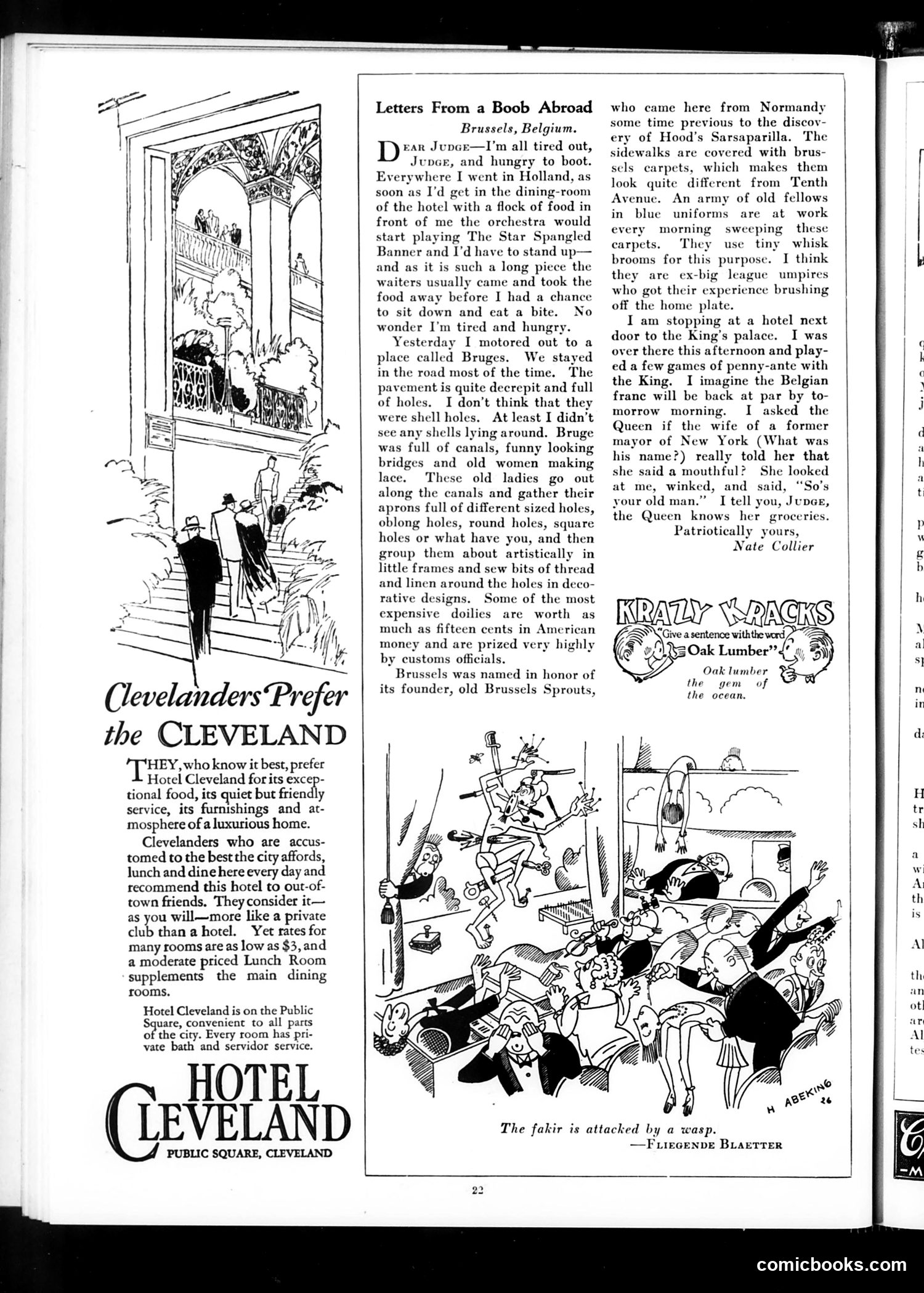
This page contains two distinct elements: **Left side:** A hotel advertisement for the Hotel Cleveland, using social prestige marketing common in the 1920s-30s era. **Main content:** A humorous travel letter titled "Letters From a Boob Abroad" by Nate Collier, describing a comically ignorant American tourist in Belgium and Holland. The satire mocks: - American tourists' lack of cultural awareness (the narrator complains the hotel orchestra plays "The Star Spangled Banner" during meals, forcing him to stand and missing dinner) - Willful misunderstanding of foreign customs (claiming Brussels was "named in honor of...old Brussels Sprouts"; describing lace-making as collecting holes from the ground) - Casual disrespect toward European royalty (claiming to play poker with the King) The cartoon below depicts "The fakir is attacked by a wasp"—an unrelated illustration by Fliegence Buaetter. The overall joke targets American provincialism and boorishness abroad—a common Judge magazine theme mocking travelers who treat foreign countries as absurd oddities rather than engaging seriously with them.
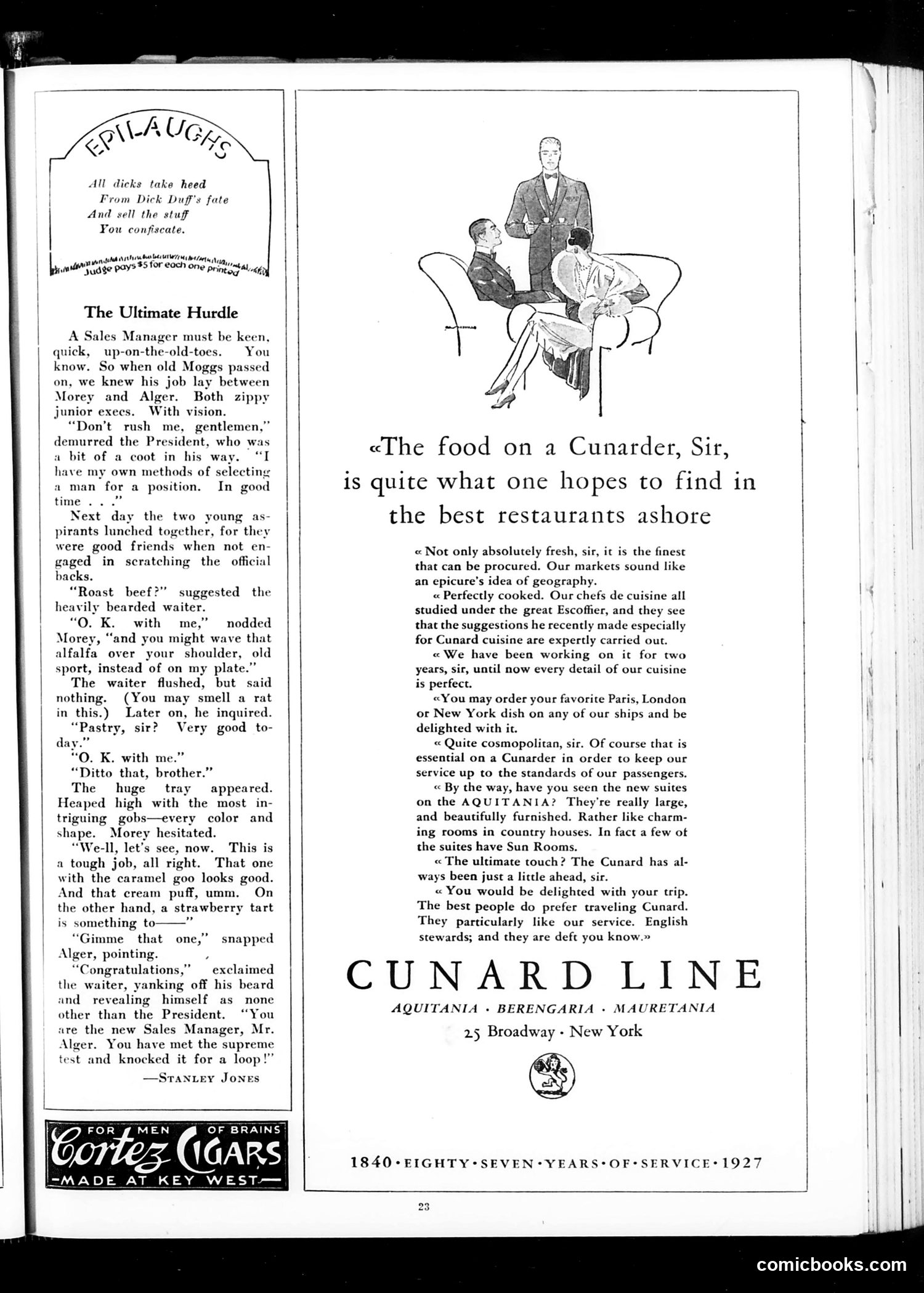
This satirical story mocks executive hiring practices of the 1920s. Two junior executives, Morey and Alger, compete for a promoted sales manager position. The unnamed company president announces he'll select the best candidate through an unconventional "test." The joke: a disguised waiter serves them lunch, observing their behavior. When Alger decisively orders ("Gimme that one"), the waiter reveals himself as the President, pronouncing Alger the winner for showing decisive leadership—the key sales management trait. The satire targets corporate culture's obsession with personality-based hiring ("vision," decisiveness) over actual qualifications. The President's theatrical test—judging men by lunch-counter behavior rather than experience—mocks the era's emerging management philosophy that equated quick decision-making with competence, even in trivial matters. The epigraph's reference to "Dick Duff's fate" and "sell the stuff / You confiscate" likely alludes to Prohibition-era corruption, adding contemporary edge to themes of business ethics.
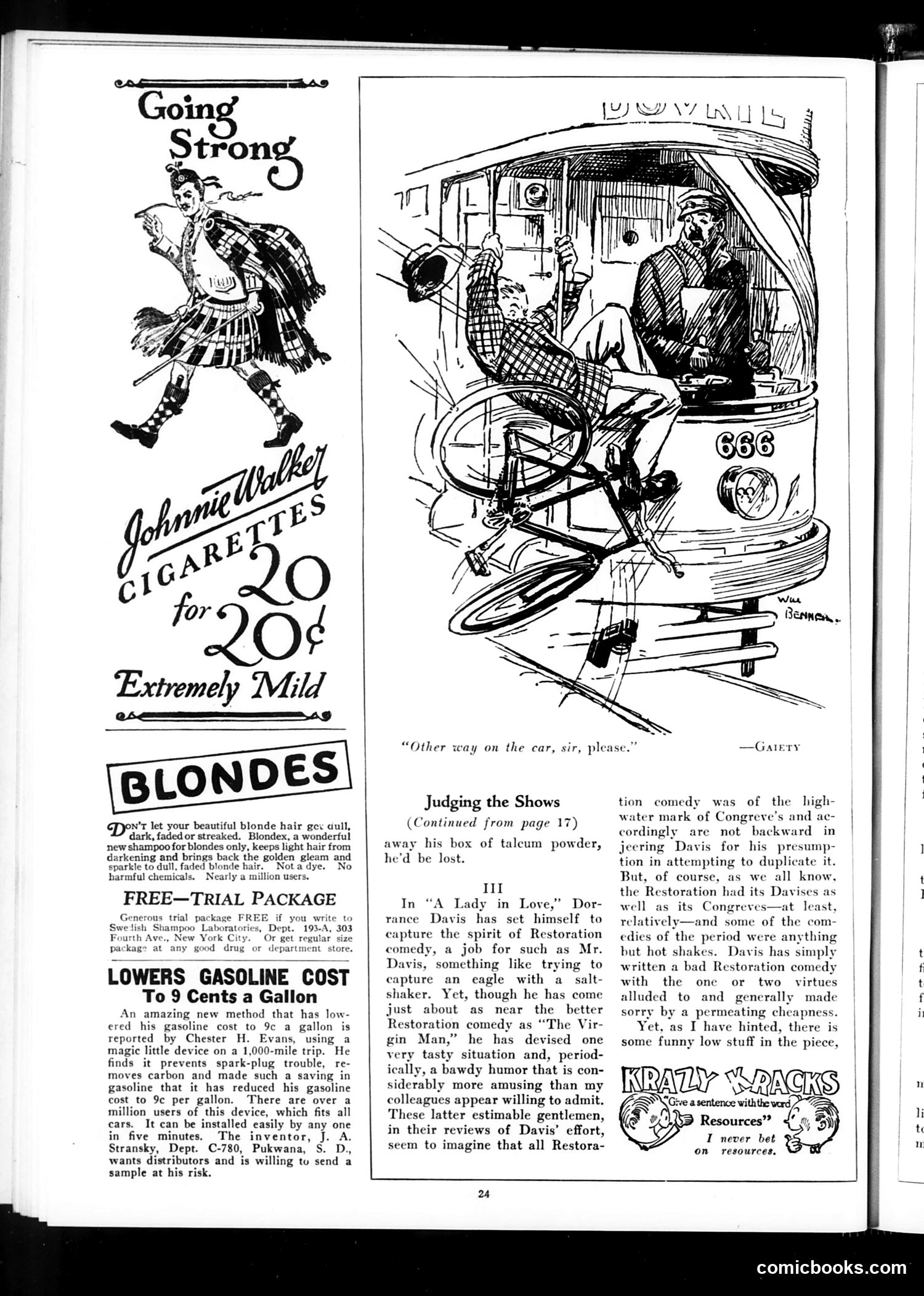
This page is primarily **advertising** with one theatre review sidebar. The main cartoon (right) depicts a cyclist colliding with a streetcar numbered 686, with the caption "Other way on the car, sir, please." The humor is visual slapstick: the cyclist's confusion about which direction to travel results in a comedic crash—a straightforward gag requiring no historical context. The left side contains cigarette and hair-product advertisements typical of the era, plus a "Krazy Wacks" word-game feature. The substantial text block reviews a theatrical production, "A Lady in Love," by performer Dorrance Davis. The critic acknowledges Davis attempts capturing Restoration-era comedy (like Congreve's) but judges his effort as "a bad Restoration comedy"—competent but mediocre, marred by cheapness. The satire targets Davis's artistic pretension: attempting high theatrical standards while falling short. **Modern context:** The piece reflects early-20th-century theatre criticism standards and attitudes toward period comedy adaptation.
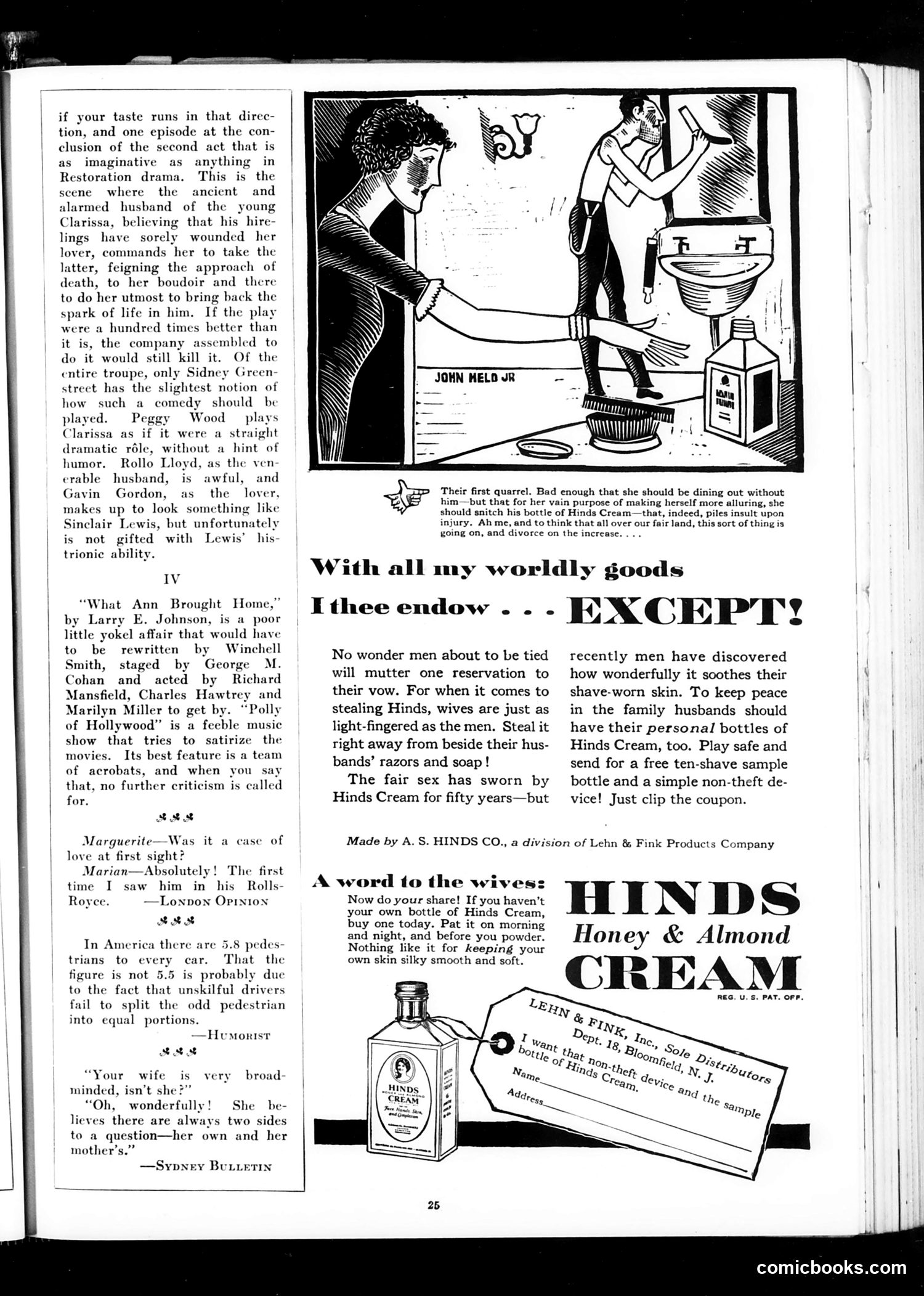
This page combines theater criticism with advertising satire. The left column reviews three Broadway productions, criticizing weak performances and material—notably "Clarissa" with Peggy Wood, dismissed as poorly acted despite imaginative Restoration-era plotting. The dominant feature is a **Hinds Cream advertisement** disguised as marital satire. The cartoon depicts a husband discovering his wife has stolen his shaving cream bottle for her own cosmetic use. The ad's humor targets contemporary marriage anxieties: wives are portrayed as light-fingered thieves of men's grooming products, leading to "divorce on the increase." This reflects 1920s-era concerns about women's changing roles and consumption. The solution offered—husbands should buy their own personal bottles—satirizes both marital conflict and the commercial push to sell duplicate products to households. The page also includes period jokes about automobiles and wives' "broad-mindedness," typical Judge fare mocking modern domestic life for advertising purposes.
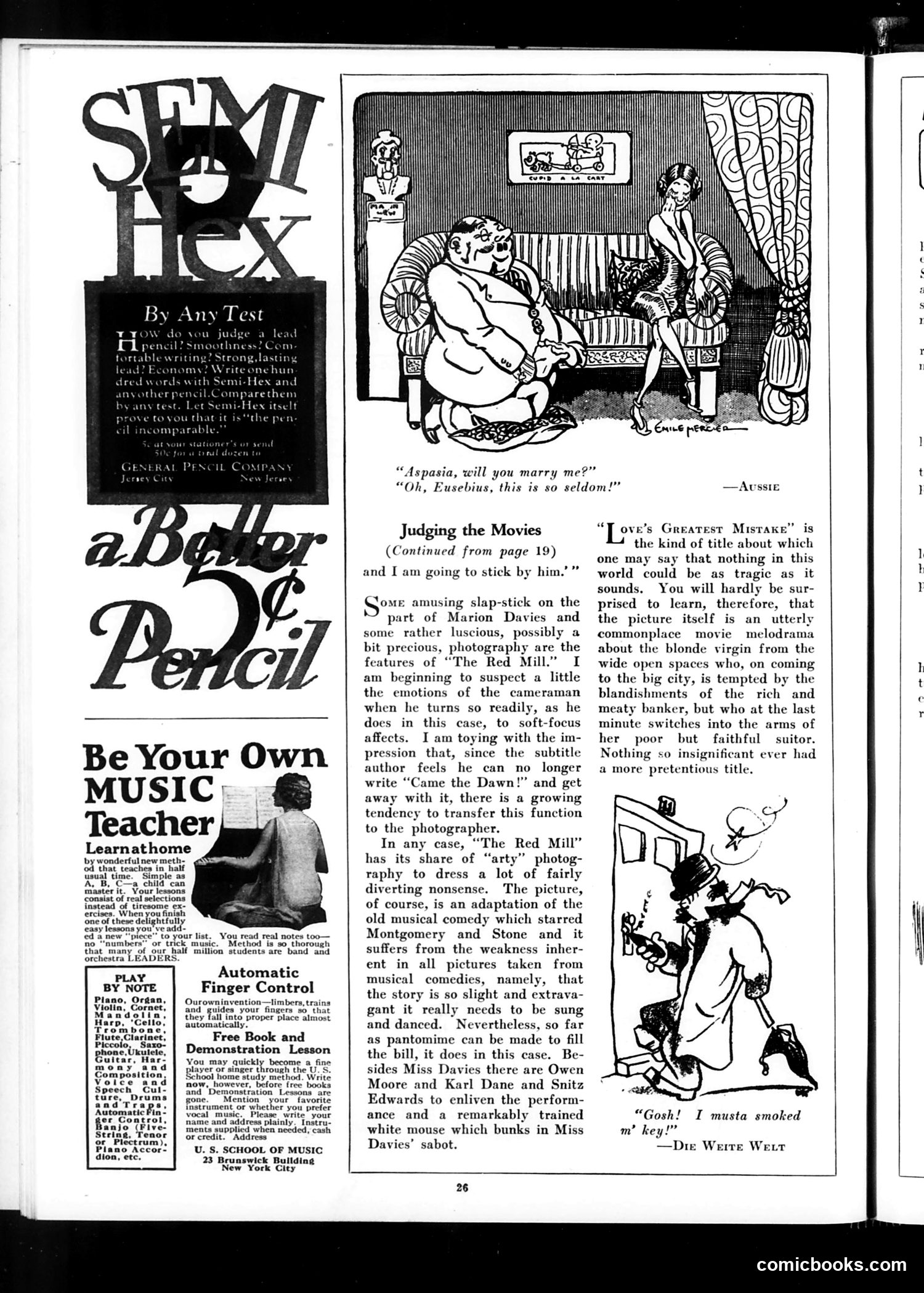
This page contains **advertisements and film criticism**, not political satire. The main content is a movie review column titled "Judging the Movies" by what appears to be a film critic. The cartoon at top shows a man proposing to a woman named Aspasia, with her coy response "this is so seldom!" — a light romantic joke about infrequent marriage proposals. The larger cartoon below depicts a character exclaiming "Gosh! I musta smoked m' key!" — apparently a slapstick gag about smoking something by mistake (the specific reference is unclear today). The review discusses Marion Davies' film "The Red Mill," critiquing its "arty" soft-focus photography and noting it's adapted from an old musical comedy. The critic complains the story is too slight for a dramatic film and requires singing/dancing, though the cast (including a trained white mouse) compensates somewhat. A second film, "Love's Greatest Mistake," is mocked for its overwrought title given its predictable plot about a country girl tempted by city wealth but choosing her poor, faithful suitor instead.
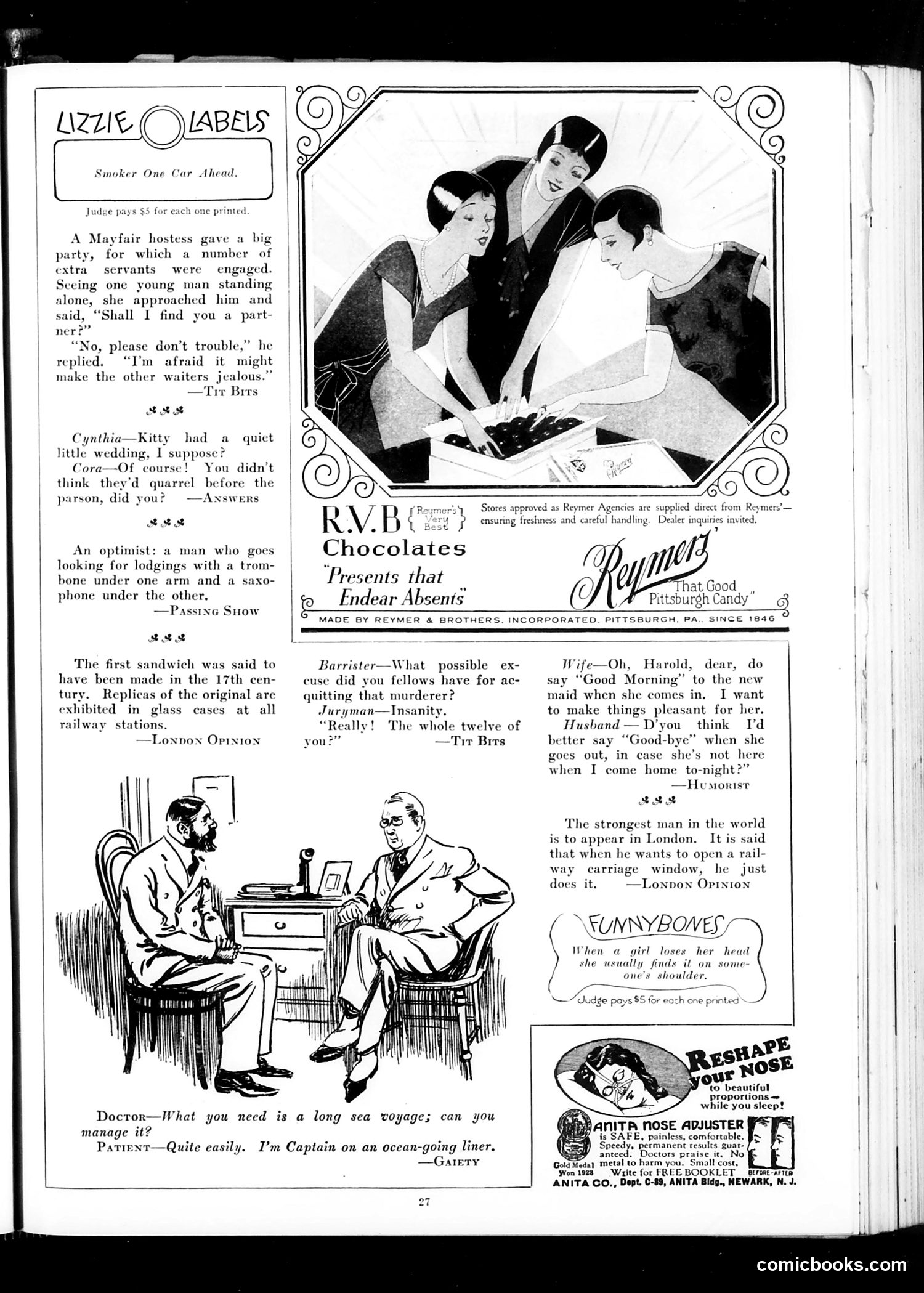
This is primarily a **humor and advertising page** from Judge magazine, featuring miscellaneous jokes and advertisements rather than political cartoons. ## The Humor Content The "Lizzie Labels" section collects brief satirical anecdotes about social situations: - A **servant mistaken for a guest** at a wealthy party, humorously rejecting a dance partner offer to avoid making other waiters jealous - A **lawyer's joke** about jurors acquitting a murderer by claiming insanity - Various one-liners about optimists, sandwiches, and marriage dynamics These represent **class commentary** typical of early 20th-century humor—poking fun at social pretension, the legal system's absurdities, and domestic relationships. ## Advertisements The page features **Reymer Chocolates** (Pittsburgh candy) and the **Anita Nose Adjuster**—a device marketed to reshape noses during sleep, reflecting period anxieties about physical appearance and ethnic features. The humor is lightweight social satire with no identifiable political figures or events—mostly period-appropriate observations about servant culture, courtship, and professional life.
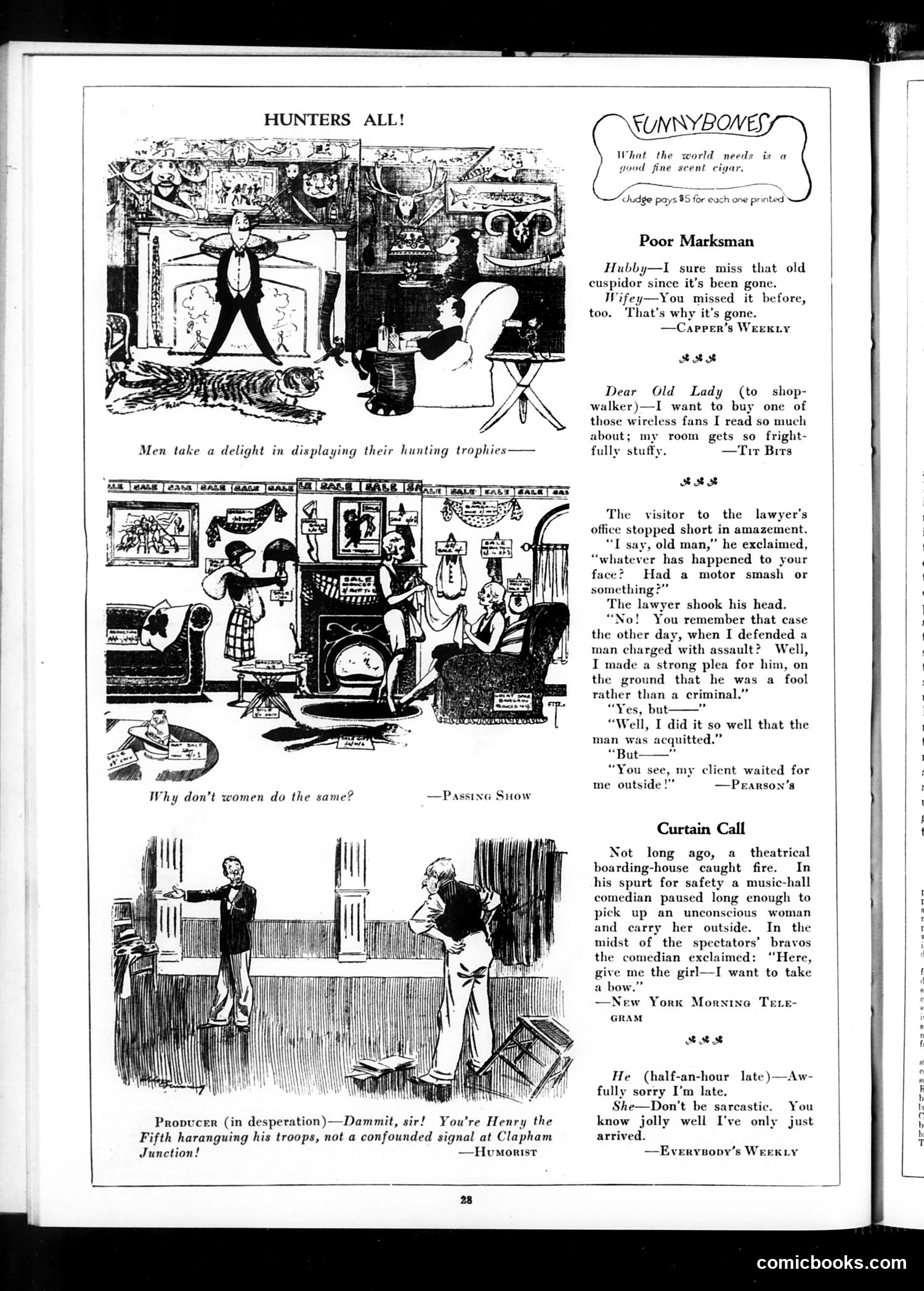
This page collects brief humorous items typical of early 20th-century satirical magazines: **"Hunters All!"** - A large cartoon showing a man displaying taxidermied hunting trophies while his wife sits bored. The caption "Why don't women do the same?" satirizes masculine pride in hunting displays, suggesting women should similarly boast about their accomplishments. **Theater/Production cartoons** - Two theater-related jokes mock dramatic pretension: one depicts an actor overacting Shakespeare, another tells of a vaudeville comedian who interrupts a rescue to take a bow—mocking performers' vanity. **"Poor Marksman" and other brief jokes** - Short quips from various publications satirize domestic life (spittoon removal), consumer confusion (wireless fans for rooms), and legal incompetence (a lawyer's client beats him up after winning his case). The page represents typical Judge content: lightweight social satire targeting middle-class pretensions, gender dynamics, and professional incompetence rather than serious political commentary.
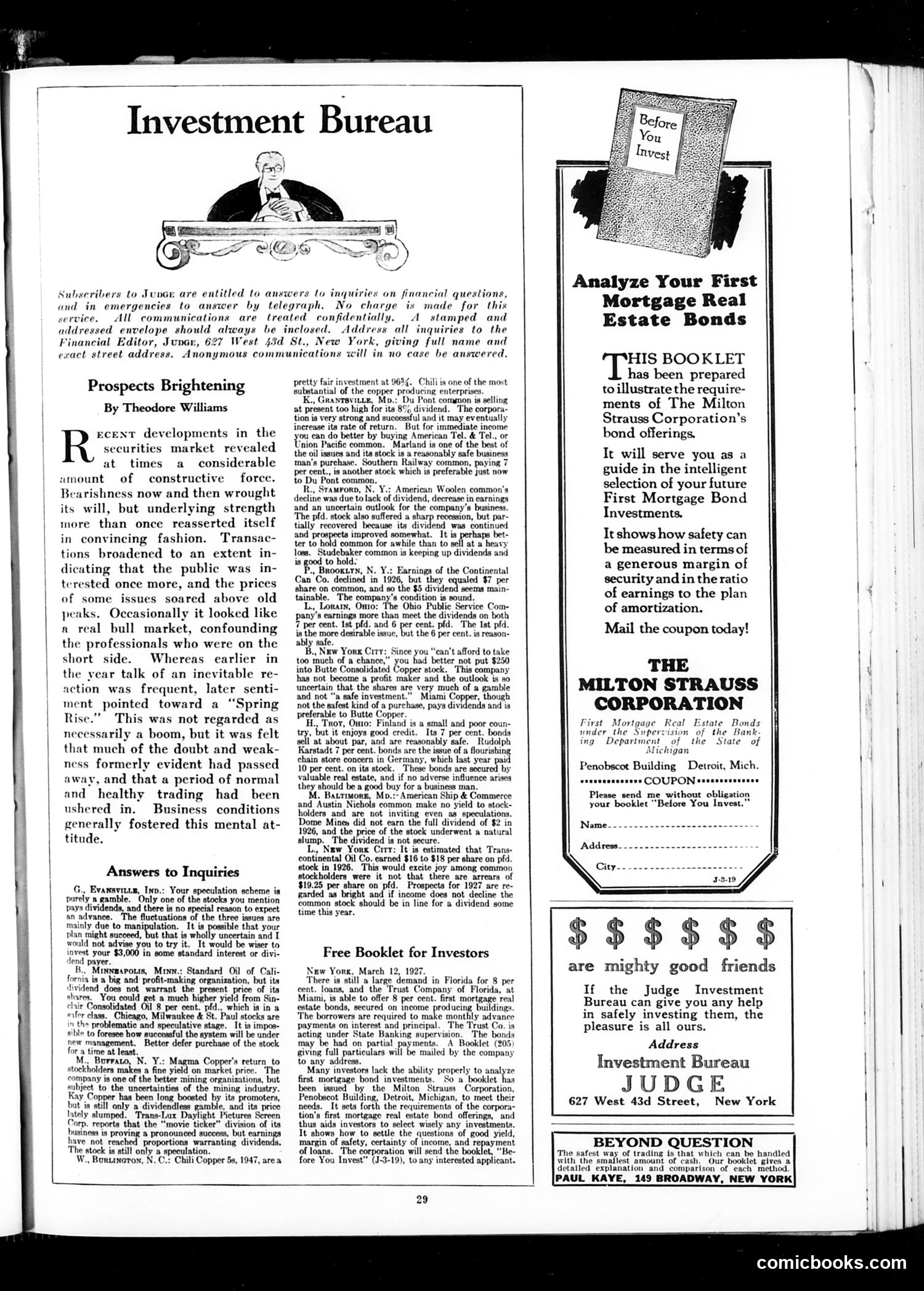
This is primarily a **financial advice column**, not a satirical cartoon page. The main feature is "Investment Bureau," Judge's service answering subscribers' financial questions about stocks and bonds. The column "Prospects Brightening" by Theodore Williams discusses the 1927 securities market, noting recent optimism after earlier bearish sentiment. It reflects the pre-crash stock market euphoria of the Roaring Twenties. The "Answers to Inquiries" section contains specific investment advice discouraging risky speculation (copper stocks, "movie ticker" ventures) while recommending established dividend-payers like Standard Oil and AT&T. The advertisements promote bond investments and investment guides—typical pitched to middle-class investors seeking safe returns during this period of broad market enthusiasm. **Historical context**: This page demonstrates how financial publications actively encouraged public stock market participation before the 1929 crash, often with optimistic messaging that proved premature.
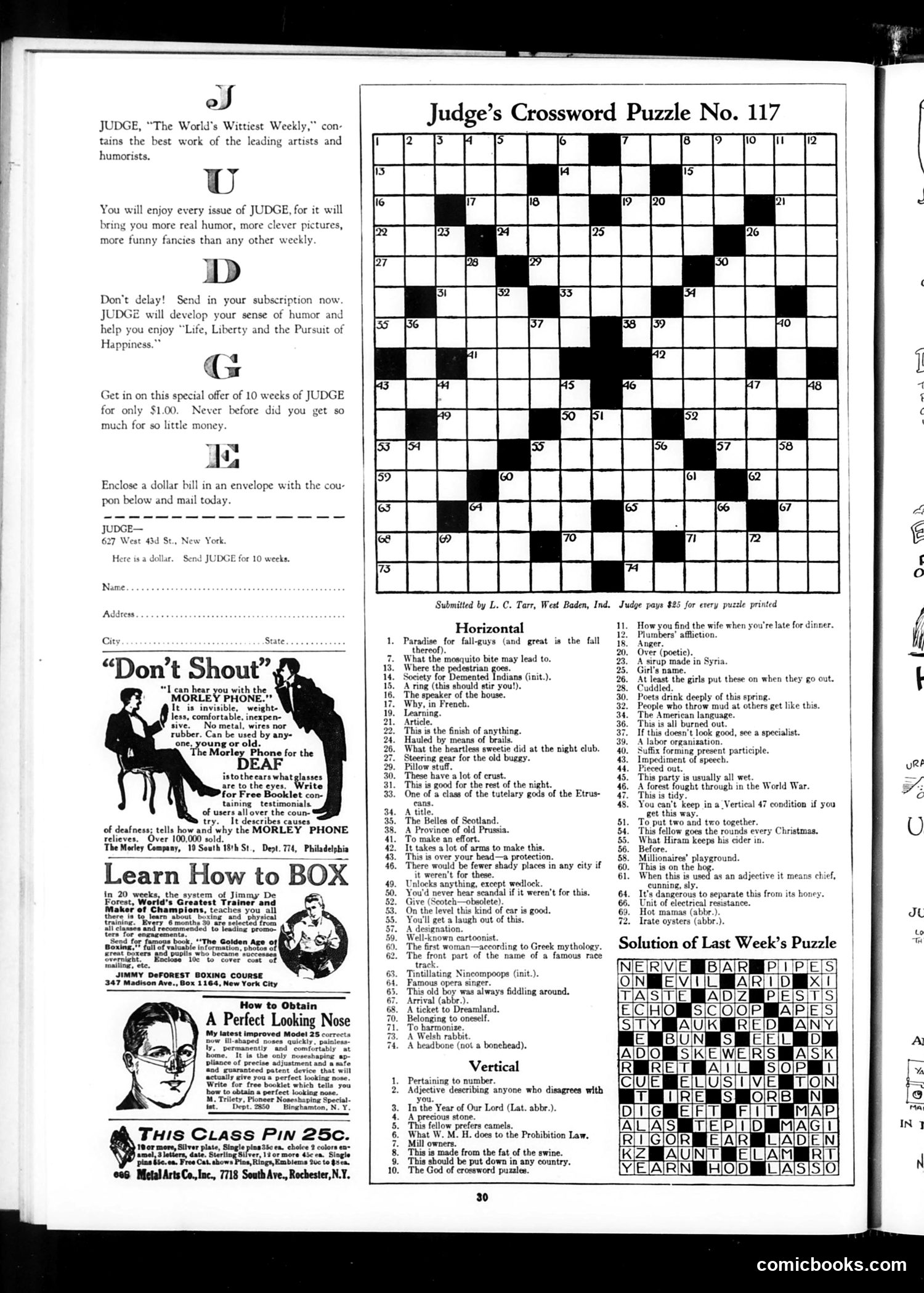
This page is primarily **advertising and subscription material** for Judge magazine itself, interspersed with vintage product advertisements typical of the era. The main content includes: **Judge's Self-Promotion:** The magazine advertises its subscription offer (10 weeks for $1.00), emphasizing it contains "the best work of the leading artists and humorists" and promising "real humor, more clever pictures, more funny fancies than any other weekly." **Period Advertisements:** The page features several ads reflecting early 20th-century concerns: - The "Morley Phone" (an early hearing device for deaf users) - Boxing instruction course - Nose-shaping device - Class pins **Crossword Puzzle:** A standard Judge crossword puzzle with humorous clues, suggesting the magazine appealed to educated, leisured readers. The page demonstrates Judge's dual purpose: satirical humor magazine and advertiser-supported publication targeting middle-class readers with disposable income for novelty products and self-improvement courses.
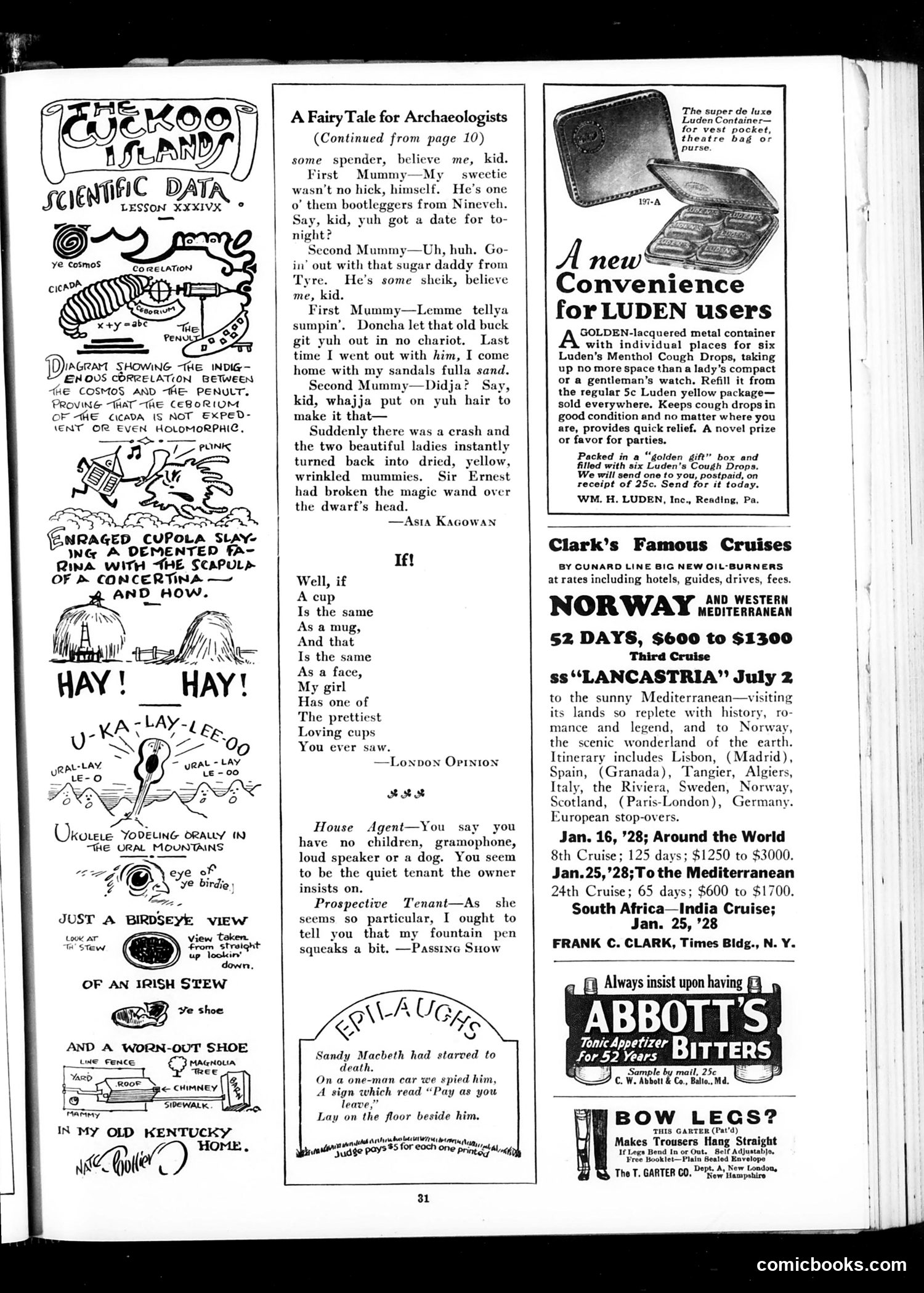
This page from Judge magazine mixes humor, advertising, and social commentary typical of the 1920s. **Left side comics** feature absurdist humor: pseudo-scientific diagrams about "indigenous correlation between cosmos and penult," a man yodeling in mountains, and colloquial sketches of Irish stew and Kentucky home life. These are whimsical, nonsensical gags rather than political satire. **Center content** includes "A Fairy Tale for Archaeologists"—modern flappers portrayed as ancient Egyptian mummies discussing bootleggers and "sugar daddies," referencing 1920s dating culture and Prohibition-era illegality. The humor derives from anachronistic language applied to archaeological subjects. **Poetry and anecdotes** offer gentle, family-friendly humor about definitions, landlord-tenant relations, and a pun about a dead man on a pay-as-you-leave tram. **Advertisements** dominate the right side: Luden's cough drops, cruise lines, Abbott's Bitters, and leg-straightening garters—typical period consumer products marketed to middle-class readers. The page reflects 1920s sensibilities: flapper culture, Prohibition references, modern commercialism, and accessible humor rather than sharp political critique.
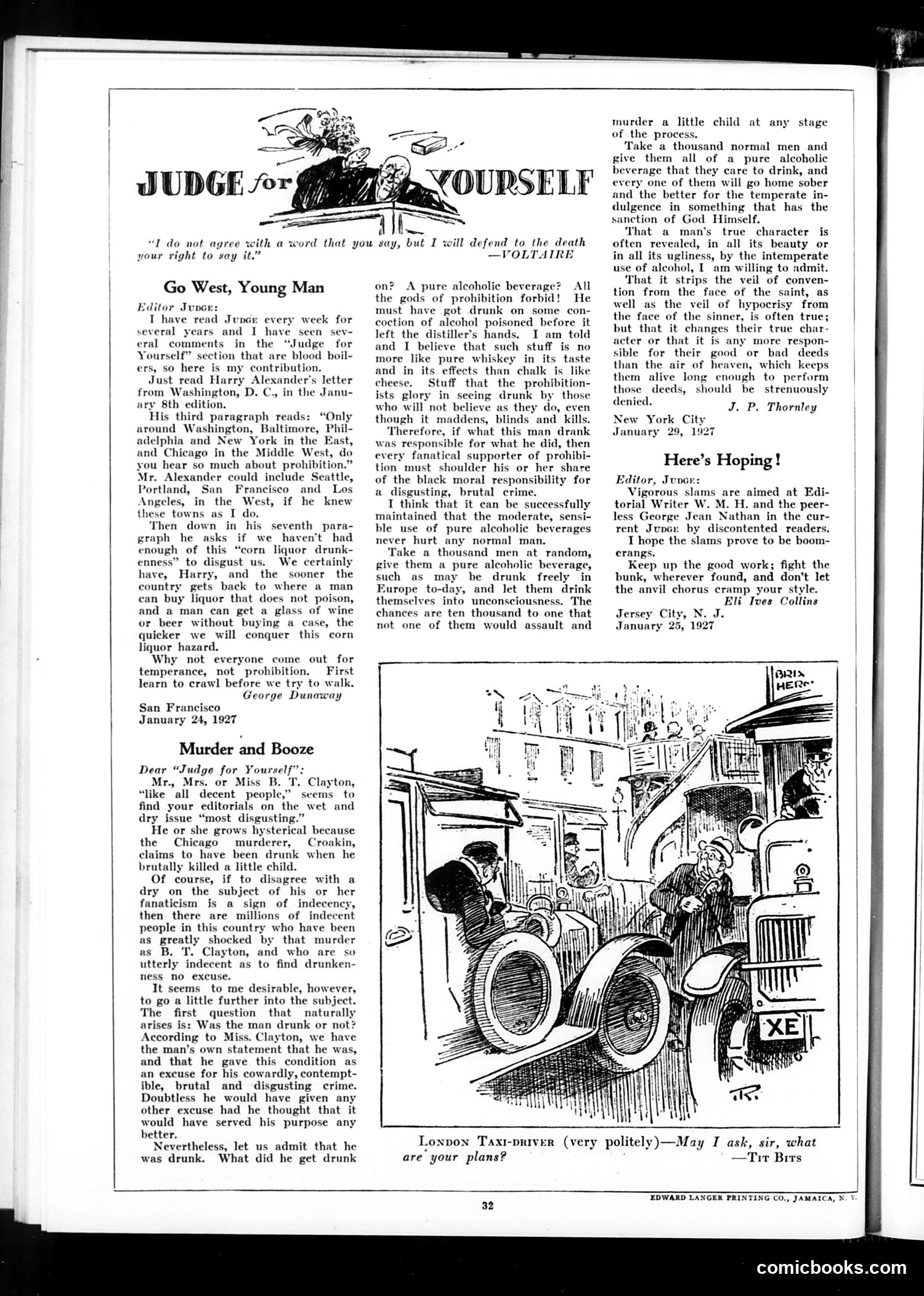
This page presents reader letters debating Prohibition—the constitutional ban on alcohol (1920-1933). Two contrasting arguments appear: **"Go West, Young Man"** argues for **temperance over prohibition**, claiming legal, quality alcohol is safer than bootleg "corn liquor" that poisons drinkers. The writer suggests allowing regulated beer and wine. **"Murder and Booze"** responds to accusations that alcohol caused a Chicago murderer (Croskin) to kill a child. The writer argues that bootleg alcohol—deliberately poisoned by prohibitionists—caused the crime, not pure beverages. He claims moderate drinking of quality alcohol never harms "normal men." The cartoon shows a London taxi driver asking about "plans," likely satirizing British observers of American Prohibition's failure. **Context**: This reflects 1920s wet-vs-dry debates. "Wets" blamed Prohibition's black market for crime; "drys" blamed alcohol itself. The letters represent the wet position that legal, quality liquor is preferable to poisoned bootleg alternatives.
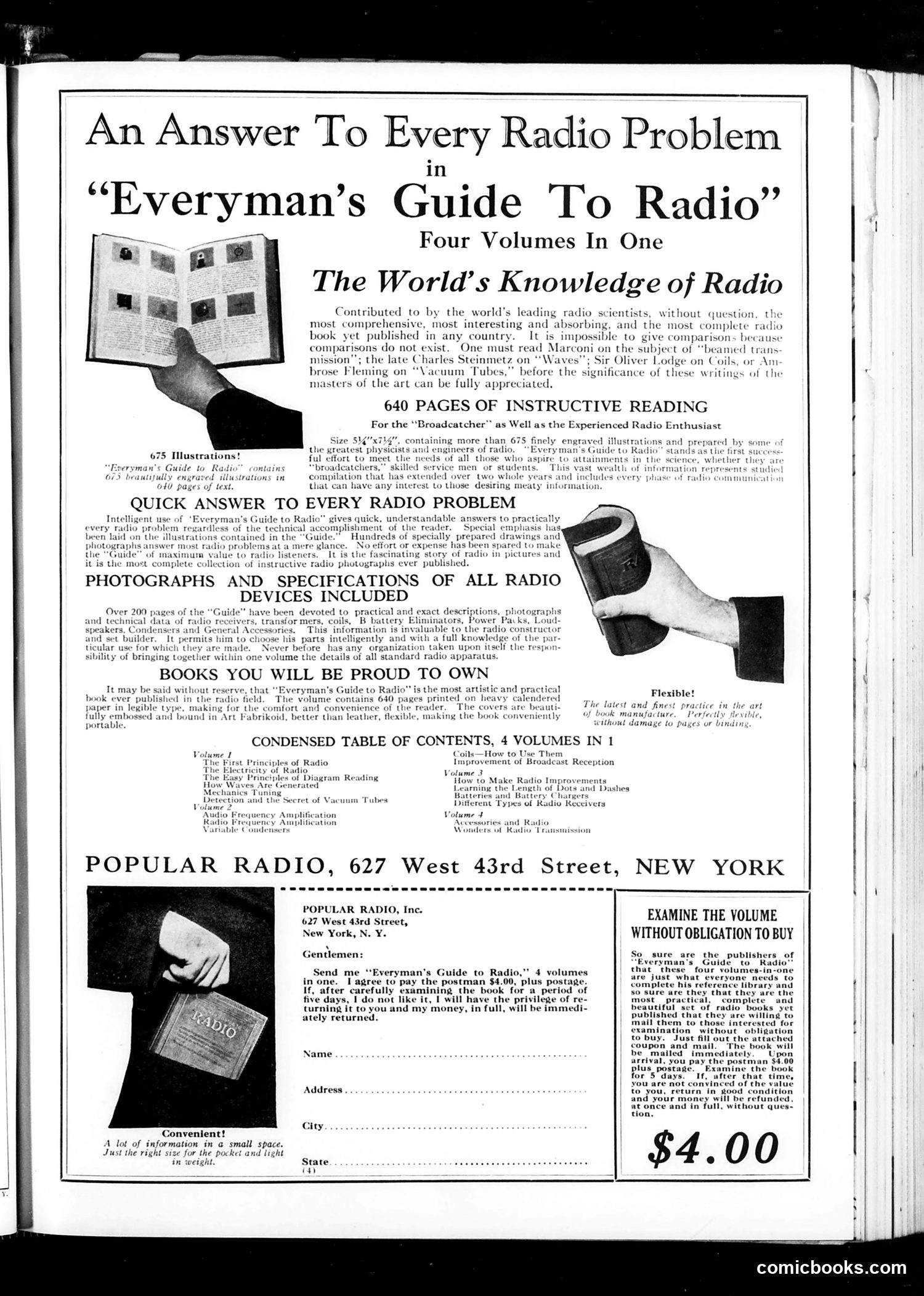
This page is primarily an advertisement, not a cartoon or satire. It promotes a comprehensive four-volume radio instruction manual published by Popular Radio magazine. The ad emphasizes the book's authoritative credentials—contributions from "world's leading radio scientists" including famous figures like Marconi and Charles Steinmetz. It highlights practical features: 640 pages, 675 illustrations, detailed specifications of radio devices and components (coils, batteries, transformers, receivers). The layout includes product photographs and an order coupon offering a five-day examination period for $4.00 (substantial for the era). The sales pitch targets two audiences: casual "broadcatchers" (radio listeners) and experienced enthusiasts. There is no satire or political content here—it's a straightforward commercial appeal to the 1920s radio boom's growing consumer interest in understanding and building radio equipment.
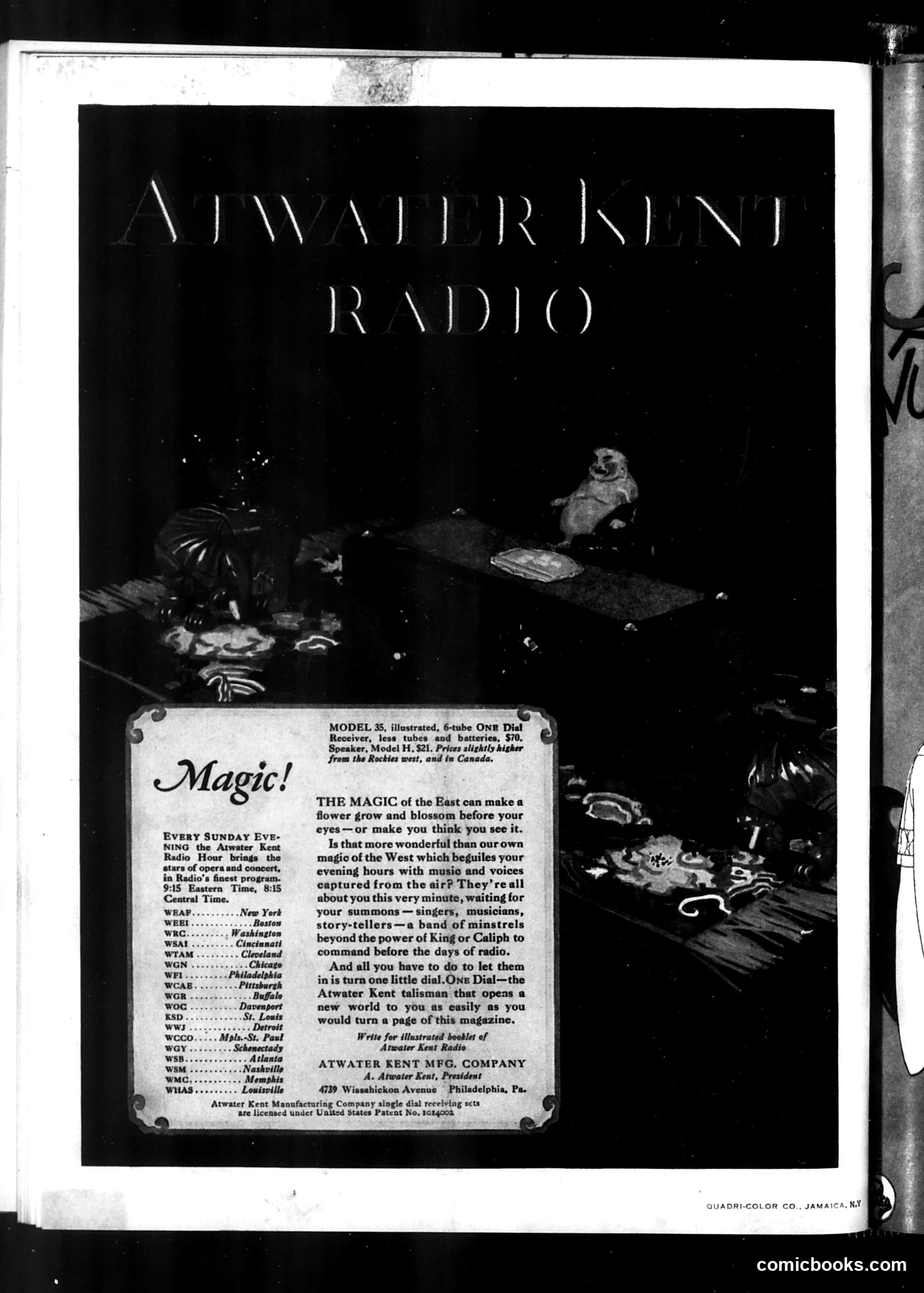
This is primarily an **advertisement**, not political satire. It promotes Atwater Kent radios, a major early radio manufacturer of the 1920s. The ad emphasizes radio's wonder by contrasting "Eastern magic" (ancient mysticism—hence the exotic imagery of flowers blooming supernaturally) with "Western magic" (modern radio technology). The copywriting argues that radio is equally miraculous: with one dial, listeners can summon singers, musicians, and storytellers "captured from the air"—a feat previously impossible. The visual shows ornate objects (vases, figurines, plants) representing exotic Eastern culture, positioned against the modernity of radio reception. The ad lists numerous radio stations (WEAF, WRC, WFAA, etc.), emphasizing radio's growing network reach across America. For modern readers: this captures early 1920s amazement at wireless technology as near-magical, before radio became commonplace. The "One Dial" feature was a genuine selling point—earlier radios required multiple adjustments.