
Judge, 1927-03-19 · page 34 of 36
Judge — March 19, 1927 — page 34: what you’re looking at
What you’re looking at
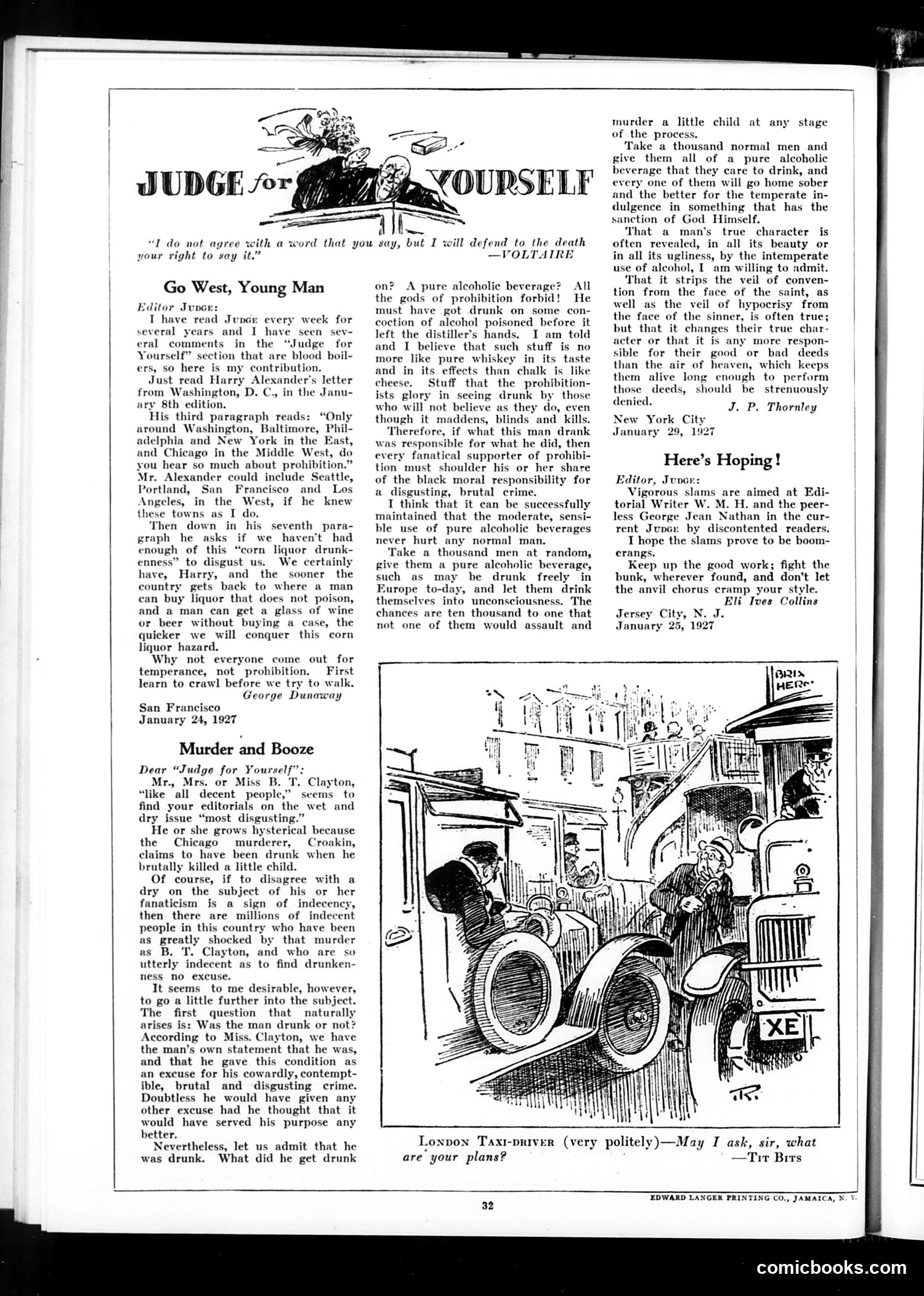
This page presents reader letters debating Prohibition—the constitutional ban on alcohol (1920-1933). Two contrasting arguments appear: **"Go West, Young Man"** argues for **temperance over prohibition**, claiming legal, quality alcohol is safer than bootleg "corn liquor" that poisons drinkers. The writer suggests allowing regulated beer and wine. **"Murder and Booze"** responds to accusations that alcohol caused a Chicago murderer (Croskin) to kill a child. The writer argues that bootleg alcohol—deliberately poisoned by prohibitionists—caused the crime, not pure beverages. He claims moderate drinking of quality alcohol never harms "normal men." The cartoon shows a London taxi driver asking about "plans," likely satirizing British observers of American Prohibition's failure. **Context**: This reflects 1920s wet-vs-dry debates. "Wets" blamed Prohibition's black market for crime; "drys" blamed alcohol itself. The letters represent the wet position that legal, quality liquor is preferable to poisoned bootleg alternatives.
📄 Transcribed text from this page (OCR, searchable)
Machine-transcribed from the original scan — historical spelling and the odd misread are preserved.
“I do not agree your right to say it.” Go West, Young Man Editor Jun T have read Sunder every week for several years and I have seen sev- eral comments in the “Judge for Yourself” section that are blood boil- ers, so here is my contribution. Just read Harry Alexander's letter from Washington, D. C,, in the Janu- ary 8th edition. His third paragraph reads: “Only around Washington, Baltimore, Phil- adelphia and New York in the East, and Chicago in the Middle West, do you hear so much about prohibition.” Mr. Alexander could include Seattle, Portland, San Francisco and Los Angeles, in the West, if he knew these towns as I do. Then down in his seventh para- graph he asks if we haven't had enough of this “corn liquor drunk- enness” to disgust us. We certainly have, Harry, and the sooner the country gets back to where a man can buy liquor that does not poison, and a man can get a glass of wine or beer without buying a case, the quicker we will conquer this corn liquor hazard. Why not everyone come out for temperance, not prohibition, First learn to crawl before we try to walk. George Dunaway San Francisco January 24, 1927 Murder and Booze Dear “Judge for Yourself”: Mr. Mrs. or Miss B. T. Clayton, “like all decent people,” seems to find your editorials on the wet and dry issue “most disgusting.” He or she grows hysterical because the Chicago murderer, Croakin, claims to have been drunk when he brutally killed a little child. Of course, if to disagree with a dry on the subject of his or her fanaticism is a sign of indecency, then there are millions of indecent people in this country who have been as greatly shocked by that murder as B. T. Clayton, and who are so utterly indecent as to find drunken- hess no excuse. It seems to me desirable, however, to go a little further into the subject. The first question that natural arises is: Was the man drunk or no According to Miss, Clayton, we have the man’s own statement that he was, and that he gave this condition as an excuse for his cowardly, contempt- ible, brutal and disgusting crime. Doubtless he would have given any other excuse had he thought that it would have served his purpose any better. Nevertheless, let us admit that he What did he get drunk was drunk. a ith a word that you say, but I will defend to the death | = —VOLTAIRE on? A pure alcoholic beverage? All the gods of prohibition forbid! He must have got drunk on some con- coction of alcohol poisoned before it left the distiller’s hands, I am told and I believe that such stuff is no more like pure whiskey in its taste and in its effects than chalk is like cheese, Stuff that the prohibition- ists glory in seeing drunk by those who will not believe as they do, even though it maddens, blinds and’ kills. Therefore, if what this man drank was responsible for what he did, then every fanatical supporter of prohibi- tion’ must shoulder his or her share of the black moral responsibility for a disgusting, brutal crime. I think that it can be successfully maintained that the moderate, sensi- ble use of pure alcoholic beverages never hurt any normal man. Take a thousand men at random, give them a pure alcoholic beverage, such as may be drunk freely in Europe to-day, and let them drink themselves into unconsciousness. The chances are ten thousand to one that not one of them would assault and murder a little child at of the process. Take a thousand normal men and e them all of a pure alcoholic beverage that they care to drink, and every one of them will go home sober and the better for the temperate in- dulgence in something that has the sanction of God Himself. ‘That a man’s true character is often revealed, in all its beauty or in all its ugliness, by the intemperate use of alcohol, I am willing to admit That it strips the veil of conven- tion from the face of the saint, as well as the veil of hypocrisy from the face of the sinner, is often true; but that it changes their true char: er or that it is any more respon- sible for their good or bad deeds than the air of heaven, which keeps them alive long enough to perform those deeds, should be strenuously denied. J. P. Thornley New York City January 29, any stage 7 Here’s Hoping! litor, JupGr: Vigorous slams are aimed at Edi- torial Writer W. M. H. and the peer- less George Jean Nathan in the cur- rent Juncr by discontented readers. T hope the slams prove to be boom- erangs. Keep up the good work; fight the bunk, wherever found, and don’t let the anvil chorus cramp your style. Eli Ives Collins E Jersey City, N. January 25, 1927 Lonvon Taxi-priver (very politely)—May I ask, sir, what are your plans? —Tir Bits comicbooks.com EDWARD LANGER PRINTING CO., JAMAICA, NY