
Judge, 1927-03-19 · page 15 of 36
Judge — March 19, 1927 — page 15: what you’re looking at
What you’re looking at
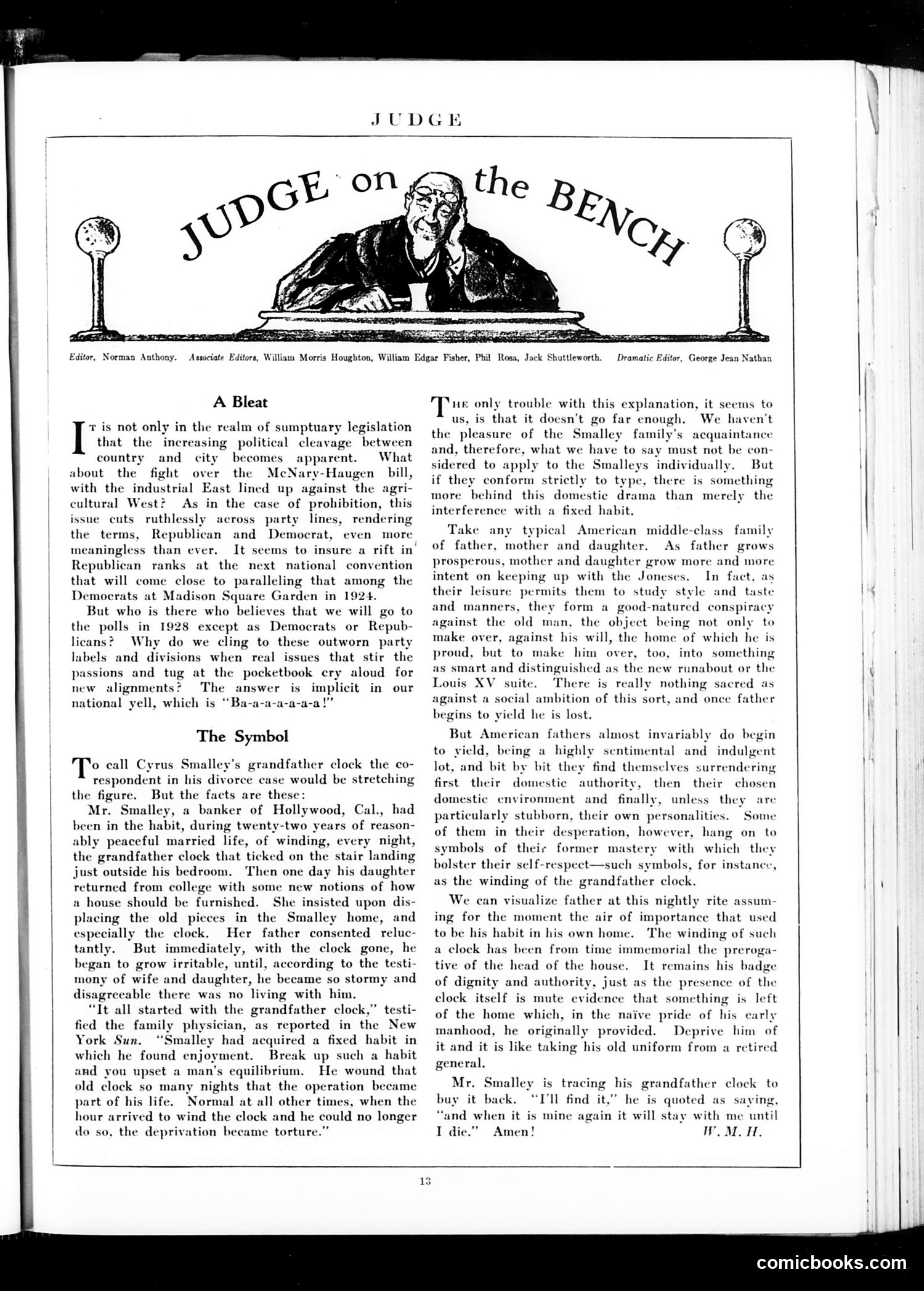
This page contains two satirical pieces from Judge magazine (1920s era). **"A Bleat"** critiques the persistence of outdated Democratic-Republican party divisions despite real economic conflicts—like the McNary-Haugen agricultural bill—that pit industrial East against agricultural West. The author questions why Americans cling to party labels when genuine issues affecting "pocketbook" divide the nation along different lines. **"The Symbol"** satirizes American middle-class domestic life through the story of banker Cyrus Smalley, whose wife and daughter pressure him to replace a beloved grandfather clock with modern furniture. When he becomes unbearably irritable without his nightly winding ritual, a physician attributes it to lost habit. The article's real point: this reflects a broader pattern where prosperous fathers, though sentimental and indulgent, gradually surrender their authority and identity as wives and daughters pursue social climbing and "keeping up with the Joneses." Both pieces critique American conformity—political and domestic.
📄 Transcribed text from this page (OCR, searchable)
Machine-transcribed from the original scan — historical spelling and the odd misread are preserved.
JUDGE Editor, Norman Anthony. A Bleat tv is not only in the realm of sumptuary legislation that the increasing political cleavage between country and city becomes apparent. What about the fight over the MeNary-Haugen bill, with the industrial East lined up against the agri- cultural West? As in the case of prohibition, this issue cuts ruthlessly across party lines, rendering the terms, Republican and Democrat, even more meaningless than ever. It seems to insure a rift in Republican ranks at the next national convention that will come close to paralleling that among the Democrats at Madison Square Garden in 1924. But who is there who believes that we will go to the polls in 1928 except as Democrats or Repub- licans? Why do we cling to these outworn party labels and divisions when real issues that stir the passions and tug at the pocketbook cry aloud for ignments? The answer is imp in our national yell, which is ‘Ba- new 4 The Symbol ‘o call Cyrus Smalley’s grandfather clock the co- respondent in his divorce case would be stretching the figure. But the facts are these: Mr. Smalley, a banker of Hollywood, Cal., had been in the habit, during twenty-two years of reason- ably peaceful married life, of winding, every night, the grandfather clock that ticked on the stair landing just outside his bedroom, Then one day his daughter returned from college with some new notions of how a house should be furnished. She insisted upon dis- placing the old pieces in the Smalley especially the clock. Her father consented reluc- tantly. But immediately, with the clock gone, he began to grow irritable, until, according to the testi- mony of wife and daughter, he became so stormy and disagreeable there was no living with him, “Tt all started with the grandfather clock,” testi- fied the family physician, as reported in the New York Sun. “Smalley had acquired a fixed habit in which he found enjoyment. Break up such a habit and you upset a man’s equilibrium. He wound that old clock so many nights that the operation became part of his life. Normal at all other times, when the hour arrived to wind the clock and he could no longer do so, the deprivation became torture.” home, and Associate Editors, William Morris Houghton, William Edgar Fisher, Phil Rosa, Jack Shuttleworth. Dramatic Editor, George Jean Nathan TT only trouble with this explanation, it seems to is that it doesn’t go far enough. We the pleasure of the Smalley family’s acquaintance and, therefore, what we have to sidered to apply to the Smalleys individually. But if they conform strictly to type, there is something more behind this domestic drama than merely the interference with a fixed habit. aven't y must not be con- Take any typical American middle-class family of father, mother and daughter. As father grows prosperous, mother and daughter grow more and more intent on keeping up with the Joneses. In fact, as their leisure permits them to study style and taste and manners, they form a good-natured conspiracy inst the old man, the object being not only to make over, against his will, the home of which he is proud, but to make him over, too, into something as smart and distinguished as the new runabout or the Louis XV suite. There is really nothing sacred as against a social ambition of this sort, and once father begins to yield he is lost. But American fathers almost invariably do begin to yield, being a highly sentimental and indulgent lot, and bit by bit they find themselves surrendering first their domestic authorit then their chosen domestic environment and finally, unless they particularly stubborn, their own personalities. are Some of them in their desperation, however, hang on to symbols of their former mastery with which they bolster their self-respect—such symbols, for instance as the winding of the grandfather clock. We can visualize father at this nightly rite assum- ing for the moment the air of importance that used to be his habit in his own home. The winding of such a clock has been from time immemorial the prer tive of the head of the house. It remains his badge of dignity and authority, just as the presence of the clock itself is mute evidence that something is left of the home which, in the naive pride of his early manhood, he originally provided. a- Deprive him of it and it is like taking his old uniform from a retired general, Mr. Smalley is tracing his grandfather clock to buy it back. “I'll find it,” he is quoted as say “and when it is mine again it will stay with me until I die.” Amen! W.M.H. comicbooks.com