
A complete issue · 36 pages · 1927
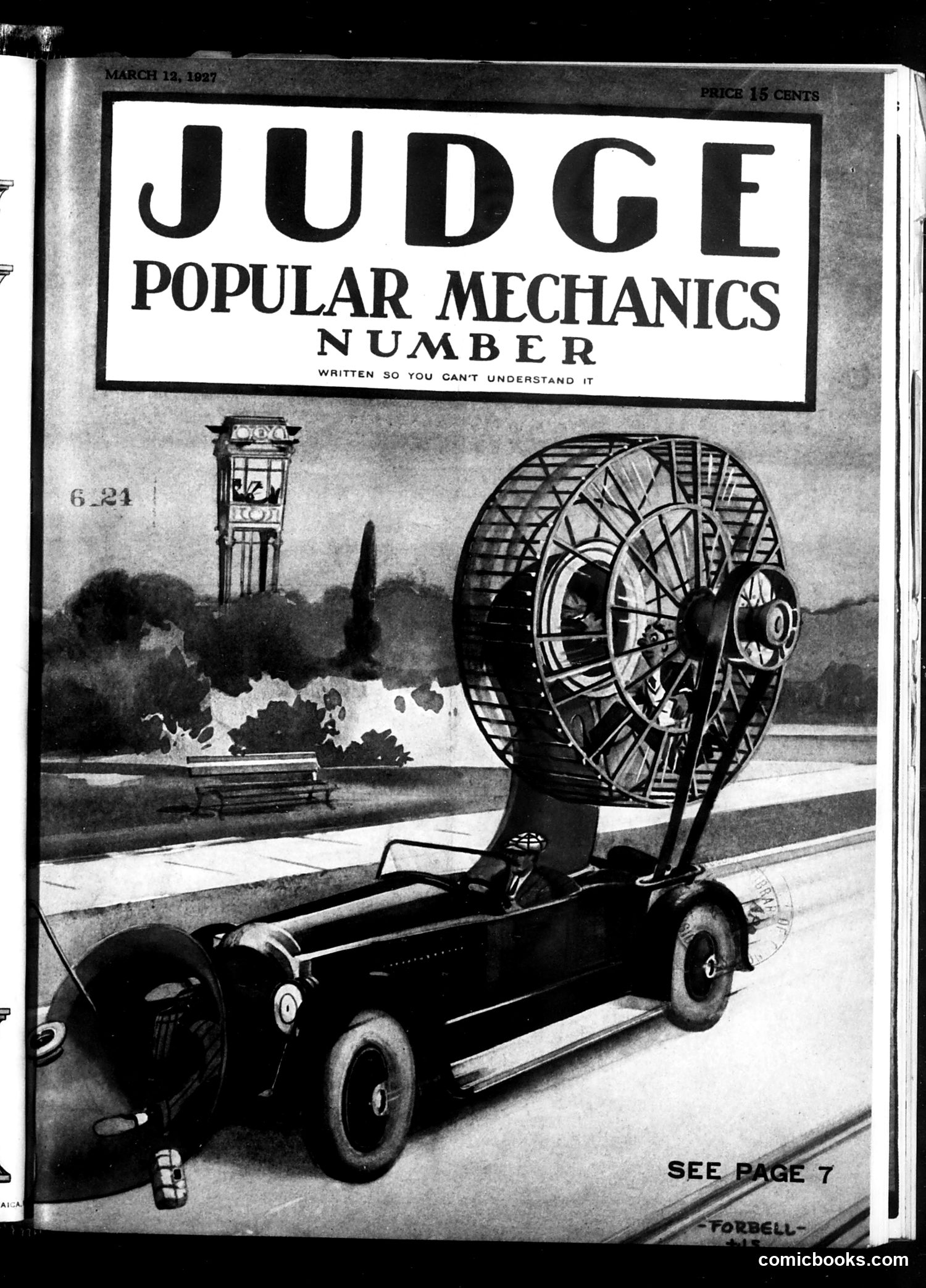
Judge — March 12, 1927
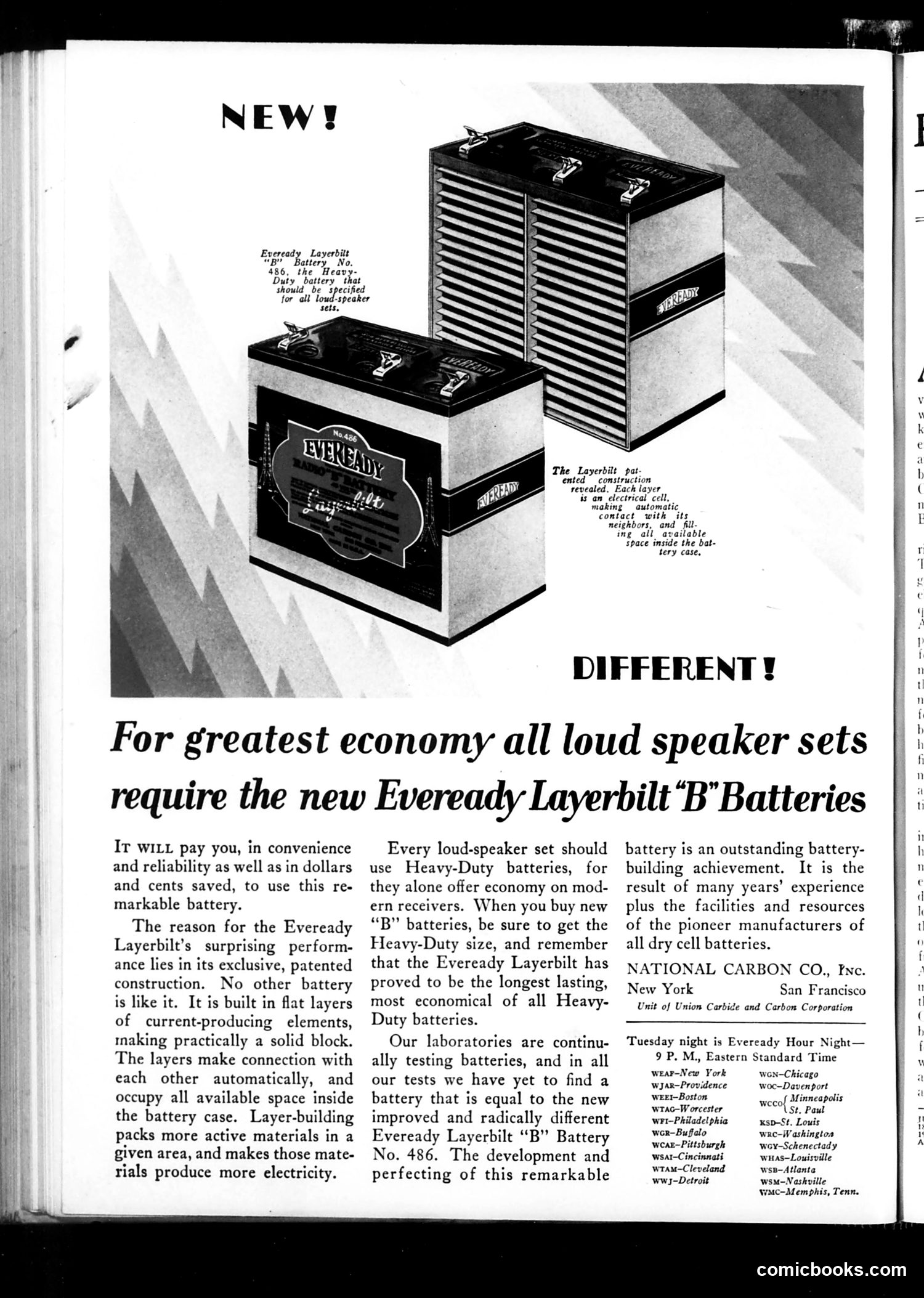
This page is **primarily a commercial advertisement**, not political satire. It promotes Eveready Layerbilt "B" Batteries for loudspeaker systems, featuring product photography of two battery units with horizontal ribbed designs. The advertisement emphasizes the battery's "exclusive, patented construction" and "layer-building" technology that allegedly produces superior electrical output compared to competitors. The copy targets radio enthusiasts and commercial loudspeaker operators, promising economy and reliability. The word "DIFFERENT!" in large text is the marketing hook—positioning this as an innovative product superior to existing options. There is **no political cartoon or satire** present on this page. It represents Judge magazine's reliance on paid advertising to fund publication during the early radio era.
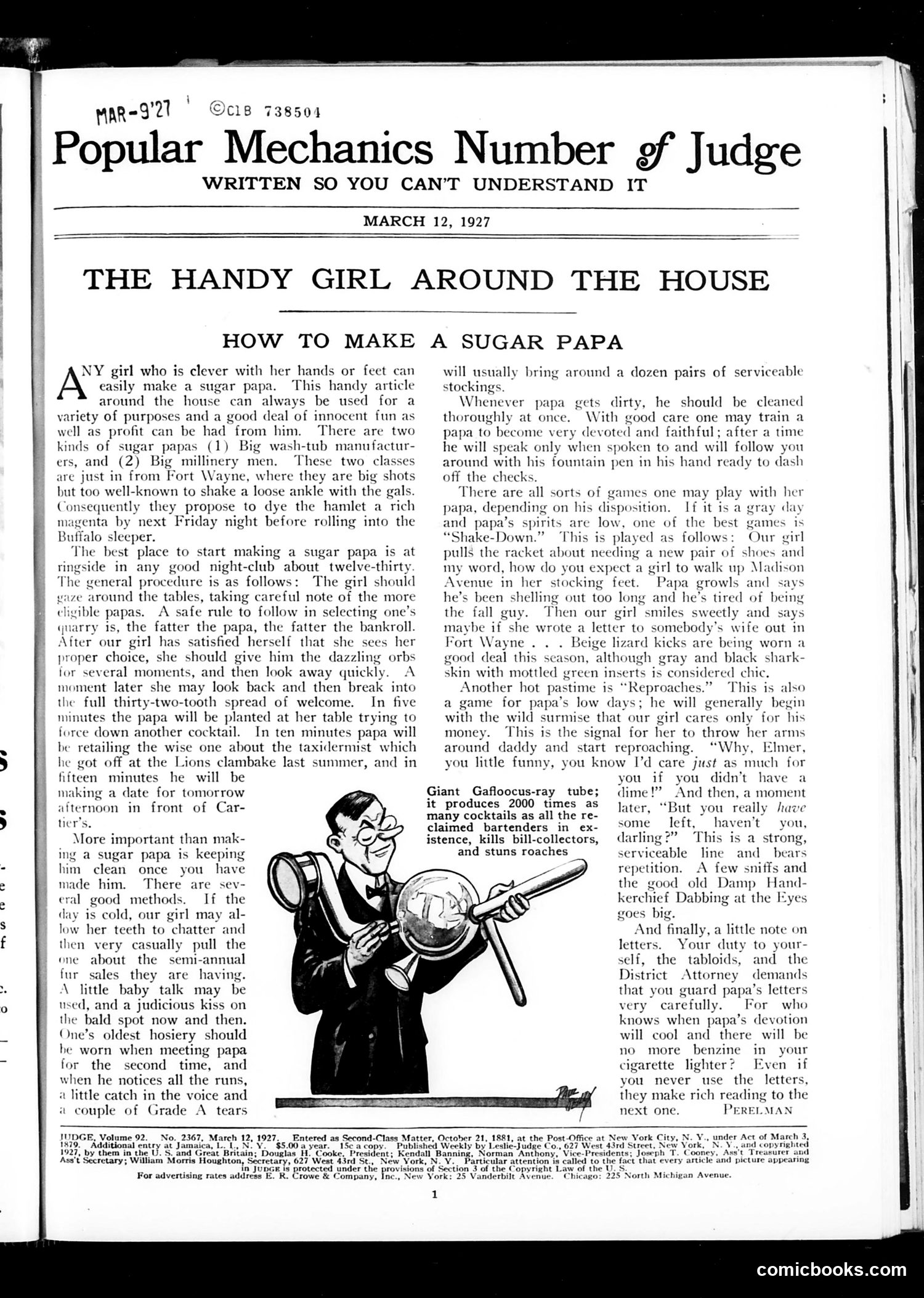
This page from *Judge* magazine (March 12, 1927) contains domestic humor rather than political satire. The article and accompanying illustration discuss making a "sugar papa"—a man financially supported by a young woman, likely a romantic or kept partner. The cartoon depicts a man being struck or manipulated by a woman, visualizing the playful inversion of traditional gender roles. The accompanying text humorously describes how a clever woman can manage such a man through various tricks and games, including flattery and emotional manipulation. This reflects 1920s social commentary on changing relationships during the Jazz Age, when young women had more independence and dating customs were shifting away from Victorian propriety. The "handy girl" uses her wits rather than domestic skills to maintain her position.
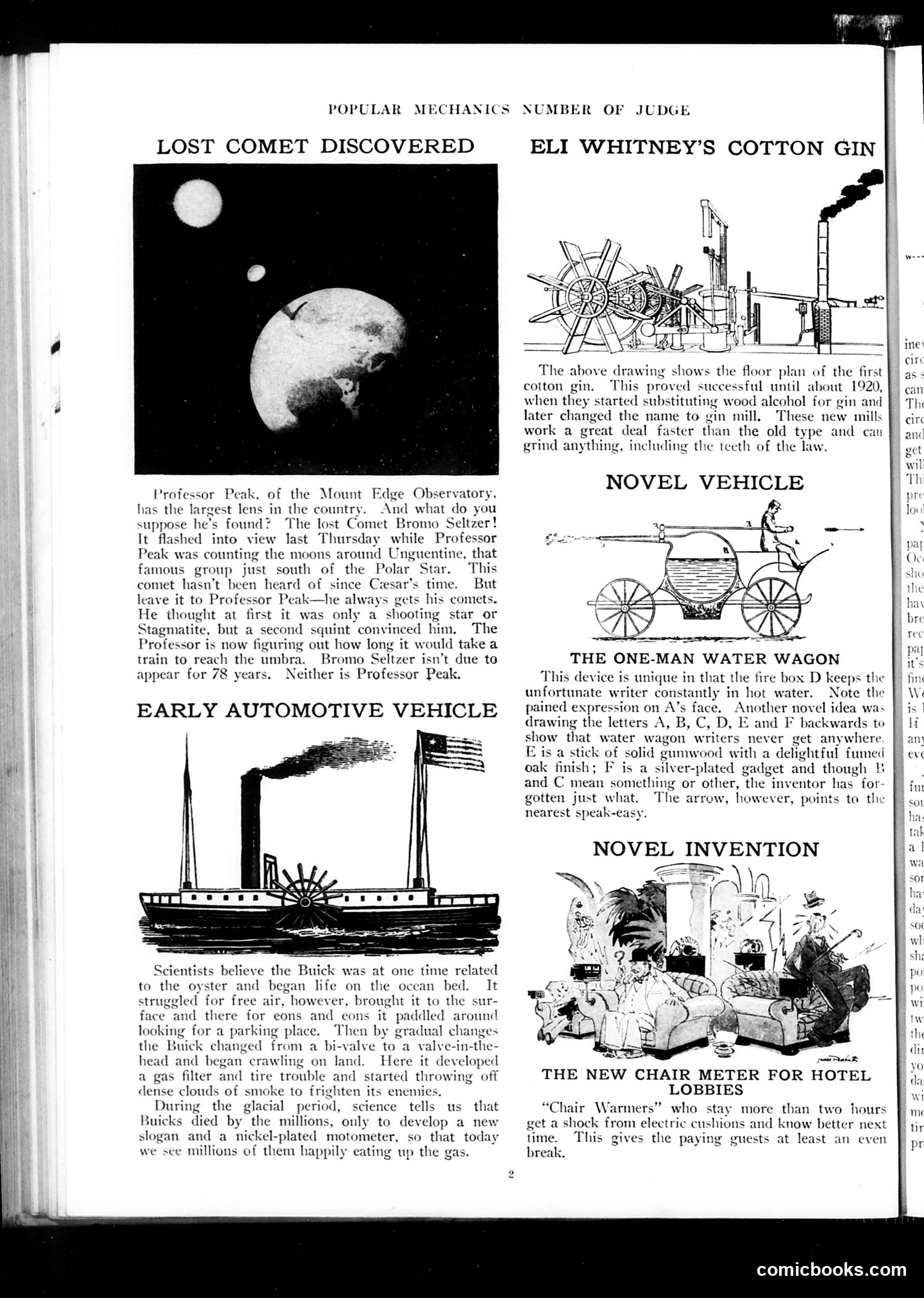
This page from *Judge* magazine contains **humorous inventions and discoveries rather than political satire**. It presents five novelty items: 1. **Lost Comet Discovery**: Satirizes Professor Peak's astronomical work, joking that a comet he discovered will take 78 years to reach the North Star. 2. **Eli Whitney's Cotton Gin**: A historical illustration of the famous textile invention. 3. **Early Automotive Vehicle**: A mock-serious account of the "Buick's" supposed evolutionary origin from oysters, humorously suggesting it gradually developed from sea creature to automobile. 4. **One-Man Water Wagon**: A humorous device where a fire box keeps a writer constantly hot and agitated. 5. **New Chair Meter for Hotel Lobbies**: Electric cushions that shock guests to prevent them from lingering. The page is primarily **whimsical comedy about everyday inventions** rather than political commentary.
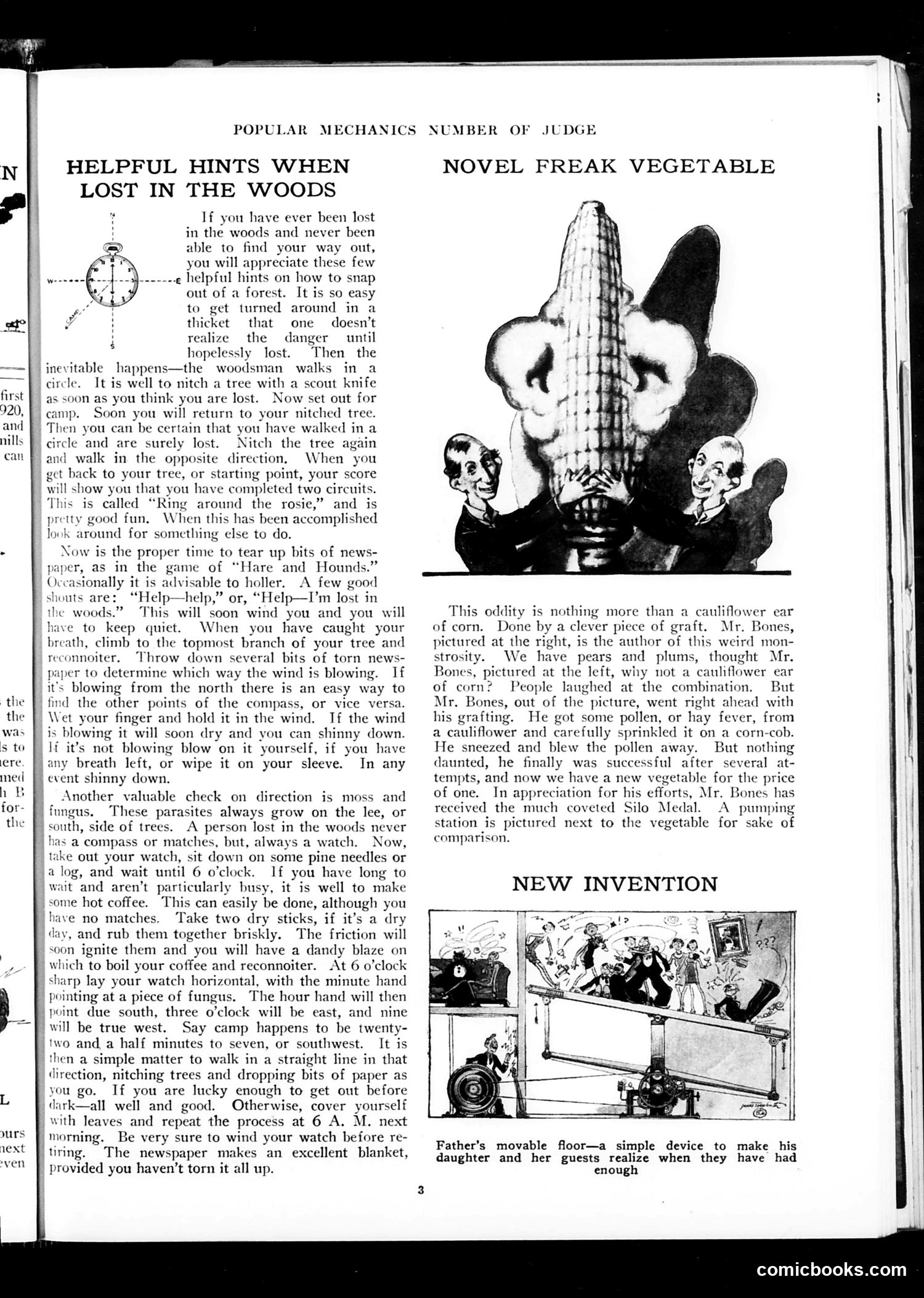
This page contains three distinct sections: **Left column:** "Helpful Hints When Lost in the Woods" provides practical survival advice (using a compass, starting fires, determining direction). This is straightforward instructional content, not satire. **Center:** "Novel Freak Vegetable" features an illustration of two men admiring an unusual corn-cauliflower hybrid created by grafting. The text credits Mr. Bones as the creator. This is presented as a humorous oddity rather than political satire—a showcase of agricultural experimentation that readers might find amusing. **Bottom right:** "New Invention" shows a cartoon of a movable floor-bed contraption. The caption jokes that "Father's movable floor-bed surely pays when they make his daughter and her guests realize when they had enough"—satirizing mechanized solutions to social problems (likely overcrowded entertainment or houseguests). None of these sections contain identifiable political figures or commentary. The page emphasizes practical information and light humor.
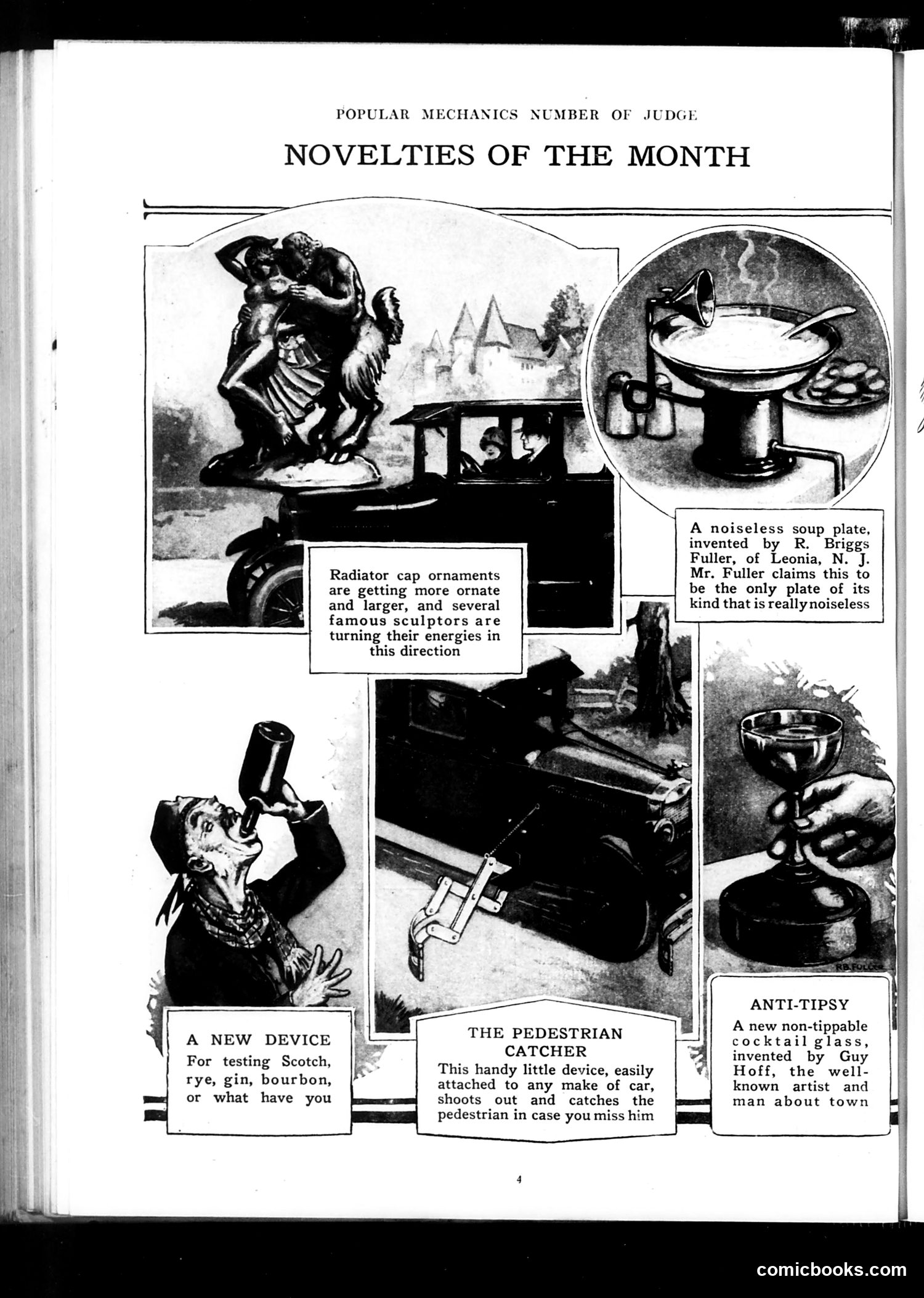
This page presents humorous novelty inventions as satirical commentary on consumer culture. The featured items include: 1. **Radiator cap ornaments** - A jab at automotive ostentation, suggesting wealthy car owners are making their vehicles increasingly ornate. 2. **A device for testing liquor** - The figure appears drunk, satirizing Prohibition-era concerns about alcohol quality and the absurdity of testing spirits. 3. **The Pedestrian Catcher** - A mechanical device for cars, mocking both reckless driving and the era's growing traffic dangers. 4. **Anti-tipsy cocktail glass** - Invented by "Guy Hoff," this non-spillable glass sardonically addresses drunkenness as a design problem rather than a behavioral one. The overall tone ridicules both technological "solutions" to social problems and consumer excess during the early automotive age.
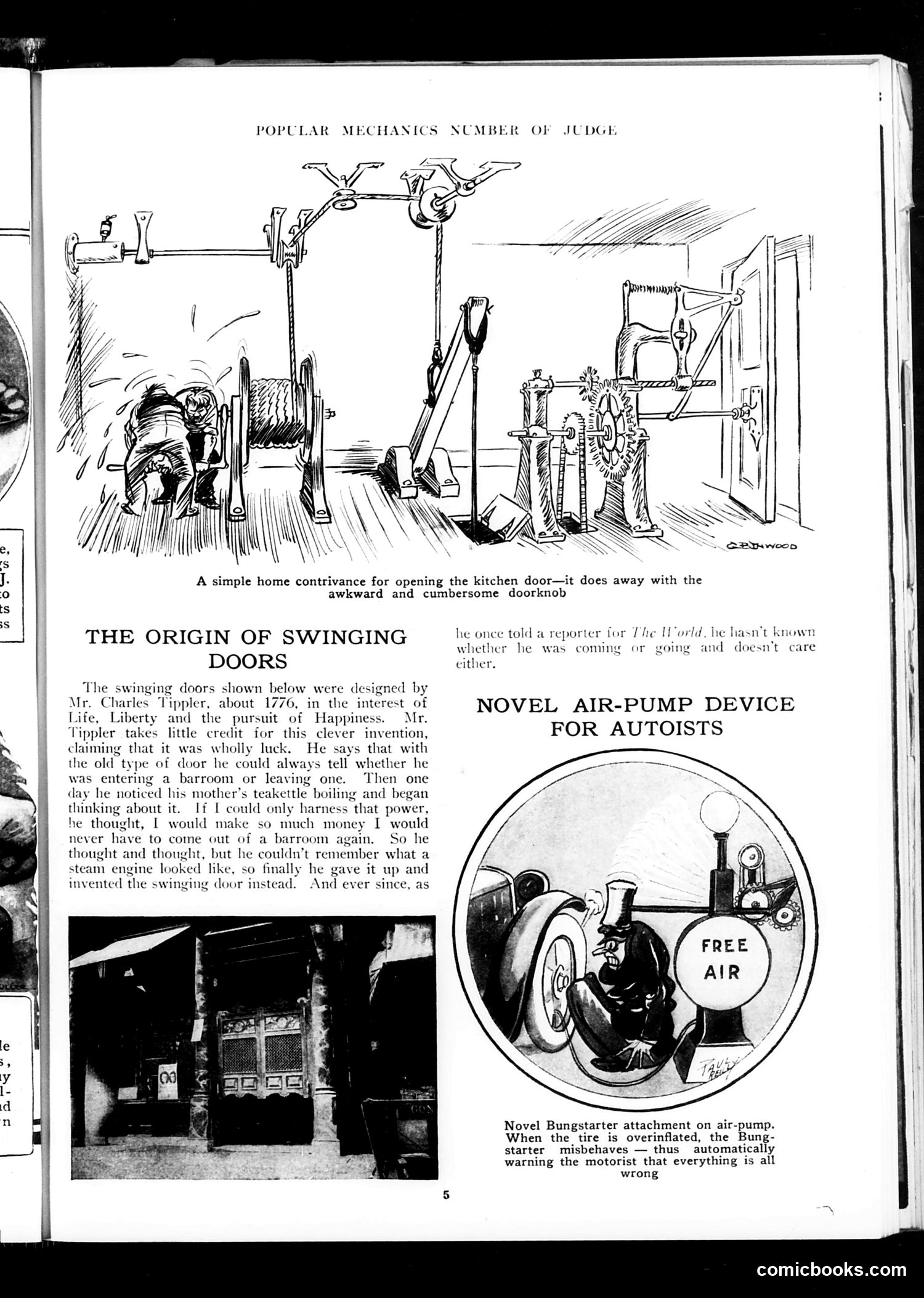
This page contains three distinct features: 1. **Kitchen Door Contraption** (top): A satirical illustration of an overly complex mechanical system for opening a kitchen door, mocking elaborate "labor-saving" devices of the era. The joke is that the contraption is absurdly complicated for a simple task. 2. **"The Origin of Swinging Doors"** (left): A humorous origin story crediting Charles Tippler (circa 1776) with inventing swinging doors. The narrative claims he wanted to avoid coming in/out of bathrooms—a lighthearted fabrication typical of Judge's satirical humor pieces. 3. **"Novel Air-Pump Device for Autoists"** (right): An advertisement-style cartoon showing a "Bungstarter" attachment for car tire pumps. The satire suggests it automatically warns motorists when tire pressure is wrong, presented with mock-seriousness. All pieces exemplify early 20th-century American humor about emerging technology and modern conveniences.
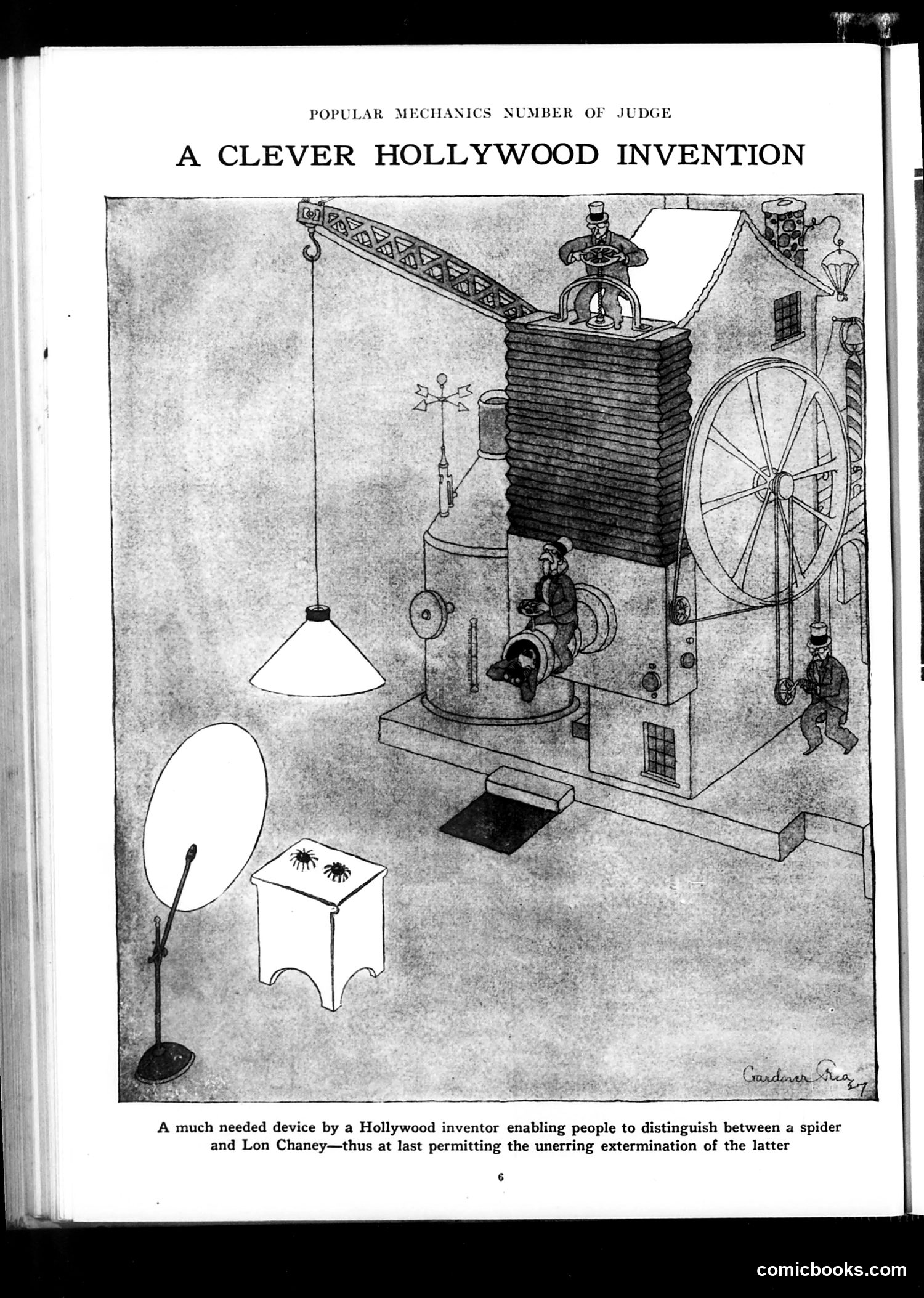
This is a satirical cartoon mocking actor **Lon Chaney**, famous for his grotesque character roles and heavy makeup in silent horror films. The joke plays on Chaney's reputation for transforming himself into frightening, spider-like or monstrous creatures so convincingly that audiences found him genuinely frightening. The cartoon imagines a fantastical contraption—complete with pulleys, gears, and mechanical apparatus—designed to help people distinguish between an actual spider and Chaney himself, so they can "unerringly exterminate the latter" (kill Chaney instead of the spider). The humor relies on suggesting Chaney's on-screen appearances were so horrifyingly effective and inhuman that he was indistinguishable from actual vermin. It's a backhanded compliment to his acting ability, mocking both his grotesque roles and Hollywood's theatrical excess.
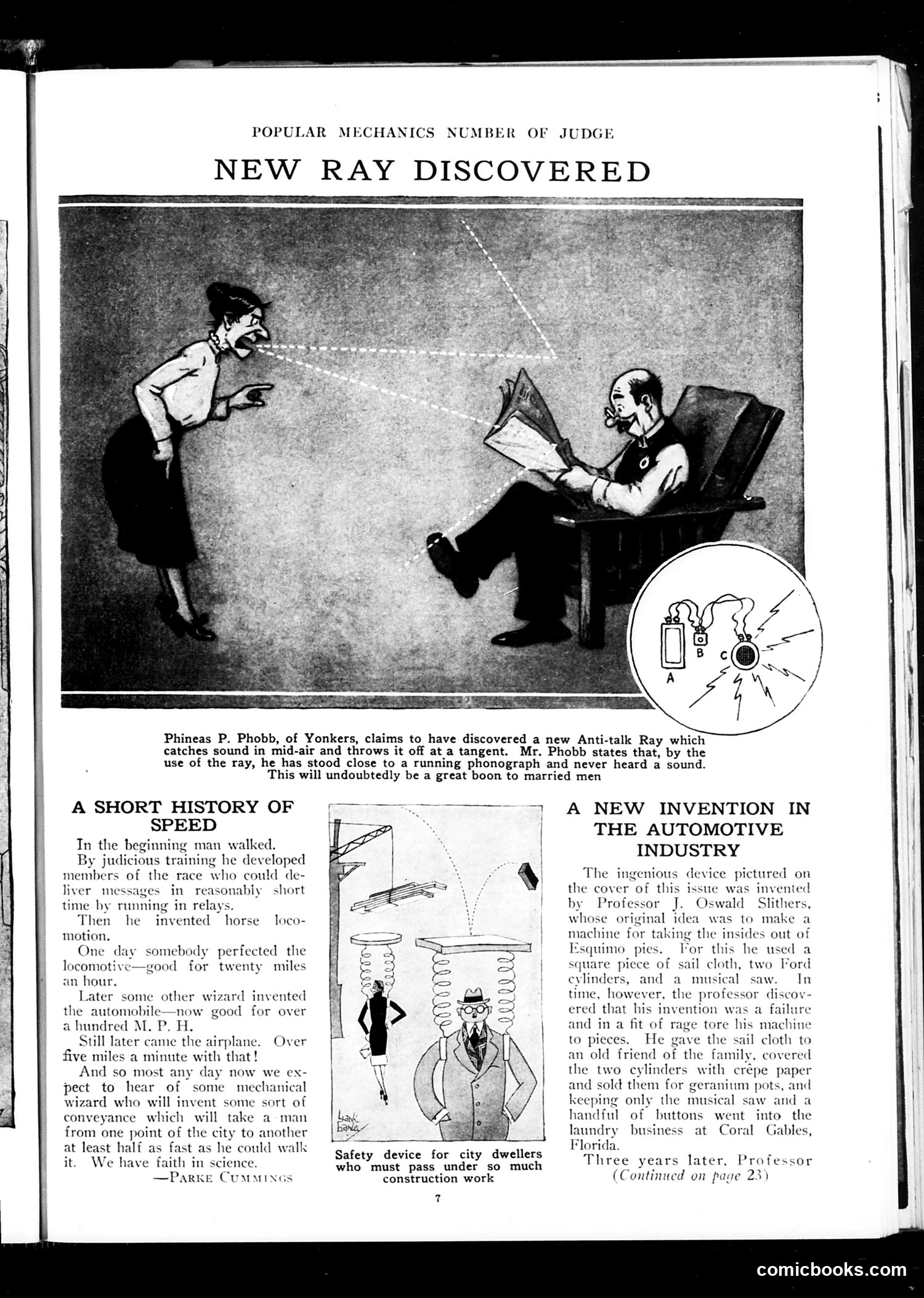
This page satirizes both marital discord and the era's obsession with technological progress. The main cartoon depicts an "Anti-talk Ray" invented by Phineas P. Phobb that silences sound—with the explicit punchline that it will benefit "married men" by allowing them to escape their wives' voices. The humor relies on a stereotypical complaint about nagging spouses. The accompanying article "A Short History of Speed" mocks the accelerating pace of invention, culminating in absurdist irony: future transportation will be *slower* than walking. "A New Invention in the Automotive Industry" describes Professor Slithers's ridiculous contraption—originally designed to hollow out Eskimo pies, then salvaged into nonsensical components (Ford cylinders, sail cloth, musical saw) that ended up as flowerpot covers in a laundry business. The satire targets both domestic tensions and the era's blind faith in "progress," suggesting inventors pursue novelty without practical purpose.
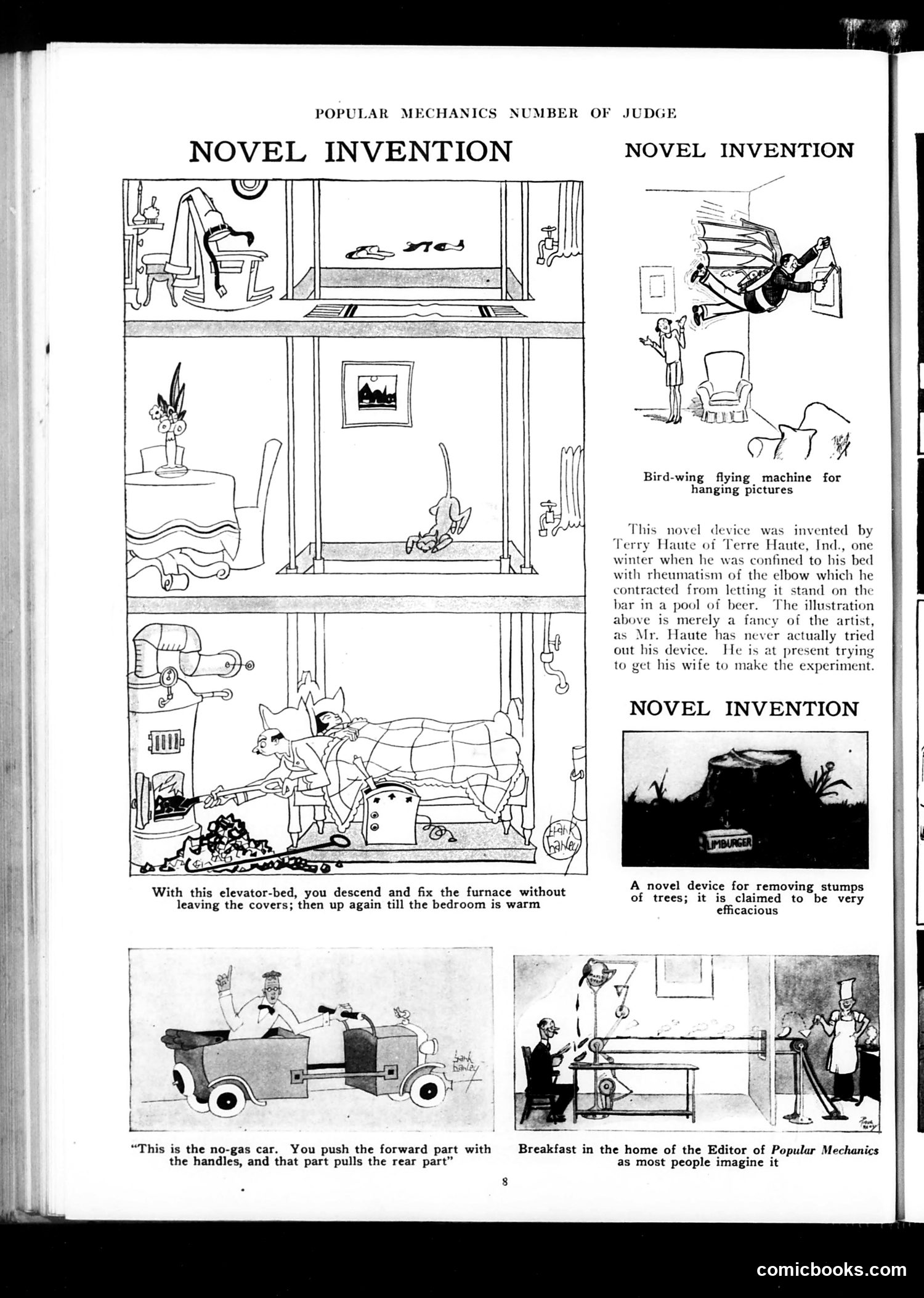
This is a humorous parody issue of *Judge* magazine styled as "Popular Mechanics." The page satirizes overly complicated or absurd "labor-saving" inventions through mock-serious presentation. The cartoons ridicule impractical solutions to everyday problems: a "bird-wing flying machine" for hanging pictures (needlessly complex), an "elevator bed" to access the furnace without leaving warmth (silly engineering), a "no-gas car" requiring manual pushing (defeating the purpose of automobiles), and a "stump-removal device" (presented without explanation, suggesting it's equally dubious). The humor stems from the contrast between the earnest tone of Popular Mechanics magazine and these transparently useless contraptions. One invention is attributed to "Terry Haute of Terre Haute, Ind."—a pun on the place name—and the text admits he's never actually tested it, undercutting the pseudo-authoritative presentation. The final panel mocks Popular Mechanics' editor, suggesting even *he* doesn't use these inventions practically. It's satire of American enthusiasm for mechanization and "progress" over common sense.
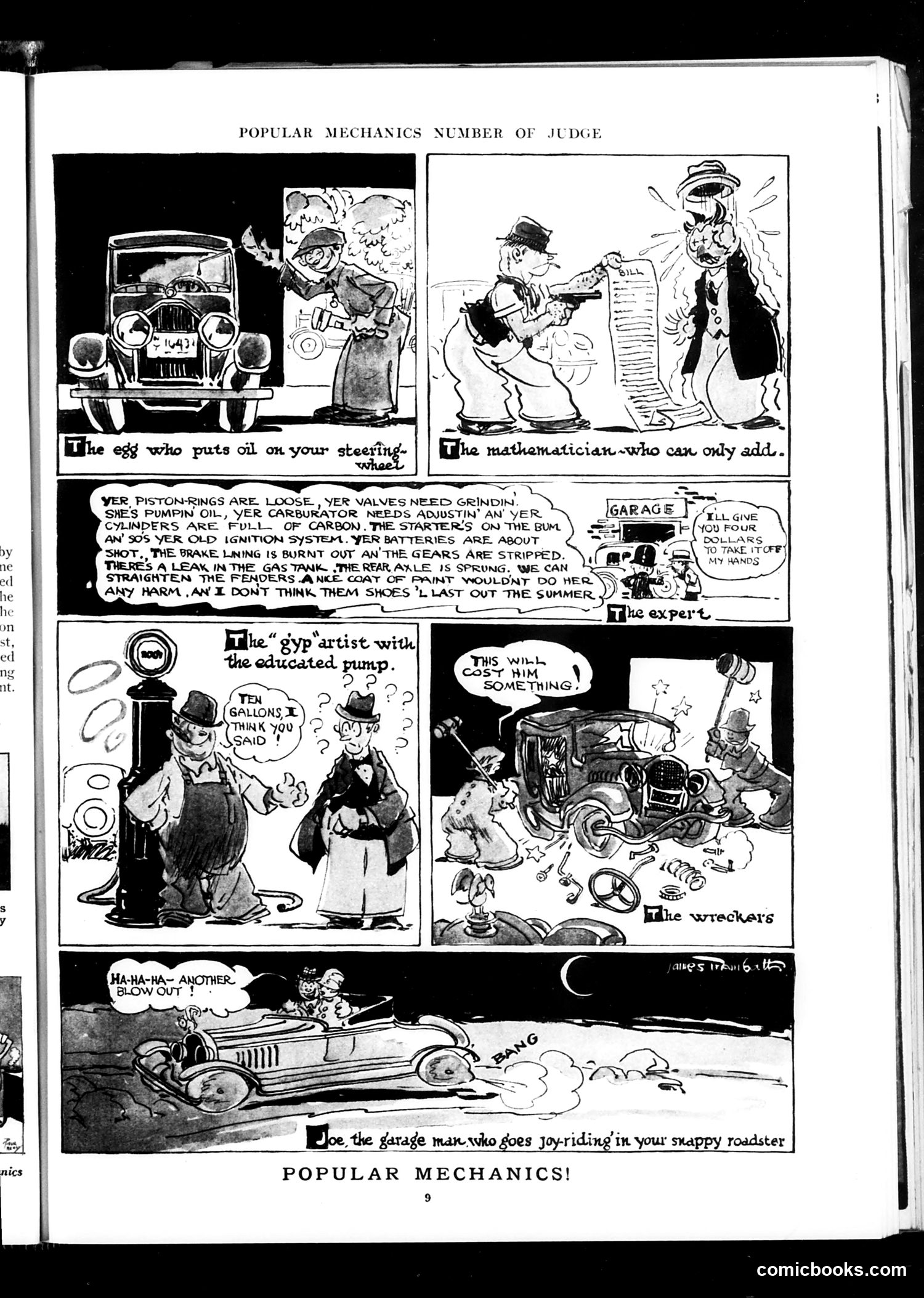
This satirical page mocks the emerging automobile culture and the specialized jargon of mechanics. The central cartoon depicts a garage mechanic delivering an incomprehensibly long, technical diagnosis to a bewildered car owner—rattling off esoteric mechanical terms (piston rings, carburators, ignition systems) that would confuse ordinary people. The humor lies in the contrast between the mechanic's confident expertise and the owner's helpless confusion. Supporting cartoons reinforce the theme: "The egg who puts oil on your steering wheel" (absurd ignorance), "The mathematician who can only add" (incompetence despite education), and "Joe the garage man who goes joyriding in your snappy roadster" (mechanics exploiting customers). The satire targets both the growing complexity of automobile technology—which created a new class of specialized workers—and mechanics' reputation for overcharging confused owners by citing obscure problems they couldn't verify or understand.
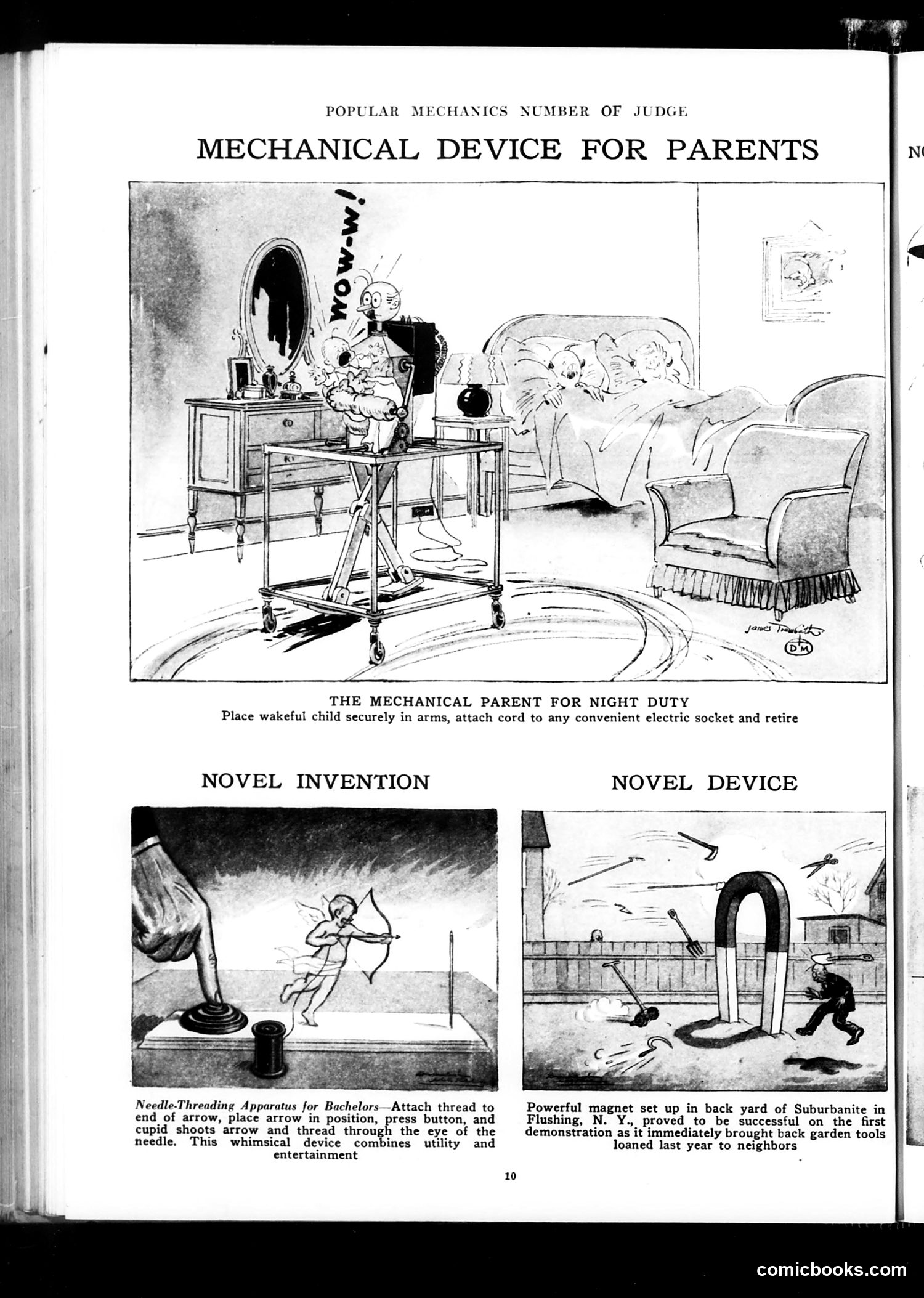
This page satirizes modern domestic problems through absurdist mechanical "solutions." The cartoons mock three common household frustrations: 1. **"Mechanical Parent"**: A robot holding a baby, mocking exhausted parents doing nighttime childcare. The joke is that parents wish they could automate this tedious duty by literally plugging in a machine. 2. **"Needle-Threading for Bachelors"**: A Cupid-themed contraption shooting an arrow through a needle's eye. This ridicules unmarried men's incompetence at basic sewing tasks, suggesting they need elaborate machinery for what women do routinely. 3. **"Powerful Magnet"**: A magnet retrieving borrowed tools from neighbors' yards, satirizing the common suburban problem of neighbors never returning loaned items. The satire targets early-20th-century anxieties about modern life's inconveniences and gender roles—how technology might "solve" domestic annoyances, while highlighting that some problems are fundamentally human, not mechanical.
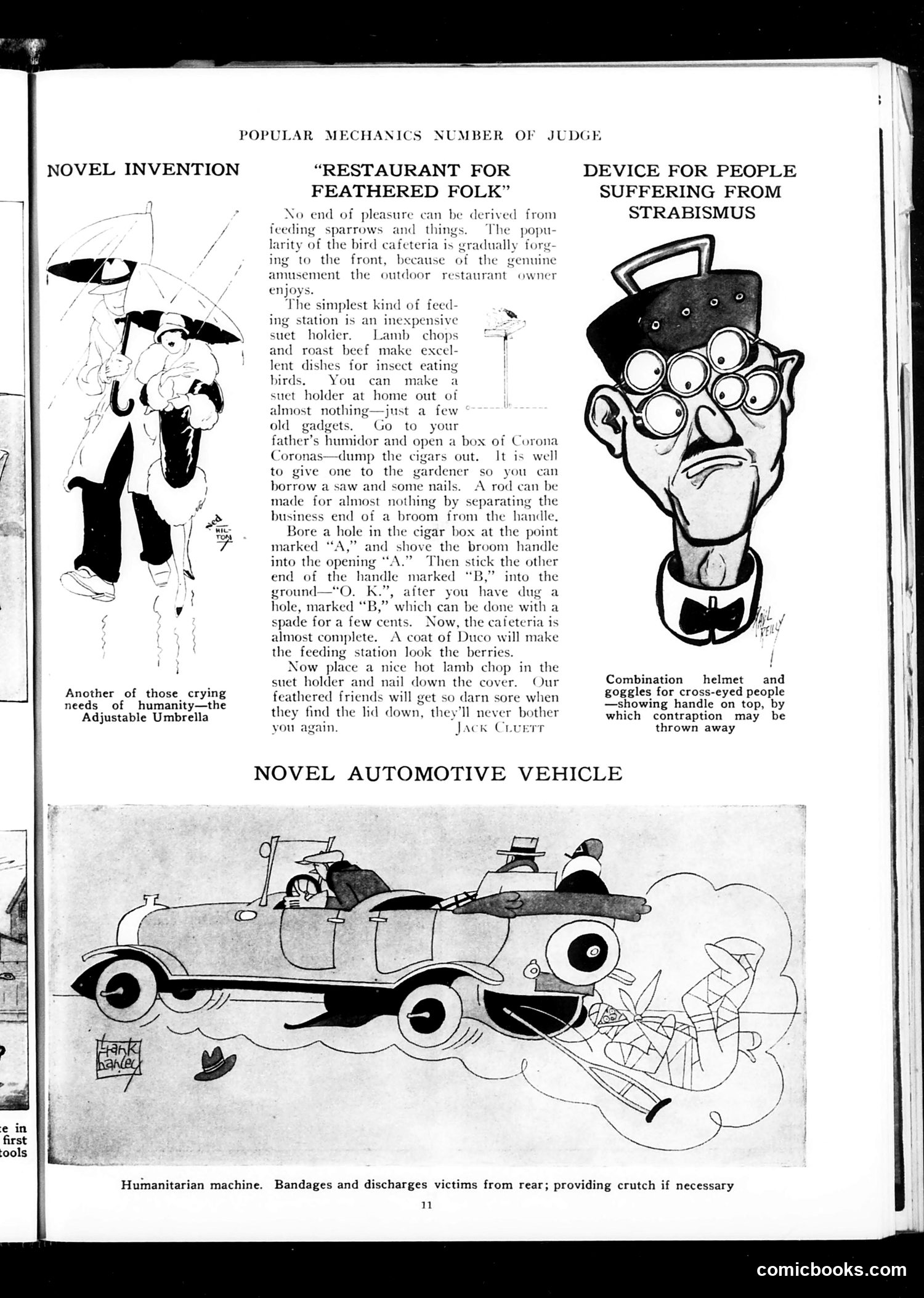
This page contains three humorous inventions mocking impractical solutions to everyday problems: 1. **"Restaurant for Feathered Folk"**: A mock DIY bird feeder made from discarded cigar boxes and broom handles. The satire lies in the absurdly overwrought instructions for creating something trivially simple, and the darkly comic ending—trapping the bird under a lid so it "never bothers you again." 2. **"Device for People Suffering from Strabismus"** (cross-eyedness): A ridiculous contraption featuring a head device with multiple eyeglasses that can be "thrown away." The joke mocks both the condition and the absurdity of such a "solution." 3. **"Novel Automotive Vehicle"**: A car equipped with mechanisms that bandage accident victims and eject them from the rear with a crutch. This satirizes over-engineered solutions to problems—here, the dark humor comes from treating car accidents as inevitable rather than preventable. The page exemplifies Judge's style: gadget-obsessed 1920s-era humor mocking American consumer culture's faith in mechanical solutions to human problems.
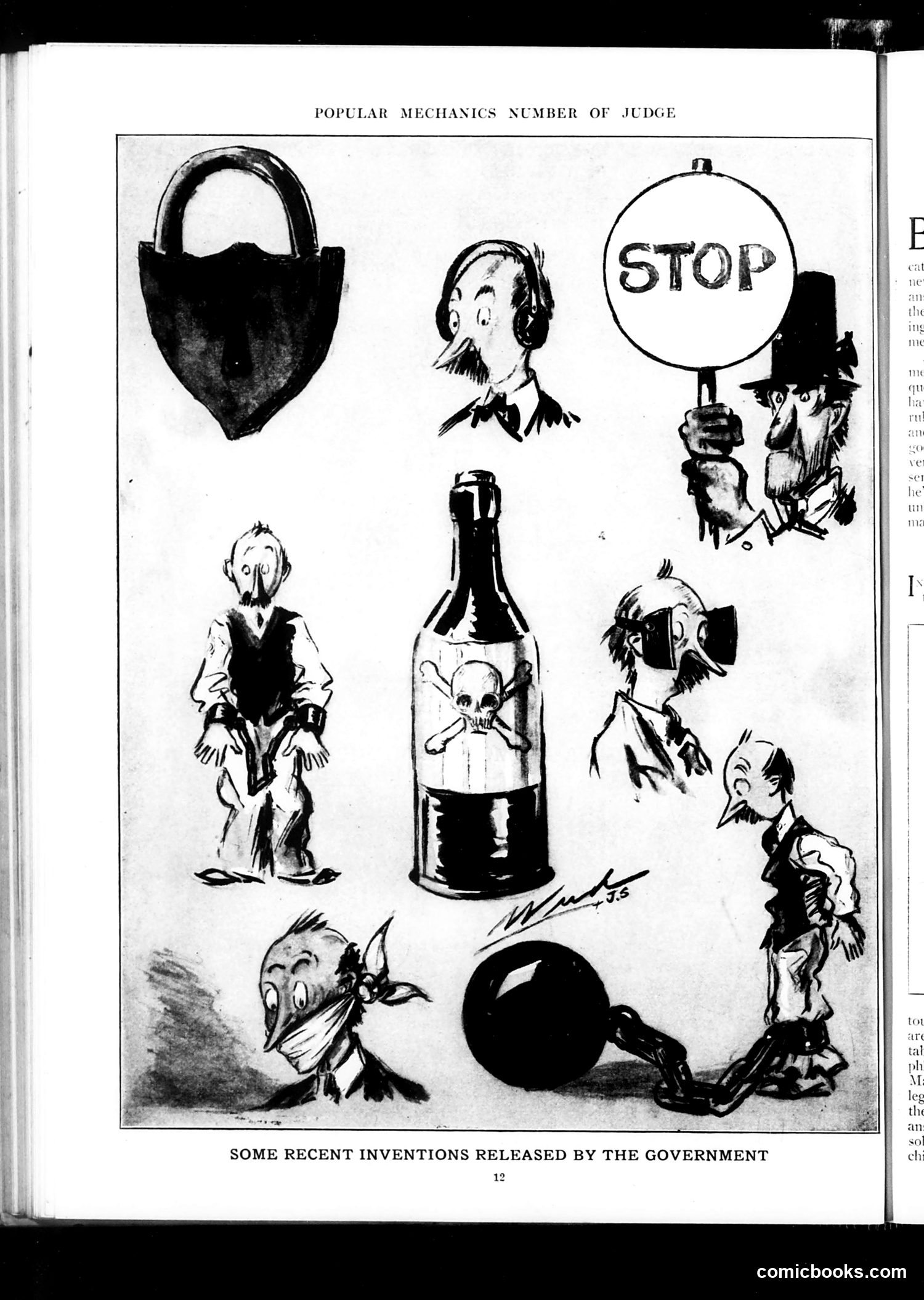
This satirical cartoon from *Judge* magazine mocks government inventions or policies, likely from the WWI or Prohibition era. The images include: - A protective mask or helmet (possibly gas mask related) - A poison bottle with skull-and-crossbones (likely referencing alcohol poisoning or Prohibition enforcement) - A "STOP" sign held by figures (possibly federal agents) - Various caricatured men showing distress or alarm The satire appears to target government overreach—suggesting these "inventions" are actually intrusive or harmful policies imposed on citizens. The grotesque expressions and menacing imagery mock government initiatives as dangerous or oppressive rather than beneficial. The specific context (WWI gas masks, Prohibition enforcement, etc.) would resonate with contemporary readers familiar with these controversial government programs.
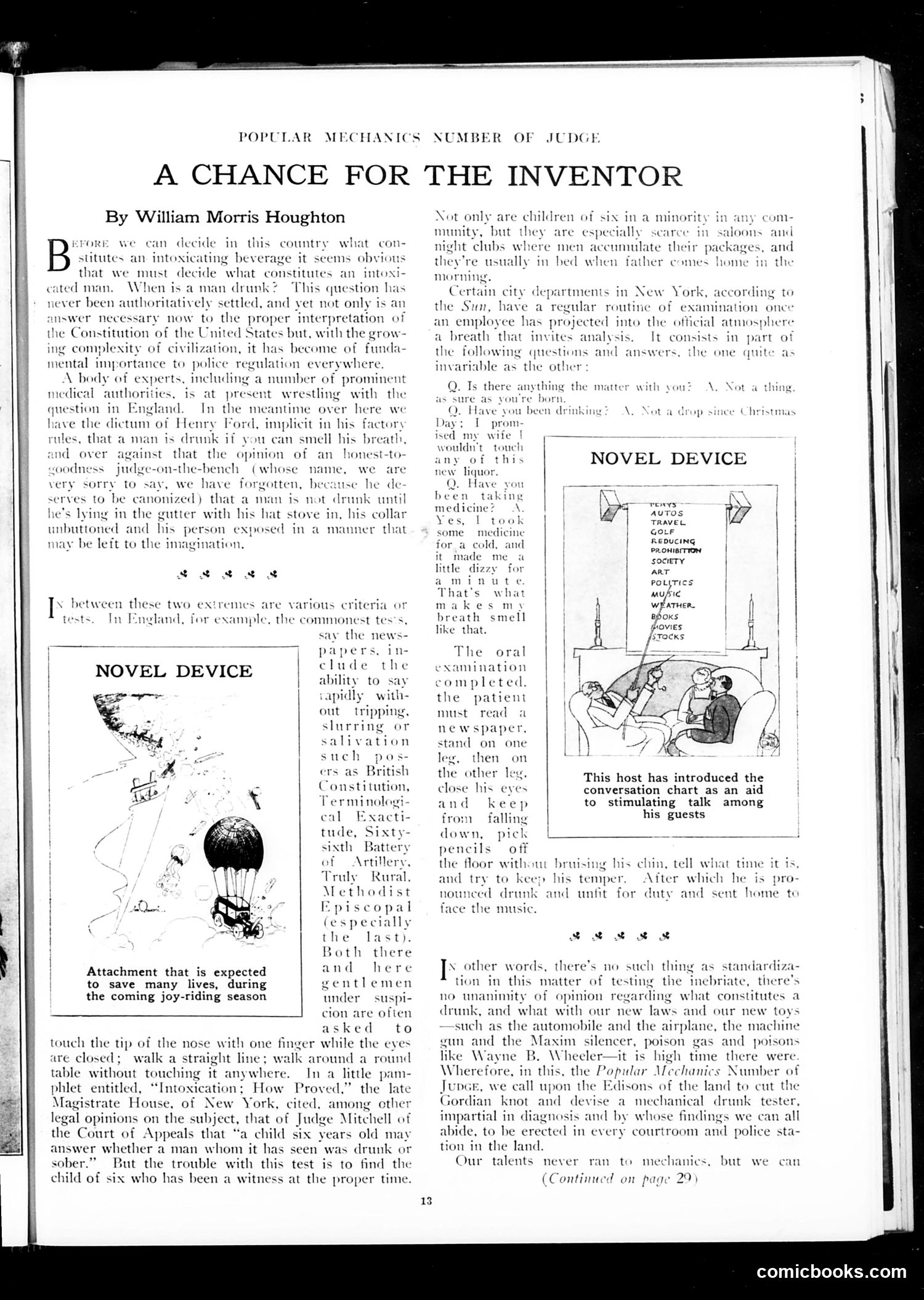
This article by William Morris Houghton satirizes the lack of standardized legal criteria for determining intoxication during Prohibition. The piece contrasts absurdly different standards: Henry Ford's factory rule (smelling alcohol on breath = drunk) versus a judge's requirement that a man be lying in the gutter with a stove-in hat. The article mocks the arbitrary tests used by police and judges—touching one's nose, walking straight lines, reciting the British Constitution—while highlighting the inadequacy of relying on a six-year-old child as a witness. The two "Novel Device" illustrations appear to propose impractical mechanical solutions: a hot-air balloon apparatus and a conversation chart listing topics (politics, weather, stocks, autos, music) to stimulate conversation among guests. These mock the era's faith in technological fixes for social problems. The satire ultimately targets Prohibition's vagueness and the absurd methods authorities improvised to enforce it, suggesting that without clear definitions, enforcement becomes comically arbitrary.
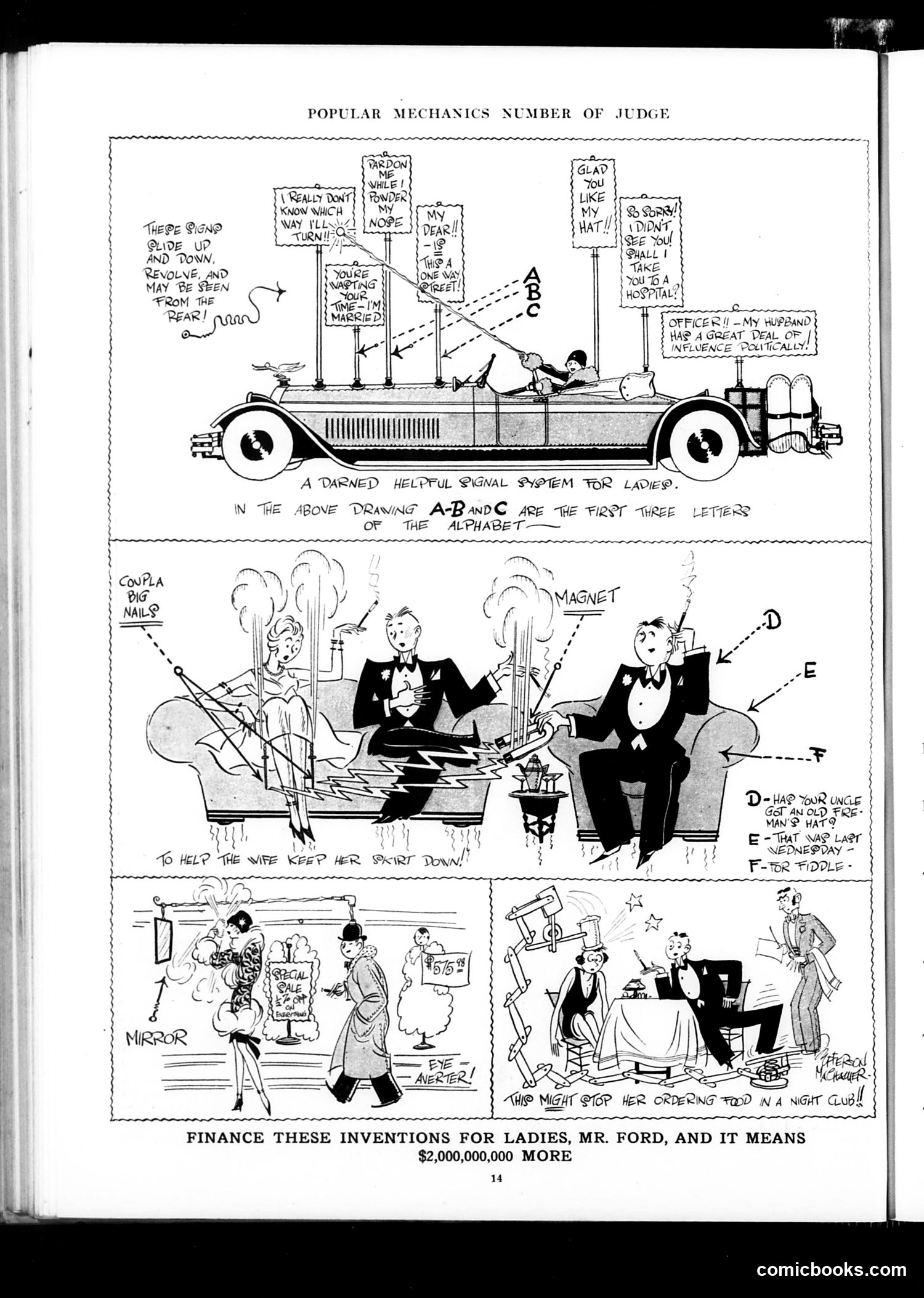
This 1920s satirical page from *Judge* mocks women drivers and automobiles through invented "helpful" devices. The top cartoon shows a car with women using elaborate signal systems (A, B, C—alphabet signals) to communicate while driving, satirizing women as incompetent motorists needing ridiculous aids. Below, four panels depict absurd contraptions "to help the wife keep her spirit down"—including magnets, hair-curlers, mirrors, and furniture-launching mechanisms in parlors and nightclubs. The humor targets both women's newfound mobility (cars, nightlife) and anxious male anxiety about female independence. The headline references Henry Ford and mass automobile production, sarcastically suggesting these inventions would cost billions—implying women drivers were such a problem they'd require massive industrial solutions. The satire reflects 1920s gender tensions as women gained voting rights and social freedoms, with the magazine channeling male resentment through "protective" mockery.
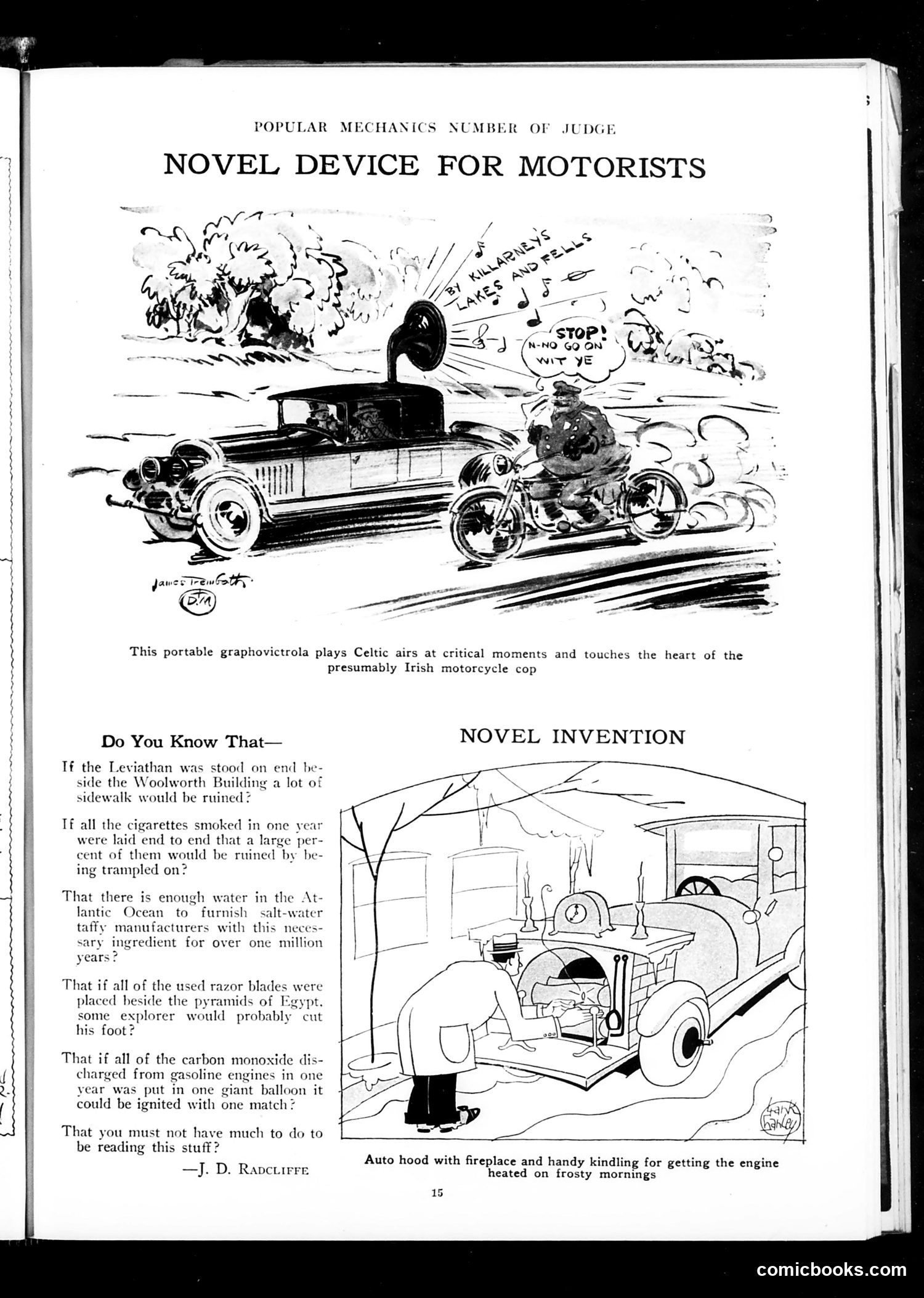
This page satirizes automotive culture and Irish-American stereotypes circa the 1920s-30s. **Top cartoon**: A car equipped with a phonograph plays "Celtic airs" to appease an Irish motorcycle policeman during a traffic stop. The joke exploits the ethnic stereotype that Irish cops could be emotionally manipulated through sentimental Irish music—a crude but common characterization of the era. **Bottom cartoon**: Shows an auto hood converted into a fireplace with kindling, meant humorously to warm cold engines on frosty mornings. This is impractical satire of motorists' winter struggles. **"Do You Know That" section**: Lists absurdist "facts" (the Leviathan ship, cigarette lengths, ocean salt) culminating in a self-aware jab: readers wasting time on frivolous content must have little else to do. This reflects the magazine's lighthearted, time-wasting purpose. The page exemplifies Judge's blend of automotive humor, ethnic comedy, and self-deprecating wit.
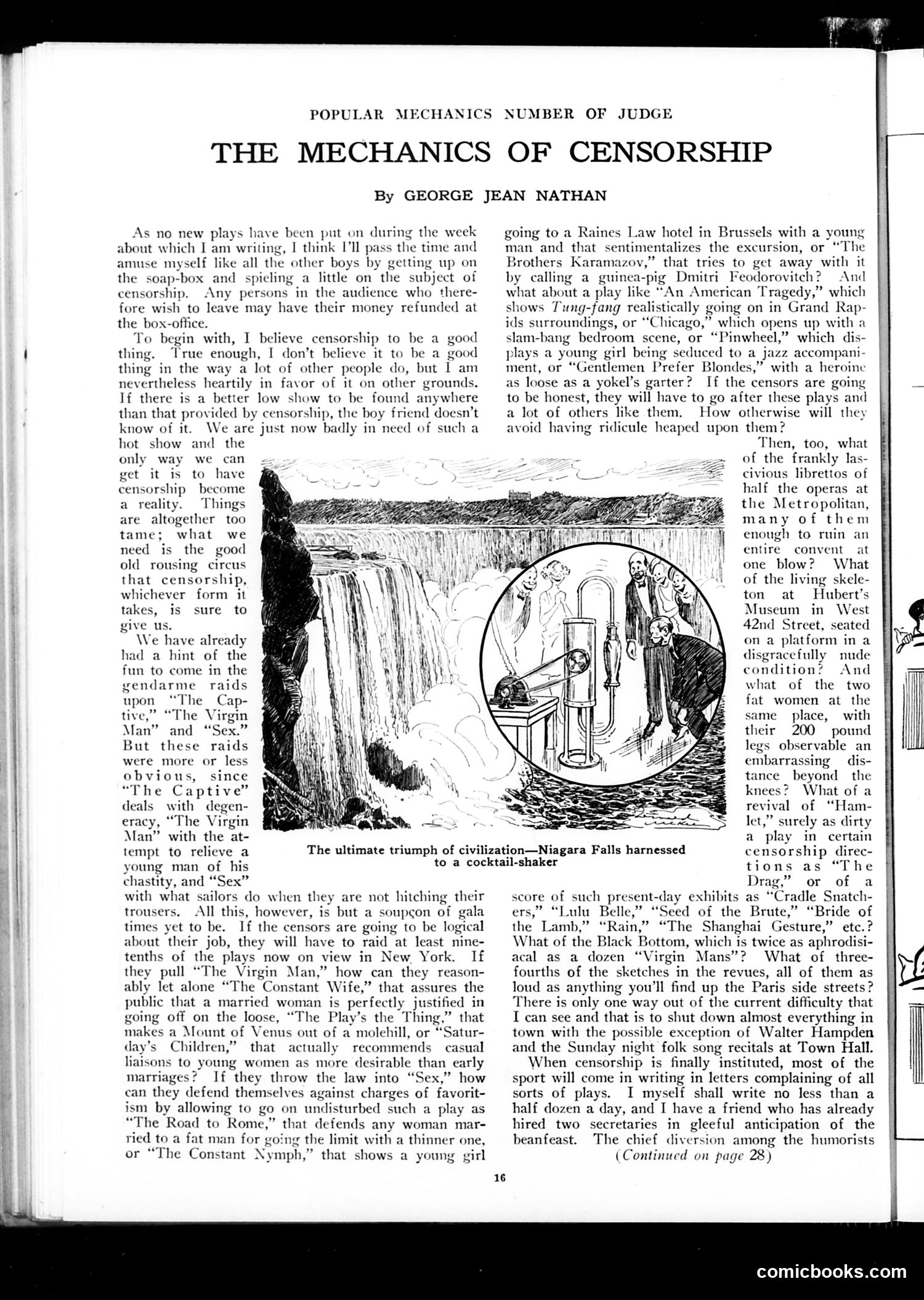
This article by drama critic George Jean Nathan satirizes theatrical censorship through ironic praise. Nathan claims censorship is "good"—but only because it creates absurd entertainment by selectively banning plays. His argument: if censors truly enforced moral standards consistently, they'd have to ban nearly *all* Broadway plays currently running—including "The Constant Wife," "The Road to Rome," and "The Constant Nymph," which depict infidelity and loose morality. Yet these escape censorship while plays like "The Captive" (dealing with homosexuality), "Sex," and "The Virgin Man" face raids. Nathan exposes the **hypocrisy and inconsistency** of censorship boards. He lists plays with increasingly provocative content to show censors apply rules arbitrarily, protecting some immoral depictions while attacking others. The cartoon shows Niagara Falls powering a cocktail-shaker—satirizing how Americans "harness" nature for frivolous excess, paralleling how censors selectively weaponize morality for inconsistent purposes.
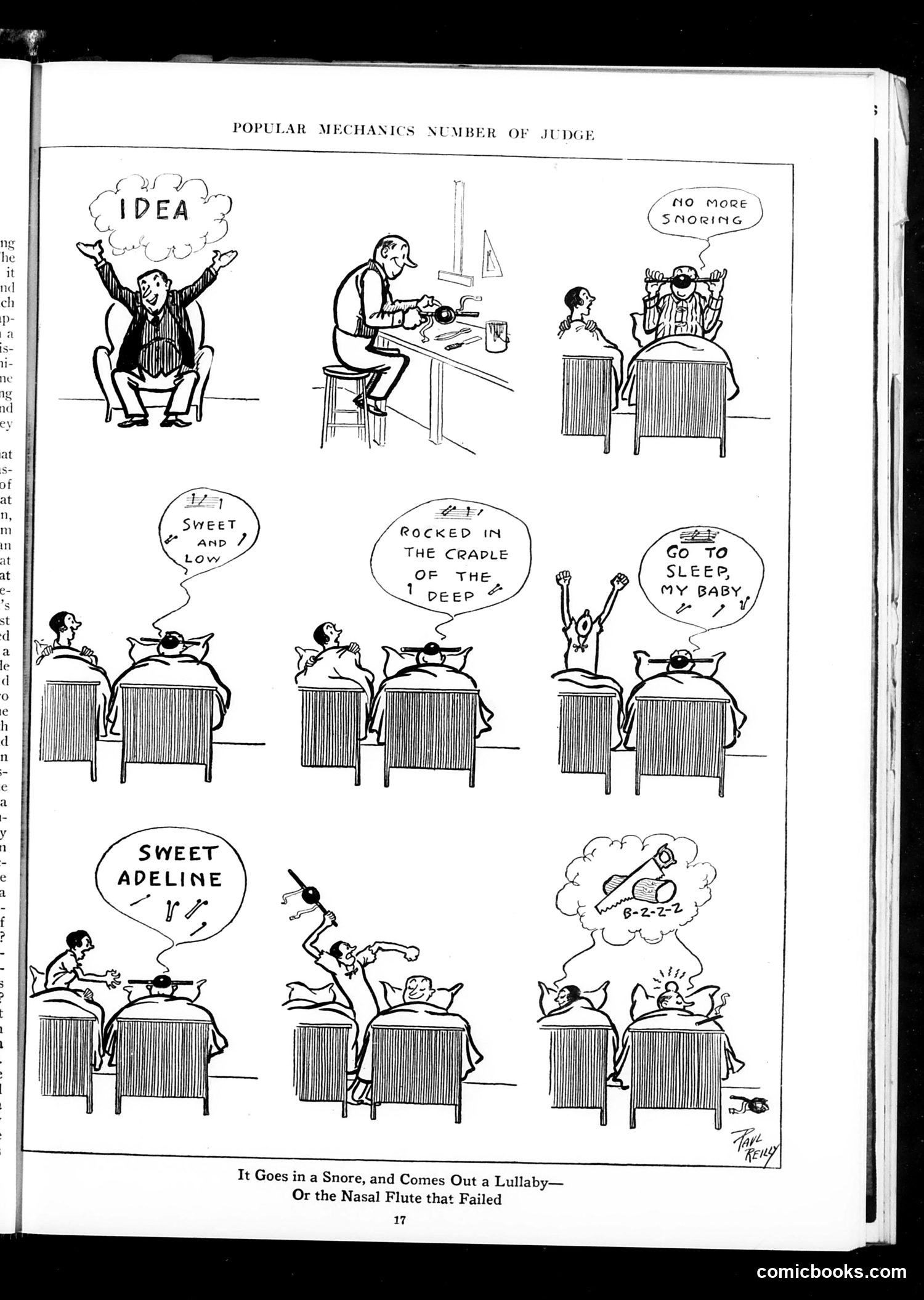
This is a humorous comic strip about snoring and its domestic consequences. The narrative follows a man who has an "IDEA" to stop snoring, then attempts various solutions—shown working at a desk, consulting with what appears to be a doctor or specialist who says "NO MORE SNORING." The strip satirizes marital bedroom dynamics, depicting the wife's escalating frustration. Her complaints progress from "SWEET AND LOW" (a lullaby reference) to "ROCKED IN THE CRADLE OF THE DEEP" to "GO TO SLEEP MY BABY." Finally, she sings "SWEET ADELINE" while apparently hitting him, before they both leap from bed in exasperation. The caption suggests the snoring "goes in a snore and comes out a lullaby—or the nasal flute that failed," mocking both snoring remedies and marital patience.
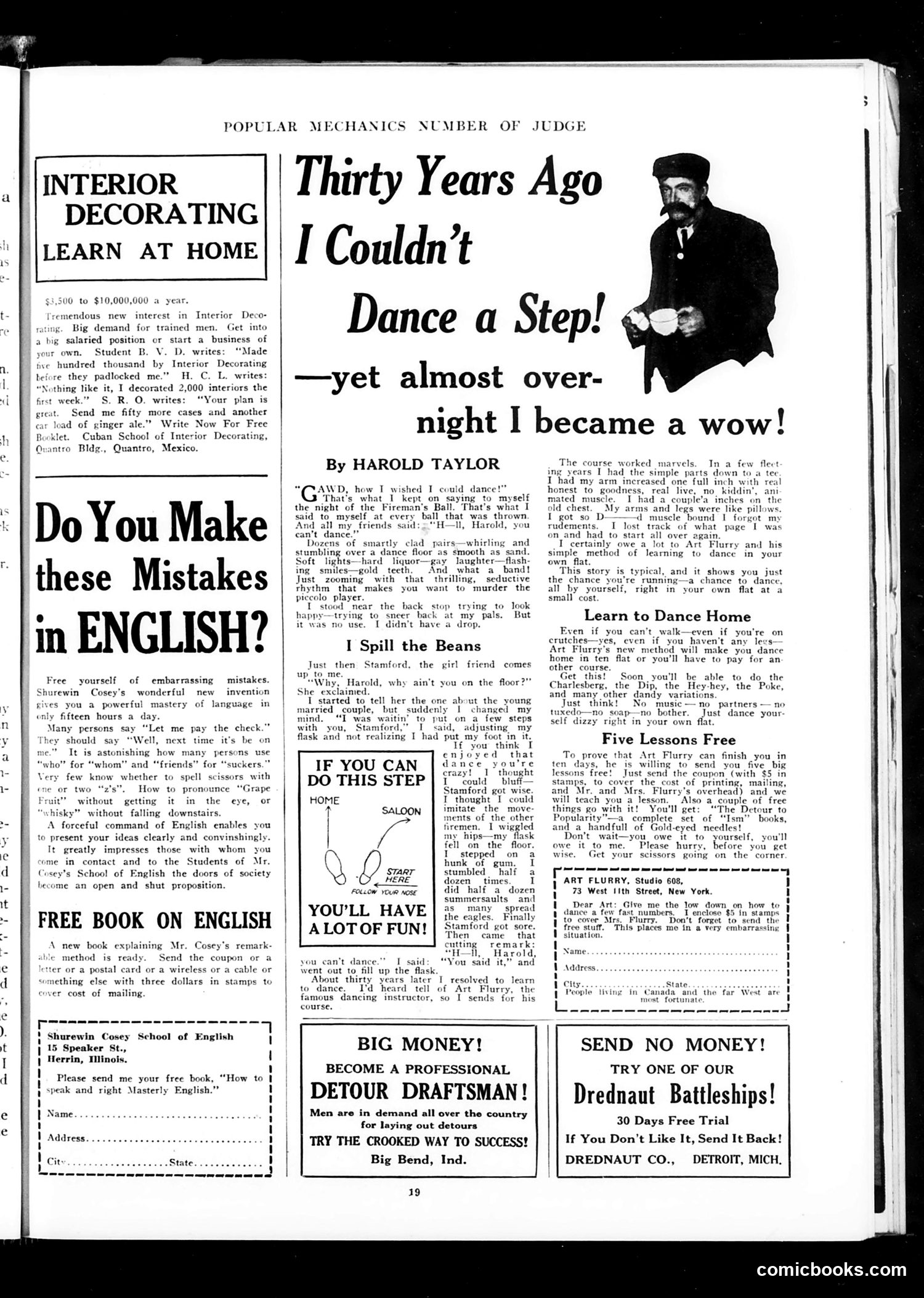
This is primarily an **advertising page** disguised as editorial content, typical of early 20th-century magazines. The main feature is a fictionalized testimonial by "Harold Taylor" promoting Art Flurry's mail-order dancing lessons—a classic example of period marketing that blurred advertising and entertainment. The satire is **subtle but present**: the exaggerated before-and-after narrative ("couldn't dance a step" to "became a wow") mocks both the product and gullible consumers. The casual mention that he "got so D——d muscle bound I forgot my rudiments" gently ridicules the course's dubious methods. The surrounding ads are equally satirical—the "Interior Decorating Learn at Home" school in Mexico promises $500-$10,000,000 yearly ("before they padlocked me"), the English grammar course promises social advancement, and the "Detour Draftsman" course capitalizes on economic anxiety. These advertorials reflect the era's proliferation of **mail-order schemes targeting working-class self-improvement desires**. The humor lies in Judge's knowing presentation of obvious frauds and exaggerated promises—targeting readers who recognized the con while sympathizing with its appeal.
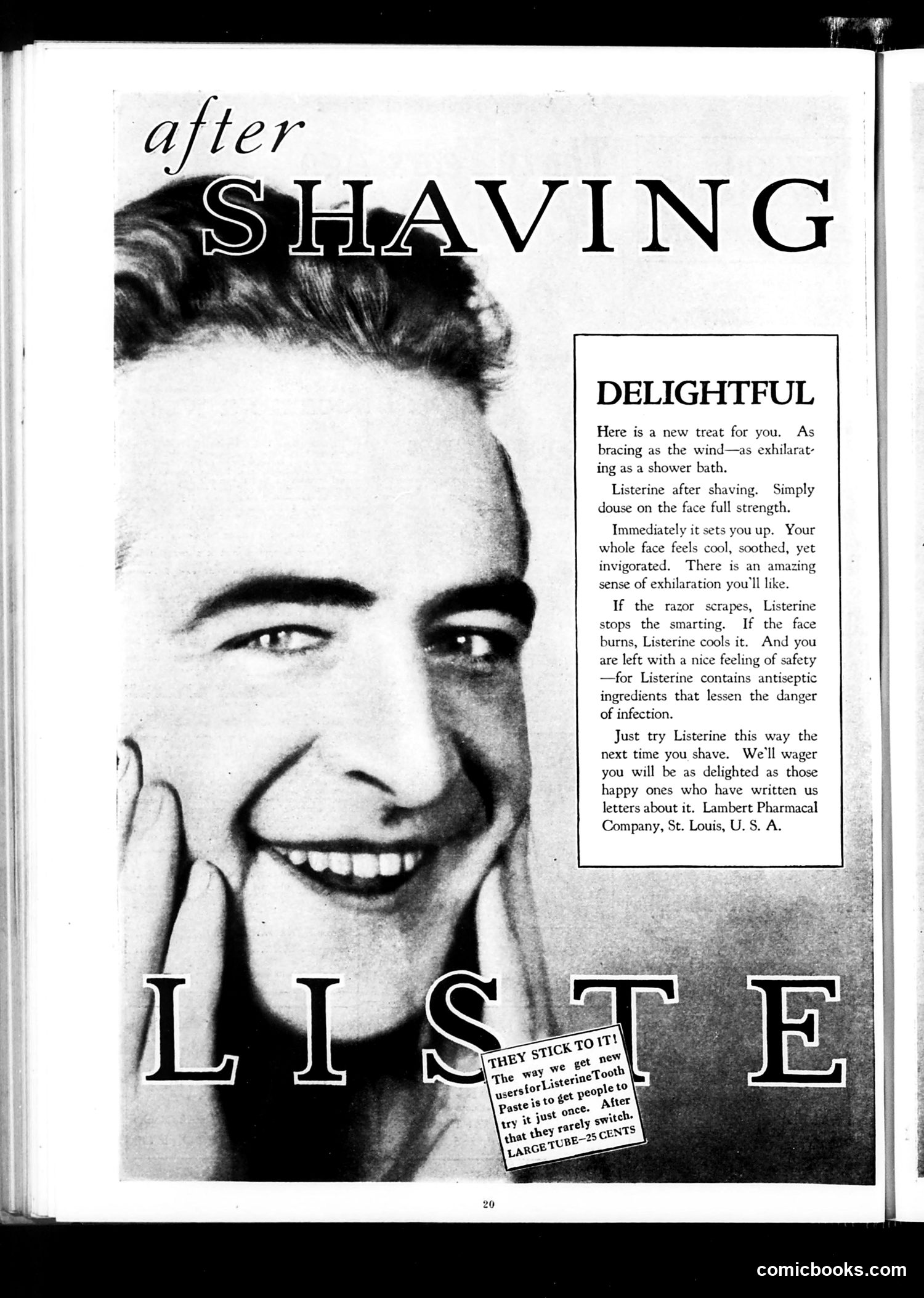
This page is **entirely an advertisement**, not political satire or a cartoon. It's a vintage Listerine mouthwash ad promoting the product as an after-shave treatment. The large photograph shows a smiling man applying the product to his face, demonstrating the advertised benefits: cooling sensation, antiseptic protection against razor burn and infection, and an "invigorating" feeling. The ad copy emphasizes Listerine's dual function—oral hygiene product *and* post-shave treatment—and includes a small testimonial note about user retention ("They stick to it!"). The Lambert Pharmacal Company branding is clearly displayed. This represents early 20th-century advertising strategy: repurposing existing products for multiple purposes and using aspirational masculine imagery to market grooming products to male readers of *Judge* magazine.
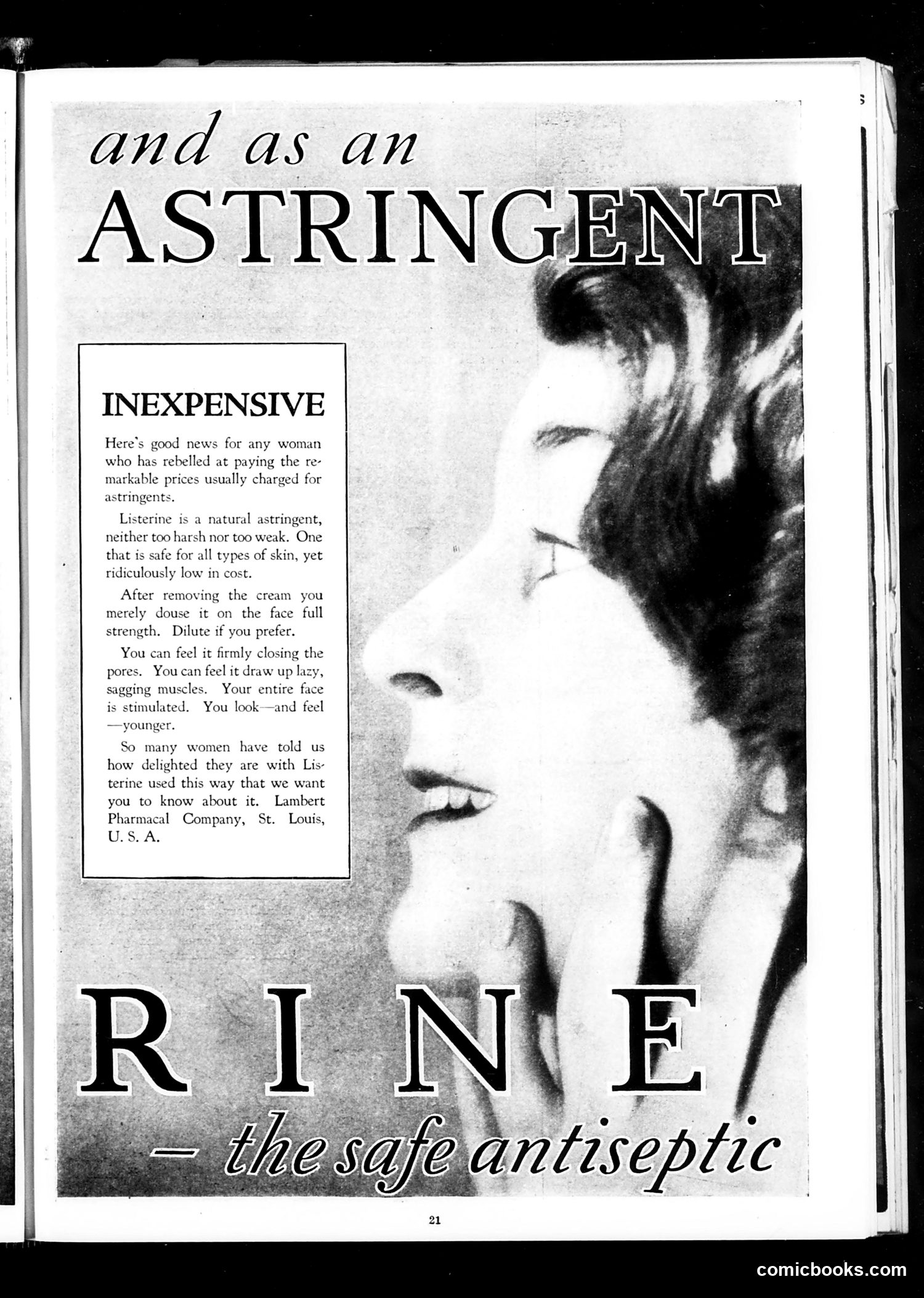
This is a **Listerine advertisement**, not a political cartoon. The page promotes Listerine mouthwash as an inexpensive facial astringent—a skincare product meant to tighten pores and firm facial muscles. The ad targets women frustrated by high cosmetic prices, positioning Listerine as an affordable alternative. The accompanying photograph shows a woman's profile, likely meant to demonstrate the product's purported skin-tightening effects. **Historical context a modern reader should know:** This represents early 20th-century advertising's aggressive marketing of medicinal products for non-medical purposes. Listerine was originally an antiseptic mouthwash; this ad repurposes it as a beauty treatment. Such cross-marketing and broader health claims were common before strict FDA regulations. The ad's emphasis on affordability and instant visible results reflects period marketing tactics targeting cost-conscious consumers, particularly women.
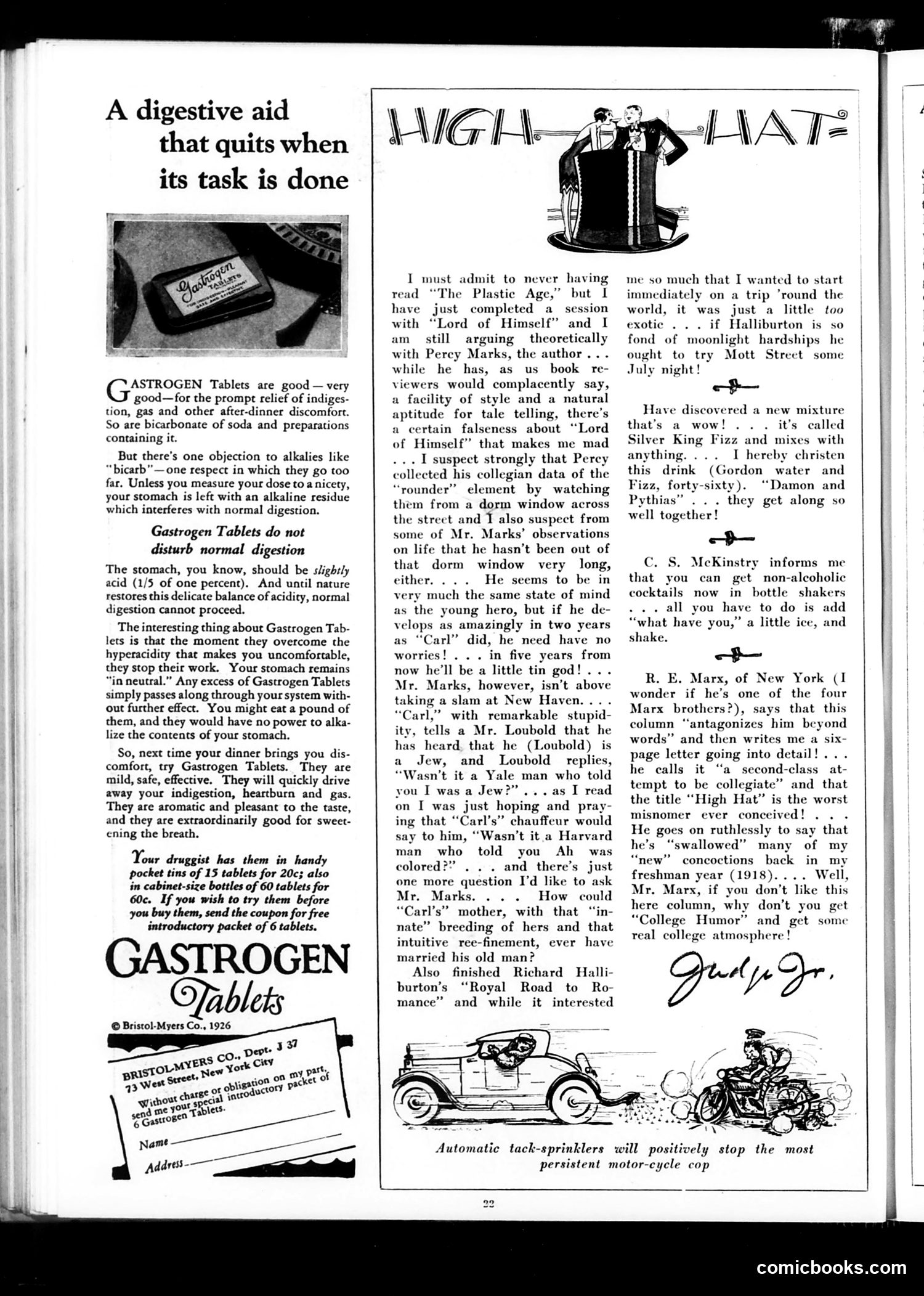
This page combines **advertisement and book reviews** from Judge magazine (circa 1926). ## Advertisement (Left Side) A full-page ad for **Gastrogen Tablets**, a digestive antacid. The pitch emphasizes that unlike competing alkaline remedies (bicarbonate of soda), Gastrogen stops working once it neutralizes stomach acid—preventing over-alkalinization that disrupts digestion. It's positioned as the "smart" choice for after-dinner indigestion. ## Book Reviews (Right Side) Unsigned reviews of contemporary 1920s literature: - **"Lord of Himself"** by Percy Marks—the reviewer criticizes its falseness, suspecting Marks observed college life from a distance rather than lived it. The review sardonically notes Marks includes anti-Semitic dialogue without apparent irony. - **"The Royal Road to Romance"** by Richard Halliburton—praised as exciting but criticized as overly exotic. The reviews reflect Jazz Age literary taste and social attitudes, including casual acceptance of prejudiced content in fiction. The magazine's satirical voice treats both digestive comfort and literary pretension with equal irreverence.
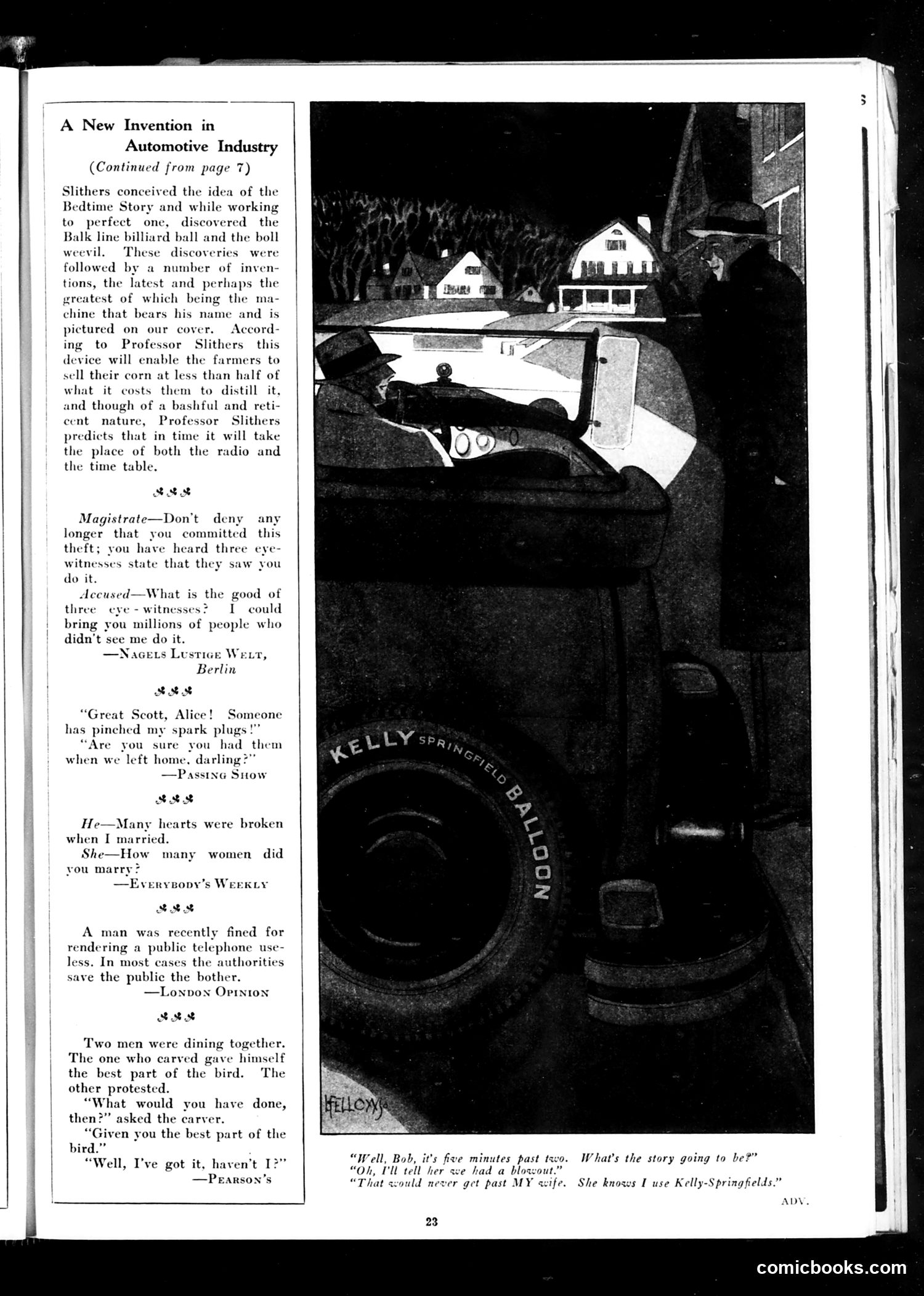
This page combines satirical commentary with advertisements and jokes typical of early 20th-century American humor magazines. **Main Content:** The top article continues discussion of a fictional "Professor Slithers" and his automotive invention—a satirical piece mocking contemporary technological enthusiasm. The accompanying photograph shows what appears to be a car with a Kelly-Springfield balloon tire, which is actually an advertisement disguised as editorial content. **The Jokes:** The remaining section collects brief humorous anecdotes mocking human nature—a magistrate dealing with a defendant's absurd logic, people losing car parts, marital discord, and dining etiquette disputes. These represent typical Judge fare: short, cynical observations about everyday foolishness. **The Advertisement:** The final illustrated joke is actually a Kelly-Springfield Balloon tire ad, with characters discussing a story while implying the tire brand's reliability would prevent marital problems. The page reflects Judge's blend of satirical commentary, social observation, and advertiser-friendly content disguised as editorial humor.
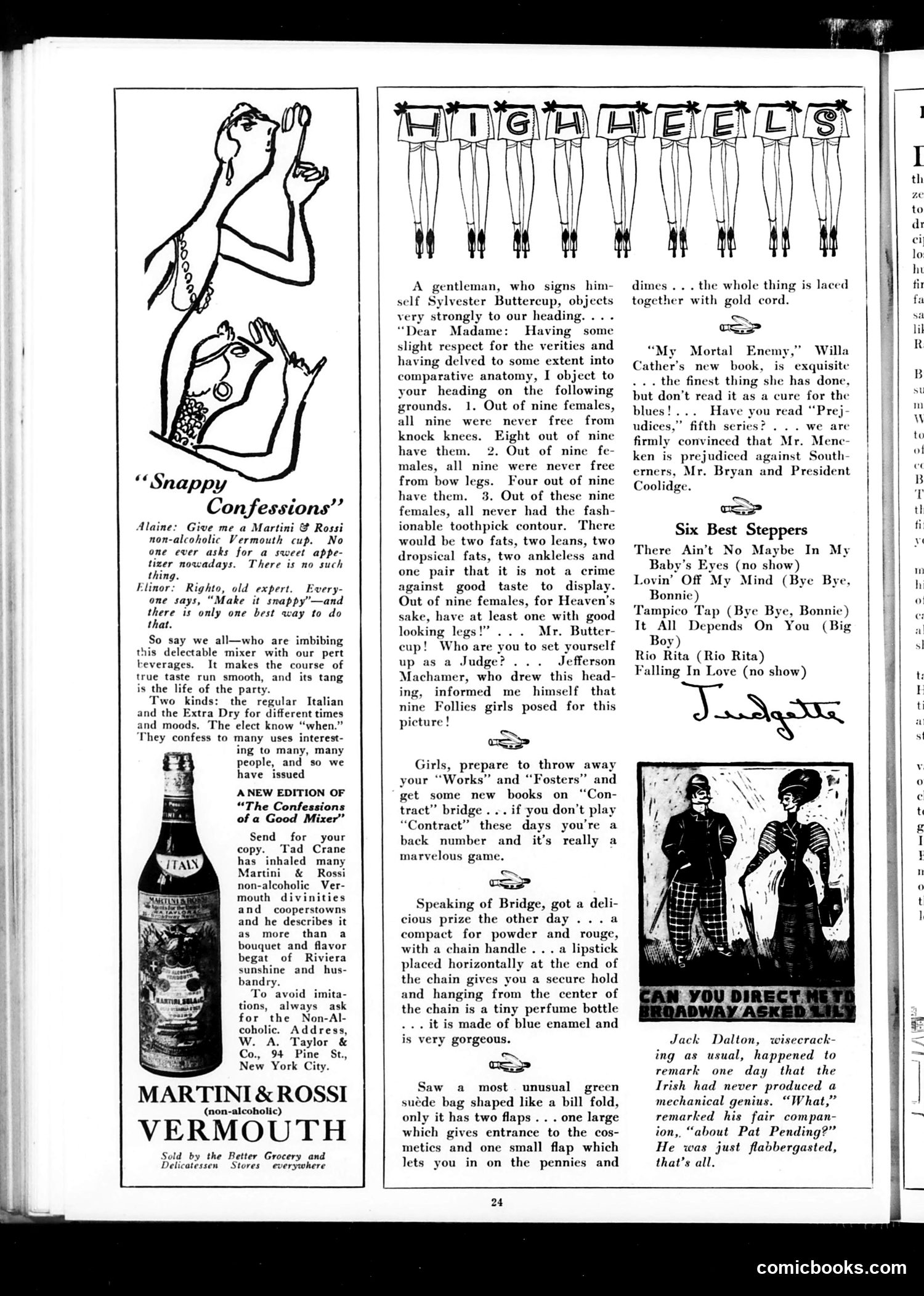
This page from Judge combines advertising with social commentary typical of 1920s American satire. **The Main Cartoon ("Snappy Confessions"):** Features a stylized female figure in a flapper pose, promoting Martini & Rossi non-alcoholic vermouth. The accompanying text humorously presents "confessions" from society women about cocktail preferences, satirizing the era's drinking culture and social pretension. **The Editorial Exchange:** A humorous letter from "Sylvester Buttercup" criticizes the magazine's illustration of nine women as representing ideal femininity, systematically listing their physical flaws (knock knees, bow legs, poor teeth). The editor counters that actual Follies chorus girls posed for the drawing—a pointed joke about the gap between aesthetic ideals and reality. **Cultural Context:** This reflects 1920s post-Prohibition anxieties (note "non-alcoholic" vermouth), flapper culture, and satirical commentary on beauty standards and women's social roles. **Other Content:** The page includes listings of popular songs and book reviews, standard Judge magazine fare for entertaining the educated, urbane readership.
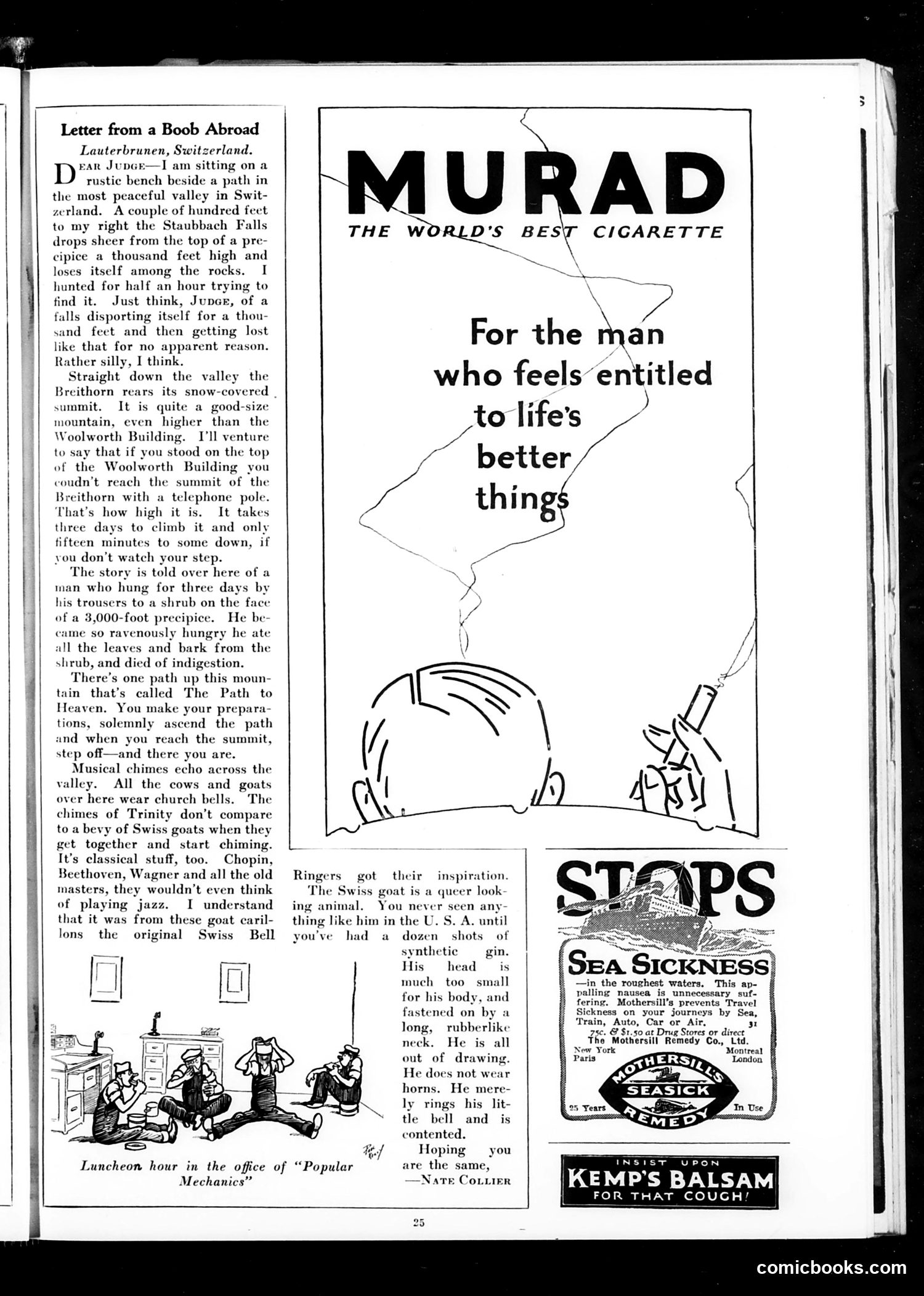
This page contains a satirical travel letter titled "Letter from a Boob Abroad" by Nate Collier, mocking American tourists abroad. The "boob" narrator describes Swiss Alpine scenery (Lauterbrunen valley, waterfalls, mountains) with absurd comparisons—measuring peaks against the Woolworth Building, relating Swiss goat bells to classical composers' inspiration for carillons. The humor targets American ignorance and provincialism: a man starving on a cliff eats a shrub, Swiss goats wear church bells, and a goat's appearance requires "synthetic gin" to comprehend. The accompanying office illustration depicts casual lunchtime conversation, likely reinforcing themes of working-class American life contrasted with the "cultured" Alpine setting. The page also contains period advertisements: Murad cigarettes ("for the man who feels entitled to life's better things"), Mothersill's seasickness remedy, and Kemp's Balsam cough medicine—typical early 20th-century product pitches.
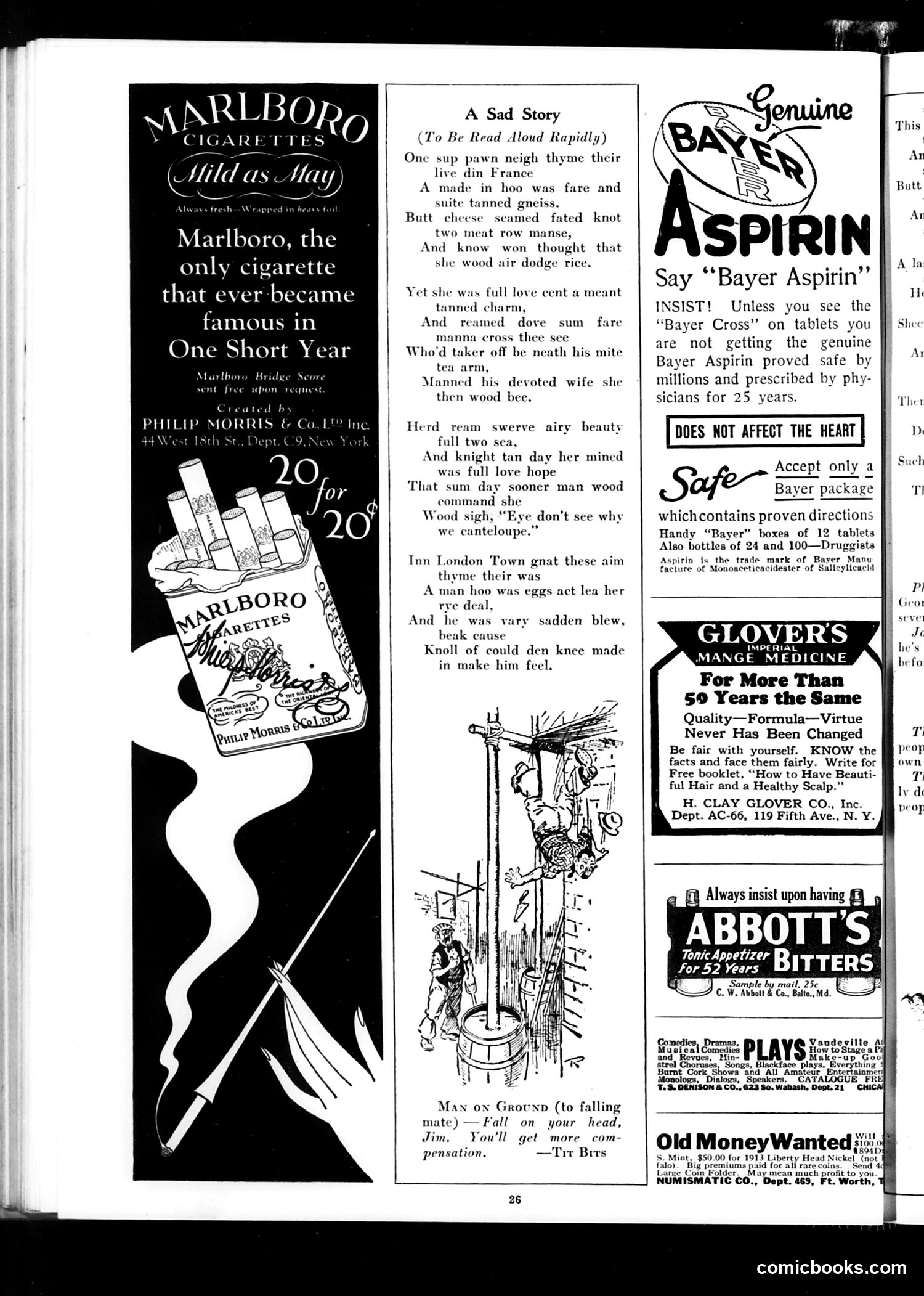
This page is primarily **advertising**, not political satire. It features period product ads (Marlboro cigarettes, Bayer Aspirin, Glover's mange medicine, Abbott's bitters) typical of early 20th-century magazines. The only comedic content is "A Sad Story (To Be Read Aloud Rapidly)" — a **phonetic word-play poem** meant as humorous nonsense. It exploits how English words sound alike when read aloud quickly, creating absurdist confusion ("pawn neigh thyme" = "pony time," "live din France" = "lived in France," etc.). This was a popular parlor entertainment style of the era. The "Man on Ground" joke is a dark humor caption about workplace injury compensation, likely reflecting contemporary anxieties about industrial accidents and legal liability. No political figures or references are present. This is entertainment and commercial content for a general audience.
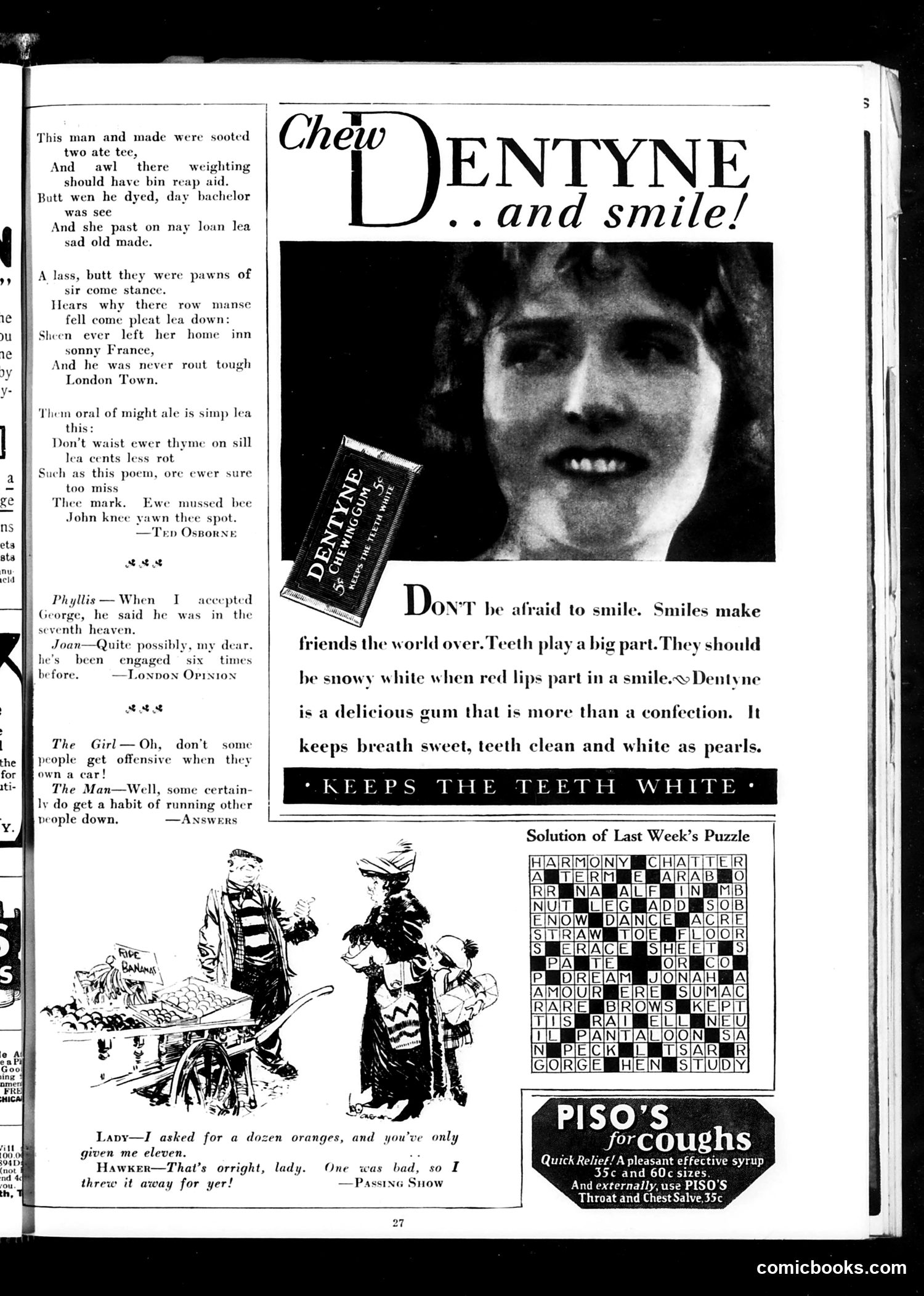
This page combines **humorous content with advertising**. The left side features satirical poems and jokes typical of Judge magazine's style—including deliberately misspelled verse mocking sentimental literature, and brief comic exchanges about social situations (cars, oranging vendors, engagements). The dominant content is a **Dentyne chewing gum advertisement** featuring a smiling woman's photograph with the tagline "Chew Dentyne...and smile!" The ad's message—that white teeth and fresh breath make you socially successful ("Smiles make friends the world over")—reflects 1920s-30s advertising psychology linking personal grooming to attractiveness and social mobility. Below is a **crossword puzzle solution** and a separate **Piso's cough syrup ad**, indicating this was a typical issue page mixing editorial content with commercial promotions. The overall tone is lighthearted and moralistic in a genteel way—poking fun at pretension while promoting consumer products as solutions to social anxiety.
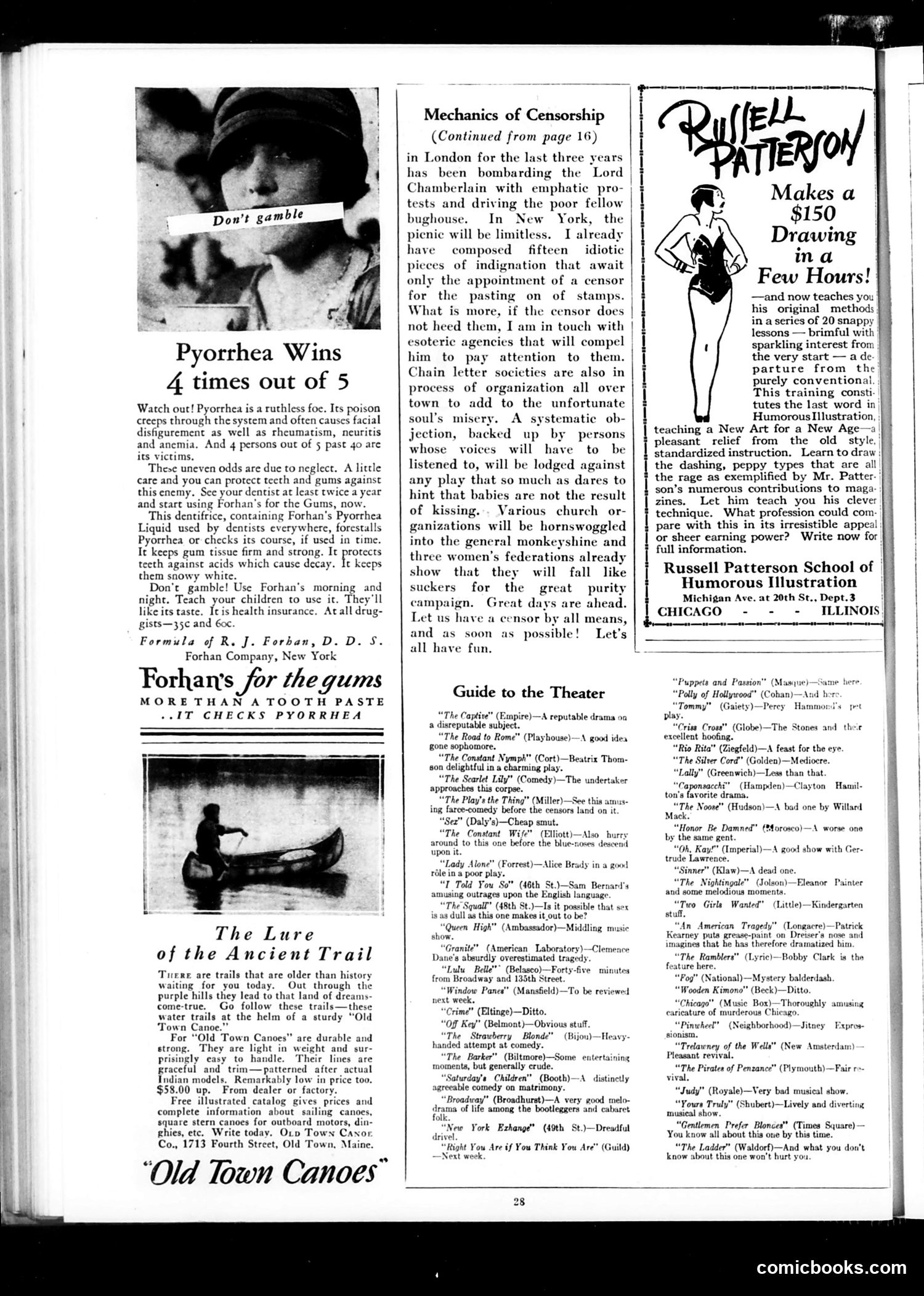
This page mostly comprises **advertisements** (Forhan's toothpaste, Old Town Canoes, Russell Patterson's drawing school) interspersed with editorial content. The substantive piece is "Mechanics of Censorship," a satirical commentary on theatrical censorship—likely referencing the **Lord Chamberlain's office in London**, which controlled stage productions. The author mocks censorship by ironically celebrating it: he claims to have prepared "fifteen idiotic pieces of indignation" awaiting a censor's stamp, and threatens to organize "chain letter societies" and manipulate "church organizations" and "women's federations" into protesting any risqué plays. The satire's point: censorship invites organized opposition and generates more attention than the censored material deserves. The author suggests the censor will become a target for harassment from coordinated groups, making censorship counterproductive and absurd. The "Guide to the Theater" below lists current Broadway plays with brief, often sarcastic reviews, several mentioning censorship concerns ("before the censors land on it," "before the blue-noses descend").
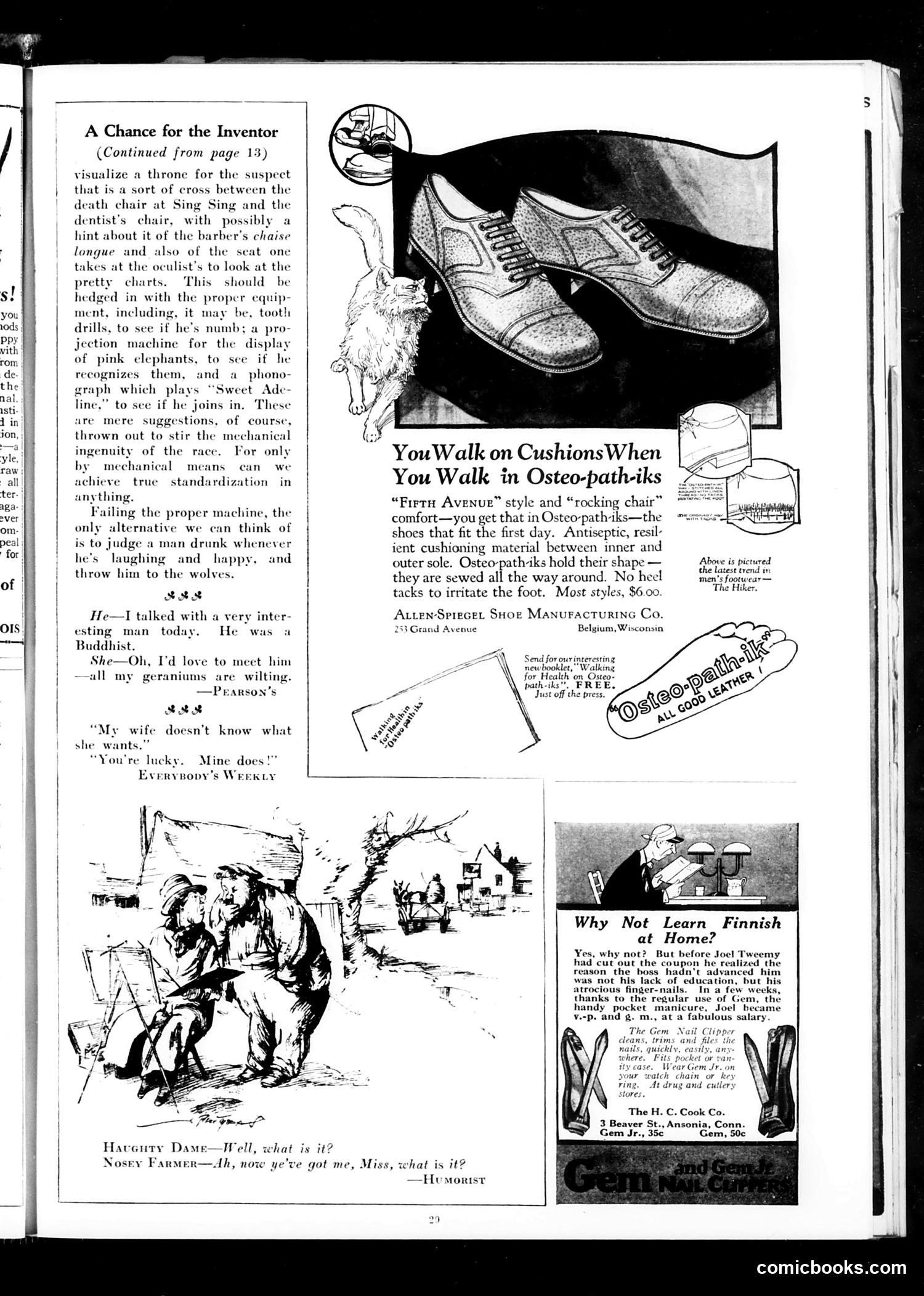
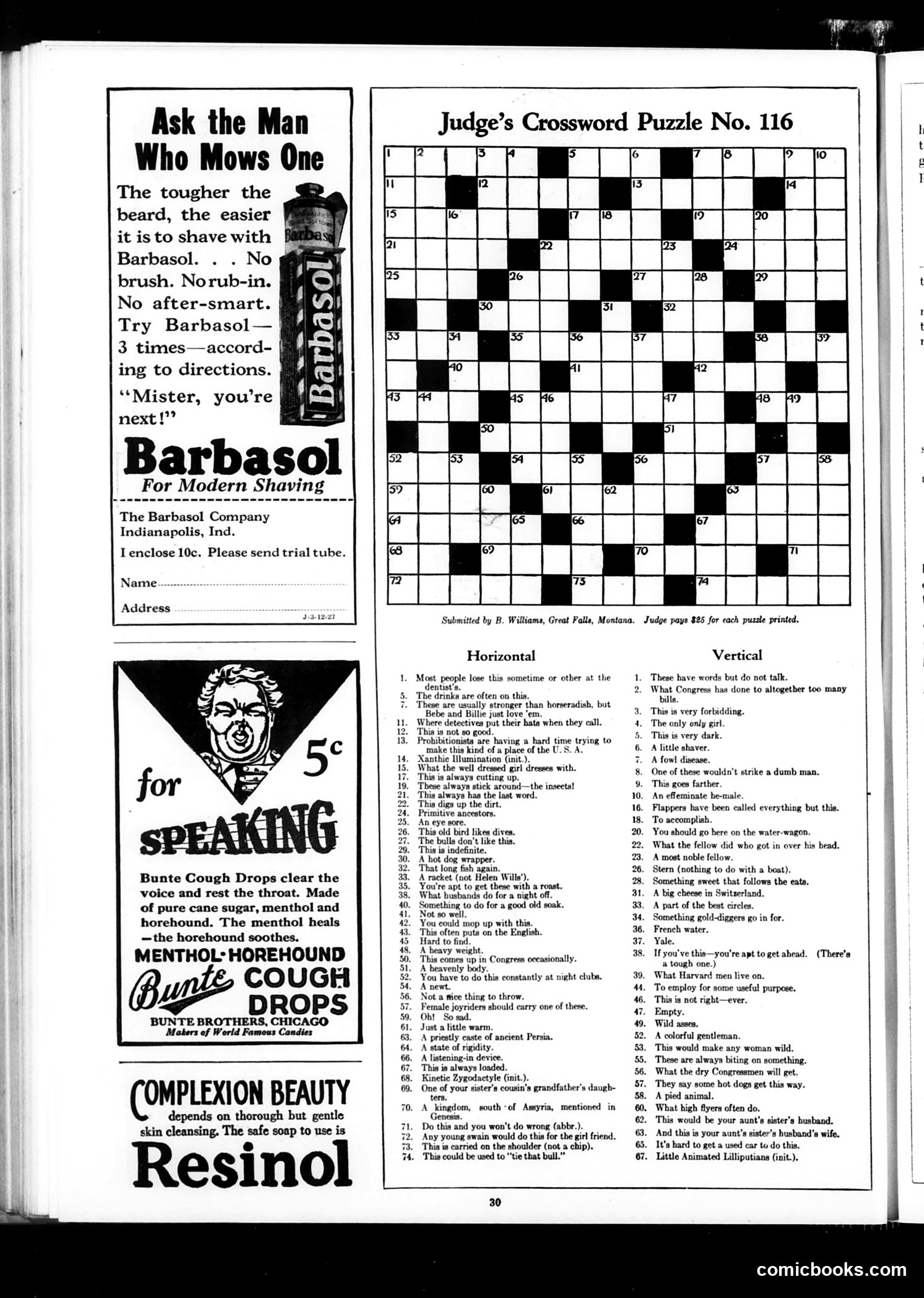
This page is primarily **advertising content** rather than political satire. It features four vintage product advertisements (Barbasol shaving cream, Bunte Cough Drops, and Resinol soap) alongside a crossword puzzle submitted by a reader. The only visual humor appears in the **Bunte Cough Drops ad**, which shows a caricatured face with an exaggerated open mouth—a generic "sick person" trope common in early 20th-century advertising, not political commentary. The **crossword puzzle clues** contain mild contemporary references (Prohibition, "flappers," Congress) but these are incidental wordplay, not satire. References to "Helen Wills" (tennis player) and "water-wagon" (temperance) reflect 1920s-era culture without making pointed political arguments. The page represents Judge's **business model**: selling advertising space while providing entertainment (puzzles, cartoons) to readers. The content is nostalgic period ephemera rather than meaningful satire.
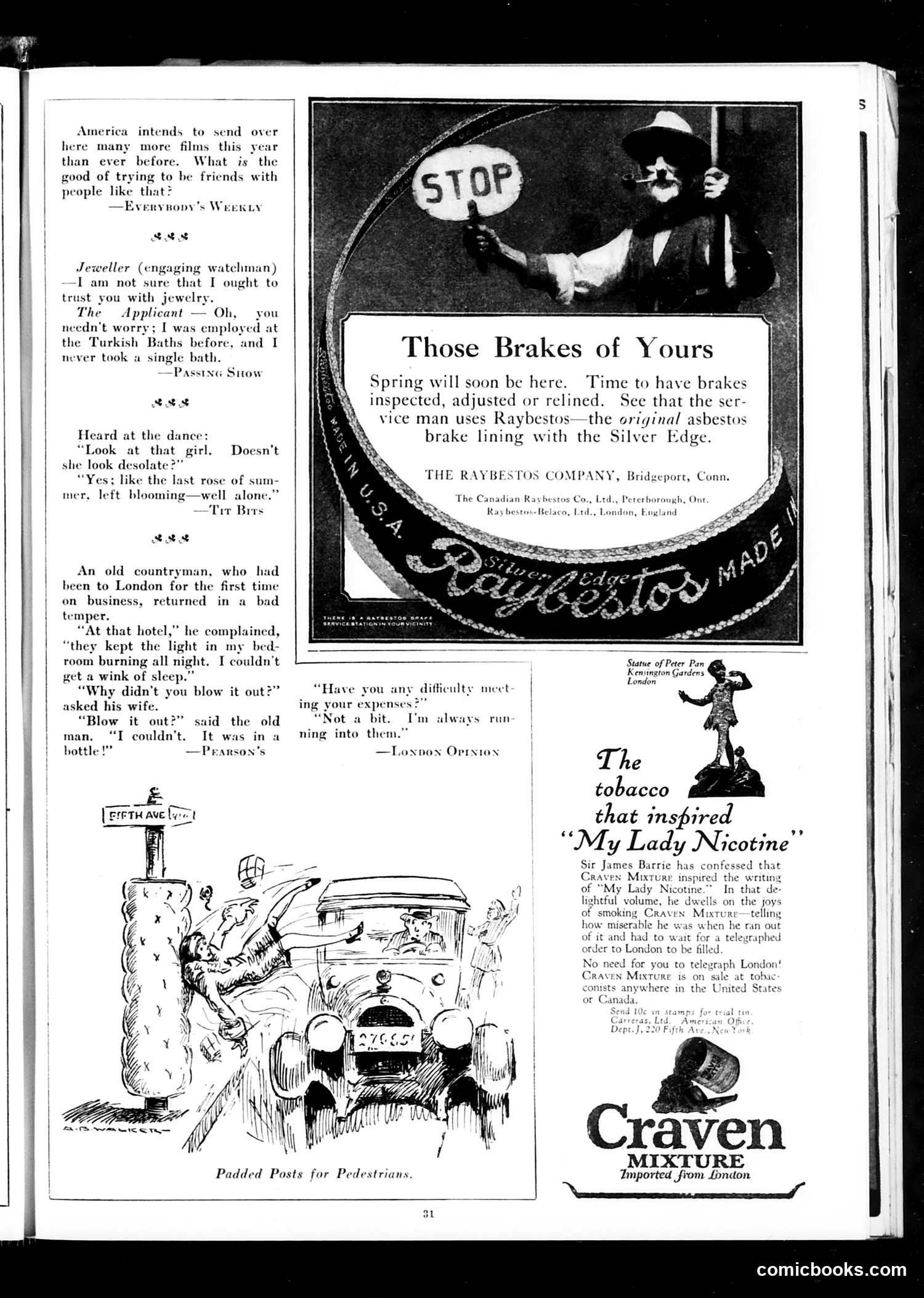
This page combines humor columns with advertisements. The jokes mock social pretension and literal-mindedness: a jeweler distrusts a watchman who worked at Turkish Baths (implying he's a thief), an applicant boasts he never bathed at his previous job (missing the point), and a countryman complains about bedroom lights left on all night—apparently not realizing he could turn them off, thinking they're in bottles. The cartoons include "Padded Posts for Pedestrians" (unclear without seeing it fully) and social commentary about American films threatening British friendship. Advertisements dominate: Raybestos brake linings capitalize on spring car maintenance; Craven Mixture tobacco claims Sir James Barrie's endorsement for his book "My Lady Nicotine," appealing to literary aspirations while emphasizing the product's London import status—suggesting American consumers valued British goods as markers of sophistication.
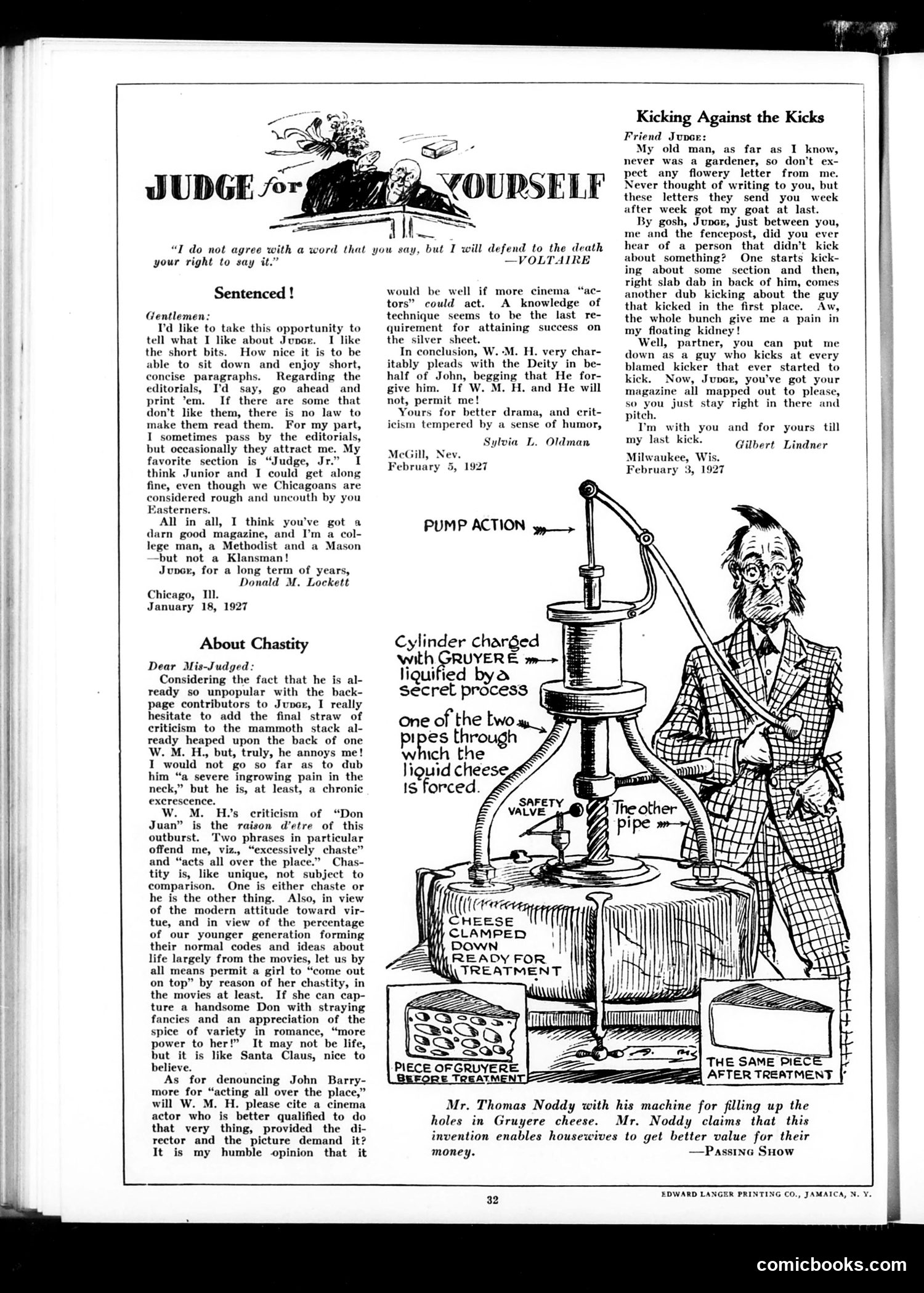
This page from Judge contains reader letters and a humorous invention diagram. The letters critique the magazine's content and film criticism. One writer defends Judge's editorials and short pieces while noting he's "not a Klansman"—a pointed 1920s reference to contemporary anxieties about the KKK's resurgence. Another letter attacks "W.M.H.," apparently a film critic, for condemning the moral content of the film "Don Juan," arguing that cinema should permit heroines to triumph through virtue. The illustrated sidebar shows **Thomas Noddy's mechanical cheese-filling device**, a humorous invention supposedly enabling housewives to "get better value for their money" by pumping liquid gruyere into cheese. The diagram's detail—complete with safety valve and secret process—parodies the era's obsession with technological "progress" solving everyday problems. The "Kicking Against the Kicks" letter humorously complains that everyone complains, creating an infinite cycle of grievances.
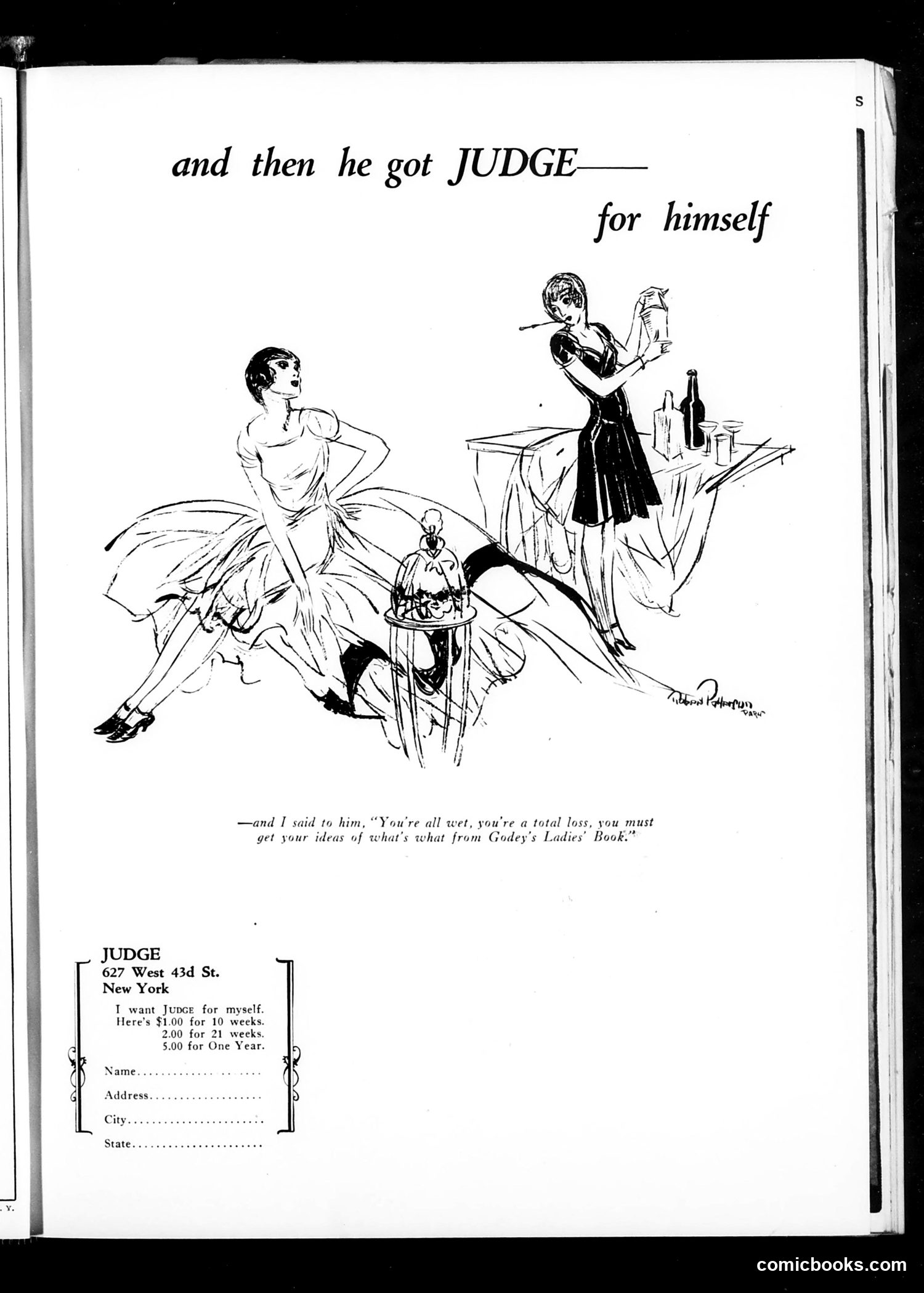
This is a subscription advertisement for *Judge* magazine disguised as a satirical cartoon. The illustration shows a woman criticizing a man for being hopelessly outdated, telling him he needs to read *Judge* instead of *Godey's Ladies' Book* (a real 19th-century women's magazine known for conservative domestic advice). The satire targets men who rely on old-fashioned sources for understanding current events and modern life. By contrasting the staid *Godey's* with the contemporary *Judge*, the ad positions the magazine as smart, current satire for sophisticated readers. The fashionable woman depicted represents the modern audience Judge hoped to attract. The coupon below invites readers to subscribe at various price points ($1–$5).
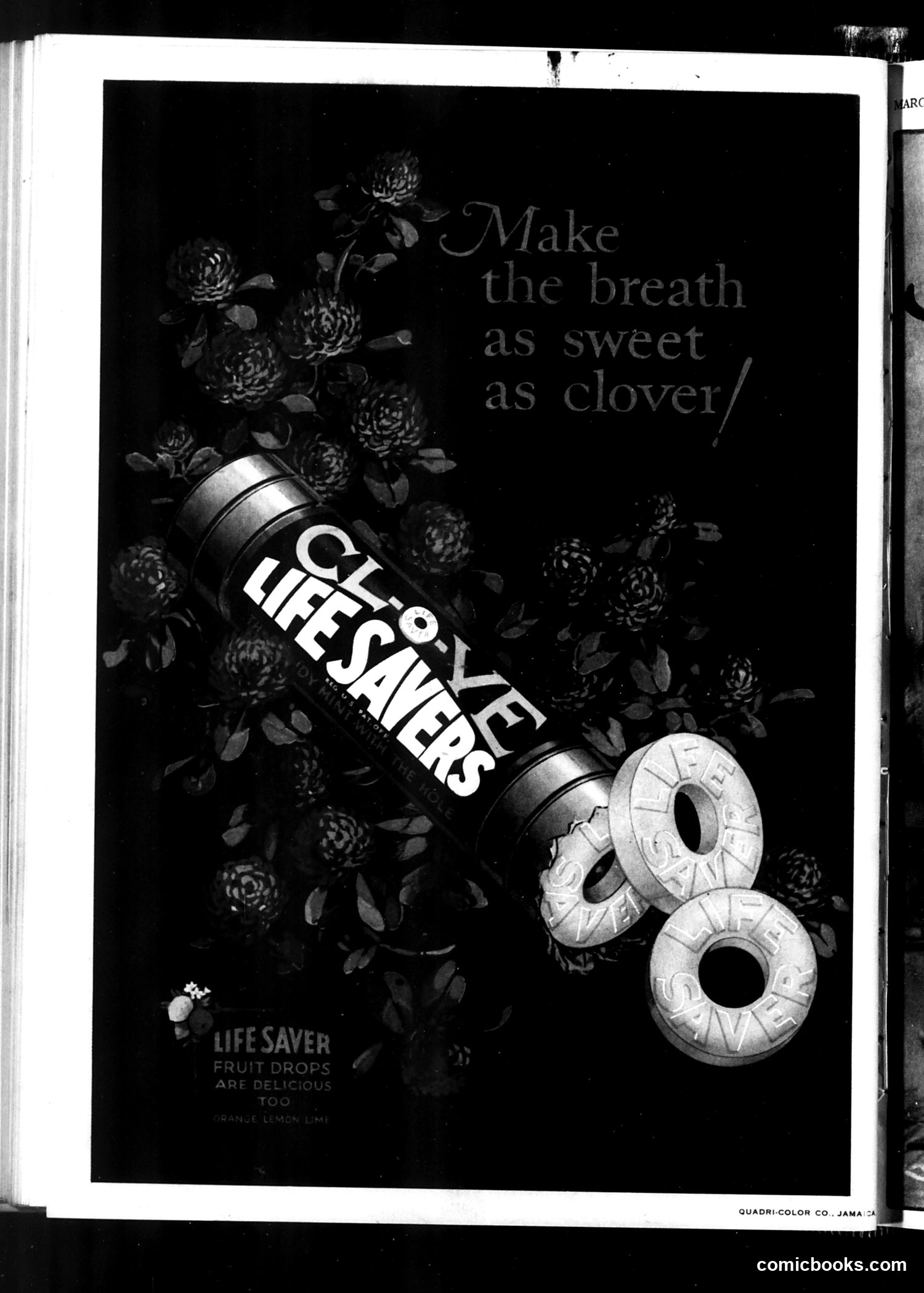
This is a vintage advertisement for Life Savers candy, not a political cartoon. The ad features a cylindrical roll of Life Savers mints positioned amid decorative clover flowers against a dark background. The advertising copy reads: "Make the breath as sweet as clover" — playing on the product's mint flavor and breath-freshening properties. Below, smaller text notes "Life Saver fruit drops are delicious too" with flavors listed as "Orange Lemon Lime." The visual composition uses the clover imagery to reinforce the "sweet" claim, while the ring-shaped candies are displayed prominently. This appears to be from an early 20th-century magazine advertisement emphasizing the product's appeal to consumers concerned with personal hygiene and freshness — a common marketing angle of that era.