
A complete issue · 36 pages · 1927
Judge — February 26, 1927
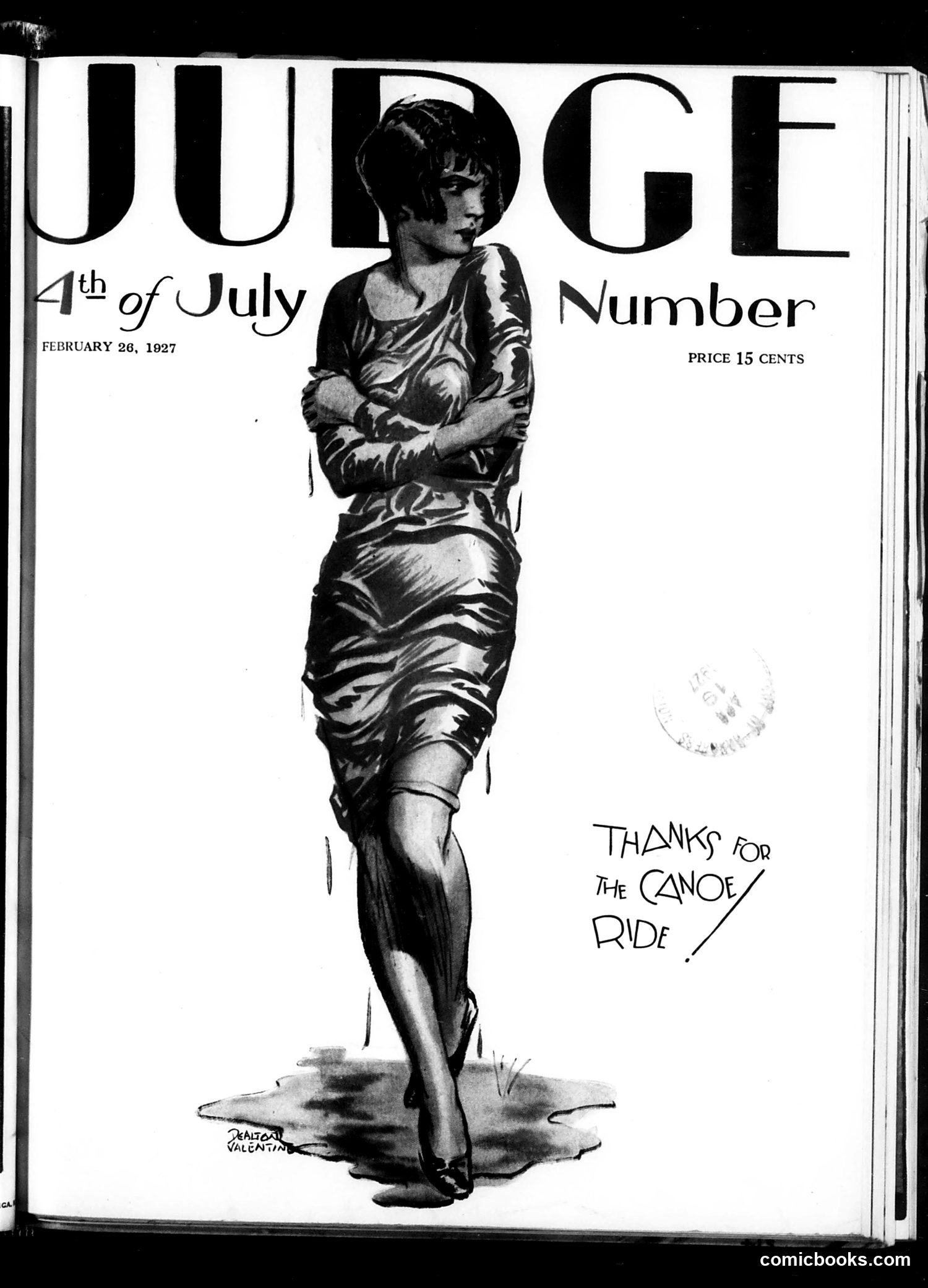
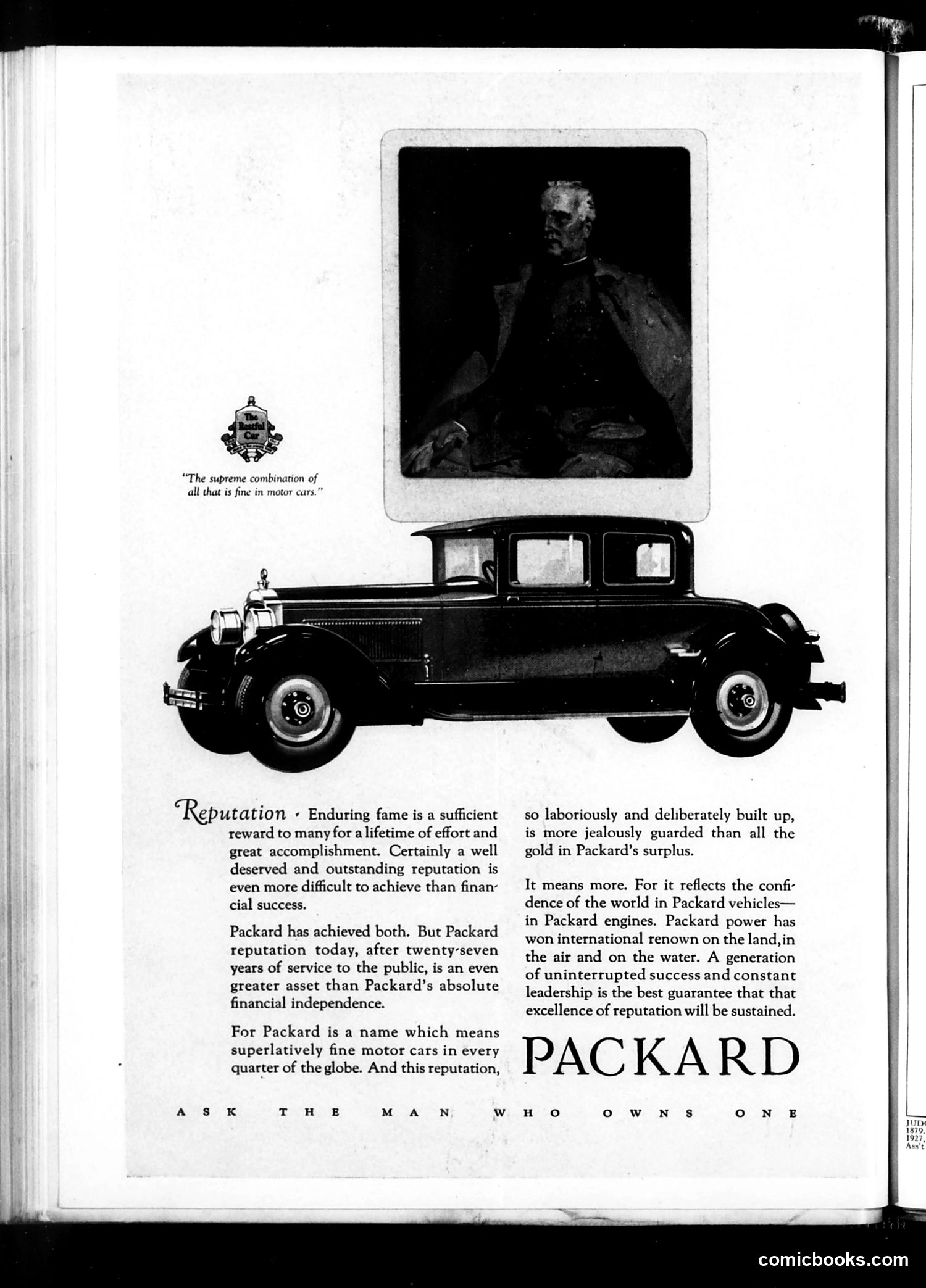
This page is **primarily a Packard automobile advertisement**, not a political cartoon. The image shows a luxury 1920s sedan with a formal portrait of an distinguished older gentleman displayed above it. The advertisement uses the concept of "Reputation" as its sales pitch, arguing that Packard's twenty-seven years of public service have earned it greater prestige than mere financial success. The text emphasizes that Packard's reputation reflects "world confidence" in the brand's engines and vehicles across land, sea, and air. The portrait appears to be a dignitary or captain of industry meant to embody the respectability and established excellence the Packard brand claims. The tagline reads "Ask the man who owns one"—a famous Packard advertising slogan. This represents luxury automotive marketing of the era, not satire.
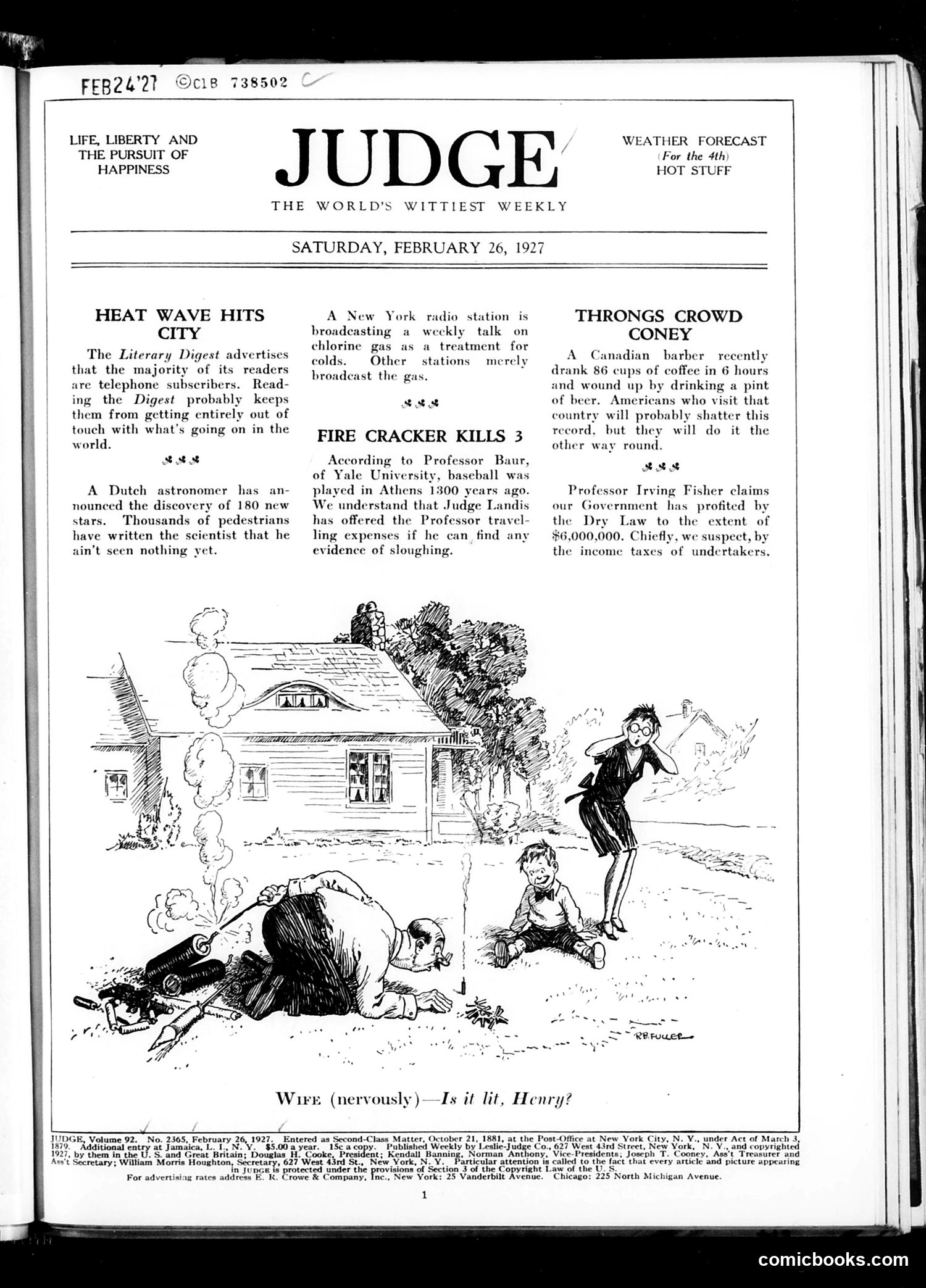
The main cartoon depicts a domestic scene titled "Wife (nervously)—Is it lit, Henry?" showing a man crouched with what appears to be a firecracker or explosive device while children and a woman watch nervously from a house. This references the article headline "FIRE CRACKER KILLS 3," which reports a fatal firecracker accident. The cartoon satirizes the dangers of firecrackers—likely still common in 1920s America—by showing a domestic scenario where an adult is about to test one, creating dark humor through the wife's nervous concern about whether the explosive is "lit." The satire critiques careless behavior with dangerous novelty items, implying that even ordinary families risk tragedy through such recklessness.
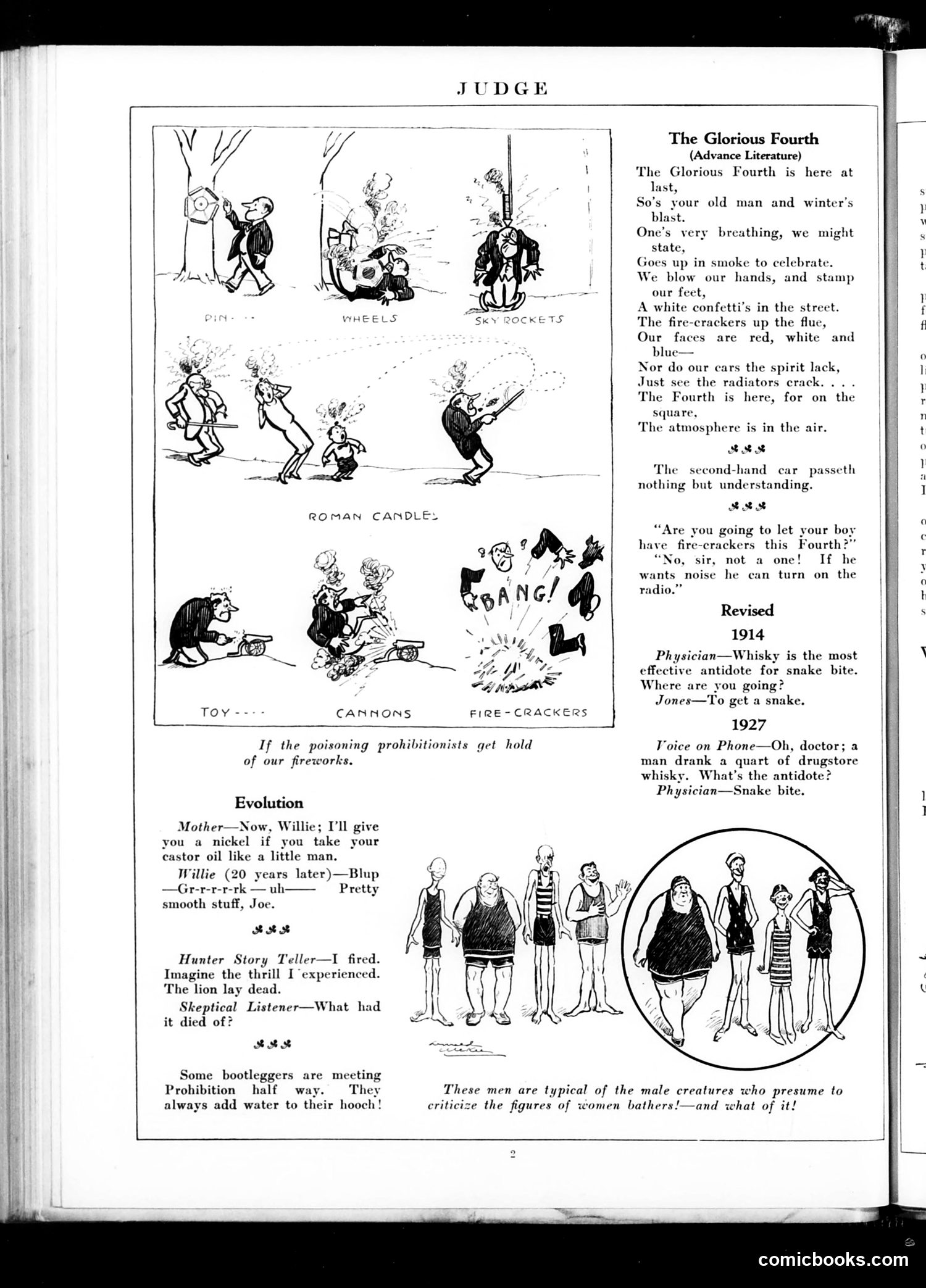
This page satirizes Fourth of July celebrations and related social issues circa 1914-1927. **"The Glorious Fourth"** depicts dangerous fireworks—firecrackers, roman candles, and rockets—injuring celebrants. The accompanying poem mocks the holiday's chaos: "Our faces are red, white and blue" (bruised), and warns that radiators crack from explosions. The satire targets both the recklessness of fireworks traditions and prohibition advocates who might restrict them. **"Evolution"** jokes about male hypocrisy: a mother bribes her son Willie with a nickel to use castor oil; twenty years later, he's become a smooth-talking ladies' man. The caption criticizes "male creatures who presume to criticize the figures of women bathers." Both sections use humor to mock contemporary social attitudes and dangerous practices.
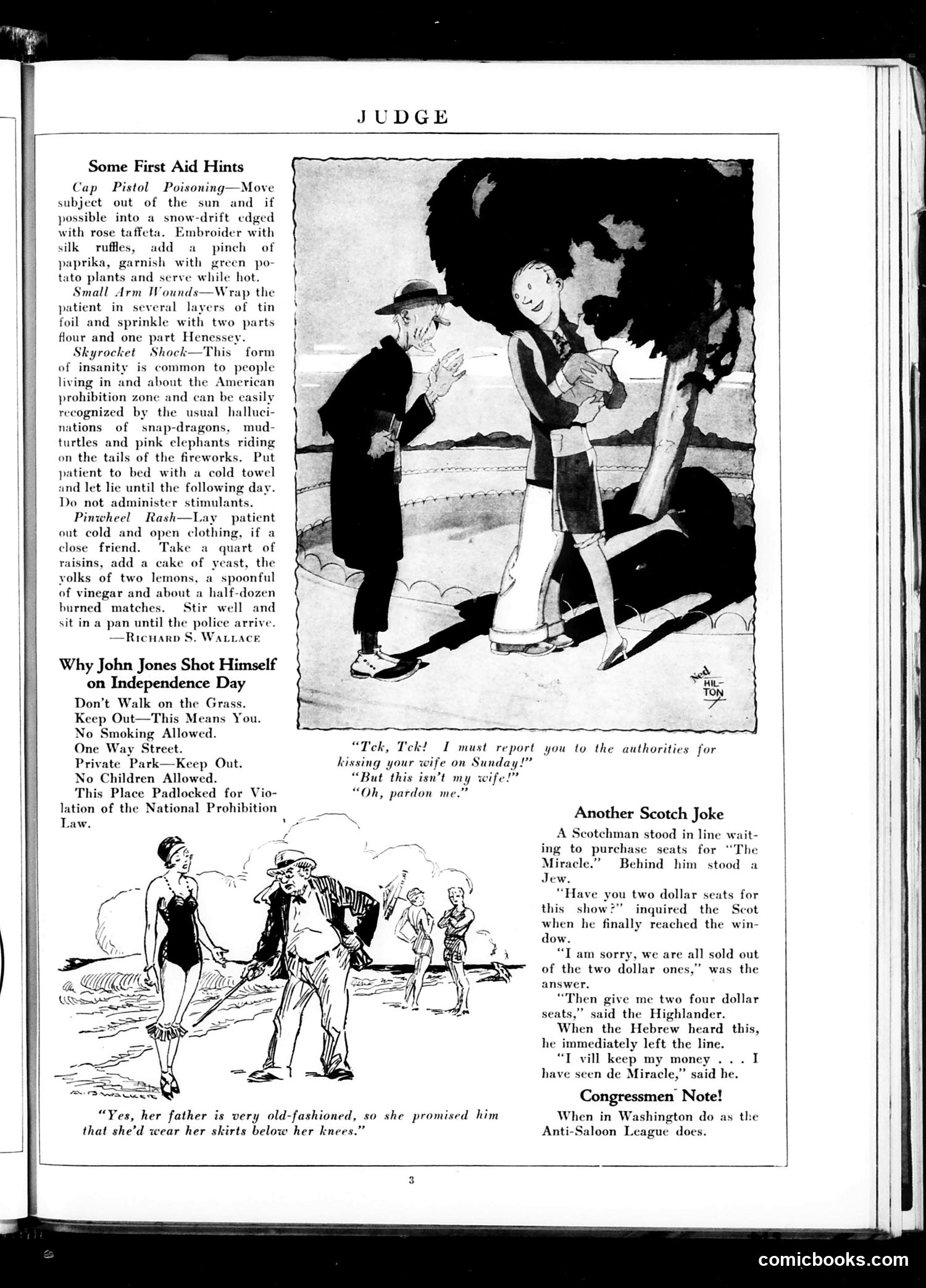
This page contains several distinct satirical pieces from the Prohibition era: **Top cartoon**: Shows a couple being confronted by authorities for kissing publicly on Sunday. The satire mocks the absurd enforcement of Prohibition laws and puritanical social restrictions—kissing is treated as a legal violation alongside alcohol prohibition. **Middle cartoon**: Depicts a beach scene mocking old-fashioned morality. The joke targets hypocrisy: a man promises his "old-fashioned" mother he'll enforce modest dress codes, then encounters scantily-clad beachgoers. **"Another Scotch Joke"**: A humorous anecdote about a Scotsman trying to buy theater seats, playing on Scottish stereotypes regarding frugality. **Text sections** include first-aid "jokes" and references to Prohibition enforcement. The overall theme satirizes the contradictions and absurdities of 1920s Prohibition-era morality.
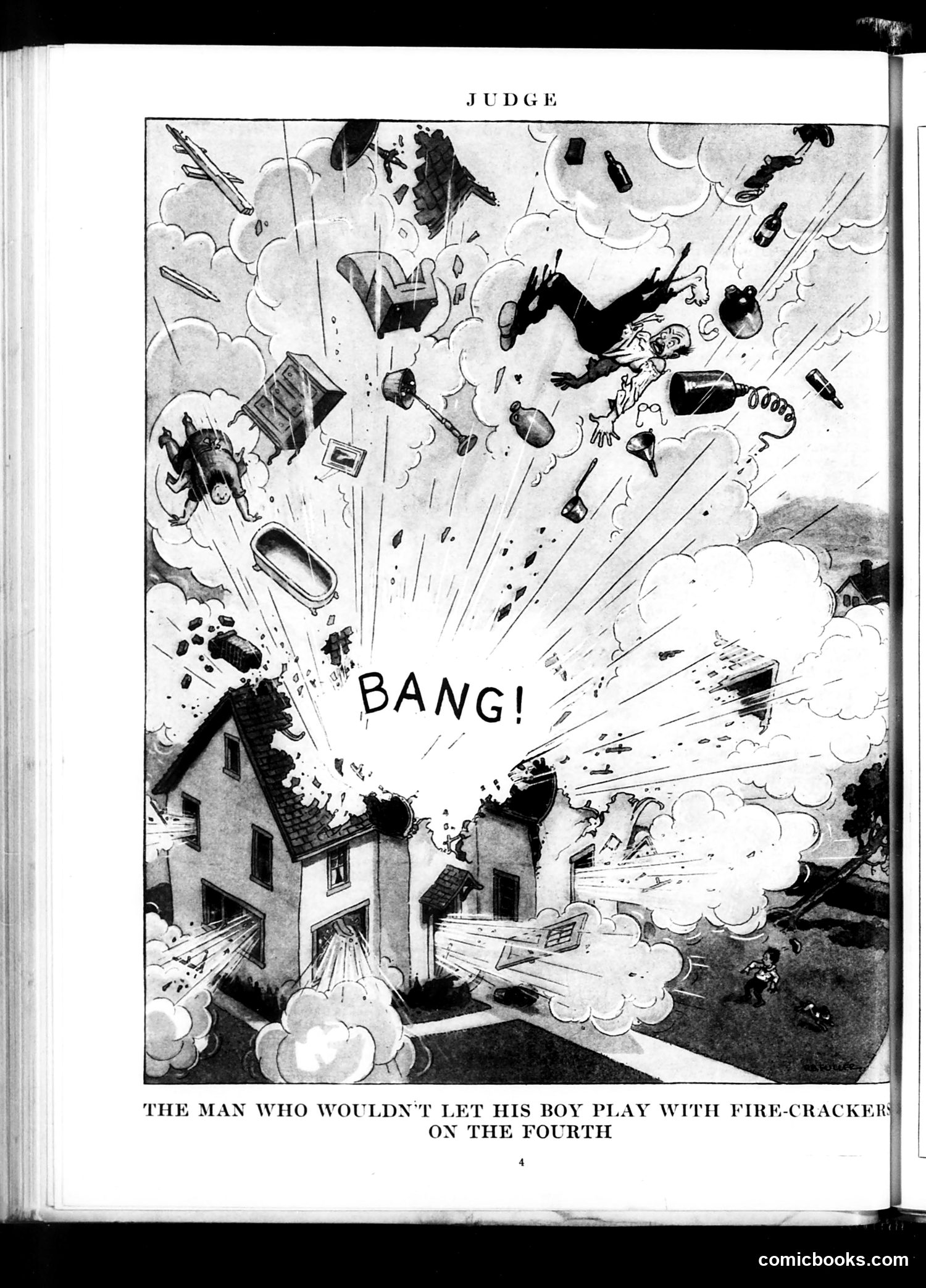
This satirical cartoon from *Judge* magazine depicts a catastrophic explosion destroying a house, with debris, people, and objects flying through the air. The title reads: "The Man Who Wouldn't Let His Boy Play With Fire-Crackers On The Fourth." The satire is ironic and darkly humorous: a father who prohibits his son from safely using firecrackers on Independence Day (Fourth of July) experiences far worse destruction—a massive explosion that obliterates his home entirely. The cartoon critiques overprotective parenting through exaggerated consequence, suggesting the father's extreme caution backfires spectacularly. This reflects early 20th-century attitudes about childhood risk-taking and Independence Day celebrations, when firecrackers were common holiday traditions despite dangers.
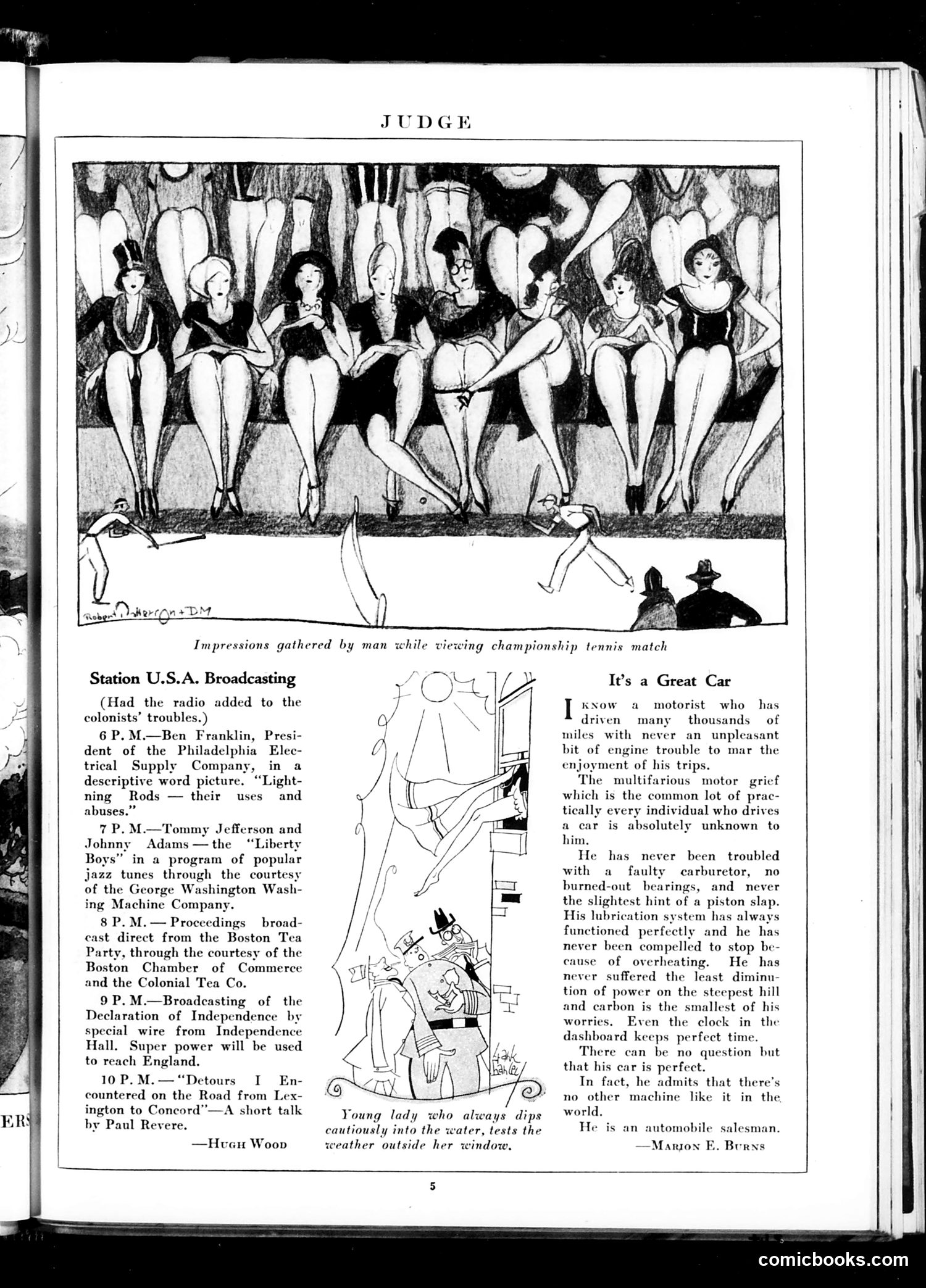
The main cartoon depicts women in bathing suits seated together, captioned "Impressions gathered by man while viewing championship tennis match." This is satirizing male spectators who attend sporting events ostensibly for the competition but are actually distracted by women's appearances and fashions. The humor reflects 1920s anxieties about changing social norms—women were increasingly visible in public spaces and wearing less restrictive clothing, which scandalized some observers. The page also contains advertisements and articles about radio broadcasts and automobiles, typical Judge content. The "Great Car" article praises a motorist's vehicle reliability, standard advertising copy for the era. The overall tone reflects Judge's satirical commentary on contemporary leisure, gender dynamics, and consumer culture of the Jazz Age period.
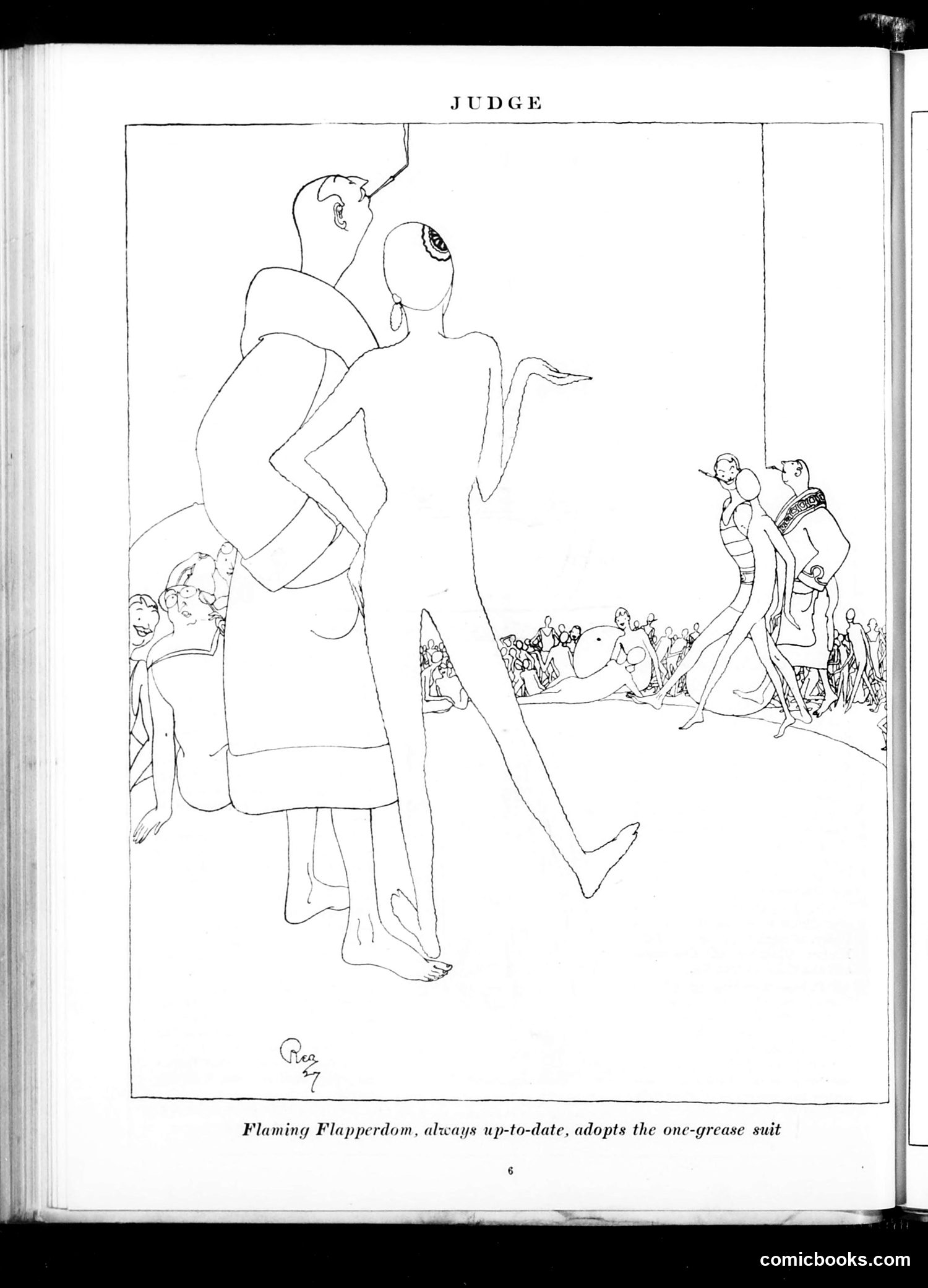
This cartoon satirizes fashion trends among wealthy or fashionable women of the era. The caption references "Flaming Flapperdom" — the 1920s youth movement known for rejecting Victorian propriety — and mocks the adoption of a "one-grease suit," likely referring to a minimalist or revealing bathing/loungewear outfit. The illustration shows two tall, exaggerated female figures in simple, form-fitting garments at what appears to be a beach or social gathering. The satire targets how flappers and fashionable women embraced scandalous new clothing styles that shocked conservative society. The cartoon ridicules both the extreme silhouettes and the broader cultural phenomenon of women defying traditional dress codes, presenting this as pretentious social climbing ("always up-to-date") rather than genuine liberation.
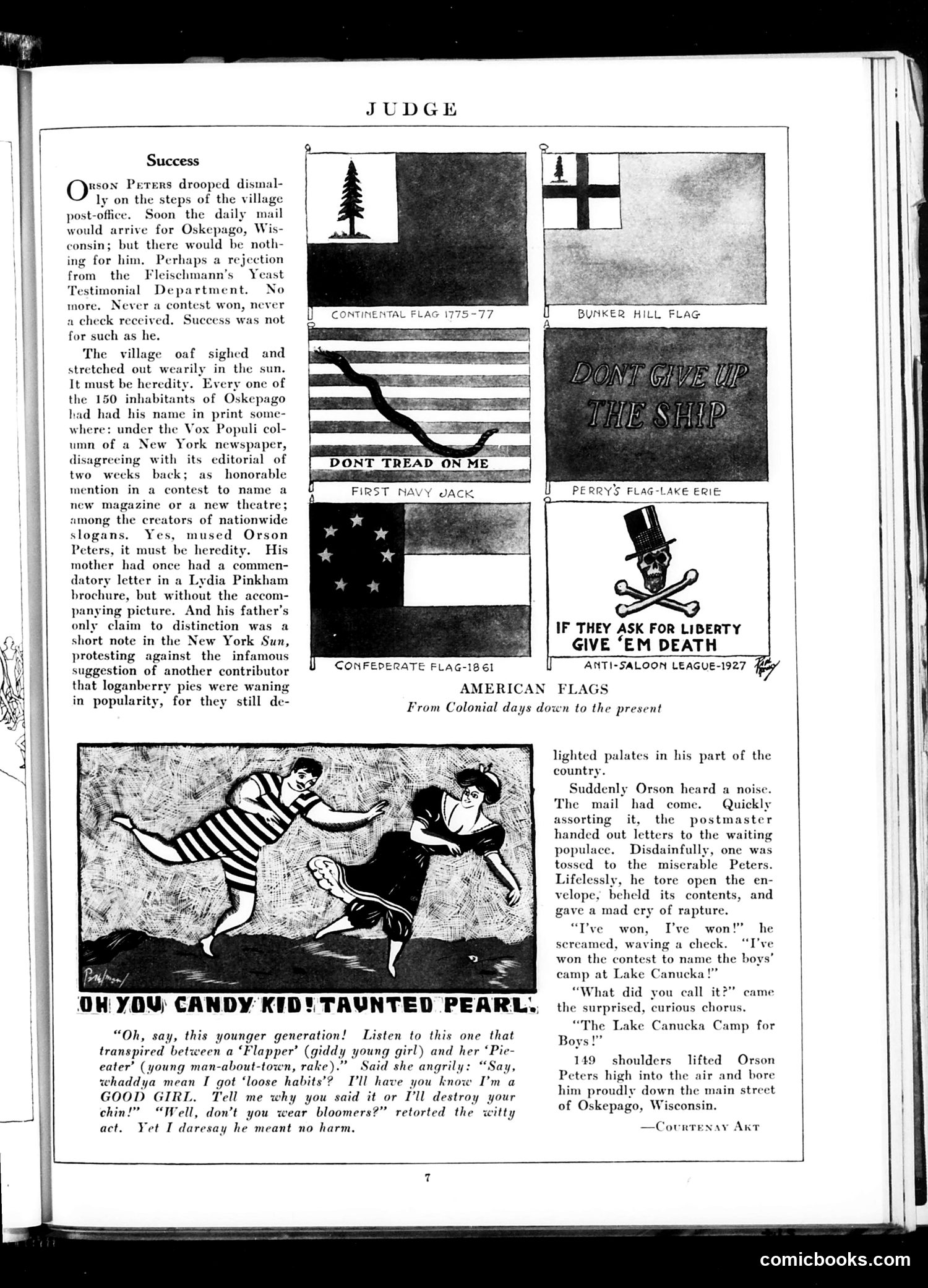
This page contains two separate pieces from *Judge* magazine: **The Story "Success"**: A satirical tale mocking small-town American life and the era's obsession with public recognition. Orson Peters, a hapless villager, is depressed because—unlike everyone else in his 150-person town—he's never had his name published anywhere (letters to newspapers, contest mentions, etc.). When he finally wins a naming contest for a boys' camp, the entire village celebrates him as a hero. The satire targets the hollow nature of minor fame and the pathetic standards by which small communities measure success. **The Cartoon "Oh You Candy Kid! Taunted Pearl"**: A joke about 1920s dating customs, featuring a "flapper" (modern young woman) and a "pie-eater" (a rakish man). She accuses him of calling her loose; he defensively points out she wears bloomers (less restrictive undergarments), which he treats as evidence of looseness. The humor relies on period-specific attitudes toward women's fashion as moral indicators. **The Flags Section**: Historical illustrations of American flags from colonial times onward, including anti-saloon league imagery (Prohibition era).
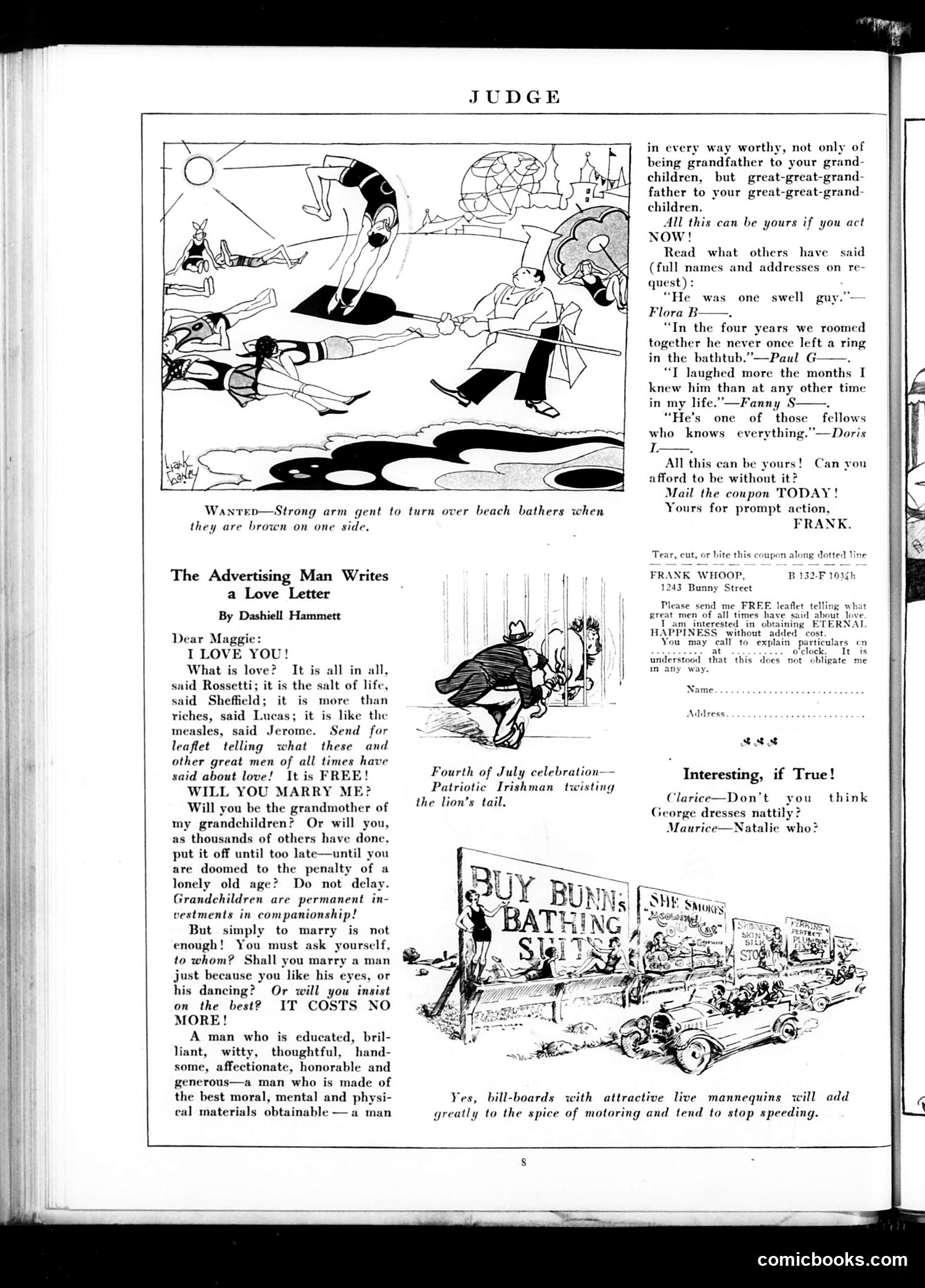
This page contains two satirical pieces from *Judge* magazine: **"The Advertising Man Writes a Love Letter"** by Dashiell Hammett is a parody of advertising copywriting. It mocks how advertisers manipulate emotions and fears—particularly the anxiety of spinsterhood and old age—to sell products. The "love letter" isn't actually romantic; it's a sales pitch disguised as courtship, using testimonials and urgency ("Mail the coupon TODAY!") to pressure women into marriage as though it's a purchasable good. The humor lies in exposing how advertisers weaponize emotional appeals. **The beach cartoon** at top mocks sun-tanning culture, suggesting men want to turn over sunbathers like meat to achieve even browning—reducing human courtship to commodity mechanics. **The Fourth of July cartoon** references the Irish-American political trope of "twisting the lion's tail"—meaning to antagonize the British Empire—a common theme in American politics reflecting Irish-American identity. The "Interesting, if True" gossip section parodies society columns and fashion criticism.
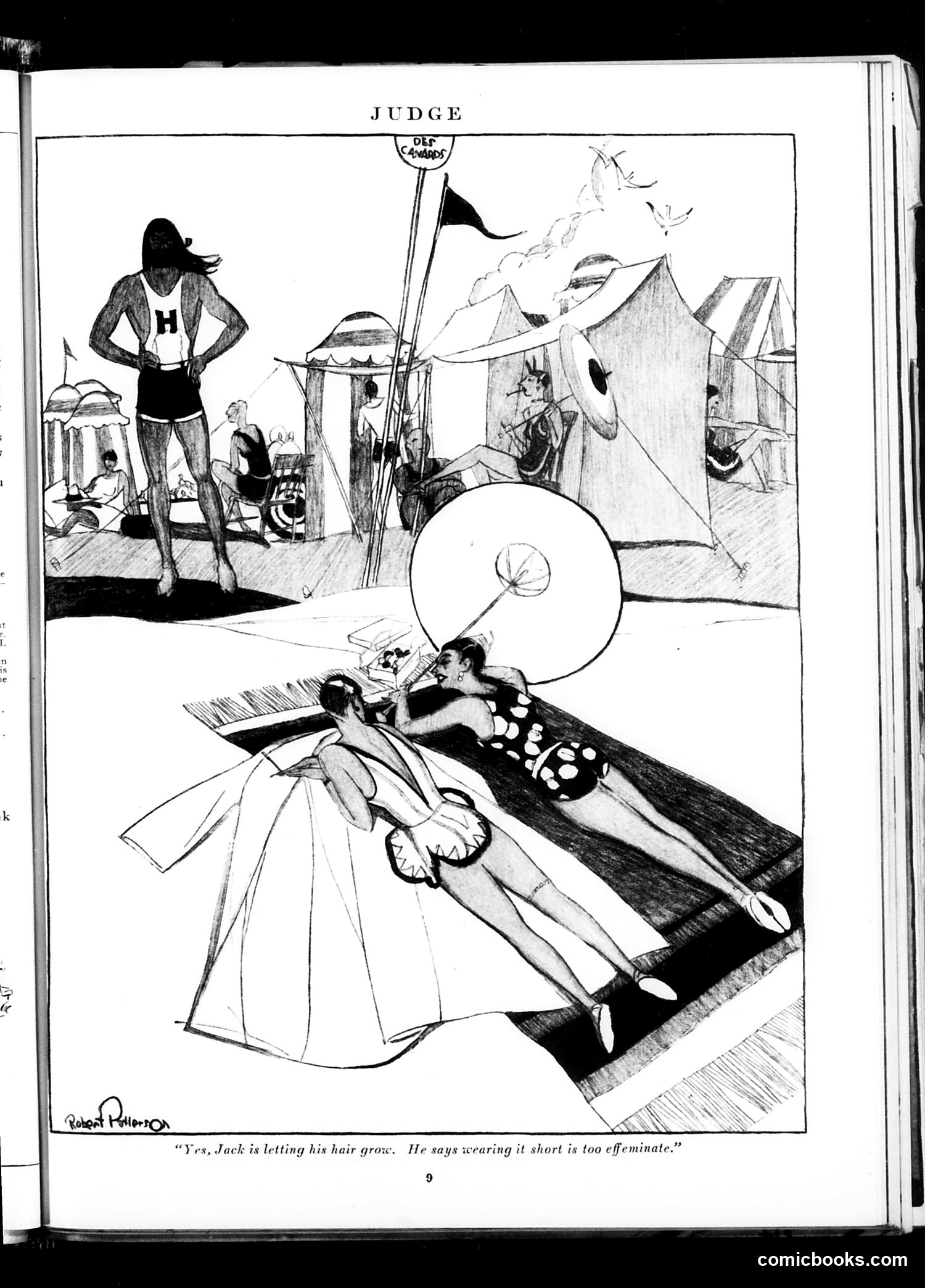
This single-panel cartoon titled "JUDGE" depicts a circus or beach scene. The caption reads: "Yes, Jack is letting his hair grow. He says wearing it short is too effeminate." The satire mocks gender anxieties about men's hair length. A man lying down has visibly long hair (depicted dramatically), while a woman in a striped dress and another figure stand nearby. The joke plays on the absurdity of the claim that *short* hair appears feminine—inverting contemporary expectations. This likely references 1920s-30s social debates about changing masculine standards, when bobbed hair on women and evolving men's styles challenged traditional gender presentation norms. The circus/leisure setting emphasizes the trivial nature of such vanity concerns.
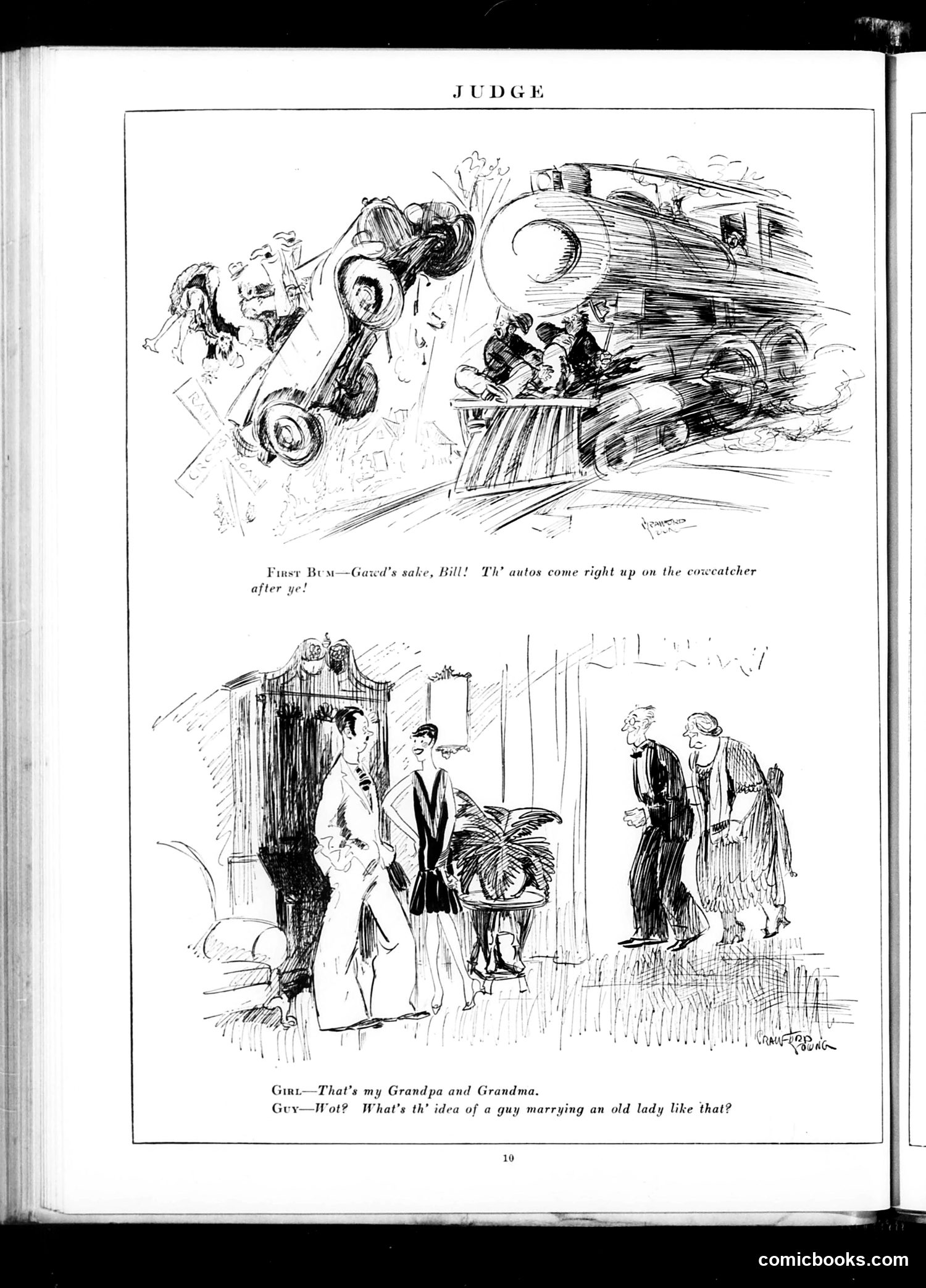
This page contains two unrelated cartoons satirizing early 20th-century social anxieties. **Top cartoon**: Shows a train nearly colliding with automobiles. The humor plays on the "cow-catcher" (the angled guard on train fronts designed to push obstacles aside), suggesting cars are now invading railroad space—reflecting contemporary tensions between established rail transport and the new automobile industry. **Bottom cartoon**: A young man's grandparents arrive by car. His friend expresses shock that an elderly woman married at all, let alone to an older man. The satire targets class attitudes about age and romance among working-class or immigrant populations, where such unions apparently seemed ridiculous to Judge's middle-class readers. The casual dialect ("Wot?") suggests these are working-class characters, making the joke partly about social class assumptions regarding courtship norms.
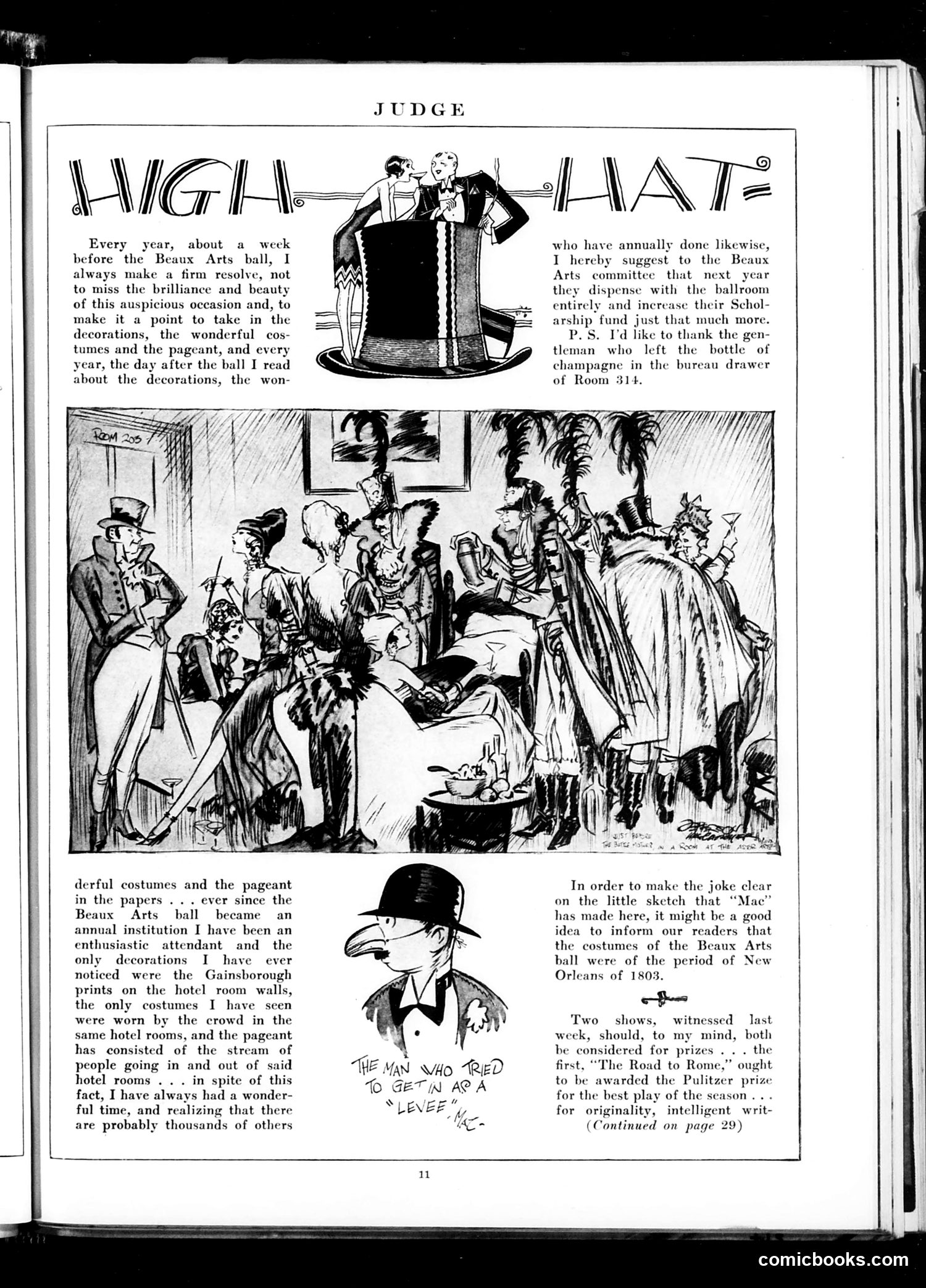
This is a satirical piece about the **Beaux Arts Ball**, an annual high-society event. The author jokes that he always *intends* to attend and appreciate the elaborate decorations and costumes, but ends up spending the entire evening in hotel rooms socializing instead—never actually seeing the official pageant. The humor targets wealthy socialites who attend such prestigious events primarily for private socializing rather than genuine cultural appreciation. The small cartoon shows "the man who tried to get an idea of a levee"—referencing the ball's New Orleans 1803 theme—apparently observing the scene from outside the main action. The author's closing suggestions are mock-serious: perhaps the committee should skip the expensive ballroom entirely and donate funds to scholarships instead. He also thanks whoever left champagne in a hotel room—highlighting how the real "action" happens in private spaces, not the official celebration. This critiques the performative nature of elite social institutions.
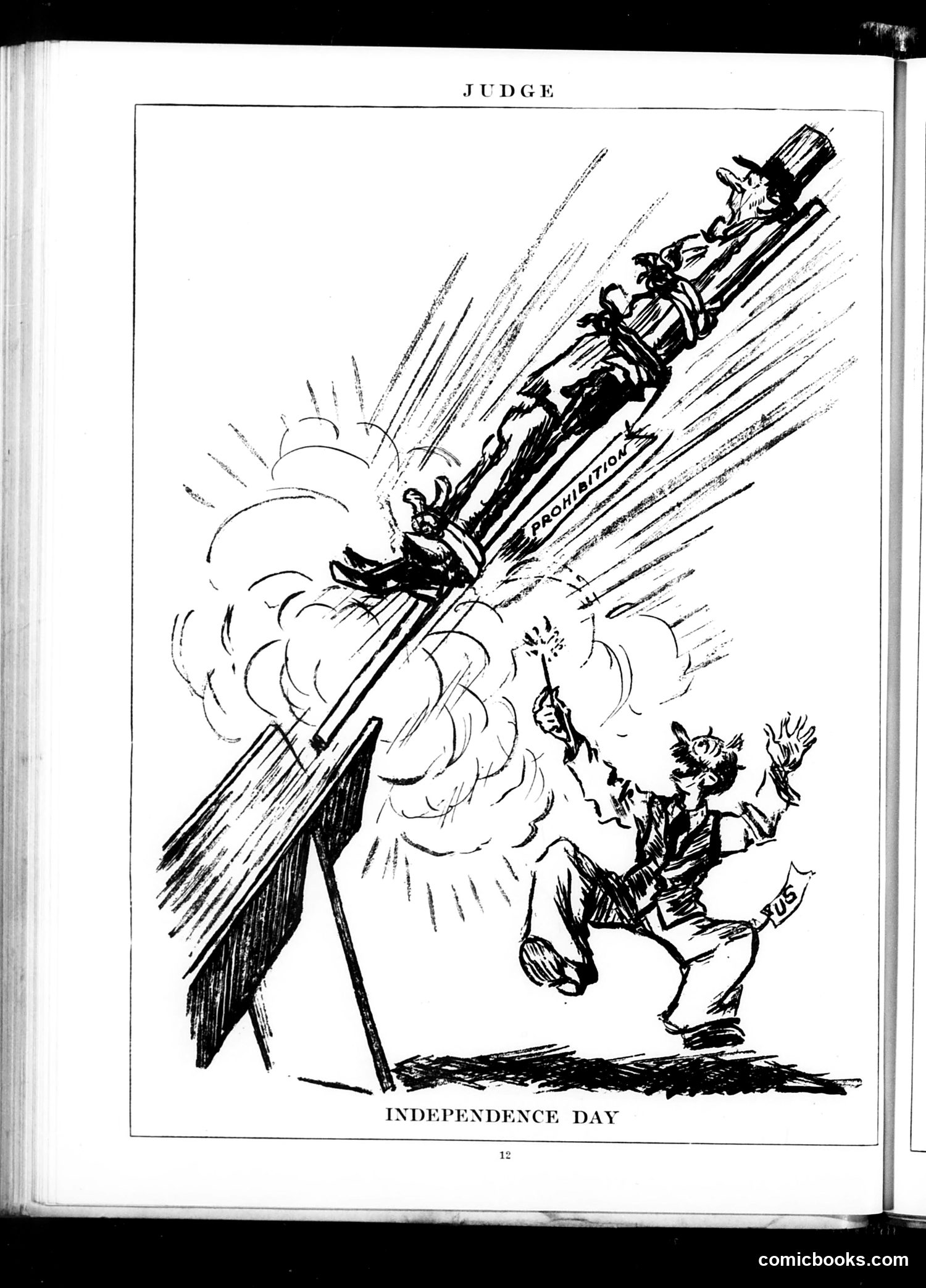
This Judge magazine cartoon satirizes Prohibition enforcement. The central image shows a large cannon labeled "PROHIBITION" firing downward, with a figure in a top hat (likely representing a Prohibition enforcer or politician) riding atop it. Below, a small figure labeled "U.S." (representing the United States or its citizens) cowers and shields himself from the blast and debris. The satire critiques how aggressively Prohibition was being enforced—depicting it as a destructive, overwhelming force rather than a beneficial policy. The "Independence Day" caption ironically suggests that Prohibition represents the opposite of American freedom, instead imposing heavy-handed government control. The cartoon reflects contemporary anti-Prohibition sentiment during the 1920s-1930s.
This editorial defends **Ben B. Lindsay**, a Denver juvenile court judge ousted in 1924 following an irregular election return—apparently orchestrated by enemies including the **KKK and self-righteous moralists**. Lindsay's controversial positions included sympathetic treatment of troubled youth, attacking parental hypocrisy and sexual secrecy, and advocating "companionate marriage" (dismissed as "free love"). The editorial argues opponents aren't genuinely outraged by these views but rather resent his *success* in redemption—saving sinners from social consequences. The piece then pivots to critique self-righteousness generally, using **Prohibition and Wayne B. Wheeler** (Anti-Saloon League leader) as examples. It accuses dry activists of sadism: they oppose non-poisonous denaturants for alcohol, *wanting* drinkers to die rather than merely abstain. The satire suggests moral crusaders secretly enjoy others' suffering, revealing hypocrisy beneath righteous rhetoric.
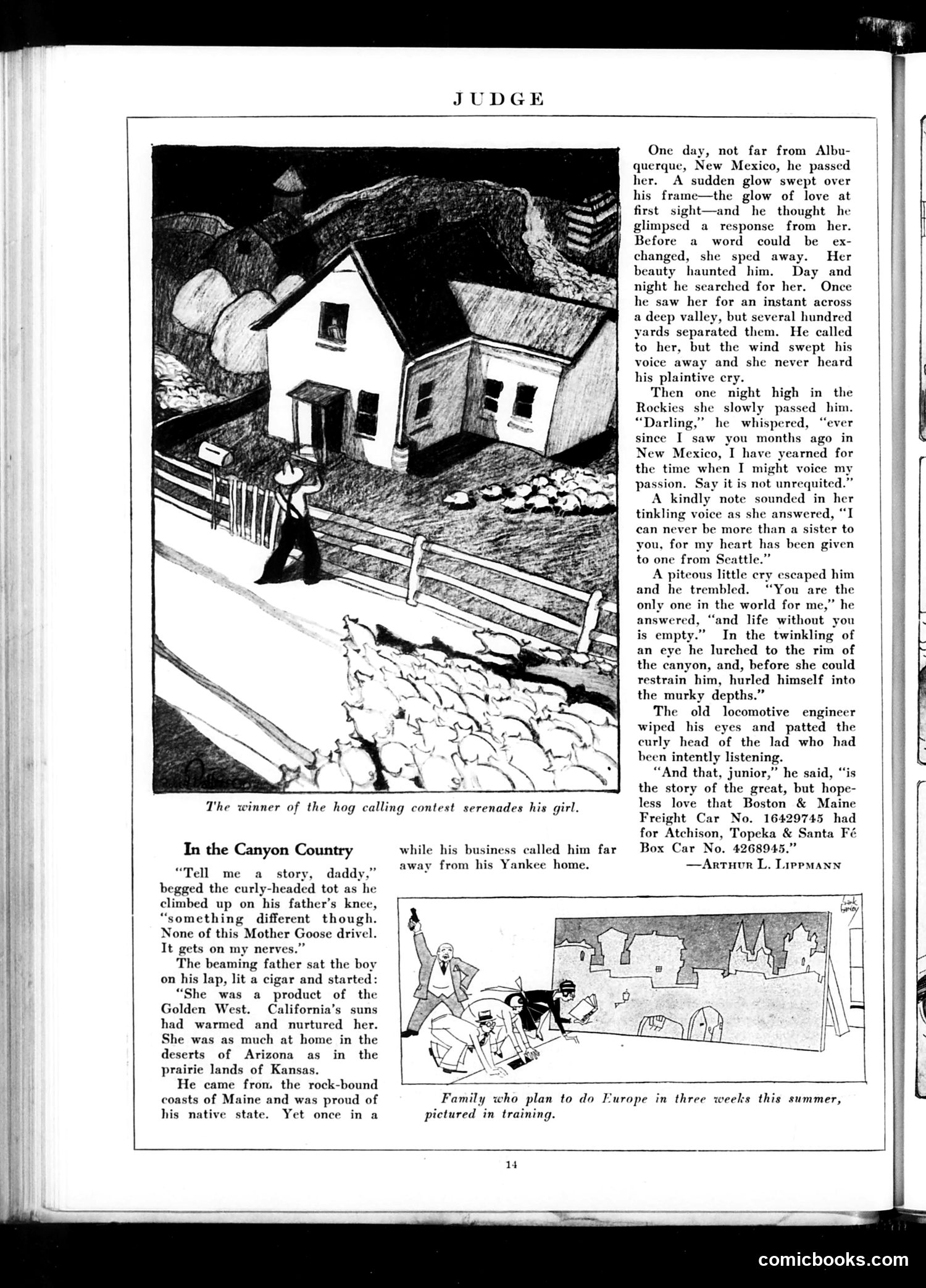
This page contains two distinct pieces of satire: **Top cartoon:** "The winner of the hog calling contest serenades his girl" shows a rural American man with a megaphone outside a small house. It's a gentle joke mocking rural Midwest culture—specifically the actual competitive sport of hog calling—by depicting its "winner" attempting romance with the same instrument used to summon pigs. **Main story:** Arthur L. Lippmann's "In the Canyon Country" is a parody of romantic melodrama. A father tells his son an overwrought love story set in the American West, but the punchline reveals the "lovers" are actually railroad freight cars—Boston & Maine No. 16429745 and Atchison, Topeka & Santa Fé No. 4268945. This mocks both the purple prose of sentimental fiction and perhaps the era's railroad obsession. **Bottom cartoon:** "Family who plan to do Europe in three weeks this summer, pictured in training" shows a family frantically packing/preparing, satirizing Americans' rushed approach to European tourism. All three pieces gently mock American regional culture, literary pretension, and tourist behavior.
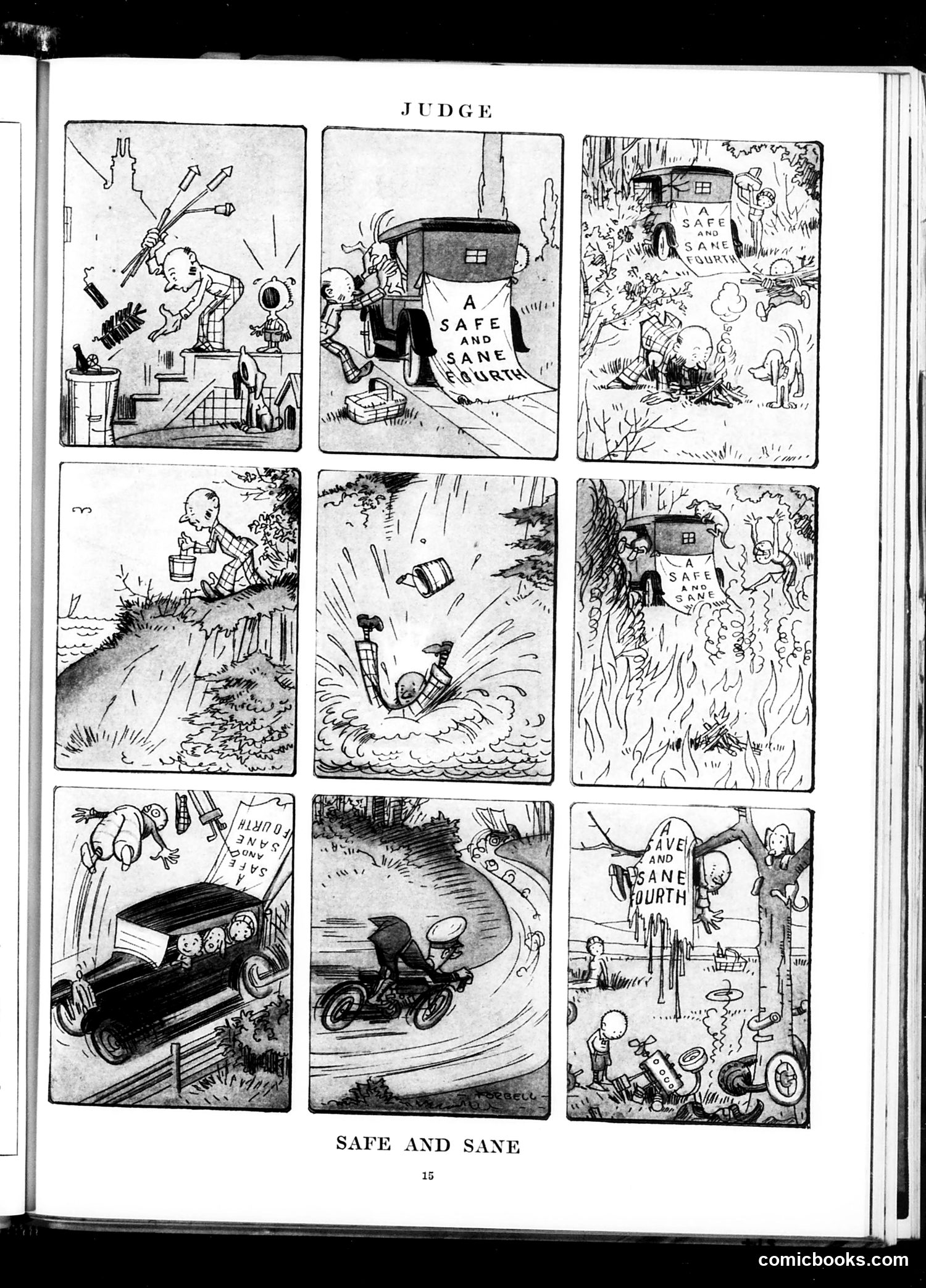
This is a nine-panel safety comic strip titled "Safe and Sane," appearing to be a public safety PSA from Judge magazine. The comic illustrates various hazards children face and their consequences: The panels depict dangerous scenarios including fireworks accidents, drowning, house fires, and traffic accidents from speeding vehicles and motorcycles. Each panel shows children in peril resulting from unsafe behavior. The title "Safe and Sane" appears repeatedly on a structure (possibly representing a safe house or institution), suggesting the comic contrasts safe versus reckless conduct. This appears to be educational content warning readers—likely parents and children—about Fourth of July holiday dangers and general childhood safety hazards prevalent in the early-to-mid 20th century.
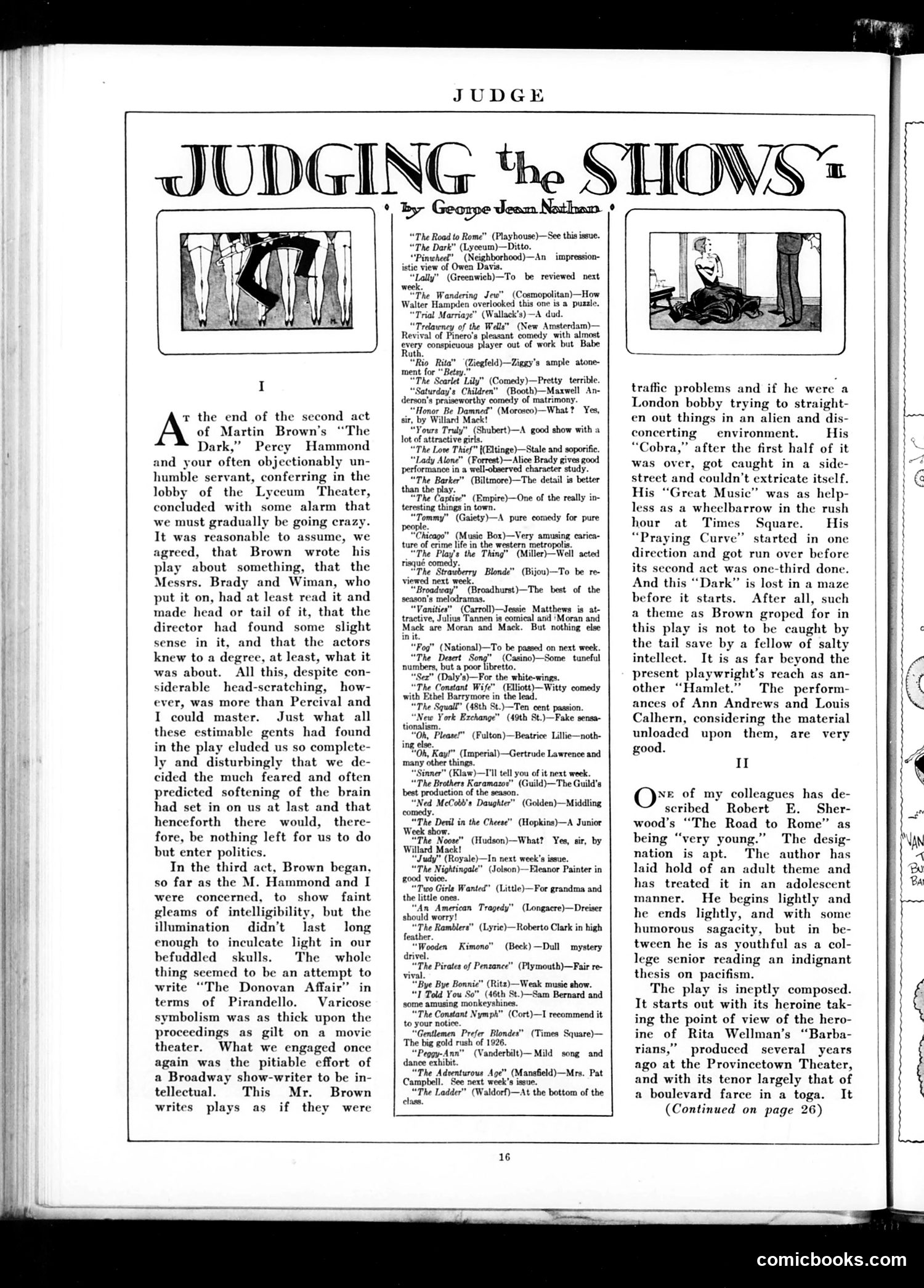
This page features theater criticism from Judge magazine's "Judging the Shows" column by George Jean Nathan. The main essay critiques Martin Brown's play "The Dark" at the Lyceum Theater, describing it as incomprehensibly obscure—so bewildering that the critic and fellow reviewer Percy Hammond feared they were losing their minds. Nathan's satire targets pretentious Broadway playwrights who attempt intellectual sophistication through excessive symbolism (he compares it to Luigi Pirandello's experimental style) rather than clear storytelling. He sarcastically suggests the play resembles "The Donovan Affair written in Pirandello terms"—mixing a conventional mystery with avant-garde pretension. The column includes a theater listings section reviewing current Broadway productions, offering quick judgments on various shows' merits and performers. The satire's point: Broadway show-writers overreach artistically, creating incomprehensible "varicose symbolism" when attempting to be intellectual, rather than focusing on coherent drama.
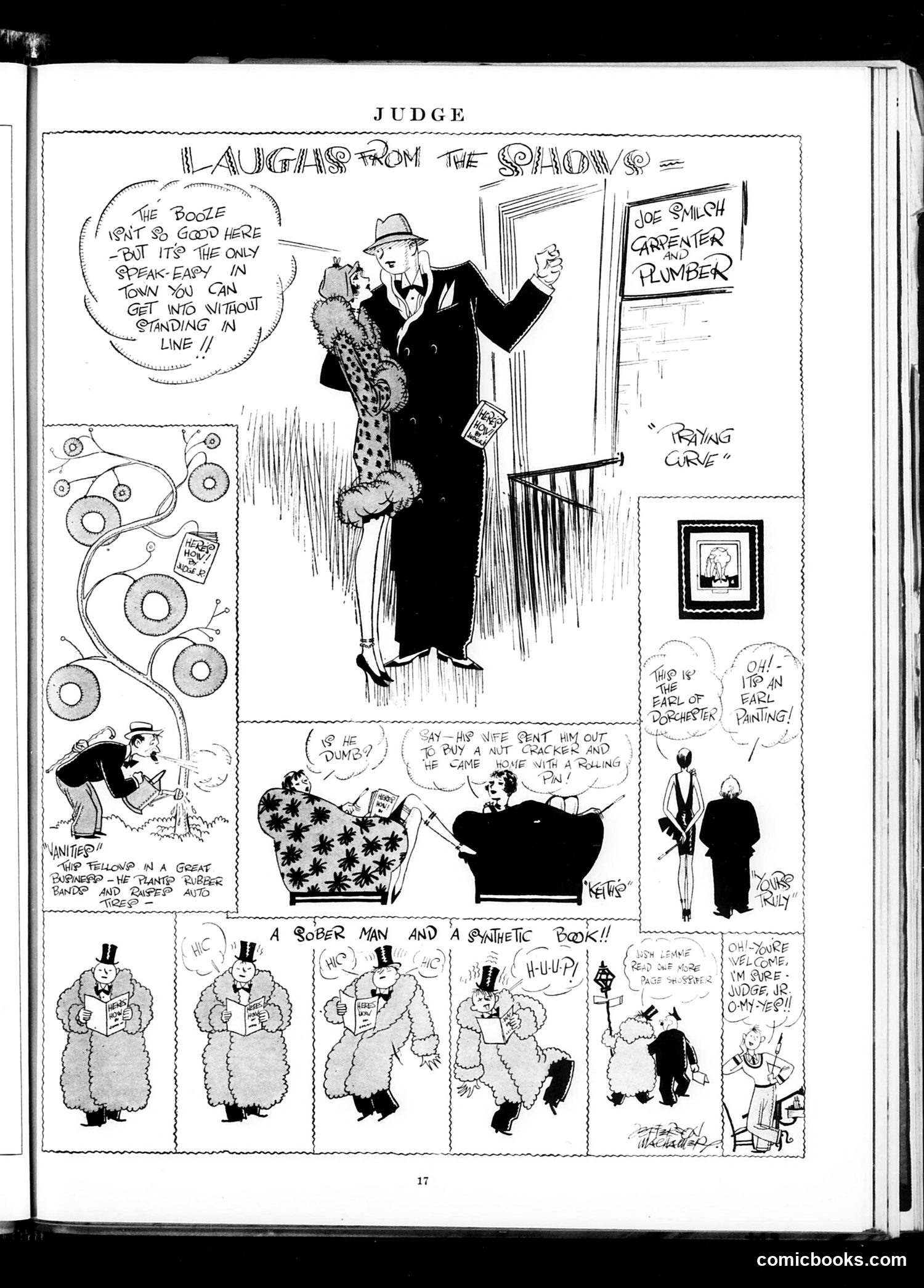
This page satirizes wealthy aristocrats and their pretensions. The top section mocks the "Earl of Dorchester," depicting a dandy in top hat and coat frequenting low venues. The joke involves social hypocrisy: he claims the booze is "the only speak-easy in town you can get into without standing in line"—suggesting even illicit establishments have status hierarchies. The middle panels appear to reference marital infidelity among the upper class, with domestic scandals involving "a nut cracker" (possibly an unflattering euphemism). The bottom strip, "A Sober Man and a Synthetic Book," shows a gentleman repeatedly reading a volume labeled "JUDGE," with his expressions changing—satirizing how reading the magazine (itself) might progressively intoxicate or transform one's perspective, perhaps mocking both pretentious literature and the magazine's own satirical claims to enlightenment. The overall target: wealthy men affecting sophistication while behaving foolishly or immorally.
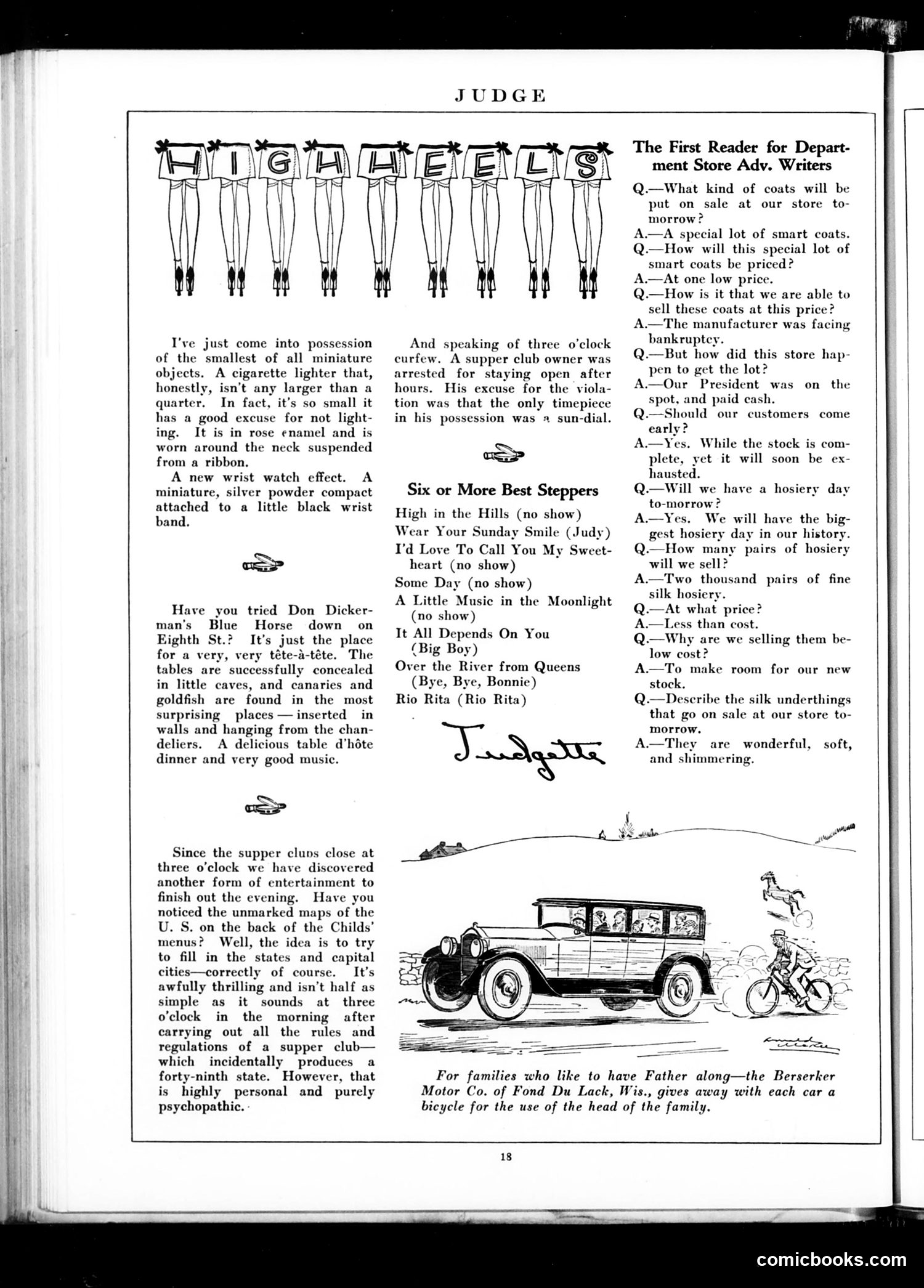
This page mixes social commentary with advertising parody. The top section satirizes 1920s nightlife trends—miniature jewelry, exclusive supper clubs with hidden tables, and elaborate entertainment like filling unmarked U.S. maps at 3 a.m. The humor relies on depicting the era's after-hours club culture and the absurdity of "forty-ninth state" geography mistakes made by intoxicated diners. A notable joke concerns a supper club owner arrested for violating curfew laws who claims his only timepiece was a sundial—mocking both Prohibition-era enforcement and the implausibility of the excuse. The "First Reader for Department Store Adv. Writers" section parodies retail advertising copy, exposing the euphemistic language used to justify sales: coats sold "at one low price" because manufacturers faced bankruptcy; silk items sold "below cost" to clear inventory. This satirizes how stores disguise distressed merchandise as bargains. The page captures 1920s consumer culture and post-Prohibition leisure, along with cynical commentary on advertising dishonesty.
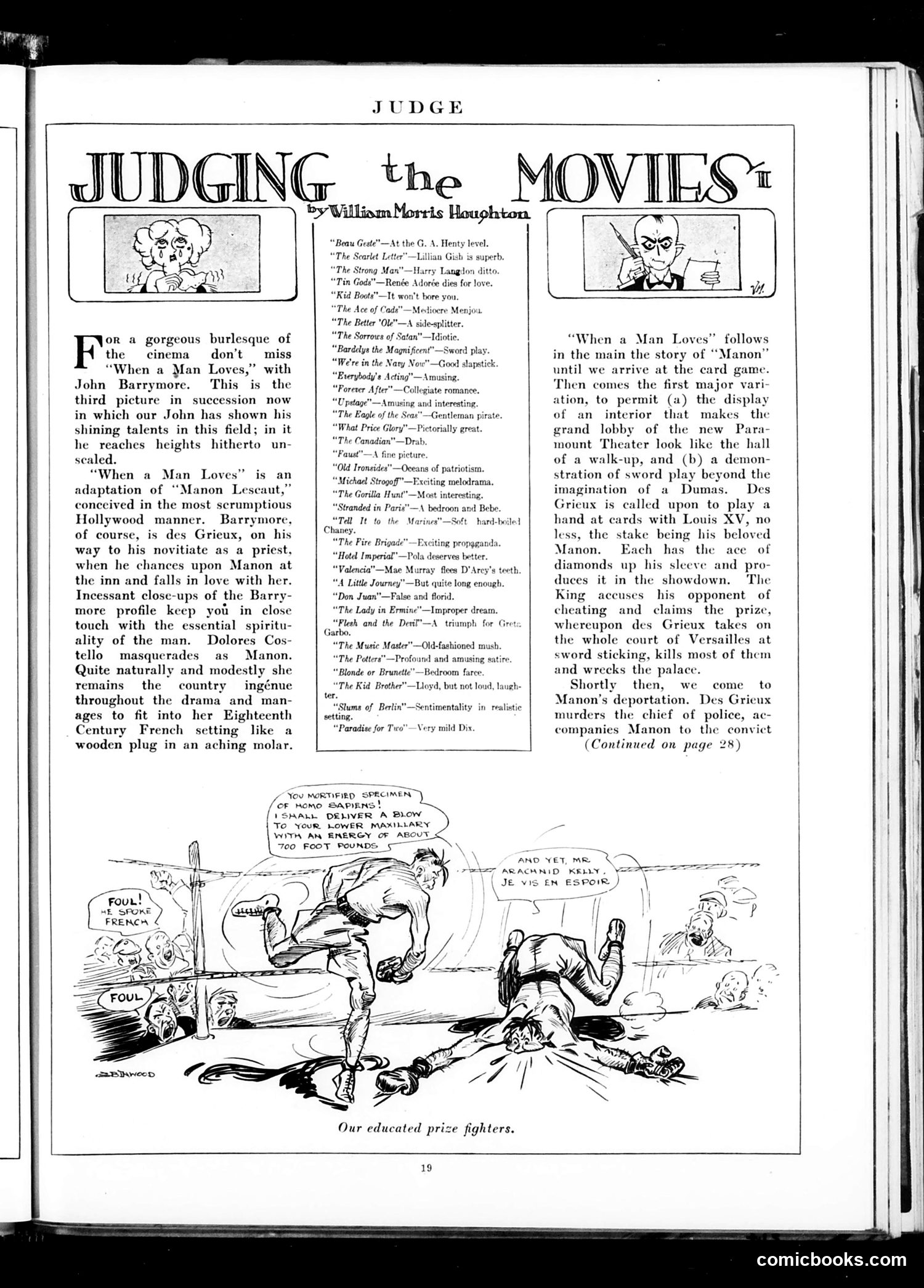
This page reviews several 1920s films, with particular mockery of "When a Man Loves," starring John Barrymore. The critic sarcastically praises Barrymore's repeated romantic roles while dismissing co-star Dolores Costello as fitting her 18th-century French setting like "a wooden plug in an aching molar." The cartoon below depicts stylized, exaggerated boxers in a humorous fight scene. One figure delivers an elaborate threat using pseudo-scientific language ("mortified specimen of homo sapiens," "lower maxillary"), while another responds coolly about "arachnid Kelly" and living "en espoir" (in hope). The caption "Our educated prize fighters" suggests satire about overly intellectual or pretentious boxers. The page mixes film criticism with sports humor typical of Judge magazine's satirical approach to American popular culture.
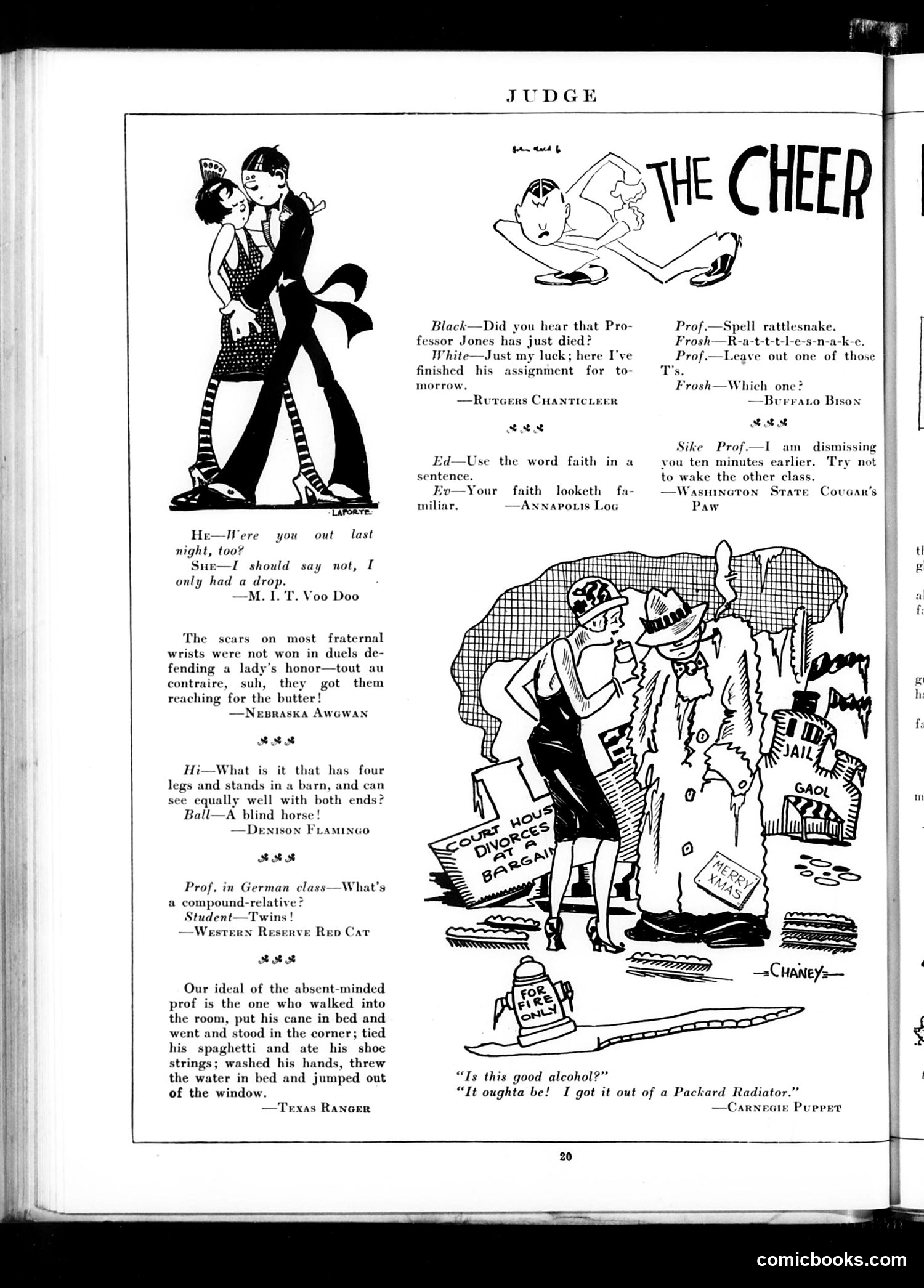
This page collects brief jokes and cartoons from college humor publications (MIT Voo Doo, Nebraska Awgwan, Denison Flamingo, etc.), mostly targeting absent-minded professors and college life in the early 20th century. The main cartoon by Chaney depicts a woman surrounded by life's chaos—divorce papers, jail notices, a "pawn" sign—apparently using alcohol extracted from a car radiator during Prohibition, when legal alcohol was unavailable. The joke plays on Depression-era desperation and Prohibition's consequences. The professor jokes mock academic types: one who literally confuses his cane with a bed; another who dismisses class but can't spell "rattlesnake"; another who mistakes spaghetti for shoelaces. Other jokes target fraternity life (scars from reaching for butter, not dueling) and student pranks (finishing a dead professor's homework). The humor reflects a college culture where professors were portrayed as comically incompetent and Prohibition forced citizens toward dangerous substitutes.
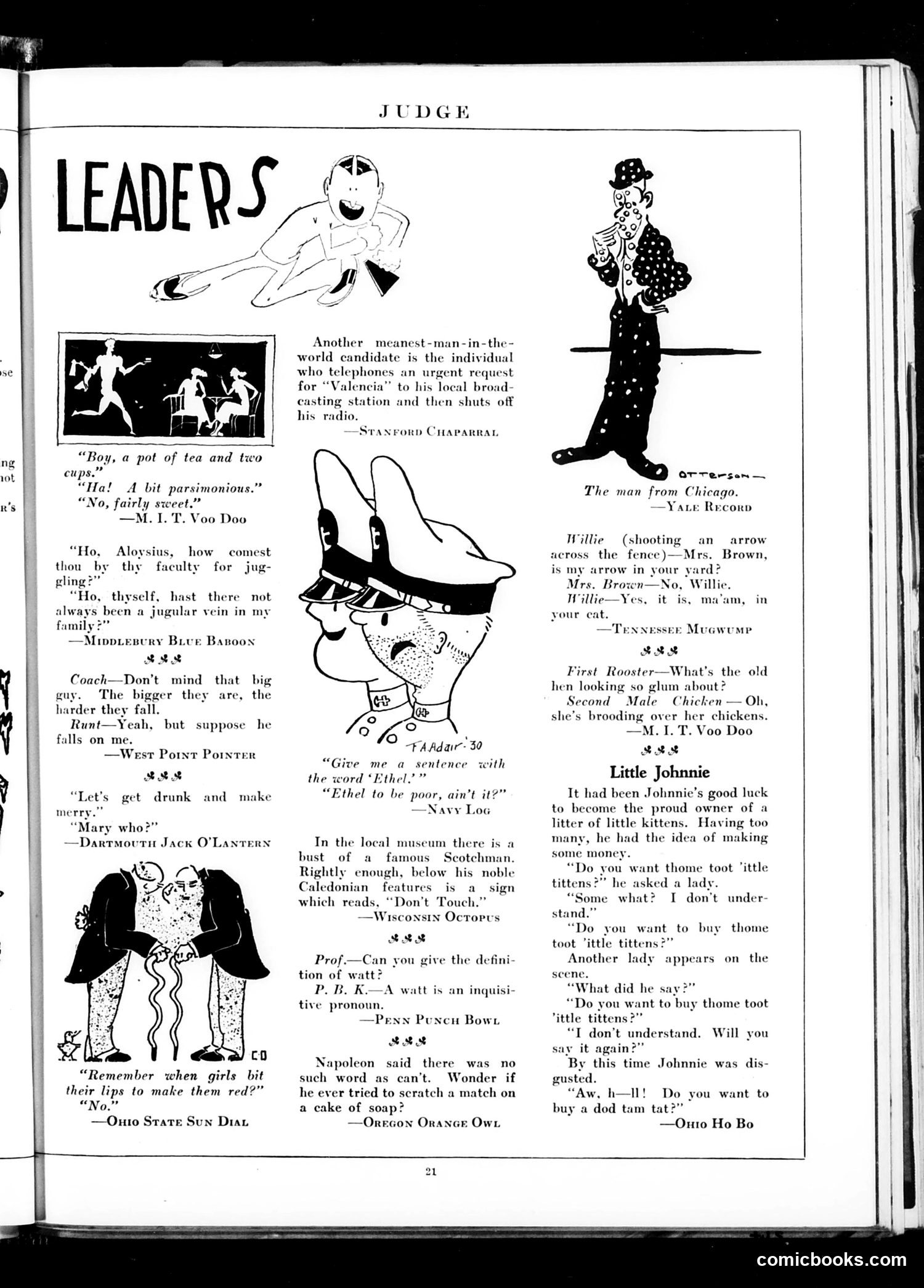
This page collects brief humorous anecdotes and jokes from college humor magazines (MIT Voo Doo, Penn Punch Bowl, etc.), typical of Judge's format. **Key satirical elements:** - **"Leaders" section title** ironically frames trivial college pranks and wordplay as serious matters worthy of "judging" - **Meanest-man joke** satirizes radio listeners who request songs then immediately turn off their radios—mocking petty, antisocial behavior as notable enough to discuss - **"Little Johnnie" story** uses child mispronunciation of "little kittens" as "tittens" for sexual innuendo humor, popular in early-20th-century publications - **Coach/Runt dialogue** plays on boxing clichés about larger opponents - **Museum bust reference** jokes about Scottish thriftiness (a common ethnic stereotype of the era) The page represents Judge's formula: collecting campus humor submissions that mock everyday absurdities, social pretension, and college life through gentle satire and wordplay rather than hard political commentary.
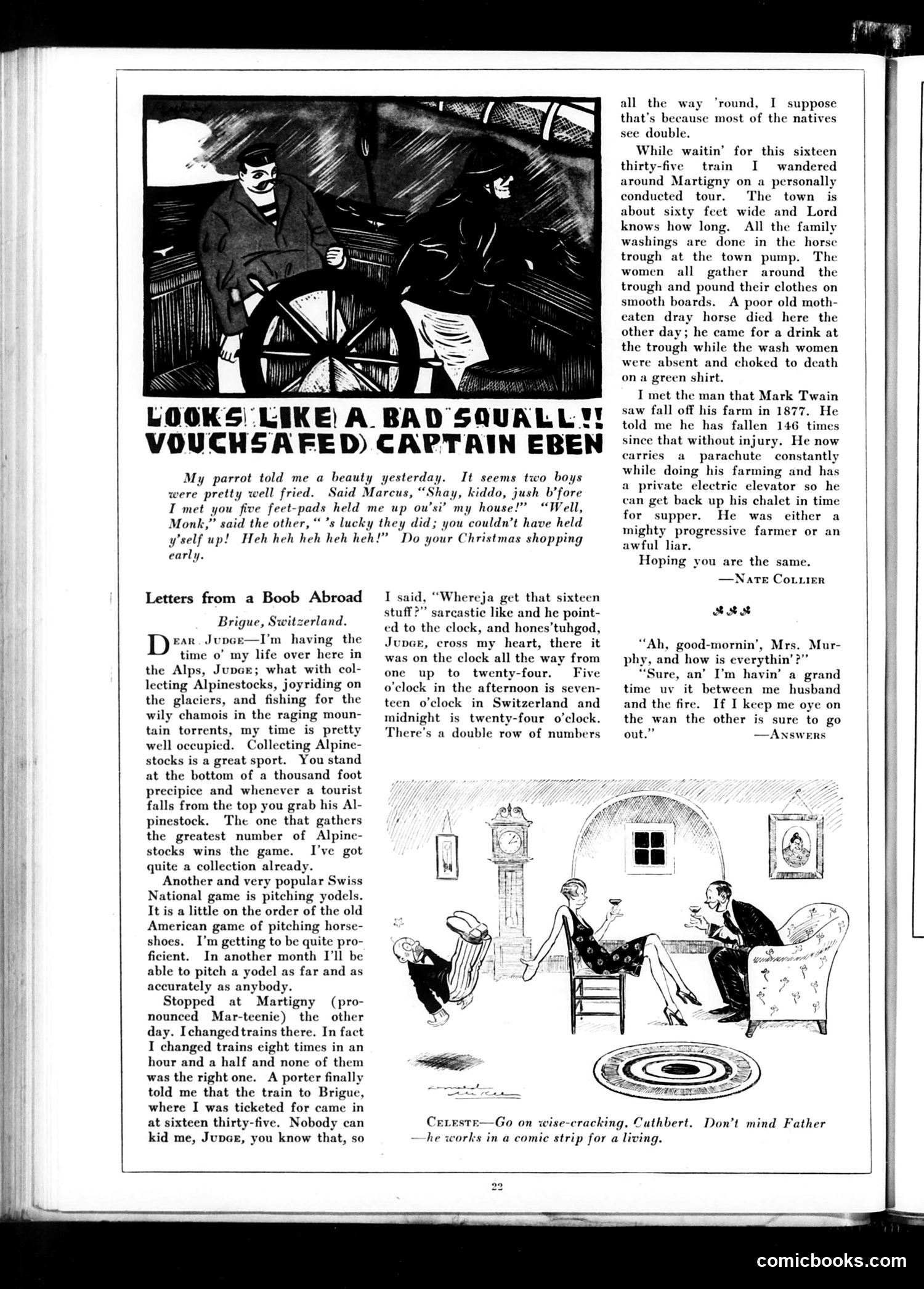
This page contains humorous content mocking American tourists abroad and exaggerating cultural differences. **Main Cartoon:** "Looks Like a Bad Squall! Vouchsafed Captain Eben" depicts two drunk men in a ship's cabin, with one recounting how muggers accosted him—a joke about intoxication and urban crime. **"Letters from a Boob Abroad":** A satirical travelogue where a naive American tourist in Switzerland describes absurd "observations." The humor relies on the writer's deliberate misunderstandings: Swiss 24-hour clock time is mocked as if genuinely confusing; Alpine sports like "collecting Alpinestocks" (stealing tourist equipment) and "pitching yodels" are invented absurdities. The Mark Twain reference and parachute farmer are exaggerated tall tales typical of the era's humor. **Lower cartoon:** An Irish-accented woman ("Mrs. Murphy") jokes about managing husband and fireplace—domestic comedy. The overall satire targets Americans' provincial ignorance of European culture while poking fun at tourist gullibility.
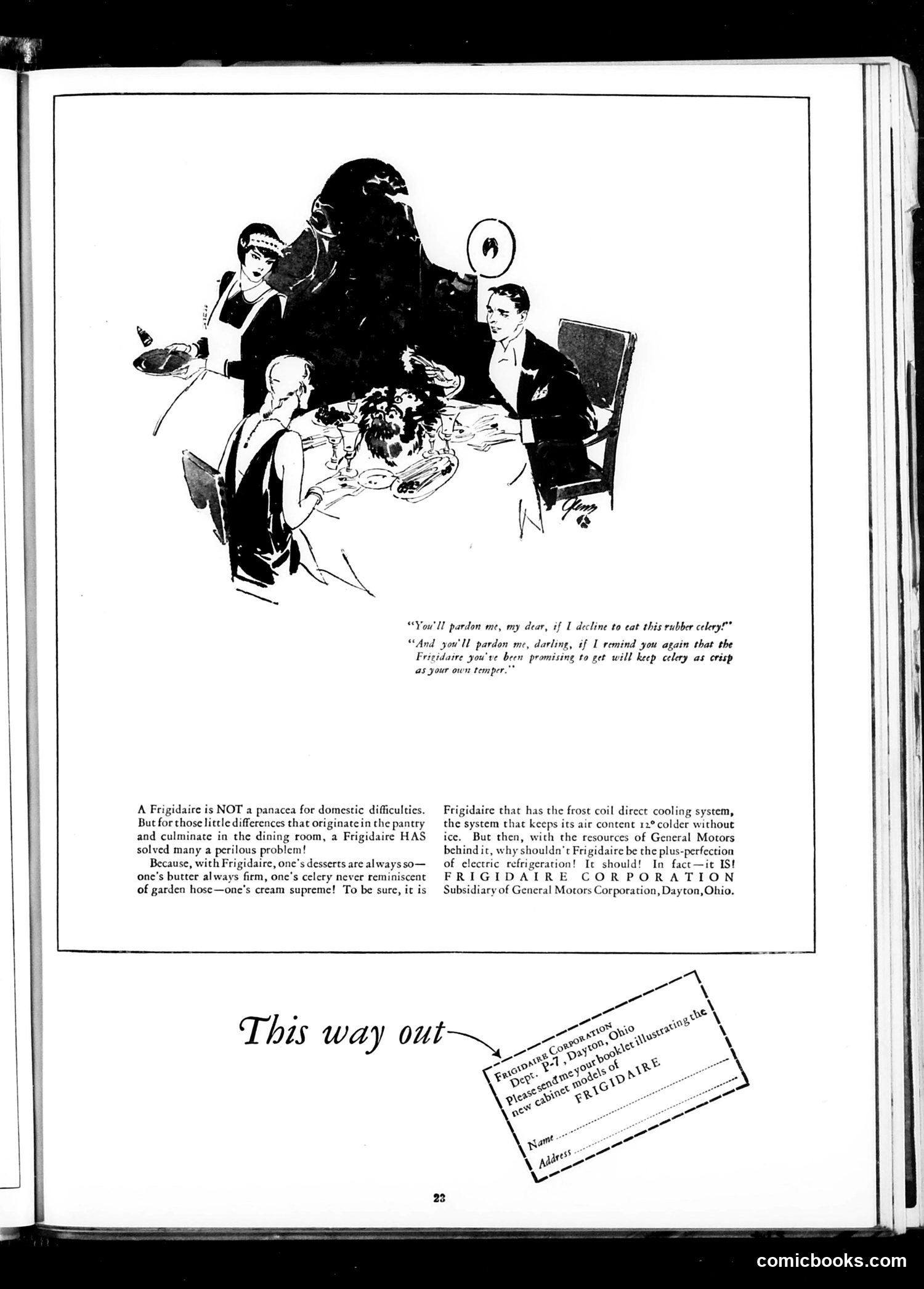
This is a **Frigidaire refrigerator advertisement disguised as cartoon humor**, targeting domestic tensions of the early 20th century. The joke: A husband complains about rubbery celery at dinner; his wife retorts that if he'd finally buy the promised Frigidaire refrigerator, the vegetables would stay crisp—and perhaps his temper would too. The implication is that poor food quality (caused by lack of refrigeration) creates marital conflict. The satire works on multiple levels: it acknowledges that appliances don't solve real relationship problems, yet simultaneously argues that Frigidaire *specifically* can prevent "perilous problems" originating in the kitchen. The ad emphasizes Frigidaire's superior cooling technology (frost coil system, General Motors backing) over competitors. For modern readers: This reflects an era when electric refrigeration was still a luxury item and a selling point for marriage harmony—treating appliance ownership as solving domestic discord, a concept that feels quaint today but reveals period anxieties about housekeeping and gender roles.
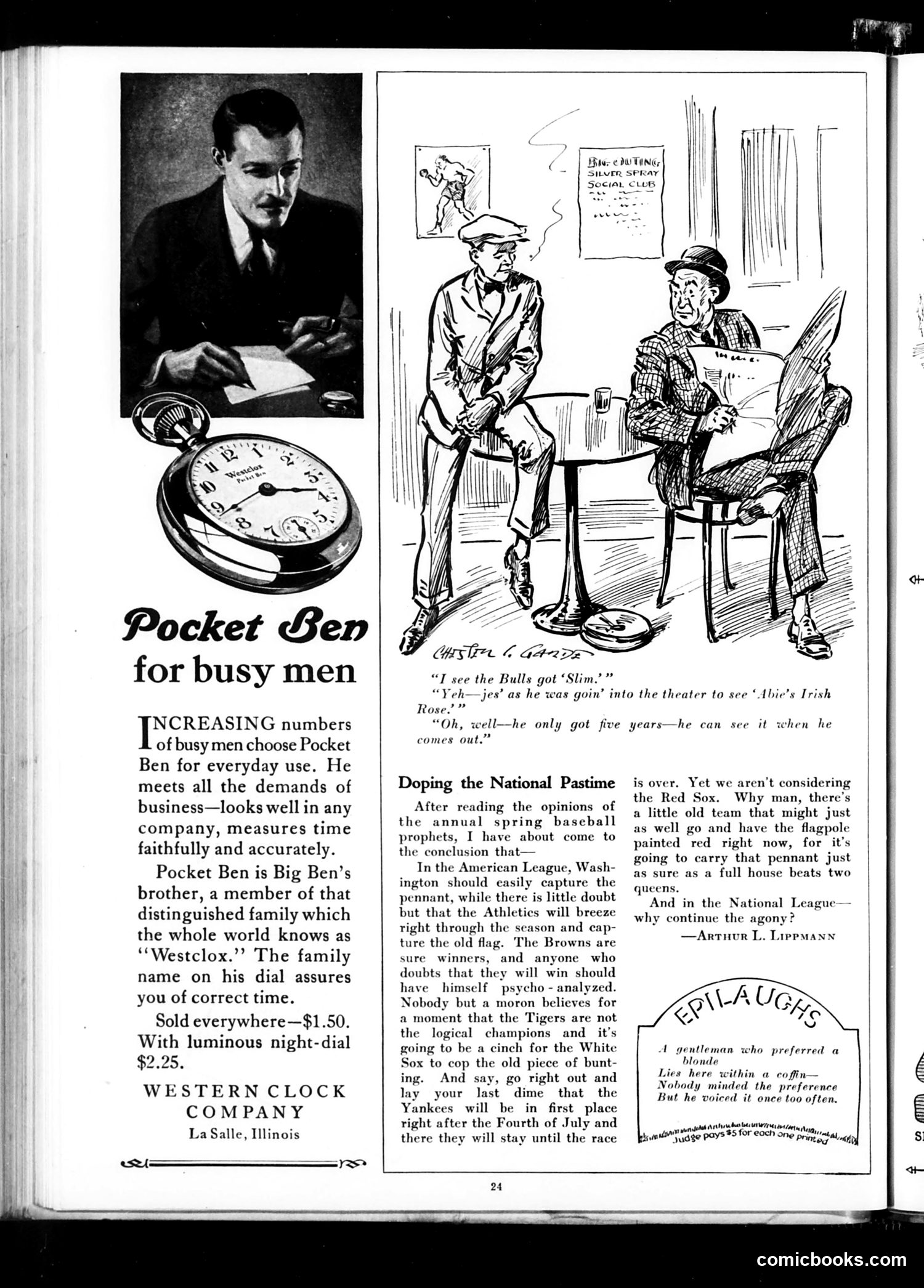
This page combines a watch advertisement with baseball satire. **The Advertisement:** "Pocket Ben" is a pocket watch by Westclox, marketed to busy businessmen as reliable and accurate. **The Cartoon:** A sketch shows two men discussing baseball, with one saying the Bulls got "Slim" (likely a player nickname). The dialogue implies someone only attended a game five years ago and missed recent developments—a joke about casual sports fans. **"Doping the National Pastime":** The main satirical article by Arthur L. Lippmann mocks overly confident spring baseball predictions. He lists absurdly contradictory forecasts (multiple teams are "sure winners"), satirizing how every team's fans believe theirs will win. The final comment about the Red Sox ("why continue the agony?") suggests they were perpetually disappointing. **The Epitaph:** A brief humorous poem about a man who "voiced it once too often"—unrelated to the sports content, filler material. The overall point: Baseball predictions are worthless because every team's supporters make equally unfounded claims.
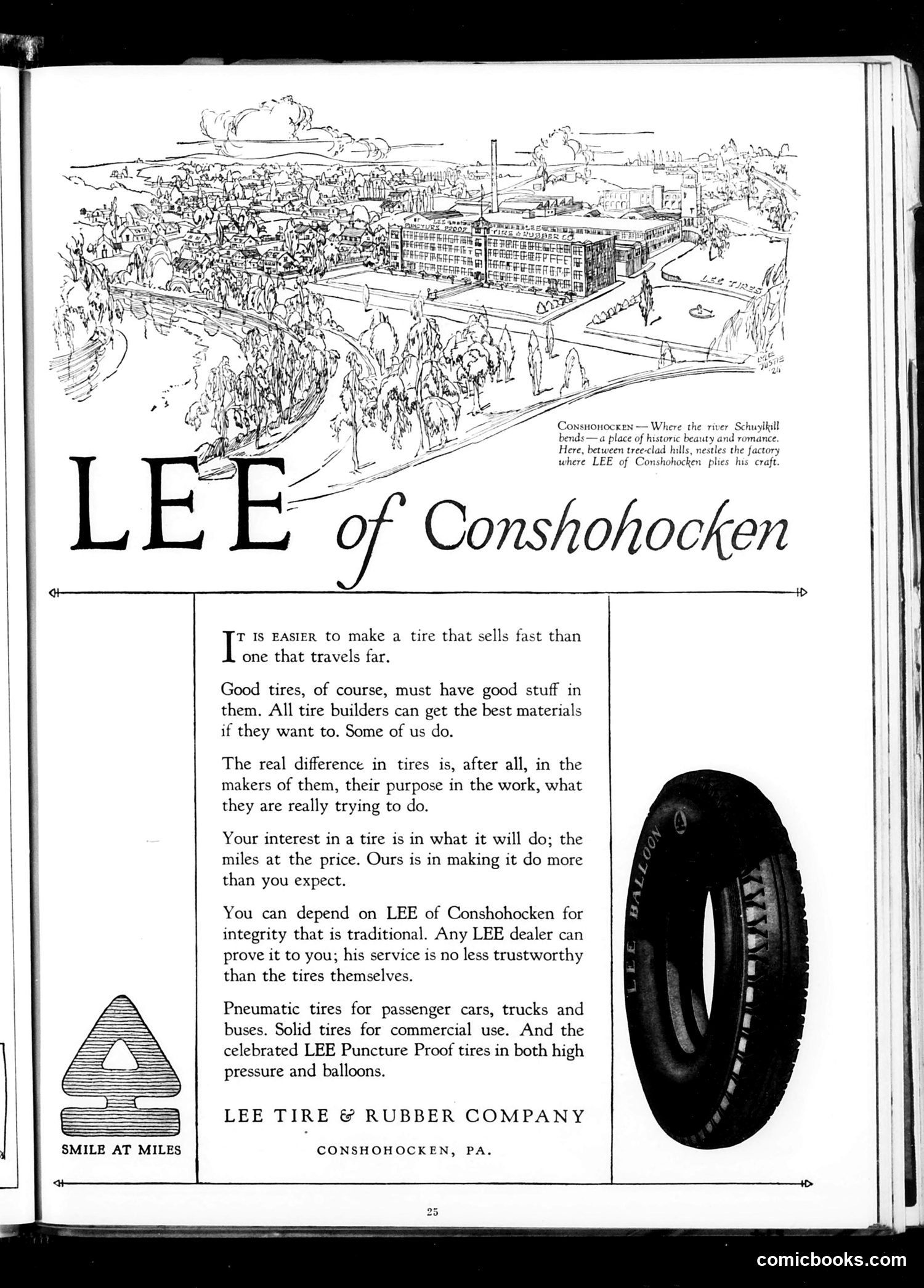
This is **not a cartoon or satire**, but rather a **full-page advertisement** for LEE Tire & Rubber Company of Conshohocken, Pennsylvania. The page features: 1. **Top illustration**: An aerial/bird's-eye sketch of the Conshohocken factory and surrounding town, depicting the manufacturing facility nestled in a scenic, tree-covered landscape—emphasizing the company's picturesque location. 2. **Right side**: A photograph of an actual LEE tire. 3. **Text**: Marketing copy arguing that quality tires depend on manufacturers' *integrity and purpose*, not just materials. LEE claims superiority by promising tires that deliver "more miles at the price" than competitors expect. 4. **Logo**: "SMILE AT MILES"—a play on words promoting tire durability. The ad appeals to consumer trust in the company's traditional values and dealer support. There is no political satire here—this appears to be a Judge magazine advertiser using the publication's space for tire promotion, likely from the early 20th century based on the vehicle types mentioned (pneumatic, solid, puncture-proof tires).
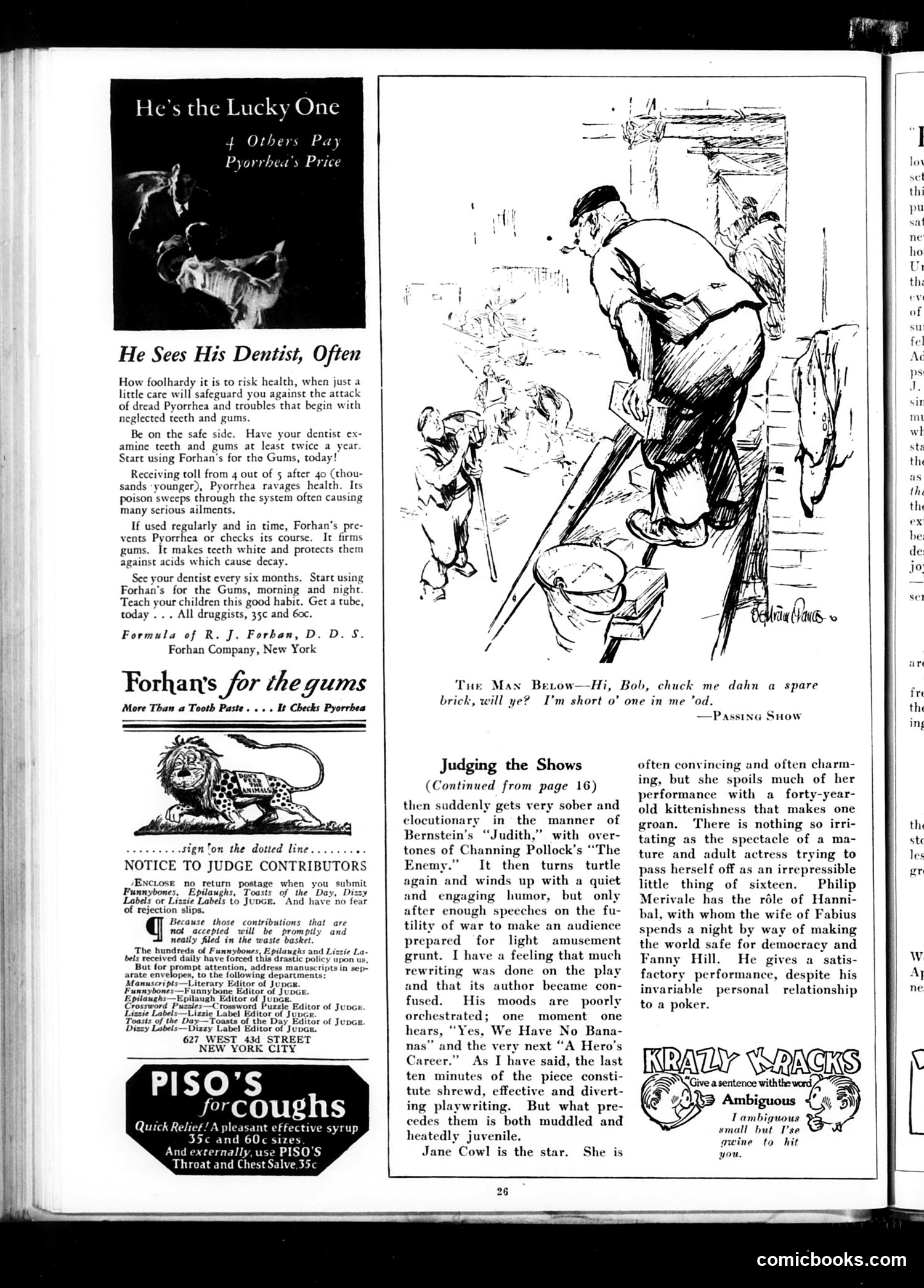
This page is primarily **advertising content** rather than political satire. The dominant material consists of: 1. **Forhan's Toothpaste Advertisement**: Uses fear-based marketing about "Pyorrhea" (gum disease), claiming it affects "4 out of 5 after 40." This reflects early 20th-century anxieties about health and dental care, promoting regular dentist visits and the product as preventive medicine. 2. **Piso's Cough Syrup Ad**: Standard patent medicine advertising from an era before FDA regulation, offering over-the-counter remedies. 3. **Minor Content**: A brief theater review by "Passing Show" discussing actress Jane Cowl's performance, and a small comic about construction workers ("The Man Below"), with a joke relying on working-class dialect humor. The page reflects Judge magazine's business model: mixing satirical editorial content with paid advertisements, using health/medical product ads that were common in this period before modern consumer protection laws.
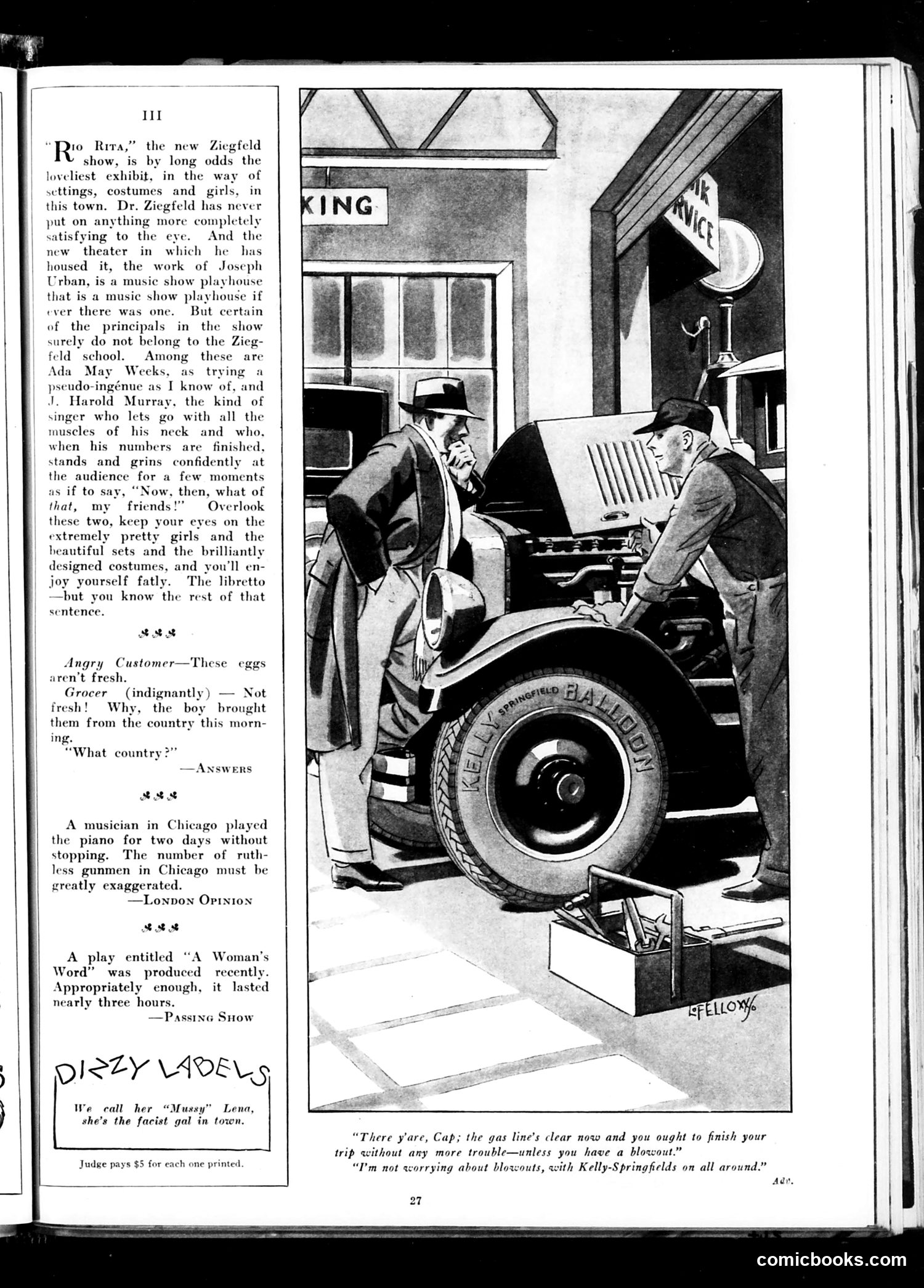
This page contains theater criticism and miscellaneous humor pieces typical of Judge's satirical format. The main illustration shows a mechanic servicing a car (identifiable by the "Kelly-Springfield" tire brand visible on the wheel), with dialogue about completing a trip without blowouts. This is essentially an advertisement disguised as humor—the joke setup ("unless you have a blowout") leads directly to a branded product endorsement, a common advertising technique of the era. The text reviews the Ziegfeld Follies production "Rio Rita," criticizing two performers (Ada May Weeks and J. Harold Murray) as unsuitable for the show's high standards, while praising the sets, costumes, and chorus girls. The remaining items are brief humor bits about fresh eggs, a Chicago pianist, and a play's length—standard filler material with contemporary references (Chicago's reputation for gangster violence). The page overall mixes entertainment criticism with advertising and short jokes, reflecting Judge's format as a satirical humor magazine.
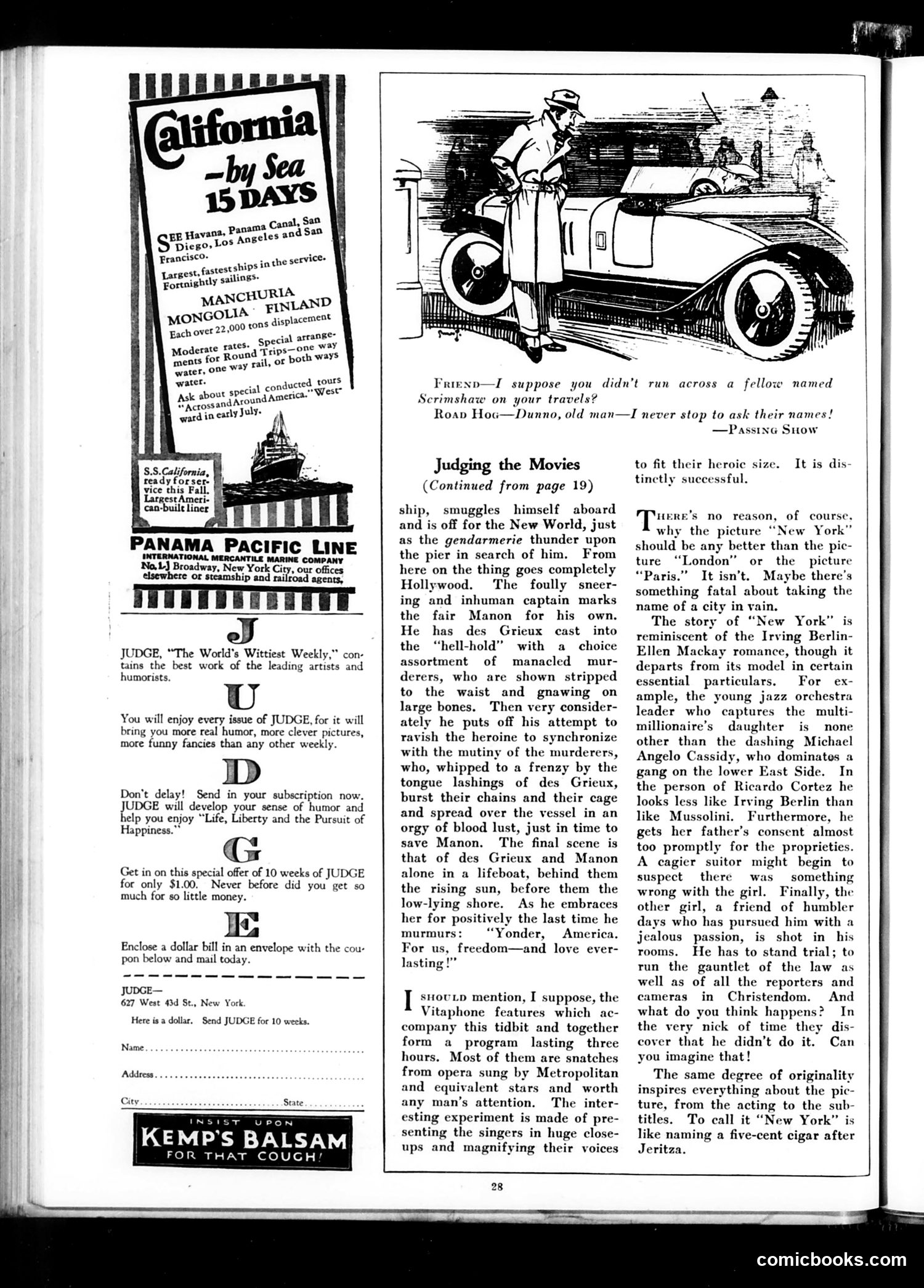
This page is primarily **advertising and subscription material** for *Judge* magazine, with a small movie review section. The cartoon at top shows a man and vintage car with a caption about someone named "Scrimshaw"—a humorous exchange where "Road Hog" admits he never bothers learning travelers' names, playing on the casual rudeness of the era. The "Judging the Movies" section reviews recent films, particularly criticizing *"New York"* for its melodramatic plot (wealthy heiress romances a jazz orchestra leader from the Lower East Side). The reviewer sarcastically notes that naming a film after a city doesn't make it better, and finds the father's quick consent to the romance implausible. The review also discusses *Manon*, a ship-based melodrama with exaggerated "Hollywood" action sequences. The advertisements promote *Judge* magazine subscriptions, ocean liner travel via Panama Canal, and Kemp's Balsam cough remedy—typical 1920s-era ads appealing to leisure travelers and middle-class readers.
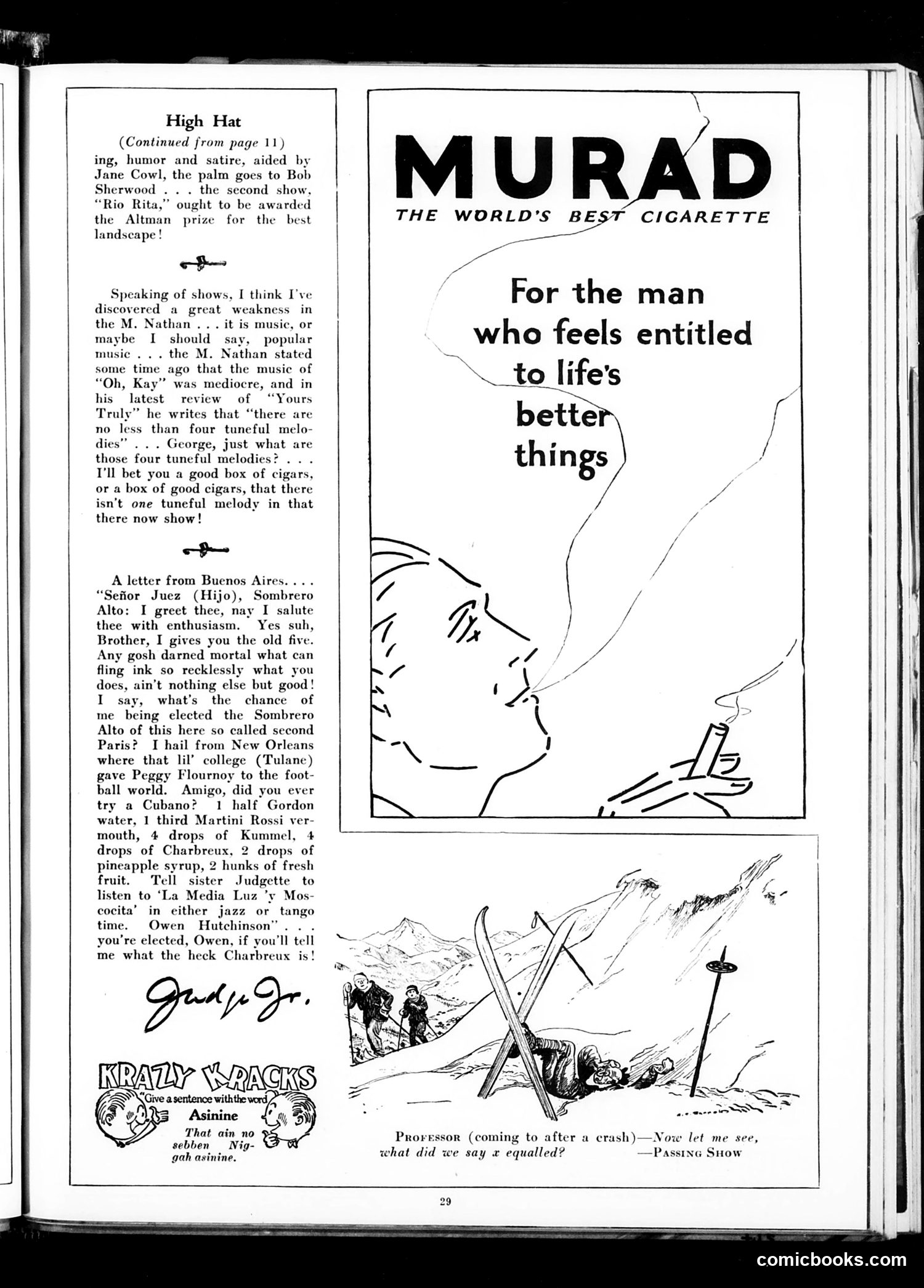
**Main Content:** This page features a Murad cigarette advertisement and editorial content by "Gluyas Jr." (likely the magazine's editor). **The Cartoons:** 1. **Top right:** A stylized illustration of a hand holding a Murad cigarette, advertising it as "the world's best cigarette" for men who feel "entitled to life's better things"—typical luxury product messaging of the era. 2. **Bottom:** A small cartoon captioned "Professor (coming to after a crash)—Now let me see, what did we say x equalled?" from "Passing Show." This appears to be a simple visual joke about a professor recovering from an accident and confusedly asking about a math equation. **Editorial Commentary:** The left column critiques Broadway shows and music critic M. Nathan's reviews, playfully challenging his assessment of melodies in current productions. A humorous reader letter from New Orleans mocks the magazine's style while describing an elaborate cocktail recipe. The page is primarily **advertising and light entertainment**, typical of Judge's mid-1920s content mixing satire with commercial promotion.
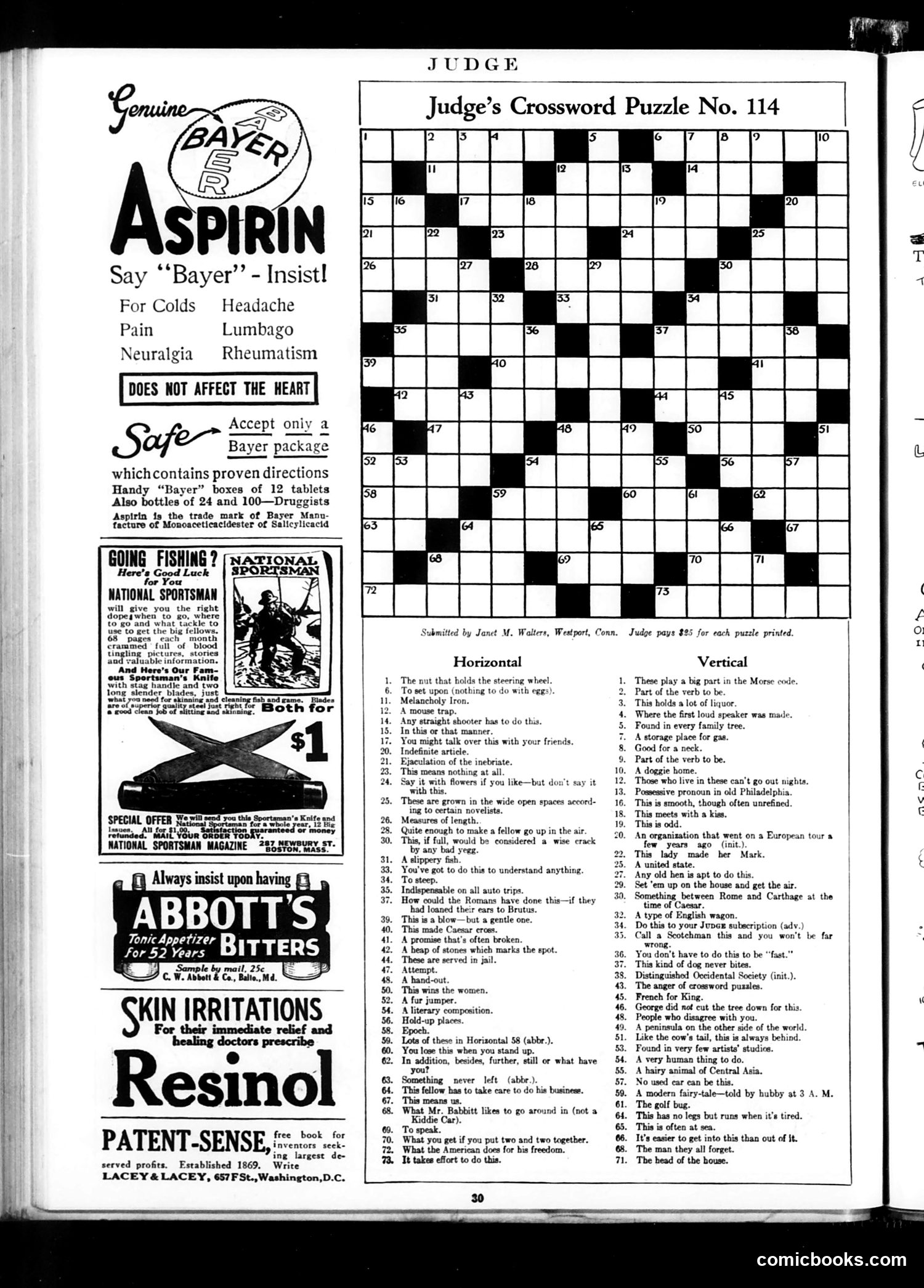
This page is primarily **advertising and a crossword puzzle** rather than satirical editorial content. The advertisements are period-typical: Bayer Aspirin emphasizing brand loyalty ("Say 'Bayer'—Insist!"), National Sportsman magazine promoting fishing knives, Abbott's Bitters tonic, Resinol skin treatment, and a patent-service firm. These ads reflect early 20th-century American consumer marketing and patent-era entrepreneurship. The centerpiece is "Judge's Crossword Puzzle No. 114"—a standard crossword puzzle with wordplay clues typical of the era. Clues reference contemporary culture: automobiles ("indispensable on all auto trips"), radio ("first loud speaker"), and popular figures like Mr. Babbitt (Sinclair Lewis's 1922 character). **No political satire or caricatures are visible here.** This appears to be a routine entertainment/advertising page from Judge magazine, demonstrating how publications of this period supplemented editorial content with puzzles and ads to attract readers and revenue.
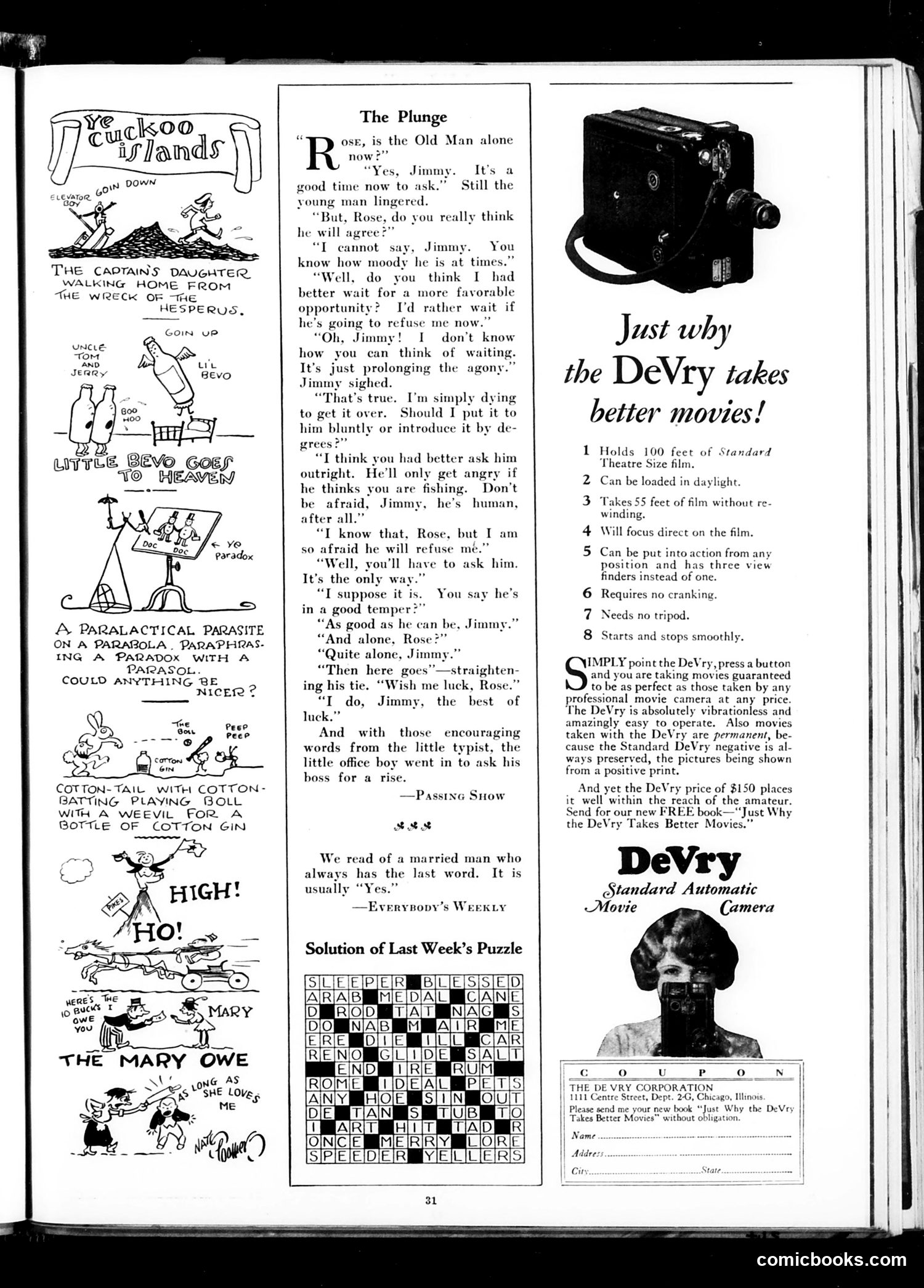
This page contains mostly **humorous filler cartoons and advertising** rather than political satire. The left side features whimsical comic strips by what appears to be various cartoonists, depicting absurdist scenarios: a captain's daughter after shipwreck, a "paralactical parasite" with a parasol, cotton imagery, and anthropomorphized animals. These are light, nonsensical humor typical of magazine fillers—no identifiable political figures or references. The center section is a short story called "The Plunge" about an office boy nervously asking his boss for a raise, with his girlfriend Rose encouraging him. It's sentimental romantic comedy. The right side is **advertisement for the DeVry movie camera**, listing technical specifications and pricing at $150, targeting amateur filmmakers. The page also includes a crossword puzzle solution. Overall, this appears to be a standard magazine issue page mixing entertainment, light humor, and commercial advertisements—not political commentary.
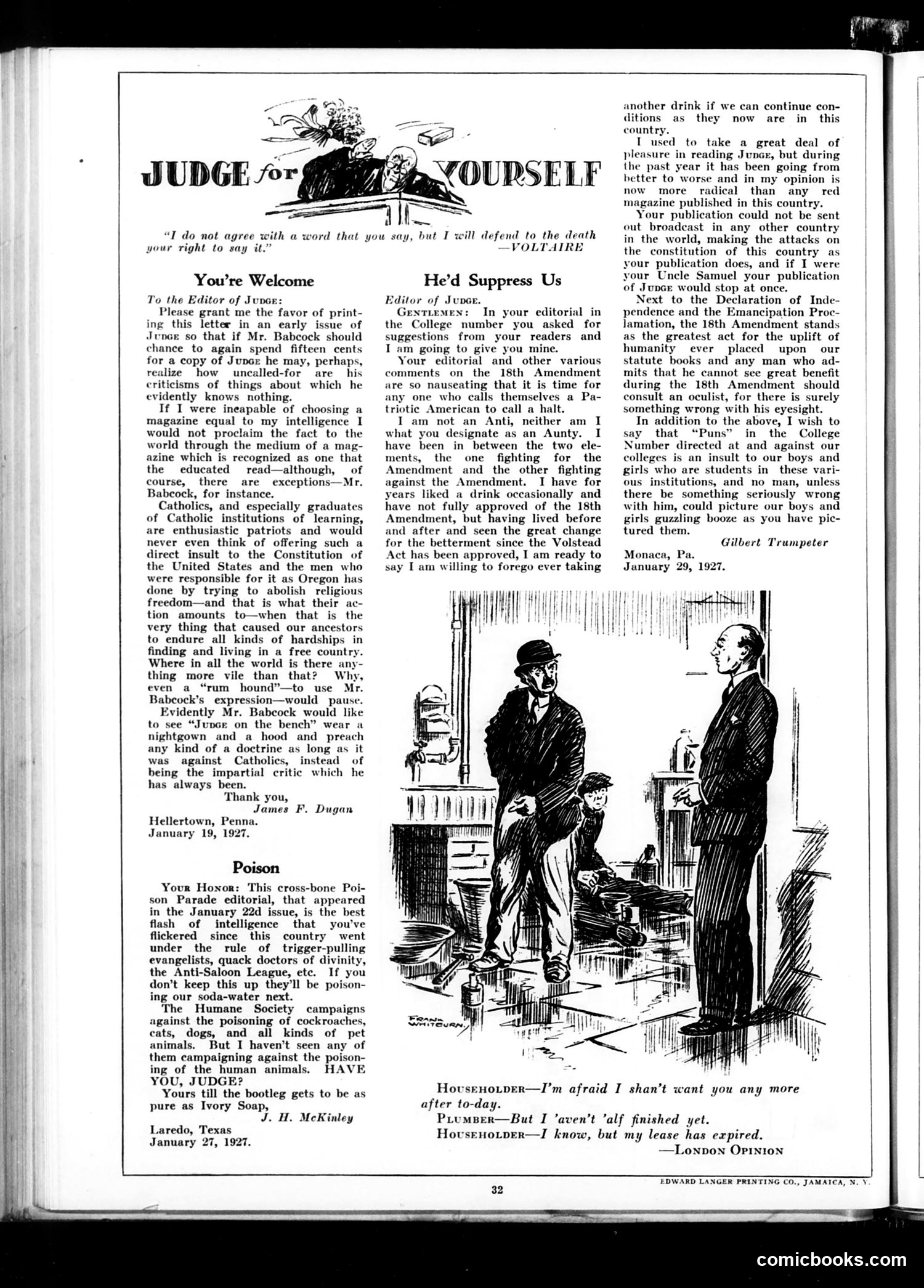
This page presents reader letters and a cartoon satirizing Prohibition-era politics. The main cartoon depicts a **plumber and householder**, with the plumber claiming he hasn't "half finished yet" while his lease has expired—a metaphor for Prohibition enforcement continuing beyond its welcome. The letters debate the **18th Amendment (Prohibition)** and Judge magazine's editorial stance. One writer praises Judge for criticizing Prohibition as "poison," comparing it to poisoning "human animals." Another defends Prohibition's "betterment" since the Volstead Act passed, accusing Judge of being excessively "radical" and anti-American for attacking the Constitution. The debate reflects 1927 divisions: **wet vs. dry factions** disagreed sharply on alcohol prohibition. The cartoon and letters suggest Judge's editorial position criticized Prohibition enforcement, while readers disagreed about whether this criticism was patriotic critique or dangerous radicalism. The "householder" represents the public tired of intrusive prohibition policies.
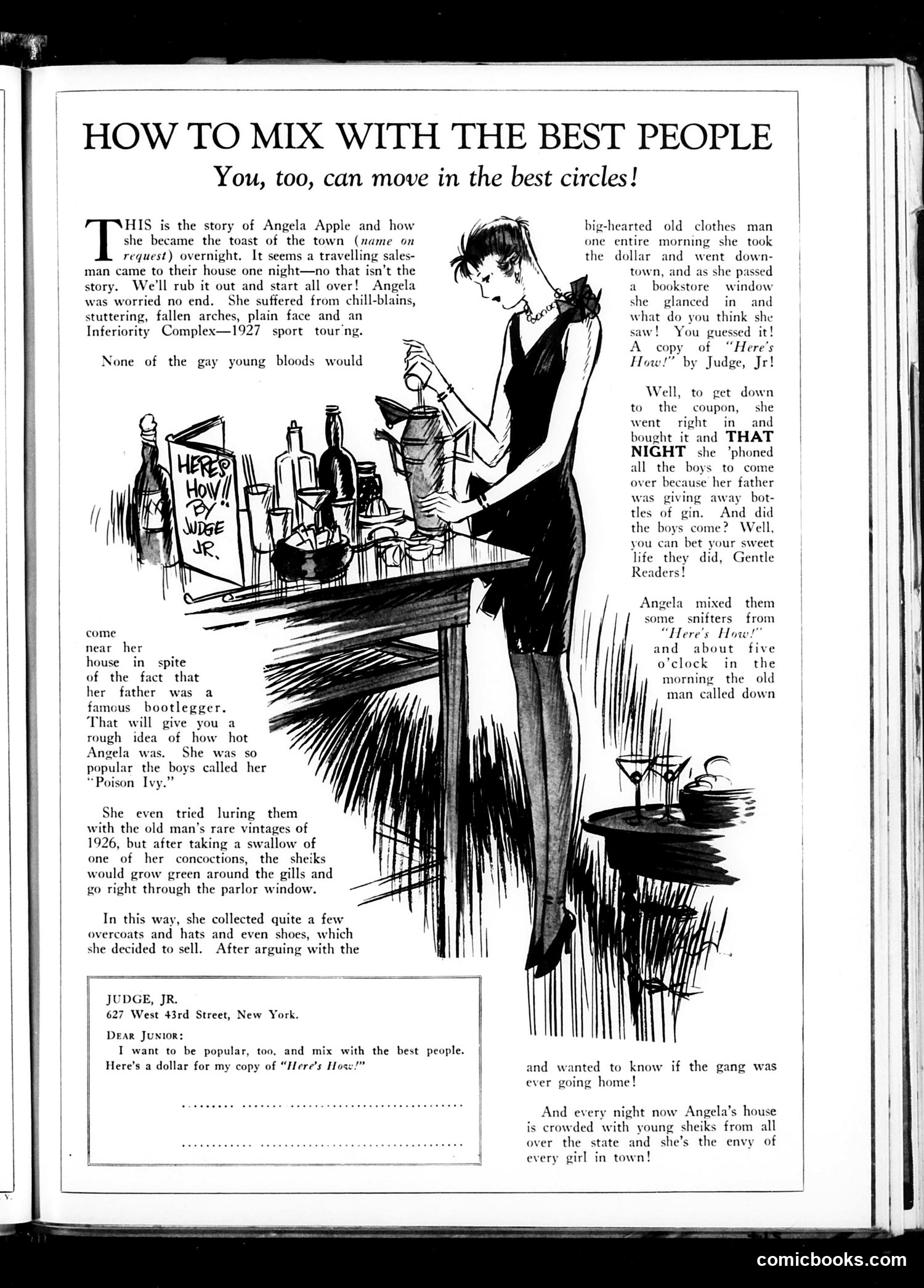
This 1927 satirical piece mocks social climbing and Prohibition-era excess. Angela Apple, an unattractive, socially awkward girl, becomes popular overnight through her father's bootleg gin supply—not personal charm or refinement. The humor targets several 1920s trends: the obsession with "mixing in the best circles," the absurdity of Prohibition (her father is a bootlegger), and the magazine's own self-promotion. The story is deliberately ridiculous—Angela's ugliness and social defects are irrelevant once alcohol appears; young men flock regardless. The "Judge, Jr." coupon at page's bottom is an advertisement disguised as narrative, selling a cocktail recipe book titled "Here's How!" The entire piece is promotional satire, using Angela's rise to popularity as a hook to advertise the magazine's own product while satirizing both social pretension and Prohibition hypocrisy.
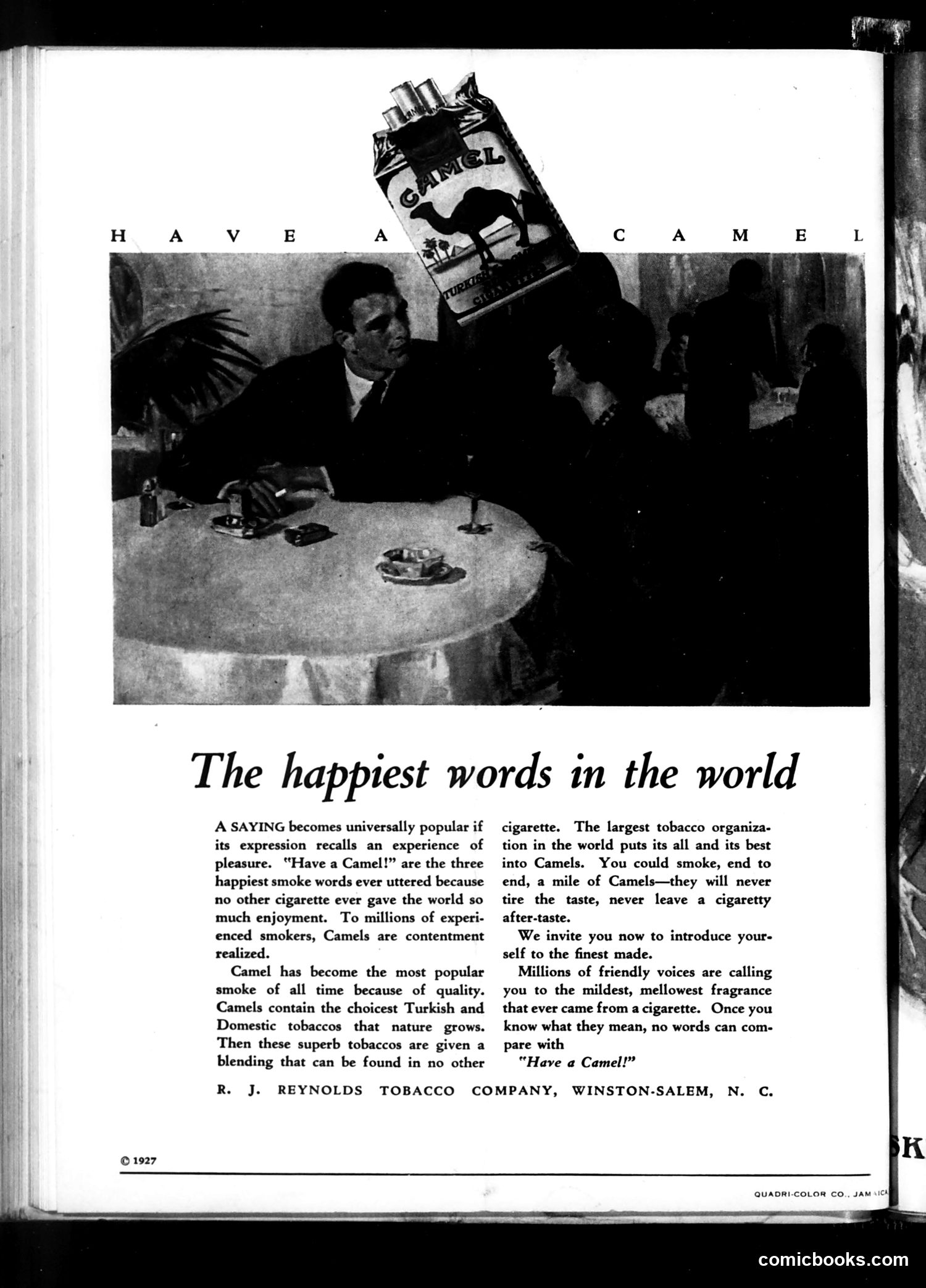
This is a **Camel cigarette advertisement**, not satire or political commentary. From 1927, it shows businessmen at a social gathering with an oversized Camel cigarette package displayed prominently above them. The ad uses the phrase "Have a Camel!" as a social catchphrase, claiming it expresses universal pleasure and contentment. It emphasizes quality (Turkish and domestic tobaccos) and promises the cigarette won't leave an unpleasant aftertaste. For modern readers: this represents pre-regulation tobacco advertising that made health and addiction claims freely. The "happiest words" framing attempts to make smoking a marker of social sophistication and friendship. This type of advertisement—depicting cigarettes as purely pleasurable with no health warnings—became illegal in the U.S. decades later as smoking's dangers were established.