
Judge, 1927-02-26 · page 21 of 36
Judge — February 26, 1927 — page 21: what you’re looking at
What you’re looking at
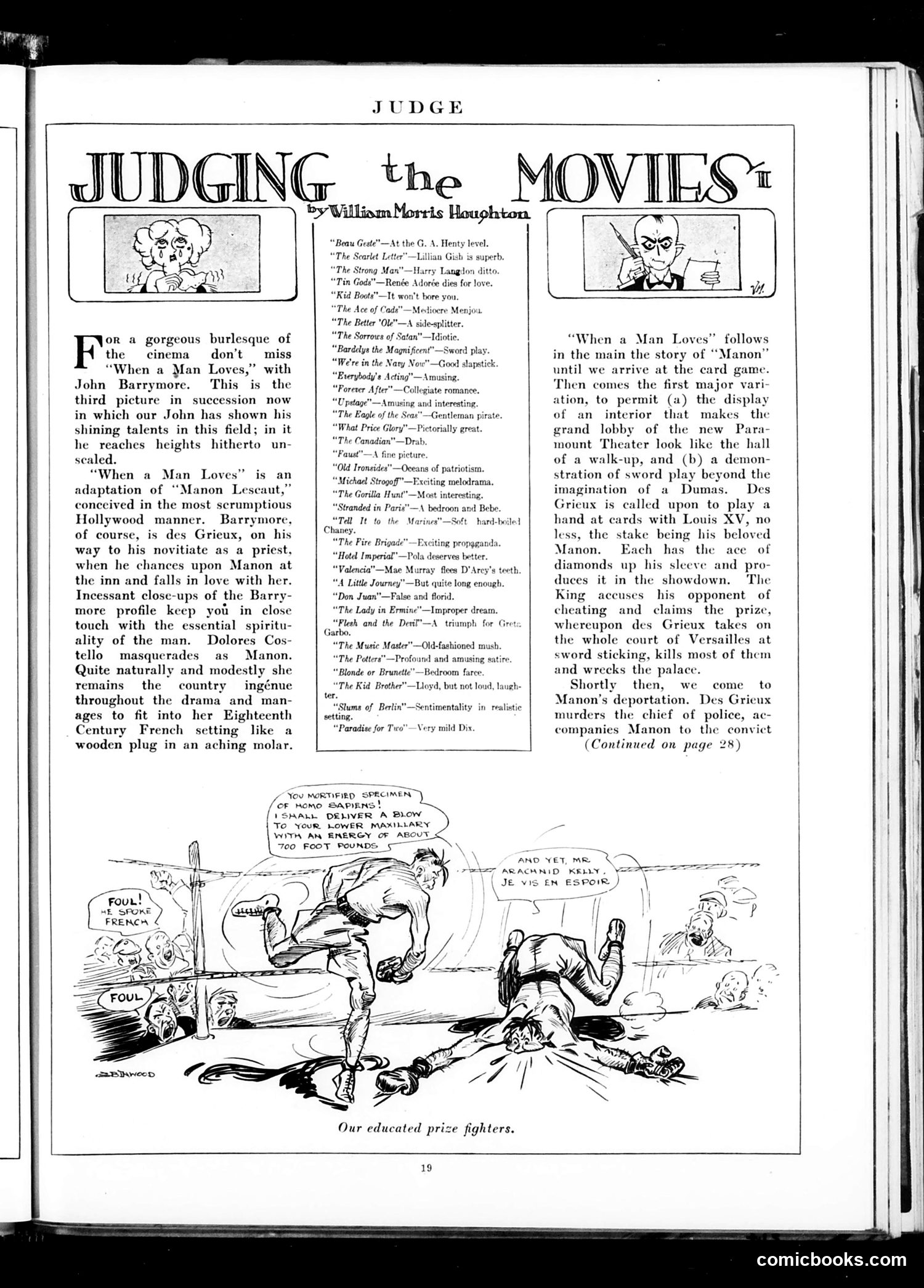
This page reviews several 1920s films, with particular mockery of "When a Man Loves," starring John Barrymore. The critic sarcastically praises Barrymore's repeated romantic roles while dismissing co-star Dolores Costello as fitting her 18th-century French setting like "a wooden plug in an aching molar." The cartoon below depicts stylized, exaggerated boxers in a humorous fight scene. One figure delivers an elaborate threat using pseudo-scientific language ("mortified specimen of homo sapiens," "lower maxillary"), while another responds coolly about "arachnid Kelly" and living "en espoir" (in hope). The caption "Our educated prize fighters" suggests satire about overly intellectual or pretentious boxers. The page mixes film criticism with sports humor typical of Judge magazine's satirical approach to American popular culture.
📄 Transcribed text from this page (OCR, searchable)
Machine-transcribed from the original scan — historical spelling and the odd misread are preserved.
JUDGE JUDGING, the MOVILS* or a gorgeous burlesque of the cinema don’t miss “When a Man Loves,” with John Barrymore. This is the third picture in succession now in which our John has shown his shining talents in this field; in it he reaches heights hitherto un- scaled. “When a Man Loves” is an adaptation of “Manon Lescaut,” conceived in the most scrumptious Hollywood manner. Barrymore, of course, is des Grieux, on his way to his novitiate as a priest, when he chances upon Manon at the inn and falls in love with her. Incessant close-ups of the Barry- more profile keep you in close touch with the essential spiritu- ality of the man. Dolores Cos- tello | masquerades as Manon. Quite naturally and modestly she remains the country ingénue throughout the drama and man- ages to fit into her Eighteenth Century French setting like a wooden plug in an aching molar. “Beau Geste"—At the G. A. Henty level. “The Scarlet L “The Strong Man"—Harry Langdon ditto. “Tin Gods"—Renée Adorée dies for love. “Rid Boots"—It won't bore you. Lillian Gish is superb. Phe Ace of Cads”—Medtioere Menjou. “The Better 'Ole”—A side-s “The Sorrows of Satan" —Idiotie. “Bardelys the Magnificent" —Sword play. “We're in the Naty Nor" —Good slapstick. “Eterybody's Acting”—Amusing. “Porever After" —Collegiate romance. “Upstage”—Armusing and interesting. “The Eagle of the Seas"—Gentleman pirate. “What Price Glory”—Pictorially great. “The Canadian" —Drab. “Faust"—A fine picture “Old Ironsides" —Oec “Michael Strogof"—E3 “The Gorilla Hunt"—Most interesting, “Stranded in Paris"—A bedroon and Bebe. Tell It to the Marines"—Soft hard-boiled Chaney. “The Pire Brigade” “Hotel Imperial’ —Pola deserves better. “Valencia”—Mae Murray flees D'Arcy’: “A Little Journey" —But qui is of patriotism. iting melodrama. Exciting prop; long enough. “The Lady in Ermine"—Improper dream. “Flesh and the Devil"—A triumph for Gret Garbo. “The Music Master"—Old-fashioned mush. “The Potters"—Profound and amusing satire “Blonde or Brunette’—Bedroom “The Kid Brother” —Lioyd, but n ter. “Slums of Berlin"—Sentimentality in realistic setting, “Paradise for Two" —Very mild Dix t loud, laugh- You MORTIFIED SPECIMEN [OF HOMO SAPIENS (1 SHALL DELIVER A BLOW \ to wr YOUR LOWER MAXILLARY -~ AN ENERGY OF ABOUT AND YET, MR \ oat rele ARACHNID KELLY. YE “When a Man Loves’ follows in the main the story of “Manon” until we arrive at the card game. Then comes the first major vari- ation, to permit (a) the display of an interior that makes the grand lobby of the new Para- mount Theater look like the hall of a walk-up, and (b) a demon- stration of sword play beyond the imagination of a Dumas. Des Grieux is called upon to play a and at cards with Louis XV, no less, the stake being his beloved Manon. Each has the ace of diamonds up his sleeve and pro- duces it in the showdown. The King accuses his opponent of cheating and claims the prize, whereupon des Grieux takes on the whole court of Versailles at sword sticking, kills most of them and wrecks the palace. Shortly then, we come to Manon’s deportation. Des Grieux murders the chief of police, ac- companies Manon to the conv (Continued on page 28) Je vis EN ESPOIR ) Our educated prize fighters. 19 comicbooks.com