
Judge, 1927-02-26 · page 18 of 36
Judge — February 26, 1927 — page 18: what you’re looking at
What you’re looking at
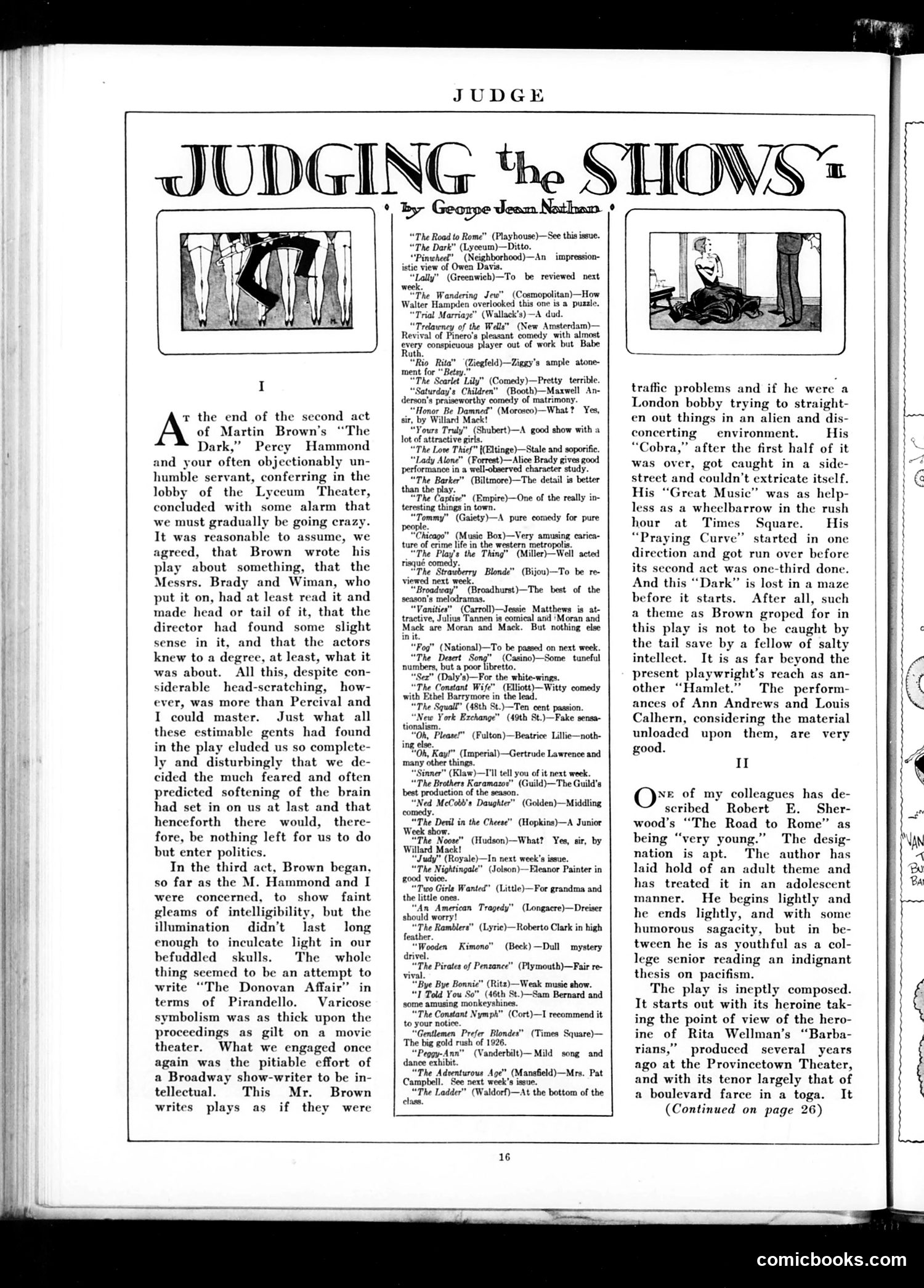
This page features theater criticism from Judge magazine's "Judging the Shows" column by George Jean Nathan. The main essay critiques Martin Brown's play "The Dark" at the Lyceum Theater, describing it as incomprehensibly obscure—so bewildering that the critic and fellow reviewer Percy Hammond feared they were losing their minds. Nathan's satire targets pretentious Broadway playwrights who attempt intellectual sophistication through excessive symbolism (he compares it to Luigi Pirandello's experimental style) rather than clear storytelling. He sarcastically suggests the play resembles "The Donovan Affair written in Pirandello terms"—mixing a conventional mystery with avant-garde pretension. The column includes a theater listings section reviewing current Broadway productions, offering quick judgments on various shows' merits and performers. The satire's point: Broadway show-writers overreach artistically, creating incomprehensible "varicose symbolism" when attempting to be intellectual, rather than focusing on coherent drama.
📄 Transcribed text from this page (OCR, searchable)
Machine-transcribed from the original scan — historical spelling and the odd misread are preserved.
t the end of the second act A of Martin Brown’s “The Dark,” Percy Hammond and your often objectionably un- humble servant, conferring in the lobby of the Lyceum Theater, concluded with some alarm that we must gradually be going crazy It reasonable to assume, w agreed, that Brown wrote his play about something, that the Messrs. Brady and Wiman, who put it on, had at least read it and made head or tail of it, that the director had found some slight sense in it, and that the actors knew to a degree, at least, what it was about. All this, despite con- siderable head-scratching, how- ever, was more than Percival and | I could master. Just what all these estimable gents had found in the play eluded us so complete- ’ ly and disturbingly that we de- cided the much feared and often predicted softening of the brain had set in on us at last and that henceforth there would, there- fore, be nothing left for us to do but enter politics. In the third act, Brown began, so far as the M. Hammond and I were concerned, to show faint gleams of intelligibility, but the illumination didn’t last long enough to inculcate light in our i befuddled skulls. The whole thing seemed to be an attempt to write “The Donovan Affair” in terms of Pirandello. Varicose symbolism was as thick upon the proceedings as gilt on a movie theater. What we engaged once again was the pitiable effort of a Broadway show-writer to be in- tellectual. This Mr. Brown writes plays as if they were JUDGE “The Road to Rome” (Playhouse)—See this issue. The Dark” (Lyceum)—Ditto. inwheel" (Neighborhood) —An istic view of Owen Davis. “Lally” (Greenwich)—To week. “The Wandering Jew" (Cosmopolitan)—How Walter Hampden overlooked this one is a puzzle. “Trial Marriaze” (Wallack's)—A dud. “Trelawney of the Wells” (New Amsterdam)— Revival of Pinero’s pleasant comedy with almost every conspicuous player out of work but Babe impression- be reviewed next uth. “Rio Rita” “(Ziegfeld)—Ziggy's ample atone- ment for “Betsy.” “The Scarlet Lily” (Comedy)—Pretty_ terrible. “Saturday's Children” (Booth)—Maxwell An- derson's praiseworthy comedy of matrimony. “Honor Be Damned” (Morosco)—What ? sir, by Willard Mack! “Yours Truly" (Shubert)—A good show with a lot of attractive girls. “The Love Thief” (Eltinge)—Stale and soporific. “Lady Alone” (Forrest)—Alice Brady gives good performance in a well-observed character study. “The Barker” (Biltmore)—The detail is better than the play. : “The Captive” (Empire)—One of the really in- teresting things in town. “Tommy” (Gaiety)—A pure comedy for pure Yes, people. e “Chicago” (Music Box)—Very amusing earica- ture of crime life in the western metropolis. “The Play's the Thing” (Miller}—Well acted risqué comedy. The Strawberry Blonde” (Bijou)—To be re- viewed next week. “Broadway” (Broadhurst)—The best of the season's melodramas. “Vanities” (Carroll)—Jessie Matthews is at- tractive, Julius Tannen is comical and ‘Moran and Mack are Moran and Mack. But nothing else init “Fog” (National)—To be passed on next week. “The Desert Song” (Casino)—Some tuneful numbers, but a poor libretto. “Sez” (Daly's)—For the white-wi “The Constant Wife” (Elliott)—Witty comedy with Ethel Barrymore in the lead. “The Squall” (48th St.)—Ten cent passion. ‘ew York Exchange” (49th St.)—Pake sensa- ialism. ‘Oh, Please! (Fulton)—Beatrice Lillie—noth- ing else. “Oh, Kay!” (Imperial) —Gertrude Lawrence and other things. inner” (Klaw)—I'll tell “The Brothers Karamazov” (G best production of the season. “Ned MeCobb's Daughter" (Golden)—Middling comedy. “The Devil in the Cheese” (Hopkins)—A Junior Week show. “The Noose” (Hudson)—What? Yes, sir, by Willard Mack! “Judy” (Royale)—In next week's issue. “The Nightingale” (Jolson)—Eleanor Painter in good voice. “Two Girle Wanted" (Little)—For grandma and the little ones. “An American Tragedy” (Longacre)—Dreiser should worry! “The Ramblers" (Lyrie)—Roberto Clark in high feather. u of it next week. id)—The Guild's Kimono” (Beck)—Dull mystery drivel. “The Pirates of Penzance” (Plymouth)—Pair re- Bye Bye Bonnie” (Ritz)—Weak musie show. "I Told You So” (46th St.)—Sam Bernard and ¢ amusing monkeyshines. "The Constant Nymph” (Cort)—I recommend it to your notice. “Gentlemen Prefer Blondes” (Times Square)— The big gold rush of 1926. “Peggy-Ann” (Vanderbilt)—Mild song and dance exhibit “The Adventurous Age” (Mansfield)—Mrs. Pat Campbell. See next week's issue. “The Ladder” (Waldorf}—At the bottom of the class. traffic problems and if he were a London bobby trying to straight- en out things in an alien and d concerting environment. Hi “Cobra,” after the first half of it was over, got caught in a side- street and couldn't extricate itself. His “Great Music” was as help- less as a wheelbarrow in the rush hour at Times Square. His “Praying Curve” started in one direction and got run over before its second act was one-third done. And this “Dark” is lost in a maze before it starts. After all, such a theme as Brown groped for in this play is not to be caught by the tail save by a fellow of salty intellect. It is as far beyond the present playwright’s reach as an- other “Hamlet.” The perform- ances of Ann Andrews and Louis Calhern, considering the material unloaded upon them, are very good. O & of my colleagues has de- scribed Robert E. Sher- wood’s “The Road to Rome” as being “very young.” The desig- nation is apt. The author has laid hold of an adult theme and has treated it in an adolescent manner. He begins lightly and he ends lightly, and with some humorous sagacity, but in be- tween he is as youthful as a col- lege senior reading an indignant thesis on pacifism. The play is ineptly composed. It starts out with its heroine tak- ing the point of view of the hero- ine of Rita Wellman’s “Barba- rians,” produced several years ago at the Provincetown Theater, and with its tenor largely that of a boulevard farce in a toga. It (Continued on page 26) II comicbooks.com [aes | LY + Sp ne eas