
A complete issue · 36 pages · 1927
Judge — February 19, 1927
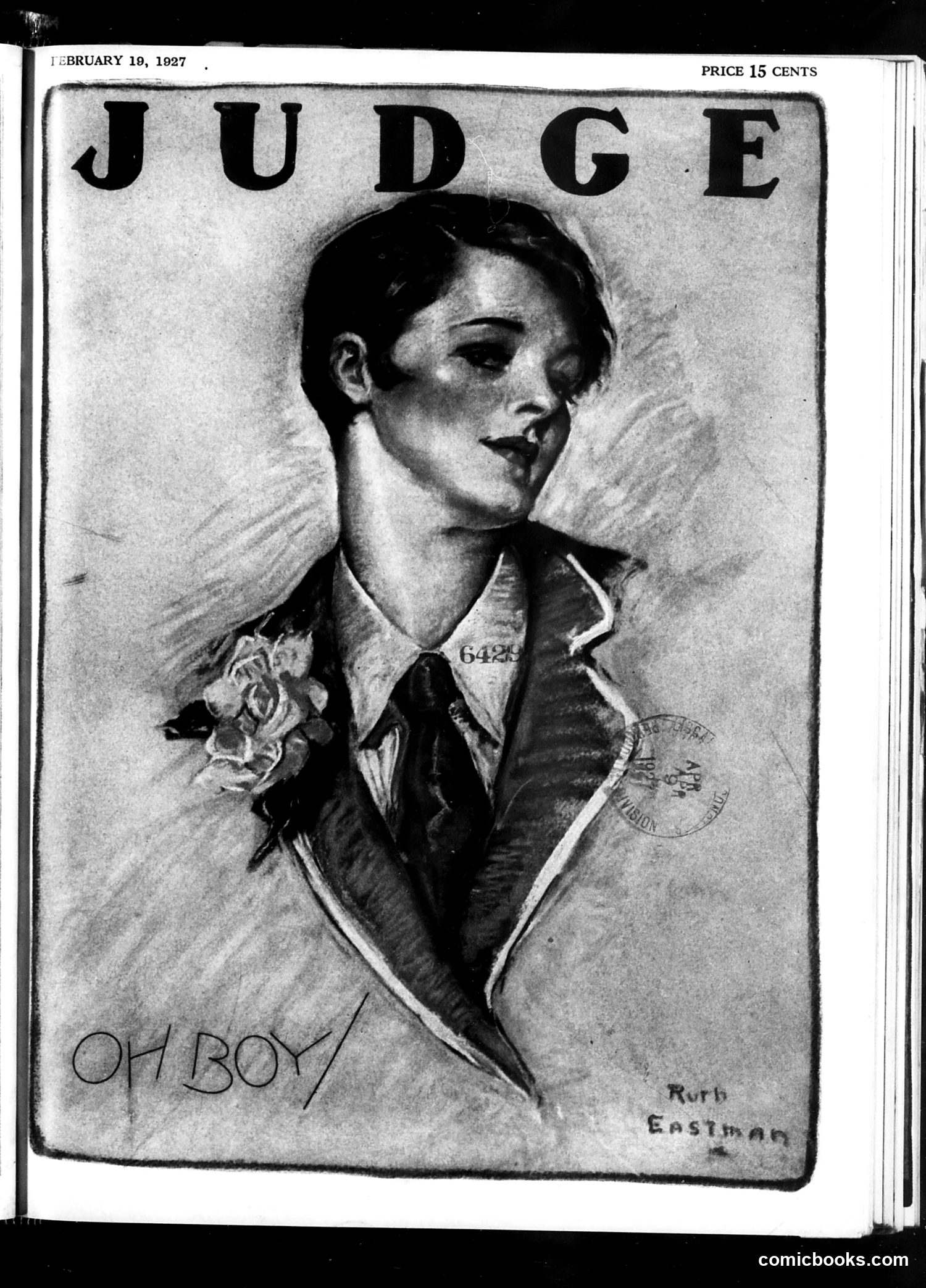
**February 19, 1927** This is a Judge magazine cover titled "Oh Boy!" featuring a portrait illustration by Ruth Eastman. The image shows a young man in formal attire (suit jacket with boutonniere) in profile, rendered in a romantic, idealized style typical of 1920s illustration. Without additional context or caption text visible on this page, the specific satirical target is unclear. However, the "Oh Boy!" exclamation and the admiring artistic treatment suggest this may be commenting on contemporary celebrity culture, youthful fashions, or romantic idealization popular during the Jazz Age. The magazine's satirical nature would typically accompany such a cover with contextual text explaining the joke or social commentary intended.
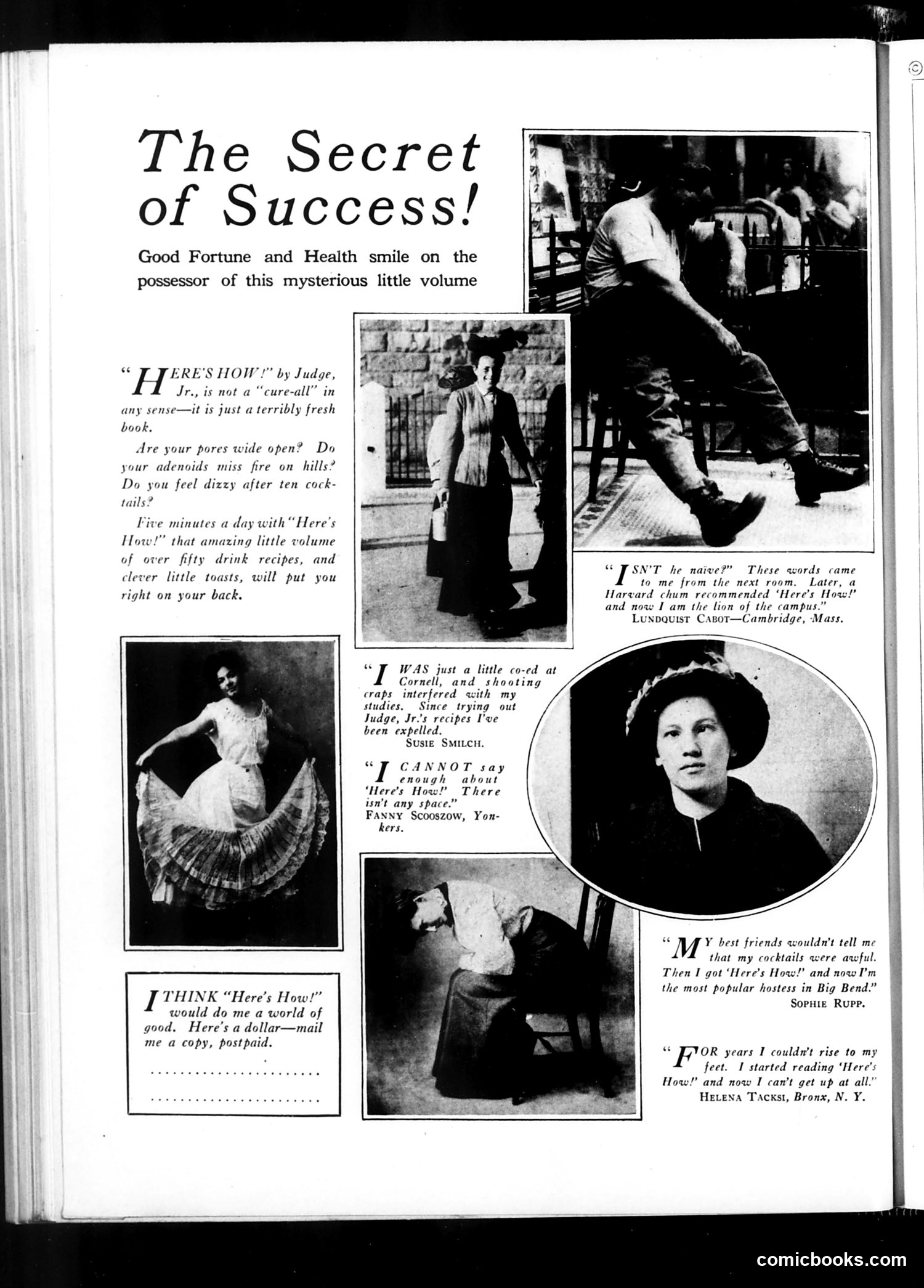
This page is primarily **advertising**, not political satire. It promotes a cocktail recipe book titled "Here's How!" by Judge Jr., marketed as containing "over fifty drink recipes, and clever little toasts." The page features testimonials from satisfied customers praising the book's usefulness. The photographs show people in various social settings—dining, socializing, appearing relaxed and convivial—meant to suggest that owning this recipe collection leads to successful entertaining and social popularity. The tagline "Good Fortune and Health smile on the possessor of this mysterious little volume" uses hyperbole typical of period advertising. This appears during Prohibition era America, when cocktail culture and home entertaining were culturally significant despite alcohol being legally restricted.
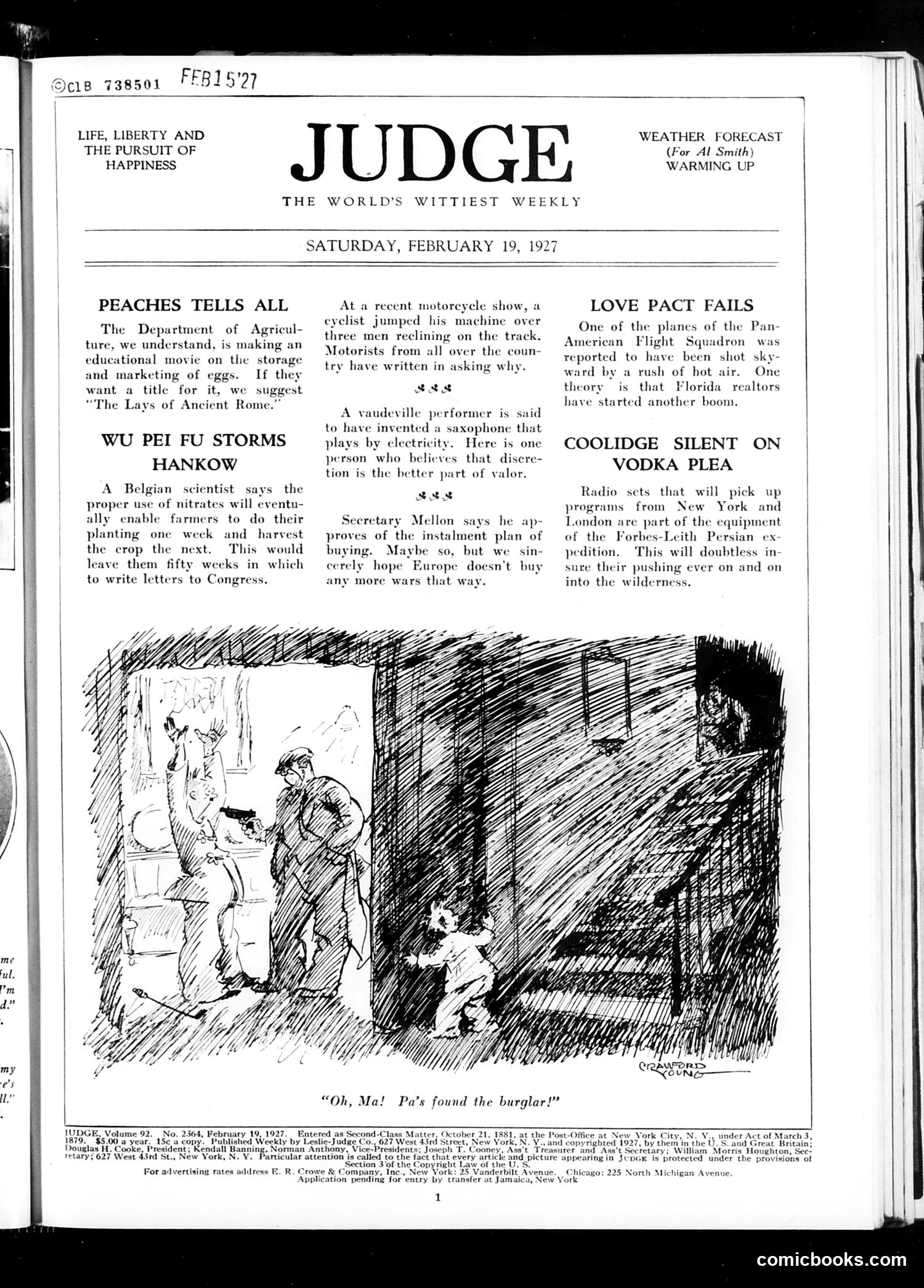
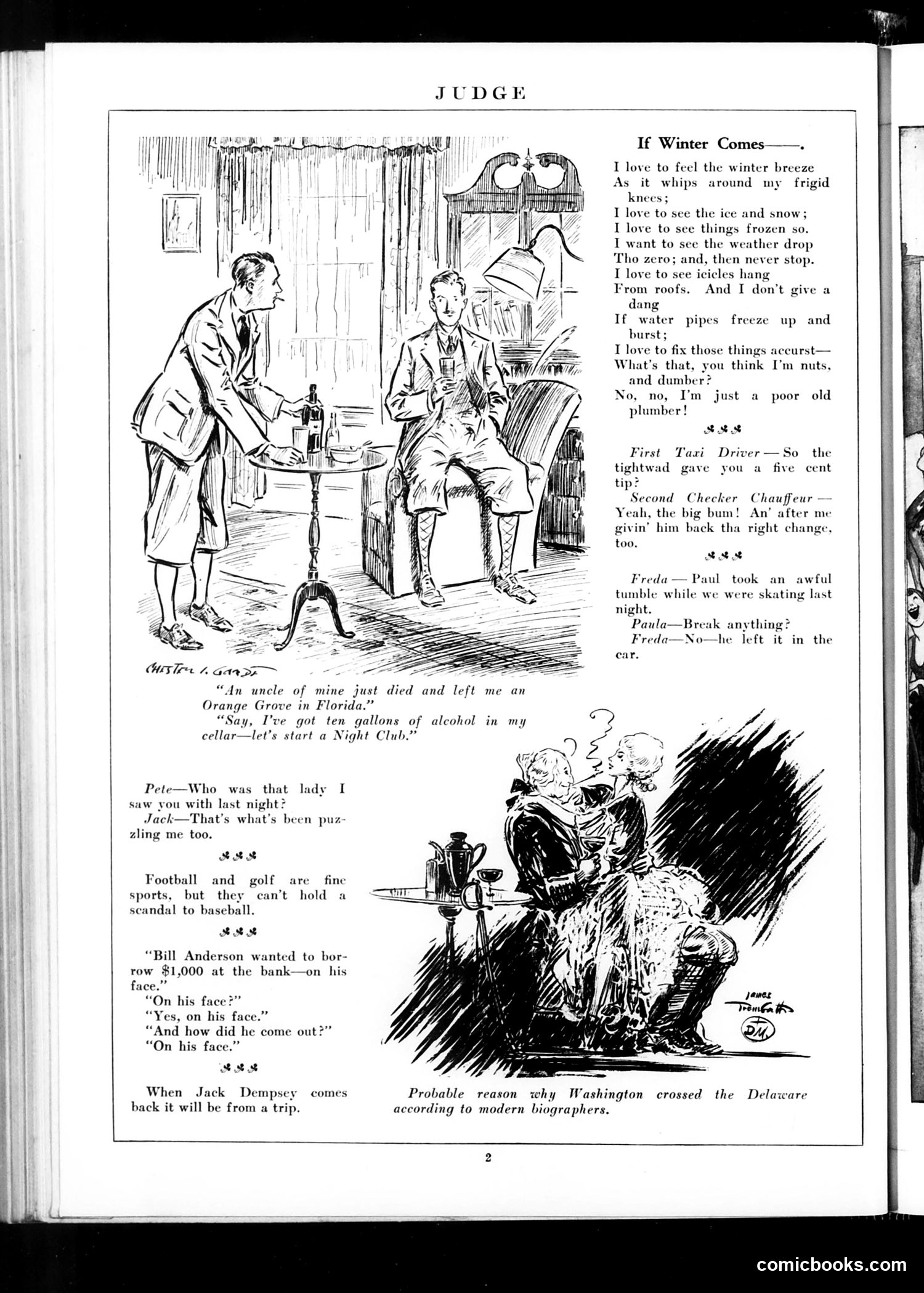
This page contains several disconnected satirical items typical of Judge's format: **Top cartoon**: Two men discuss inheriting alcohol during Prohibition—one received "ten gallons" from a deceased uncle in Florida and proposes starting a "Night Club." This jokes about wealthy people's ability to circumvent alcohol bans through inheritance and connections. **Lower cartoons and jokes**: Include wordplay about taxi drivers, checkers, romantic mishaps while skating, and sports scandals. One references "Bill Anderson" borrowing money "on his face" (meaning using his reputation/credit). **Bottom caption**: Makes a joke about George Washington crossing the Delaware, suggesting modern biographers would attribute it to different motives than historical accounts claim. The page reflects 1920s-era concerns: Prohibition enforcement gaps, casual corruption, and irreverent humor about American history.
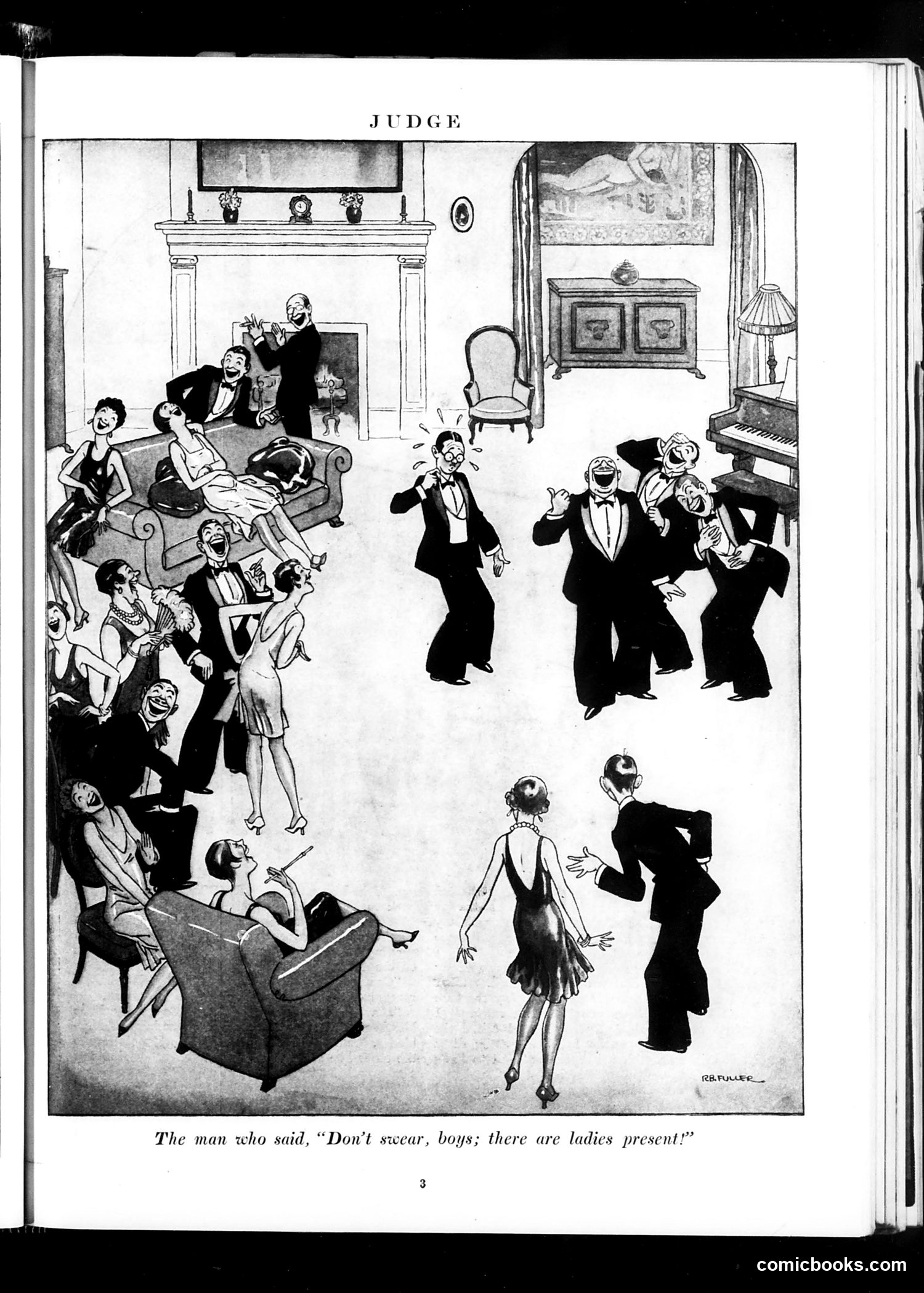
This single-panel cartoon depicts a social gathering where a man attempts to enforce propriety by cautioning others: "Don't swear, boys; there are ladies present!" The satire critiques the performative nature of social decorum in the 1920s-era upper class. The cartoon shows guests engaged in boisterous, uninhibited behavior—dancing, laughing, and carousing—yet the moment a woman appears, the men are expected to instantly adopt formal restraint. The joke targets the hypocrisy of "polite society," where behavior supposedly changes dramatically based on who's watching. The elegantly furnished drawing room with fireplace and piano suggests wealthy settings where such artificial social codes were most rigidly enforced. The cartoon mocks both the absurdity of such sudden behavioral shifts and the condescending assumption that women required special protective courtesy.
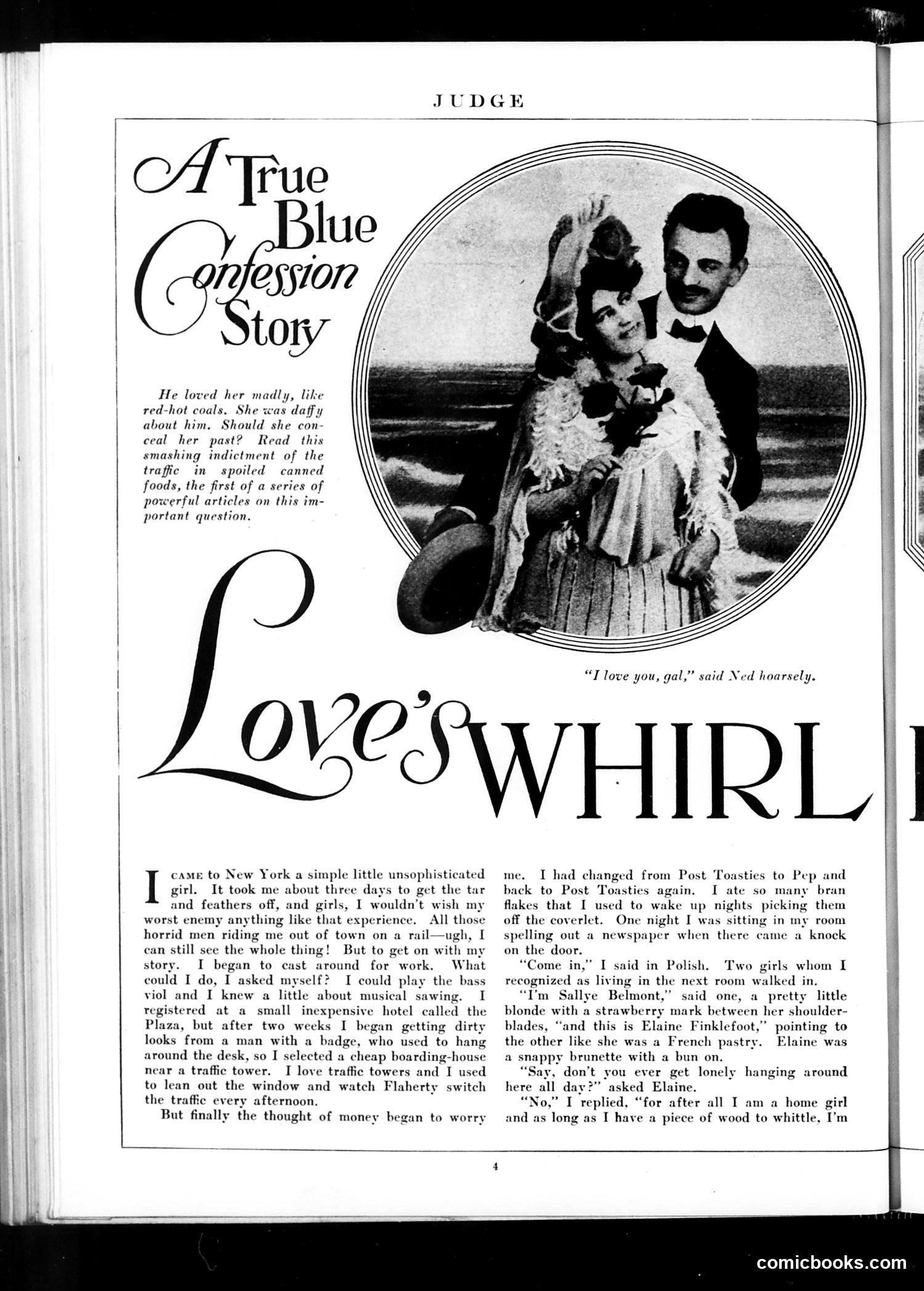
This appears to be the opening page of a serialized romantic fiction story rather than a political cartoon. The headline identifies it as "A True Blue Confession Story," suggesting it's part of Judge's regular fiction content. The narrative concerns a young, unsophisticated woman who arrives in New York and takes a room at an inexpensive hotel. She befriends two other female residents—Sallie Belmont (blonde) and Elaine (a brunette with a French accent). The story suggests romantic complications, with a man named Ned expressing his affection. Rather than satire, this represents Judge's broader editorial content blending humor, advice, and serialized stories for readers, characteristic of early 20th-century American magazines targeting middle-class audiences.
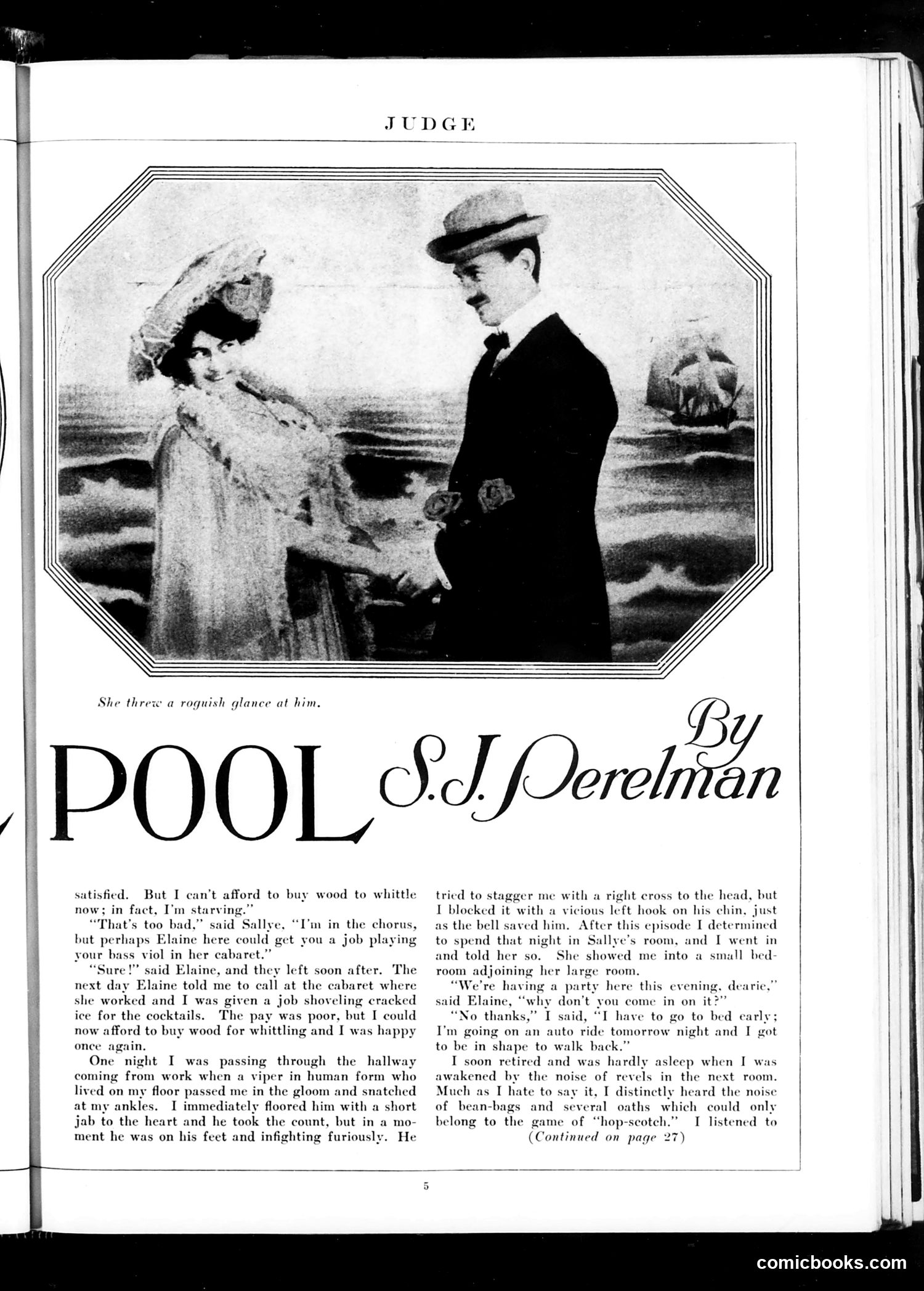
This is a short story rather than a political cartoon. The page shows a scene between a man and woman by the sea, with the caption "She threw a roguish glance at him." The narrative describes the unnamed narrator's romantic entanglement with a woman named Elaine. The story satirizes early 20th-century romantic courtship through comedic social situations: the narrator attends Elaine's cabaret performance, they awkwardly navigate a party invitation, and he's disturbed by noises from bean-bag games in an adjacent room. Perelman's humor relies on mundane domestic details and the narrator's hapless, self-deprecating observations about romance and social awkwardness—typical of his witty, sophisticated comic writing style that appeared frequently in Judge magazine.
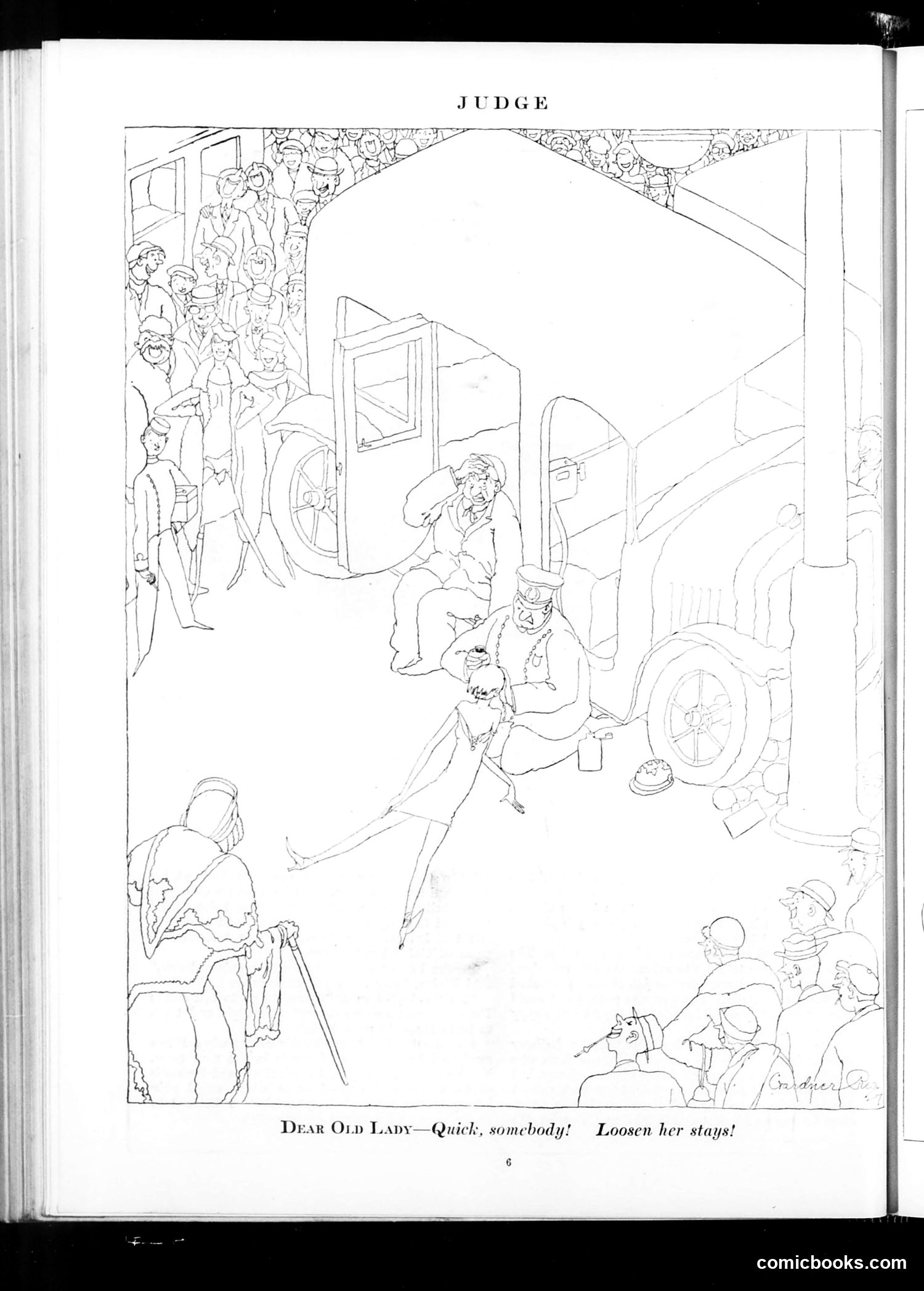
This cartoon depicts an elderly woman in distress near automobiles, with onlookers rushing to help. The caption "Dear Old Lady—Quick, somebody! Loosen her stays!" suggests she's overcome—likely by the shock or chaos of modern traffic. The satire targets early-20th-century anxieties about automobiles and their disruptive effect on traditional society. The "dear old lady" represents older generations struggling to adapt to rapid modernization. Her tight Victorian corset ("stays") becomes a metaphor for outdated social constraints being strained by progress. The crowd of onlookers and military/police figures suggest urban chaos and the overwhelming nature of the automobile age. The humor derives from the collision between old-fashioned propriety and modern urban life's overwhelming demands.
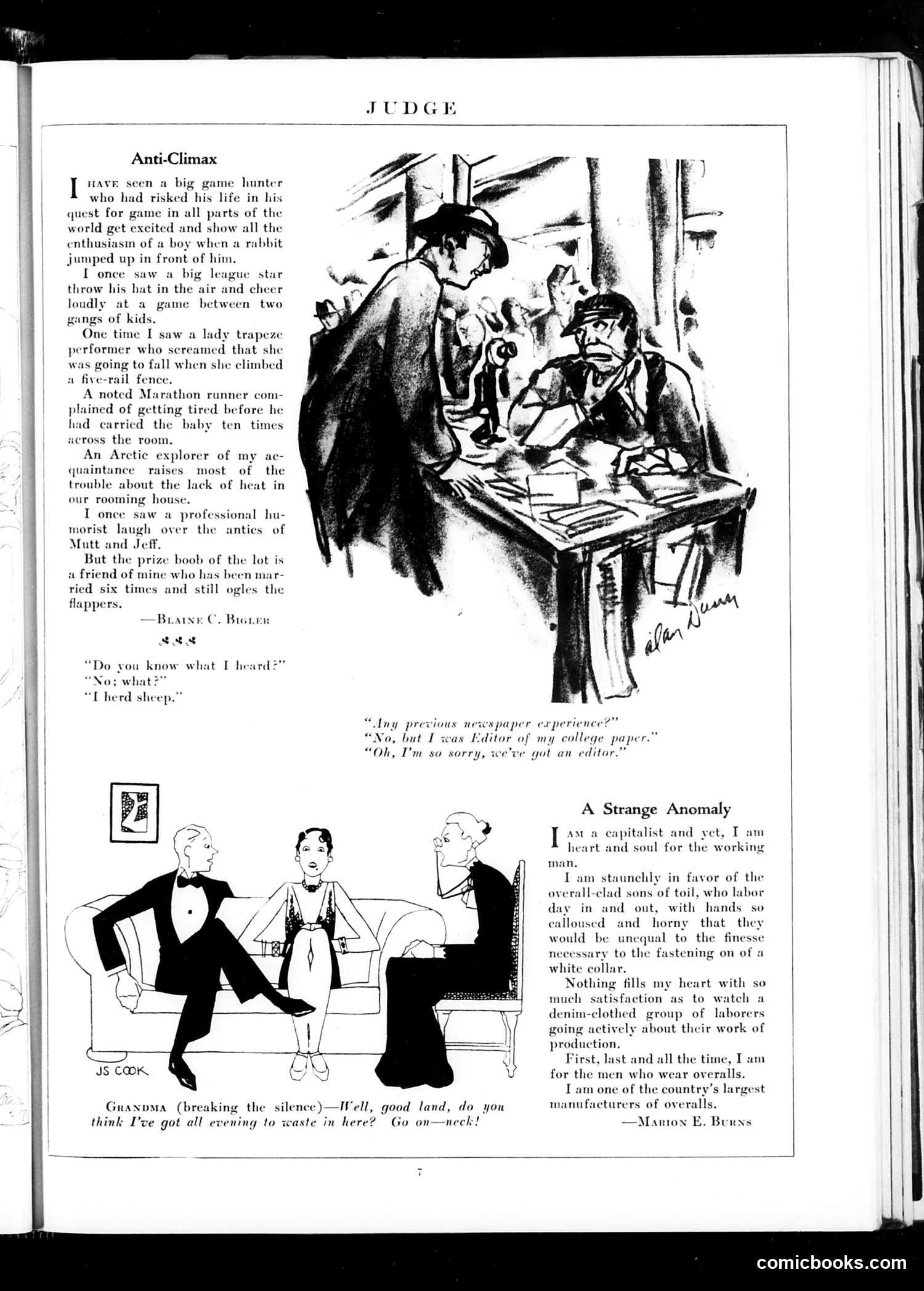
This page contains two satirical pieces mocking social contradictions and pretension: **"Anti-Climax"** (by Blaise C. Bigler) lists absurd examples of accomplished people displaying enthusiasm wildly disproportionate to trivial situations—a big-game hunter excited by a rabbit, a marathon runner tired from carrying a baby. The humor culminates in the "prize boob": a man married six times who still chases young women (flappers), suggesting his romantic desperation never matured despite repeated failures. **"A Strange Anomaly"** satirizes a capitalist manufacturer who claims passionate support for working-class laborers in overalls while being "one of the country's largest manufacturers of overalls"—profiting from their labor. The irony is that his self-proclaimed sympathy for workers is revealed as pure commercial interest; he loves workers only insofar as they buy his product. The lower cartoon shows a grandmother interrupting a young couple's romantic moment, scolding them for wasting the evening on "necking" (kissing).
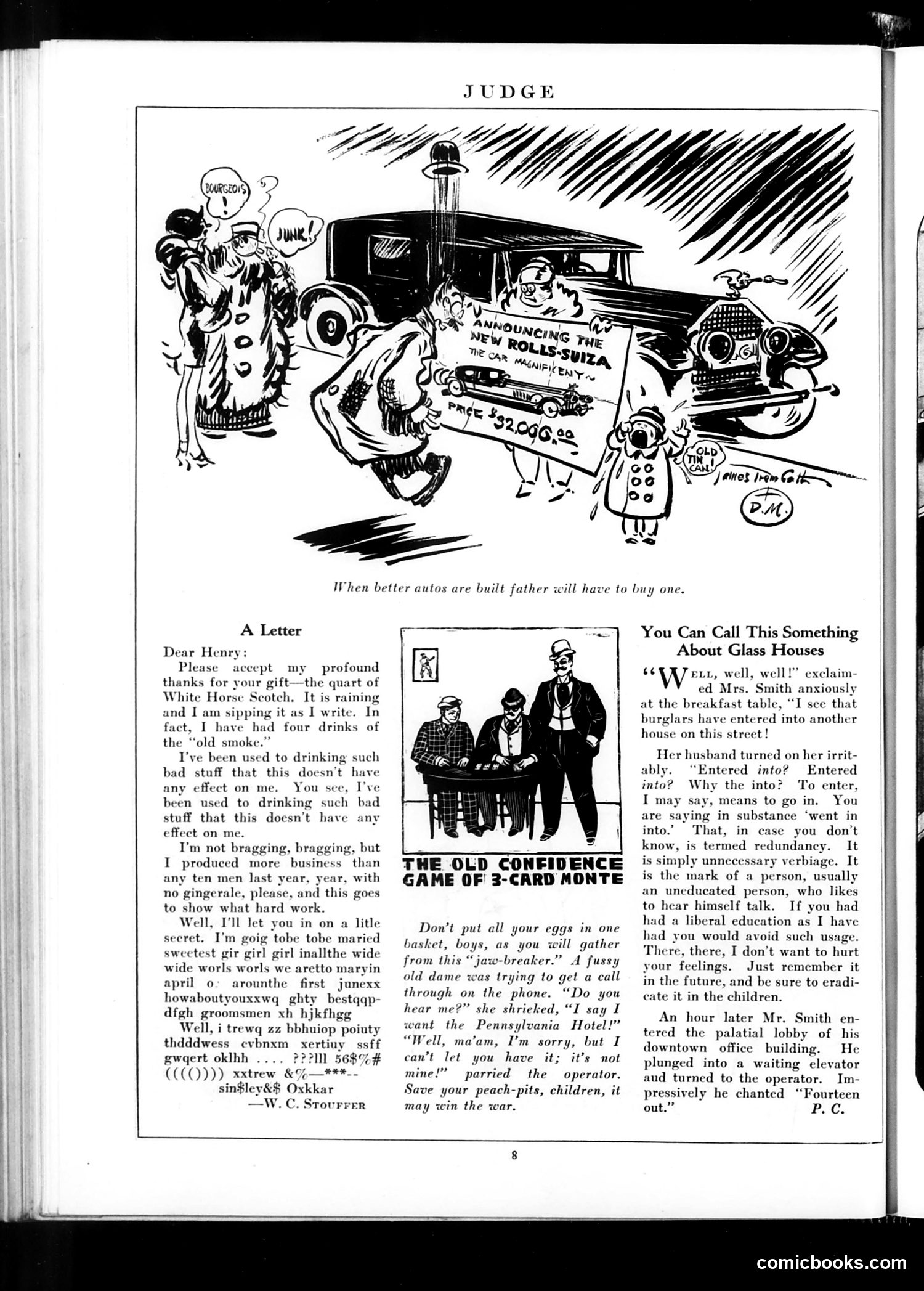
**Top Cartoon:** A satirical comment on luxury automobiles. The caption "When better autos are built father will have to buy one" mocks the conspicuous consumption of wealthy fathers—a Rolls-Royce is being announced at $52,000 (an astronomical sum in the 1920s). The poorly dressed figures express amazement, suggesting social commentary on economic inequality and the absurd expense of status symbols. **"A Letter":** Appears to be deliberately garbled nonsense text—possibly satirizing either drunk writing or editorial incompetence. The readable portions mention Scotch whisky and boasting about business success, likely mocking wealthy braggarts of the era. **"Glass Houses" Section:** A domestic humor piece where Mr. Smith pedantically corrects his wife's grammar (criticizing "entered into" as redundant), then immediately makes the same error himself ("Fourteen out" instead of proper phrasing) when addressing an elevator operator. The satire: people who lecture others about proper speech often violate their own rules—the "glass houses" metaphor suggests those living in glass houses shouldn't throw stones.
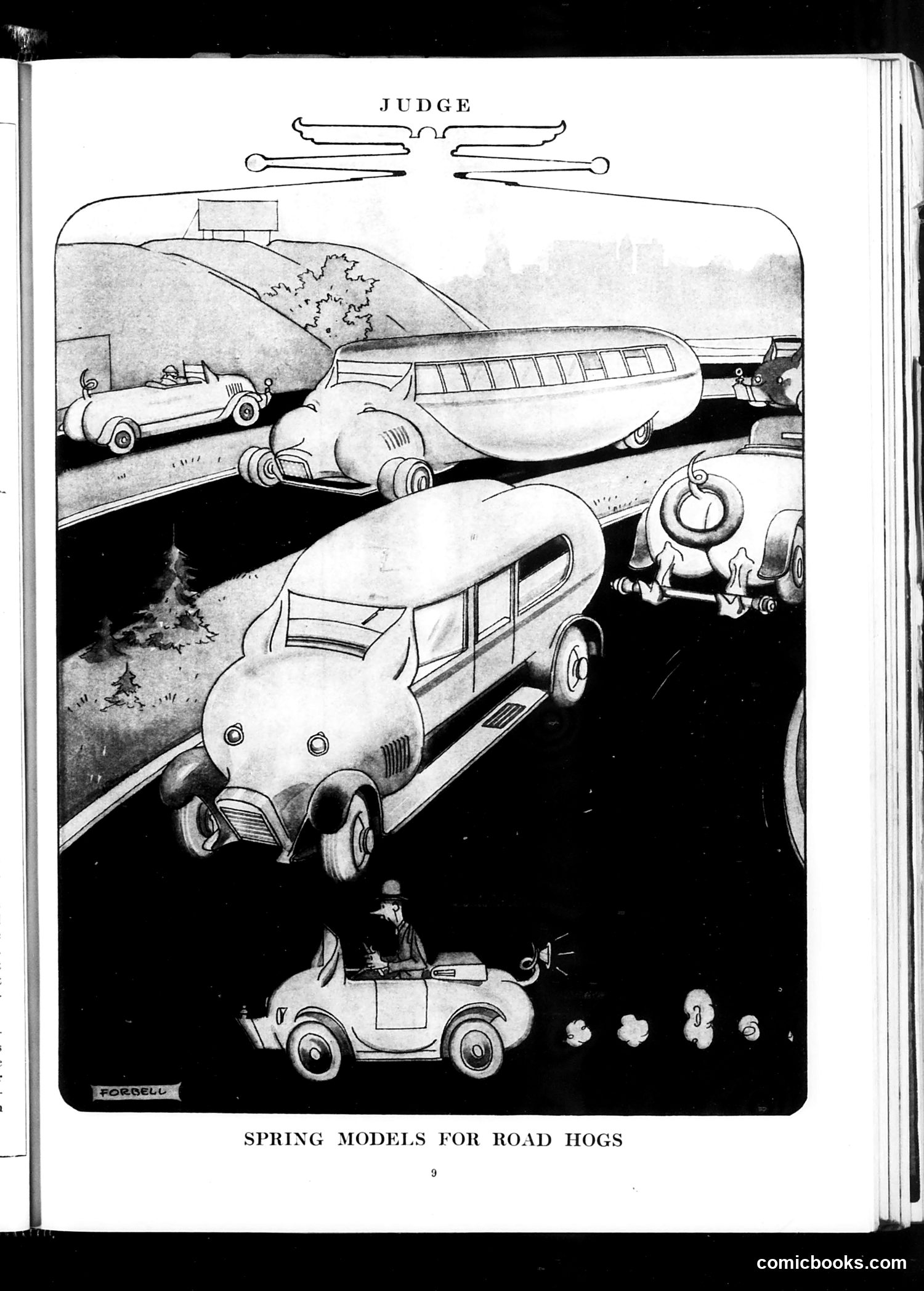
This satirical cartoon mocks dangerous drivers—"road hogs"—by depicting them as literally pig-like vehicles. The image shows increasingly absurd, bloated car designs with exaggerated proportions, culminating in a tiny human driver operating a grotesquely oversized automobile. The satire works on two levels: it visually represents selfish, aggressive drivers who hog the road, and it suggests their vehicles are comically outsized and unwieldy. The "spring models" reference appears to be a play on automotive marketing language, treating these ridiculous designs as if they were legitimate new car announcements. The small figure at the bottom—a driver dwarfed by his vehicle—emphasizes the absurdity of excessive automotive design. This likely critiques 1920s-30s trends toward larger, more powerful cars that prioritized speed and status over safety or road etiquette. The cartoonist (Fordell) uses visual exaggeration to mock automobile culture excess.
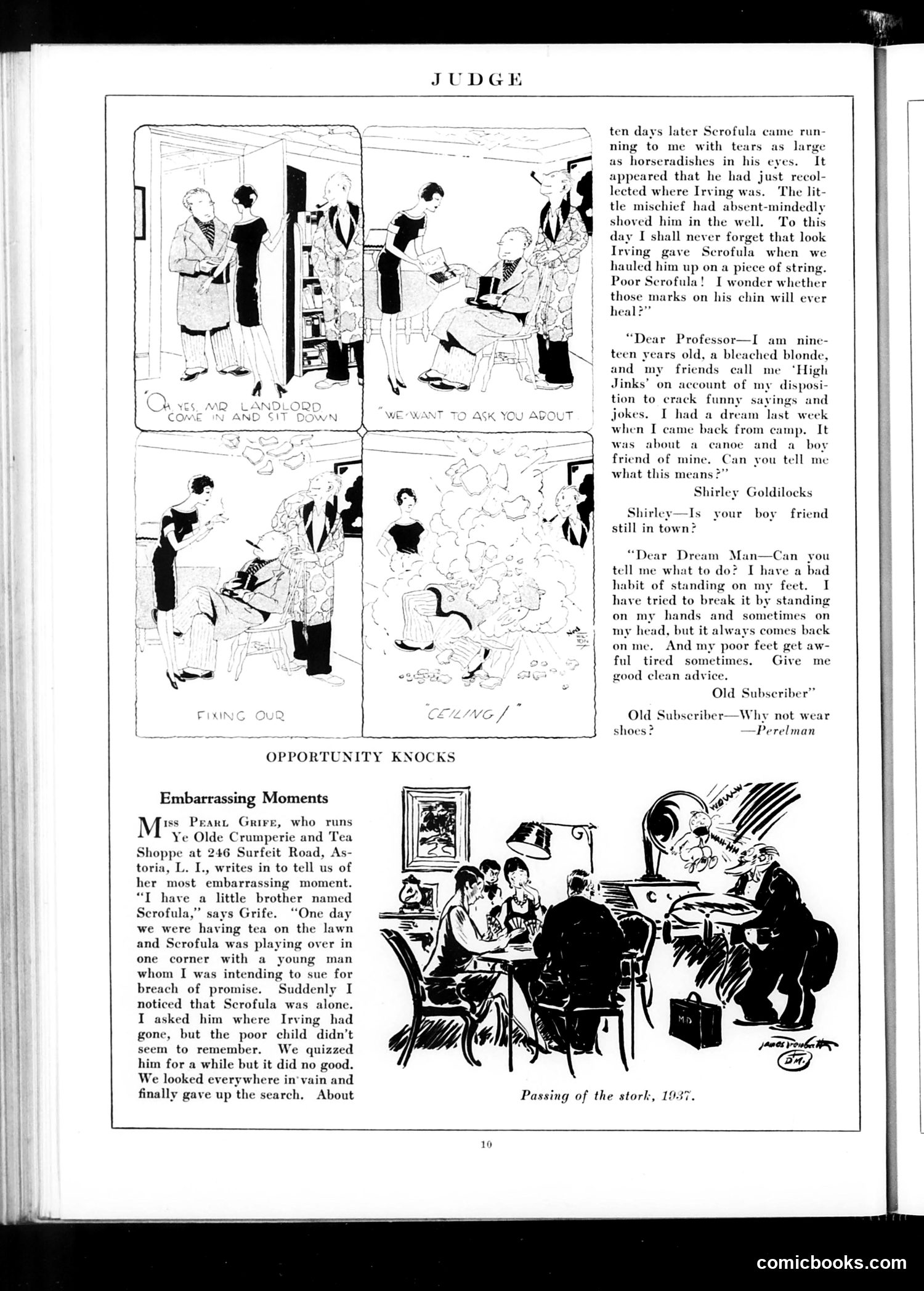
This page features humorous reader submissions and advice responses, typical of Judge's satirical format. The main story describes a woman whose brother accidentally pushed her suitor into a well during childhood—a darkly comedic tale playing on the absurdity of forgotten traumas and sibling mishaps. Below are letters from readers: "Shirley Goldilocks" asks a dream analyst about a canoe dream (with the analyst's joke response questioning if her boyfriend is still around), and "Old Subscriber" complains about compulsively standing on his feet, receiving the witty retort to simply wear shoes. The cartoon "Passing of the Stork, 1937" (bottom right) appears to show the decline of the stork delivery myth—depicting a stork character among modern furnishings, likely satirizing changing attitudes toward sex education and children's origins in 1930s America. The tone throughout is light mockery of everyday absurdities and outdated social conventions.
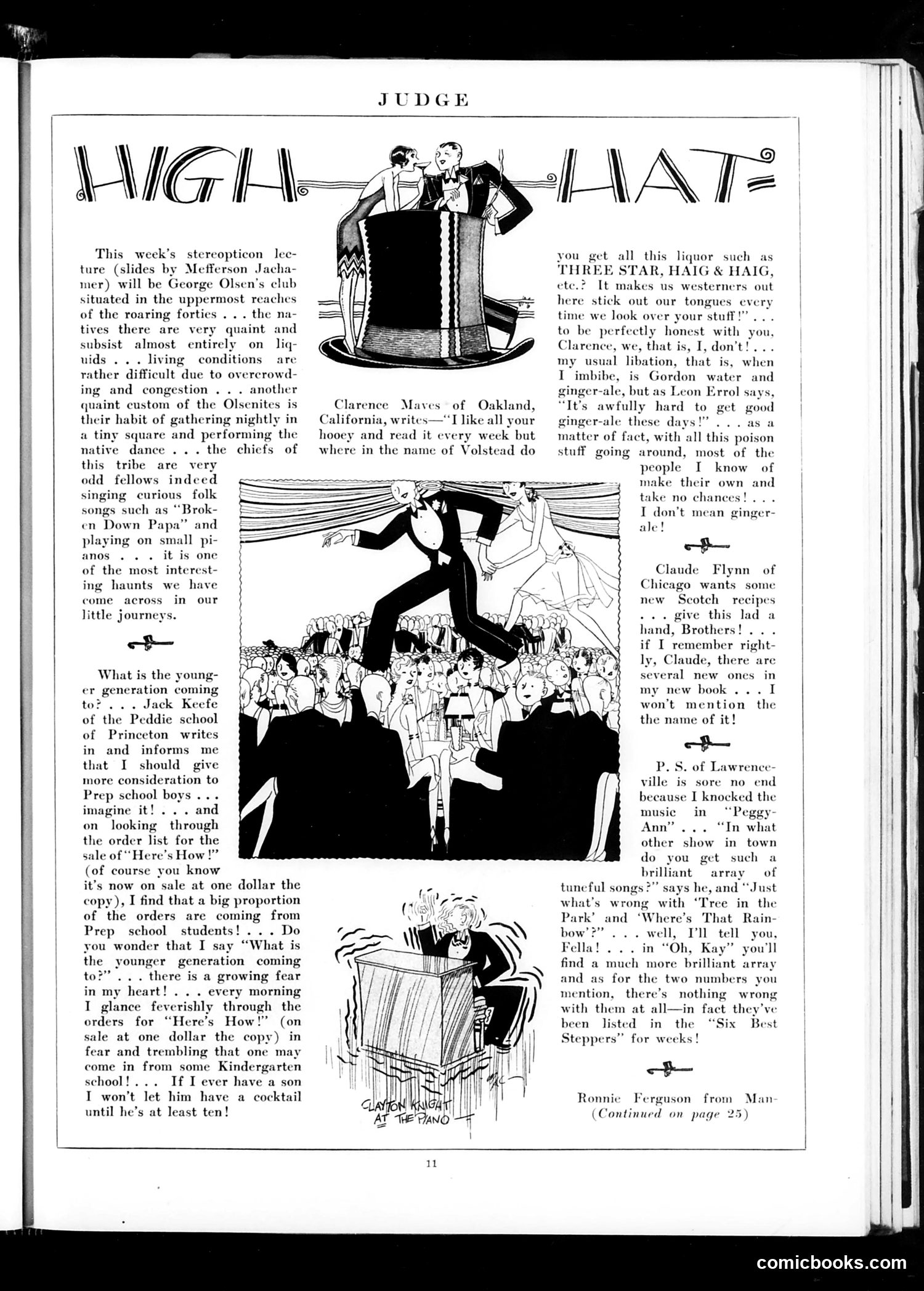
This page satirizes **Prohibition-era drinking culture** (the 1920s, when alcohol was legally banned in America). The column mocks the hypocrisy and absurdity surrounding illegal liquor consumption. Key targets include: **George Olsen's club** — a speakeasy (illegal bar) disguised as a fashionable nightclub in New York's "roaring forties" neighborhood, presented mockingly as an anthropological curiosity with "natives" drinking constantly. **The "younger generation"** — the writer feigns shock that prep school students are ordering "Here's How!" (apparently a cocktail guide), expressing exaggerated concern about underage drinking while clearly participating in the drinking culture himself. **The Volstead Act reference** — named after the law enforcing Prohibition; a reader complains about liquor brand-names mentioned in the column, revealing how openly alcohol was discussed despite being illegal. The satire's point: despite Prohibition's legal ban, wealthy urbanites openly patronized speakeasies and discussed branded liquors publicly, exposing the law's ineffectiveness and the era's widespread hypocrisy about "dry" America.
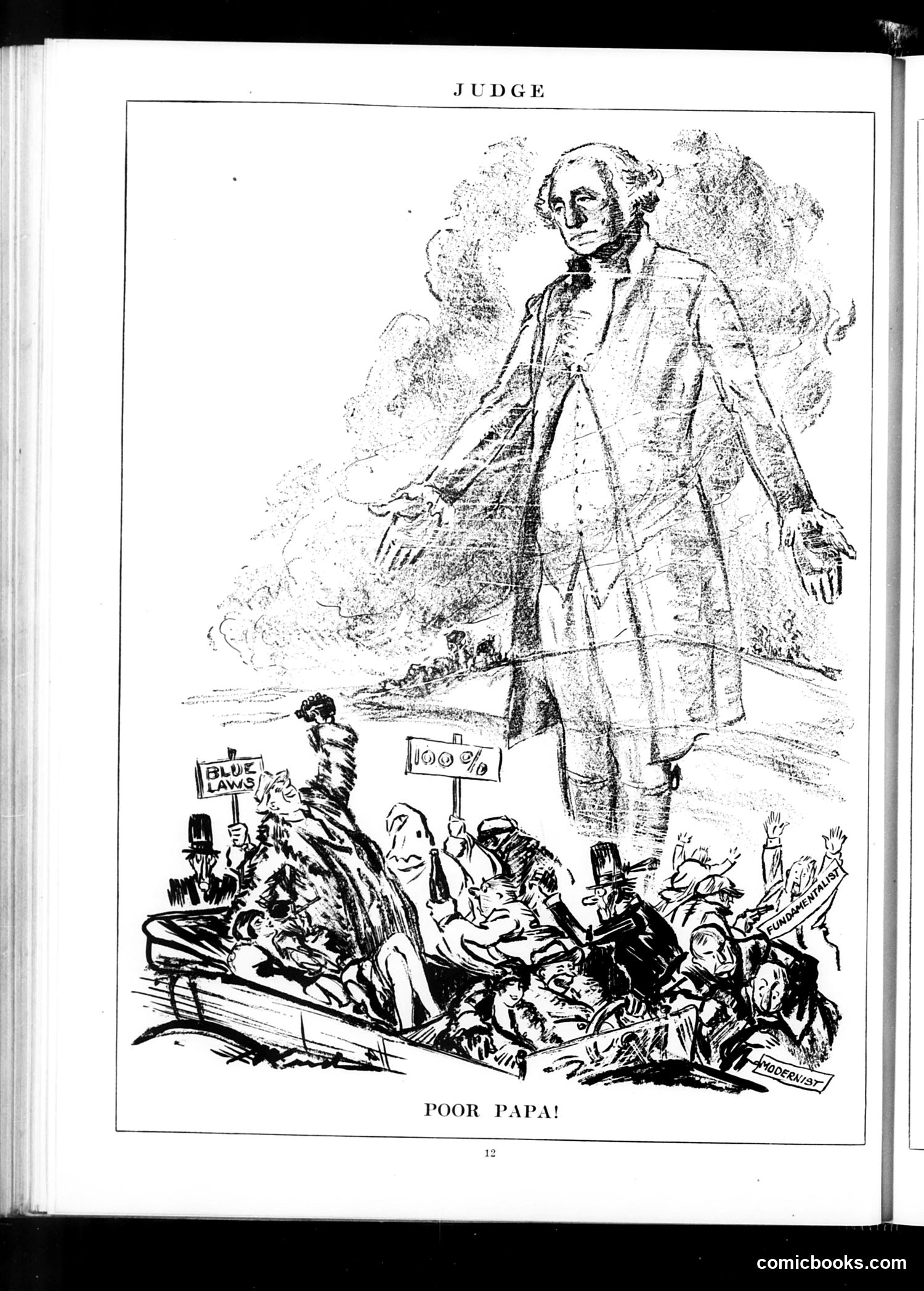
This Judge magazine cartoon depicts a tall, dignified gentleman towering over a chaotic crowd of smaller figures below. The caption "Poor Papa!" suggests paternal concern. The crowd appears to represent various political or social factions—indicated by signs and different attire—seemingly in disorder or conflict. One sign reads "100%" (likely referencing loyalty or purity demands common in early 20th-century American politics). The "Blue Laws" sign visible suggests debate over restrictive legislation. The cartoon satirizes a father-figure (possibly representing established authority, tradition, or a political leader) overwhelmed or disappointed by the fractious behavior of subordinates or citizens below him. The satire critiques either political discord, generational conflict, or failure of leadership to maintain order among competing interests. Without a publication date visible, the specific historical context remains unclear.
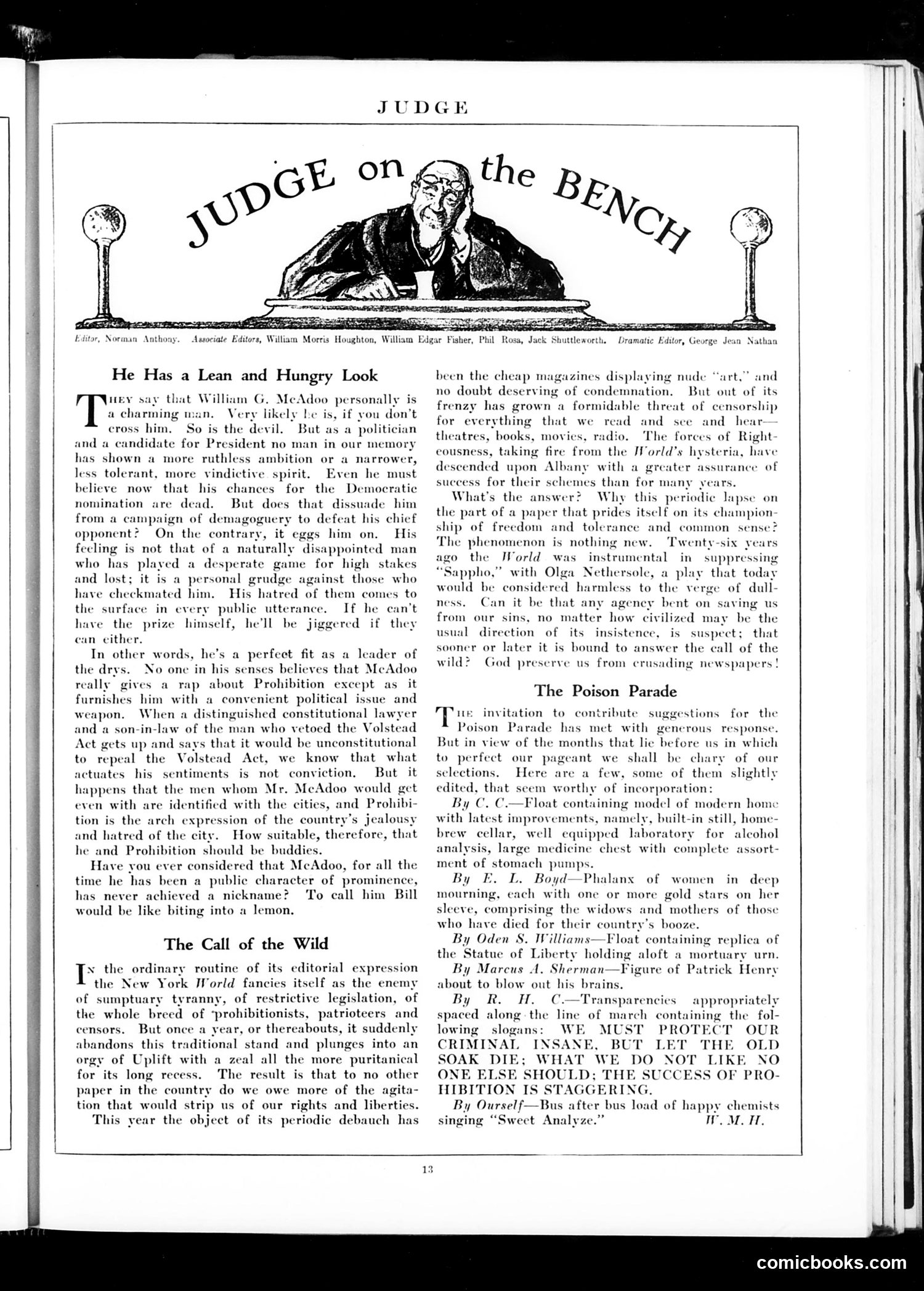
This page contains political commentary on **William G. McAdoo**, a prominent Democratic politician of the era (likely 1920s, based on references to Prohibition and presidential ambitions). **The main article, "He Has a Lean and Hungry Look,"** attacks McAdoo as a ruthless, vindictive politician masking personal ambition as principle. The author argues McAdoo: - Abandoned his chance at the Democratic presidential nomination but continues campaigning destructively against rivals - Opportunistically champions Prohibition not from conviction but to exploit rural-urban political divisions (cities oppose Prohibition; he uses this to hurt "city" politicians) - Lacks genuine public appeal (never even earned a nickname) **Secondary pieces critique the New York World newspaper** for hypocritical "periodic" moral crusades—specifically censoring magazines—while usually defending freedom of press. The satire targets political opportunism and inconsistent principle-driven activism. The "Lean and Hungry Look" reference (Shakespeare's *Julius Caesar*) suggests McAdoo as an ambitious schemer.
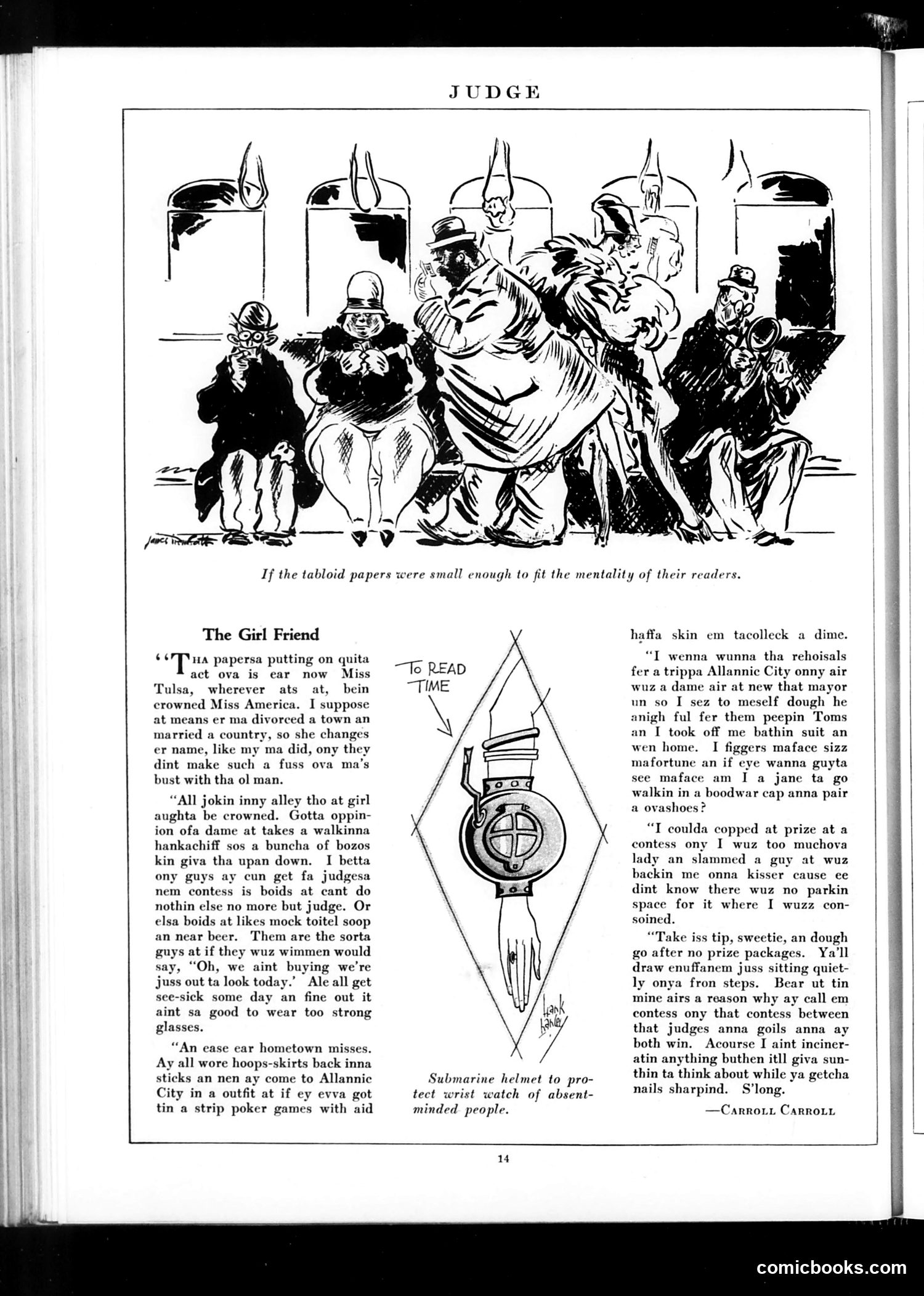
This page contains two satirical pieces from Judge magazine: **Top Cartoon:** A visual joke about tabloid newspapers. The caption states if tabloid papers were "small enough to fit the mentality of their readers"—mocking readers of sensationalist tabloids as intellectually limited. **"The Girl Friend" Article:** A monologue in exaggerated working-class dialect (phonetic spelling throughout) commenting on beauty pageants, apparently referencing a "Miss Tulsa" or similar regional pageant winner. The speaker critiques: - The absurdity of crowning women based on appearance - Male judges who enjoy scrutinizing contestants - Women who strip down for competitions - The shallow nature of such contests The speaker ironically advises women to skip pageants and win male attention naturally by sitting on front steps instead—suggesting pageants are undignified spectacles. **Context:** This reflects 1920s-30s satirical commentary on commercialized beauty pageants and working-class American culture, using dialect humor (common then, now considered offensive) to mock both the pageant industry and its audience.
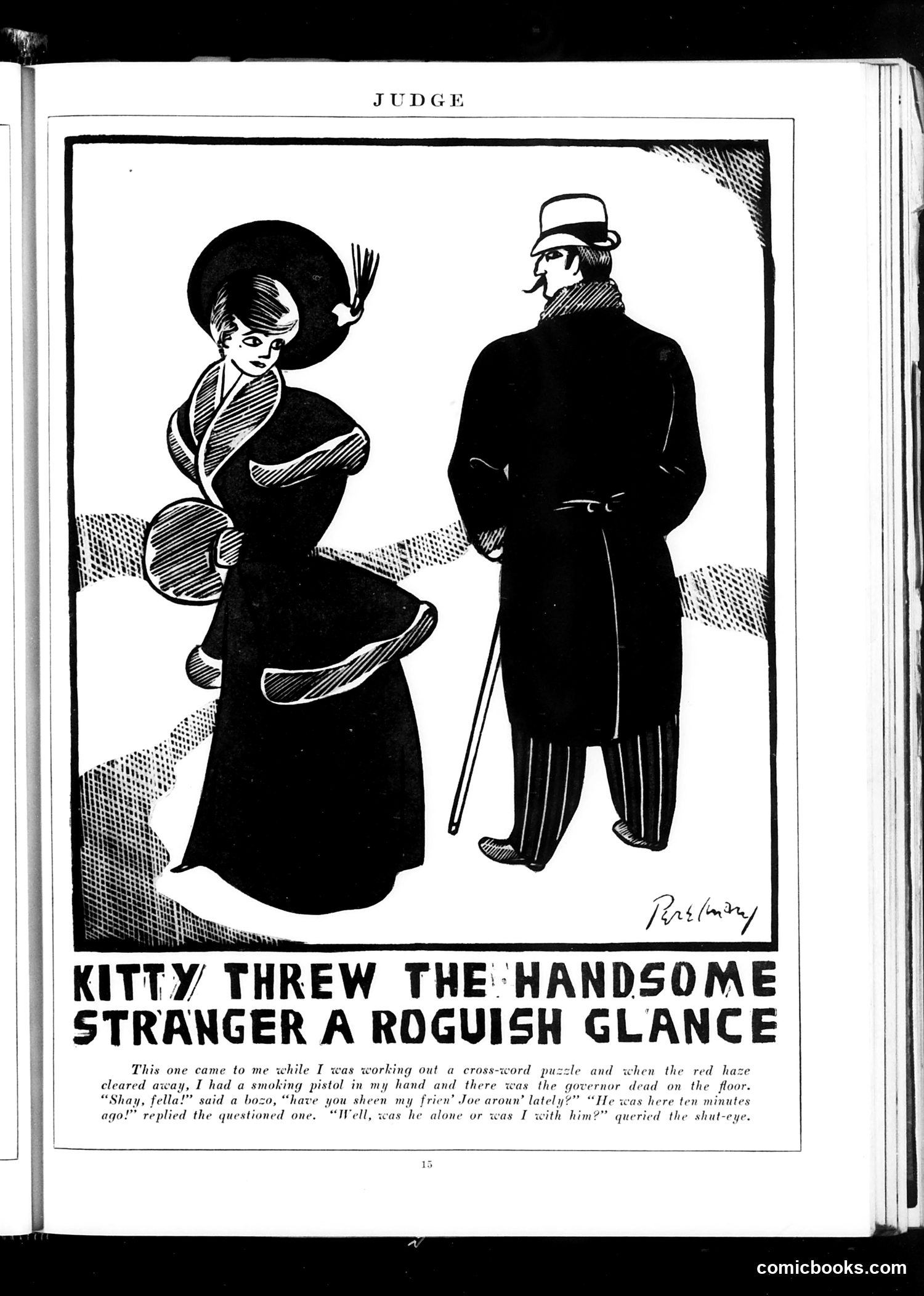
This is a single-panel cartoon titled "Kitty Threw the Handsome Stranger a Roguish Glance" from *Judge* magazine. It depicts a flirtatious woman in fashionable dress making eyes at a well-dressed man with a cane. The accompanying text describes a crime-story scenario: the narrator was solving a crossword puzzle when a shooting occurred, leaving a governor dead. When questioned about whether a friend "Joe" was present, the questioner asks confusingly whether Joe was "alone or was I with him?"—a logical impossibility meant to be humorous. The cartoon appears to satirize pulp crime fiction and detective stories popular in the era. "Kitty" represents the archetypal femme fatale of such narratives, while the "handsome stranger" embodies the mysterious male character. The joke connects the melodramatic setup with the absurd questioning that follows, mocking the conventions of pulp mystery fiction.
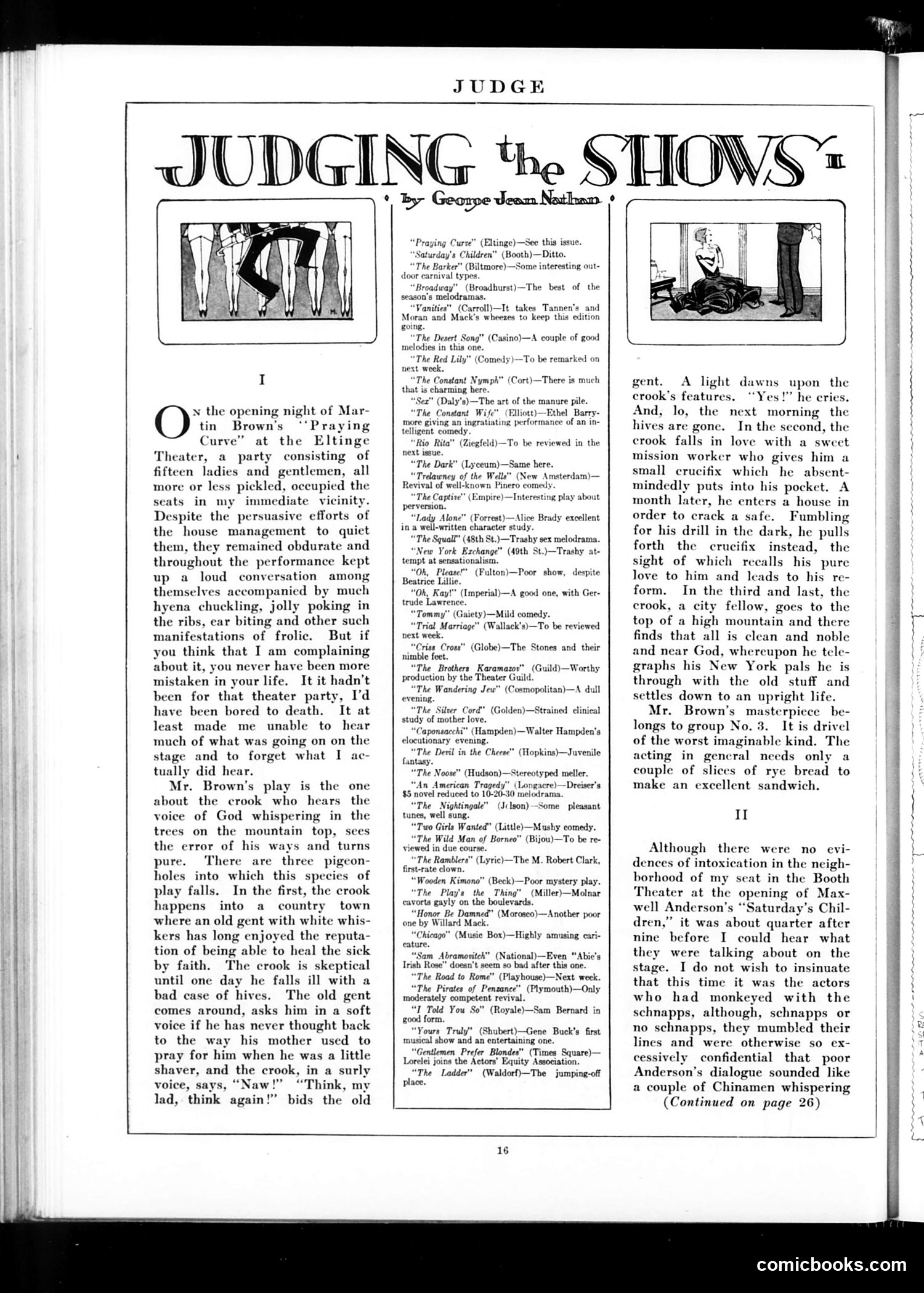
This page presents George Jean Nathan's theatrical review column, a regular Judge feature mocking Broadway productions. Nathan uses exaggerated complaint as satire—he claims the drunk, disruptive theater party next to him was better entertainment than Martin Brown's actual play "The Praying Curve," a redemption melodrama about a criminal who hears God's voice on a mountaintop. The satire targets both the play's predictability (Nathan catalogs three hackneyed plot formulas for such morality tales) and theater-going culture itself. The accompanying reviews list dozens of contemporary Broadway shows with snide one-liners—dismissing productions as "trashy," "dull," or "muddy." The cartoons (illustrations showing theatrical scenes) visualize the absurdity Nathan describes. This column format allowed Judge to simultaneously entertain readers while mocking both theatrical quality and the pretensions of Broadway audiences in the 1920s.
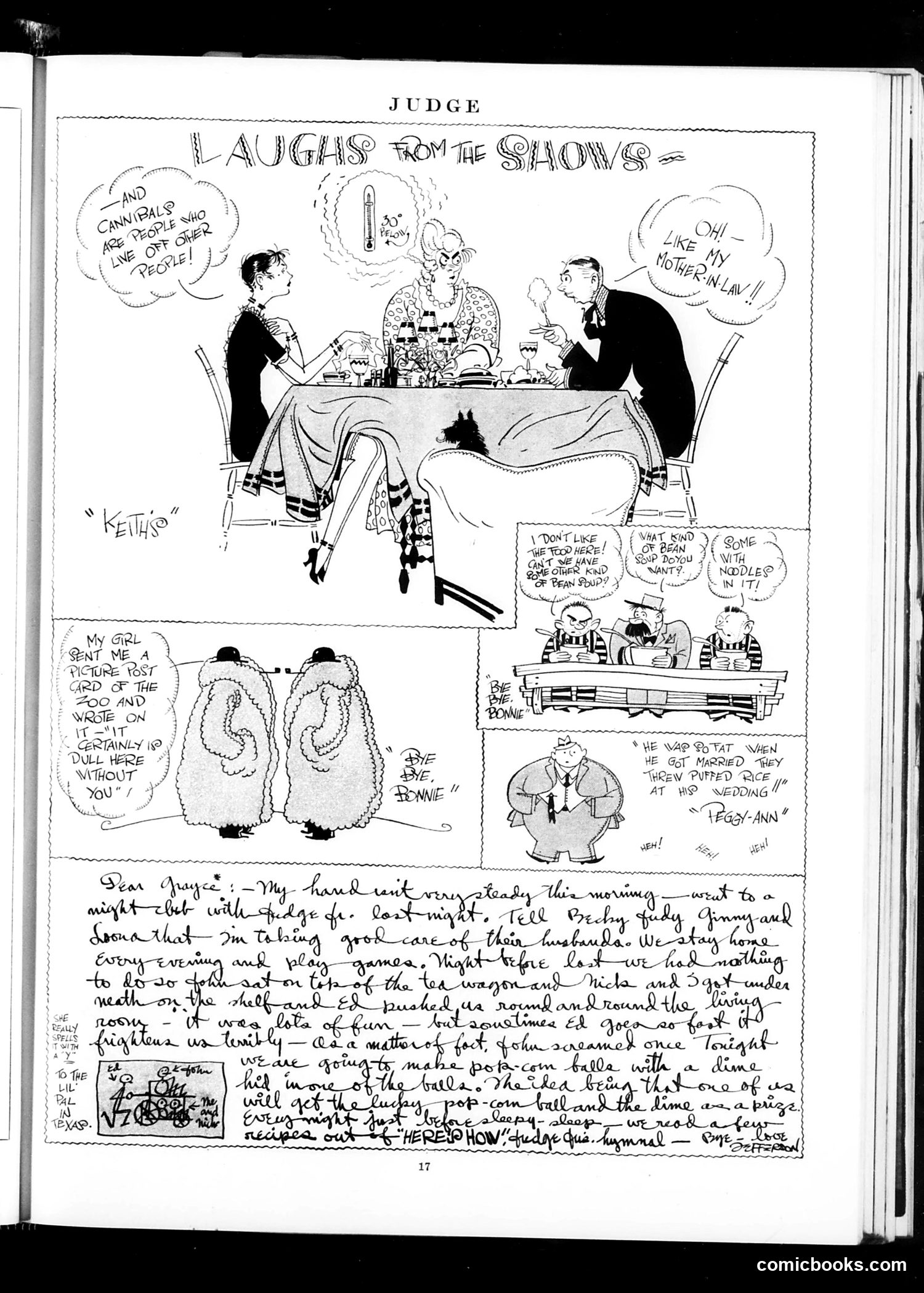
This page collects humorous anecdotes and jokes, likely submitted by readers. The top cartoon shows a dinner party where guests make crude remarks—one mentions "cannibals" and "people who live off each other," another says "like, oh—mother-in-law!"—suggesting satirical commentary on marriage and in-law relationships, common comedic targets. Lower cartoons include gags about mistaken identity (a postcard mix-up at the zoo) and newlyweds throwing rice at a wedding. The handwritten letter at bottom appears to be a reader submission describing a domestic scene. The overall tone is light vaudeville-style humor targeting middle-class social situations: marriages, family relationships, and awkward social moments. This represents typical early 20th-century *Judge* magazine content—satirizing genteel society's pretenses through everyday domestic comedy rather than political commentary.
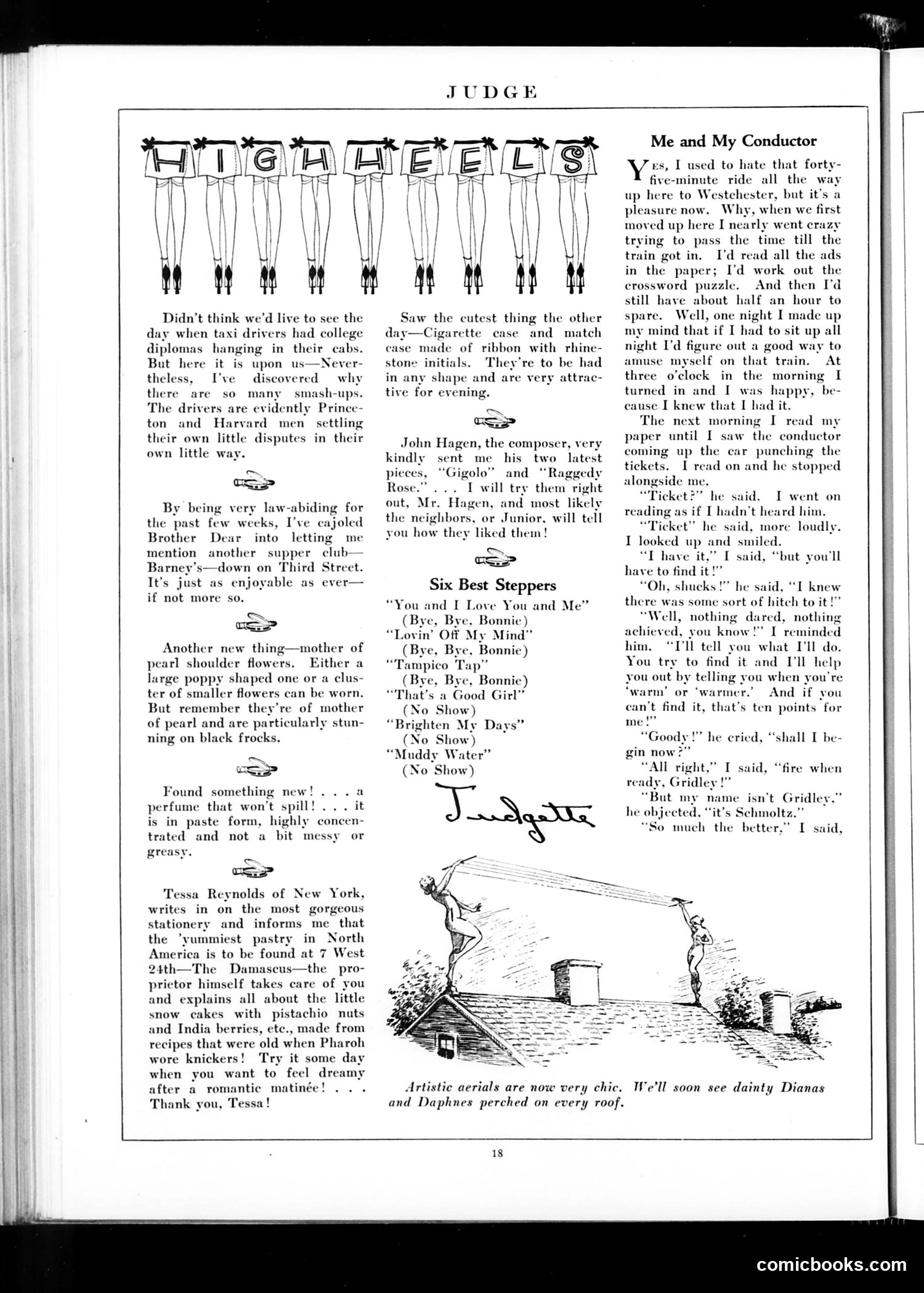
This page from the satirical magazine **Judge** contains several humorous commentary pieces rather than political cartoons: **Main Content:** The page features social commentary on 1920s urban life, including jokes about taxi drivers with college degrees causing accidents (satirizing overqualified workers), mentions of fashionable items (mother-of-pearl flowers, non-spill perfume), and restaurant recommendations. **"Me and My Conductor" Story:** The longest piece describes a commuter's game with a train conductor on the Westchester line—she hides her ticket and makes him search while she gives "warmer/colder" hints. The joke plays on the traveler's boredom with commuting and the conductor's good-natured participation. The reference to "Gridley" appears to be a witty deflection. **"Six Best Steppers":** A list of popular songs, likely from Broadway shows or jazz era recordings. **Overall Tone:** The page reflects affluent, urban 1920s leisure concerns—commuting, nightclubs, fashion, and entertainment—with light, gossipy humor aimed at society readers rather than sharp political satire.
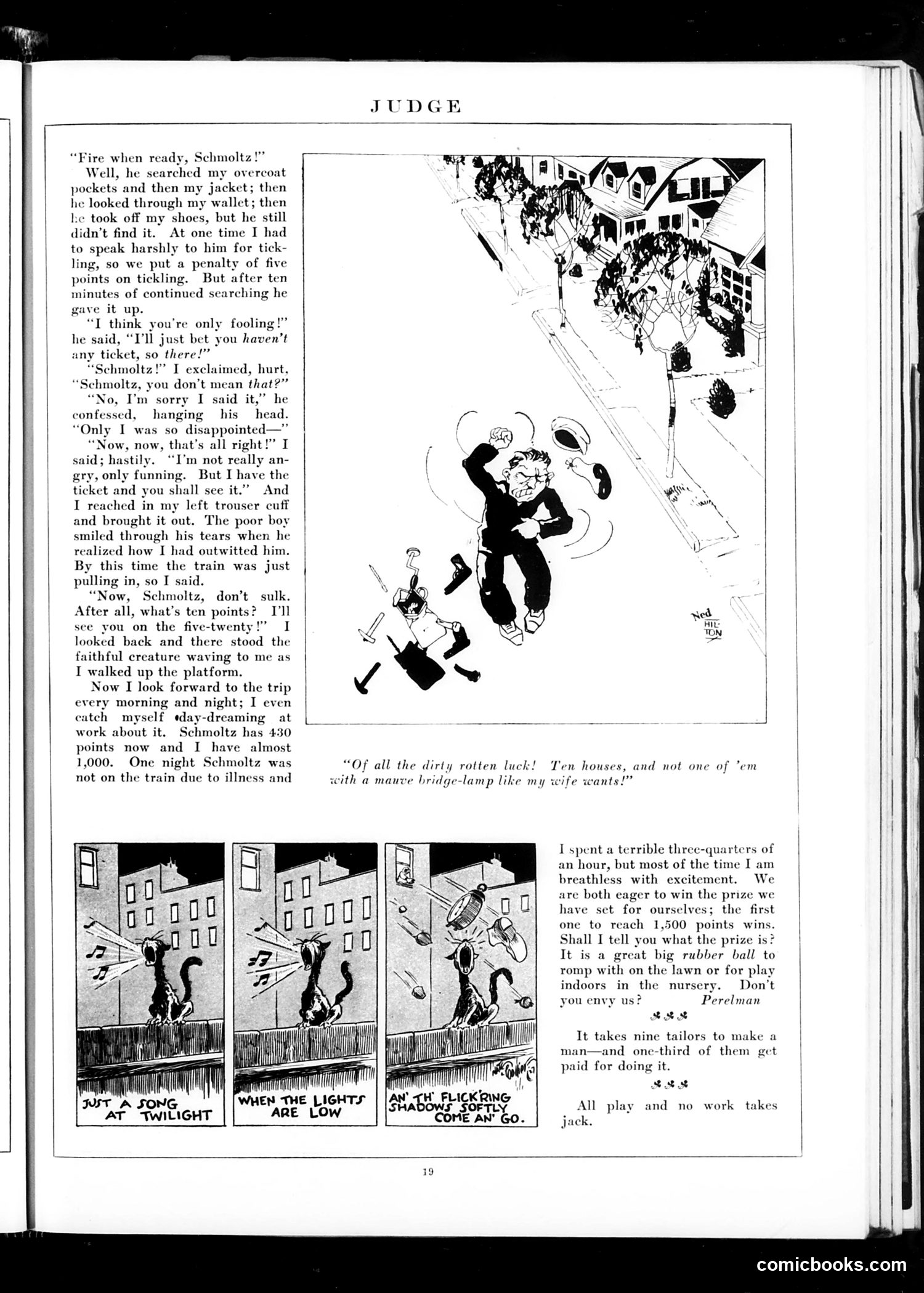
This page contains a humorous short story by S.J. Perelman (bylined "Perelman") about a game between the narrator and "Schmoltz," apparently a porter or train employee. The men play a tickling/searching game earning points toward a prize—a rubber ball for the narrator's nursery. The humor relies on absurdist comedy: an adult obsessively competing with a worker over an elaborate point system, with emotional stakes (the porter cries when outwitted). The joke's appeal lies in the narrator's earnest enthusiasm for something trivial. The page also includes three small comic strips at bottom showing a silhouetted figure humming near buildings ("Just a Song at Twilight," "When the Lights Are Low," "An' th' Flickering Shadows Softly Come an' Go"), depicting someone crooning while conducting some unspecified activity—the humor apparently deriving from juxtaposition of romantic song with mundane reality. Additional proverbs/aphorisms fill remaining space, typical of Judge's satirical format. The overall tone is whimsical rather than political.
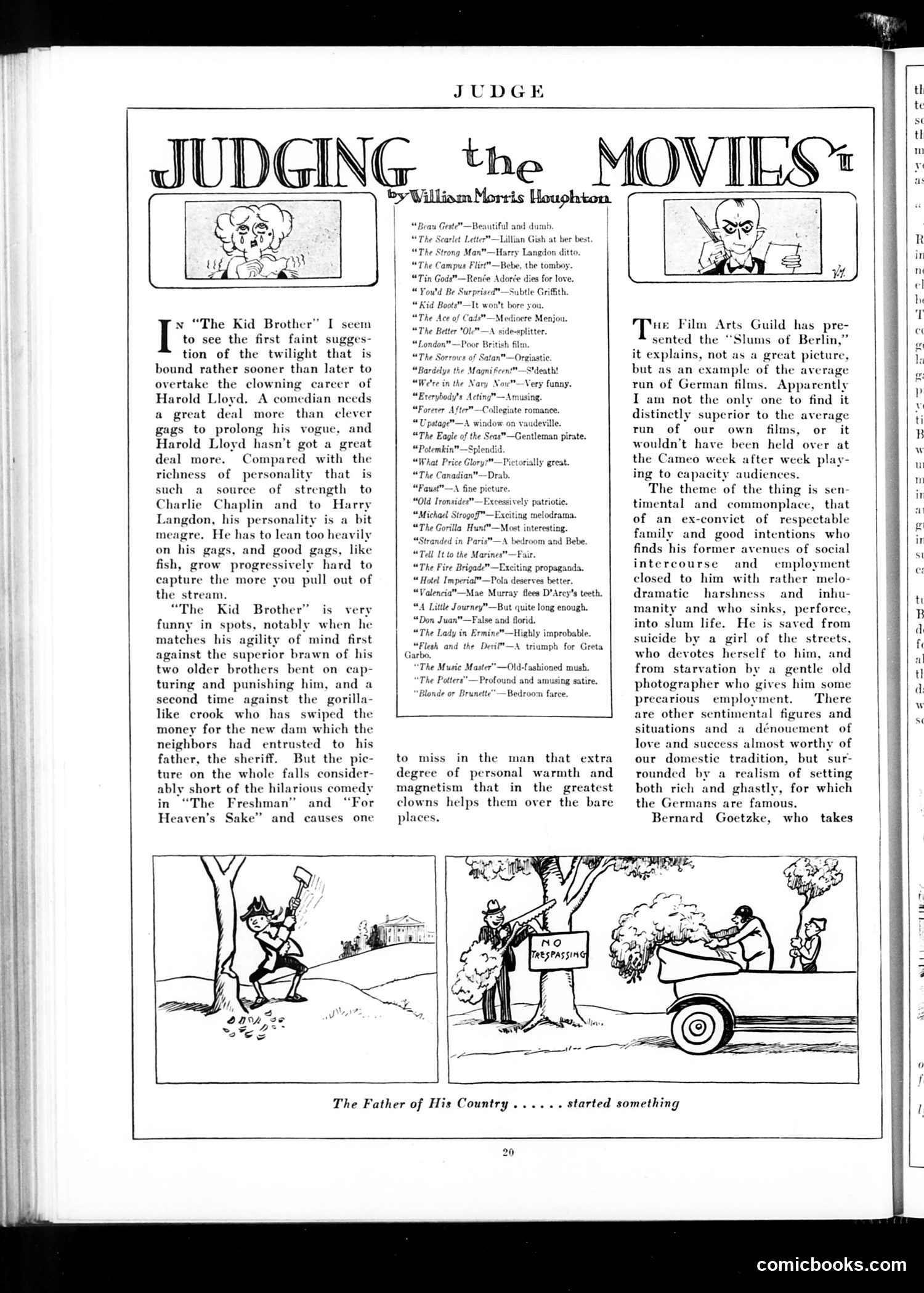
This page from *Judge* magazine contains film criticism by William Morris Haughton reviewing recent movies (circa mid-1920s based on titles like "Kid Boots" and "The Kid Brother"). The main critique focuses on **Harold Lloyd's comedies**, particularly "The Kid Brother." Haughton argues Lloyd lacks the personality depth of contemporary rivals **Charlie Chaplin** and **Harry Langdon**, relying too heavily on physical gags that grow repetitive. He praises Lloyd's acrobatic timing against stronger opponents but finds the overall comedy falls short of Lloyd's earlier hits "The Freshman" and "For Heaven's Sake." The page also reviews **"Slums of Berlin,"** a German film presented by the Film Arts Guild. Though not a great picture, Haughton notes it exemplifies superior average German cinema compared to American output, praising its realistic depiction of urban poverty and moral redemption—characteristics he credits to German filmmaking's famous realism. The cartoons below illustrate scenes from these films, including what appears to be "The Father of His Country," though the specific reference is unclear.
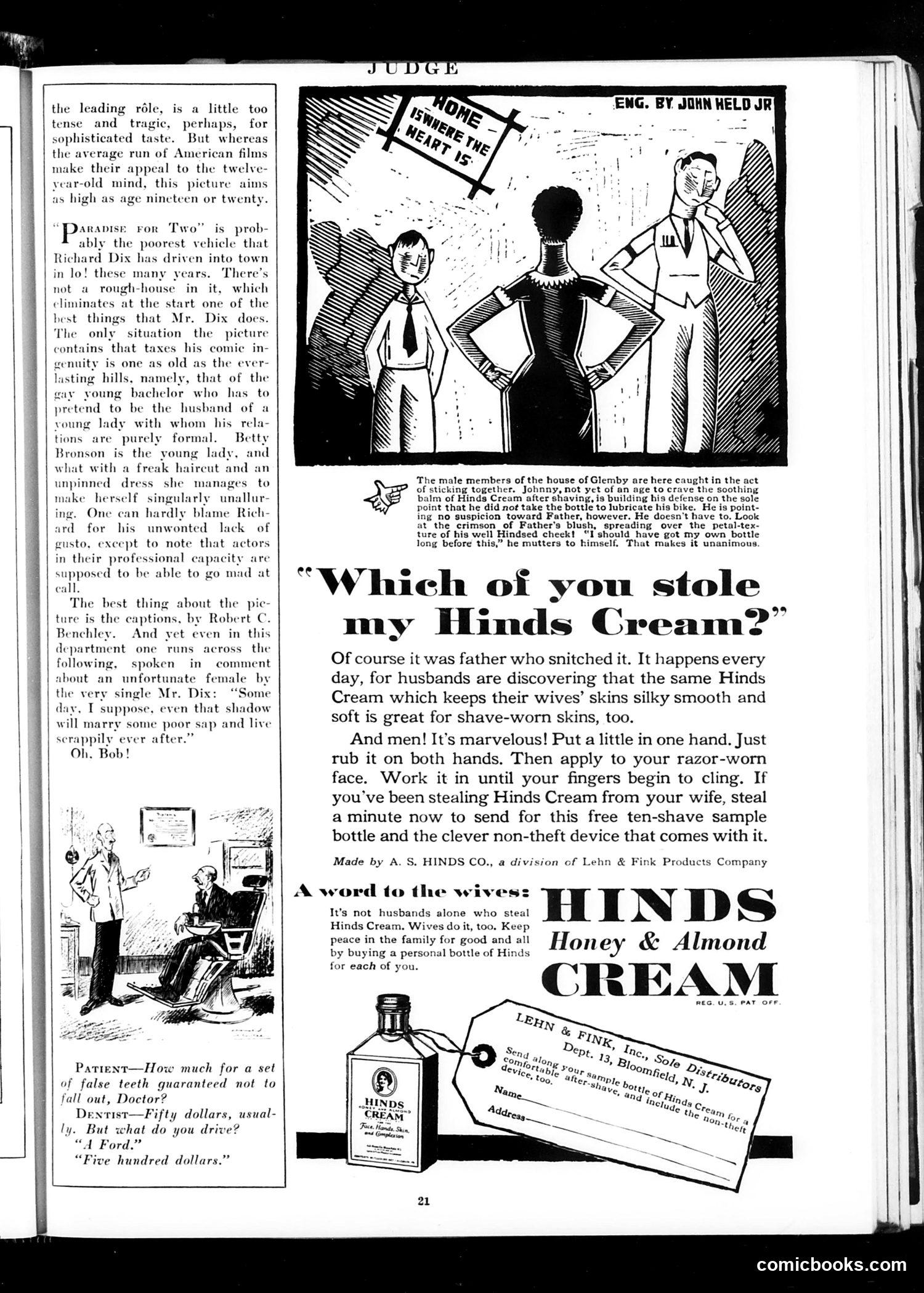
This page mixes film criticism with advertising. The left column reviews "Paradise for Two," starring Richard Dix and Betty Bronson—a silent-era romantic comedy. The critic praises Robert C. Benchley's witty captions but finds the film otherwise dated, relying on the hackneyed premise of a bachelor pretending to be a woman's husband. The dominant content is a **Hinds Cream advertisement** disguised as humorous editorial. A cartoon shows a household where family members have stolen father's shaving cream. The joke plays on marital dynamics: husbands and wives both covet the product for skin care. The ad's humor suggests that using women's cosmetics was slightly embarrassing for men—hence the comedic shame of "snitching" it. A small joke at bottom contrasts car values with dental costs, implying Ford owners are poor. The advertisement represents early 20th-century marketing that normalized beauty products for men by framing them through domestic comedy and gentle peer pressure.
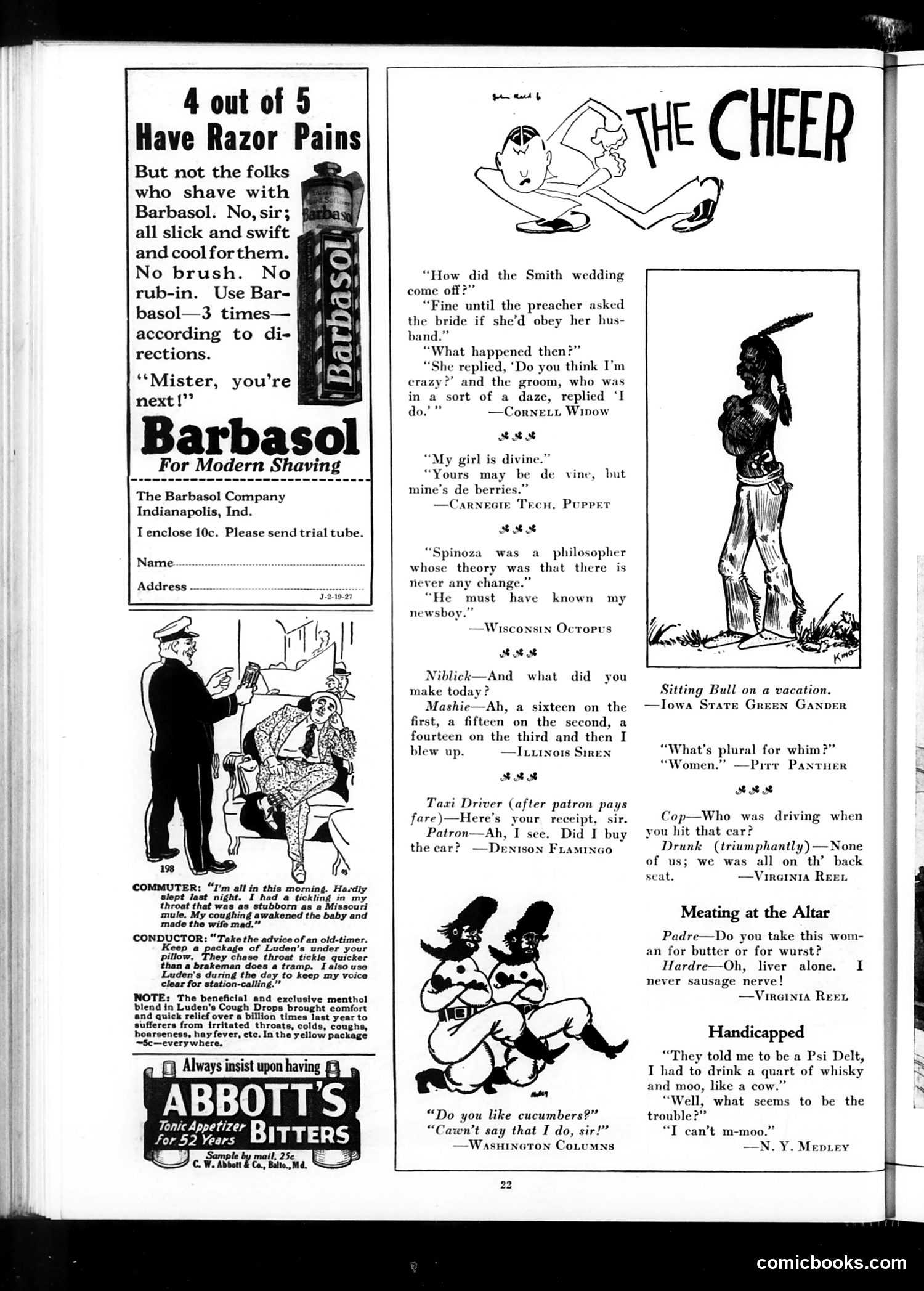
This is primarily a **humor/joke page** rather than political satire. "The Cheer" collects short jokes and witty exchanges sourced from various publications and contributors. The jokes reflect **early 20th-century social attitudes**: - **Gender humor**: A bride refusing obedience vows (mocking women's emerging independence); a quip about women being the "plural for whim" - **Class/ethnic comedy**: Dialect humor ("Cawn't say," "m-moo") stereotyping working-class or immigrant speakers - **Marital satire**: A priest's pun about "butter or wurst" (mistaking marriage vows for food choices) - **College culture**: A fraternity pledge joke about hazing rituals involving alcohol and degradation The accompanying illustrations—a cheerleader figure, sitting Native American ("Sitting Bull on vacation"), dancing figures—are decorative rather than narrative. **For modern readers**: This page demonstrates how period humor often relied on gender stereotypes, mocking dialects, and casual endorsements of hazing and intoxication that would be considered offensive or inappropriate today.
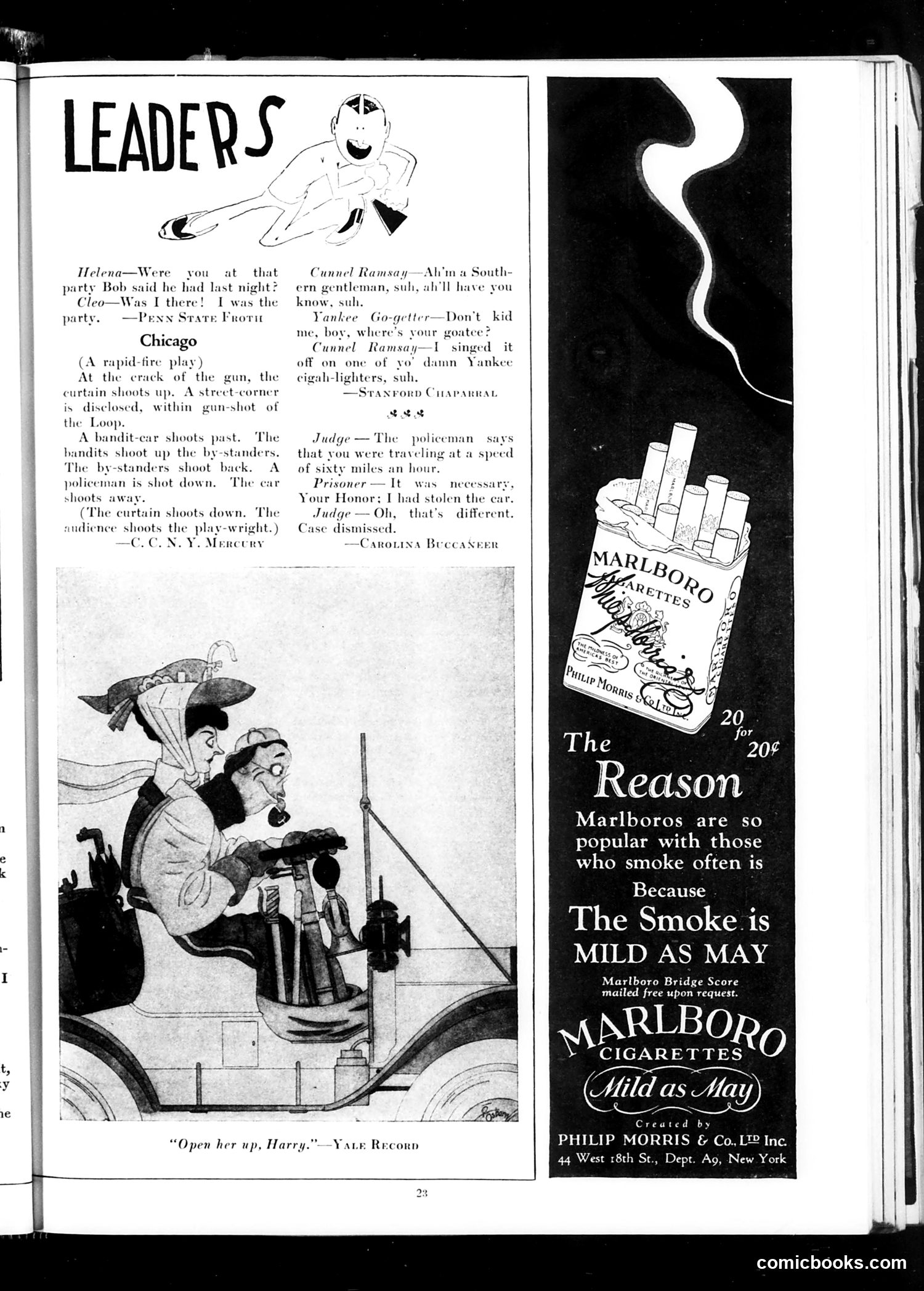
This page contains several short humorous sketches typical of Judge's satirical style: **"Helena" joke**: A woman brags she *was* the entire party—suggesting she dominated socially or was the main attraction. **"Chicago" sketch**: Sharp satire on urban gang violence of the Prohibition era. A rapid-fire scene depicts a shootout involving bandits, bystanders, police, and a getaway car—then jokes that the audience "shoots the playwright," mocking how sensational and formulaic such crime stories had become. **"Cunnel Ramsay" bit**: Stereotyped Southern gentleman character complains about Yankee cigarette lighters, playing on regional tensions and product placement humor. **"Judge" courtroom joke**: A prisoner admits to stealing a car while speeding; the judge dismisses charges because theft justifies reckless driving—absurdist humor inverting legal logic. The page also features a **Marlboro cigarette advertisement** emphasizing "mild" smoke, typical of vintage tobacco marketing before health warnings.
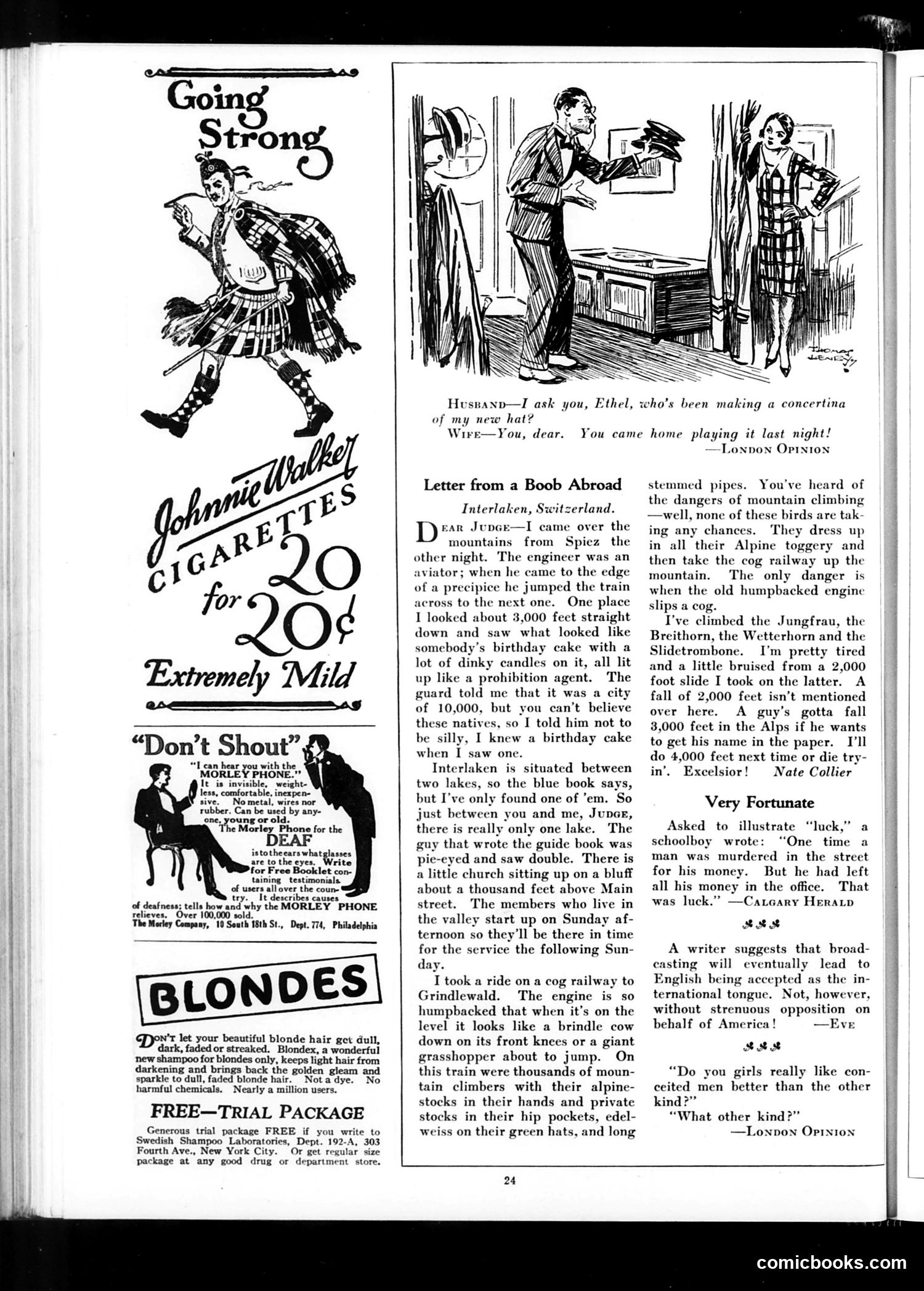
This page from *Judge* magazine contains mostly **advertisements and humor columns** rather than political cartoons. The main cartoon (top right) is a domestic comedy: a husband accuses his wife of ruining his new hat by playing it like a concertina (accordion) the previous night. The joke relies on the absurdity of treating a hat as a musical instrument—typical early-20th-century wordplay humor. Below that, "Letter from a Boob Abroad" is a travel satire mocking American tourists in Switzerland. The narrator exaggerates everything: mistaking a city for a birthday cake, claiming a lake doesn't exist because he only sees one reflection, and dramatically inflating the danger of mountain climbing. The humor targets American ignorance and braggadocio abroad. The remaining items are brief jokes and advertisements for period products (Morley Phone hearing device, Blondex hair shampoo) typical of magazine filler from this era.
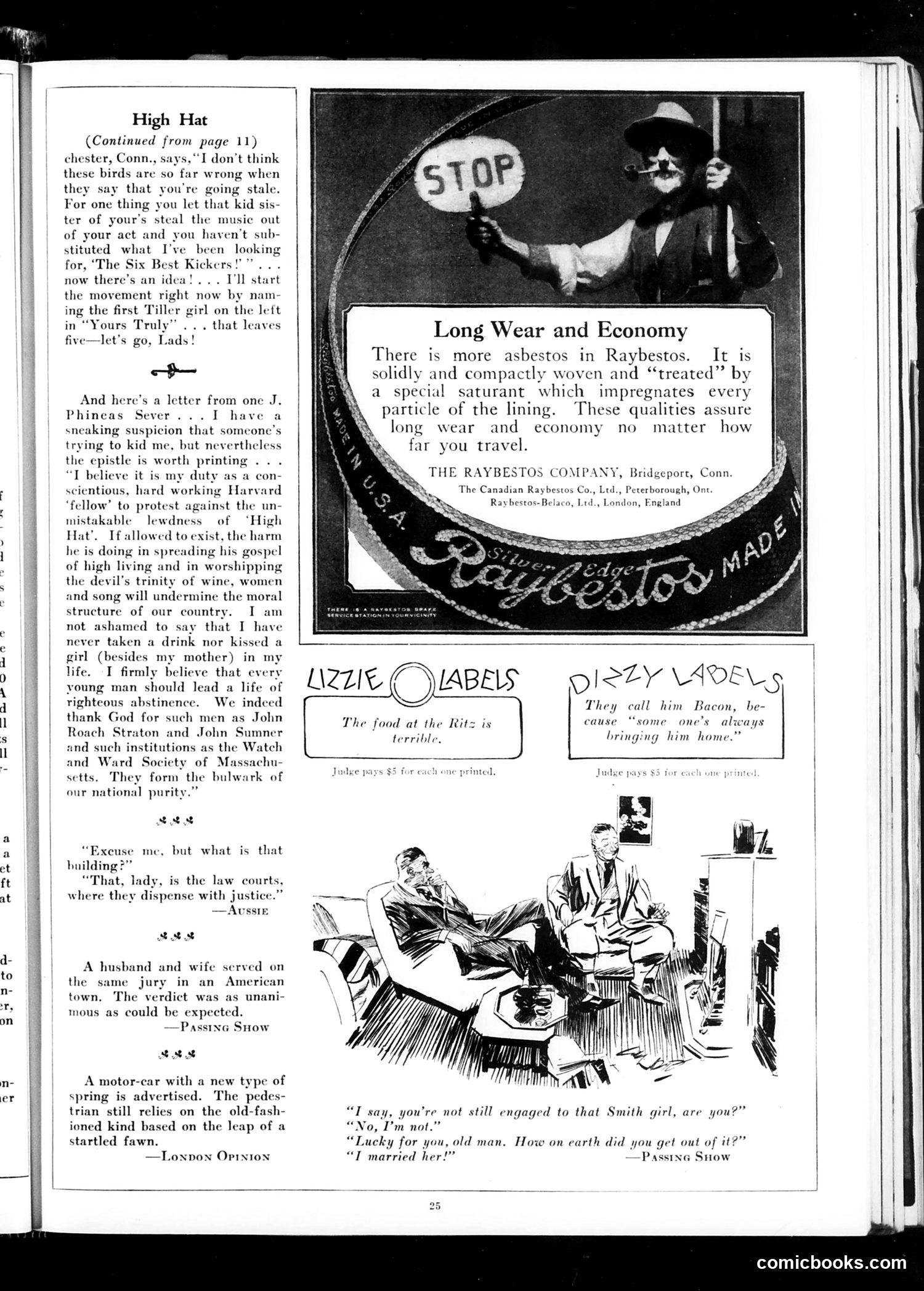
This page contains satirical commentary on morality and social behavior, typical of Judge magazine's style. The main content features letters attacking "High Hat" (a theatrical act or performer) for promoting vice. One correspondent from Harvard, J. Phineas Sever, claims the act glorifies "wine, women and song" and threatens national morality. He appeals to contemporary moral authorities like John Roach Straton and the Watch and Ward Society—real organizations known for censoring "obscene" entertainment in the 1920s-30s. The satire works by having an obviously sanctimonious prude (who's never drunk or kissed a woman) express exaggerated concerns, likely mocking both the act's critics and Prohibition-era moral panic. The bottom section contains unrelated joke comics, including one about a husband and wife on a jury (implying predictable marital outcomes) and another playing on the name "Bacon" as slang for bringing something home. The Raybestos advertisement occupies the upper right.
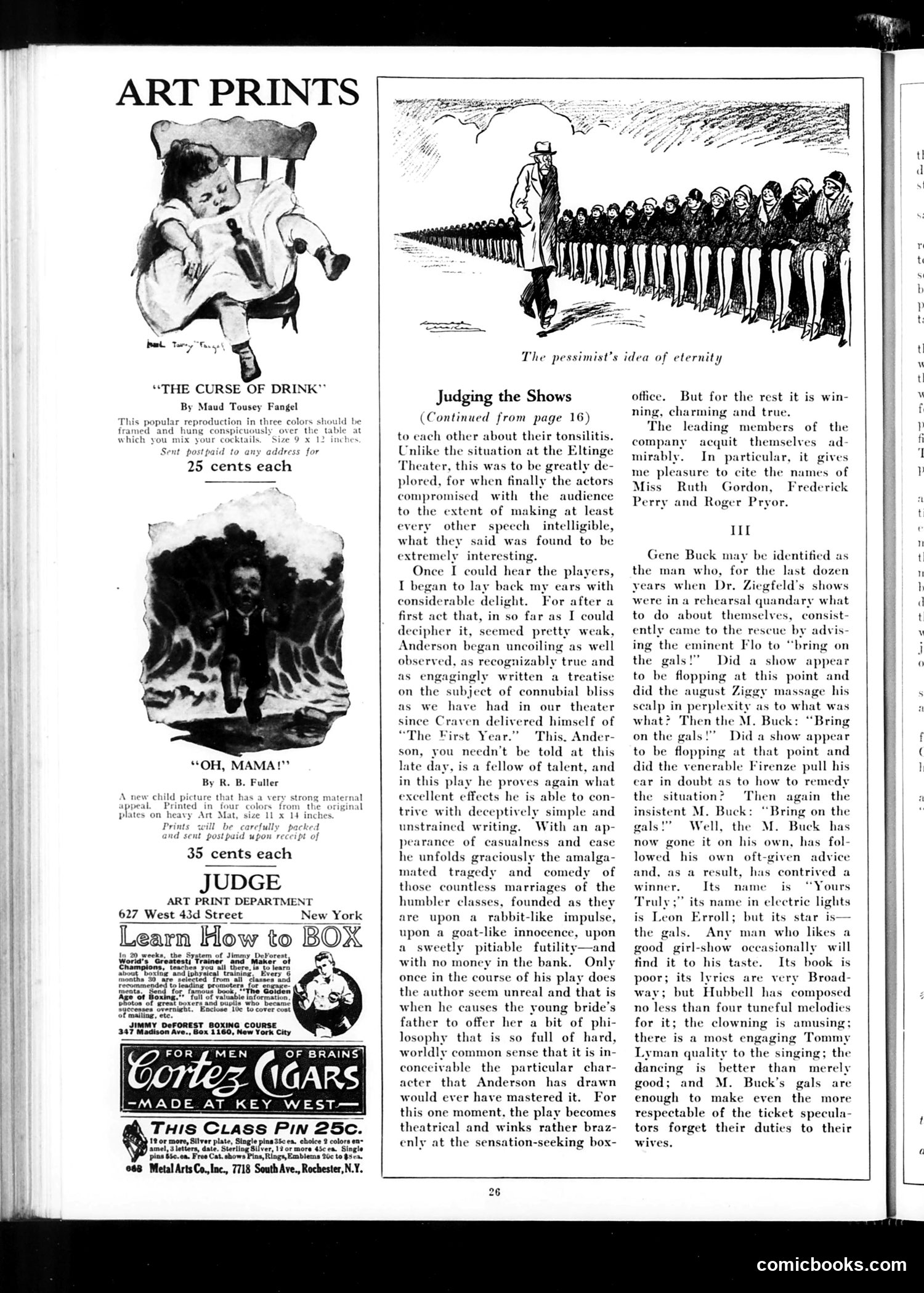
This page mixes advertisements with theater criticism. The art prints section advertises reproductions like "The Curse of Drink" (showing a woman drinking) and "Oh, Mama!" (a sentimental child image)—typical mass-market fare of the era. The main content is a theater review titled "Judging the Shows," praising a play (likely by John Golden) featuring actor Richard Anderson. The critic praises Anderson's naturalistic acting style and the play's portrayal of working-class marriages founded on "rabbit-like impulse" and "goat-like innocence"—satirizing impulsive lower-class courtship. The cartoon "The pessimist's idea of eternity" (top right) depicts an endless line of identical figures following a man, likely satirizing conformity or repetitive drudgery as a vision of hell. Gene Buck is identified as Florenz Ziegfeld's go-to problem-solver for Ziegfeld Follies shows, known for his catchphrase "bring on the gals!"—essentially solving theatrical crises through spectacle rather than substance.
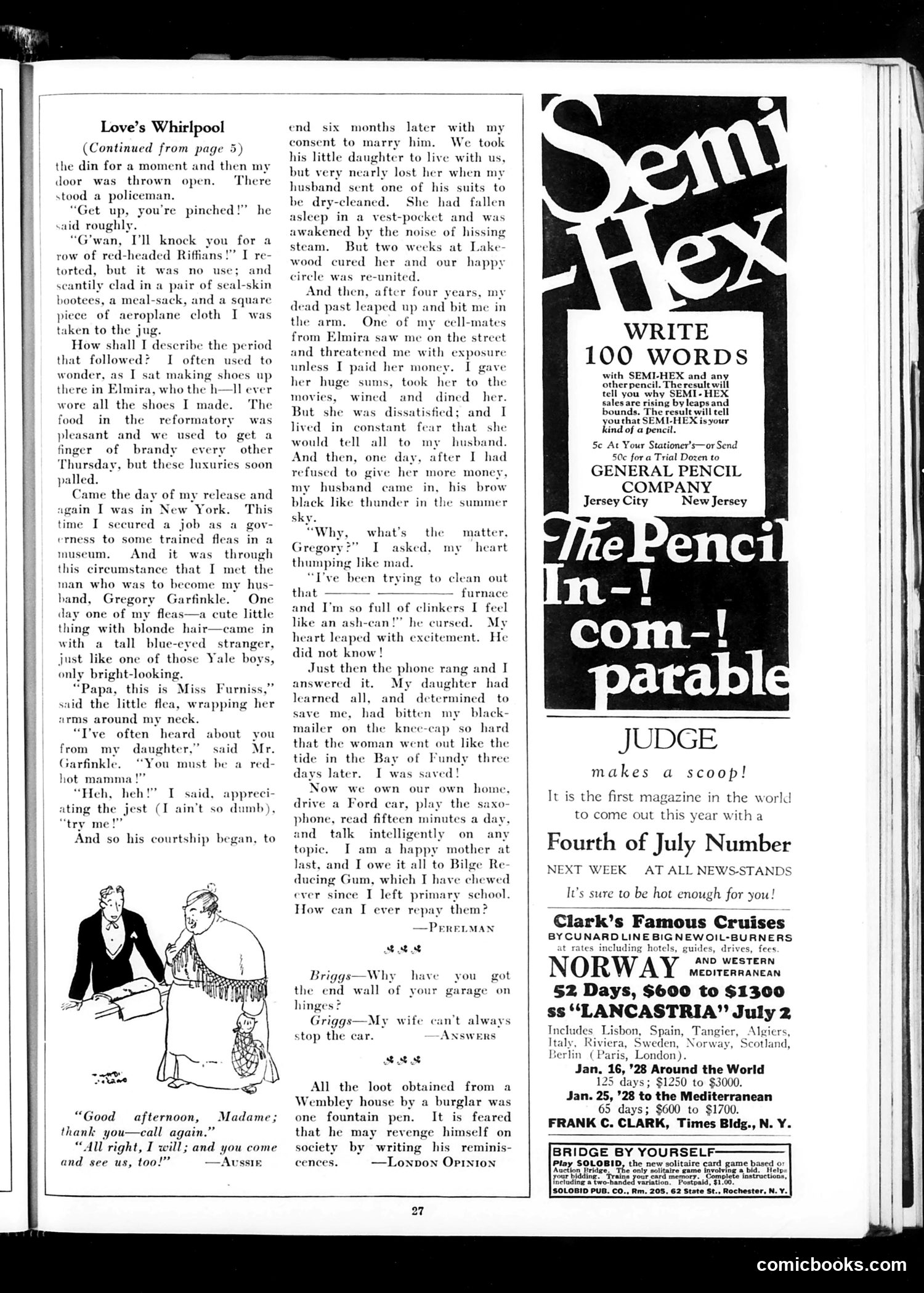
This page features a serialized humorous short story by S.J. Perelman (credited as "Perelman" at bottom), a celebrated American humorist. The narrative is a melodramatic first-person account of a woman's tumultuous life—imprisonment, governess work with trained fleas, marriage to Gregory Garfinkle, blackmail by a former cellmate, and ultimate redemption through her daughter's intervention. The satire targets overwrought pulp fiction and melodrama popular in the 1920s-30s, mocking clichéd plot devices (hidden past, blackmail, dramatic last-minute rescue) with absurdist humor (trained fleas as museum exhibits, daughter biting the blackmailer). A small cartoon below shows a domestic exchange about a garage door, exemplifying everyday marital humor. The page is primarily text-driven rather than visual satire, showcasing Judge's literary content alongside period advertisements for cruises and pencils.
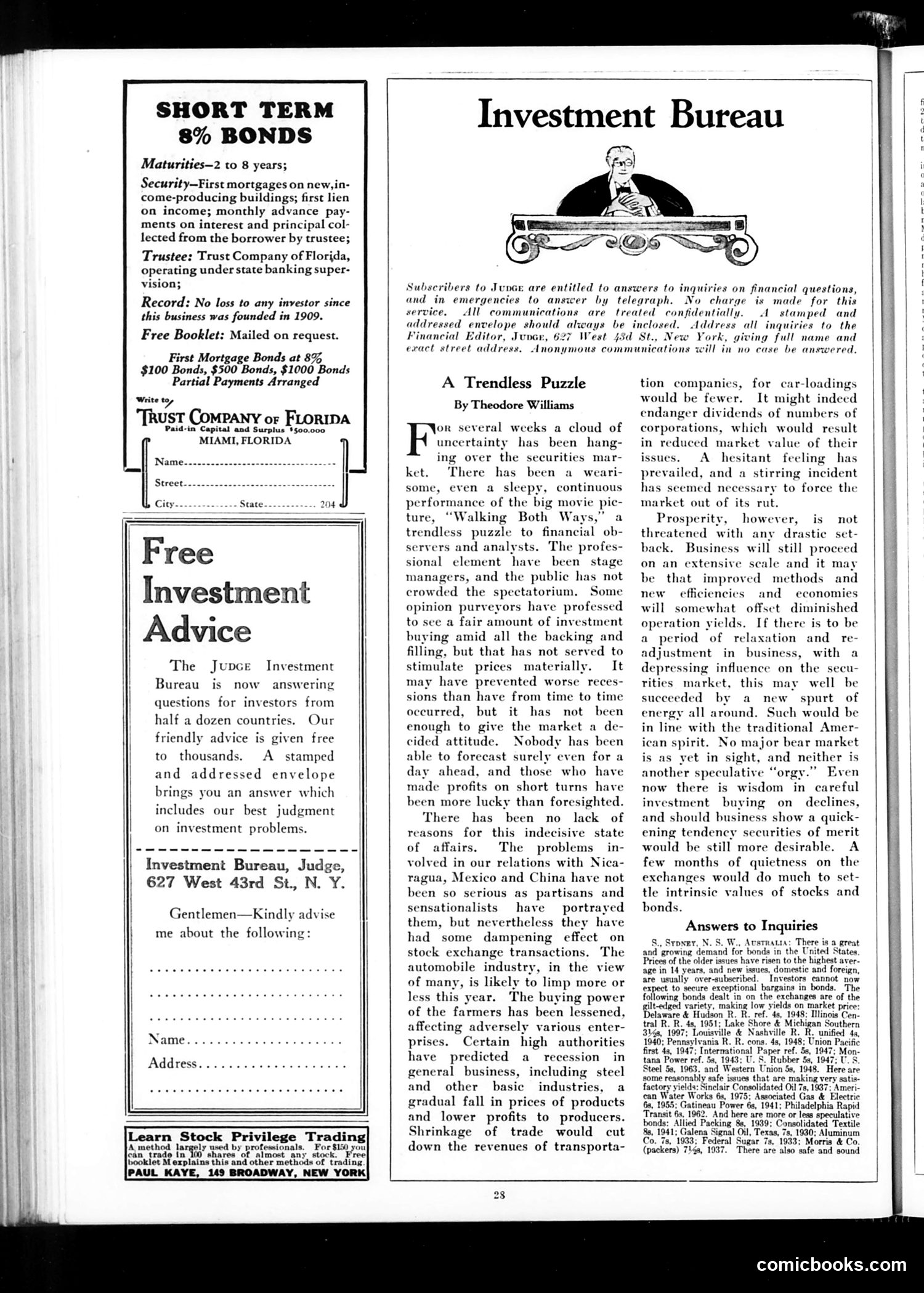
This page is primarily **advertising and financial advice**, not political satire. It contains: 1. **Investment advertisements**: Bond offerings from Trust Company of Florida and stock trading instruction services—standard financial promotion. 2. **"Investment Bureau" advice column**: Judge magazine's service answering investor questions from readers worldwide, presented as a public service. 3. **"A Trendless Puzzle" article** by Theodore Williams: An analysis of stock market uncertainty during what appears to be the 1920s. The piece discusses depressed market conditions caused by multiple factors—diplomatic tensions with Nicaragua/Mexico/China, weakness in the auto industry, reduced farm purchasing power, and predictions of general business recession. The "puzzle" is the market's inability to move decisively upward despite some investment buying activity. **No political cartoon is visible**—this is a financial/business page typical of Judge's era, when the magazine mixed satire with legitimate investment content.
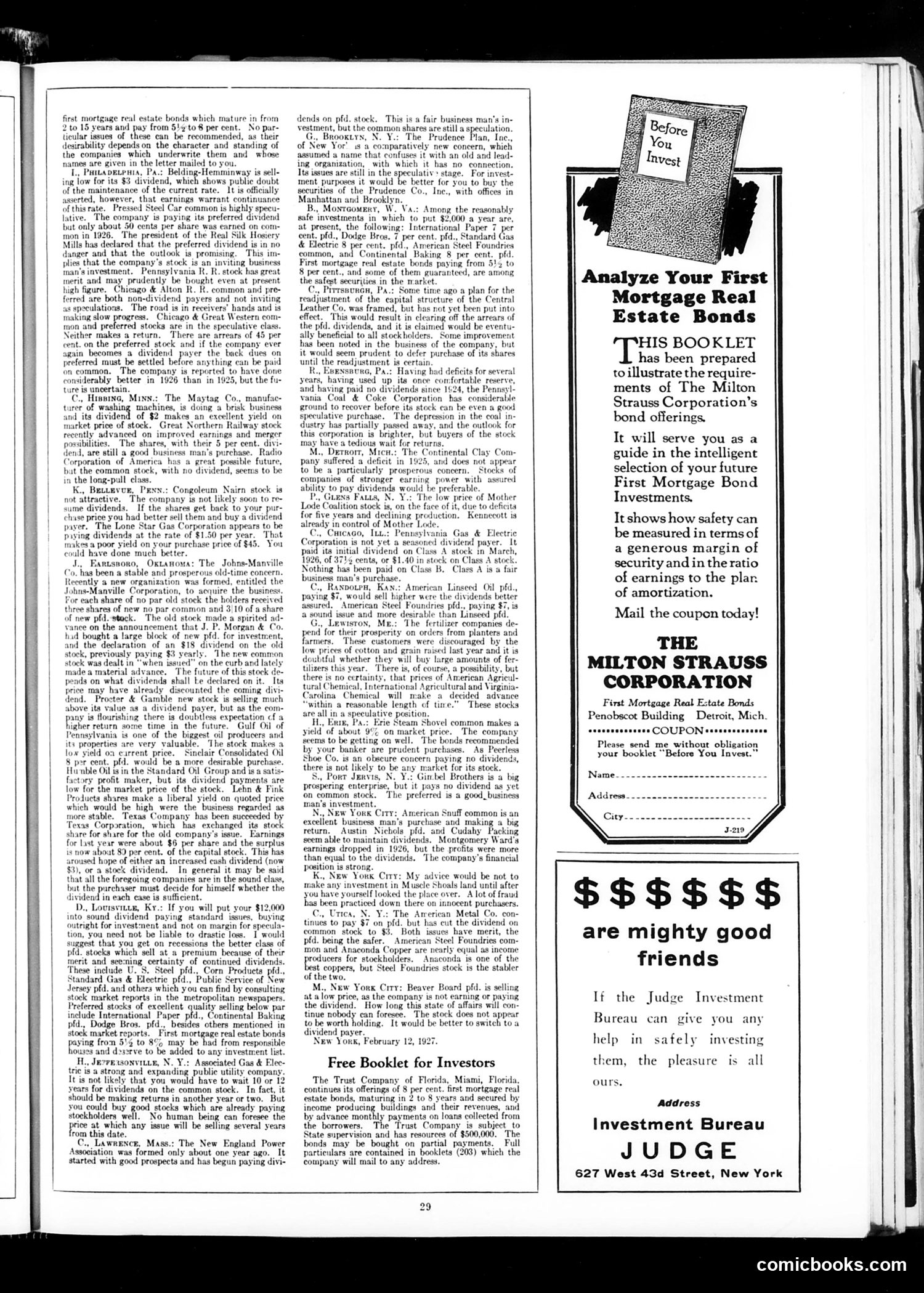
This page consists almost entirely of **investment advice columns**, not political satire or cartoons. The content addresses reader questions about purchasing various stocks and bonds—railroad companies (Pennsylvania R.R., Chicago & Alton), industrial manufacturers (Maytag, Radio Corporation of America), and oil companies (Gulf Oil, Sinclair). The small illustration in the upper right is an **advertisement** for the Milton Strauss Corporation's booklet on analyzing first mortgage real estate bonds, not a satirical cartoon. The text reflects 1920s investment culture during the prosperity before the 1929 crash, with advisors recommending stocks based on dividend yields and company stability. There is **no evident political satire or social commentary** on this page—it's a practical financial guidance column typical of Judge's mixed content. The page is primarily **informational rather than humorous or polemical**.
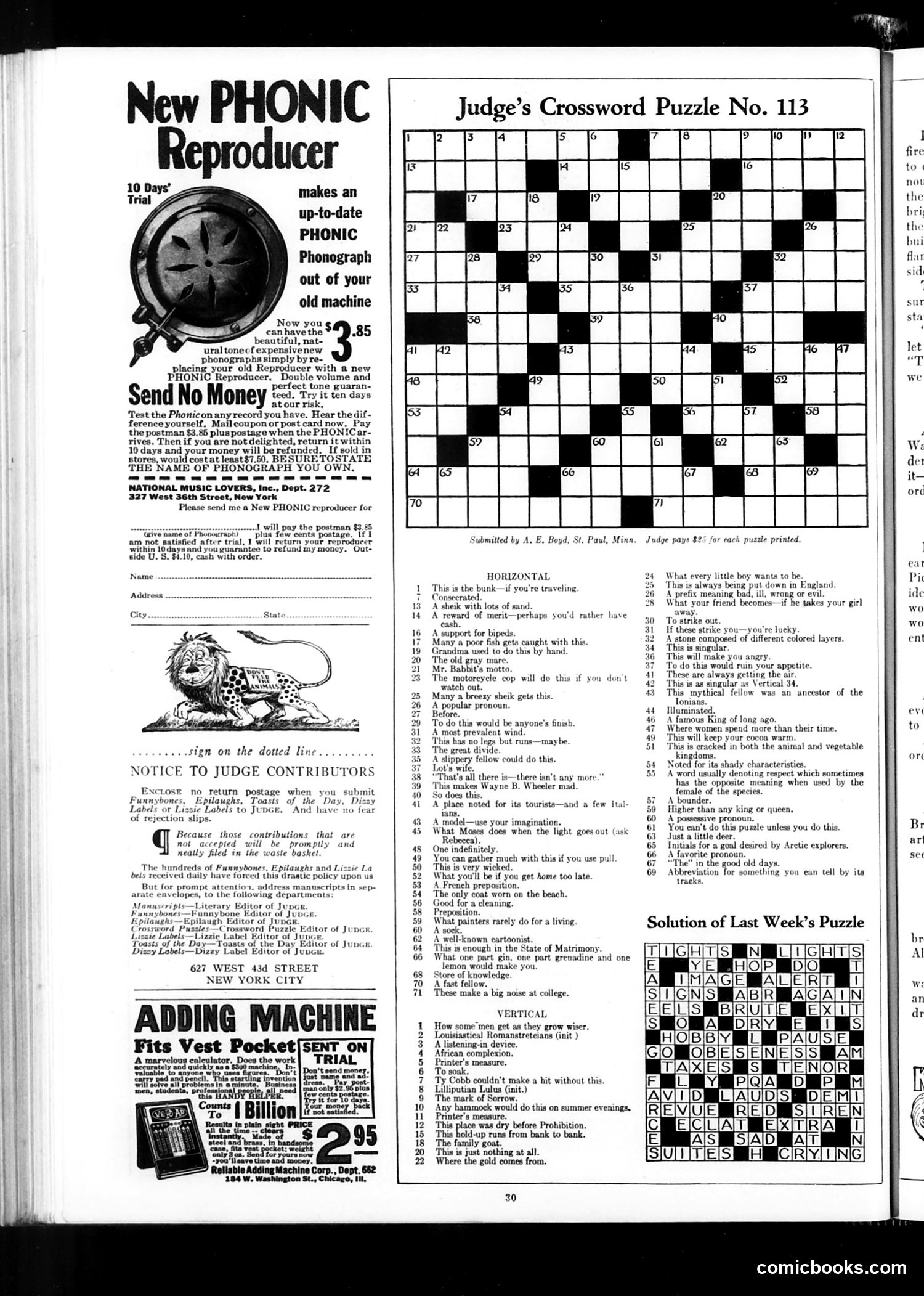
This page is primarily **advertising and puzzle content** rather than political satire. The main features are: 1. **"New Phonic Reproducer" advertisement** (top left): A mail-order offer to upgrade old phonographs with a new sound device for $3.85, exploiting consumer desire for modern technology without upfront payment. 2. **"Judge's Crossword Puzzle No. 113"** (center/right): A standard crossword puzzle with clues referencing 1920s culture—references to Wayne B. Wheeler (Prohibition enforcer), "Mr. Babbitt" (Sinclair Lewis's conformist character), and contemporary slang. 3. **"Adding Machine" advertisement** (bottom left): Another mail-order gadget promising pocket-sized calculation. 4. **Contributor guidelines** (lower left): Instructions for submitting comic material to Judge magazine. The page reflects **1920s consumer culture and advertising**, showcasing direct-mail marketing tactics and mass-market gadgetry rather than political commentary.
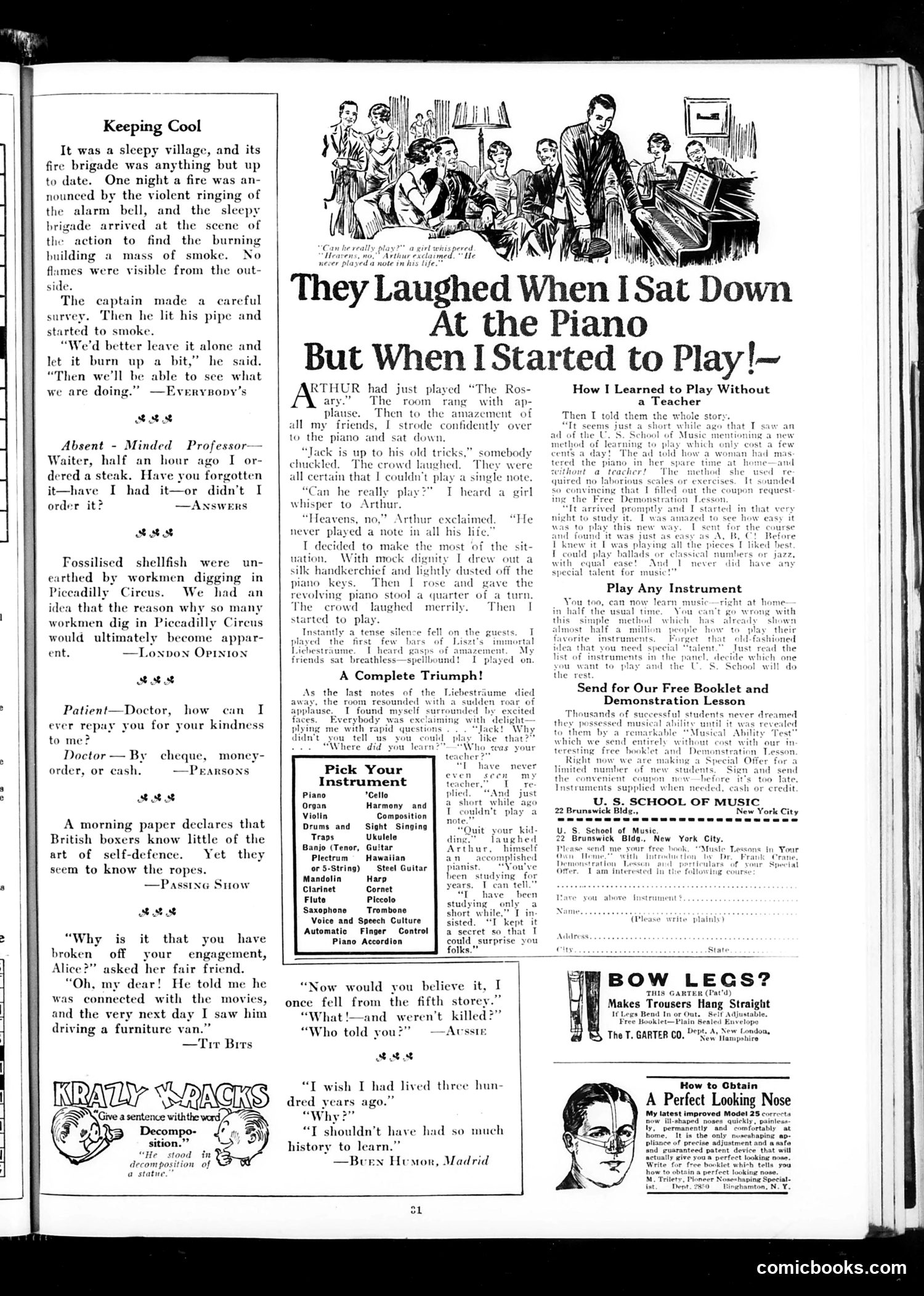
This page contains **primarily advertisements and humorous anecdotes** rather than political satire. The main feature, "They Laughed When I Sat Down At the Piano," is a **fictionalized advertisement** for the U.S. School of Music's mail-order piano lessons. The narrative depicts a social scenario typical of early 20th-century entertainment: a guest surprises a gathered crowd by playing piano skillfully despite everyone believing he couldn't play. This was designed to appeal to readers' aspirations for self-improvement and social status through music lessons. The scattered short jokes throughout ("Keeping Cool," "Absent-Minded Professor," etc.) are **generic humor with no political content**—targeting universal human foibles like forgetfulness and poor service. The bottom advertisements promote "Bow Legs" correction devices and nose-shaping procedures, reflecting period anxieties about physical appearance. This page represents **consumer-oriented entertainment journalism** rather than satirical commentary on current events or politics.
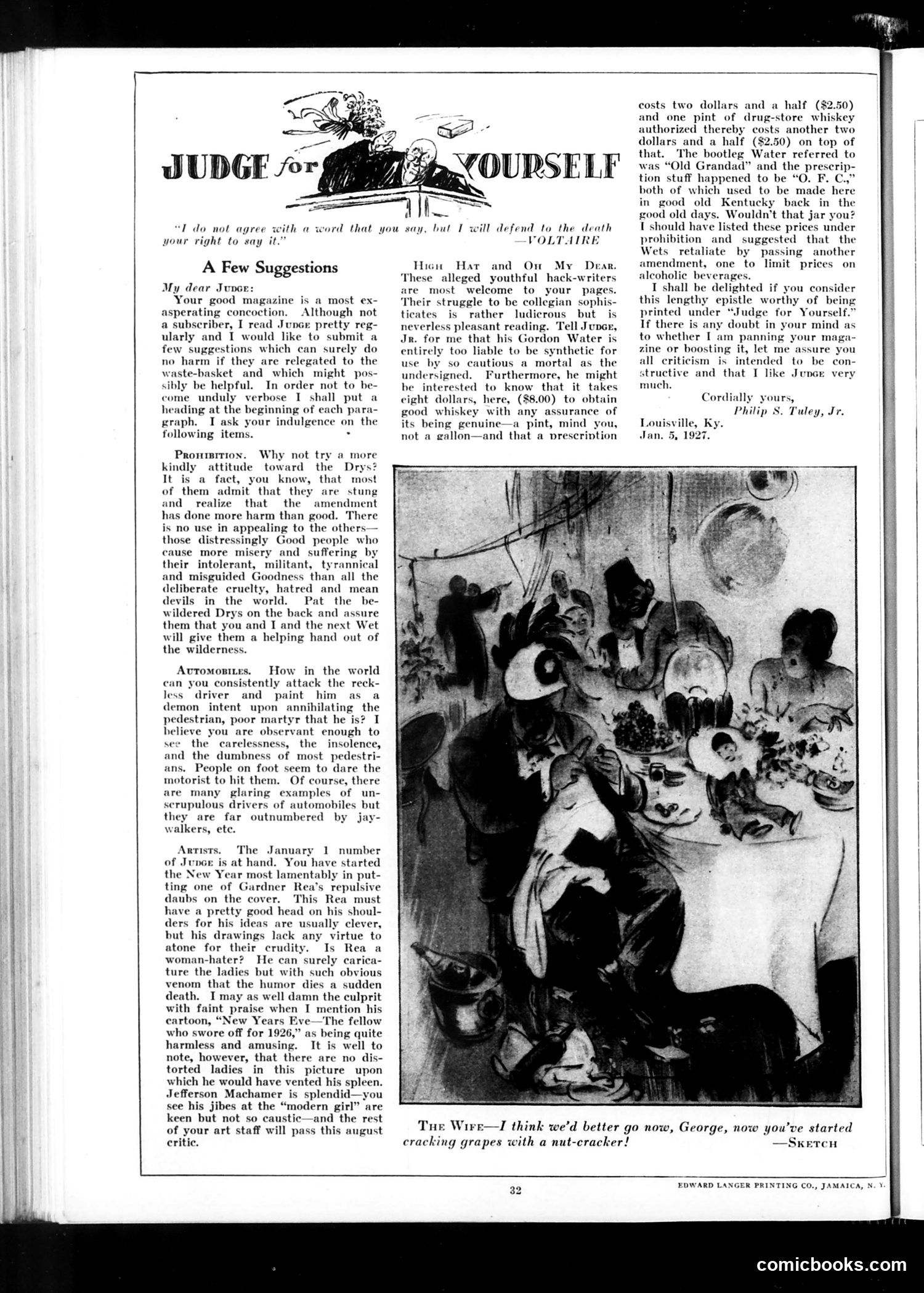
This is a **letters-to-the-editor page** from Judge magazine, featuring reader criticism disguised as mock praise. The main cartoon shows a couple discovering their child has been sampling illicit alcohol during Prohibition—"cracking grapes with a nut-cracker" (making homemade wine). The letters satirize Prohibition-era hypocrisy. One correspondent attacks Judge's criticism of reckless drivers while defending pedestrians' carelessness. Another mocks the magazine's artist Gardner Rea for drawing women with obvious "venom," suggesting misogyny. A third letter, clearly tongue-in-cheek, complains that bootleg whiskey costs $8 per pint plus $2.50 prescriptions for "medicinal" alcohol—then nostalgically recalls Kentucky bourbon from "good old days," implying Prohibition's prices are absurd and unenforceable. The overall effect: readers using Judge's own format to expose contradictions in Prohibition enforcement and mock both the law's unpopularity and the magazine's editorial positions.
This is a promotional advertisement rather than a political cartoon. Judge magazine is running a contest soliciting one-dollar bills from readers. The "lucky" criteria are somewhat whimsical: the bill must feature George Washington (the first U.S. President), have "Washington" spelled with ten letters, and possess a green back—all standard features of authentic dollar bills, making the "luck" somewhat tongue-in-cheek. The humor lies in the disclaimer that Judge won't ask how readers obtained the dollar or publish their photograph, suggesting a playful acknowledgment that some might be parting with currency they'd rather not explain. In exchange for sending in a dollar bill, readers receive ten weeks of Judge magazine. It's essentially a lighthearted subscription promotion disguised as a luck-based contest.
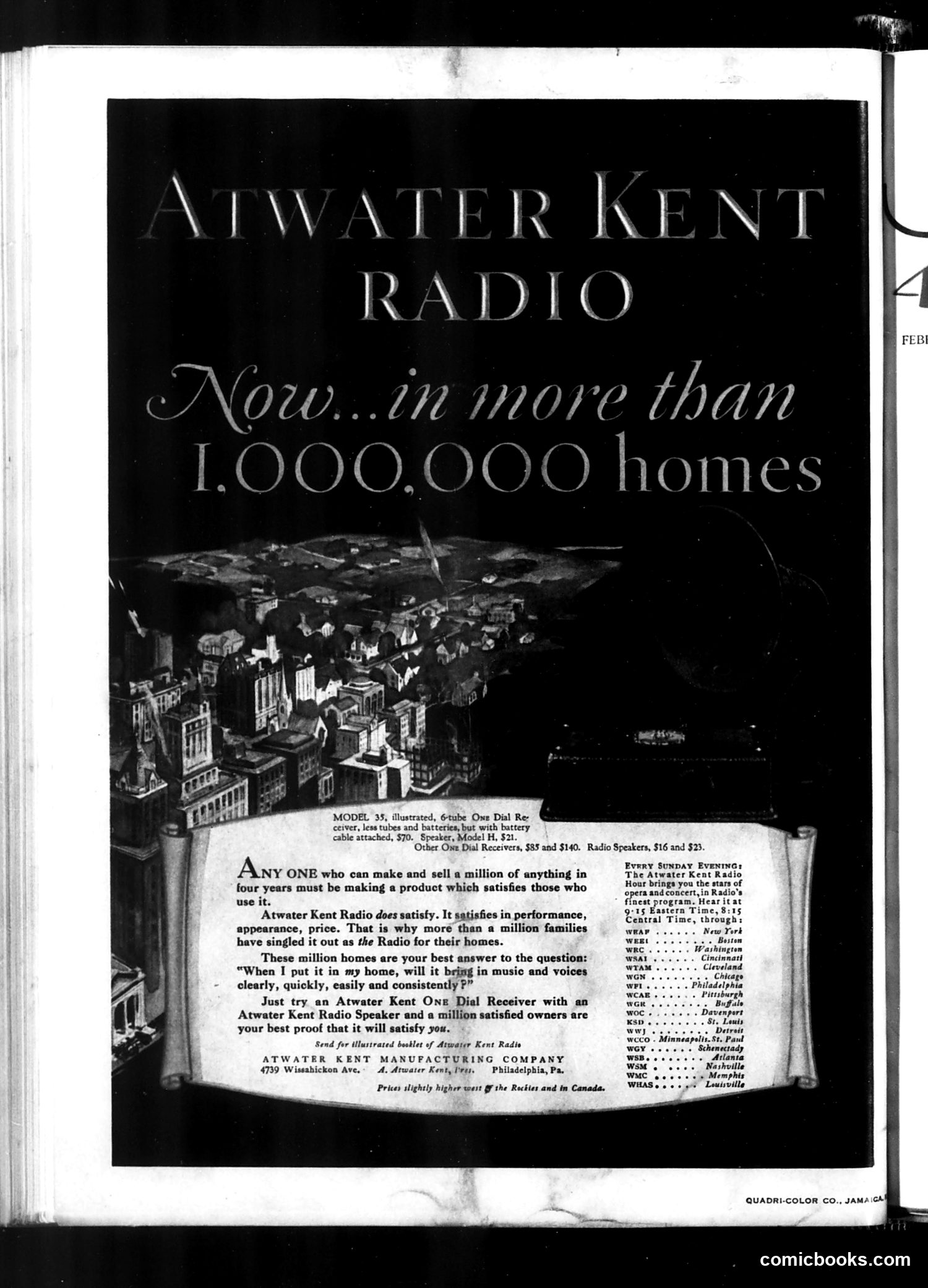
This is not a cartoon but a full-page advertisement for Atwater Kent radios, likely from the 1920s when radio ownership was rapidly expanding. The ad claims the product is "Now...in more than 1,000,000 homes," using this massive adoption as proof of quality and satisfaction. The advertisement employs a persuasive strategy common to that era: the argument that popularity equals reliability. The aerial cityscape image reinforces radio's modernity and urban sophistication. The text emphasizes the radio's performance, appearance, and price competitiveness—practical selling points for consumers deciding whether to invest in this new technology. The listing of radio stations (WEAF, WBZ, WBAY, etc.) demonstrates the growing network of broadcasting available to owners, suggesting entertainment value justifies the purchase.