
Judge, 1927-02-19 · page 18 of 36
Judge — February 19, 1927 — page 18: what you’re looking at
What you’re looking at
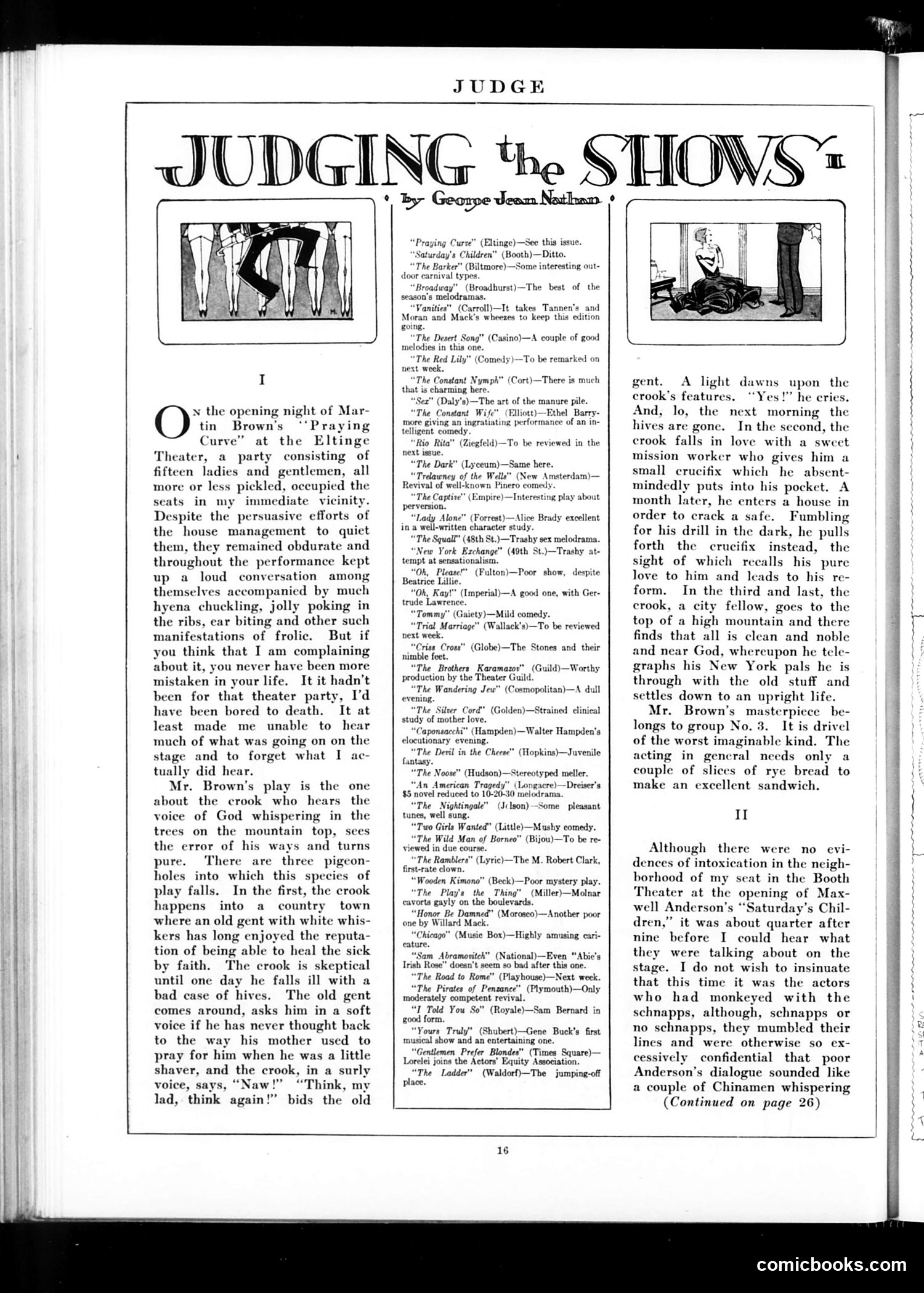
This page presents George Jean Nathan's theatrical review column, a regular Judge feature mocking Broadway productions. Nathan uses exaggerated complaint as satire—he claims the drunk, disruptive theater party next to him was better entertainment than Martin Brown's actual play "The Praying Curve," a redemption melodrama about a criminal who hears God's voice on a mountaintop. The satire targets both the play's predictability (Nathan catalogs three hackneyed plot formulas for such morality tales) and theater-going culture itself. The accompanying reviews list dozens of contemporary Broadway shows with snide one-liners—dismissing productions as "trashy," "dull," or "muddy." The cartoons (illustrations showing theatrical scenes) visualize the absurdity Nathan describes. This column format allowed Judge to simultaneously entertain readers while mocking both theatrical quality and the pretensions of Broadway audiences in the 1920s.
📄 Transcribed text from this page (OCR, searchable)
Machine-transcribed from the original scan — historical spelling and the odd misread are preserved.
JUDGE JUDGING the SHOWS™ | n the opening O tin Brown’s ‘‘Praying Curve” at the Eltinge Theater, a party consisting of fifteen ladies and gentlemen, all more or less pickled, occupied the seats in my immediate vicinity. Despite the persuasive efforts of the house management to quiet them, they remained obdurate and throughout the performance kept up a loud conversation among themselves accompanied by much hyena chuckling, jolly poking in the ribs, ear biting and other such manifestations of frolic. But if you think that I am complaining about it, you never have been more mistaken in your life. It it hadn’t been for that theater party, I'd have been bored to death. It at least made me unable to hear much of what was going on on the stage and to forget what I 2 tually did hear. Mr. Brown's play is the one bout the crook who hears the voice of God whispering in the trees on the mountain top, sees the error of his ways and turns pure. There are three pigeon- holes into which this species of play falls. In the first, the crook happens into a country town where an old gent with white whis- kers has long enjoyed the reputa- tion of being able to heal the sick by faith. The crook is skeptical until one day he falls ill with a bad case of hives. The old gent comes around, asks him in a soft voice if he has never thought back to the way his mother used to pray for him when he was a little shaver, and the crook, in a surly voice, says, “Naw!” “Think, my lad, think again!” bids the old by Georpe Jeam Nathan ¢ raying Curte” (Eltinge)—See this issue. ‘Saturday's Children” (Booth)—Ditto. The Barker” (Biltmore)—Some interesting out- door carnival types. Broadway" (Broadburst)—The best of the season's melodramas. “Vanities” (Carroll)—It takes Moran and Mack's wheezes to keep this going. The Desert Song” (Casino)—A couple of good melodies in this one. The Red Lily" (Comedy)—To be remarked on next week. “The Constant Nymph” (Cort)—There is much that is charming here “Sez” (Daly's) —The art of the manure pile. “The Constant Wife” (Elliott)—Ethel Barry- more giving an ingratiating performance of an in- telligent comedy “Rio Rita” (Ziegfeld) next issue. “The Dark" (Lyceum)—' “Trelawney of the Wells" Revival of well-known Pi “The Captite” (Empire) —Int perversion. “Lady Alone” (Forrest)—Alice Brady excellent in a well-written character study. “The Squall” (48th St.)—Trashy sex melodrama. “New York Exchange” (49th St.)—Trashy at- tempt at sensationalism. “Oh, Please!” (Fulton)—Poor show, despite Beatrice Lillie. “Oh, Kay! (Imperial)—A good one, with Ger- trude Lawrence. “Tommy’ (Gaiety)—Mild comedy. “Trial Marriage” (Wallack's)—To be reviewed t week. » be reviewed in the me here. Amsterdam)— dy esting play about “Criss Cross" (Globe)—The Stones and their nimble feet. “The Brothers. Karamazor” (Guild)—Worthy production by the Theater Guild. “The Wandering Jew" (Cosmopolitan)—A dull evening. “The Silver Cord” study of mother love. “Caponsacchi” (Hampden)—Walter Hampden's clocutionary evening. “The Deril in the Cheese” (Hopkins)—Juvenile fantasy. “The Noose” (Hudson)—Stereotyped meller. “An American Tragedy” (Le $5 novel reduced to 10-20-30 melodr: “The Nightingale” (Jclson)—Some pleasant tunes, well sung. “Two Girls Wanted” (Little)—Mushy comedy. “The Wild Man of Borneo” (Bijou)—To be re- viewed in due course. “The Ramblers” (Lytic)—The M. Robert Clark, first-rate clown. “Wooden Kimono” (Beck)—Poor mystery play. “The Play's the Thing” (Miller)—Molnar cavorts gayly on the boulevards. “Honor Be Damned” (Morosco)—Another poor one by Willard Mack. ‘hicago” (Music Box)—Highly amusing cari- cature. “Sam Abramoriteh” (National)—Even “Abie's Irish Rose” doesn't seem so bad after this one. “The Road to Rome” (Playhouse)—Next week. “The Pirates of Penzance” (Plymouth)—Only moderately competent revival. “I Told You So" (Royale)—Sam Bernard in good form. “Yours Truly” (Shubert)—Gene Buck's first musical show and an entertaining one. “Gentlemen Prefer Blondes” (Times Square)— Lorelei joins the Actors’ Equity Association. ‘he Ladder” (Waldorf)—The jumping-off place. jolden)—Strained clinical -Dreiser's na. gent. A light dawns upon the crook’s features. “Yes!” he cries. And, lo, the next morning the hives are gone. In the second, the crook falls in love with mission worker who gives him a small crucifix which he absent- mindedly puts into his pocket. A month later, he enters a house in order to crack a safe. Fumbling for his drill in the dark, he pulls forth the crucifix instead, the sight of which recalls his pure love to him and leads to his re- form. In the third and last, the crook, a city fellow, goes to the top of a high mountain and there finds that all is clean and noble and near God, whereupon he tele- graphs his New York pals he is through with the old stuff and settles down to an upright life. Mr. Brown’s masterpiece be- longs to group No. 3. It is drivel of the worst imaginable kind. The acting in general needs only a couple of slices of rye bread to make an excellent sandwich. sweet II Although there were no evi- dences of intoxication in the neigh- horhood of my seat in the Booth Theater at the opening of Ma well Anderson's “‘Saturday’s Chil- dren,” it was about quarter after nine before I could hear what they were talking about on the stage. I do not wish to insinuate that this time it was the actors who had monkeyed with the schnapps, although, schnapps or no schnapps, they mumbled their lines and were otherwise so ex- cessively confidential that poor Anderson’s dialogue sounded like a couple of Chinamen whispering (Continued on page 26) 16 comicbooks.com A aan SAMARIA A hts nn —~