
Judge, 1927-02-19 · page 30 of 36
Judge — February 19, 1927 — page 30: what you’re looking at
What you’re looking at
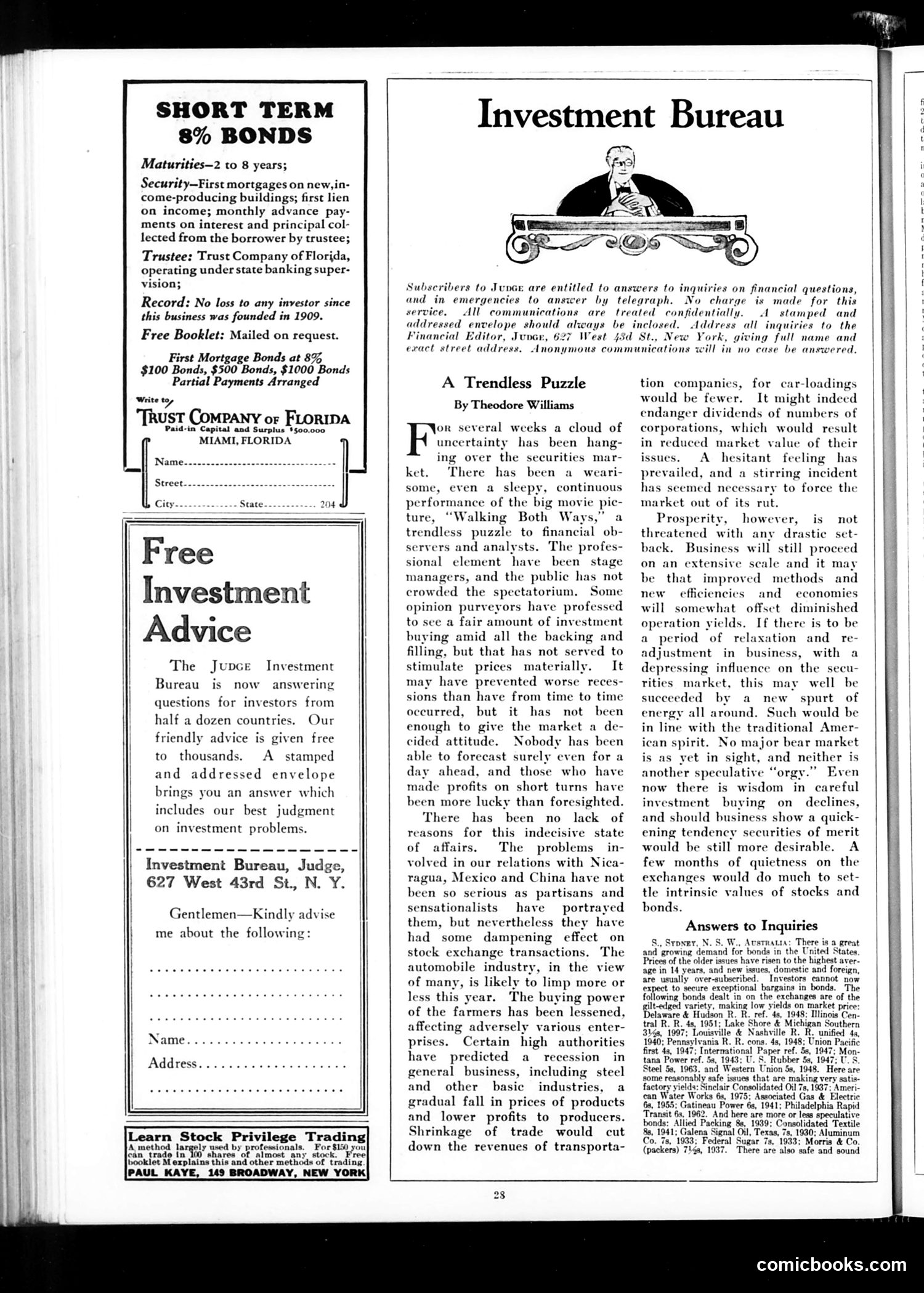
This page is primarily **advertising and financial advice**, not political satire. It contains: 1. **Investment advertisements**: Bond offerings from Trust Company of Florida and stock trading instruction services—standard financial promotion. 2. **"Investment Bureau" advice column**: Judge magazine's service answering investor questions from readers worldwide, presented as a public service. 3. **"A Trendless Puzzle" article** by Theodore Williams: An analysis of stock market uncertainty during what appears to be the 1920s. The piece discusses depressed market conditions caused by multiple factors—diplomatic tensions with Nicaragua/Mexico/China, weakness in the auto industry, reduced farm purchasing power, and predictions of general business recession. The "puzzle" is the market's inability to move decisively upward despite some investment buying activity. **No political cartoon is visible**—this is a financial/business page typical of Judge's era, when the magazine mixed satire with legitimate investment content.
📄 Transcribed text from this page (OCR, searchable)
Machine-transcribed from the original scan — historical spelling and the odd misread are preserved.
SHORT TERM 8% BONDS Maturities—2 to 8 years; Security—First mortgages on new, in- come-producing buildings; first lien on income; monthly advance pay- ments on interest and principal col- lected from the borrower by trustee; Trustee: Trust Company of Florida, operating under state banking super- vision; Record: No loss to any investor since this business was founded in 1909. Free Booklet: Mailed on request. First Mortgage Bonds at 8% $100 Bonds, $500 Bonds, $1000 Bonds Partial Payments Arranged ‘Write to, ‘Trust CoMPANY or FLORIDA Paid-in Capital and Surplus 500,000 MIAMI, FLORIDA Investment Advice The Jupce Investment Bureau is now answering questions for investors from half a dozen countries. Our friendly advice is given free to thousands. A stamped and addressed envelope brings you an answer which includes our best judgment on investment problems. Investment Bureau, Judge, 627 West 43rd St. N. Y. Gentlemen—Kindly advise me about the following: Learn Stock Privilege Trading A method largely used by professionals. For $15) you| can trade in 100 shares of almost any stock. Free booklet M explains this and other methods of trading. PAUL KAYE, 149 BROADWAY, NEW YORK) Investment Bureau Subscribers to Jen and in emergencies to answer are entitled to answers to inqui $ on financial questions, by telegraph. No charge is made for this service. All communications are treated confidentially. A stamped and addre. ed envelope should al A Trendless Puzzle By Theodore Williams OR sev weeks a cloud of uncertainty has been hang- ing over the securities mar- ket. There has been a_ weari some, even a sleepy, continuous performance of the big movie pi ture, “Walking Both W trendless puzzle to financial ob- servers and analysts. The profes- sional element have been stage managers, and the public has not crowded the spectatorium. Some opinion purveyors have professed to see a fair amount of investment buying amid all the backing and filling, but that has not served to stimulate prices materially. It ve prevented worse reces- sions than have from time to time occurred, but it has not been enough to give the market a de- cided attitude. Nobody has been able to forecast surely even for a day ahead, and those who have made profits on short turns have been more lucky than foresighted. There has been no lack of reasons for this indecisive state of affairs. The problems in- volved in our relations with Nica- ragua, Mexico and China have not been so serious as partisans and sensationalists have portrayed them, but nevertheless they have had some dampening effect on stock exchange transactions. The automobile industry, in the view of many, is likely to limp more or less this year. The buying power of the farmers has been lessened, affecting adversely various enter- prises. Certain high authorities have predicted a rece: general business, including steel and other basic industries, a gradual fall in prices of products and lower profits to producers. Shrinkage of trade would cut down the revenues of transporta- ion in ays be inclosed Financial Editor, Juvcr, 627 West 43d St., Ni exact street address. Anonymous communications % Address all inqui Yo 3 to the . giving full name and ill in no case be answered. tion companies, for car-loadings would be fewer. It might indeed endanger dividends of numbers of corporations, which would result in reduced market value of their issues. A hesitant feeling has prevailed, and a stirring incident ‘y to force the market out of its rut. Prosperity, however, is not threatened with any drastic set- back. Business will still proceed on an extensive scale and it may be t improved methods and new efficiencies and economies will somewhat offset diminished operation yields. If there is to be period of relaxation and re- adjustment in business, with a depressing influence on the secu- rities market, this may well be succeeded by a new spurt of energy all around. Such would be in line with the traditional Amer- ican spirit. No major bear market is as yet in sight, and neither is another speculative “orgy.” Even now there is wisdom in careful investment buying on declines, and should business show a quick- ening tendency securities of merit would be still more desirable. A few months of quietness on the exchanges would do much to set- tle intrinsic values of stocks and bonds. has seemed neces: Answers to Inquiries S., Sypser, N.S. W., Avstnatta: There is a great and growing demand for bonds in the United States, Prices of the older issues have risen to the highest aver- ‘age in 14 years, and new issues, domestic and foreign, are usually over-subscribed. Investors cannot now expect to secure exceptional bargains in bonds. The following bonds dealt in on the exchanges are of the gilt-edged variety, making low yields on market price: Delaware & Hudson R. R. ref. 4s, 1948; Illinois Cen- tral R. R. 4s, 1951; Lake Shore & Michigan Southern : Louisville & Nashville R. R. unified 4a, ania R. R. cons. 4s, 1948; Union Pacific tana Power ref. 53, 1943; U.S. Rubber 5s, 1947; U. Steel 5a, 1963, and Western Union 5s, 1948. Here are some fe issues that are making ry yields: Sinclair Consolidated Oil 7s, 1937 can Water Works 63, 197: 2 6s, 1955: Gatineau Power 6s, 1941; Philadelphia Rapid ‘Transit 63, 1962. And here are more or less speculative bonds: Allied Packing 8¢, 1939; Consolidated Textile 8s, 1941; Galena Signal Oil, Texas, 7s, 1930; Aluminum ugar 7s, 1933; Morris & Co. There are also safe and sound | 4 { comicbooks.com