
A complete issue · 36 pages · 1926
Judge — November 6, 1926
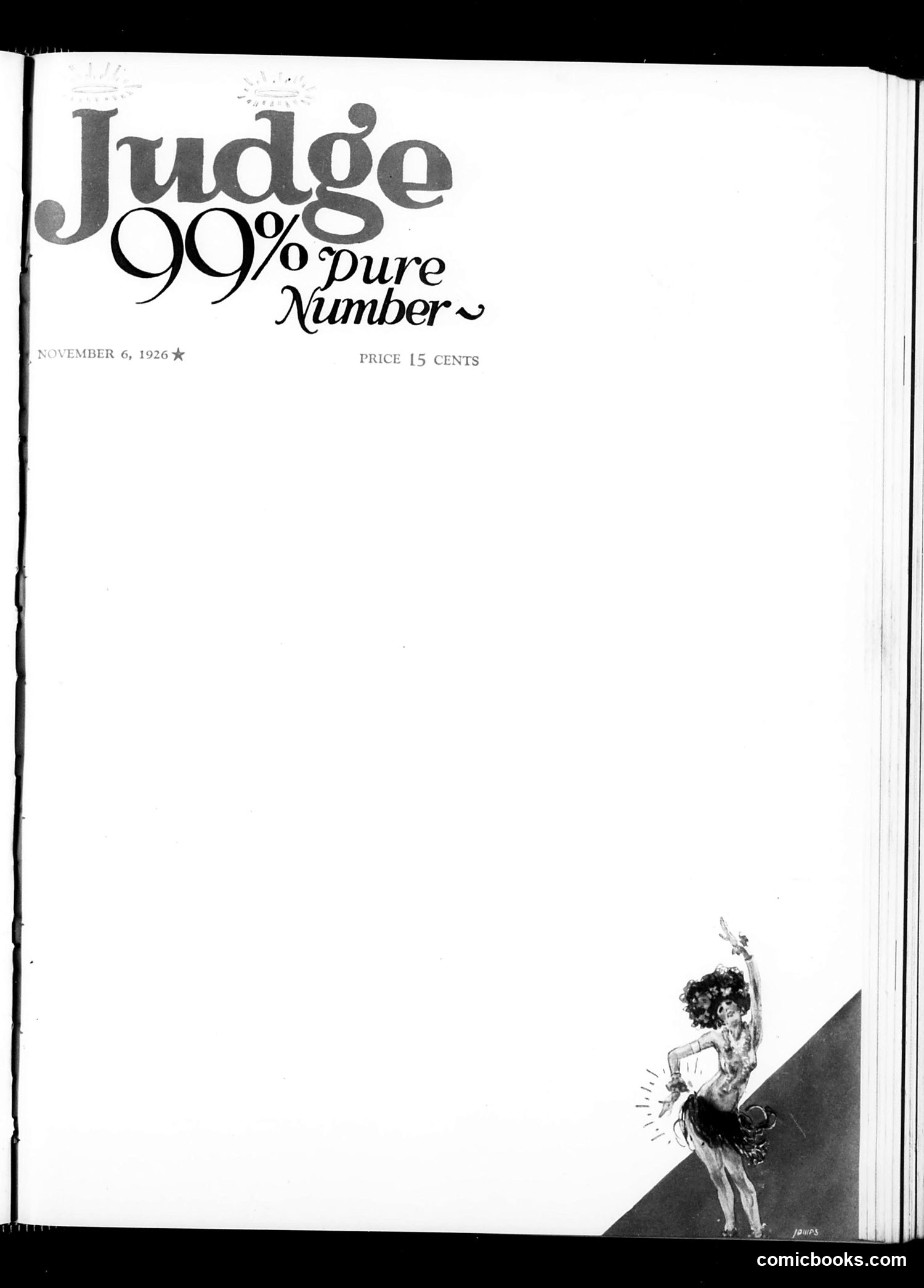
This is the cover of Judge magazine's "99% Pure Number" issue, priced at 15 cents. The main visual element shows a stylized female figure in an exaggerated pose on the right side of the page. The "99% Pure" reference likely alludes to commercial advertising claims of product purity prevalent in the 1920s—a common target of Judge's satirical commentary. The specific issue title suggests commentary on commercialism, consumer culture, or possibly political/social authenticity of the era. The figure's dramatic pose and styling are characteristic of 1920s illustration aesthetics. Without additional context or visible text on the cover itself, the specific satirical target remains unclear, though it likely critiques contemporary advertising, consumer behavior, or social pretension of the Jazz Age.
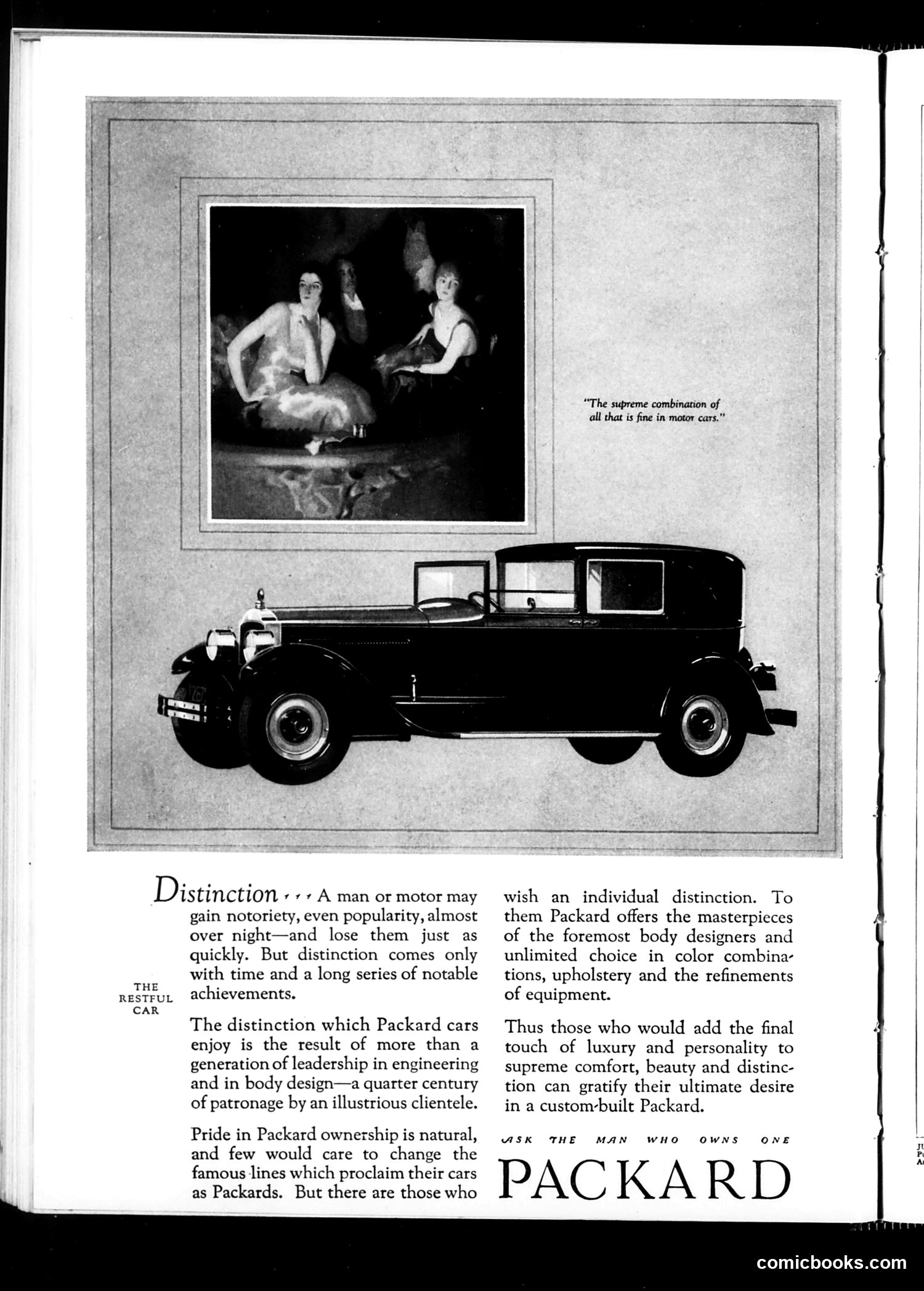
This is **not a cartoon or satire**—it's a luxury automobile advertisement for Packard cars, appearing in *Judge* magazine. The page presents an aspirational image: a photograph of two elegantly dressed women in an artistic, theatrical setting appears above a side-view illustration of a Packard automobile. The ad's text emphasizes that Packard ownership conveys "distinction" and "individual distinction"—suggesting the car signals wealth, taste, and social status to observers. The advertisement targets wealthy readers by emphasizing customization options, superior engineering, and the prestige associated with Packard's "quarter century of patronage by an illustrious clientele." This was standard luxury marketing of the era, positioning the automobile as a status symbol rather than mere transportation.
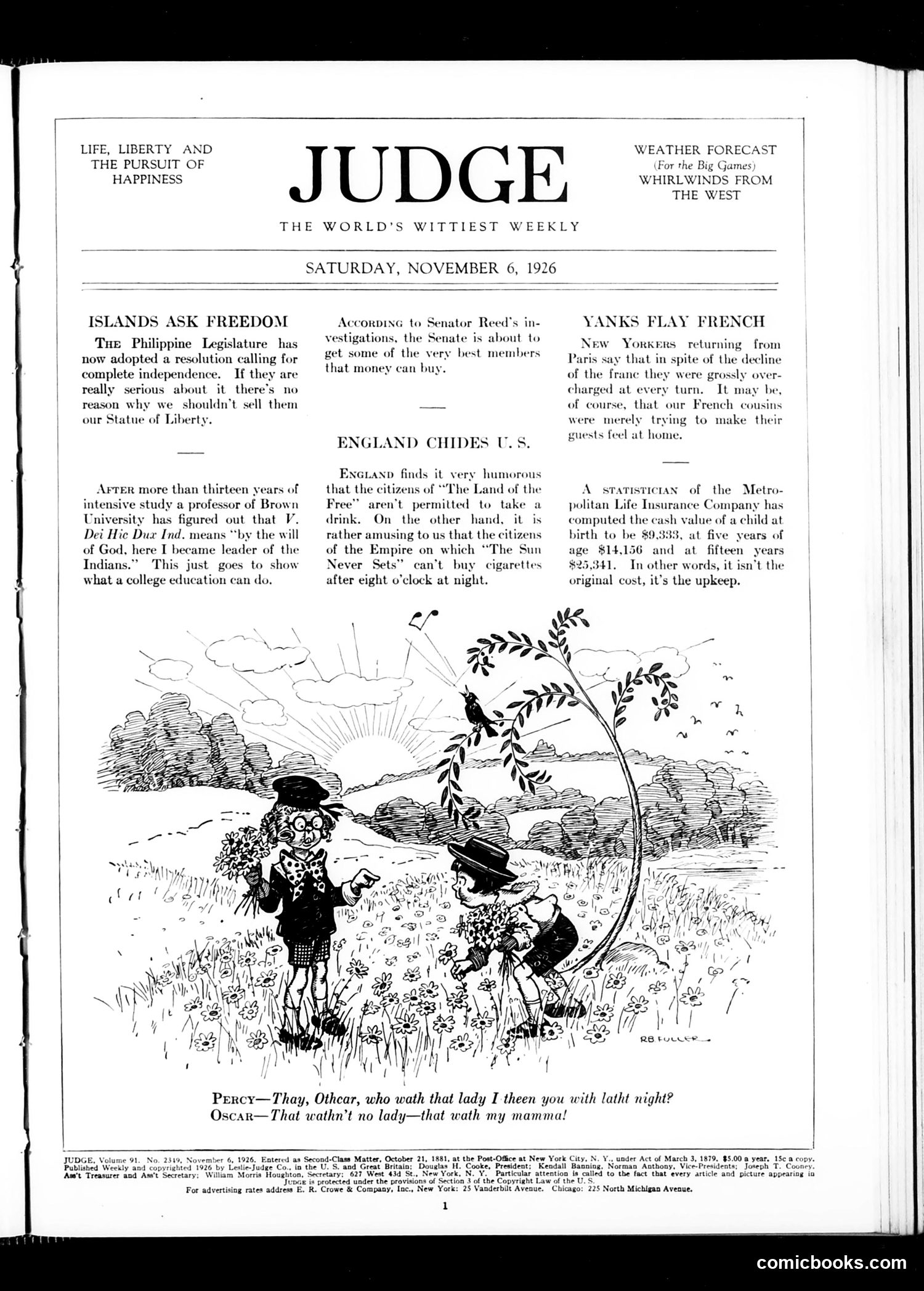
The main cartoon depicts two children in a flower field with the caption: "Percy—Thay, Otear, who walk that lady I theen you with lath night? / Oscar—That wathn't no lady—that wath my mamma!" This is a classic joke format playing on the children's lisp and mispronunciation ("theen," "lath," "wathn't"). The humor relies on the implication that Percy saw Oscar's mother in a compromising situation with someone who wasn't her husband—the punchline being Oscar's innocent misunderstanding that deflates the adult innuendo. The cartoon uses sentimental pastoral imagery (flowering meadow, sunrise) to contrast sharply with the risqué subject matter, a typical Judge satirical technique. It's primarily a joke about adult infidelity filtered through children's innocent speech.
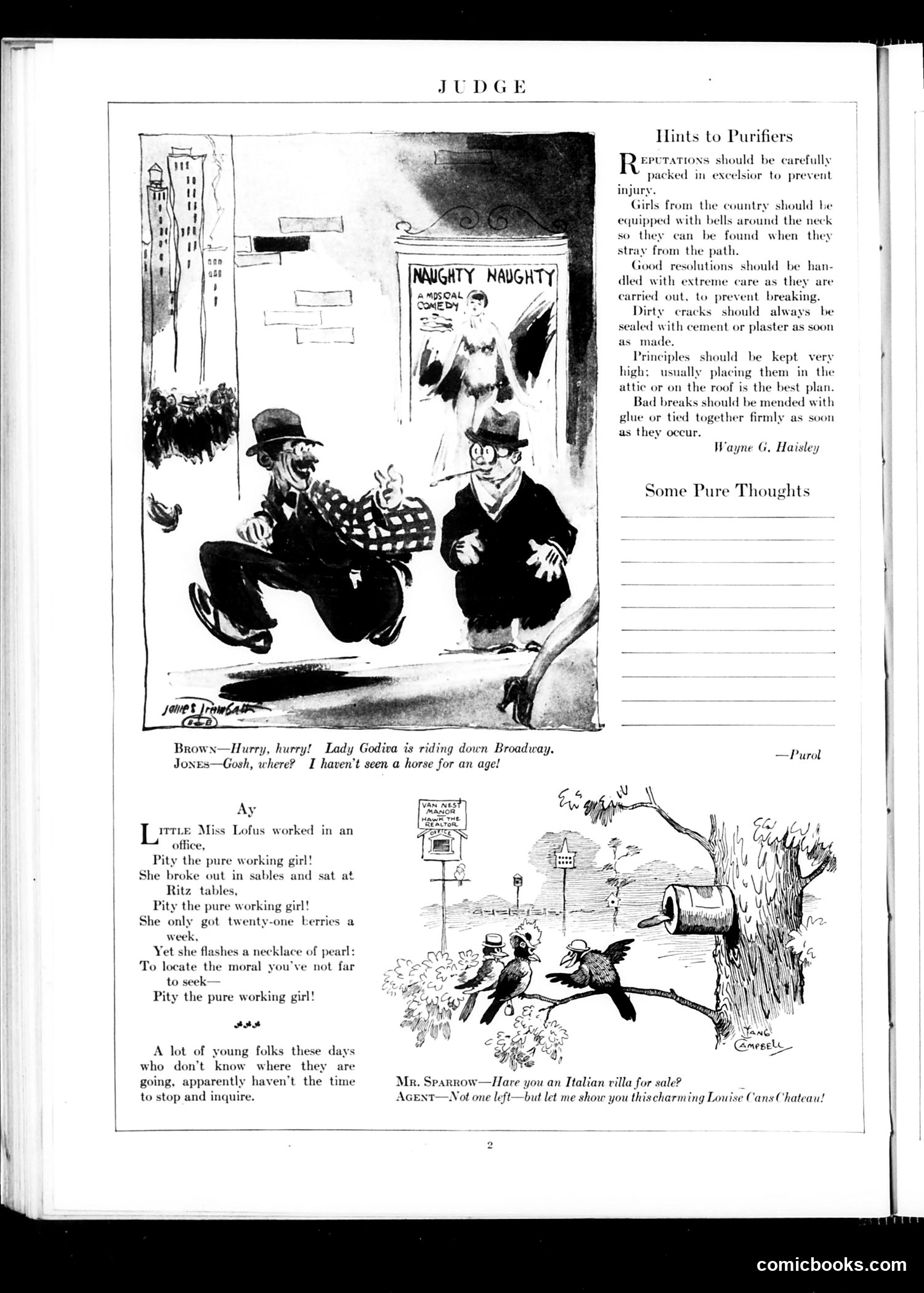
This page contains two separate cartoons and satirical pieces: 1. **Top Cartoon**: Two working-class men (Brown and Jones) react to seeing "Lady Godiva" riding down Broadway. The joke appears to reference the famous legend of Lady Godiva riding naked through town, suggesting a scandalous or indecent public spectacle on a New York street. The humor derives from the incongruity of this mythological event occurring in modern urban America. 2. **Bottom Section**: Includes a poem mocking "Little Miss Lotus," a working office girl earning only twenty-one dollars weekly who nonetheless wears pearl necklaces—critiquing the aspirational materialism and vanity of young working women. A accompanying note satirizes youth's ignorance about practical matters. Both pieces reflect early 20th-century attitudes toward class, gender, and morality, using gentle mockery rather than harsh political commentary.
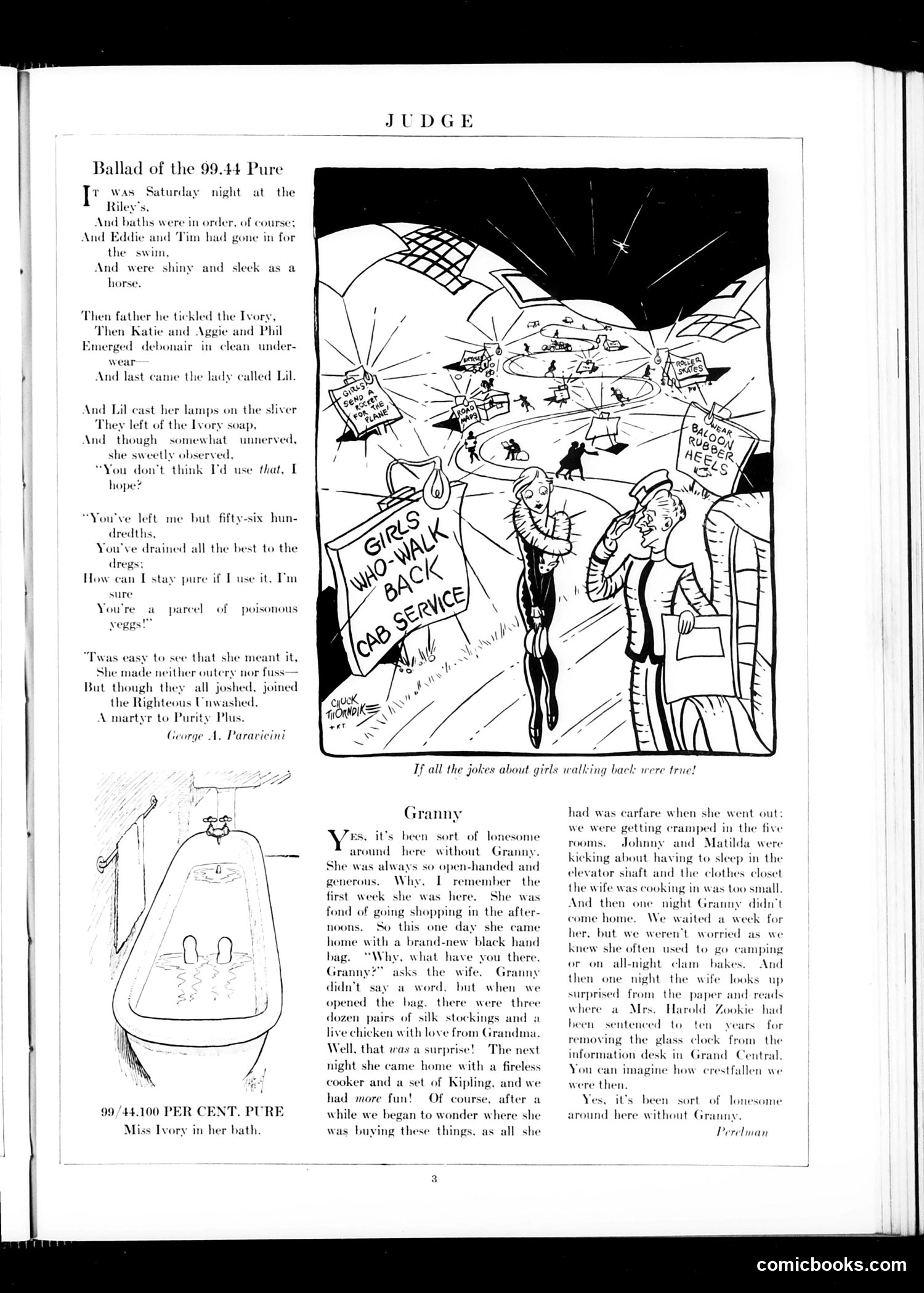
This page contains two pieces of content: **"Ballad of the 99.44 Pure"** (top): A poem-and-cartoon satirizing Ivory soap's famous "99.44% pure" advertising slogan. The illustration shows a chaotic domestic scene with a woman (Lil) discovering her husband's infidelity through soap residue evidence. The satire mocks both the soap's purity claim and marital complications—suggesting commercial purity messaging contrasts absurdly with human messiness. **"Granny" (bottom)**: A humorous domestic narrative about an elderly woman's mysterious shopping habits. The story plays on generational mystery and domestic surprise, culminating in the revelation of practical purchases (stockings, cooker). The accompanying bathtub illustration reinforces the domestic humor. Both pieces use everyday consumer products and household situations as vehicles for gentle satire on American middle-class life and advertising culture.
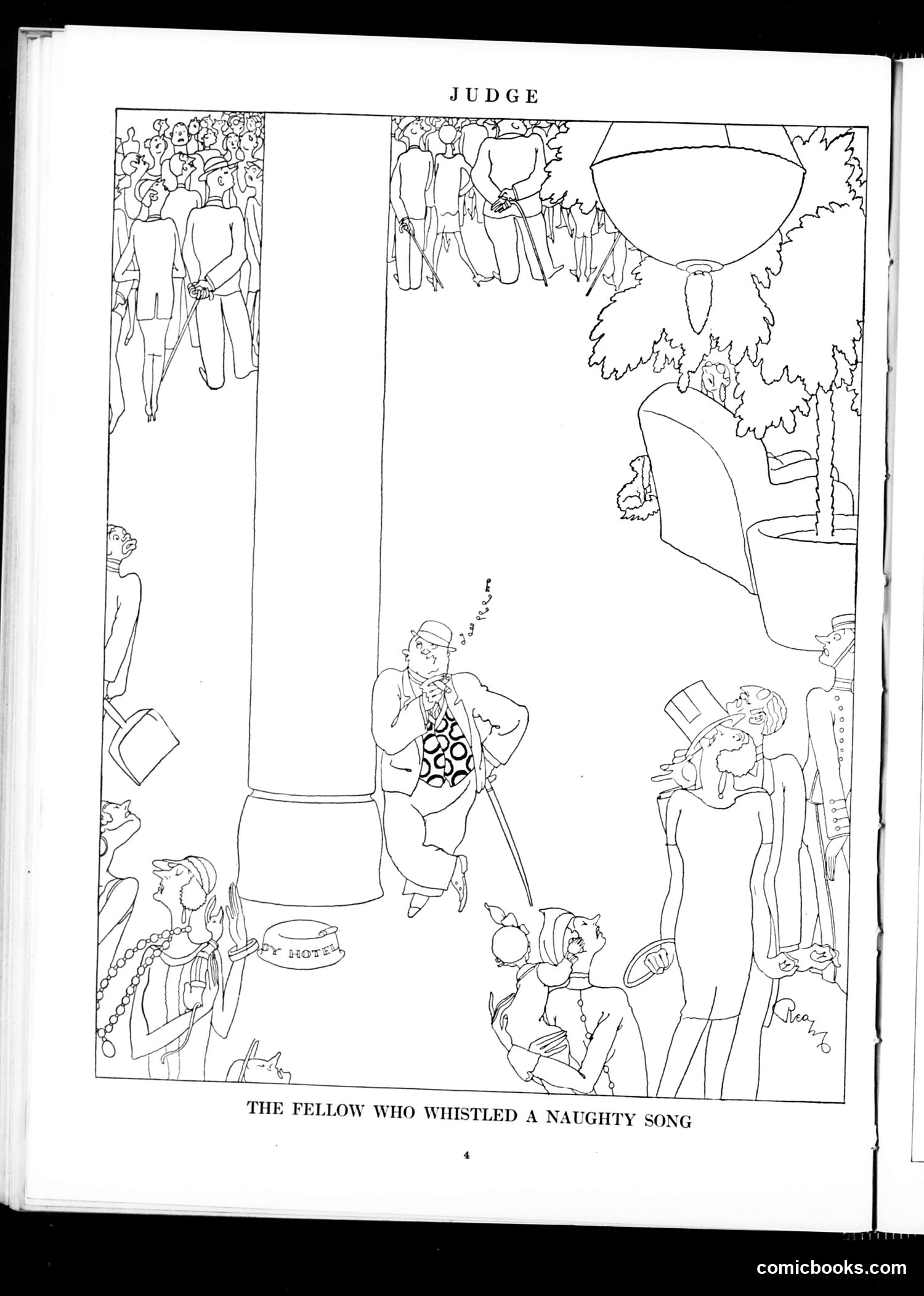
This satirical cartoon depicts a courtroom scene where a man stands accused before a judge. The title suggests he's being prosecuted for whistling inappropriate music—likely a reference to obscenity laws that were actively enforced during Judge magazine's era (early-to-mid 20th century). The humor lies in the absurdity of criminalizing such a minor, victimless act. The various onlookers and officials represent the machinery of law enforcement being deployed against trivial moral infractions. The cartoon satirizes both overzealous moral policing and the judicial system's priorities—suggesting society wastes resources prosecuting harmless behavior rather than serious crimes. The artistic style and legal setting emphasize the disconnect between the severity of the court proceedings and the pettiness of the alleged offense.
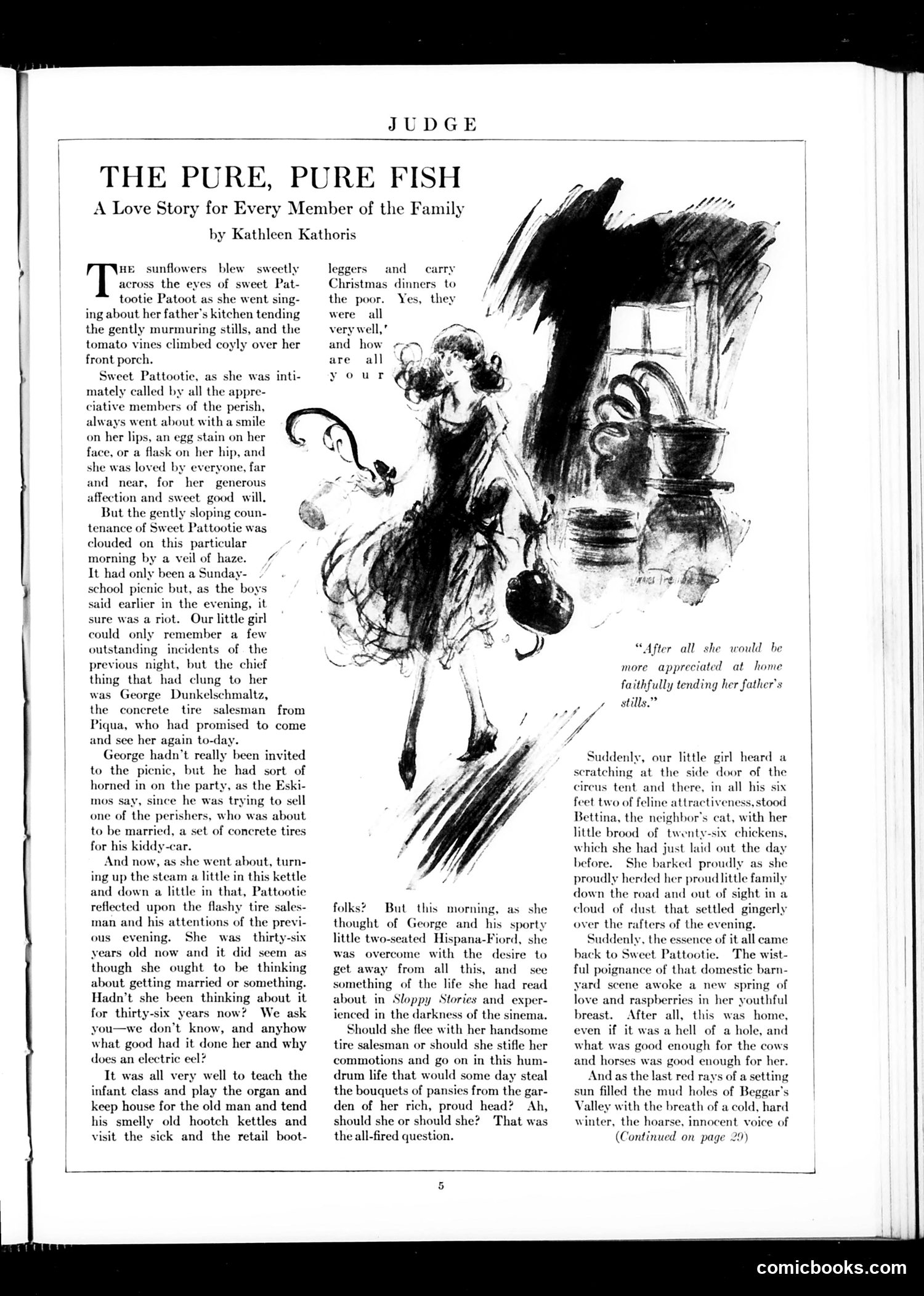
This page contains the opening of a short story rather than a political cartoon. The illustrated narrative follows Sweet Pattootie, a young girl characterized as perpetually cheerful and beloved by her community. The story establishes her domestic setting—her father's kitchen with tomato vines and front porch—before introducing a central tension: George Dinkelschmidt, a concrete tire salesman from Papua, has promised to visit. The text suggests this is a sentimental family tale exploring themes of anticipation and desire, likely with romantic or comedic undertones. The sketch-style illustration depicts the protagonist in period clothing. Without seeing the full narrative conclusion, the satirical intent—if any—remains unclear, though Judge typically employed humor about courtship and social pretensions.
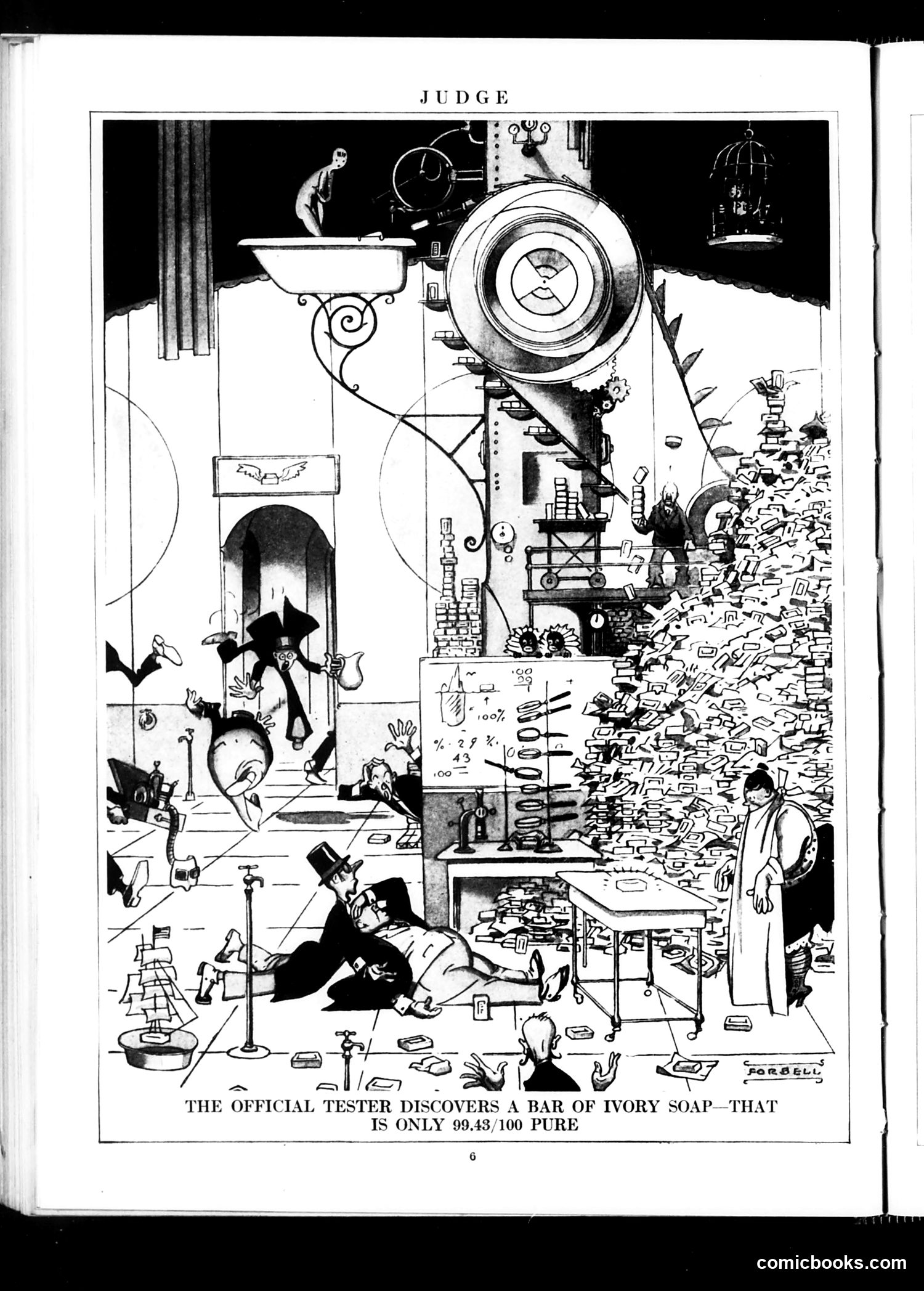
This is an **advertisement disguised as satirical cartoon** for Ivory soap, illustrated by (appears to be) Forbell. The elaborate machinery and chaotic laboratory setting satirize obsessive product testing. The central figure—a man in formal attire reclining amid scientific apparatus—represents an "official tester" conducting rigorous purity verification. The absurdist contraption (featuring clocks, scales, chemical equipment, and stacked papers) exaggerates the lengths manufacturers claim to go for quality assurance. The joke targets contemporary advertising culture: companies boasting scientific precision to justify premium pricing. The specific claim "99.43/100 pure" mocks such hyper-specific purity percentages used in marketing. The cartoon suggests this elaborate theater is overkill, yet simultaneously functions as endorsement—implying Ivory's actual commitment to quality justifies even this ridiculous testing. It's both satire of advertising excess and advertising itself.
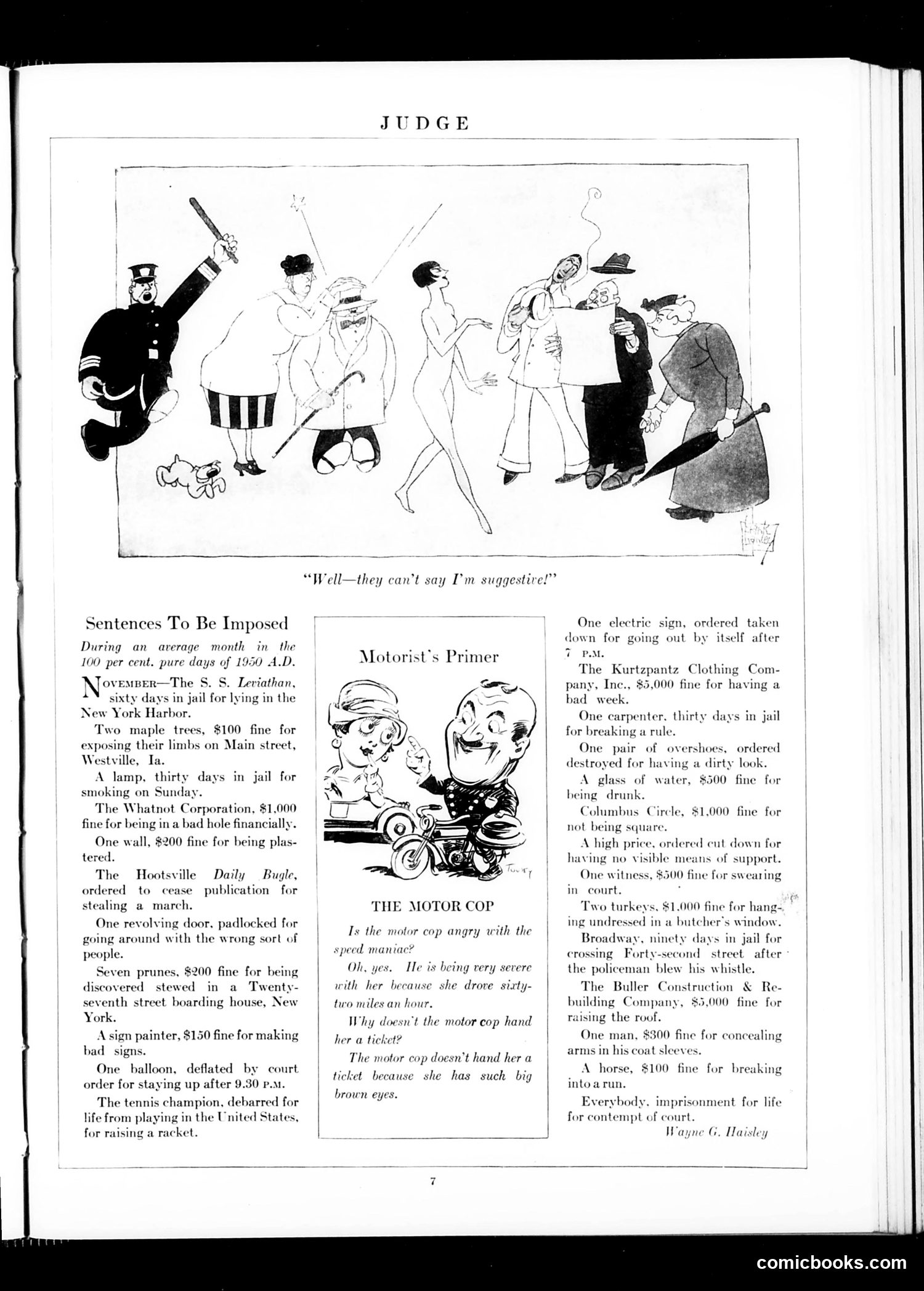
This page satirizes excessive regulation and puritanical social control in 1950s America. The cartoon imagines an absurdly over-regulated future where inanimate objects and minor infractions face legal punishment: a ship lies in jail, trees are fined for "exposing" their limbs, a balloon is jailed for staying up past 9:30 p.m., and prunes are prosecuted for being "stewed." The humor targets Progressive Era reformism—the impulse to legislate morality and control behavior through law. Items like penalizing a glass of water "for being drunk" and fining Columbus Circle "for not being square" use absurdist wordplay to mock the era's earnest social engineering. The "Motorist's Primer" supplements this by satirizing selective law enforcement: a female speeder avoids a ticket due to her "big brown eyes," mocking both gender bias and arbitrary police discretion. The top cartoon references the Roaring Twenties' culture wars, with figures suggesting jazz dancing and flapper culture amid moral panic.
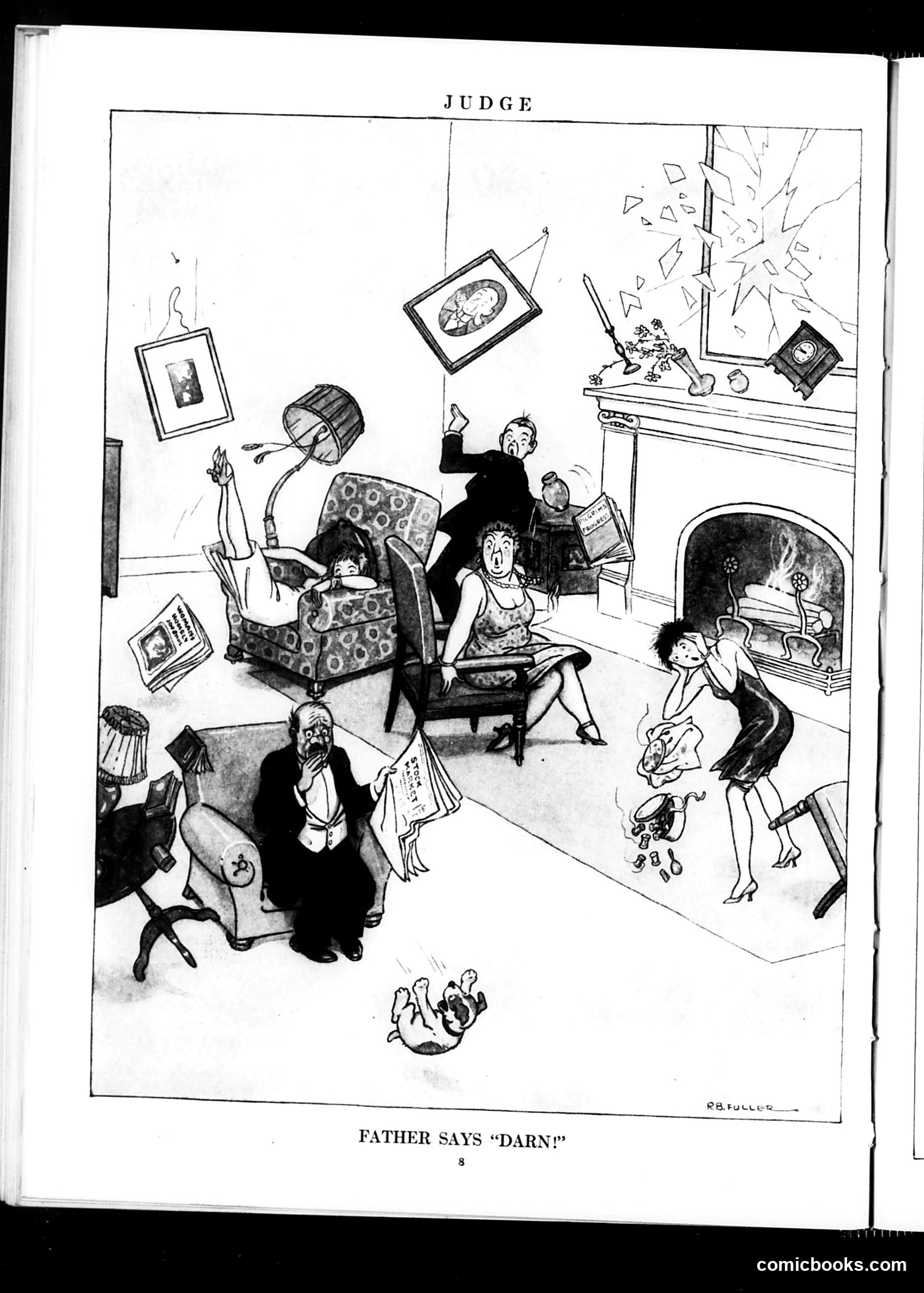
This cartoon satirizes the chaos of a middle-class household where the father has just exclaimed a mild expletive ("darn"). The image depicts total domestic pandemonium: children running wild, furniture overturned, pictures falling from walls, objects scattered everywhere, and family members in disarray. The joke appears to be social commentary on parental authority and household discipline. The father's outburst—even a mild one—seems to trigger or reflect the already-chaotic state of the home, suggesting either that the family is so unruly his frustration is justified, or that his minimal display of emotion causes disproportionate disruption. It mocks both overly permissive parenting and the loss of paternal control that characterized early 20th-century American domesticity.
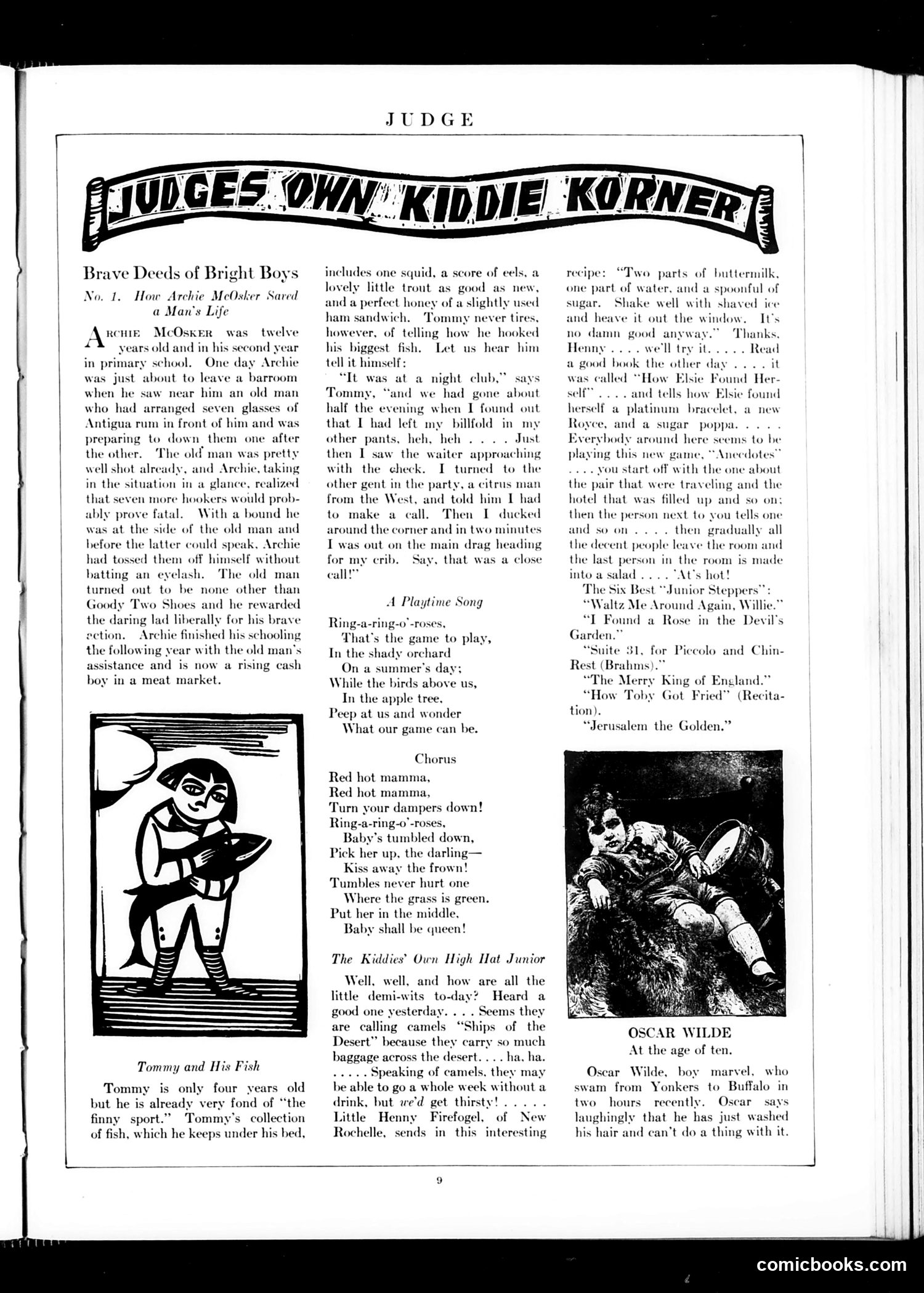
This page satirizes sentimental Victorian children's literature through grotesque exaggeration. The opening story mocks pious tales of moral youth: "Archie McOsker" is praised for heroically preventing an old man's death by drinking seven glasses of rum himself—a ridiculous inversion of virtue that rewards reckless behavior. The subsequent items—a four-year-old collecting "fish" including a used ham sandwich, a crude children's song mixing innocent playground rhymes with inappropriate 1920s slang ("Red hot mamma")—continue the mockery. "The Kiddies' Own High Hat Junior" section offers dumbed-down jokes and an absurd buttermilk recipe meant to parody children's advice columns. The satire targets the gap between sanctimonious claims about children's innocence and the messy, crude reality of actual kids' behavior and interests. Judge presents children as small adults with adult vices, mocking the pretense of wholesome youth literature.
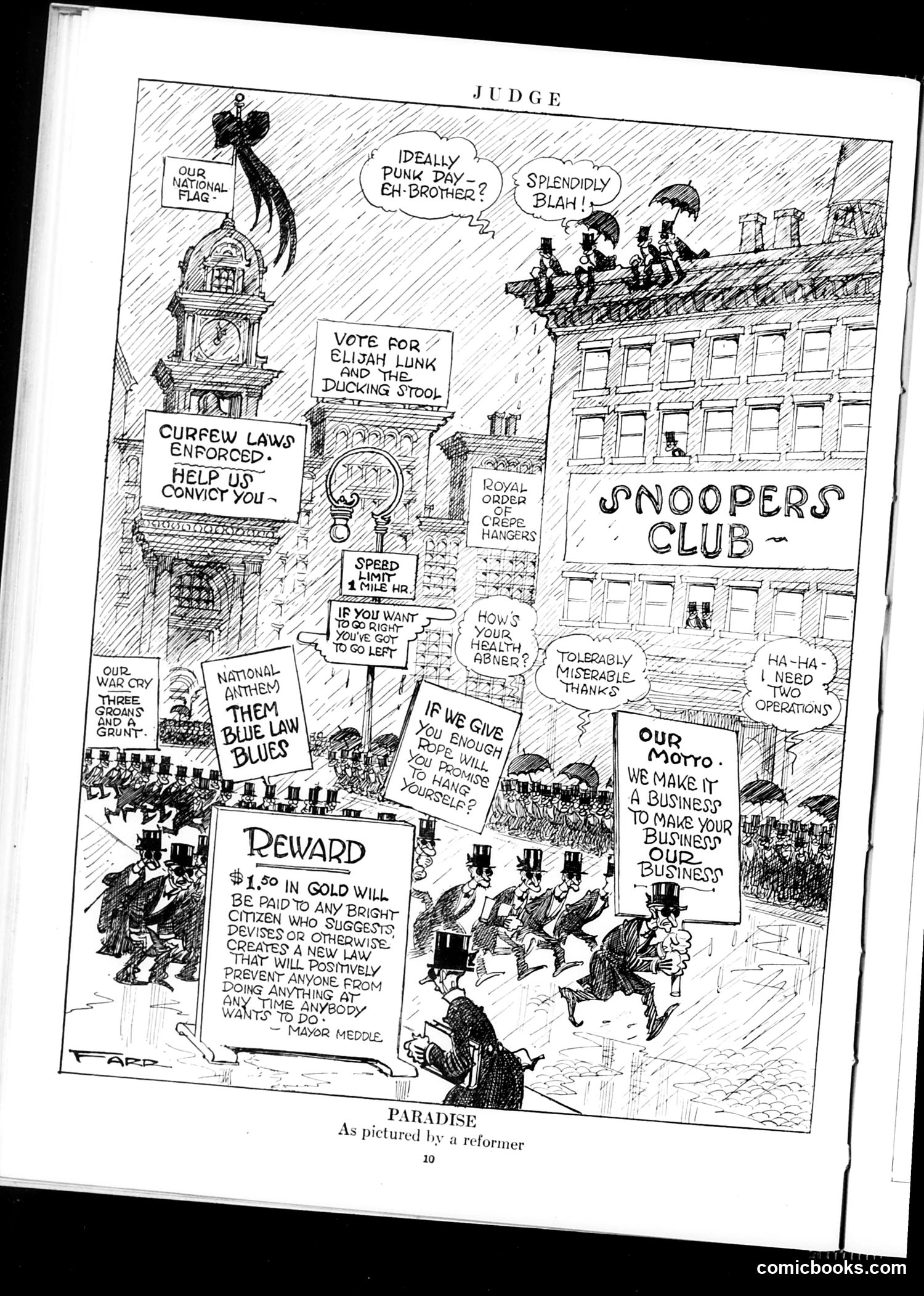
This satirical cartoon mocks progressive reform movements of the era. It depicts an idealized city where various reformist demands have been implemented: curfew laws, speed limits, prohibition ("Blue Law Blues"), and a "Snooper's Club" monitoring citizens. The cartoon's joke is that this "paradise" of strict regulation has become oppressive and joyless. Well-dressed politicians and reformers promote their causes with signs, while ordinary citizens appear miserable. A reward is offered for suggestions on new laws to restrict behavior further—satirizing reformers' seemingly endless appetite for regulation. The cartoon critiques the unintended consequences of reform: what reformers envision as improving society actually creates an intrusive, controlling environment that eliminates personal freedom and enjoyment. The "Snooper's Club" particularly highlights anxieties about surveillance and social control underlying reform movements.
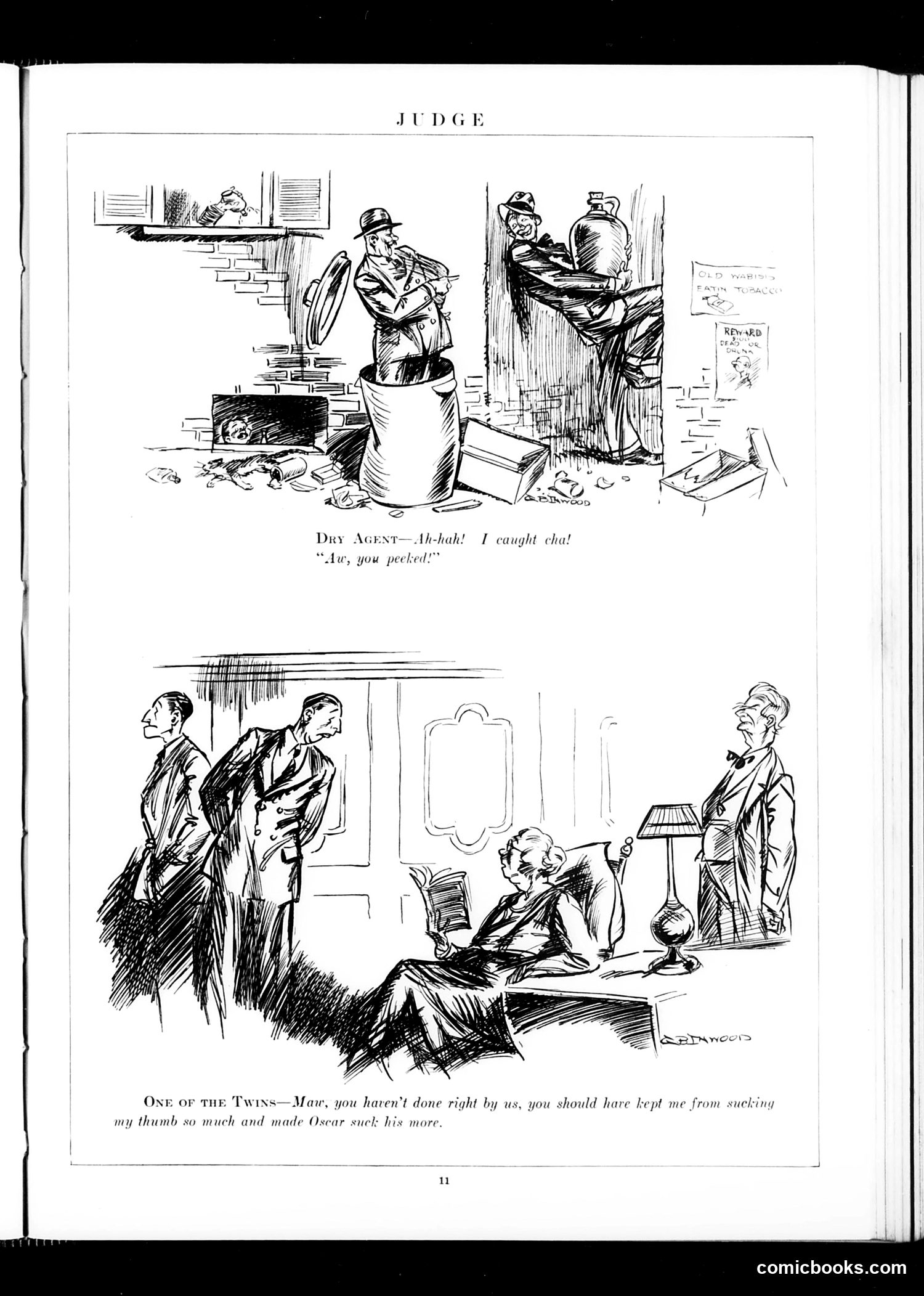
The page contains two unrelated cartoons satirizing early 20th-century American life. **Top cartoon**: A dry goods agent catches someone stealing—likely commenting on retail theft or shoplifting during this era. The humor derives from the caught person's defensive response. **Bottom cartoon**: Two adult twins complain to their mother about unequal parenting regarding thumb-sucking habits. One twin claims his mother should have prevented *his* thumb-sucking while encouraging the *other* twin's, suggesting sibling rivalry and blame-shifting. The satire mocks both childish adult behavior and parental favoritism—the absurdity of grown men still concerned with childhood thumb-sucking habits and blaming their mother for differential treatment. Both cartoons use exaggerated character drawings typical of Judge's satirical style to mock social behavior and family dynamics of the period.
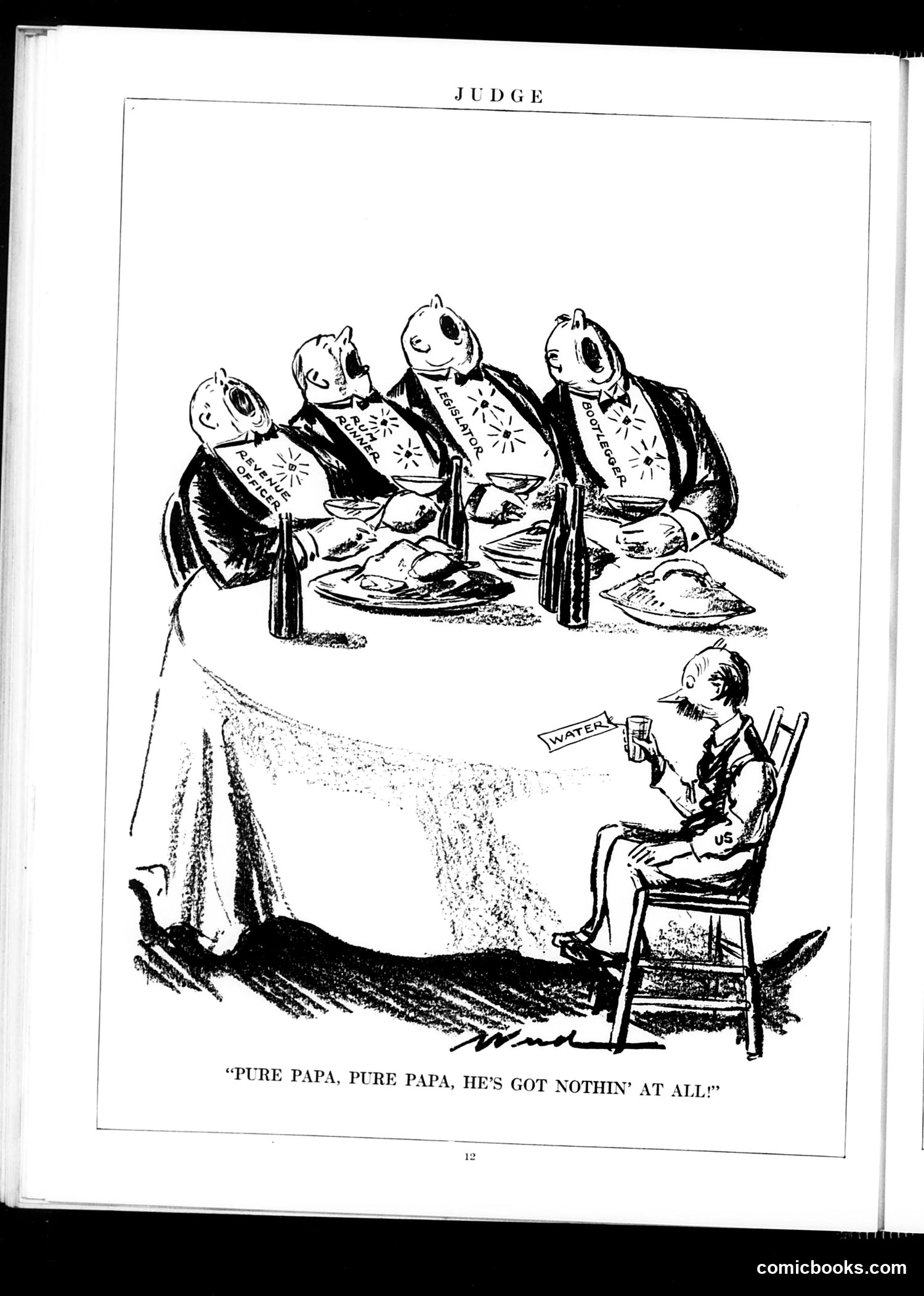
This Judge magazine cartoon satirizes wealthy elites dining lavishly while ordinary Americans struggle. Four portly figures wearing "RESTRICTED" bibs sit at a table with wine bottles and full plates, feasting abundantly. A thin, ragged figure labeled "US" sits apart, holding only "WATER," observing their excess. The caption—"Pure Papa, Pure Papa, He's Got Nothin' at All!"—suggests ironic commentary on claims of scarcity or hardship from the wealthy, who clearly possess everything while others starve. This likely references Depression-era inequality or post-war economic disparity, when cartoon satire frequently contrasted plutocratic excess against ordinary citizens' deprivation. The "restricted" bibs may reference exclusive clubs or class barriers.
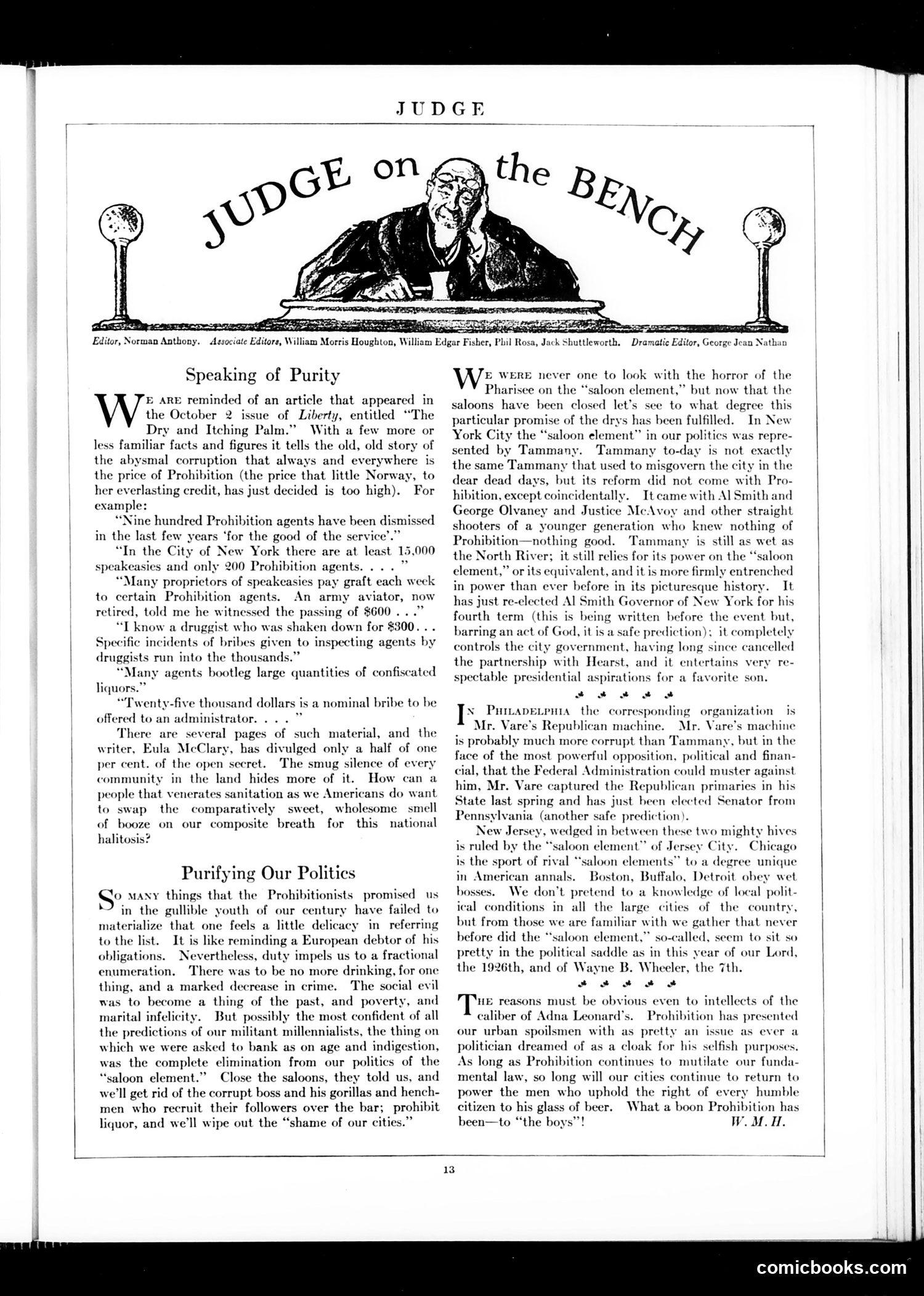
This editorial page attacks **Prohibition's failures**, using the "Judge on the Bench" format to deliver political commentary. **The Main Argument:** Prohibitionists promised that closing saloons would eliminate corruption from urban politics. The article demonstrates this is false, using Tammany Hall—New York's notorious Democratic political machine—as the prime example. **Key Points:** - Lists concrete corruption under Prohibition: dismissed agents, thousands of bribes to officials, Prohibition agents bootlegging confiscated liquor, widespread graft. - Notes Tammany Hall (the "saloon element") remains powerful despite saloon closures, recently re-electing Al Smith as governor. - Credits Al Smith, George Olvany, and Justice McAvoy—reformers from *outside* Prohibition—with Tammany's limited improvements, not the dry law itself. - Concludes: eliminating saloons didn't eliminate political corruption; the "saloon element" persists in different forms. **The Satire:** Mocks Prohibitionists' naive faith that closing bars would automatically purify politics, when corruption runs far deeper than where politicians drink.
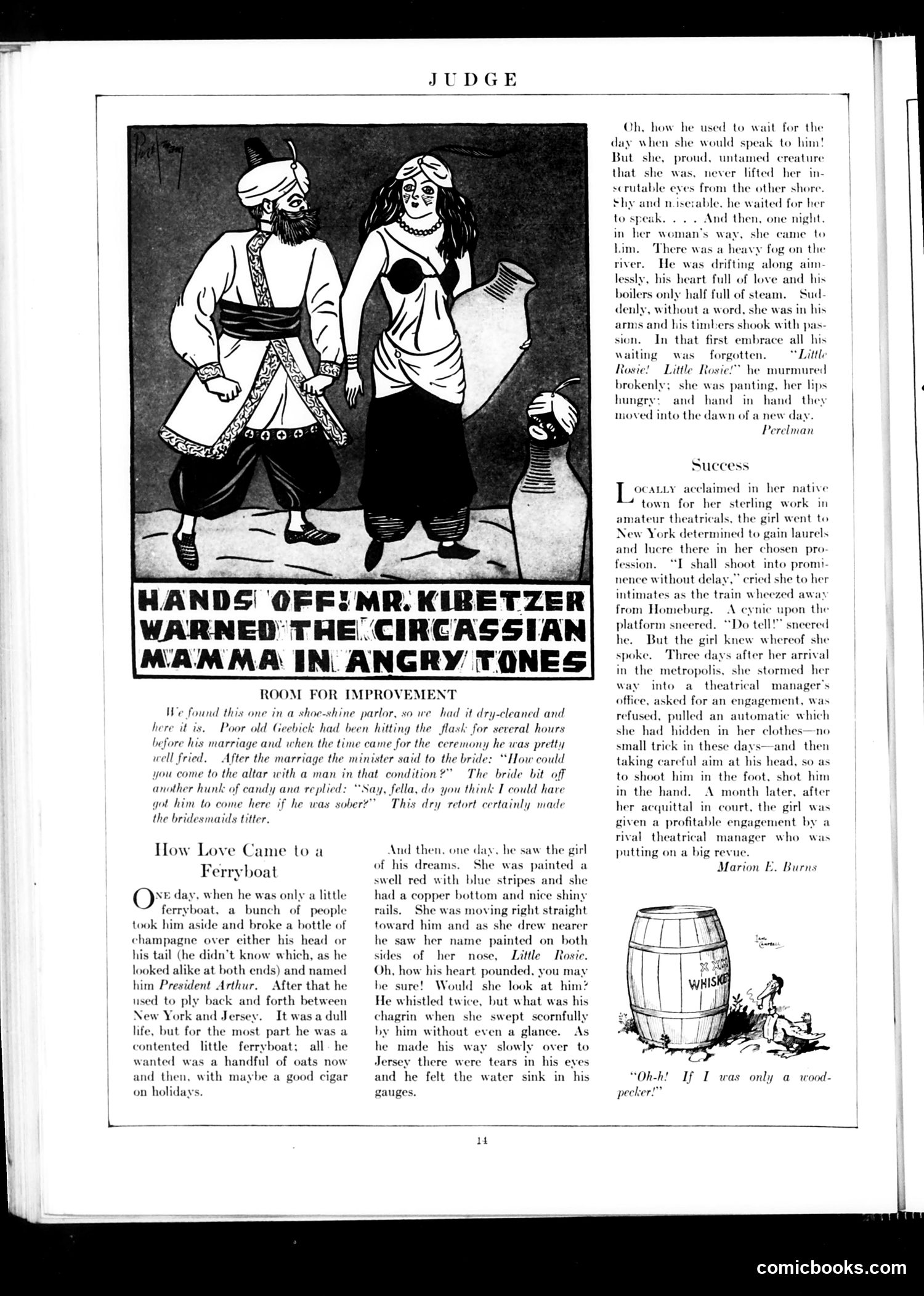
This page contains three humorous stories typical of Judge's satirical style: **"Hands Off! Mr. Kibetzer Warned the Circassian Mamma"** is a brief joke about a drunk groom at his wedding ceremony, playing on ethnic stereotypes common to the era. **"How Love Came to a Ferryboat"** is a whimsical anthropomorphic romance where two ferryboats fall in love—a parody of romantic melodrama, complete with unrequited longing and eventual passionate union. **"Success"** satirizes both theatrical ambition and gender roles: a girl from a small town (Homeburg) enters New York theater, gets rejected, shoots her manager in frustration (though attempting to aim for his foot), then gets hired by a *rival* manager. The satire mocks both the arbitrary nature of show business success and—likely—contemporary anxieties about "modern women" carrying firearms. The accompanying illustration shows a whiskey barrel, unrelated to the text. The humor relies on exaggeration, absurdity, and social commentary typical of early 20th-century American satire.
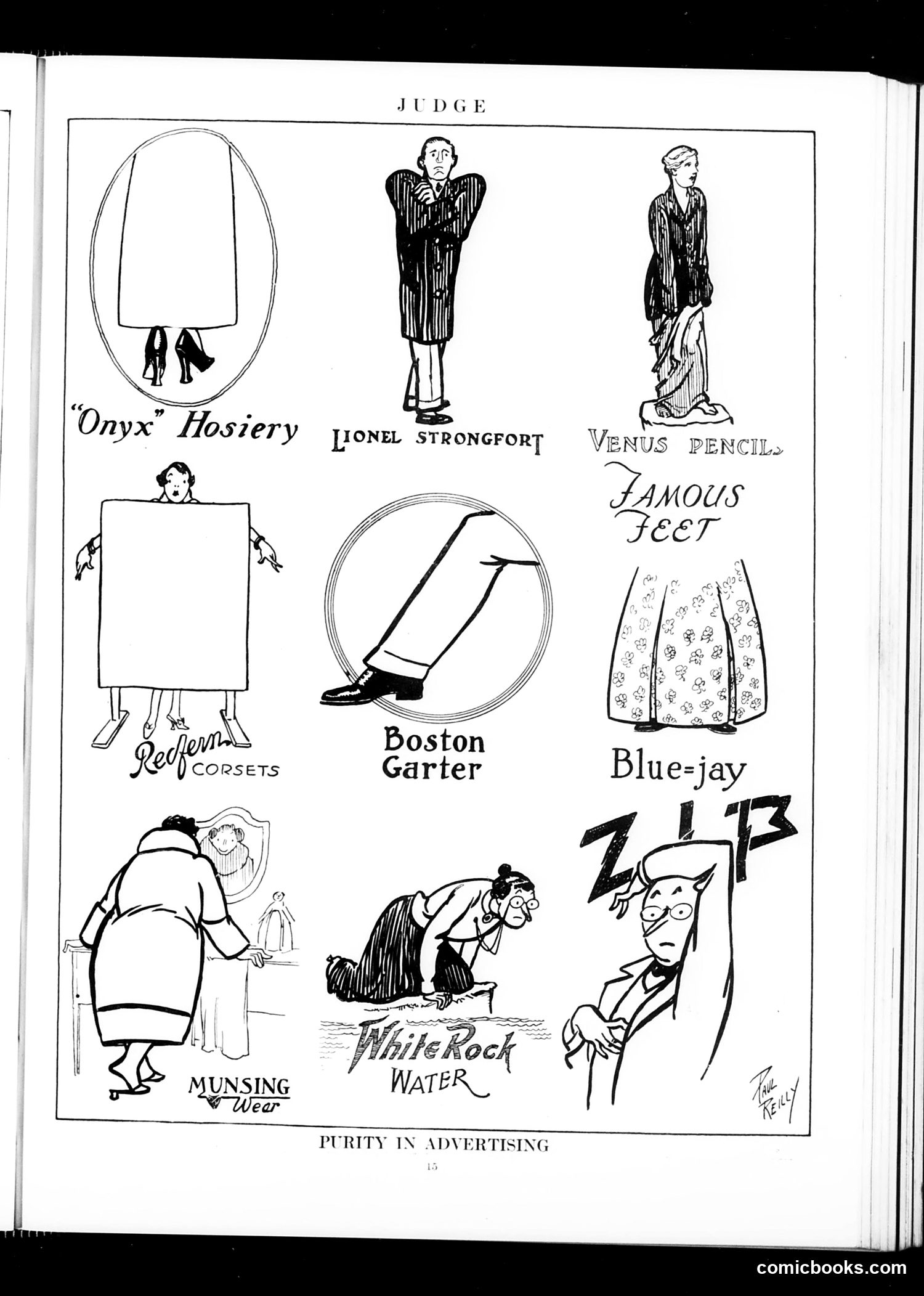
This satirical page mocks the contrast between products' claimed virtues and their actual associations. The title "Purity in Advertising" is ironic—each product advertisement pairs respectable branding with suggestive or absurd imagery. For example, "Lionel Strongfort" (likely a real bodybuilder/fitness brand) appears alongside "Venus Pencil" and "Famous Feet," while products like "Onyx Hosiery" and "Boston Garter" (legwear brands) feature leg imagery. "Munsing Wear," "White Rock Water," and "Blue-jay" shoes complete the collection. The cartoon criticizes how turn-of-the-century advertisers used euphemisms and suggestive illustrations—particularly featuring women's bodies and legs—to sell mundane products, all while maintaining a veneer of respectability. The satire exposes the gap between advertising's claimed "purity" and its actually manipulative, often sexually suggestive tactics.
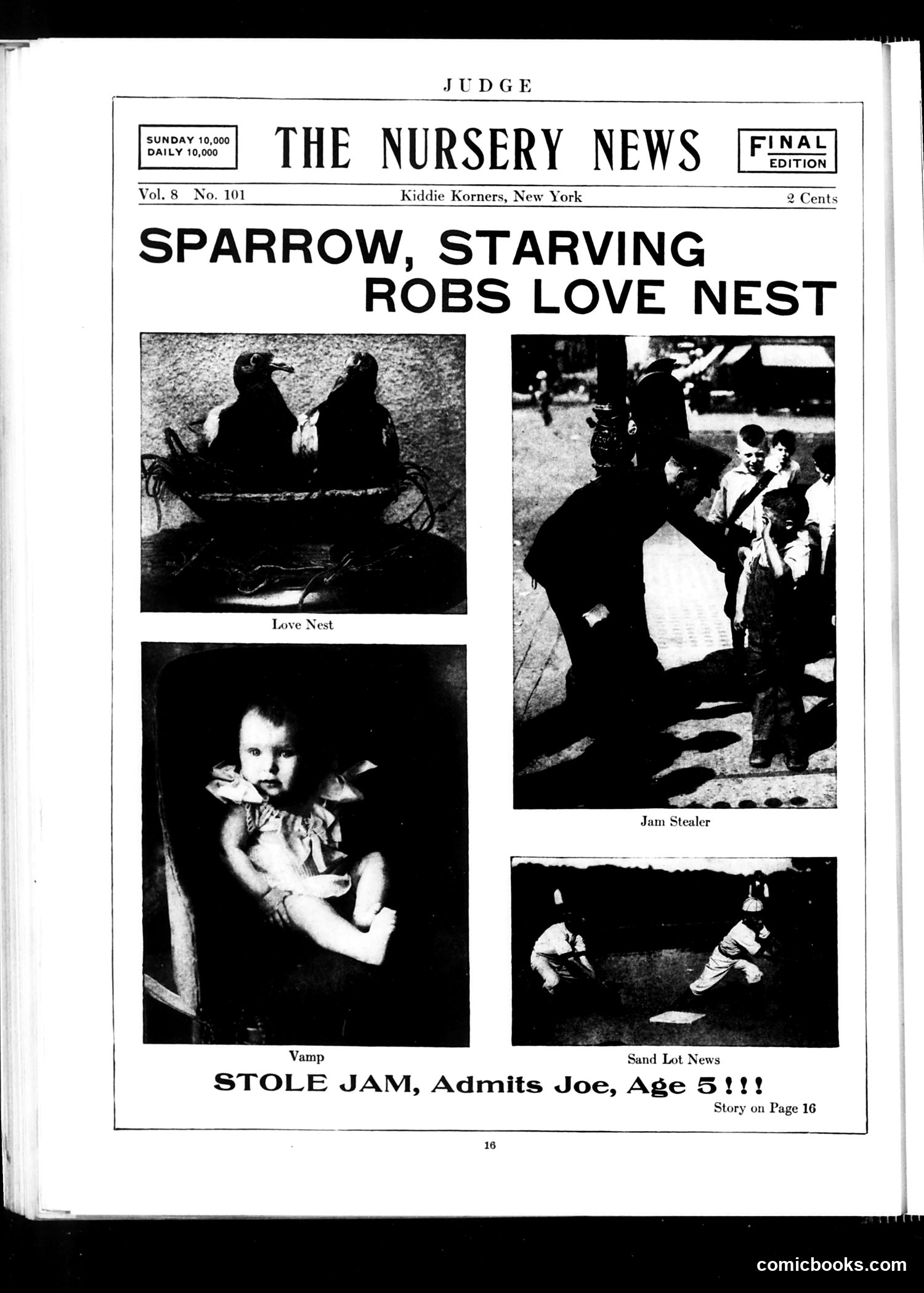
This is a satirical children's newspaper parody from *Judge* magazine that mimics real newspaper sensationalism by applying crime-reporting language to innocent childhood activities. The headline "SPARROW, STARVING ROBS LOVE NEST" humorously treats birds nesting as criminal activity. The four photos show children engaged in typical play: a child with a doll labeled "Vamp," children playing outside ("Jam Stealer," "Sand Lot News"), and what appears to be a child with jam. The subheading "STOLE JAM, Admits Joe, Age 5" mockingly treats a young child's petty mischief—taking jam—as a serious crime confession, complete with age specification as if from an arrest report. The satire ridicules both sensationalist journalism of the era and adult anxieties about childhood behavior, treating trivial nursery incidents with exaggerated criminal seriousness for comedic effect.
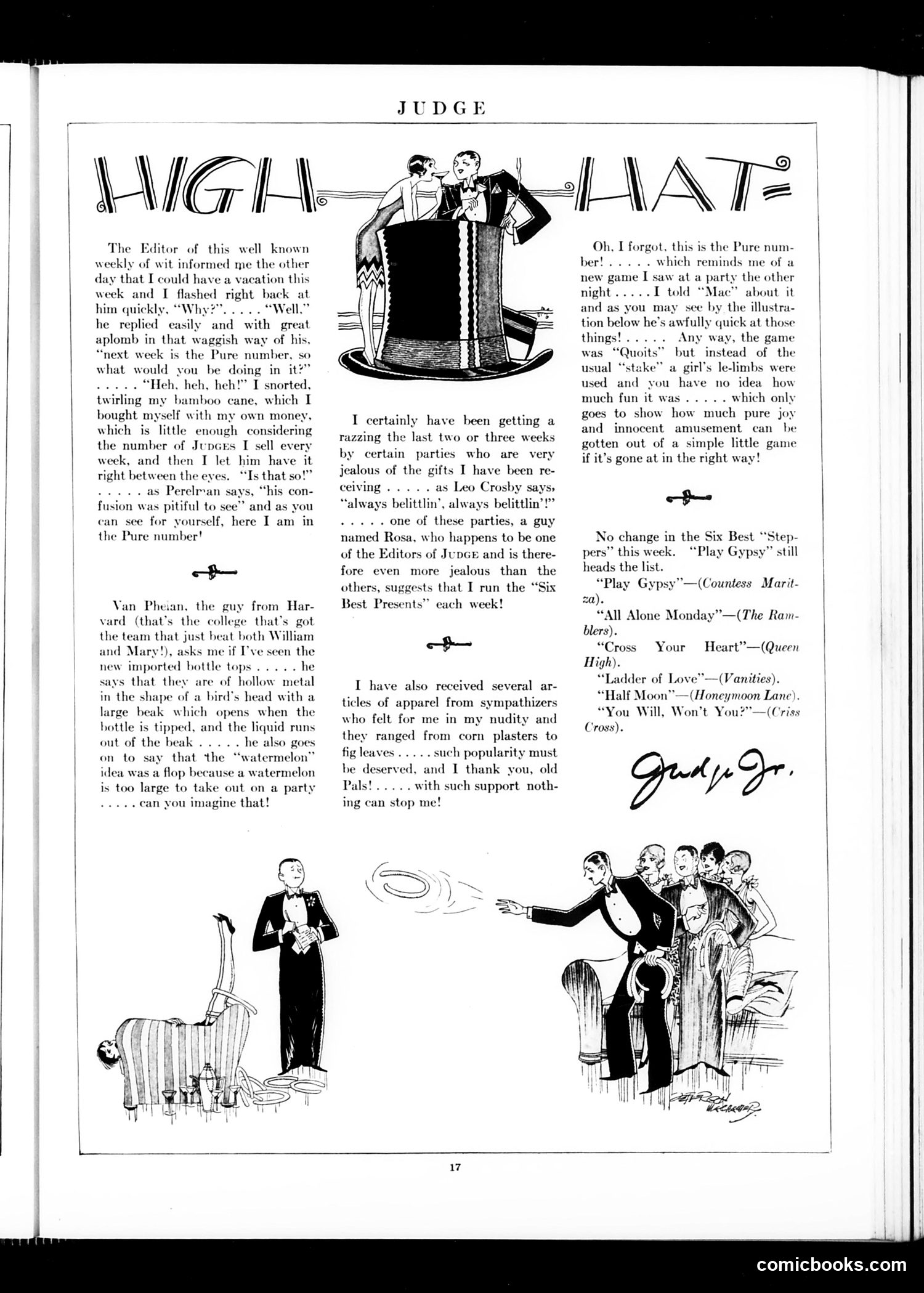
This is the editor's satirical column from Judge magazine. The writer describes being told to take vacation during the "Pure number" issue—a special edition apparently focused on wholesome content. The satire lies in the irony: while claiming to embrace "pure" amusement, the column discusses party games using "a girl's le-limbs" as stakes instead of traditional quoits, and references receiving sympathy gifts for "nudity." The cartoon illustrations depict gentlemen in formal attire at parties—one shows a man with an elaborate bottle opener shaped like a bird's head, another shows a host directing guests. These visualize the leisurely, wealthy social scene being discussed. The Six Best "Steppers" list references popular songs of the era (likely 1920s-30s based on style), a regular Judge feature ranking current hits. The satire criticizes the pretense of "Pure" entertainment while the actual content remains risqué and bawdy—typical of Judge's irreverent approach to Jazz Age social behavior and propriety.
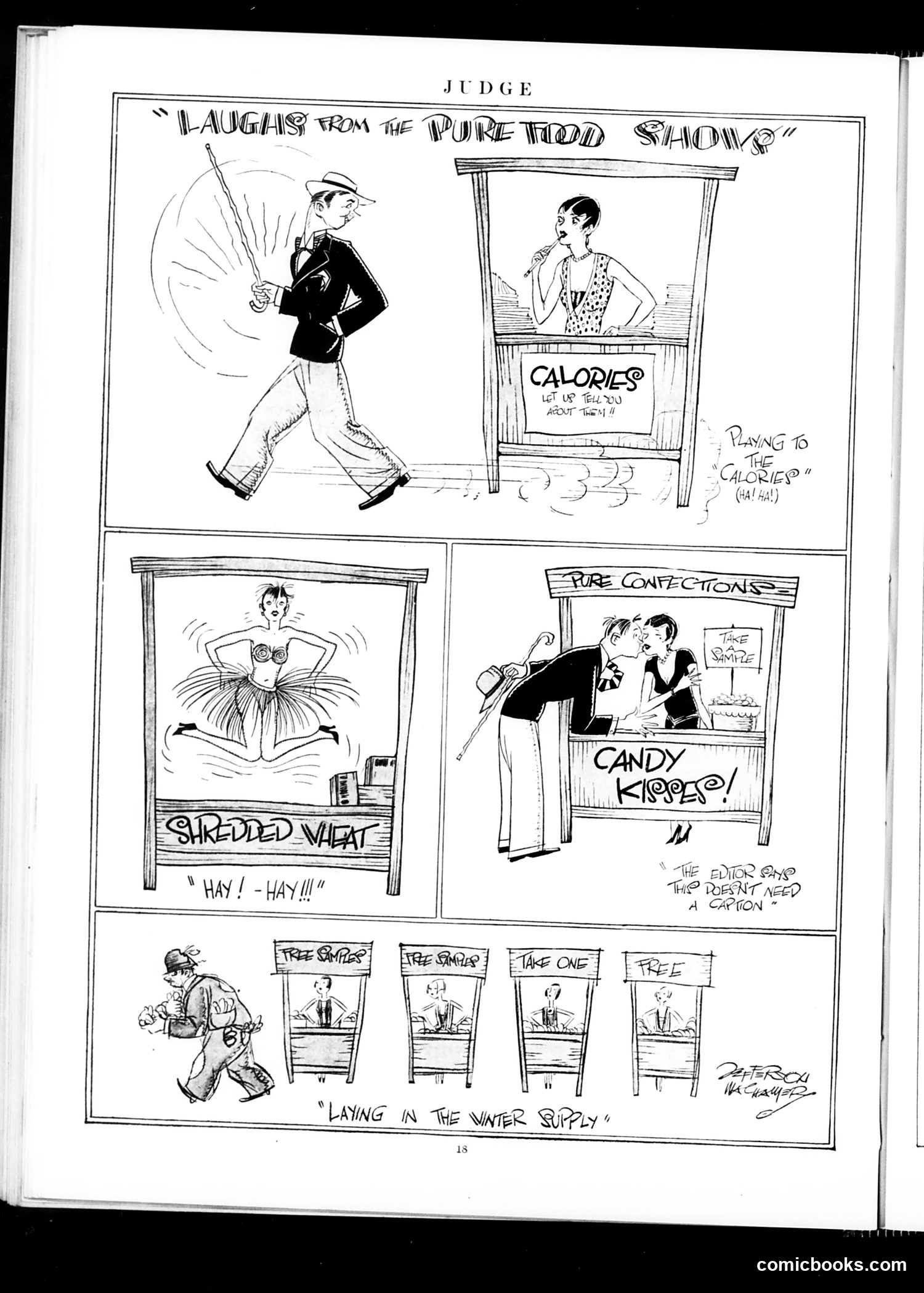
This Judge page satirizes early 20th-century food industry practices and the emerging "calorie-counting" health fad. The cartoon strips mock various food vendors at what appears to be a "Pure Food Show" exposition: - A man energetically promotes his product to a calorie-conscious woman at a booth - "Shredded Wheat" is humorously depicted as physically demanding - A candy vendor appears to be operating deceptively - The final panel shows men installing samples in "the winter supply," suggesting adulteration or substitution of food contents The satire targets both food manufacturers' dubious purity claims and the contemporary obsession with calorie-counting as a pseudo-scientific health measure. The humor derives from the gap between marketed "pure" food and actual questionable practices—a pointed commentary on food industry deception during the Progressive Era's food safety debates.
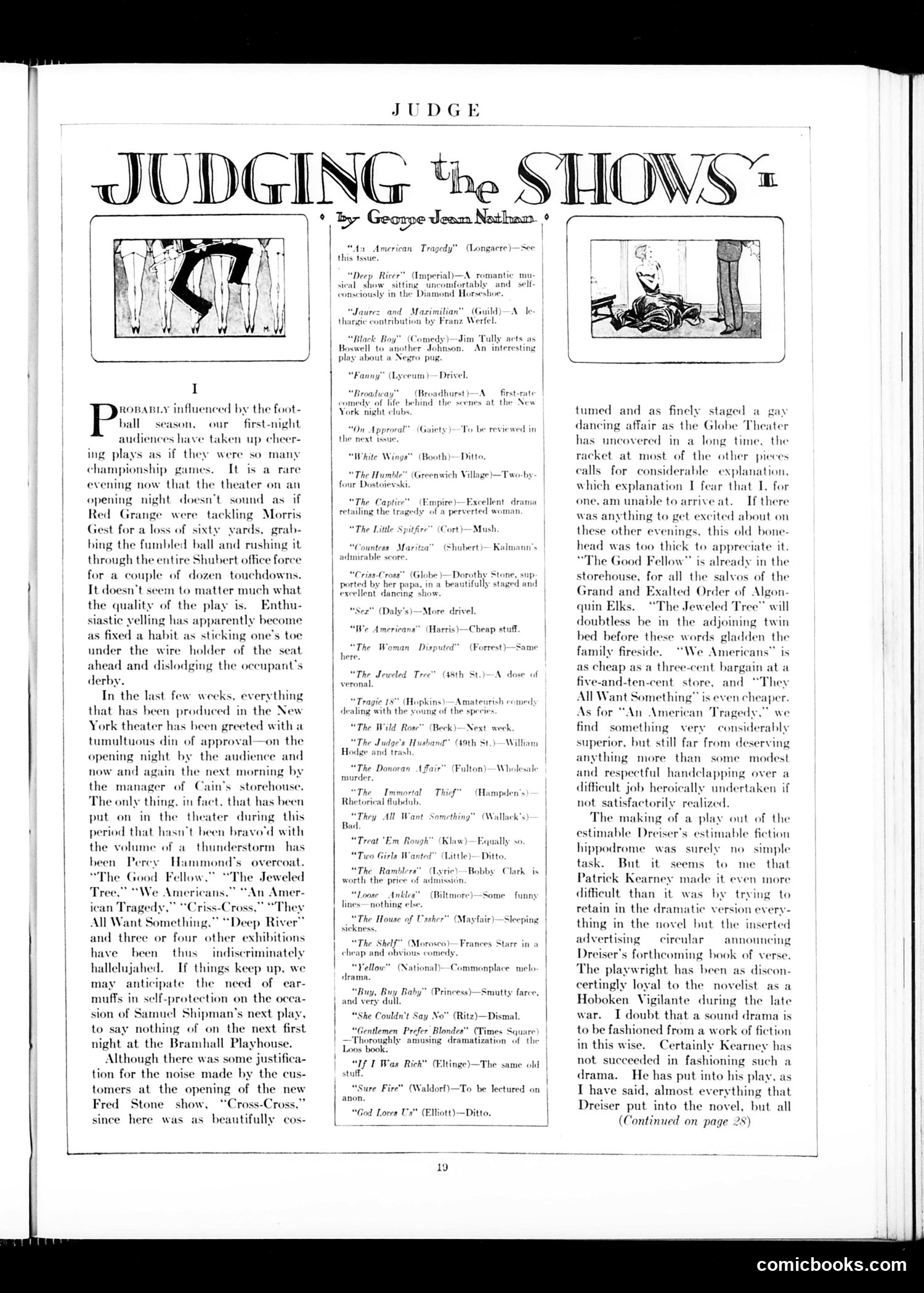
This is a theater review column, not a political cartoon. The author criticizes New York's opening-night theater audiences for their indiscriminate enthusiasm, using a football metaphor: they cheer like championship-game fans regardless of play quality, comparing audience noise to "Red Grange" (a famous 1920s football star) tackling producer Morris Gest. The piece lists recent Broadway productions with brief, often dismissive reviews ("drivel," "cheap stuff," "mush"). Notable exceptions praised include "Cross-Cross" and Dorothy Stone's dancing show. The author complains that nearly everything gets thunderous applause on opening night, making it hard to distinguish genuinely good theater from mediocre work. The underlying point: 1920s theatergoers behaved more like sports fans than discerning audiences, obscuring real theatrical merit beneath noise and hype.
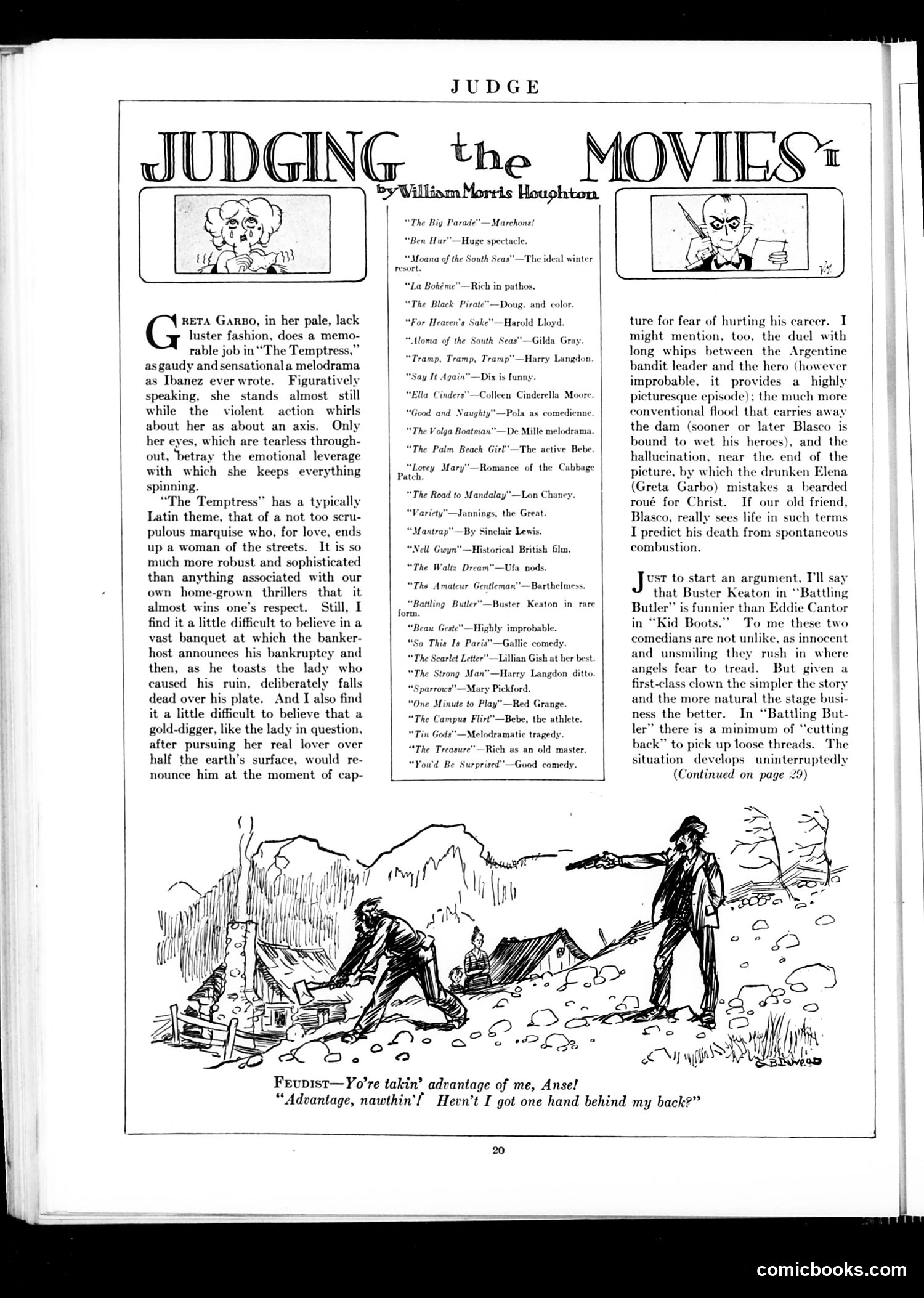
This is a film criticism column by William Morris Houghton reviewing 1920s cinema. The main text discusses Greta Garbo's performance in "The Temptress," a melodrama where her character—a marquise who becomes a street woman—maintains emotional control through tearless eyes while chaos swirls around her. The critic finds the plot implausible, particularly a banker announcing bankruptcy then dying mid-toast, and a gold-digger abandoning her lover at the crucial moment. The list catalogs contemporary films with one-line reviews (praising Douglas Fairbanks' *The Black Pirate*, Harold Lloyd's work, etc.). The cartoon depicts a feudal or frontier dispute over "advantage," with one figure claiming an unfair advantage while pointing out he fights with one hand behind his back—a visual joke about leveling the playing field in conflict.
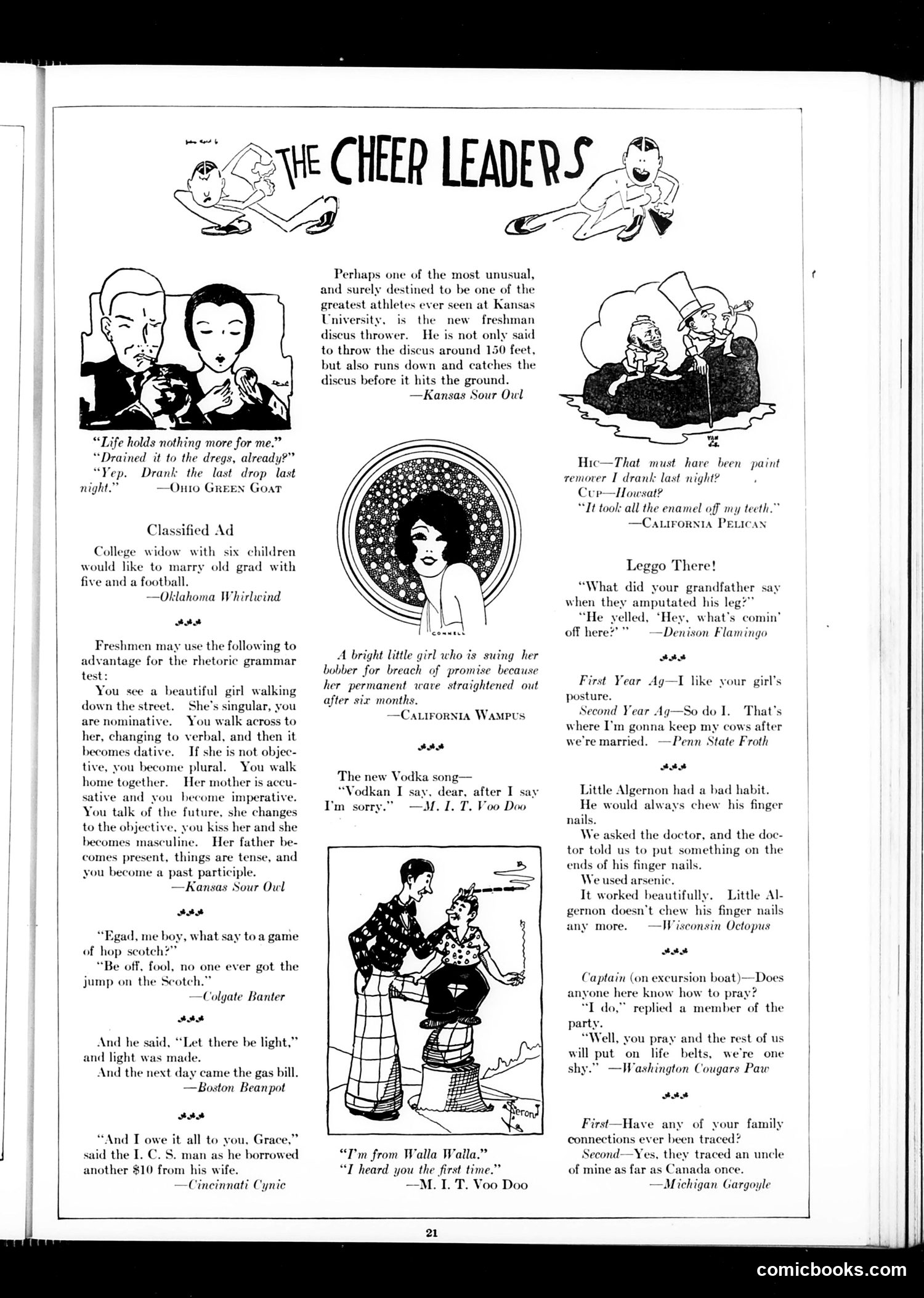
This is a humor compilation page from Judge magazine featuring collegiate jokes and quips, not political cartoons. The content reflects 1920s college culture through jokes submitted by university humor magazines (Kansas Sour Owl, M.I.T. Voo Doo, etc.). The humor targets familiar college stereotypes: "college widows" (unmarried women pursuing wealthy graduates), freshman rhetoric lessons using romantic encounters as grammar examples, and excessive drinking ("drained it to the dregs"). There's also absurdist humor (a discus thrower catching his own throw) and dark comedy (poisoning a child's nails with arsenic to stop nail-biting). The scattered illustrations show students in period dress and everyday college scenarios. The "Walla Walla" repetition joke exploits the Native American place name for comedic effect. Overall, this reflects 1920s college life: dating customs, prohibition-era drinking references, and the casual bigotry typical of mainstream American humor of that era.
This page primarily contains **advertising and humor columns** rather than political cartoons. **The Main Content:** The left side advertises the Santa Fe Railway's new "Chief" train between Chicago and California—a luxury service with dining cars, lounges, and observation decks managed by Fred Harvey. It emphasizes exclusivity and comfort. **The Satire:** The center-right features "Little Interviews With People You Would Like to Meet," profiling Eudora Bascom, a self-styled "nature lover." The piece gently mocks pretentious amateur naturalists who romanticize wilderness while remaining comically ignorant. Bascom claims to understand animal sounds and wrote guides like "With Traps and Snares," yet describes absurd scenarios (a wildcat using its tail to fish for food). The humor lies in her overwrought descriptions of nature contrasting with her obvious naïveté. **The Bottom Cartoon:** A brief joke about income tax evasion—Jones admits dodging taxes five years; his acquaintance reveals he's the local tax collector. This reflects 1920s-era tax anxieties and humor about authorities. The page reflects period attitudes toward leisure travel, nature fads, and tax compliance.
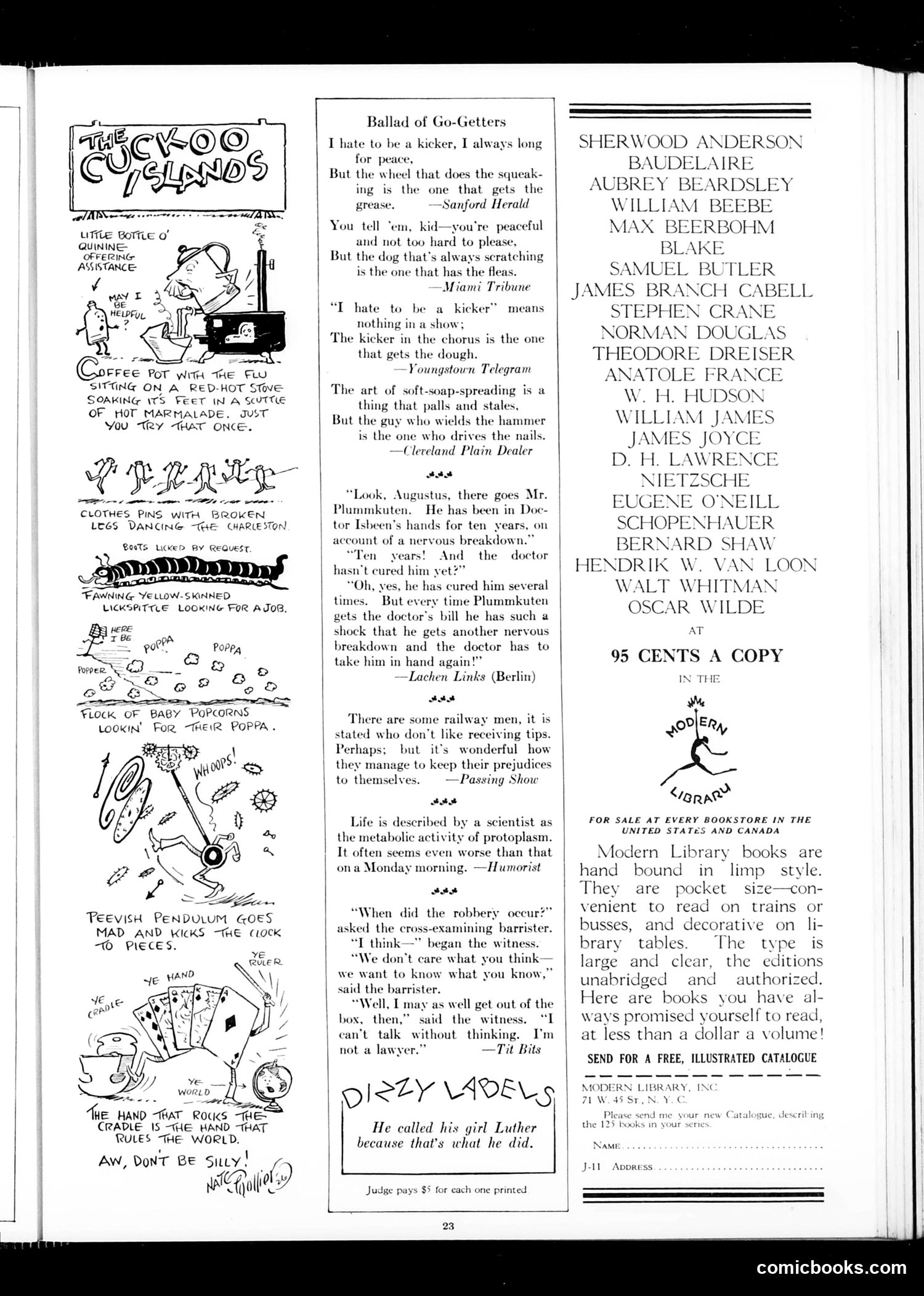
This page primarily contains **humorous cartoons and jokes** rather than political satire. The left side features "The Cuckoo Islands"—absurdist cartoon vignettes depicting nonsensical scenarios (coffee pots with flu, clothes dancing the Charleston, popcorn babies). These are whimsical non-sequiturs meant purely for comedic effect. The center section presents the "Ballad of Go-Getters," a collection of brief humorous observations reprinted from various newspapers. The jokes mock everyday frustrations: nervous patients endlessly returning to doctors, railway workers' contradictory attitudes toward tips, and a lawyer's circular logic about thinking versus knowing. The right side is primarily **advertising** for Modern Library books—affordable pocket-sized classics by authors like Whitman, Joyce, and Shaw—sold at 95 cents, positioned as accessible literature for train commuters. This appears to be a typical Judge magazine page blending light humor with advertising, rather than addressing specific political events or figures.
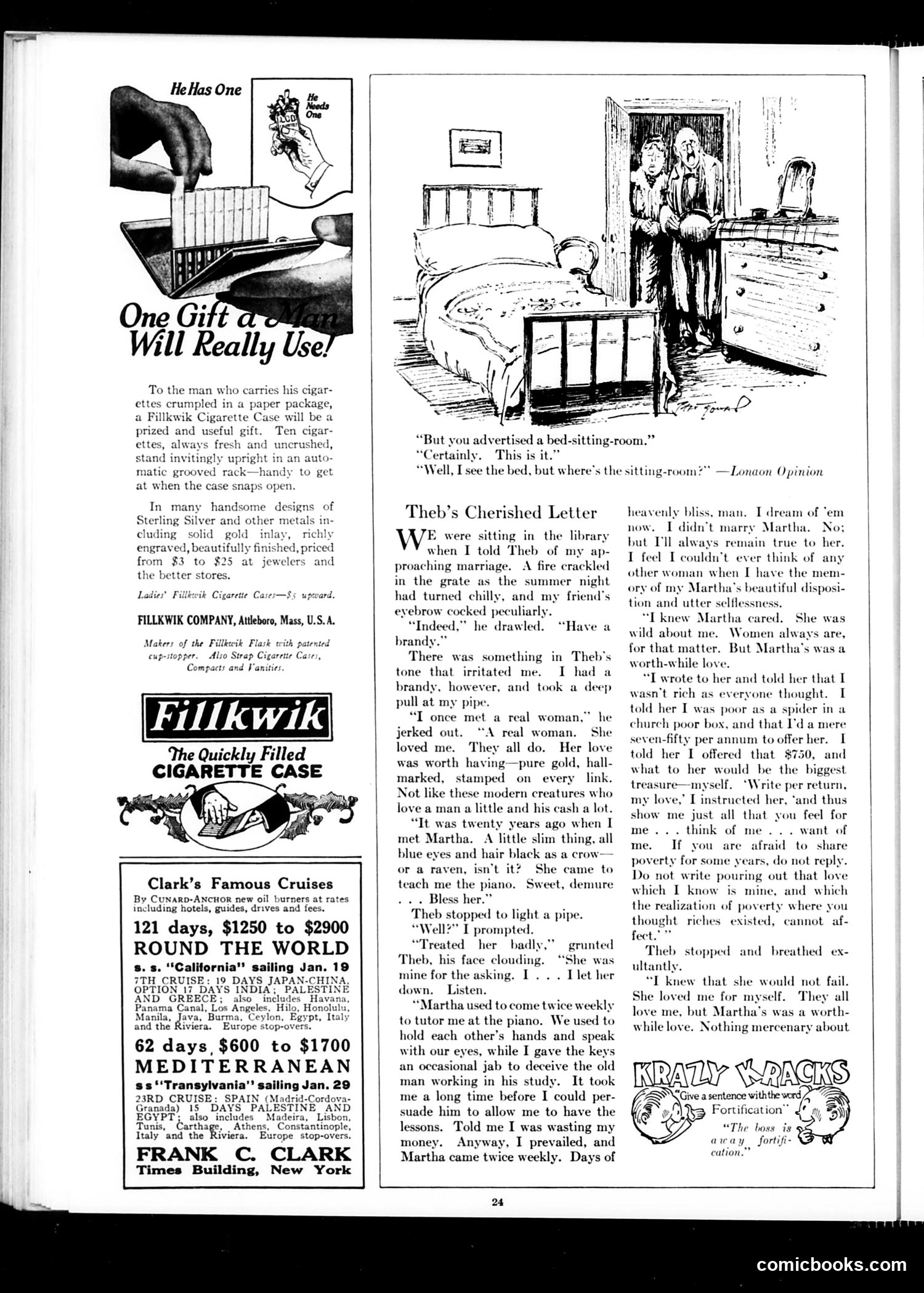
This is a sentimental short story rather than political satire. The narrative describes a man ("Theb") reminiscing about a past romance with Martha, a piano teacher from twenty years prior. The story's point involves class and romantic idealism: Theb recalls Martha as a "real woman" of pure, genuine love—contrasted with "modern creatures who love a man a little and his cash a lot." When Theb revealed his poverty ($750 annual income) to test her devotion, he's apparently reflecting on whether she truly loved him for himself. The upper cartoon is unrelated—a joke about apartment advertising where a "bed-sitting-room" is advertised but the sitting area is mysteriously absent (from *London Opinion*). The page is primarily advertising (cigarette cases, ocean cruises, travel) with the story as filler content. Without seeing the story's conclusion, the ultimate satirical point—if any—remains unclear.
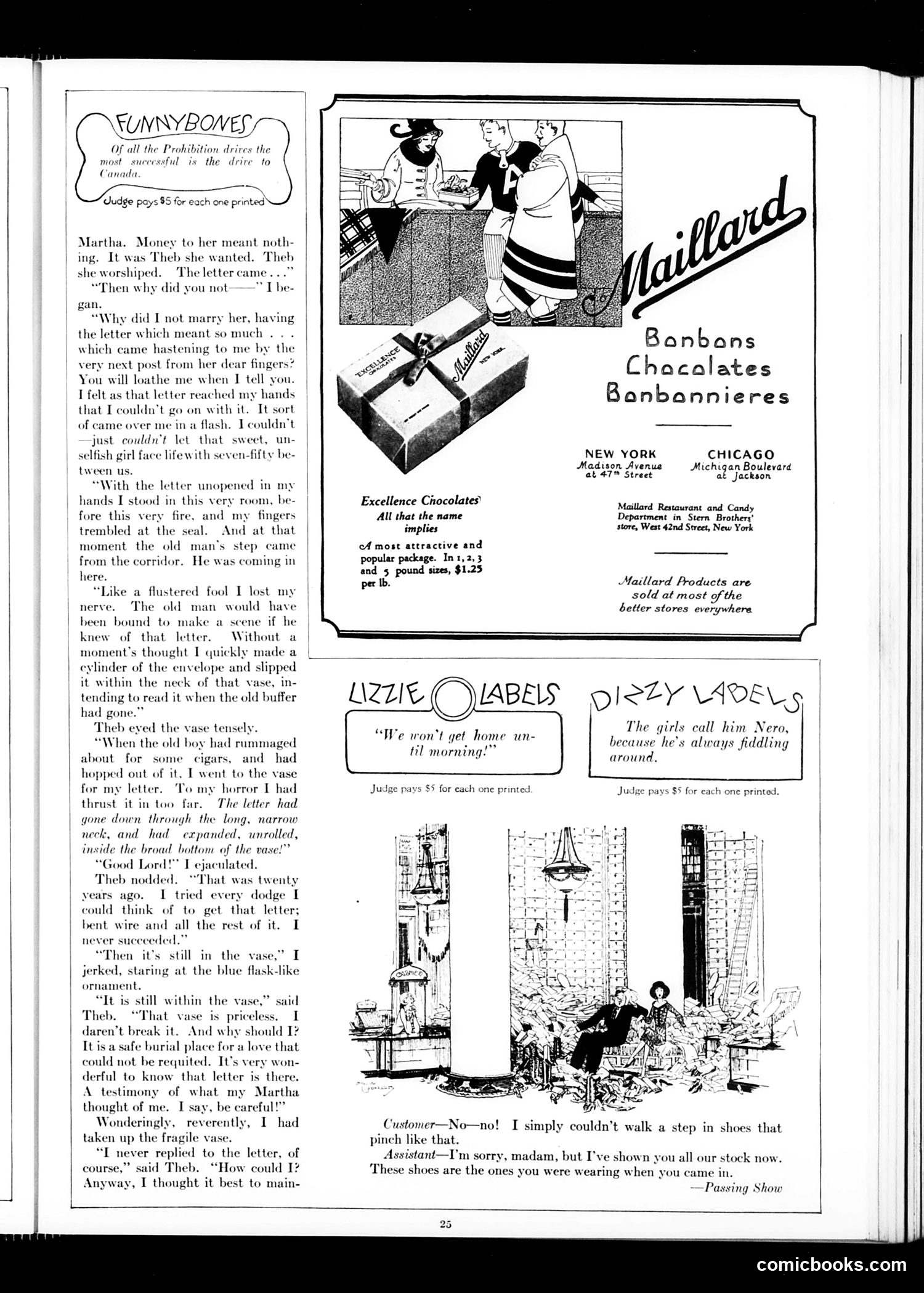
This page contains three distinct humor features typical of Judge's satirical content: **"Funny Bones" (top left):** A sentimental short story about a man who hid an unopened love letter from his beloved Martha inside a valuable vase decades ago, where it remains trapped. The joke plays on romantic tragedy—the letter representing a love he couldn't afford to pursue (they had only "seven-fifty between us"), now sealed forever in a priceless vessel he dare not break. **Advertisements (center):** Maillard chocolates and candies, presented as luxury goods sold at upscale department stores in New York and Chicago. **"Lizzie Labels" and "Dizzy Laden" (bottom):** Two single-panel gag cartoons. One depicts a woman refusing to go home until morning because "Nero" won't stop "fiddling." The other shows a shoe shop assistant revealing that the "new stock" the customer rejected are actually the shoes she wore in—a joke about uncomfortable footwear and selective memory. The Prohibition reference at top suggests this was published during the 1920s-early 1930s era.
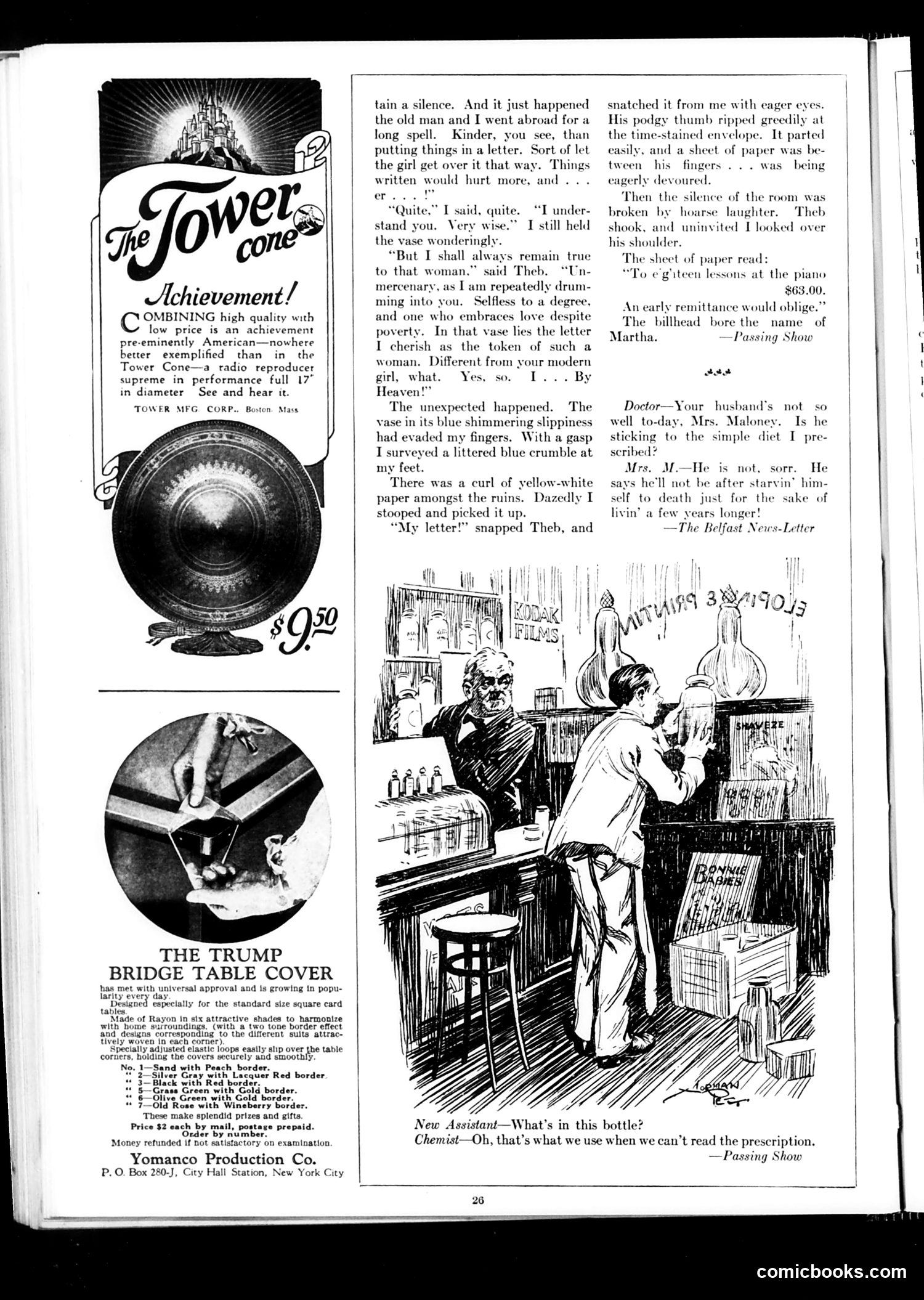
This page combines advertisements with two separate comic narratives. **The main cartoon** (center-right) depicts a domestic drama: a man ("Theb") has preserved a letter from his beloved in a blue vase, claiming it represents her selfless, mercenary-free love. When the narrator accidentally breaks the vase, the letter is revealed—it's merely a *piano lesson bill* from someone named Martha for $63.00. The joke satirizes romantic delusion: Theb's idealized memory of his devoted woman is actually just an unpaid invoice, deflating his sentimental pretensions through humorous anticlimax. **Two shorter jokes** appear below, unrelated to the main cartoon, offering quick satirical quips about doctors and pharmacists. **The advertisements** for "The Tower Cone" radio and "Trump Bridge Table Cover" occupy the left side, typical commercial content for the era. The satire targets male sentimentality and self-deception about romantic relationships.
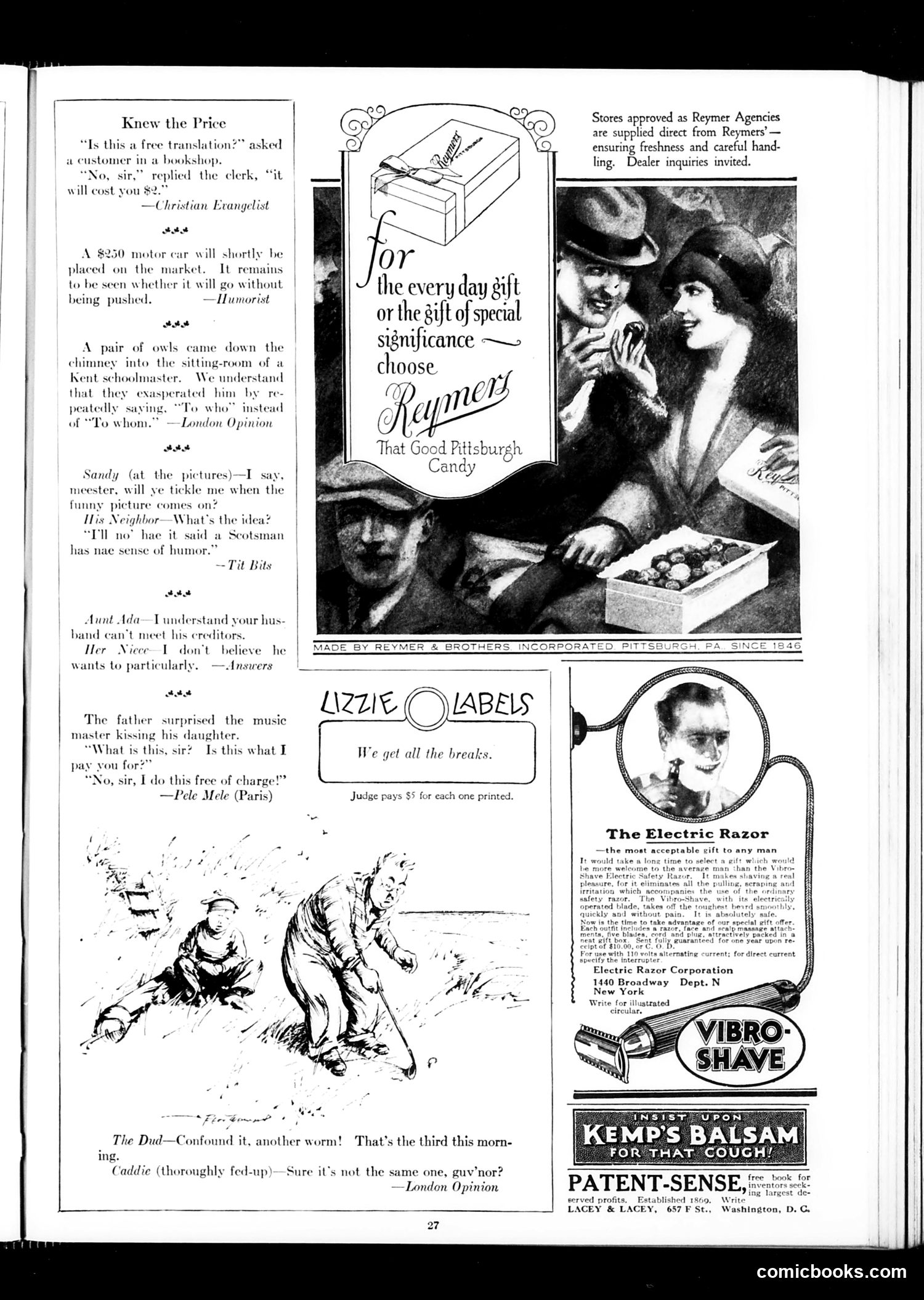
This page from *Judge* magazine (a major American satirical publication) is primarily **advertising with interspersed humor snippets**. The cartoons and jokes are brief, disconnected items typical of the era. The **main cartoon** (lower left) shows two golfers in frustration—one caddie telling another "Confound it, another worm! That's the third this morning," with the response "Sure it's not the same one?" This is gentle golf-humor satire about incompetence or repetition. The **upper advertisement** for Reymer's candy uses period-appropriate imagery of well-dressed couples, marketing it as gift-suitable. The remaining content consists of **one-liner jokes** from various international publications (Christian Evangelist, London Opinion, Tit Bits, etc.)—mostly puns or domestic humor with no specific political content. The **bottom advertisements** promote electric razors, cough medicine, and patent medicines—standard early-20th-century commercial goods. Overall, this page reflects *Judge*'s mix of light satire, advertising, and reprinted jokes rather than serious political commentary.
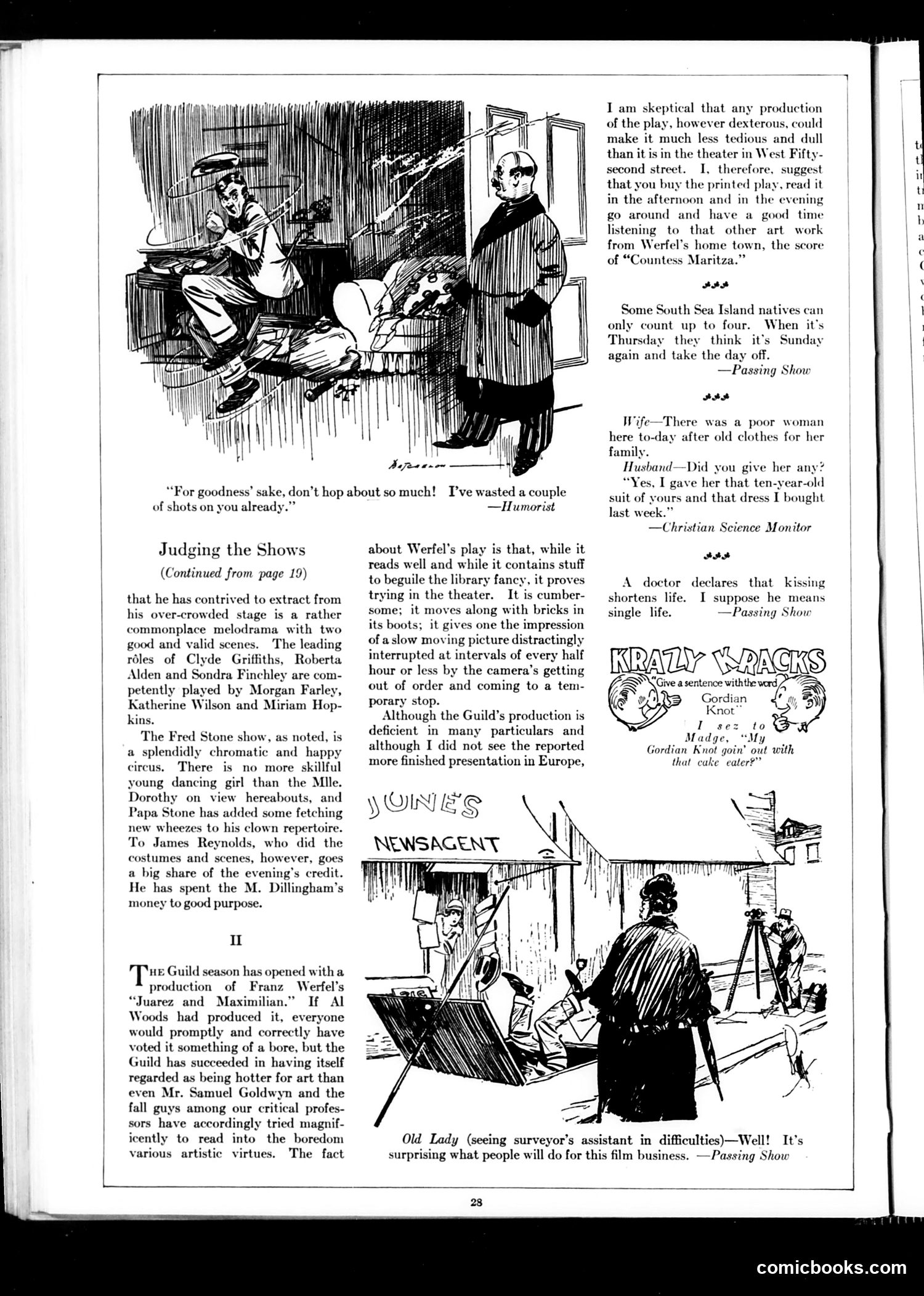
This page from *Judge* magazine contains theater reviews and satirical humor pieces typical of early 20th-century American magazines. **Main Content:** The primary article, "Judging the Shows," reviews recent theatrical productions. The critic praises Fred Stone's circus-themed show and its choreography, while expressing skepticism about Franz Werfel's "Juarez and Maximilian"—dismissing it as tedious despite the Guild Theatre's attempts to present it as sophisticated art. The critic suggests audiences read the script at home and listen to the operetta "Countess Maritza" instead. **Satirical Humor:** Scattered throughout are brief jokes mocking social behaviors—South Sea Islanders' counting abilities, wives giving away husbands' old clothes, and a doctor's dubious claims about kissing. The bottom cartoon depicts a film crew shooting outdoors, with the caption sarcastically noting people's willingness to endure hardship for movie work. **Overall Tone:** The page reflects *Judge*'s characteristic irreverent stance toward both high culture and everyday absurdities, using humor to critique pretentious theater criticism and social conventions.
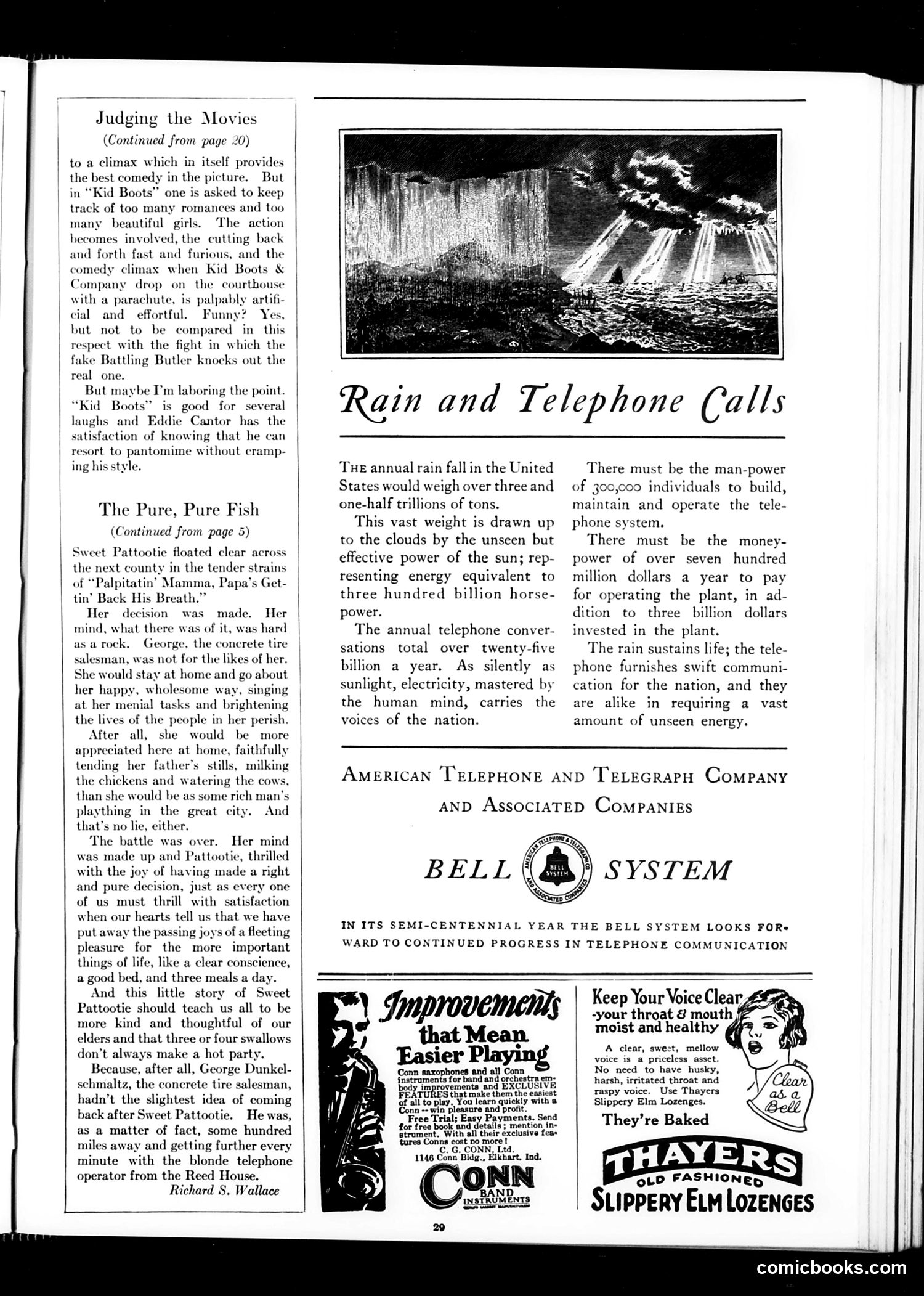
This page combines film criticism with advertising. The "Judging the Movies" section reviews 1920s comedies—specifically "Kid Boots" (starring Eddie Cantor) and "The Pure, Pure Fish." The reviewers critique these films' plots and comedic timing, with the second review satirizing rural melodrama through the character Sweet Pattootie, a farm girl who rejects city temptation. The main content is a corporate advertisement from Bell Telephone System comparing rainfall's power to sustain life with telephone networks' role in national communication. Both require vast "unseen energy"—rain from the sun, phones from electricity and human infrastructure. This is corporate messaging framed as philosophical observation, typical of 1920s advertising that positioned technology companies as modernizing forces serving the nation. The page also includes period product ads (Conn saxophones, Thayers lozenges).
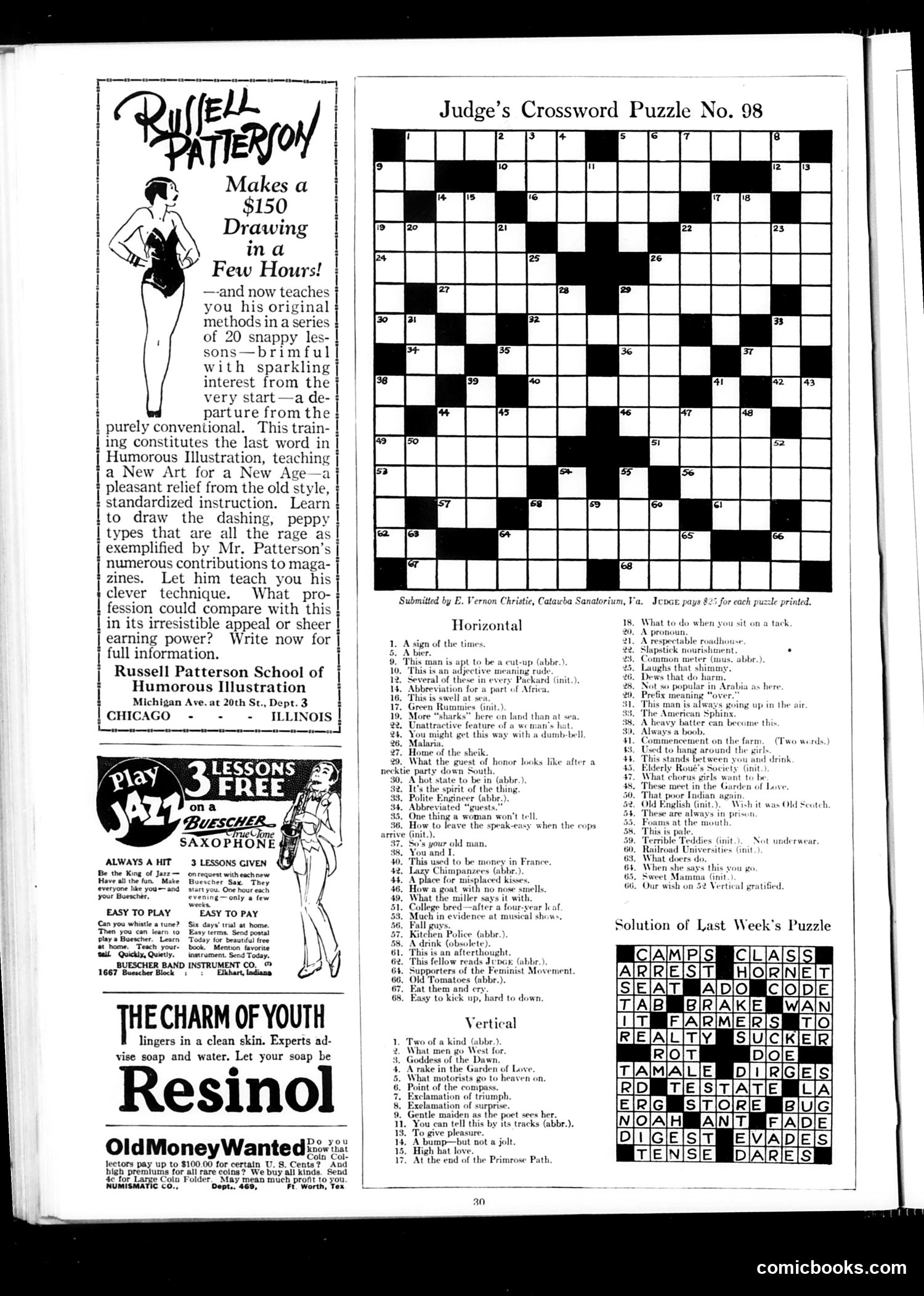
This page is primarily **advertising and instructional content**, not political satire. The dominant feature is an advertisement for Russell Patterson's correspondence school teaching humorous illustration—a "20 snappy lessons" course. Patterson was a popular cartoonist of this era, and the ad emphasizes his "dashing, peppy types" as models for modern illustration students. The page includes additional period advertisements: a Buescher saxophone lesson offer ("Be the King of Jazz"), Resinol soap ("The Charm of Youth"), and an "Old Money Wanted" numismatic collector notice. **Judge's Crossword Puzzle No. 98** occupies the right side—a standard feature of the magazine. **Context for modern readers**: This reflects 1920s-30s consumer culture and the era's enthusiasm for correspondence courses and self-improvement advertising. There is **no apparent political cartoon or satire** on this page; it represents Judge functioning as an advertising-supported humor magazine rather than purely satirical publication.
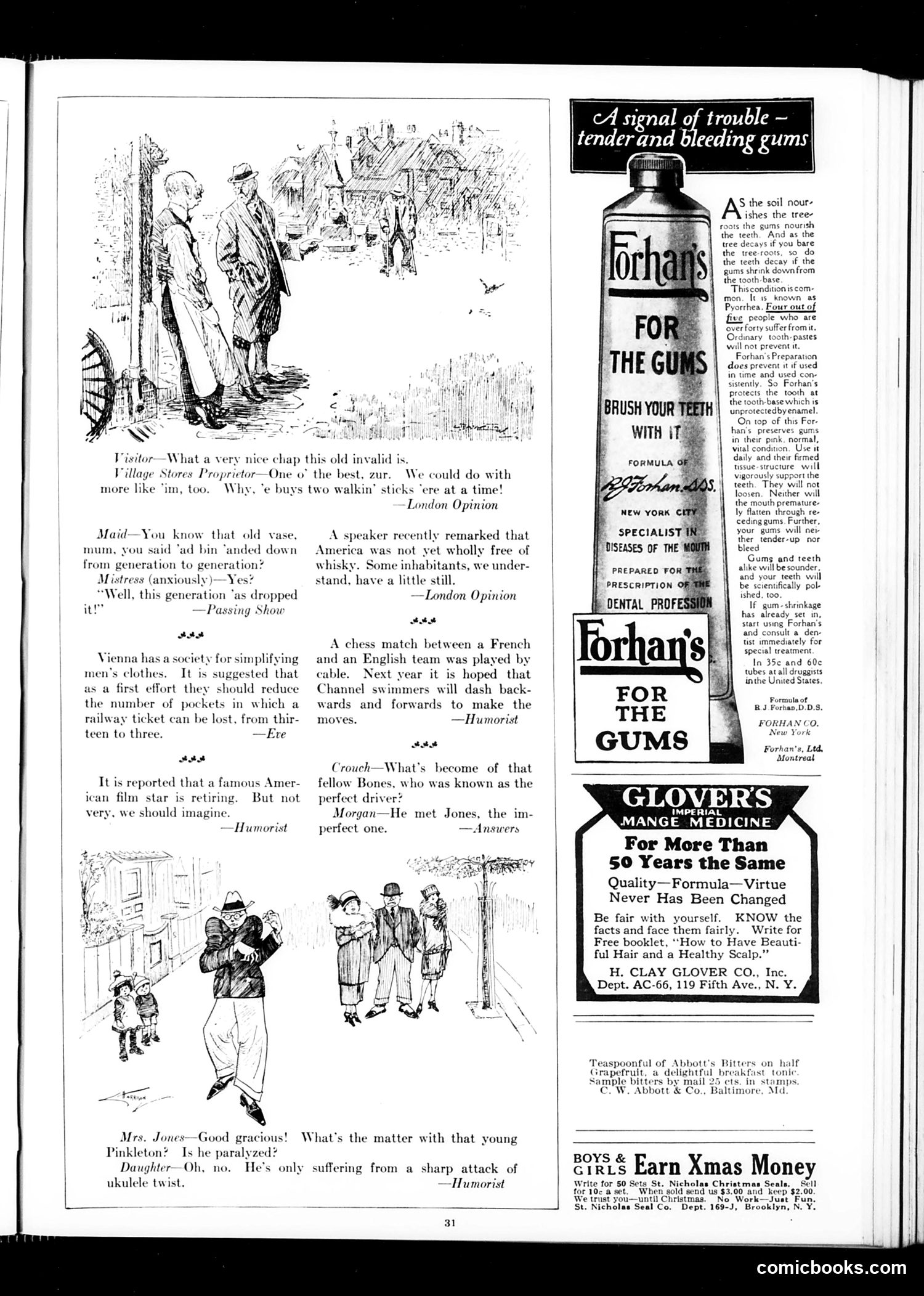
This page combines humorous anecdotes with period advertisements (circa 1920s). The left side features satirical vignettes mocking contemporary life: **The cartoons/jokes** depict: - A servant breaking an heirloom vase, undermining claims of generational continuity - Vienna's proposal to reduce pocket count in men's clothing (mocking efficiency crazes) - A film star's "retirement" that isn't really retiring - A chess match played by transatlantic cable, with absurd speculation about swimmers playing chess backwards - A car accident victim with "ukulele twist" (likely referencing the 1920s dance fad) **The satire targets**: class pretension, modern absurdity, and the gap between aspiration and reality—typical Judge magazine fare. **The advertisements** (Forhan's toothpaste, Glover's mange medicine, Abbott's bitters) represent contemporary patent medicine marketing, emphasizing pseudo-scientific health claims common to the era. The page is primarily **entertainment and advertising**, with no identifiable political figures or specific historical events referenced.
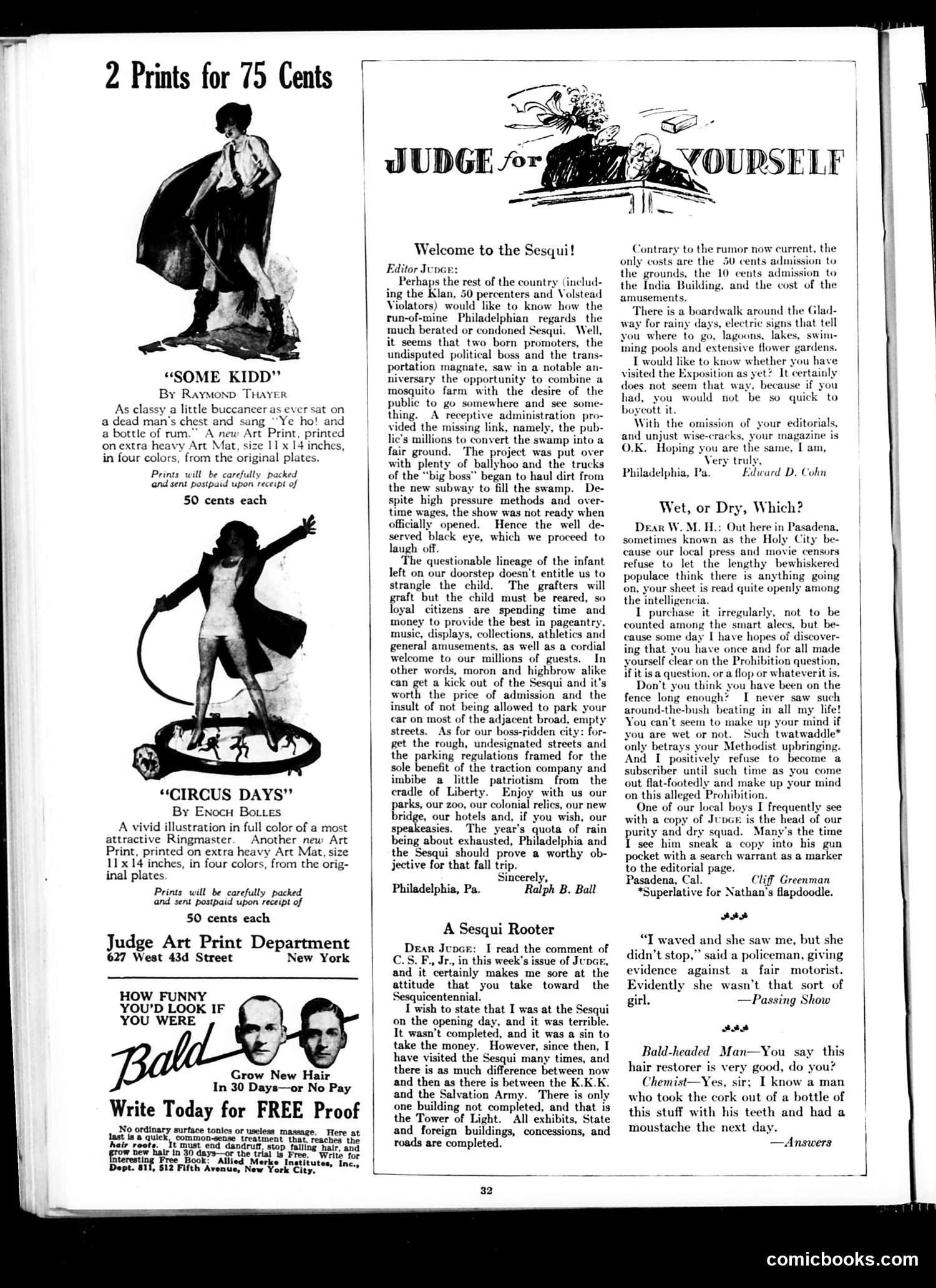
This page from Judge satirizes Philadelphia's **Sesquicentennial Exposition** (1926), a major public celebration marking the nation's 150th anniversary. The editorial content presents competing perspectives on the event. **The satire:** Editor Ralph B. Ball defends the Sesqui despite its troubled opening—acknowledging it was an unfinished "mosquito farm" built on a swamp using political patronage and corruption ("grafters will graft"), yet arguing citizens should still support it as a patriotic obligation. He dismissively references contemporary social anxieties: the KKK, Prohibition violators ("Volstead Violators"), and "50 percenters" (unclear reference, possibly labor radicals). **The counter-letter** from "A Sesqui Rooter" concedes the opening was terrible but insists the exposition has vastly improved—comparing pre- and post-opening conditions to the moral distance between the KKK and Salvation Army. **Modern context:** The page reveals 1920s class attitudes: elites promoting civic spectacle despite obvious mismanagement, while ordinary citizens grudgingly accept patriotic duty. The heavy-handed patriotism masks admitted corruption. The print advertisements are unrelated commercial offerings.
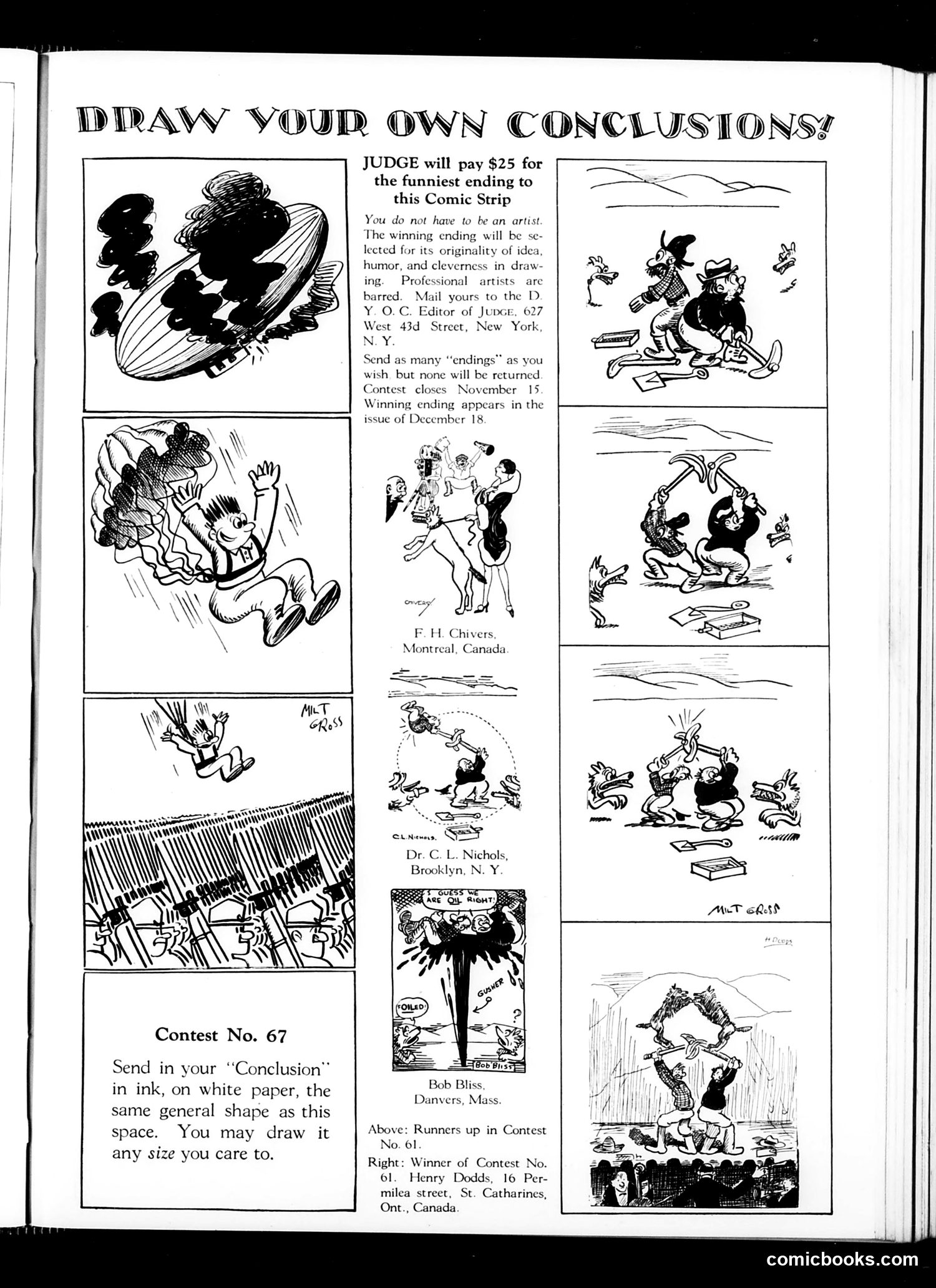
This page presents an interactive comic contest where readers submit their own endings to an incomplete comic strip. The left side shows four sequential panels depicting slapstick physical comedy—a character being launched, tumbling, crashing, and landing in chaos. The final panel is blank, awaiting reader submissions. Judge offered $25 (substantial money in this era) for the funniest conclusion, judged on originality and humor rather than artistic skill—amateurs were explicitly welcomed while professionals were barred. The contest encouraged participatory humor and creative engagement from readers. The right side displays runners-up and the winner from a previous contest (No. 61), showing approved submissions for reference. This represented a popular early-20th-century magazine format: combining entertainment with audience participation and modest monetary incentives to boost reader engagement and submission volume.
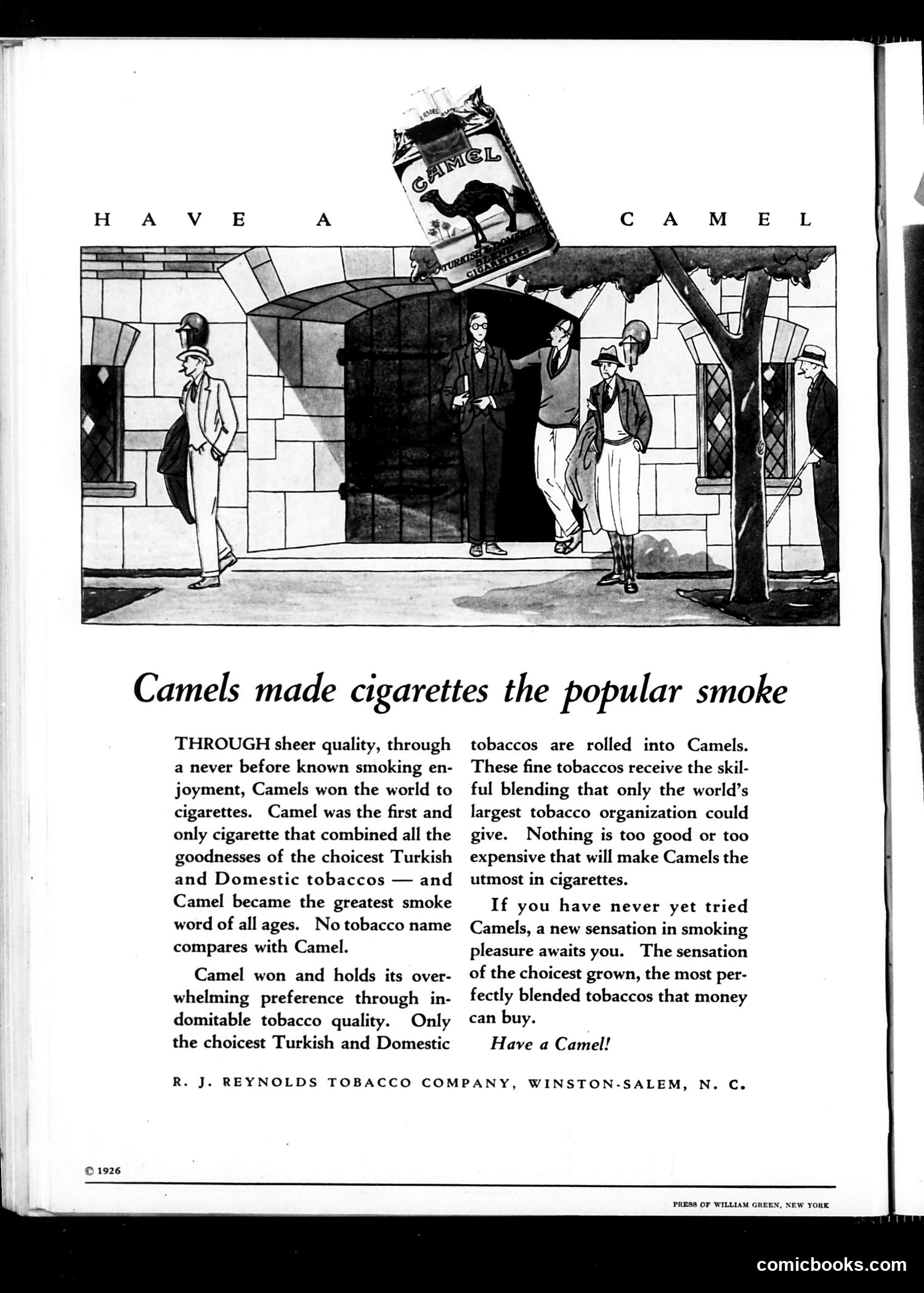
This is not satire or a political cartoon—it's a **straightforward cigarette advertisement** for Camel brand cigarettes by R.J. Reynolds Tobacco Company, appearing in *Judge* magazine in 1926. The illustration depicts an upscale urban scene with well-dressed figures and a large Camel cigarette pack prominently displayed, establishing aspirational brand imagery. The text employs advertising rhetoric typical of the era: claims about "quality," "Turkish and Domestic tobaccos," and "smoking pleasure" without any health warnings or disclaimers. For modern readers, the striking element is the *casual normalization* of tobacco advertising in mainstream magazines and the complete absence of health warnings—something that would be legally impossible today. The advertisement assumes cigarette smoking is desirable and fashionable, targeting educated, affluent consumers through *Judge*'s upscale readership.