
Judge, 1926-11-06 · page 21 of 36
Judge — November 6, 1926 — page 21: what you’re looking at
What you’re looking at
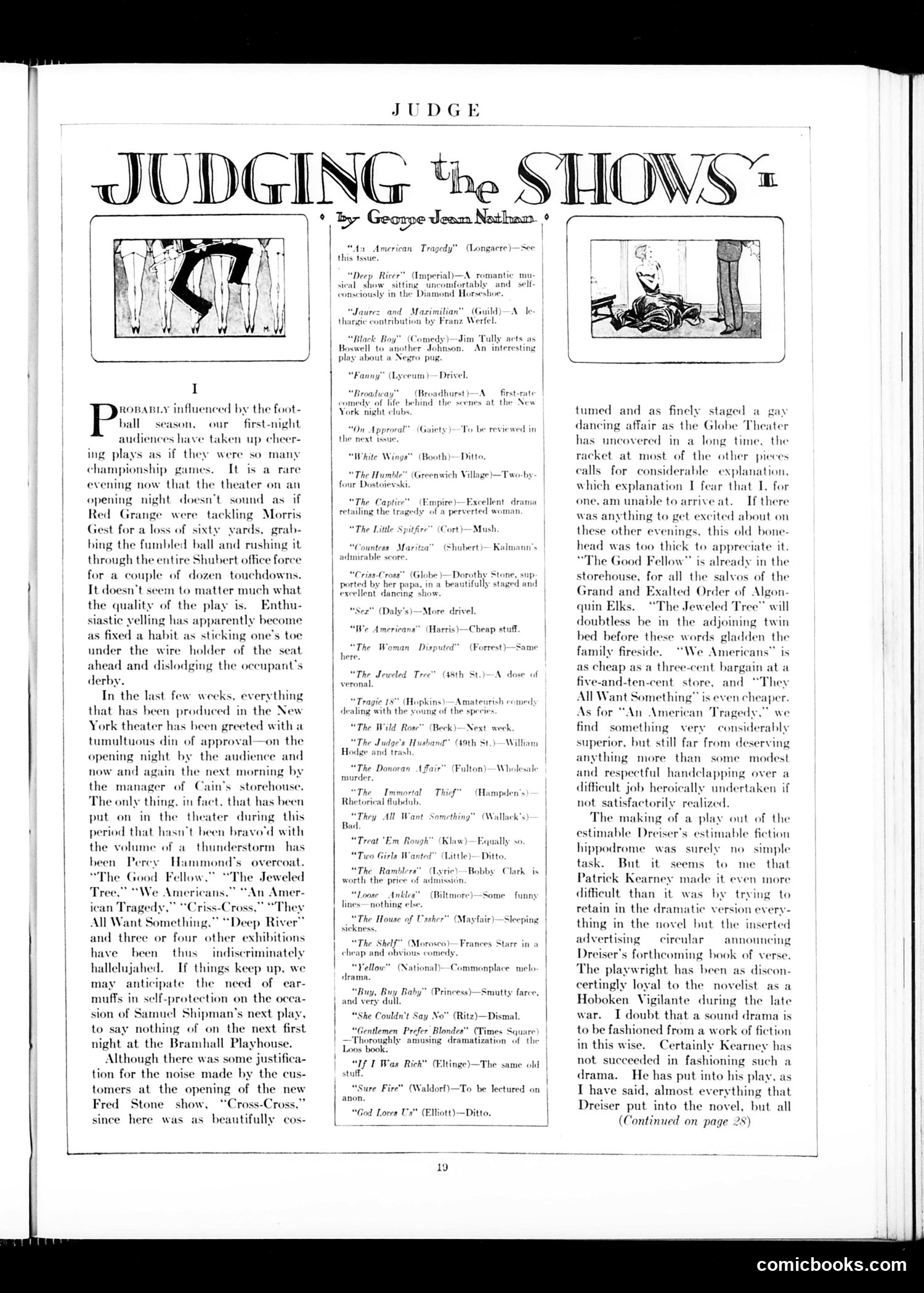
This is a theater review column, not a political cartoon. The author criticizes New York's opening-night theater audiences for their indiscriminate enthusiasm, using a football metaphor: they cheer like championship-game fans regardless of play quality, comparing audience noise to "Red Grange" (a famous 1920s football star) tackling producer Morris Gest. The piece lists recent Broadway productions with brief, often dismissive reviews ("drivel," "cheap stuff," "mush"). Notable exceptions praised include "Cross-Cross" and Dorothy Stone's dancing show. The author complains that nearly everything gets thunderous applause on opening night, making it hard to distinguish genuinely good theater from mediocre work. The underlying point: 1920s theatergoers behaved more like sports fans than discerning audiences, obscuring real theatrical merit beneath noise and hype.
📄 Transcribed text from this page (OCR, searchable)
Machine-transcribed from the original scan — historical spelling and the odd misread are preserved.
ROBABLY influenced by the foot- ball season, our — first-night ing plays as if they were so many championship games. It is a rare evening now that the theater on an opening night doesn’t sound as if Red Grange were tackling Morris Gest for a loss of sixty yards, grab- bing the fumbled ball and rushing it through the entire Shubert office force for a couple of dozen touchdowns. It doesn’t seem to matter much what the quality of the play is. Enthu- iastic 3 apparently become elling ha as fixed a habit as sticking one’s toe under the wire holder of the seat ahead and dislodging the occupant’s derby. In the last few weeks, everything that has heen produced in the New York theater has been greeted with a tumultuous din of approval—on the opening night by the audience and now and again the next morning by the manager of Cain's storehouse. The only thing, in fact, that has been put on in the theater during. this period that hasn’t been bravo'd with the volume of a thunderstorm been Perey Hammond's “The Good Fellow.” Tree.” “We Ame ican Tragedy,” “Criss-Cross,” “They All Want Something.” “Deep River” and three or four other exhibitions thus has overcoat. “The Jewelec An Amer- have been indiscriminately hallelujahed. may anticipate If things keep up, we the need of ear- muffs in self-protection on the oc sion of Samuel Shipman’s next play, ay nothing of on the next first night at the Bramhall Playhouse. Although there was some just tion for the noise made by the cus- tomers at the opening of the new Fred Stone since here was as beautifully cos- show, “Cross-Cross JUDGE “Aa American (Longacre) —See Tragedy” this 1ssue )—A romantic mu takes nd self sical consciously in the Imperi how sitting Mazimilian” (Guild) —A le n by Franz Werfel aurez and Jim ‘Tully acts as nson. An. interesting play about a Negro pug. “Fanny” (Lyceum )—Drivel. “Broadway” (Broadhurst A first-rate comedy of life behind the scenes at the New York night clubs “On Appr Gaiety )—To be reviewed in the next i “White Wings” (Booth)—Ditto. “The Humble four Dostoievski Greenwich Village)— “The Captive” Empire)—Excellent- drama retailing the tra of a perverted woman “The Little Spitfire” (Cort)—Mush. ountess: Maritza” (Shubert) Kalmann’s rable score riss-Cross” (Globe )—Dorothy Stone, sup: ported by her papa, in a beautifully staged and excellent dancing show ” (Daly’s)—More drivel. {mericans” (Hartis)—Cheap stuff Woman Disp Forrest )—Same $8th St.)—A dose of “The Jeweled Tree H Tragic 18° (He aling with the y Amateurish comed “The Wild Rose” (Beck)—Next week. “The Judge's Hushant™ (49th St.)—William Hodge and trash “The Donoran Affair” (Fulton)—Wholesle murder “The Immortal Thief” (Hampden’s Rhetorical flubdul “They All Want Something” (Wallack’s Bad “Treat "Em Rough” (Klaw)—Equally so “Tuco Girls Wanted” (Little)— Ditto. “The Ramblers” (Lyrie)—Bobby Clark is worth the price of admission “Loose Ankles” (Bilt more)—Some funny lines—nothing else. “The House of Ussher” (Maytair)—Sleeping | sickn “The Shelf” (Morosco)—Frances Starr in a cheap and obvious comedy “Yellow” (National)—Commonplace melo. dram Buy, Buy Baby” (Princess) and very dull “She Couldn't Say No” (Ritz)—Dismal. “Gentlemen Prefer Blondes” (Times Square —Thoroughly amusing dramatization of the Loos book. “If | Was Rick” (Eltinge)—The same old stuff “Sure Fire” (Waldorf) anon. “God Loves Us" (Elliott)—Ditto. be lectu Smutty farce, | tumed and as finely sta f dancing affair as the Globe Theater has uncovered in a long time, the racket at most of the othe pieces calls for considerable explanation, which explanation I f that I. for one, am unable to arrive at. If there was anything to get excited about on these other evenings, this old bone- head was too thick to appreciate it “The Good Fellow” is already in the storehouse, for all the salvos of the Grand and Exalted Order of Algon quin Elks. “The Jeweled Tree” will doubtless be in the adjoining twin bed before these words gladden the family fireside. “We Americ: as cheap as a three-cent bargain at a five-and-ten-cent and “They All Want Something” is even cheaper. As for “An find something very ¢ superior, but still far from deserving anything more than modest and respectful handelapping over a difficult job heroically undertaken if not satisfactorily realized. The making of a play out of the estimable Dreiser's estimable fiction ns” is store, American Tragedy,” we nsiderably some hippodrome was. surely no_ simple task. But it that Patrick Kearney made it even more difficult than it retain in the dramatic version every- thing in the novel but the inserted advertising — circular announcing Dreiser's forthcoming book of verse. seems to me by trying to The playwright has been as discon- certingly loyal to the novelist as a Hoboken Vigilante during the late war. I doubt that a sound drama is to be fashioned from a work of fiction in this wise. Certainly Kearney has not succeeded in fashioning such a drama. He has put into his play, as I have said. vthing that Dreiser put into the novel, but all (Continued on page 28) Imost evel comicbooks.com