
Judge, 1926-11-06 · page 22 of 36
Judge — November 6, 1926 — page 22: what you’re looking at
What you’re looking at
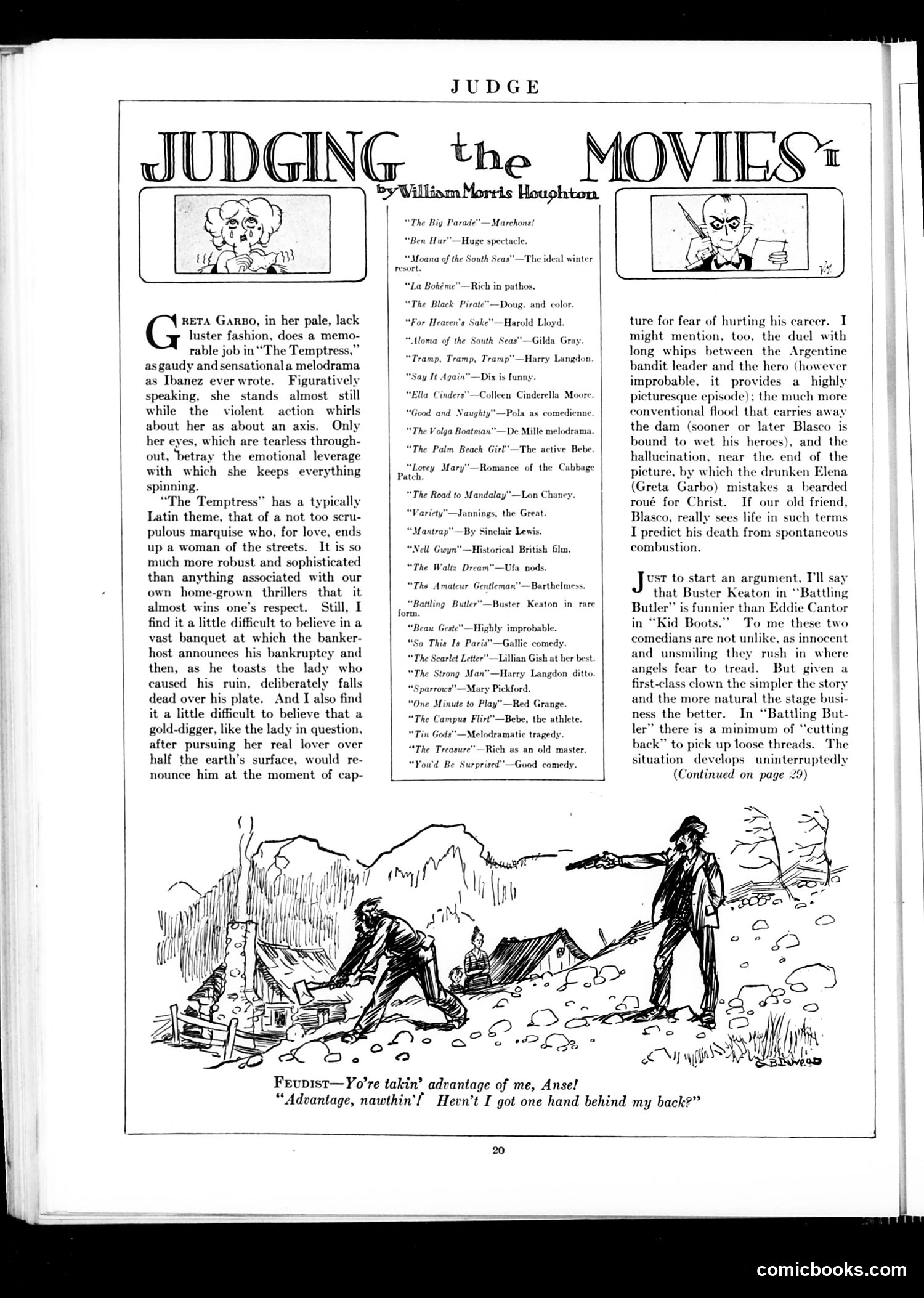
This is a film criticism column by William Morris Houghton reviewing 1920s cinema. The main text discusses Greta Garbo's performance in "The Temptress," a melodrama where her character—a marquise who becomes a street woman—maintains emotional control through tearless eyes while chaos swirls around her. The critic finds the plot implausible, particularly a banker announcing bankruptcy then dying mid-toast, and a gold-digger abandoning her lover at the crucial moment. The list catalogs contemporary films with one-line reviews (praising Douglas Fairbanks' *The Black Pirate*, Harold Lloyd's work, etc.). The cartoon depicts a feudal or frontier dispute over "advantage," with one figure claiming an unfair advantage while pointing out he fights with one hand behind his back—a visual joke about leveling the playing field in conflict.
📄 Transcribed text from this page (OCR, searchable)
Machine-transcribed from the original scan — historical spelling and the odd misread are preserved.
JUDGE RETA Garo, in her pale, lack luster fashion, does a memo- rable job in“*The Temptress,” asgaudy andsensationala melodrama as Ibanez ever wrote. Figuratively speaking, she stands almost still while the violent action whirls about her as about an axis. Only her eyes, which are tearless through- out, ‘betray the emotional leverage with which she keeps everything spinning. “The Temptress” has a typically Latin theme, that of a not too scru- pulous marquise who, for love, ends up a woman of the streets. It is so much more robust and sophisticated than anything associated with our own home-grown thrillers that it almost wins one’s respect. Still, I find it a little difficult to believe in a vast banquet at which the banker- host announces his bankruptcy and then, as he toasts the lady who caused his ruin, deliberately falls dead over his plate. And I also find it a little difficult to believe that a gold-digger, like the lady in question, after pursuing her real lover over half the earth’s surface, would re- nounce him at the moment of cap- | iyi Mi Wy) | STL (int } HAN WILE \ “The Big Parade" —Marchons! | “Ben Hur"—Huge spectacle. Th | “Moana of the South Seas" ie ideal winter | resort. “La Bokéme”—Rich in pathos. “The Black Pirate"—Doug. and color. “For Heaven's Sake"—Harold Lloyd. “Aloma of the South Seas"—Gilda Gray “Tramp, Tramp, Tram Harry Langdon “Say It Again” —Dix is funny. “Ella Cinders”—Colleen Cinderella Moore “Good and Naughty"—Pola as comedienne. “The Volga Boatman" —De Mille melodrama. | “The Palm Beach Girl"—The active Bebe. Patch. “The Road to Mandalay"—Lon Chaney. “Varicty”"—Jannings, the Great “Mantrap"—By Sinclair Lewis. “Nell Gwyn" — orical British film. “The Waltz Dream"—Ufa nods. “The Amateur Gentleman" —Barthelmess. “Battling Butler”—Buster Keaton in rare form “Beau Geste”—High “So This Is Par Gallic comedy. “The Scarlet Letter”—Lillian Gish at her best “The Strong Man"—Harry Langdon ditto. improbable. “Sparrows” —Mary Pickford “One Minute to Play"—Red Grange. “The Campus Flirt"—Bebe, the athlete. “Tin Gods" —Melodramatic tragedy. “The Treasure” Rich as an old master. “You'd Be Surprised”—Good comedy. “Lovey Mary"—Romance of the Cabbage | Frevupist—Yo’re takin’ advantage of me, Anse! “Advantage, nawthin’f Hevn’t I got one hand behind my back?” ture for fear of hurting his career. I might mention, too, the duel with long whips between the Argentine bandit leader and the hero (however improbable, it provides a highly picturesque episode); the much more conventional flood that carries away the dam (sooner or later Blasco is bound to wet his heroes), and the hallucination, near the. end of the picture, by which the drunken Elena (Greta Garbo) mistakes a bearded roué for Christ. If our old friend, Blasco, really sees life in such terms I predict his death from spontaneous combustion. ust to start an argument, I'll say that Buster Keaton in “Battling Butler” is funnier than Eddie Cantor in “Kid Boots.” To me these two comedians are not unlike, as innocent and unsmiling they rush in where angels fear to tread. But given a first-class clown the simpler the story and the more natural the stage busi- ness the better. In ‘Battling But- ler” there is a minimum of “cutting back” to pick up loose threads. The situation develops uninterruptedly (Continued on page 29) comicbooks.com