
Judge, 1926-11-06 · page 15 of 36
Judge — November 6, 1926 — page 15: what you’re looking at
What you’re looking at
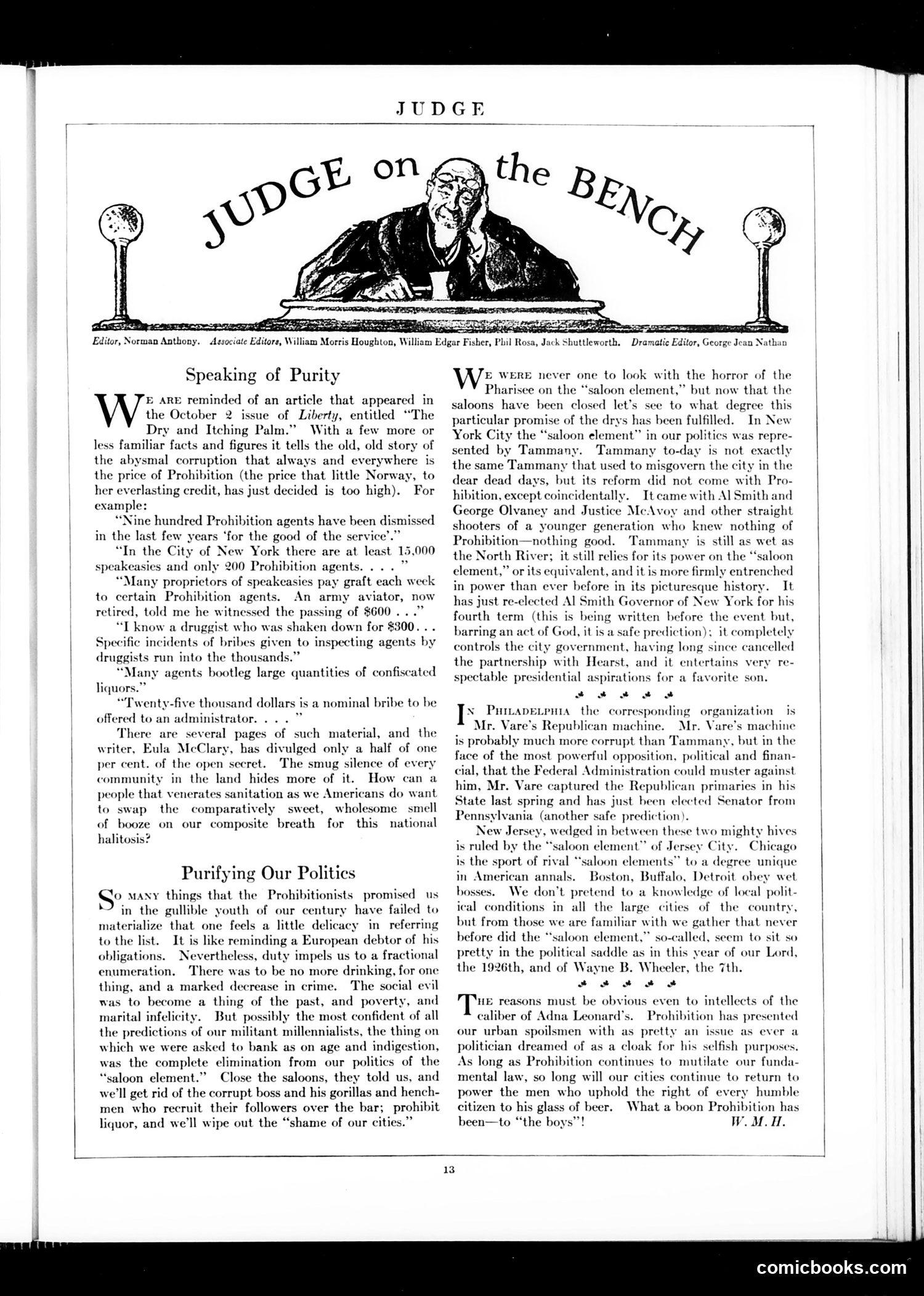
This editorial page attacks **Prohibition's failures**, using the "Judge on the Bench" format to deliver political commentary. **The Main Argument:** Prohibitionists promised that closing saloons would eliminate corruption from urban politics. The article demonstrates this is false, using Tammany Hall—New York's notorious Democratic political machine—as the prime example. **Key Points:** - Lists concrete corruption under Prohibition: dismissed agents, thousands of bribes to officials, Prohibition agents bootlegging confiscated liquor, widespread graft. - Notes Tammany Hall (the "saloon element") remains powerful despite saloon closures, recently re-electing Al Smith as governor. - Credits Al Smith, George Olvany, and Justice McAvoy—reformers from *outside* Prohibition—with Tammany's limited improvements, not the dry law itself. - Concludes: eliminating saloons didn't eliminate political corruption; the "saloon element" persists in different forms. **The Satire:** Mocks Prohibitionists' naive faith that closing bars would automatically purify politics, when corruption runs far deeper than where politicians drink.
📄 Transcribed text from this page (OCR, searchable)
Machine-transcribed from the original scan — historical spelling and the odd misread are preserved.
Editor, Norman Anthony. JUDGE Speaking of Purity E ARE reminded of an article that appeared in W the October 2 issue of Liberty, entitled “The Dry and Itching Palm.” With a few more or less familiar facts and figures it tells the old, old story of the abysmal corruption that always and everywhere is the price of Prohibition (the price that little Norway, to her everlasting credit, has just decided is too high). For example: “Nine hundred Prohibition agents have been dismissed in the last few years ‘for the good of the service’.” “In the City of New York there are at least 15,000 sasies and only 200 Prohibition agents... . ” y proprietors of speakeasies pay graft each week to certain Prohibition agents. An army aviator, now retired, told me he witnessed the passing of $600 . “I know a druggist who was shaken down for $300. Specific incidents of bribes given to inspecting ogents by druggists run into the thousands.” “Many agents bootleg large quantities of confiscated liquors.” “Twenty-five thousand dollars is a nominal bribe to be offered to an administrator. . . . There are several pages of such material, and the writer, Eula McClary, has divulged only a half of one per cent. of the open secret. The smug silence of every commun: in the How can a people that venerat nitation as we Americans do want to swap the comparatively sweet, wholesome smell e on our composite breath for this national land hides more of it. Purifying Our Politics ) MANY things that the Prohibitionists promised us in the gullible youth of our century have failed to materialize that one feels a little delicacy in referring to the list. It is like reminding a European debtor of his obligations. Nevertheless, duty impels us to a fractional enumeration. There was to be no more drinking, for one thing, and a marked decrease in crime. The social evil was to become a thing of the , and poverty, and marital infelicity. But possibly the most confident of all the predictions of our militant millennialists, the thing on which we were asked to bank as on age and indigestion, was the complete elimination from our politics of the “saloon element.” Close the saloons, they told us, and we'll get rid of the corrupt boss and his gorillas and hench- men who recruit their followers over the bar; prohibit liquor, and we'll wipe out the “shame of our cities.” Associate Editors, William Morris Houghton, Williom Edgar Fisher, Phil ca Jack Shuttleworth. Dramatic Editor, George Jean Nathan E WERE never one to look with the horror of the Pharisee on the “saloon element,” but now that the have been closed let’s see to what degree this particular promise of the drys has been fulfilled. In New York City the “saloon element” in our politics was repre- sented by Tammany. Tammany to-day is not exactly the same Tammany that used to misgovern the city in the dear dead days, but its reform did not come with Pro- hibition, except coincidentally. It came with Al Smith and George Olvaney and Justice McAvoy and other straight shooters of a younger generation who knew nothing of Prohibition—nothing good. Tammany is still as wet as the North River; it still relies for its power on the “saloon element,” or its equivalent, and it is more firmly entrenched in power than ever before in its picturesque history. It has just re-elected Al Smith Governor of New York for his fourth term (this is being written before the event but, barring an act of God, it is a safe prediction); it completely controls the city government, having long since cancelled the partnership with Hearst, and it entertains very re- spectable presidential aspirations for a favorite son. saloo + tt tt I < Puitapetpnia the corresponding organization — is Mr. e’s Republican machine. Mr. Vare’s machine is probably much more corrupt than Tammany, but in the face of the most powerful opposition, political and fi cial, that the Federal Administration could muster against him, Mr. Vare captured the Republican primaries in his State last spring and has just been elected Senator from Pennsylvania (another safe prediction). New Jersey, wedged in between these two mighty hives is ruled by the “saloon element” is the sport of rival of Jersey City “saloon elements” Chicago to a degree unique in American annals. Boston, Buffalo, Detroit obey wet bosses. We don’t pretend to a knowledge of local polit- ical conditions in all the large cities of the country, but from those we are familiar with we gather that never before did the “saloon element seem to sit so pretty in the political saddle as in this of our Lord, the 1926th, and of Wayne B. Wheeler, the 7th. sos so-called, rr ey HE reasons must be obvious even to intellects of the caliber of Adna Leonard's. Prohibition has presented our urban spoilsmen with as pretty an issue as ever a politician dreamed of as a cloak for his selfish purposes. As long as Prohibition continues to mutilate our funda- mental law, so long will our cities continue to return to power the men who uphold the right of every humble citizen to his glass of beer. What a boon Prohibition has been—to “‘the bo) W.M.H. comicbooks.com