
Judge, 1926-11-06 · page 7 of 36
Judge — November 6, 1926 — page 7: what you’re looking at
What you’re looking at
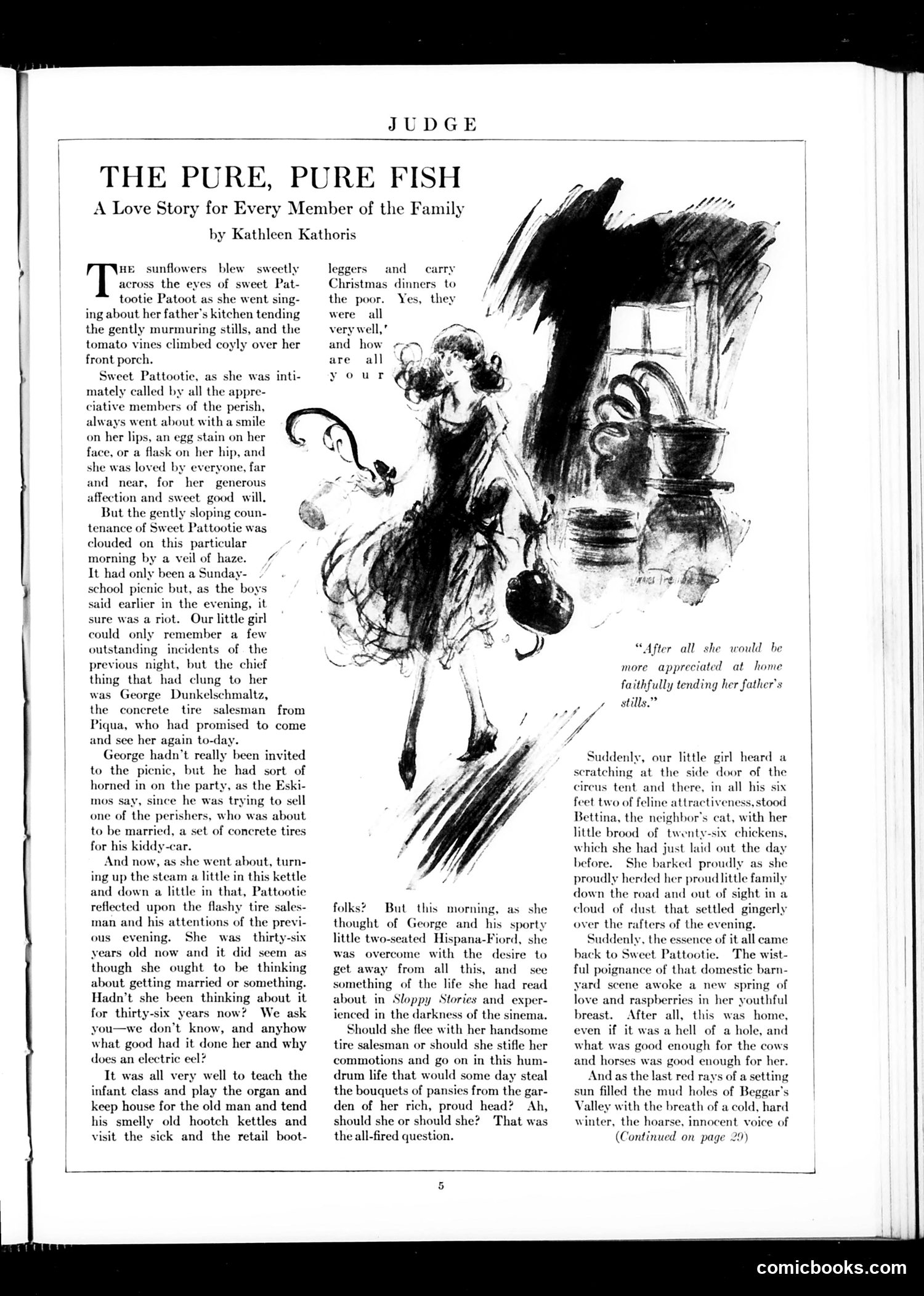
This page contains the opening of a short story rather than a political cartoon. The illustrated narrative follows Sweet Pattootie, a young girl characterized as perpetually cheerful and beloved by her community. The story establishes her domestic setting—her father's kitchen with tomato vines and front porch—before introducing a central tension: George Dinkelschmidt, a concrete tire salesman from Papua, has promised to visit. The text suggests this is a sentimental family tale exploring themes of anticipation and desire, likely with romantic or comedic undertones. The sketch-style illustration depicts the protagonist in period clothing. Without seeing the full narrative conclusion, the satirical intent—if any—remains unclear, though Judge typically employed humor about courtship and social pretensions.
📄 Transcribed text from this page (OCR, searchable)
Machine-transcribed from the original scan — historical spelling and the odd misread are preserved.
JUDGE HE sunflowers blew sweetly I across the eyes of sweet Pat- tootie Patoot as she went sing- ing about her father’s kitchen tending the gently murmuring stills, and the tomato vines climbed coyly over her front porch. Sweet Pattootie, as she was inti- mately called by all the appre- ciative members of the perish, always went about with a smile on her lips, an egg stain on her face, or a flask on her hip, and she was loved by everyone, far and near, for her generous affection and sweet good will. But the gently sloping coun- morning by a veil of haze. THE PURE, PURE FISH A Love Story for Every Member of the Family by Kathleen Kathoris leggers and — carry Christmas dinners to the poor. Yes, they were all very well,” and how ¢ are all your tenance of Sweet Pattootie was 8 , v clouded on this particular y A It had only been a Sunday- school picnic but, as the boys said earlier in the evening, it sure was a riot. Our little girl could only remember a few outstanding incidents of the previous night, but the chief thing that had clung to her was George Dunkelschmaltz, the concrete tire salesman from Piqua, who had promised to come and see her again to-day. George hadn't really been invited to the picnic, but he had sort of horned in on the party, as the Eski- mos say, since he was trying to sell one of the perishers, who was about to be married, a set of concrete tires for his kiddy-car. And now, as she went about, turn- ing up the steam a little in this kettle and down a little in that, Pattootie reflected upon the flashy tire sales- man and his attentions of the pre’ ous evening. She was thirty-sis years old now and it did seem as though she ought to be thinking about getting married or something. Hadn’t she been thinking about it for thirty-six years now? We ask you—we don’t know, and anyhow what good had it done her and why does an electric eel? It was all very well to teach the infant class and play the organ and keep house for the old man and tend his smelly old hootch kettles and visit the sick and the retail boot- folks? But this morning, as she thought of George and his sporty little two-seated Hispana-Fiord, she was overcome with the desire to get away from all this, and see something of the life she had read about in Sloppy Stories and exper- ienced in the darkness of the sinema. Should she flee with her handsome tire salesman or should she stifle her commotions and go on in this hum- drum life that would some day steal the bouquets of pansies from the gar- den of her rich, proud head? Ah, should she or should she? That was the all-fired question. “After all she would be more appreciated at home faithfully tending her father's , stills.” Suddenly, our little girl heard a scratching at the side door of the circus tent and there, in all his six feet two of feline attractiveness, stood Bettina, the neighbor's cat, with her little brood of twenty-six chickens, which she had just laid out the day before. She barked proudly as she proudly herded her proud little family down the road and out of sight in a cloud of dust that settled gingerly over the rafters of the evening. Suddenly, the essence of it all came back to Sweet Pattootie. The wist- ful poignance of that domestic barn- yard scene awoke a new spring of love and raspberries in her youthful breast. After all, this was home, even if it was a hell of a hole, and what was good enough for the cows and horses was good enough for her. And as the last red rays of a setting sun filled the mud holes of Beggar's Valley with the breath of a cold, hard winter, the hoarse, innocent voice of (Continued on page 29) comicbooks.com