
A complete issue · 36 pages · 1926
Judge — July 31, 1926
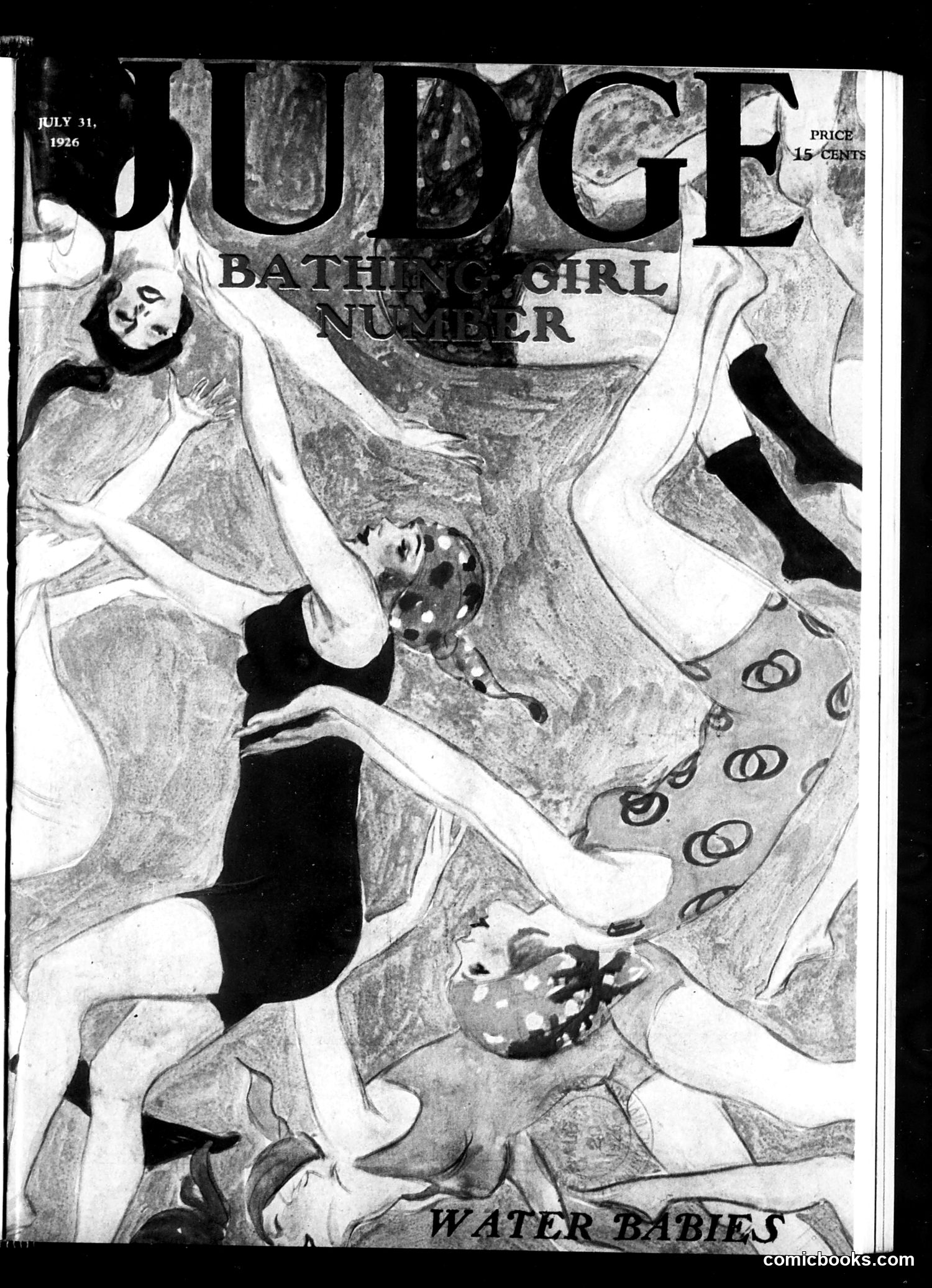
This is a "Bathing Girl Number" cover featuring playful illustrations of women in 1920s swimwear. The title "Water Babies" suggests lighthearted summer content typical of Judge's recreational humor. The cover depicts multiple female figures in various bathing poses - swimming, floating, and lounging - rendered in an art deco style popular during this era. The imagery reflects 1920s beach culture and the social liberation of the "Flapper" age, when women's fashion and public leisure activities were becoming more revealing and socially accepted compared to previous Victorian standards. This was standard entertainment content for the magazine - not political satire, but rather humorous celebration of contemporary summer recreation and modern womanhood.

This is a **Fisk Tire Company advertisement** from 1926, not a political cartoon. The image shows a man jumping over a potted plant while a child watches from below, with the slogan "Get a FISK" prominently displayed. The ad uses dynamic imagery to suggest Fisk tires enable agility and superior performance—the acrobatic leap implies the tires allow vehicles to navigate obstacles effortlessly. The child observer adds a domestic, relatable element, suggesting Fisk tires are trustworthy for family use. The design exploits the magazine's satirical audience to present the tire brand through an entertaining visual metaphor rather than straightforward marketing copy. This represents typical early-20th-century advertising strategy: combining humor and aspiration to sell consumer products.
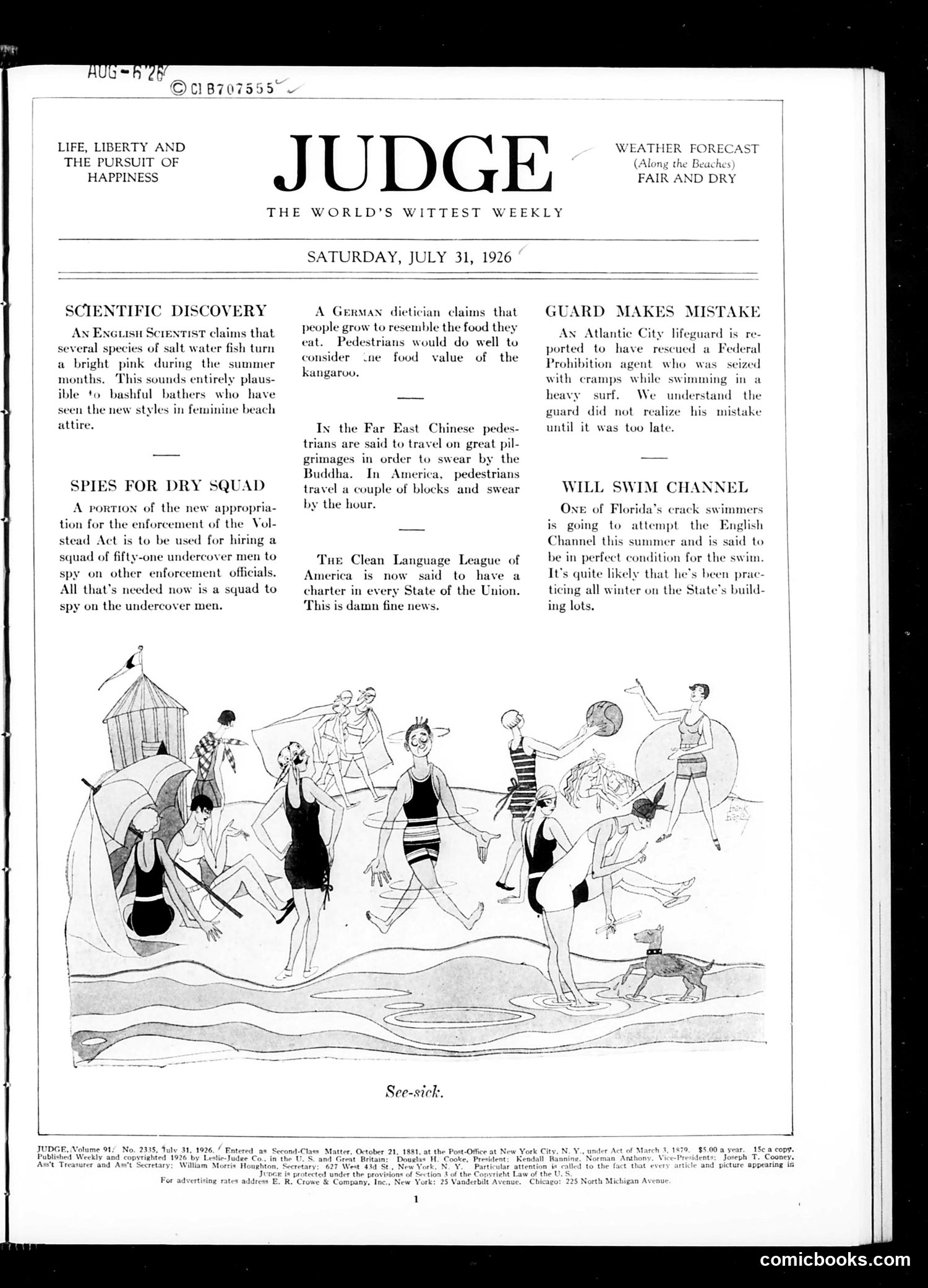
The main cartoon, captioned "See-sick," depicts beachgoers in 1920s bathing attire engaged in various seaside activities. The satire appears to target the fashions and social behaviors of the era—particularly the abbreviated swimwear styles that were controversial at the time. The figure titles suggest commentary on modern beach culture and changing social mores. The accompanying text items are brief humorous observations: one mocks a German dietician's claim about kangaroo food value, another criticizes an Atlantic City lifeguard's error during Prohibition enforcement, and a third promotes an upcoming English Channel swimming attempt. The overall page exemplifies Judge's lighthearted social commentary on contemporary fashion, leisure activities, and legal absurdities of the 1920s.
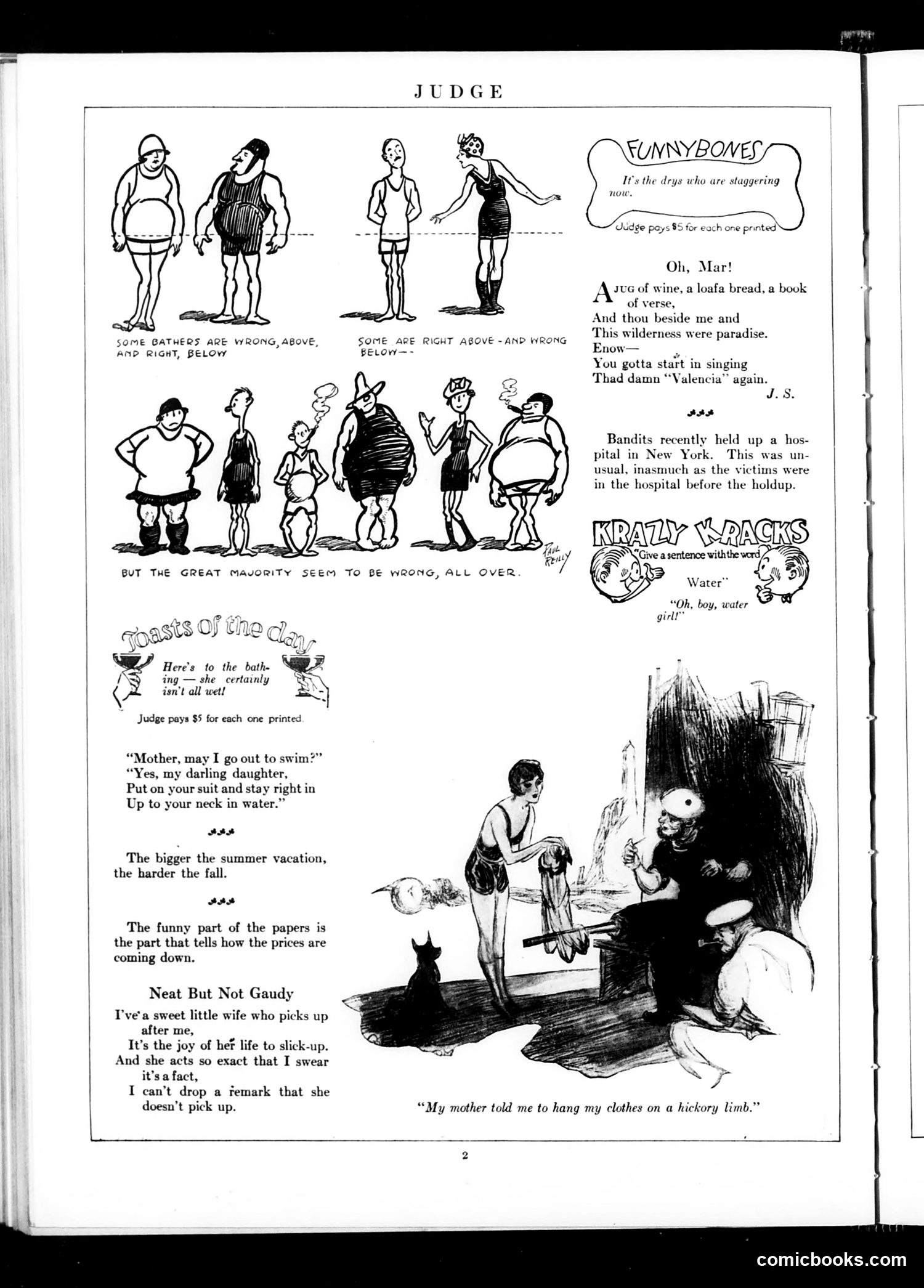
This page contains satirical commentary on body types and social conventions circa early 20th century. **"Judge" section (top):** Cartoon critiques weight distribution—some people carry excess weight "wrong" (upper body/lower body imbalance) while others are proportionally wrong "all over." The joke mocks how people's bodies deviate from perceived ideals, suggesting the "great majority seem to be wrong." **"Funny Bones" and "Krazy Whacks":** Brief humorous quips about swimming, inflation of summer vacation costs, and newspaper price declines. **Bottom cartoon:** Shows a child at a beach with adults. Caption references hanging clothes on a "hickory limb"—likely a colloquial/dialectal expression the cartoonist finds amusing enough to satirize. The overall tone targets physical appearance standards and colloquial language of the era.
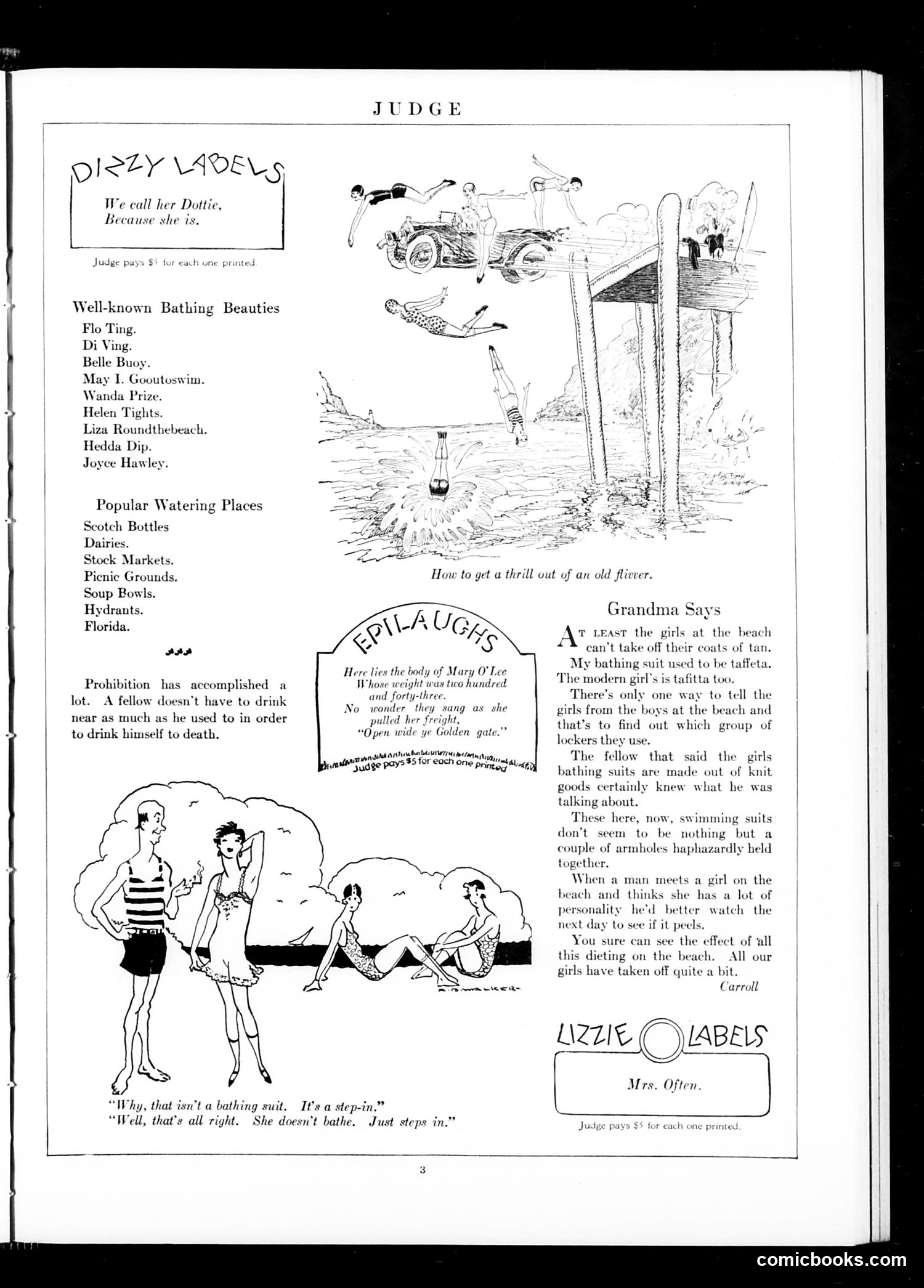
This page from *Judge* magazine contains humorous social commentary about 1920s beach culture and women's fashion during the Prohibition era. The main cartoon depicts a woman in a revealing bathing suit confronted by a man questioning whether it's actually a bathing suit or just a "step-in" (underwear). The joke satirizes the dramatically shortened women's swimwear of the 1920s, which shocked conservative society—garments barely covering the body compared to Victorian bathing costumes. "Grandma Says" provides generational commentary, with an older woman criticizing modern girls' scanty beach attire and their behavior around men. The piece mocks both the younger generation's liberation and older generations' disapproval. Other content includes lists of "Well-known Bathing Beauties" and "Popular Watering Places," typical of *Judge's* light social satire targeting contemporary mores and fashion trends during the Jazz Age.
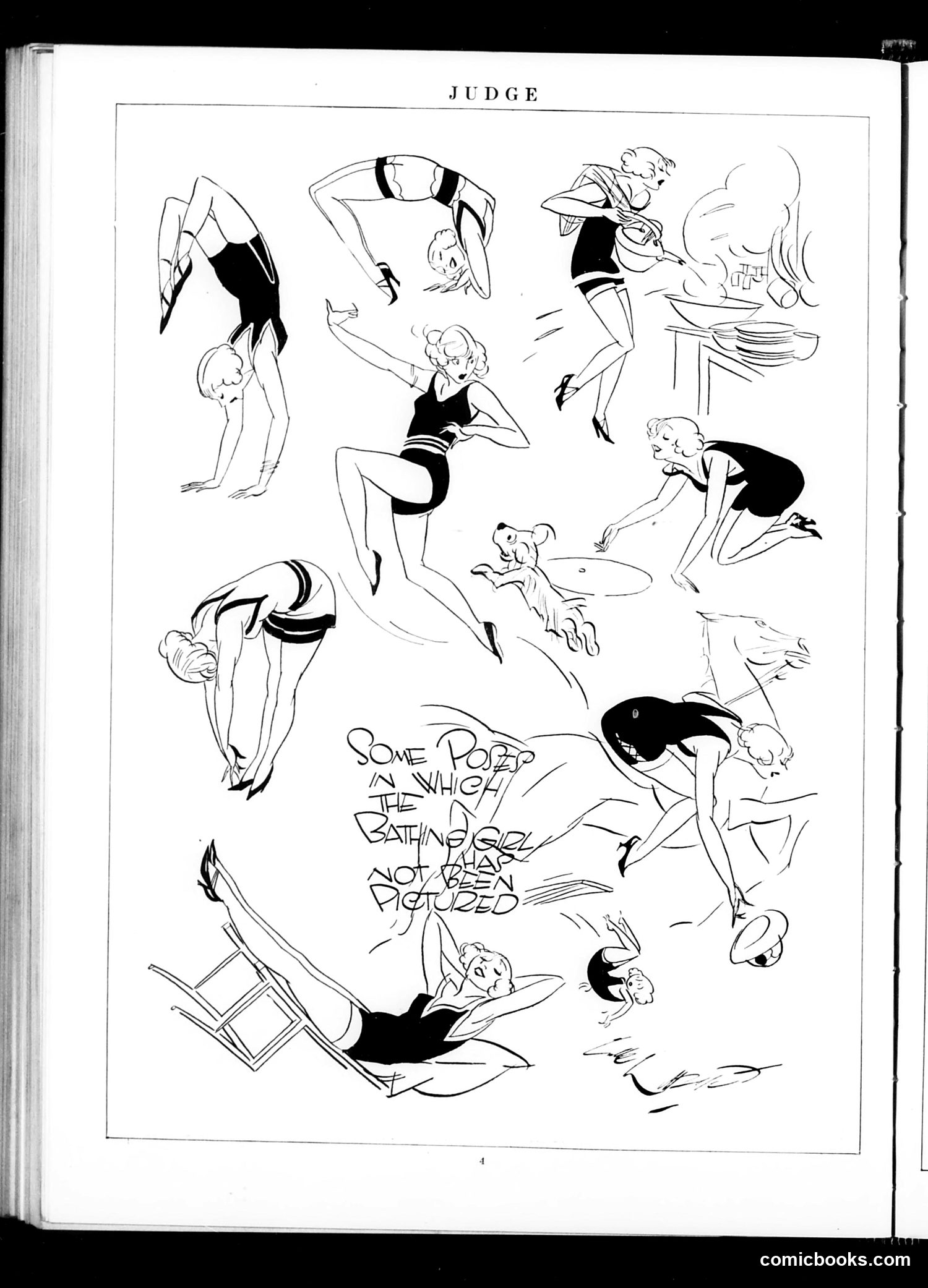
This page titled "Judge" depicts multiple figures engaged in bathing and swimming activities. The central text reads: "SOME POPPY WHICH IS BATHING SUIT NOT BEEN PICTURED." The cartoon appears to be satirizing fashions in women's bathing suits, likely from the early-to-mid 20th century. The various sketches show women in different poses and styles of swimwear, presumably highlighting the diversity of bathing suit designs available or the evolution of swimwear fashion. The joke's target is unclear without additional context, but it may be mocking either: the proliferation of bathing suit styles, debates over appropriate swimwear modesty, or perhaps the fashion industry's constant redesigning of similar garments. The phrase "not been pictured" suggests the cartoon is humorously claiming to show *almost* every possible bathing suit variation—implying an absurd abundance of choices.
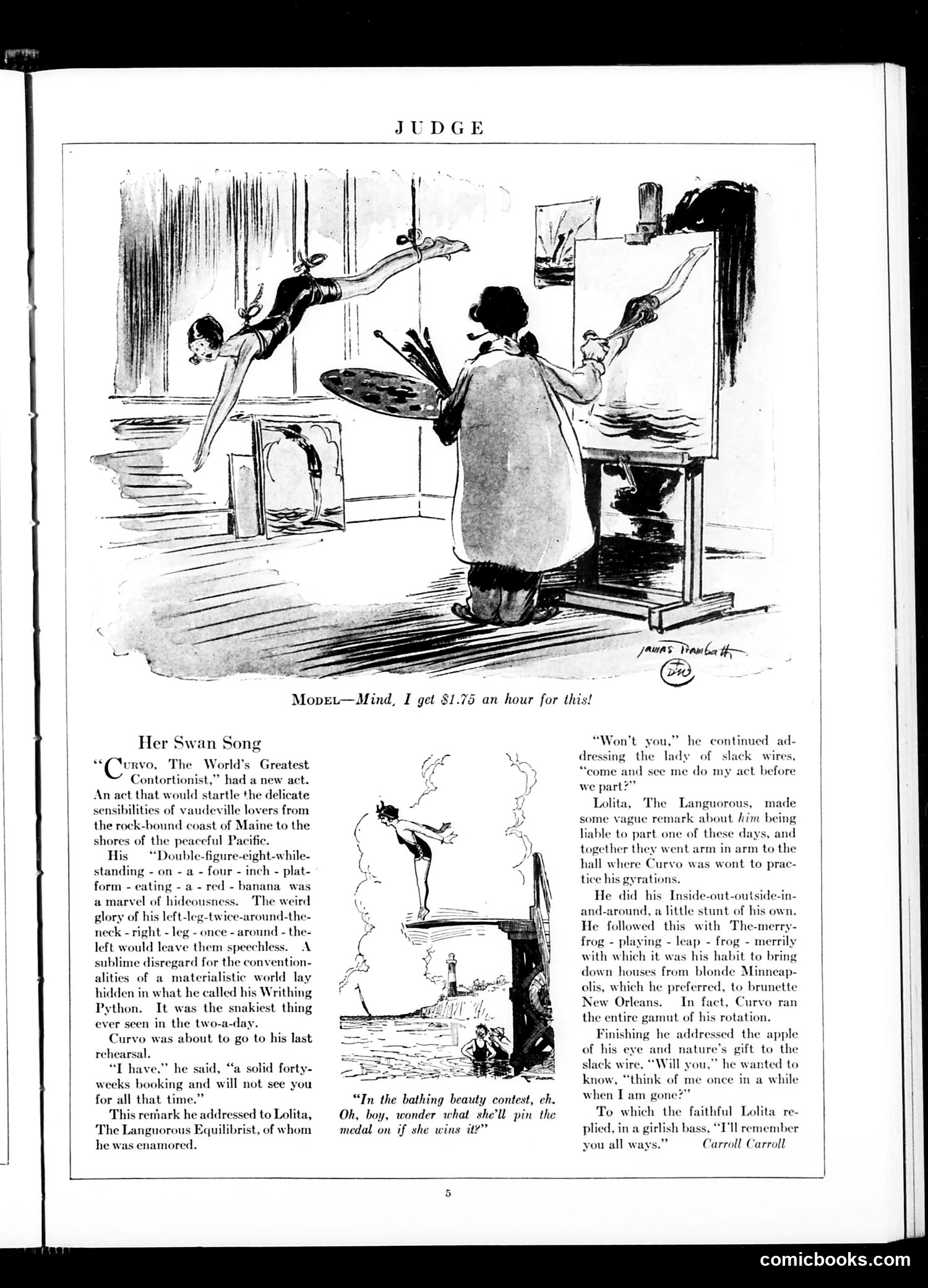
**Top Cartoon ("Judge"):** A satirical commentary on artist models' wages. A woman artist, kneeling and holding a palette, directs acrobatic male models performing dangerous stunts (balancing on wires, contorted poses). The model's complaint—"Mind, I get $1.75 an hour for this!"—mocks the low pay for physically demanding work, suggesting artists exploit models by demanding increasingly difficult poses without proportional compensation. **"Her Swan Song" Story:** This appears to be a theatrical satire about an acrobatic performer named Curvo and his romantic entanglement with Lolita, "The Languorous Equilibrist." The accompanying illustration shows acrobatic performers in a water setting. The narrative satirizes theatrical performers and their romantic complications, though specific contemporary references are unclear without additional context. Both pieces mock the economics and absurdities of performance and artistic work in early 20th-century entertainment.
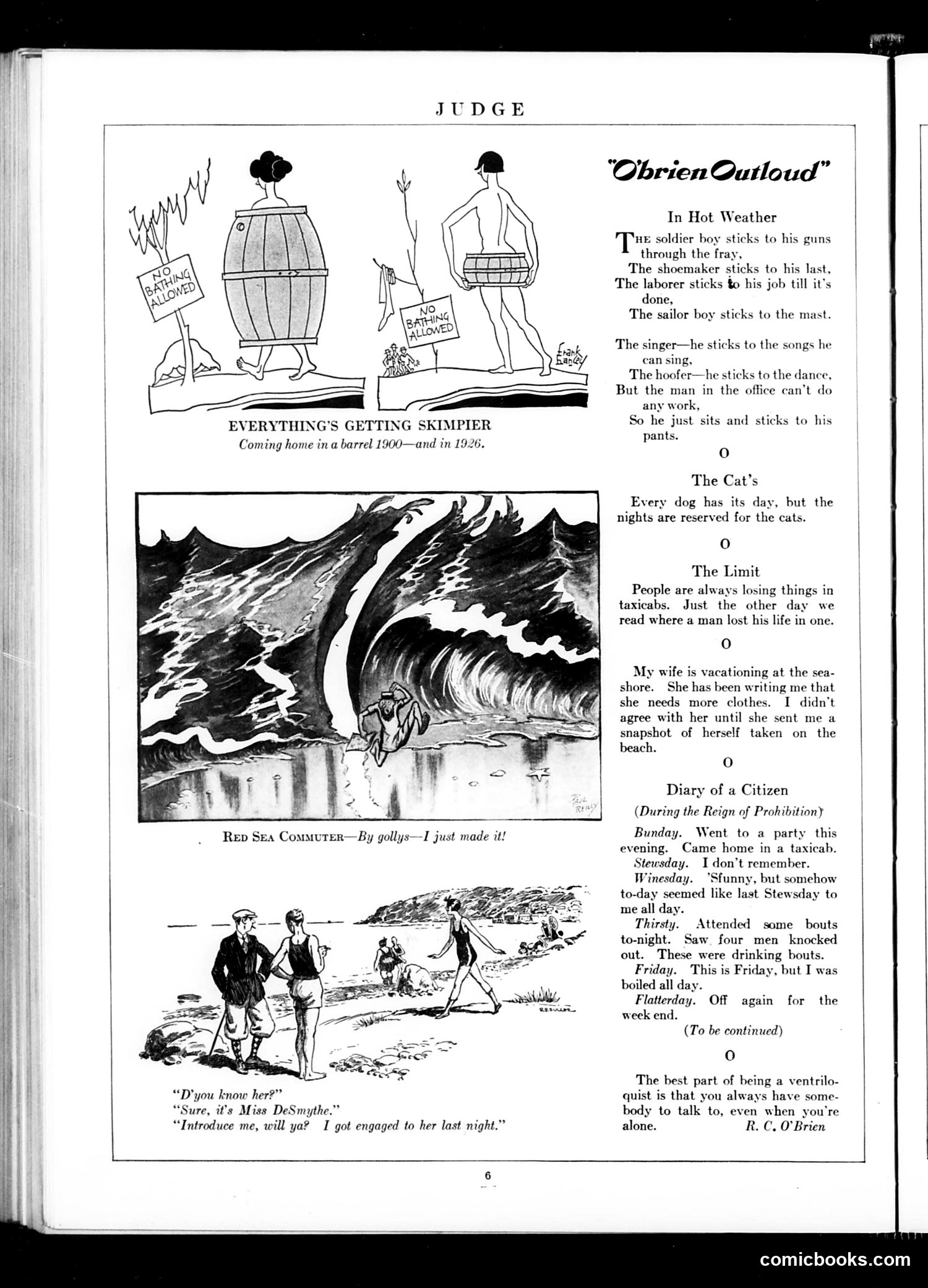
This page contains several satirical pieces from 1926, reflecting post-Prohibition era humor and social commentary. **Top cartoon "Everything's Getting Skimpier"** compares 1900 to 1926, showing women's bathing attire becoming increasingly minimal—a joke about changing fashion and modesty standards. The barrel reference suggests earlier full coverage versus the scanty 1926 swimwear. **"Red Sea Commuter"** depicts a dramatic ocean wave, likely satirizing exaggerated travel stories or dangerous commuting conditions. **The beach scene** jokes about casual romance and social introductions. **Right-side humor pieces** mock various professions and situations: office workers being unproductive in heat, the Prohibition era (references to "boiled," "bouts," coded drinking language), and everyday absurdities. The "Diary of a Citizen" specifically satirizes Prohibition enforcement through wordplay—"Stewsday," "Winesday," "Thirsty"—suggesting people's preoccupation with alcohol despite legal bans. The overall tone is lighthearted social observation typical of 1920s satirical magazines.
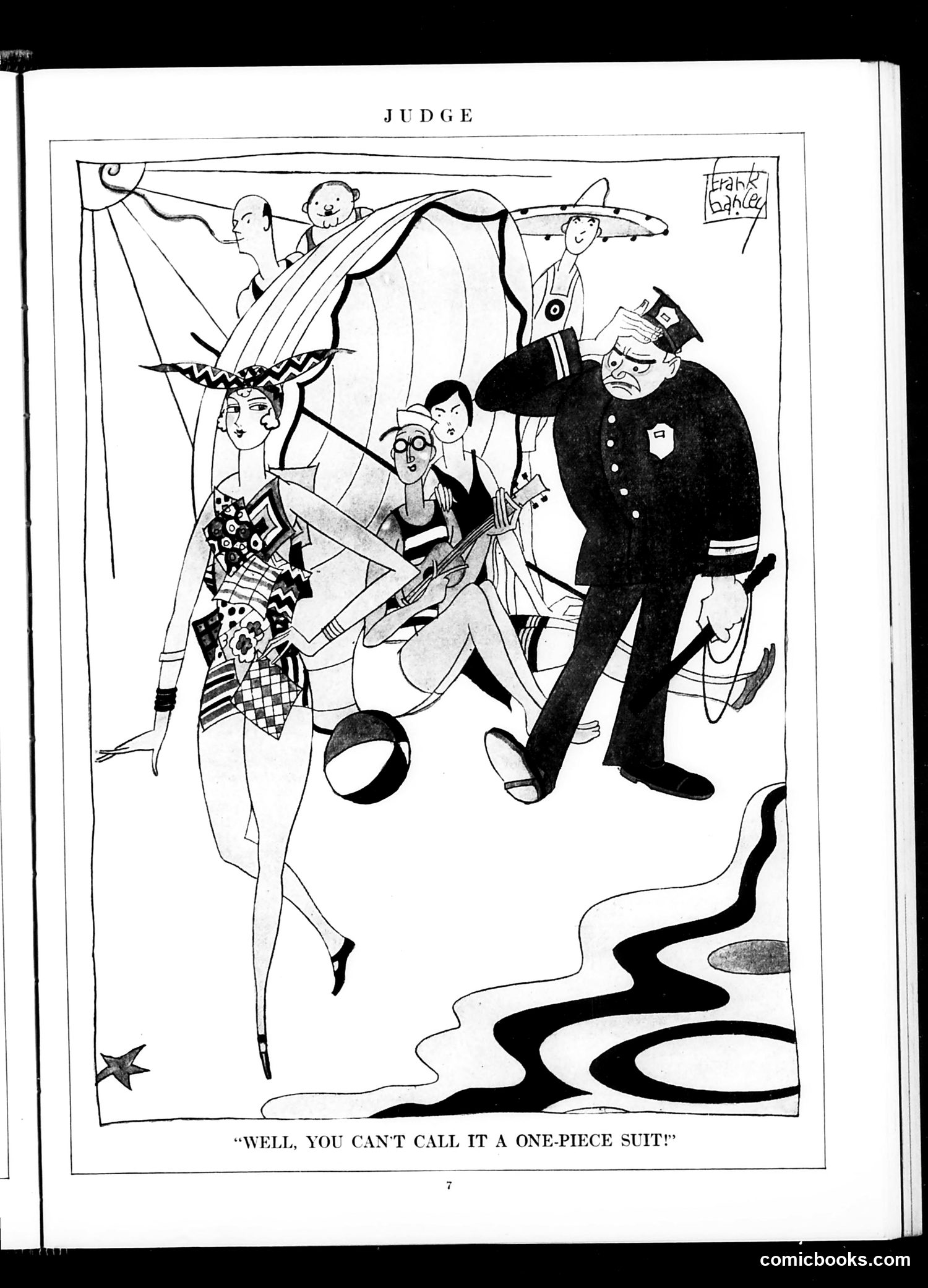
This cartoon satirizes women's evolving fashion in what appears to be the 1920s era. A stern-looking judge or authority figure (likely representing traditional social values or legal standards) observes a woman in a revealing, scanty bathing suit surrounded by fashionable onlookers and performers in a circus-like setting. The caption's joke plays on the term "one-piece suit"—the woman's minimal garment is so skimpy that it barely qualifies as a single piece of clothing. The satire mocks both the increasingly daring swimwear of the era and the conservative establishment's disapproval of women's liberated fashion choices. The circus atmosphere suggests this represents a shocking spectacle to traditional society.
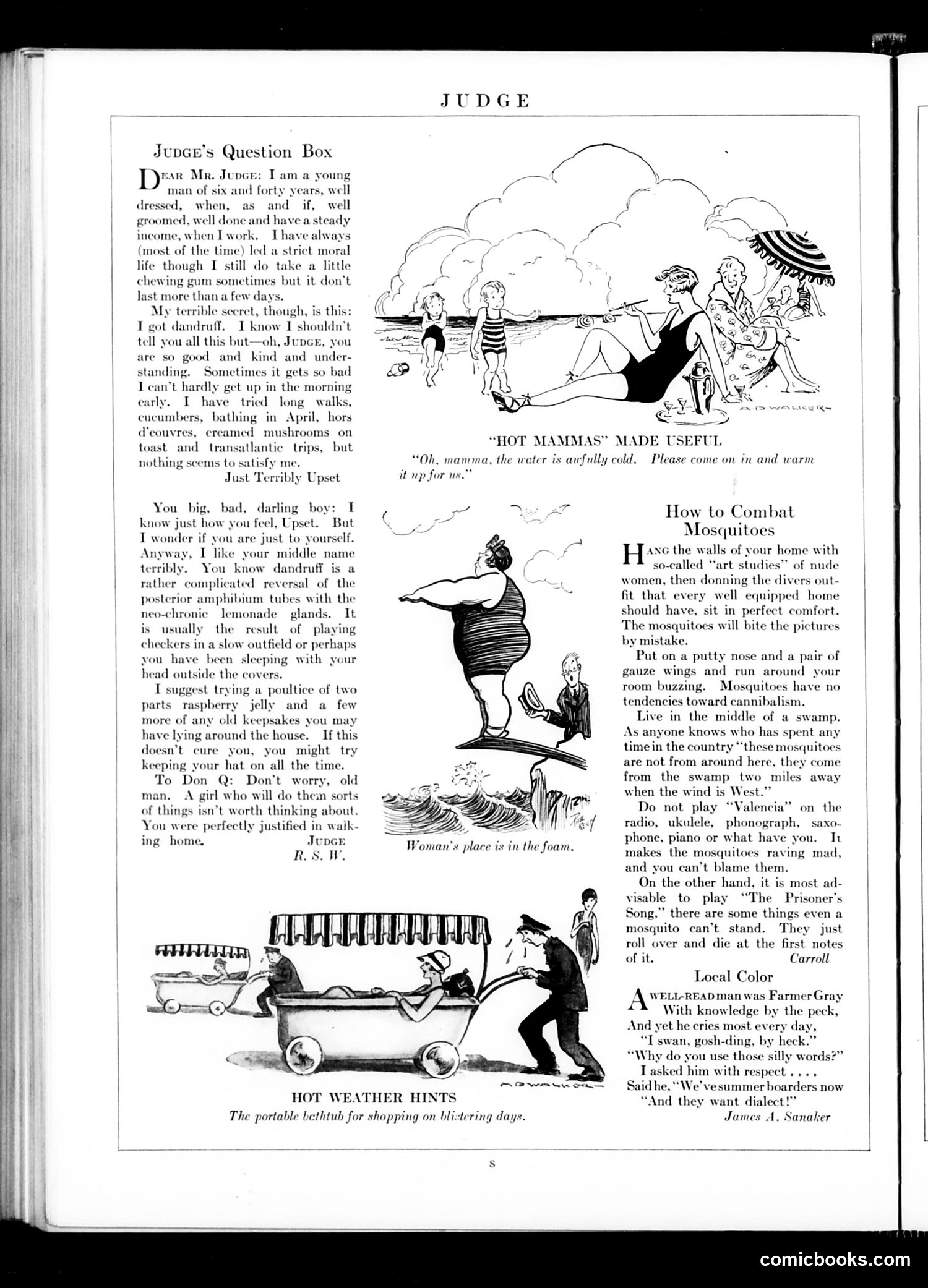
This page collects several satirical humor pieces typical of Judge magazine's format: **Judge's Question Box** mocks advice columns by giving absurd pseudo-scientific responses. A man confesses to dandruff; the "Judge" responds with deliberately nonsensical medical jargon ("posterior amphibium tubes," "neo-chronic lemonade glands") and ridiculous remedies (raspberry jelly poultices, keeping your hat on). The satire targets both pretentious medical pseudoscience and the earnest confessional tone of real advice columns. **"Hot Mammas" and "Hot Weather Hints"** are summer-themed jokes illustrated with cartoons—a woman calling to her mother from cold water, and a portable bathtub for shopping. **"How to Combat Mosquitoes"** offers absurdist solutions: hanging nude art to distract mosquitoes, wearing a putty nose disguise, or playing "The Prisoner's Song" to kill them. This satirizes overly elaborate solutions to common problems. **"Local Color"** pokes fun at tourists and dialect humor—a farmer adopts exaggerated speech patterns ("gosh-ding") because summer boarders expect "authentic" rural dialect.
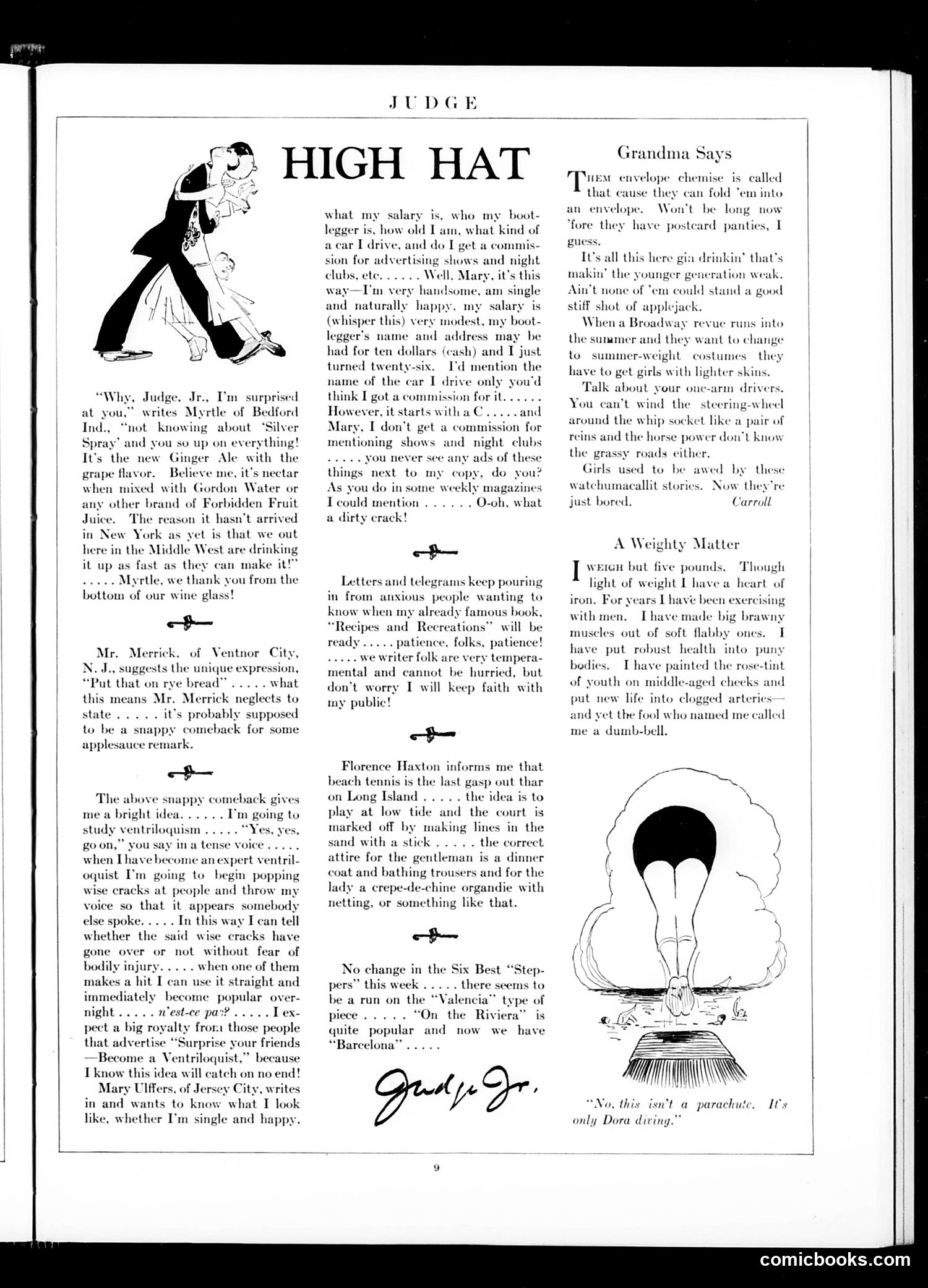
This page from *Judge*, a satirical magazine, contains humor columns and reader letters rather than political cartoons. The main feature, "High Hat," is a gossip/advice column where the author (signed "Judge Jr.") responds to readers' letters with witty commentary on 1920s social trends. **Key content:** - Readers write about new products (Silver Spray Ginger Ale), slang expressions, and social phenomena - References to Prohibition-era drinking ("bootlegger," "Forbidden Fruit Juice") - Jokes about beach tennis fashions on Long Island and Broadway revue costume changes - A sidebar "Grandma Says" offering satirical elderly observations about younger generations, gin drinking, and modern driving **The satire targets:** youth culture's perceived weakness, modern fashion trends, and Prohibition's absurdities. The humor relies on period slang and assumptions about readers' familiarity with NYC/Long Island society. The "Grandma" section mocks generational anxiety through exaggerated old-fashioned complaints. The small illustration shows Dora performing a diving stunt, captioned "No, this isn't a parachute. It's only Dora diving."
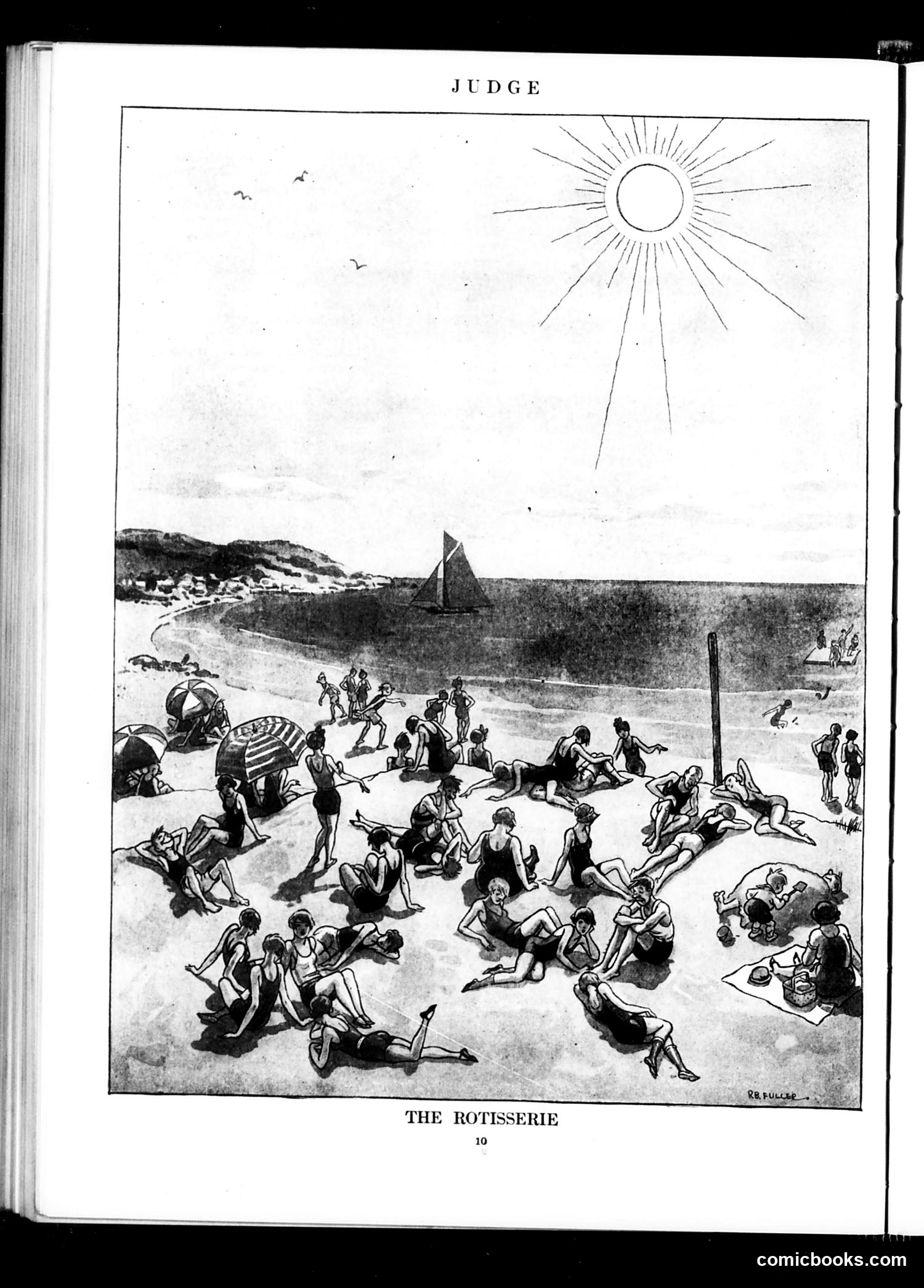
This satirical illustration from *Judge* magazine depicts a crowded beach scene where numerous people are being roasted under the intense sun, depicted as a large glowing orb with radiating lines above. The title "The Rotisserie" is a darkly humorous metaphor comparing sunbathing beachgoers to meat being rotated and cooked. The cartoon satirizes the popular early 20th-century beach culture and the physical toll of prolonged sun exposure. People lie sprawled across the sand in various states of discomfort and exhaustion, some with beach umbrellas for minimal protection. A sailboat floats offshore while spectators enjoy the water. The satire likely critiques either the obsession with beach leisure activities or the dangers of excessive sun exposure that contemporary society overlooked, presenting beachgoers as passive victims being slowly "cooked."
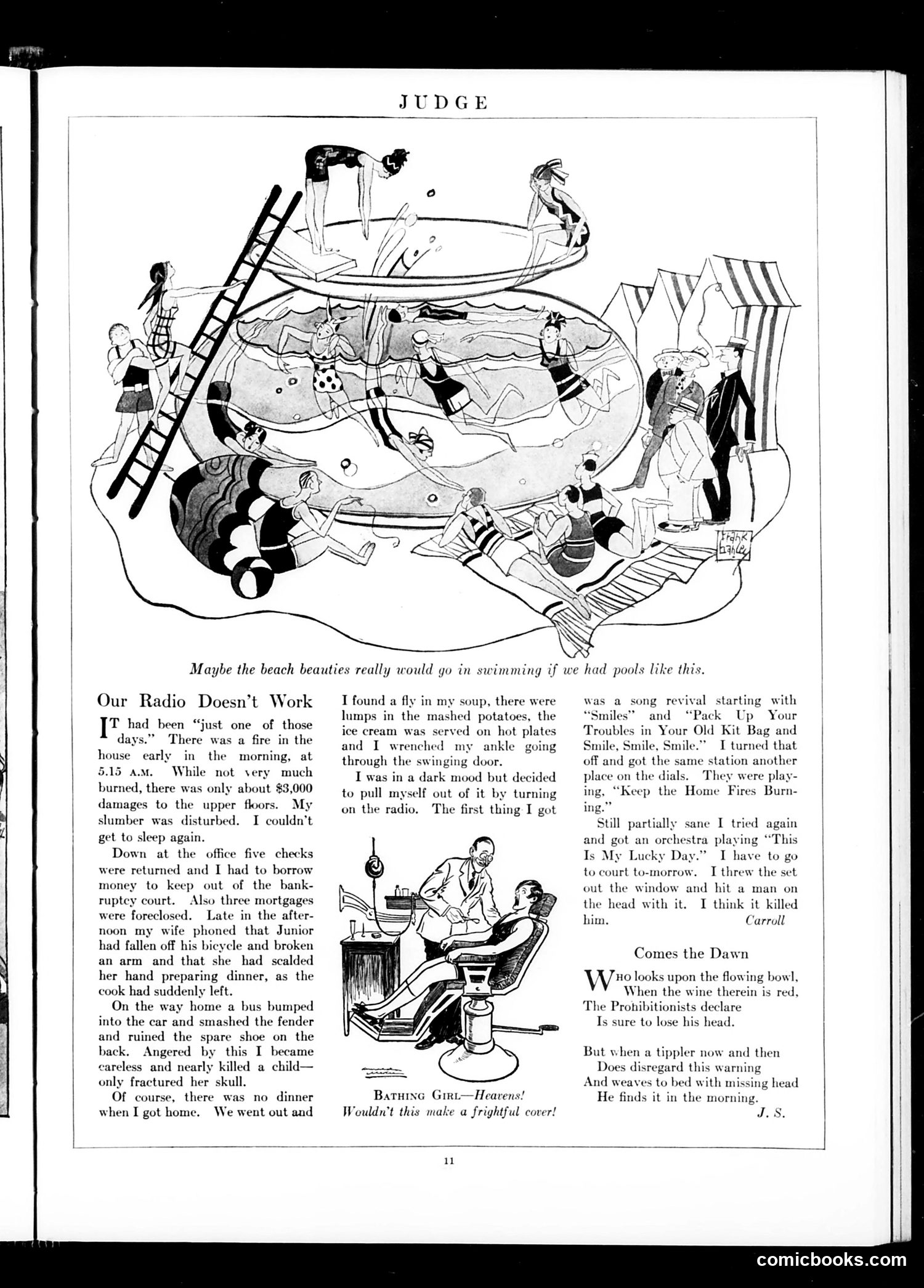
This page contains two satirical pieces about 1920s American life: **"Our Radio Doesn't Work"** mocks the newly popular radio as a source of frustration. A man enduring a catastrophically bad day (fire, financial ruin, child injuries, car accident) turns to radio for comfort but finds only sentimental WWI-era songs ("Keep the Home Fires Burning," "Pack Up Your Troubles"). Enraged, he throws the radio out the window, killing someone. The joke: radio promised to improve modern life but delivers only platitudes during genuine crisis. **"Comes the Dawn"** is a brief satirical poem about Prohibition (1920-1933). It mocks temperance advocates' warnings that alcohol causes men to "lose his head"—reinterpreting this literally: a drunk man loses his physical head but finds it again the next morning. The humor lies in absurdist contradiction of prohibition rhetoric. The top cartoon depicts an elaborate public swimming pool, captioning that beach-goers would swim more in such facilities—reflecting 1920s debates about public recreation and leisure.
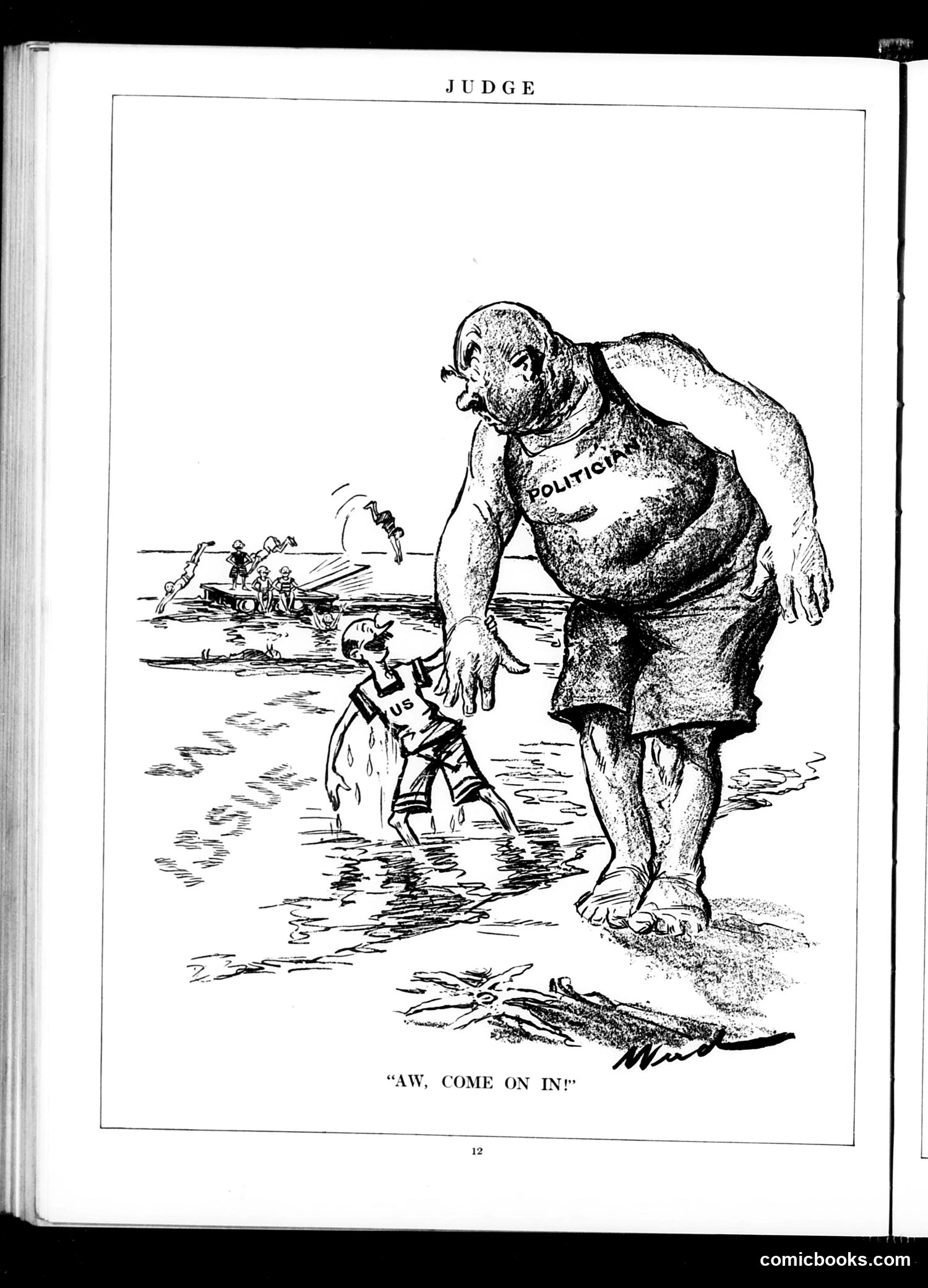
**The Image:** A large figure labeled "POLITICIAN" stands in shallow water, beckoning a small figure labeled "US" to enter. In the background, a boat appears to be sinking or in distress. **The Satire:** This cartoon critiques political deception and false reassurance. The "Politician" invites the American public ("US") into dangerous waters, seemingly safe, while evidence of disaster (the struggling boat behind) suggests treacherous conditions ahead. **The Point:** The cartoon warns readers that politicians make appealing promises ("Aw, come on in!") to draw public support into situations that are actually perilous or corrupt. It's a commentary on political manipulation and the gap between politicians' reassuring rhetoric and the actual harmful consequences of their policies or leadership. The cartoon appears to be from an era of American political cynicism, though the specific political context remains unclear from the image alone.
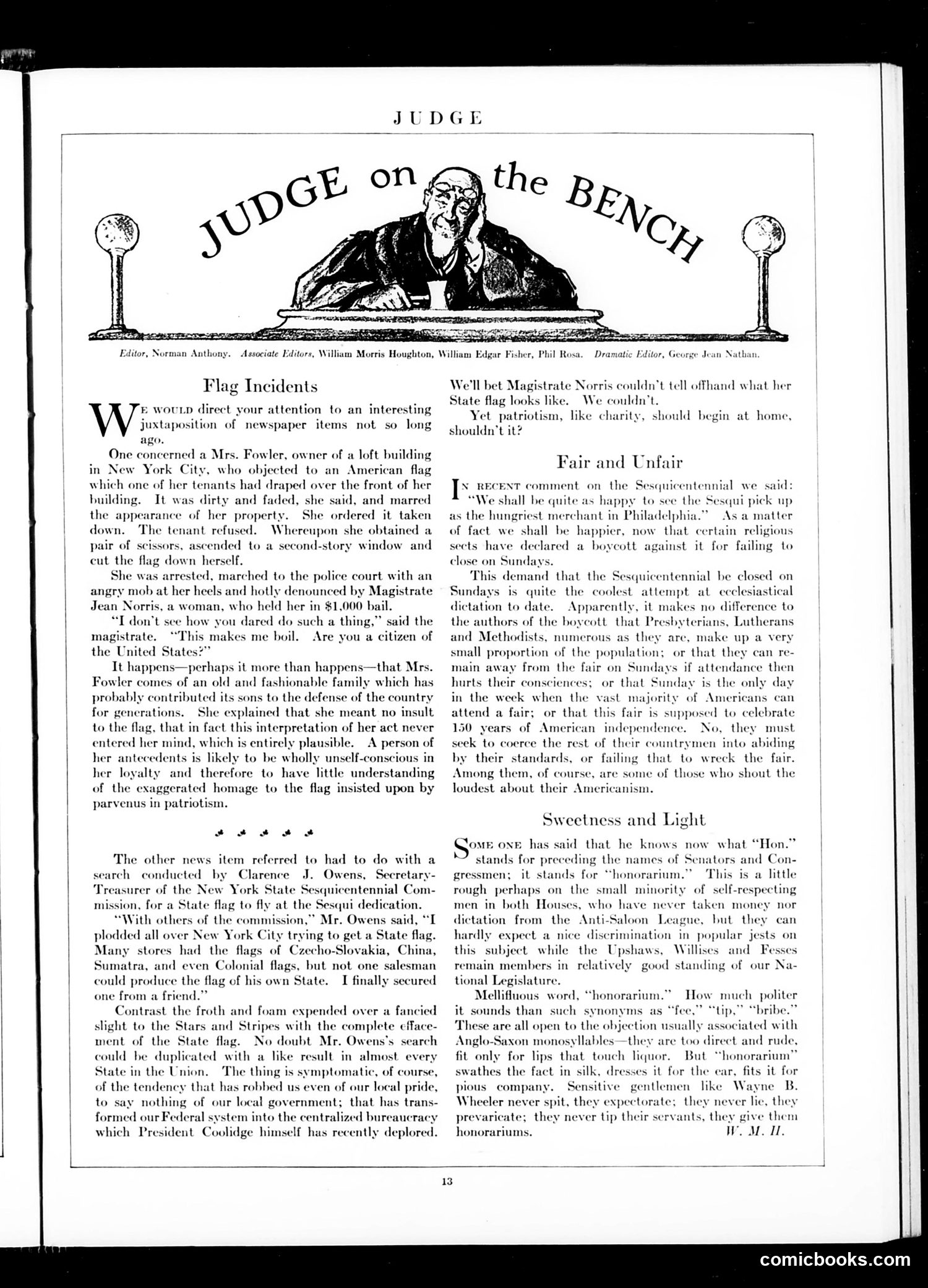
This page from Judge magazine contains three opinion pieces satirizing American patriotism and civic priorities, circa mid-1920s. **"Flag Incidents"** ridicules the contrasting treatment of two flag-related stories: Mrs. Fowler, a wealthy New York woman, was arrested and held on $1,000 bail for removing a faded American flag from her building, while simultaneously, a state official couldn't find a single New York State flag anywhere in the city for the Sesquicentennial celebration. The satire mocks the exaggerated reverence for the American flag among "parvenus in patriotism" (nouveau-riche patriots) while neglecting actual civic symbols and local governance. **"Fair and Unfair"** criticizes religious groups boycotting the Sesquicentennial for not closing on Sundays, arguing this represents ecclesiastical overreach by a minority attempting to impose their standards on the majority who can only attend on Sundays. Both pieces share a theme: Judge criticizes what it sees as misplaced patriotic fervor and the tyranny of self-righteous minorities over practical civic concerns.
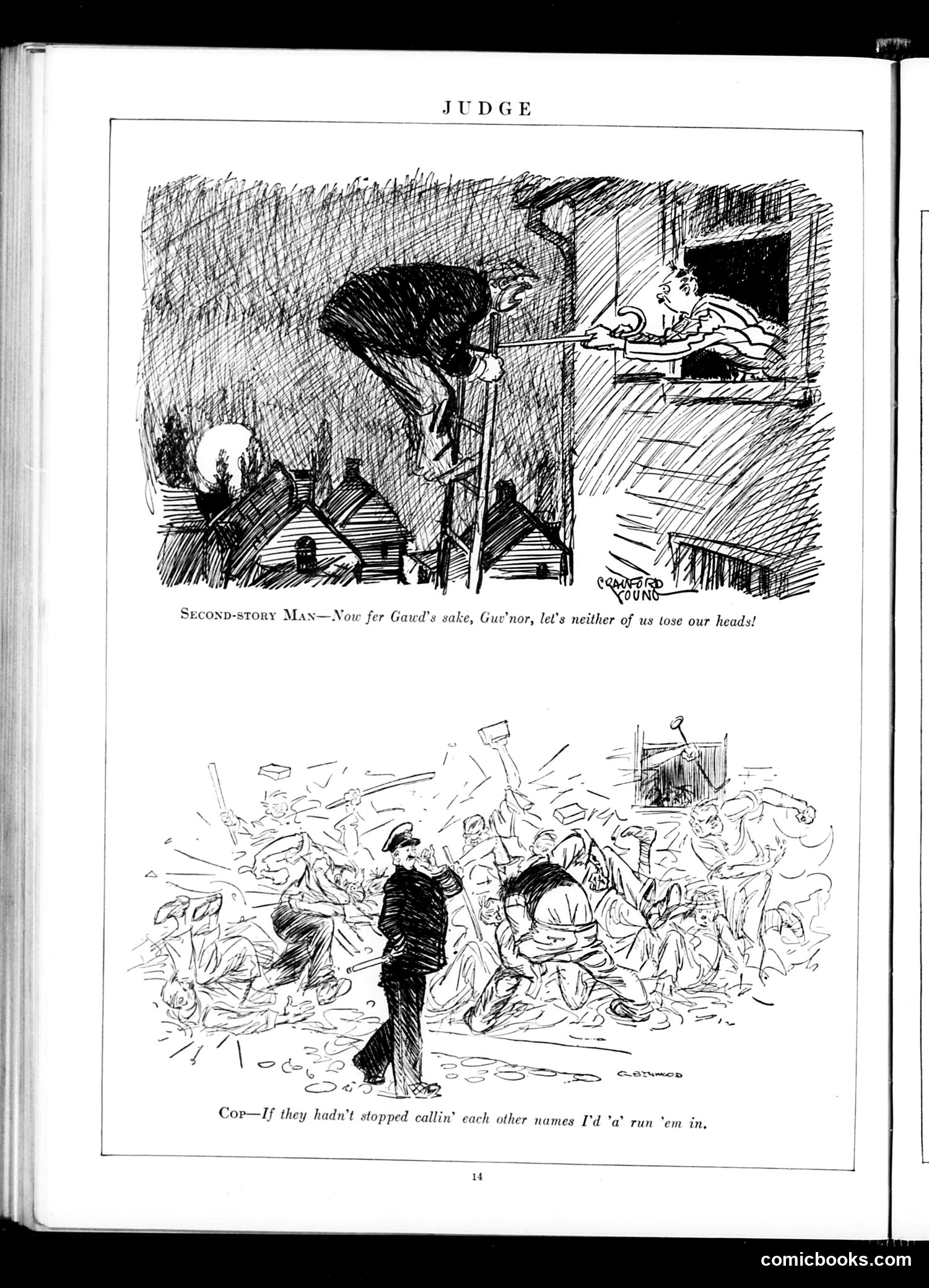
This page contains two satirical cartoons: **Top cartoon ("Second-story Man"):** A burglar peers through a window at a judge inside, saying "Now for Gawd's sake, Guvnor, let's neither of us use our head!" The joke appears to satirize judicial corruption—suggesting a burglar and judge might reach a mutually beneficial arrangement by avoiding confrontation. **Bottom cartoon ("Cop"):** A police officer stands amid a chaotic street brawl, stating "If they hadn't stopped callin' each other names I'd 'a' run 'em in." This satirizes law enforcement priorities: the cop would arrest people merely for name-calling, but actual fighting apparently doesn't warrant arrest. It mocks selective or absurd policing standards. Both cartoons use working-class dialect and target institutional hypocrisy—legal corruption and arbitrary law enforcement—common themes in early 20th-century Judge satire.
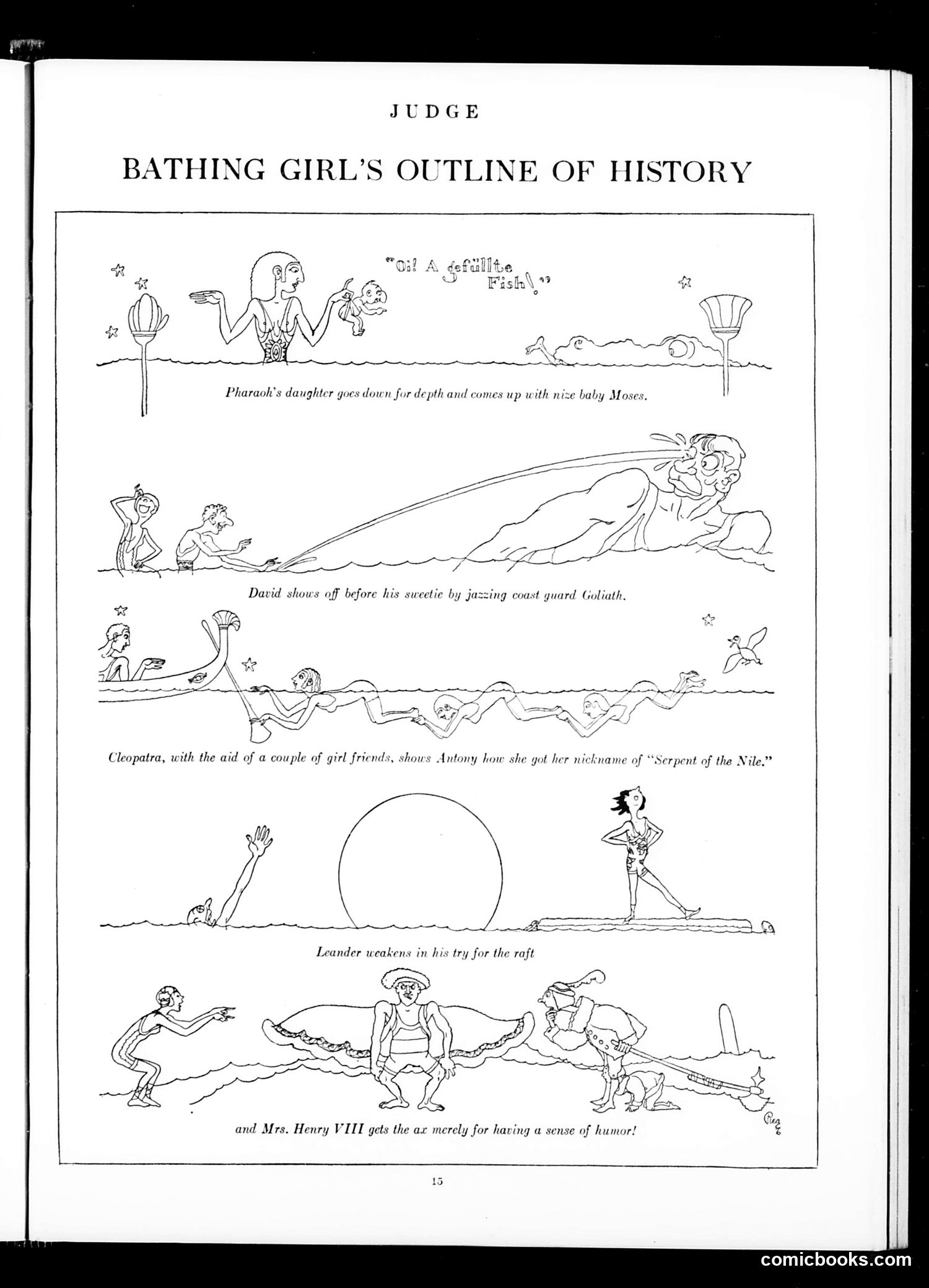
This is a humorous one-page cartoon that parodies famous historical and mythological events through the lens of bathing/swimming. Each panel reimagines a well-known story: 1. **Pharaoh's daughter** retrieves baby Moses from the water 2. **David** shows off to Goliath by diving ("gazzing coast guard Goliath") 3. **Cleopatra** earns her "Serpent of the Nile" nickname through aquatic antics with friends 4. **Leander** struggles attempting to swim across water 5. **Anne Boleyn** (Mrs. Henry VIII) loses her head for having humor The satire jokes that serious historical figures are reduced to bathing/swimming scenarios—treating grand historical narratives as trivial beach activities. It's gentle mockery of how classical education gets simplified and feminized through the "bathing girl" framework, popular in early 20th-century leisure culture.
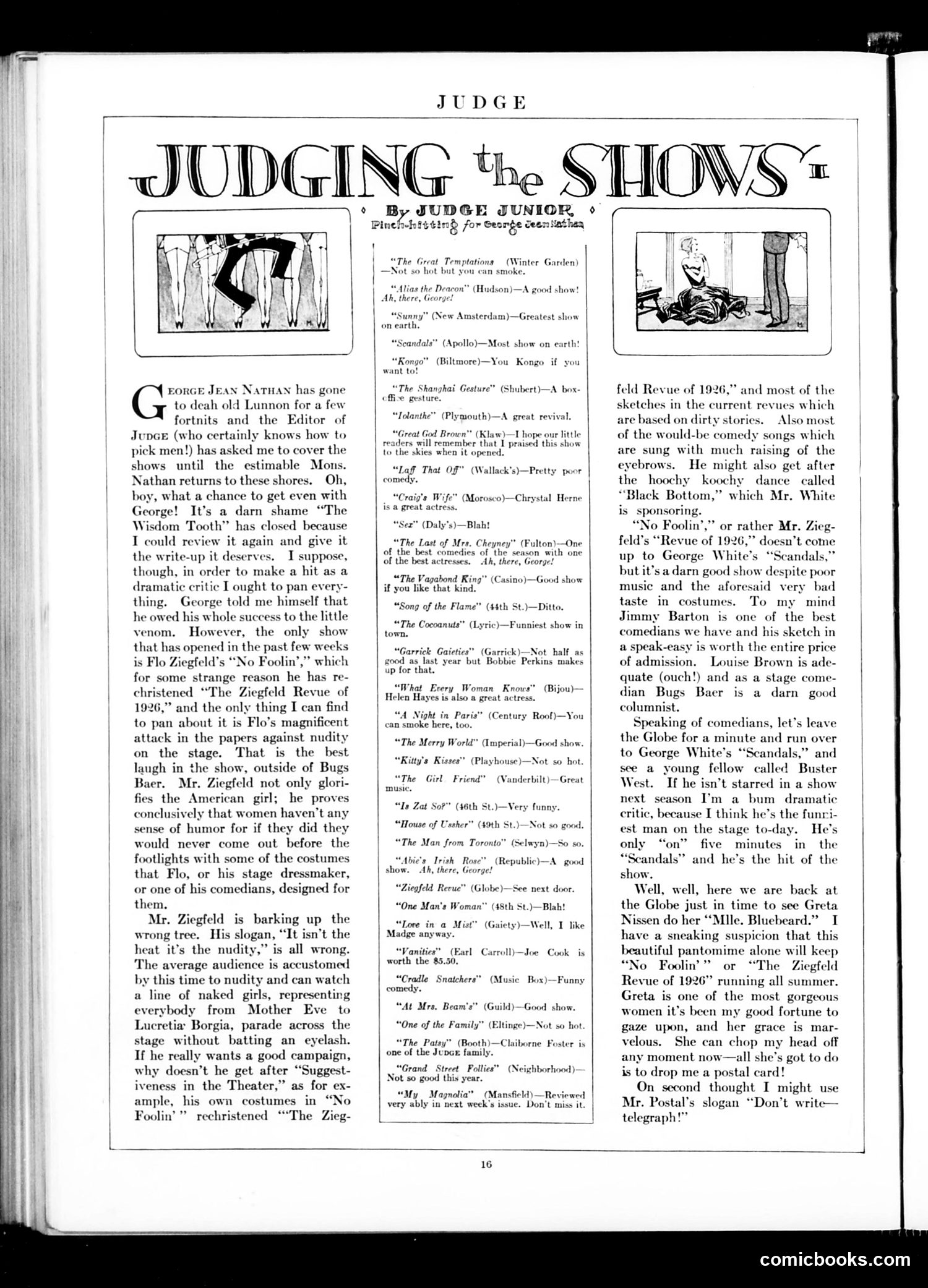
This page contains a theatre review column by "Judge Junior" covering Broadway shows during the 1926 season. The main article attacks impresario **Flo Ziegfeld** for his public campaign against nudity in theatre while simultaneously featuring scantily-clad performers in his "Ziegfeld Revue of 1926." The critic argues Ziegfeld's moralizing is hypocritical—audiences are already desensitized to nudity, so his real issue should be "suggestiveness," exemplified by his own costume designs. The reviewer sardonically praises Ziegfeld for "proving conclusively that women haven't any sense of humor" by wearing such costumes. The middle section lists brief reviews of 26 current Broadway productions with one-line judgments (mostly positive or dismissive). The satire targets Ziegfeld's contradictory stance: condemning theatrical nudity publicly while profiting from it commercially—a classic example of 1920s entertainment hypocrisy.
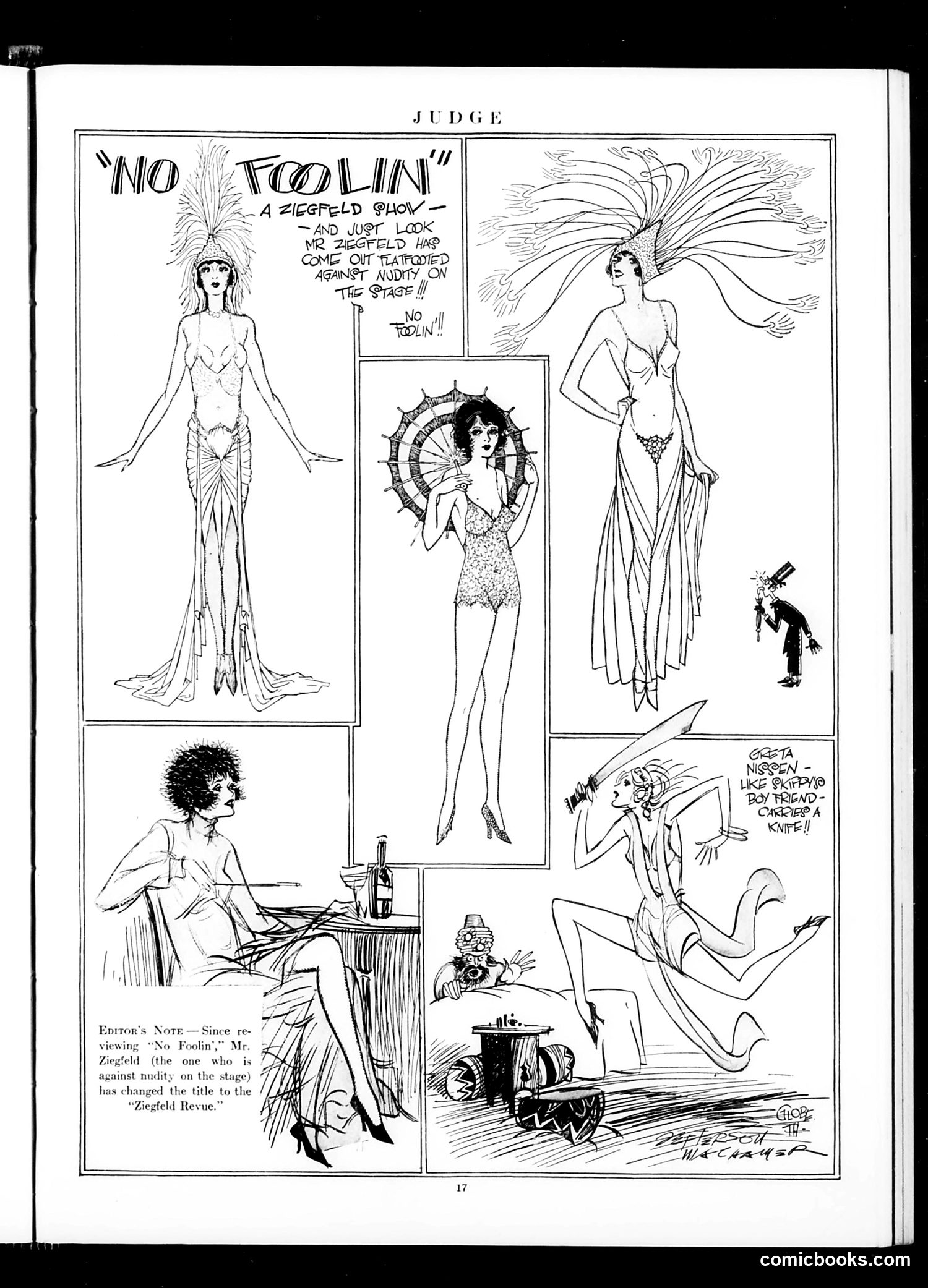
This is a satirical commentary on the Ziegfeld Follies, the famous theatrical revue known for elaborate costumes and provocative staging. The page mocks the show's aesthetic through multiple costume sketches showing increasingly minimal clothing and elaborate headdresses. The editor's note explains that "No Foolin'" originally featured nudity on stage, prompting Judge to retitle it the "Ziegfeld Revue" for this article. The humor lies in the contrast between the show's claims of respectability and its actual content—the cartoon illustrates how the performers' costumes progressively reveal more while maintaining theatrical pretense through extravagant accessories and styling. The small vignettes (the woman with bottle, the knife-wielding scene) appear to show comedic stage moments. This reflects early-twentieth-century debates about theatrical morality and censorship.
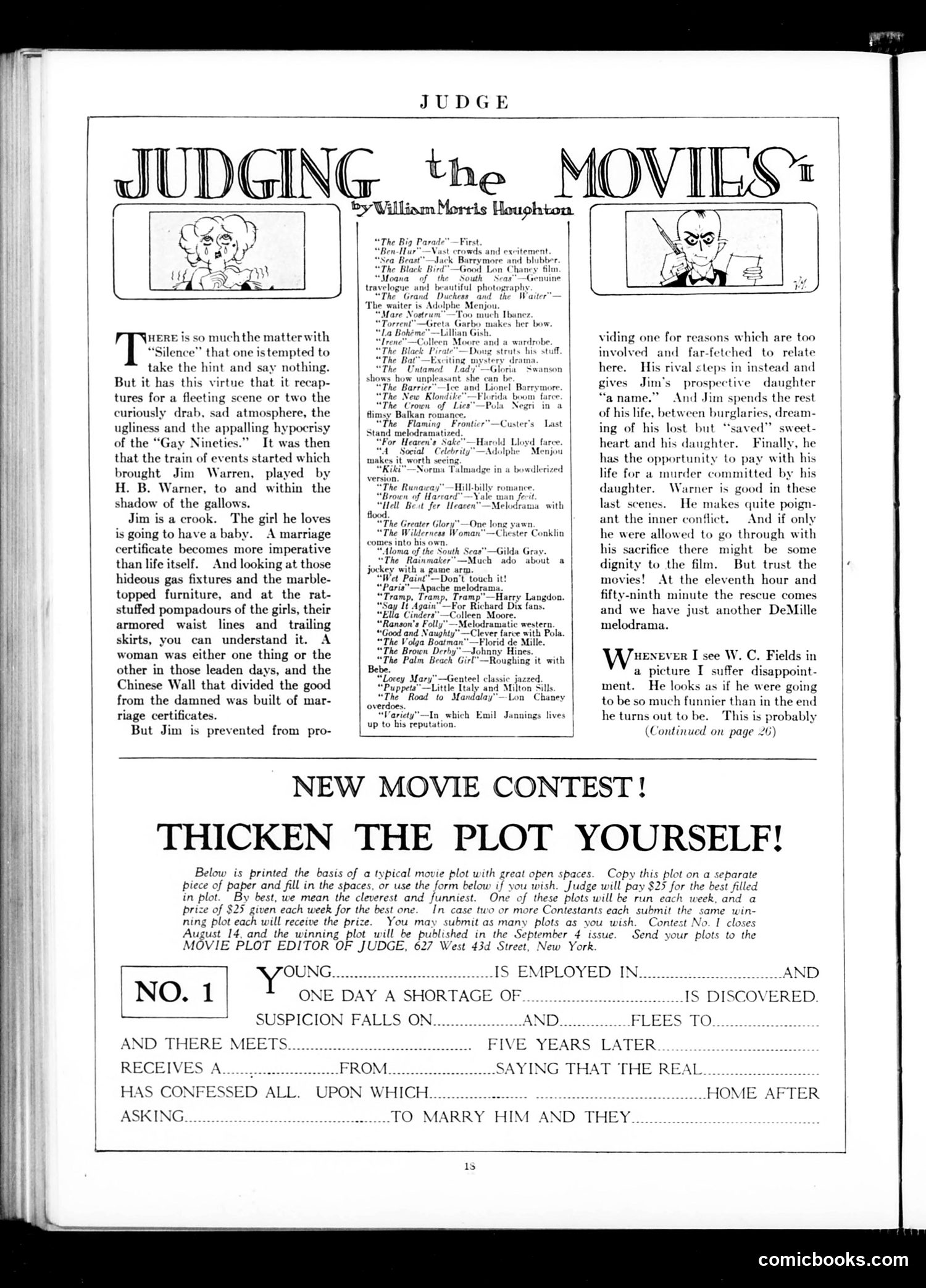
This page from *Judge* magazine features two main elements: **"Judging the Movies"** column by William Morris Houghton reviews silent films from the mid-1920s, critiquing plots and performances. The extended commentary mocks the film *Silence*, starring H.B. Warner, for its melodramatic plot involving a criminal, an illegitimate baby, and contrived moral redemption—typical of silent-era sentimentality. Houghton expresses particular disappointment with W.C. Fields, suggesting he has comedic potential but underperforms. **"Thicken the Plot Yourself"** is a reader contest inviting submissions to complete a skeleton movie plot template. *Judge* promises $25 weekly prizes for the cleverest entries, published in subsequent issues. This reflects the era's fascination with cinema and playful satire of formulaic Hollywood storytelling—the melodramatic, predictable narratives that dominated silent films. The page captures 1920s middlebrow entertainment culture and magazines' interactive relationship with readers.
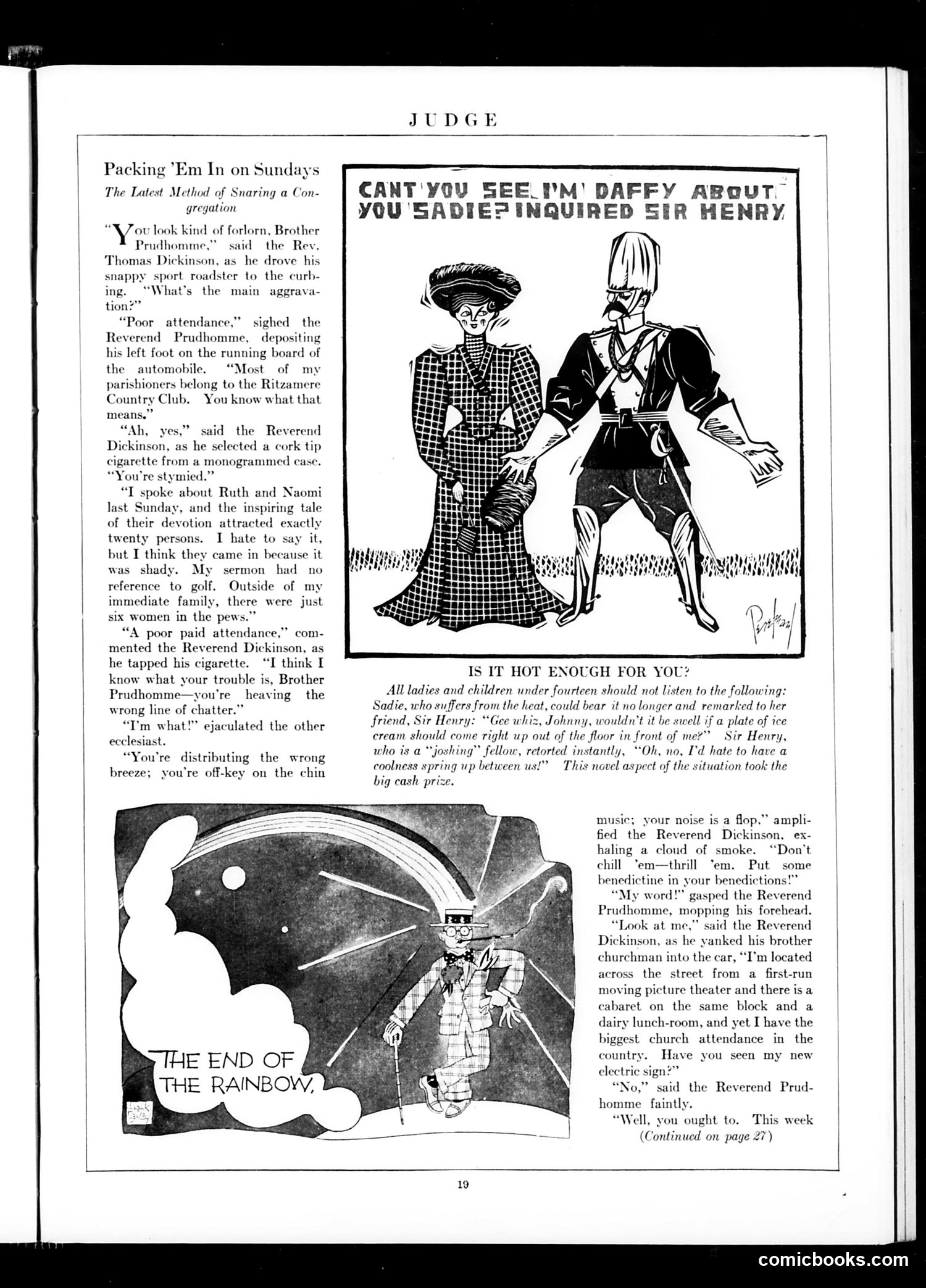
This page satirizes early 20th-century churches struggling with attendance as secular entertainment competed for congregants' time and money. **Main Cartoon:** Two reverends discuss poor church attendance. Reverend Prudhomme complains his parishioners prefer the Ritzamere Country Club and golf to services. Reverend Dickinson offers cynical advice: churches must "thrill 'em" with spectacle and marketing—not substance—to compete. He boasts his own church thrives because it's located near a movie theater, cabaret, and lunch-room, and he advertises with an electric sign. **Secondary Cartoon ("Is It Hot Enough For You?"):** A flirtatious exchange between Sadie and Sir Henry uses double entendre about ice cream and "coolness" as a prize-winning joke. **The Satire:** Judge mocks both the commercialization of religion and clergy willing to abandon spiritual authority to chase crowds like entertainment venues do. The humor lies in the reverends' frank admission that faith content matters less than packaging and competition with secular amusements—a damning critique of religious institutions prioritizing numbers over meaning.
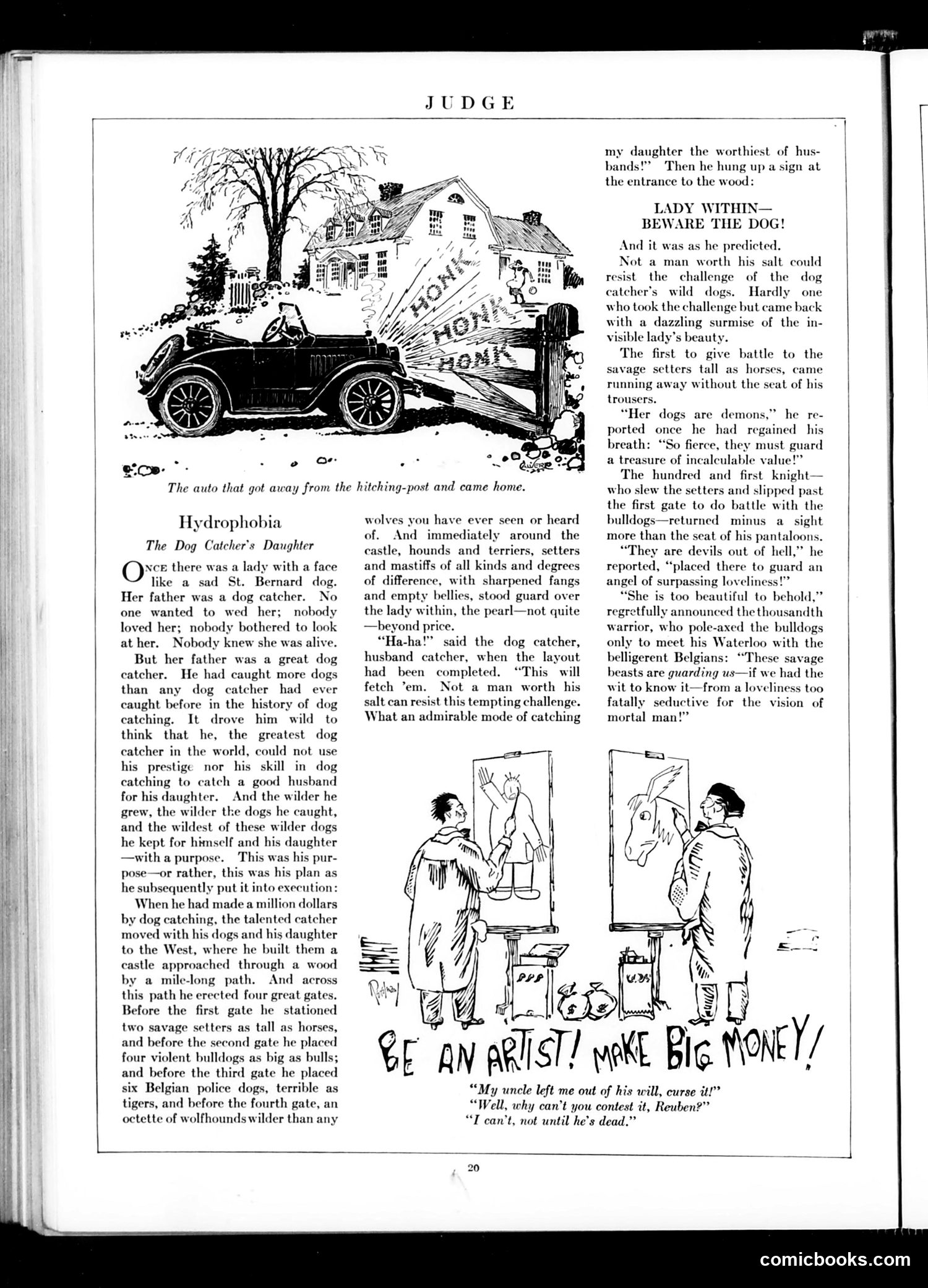
This is a satirical fairy-tale parody about a dog catcher who uses his profession to find his unattractive daughter a husband. Unable to marry her off through normal means, he builds a castle in the West and surrounds it with increasingly fierce dogs (setters, bulldogs, Belgian police dogs, wolfhounds) as a test of worthiness. The joke: Men don't resist because of the daughter's actual beauty, but because rumors of her guarded "treasure" make them assume she must be exceptionally beautiful. Each suitor returns increasingly damaged but more convinced of her value—they've rationalized pain as evidence of desirability. The satire targets both male superficiality (judging women by scarcity/difficulty rather than merit) and the absurdity of using brutal obstacles as courtship strategy. The side cartoon about artists making money appears unrelated.
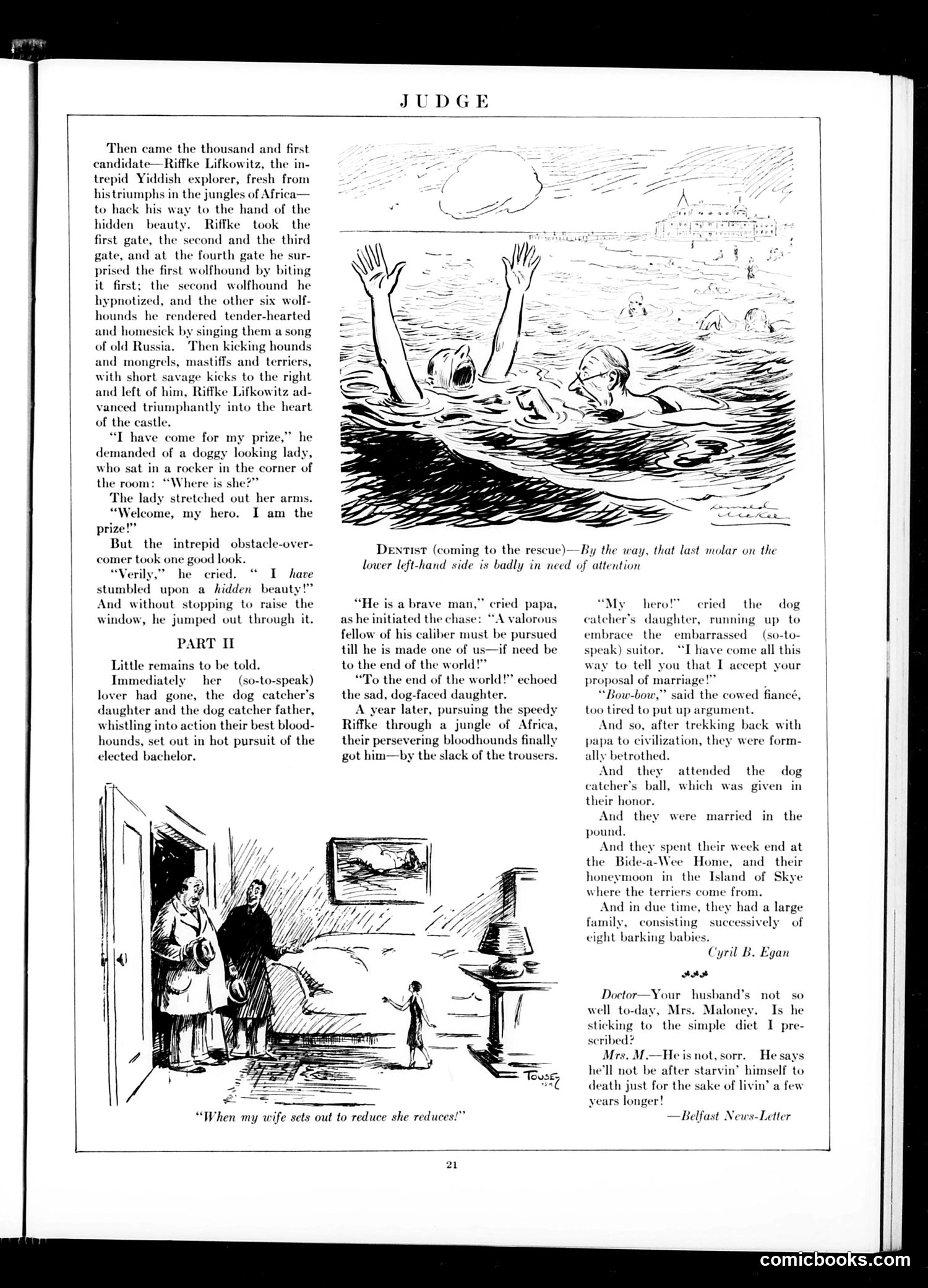
This page contains two separate pieces of satire: **Main Story ("Judge"):** A lengthy comic narrative mocking Jewish immigrants and their romantic prospects. "Riffke Lifkowitz," a Yiddish-named character, attempts to win a hidden beauty through increasingly absurd trials (fighting dogs, singing Russian songs). Upon finally meeting the "prize," he discovers it's an unattractive woman and jumps out a window. He's then pursued by a dog catcher's family across Africa, eventually captured and forced into marriage—with the ending suggesting he and his bride have become literally dog-like (producing "barking babies," living in a pound). The satire employs crude ethnic stereotyping common to early 20th-century American humor, treating Jewish immigrants and their courtship customs as objects of ridicule. **Bottom Cartoon:** An unrelated Irish domestic joke about a husband refusing to diet, valuing life's pleasures over longevity—a gentler form of ethnic humor targeting Irish-American working-class attitudes.
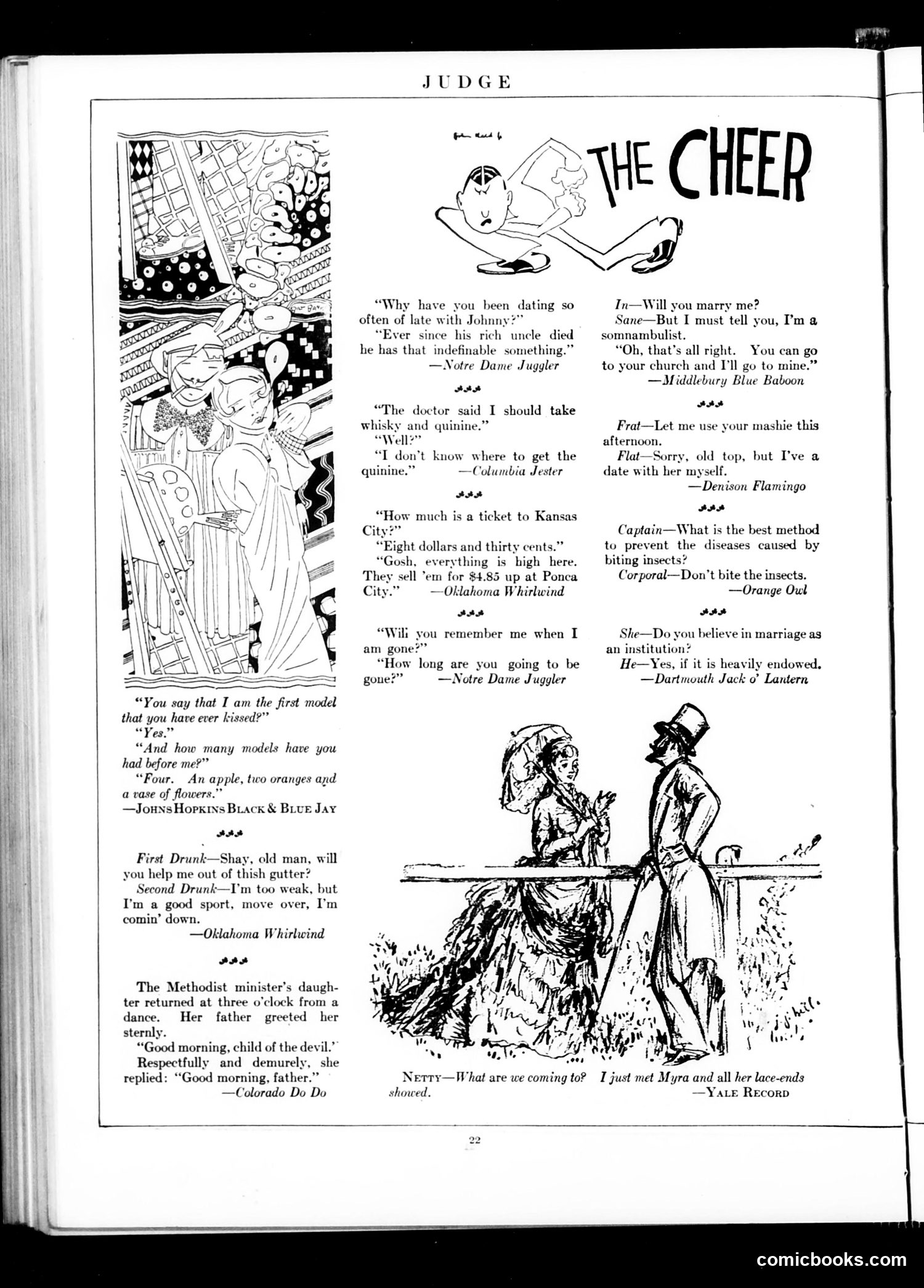
This is a humor page collecting brief jokes and quips from various college publications (Notre Dame Juggler, Columbia Jester, Yale Record, etc.). The jokes satirize early 20th-century social conventions around courtship, class, and propriety. Key themes include: young men pursuing women for wealth rather than love; the gap between social pretense and reality (a somnambulist bride, a minister's daughter returning late from dances); and physical comedy (two drunks helping each other into gutters). The accompanying illustrations depict flirtation and romantic scenarios. The humor depends on readers recognizing the absurdity of rigid social expectations—women as status symbols, religious hypocrisy, and the performative nature of courtship among the educated classes. The collegiate sources suggest this appealed to young, educated readers amused by gentle mockery of their own world.
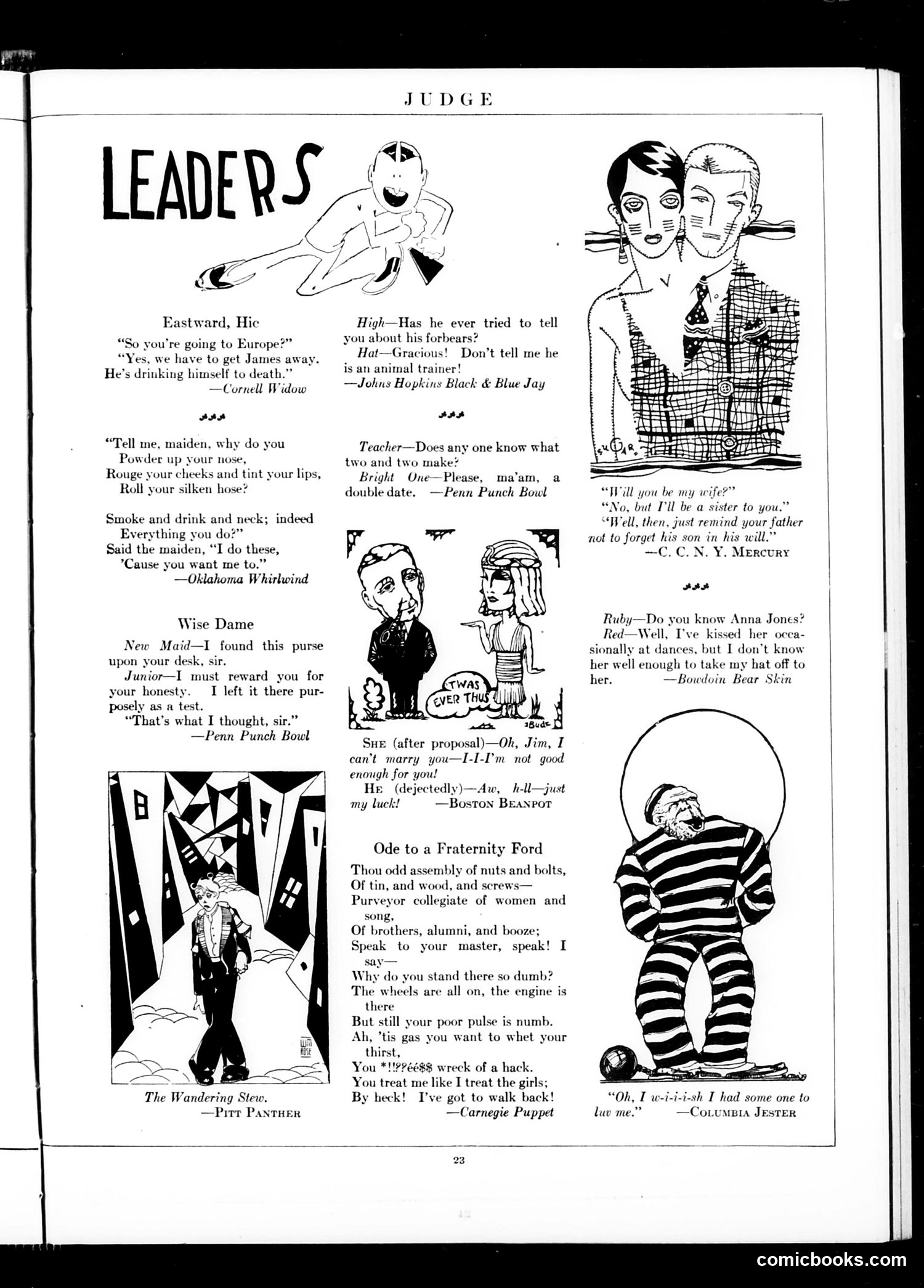
This page collects short humor pieces satirizing early 20th-century social behaviors and attitudes. The cartoons mock: **Social pretense**: "Wise Dame" ridicules a servant's transparent lie about finding a purse—satirizing class anxieties and dishonesty. **Modern youth culture**: Multiple jokes target young women's cosmetics, smoking, drinking, and "necking" (kissing), with the recurring theme that women adopt these behaviors solely to please men—a critique of both female compliance and male social pressure. **Romance and courtship**: Several pieces mock courtship rituals, including a woman rejecting marriage while offering "sisterhood," and a man bragging about kissing women casually. **College culture**: The "Ode to a Fraternity Ford" satirizes the unreliable automobiles fraternity men owned—vehicles frequently breaking down during dates, forcing embarrassing walks home. The overall satire targets the apparent moral decline of the Jazz Age: drinking, casual intimacy, materialism, and the gap between expressed values and actual behavior. The tone reflects conservative anxiety about rapid social change in the 1920s.
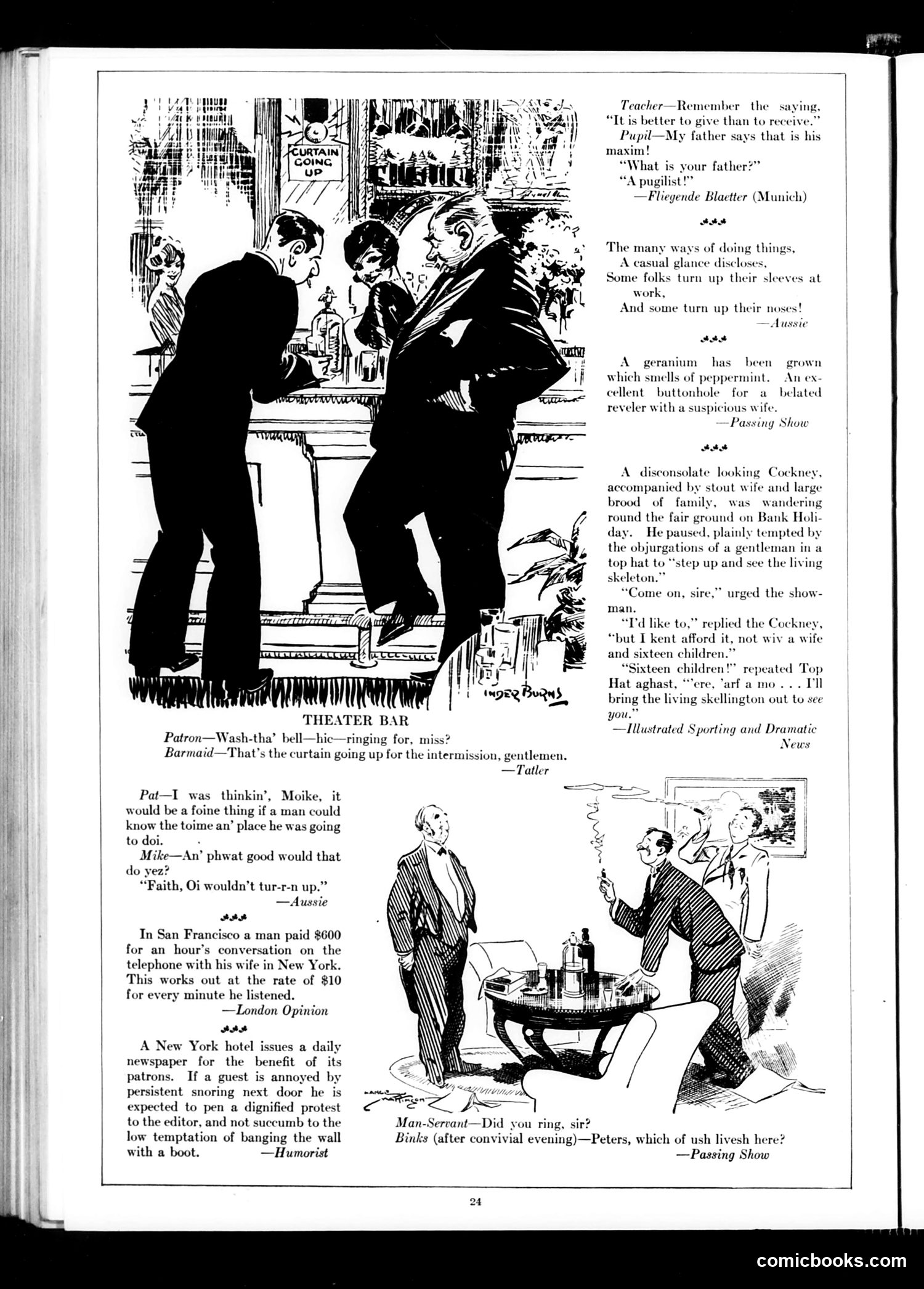
This page collects brief humorous items and cartoons typical of early 20th-century satirical magazines. The main cartoon depicts well-dressed men at what appears to be a theater bar, with silhouetted figures in conversation. The surrounding jokes target various social absurdities: - **Working-class aspiration**: A Cockney family at a fair can't afford to see the "living skeleton" exhibit because of his large family. - **Marital expense**: San Francisco telephone rates ($600/hour) are mocked as evidence that listening to one's wife is prohibitively costly. - **Class behavior**: A drunk guest ("Binks") forgets which house he lives in after "a convivial evening." - **Hotel annoyances**: Rather than violently protest snoring neighbors, guests must write dignified complaints to the editor. The humor relies on period-specific references (telephone costs, music halls, servant culture) and assumes readers recognize social hierarchies and gender dynamics of the era. The overall tone mocks both working-class financial struggles and upper-class pretension.
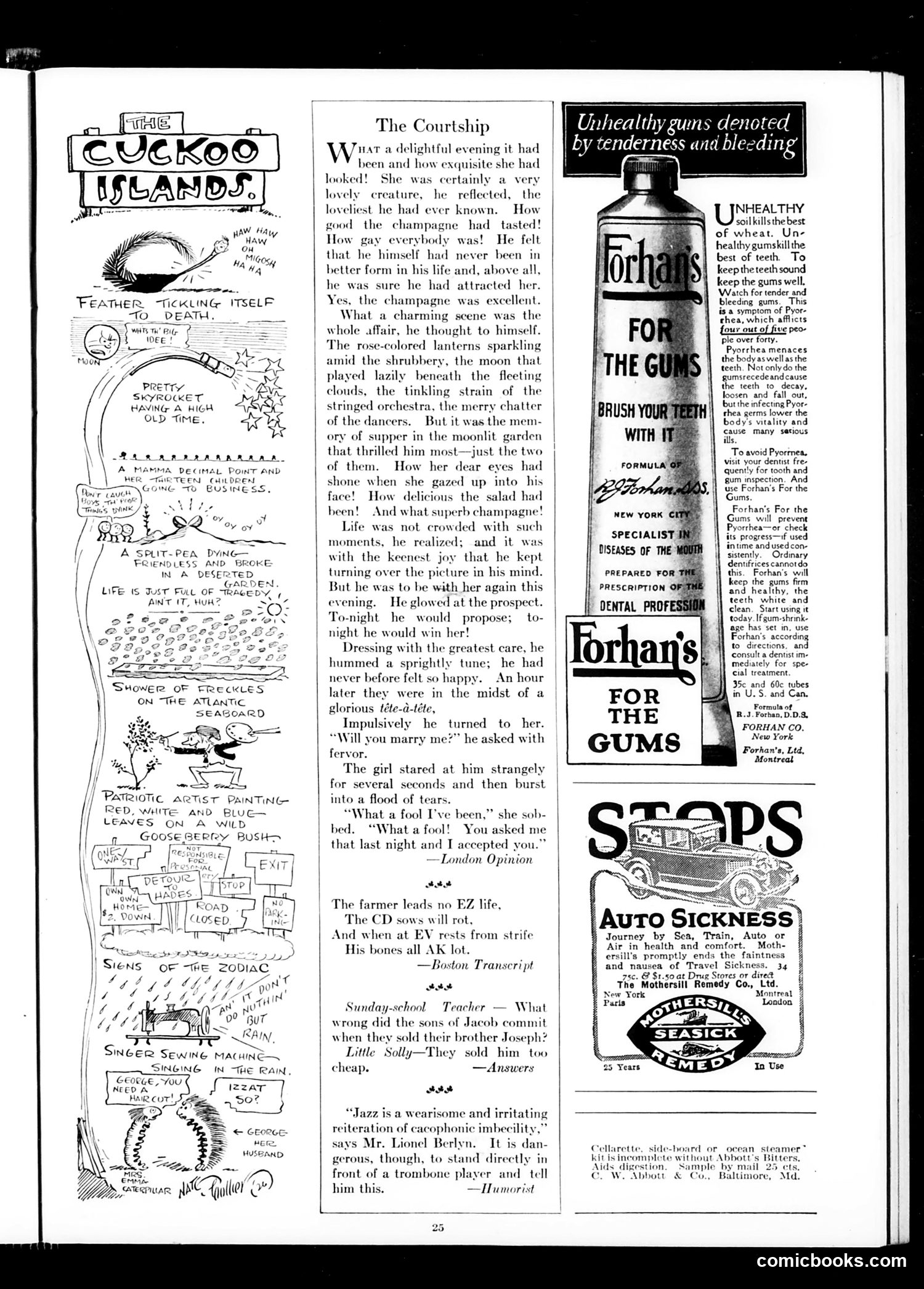
**Left Side - "The Cuckoo Islands" Comic Strip:** This appears to be a humorous illustrated narrative, likely satirizing romantic sentimentality. The comic depicts various whimsical scenes with minimal captions, using visual gags and absurdist humor typical of early 20th-century comics. **Center - "The Courtship" Story:** A brief comedic narrative about a man planning to propose after a romantic evening. The joke: he asks "Will you marry me?" only to learn she already accepted his proposal the previous night—he'd forgotten. This satirizes male vanity and the superficiality of romantic gestures (expensive champagne, moonlit gardens) that fail to create genuine memories. **Right Side - Advertisements:** Standard period ads for Forhan's tooth powder (targeting gum disease/pyorrhea) and Scaps auto sickness remedy. These represent typical vintage advertisements using pseudo-medical language and fear-based marketing. **Bottom - Humor Snippets:** Brief jokes including wordplay riddles and a quip about jazz musicians being irritating to trombone players—reflecting period attitudes toward jazz as cacophonous.
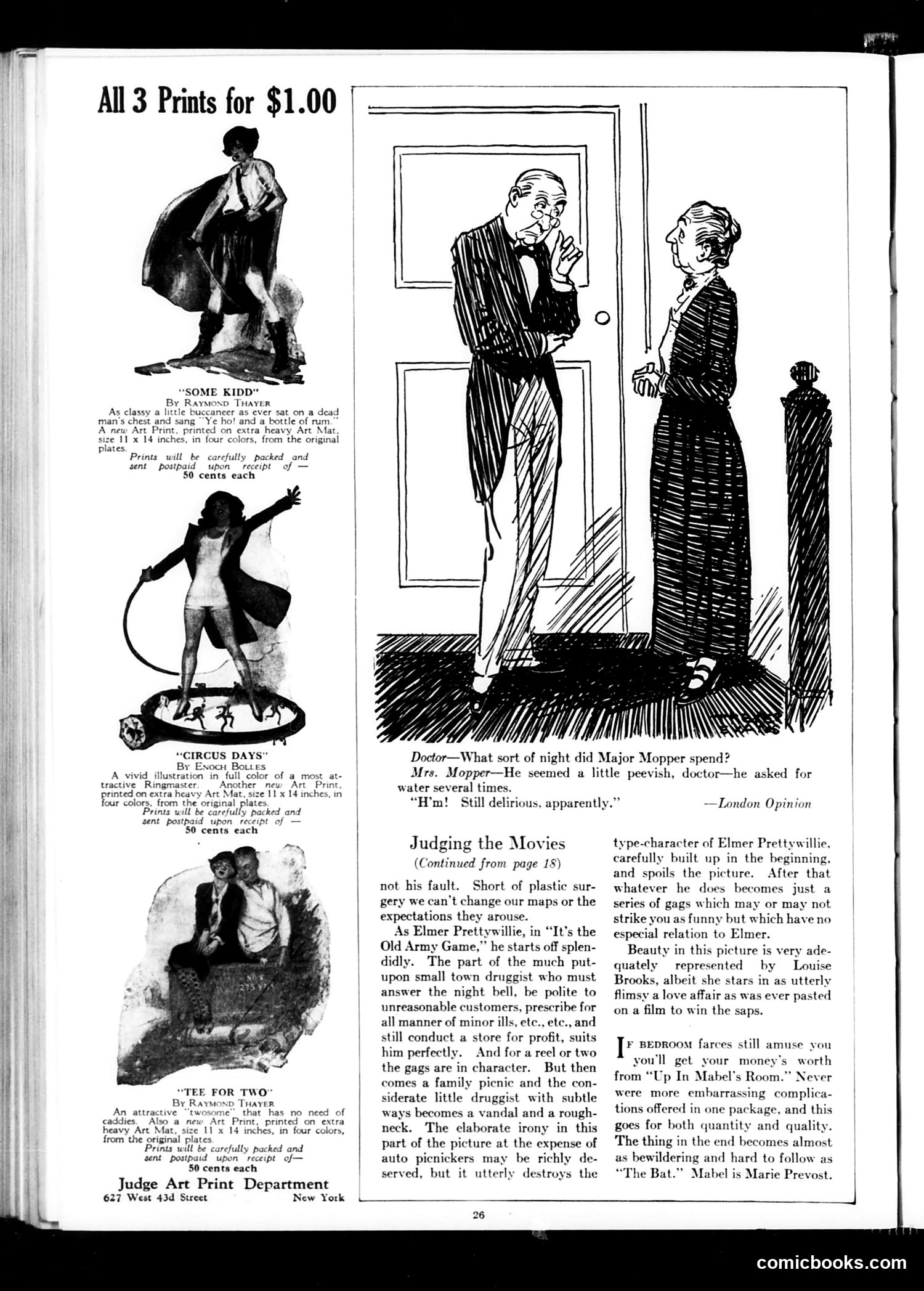
This page combines art print advertisements with film criticism. The left side advertises three prints ("Some Kidd," "Circus Days," "Tee for Two") for 50 cents each—charming illustrations of a child pirate, a ringmaster, and golfers, typical of Judge's decorative commercial offerings. The right side contains two elements: a cartoon joke about Major Mopper's night (a mild domestic humor piece), and a film review critiquing Elmer Prettywillie's comedic performance in "It's the Old Army Game." The reviewer argues the character loses coherence when the narrative shifts from a sympathetic druggist dealing with customer absurdities to a vandal during a family picnic scene—the gags become disconnected from character motivation. Louise Brooks is noted as beautiful but cast in a thin romantic subplot. The review also dismisses "Up In Mabel's Room" as bedroom farce relying on plot complications rather than genuine comedy. This reflects 1920s film criticism standards emphasizing character consistency and narrative logic over pure slapstick.
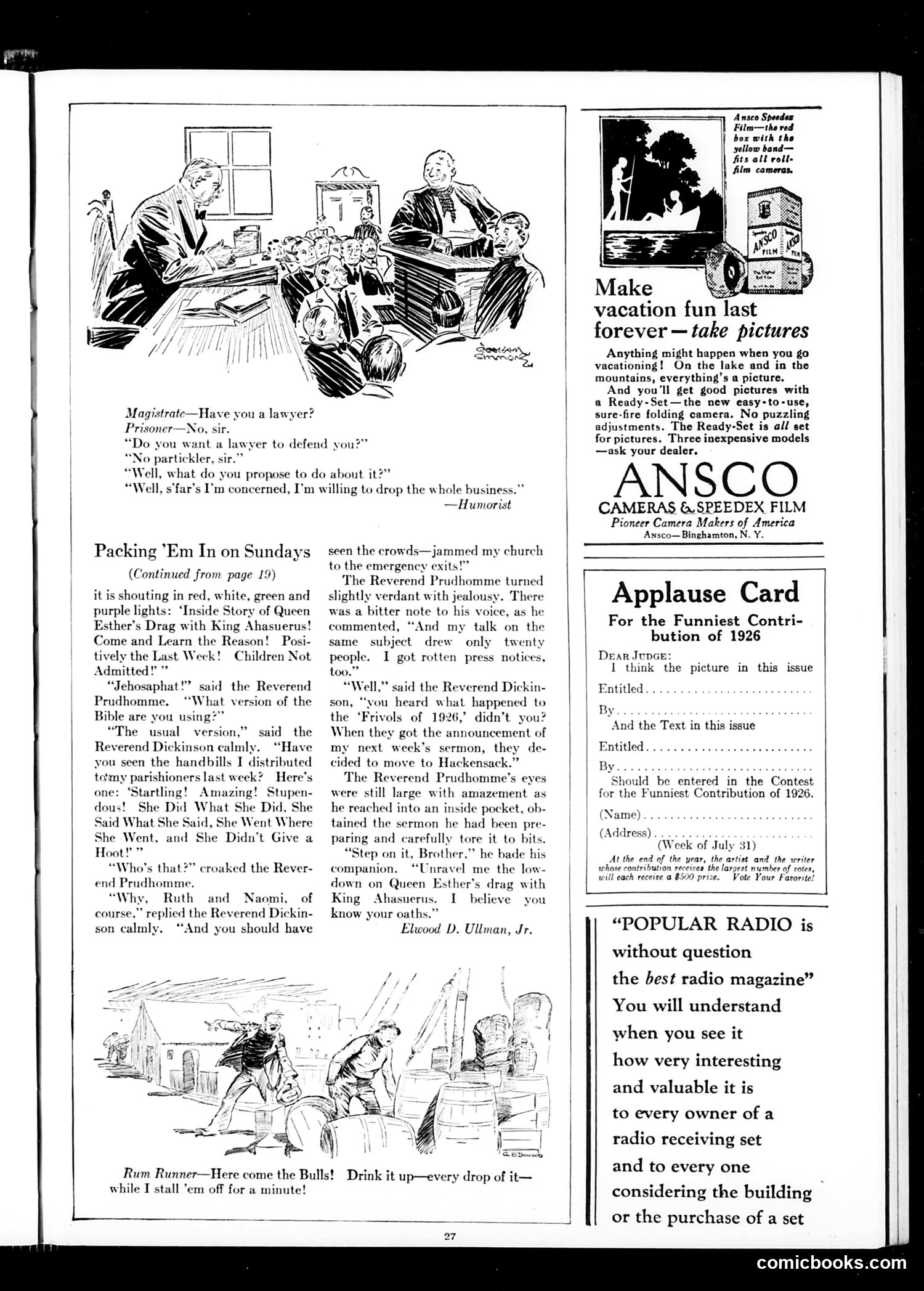
This page contains three distinct humor pieces satirizing 1920s American life: **Top cartoon ("Magistrate")**: A prisoner casually dismisses legal proceedings, proposing to "drop the whole business" rather than hire a lawyer. The joke mocks working-class indifference to the judicial system—the prisoner treats serious criminal charges as a minor annoyance. **Middle article ("Packing 'Em In on Sundays")**: Two competing reverends discuss filling church pews. One uses sensationalized sermon titles (framing biblical stories as lurid entertainment) to attract crowds, while the other's serious preaching draws only twenty people. The satire critiques how churches had begun adopting movie-style marketing tactics to compete for attendance during the 1920s entertainment boom. **Bottom cartoon ("Rum Runner")**: A bootlegger orders his companion to destroy illegal alcohol before police ("the Bulls") arrive. This references Prohibition-era smuggling, a widespread criminal enterprise of the 1920s treated here as everyday comedy. The page's advertisements (cameras, radio magazines) are incidental. The humor targets institutional hypocrisy, criminal casualness, and commercialization of religion.
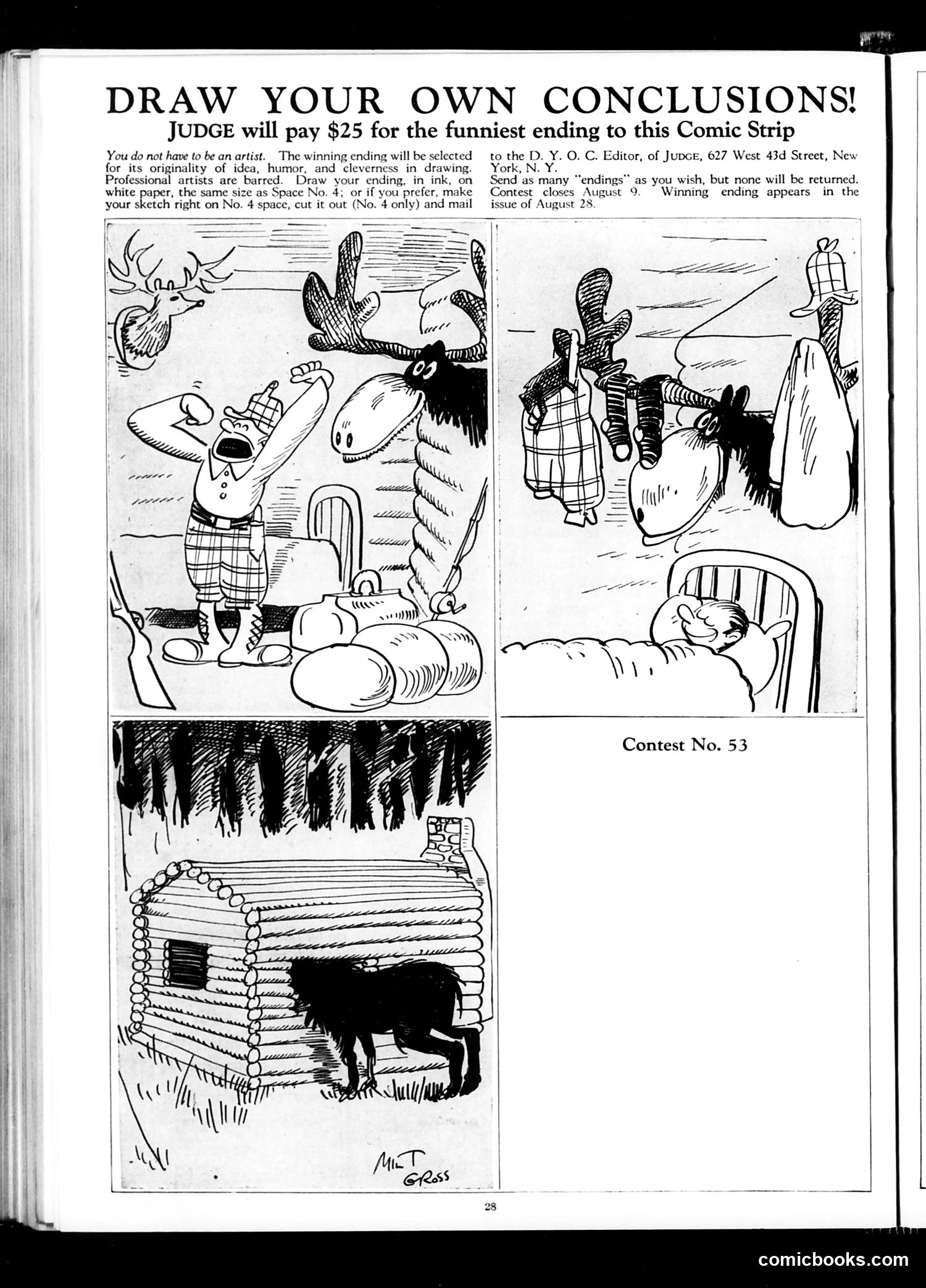
This page features a reader-participation contest where Judge magazine invites amateur cartoonists to complete an unfinished comic strip. The incomplete narrative shows a Scottish Highlander and his large moose in a cabin interior, then transitioning to what appears to be the man in bed while others (possibly family) prepare to depart, and finally a dog approaching a log cabin exterior. The humor likely plays on the moose's incongruity in a domestic setting or some misunderstanding involving the animal. The contest offers $25 for the "funniest ending"—a significant prize for the era—emphasizing originality and humor over artistic skill, deliberately excluding professional artists. This represents a common magazine engagement strategy of the period, inviting reader creativity while generating content and reader involvement.
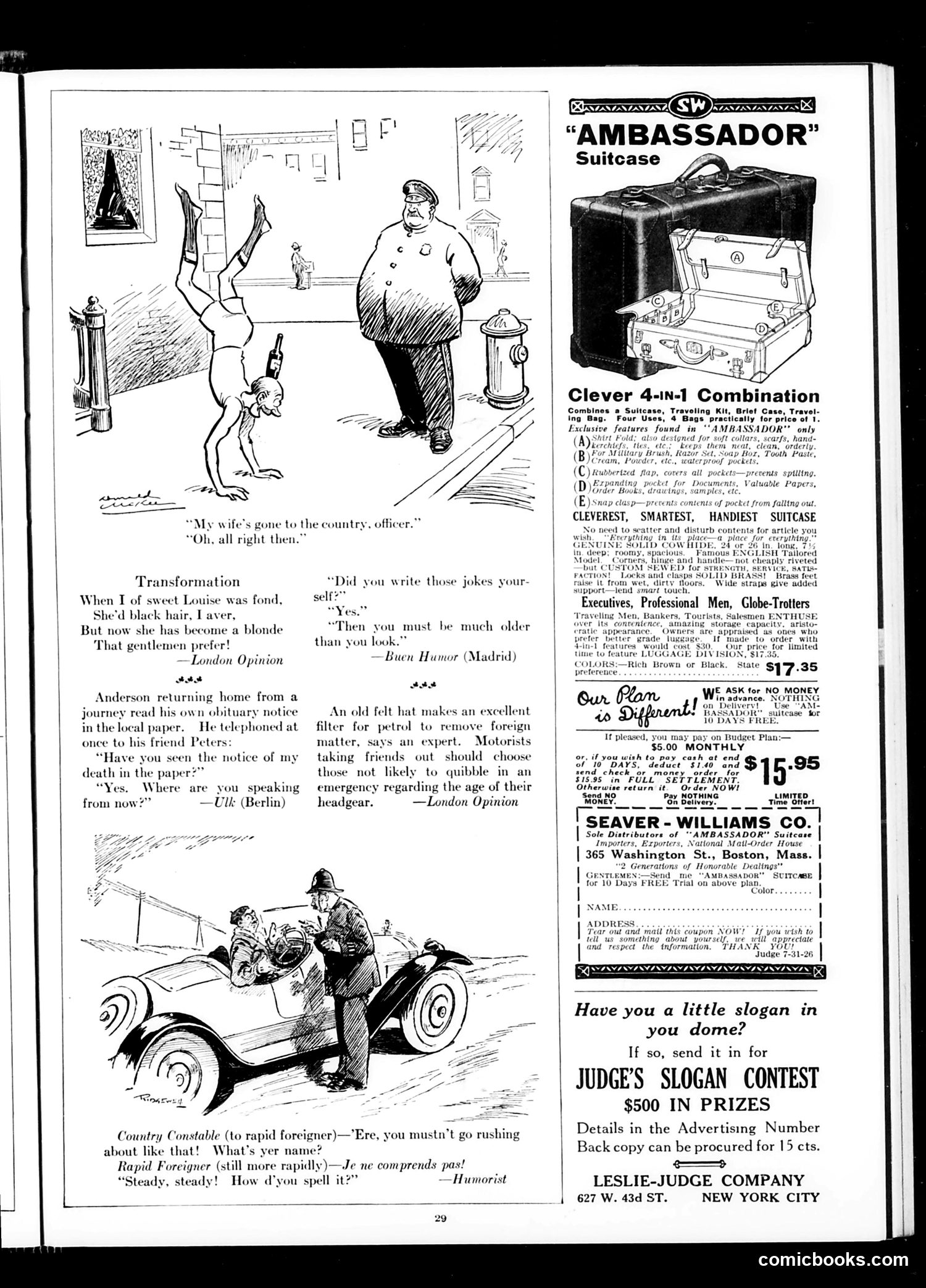
This page contains **humor reprints and advertising** rather than political cartoons. The humor section collects **international jokes** from various sources (London Opinion, Buen Humor, Humorist, etc.), typical of Judge's cross-Atlantic content exchange. The jokes reflect early 20th-century preoccupations: a woman dyeing her hair blonde (playing on the "gentlemen prefer blondes" trope), a man reading his own obituary, and a linguistic misunderstanding between a British constable and a "rapid foreigner." The main visual cartoon depicts this last scenario: a confused Continental traveler being questioned by a country policeman, with the foreigner's fractured French ("Je ne comprends pas!") as the punchline. The **"Ambassador" suitcase advertisement** dominates the right side, marketed to "Executives, Professional Men, Globe-Trotters"—reflecting the era's emphasis on business travel and status symbols. The page is primarily **entertainment and commercial content** rather than political satire.
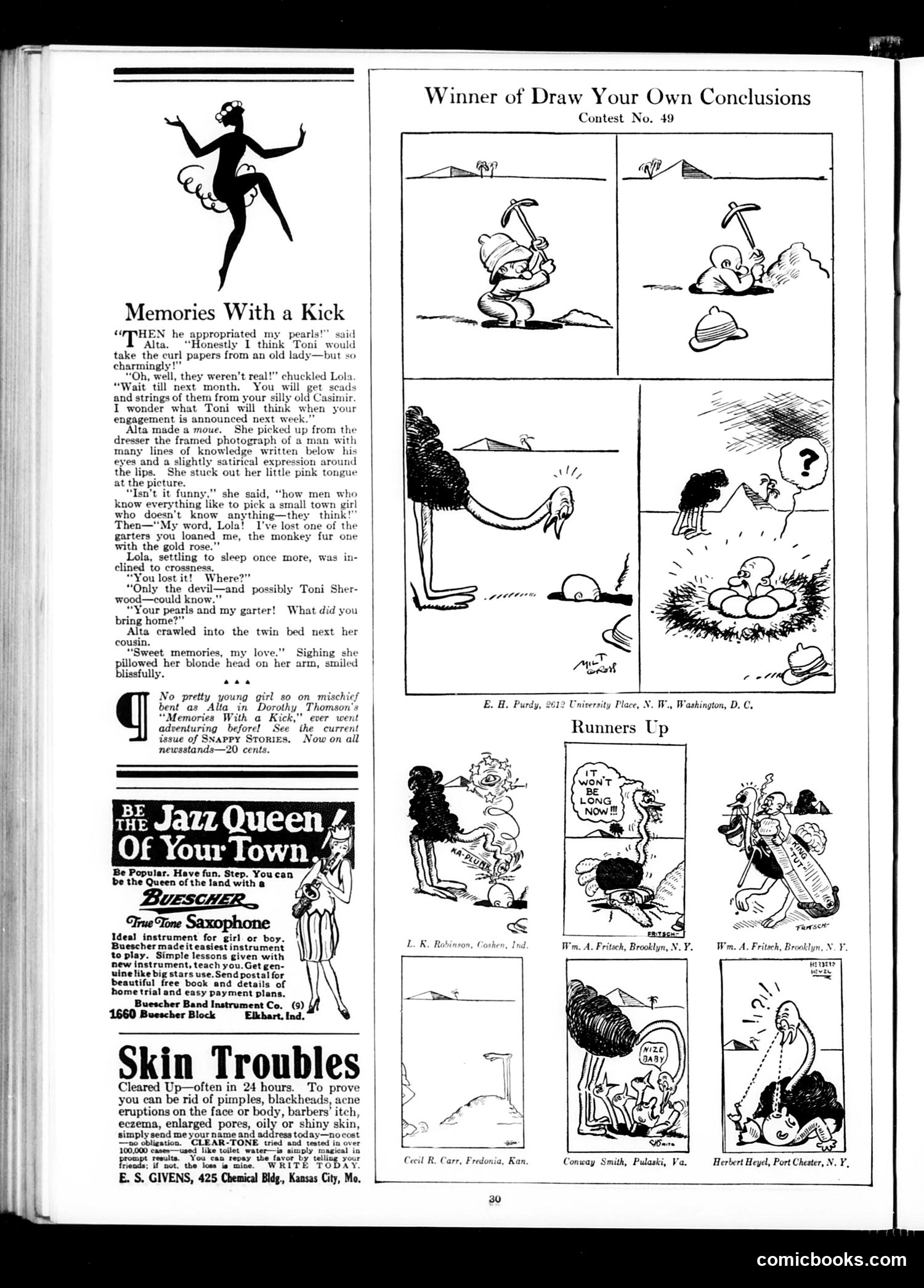
This page contains two main elements: **"Memories With a Kick"** is a short romantic story about a flirtatious young woman named Alta who charms men into giving her gifts (pearls, garters). The narrative suggests she's romantically involved with someone named Toni while also accepting favors from other admirers. The "kick" refers to the thrill of her mischievous behavior. This appears to be promoting Dorothy Thomson's story in *Snappy Stories* magazine—a pulp publication known for risqué romantic content. **"Draw Your Own Conclusions" Contest** shows cartoon panels where readers inferred humorous conclusions from ambiguous illustrations. The winning entry (by E. B. Purdy) and runners-up are displayed. These were popular interactive features allowing audience participation. The remaining content consists of period advertisements for a saxophone, skin treatment product, and other goods—typical magazine filler. The overall page reflects 1920s popular entertainment: light romantic scandal, participatory contests, and consumer products targeting young urban audiences.
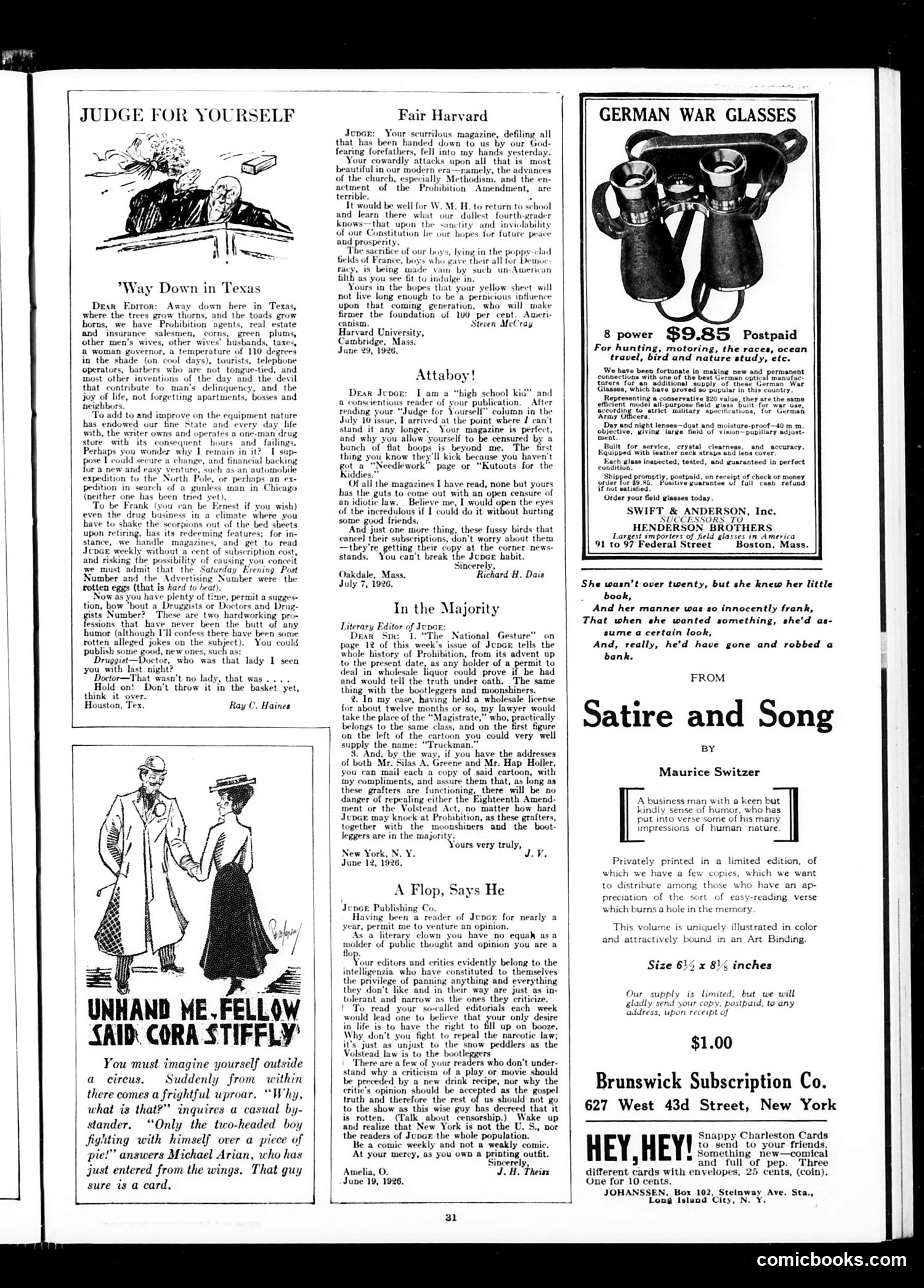
This page showcases Judge's satirical commentary on 1920s American culture, particularly Prohibition and social conservatism. **"Way Down in Texas"** is a humorous letter from a Texas druggist cataloging life's absurdities—scorpions in bedsheets, heat, tourists—suggesting Judge magazine brings necessary levity to difficult circumstances. **"Fair Harvard"** presents a sanctimonious letter attacking Judge for mocking Methodism and Prohibition, invoking fallen World War I soldiers. Judge publishes this to mock such self-righteous moralism. **"Attaboy!"** is a supportive letter from a high school reader praising Judge's willingness to criticize Prohibition ("an idiotic law"), positioning the magazine as bold against censorious authority. The cartoon **"Unhand Me, Fellow, Said Cora Stiffly"** appears to be a vaudeville-style joke about circus performers, though the specific reference is unclear. Together, these pieces satirize both Prohibition-era moral crusaders and celebrate Judge's irreverent editorial stance against what it viewed as prudish hypocrisy.
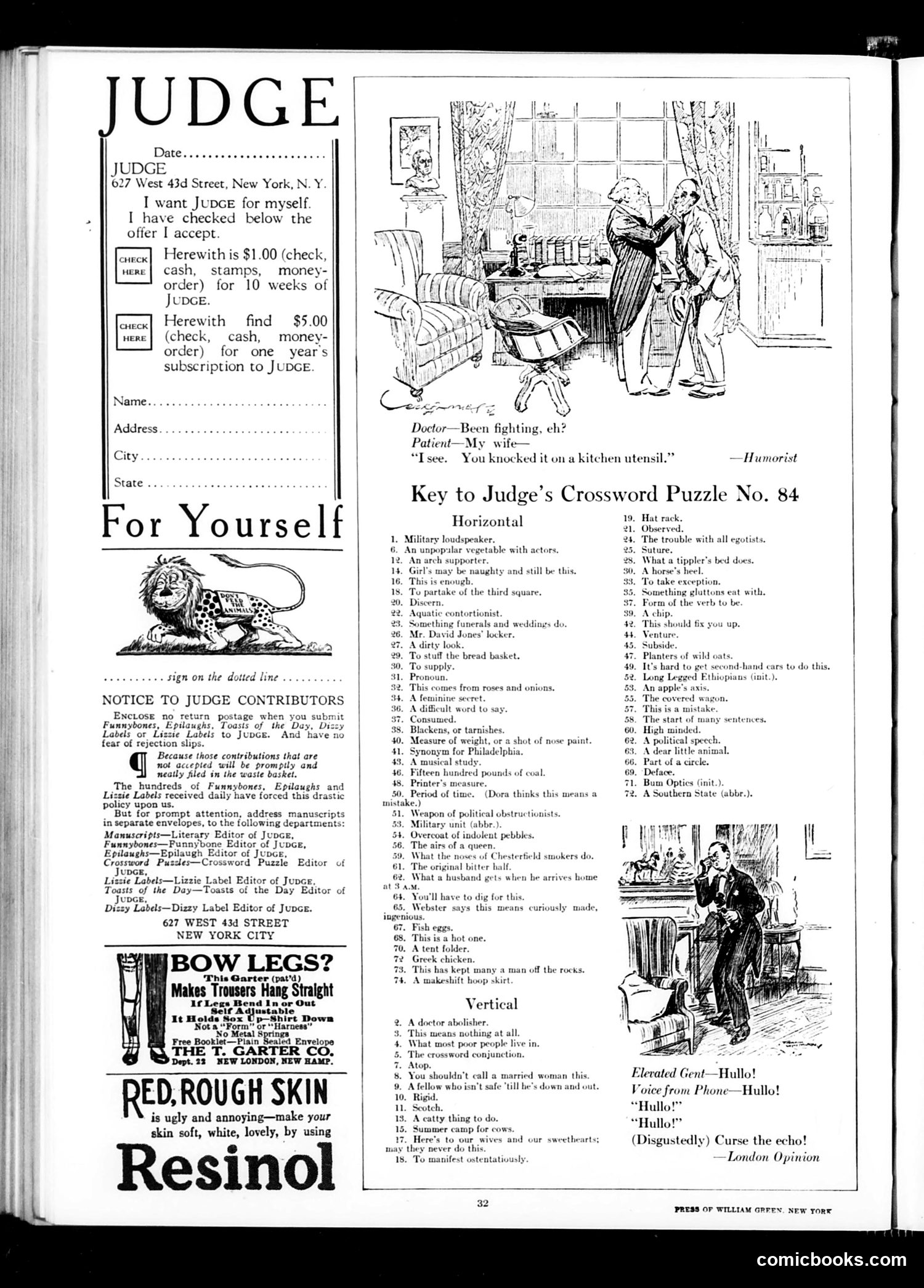
This page is primarily a **subscription advertisement and administrative notice** for Judge magazine, with minimal actual satirical content. The main cartoon depicts a **domestic quarrel**: a doctor asks a patient about fighting; the patient explains he was struck by his wife with a kitchen utensil. This is a standard marital-discord joke common to the era—playing on the cliché that wives and husbands physically fight over trivial matters. The page also includes: - **Subscription offers** ($1 for 10 weeks, $5 for one year) - **Contributor guidelines** rejecting unsolicited "Funnybones" and "Lizzie Labels" (Judge's regular humor columns) - **Advertisements** for bow-leg correctors, Resinol skin cream, and other period products - **A crossword puzzle** with its answer key The page functions primarily as internal magazine business and marketing rather than satire. The single cartoon represents typical early-20th-century domestic humor: marital conflict treated as lighthearted entertainment.
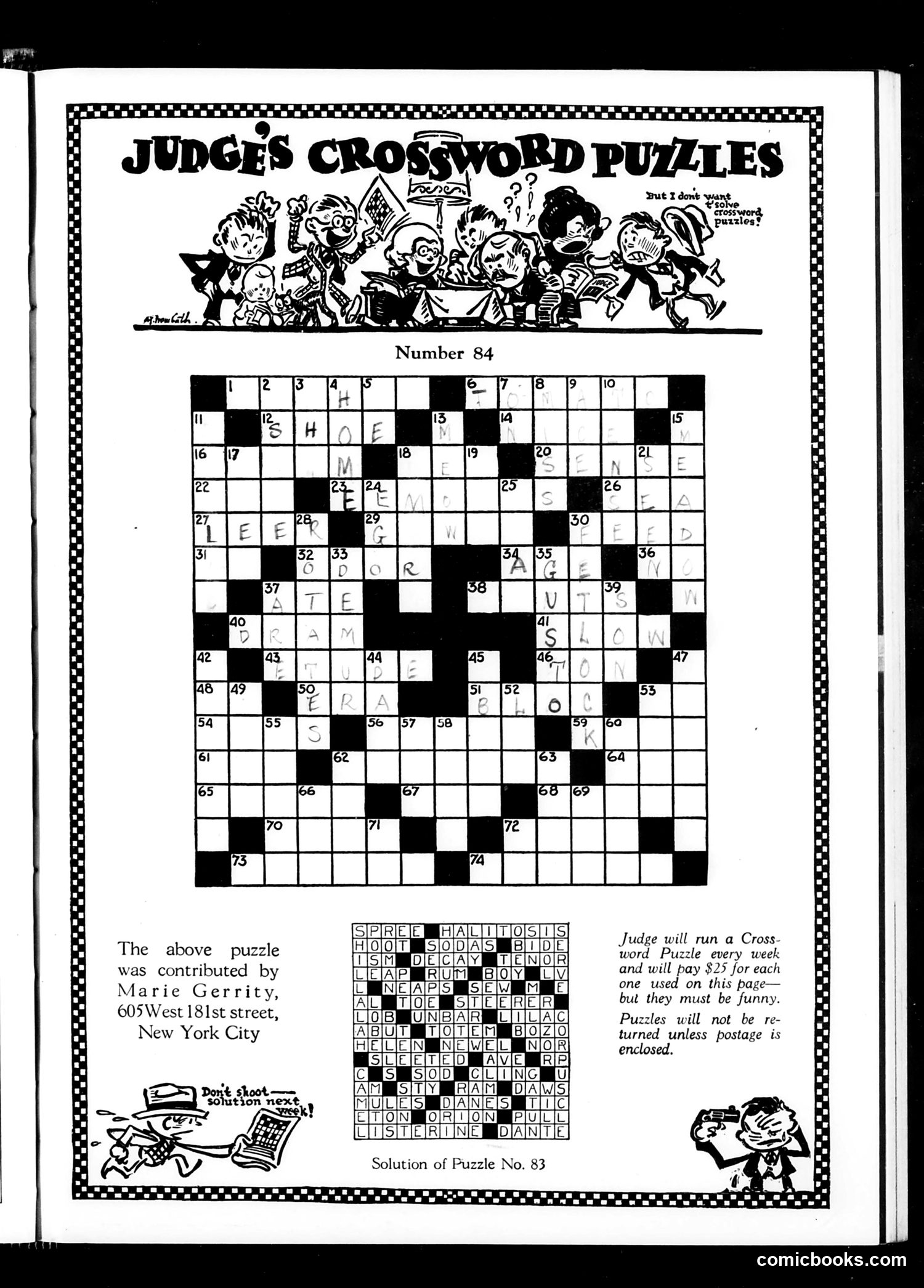
This page from *Judge* magazine features **Crossword Puzzle Number 84**, contributed by reader Marie Gerrity of New York City. The content is straightforward: *Judge* announced it would publish a new crossword puzzle weekly, paying $25 for submissions—with the stipulation that puzzles "must be funny," meaning the clues or answers should contain humor or wit. The page also displays the solution to the previous week's puzzle (No. 83). The cartoon header showing playful characters represents the lighthearted, humorous tone *Judge* cultivated. This reflects early 1920s-30s popular culture: crossword puzzles were a major fad, and magazines competed for reader engagement by offering contests and paying for contributions. The "funny" requirement indicates *Judge's* satirical brand—even puzzles should serve its comedic mission.
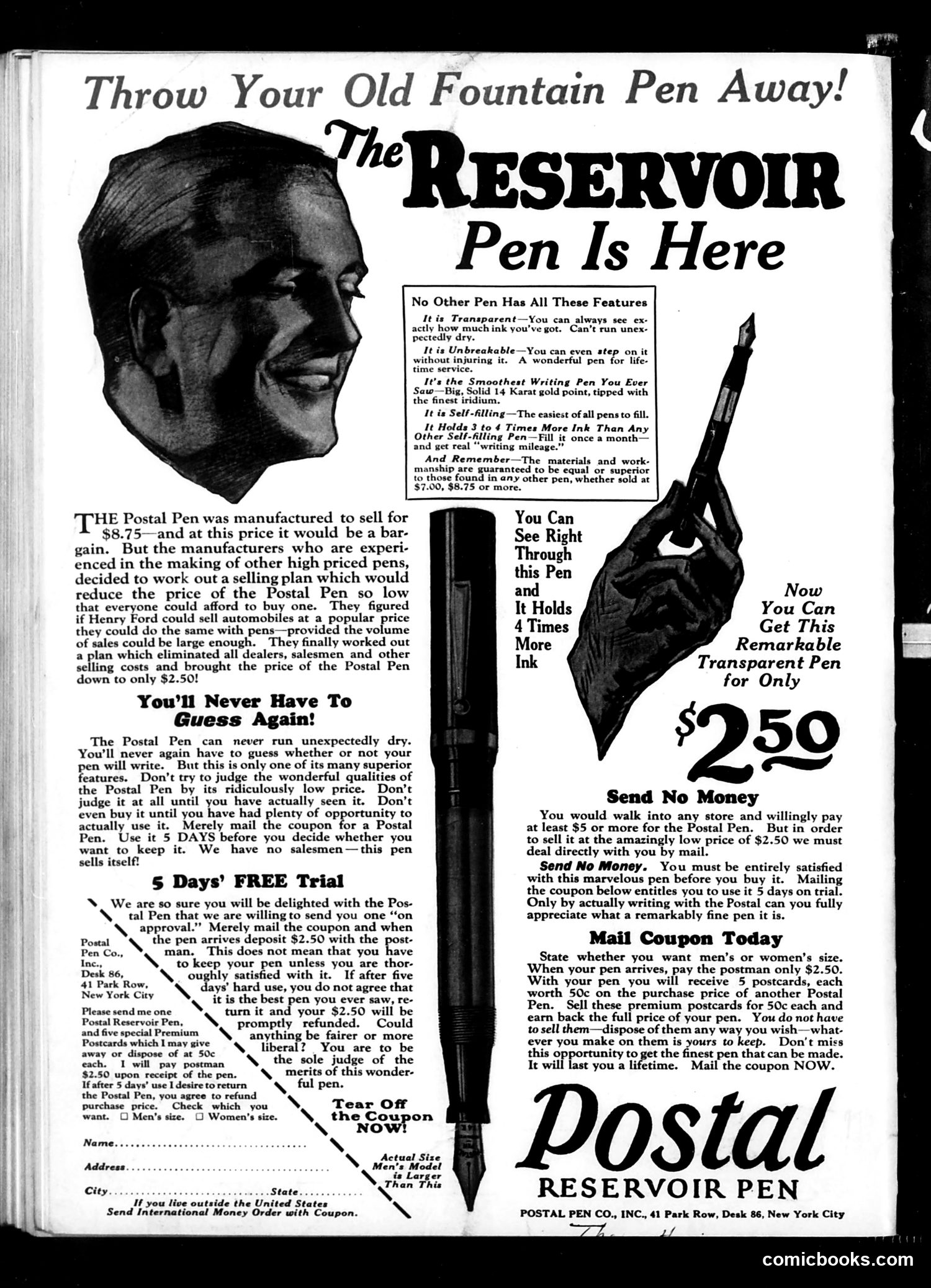
This page is primarily a **product advertisement**, not political satire. It promotes the "Postal Reservoir Pen," priced at $2.50—remarkably cheap for the era. The advertisement references **Henry Ford's business model**: just as Ford mass-produced affordable automobiles by eliminating middlemen and dealers, the pen manufacturer claims to slash prices by selling direct-to-consumer via mail, bypassing traditional retail markup. The large male face at left appears to be a generic businessman or the manufacturer—not a specific historical figure. It's meant to convey trustworthiness and innovation. The satire is **subtle and commercial**: the headline "Throw Your Old Fountain Pen Away!" mocks consumer obsolescence, while the marketing copy ironically emphasizes the pen's superior quality *despite* its low price—playing on consumer suspicion that cheap goods are inferior. The "5 Days' Free Trial" coupon was a pioneering direct-mail sales tactic. This is straightforward early-20th-century consumer marketing masquerading as editorial content in *Judge* magazine.